Luis Carazo | CANDELA OBSCURA

by Ed Fortune

Luis Carazo is an actor best known for his roles in the likes of The Last Ship and NCIS: Los Angeles. He’s best known to gaming fans for his role as Zerxus Ilerez in the D&D live play show Exandria Unlimited: Calamity. We caught up with him to talk about his latest role in a brand new live-play show, the horror-based detective mystery Candela Obscura:The Circle of Needle and Thread.

STARBURST: How would you describe The Circle of Needle and Thread to a fan of Columbo?

Luis Carazo: I believe the format of how a case begins in Candela is similar to Columbo, and part of what is compelling is watching how the investigators piece together clues and what they do to try to solve the case. But in Candela Chapter Two, there’s quite a bit of personal history carried by the characters that give it a certain kind of weight.

Who is your character? And why did you make those choices? Did you draw upon anything specific for that role?

I play Marion, who, to use Auntie B’s [Marisha’s PC] words, is a “sweet boy”. He’s a good kid with a good heart who never lost that as he grew up because he had to hold onto that part of himself due to what was taken from him as a child. In spite of that, he has a very pure and almost simple-minded way of seeing the world. He’s loosely inspired by one of my favourite stories, Pinocchio. I was really curious about exploring something parallel to how Pinocchio is trying to become ‘a real boy’ because he feels he would be discarded if he remains as he is.As things unfolded, I wanted to see what would happen if and when he was well on the other side of that lesson.

How do you prepare for this role, and is it a different routine for Critical Role?

The way I prepare for any role depends on the specific demands of that role and the story we’re in, but I always involve some way to try to get behind how they see the world and how they believe others see them. With Marion, I spent a lot of time thinking about a very specific event from his childhood and also some events in the war he experienced with Sean and Nathaniel, Brennan and Travis’s characters, and how that all shaped his POV and what he fears about and hopes for in the future. 

We last saw you in Calamity. That was intense. How does this compare?

I’ll just say… this is intense [laughs]. 

What draws you most to this particular world? Why this particular genre?

Ooooo, I really like the horror genre. I like dark stories, puzzles and mysteries. There’s so much potential for all of that in Candela. It’s exciting to me.  

What other roles in other worlds would you like to play?

I really want to play in a sci-fi futuristic setting, but it looks like I’m about to scratch that itch… 

If you were to rescue a piece of media/art and keep it safe until the sun died out, what would it be?

The Man Who Fell In Love with The Moon by Tom Spanbauer and The God of Small Things by Arundhati Roy. I know I picked two…

What recent piece of media has delighted you the most and why?

Pan’s Labyrinth. I know it’s not recent, but it will always stay with me.

What is the future of TTRPGs? Is it okay to pronounce TTRPG as ‘Titterpig?’

I’ve never heard titterpig [laughs]. Sounds naughty! More and more people are noticing the power of collaborative storytelling that is TTRPG. I think they’re only going to grow.

Where can we see the show? Should we dress up?

August 31st on the Critical Role Twitch channel, plus at select Cinemark movie theatres! As for dressing up, I’m all for it! And if you want to let me know what you think of Candela, or Calamity, or if you want to keep up with what I have around the corner, find me by just searching my first and last name on any social media, including Instagram, Blue Sky, Threads, and Twitter.

THE TELEPHEMERA YEARS: 1983, part 1

The Duck Factory, 1984

Ah, telephemera… those shows whose stay with us was tantalisingly brief, snatched away before their time, and sometimes with good cause. They hit the schedules alongside established shows, hoping for a long run, but it’s not always to be, and for every Street Hawk there’s two Manimals. But here at STARBURST we celebrate their existence and mourn their departure, drilling down into the new season’s entertainment with equal opportunities square eyes… these are The Telephemera Years!

1983-84

Glamour, adventure, and glamorous adventure were the order of the day in 1983 as the US settled into years of Reaganomics, with the big money, big hair, and even bigger shoulder pads of Dallas, Dynasty, and Falcon Crest dominating the TV ratings, making the likes of The A-Team, The Fall Guy, and Magnum, PI look positively gritty and real in comparison. The big new hits were single-moms sitcom Kate & Allie and Hotel, based on an Arthur Hailey novel that would soon become a permanent fixture of charity shop paperback spinners, and there were farewells to Happy Days, Fantasy Island, Hart to Hart, and Three’s Company (which had somehow lasted for eight seasons).

For genre fans, Airwolf and Knight Rider arrived to provide vehicular action and V: The Final Battle was creating the kind of buzz that would have set the internet alight if the internet was something that hadn’t only been invented in January 1983. Glen A Larson fans were well-served not only by the debuting Knight Rider but also the less-successful Manimal, Automan, and Masquerade, shows which did not outstay their already limited welcome. Of course, those three shows were not the only ones that failed to attract an audience; this is the story of four more shows from the 1983 season that fizzled rather than sizzled…

Blue Thunder (ABC): Spinning out of the 1983 movie that starred Roy Scheider as a PTSD-affected military veteran saving the world from sinister forces intent of using his advanced helicopter for nefarious means, the temporal impact of Blue Thunder has faded in the face of Airwolf, which actually debuted sixteen days later (and a full eight months after the original movie). Scheider didn’t return for the TV version of Blue Thunder, having destroyed the titular chopper at the end of the movie, instead replaced by James Farentino, who hadn’t starred in Jaws.

Farentino’s Frank Chaney was backed up by co-pilot Clinton Wonderlove (a pre-Saturday Night Live Dana Carvey), and by a ground team in Rolling Thunder, a big van driven by Dick Butkus and Bubba Smith, two former NFL legends. There’s a nod to the bigwigs at the start of the first episode being familiar with Blue Thunder but otherwise you could ignore the movie and dive straight in to its story of a rogue pilot shooting down police helicopters who can only be stopped by Chaney and crew.

Blue Thunder, 1984

Blue Thunder premiered in mid-season on Friday nights on January 6th 1984, displacing Lottery! to Thursdays. Lottery! had been struggling in the ratings against Dallas and it was supposed that a hi-octane action show might have a better chance of displacing the Texas oil barons from their throne, an optimism that has to be applauded (if not secretly mocked). By contrast, Airwolf was given Saturday nights, opposite a fading Love Boat, but the battle between the two ‘copter shows was nonetheless joined.

The pilot episode of Blue Thunder drew almost eighteen million viewers but was only the thirty-third most viewed show of the week, and three million of those didn’t come back for episode two.  Airwolf only grabbed sixteen million viewers for its debut, but by then Blue Thunder had shed another million, and although it rebounded to fifteen million viewers for its final episode, the network had already decided to cancel the show with just eleven episodes in the can. Rarely seen since, the show is fondly remembered for fans and comes out well in nostalgic comparisons with its more successful rival, which eventually ran for four seasons before its own rotor slowed to a halt.

The Duck Factory (NBC): Ten years before exploding onto the scene with Ace Ventura: Pet Detective, Jim Carrey landed the role of Skip Tarkenton, a naïve young cartoonist who has arrived in Hollywood and finds himself thrust into the shoes of a legendary – and just deceased – animator. With some liberties taken to ignore Carrey’s successful Canadian stand-up career, his leading role in the Canadian TV movie Introducing… Janet, and a headlining run at The Comedy Store in Los Angeles in 1983, it could almost be Carrey’s own story, except for the replacing a legend bit (and lots of other stuff and, well, it doesn’t really work at all but you know…).

The Duck Factory took its name for the in-show nickname for the fictional Buddy Winkler animation studios, whose top property is The Dippy Duck Show. Skip is soon taken under the wing of veteran animator Brooks Carmichael (Jack Gilford), encountering the rest of the wacky cast of misfits which includes legendary voice actor Don Messick, and a trio of possible love interests in editor Andrea Lewin, business manager Aggie Aylsworth, and Winkler’s widow, Sheree, a ditzy former topless ice dancer who had only been married to the cartoonist for three weeks before he died.
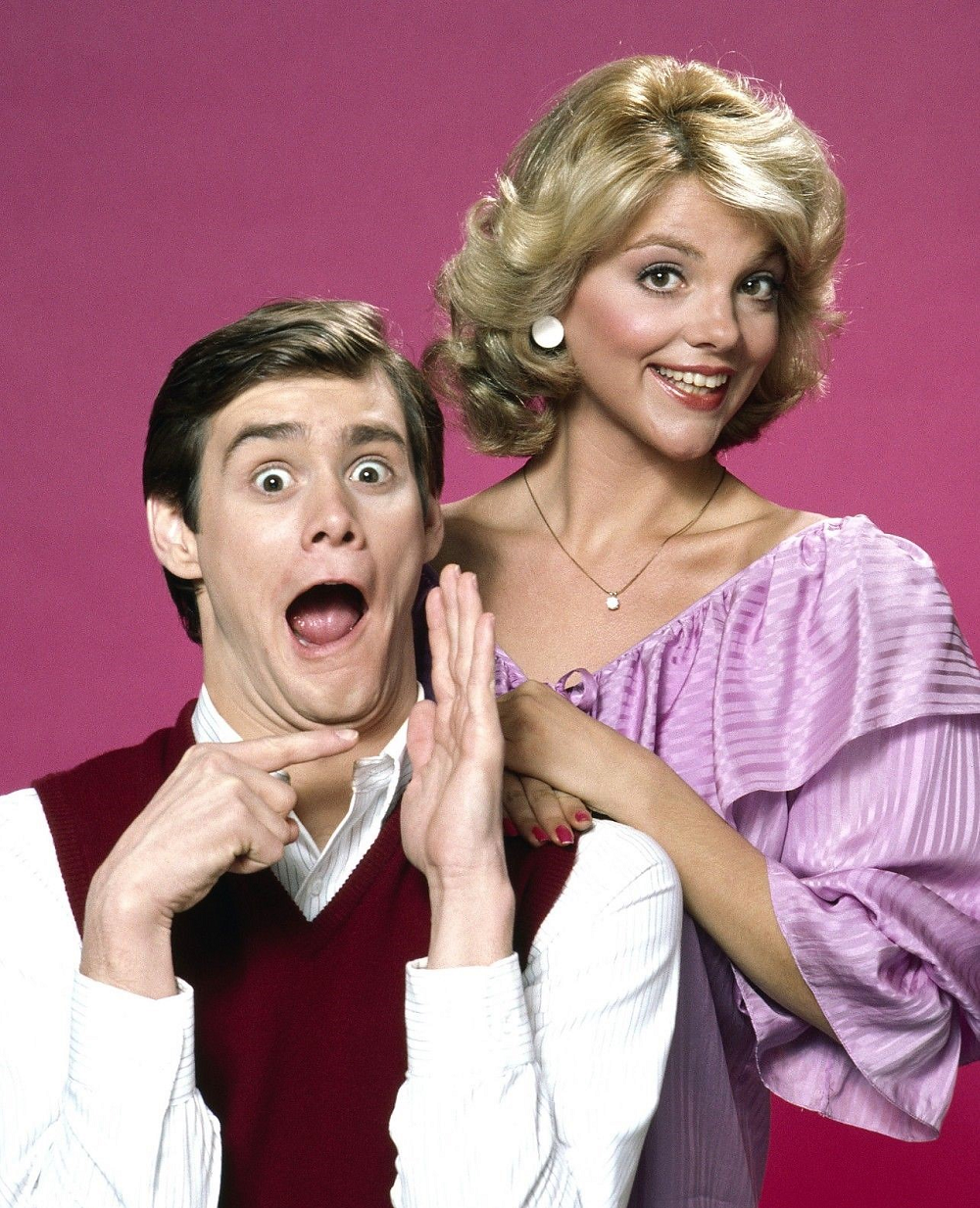
The Duck Factory, 1984

The pilot episode aired as a Spring replacement for radio station sitcom Buffalo Bill, and saw Skip bring new life to the ailing studio, turning the ailing studio’s fortunes around with his fresh ideas and revitalising The Dippy Duck Show, running into the second episode where the plot continued with Skip’s fight with the network to stop the show being cancelled. He succeeds, but viewers must have been confused by the events of the episode when it was shown as the season finale, NBC having decided in their infinite wisdom to run the series wildly out of production order, rendering any ongoing storylines – and there were a few – nonsensical.

Not that it mattered too much in the end as the first episode drew less than fourteen million viewers in its prime Thursday night slot and was down to around ten million on average by the time the axe fell, although its full mid-season order of thirteen episodes did get to air (just not in the right order). Carrey went back to stand-up, appeared in a few movies, and repeatedly failed to get cast on Saturday Night Live, before eventually becoming a big part of Fox’s In Living Color sketch show. This led to Ace Ventura and eventual mega-stardom, but it all started at The Duck Factory

Lottery! (ABC): When Lottery! began airing on ABC in September 1983, it was the ultimate aspirational show. Not only did its basic premise involve the lives of ordinary people being changed by winning a huge amount of money, it wasn’t even something that much of America could dream of, lotteries being illegal in many states, and that’s before you even think of the UK, where it didn’t air because it would have had to have been retitled Pools!

Created by Rick Rosner, whose CHiPs had finished its six-year run months earlier, Lottery! starred Ben Murphy and Marshall Colt as the men sent to advise new winners as to how the windfalls would change their lives. Murphy’s Patrick Flaherty worked for the fictional Intersweep Lottery, while Eric Rush (Colt) was an IRS man, along to ensure all tax arrangements were made in what was surely the most boring character creation of all time.
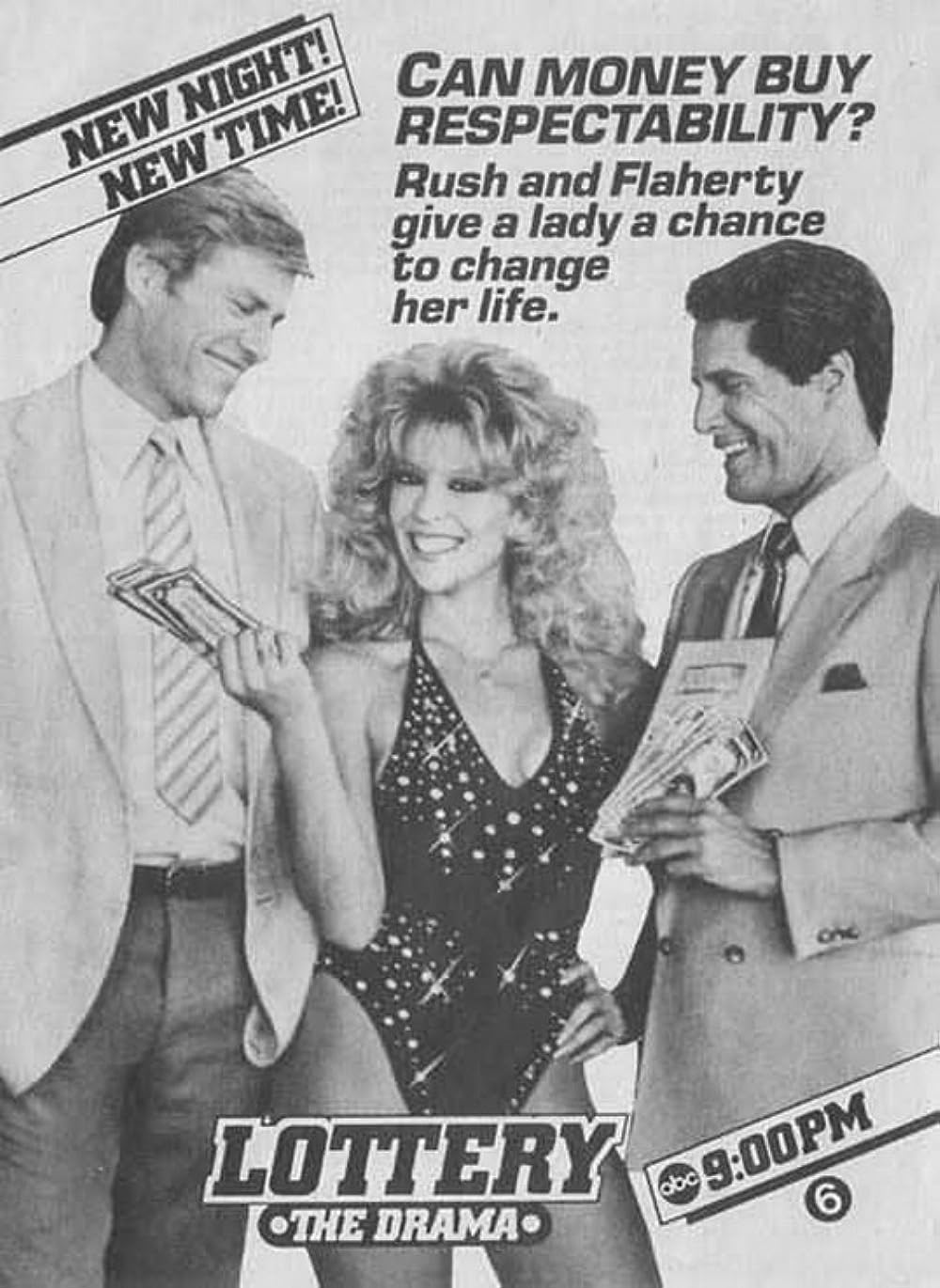
Lottery!, 1983

Each episode took place in a different city, with one or more winners having their lives turned upside down, allowing for a (low rent) guest star of the week format that brought the likes of Robert Pine, Julia Montgomery, and a young Corey Feldman (who was nominated for a Young Artist award as a result) to play. The dramatic tension was heightened by subplots involving blood oaths, church bingo, jealous husbands, and the rights of the developmentally challenged.

Somehow seventeen episodes were wrung out of this flimsy formula but encouraging ratings for the first two episodes soon plunged to a level that ABC considered too low, the plug being pulled after episode eleven aired in December 1983, the rest of the order burned off in March and June 1984. Rosner moved into quiz shows instead, reviving Hollywood Squares and creating the casino-themed Caesars Challenge for NBC, and later invented a portable satellite TV receiver, probably not backed by lottery money.

The Master (NBC): Move over John Carradine, Lee van Cleef is in town! And that town is Japan! NBC’s replacement for the doomed Manimal in the “Dallas is on CBS, throw anything at the wall and see if it sticks!” slot, The Master starred van Cleef as John McAllister, an American soldier who stayed in Japan after World War Two, as did hundreds of thousands of serving troops. The difference? McAllister learned the secrets of the ninja and became The Master!

Now an old man, McAllister gets word that a daughter he never knew he had is in trouble and leaves for the US, an act seen as dishonourable for some reason by his ninja pals, who try to assassinate him. Escaping with his life, The Master lands in small town America, looking for his missing daughter and trying to train hot-headed drifter Max Keller (Timothy van Patten), all the while pursued by a former student played by Sho Kosugi, who lets the side down by not having “van” in his name.
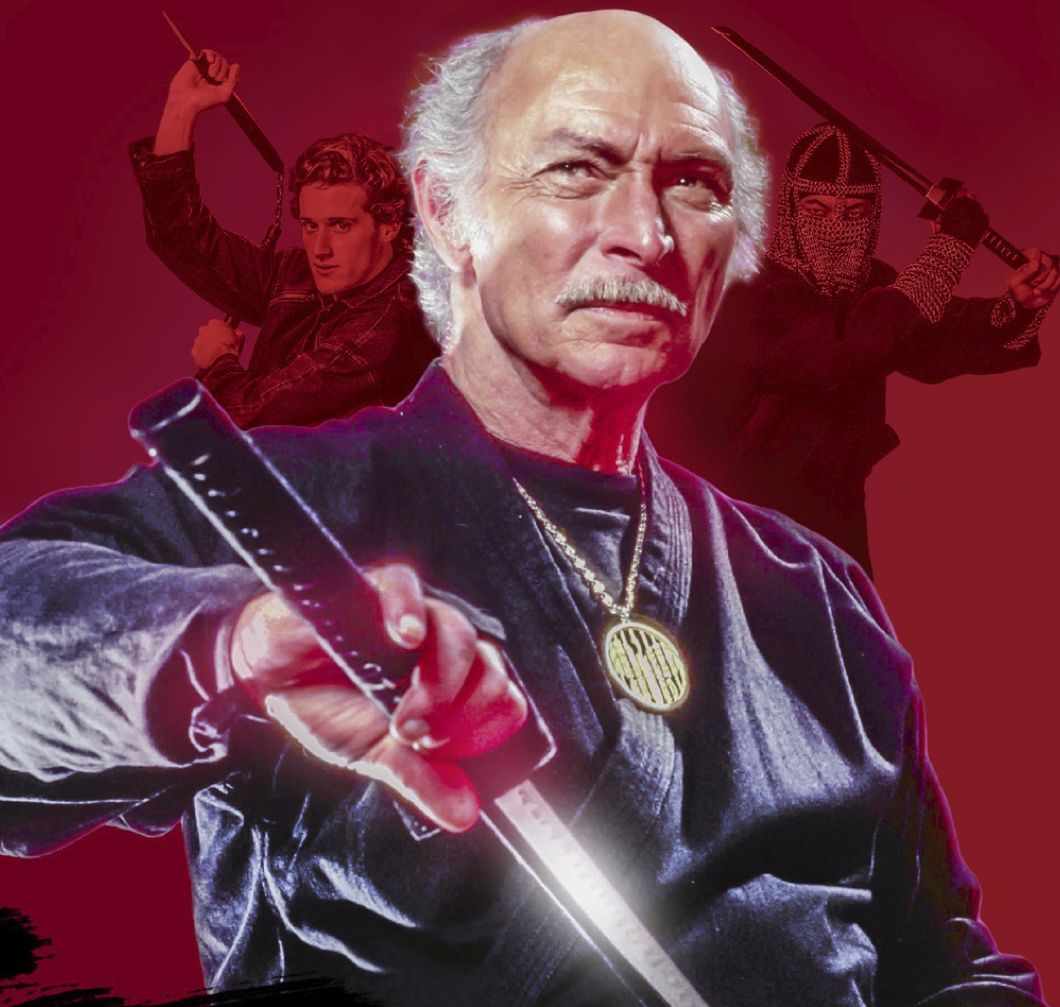
The Master, 1984

Essentially adopting the successful “walking the Earth” formula that did wonders for shows as diverse as The Incredible Hulk and Highway to Heaven, The Master  was chock-full of chop-socky action, with guest star turns from David McCallum, George Lazenby, Robert Pine (again), and a young Demi Moore. Kosugi, though, was the real star, standing in for van Cleef in fight scenes after having helped to start the ninja craze in the US through his appearances in Enter the Ninja and Revenge of the Ninja for Cannon films.

Still, as exciting as the show could be (mildly), it was still up against that ratings juggernaut on NBC and lasted just thirteen episodes before NBC decided to give Legmen, a drama about two students who did groundwork for a private eye, a chance; that reached episode eight before Dallas claimed another TV life. Episodes of The Master were later recut into seven TV movies and released for the thriving home VHS market, and even later mocked mercilessly by a man and two robots on Mystery Science Theater 3000.

Next on The Telephemera Years: More of 1983’s never-weres, with sexy ghosts, talking apes, and hip genies…

Check out our other Telephemera articles:

The Telephemera Years: pre-1965 (part 1, 2, 3, 4)

The Telephemera Years: 1966 (part 1, 2, 3, 4)

The Telephemera Years: 1967 (part 1, 2, 3, 4)

The Telephemera Years: 1968 (part 1, 2, 3, 4)

The Telephemera Years: 1969 (part 1, 2, 3, 4)

The Telephemera Years: 1971 (part 1, 2, 3, 4)

The Telephemera Years: 1973 (part 1, 2, 3, 4)

The Telephemera Years: 1975 (part 1, 2, 3, 4)

The Telephemera Years: 1977 (part 1, 2, 3, 4)

The Telephemera Years: 1978 (part 1, 2, 3, 4)

The Telephemera Years: 1980 (part 12, 3, 4)

The Telephemera Years: 1982 (part 1, 2, 3, 4)

The Telephemera Years: 1984 (part 1, 2, 3, 4)

The Telephemera Years: 1986 (part 1, 2, 3, 4)

The Telephemera Years: 1987 (part 1, 2, 3, 4)

The Telephemera Years: 1989 (part 1, 2, 3, 4)

The Telephemera Years: 1990 (part 1, 2, 3, 4)

The Telephemera Years: 1992 (part 1, 2, 3, 4)

The Telephemera Years: 1995 (part 12, 3, 4)

The Telephemera Years: 1997 (part 1, 2, 3, 4)

The Telephemera Years: 1998 (part 1, 2, 3, 4)

The Telephemera Years: 2000 (part 1, 2, 3, 4)

The Telephemera Years: 2003 (part 1, 2, 3, 4)

The Telephemera Years: 2005 (part 1, 2, 3, 4)

The Telephemera Years: 2006 (part 1, 2, 3, 4)

The Telephemera Years: 2008 (part 1, 23, 4)

Titans of Telephemera: Irwin Allen

Titans of Telephemera: Stephen J Cannell (part 1, 2, 3, 4)

Titans of Telephemera: DIC (part 1, 2)

Titans of Telephemera: Hanna-Barbera (part 1, 2, 3, 4, 5)

Titans of Telephemera: Kenneth Johnson

Titans of Telephemera: Sid & Marty Krofft

Titans of Telephemera: Glen A Larson (part 1, 2, 3, 4)

Titans of Telephemera: Quinn Martin (part 1, 2)

Titans of Telephemera: Ruby-Spears

10 Films Not to Miss at Pigeon Shrine FrightFest 2023

frightfest 2023 line-up

Horror Christmas is almost here, and we have scoured the films that are screening throughout the duration of Pigeon Shrine FrightFest. Here are the ones we think you shouldn’t miss:

The J-Horror Virus
Friday, August 25th at 11am

Everything you always wanted to know about J-horror but didn’t know who to ask. Filmmakers Sarah Appleton (The Found Footage Phenomenon) and Jasper Sharp guide us through the origins of the likes of The Ring and The Grudge.

Black Mold
Friday, August 25th at 1.30pm

A pair of urban exploring photographers discover more than they bargained for in an abandoned building in this atmospheric nightmare. Directed with style by John Pata (editor and producer on The Stylist).

How to Kill Monsters
Friday, August 25th at 6.10pm

Stewart Sparke’s spiritual follow-up to Book of Monsters promises to be a blood-soaked good time. Many of the cast from that film are back for this, and you’ll recognise them from many British indie films. Imagine Assault on Precinct 13 only with creatures from another dimension.

Werewolf Santa
Friday, August 25th at 10.55pm (additional screening Sat 1.20pm)

Late night fun with a film that does what its title suggests. You get Santa turned into a werewolf. Written and directed by Airell Anthony Hayles (writer and co-director of They’re Outside, which played at FrightFest a few years back) and featuring everyone’s favourite horror star Emily Booth, you better watch out as Christmas gets hairy!

Hostile Dimensions
Saturday, August 26th at 3.25pm (also screening Monday 1.20pm)

Sick of the multiverse? Yep, us too. However, how about one last throw of the dice with the marvellous indie film in which the search for a missing graffiti artist and the discovery of a strange door opens up a world of strangeness.

The Moor
Saturday, August 26th at 3.40pm

OK – we hate to recommend films that clash, but they both are really worthy of your time. This is a sombre tale in which the father of a murder victim hopes to find his son’s remains in the desolate moorland where the killer was known to bury his victims. Yes, it’s a little too on the nose for a well-publicised case, but it’s handled well and sucks you with the mesmerising performances.

Isaac
Saturday, August 26th at 6.30pm

First-time director Tariq Sayed presents a disturbing tale of a couple who take part in a trial that gives them a genetically engineered baby. Stars Johnny Vivash (Black Mass) and horror legend Catriona MacColl. You can read our interview with her about the film here.

The Black Mass
Sunday, August 26th at 1.40pm

Set in 1978, this serial killer thriller shows us 24 hours of a stalking, psychotic madman and the women he has in his sights. Directed by Devanny Pinn (Pretty Boy) and starring Jeremy London (Mallrats), it’s a grim but brilliant picture that is thankfully weighted towards the victims’ viewpoint.

Mancunian Man: The Legend of Cliff Twemlow
Sunday, August 27th at 8.50pm

You may or may not know anything about the Manchester filmmaker/composer/bouncer Cliff Twemlow, but Jake West’s documentary will put that right. It’s a true underdog story that’s fascinating, inspiring, funny, and tragic in varying ways. His 1983 film G.B.H. is his best known, but there was much more to Cliff than that. Make sure you don’t miss this one! (Although apologies in advance as it contains a member of the STARBURST editorial team!)

Failure!
Monday, August 27th at 10.45am

Shot in one take, this film from Alex Kahuam (Forgiveness) stars Ted Raimi knocking it out of the park as a beleaguered man forced to make a difficult decision about his family’s factory. Forget the hangover, this one’s worth getting out of bed for!

Pigeon Shrine FrightFest takes place between Thursday, August 24th and Monday, August 28th. Find out more and book tickets here.

Dara Taylor | STRAYS

Dara Taylor | STRAYS

By Nick Spacek

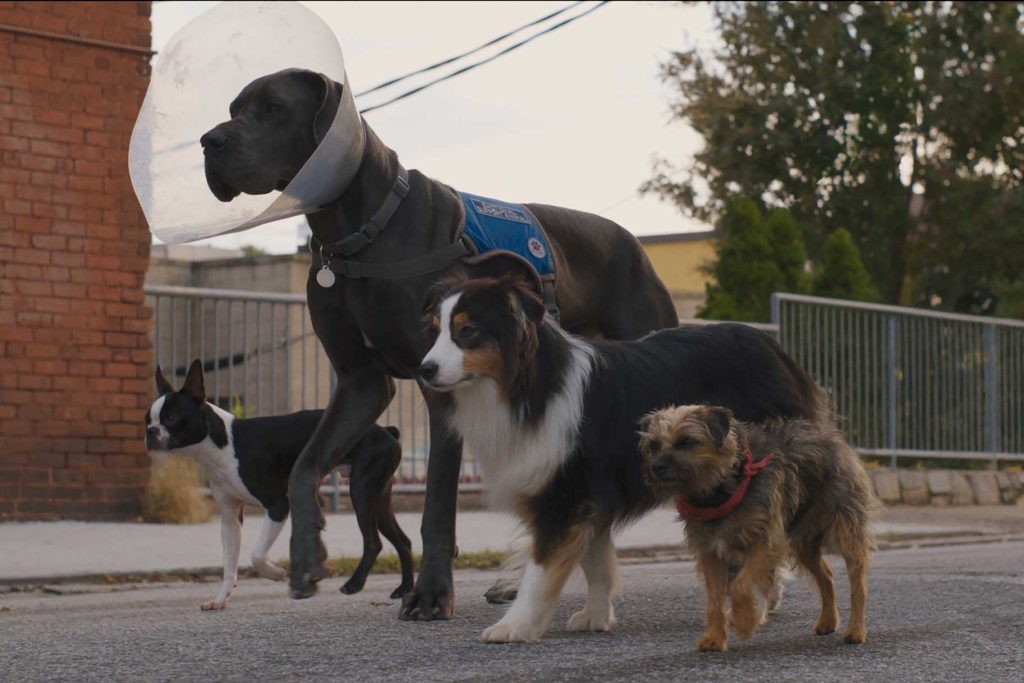
Composer Dara Taylor‘s work can be found in films as diverse as the madcap comedy Barb & Star Go to Vista del Mar and the dramatic The Tender Bar, along with director Jessica M. Thompson’s modern vampire tale, The Invitation. Her score for the new NSFW animal comedy, Strays sees her working in both comedy and action, resulting in “a score that speaks to the heart of the film and its characters, which is finding your support and chosen family.” We spoke with the composer about her work for this new film.

STARBURST: What attracted you to Strays? The idea sounds like a kid’s movie, but then you see that first trailer, and it’s very much apparent this is not a kid’s movie.

Dara Taylor: No. No children allowed. I read the script, and it was hilarious. I had also worked with the director, Josh Greenbaum, before on Barb & Star Go to Vista del Mar, so I already knew his work and his directing style, and I know he makes things that are peak ridiculous and just so funny. This was just hilarious from start to finish.

What’s the process of getting started on this? The process of a movie with animals like this and how they make the film is a little bit different than the usual filmmaking process.

Yeah. And especially with four dogs almost all the time, they had to hit their marks, and they had to hit them together. It was fun to watch the different layers of VFX removing things over time or adding things. I think for the longest time, for most of my process, the mouths weren’t fully finished yet, so so I had just gotten used to hearing it as narration.

Other than that, though, it is like working on any other film or any other comedy. I started working while I think they were in production, and I started coming up with some thematic ideas and trying a few things out and sending those over and fine-tuning those until we were ready to start really getting into it.

Strays has this action-comedy vibe, which really demonstrates that, with each new project you work on, you add a new thing to your repertoire.

Yeah. Action comedy has definitely got a fine line that you have to walk between funny and rousing. A lot of it is taking the situation as seriously as the dogs take the situation but also not overplaying your hands, so it feels like a spoof. It’s definitely a fine line, and comedy, in general, is a fine line. I mean, I love comedy in general. If I’m watching something, it’s usually a comedy.

You’ve been able to work with the director twice – what does that allow you to do, in terms of your process, when you already have an idea of how they work, even though it might not be what they want for this film?

I think the best thing is being able to kind of refer back to both old music and old processes and old spotting things. Even old notes from the previous film were like, “Okay, remember how we fine-tuned this? Let’s do something like this timing-wise that we did before.” There was a scene in Barb & Star that had a lot of starts and stops for comedy, and there was a similar scene here. We referred back to that to see if we should play it like we played it then or play it slightly differently.

You came up with different themes for the four different dogs that are in this movie. How did you approach each of those?

There’s a main theme for Reggie, and that kind of became the main theme of the movie and for the journey. Then there’s a theme for Bug, and there’s a melody that refers to the two other characters in certain moments. I’m trying not to give spoilers as we talk about it. [laughs] But yeah, I mean, we didn’t go too Peter and the Wolf with it: “Okay, this person’s on screen, so let’s do their theme,” but some things felt recognisable throughout, and I really hung my hat mostly on Reggie’s theme ’cause that really became the melody of the movie and of the journey.

This film is out now, but we’re curious as to how what you do as a composer has been affected by the strikes that are going on.

I’m grateful to be working at the moment, but there is a time when I’m like, “Okay, I don’t know what the next thing is,” and it’s hard to find the next job because so many things are just paused. So yeah – not sending out nearly as many reels and submissions as I was before all these strikes happened!

The thing about the strikes is that, sure, the first one started in May, but it’s been looming since February, so there was trepidation even then. It’s been a very odd year overall, and we’re just all hoping that a fair resolution can be reached.

Strays is out now in UK and US cinemas.

Ariella Como Stoian | HIVE

Hive hero image (Credit: Graphic Design Lily McStocker) Image Description: The colourful silhouettes of two people - one slightly taller than the other - standing next to each other, facing forward with a dark purple background. The silhouettes are made from a collage of eldritch insects in different colours, reds and oranges in the centre of the figures, and blues and purples on their edges.

by Ed Fortune

Ariella Como Stoian is a queer playwright and immersive and interactive theatre-maker who specialises in speculative fiction and magical realism. Their latest work is Hive, a queer, cross-generational, sci-fi play exploring family, shared memory and the meaning of home. We caught up with Ariella to find out more.

STARBURST: How would you pitch Hive to someone who reads a lot of dystopian fiction?
Ariella Como Stoia: I would say Hive is an example of soft world building, where the impact on lives and relationships of a speculative world is shown in the everyday. I’d say while some elements of Hive’s dystopia are exaggerated and fantastical, a lot of it is close and recognisable, slightly heightened, but definitely not a world where humans have emigrated off planet to mine more silicon and live in a replicated exclusionary status quo run by a benevolent yet misguided AI or something.

It’s a gentle apocalypse, like our own. And the dystopian themes speak more to how we live with uncertainty and imagine beyond catastrophe, in this case, when we’ve lost someone or something, and we’re trying to reconfigure our sense of home and family anew. Where nothing is easily resolved and, in fact, gets more wildly, delightfully chaotic. So it’s not 1984. That’s what I would say. And then I’d probably ask what they were currently reading.

What makes this weird fiction?
That question is a bit of a spoiler! But I suppose it is weird fiction in how elements of the story sit at the axis of fear, awe, and the sublime, which can’t be understood in literal, pragmatic parameters. The play holds dread and fascination with the unknown, something that hardly fits in the human mind but is inspired by its imagination and limbic-system production value. This multiplicity and warring complexity are also the joy of the piece. I would say the strategies of weird fiction are central to how the characters in the play – Ria and Salve – connect, disconnect and reconnect, blending quasi-sci-fi with weird nature and inexplicable magic.

I hope I’ve been both subtle and informative here. I may have said nothing.

What inspired this show?
Like many things, it’s made of many parts.

At the beginning of the year, I was commissioned to write a piece for The Space on the Isle of Dogs, so Hive became situated through that relationship, sense of place and history of rapid development.

A lot of which sits close to my own experiences around the loss of home, family, and displacement. I’ve also weathered storms and heat waves and experienced disrupted migration patterns that have driven waves of moths into the cities they were flying away from. Plastering windows and doors to the point you can’t see out past their many legs and wriggling confusion.

I would say as well my experiences of grief have been key inspirations in this show, and my relationship with my mum, who is a single working mum like Ria. Whodathunk? I am a non-binary, queer writer, and the character of Salve is a non-binary teen whose identity is never in question in the play. They never have to explain themselves or come out. Rather their story is about processing radical changes in their family structure in a turbulent world and figuring out how to hold and remember someone who gave them acceptance, strength and love. To process a shared yet distinct grief together, as well as having to address the material impact of a loss and subsequent decisions around their home.

Casual representation of queer identities is hugely important to me, as well as discussions being had around grief and change that doesn’t try to solve or resolve anything fully but rather sit in the messy, loving strangeness that grief brings and how it transforms the world, whichever world that may be, but how we remember together.

Then all of these many ideas filtered through my brain, which happens to process and understand through storytelling, particularly through lenses of sci-fi, worldbuilding and the gloriously odd.

Who is this for? It is intended for a mostly queer audience?

I would say Hive is not just for queer audiences, though I’d obviously love all kinds of queers to show up. I think the central relationship between single mum/conservationist Ria and adventurous teenage kid Salve is very relatable for everyone, even if you’re not coming from a direct experience of their context. At the heart of it, the piece is a poetic romp about love, loss, and how you communicate with someone who is going through a very similar experience to you in a weird, complex world. Highly relevant to a number of folks, I’d imagine, and the story is very invested in this relationship between a parent and teen struggling to connect, as well as their previous multi-generational family dynamic.

Why theatre? What does theatre bring to this story that other formats don’t?

Great question. I’d say the imaginative possibilities that theatre provides. I’ve always felt that there was an expansive scope to theatre that could allow you to both question how we understand and construct our reality but playfully and joyfully imagine new possibilities. In a way, the play almost operates like a game of DnD where you’re being offered descriptions of a world that you’re imaginatively collaborating on, collectively making a story more real, more tangible.

Hive tells its story through the tensions between the aural and visual, expressing the inner and outer dynamics of its humans in an unusual, speculative setting. Their interweaving thoughts, whose rhythm is shared between characters, explore the relationship between a parent and child after the loss of the third pillar of their family, ‘Nan’, and their closeness throughout separate, similar journeys that occupy the same space. This world is built on stage through lyrical language and offers made to an audience’s imagination.

These poetics, the radical empathy this represents and this weird-fiction metaphor is uniquely expressed by theatre in this case and its potential for collaborative, non-naturalistic storytelling.

Why the Edinburgh Fringe?

The Edinburgh Fringe is a place of discovery and community with many willing audiences, and so you learn so much about your work. Hive is an experimental, non-naturalistic play in a lot of ways. Though sometimes when words like experimental are used, I’m a little like, is the way I think and experience the world experimental? I don’t know. Not deliberately. Categories for being a human… The fringe is a place of chance and connection. This is ‘Hive’s’ first outing, and we want to find lots of different folks it speaks to and offer this atmospheric, encompassing world to anyone we can. As well as taking a chance on many other worlds ourselves.

They are thousands of shows at the fringe. Why should Starburst readers seek this out?

It’s a unique experience, gorgeously immersive in its multidisciplinary design and wonderfully distinct in its style of storytelling. Honestly, it is a bit of an unexpected time. Beautiful and eerie, with love poured into it from every member of the team. It’s a brilliant bunch of people working together to realise an adventurous story. Taking you on a journey that allows you to feel and process without demanding a particular response from you, a gentleness held alongside its wild scope. Why wouldn’t you give it a go? It’s cool and genre work, human with a touch of eldritch. Someone said it was like Solaris; someone else said it was like if Annihilation met Studio Ghibli. I’m not sure I agree completely with these takes, but it’s obviously lovely to get the comparisons, particularly to Ghibli. I’m here for it all and looking forward to more references and responses. Nerds assemble.

The Mushmoss Collective list LARP as an inspiration. What sort of LARP have you drawn from in your recent works?

Another great question! Our recent show ‘You wake up/octopus’ (CPT, Theatre Deli, The Space) was developed structurally with inspiration from Nordic Chamber LARP, mixed with a more compositionally-driven, experimental (there’s that word again) play akin to happenings, or collaborative live rehearsals. ‘You wake up/octopus’ is about chosen self, transformation, becoming and memory. It’s a completely silly, otherworldly endeavour where you play one tentacle of a newly conscious octopus who might decide to go to space. So it’s like interspecies roleplay meets a TTRPG, but then you build a spacefaring vessel out of fabric and light with strangers, sharing in the creation of the story, world and soundworld.

Additionally, this show takes place in a shared archival space, filled with games and co-created artefacts, fairy lights, projections and flowers, called the ‘Memory Tree’. Visitor responses and contributions influence the stories that then take place in this archive, developing a collective, joyful, ongoing lore, repositioning what memories we value and how we might collaborate on empathy. (Did someone say tentacular thinking?) Structurally, we were both onboard into the world and shared ‘character’ through interaction and immersion with the ‘Memory Tree’ as well as debriefing post-shows.

‘Hive’ is not interactive, nor does it involve roleplay. It is a traditionally end-on play, but I would say it values these same principles and an imaginative relationship with an audience. Honestly, I’d love to do an immersive, interactive version of the story set in an actual multi-level construction site. But I guess one highly ambitious thing at a time.

How would you describe your process?

I would say my process is made-up of layering and finding resonances between ideas. I’m very driven by rhythms, musicality and humanity in my writing. My work is often referred to as poetic, but I think that’s more to do with a playfulness or irreverence toward language than any kind of sonnet stanning on my side. I’m intuitive, multi-disciplinary, and really excited and enlivened by collaboration between different practices. I’m a tad non-dramatic in my art and really like there to be space held open for audiences or players, as the situation may be. As you’ve probably gotten by the amount of times I’ve used the word, I highly value imagination and possibility. I’m very driven by story, even when it may not be the foremost way of creating meaning in a piece. I’ve only had one commercially viable idea in my life (for a reality tv show), and I hope one day it’ll fund more of our immersive art about jellyfish and space-moths. Or it’ll be stolen and make someone else millions because I keep bragging about it loudly in public. Either way, I won’t shut up about it until I’ve willed it into the world, and that’s my process too.

What media are you currently enjoying?

I’ve been playing Tears of the Kingdom, and as a part of playing TotK, I’ve been on Reddit reading about other people playing TotK and watching other people play TotK on YouTube, as well as consuming all the timeline and Zelda lore videos.

I don’t know if I’ve been enjoying this, though.

I’ve also been reading Ursula Le Guin’s ‘The Lathe of Heaven’ for the first time and watching Boots Riley’s ‘I’m a Virgo’.

What’s next?

While we’re in Edinburgh, we’ll be presenting a scratch of new work, ‘Do plants sleep’ for Summerhall Surgeries. It’s a WIP gamified experience about energy management and choosing to rest, equating everyday tasks with the scope and scale of adventure, i.e brain fog=swamp, etc. Interwoven with quiet reflections, found moments and mutual care with a plant. It’ll be on later in the year for Theatre Deli’s Social Model…& More Festival in London this November.

But we’re hoping Hive has a future life beyond the fringe. We’re looking for the right home!

Tickets for the 2023 Edinburgh Fringe run can be found here. You can find out more about Ariella’s future work here.


Catriona MacColl | ISAAC

Catriona MacColl | ISAAC

by Martin Unsworth

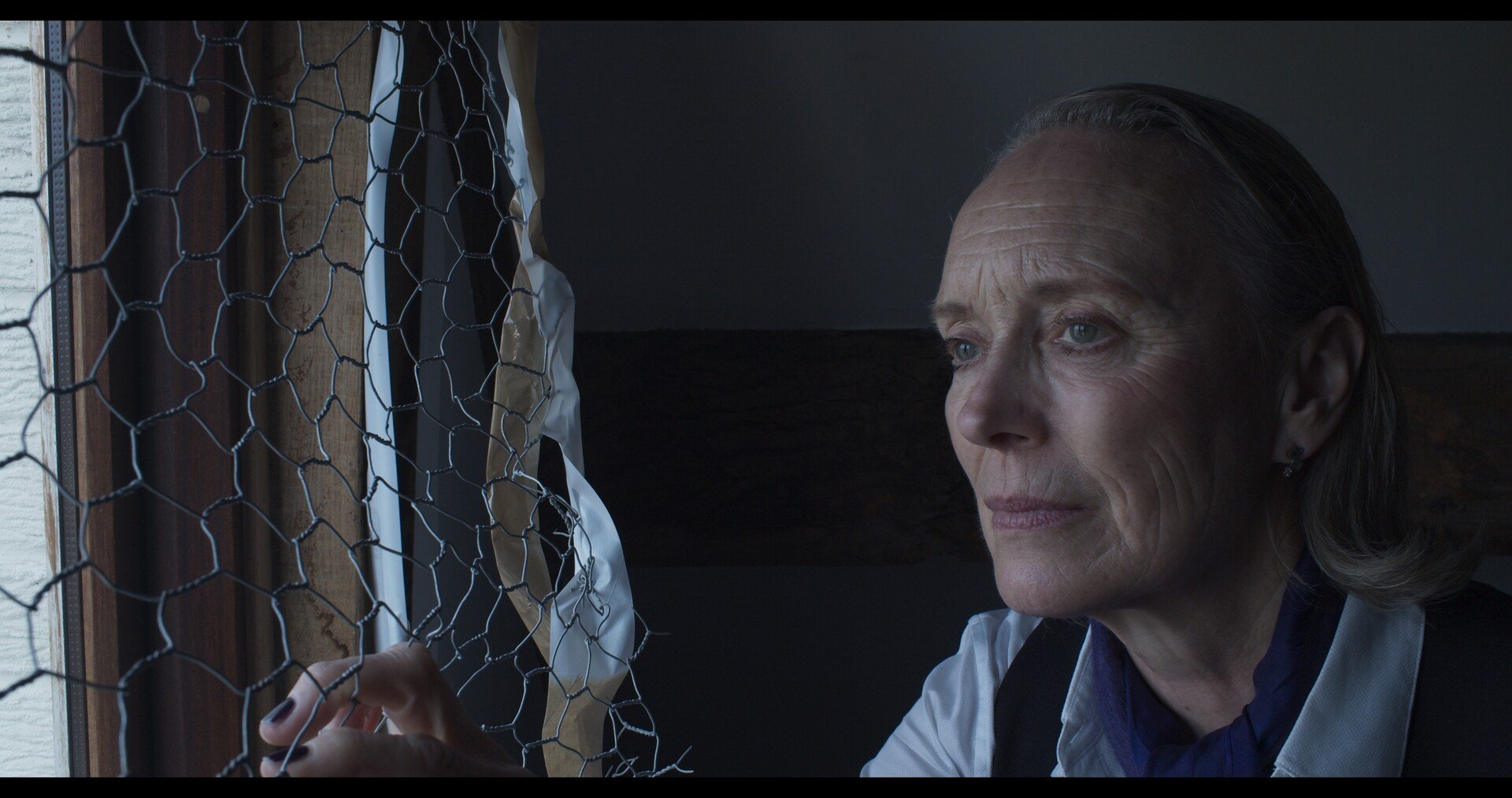
Independent British film Isaac gets its world premiere at this year’s Pigeon Shrine FrightFest as part of the New Blood strand. The film stars STARBURST Fantasy Award-winner for Best Performance Johnny Vivash and Kathryn Louise as a couple who enrol into a trial that involves raising a child created with genetic engineering. Genre legend Catriona MacColl plays the doctor working for the GM company. We caught up with her while the movie was being shot to find out more about her character and more…

STARBURST: What can you tell us about Isaac?

Catriona MacColl: Well, I can tell you that it is quite an ambitious project for a first film, but [writer/director] Tariq Sayed seems to be pulling it off! It’s a horror film, but it’s disturbingly close to home, despite the fact that it’s slightly futuristic – it could be possible. There’s no gore as such. There are some special effects, though. It’s psychologically terrifying, let’s put it like that. There were several reasons why I wanted to do it. The first one is that it’s very, very good. Secondly, the subject matter and the part that was offered to me. She’s a tough lady at the top of the game as a scientist, and it’s a challenging part to play.

How did you how do you approach this character?

As I grow older, I tend to be playing like this more and more. I don’t want to get give away too much of the story, but she’s fairly awesome and frightening from right when she appears, just through what she’s saying. It’s in a very cold and seductively calculating way. She is, nevertheless, a doctor, and the way I have approached the way she looks is terribly important. I had a discussion with Tariq about that. He had a very clear idea of what he wanted her to look like. He gave me the idea that helped me compose the part. I trust myself to be able to play those parts quite well and to be able to have a ball. So I went with my intuition. It seems to be right from what I’ve understood. Tariq seems to be happy with it! So hopefully, I’ve done it right!

Most people will know you from the Fulci films and the like – do you feel your presence brings a level of gravitas to the film?

Quite possibly. I guess I am known as a ‘cult’ actor, but it’s thrilling for me that these young directors want to work with me and that I represent something. I don’t mind at all if I just do short films at this point in my life. There’s a fresh energy to working with the younger generation. I feel I’m helping the younger generation to get off the ground, and that’s very exciting because they’re going to be the filmmakers of tomorrow.

Isaac gets its world premiere at Pigeon Shrine FrightFest on Saturday, August 26th. You can buy tickets here.


Marc Burrows | THE MAGIC OF TERRY PRATCHETT

The Magic of Terry Pratchet - Marc Burrows_photo credit Kim Burrow illustration Andrea c White

by Ed Fortune

Marc Burrows is an award-winning comedian, author, journalist and musician. In 2020 they wrote The Magic of Terry Pratchett, the first-ever full biography of the beloved author, which won the 2021 Locus Award (non-fiction). Their new show, The Magic of Terry Pratchett, is currently on at the Edinburgh Fringe before it tours the UK. We caught up with Marc to find out more.

STARBURST: How would you pitch The Magic of Terry Pratchett to someone who has heard of, but has never read, Terry’s work?

Marc Burrows: This man, Terry Pratchett, was the most-read living author in the English language in the UK for a lot of the ’90s. Whatever ideas you have about the type of books he wrote or the type of people that read them, I promise there’s more to it. That many people can’t be wrong, can they? (Ignore that pile of Fifty Shades of Grey in the corner of the bookshop). I’ve worked really hard to make sure this show will work for people who have never read a Pratchett book as well as it does for people that have read all of them multiple times. It’s the story of a man with a fascinating life who wrote great jokes and had a really interesting worldview. After you’ve seen it, you might even want to pick up one of his books.

Why was the Discworld series so beloved?

That might be the biggest question of all, you know. I can tell you why Terry’s books are great, how nuanced, fascinating, funny, angry, and exciting his work is, how well he understood people, and how vivid his imagination was. But those are just… factors. They’re not explanations. It’s like when someone you love asks you why you love them. You can list a million things you love about them, but you can never really define why you love them.

Why did these books capture the imagination? I’ve got theories. Firstly, it’s that they’re funny. And they’re funny before they’re anything else. That’s important. Secondly, I think Terry understood people, our lives, our thinking, our society, our weird foibles, our strange desires, the best of us and the worst of us better than any other author since Dickens. I mean that sincerely. He could see how and why the world ticked. Something about that resonates. It makes his work addictive, and his characters are people you fall in love with. You read his books, and you want to read another one.

How different is this show from your work with The Men That Will Not Be Blamed For Nothing?

That’s a fantastic question, actually. Because on the one hand, obviously, it’s totally different – The Men is a punk rock/metal band – it’s loud, it’s shouty, it’s a wee bit obnoxious, and it has guitar solos and considerably more swearing.

But… it’s not a massive stretch to see that there’s considerable crossover between Terry’s fans and ours. I think 90% of people who love our band (and there are, weirdly, quite a lot of them) are also Discworld fans. There’s a lot of thematic cross-over. Terry LOVED the Victorian era, and our band is entirely Victorian-themed. He also had a sharp sense of injustice and a filthy sense of humour, both of which we do as well, although remarkably, I’m the only Pratchett fan in the band, despite Andrew, our guitarist, literally being in Good Omens 2.

Why this show? Why now?

I suppose the obnoxious answer is, “Why not?” There’s never a bad time to celebrate Sir Terry. It may as well be now. More broadly, though, I always knew I wanted to turn my book (of the same name) into a stand-up show, although in truth, the show moved quite a long way from the book. Terry’s life is a great story, and his message is powerful – think for yourself, don’t suffer injustice, don’t tell people who they should or shouldn’t be. Have a large brandy. That’s good advice, whatever the year, but in 2023, amid all the fractured identity politics, propaganda, fake news, media saturation, oligarchy, patriarchy and cryptocracy, it feels like a message worth hearing. I just want people to remember him. To say his name. To pick up the books. I think we need it now more than ever.

What is the appeal of the Edinburgh Fringe?

Great falafel and pubs that open late. But aside from that, it’s a completely unique setting. You can see comedy and theatre anywhere, but there’s specific magic to having so much of it in one place. As a comedian, it gives you a chance to write a real show with a beginning, middle and end, something that says something about who you are and your worldview, which isn’t always easy to do in a club set. It’s a rich creative opportunity. It’s also a place where audiences take chances – they’ll go and see something weird, they’ll take a flyer and pop into a show on the off chance they’ll like it. Also, many comedians and performers in such a small, concentrated space for such a long time always run the risk of punching a hole in space-time, and that’s an annual rollercoaster. Terry would use a metaphor here with weights on a rubber sheet, I’m sure.

Why theatre? What does theatre bring to this story that other formats don’t? They are thousands of shows at the fringe. Why should STARBURST readers seek this out?

‘Theatre’ is an interesting word, isn’t it? Is this show ‘theatre;? My natural inclination is to think of it as a stand-up comedy show, which isn’t necessarily the same thing. A “one-man show” is theatre, but stand-up is always stand-up, and though this is a show that can be at times very earnest and deals with some tough subjects, I never wanted to lose sight of writing a comedy show. I was very keen for it to be in the “comedy” part of the Fringe brochure. Terry was a comic author – he was hilarious. The first sentence of the first page of the first Discworld novel has a great honking pun in it “on an astral plane that was never meant to fly”. I wanted the story to be funny, and funny works best out loud. Terry’s jokes sing on the page, but they SCREAM when you read them out. You could also call it a lecture, which is technically true, but I promise I’m funnier than most of your lecturers.

As for why this one? It’s a good story, I promise. It really is. Terry’s life was fascinating, and it’s a joy to be allowed to share it. Plus, you get a free booklet of Terry Pratchett writing unseen since the ’70s. You don’t get that from free-entry improv shows, I promise you that.

What’s your favourite Terry Pratchett work?

My answer to this changes week on week and probably day on day. I think his very best book is probably Nation, a staggering YA story about a young Pacific Islander whose entire world is wiped out by a Tsunami, leaving him to rage at the gods. It’s his masterpiece in every sense of the word. My other favourite is Night Watch, the 29th and angriest Discworld novel and the closest Terry gets to writing a thriller. It’s a really special book.

What’s your next project?

Currently, I’m consumed with Fringe stuff. I’m taking this show, plus its companion show The Magic of Terry Pratchett: The Footnotes, which is a full-on fan core nerd-out in a smaller space straight after the main one, and I’m doing a straight stand-up show every night, Marc Burrows In the Glom of Nit [at City Café at 11.15pm], so that’s kind of filled my thinking. We’re doing a big London performance of The Magic of Terry Pratchett in October at the Bloomsbury Theatre and then touring it next year. Then there’s something that Rob Wilkins, who runs the Pratchett estate, and I are working on together, but I can’t tell you anything about that just yet. I’ve also got a book about Nirvana coming out if I ever get time to finish it, and I want to do a sequel to my last book, The London Boys, which was about Bowie and Marc Bolan’s teenage careers in the ’60s. The next one will deal with their ’70s pomp. And like everyone else, I want to write a novel. Oh, and I’ve started writing songs for the next Before Victoria album, which is my little indie-rock off-shoot from The Men That Will Not Be Blamed For Nothing.

I’m not sure which of these counts as my “next” project 😬.

What media are you currently enjoying?

Predictable answer, but Good Omens 2 is BRILLIANT. Neil has done such a wonderful job of capturing what worked in the first series. I really hope they do a third. I’m also devouring Star Trek: Strange New Worlds season 2, which is, I think, the best season of Trek we’ve had since the ’90s. And in a year that also had Picard Season 3, that’s really saying something. Music: new albums by Blur, Nicky Wire, Tim Arnold. Podcasts: The Inadvisable Trapdoor by Andrew O’Neill.

How can we help?
Say. His. Name. The message of the show is to keep talking about and celebrating Terry Pratchett. With Good Omens 2 being written entirely by Neil Gaiman – and John Finnemore, who has done a great job with it, I want to remind everyone that Terry is sewn into its DNA. Terry still lives while we talk about him. While the ripples are still spreading. As far as the show goes – spread the word! Come see! Find me on social media! I’m @20thCenturyMarc on pretty much everything.

Where can we see the show?
At the Edinburgh Fringe, at the Gilded Balloon Teviot, 2-28th August, with a day off on the 14th, with The Footnotes show straight after at 7pm. Then we’re doing the Bloomsbury Theatre in London on October 14th, which will be a big celebration for the 40th anniversary of Discworld with some really special guests and a tour next year.

The Magic of Terry Pratchett will be performed at 5.30pm in Gilded Balloon Teviot (Dining Room) from August 2nd – 28th (not 14th).

Read our Five Star review of the show here.


Eric Rose | TOMORROW’S CHILD

by Ed Fortune

Eric Rose is the Artistic Director of Ghost River Theatre and the Co- Sound Designer, Director and Adaptor of Tomorrow’s Child, a show based on the Ray Bradbury story of the same name. We caught up with Eric to find out more about this show, which is currently on at the Edinburgh Fringe. 

STARBURST: How would you pitch Tomorrow’s Child to someone new to the fringe?

Eric Rose: Tomorrow’s Child is a one-of-a-kind blindfolded listening experience that brings Ray Bradbury’s retro-futuristic sci-fi world to life through audiences’ imaginations and a high-fidelity soundscape.

Why this particular Ray Bradbury story?

Bradbury is one of the world’s literary sci-fi giants, and he’s at his classic best with Tomorrow’s Child [also published as The Shape of Things in 1948]. Bradbury wrote Tomorrow’s Child coming out of WWII in the late ’40s, imagining the futuristic world of 1988. For audiences in 2023, it’s a retro-futuristic world that is full of a symphony of mechanisms, buttons, motors, and machinery.

In other words, Bradbury’s world is full of mechanical gadgets that make sound, unlike our silent contemporary digital devices. 

Not to mention Tomorrow’s Child poses some fun and unique sci-fi challenges. For example, creating what it sounds like to be born into the fourth dimension. Or even better, conceptualizing the sounds of a baby in the fourth dimension who appears to everyone as a blue pyramid. These lush audio challenges are a fantastic starting point for a piece of immersive theatre. 

Tomorrow’s Child is mastered for high-fidelity sound featuring more than 10,000 individual sounds created by over 50 artists – making it an extremely vivid, deep listening experience for our blindfolded audiences.

The other reason we chose Tomorrow’s Child is its story. At the time we were making Tomorrow’s Child, I was a new dad, and the struggles of the main character Polly had a significant resonance for me. 

The story follows Polly as a new mother who, in isolation, suffers from postpartum depression, trying to navigate caring for a baby who is different. I believe Polly’s story is especially relevant at a time when the world is emerging out of physical disconnection with a renewed focus on mental wellness. Indeed, the story challenges our assumption of what is ‘normal’ and how we treat families and individuals that don’t conform to traditional ideas of what people or families look or act like. 

Hang on, blindfolds? What does theatre bring to this story that other formats don’t?

Tomorrow’s Child is part of a larger body of Ghost River Theatre’s work which explores what happens to the boundaries of narrative when you focus on stimulating the audience’s senses. When you take away sight – our primary gateway in the world – how do our imaginations open up to narrative? How can being deprived of sight prime us for a unique performance experience? 

At the forefront of Ghost River Theatre’s work is the question of liveness: how we unearth and reveal the world differently for audiences based on the immediacy and interactivity of the performance experience. Tomorrow’s Child, along with our other blindfolded immersive work, challenges us in our devised practice to better understand and trust the imaginary space our audience needs, to fully engage in the live performance experience.

How different is this from other Ghost River Theatre projects?

Tomorrow’s Child is part of a collection of sensory-based immersive experiences produced by Ghost River Theatre over the last decade. 

Would you adapt other classic sci-fi works? 

YES! I am a huge sci-fi fan and love the strange shifting experience of working on stories that ask us to exist between the past, present and future. I am endlessly fascinated by how science fiction defines the present moment by the way we imagine a fictional future. 

As a sidebar, we have had a number of academics write about our production, including an article in the Canadian Theatre Review titled: “Nature Exposed to Our Line of Questioning”: Tomorrow’s Child as Quantum Theatre. Cool, eh?

Why did you bring this particular project to Scotland? 

Scotland has an incredible, complex and rich history that offers a vast perspective when imagining our future. Every day in Scotland, you can’t help but be confronted with architecture, artefacts and monuments that often push up against the contemporary present. So, the Scottish are primed to imagine the retro-futuristic world of Tomorrow’s Child. Also, Edinburgh is renowned for being a city of audiophiles.

Why should STARBURST readers seek this out?

To experience a rare and adventurous immersive audio experience that is surprisingly visual even though the audience is blindfolded! Also, if you are a lover of rich sound and Sci-fi, this experience is for you!

What media are you currently enjoying?

I am a big fan of podcasts (Radio-Lab, The Stranger, Serial, Love and Radio, The Moth) along with TV Series like The Foundation, Westworld, and The Twilight Zone) and am just finishing the classic Stephen King novel, The Tommyknockers.

What are your plans after the Edinburgh Fringe?

Our hope is that we will build a tour for Tomorrow’s Child out of our run in Edinburgh. Immediately after the Fringe, however, Ghost River Theatre will be going into post-production for a new Cli-fi (Climate-change Science Fiction) streaming series, So Dark The Sky, that I co-wrote and directed.

Tomorrow’s Child runs at the Edinburgh Fringe until August 28th, 2023. You can find out more about Ghost River Theatre here.


THE TELEPHEMERA YEARS: Pre-1965, part 4 – 1963-64

My Living Doll, 1964

Ah, telephemera… those shows whose stay with us was tantalisingly brief, snatched away before their time, and sometimes with good cause. They hit the schedules alongside established shows, hoping for a long run, but it’s not always to be, and for every Street Hawk there’s two Manimals. But here at STARBURST we celebrate their existence and mourn their departure, drilling down into the new season’s entertainment with equal opportunities square eyes… these are The Telephemera Years!

Pre-1965, part 4: 1963-64

There’s no concrete reason why The Telephemera Years begins in 1965, except for arbitrary reasons of available content and the more solid fixed point that is the great colour transference of that year, when it was announced that half of all network programming would be broadcast in colour from the Fall 1965 season. The years before we were gifted My Mother the Car, Lost in Space, and (eventually) Batman may look thinner in terms of genre programming but there were still those hardy souls doing pioneering work in the field of the strange and the fantastic.

So, while The Beverly Hillbillies, Bonanza, Gunsmoke, and Wagon Train dominated the ratings, less rustic thrills could still be found dotted across the schedules, right up to a 1964 Fall season which saw The Addams Family, Bewitched, Flipper, Gilligan’s Island, Jonny Quest , The Man from UNCLE, The Munsters, and Voyage to the Bottom of the Sea all make their TV debuts. So sit back, pop on your slippers and light up your pipe, have the little lady bring you a little treat, and see what the pre-1965 era has in store for us…

East Side/West Side (1963, CBS): David Susskind is not a name spoken of often when the history of television and civil rights is told and it’s an unfortunate oversight that ought to be corrected at every opportunity. A working-class Jew from Massachusetts, Susskind graduated from Harvard in 1942 and, after serving in the US Navy during World War Two, became a talent agent for Warner Brothers, ultimately forming his own agency – Talent Associates – to represent those involved in television and film production.

In 1958, Susskind stepped in front of the camera to present Open End, a talk show that aired on New York commercial station WNTA. Three years later, the show was renamed The David Susskind Show and went into national syndication, bringing Susskind’s frank and open discussion to the American people. Alongside supporting Black emancipation and criticising the government’s foreign policy, Susskind was among the first to champion gay rights, giving a platform to those wishing to advance the cause, and even addressed transgender issues with a sensitivity and level-headedness that is lost on some even to this day.

East Side-West Side, 1963

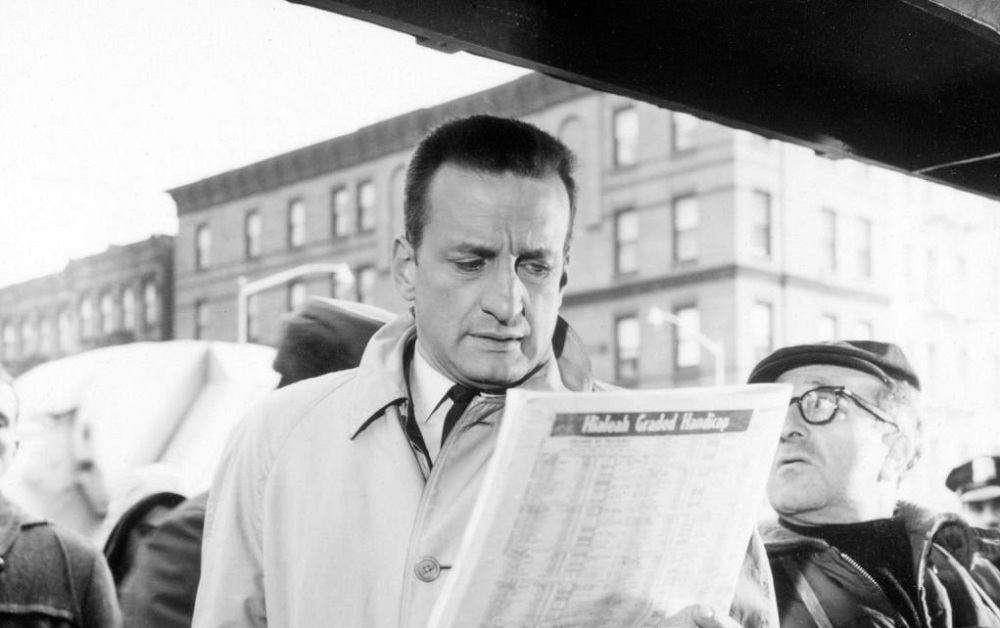
Susskind also produced TV drama and East Side/West Side was an attempt to tell the story of the New York he knew, highlighting the uncanny strengths of its people in the face of obstacles that were often institutional in nature. George C Scott starred as Neil Brock, a social worker working for a private agency who took cases others blanched at. The first two episodes alone dealt with prostitution and statutory rape, and subsequent cases involved PTSD, intellectual disability, gambling, mental health, and race, with no topic seemingly off-limits to Susskind and his team of writers.

The series switched tracks for its last five episodes, with Brock taking a job as an aide to a campaigning congressman, allowing the show to dip its toes into the rotten democratic process without ignoring ground-level issues. All this came at a price as sponsors avoided the show and many CBS affiliates declined to pick up the series, with one episode being blacked out in Louisiana and Alabama when it hit too near to home on racial discrimination. Despite a campaign by Susskind to earn a renewal, East Side/West Side was cancelled after just twenty-six episodes, but Susskind kept up the good fight through his other projects, with The David Susskind Show running until 1986.

Arrest and Trial (1963, ABC): When it arrived on our screens in 1990, Law & Order was hailed as new and innovative, dedicated as it was to showing the investigation and then prosecution of crimes in New York City. There are seldom any genuinely new ideas in television, however, and Earl Bellamy must have raised at least an eyebrow when Dick Wolf’s “new” show debuted on NBC…

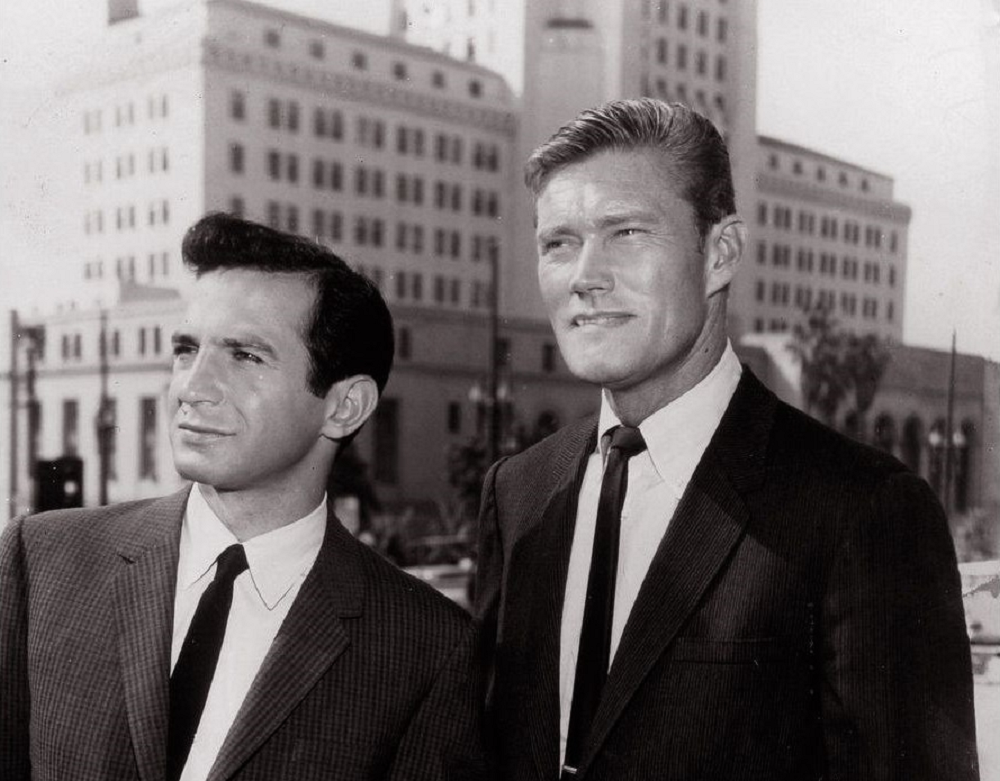
Twenty-seven years earlier, Rosenberg had created Arrest and Trial, starring Ben Gazarra and Roger Perry as a pair of Los Angeles cops who would investigate the crime of the week during the first half of the ninety-minute show. The focus would then switch to Chuck Connors’s public defender, going head-to-head with the Deputy District Attorney in an attempt to find his client innocent of all charges, or at least mitigate on their behalf.

Arrest and Trial, 1963

It was this crucial difference that gave Arrest and Trial its heart, coupled with Gazarra’s insistence that its depiction of the police not be stereotypical or hard-nosed, his Detective Sergeant Nick Anderson more concerned with what led to the crime being committed than how to punish the offender. Each week, a seemingly open-and-shut case would unravel, revealing depth and nuance not present in many other legal dramas.

In different hands, Arrest and Trial might have lasted longer than its thirty episodes and enjoy a more prominent place in TV history (Wolf claimed he’d never heard of the show when he created Law & Order) but executive producer Frank Rosenberg reportedly ignored commissioned scripts by writers he’d fallen out with and butted heads with Connors over this and Rosenberg’s treatment of the crew. Lacklustre ratings and strife on set led to the show’s cancellation in September 1964, although it did become later the first US show to be aired on BBC2 in the UK.

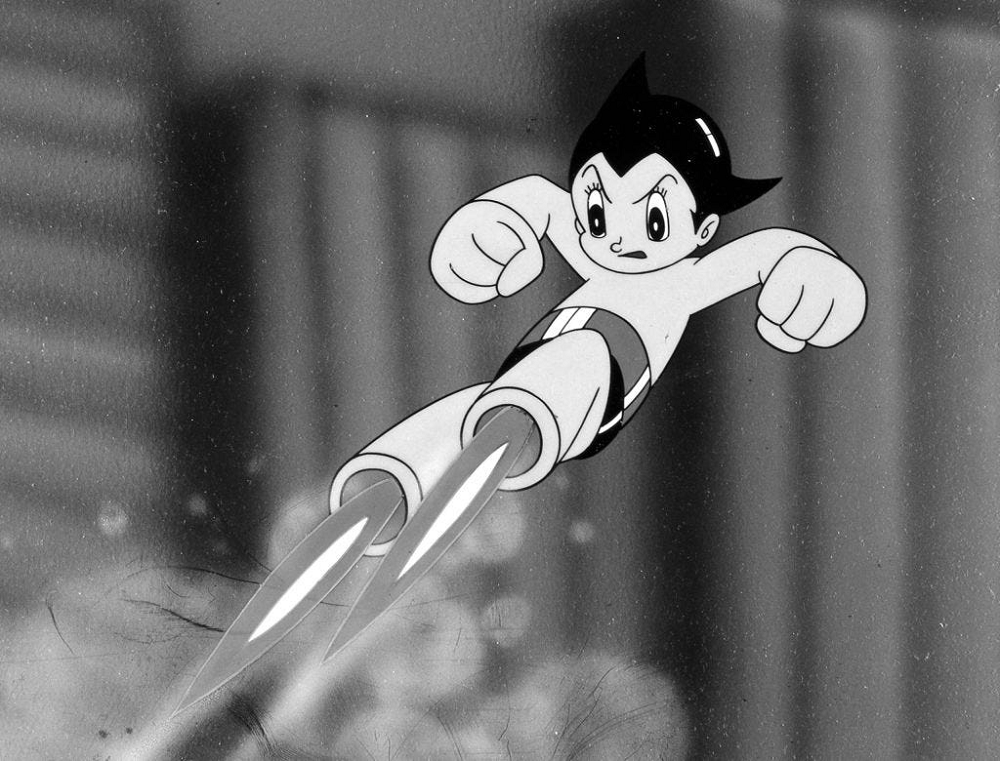
Astro Boy (1963, syndication): Osamu Tezuka is known as the “godfather of manga,” the Japanese comic book artform that earns far more respect than its western counterpart. In 1952, he created Tetsuwan Atom (“Iron-Armed Atom”) for serialisation in the monthly Shonen magazine, the story of an artificial boy created by a heartbroken scientist after the death of his own son. Astro Boy is soon sold to a robot circus but is rescued by a kindly professor who builds him a robot family and sends him off on adventures to better or save mankind.

Tetsuwan Atom became an instant sensation and when television ownership became widespread in the aftermath of the wedding of Prince Akihito, it was a shoo-in for a TV adaptation, a live-action version in 1959. That was short-lived but another version, this time animated, debuted in January 1963, originally adapted stories from the manga but soon outpacing the source material, leading to Tezuka providing original stories for the show. At its height, over forty percent of Japanese viewers were watching the show and its kid-friendly action and adventure themes made it a natural for overdubbing and airing in the US.

Astro Boy, 1963

Renamed Astro Boy, the first episode premiered on NBC in September 1963, the first Japanese show to make it to US TV, and was initially very popular. Changes were made by the US network to tone down some of the content, which often angered Tezuka, but it was successful enough that NBC renewed the show after the first year of weekly episodes for a second run of fifty-two episodes. By the end of that run, however, ratings had declined to the point where the network declined to buy more, preferring instead to syndicate the 104 episodes they already had well into the 1970s.

In Japan, Tetsuwan Atom ran for 193 episodes, through to December 1966, and further adaptations were produced in 1980 and 2003. The impact of the show in the US created a nascent anime fandom that would explode as home video became more viable, and shows such as 8th Man, Kimba the White Lion, and Gigantor entertaining cereal-eating kids throughout the 1960s, with Speed Racer arriving in 1967 and becoming the next cultural save-point in the history of Japan-US relations.

My Living Doll (1964, CBS): My Living Doll was created by Bill Kelsay and Al Martin, who had met while writing for My Favorite Martian. It was the success of that show that led to CBS ordering My Living Doll to series without even seeing a pilot, such was the pedigree of producer Jack Chertok, who had brought My Favorite Martian to CBS the year before and saw it become the number ten show for the season.

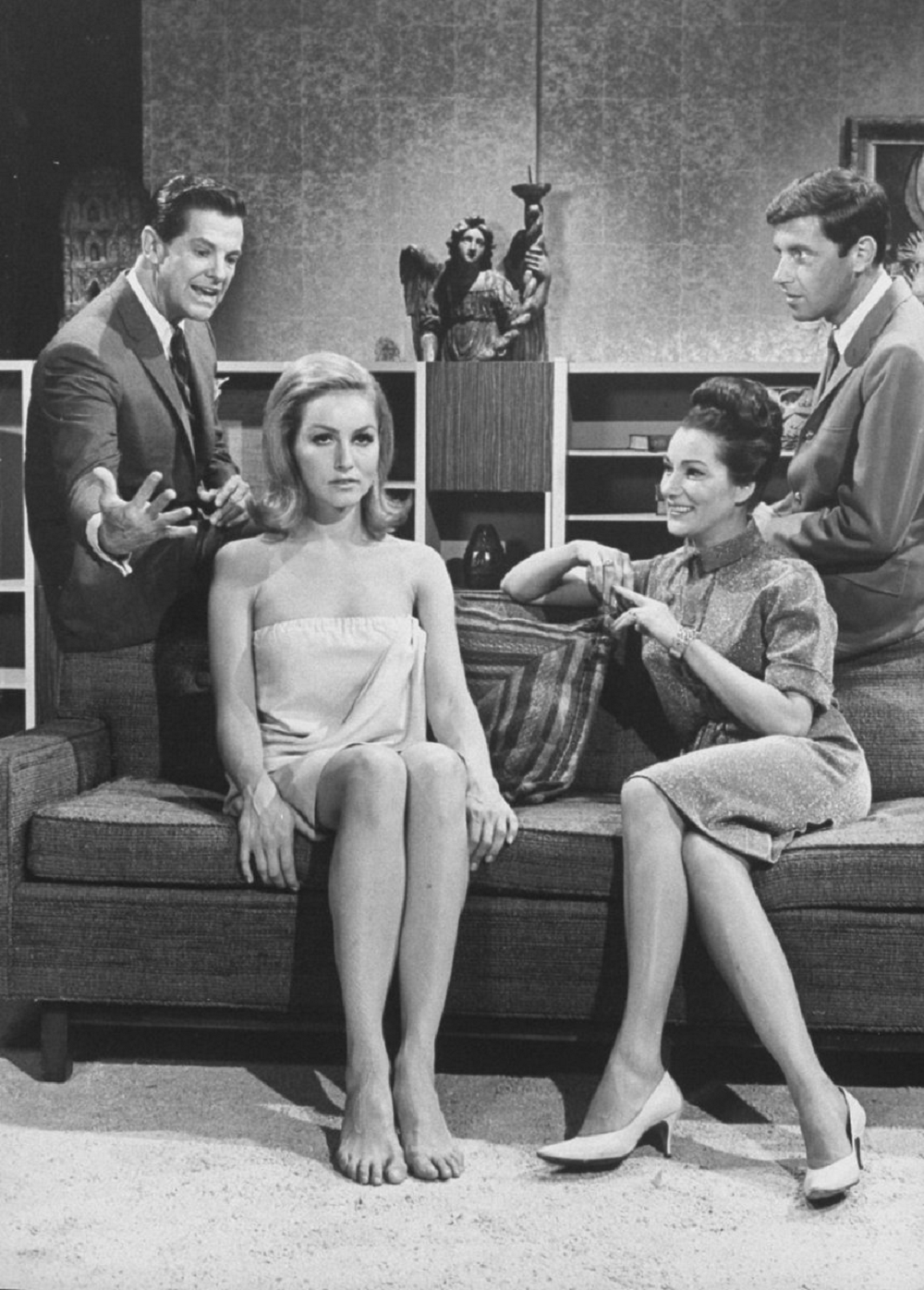
The living doll of the title was AF-709, a lifelike robot created by scientist Carl Miller for the US military but transferred into the care of psychiatrist Bob MacDonald (Bob Cummings) when Miller is transferred abroad and becomes worried what the military will do with his creation. MacDonald undertakes a mission to teach AF-709 – who Miller has named Rhoda – to be the perfect woman, although his idea of the perfect woman certainly doesn’t match the enlightened era of the 1960s, creating comedic tension between the developing Rhoda and her stuffy keeper.

My Living Doll, 1964

The role of Rhoda went to Julie Newmar, a Broadway actress of statuesque proportions who had an otherworldly beauty deemed perfect for the part. My Living Doll was her breakout television role, earning her an Emmy nomination, although she is probably best known for playing Catwoman in the first two seasons of Batman, opposite Adam West and Burt Ward. She later returned to the theatre and was granted a patent for both pantyhose and brassiere developments.

My Living Doll was warmly received by those that saw it, who no doubt enjoyed its risqué nature and progressive humour, but they didn’t see it in enough numbers – it was scheduled opposite Bonanza and The Virginian, both huge hits – to save it from cancellation. Its lasting legacy, other than introducing the world to Newmar, is in Rhoda’s catchphrase, the first recorded use in popular culture of “Does not compute!”

Next time on The Telephemera Years: It’s back to the future… 1983 to be precise, where a fantastic helicopter awaits – but not the one you’re thinking of!

Check out our other Telephemera articles:

The Telephemera Years: pre-1965 (part 1, 2, 3)

The Telephemera Years: 1966 (part 1, 2, 3, 4)

The Telephemera Years: 1967 (part 1, 2, 3, 4)

The Telephemera Years: 1968 (part 1, 2, 3, 4)

The Telephemera Years: 1969 (part 1, 2, 3, 4)

The Telephemera Years: 1971 (part 1, 2, 3, 4)

The Telephemera Years: 1973 (part 1, 2, 3, 4)

The Telephemera Years: 1975 (part 1, 2, 3, 4)

The Telephemera Years: 1977 (part 1, 2, 3, 4)

The Telephemera Years: 1978 (part 1, 2, 3, 4)

The Telephemera Years: 1980 (part 12, 3, 4)

The Telephemera Years: 1982 (part 1, 2, 3, 4)

The Telephemera Years: 1984 (part 1, 2, 3, 4)

The Telephemera Years: 1986 (part 1, 2, 3, 4)

The Telephemera Years: 1987 (part 1, 2, 3, 4)

The Telephemera Years: 1989 (part 1, 2, 3, 4)

The Telephemera Years: 1990 (part 1, 2, 3, 4)

The Telephemera Years: 1992 (part 1, 2, 3, 4)

The Telephemera Years: 1995 (part 12, 3, 4)

The Telephemera Years: 1997 (part 1, 2, 3, 4)

The Telephemera Years: 1998 (part 1, 2, 3, 4)

The Telephemera Years: 2000 (part 1, 2, 3, 4)

The Telephemera Years: 2003 (part 1, 2, 3, 4)

The Telephemera Years: 2005 (part 1, 2, 3, 4)

The Telephemera Years: 2006 (part 1, 2, 3, 4)

The Telephemera Years: 2008 (part 1, 23, 4)

Titans of Telephemera: Irwin Allen

Titans of Telephemera: Stephen J Cannell (part 1, 2, 3, 4)

Titans of Telephemera: DIC (part 1, 2)

Titans of Telephemera: Hanna-Barbera (part 1, 2, 3, 4, 5)

Titans of Telephemera: Kenneth Johnson

Titans of Telephemera: Sid & Marty Krofft

Titans of Telephemera: Glen A Larson (part 1, 2, 3, 4)

Titans of Telephemera: Quinn Martin (part 1, 2)

Titans of Telephemera: Ruby-Spears

Exclusive TRANSFORMERS: RISE OF THE BEASTS ‘Making Of’ Clip

We interviewed the cast and crew of Transformers: Rise of the Beasts in our latest issue ahead of the film’s theatrical run, and now, to celebrate its digital drop, we present this exclusive ‘Making Of’ clip, which takes us even further behind the scenes!

Transformers: Rise of the Beasts is available to Download & Keep from the 14th August and on DVD, Blu-ray™, 4K UHD™, 4K UHD™ + Blu-ray™ SteelBook® and HMV exclusive 4K UHD™ + Blu-ray™ SteelBook® 9th October.


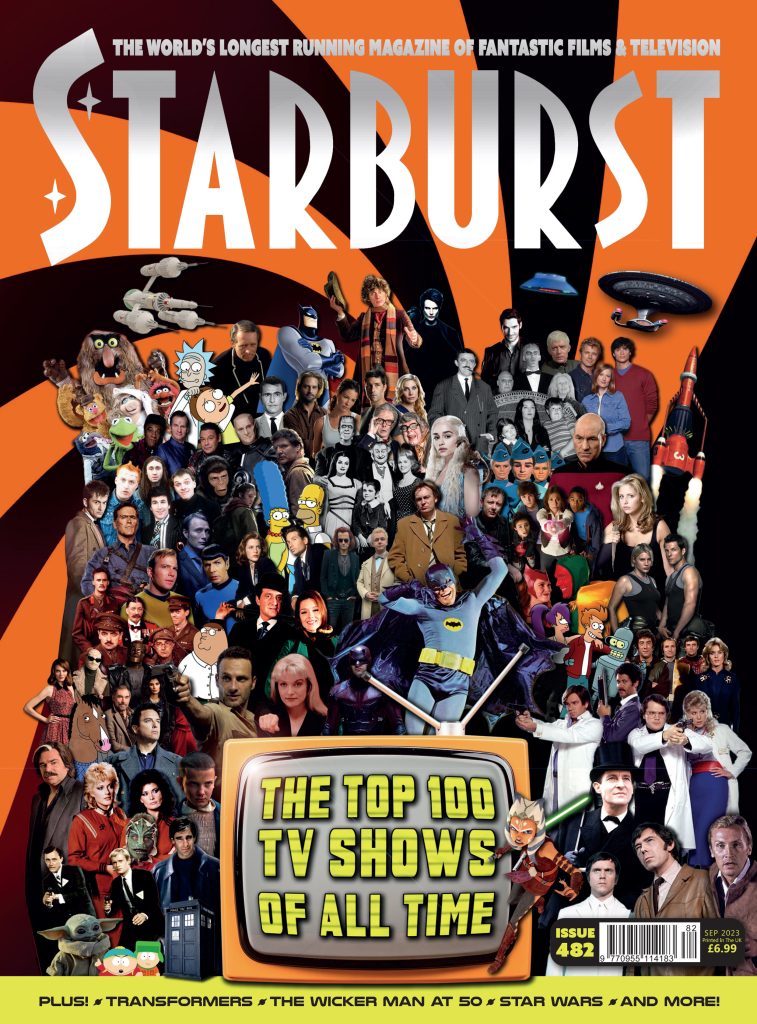
To read our interviews with director Steven Caple Jr., series producer Lorenzo di Bonaventura, and stars Anthony Ramos & Dominique Fishback, pick up a copy of our new issue in stores now, on digital through Magzter, or get it delivered to your door by clicking the cover below!