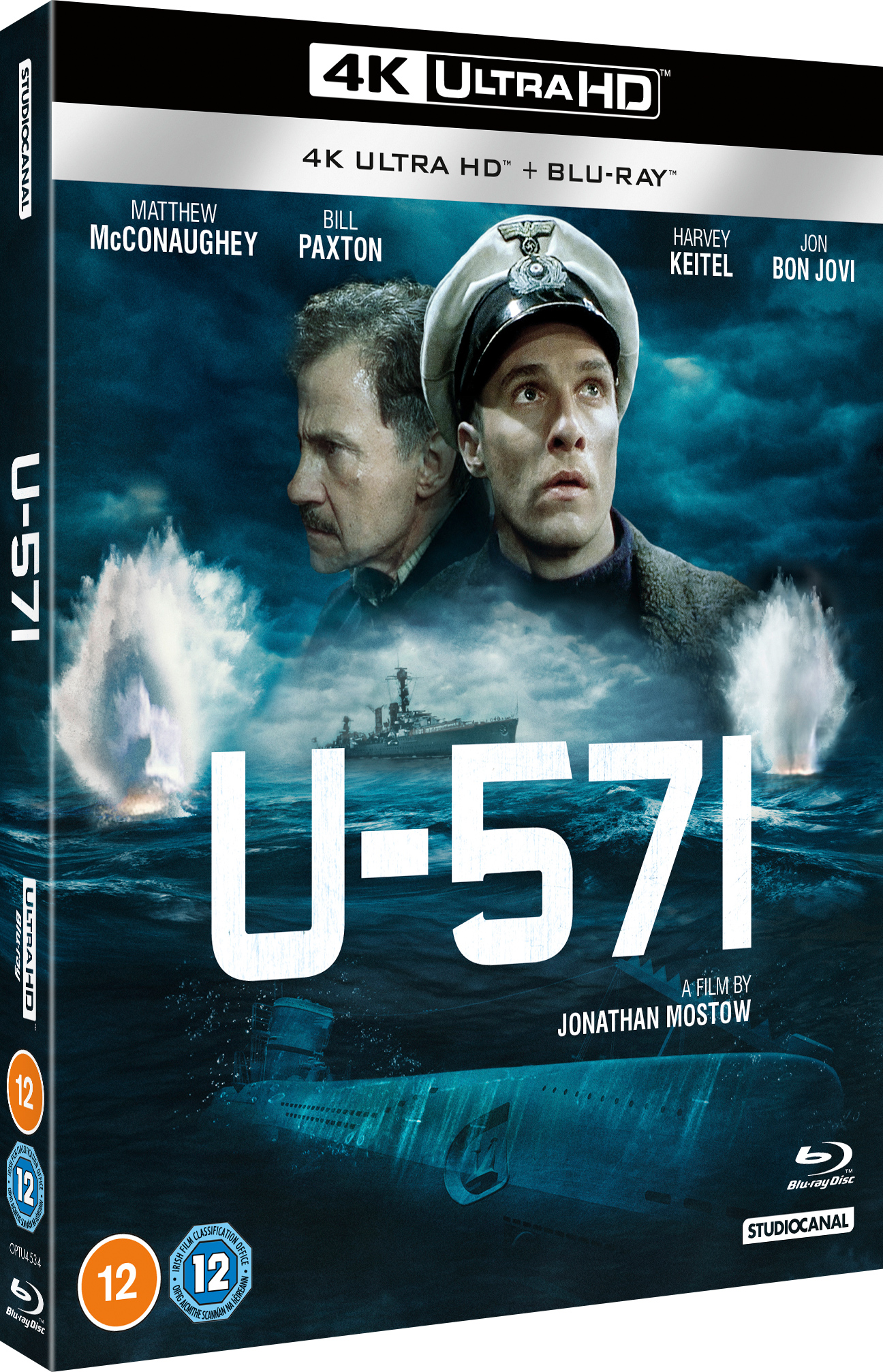
The submarine-based, action-packed WWII thriller U-571 is out now on 4K UHD from Studiocanal, and we’ve got two copies to give away to our lucky readers! Read on and enter below…
Starring Matthew McConaughey, Bill Paxton, Harvey Keitel, and Jon Bon Jovi and directed by Jonathan Mostow, the hit film follows a team of U.S. soldiers are sent on a mission to sneak aboard a disabled German U-Boat to steal an encryption device that would give the Allies the edge they need to win the war. What they don’t know is… Germans are on their way to answer the S.O.S. as well…
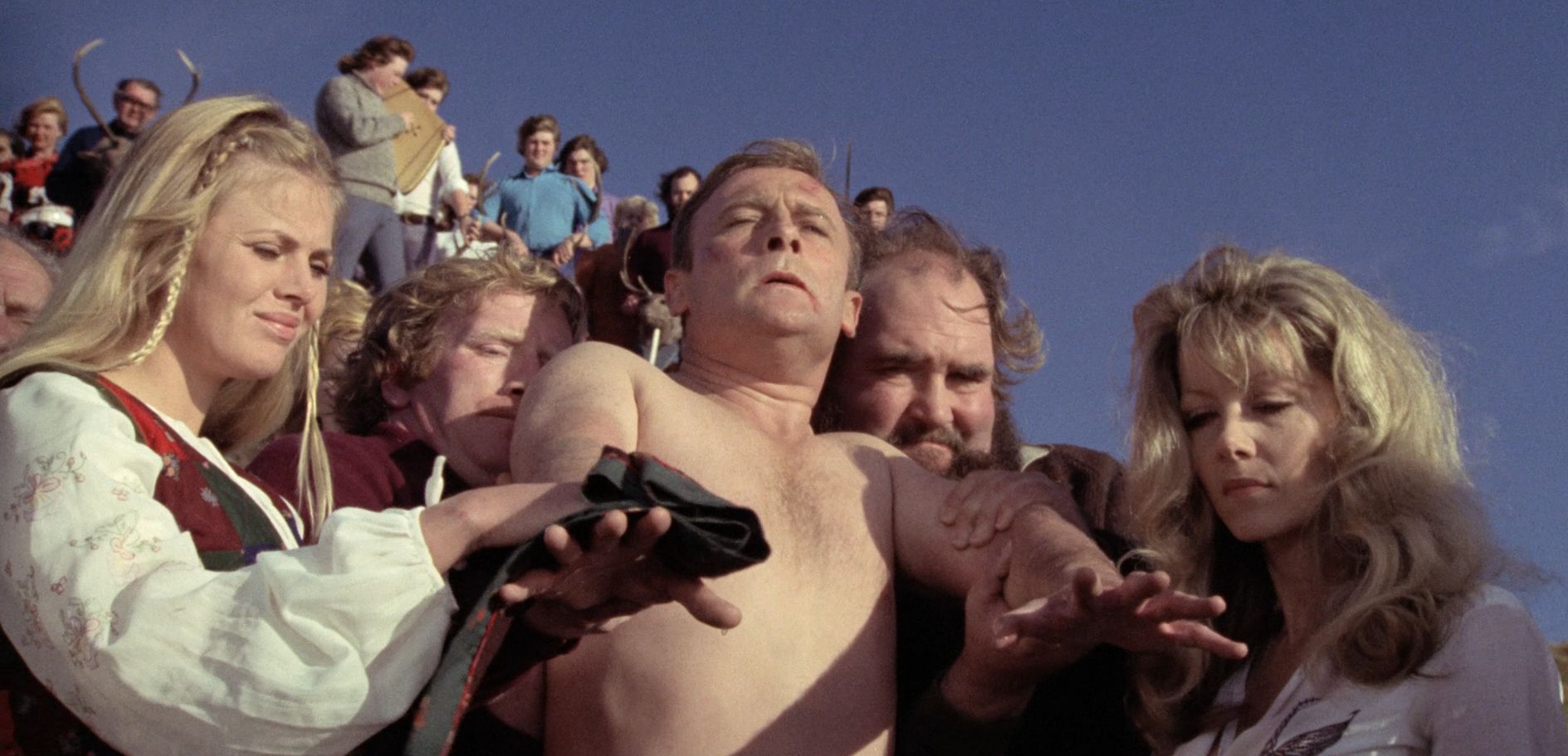
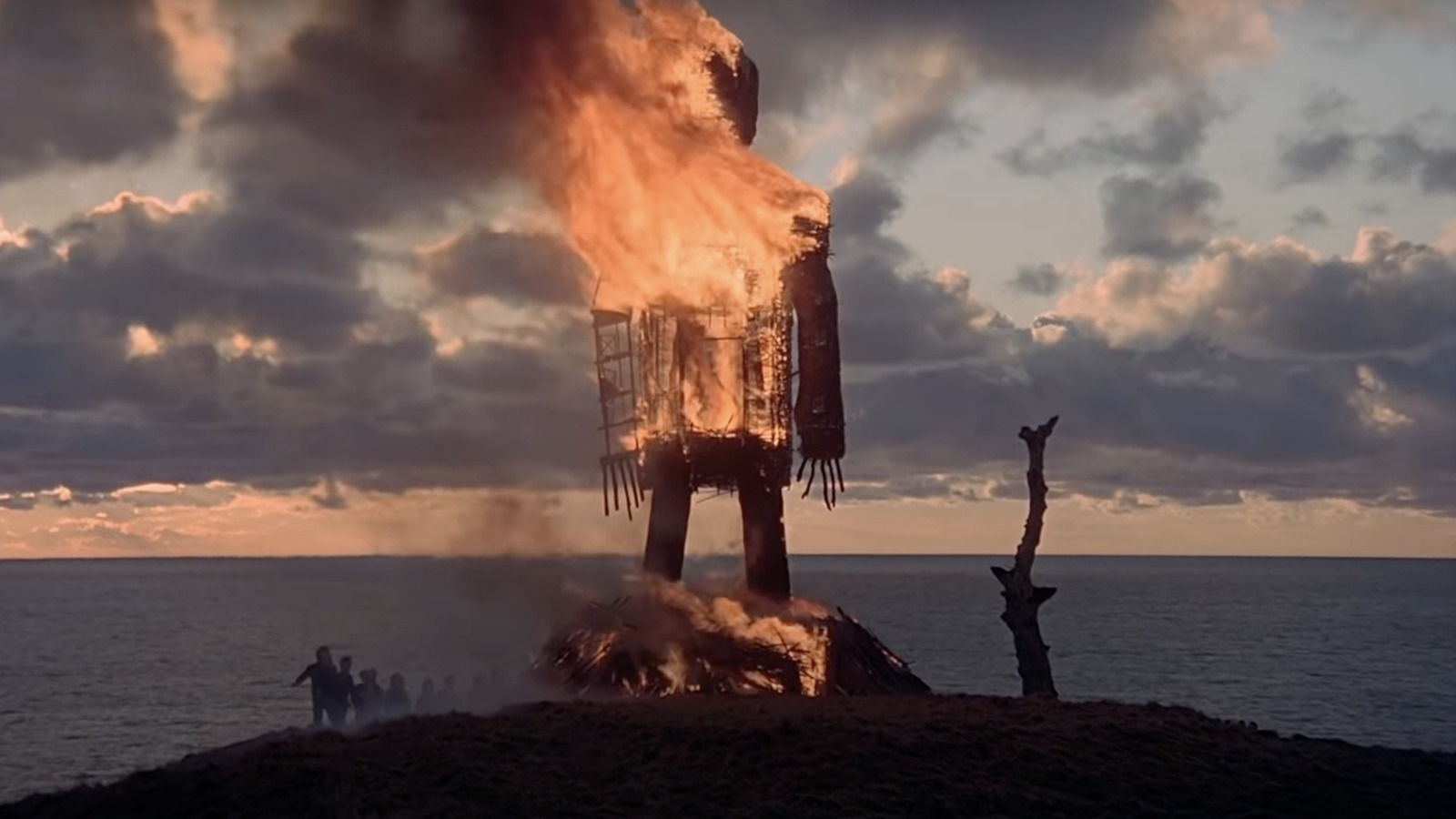
It’s hard to believe it’s been fifty years since that giant wicker man at the end of Robin Hardy’s classic was set ablaze on the cliff tops off Burrow Head, Scotland, in what became one of the most powerful and shocking film endings ever. The Wicker Man was part of a new wave of more mature horror movies that emerged in the early ‘70s alongside The Exorcist,The Texas Chain Saw Massacre and Don’t Look Now, signalling a sea change from the gaudy genre B-pictures and Hammer films that preceded it. Sadly, most of its key cast and crew have since passed away, but STARBURST was lucky to recently catch up with lead actor Britt Ekland (who played Willow) at StudioCanal’s office in central London.
Upon arrival at the glass-walled office, in a lobby occupied by various wicker creatures, Ekland was friendly, lively, and spirited, casually commenting on the dexterity of the ballet dancers we could see through the window in the building opposite.
She was also keen to discuss her memories of the production, how The Wicker Man led to her starring in The Man With The Golden Gun, and a planned but scrapped sequel to the folk horror classic that was nearly made in the 1980s.
STARBURST: It’s been fifty years since you made the film; how do you feel looking back? Do you have any good memories of the production?
Britt Ekland: I didn’t actually realise fifty years had passed until my son said to me about a month ago that it’s his fiftieth birthday in June. Then I realised that The Wicker Man also turns fifty. Such a long time ago! I keep diaries but don’t have a good memory of specific things. The one thing that stayed in my mind from the production is this endless procession. Walking and walking and walking across the moors with nothing around us. We walked towards the sea, another time towards the Wicker Man, then towards the cave where Rowan, the missing girl, was hiding.
It looked quite a joyful production because there was a lot of singing and frivolity despite its darker moments.
It wasn’t! We were meant to be wandering around a beautiful sun-filled island that had this good fortune of bearing fruit and being beautiful and gorgeous because it was set in the summer, but instead, we were on the west coast of Scotland, wandering in the typical UK weather in October and November so it was grey, damp, and cold. We were all wearing these… indescribable summer clothes. They weren’t modern, and they weren’t old. It was actually quite a brilliant wardrobe because the outfits could have been from today, but they weren’t particularly ‘70s, either.
Do you remember how you came about the project and what first attracted you to it?
I had done quite a few films before it and my agent, who was a very close friend, said: “There is this film, it’s in Scotland, it’s low budget, not a lot of money,” but we are actors, we get paid for our work. If we don’t work, we don’t get paid, and this was the next thing that came along. I thought I could deal with the kind of nudity that I read in the script, but in the end, I only bared my breasts. They could not use my bottom, but they said it was fine, so that’s how I agreed to do the film.
Did you get on okay with the cast and crew?
We were all kind of separate people. I was pregnant and felt very alone, but I did become friendly with Diane Cilento, who played the school teacher, Miss Rose. Not so much with Ingrid Pitt, Christopher Lee, or Edward Woodward. They were all solitary people, so from that point of view, it was a very lonely project. We didn’t have a community like on The Man With The Golden Gun where Maud Adams and I became best friends and are still best friends today. Roger Moore was very open and welcoming and fun on that. Hervé Villechaize was cute and fun, but he just liked to chase girls, so we never saw him outside of filming. He was very friendly and cheeky, but the minute he saw a skirt, he was off. We didn’t have that kind of community on The Wicker Man.
How did you find working with director Robin Hardy?
I don’t think he liked me very much, but he had his own problems. The film had problems with financing. Robin had heart problems, so I think it was hard to get the insurance, but ultimately, he didn’t like me. I think Ingrid Pitt wanted my role but because she was the Queen of Hammer and Christopher Lee was the King of Hammer, and this wasn’t really that kind of horror film. I think they felt if they put Ingrid and Christopher Lee in the leading roles, it would just become another so-called Hammer Horror. I know Christopher wanted to throw off his Hammer coat and become something else, and this was his first film to give him the opportunity to do that.
The Wicker Man was part of a new wave of more serious horror films that seemed to go against what Hammer represented at the time. Did you realise while you were filming that it was becoming something special?
No, not at all. Because I was pregnant as soon as we finished filming, I did no promotion or interviews or anything like that. I should’ve checked my diaries, but I don’t remember ever even seeing the film until it was re-released, I think, in 2014, when I took my youngest son to see it. Now, when I watch it, I can see the merits, but it wasn’t a happy experience to work on.
Robin Hardy described it as a melodrama musical.
It’s a different kind of horror, for sure, but the music and beat were important. Gave it an eerie, creepy feeling.
Is it right that there were marketing and distribution issues following the production?
Oh yes, it just got buried. If we use Hammer as an example, marketing those films was easy. There were fangs, blood, and black capes with red that were very important. The Wicker Man didn’t have any of that. It did have the most shocking ending of any film ever. No one has ever done anything as spectacular as that, but I think it took a long time for the promoters to realise they could put it in a different niche. They put it in a double bill with Don’t Look Now, but I don’t think that did as well as they hoped. The Wicker Man’s reputation grew over time, and it’s fans have made it what it is today.
Did The Wicker Man open new doors for you in terms of getting more roles and job offers? We were wondering if the Christopher Lee connection may have led to you working together again on The Man With The Golden Gun?
No, not at all. Golden Gun had nothing to do with Christopher. Apparently, Cubby Brocolli saw The Wicker Man and, as I was pregnant at the time and had beautiful bosoms, he thought I would be a good Bond girl. But even before that, I read the book by Ian Flemming and dressed up as the Mary Goodnight character, who was a secretary – in those days, we called the women who did that kind of job ‘the secretary’; properly dressed with her hair up, white blouse, and covered up. No high heels, just walking shoes. So I dressed just how I thought the secretary should and walked to Cubby’s office, as I lived just around the corner. I walked in and asked if I could see him. Because I was already a well-known actress, I could do that. Cubby told me they just take the title of Flemming’s books and re-write them, but he thanked me for coming.
Then, on the way out, Roger Moore came in. I had met Roger previously when I was married to Peter Sellers, so we said hello, and then I went off to America to do a movie and thought nothing more of it until on the plane back to London six or seven weeks later. I was reading an English newspaper that said: ‘Swedish girl, the new Bond girl’. And I thought, “Oh… wonderful”. But then I heard from someone else that Maud Adams got the part. When I got home, my agent called and said I’ve got to go and see Cubby Brocolli immediately. I was so naïve I thought Cubby was just going to apologise that he had to give the part to someone else. I literally got off the plane, rushed down to his office, and when I got there, he burst open the doors with the script in his hand and said: “You are Mary Goodnight”, and he handed me the script. It was very dramatic. I ran home after, all excited, knowing that a really fun and important adventure had just started in my life.
It sounds it. Many years later, Robin Hardy made a sequel to The Wicker Man called The Wicker Tree. Were you ever asked to be involved in that at any point?
Well… let’s go back. I became very friendly with Tony Shaffer [The Wicker Man’s screenwriter]. Then in the ‘80s, when I was married to Slim Jim [Phantom, drummer of The Stray Cats], Tony came to LA and gave me a script for the second Wicker Man. There was a cocktail party with very influential people to raise money for it. So I had the script and photos of me and Tony Shaffer at this cocktail party… but nothing ever came of it. Then, in the ‘90s, I lived in London off Fulham Road by Chelsea Football Ground, and Tony’s studio was opposite Marsden Hospital, Fulham Road. We met up, and I went over to have lunch with him. We talked some more about it, but then he sadly passed away, so… I knew there was The Wicker Tree, and I was offered a role in a version set in Iceland where I had to live alone in a hut somewhere and speak a strange language that they made up. It was so far-fetched, but it never happened. After that, years later, came Robin Hardy’s film, and I said I couldn’t do that.
The original Wicker Man has since become such a cult classic and still seems to be influencing folk horror films today, like Midsommar and Enys Men. What is it about the original that has such appeal and longevity?
I think it’s the ending. A lot of people do pagan ritual horror films now with characters masquerading as people they’re not, but no one has ever topped that ending. I think even if people come to the film for the first time and already know the ending, they like to see the build-up to it so you can watch in disbelief and false hope in maybe thinking that a helicopter will come and rescue him at any moment, but that doesn’t happen. The film just leaves you in this state of total disbelief, stunned with no sense of relief. I think that is the appeal.
STUDIOCANAL has restored all three cuts of THE WICKER MAN in honour of the 50th anniversary. All three versions of the film will be released in an exclusive Collector’s Edition and on 4K UHD for the first time on September 25th. The 5-disc Collector’s Edition will also include an exclusive EP from Heavenly Records, a 64-page booklet with brand new essays, 3 ‘Postcards from Summerisle’ and 2 posters of the new and original artwork. The film will also be released as a Steelbook and on Digital.
Ah, telephemera… those shows whose stay with us was tantalisingly brief, snatched away before their time, and sometimes with good cause. They hit the schedules alongside established shows, hoping for a long run, but it’s not always to be, and for every Street Hawk there’s two Manimals. But here at STARBURST we celebrate their existence and mourn their departure, drilling down into the new season’s entertainment with equal opportunities square eyes… these are The Telephemera Years!
1983-84
Glamour, adventure, and glamorous adventure were the order of the day in 1983 as the US settled into years of Reaganomics, with the big money, big hair, and even bigger shoulder pads of Dallas, Dynasty, and Falcon Crest dominating the TV ratings, making the likes of The A-Team, The Fall Guy, and Magnum, PI look positively gritty and real in comparison. The big new hits were single-moms sitcom Kate & Allie and Hotel, based on an Arthur Hailey novel that would soon become a permanent fixture of charity shop paperback spinners, and there were farewells to Happy Days, Fantasy Island, Hart to Hart, and Three’s Company (which had somehow lasted for eight seasons).
For genre fans, Airwolf and Knight Rider arrived to provide vehicular action and V: The Final Battle was creating the kind of buzz that would have set the internet alight if the internet was something that hadn’t only been invented in January 1983. Glen A Larson fans were well-served not only by the debuting Knight Rider but also the less-successful Manimal, Automan, and Masquerade, shows which did not outstay their already limited welcome. That’s what occupied the schedules in prime time but what about Saturday mornings? This is the story of 1983’s new kids’ TV hits and misses…
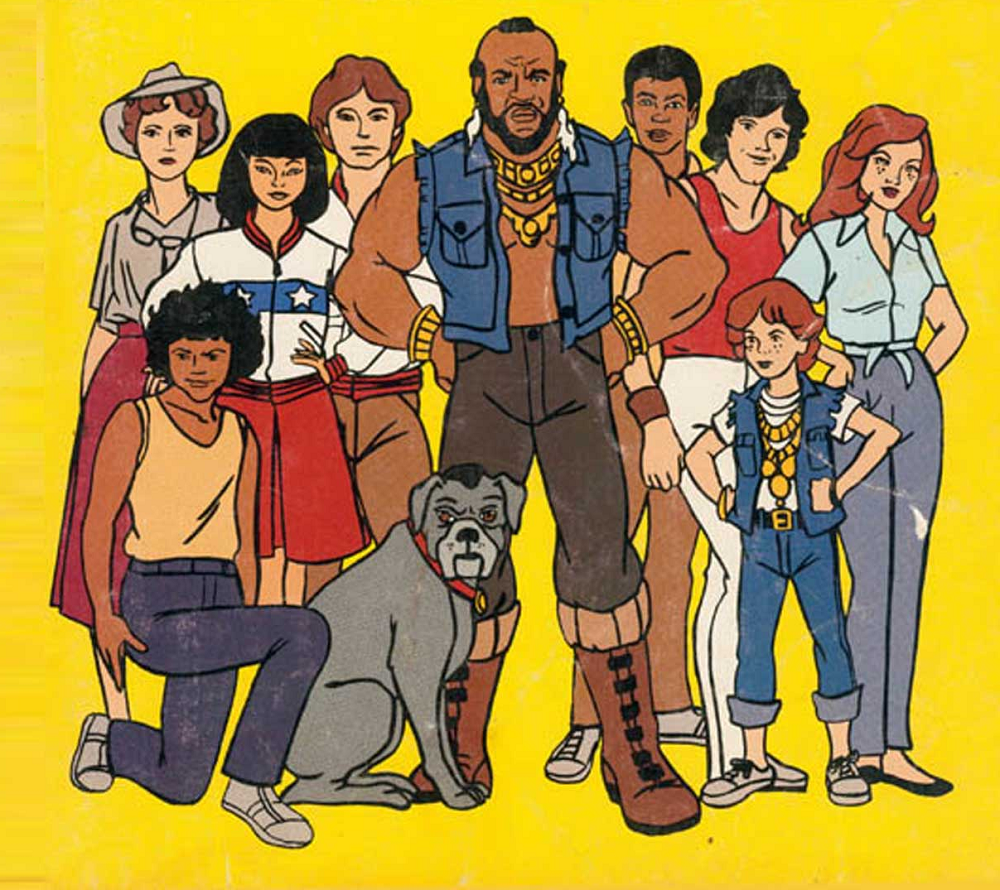
Mister T (NBC): There’s probably no way you could write Mr T’s life story and have be believable. He became Mr T – his legal name – at eighteen years old, determined that he would not be called “boy” like so many of his family and peers, that the first word out of people’s mouths when they were talking about him would be “Mister.” From there to adopting the hairstyle of the Mandinka warriors from a spread he saw in National Geographic, to being spotted by Sylvester Stallone while competing in America’s Toughest Bouncer on NBC and being cast in Rocky III, the world soon learned that this man was no fool, and certainly not one that could be in any way pitied.
In January 1983 he made his debut as BA Baracus on The A-Team, sending his star rising even higher, and had already signed a deal to star in an animated series made by Ruby-Spears. Erroneously titled Mister T (legally he’s just Mr), the show saw him become a coach to a youth gymnastics team, imparting wisdom to his charges – every episode ended with a particular lesson from our overgolded hero – and solving mysteries as they toured the world. Oh, and he’s got a dog. With a mohawk.
The first season of twelve episodes debuted in September 1983 and took T all over the US and into Mexico, with subsequent seasons extending the team’s reach to Canada and Egypt, but wherever they went there were plenty of people up to no good. With the help of his flexible children, their capable driver, and a dog, T took down sinister scientists, ninjas, street thugs, pirates, arsonists, and all manner of threats to whichever locality their seemingly never-ending gymnastics tour took them to.
Somehow they got three seasons out of this, without ever explaining how T’s gymnastics squad was funded or where their parents were, and in the best Saturday morning tradition each of the thirty episodes can be watched in any order, the status quo reset at the beginning of each instalment. With all Ruby-Spears productions becoming part of the Hanna-Barbera operation in 1991, the DVDs can be obtained through the Warner Archive Collection but, really, all you need is that Haim Saban theme tune, one of the best of any Saturday morning cartoon or any TV show.
Rubik the Amazing Cube (ABC): Ernő Rubik was a professor of architecture and design when he created the puzzle that would make him famous, coming up with the concept as a way of testing his students. Obtaining a patent for the cube in 1975, it was first licensed in the UK in 1978, and in the US through Ideal in 1980. Within a year, Rubik’s Cube had become a phenomenon, selling almost 300 million units, and books offering short-cut solutions became best-sellers.
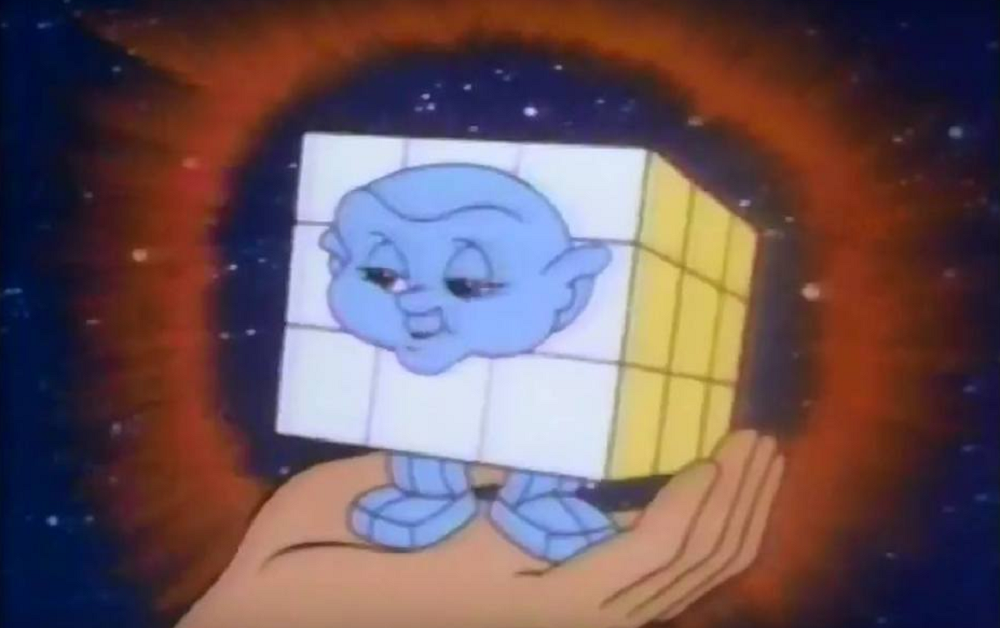
All of which explains why, on September 17th 1983, Rubik the Amazing Cube became part of ABC’s Saturday morning line-up. A Ruby-Spears production, the show’s basic premise involved the eponymous puzzle – with added head and legs – escaping from his evil magician master to be found by a trio of children (and obligatory dog). The twelve episodes largely dealt with the magician’s efforts to regain his property, but Rubik also found time to help the kids deal with more humdrum adversaries.
Where Rubik the Amazing Cube broke new ground was in its mostly Hispanic cast of characters, voiced by Latinx voice actors including Welcome Back, Kotter’s Ron Palillo, and with a theme tune provided by ever-mutating teen group Menudo. The children were depicted as particularly bright, especially when it came to solving puzzles (which included usually having to put a scrambled Rubik back into order to access his magic powers).
Ernő Rubik went on to create Rubik’s Magic, Rubik’s Snake, Rubik’s 360, and more, all with diminishing returns and none of which earned a Saturday morning cartoon, although he’s still active at seventy-nine and you shouldn’t rule anything out when it comes to Rubik the Amazing Human.
GI Joe: A Real American Hero (syndication): Tired of seeing its twelve-inch line of GI Joe action figures beaten at the checkout by the three-and-three-quarter-inch Star Wars toys from Kenner, Hasbro took action. Not only would it produce its own line of smaller figures, but it would also engage the services of Marvel Comics to provide a compelling back story for its heroes and villains, told each month in the pages of a comic book that eventually ran for over twelve years.
To support both the comic book and the toyline, Hasbro engaged the fledgling Marvel Productions studio to produce a series of thirty-second animated commercials, which proved extremely popular. A year after the launch of the Marvel comic, Hasbro and Marvel went a step further, taking advantage of relaxed regulations surrounding the use of feature presentations as advertising to produce an animated mini-series, perfect to sell its wares to a whole generation of kids glued to their goggle boxes.
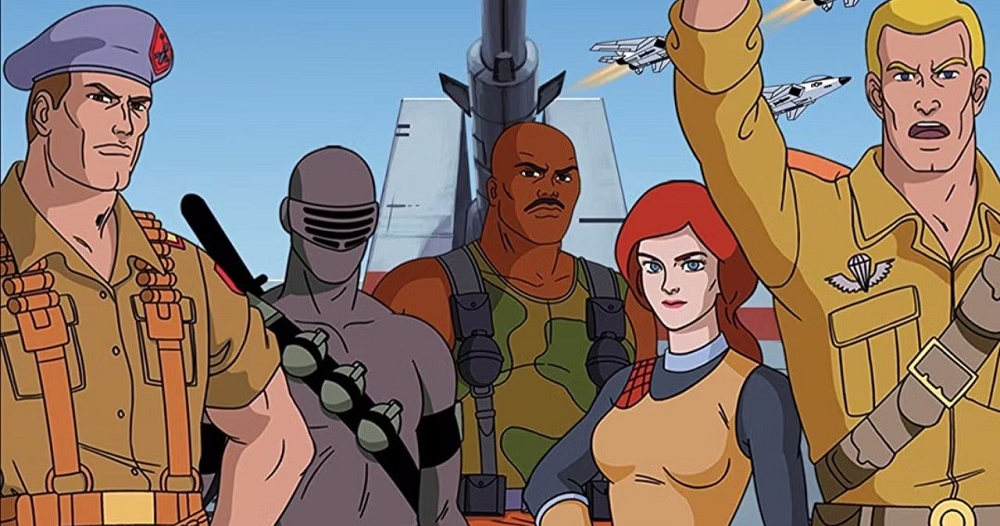
GI Joe: A Real American Hero debuted in syndication on Monday September 12th 1983 and told, over five daily episodes, the story of the evil Cobra organisation’s attempt to steal a satellite, eventually thwarted by Duke and his team of colourful operatives. Written by Ron Friedman (although the basic concepts were all pretty much developed by Vietnam-vet Larry Hama at Marvel), the series was enough of a success that a second mini-series aired a year later, this time surrounding Cobra’s attempts to control the world’s weather.
In September 1985, a full series of GI Joe: A Real American Hero debuted, consisting of the fifty-five episodes needed to (when added to the two mini-series) take the show up to the level needed for quarterly syndication, with a second full season of thirty episodes following a year later. The story was continued in a feature-length animated movie released in 1987 that was originally supposed to end with the death of Duke, only for the backlash surrounding the death of Optimus Prime in Transformers: The Movie to force a late and clumsy edit.
The toyline continued to be popularly into the early 1990s, with DIC producing a sequel series of forty-four episodes between 1989 and 1992, and remains beloved for a certain generation of American adults who spent their adolescence re-enacting the cartoon’s episodes and shouting, “Yo Joe!” at every opportunity.
Saturday Supercade (CBS): Alongside turning Mr T and a multi-coloured puzzle into Saturday morning heroes, 1983 also saw Ruby-Spears take a crack at translating the thrill of the arcade – or its less-thrilling home equivalent – through a series of short cartoons based on the popular videogames of the time. Collected together as Saturday Supercade, the line-up spanned the developing videogame market to bring action from games developed by Konami, Sega, Nintendo, and more, in a weird mix of humour and adventure serials.
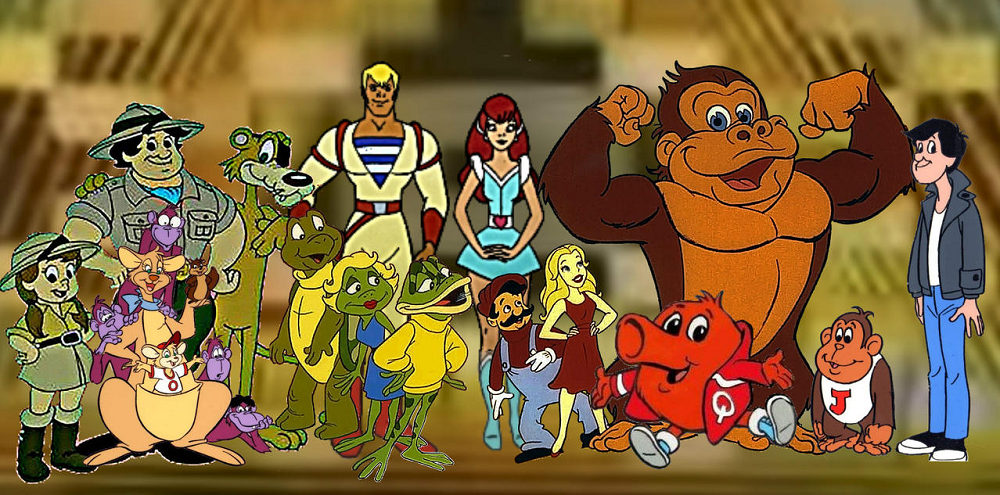
First up to bat was Frogger, a game that never attempts to answer the question “why did the chicken cross the road?” by instead featuring a frog who has no reason to cross, he JUST MUST. In this version of the story, however, Frogger is an ace reporter for The Swamp Gazette, engaging his pals to investigate stories that often involve him being squashed by traffic or eaten by an alligator (but always revived).
Frogger was joined by a Donkey Kong that was on the run from Mario’s circus, Pitfall’s jungle explorer Harry, and an incredibly bizarre interpretation of Q*bert, who is now a 1950s teenager living in the town of Q*berg who has to deal with the attentions of a group of bullies, aided only by his girlfriend Q*tie and brother Q*bit. Donkey Kong and Pitfall were replaced for the show’s second season – yes, there was a second season of this nonsense – by segments based on Atari’s Kangaroo and Don Bluth’s Dragon’s Lair sequel, Space Ace.
In recent years, there has been a clamour for a home video release of the series, fed by a nostalgia-crazy band of forty-somethings, but rights issues and missing masters have prevented much of it being released, even as an on-demand release through the Warner Archive. Q*bert, though, did get his own DVD, compiling seventeen of the nineteen episodes – in 2015, through Sony Pictures Entertainment, although sales figures for this sure hit remain frustratingly elusive.
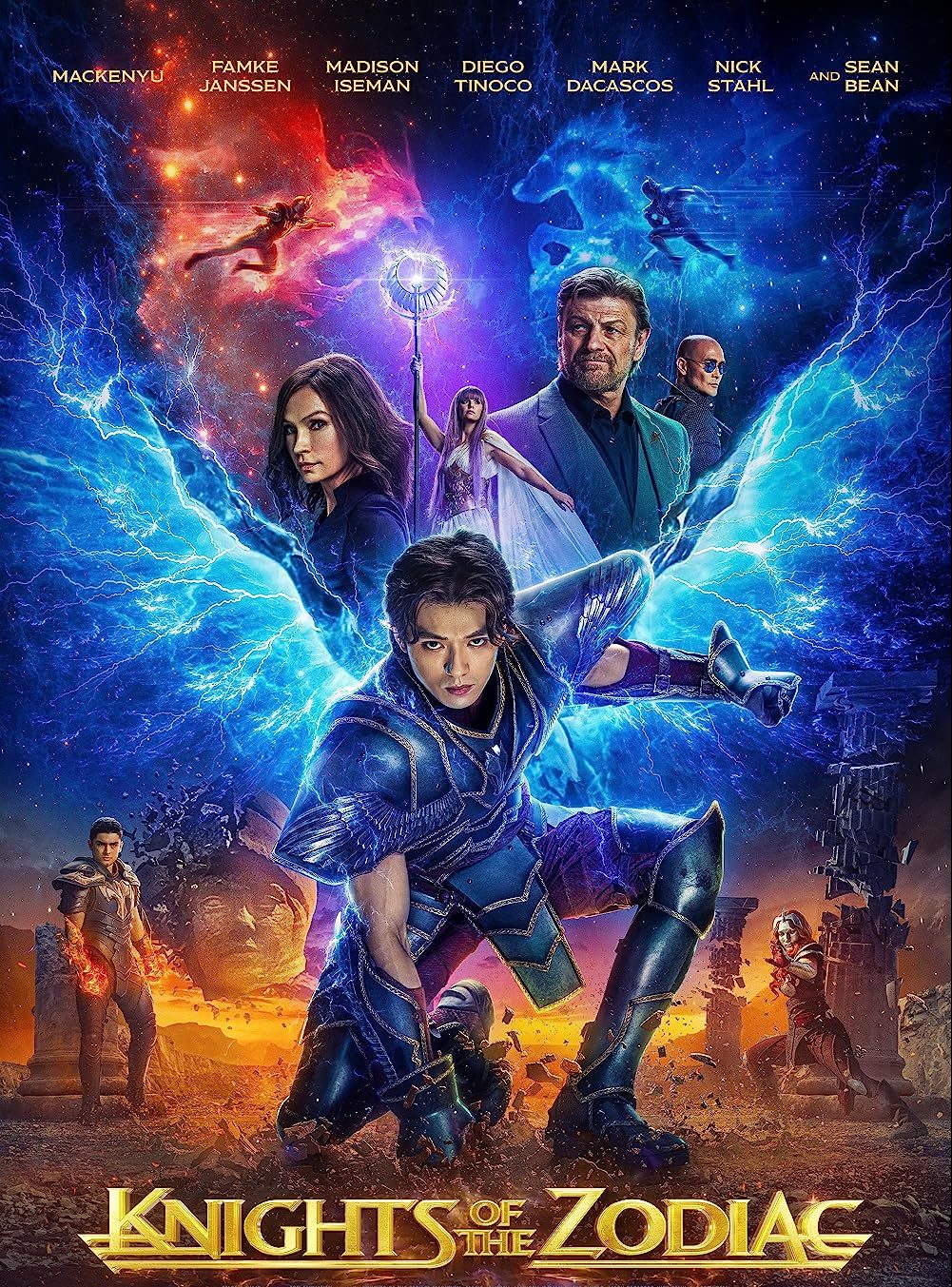
Cult franchise KNIGHTS OF THE ZODIAC has a massive global outside the UK and USA. The new live-action version of this classic anime and manga phenomenon – coming soon to Digital – features Sean Bean, Famke Janssen, and a whole host of special effects. STARBURST brings you up to speed…
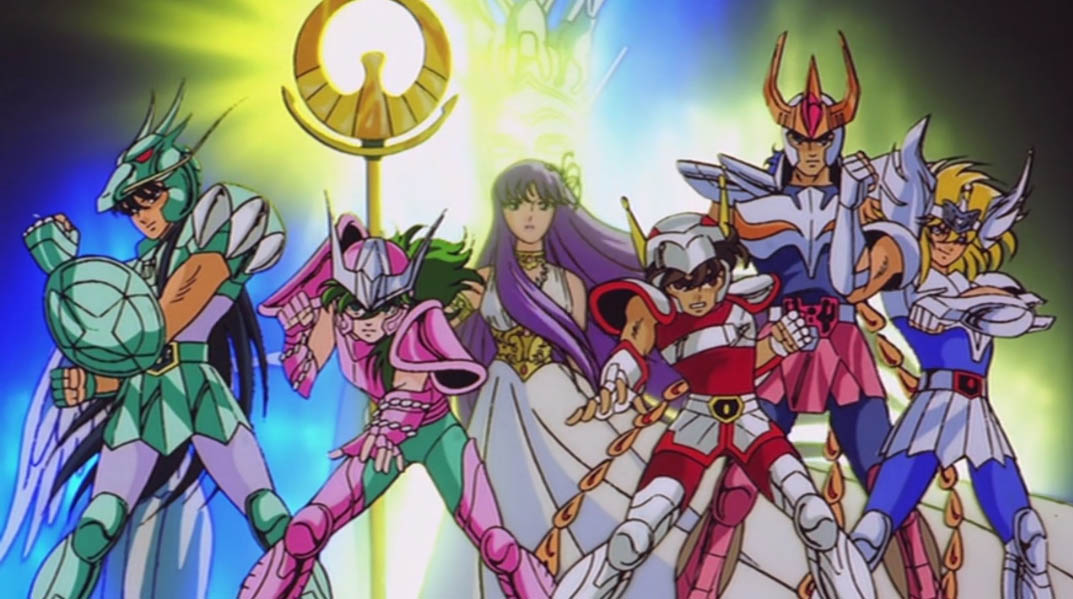
Knights of the Zodiac is better known to most of the world as Saint Seiya or, if you’re Japanese, Seinto Seiya. It’s a long-running manga that appeared in Japan’s Weekly Shōnen Jump magazine in 1986. It was created by the legendary Masami Kurumada. Originally intended as a sports drama inspired by TheKarate Kid, the story quickly mutated into a tale of magically powered martial artists. Those powers come from cloths and magical armours that are powered by the constellations, and together, they protect the Goddess Athena, who in turn defends the Earth from all the other Greek gods. These 88 warriors (divided into bronze, silver, and golden ranks) use Cosmos Energy, which focuses the awesome power of the stars, allowing them to achieve amazing feats of strength and power. The animated show was developed simultaneously and ran for an astonishing 114 episodes before getting cancelled. Only the first two main story arcs from the comics (the Sanctuary Act and The Poseidon Act) originally made it to the screen.
Saint Seiya was rebranded as Knights of the Zodiac in the ’80s and ’90s for European audiences. Known as I Cavalieri dello zodiaco in Italy, Les Chevaliers du Zodiaque in France and Los Caballeros del Zodiaco in the Spanish-speaking world, the show picked up a huge international cult following. This is partly due to the ‘very violent for the time’ storylines that involved super-powered teens beating the snot out of each other and also because it has a very catchy and memorable theme song. Many of the adventures had a tournament format, with heroes and villains facing off for ridiculously over-the-top fights in almost every episode, with an added element of soap opera drama for spice.
In the 2000s, there was an attempt to launch Knights of the Zodiac in the US and UK off the back of shows like Sailor Moon and Power Rangers. Alas, much of the violence was edited out to widen the show’s appeal, and the heavy metal theme song was replaced with bland American rock. Up against shows like Samurai Jack, the rapidly ageing show fared poorly. Re-edited and reissued versions of the original anime and manga did gather something of a cult following in the US and were devoured by fans in the rest of the world, alongside a whole range of cool action figures from Bandai.
Fans would have to wait until 2002 before an animated version of the final Hades act made it to the screen. However, the show had a huge following in Japan, and the final act sparked a revival of interest in the franchise with new animated shows, comic books, toys and, of course, the inevitable Funko Pops.
Knights of Zodiac has been an incredible influence on the superhero martial arts genre, but as it’s almost unknown in the US, many American fans think that it’s corny as they’ve seen shows inspired by the franchise before seeing the original. This hasn’t stopped the rest of the world from enjoying it, though.
The live-action movie came out this year and is a special effects extravaganza that barely touches the lore of this epic franchise, focusing on the origins of Athena’s arrival on the mortal realm and the rise of her beloved protector, the knight Seiya. The movie is notable because it’s written as the first chapter in an ongoing series, touching lightly on the complicated lore behind the franchise’s success. With the exception of Seiya and Athena, many of the cast play characters considered minor by the fandom. We caught up briefly with some of the cast, mostly to talk about the movie’s spectacular combat scenes and effects.
Famke Janssen should be well known to STARBURST readers for her work in movies such as GoldenEye and the X-Men franchise. In Knight of the Zodiac, she plays the main villain, Guraad, who seeks to destroy Seiya. Famke was unfamiliar with the source material before beginning the project but told us she’s now a huge fan. She had much fun with the various effects shots during the production, especially with the virtual sets. “A lot of people use this new technology. It gives this very discombobulated feel because the background is attached to the camera movement. And so when you’re on set, it looks like your backdrop moves around. So everything sort of lunged when I stood up. I was like, what’s going on? But it’s a lot like doing green screen, which I’ve done it so many times.”
Diego Tinoco plays Guraad’s main henchman, Nero. We asked him more about working with the various special effects. “It was my first time working with wires. I had no idea, and I had this first thought right when punching the camera. I was trying to perform an action, and suddenly, I got yanked backwards super fast! I go flying across the room, and I hit these padded mats. I had no idea that was going to happen. I mean, they prep people, but you can’t really prep for that feeling of flying into the air. So it was pretty crazy for me.”
Nick Stahl is perhaps best known as John Connor in Terminator 3: Rise of the Machines. In Knights of the Zodiac, he plays the thuggish Cassios. He features in the movie’s many action-intensive scenes. “I was very glad I was able to train with the stunt team early on; I think I was there a month early. By the time we filmed, it was like we eased into it.”
Madison Iseman plays the character of Athena. She told us, “There’s a scene where Athena has to float in the sky and be a goddess. There was a question of whether it would be wires or whatever. They made a rig where I was sitting on a bicycle seat, and they would lever me up into the sky. And it made so much sense because I was able to float without being hauled necessarily. They did such a great job on the heavy lifting!”
KNIGHTS OF THE ZODIAC is available to buy on Digital from September 25th
Glamour, adventure, and glamorous adventure were the order of the day in 1983 as the US settled into years of Reaganomics, with the big money, big hair, and even bigger shoulder pads of Dallas, Dynasty, and Falcon Crest dominating the TV ratings, making the likes of The A-Team, The Fall Guy, and Magnum, PI look positively gritty and real in comparison. The big new hits were single-moms sitcom Kate & Allie and Hotel, based on an Arthur Hailey novel that would soon become a permanent fixture of charity shop paperback spinners, and there were farewells to Happy Days, Fantasy Island, Hart to Hart, and Three’s Company (which had somehow lasted for eight seasons).
For genre fans, Airwolf and Knight Rider arrived to provide vehicular action and V: The Final Battle was creating the kind of buzz that would have set the internet alight if the internet was something that hadn’t only been invented in January 1983. Glen A Larson fans were well-served not only by the debuting Knight Rider but also the less-successful Manimal, Automan, and Masquerade, shows which did not outstay their already limited welcome. But at least those shows got the chance to fail; this is the story of 1983’s unsold pilots…
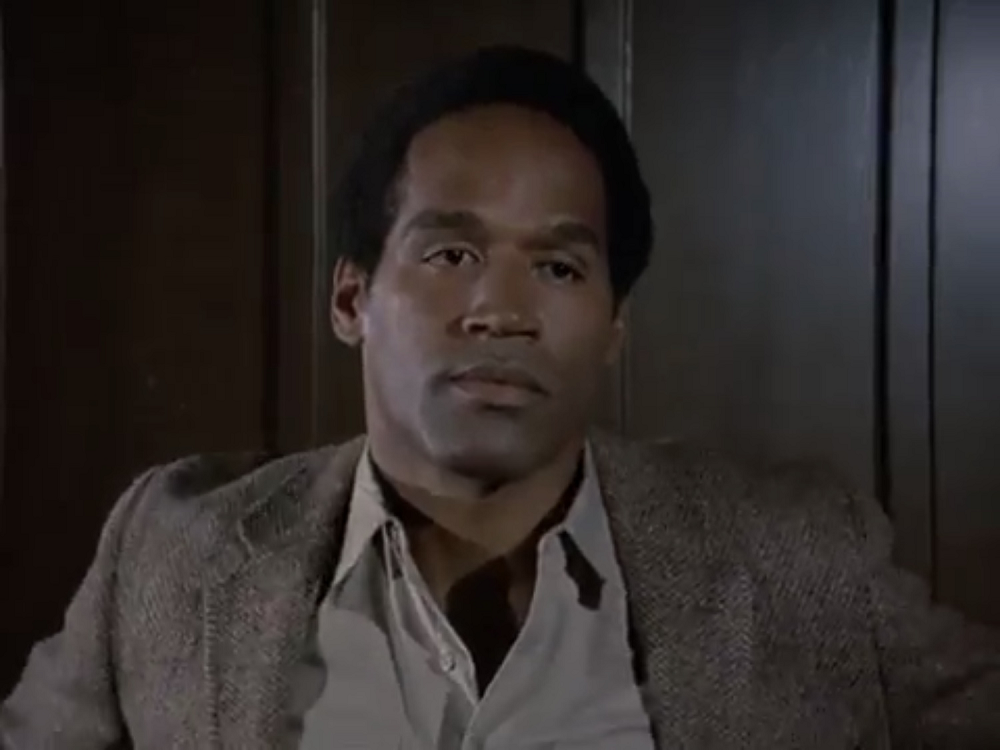
Cocaine And Blue Eyes (NBC): When OJ Simpson retired from his glittering professional football career in 1979, he’d already dabbled in acting. In fact, his first acting job came while he was playing college football at the University of Southern California, appearing as a potential police recruit in Dragnet, and afterwards he doubled up as an actor while playing in the NFL with the Buffalo Bills and San Francisco 49ers. After enjoying supporting roles in the likes of The Towering Inferno and Capricorn One, Simpson set up his own production company – Orenthal Productions – which produced mostly made-for-TV fare.
In 1983, Orenthal Productions grabbed the rights to Cocaine and Blue Eyes, a novel by Fred Zackel that featured a no-nonsense private detective on the hunt for the missing girlfriend of a recently deceased client. Of course, Simpson cast himself as PI Michael Brennen, and Kendelle J Blair’s script turned Zackel’s novel into a modern film noir, complete with voiceover and hackneyed dialogue that would have been embarrassing if uttered by Humphrey Bogart, let alone a limited ex-footballer.
With a supporting cast that also included Cliff Gorman (nope), Eugene Roche (me either), Keye Luke (ooh, heard of him!), and Candy Clark (American Graffiti), and direction from the brilliantly named veteran EW Swackhamer, Cocaine and Blue Eyes stumbles along, hampered by its chief casting choice, its decision to use film noir tropes in a modern-day setting, or both. Needless to say that NBC executives, although put it out as part of their Sunday Night at the Movies block, were not interested in a full series.
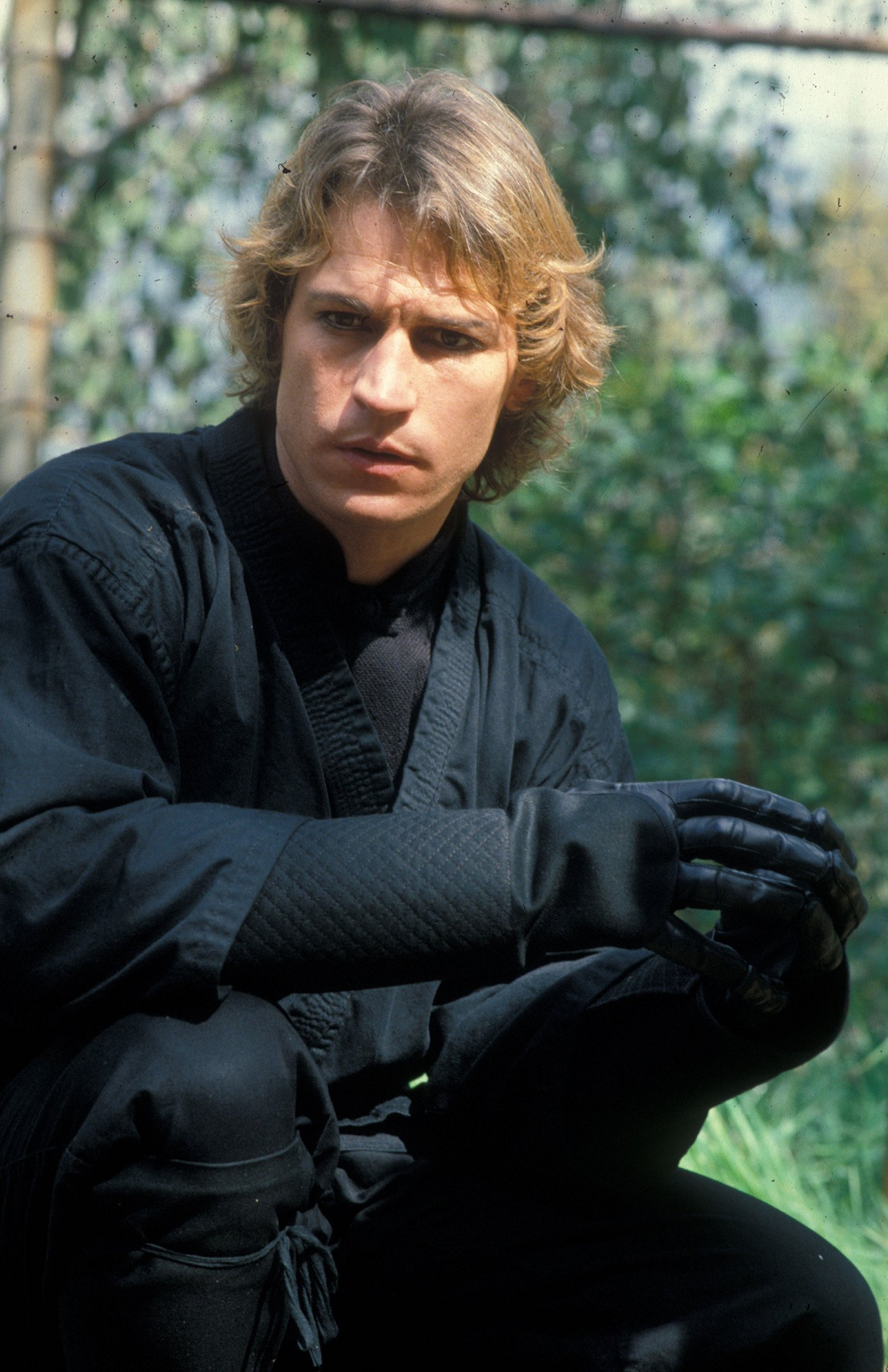
The Last Ninja (ABC): America was ninja crazy in the early 1980s, an extension of the general martial-arts fad of the 1970s and sparked by Eric van Lustbader’s 1980 novel, The Ninja. Cannon Films’ Enter the Ninja in 1981 brought the black clad assassins to the big screen (and, subsequently, the small one through the VHS explosion), and TV was looking to get in on the act. While NBC grabbed Lee van Cleef to star in The Master, ABC instead went for Michael Beck, a B-movie star with an impressive (for people who like that sort of thing) résumé that included The Warriors, Xanadu, Warlords of the 21st Century, and Megaforce.
Beck was cast as Kenjiro Sakura, an American adopted by a Japanese family as a baby and raised in the mysterious ways of the ninja! The Last Ninja finds Ken living quietly in America as an antiques dealer, complete with a sweet hidden ninja cave. He is contacted by a shady government agent named Cosmo, who mentions he’s been tracking a mysterious crimefighter in the area – who, of course, is Ken but he denies this – and offers Ken a job to deal with a bunch of terrorists who’ve taken over a tower block. So far, so Die Hard, and Ken reluctantly agrees to keep the world safe.
The pilot plays out with Ken’s heroics intercut with flashbacks to his training, including a ninja kitten and a sequence where his adopted father drops him in a barrel of water as a baby to see if he has what it takes to swim to the surface (and thus be worthy of ninjadom). The fight sequences are less violent than you’d imagine, although this was intended as a trailer for a prime-time series, and lean heavily into the spiritual side of ninjitsu, but it still didn’t impress ABC executives who passed on taking the concept to series. Just as well, The Master lasted for just thirteen episodes but The Last Ninja might well have been a different prospect…
Nightmares (NBC): In 1983, Joseph Sargent (born Giuseppe Sorgente), a veteran director with credits including MacArthur, The Taking of Pelham One Two Three, and sports sci-fi flick Goldengirl, was given the opportunity to helm a pilot for NBC’s proposed new horror anthology series. Once a popular inclusion on TV schedules across all three networks, ABC had made an attempt to bring back the format with Darkroom in 1981, although that show lasted just seven episodes (and it was even rumoured that the segments used in Nightmares had been originally intended for that show).
Starring Lance Henriksen, Cristina Raines, and Emilio Estevez, who’d just completed The Outsiders and was about to make Repo Man with Alex Cox, the project also featured Lee Ving (from the punk band FEAR), Moon Unit Zappa, and The Thing’s Richard Masur. The pilot consisted of four segments, three of which were written by producer and BJ and the Bear creator Christopher Crowe, featuring serial killers, videogames, demonic trucks, and even more demonic rats.
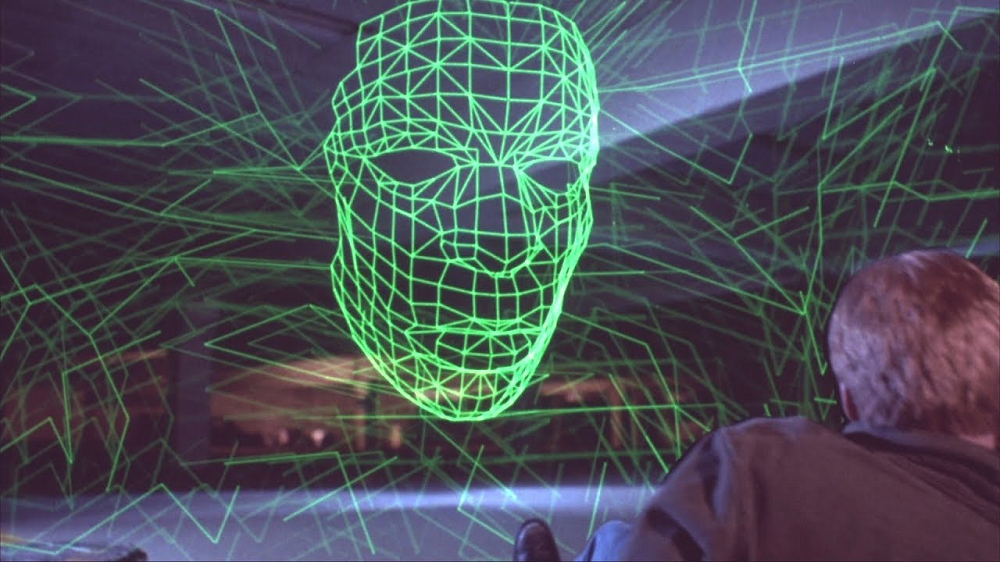
With new technology developing all the time, Sargent was persuaded to use cutting edge technology for his film, and it became the first to combine live-action footage and computer-generated imagery, produced with an ACS1200 computer, a decision which cost so much it almost bankrupted the production. Eventually cut into a two-hour movie and retitled Nightmares, the anthology was released theatrically in September 1983, making back its budget at the box office but little else.
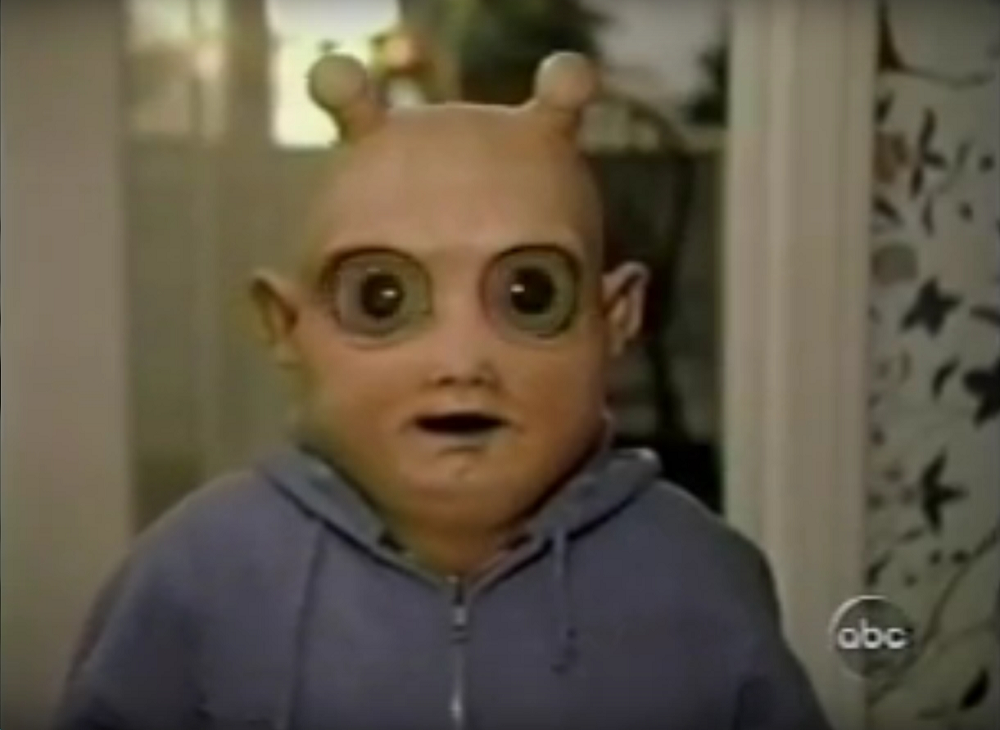
Wishman (ABC): In the scramble to cash in on the success of ET: The Extra Terrestrial, many strange products and projects were greenlit, and Wishman might just be the televisual equivalent of those weird green and orange biscuits that Nabisco produced in association with Spielberg’s movie. Given the name of the show, you might think that the titular creature might grant wishes, but you would be wrong. “Wishman” comes from the thing’s creator, Dr Wish, the head of a science project designed to create the first intelligent life from scratch.
Now if you thought that this is something that would probably soon go awry and in that you would be right because as soon as Dr Wish’s corporate bosses order Wishman to be dissected because it can’t follow a simple instruction, his assistant Alex (The Blach Hole’s Joseph Bottoms) steals it away, hiding it in his home to keep it safe. At this point, we’re yet to see what Wishman actually looks like – it’s been all partial glimpses and POV camera shots for the little beasty – but after Alex enlists the help of his wife (Linda Hamilton, still a year away from Terminator), we are introduced to a strange little orange child. With antenna.
Needless to say, when it is discovered that Alex has stolen a valuable piece of company property, they send hired goons after him, leading to Wishman saving the day with his electrical powers. At least for now, because this was intended as a pilot and the film ends with Dr Wish being given seventy-two hours to recover the asset. Except that was it. No series. No more Wishman. No more partial nudity far too racy for a prime-time TV series. Nothing. I wish there’d been more.
Savage in the Orient (CBS): With Magnum, PI doing gangbusters business on Thursday nights, and Tales of the Gold Monkey having whet whistles for light drama featuring transplanted Americans in Southeast Asia, you might think that Savage in the Orient was the result of a stereotypical approach to commissioning TV, as well as having a title that – even for 1983 – doesn’t sit well with modern sensibilities. What you probably wouldn’t think was that it came from the fevered imagination of Wendell Mayes, the man responsible for Death Wish, Von Ryan’s Express, and The Poseidon Adventure…
In this pilot for a proposed Fall 1983 series, Joe Penny is Peter Savage, a private detective operating out of Manila, where he also runs an antique shop. Born in England, Penny had acted in minor roles until 1981’s The Gangster Chronicles, where he played Bugsy Siegel, and would go on to star in Glen A Larson’s Riptide and be Jake in Jake and the Fatman. In Savage in the Orient, he’s hired to ensure the release of an American hostage but when the hostage is killed things start to go very wrong.
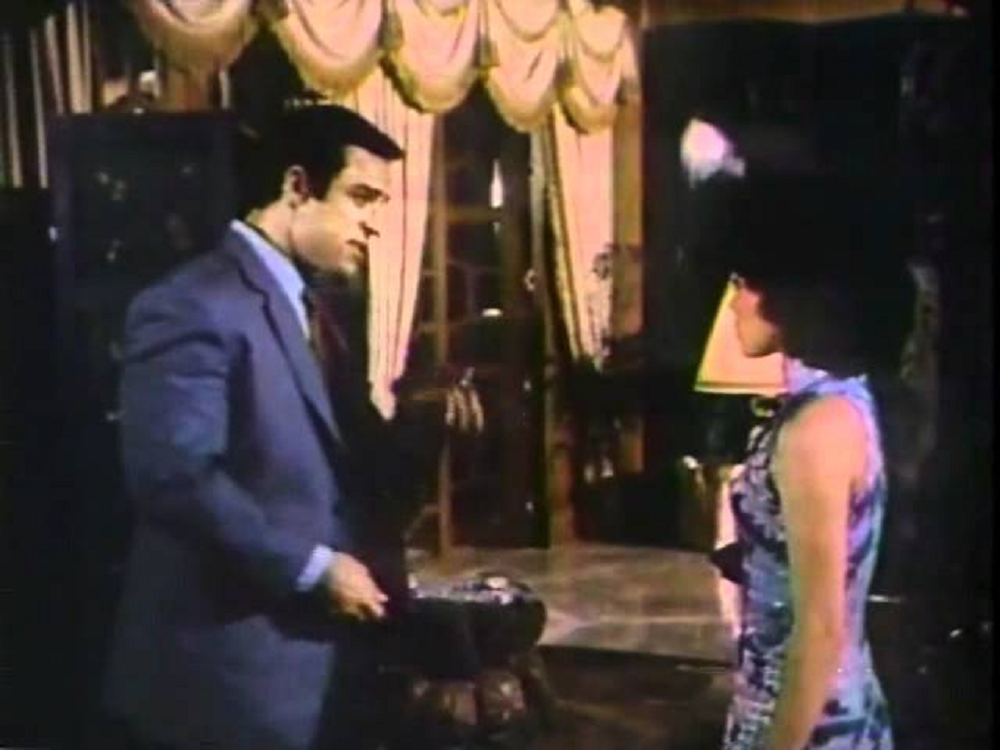
With able backing from Leif Erickson and Gayle Hunnicutt, Penny is a decent action lead, and it’s easy to see how they might have gotten a full series out of the exploits of a laid-back transplant solving crimes the locals couldn’t handle. Unfortunately, CBS already had Magnum, PI and so passed on more Savage. Mayes completed just one more screenplay, 1992’s Criminal Behaviour starring Farrah Fawcett. He died later that year, not knowing if Criminal Behaviour would do what Savage in the Orient could not and go to series. (It didn’t).
Luck is something we contend with in our daily lives, influencing its most mundane and impactful events. We can’t know if coincidences happen for a reason or not – except when they happen in a script. With our favourite movies, we can put names and faces to the people that made them happen and sometimes, they get a little too familiar with luck to drag out their stories. Here are three examples.
When Luck Counts
First, we should establish when luck counts. For example, some might say how very convenient it is that a plot starts through a chance encounter. However, at the start of a story, we’re generally more forgiving of coincidences and blind luck as everything is set up – the stakes are low. It’s at the climax of a movie, when loose ends need tying up that it’s most egregious.
Luck itself is an entertaining notion. There are entire industries built off luck, where the appeal is how unpredictable an outcome can be. Think casinos or their digital counterpart – iGaming websites. On these sites, users will line up to play slingo bingo exciting games where the outcome is entirely random. They may have different themes and digital art styles, but the central premise of each game revolves around luck.
So, luck can be enjoyable but, when it’s the difference between the hero winning or losing, it can deflate tension and show the writer’s invisible hand guiding the action.
A Train Tunnel Saves Mission: Impossible
The Mission: Impossible franchise is getting long in the tooth, with seven released movies and an eighth upcoming. While Tom Cruise has received heaps of praise for keeping the franchise modern and doing his own stunts, it’s the very first movie that has a glaring ‘well, that was lucky’ moment.
In the first movie, Ethan Hunt becomes a suspected traitor to his organisation – the IMF. As a result, he must go it alone to find out who is trying to leak CIA secrets while avoiding those trying to bring him to justice. To do that, he actually steals the CIA secrets in that famous sequence.
The plan is to rendezvous with bad guys Max and Phelps to expose them, clearing Hunt’s name. Now, that plan can be debated already (betray your country to prove you’re not betraying your country) but it’s the Max meeting where luck strikes. Hunt gives Max the list of CIA secrets while Ving Rhames’ Stickell makes sure she can’t upload it.
However, he gets chased away by agents and Max almost completes her upload. Just as it’s about to go through, the train goes into a tunnel that stops her connection. This being the ‘90s, the whole transfer is aborted instead of just carrying on afterwards.
Skyfall Needs the Trains to Run on Time
For Daniel Craig’s third outing as James Bond, Skyfall put aside the typical rogue’s gallery to give us Raoul Silva instead. A forsaken MI6 agent, Javier Bardem’s Silva is out for revenge against the organisation. His plans come to fruition in a London set piece that involves getting captured, tricking the MI6 into hacking themselves and then escaping through the London underground to cause chaos.
In fact, Silva escapes to the real underground – old pathways built and forgotten beneath the modern tube systems. Bond catches up with Silva, who does the expected thing by dropping a train on Bond. See it for yourself.
Amongst other issues with his winding plan, people have questioned how Silva could be so accurate with the train timing here. After figuring out the younger (but still old) Bond might catch him here, he needs to find the perfect point and angle to blow the old station open so that a modern train will fall through, right on cue.
There’s a world where Silva had a five, maybe ten-minute wait on his hands after dropping that witty radio callback. Of course, this is nowhere near the wackiest a Bond film has gotten. However, for the best-performing Bond movie with a great, relatively grounded story, it raises eyebrows.
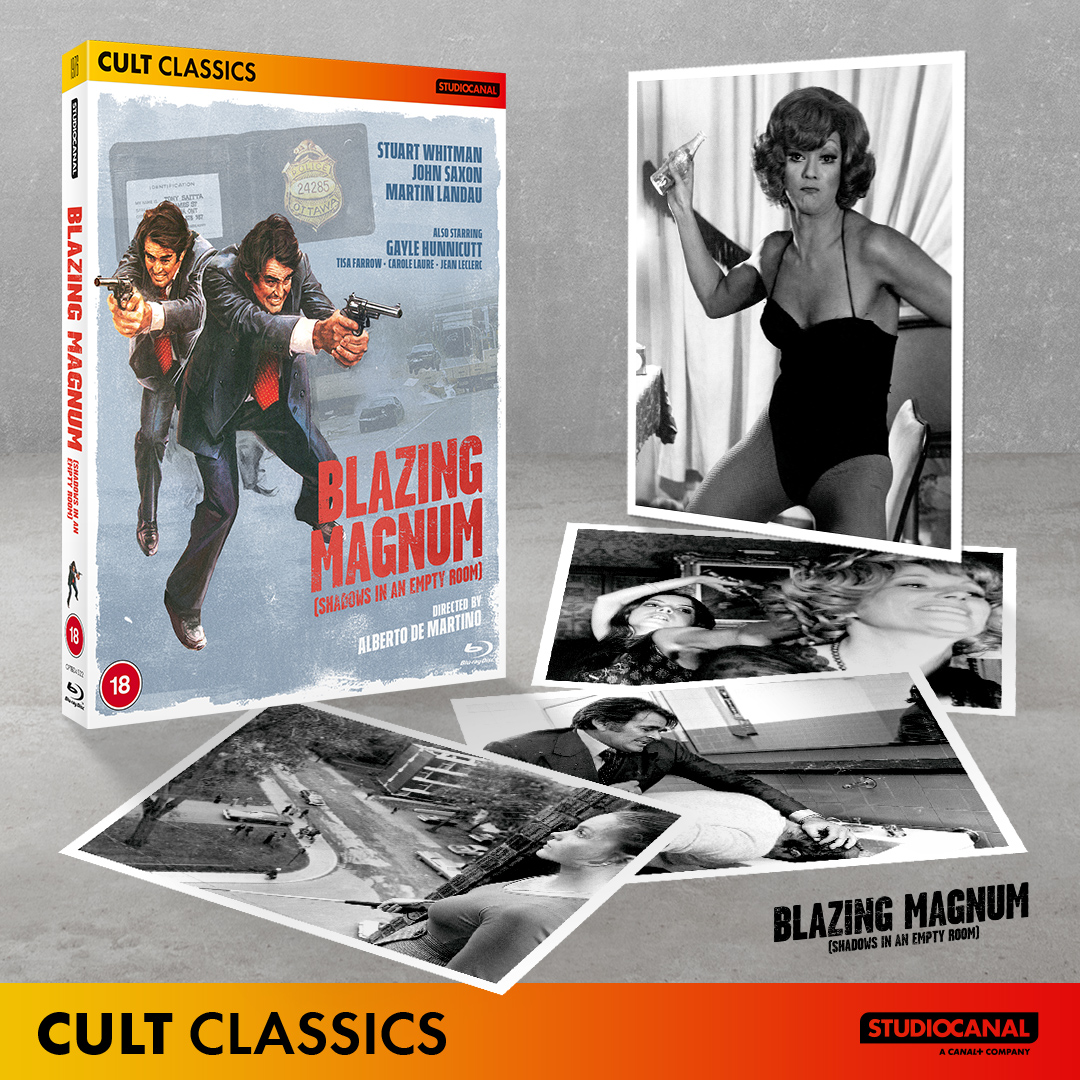
StudioCanal’s Cult Classic series continues with Alberto De Martino’s 1976 action-packed Blazing Magnum. Starring Stuart Whitman, John Saxon (Cannibal Holocaust), Martin Landau (Space: 1999), and Tisa Farrow (Zombie Flesh Eaters), this cult favourite is released on September 11th. You can win one of two copies by reading on and entering below…
Synopsis:
After his sister was poisoned, tough cop Tony Saitta embarks on a violent journey to find her killer, which turns into a whirlpool of revenge and betrayal.
INCLUDED WITH BLAZING MAGNUM:
BRAND NEW SPECIAL SENTIMENTS: Alberto De Martino’s Magnum Memories
• BRAND NEW CITY HUNTER: Interview with film historian Kim Newman
• Theatrical trailer
• Blu-ray edition comes with four collector’s art cards
• English and Italian audio options available.
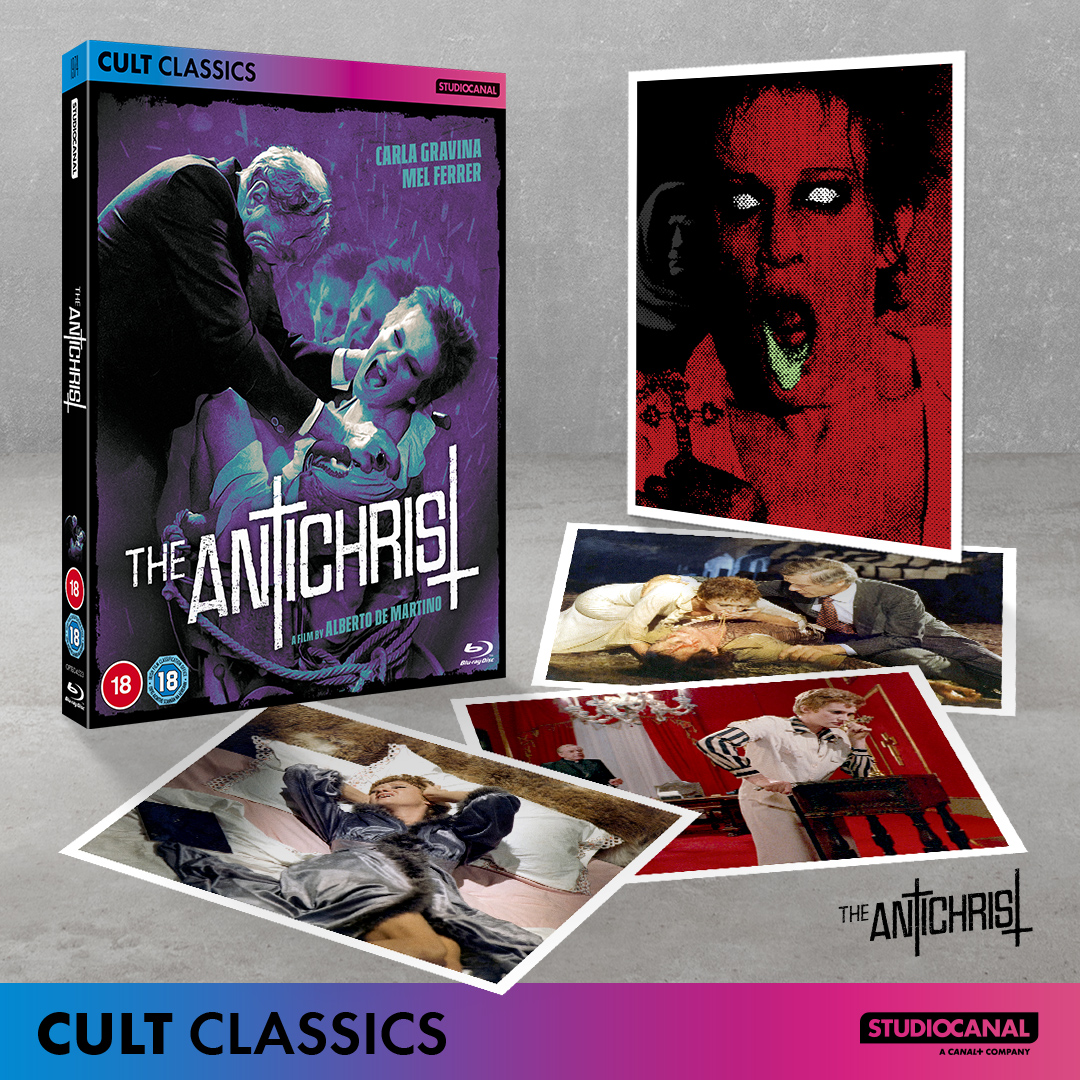
StudioCanal’s Blu-ray release of Cult Classics continues with Alberto De Martino’s 1974 exorcism film The Antichrist. Starring Carla Gravina, Mel Ferrer (The Island of the Fishmen), and Arthur Kennedy (Living Dead at Manchester Morgue), it hits Blu-ray in a special edition on September 11th. We have two copies to give away to our readers. Just read on and enter below…
Synopsis:
A car accident caused by her father leaves the young Ippolita (Carla Gravina) paralyzed and her mother dead. Following her uncle’s advice, she undergoes a hypnotic session with the intent to heal her, but it actually awakens the spirit of her ancestress, who was condemned for witchcraft.
Special Features:
BRAND NEW SACRED AND PROFANE: The Audio Recollections of Alberto De Martino
• RAISING HELL: Featuring Alberto De Martino and Ennio Morricone
• Audio Commentary with Author/Critic Lee Gambin and Critic Sally Christie
• The Tempter Opening Credits
• TV Spot
• Blu-ray edition comes with four collector’s art cards
• English and Italian audio options available
Ah, telephemera… those shows whose stay with us was tantalisingly brief, snatched away before their time, and sometimes with good cause. They hit the schedules alongside established shows, hoping for a long run, but it’s not always to be, and for every Street Hawk there’s two Manimals. But here at STARBURST we celebrate their existence and mourn their departure, drilling down into the new season’s entertainment with equal opportunities square eyes… these are The Telephemera Years!
1983-84
Glamour, adventure, and glamorous adventure were the order of the day in 1983 as the US settled into years of Reaganomics, with the big money, big hair, and even bigger shoulder pads of Dallas, Dynasty, and Falcon Crest dominating the TV ratings, making the likes of The A-Team, The Fall Guy, and Magnum, PI look positively gritty and real in comparison. The big new hits were single-moms sitcom Kate & Allie and Hotel, based on an Arthur Hailey novel that would soon become a permanent fixture of charity shop paperback spinners, and there were farewells to Happy Days, Fantasy Island, Hart to Hart, and Three’s Company (which had somehow lasted for eight seasons).
For genre fans, Airwolf and Knight Rider arrived to provide vehicular action and V: The Final Battle was creating the kind of buzz that would have set the internet alight if the internet was something that hadn’t only been invented in January 1983. Glen A Larson fans were well-served not only by the debuting Knight Rider but also the less-successful Manimal, Automan, and Masquerade, shows which did not outstay their already limited welcome. Of course, those three shows were not the only ones that failed to attract an audience; this is the story of four more shows from the 1983 season that fizzled rather than sizzled…
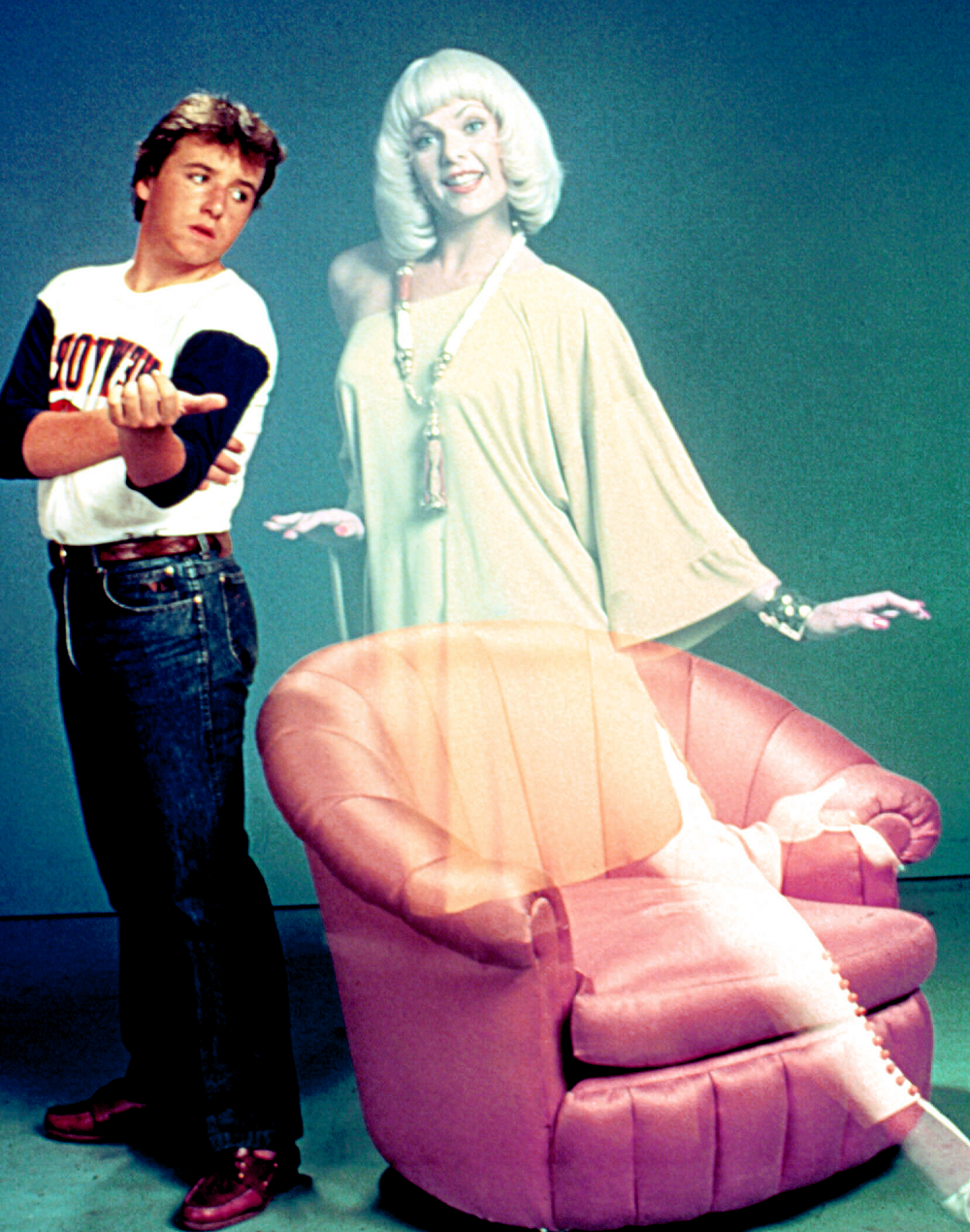
Jennifer Slept Here (NBC): On the surface, the premise of Jennifer Slept Here is actually pretty simple. It’s a laugh-tracked sitcom that tells the story of a teenage boy, moved across the country from New York to California by his lawyer dad when said lawyer dad is charged with sorting out the affairs of a dead movie star, the ghost of whom appears to Joey as his confidante. But if you dig even a tiny bit deeper, it uncovers levels… creepy levels.
Jennifer Farrell (Ann Jillian) was at the height of her fame when she was killed by a reversing ice cream truck in 1978 and, six years later, George Elliot moves his family into her old house while he finalises her estate. Thirteen-year-old Joey (John P Navin Jr) takes Jennifer’s old room and, fortunately before he can do teenage boy things in her old bed, Jennifer’s ghost makes its presence known to him. In the pilot Jennifer talks Joey out of running away from home, back to New York to visit a girl he likes, and becomes his guide as the series progresses.
Their relationship goes both ways, with Joey trying to stop his dad auctioning a nude photo of Jennifer from early in her career that she regrets and Jennifer helping Joey impress twins at a séance or dealing with his bullies. It also takes some liberties when Jennifer inhabits the body of Joey’s mother to rekindle an old flame, or when she chases off a living woman out of jealousy that she might be getting to close to her teenage pal.
Thirteen, of course, is the cusp of childhood and adolescence and it would have been interesting, in a purely prurient way, to see how Joey grew and how his relationship with the former starlet developed. Viewers, however, had other ideas, ignoring the show in favour of Webster and The Dukes of Hazzard to the extent that it was cancelled after just eight episodes had aired. The other five completed episodes were aired in the Spring of 1984, and everyone moved onto something else. Creators Larry Rosen and Larry Tucker next helmed the unsuccessful TV transfer of Stir Crazy, Ann Jillian returned to It’s a Living and then played herself in a TV biopic of her life, and John P Navin Jr did four more acting jobs and then disappeared, becoming a virtual ghost to match the real one he had an unconventional relationship with.
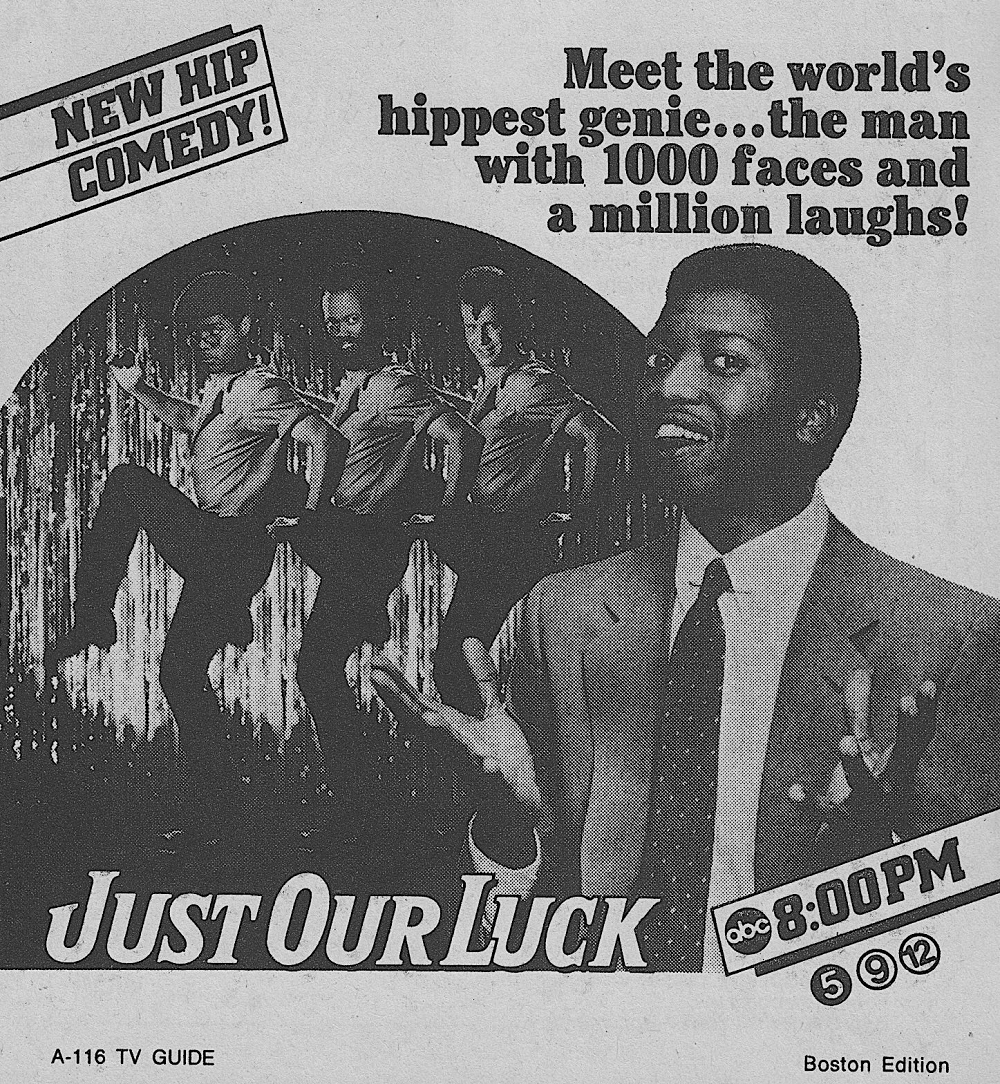
Just Our Luck (ABC): Lawrence Gordon cut his teeth as a screenwriter for Aaron Spelling in the 1960s, easing himself into a production position at AIP, where he produced movies such as Foxy Brown and Ralph Bakshi’s trippy Heavy Traffic. Striking out on his own, he formed a partnership with Walter Hill and was responsible for The Warriors, 48hrs, and Brewster’s Millions. After staring as a talent agent, his brother Charles came on board as a co-producer and the two delivered their first TV show as a mid-season replacement in March 1983, the short-lived The Renegades.
Despite that show failing to find its audience, and having a pilot named Lone Star turned down for series, the brothers were back in September 1983 with Just Our Luck, an urban twist on I Dream of Jeannie. Gordon and Hill had just broken Eddie Murphy into movies as Nick Nolte’s odd couple partner in 48hrs and you’d be forgiven for thinking that the Gordons were looking to repeat the trick when they cast TK Carter (who’d worked with Hill on Southern Comfort) as a wisecracking, streetwise genie out to make life difficult for his new master, straightlaced weatherman Keith Burrows, played by Airplane II’s Richard Gilland.
ABC had high hopes for the new show and trailed it extensively as the Fall season arrived, with Carter’s Shamu even appearing in spots with other ABC sitcom characters, including The Fonz and Benson. The first episode debuted on September 20th 1983 as a lead-in to Happy Days, which was struggling in the ratings opposite The A-Team on Tuesday nights. Although the premiere drew almost fifteen million viewers, the critics gave almost universal thumbs down, and the NAACP were so offended by a show depicting a black man as a white man’s servant that they called for a boycott of the whole network until Just Our Luck was cancelled.
In the face of such opposition – and settling in at under thirteen million viewers, half of what The A-Team was pulling – Just Our Luck never had a chance and ABC pulled it after twelve episodes, the thirteenth going unaired other than in some foreign markets. Needless to say, TK Carter did not become the next Eddie Murphy, though he did land a role on Punky Brewster, appear in pre-Saved By the Bell show Good Morning Miss Bliss, and still gets the odd role from directors with long memories, last turning up in an episode of the much-missed Stumptown in 2020.
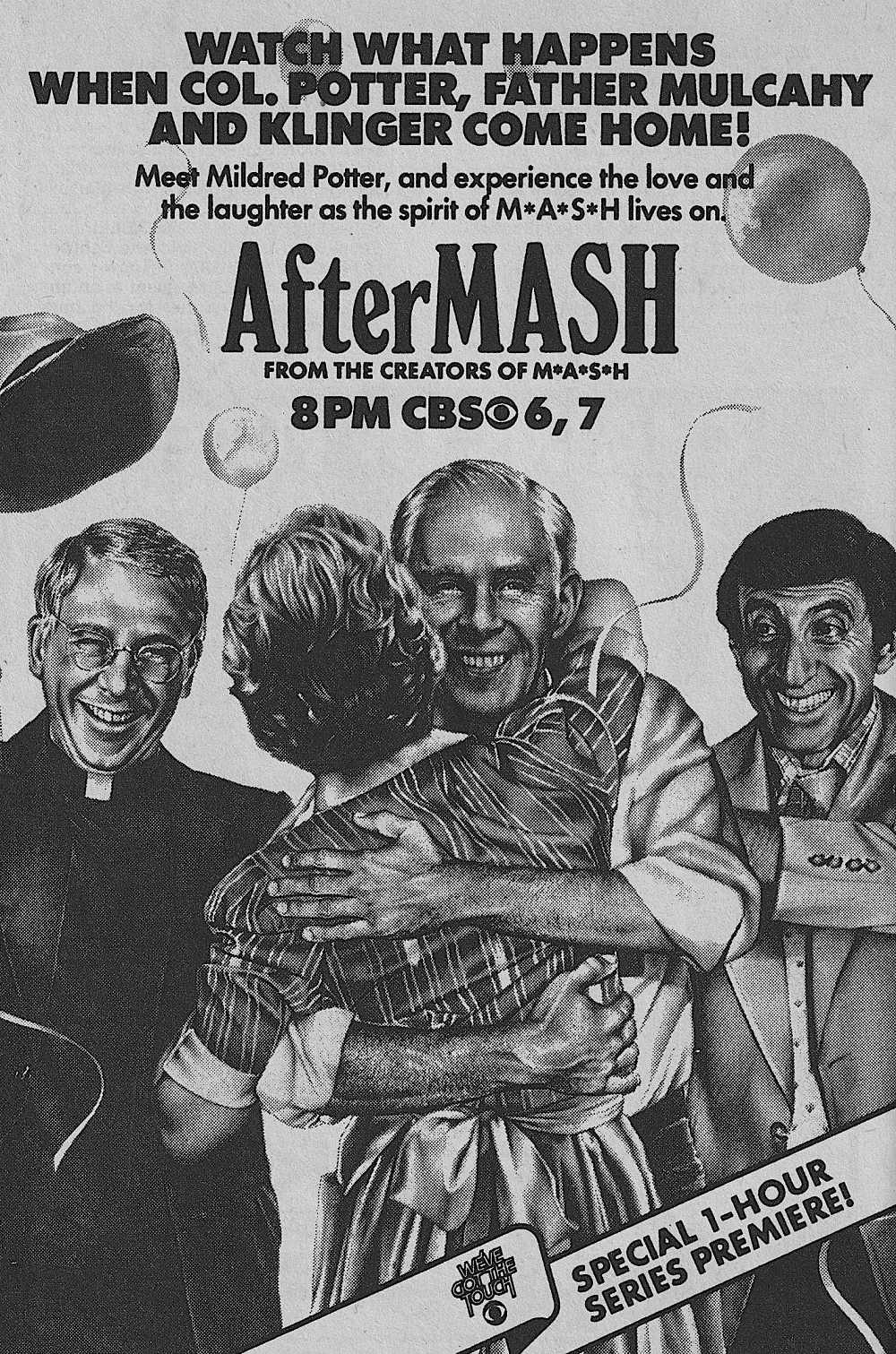
AfterMASH (CBS): The world ground to a halt on February 28th 1983 when the series finale of M*A*S*H aired on CBS. The two-hour-plus episode attracted almost two-thirds of those watching TV on that Monday night and was even broadcast live to US personal serving in Korea, despite the fourteen-hour time difference. When it was all over, viewers had laughed and cried along with Hawkeye, Hot Lips, Radar and the rest for the best part of eleven years, seven years longer than the Korean War itself.
How do you follow that? Wise heads would counsel that you don’t even try but CBS needed something to fill M*A*S*H’s gap in the schedules and looked very close to home for the solution. Original series developer Larry Gelbart formed a four-man team to create the new show, which would focus on a trio of characters moving into civilian life after the war had ended. Alan Alda, Larry Linville, and Loretta Swit were presumably too busy to sign on for the new show and so the story was tooled around the unlikely trio of cross-dressing Corporal Klinger, Lieutenant Colonel Potter, and military chaplain Father Mulcahy.
The premise saw Potter unhappily retired and urged by his suffering wife to get a job at the local hospital, where he is soon joined by Klinger and Mulcahy. Now married to a Korean woman, Klinger is running from trouble with the law, while Mulcahy – whose hearing was damaged in the M*A*S*H finale, had become a heavy drinker. Under the watchful eye of their former Colonel, both men turn their lives around, although there’s still plenty of trouble for Klinger to get himself – and the others – into.
The old show’s Radar made a guest appearance and AfterMASH did well enough in the ratings to earn a second season, although critics generally hated the show. For its sophomore outing, CBS moved the show to Tuesday, hoping to combat The A-Team, only realising too late that nothing combats The A-Team. Just eight episodes into its second season, AfterMASH was cancelled, a ninth episode going unaired. Although M*A*S*H is still fondly remembered, forty years after its finale, almost no-one recalls the spin-off, and in 2002 TV Guide voted it the seventh worst TV show of all time. A little harsh, perhaps, but how different could it have been if Hot Lips was available?
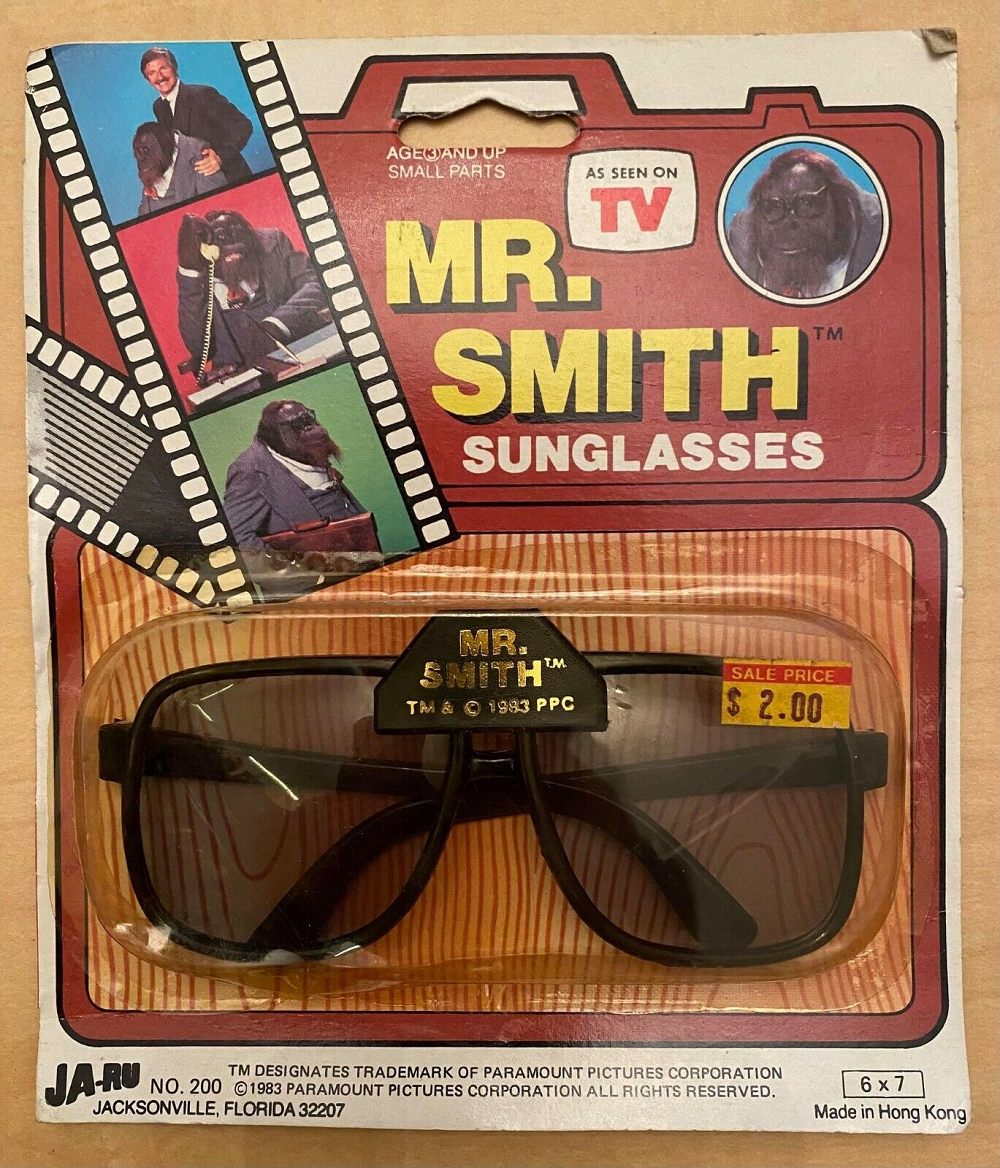
Mr Smith (NBC): Who was the star of Every Which Way but Loose and Any Which Way You Can? If “Clint Eastwood” was your answer then you have a very human-centric view of the world, because the real stars of those movies were Simian-American actors Manis and Buddha, without whom they would have been very dull indeed. After growing too big to play Clyde in the second film, Manis landed a part in The Cannonball Run II and was then cast in his own show, where his thespian skills could truly be showcased.
In Mr Smith, Manis played Cha Cha, an escapee from a circus who finds himself in a government research lab. Escaping once more, Cha Cha noses around the facility, stumbling on a formula designed to increase intelligence and drinking it down. Finding he can talk, and being judged to have an IQ of 256, Cha Cha is renamed Mr Smith and – obviously – becomes a political advisor.
Mr Smith was co-created by Stan Daniels and Ed Weinberger, who had previously created Taxi together. Weinberger also provided the voice for Mr Smith as he attempts to solve various political problems, all the while looking for his brother, Bobo, and trying to keep his real identity – that of an ape – a secret from the American public. Paired with Jennifer Slept Here, Mr Smith crawled to its thirteenth episode and was then humanely destroyed, ranking ninety-fifth of one-hundred shows in the year’s ratings list.
Manis returned to his handlers and later appeared in an episode of Cheers, presumably going on to live a happy life in retirement, which is more than poor Buddha got. Brought in to replace Manis as the loveable Clyde, Buddha was badly treated by his humans, eventually beaten to death with an axe handle for the crime of stealing doughnuts from the craft services table, at least according to a book by Dale Peterson and Jane Goodall. That the claims are not more widely reported smacks of a political cover-up… now I wonder who could be responsible for that?
I loved Barney And Friends as a kid. I had toys, tapes and even a Barney themed birthday party. As I approached tween-hood, I pretended to shun his teachings, but I still held a fondness for the kitsch creation and his crustaceous colleagues Baby Bop and BJ. To hate Barney was a blasphemy against my pop culture Jesus.
What I would soon discover was that Barney hate had been so deeply embedded into the cultural zeitgeist that in 1995, some unexpected names in the music industry created a musical roast of sorts for Sheryl Leache’s iconic creation. Unearthing this pop oddity set me on a new Barney journey, one that would lead directly to the players involved in this surreal undertaking.
First of all, what makes Barney so hateable? I asked Critical Inquiry editor W.J.T. Mitchell, a Gaylord Donnelly Distinguished Service Professor of English and Art History at the University of Chicago.
“I think it had to do with not just Barney, but with the whole tendency in children’s television to eliminate any trace of conflict, any kind of picturesque or gritty material. Barney was completely sanitised.”
Mitchell goes on to describe his studies on how young children would react to images of various dinosaurs.
“[When] it came to Barney… it was really astonishing, they had all of these jump rope rhymes, jokes, my favorite being, ‘I love you, you love me, Barney gave me H.I.V.’”
So, I said, “Could you explain this to me?” These were first and second graders. Some of the kids said, “I still like Barney, what’s wrong with Barney?” Many of the others said, “Barney is for little kids. He’s for kids who can’t handle anything complicated or difficult.”
So, it was really about generational conflict between four, five and six year olds. By the time kids are six years old, they can’t bare Barney. If they have siblings, they say “that’s my little brother’s thing, and my little brother is stupid, he doesn’t know anything.”
Fifth Avenue Records and Tapes is where I discovered the genesis of this article. Some time last year, I was browsing the CDs, when behind some dusty glass casing, something caught my eye: “The Unauthorized I Hate Barney Songbook: A Parody”. I had to have it.
I initially assumed it was made by a few guys in their basement. The idea of an entire album dedicated to hating Barney seemed like something that wouldn’t have utilised any great talent. Then I looked on the back cover, and realized all the songs are sung by Freda Payne, who reached #3 on the Billboard charts with her hit “Band of Gold”, one of Rolling Stone Magazine’s 500 Greatest Songs of All Time. Prominently featured below was Tony Haynes, listed as primary songwriter. A quick search revealed Tony had written for such blockbuster acts as Earth, Wind and Fire, The Temptations, Robert Palmer, and the Pointer Sisters. This album didn’t just utilize talent, it was created by two music industry icons.
I knew I had to get to the bottom of this somehow, and I realized if I could get some of the people involved with this project to talk to me, I could create an oral history of the album. Over the next two weeks, I was able to interview three of the key figures involved in the album; Cindy Jo Hinkleman, the production coordinator, Tony Haynes, the primary songwriter, and none other than the legendary Freda Payne herself.
When I told Freda I wanted to interview her about this album, her initial response was one of bewilderment.
Freda: “Why are you interested in that?!”
Production coordinator Cindy Jo shed some light on the married couple that owned Dove Audio, the company responsible for the album:
“Michael Viner and Deborah Raffin… owned Dove Audio at the time. Michael was a very powerful man in Hollywood, Deborah was an actress. She was in Death Wish 3 with Charles Bronson. It was one of the very first companies that did audiobooks… I was production coordinator on all their titles. Their approach to [marketing] audiobooks at the time, and one of the reasons they got Freda, was that they wanted only big name celebrities to record them. Michael was written up as one of the top ten most feared men in Hollywood. You did not cross Michael. Him and I got along great, we were the best of friends… but you didn’t cross him. For one of the ten most feared men in Hollywood to release I Hate Barney… It was just kind of bizarre!”
Tony Haynes: Michael Viner and Deborah Raffin… I had a deal with them, a joint venture to do kid’s audio projects.
Tony had previously created “A Day in the Lives of Dina and Darren Dinosaur” and realized Michael Viner was not going to pay him any royalties.
“I’m doing all this work, and I’m not making any money from it. So I asked Michael to let me out of my contract. He says: “I’ll let you out of your contract, but you have to write an album of ‘I Hate Barney’ songs.” I say, “well, you know my oldest daughter is three, and she fucking loves Barney, and I watch Barney every day.” He says, “well, if you want to get out of your contract, do an I Hate Barney songbook.”
So I sat, and over a weekend, I wrote ten songs… I used the piano to write the lyrics. So, by Monday, the ten songs were written, which means they were sketched in a way that I wrote the lyrics, and I could sing them.
Tony worked with various producers, including Oji Pierce, who had produced “This is How We Do it”. Michael Viner ultimately made the decision to have the entire album sung by Freda Payne, who Tony had previously worked with on his “Dina and Darren” project.
Freda: I’d known Michael since I think about 1973, here in LA. It was before he’d established Dove Audio. He was always a fan-friend, more of a friend, I would say. He told me, “Freda, a lot of parents, you know that purple dinosaur on the TV for kids, it’s a dinosaur called Barney, kids are becoming obsessed with it, and a lot of parents are getting sick and tired of it.… we came up with an idea.”
Michael explained to Freda that Tony Haynes had written some parody songs skewering Barney and asked if she would like to sing on them. However, Freda had no personal animosity towards the dinosaur.
Freda: I could have cared less! I said, I have no animosity about Sesame Street, I have no animosity about the Electric Company. So, why should I have any animosity about Barney the dinosaur?
I had a son, but by that time, I think he was probably in his teens. Maybe if he had been younger than that, he may have been into [Barney]. I don’t even know if he was aware of it.
I was wondering why he wanted to do it in the first place. I said you want to do a whole album on this? I thought it was kind of way out. In a way, I felt that, if I agreed to do this, because I was getting paid to do it, I hope I don’t wind up regretting this. I hope it doesn’t come back to haunt me!
Cindy Jo: I remember that Michael said to me one day, “we’re doing an audio book,” even though it’s more of an album, “we’re doing… ‘I Hate Barney.’” I went, “excuse me? Why would you do that?” He was quirky and he loved things that were kind of controversial.
As they moved forward on the project, Michael excitedly told Cindy he had gotten Freda Payne to perform the songs and Tony Haynes to write them.
I thought, “you gotta be kidding me.” Freda Payne, you know, she tore it up, but I don’t know why she agreed to it. The music was fantastic, it’s too bad it wasn’t just some kind of album of great music, instead of I Hate Barney.
To Freda, it was just another project.
Freda Payne: When the record company says, “we think you should do some blues songs” or “we think you should do an album of all American songbook songs”, you know, you pick a theme. It was a deviation from the norm.
It was now up to these key figures at Dove Audio to deliver the songbook on time.
Cindy Jo: My role was… to make sure that all the steps in the process got done, that everything got recorded, that everything got mastered, that the artwork was done, and that it was delivered on time.
Tony Haynes: This project was very, “let’s just get it done”. The [songs] were all unique, written off the top of my head, from the beginning. Even though [Michael] got credit as producer, he didn’t produce the project. It was basically me.
Tony intended to create a narrative around the album, with some songs illustrating an inner conflict of a Barney hater.
Tony: Each song tells its own story – “I hate him, but maybe I hate him because I want to be him.” Most people don’t like things because they’re so simple… they want to make things complicated. They say “Barney’s not so complicated at all, but I hate him anyway.”
Tony may not have trusted Michael, but he still considered him a friend.
Tony: I really liked Michael a lot… He was ornery, he was mean, but you knew what you were getting. I loved his wife Deborah, gorgeous, great actress. You knew he was gonna fuck you, but at least you knew that he wasn’t going to do it behind your back, he’s just gonna do it.
Cindy Jo sheds some light on the power Michael held at the time. In 1995, during the height of the OJ Simpson trial, he became obsessed with capitalising off of it.
Cindy Jo: The next thing I know, he’s like “were gonna do a book.” I say “what?” He says, “Faye Resnick.” I say “who’s Faye Resnick?” He says “Faye was one of Nicole Brown Simpson’s best friends. We’re going to publish a book, it’s called ‘Nicole Brown Simpson, The Private Diaries of A Life Interrupted, by Faye Resnick”.
Reportedly, Michael had paid Faye Resnick enough to make a down payment on a nice house in LA in exchange for her information. When the book was released, Judge Ito summoned Michael personally to his chambers.
Cindy Jo: He said “Mr. Viner, you must cease and desist pushing this book” And Michael said “I won’t”. Michael proceeded with publishing his book, and Judge Ito called him in again. He said “you have to stop this.” And Michael said “I won’t”. And he didn’t… he got away with it. I remember, I walked into his office after the second meeting, and he told me about it, and I said “you are gonna get yourself thrown in jail!” But he didn’t. That’s an example of his power… It was wild.
Cindy recalls the first time she met Tony Haynes, during the Barney project.
Cindy Jo: He came by the office to pick me up and he pulled up in this older Rolls Royce… As we were driving I said “Tony! Your car is awesome!” he says “yeah, I bought it from Kenny Rodgers.”
Tony: Kenny Rodgers owned the Rolls Royce first, he drove it from Texas to California. He sold it to Lionel Ritchie, and Lionel sold it to somebody else, and that somebody else sold it to Gene Simmons. I met Gene Simmons, and I talked to him about the car over lunch. [Eventually] I bought it from a car lot in San Fernando valley. Tupac bought one because I had one, and he put the eyepatch on because I wear an eyepatch. A lot people liked the fact that a brother was running around in a Rolls Royce back in those times.
Once the book was released, the marketing for it was a bit unorthodox.
Cindy Jo: It was marketed as an audiobook, which was odd. I don’t think the target audience was children. The songs weren’t recorded as kid-sounding songs, they were more well produced, you know what I mean?
Tony Haynes: The target audience was parents who were sick of Barney and the kids who didn’t really like him. I wrote the songs to appeal to parents, but also appeal to youngsters who could dance to it. I didn’t make the quality as perfect as you’d want, so it would feel a little bootlegged, and feel a little like, “yeah, that’s how I feel, a little ornery.”
I asked WJT Mitchell to explain the psychology that would allow this album – or “audiobook” – to have had any sort of anticipated audience. What made Barney so unsavoury that the album could be placed into retail outlets all across America?
WJT Mitchell: If you wanted to go really deeply into it, there’s the whole theory of the transitional object. Donald Winnicott, the psychiatrist, studied things like security blankets, and he talked about the transitional object, the teddy bear is the classic, but kids adopt objects, security blankets, teddy bears, other stuff, toys. They get very attached. [An adult] can’t just grab the bear and do anything they want to it. It makes the kid very upset. On the other hand, they can do anything they want to it, and often they will be very violent with this thing they love. So, the transitional object is a very interesting object of both love and hate. That’s the more general phenomena, I think, that Barney was an attempt to market a transitional object that was pure goodness.
However, not everyone hated Barney. In fact, a lot of people were angry that Dove would release a work that mocked Barney, and let the company know.
Cindy Jo: There were reviews, and I remember the company got phone calls and letters, this was right before email. I think it was really because Barney was so beloved at the time, and the marketing for Barney was amazing at the time. Sesame Street got pushed aside, everything got pushed aside for Barney the purple dinosaur. Then this company comes out with this CD of “I Hate Barney”, and moms and dads from everywhere were just appalled.
Kaia PopTart is a 37-year-old artist who bought “The Unauthorized I Hate Barney Songbook” when she was 9 or 10.
Kaia: I picked it up at some bargain store when I was in elementary school. I got some rock music trading cards from the same store. That’s how I started getting into extreme music. I remember being very disappointed in it. I was under the impression that it would be a little more edgy, but it was just some lady singing parodies of Barney songs and not swearing at all… I probably only listened to it a couple times and went back to my Ren and Stimpy tape.
Tony Haynes: People hated it, because people love Barney so much, but Michael built his business [taking] popular culture and doing the opposite, nobody could do that better than him. I knew [this criticism] would come, so I also had songs on there that were complimentary to Barney, that give you a well rounded thing in between that. At the same time, a lot of people liked the fact because they didn’t like Barney. It was 50/50.
However, Freda says the public’s anger didn’t come near her.
Freda: You know, don’t harm the messenger. I mean, it wasn’t my idea, it was their idea.
An oft-repeated rhyme heard on many a playground and school bus is “I Hate You, You Hate Me. Let’s Get Together and Kill Barney.” Tony tells me wherever it came from, his album had nothing to do with that.
Tony: My lyrics are “I hate you, you hate me, we’re a wacko family, with a great big hug and a yuck from me and you, won’t you say you hate me too.” There’s no reference of killing Barney. We don’t hate him to that point. It’s all tongue in cheek, and not as mean as I could have gone. You don’t really want kids to be that mean, which is why we had the song “No and shut up”, and “Stupidee Dupidee Ideas”, and even with the Barney song, it’s irreverent to a point, but not to where Barney needs to go out and get security.
Soon after the album, many employees began leaving Dove Audio as it sunk into commercial decline.
Tony: Dove had its own problems with money, so they couldn’t market it the way they wanted, because people were suing them over other things, and the OJ book.
Cindy Jo: Michael started to publish more controversial things.. that was about the time I left. I got a call… [I was] asked “do you want a job doing all the artist interviews on American Top 40?” I said “Sorry Michael and Deborah, I have to go!” When I left they bought me an engraved Tiffany bracelet. I was so touched by that. This little CD you found has such stories!
Tony: This project helped me later, because I wrote for Animaniacs, Pinky and the Brain, Barbie, Looney Tunes, and now I’m out creating television shows and novels, and I’m out pitching stuff. This project was actually the project that showed me, I can write musicals, novels, and all the things, ‘cause it was out of my initial comfort zone but became the benchmark for everything. I’ve written 34 children’s books. This was a monumental thing looking back.
It seemed like everyone involved with the album went on to do great things. I asked what they were up to these days.
Cindy Jo: I’m currently acting, developing a feature film and developing a YouTube show. I’m also still working in audiobooks, directing, editing and proofing.
Freda Payne: I have a new EP that’s out now, it was released a few months ago, it’s a jazz album, and it’s called Let There Be Love. I did a duet with Johnny Mathis, I did with Kenny Lattimore, Dee Dee Bridgewater and Kurt Elling.
Tony Haynes: To see what I’m working on now, you can go on iamtonyhaynes.com.… I’m pitching and meeting with people to put shows out. The goal is to build a multi-billion dollar business. It’s like if you were the same guy who created The Blacklist, Two and a Half Men, Modern Family, that’s what I’m doing. I’m going to give you an example of my gift, I’m going to give you a gift. All you have to do is write your name on the left side of a piece of paper downwards. I’m gonna create a poem that spells your name within one minute. Then, give it a title. Something about you, in your life.
I chose the title “Grateful”, as I was grateful Tony had taken the time to talk to me. Off the top of his head, Tony recited this poem to me:
GRATEFUL
Daily I am grateful
Yesterday too
Looking at my future
And from that point of view
Nothing makes me more grateful
Gratitude is the key
Recalling things that were
Every day I am grateful for
Each new thing that occurs
Nothing compares to gratitude
Because it is the key
Everything about it
Reveals new
Grateful things in me
Tony had said it best; I was grateful for all the people involved who chose to speak with me, and for the fact that there was such an interesting story behind this seemingly simple concept. Most of all, however, I was grateful for Barney; for those who love him, and for those who hate him.