Damien Warren-Smith • GARRY STARR: CLASSIC PENGUINS

Damien Warren-Smith

Damien Warren-Smith trained with legendary clown teacher Philippe Gaulier, and is an award-winning clown in his own right.  He’s best known for his character of Garry Starr, who regularly reduces audiences to fits of giggles. We caught up with Damien to find out more about his latest showGarry Starr: Classic Penguins, which is coming to the Edinburgh Fringe this August. We caught up with Damien to find out more about Garry.

STARBURST: How would you pitch Garry Starr: Classic Penguins to someone who’s really into books?
Damien Warren-Smith: If you care even the teeniest weeniest of iotas about literature, you simply must see Classic Penguins! In the space of 60 minutes, Garry Starr tears – not literally – through every Penguin Classic novel with the utmost nincompoopery in order to save literature – and by extension, penguins – from complete and utter extinction.

Where did the inspiration for Garry come from?
It came from a visit to a bookshop in Western Australia. There was a book signing taking place, and the author was a penguin. Until that point, I hadn’t realised that penguins had written all of the Penguin Classic novels. I thought it was just a cute publishing name. With penguins also facing extinction, I came to the conclusion that if we all buy more books by penguin authors, we can kill two (flightless) birds with one stone and save both literature and our feathered friends from the chopping block.

What else would we know you from?
If you’ve ever stepped outside your comfort zone and ventured to an Edinburgh Fringe show that doesn’t involve someone standing there with a microphone telling jokes, you would very likely have heard my name being uttered amongst the slightly weird, thrill-seeking audience. You would not know me from the telly unless you caught my brief appearances on Law and Order: UK or the ill-fated BBC comedy series The Persuasionists.

Where does Damien end and Garry Begin?
This is an ongoing discussion with my therapist. It’s very likely that my next show will be a two-hander whereby Damien adapts Mary Shelley’s Frankenstein, casts himself as Victor Frankenstein and Garry Starr to play The Monster. I’m sure it will go very smoothly and be completely absent of metaphors.

How is Garry Starr: Classic Penguins different from normal theatre?
I think the key word there is ‘normal’. Normal theatre is allowed to be boring at times. You invest in the characters and the story, and through patience and commitment, one would hope the time you have invested pays off, resulting in you being enlightened or moved in some way. Garry Starr shows are never boring. But you may still be enlightened or moved.

The show is coming to Edinburgh, which, of course, is the home of the famous penguin, Major General Sir Nils Olav III, Baron of the Bouvet Islands. What do you think they’d make of the show?
I’ve actually been in constant communication with Major Turd – it’s a little nickname I have for him because he pronounces ‘the third’ as ‘de turd’. He calls me Garry-incredibly-well-hung Starr, which I think is sarcastic. He’s very excited about the show as he’s a distant relative of Henning Mankell.

What was the most challenging part of the production?

The most challenging part was during the research and development phase when I spent nine months in a penguin colony in Antarctica. Many authors still spend a good portion of their time there as it’s the safest place for them to breed and write. I immersed myself in order to get closer to their lived experience. I didn’t wear pants for the duration. The shrinkage I experienced was something else.

How do you prepare for a role like this?
In preparation for this role, I universally forwent pants and attempted, unsuccessfully, to grow feathers. Penguins don’t actually have penises, so I spent a good portion of my time tucked back, which makes it very difficult to wee.

What’s next for you?
As I mentioned earlier, I shall be adapting Mary Shelley’s Frankenstein as a two-hander between Damien and Garry. It will likely debut on Broadway.

What other projects would you love to be involved with?

I would really love to do a production of Jane Air whereby all cast members are airborne for the duration.

Emperor Penguins or Republican Penguins?

Can I choose Publican Penguins? More penguins should run pubs.

Doctor Who or Doctor No?

What? Yes.

Simpsons or Futurama?
Teenage Mutant Ninja Turtles all the way.

Truth or Beauty?
Treaut.

Classic Penguins is on at the Edinburgh Fringe 2024 and you can book tickets here. You can find out more about Damien and any future tours beyond the fringe here.

Sabrina Messer • A JAFFA CAKE MUSICAL

Sabrina Messer Jaffacake the musical

Sabrina Messer is plays Katherine in Gigglemug Theatre’s latest show, A Jaffa Cake Musical. She plays the badass barrister representing HMRC in the tribunal and has previously worked with Gigglemug on Timpson: The Musical. We caught up with them to find out more about their new project.

STARBURST: How would you pitch A Jaffa Cake Musical to a staunch fan of Chocolate Hobnobs?
Sabrina Messer: Well, I’d say you’re about to discover your new favourite biscuit! Or is it a cake…? You’ll have to come and find out, won’t ya! No, but seriously, you don’t even need to like Jaffa Cakes to enjoy this show – just please make sure you bring a sense of humour.

How did this come about? Why Jaffa Cakes?
I asked myself that same question, and when I couldn’t find the answer, I went to our writer/composer, Sam Cochrane, because surely he’d know, right? So, to quote Sam, “It’s the nation’s favourite snack, and it’s about to be the nation’s favourite show!”. Alright, Sam… calm down.

How similar is this to your other works like RuneSical or Timpson: The Musical?
This show has Gigglemug’s signature zaniness, that’s for sure! Like the others, it’s also completely family-friendly and very, very silly. And if you’ve seen RuneSical or Timpson: The Musical, then you might recognise some familiar characters.

You’ve been called the UK version of StarKid. How accurate is this?
Now, you see, I’m biased because I happen to think we’re pretty darnn good. With that in mind, I’d say that’s accurate.

What’s the best bit of A Jaffa Cake Musical?
That’s tricky because it really does have something for everyone – we dance, we sing, we act our socks off, and not to give any spoilers, but there are some pretty awesome props and set pieces… We believe that if we’re having the maximum amount of fun onstage then the audience will too.

Seriously though, are they cakes or biscuits?
If I couldn’t tell, I’d get fired. We do actually give you a definitive answer in the show, so come and find out what it is!

Why the Edinburgh Fringe?
Being in the same city as like-minded people with stories to tell, there’s nothing else like it. I can’t wait to be back after SIX years away!

What was the most challenging part of the production?

The show is all-sung, which means there are 30 songs in total! It was a lot to learn in a short space of time but we did it, and it’s sounding awesome!

Why do we love musicals so much?
They’re like plays, but with additional bangers, how could we not love them?! Anyone who says they don’t like musicals is lying, or hasn’t seen A Jaffa Cake Musical yet…

What other projects would you love to be involved with?
I’d love to do more comedy, specifically improv!

Simpsons or Futurama?

I grew up on the Simpsons, so that’s a no brainer!

Doctor Who or Doctor No?

Doctor Who – apart from the Weeping Angels, whoever wrote that episode is a genius but a terrible person! – but maybe that’ll be my next Halloween costume…

Full Moon or Total Eclipse?

Full moon – awhoooo! – but when it comes to Jaffa Cakes… Total eclipse!

Truth or Beauty?
To tell you the truth… Beauty 😉

A Jaffa Cake Musical can be found  at the Edinburgh Fringe from August 1st through to the 26th. Tickets for A Jaffa Cake Musical can be found here.

THE TELEPHEMERA YEARS: 2001 – PART 1

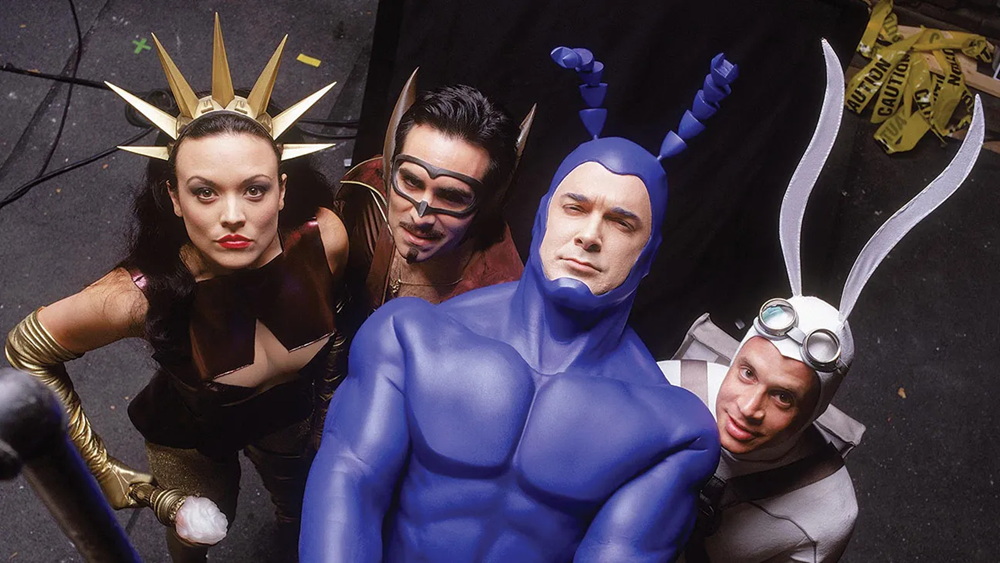
The Tick, 2001-02

Ah, telephemera… those shows whose stay with us was tantalisingly brief, snatched away before their time, and sometimes with good cause. They hit the schedules alongside established shows, hoping for a long run, but it’s not always to be, and for every Street Hawk there’s two Manimals. But here at STARBURST we celebrate their existence and mourn their departure, drilling down into the new season’s entertainment with equal opportunities square eyes… these are The Telephemera Years!

2001-02

Although they were still experiencing difficulties finding the right show for their 8.30pm slot, NBC’s Must-See Thursdays continued to dominate the TV ratings in in 2001-02, with Friends and ER occupying two of the top three spots and Will & Grace and Just Shoot Me not far behind. Their chief competition came from CBS, whose CSI: Crime Scene Investigation was entering its second season and threatening to topple Friends from its perch. Monday Night Football was ABC’s sole top-rating show and the Alphabet network also said goodbye to two sitcom stalwarts when both Spin City and Dharma & Greg began their final runs in Fall 2001.

ABC did have JJ Abrams’s Alias and insane dating show The Bachelor on deck for the new season, though just two of a handful of notable new arrivals that also included 24, Scrubs, Six Feet Under, and Star Trek: Enterprise, while Buffy the Vampire Slayer moved from The WB to UPN for its sixth season. Genre fans were well served by new shows in 2001, with Roswell and Smallville coming on board, although The X-Files would reach the end of its conspiracy trail by May 2002. Those are all shows that people remember, though; what about the ones that left less of an impact on the collective memory? This is the story of four of 2001’s less than stellar successes…

The Tick (Fox): Ben Edlund was still in high school when he created The Tick as a mascot character for New England Comics, a shop he frequented in Brockton, Massachusetts. The shop published a newsletter and Edlund progressed to a three-page strip in July 1986, the success of which prompted New England Comics to publish the character in his own, black and white comic in June 1988.

The Tick was an offbeat comedy, its hero an escapee from a mental institution who does as much damage as good, and with a wacky supporting cast that included sidekick Arthur, Man-Eating Cow, Paul the Samurai, and more. Edlund continued to draw The Tick while at college and the comic’s popularity led to an approach by Kiscom, a New Jersey-based licensing company, and Sunbow Entertainment, who were keen to produce an animated series.

That series, also titled The Tick, debuted on Fox in September 1994, running for three seasons with Townsend Coleman voicing the titular hero. Much of The Tick’s supporting cast was deemed inappropriate for a children’s cartoon and so new characters were created for the show, including Die Fledermaus and American Maid. Edlund’s final issue of The Tick was published in May 1993, with the animated series finishing in November 1996, but he wasn’t done with his creation just yet.

The Tick, 2001-02

In 1999, Sonnenfeld/Josephson Worldwide Entertainment picked up The Tick for development into a live-action sitcom, installing former Seinfeld writer Larry Charles and ex- Simpsons scribe David Sacks as producers. Unlike the animated series, the emphasis was on the characters rather than action, and casting got off to a strong start when Patrick Warburton was given the title role. The supporting cast from the comic book was present, but the characters created for the animated show were now owned by Disney and so new analogues were created for the show, including Batmanuel and Captain Liberty.

With David Burke joining the show as Arthur, The Tick premiered on Fox on November 8th 2001, with a tweaked origin story and the threat of the Red Scare, a robot programmed in the 1970s to destroy President Jimmy Carter and still hellbent on its mission. Despite episodes written by Charles, Sacks, and Edlund himself, The Tick failed to gather more than a cult following and just nine episodes aired before Fox pulled the plug, the final episode airing in January 2002 and telling the story of The Tick’s battle with 110-year-old villain The Terror.

The series was released on DVD in 2003 and Edlund hoped it might spark a revival, but The Tick lay dormant for another thirteen years until Netflix made a new series in 2016 with Peter Serafinowicz in the starring role. In the intervening period, Edlund had worked on shows such as Angel, Supernatural, Gotham, and Powers. The 2016 Tick lasted for two seasons of eleven episodes each before Netflix cancelled the show and Edlund is no doubt waiting for the right time for The Tick’s cry of “Spoon!” to echo across the airwaves once more.

Jeremiah (Showtime): Loosely based on the 1979 comic book by Belgian cartoonist Hermann Huppen, Jeremiah told the story of a post-apocalyptic near future where most of the adult population of Earth has been wiped out by a virus. After Platinum Studios – which had previously brought comic book properties Cowboys and Aliens and Men in Black to screen – acquired the rights to the book, Babylon 5 creator J Michael Straczynski took the raw nuggets of Huppen’s concept and expanded them into a fully realised world.

Straczynski had gotten his start writing spec scripts for He-Man and the Masters of the Universe, before showrunning The Real Ghostbusters for DIC. A move into live-action children’s TV with Captain Power sparked work for more adult-oriented shows and he spent time writing scripts for The Twilight Zone and working as a producer of Jake and the Fatman and Murder, She Wrote.

Babylon 5 followed in 1991 with a five-season run on PTEN, and Straczynski also moved into the world of comic books, firstly with adaptations of his Babylon 5 stories and then with Rising Stars for Top Cow/Image Comics in 1999. This put him in a perfect place for Platinum to approach him to develop Jeremiah, which the writer envisaged as a “road show.”

Jeremiah, 2001-02

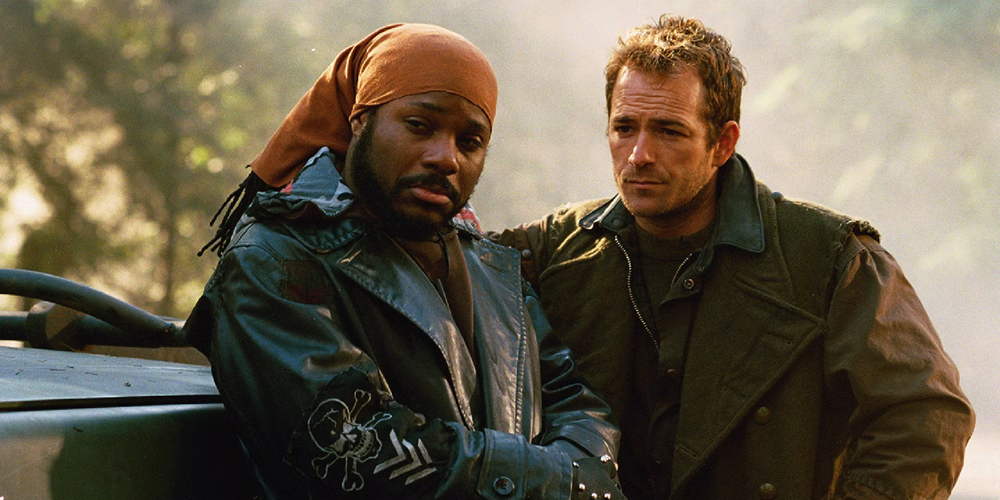
Jeremiah took place in 2021, fifteen years after a plague nicknamed The Big Death (or just “Big D”) has swept across the civilised world. Jeremiah, played by former Beverly Hills 90210 heartthrob Luke Perry, had spent the last fifteen years travelling across the USA in search of his father, who he believes may still be alive in a government facility known as the Valhalla Sector. Jeremiah and another young man named Kurdy (Malcolm-Jamal Warner) discover a functioning community named Thunder Mountain, where they help to rebuild society and are sent out on recon missions by its leader, former child prodigy Markus Alexander (Peter Stebbings).

Over the next two seasons, Jeremiah and Kurdy encountered many other survivors, all against a backdrop of the threat of the Western Alliance, an authoritarian group holed up at Valhalla Sector. Straczynski had planned a five-season story but conflicts with Showtime management over the direction of the show led to him taking his name off one of the episodes he wrote and threatening to leave unless he was given certain assurances for season three. As it was, Showtime decided that they were done with science fiction, anyway, and cancelled Jeremiah at the end of its second season. The writing had been on the wall as early as November 2003, when the network scheduled just seven of the fifteen episodes in season two for broadcast, the balance airing from September 2004, ten months after the last new episode.

Stung by the experience, Jeremiah was Straczynski’s last TV project until 2015’s Sense 8, spending the intervening time on comic books (including Amazing Spider-Man and Supreme Power for Marvel) and on writing films, winning awards for Clint Eastwood crime drama Changeling and also working on Thor, Underworld: Awakening, and World War Z.

Wolf Lake (CBS): Werewolves have always been a tricky thing to get right on the screen, at least as sensitive, sexy protagonists. In stark comparison to vampires, their animal nature always seems to override any sense of mystery; not for nothing did the Fashion SWAT department of the Something Awful website declare that “Dracula is a caped sophisticate, but Wolfman is just a guy who can’t hold his shit together.”

John Leekley had already attempted to do sexy vampires with 1996’s Kindred: the Embraced, loosely based on the Vampire: the Masquerade role-playing game, and clearly fancied trying his hand at doing the impossible when he pitched Wolf Lake to CBS in 2001. Before creating Kindred, Leekley had written for shows as diverse as Miami Vice, Nightmare Cafe, and Knight Rider 2010, but clearly found his niche with the supernatural, having just written nine episodes of the Todd McFarlane’s Spawn animated series before creating Wolf Lake.

Wolf Lake, 2001-02

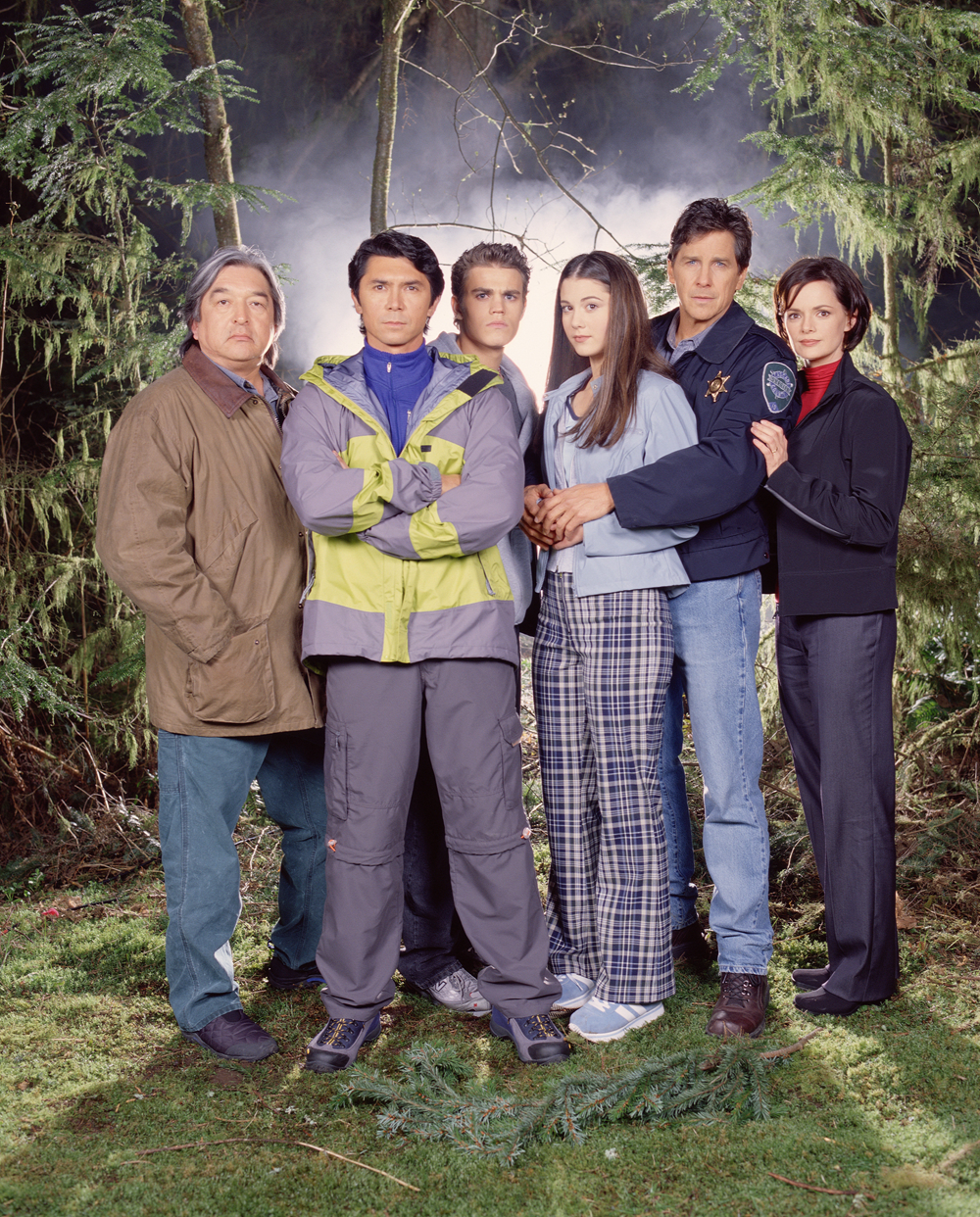
The eponymous small town was home to Ruby Wilder, the girlfriend of Seattle policeman John Kanin, who proposes marriage as the show begins. She accepts but is then attacked by an unseen assailant and vanishes, leaving only a severed hand behind. Seeking answers, Kanin travels to Wolf Lake but is unprepared for what he finds, a place dominated by a clan of werewolves who live in an estate known as The Hill and make life very difficult for the town’s normal inhabitants.

None of this was in Leekley’s original script, used for a pilot starring Lou Diamond Phillips as a wildlife warden tracking some unusually aggressive wolves and picked up by CBS for a Fall 2001 debut. Somewhere along the line, wholesale changes were made, and Leekley voluntarily left the show, although he retained a creator’s credit. Diamond Phillips was on the fence but agreed to stay for the revamped version of the show, which premiered on September 19th 2001. The former Young Guns actor was joined in the cast by Mia Kirschner as Ruby, Tim Matheson as Wolf Lake’s Sheriff, and by Graham Greene as Sherman Blackstone, the keeper of the town’s secrets.

With a bunch of attractive teen werewolves also thrown in, CBS were banking on Wolf Lake to become their own Buffy the Vampire Slayer with a dose of The X-Files and Twin Peaks added to the mix, but – despite the changes – the network never seemed completely behind the show, putting it on hiatus after just five episodes had aired. Nine episodes had been completed, though, and UPN stepped in to re-run the first five and air the remaining episodes in March 2002.

There were hopes that UPN might order a second season of the show, but ratings had not been good enough and Wolf Lake was not among the six shows renewed by the network, one of which – ironically – was Buffy the Vampire Slayer. Leekley, who had once written a series bible for a proposed Doctor Who reboot, bowed out of TV shortly afterwards and now writes a food blog with his wife, Rebekah.

Undeclared (Fox): Judd Apatow enjoyed massive critical success with Freak and Geeks, the drama he created with writer Paul Feig that starred Linda Cardellini, James Franco, Seth Rogan, and others as a group of disaffected teens at a small-town High School in 1980s Michigan. Unfortunately, those who loved Freak and Greeks – and those who loved It really loved it – were not enough in number to prevent the show’s cancellation at the end of its first season at the hands of an NBC network who didn’t know what to do with it.

While he was developing Freaks and Geeks, Apatow also created Sick in the Head for Fox, a sitcom starring David Krumholtz, Amy Poehler, and Kevin Corrigan, but Fox passed on the show, allowing Apatow to devote his time to his NBC project. When it came time for Apatow’s next project, he already had an in at Fox and pitched them on Undeclared, a half-hour sitcom starring Freaks and Geeks alumni Rogen, and featuring Jason Segel, and Busy Philipps – as well as Krumholtz and Poehler – as recurring guest stars.

Undeclared, 2001-02

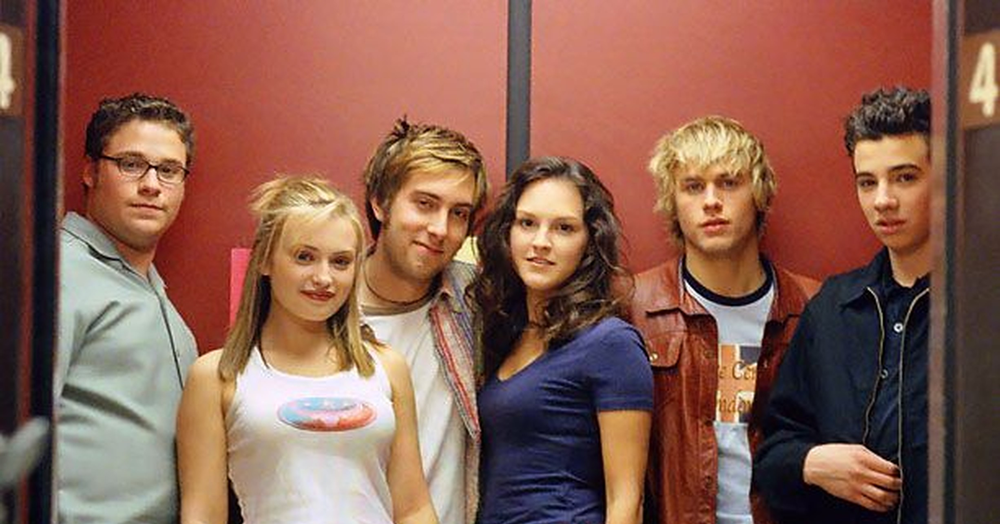
Alongside Rogen in the main roles were Canadian actor Jay Baruchel, Brooklyn newcomer Carla Gallo, Queer as Folk’s Charlie Hunnam, and former Dawson’s Creek guest star Monica Keena, a bunch of sexy, if awkward, young things that could have become ciphers for the usual college stories in less-creative hands. Under Apatow, however, and with scripts written by Rogen, future Into the Spider-Verse writer Rodney Rothman, Beavis and Butthead Do America scribe Kristofor Brown, Nicholas Stoller (who co-wrote 2001’s Muppets reboot with Segel), and by Malcolm & Eddie creator Joel Madison, Undeclared became almost as beloved as Freaks and Geeks.

Unfortunately, something so good cannot be allowed to exist for long; Fox took twenty-five weeks to get through the seventeen-episode first season, with episodes aired out of order and in three different time slots. The network had already clashed with Apatow during the show’s production, insisting on a laugh track, something that Apatow only avoided by threatening to walk.

As the show passed the mid-point of its run, and with ratings less than those demanded by the network, Apatow attempted to repeat a trick he’d tried with Freaks and Geeks, mailing advance copies of upcoming episodes to TV reviewers in the hope that they’d champion the show. The trouble was that critics almost universally loved the show anyway, it was the American public who didn’t see (or couldn’t find) its obvious charms. Again.

Apatow developed two more TV shows – North Hollywood for ABC (with Rogen and Segel once again) and Life on Parole for Fox – but never got past the pilot stage and he turned his attention to movies, producing Anchorman: The Legend of Ron Burgundy in 2004 before directing The 40-Year-Old Virgin a year later. The rest, as they say, is history, but it’s somehow comforting that he still finds room for his old friends in his projects, with eight of the Undeclared cast popping up in future projects. Now that’s school spirit!

Next time on The Telephemera Years: More failed shows from 2001, including unwelcome spin-offs and universe controllers!

Check out our other Telephemera articles:

The Telephemera Years: pre-1965 (part 1, 2, 3, 4)

The Telephemera Years: 1966 (part 1, 2, 3, 4)

The Telephemera Years: 1967 (part 1, 2, 3, 4)

The Telephemera Years: 1968 (part 1, 2, 3, 4)

The Telephemera Years: 1969 (part 1, 2, 3, 4)

The Telephemera Years: 1970 (part 1, 2, 3, 4)

The Telephemera Years: 1971 (part 1, 2, 3, 4)

The Telephemera Years: 1973 (part 1, 2, 3, 4)

The Telephemera Years: 1974 (part 1, 2, 3, 4, 5)

The Telephemera Years: 1975 (part 1, 2, 3, 4)

The Telephemera Years: 1976 (part 1, 2, 3, 4)

The Telephemera Years: 1977 (part 1, 2, 3, 4)

The Telephemera Years: 1978 (part 1, 2, 3, 4)

The Telephemera Years: 1980 (part 12, 3, 4)

The Telephemera Years: 1981 (part 1, 2, 3, 4)

The Telephemera Years: 1982 (part 1, 2, 3, 4)

The Telephemera Years: 1983 (part 1, 2, 3, 4)

The Telephemera Years: 1984 (part 1, 2, 3, 4)

The Telephemera Years: 1986 (part 1, 2, 3, 4)

The Telephemera Years: 1987 (part 1, 2, 3, 4)

The Telephemera Years: 1989 (part 1, 2, 3, 4)

The Telephemera Years: 1990 (part 1, 2, 3, 4)

The Telephemera Years: 1991 (part 1, 2, 3, 4)

The Telephemera Years: 1992 (part 1, 2, 3, 4)

The Telephemera Years: 1995 (part 12, 3, 4)

The Telephemera Years: 1997 (part 1, 2, 3, 4)

The Telephemera Years: 1998 (part 1, 2, 3, 4)

The Telephemera Years: 1999 (part 1, 2, 3, 4)

The Telephemera Years: 2000 (part 1, 2, 3, 4)

The Telephemera Years: 2002 (part 1, 2, 3, 4)

The Telephemera Years: 2003 (part 1, 2, 3, 4)

The Telephemera Years: 2005 (part 1, 2, 3, 4)

The Telephemera Years: 2006 (part 1, 2, 3, 4)

The Telephemera Years: 2007 (part 1, 2, 3, 4)

The Telephemera Years: 2008 (part 1, 23, 4)

The Telephemera Years: O Canada! (part 1, 2, 3, 4)

Titans of Telephemera: Irwin Allen

Titans of Telephemera: Stephen J Cannell (part 1, 2, 3, 4)

Titans of Telephemera: DIC (part 1, 2)

Titans of Telephemera: Filmation (part 1, 2)

Titans of Telephemera: Hanna-Barbera (part 1, 2, 3, 4, 5)

Titans of Telephemera: Kenneth Johnson

Titans of Telephemera: Sid & Marty Krofft

Titans of Telephemera: Glen A Larson (part 1, 2, 3, 4)

Titans of Telephemera: Quinn Martin (part 1, 2)

Titans of Telephemera: Rankin/Bass

Titans of Telephemera: Ruby-Spears

Titans of Telephemera: Sunbow

TITANS OF TELEPHEMERA: SUNBOW

Bucky O'Hare and the Toad Wars!, 1991-92

Ah, telephemera… those shows whose stay with us was tantalisingly brief, snatched away before their time, and sometimes with good cause. Dedicated miners of this fecund seam begin to notice the same names cropping up, again and again, as if their whole career was based on a principle of throwing stuff at the wall and seeing what sticks. What’s more, it isn’t all one-season failures and unsold pilots, there’s genuine gold to be found amongst their hoards; these men are surely the Titans of Telephemera!

Sunbow Productions

The roots of Sunbow Entertainment lie in New York advertising agency Griffin Bacal. Formed in 1978 by Tom Griffin and Joe Bacal, who had previously worked together at the Benton and Bowles agency, one of Griffin Bacal’s first major clients was Hasbro, for whom they devised a series of animated commercials. The natural next step was to move from commercials into television, and the studio – often in partnership with Marvel Productions – became known as Hasbro’s unofficial TV arm. Sunbow’s first big hit was their GI Joe: A Real American Hero cartoon, which ran for two seasons in syndication between 1983 and 1986, with the ninety-eight-episode The Transformers (the first two seasons of which were produced in association with Japanese giant Toei) following soon after.

Jem and the Holograms and My Little Pony consolidated that success, but by 1987 Hasbro were losing money and ended their once-fruitful partnership. Sunbow continued to produce both original and tie-in shows through the 1990s until they were sold to Sony in 1998. That state of affairs lasted for just two years before Sunbow was sold again, this time to German company TV-Loonland and, despite a flurry of planned and unreleased projects, the first season of Cartoon Network’s The Cramp Twins was Sunbow’s final production before the studio went dormant. We’ve written about GI Joe and Jem in our 1983 and 1985 features, but there are other stories worth telling…

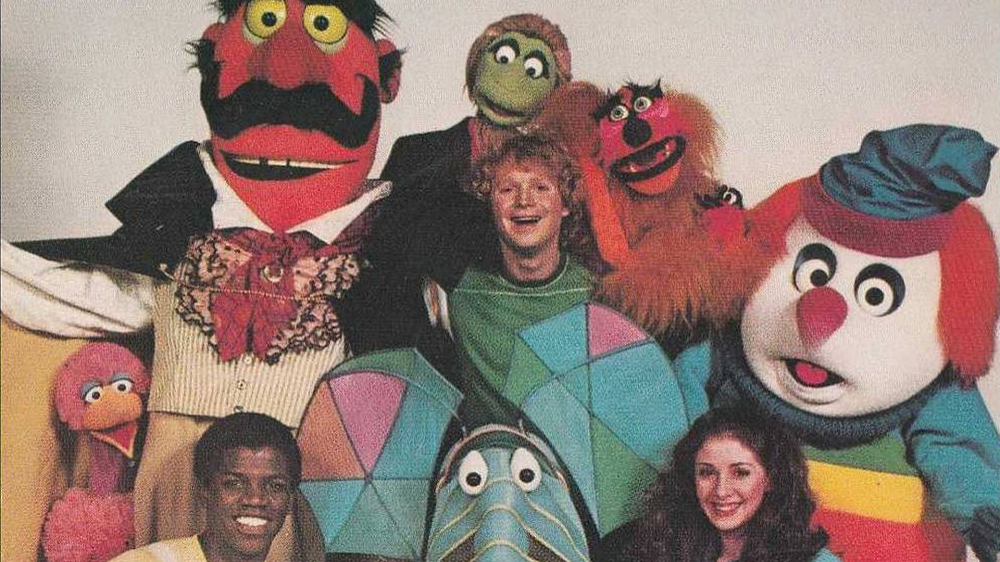
The Great Space Coaster (syndication, 1981): Before Sunbow became associated with Hasbro, their first foray into the world of children’s television was The Great Space Coaster, a 1981 show for which they acted as little more than distributors. The show was the brainchild of Kermit Love, one of Jim Henson’s original Muppet designers and builders, and who – to prove that the real world is always stranger than fiction – met Henson five years after Henson had created and named Kermit the Frog.

Love had begun his theatrical career at the age of nineteen in 1935, building marionettes for a government-sponsored theatre in New Jersey. After a long career on Broadway, during which he built at near-thirty-foot marionette for a production of Don Quixote, he met Henson when the two collaborated on a commercial for Chinese food brand La Choy. The dragon they created together would later serve as the base for Big Bird and it wasn’t long before Love was creating other characters for Henson, including Oscar the Grouch, the Cookie Monster, and Mr Snuffleupagus.

With Henson buy building the Muppets brand during the 1970s, Sesame Street chiefly became Love’s domain, but he had time to take freelance work and it was in this capacity that he created The Great Space Coaster for MetroMedia Television, a production company that had grown out of the DuMont Network that briefly challenged the domination of the big three networks in the 1950s. The Great Space Coaster starred Emily Bindiger, Chris Gifford (who would later go on to co-create Dora the Explorer), and future Village People member Ray Stephens as three human children brought to an inhabitable asteroid named Coasterville, where the formed a vocal harmony trio.

The Great Space Coaster, 1981-82

There they would join a clown called Baxter aboard his spaceship (which resembled a roller coaster car) and have adventures, encountering some of Love’s creations, including Goriddle Gorilla, Gary Gnu, and Knock Knock the Woodpecker, many of whom were puppeteered by Love’s protégé and future Elmo, Kevin Clash. Slight peril was introduced in the form of MT Promises, a circus owner looking to bring Baxter back to the carnival.

The Great Space Coaster premiered in January 1981 and ran for an incredible 250 episodes over five seasons, with stars such as Mark Hamill, Valerie Harper, “Sugar” Ray Leonard, and Henry Winkler dropping for guest appearances. Once the show had concluded its run, Clash was brought onto staff at Sesame Street by Love, who retired in 1990 but nevertheless kept busy, designing full-body puppets for a production of The Nutcracker at the Joffrey Ballet in Chicago, and Aza, the mascot for the Association of Zoos and Aquariums.

Love – who appeared as Santa Claus on the cover of New York magazine in 1982, 1985, and 1985 – died in 2008, his death marked by few other than Muppet obsessives, despite the huge part in played in building generations of children. At least, with The Great Space Coaster, he left some of his singular vision for the ages, even if it remains a piece of classic telephemera.

Inhumanoids (syndication, 1986): As fleshed out by former Ruby-Spears staffer Flint Dille, who had previously worked on both GI Joe and Transformers, Inhumanoids was a line of action figures released by Hasbro in Spring 1986. According to Dille’s backstory, the Inhumanoids themselves were three gargantuan monsters that had been sealed in the Earth aeons ago by a smaller, friendlier race of creatures known as the Mutores. The discovery of one of their kind – D’Compose – trapped in amber in the modern day drives evil industrialist (is there any other kind?) Blackthorne Shore to find and release the other two (the plant-like Tendril and volcanic Metlar), seeking to control them for his own ends.

Only the Earth Corps, a government-sponsored geological research team, have the expertise and the equipment to battle the Inhumanoids before they can release Metlar, with all concerned available in a series of action figures ranging from 6” for the humans to over 14” for the giant Inhumanoids themselves. Inhumanoids began as part of the Super Sunday (Super Saturday in some markets, and originally Super Week) block, which had begun in October 1985 with Robotix and Bigfoot and the Muscle Machines as twin features. Jem and the Holograms was added a month later, and Inhumaoids arrived in June 1986 for a three-month run until the show was stood down in September.

Inhumanoids, 1986-87

Like Inhumanoids (and like GI Joe and Transformers, Sunbow’s earlier collaborations with Marvel Productions), all the Super Sunday ‘toons were based on a toy line from Hasbro (or one of its subsidiaries), and the six-to-seven-minute shorts were collected as “movies” and released on VHS. Although the Robotix and Bigfoot and the Muscle Machines stories stop there, both Jem and Inhumanoids were spun off into their own shows for the Fall 1986 season, with the Super Sunday segments for Inhumanoids again re-edited, this time into the first five episodes of the season, an arc titled “The Evil That Lies Within.”

Inhumanoids was unusual for its time in that, although it didn’t adhere strictly to continuity, it did include several ongoing storylines that enhanced viewing for regular viewers. This, coupled with a distinctive animation style and graphic scenes that would cause conniptions for the likes of Action for Children’s Television, gave the show a more mature feel than its contemporaries, but – tucked away in syndication – it escaped the attentions of censorious parties.

Not that it mattered in the long run, because after an initial season of thirteen episodes (including the five that were repurposed from Super Sunday), no new episodes of Inhumanoids were produced after Hasbro decided the end the toy line. Several designs for future toys did make it into later episodes of the animated series, and there were even plans for a fourth Inhumanoid, Sslither, in the works. There have been efforts to bring the series back as a comic book in recent years, but the most recent attempt to build a shared Hasbro universe – Image Comics’ Energon Universe – has yet to expand beyond GI Joe and Transformers characters.

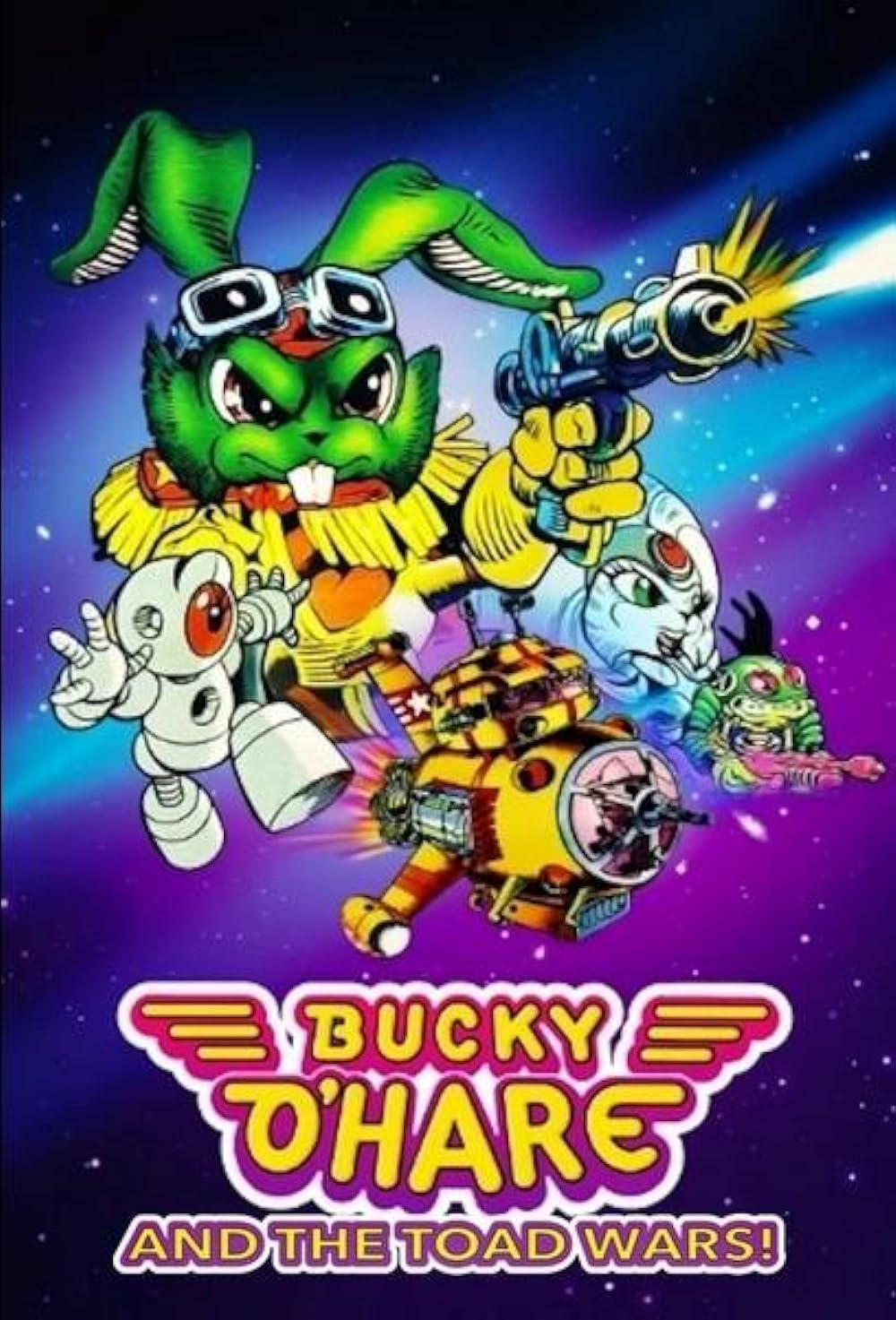
Bucky O’Hare and the Toad Wars! (syndication, 1991): To seasoned fans of both action figures and the animated series that promote them, Larry Hama is a big name. After every other writer at Marvel had reportedly turned the assignment down, military veteran Hama was given carte blanche by Marvel editor-in-chief Jim Shooter when the publisher began collaborating with Hasbro on turning a series of military-themed action figures into a fully realised concept. Hama’s work on the 1982 GI Joe comic book – which now stretches beyond 300 issues after resuming in 2010 – laid the foundations for the toy line (for which he wrote most of the “fact files” on the back on the packaging) and the subsequent animated series from Sunbow.

GI Joe wasn’t Hama’s first foray into creating a toy line, however. In 1978, while working at DC Comics, he was encouraged to develop what would have become the publisher’s first creator-owned comic book. Inspired by the massive success of the Star Wars line from Kenner, Hama designed a series of characters that would work as both comic book characters and action figures but left DC before the concept could be brought to market (with worries over just how creator-owned it might be playing at the back of his mind).

Hama had gotten his start in comic books with Neal Adams’s Continuity Studios, where he became one of the gang known as the Crusty Bunkers. Adams had been an early adherent of creators’ rights and started his own comic book line – Continuity Studios – in 1984. Among the first titles published by Continuity was Bucky O’Hare, a spacebound story of a green rabbit developed from Hama’s aborted 1978 DC pitch. With artist Michael Golden on board, six issues of the comic were published, later collected as a graphic novel.

Bucky O'Hare and the Toad Wars!, 1991-92

Hama always intended to return to the series, but other work kept him busy until Bucky O’Hare was optioned for an animated series by Sunbow in 1991. In association with Abrams/Gentile Entertainment, French company IDDH, and Marvel Productions, and with animation by Korean studio AKOM, the series debuted in syndication in September 1991. It was accompanied by a toy line produced by Hasbro, fulfilling Hama’s original concept to a tee, with ten action figures and two vehicles making up the line, all of which were given ample airtime in the extended adventures of Bucky O’Hare in the aniverse.

Hama and Golden began work on an expanded series of the original comic, only five issues of which saw publication before Continuity shut up shop in 1994, but even that outlasted the animation series, which got just one season of thirteen episodes before the plug was pulled when Hasbro declined to continue the toy line. Still, further issues of the comic book were published in the UK market and video games for the NES and the arcade were released in 1992, ensuring the legacy of Bucky O’Hare had a reach beyond other shows of its time and style, with a range of action figures re-appearing in 2017 from Boss Fight Studios.

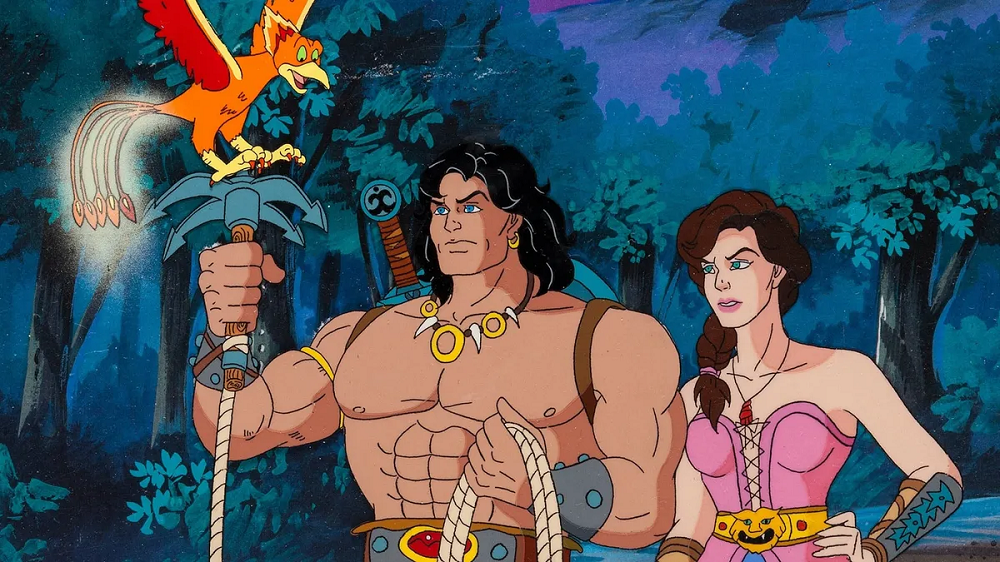
Conan the Adventurer (syndication, 1992): In an age where authors license their works to Netflix before they even pick up a pen, it seems remarkable that it took fifty years for Robert E Howard’s famous barbarian to get the TV treatment. There’d been comic books, of course, and the two Arnold Schwarzenegger movies in the early 1980s, but the small screen remained Cimmerian-free until Sunbow and JetLag Productions partnered on Conan the Adventurer, debuting in syndication in September 1992.

The show was developed by Christy Marx, a writer who’d gotten her start selling a story to Marvel Comics for their Savage Sword of Conan title in 1978. Marx had moved to Los Angeles with her husband, who wanted to pursue Scientology, but found it wasn’t for her and was instead slowly absorbed by Hollywood. Her first TV scripts were for Marvel Comics shows Fantastic Four, Spider-Man, and Spider-Man and his Amazing Friends before dipping her toe into the Sunbow pool with scripts for both GI Joe: A Real American Hero and Jem and the Holograms.

Conan the Adventurer, 1992-93

In 1991, Marx scripted six episodes of Bucky O’Hare and the Toad Wars!, which put her in the frame to develop Conan the Adventurer, once Sunbow had obtained the license from the notoriously hard to please Howard estate. Marx set Conan’s adventures in his earlier days, the first episode acting as an origin story of sorts before pitching him into full-blown opposition to the evil Wrath-Amon’s empire. One difference between Marx’s Conan and those that came before was in the character’s morals; the Conan of the books, comic books, and films had little compunction with killing, pillaging, and womanising – this Conan is definitely less barbaric.

To accompany the thirteen-episode first season, Hasbro produced a series of action figures, with no less than four Conans in the eight-figure range, including Ninja Conan, something that Howard probably never dreamed of. Ninjas or not, the animated series was praised by many seasoned Howard fans for its faithfulness to the worlds he created, even if others were less enamoured by what they saw as a sanitisation of some of the more adult elements in the Conan stories in this, a show aimed at children.

A second season of fifty-two episodes (taking the total to sixty-five, a magic number in syndication which allows for three months of weekday episodes without a re-run) followed in September 1993, produced in association with former DIC founder Jean Calopin’s Créativité and Developpement Studio. Unusually for animated series of the time, the show ended with a definite ending, although room was allowed for a sequel if desired.

That next chapter came quicker than expected, a March 1994 debut for Conan and the Young Warriors, a thirteen-episode series overseen by animation veteran Michael Reaves. Featuring a slightly older Conan, training a trio of young apprentices to one day rule Hyboria while dealing with the treat of serpent-man sorceress Sulinara. Unlike its predecessor, it ended after thirteen episodes with no storyline resolution, and Conan next returned to TV in 1997 in live-action.

GI Joe Extreme (syndication, 1995): In 1995, Sunbow returned to the franchise that had made its name and partnered with Hasbro once more to bring GI Joe Extreme into American homes. The original run of GI Joe: A Real American Hero had ended in 1986 after ninety-five episodes, followed by GI Joe: The Movie in 1987, in which Golobulus and Cobra-La were unleashed upon the world. A single season, forty-four-episode reboot, also titled GI Joe: A Real American Hero, was produced by DIC Entertainment in 1989, but that was the last the animated world saw of Snake Eyes, Scarlet, Storm Shadow, and the rest, with the toy line spluttering to an end in 1994.

Plans were already underway to reboot the line, however, under the name Sgt Savage, slightly bigger than the old GI Joe figures at a full 4”. Sunbow came on board and produced a pilot episode – Sgt Savage and his Screaming Eagles, which included characters from GI Joe to tie the lines together – but the toys did not do the business Hasbro had hoped. Hasbro went back to the drawing board again, this time returning the iconic GI Joe name to the property but making even bigger – you could say, more extreme – action figures of 5” tall.

In mid-1991, Hasbro acquired Kenner Products as part of a deal when they bought Tonka, complete with the Star Wars license which had lain dormant since 1985. Eyeing an opportunity to develop new Star Wars figures in the wake of the original films’ reissue on VHS and laserdisc, Kenner produced Power of the Force, a slightly larger, more muscled range of action figures based on the original trilogy. The new GI Joe Extreme figures more closely resembled the Power of the Force line than they did earlier GI Joe figures, and they needed an animated series to go along with it.

GI Joe Extreme, 1995-96

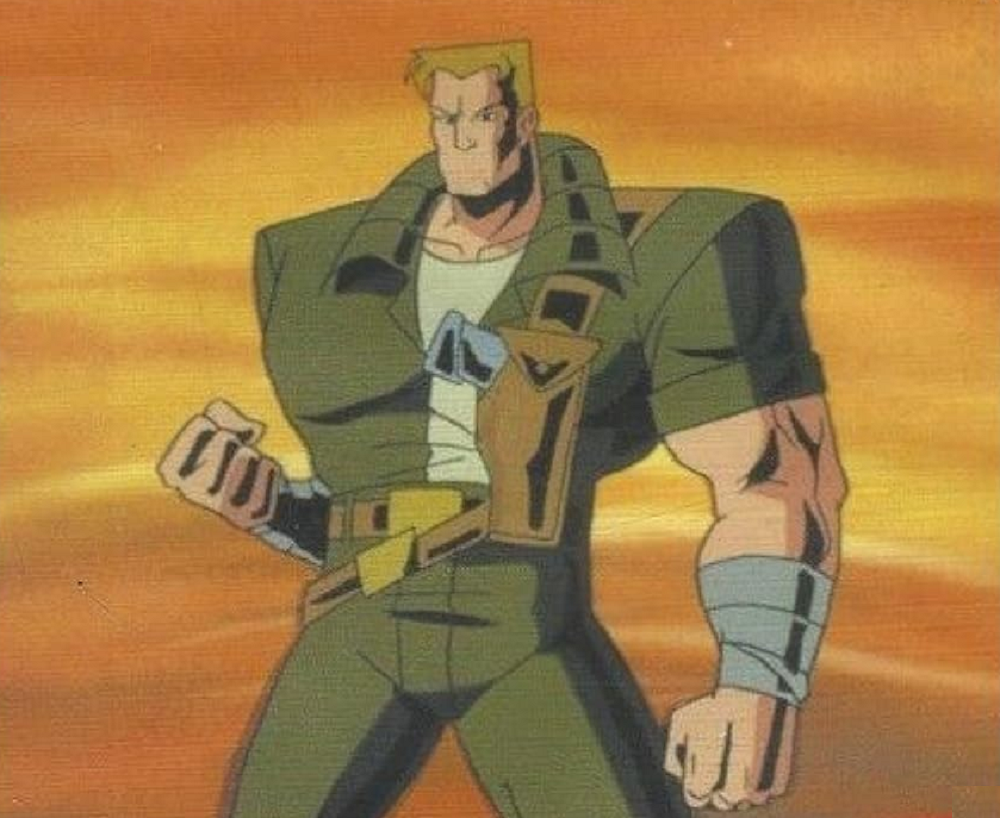
GI Joe Extreme debuted in September 1995, developed by The Real Ghostbusters and Teenage Mutant Ninja Turtles veteran Michael Edens. Rather than Cobra, this new team of Joes faced the threat of SKAR (Soldiers of Khaos, Anarchy and Ruin), and gone too were the familiar faces of yore, replaced by a motley crew let by Lt Stone and including ninja Black Dragon, heavyweight Freight, and a returning Sgt Savage. One thing did continue over from the original cartoons, however: each episode ended with a “Knowing is half the battle”-style public service announcement starring the Joes.

The world moves quickly, though, and what worked in 1983 was not going to cut muster twelve years later. Hasbro ended the GI Joe Extreme line after just one wave of action figures, but production was well underway on season two of the animated show. Another thirteen-episode affair, it aired between September 1996 and February 1997 (with a two-month gap between episodes six and seven), but it would be the last fruits of the Sunbow/Hasbro relationship. By the time GI Joe returned again with 2006’s GI Joe: Sigma 6, Sunbow were all but a name on a balance sheet.

Next time on The Telephemera Years: Spoon!

Check out our other Telephemera articles:

The Telephemera Years: pre-1965 (part 1, 2, 3, 4)

The Telephemera Years: 1966 (part 1, 2, 3, 4)

The Telephemera Years: 1967 (part 1, 2, 3, 4)

The Telephemera Years: 1968 (part 1, 2, 3, 4)

The Telephemera Years: 1969 (part 1, 2, 3, 4)

The Telephemera Years: 1970 (part 1, 2, 3, 4)

The Telephemera Years: 1971 (part 1, 2, 3, 4)

The Telephemera Years: 1973 (part 1, 2, 3, 4)

The Telephemera Years: 1974 (part 1, 2, 3, 4, 5)

The Telephemera Years: 1975 (part 1, 2, 3, 4)

The Telephemera Years: 1976 (part 1, 2, 3, 4)

The Telephemera Years: 1977 (part 1, 2, 3, 4)

The Telephemera Years: 1978 (part 1, 2, 3, 4)

The Telephemera Years: 1980 (part 12, 3, 4)

The Telephemera Years: 1981 (part 1, 2, 3, 4)

The Telephemera Years: 1982 (part 1, 2, 3, 4)

The Telephemera Years: 1983 (part 1, 2, 3, 4)

The Telephemera Years: 1984 (part 1, 2, 3, 4)

The Telephemera Years: 1986 (part 1, 2, 3, 4)

The Telephemera Years: 1987 (part 1, 2, 3, 4)

The Telephemera Years: 1989 (part 1, 2, 3, 4)

The Telephemera Years: 1990 (part 1, 2, 3, 4)

The Telephemera Years: 1991 (part 1, 2, 3, 4)

The Telephemera Years: 1992 (part 1, 2, 3, 4)

The Telephemera Years: 1995 (part 12, 3, 4)

The Telephemera Years: 1997 (part 1, 2, 3, 4)

The Telephemera Years: 1998 (part 1, 2, 3, 4)

The Telephemera Years: 1999 (part 1, 2, 3, 4)

The Telephemera Years: 2000 (part 1, 2, 3, 4)

The Telephemera Years: 2002 (part 1, 2, 3, 4)

The Telephemera Years: 2003 (part 1, 2, 3, 4)

The Telephemera Years: 2005 (part 1, 2, 3, 4)

The Telephemera Years: 2006 (part 1, 2, 3, 4)

The Telephemera Years: 2007 (part 1, 2, 3, 4)

The Telephemera Years: 2008 (part 1, 23, 4)

The Telephemera Years: O Canada! (part 1, 2, 3, 4)

Titans of Telephemera: Irwin Allen

Titans of Telephemera: Stephen J Cannell (part 1, 2, 3, 4)

Titans of Telephemera: DIC (part 1, 2)

Titans of Telephemera: Filmation (part 1, 2)

Titans of Telephemera: Hanna-Barbera (part 1, 2, 3, 4, 5)

Titans of Telephemera: Kenneth Johnson

Titans of Telephemera: Sid & Marty Krofft

Titans of Telephemera: Glen A Larson (part 1, 2, 3, 4)

Titans of Telephemera: Quinn Martin (part 1, 2)

Titans of Telephemera: Rankin/Bass

Titans of Telephemera: Ruby-Spears

TITANS OF TELEPHEMERA: RANKIN/BASS

Thundercats, 1985-86

Ah, telephemera… those shows whose stay with us was tantalisingly brief, snatched away before their time, and sometimes with good cause. Dedicated miners of this fecund seam begin to notice the same names cropping up, again and again, as if their whole career was based on a principle of throwing stuff at the wall and seeing what sticks. What’s more, it isn’t all one-season failures and unsold pilots, there’s genuine gold to be found amongst their hoards; these men are surely the Titans of Telephemera!

Rankin/Bass

Arthur Rankin Jr and Jules Bass formed Videocraft International in 1955 to produce commercials for the burgeoning television market and over the new few years they moved into animation, notably a stop-motion process that would come to be called “animagic.” The move into animation coincided with a dersire to produce their own TV shows, the first of which – The New Adventures of Pinocchio – was produced in association with Tadahito Mochinaga of Japanese studio Dentsu. The partnership with Mochinaga would eventually bear ripe fruit in the form of seasonal stop-motion favourites Rudolph the Red-Nosed Reindeer and Frosty the Snowman, but Rankin/Bass wasted little time in also delivering traditionally animated shows, with Tales of the Wizard of Oz a hit in syndication in 1961.

Over the next two decades, Rankin/Bass produced a slew of animated shows in both traditional and stop-motion form, the latter occupying much of their time in the 1970s after their collaborations with Mochinaga became beloved perennial favourites. Although Rankin/Bass remained a going concern until 2001, when it delivered its final seasonal special Santa, Baby!, the studio’s output had slowed to a crawl after Jules Bass’s retirement in 1987. Arthur J Rankin died in Bermuda, where he’d lived since his own retirement in 2001, in 2014 at the age of eighty-nine. He was outlived by Bass, who finally went to meet his maker eight years later at eighty-seven-years old, having spent much of his later years writing children’s books about Herb the Vegetarian Dragon.

We’ve written about Rankin/Bass productions The King Kong Show, The Smokey Bear Show, The Jackson 5ive, and SilverHawks in previous features, but here are four more Rankin/Bass shows you should know about…

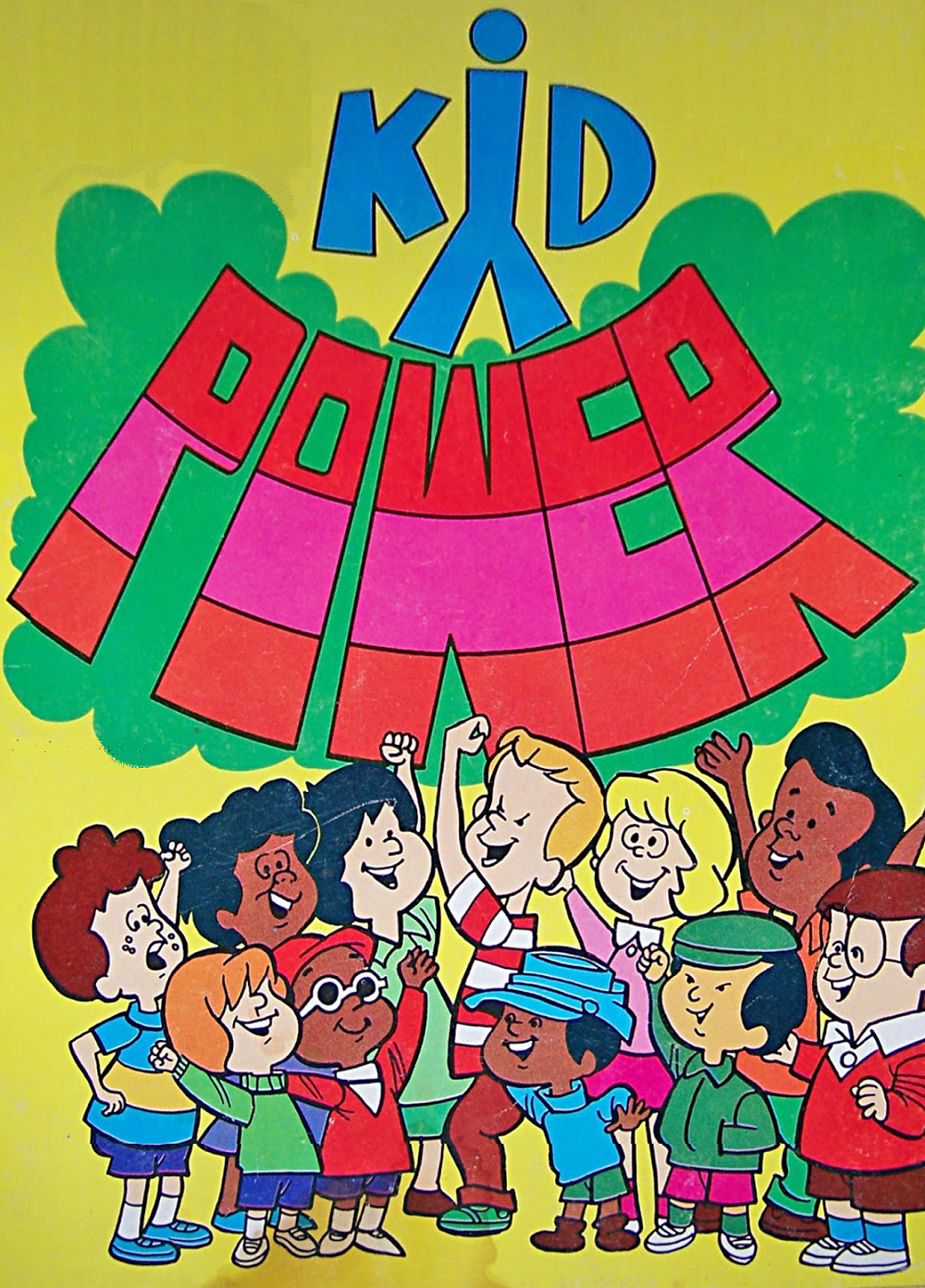
Kid Power (ABC, 1972): Born in Oakland, California, in December 1923, Morrie Turner started drawing at a young age and decided he wanted to be a professional cartoonist, but – other than some illustrations that were used in Stars and Stripes magazine while he served as a mechanic for the Tuskegee airmen during World War Two, and some work for industry magazine Baker’s Helper – he found it hard to get work as a black cartoonist in pre-Civil Rights America. In 1963, he joined the Association of California Cartoonists and Gag Artists, where he met Charles Schulz and Family Circle’s Bil Keane, both of whom encouraged him in his work.

It was Schulz who, when Turner bemoaned a lack of black characters in comic strips, suggested Turner should create his own; in 1964, he produced a strip featuring African American children named Dinky Fellas, but only one newspaper bought the strip. Undaunted, Turner made the cast more ethnically diverse, developing a rollcall which would eventually include not only black and white characters, but also those representing the Asian, Jewish, Latino, and Native American communities, as well as those with disabilities. The re-worked strip, now named Wee Pals, debuted in February 1965 and eventually ran in over a hundred newspapers nationwide.

Kid Power, 1972-73

In 1972, Rankin/Bass – working with Japanese animation studio TopCraft – brought Wee Pals to television, under the name Kid Power. They retained the characters and setting of Turner’s strip, in the process delivering the first children’s TV show that actually reflected the America those children were living in. Dubbed the Rainbow Gang, their adventures were scripted by William J Keenan, a writer who had gotten his start at Filmation before starting with Rankin/Bass on The King Kong Show. Keenan would eventually go on to write for The Six Million Dollar Man, Laverne and Shirley, and Fantasy Island.

Kid Power debuted on September 16th 1972, beginning a seventeen-episode run that lasted through January 1973, with re-runs following thereafter. Kids in the Bay Area could receive a double-dose of Wee Pals fun as a live-action show – Wee Pals on the Go – aired on San Francisco station KGO-TV. Although their televised adventures were restricted to that one season, Turner continued to draw the exploits of the Rainbow Gang until his death in 2014, the strip falling thirteen months short of a fifty-year run, just four months less than his mentor Schulz achieved with Peanuts.

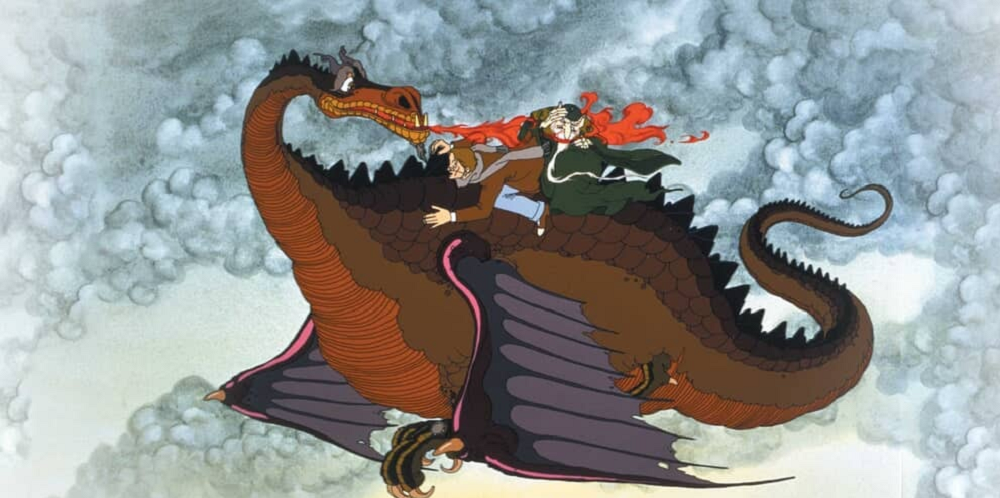
The Flight of Dragons (ABC, 1982): In 1977, Rankin/Bass partnered with TopCraft to produce an animated adaptation of JRR Tolkien’s beloved The Hobbit, broadcast on NBC on Sunday November 27th as part of a special evening of television that also included A Doonesbury Special and Miss World 1977. Although they stayed faithful to the original novel, Rankin/Bass were able to produce the special due to a publishing error that saw Tolkien’s work fall into the public domain until it was rectified two decades later.

The Hobbit did not please either critics or Tolkienophiles, one of whom called it “execrable,” and 1978’s adaptation of The Return of the King, the third book in Tolkien’s Lord of the Rings trilogy fared little better. In 1982, Rankin/Bass tried their hand at fantasy again, this time choosing to adapt the Peter Dickinson book The Flight of Dragons, a “speculative evolution” book that purports to accurately and scientifically describe dragons as if they were a real species.

The Flight of Dragons, 1982-83

Although it was a fascinating read and contained beautiful illustrations of its subjects (many of which were used as the basis for the dragons in the eventual movie), Dickinson’s book lacked a story and so the studio borrowed the plot from another novel, The Dragon and George by Gordon R Dickson, changing the name of its protagonist to Peter Dickinson as a tribute to the original author. Both books were credited as sources, although the final screenplay was welded together by Romeo Muller, a Rankin/Bass loyalist who’d previously written Rudolph, Frosty, Santa Claus is Coming to Town, and more.

Back in the age of magic, the green wizard Carolinus proposes the creation of a magical realm in order that creatures of legend can survive the upcoming scientific revolution. They all agree, save for one of their number, the red wizard Ommadon, who pledges to wage war on mankind instead. In search of a man of science descended from a hero, Carolinus travels forward 1,000 years in time to find Peter Dickinson, a former scientist who is obsessed with dragons and now works as a board game designer. Can Peter overcome his meekness and save the world of magic?

Released on VHS in the US in August 1982 (and a year later in the UK), The Flight of Dragons found a much better response from critics, who were especially wowed by the animation supplied by TopCraft. An airing on ABC as a Saturday Night Movie in 1986 cemented its place in the heart of a generation, to many of whom it remains “that dragon film nobody remembers that was quite good,”

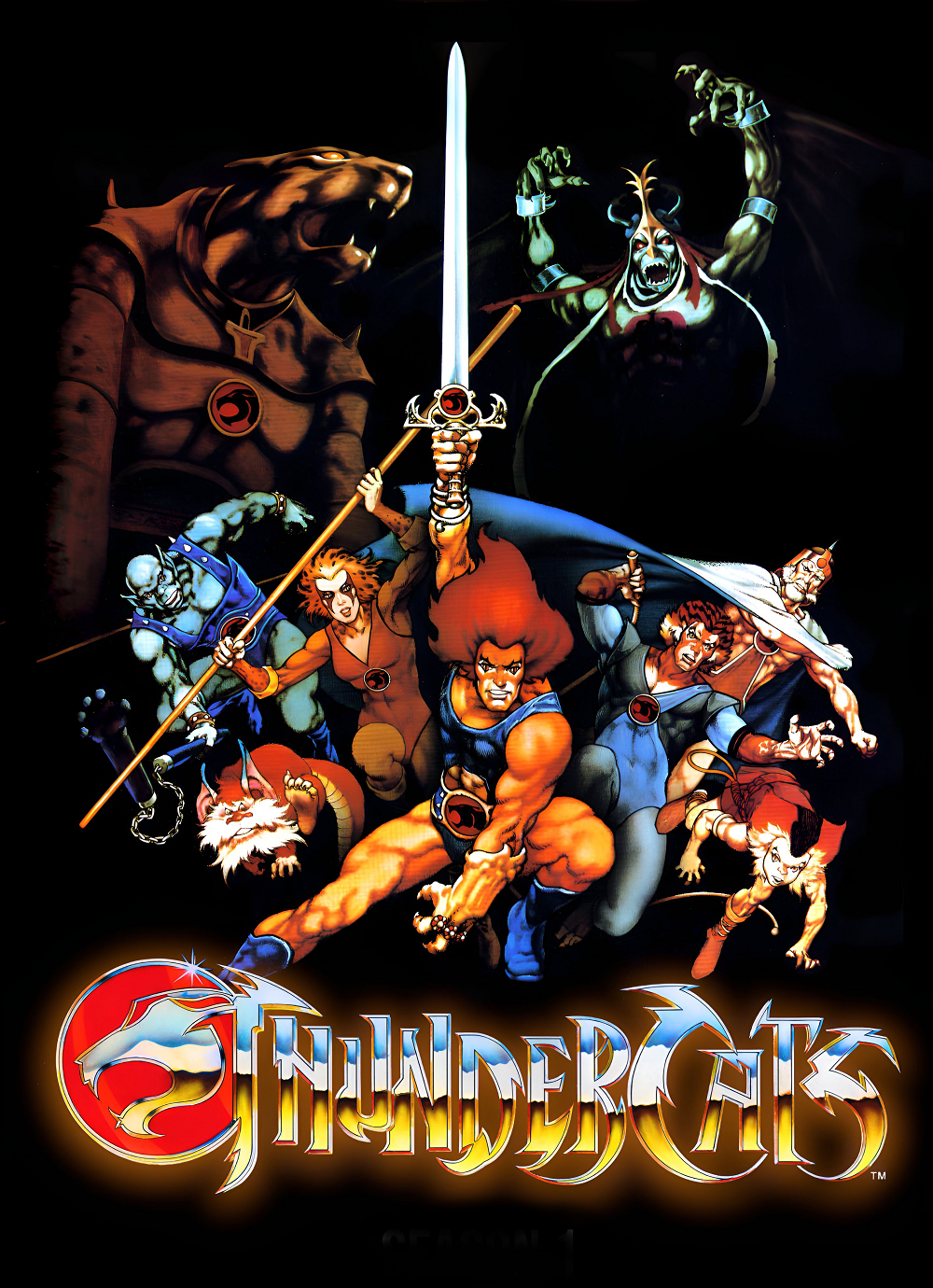
ThunderCats (syndication, 1985): Ted “Tobin” Wolf was working as a freelance toy developer when he first sketched what would become ThunderCats in 1981. Wolf, who lost part of a leg during the Battle of the Bulge, studied mechanical engineering after leaving the army, finding work with Westinghouse, where he patented several inventions. After going freelance, he came up with a portable record player that was manufactured by Singer, leading him down the road to the youth and children’s markets.

Wolf’s sketch for an animal-themed superhero team was further developed with the help of his family and, in 1983, his friend Stanley Weston – another former veteran turned licensing agent, who had invented GI Joe (and probably the whole concept of the action figure) in 1963 – pitched it to several production companies through his Leisure Concepts Inc merchandising agency, with Rankin/Bass immediately taken by the idea.

Thundercats, 1985-86

The Telepictures Corporation, who had worked with Rankin/Bass since 1974 (and would buy the studio outright in 1983), agreed to distribute the show, and Weston’s LCI partner Mike Germakian set to work fleshing out the ThunderCats universe, designing many of the characters and vehicles that would appear in the show, as well as the iconic logo. While work was underway on the TV show, LCI negotiated a deal with toy company LJN to make a range of action figures and vehicles based on Wolf and Germakian’s designs.

Both the TV show and the toyline were scheduled for a Fall 1984 release, but production delays at TopCraft (which eventually went bankrupt) meant the two-part pilot didn’t air until January 1985, with the balance of the sixty-five-episode first season arriving in September that year. Despite the delays, the toys and the cartoon were a big hit, and a second series of twenty-five episodes went into production for a Fall 1986 release, this time using the animation skills of the Pacific Animation Corporation, a new studio formed by ex-TopCraft staffers.

Thundercats, 1985-86

ThunderCats eventually ran for four seasons and a total of 130 episodes, the last original episode airing in September 1989, with the toyline ending two years earlier, although LJN had planned another wave of figures and vehicles before dropping the line as the action figure market contracted. Tobin Wolf died in 1999, but – thanks to his sight beyond sight – ThunderCats retained a faithful audience even after its cancellation and has been periodically revived, earning royalties for Wolf’s family, who co-own the property along with Telepictures (which is now owned by Warner Bros).

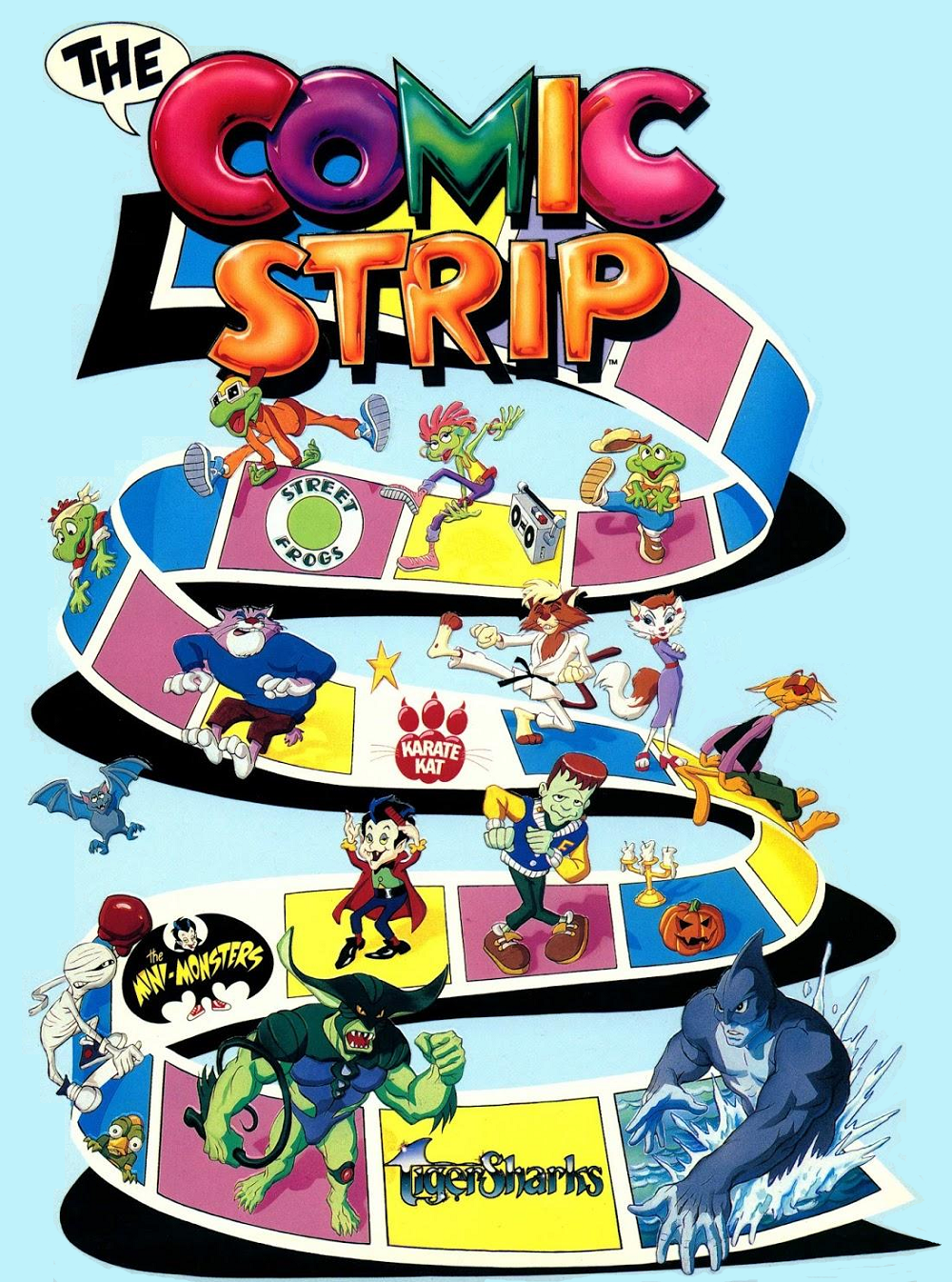
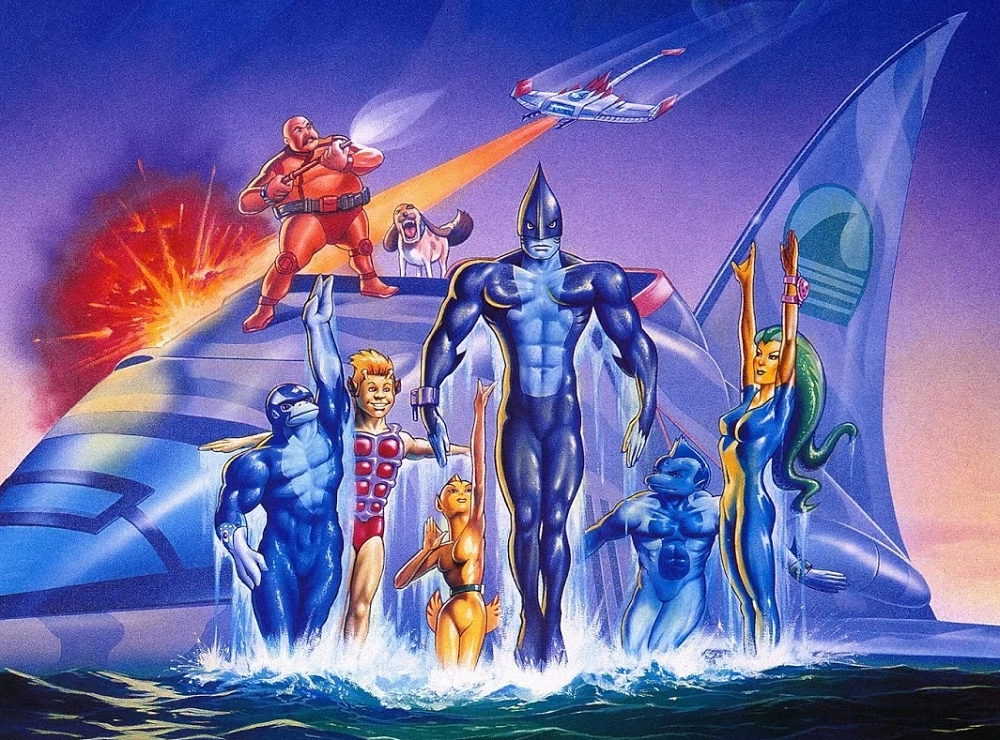
The Comic Strip (syndication, 1987): After repeating the ThunderCats formula (with diminishing returns) in 1986 with SilverHawks, Rankin/Bass went to the well for a third time a year later, but this time went underwater with TigerSharks, a far-future group of humans and aliens who use a device called the Fish Tank to transform into superpowered hybrid sea creatures. TigerSharks pitted the titular protagonists against two separate groups of villains, the Mantennas and Captain Bizzarly’s pirate crew. Both groups had the aim of conquering Water-O, an aquatic planet that was home to the Waterians, whom the TigerSharks have vowed to protect.

The Comic Strip, 1987-88

As with ThunderCats and SilverHawks, TigerSharks was accompanied by a toyline from LJN and it seems that the original plan was for TigerSharks to have a show of its own, only to be collapsed into The Comic Strip, an anthology series which premiered on September 7th 1987.  There it became one of four revolving features in a half-hour show, each episode featuring two of the four at a time (and with episodes of TigerSharks cut in half).

Alongside TigerSharks were Karate Kat, The Mini-Monsters, and Street Frogs. Karate Kat was set in a world of anthropomorphic cats, where Karate Kat worked to take down crime boss Big Papa while working for McClaw’s Detective Agency, run by Big Papa’s ex-wife, Big Mama. The Mini-Monsters saw normal human twins Sherman (voiced by a young Seth Green) and Melissa sent to a summer camp that is otherwise populated by the offspring of famous monsters, including Dracula, the Wolf Man, Frankenstein’s Monster, and more. The adventures of a gang of young, street-smart anthropomorphic frogs, Street Frogs is almost certainly “inspired” by Teenage Mutant Ninja Turtles, which would debut in a cartoon of a few months later.

The Comic Strip, 1987-88

A syndication-friendly sixty-five episodes were made, but there was no second season for The Comic Strip, nor a standalone extension for TigerSharks. Jules Bass’s retirement saw Rankin/Bass slip into dormancy, with no new TV shows and just a handful of feature presentations appearing before Rankin, too, retired in 2001. Beyond their season stop-motion specials, Rankin/Bass are probably best remembered for partnering with Eiji Tsuburaya and Tsuburaya Productions to produce a number of historical, monster, and disaster movies, from 1967’s King Kong Escapes through to 1981’s The Bushido Blade, although for many it will always be their unwavering commitment to wringing out the basic concept behind ThunderCats that be their lasting legacy.

Next time on Titans of Telephemera: We finish our look at the animation studios that created our childhoods with Sunbow Productions!

Check out our other Telephemera articles:

The Telephemera Years: pre-1965 (part 1, 2, 3, 4)

The Telephemera Years: 1966 (part 1, 2, 3, 4)

The Telephemera Years: 1967 (part 1, 2, 3, 4)

The Telephemera Years: 1968 (part 1, 2, 3, 4)

The Telephemera Years: 1969 (part 1, 2, 3, 4)

The Telephemera Years: 1970 (part 1, 2, 3, 4)

The Telephemera Years: 1971 (part 1, 2, 3, 4)

The Telephemera Years: 1973 (part 1, 2, 3, 4)

The Telephemera Years: 1974 (part 1, 2, 3, 4, 5)

The Telephemera Years: 1975 (part 1, 2, 3, 4)

The Telephemera Years: 1976 (part 1, 2, 3, 4)

The Telephemera Years: 1977 (part 1, 2, 3, 4)

The Telephemera Years: 1978 (part 1, 2, 3, 4)

The Telephemera Years: 1980 (part 12, 3, 4)

The Telephemera Years: 1981 (part 1, 2, 3, 4)

The Telephemera Years: 1982 (part 1, 2, 3, 4)

The Telephemera Years: 1983 (part 1, 2, 3, 4)

The Telephemera Years: 1984 (part 1, 2, 3, 4)

The Telephemera Years: 1986 (part 1, 2, 3, 4)

The Telephemera Years: 1987 (part 1, 2, 3, 4)

The Telephemera Years: 1989 (part 1, 2, 3, 4)

The Telephemera Years: 1990 (part 1, 2, 3, 4)

The Telephemera Years: 1991 (part 1, 2, 3, 4)

The Telephemera Years: 1992 (part 1, 2, 3, 4)

The Telephemera Years: 1995 (part 12, 3, 4)

The Telephemera Years: 1997 (part 1, 2, 3, 4)

The Telephemera Years: 1998 (part 1, 2, 3, 4)

The Telephemera Years: 1999 (part 1, 2, 3, 4)

The Telephemera Years: 2000 (part 1, 2, 3, 4)

The Telephemera Years: 2002 (part 1, 2, 3, 4)

The Telephemera Years: 2003 (part 1, 2, 3, 4)

The Telephemera Years: 2005 (part 1, 2, 3, 4)

The Telephemera Years: 2006 (part 1, 2, 3, 4)

The Telephemera Years: 2007 (part 1, 2, 3, 4)

The Telephemera Years: 2008 (part 1, 23, 4)

The Telephemera Years: O Canada! (part 1, 2, 3, 4)

Titans of Telephemera: Irwin Allen

Titans of Telephemera: Stephen J Cannell (part 1, 2, 3, 4)

Titans of Telephemera: DIC (part 1, 2)

Titans of Telephemera: Filmation (part 1, 2)

Titans of Telephemera: Hanna-Barbera (part 1, 2, 3, 4, 5)

Titans of Telephemera: Kenneth Johnson

Titans of Telephemera: Sid & Marty Krofft

Titans of Telephemera: Glen A Larson (part 1, 2, 3, 4)

Titans of Telephemera: Quinn Martin (part 1, 2)

Titans of Telephemera: Ruby-Spears

TITANS OF TELEPHEMERA: FILMATION – part 2

Tarzan and the Super 7, 1978-79

Ah, telephemera… those shows whose stay with us was tantalisingly brief, snatched away before their time, and sometimes with good cause. Dedicated miners of this fecund seam begin to notice the same names cropping up, again and again, as if their whole career was based on a principle of throwing stuff at the wall and seeing what sticks. What’s more, it isn’t all one-season failures and unsold pilots, there’s genuine gold to be found amongst their hoards; these men are surely the Titans of Telephemera!

Filmation

Having formed a partnership when they were working at Larry Harmon Pictures on the televised Popeye cartoons in the late 1950s, Lou Scheimer and Hal Sutherland founded Filmation Associates in 1962, along with former radio DJ Norm Prescott. The nascent studio’s first credits were on the production of Rod Rocket a year later, a project they inherited from former employees SIB Productions. After struggling for years to complete an adaptation of The Wizard of Oz – and failing to sell to sell their first original cartoon, The Adventures of Stanley Stoutheart – they were about to close the studio down when DC Comics’ Mort Weisinger approached them to produce a cartoon based on DC’s most famous character.

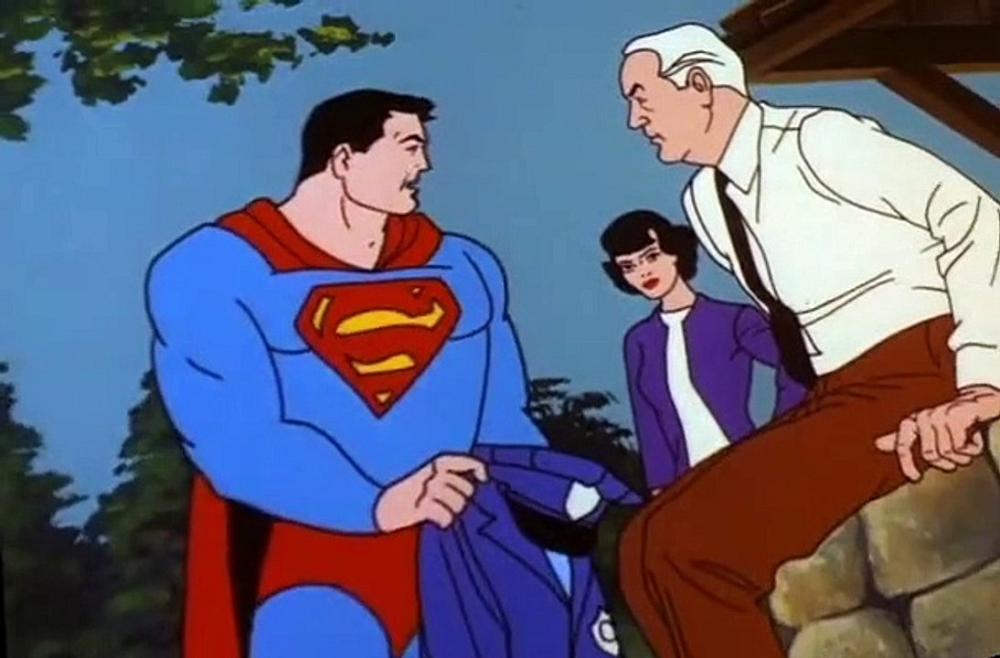
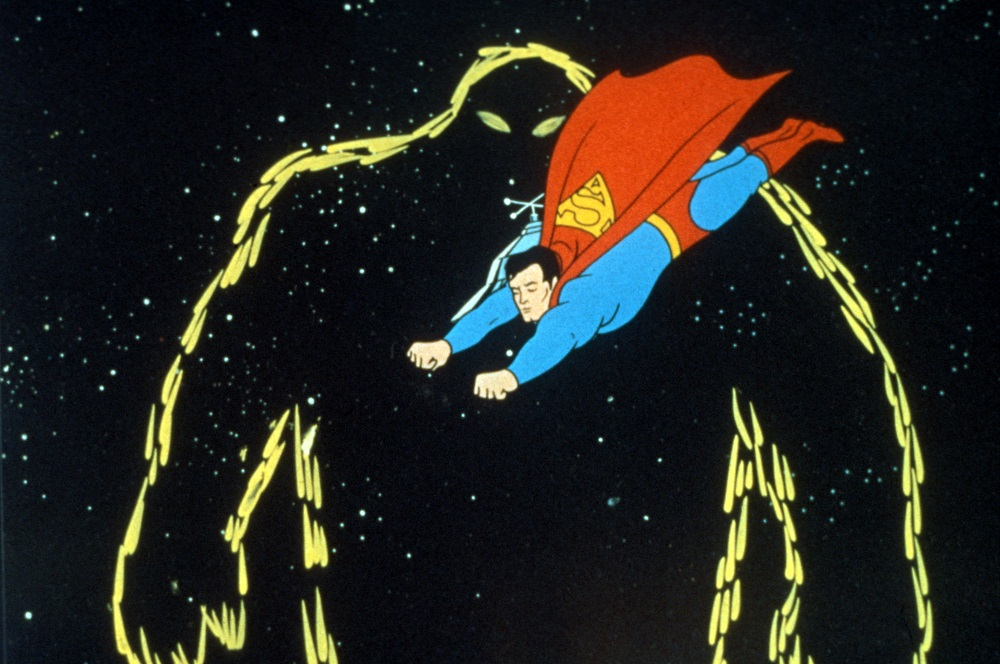
The New Adventures of Superman debuted in 1966, just as Batman-fever was taking hold of the US, and turned Filmation into a major player almost overnight. More DC comics ‘toons and adaptations of film properties Journey to the Center of the Earth and Fantastic Voyage followed, with The Archie Show, The Hardy Boys, and Will the Real Jerry Lewis Please Stand Up? leading into a massively prolific 1970s. By that time, the company had been sold to the TelePrompTer Corporation, who themselves were bought by Westinghouse in 1981. It was Westinghouse who closed Filmation in 1989, shortly before selling the properties to French make-up firm L’Oreal. The closure came one day before a new law would have given employees two months’ notice, but by that point Scheimer was the sole founder left at the company. He went into retirement soon after but did make one last feature in 1999; Robin and the Dreamweavers, a Dutch-backed erotic space adventure, was sadly never released, although it can be seen on YouTube.

The Telephemera Years has already featured many of Filmation’s most-famous shows but no true round-up of the world of disposable televisual entertainment would be complete without investigating the balance of the studio’s work. With that guiding us, this is the story of their second decade and beyond…

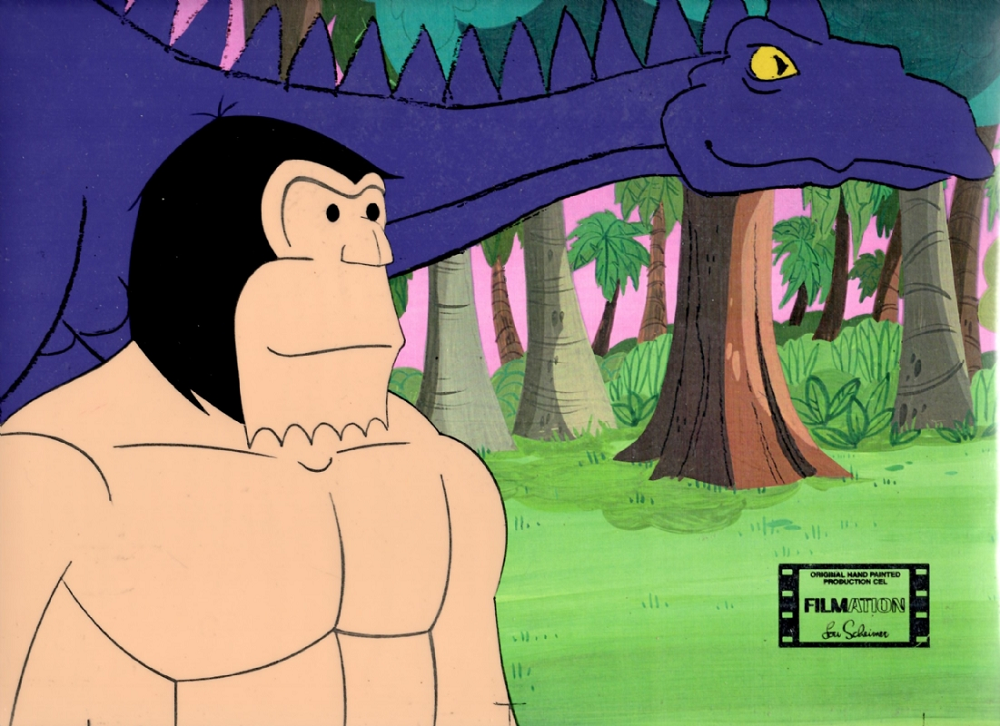
Tarzan and the Super 7 (CBS, 1978): We wrote about the origins of Filmation’s Tarzan, Lord of the Jungle in our 1976 feature, but two years later he was given company in the form of the Super 7, of which there were either six or twelve, depending on how you count them. After starting with a simple half-hour slot, and then spending his second season as part of The Batman/Tarzan Adventure Hour, the jungle hero’s time was again expanded for 1978, when Tarzan and the Super 7 occupied a ninety-minute block on Saturday mornings.

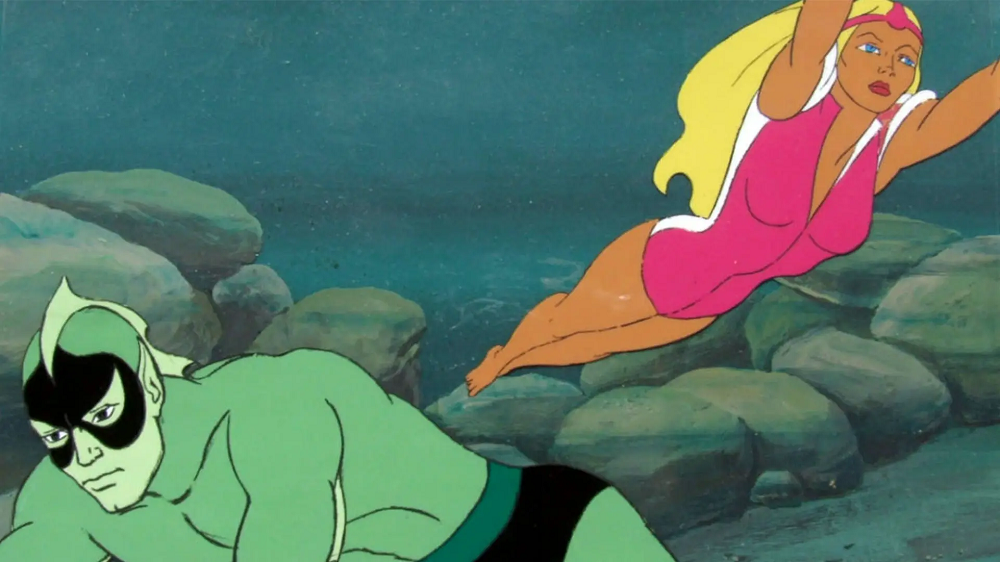
Although they occupied two very different worlds, The New Adventures of Batman was still around as a co-feature, even if it had lost title privileges, and five new features were added to the slate, all superhero (or space adventurer) based. First up was The Freedom Force, which took Isis from the 1975 live-action show The Secrets of Isis and gave her four comrades. Hercules had previously appeared as one of the Space Sentinels in 1977, but Merlin, Sinbad, and Japanese hero Super Samurai were new, at least to the world of Filmation. Manta and Moray featured the underwater adventures of Manta, the Monarch of the Deep, awoken from a long spell in suspended animation by Moray, a human woman who becomes his partner in crimefighting.
Tarzan and the Super 7, 1978-79

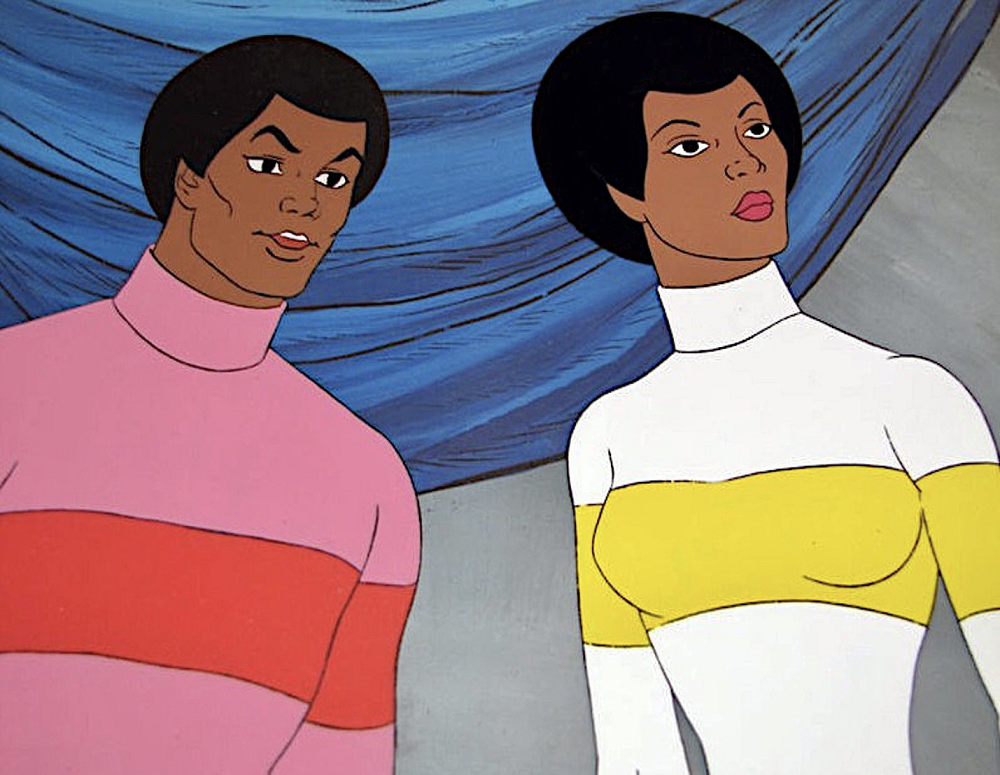
The protagonists of the third new feature, married couple Chris and Christy Cross, were remarkable in two ways; they were the first African American couple to star on a children’s TV show and they were the superheroes Superstretch and Microwoman! Both Manta and Superstretch would become the focus of a lawsuit later field by DC Comics against Filmation, alleging that the characters were thinly veiled knock-offs of Aquaman and Plastic Man. A court found in DC’s favour in 1980 and on appeal in 1986, and neither feature has subsequently been released on home media.

A similar fate was narrowly avoided by the fourth new animated segment, Web Woman, which had been initially titled Spider-Woman before Marvel Comics learned of their plans and hastily created their own Spider-Woman (who got her own animated show a year later from DePatie-Freleng Enterprises). Filmation’s renamed heroine was Kelly Webster, given amazing powers when she saves the life of a dying alien. The final segment – and the only live-action feature – was Jason of Star Command, which followed space adventurer Jason (perennial guest star Craig Littler) and his crew – Professor Parsafoot and pocket robot W1K1 – as they battle James Doohan’s Dragos.
Tarzan and the Super 7, 1978-79

Despite its title, each episode of the show featured five segments, one each from Tarzan and Batman, and a revolving set of three from the other five; Jason of Star Command was the most regular attraction, with sixteen episodes, while Freedom Force notched just five. After running throughout the 1978-79 season, the show returned for Fall 1979 with a couple of changes as Jason of Star Command was spun off into his own show, and the block was reduced to an hour in length.

In 1980, Tarzan ran off to join John Reid in The Tarzan/Lone Ranger Adventure Hour and the show was renamed Batman and the Super 7, now making even less sense as it consisted of just five different segments. No new episodes were produced and there was a change of network as NBC took the block. The show was Batman’s last solo animated outing until Batman: The Animated Series in 1992. Only the Jason of Star Command and Freedom Force (the latter as part of a set with Space Sentinels) have ever been released on home media, complicated rights issues (and legal action) consigning the rest to the dustbin of history, otherwise known as YouTube.

Fabulous Funnies (NBC, 1978): Tarzan and the Super 7 wasn’t the only new anthology show on the 1978 slate from Filmation as Fabulous Funnies debuted on NBC. It couldn’t have been more different from the superhero-themed offering on CBS, however, concerned as it was with classic characters from the newspaper funny pages.

Six strips were originally featured, three of which – Alley Oop, Broom-Hilda, and The Captain and the Kids – appeared in every episode, with the other three (well, two, but more of that later) rotating through the series. Alley Oop first appeared in newspaper in December 1932, the creation of cartoonist VT Hamlin. It originally focussed on the adventures of the titular caveman in the Stone Age but later evolved to have Alley Oop travel through time at the behest of wacky inventor Dr Elbert Wonmug. Hamlin continued the strip until 1991, when he handed it over to Jack Bender. He died two years later but new adventures of Alley Oop still appear, albeit in a dwindling number of newspapers.
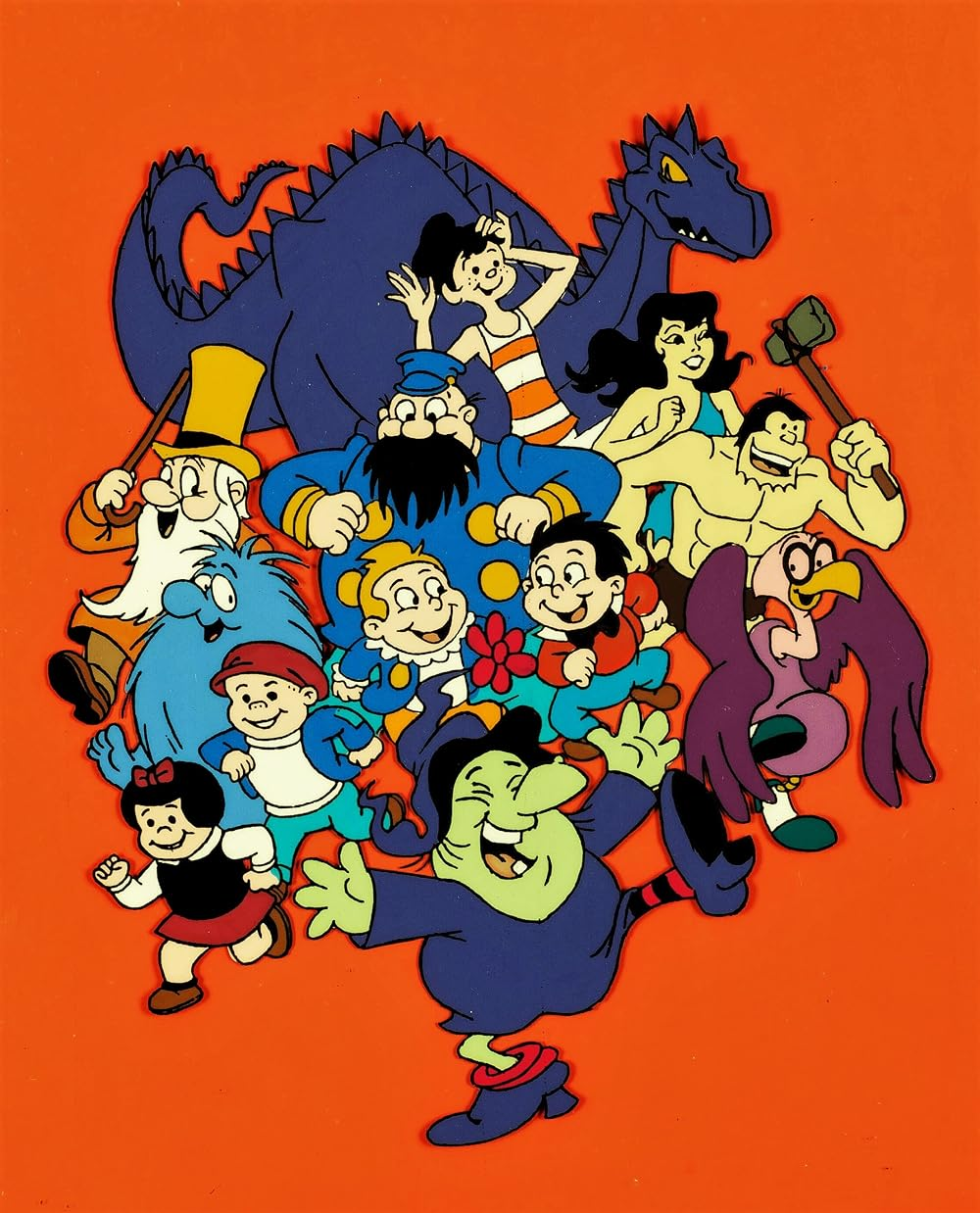
Fabulous Funnies, 1978-79

Russell Myers’s Broom-Hilda was a fairly late addition to the great comic strip cannon, first appearing in April 1970, the story of a cigar-smoking, beer-guzzling 1,500-year-old witch who was constantly after a boyfriend; it has recently moved into its fifty-fifth year of consecutive publishing, still in the hands of its octogenarian creator. By contrast, The Captain and the Kids had its origins in The Katzenjammer Kids, a strip that first appeared in 1897 from German American cartoonist Rudolph Dirks. In 1914, a series of legal disputes between Dirks and the Hearst group of newspapers led to the artist leaving the strip, only to pitch up at the Pulitzer group with The Captain and the Kids, using the characters he’d created for Hearst. Both strips continued (with Harold Knerr taking over The Katzenjammer Kids in 1912) until 1979, when The Captain and the Kids ended, with the rival strip continuing until 2006.

Alongside the three mainstays were Emmy Lou, Nancy, and Tumbleweeds, although the latter – a humorous tale of the old west created by Tom K Ryan in 1965 – only appeared in the first episode, after which Filmation realised they didn’t actually have the rights to the strip. Emmy Lou began as Bobby Sox and starred teenage Mimi, described by The San Francisco Chronicle as a “precocious sub-deb with a flair for trouble.” Created by female cartoonist Marty Links, the term bobby sox had become outdated by 1951 and she changed the title to reflect its current protagonist, although the stories still told of the trials of teenage life until Links ended the strip in December 1979.
Fabulous Funnies, 1978-79

Nancy didn’t start out as the star of her own strip, instead first appearing as a side character in Ernie Bushmiller’s Fritzi Ritz feature, which had begun in 1922. Nancy made a splash when she arrived as Fritzi’s niece in January 1933 and within five years it was her name on the masthead, audiences much preferring the adventures of a troublesome, if thoughtful, eight-year-old girl and he best friend Sluggo. Fritzi continued to appear in the strip, but she was less girl-about-town and more stand-in mother figure. The comic strip Nancy still continues to this day in the hands of offbeat cartoonist Olivia Jaimes, the fifth person to take the strip on after Bushmiller’s death in 1982.

Fabulous Funnies debuted on September 9th 1978 and enjoyed a first run season of thirteen episodes, after which it entered into re-runs. After appearing in the first episode, Tumbleweeds was withdrawn, although Ryan agreed not to sue if no more episodes based on his strip were aired. The show received a mixed reception, with many critics pointing out that the unique humour of the strips had been neutered by NBC’s insistence that they impart a moral message on air. Two years later, Mendelson/Melendez partnered with CBS to create a one-off special, The Fantastic Funnies, which featured many of the strips featured in Fabulous Funnies alongside new arrivals such as Garfield and Peanuts.

Sport Billy (NBC, 1980): It’s no surprise that Sport Billy has the feel of a European cartoon translated for the American market, because that’s exactly what it was. Based on a German comic strip by Rolf Deyhle that was popular across mainland Europe, Filmation was approached by Sport Billy Productions in 1980 to make an animated show for the French and German markets, starring sports mad Billy, his friend Susie, and dog pal Hannibal (the original comics had another character – Dickie – but he was phased out before Filmation came on board).

Billy is from the planet Olympus, Earth’s twin planet on the opposite side of the Sun, although whether it is the one first seen in 1969 British sci-fi movie Doppelgänger is pure conjecture. Billy is given the Omnisack – a magical sportsbag from which he can produce any piece of sporting equipment he desires – by President Sportikus XI and sent to Earth to encourage teamwork and sportsmanship. Opposing him is the evil Queen Vanda, who finds fair play disgusting. Teaming with his Earth friends, Billy must stop Vanda ruining a different Earth sport each episode.
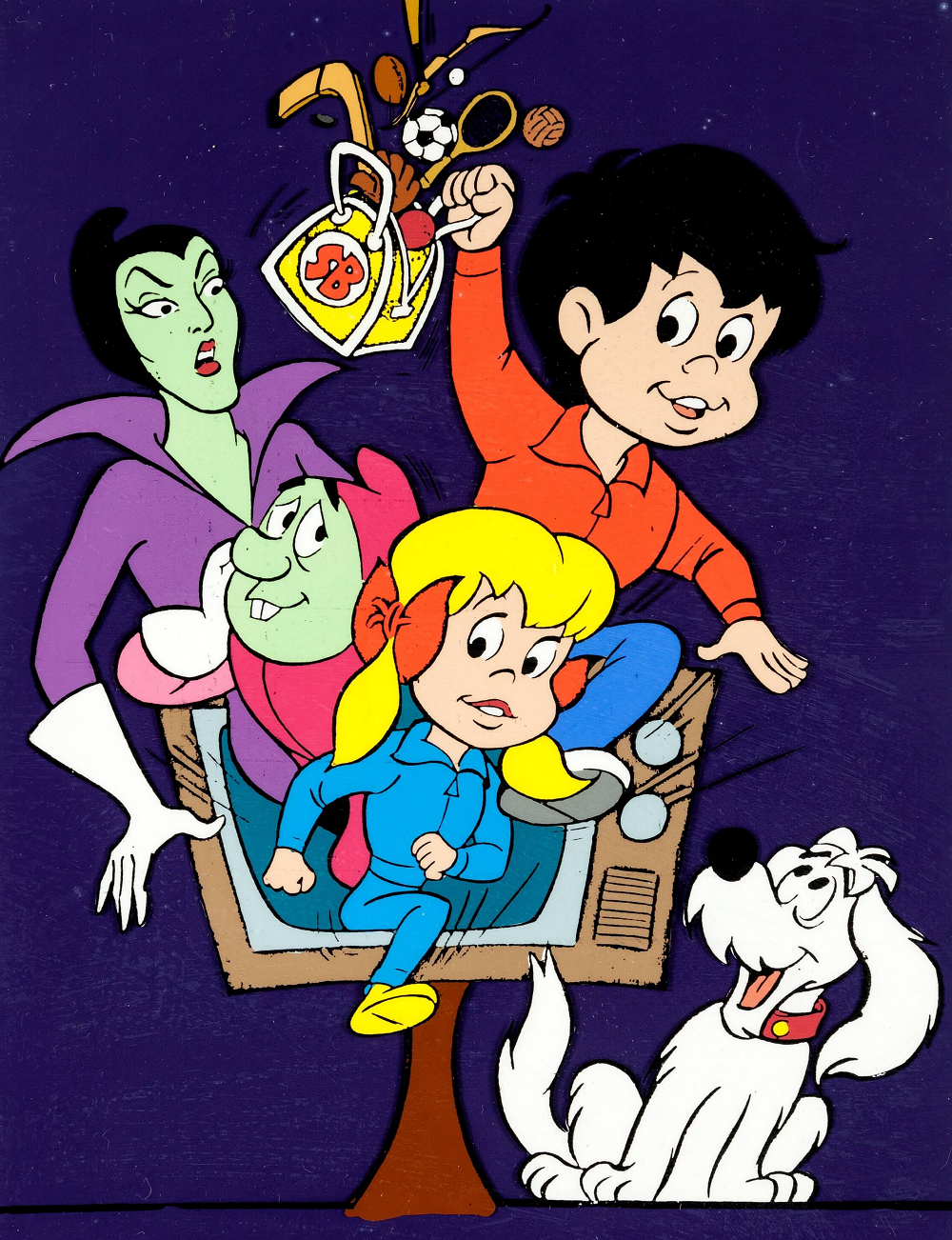
Sport Billy, 1980-81

Twenty-six episodes were produced for the European market and with the 1980 Olympic Games – for which NBC had paid $87 million to obtain the broadcast rights – fast approaching, Filmation brought the show to the US, with an all-new voice cast led by man of many voices (and animal sounds) Frank Welker. Subtle tweaks were made, with Susie and Hannibal becoming Lily and Willy, respectively, and the show was scheduled for Fall 1980, ready to pick up an audience on the back of US success in Moscow.

Unfortunately, the Soviet invasion of Afghanistan led to a boycott of the Olympics by the US, almost bankrupting NBC. US audiences were less than enthused by the US’s replacement event, The Liberty Bell Classic, a twenty-nine-country event that saw the home nation carry off twenty of the thirty-three gold medals on offer, and Sport Billy was shelved for two years until after the World Cup of 1982, although an edited together feature length adventure did get an airing on HBO.

The World Cup tie-in was fitting as the character had been adopted by FIFA in 1978 as a fair play mascot (with 1978 official mascot Gauchito bearing more than a casual resemblance to the character), but it’s probably notable that – among its English-language markets – soccer-centric Billy is better remembered by those who saw it on the BBC in the UK than American viewers of the syndicated show.

He-Man and the Masters of the Universe (1983)/She-Ra: Princess of Power (1985): It’s probably fair to say that there’d be no He-Man as we know him without Strawberry Shortcake. It’s a story that begins in 1969 when Mattel sponsored a Hot Wheels show on ABC, designed to promote their line of toy cars. The show attracted the ire of the Federal Communications Commission, who considered it a half-hour commercial against the regulations of the time, but ABC fought their corner and the show remained on air for two seasons.

Afterwards, though, networks became more circumspect about promoting toylines on their shows, but the blockbuster success of Star Wars and its associated toyline brought about a change of thinking, especially as movies were not regulated in the same way when it came to being used as advertising fodder. In 1980, having partnered with Kenner to produce a doll based on its popular greetings card character Strawberry Shortcake, American Greetings hired Murakami-Wolf-Swenson and Japanese animation studio Toei to produce a thirty-minute animated special entitled The World of Strawberry Shortcake.
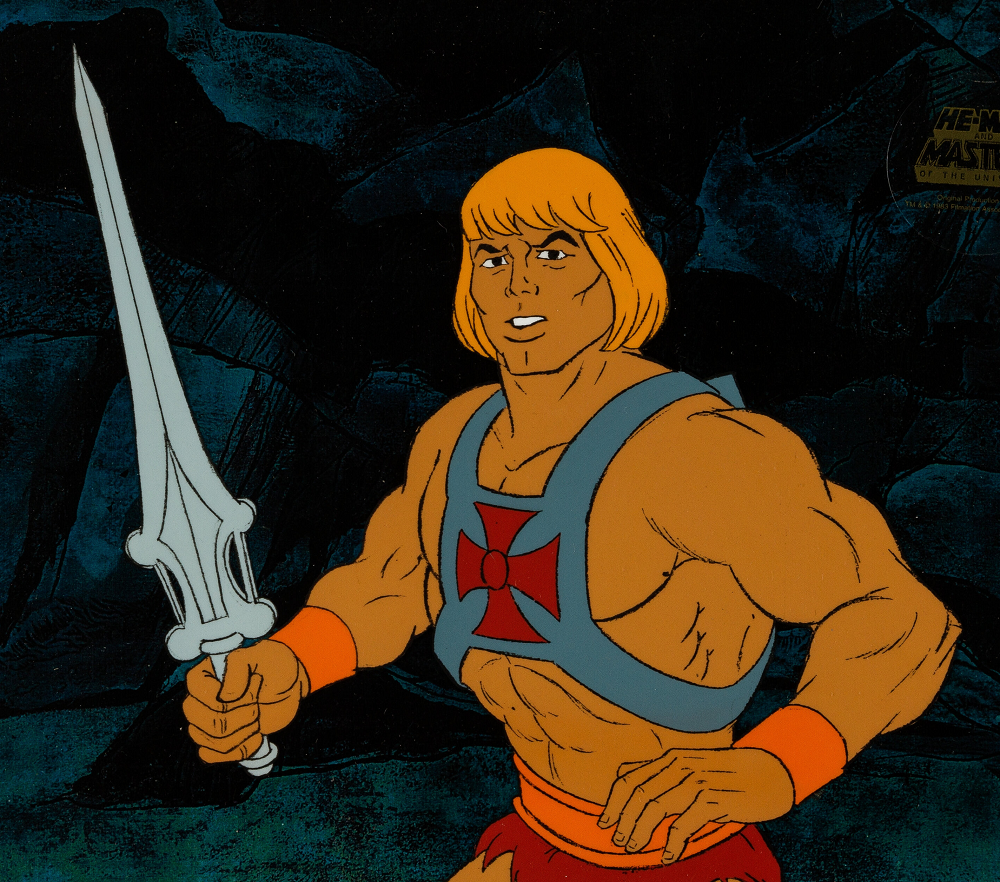
He-Man and the Masters of the Universe, 1983-84

The special aired in syndication after major networks rejected it, fearing the ire of the FCC, but the recent election of Ronald Reagan saw a relaxing of government attitudes to, well, just about anything that concerned the almighty dollar, and it began to dawn on TV bosses that previous restrictions on using their Saturday morning shows to advertise toys to America’s children were a thing of the past. One of the first to take advantage was Mattel, who commissioned Filmation to produce an animated show based on their new Masters of the Universe toyline.

Mattel won the gig after producing several animated commercials for the company, but when Mattel pitched the show to ABC, they were unimpressed. Instead, they took it to the 1983 NATPE convention for independent TV stations and sold it into syndication, the first such series based on a toyline. Attempts to mitigate the violence on show, and as a sop to those who still considered using cartoons as commercials to be beyond the pale, each episode came complete with a moral imparted at the end by one of the main characters. By mid-1985, He-Man and the Masters of the Universe was airing on 152 stations across the US and Mattel decided to repeat the formula with a new line of toys for girls.
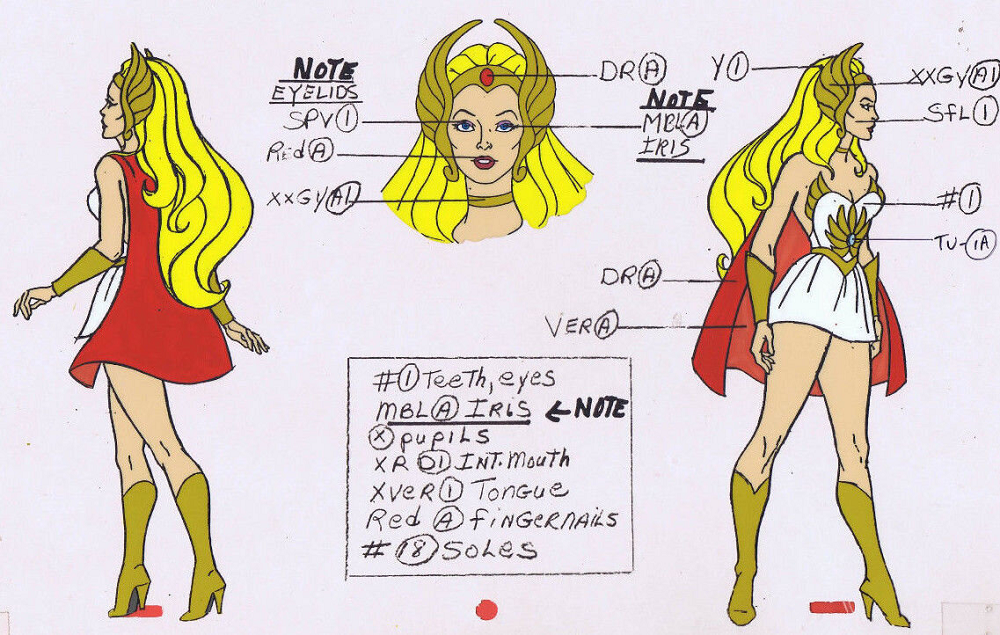
She-Ra, Princess of Power, 1985-86

On March 22nd 1985, a feature length He-Man and the Masters of the Universe film entitled The Secret of the Sword was released in US theatres. The film told the origin story of He-Man’s twin sister, She-Ra, and was preceded by a range of nine action figures in late 1984. In September 1985, She Ra: Princess of Power went into syndication, its ninety-three-episode run taking the combined number of He-Man and She-Ra episodes to a mammoth 224.

Despite their origins as a toyline, and a series bible created by seasoned television Michael Halperin, He-Man and the Masters of the Universe and She-Ra: Princess of Power have Lou Scheimer written all the way through them like a stick of rock. Not only did he co-write the closing theme, Scheimer also provided voices for many of the characters when the regular voice actors were unavailable, and the latitude he allowed his staff in the production of the shows ensured that they remain extremely watchable even now, with She-Ra miles from the “He-Man with boobs” it so easily could have been.

Time was running out for Filmation, though, and only two more shows would see production before its closure in 1989. We wrote about one of those, Ghostbusters, in our 1986 feature here, but the story of Filmation – that started with The New Adventures of Superman in 1966 – ends with BraveStarr

BraveStarr (1987): Even with the most charitable attitude, there is little to recommend Ghostbusters, Filmation’s attempt to spoil DIC’s The Real Ghostbusters by bringing back the cast of the 1976 live-action show that owned the name before Dan Aykroyd and company showed up with their proton packs and particle throwers. It does, however, play a part in the creation of BraveStarr, the final Filmation show to make it to air before Westinghouse shuttered the studio in 1989.
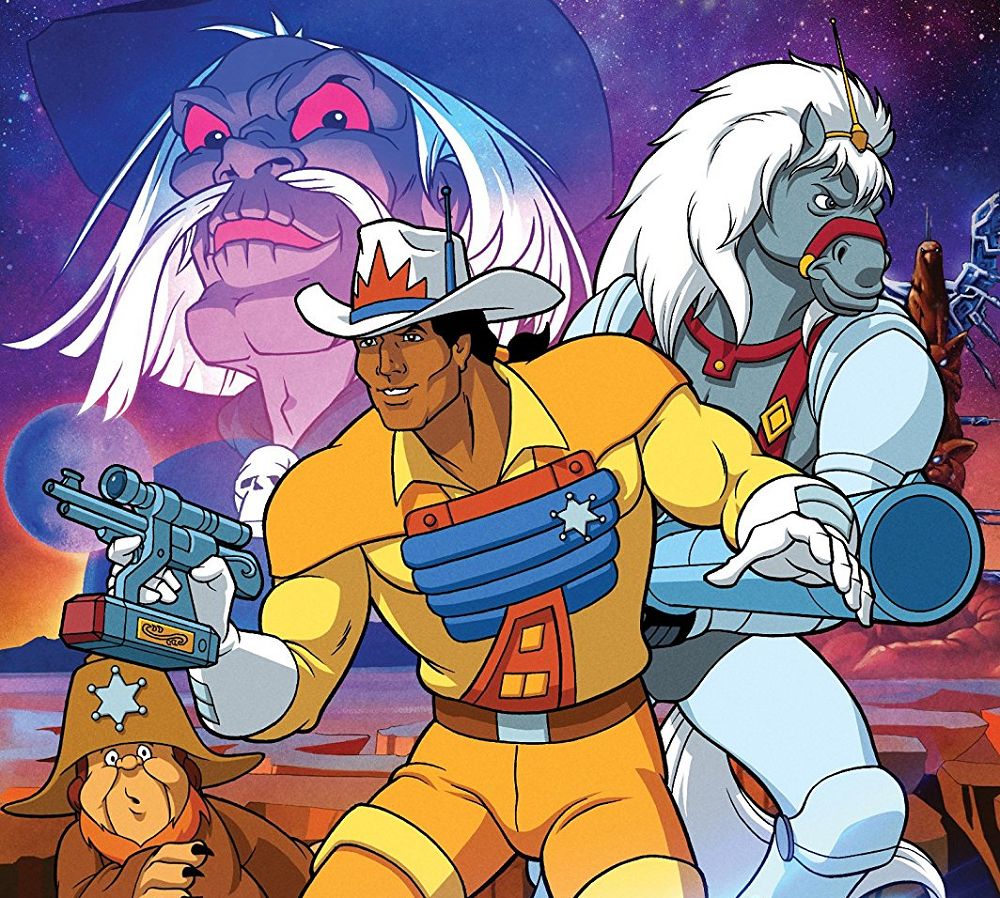
Bravestarr, 1987-88

While Ghostbusters was less than a success, Lou Scheimer was particularly captured by a design for one of the show’s villains. Scheimer thought that Tex Hex, a purple-skinned Old West prospector type, had potential beyond an enemy of the week for Ghostbusters and tasked Arthur Nadel and John Grusd with developing a science-fiction show based around the character. As the project developed, Tex Hex returned to his villainous status, but this time as one of a bunch of ruthless outlaws known as the Carrion Bunch, often under the employ of the Stampede, a monstrous crime boss.

Standing in their way, the concept fleshed out by writer Bob Forward, was BraveStarr, a galactic marshal of New Texas, and his chief deputy Thirty/Thirty, a human/horse hybrid. Thanks to his Native American roots, BraveStarr is able to call upon spirit animals, endowing him with the Eyes of the Hawk, the Ears of the Wolf, the Strength of the Bear, and the Speed of the Puma. In harmony with his spiritual side, BraveStarr often prefers to mediate rather than punish, although he is not above getting hands on with the show’s villains (which, alongside Tex Hex, include Outlaw Skuzz, Cactus Head, Thunder Stick, Sand Storm, and Vipra.
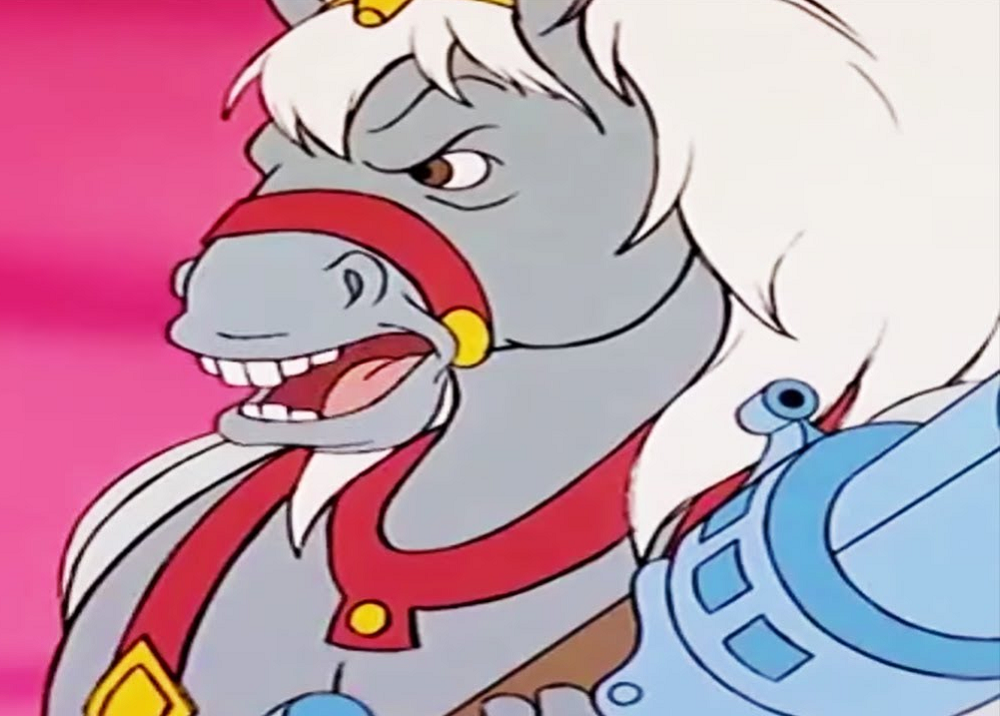
Bravestarr, 1987-88

In an attempt to repeat their earlier successful partnership, Mattel produced a range of action figures based on the show, but released them early, almost a year before the show debuted in syndication in September 1987. Scheimer thought that this undermined the show, suggesting that it led viewers to think the cartoon was a cash-in for the toys when, in fact, the toyline was based on Filmation’s original concept.

Regardless, BraveStarr was successful in syndication, and an animated prequel movie was released theatrically in March 1988. This was not a commercial success, but plans were underway for a second season of the show, and also a spin-off – Bravo – featuring the adventures of the Prairie People, one of New Texas’s native species. All this – and a new show, Bugzburg, featuring characters from Filmation’s animated movie Pinocchio and the Emperor of the Night – was put on hold as Westinghouse prepared to sell the studio, and finally abandoned when Filmation was closed down ahead of the sale to Paravision International. One final feature film – Happily Ever After – had been completed, but it didn’t see a release until 1993.

Next time on Titans of Telephemera: We ask for sight beyond sight and turn our attention to the cartoon productions of Rankin/Bass!

Check out our other Telephemera articles:

The Telephemera Years: pre-1965 (part 1, 2, 3, 4)

The Telephemera Years: 1966 (part 1, 2, 3, 4)

The Telephemera Years: 1967 (part 1, 2, 3, 4)

The Telephemera Years: 1968 (part 1, 2, 3, 4)

The Telephemera Years: 1969 (part 1, 2, 3, 4)

The Telephemera Years: 1970 (part 1, 2, 3, 4)

The Telephemera Years: 1971 (part 1, 2, 3, 4)

The Telephemera Years: 1973 (part 1, 2, 3, 4)

The Telephemera Years: 1974 (part 1, 2, 3, 4, 5)

The Telephemera Years: 1975 (part 1, 2, 3, 4)

The Telephemera Years: 1976 (part 1, 2, 3, 4)

The Telephemera Years: 1977 (part 1, 2, 3, 4)

The Telephemera Years: 1978 (part 1, 2, 3, 4)

The Telephemera Years: 1980 (part 12, 3, 4)

The Telephemera Years: 1981 (part 1, 2, 3, 4)

The Telephemera Years: 1982 (part 1, 2, 3, 4)

The Telephemera Years: 1983 (part 1, 2, 3, 4)

The Telephemera Years: 1984 (part 1, 2, 3, 4)

The Telephemera Years: 1986 (part 1, 2, 3, 4)

The Telephemera Years: 1987 (part 1, 2, 3, 4)

The Telephemera Years: 1989 (part 1, 2, 3, 4)

The Telephemera Years: 1990 (part 1, 2, 3, 4)

The Telephemera Years: 1991 (part 1, 2, 3, 4)

The Telephemera Years: 1992 (part 1, 2, 3, 4)

The Telephemera Years: 1995 (part 12, 3, 4)

The Telephemera Years: 1997 (part 1, 2, 3, 4)

The Telephemera Years: 1998 (part 1, 2, 3, 4)

The Telephemera Years: 1999 (part 1, 2, 3, 4)

The Telephemera Years: 2000 (part 1, 2, 3, 4)

The Telephemera Years: 2002 (part 1, 2, 3, 4)

The Telephemera Years: 2003 (part 1, 2, 3, 4)

The Telephemera Years: 2005 (part 1, 2, 3, 4)

The Telephemera Years: 2006 (part 1, 2, 3, 4)

The Telephemera Years: 2007 (part 1, 2, 3, 4)

The Telephemera Years: 2008 (part 1, 23, 4)

The Telephemera Years: O Canada! (part 1, 2, 3, 4)

Titans of Telephemera: Irwin Allen

Titans of Telephemera: Stephen J Cannell (part 1, 2, 3, 4)

Titans of Telephemera: DIC (part 1, 2)

Titans of Telephemera: Filmation (part 1)

Titans of Telephemera: Hanna-Barbera (part 1, 2, 3, 4, 5)

Titans of Telephemera: Kenneth Johnson

Titans of Telephemera: Sid & Marty Krofft

Titans of Telephemera: Glen A Larson (part 1, 2, 3, 4)

Titans of Telephemera: Quinn Martin (part 1, 2)

Titans of Telephemera: Ruby-Spears

TITANS OF TELEPHEMERA: FILMATION – part 1

Shazam!, 1974-75

Ah, telephemera… those shows whose stay with us was tantalisingly brief, snatched away before their time, and sometimes with good cause. Dedicated miners of this fecund seam begin to notice the same names cropping up, again and again, as if their whole career was based on a principle of throwing stuff at the wall and seeing what sticks. What’s more, it isn’t all one-season failures and unsold pilots, there’s genuine gold to be found amongst their hoards; these men are surely the Titans of Telephemera!

Filmation

Having formed a partnership when they were working at Larry Harmon Pictures on the televised Popeye cartoons in the late 1950s, Lou Scheimer and Hal Sutherland founded Filmation Associates in 1962, along with former radio DJ Norm Prescott. The nascent studio’s first credits were on the production of Rod Rocket a year later, a project they inherited from former employees SIB Productions. After struggling for years to complete an adaptation of The Wizard of Oz (and failing to sell to sell their first original cartoon, The Adventures of Stanley Stoutheart), they were about to close the studio down when DC Comics’ Mort Weisinger approached them to produce a cartoon based on DC’s most famous character.

The New Adventures of Superman debuted in 1966, just as Batman-fever was taking hold of the US, turning Filmation into a major player almost overnight. More DC comics ‘toons and adaptations of film properties Journey to the Center of the Earth and Fantastic Voyage followed, with The Archie Show, The Hardy Boys, and Will the Real Jerry Lewis Please Stand Up? leading into a massively prolific 1970s. By that time, the company had been sold to the TelePrompTer Corporation, who themselves were bought by Westinghouse in 1981. It was Westinghouse who closed Filmation in 1989, shortly before selling the properties to French make-up firm L’Oreal. The closure came one day before a new law would have given employees two months’ notice, but by that point Scheimer was the sole founder left at the company. He went into retirement soon after but did make one last feature in 1999; Robin and the Dreamweavers, a Dutch-backed erotic space adventure, was sadly never released, although it can be seen on YouTube.

The Telephemera Years has already featured many of Filmation’s most-famous shows but no true round-up of the world of disposable televisual entertainment would be complete without investigating the balance of the studio’s work. With that guiding us, this is the story of four shows from their first decade of hits…

The New Adventures of Superman (CBS, 1966): Created by two shy friends from Cleveland in 1938, it took Superman just three years to transfer to the moving picture in a series of (still) critically acclaimed theatrical shorts produced by the Fleischer brothers. A live-action serial followed in 1948, with a live-action TV show starring George Reeves arriving in 1952.

Adventures of Superman enjoyed a six-year run, but the Man of Steel was absent from TV screens until 1966 when, as part of a drive led by CBS’ head of daytime programming Fred Silverman to transform Saturday mornings on the network into a superhero adventure block, DC Comics approached Filmation with the opportunity to turn its comic book character into cartoons, an offer eagerly accepted by the struggling studio. There was just problem: Silverman wanted to visit the Filmation Studios first but there wasn’t a Filmation Studios in the physical sense, at least not until Norm Prescott, Lou Scheimer, and Hal Sutherland called everyone they knew to come to their offices and pretend to be a bustling studio!

The New Adventures of Superman, 1966-67

Satisfied, CBS gave Filmation the green light to begin production and Scheimer took the lead, working closely with DC Comics on character design (predominantly using comic artist Curt Swan’s art as model sheets) and bringing in several veterans of the Fleischer cartoons, including Bud Collyer and Joan Alexander as the voices of Superman/Clark Kent and Lois Lane. With scripts wholly or co-written by Weisinger, The New Adventures of Superman debuted on September 10th 1966 with a pair of stories that saw the Last Son of Krypton tackle aliens and mermen, sandwiching a single outing for the hero’s teenage self in The Adventures of Superboy.

Comic book villains Lex Luthor, Titano, Brainiac, the Toyman, the Prankster, and Mr Mxyzptlk all made appearances in the eighteen-episode first season, airing in a block that also featured Mighty Mouse, Underdog, Frankenstein Jr & the Impossibles, Space Ghost, and The Lone Ranger. To say the show was a success would be an understatement and the show was extended to an hour for its second season, bringing in more of DC’s colourful characters.

The New Adventures of Superman, 1966-67

Retitled The Superman/Aquaman Hour of Adventure, each episode featured four stories, with oen each starring Superman and Superboy joined by an Aquaman segment and a revolving fourth feature, which spotlighted the likes of The Atom, The Flash, Green Lantern, Hawkman, and the Teen Titans. Only Batman (whose live-action show was airing on ABC) and Wonder Woman (subject of a live-action pilot by Batman’s William Dozier) were missing from the line-up of DC’s heaviest hitters, but Batman finally made an appearance in time for season three, again retitled as The Batman/Superman Hour.

While a fourth season of re-runs of Superman and Superboy segments did appear in 1969, a combination of pressure from the Action for Children’s Television group and falling ratings led Silverman to pivot away from superheroes for the 1970 season. The Man of Tomorrow wouldn’t have to wait long for a comeback, though, returning with his Justice League pals in Super Friends in 1973, but from Filmation’s chief rivals Hanna-Barbera. No matter, Scheimer and company had plenty to keep them busy…

Journey to the Center of the Earth (ABC, 1967): First published in 1864, Voyage au Centre de la Terre was the third of fifty-four Voyages extraordinaires written by Jules Verne before his death in 1905. Journey to the Center of the Earth, as it was known in English, told the story of an eccentric German scientist who is convinced there are volcanic tubes that reach the centre of the Earth, and who embarks on an adventure to discover them with his son and an Icelandic guide.

Given that Verne’s earliest works entered the public domain in the US in the 1920s, it’s remarkable that it took until 1959 for Hollywood to adapt Journey to the Centre of the Earth. Written by The King and I producer Charles Brackett, and directed by experienced hand Henry Levin, the movie was a financial success, earning three times its budget at the box office, although critics were mixed on its creative merits.

Journey to the Center of the Earth, 1967-68

Brackett’s script took some liberties with Verne’s novel, adding in a villain, a love interest, and a duck, amongst other changes, and when Filmation came to produce a Saturday morning cartoon it was the 1959 movie that they took as their starting point, rather than adapt the novel anew. Almost a sequel to Brackett and Levin’s film, former Disney animator and comic book artist Don Christensen came up with the plot that saw Professor Lindenbrook, assistant Alec McEwan, and guide Lars (Hans in the movie, although his duck remains) trapped in the underground world, valiantly searching to find a way back to the surface.

Unlike the film (or, indeed, the original text), they are accompanied by Lindenbrook’s niece Cindy, and all have been trapped by a landslide caused by the evil Count Sacknussem and his henchman Torg. Over the next seventeen episodes, the intrepid quartet must negotiate all manner of threats, including pterodactyls, giant cavemen, Wolf Men, and human/spider hybrids, and avoid the traps set by Sacknussem and Torg, all in the hope of returning home.

Journey to the Centre of the Earth debuted on ABC on September 9th 1967, opposite the second season of Space Ghost on CBS and NBC’s new biblical superhero Young Samson. Despite its fantastic setting, the cartoon could be slow at times and ABC declined to option a second season, leaving the Professor and his comrades stranded under the Earth for all time. A year later, Filmation embarked on another Fantastic Voyage, adapting the 1966 movie about a miniature submarine and its crew stranded inside the body of an injured scientist, again with several changes.

Shazam! (CBS, 1974): In 1968, Hanna-Barbera produced two live-action/animation hybrids – The Banana Splits Adventure Hour and The New Adventures of Huckleberry Finn – for the Saturday morning market to mixed reviews. Hanna-Barbera went right back to what it knew best but by 1974 it was ready to dip its toes in the live-action market again, with Neanderthal drama Korg: 70,000 BC. Coincidentally (or not, depending on your view of such things), chief rivals Filmation were also preparing a live-action show for Saturday mornings, teaming back up with former partners DC Comics for a show based on one of the Golden Age of comic books’ greatest heroes…

Like many of the Golden Age’s publishing houses, Fawcett Comics looked on enviously as National Comics Publications (later DC Comics) enjoyed unparalleled success with a series of superhero titles, notably those starring Superman and Batman. Staff writer Bill Parker was tasked with developing Fawcett’s own superheroes, coming up with Ibis the Invincible, the Spy Smasher, Dan Dare (no relation), and others for a comic provisionally Flash Comics. He also created one of comics’ first superhero teams, a six-man crew each with a power inspired by a Greek god, but his boss decided that it might work better if it were one man with all those powers.

Teaming Parker with artist CC Beck led to the creation of Captain Thunder but it was discovered that both the Flash Comics and Captain Thunder (and alternate Thrill Comics) were already in use after an ashcan edition had already been published to establish copyright. Thus, the renamed Whiz Comics #2 (continuing the numbering after the ashcan edition) saw the debut of Captain Marvel, an orphaned boy named Billy Batson given amazing powers when he says the word “Shazam!” (each letter corresponding to one of six mythological figures providing his abilities).

Shazam!, 1974-75

Captain Marvel became an immediate smash, attracting the attention of DC Comics, who launched a lawsuit claiming he was overly derivative of Superman which eventually was settled in Fawcett’s favour in 1951. That verdict was overturned a year later, by which time Fawcett (and the rest of the US comics business, save for DC) had largely gotten out of the superhero market; they agreed to shutter production of Captain Marvel comics (and, eventually, all comics), sending the character into limbo for almost two decades. In 1972, DC reached an agreement with Fawcett to license the character, but in the intervening years, Marvel Comics had published their own Captain Marvel, gaining copyright on the name, at least for title purposes, and so the Big Red Cheese was re-introduced in Shazam! #1 in January 1973, sharing a cover with his former courtroom foe.

Around that time, Filmation came calling at DC in the hopes of rekindling a relationship that had put the studio on the map. Unfortunately, the lion’s share of DC characters had been licensed to Hanna-Barbera for their Super Friends cartoon, but having newly acquired Captain Marvel, the publisher offered that property to Lou Scheimer and company, who eagerly took it on. Filmation prepared an animated pilot for Fred Silverman at CBS, but he asked them to do a live-action show instead, perhaps aware that ABC and NBC were both going with some live-action shows in their Saturday morning line-ups for Fall 1974.

Shazam!, 1974-75

Filmation reworked the concept into Shazam!, slightly altering the comic book’s premise to eliminate the wizard that gives young Billy Batson his powers in favour of the six mythological figures themselves, all imparting advice to a teenage boy travelling the US in a motorhome with a mentor figure named, erm, Mentor. Former Brian Keith Show regular Michael Gray was cast as Billy, with Jackson Borthwick stepping up from bit parts to play his muscled alter-ego.

The first, fifteen-episode season of Shazam! did well enough that a second of seven episodes was commissioned for 1975, with the hero paired with Isis, an Egyptian themed superheroine created by Scheimer. As part of their agreement, Isis (who you can read about in our 1975 feature) appeared in DC Comics and has since become part of their canon. The Shazam!/Isis Hour returned for six more episodes in 1976, and all twenty-six episodes are now available on Blu Ray. Filmation did eventually get a chance to do that animated Captain Marvel show and you can read about that in our 1981 feature here.

Ark II (CBS, 1976): After the success of Shazam!, Filmation continued to make live-action programming for the Saturday morning market, producing the less-remembered The Secrets Lives of Waldo Kitty and Ghost Busters in 1975. A year later, they debuted a new show on CBS, created by Martin Post, a veteran scriptwriter who got his start on Glenn Miller Time in 1961.

Post was teamed with Hang ‘Em High, Magnum Force and Beneath the Planet of the Apes director Ted Post, and their Noah-inspired Ark II told the story of the titular mobile base, a surviving repository of all of mankind’s knowledge from before the fall of civilisation on a near future Earth. Its mission is to travel the wastelands searching for the last remnants of humanity, tasked with the mission of rebuilding what has been destroyed.

Ark II, 1976-77

At least, that was more or less the gist of the opening narration provided by Filmation’s Lou Scheimer, who – possibly as much as a cost-cutting exercise as any desire to perform – had moved into providing voices for much of the studio’s output. The young crew of Ark II were led by Terry Lester’s Jonah, and also included Ruth and Samuel, played by Asian American actress Jean Marie Hon and the Mexican American José Flores, respectively, filling out an admirably racially diverse cast (with a nod to our primate cousins given by the addition of chimpanzee Moochie).

Premiering on September 11th 1976 as part of a ninety-minute CBS block with The Shazam!/Isis Hour, Ark II got a fifteen-episode run, during which guests stars such as Jim Backus, Jonathan Harris, Malachi Throne, a young Helen Hunt, and Robby the Robot (from Forbidden Planet) appeared. Groups of feral children, an authoritarian Baron, rogue AIs, and a futuristic Robin Hood are all encountered along the crew’s journey to, well, they never really said (and the series ended before they got there). Before a second season could enter production, Hollywood was awash with talk of a new sensation named Star Wars, and rather than stay Earthbound, Filmation opted to go galactic for their next live-action production, Space Academy.

Next time on Titans of Telephemera: More Filmation classics from their second decade and beyond, including the show that changed the cartoon and toy business…

 Check out our other Telephemera articles:

The Telephemera Years: pre-1965 (part 1, 2, 3, 4)

The Telephemera Years: 1966 (part 1, 2, 3, 4)

The Telephemera Years: 1967 (part 1, 2, 3, 4)

The Telephemera Years: 1968 (part 1, 2, 3, 4)

The Telephemera Years: 1969 (part 1, 2, 3, 4)

The Telephemera Years: 1970 (part 1, 2, 3, 4)

The Telephemera Years: 1971 (part 1, 2, 3, 4)

The Telephemera Years: 1973 (part 1, 2, 3, 4)

The Telephemera Years: 1974 (part 1, 2, 3, 4, 5)

The Telephemera Years: 1975 (part 1, 2, 3, 4)

The Telphemera Years: 1976 (part 1, 2, 3, 4)

The Telephemera Years: 1977 (part 1, 2, 3, 4)

The Telephemera Years: 1978 (part 1, 2, 3, 4)

The Telephemera Years: 1980 (part 12, 3, 4)

The Telephemera Years: 1981 (part 1, 2, 3, 4)

The Telephemera Years: 1982 (part 1, 2, 3, 4)

The Telephemera Years: 1983 (part 1, 2, 3, 4)

The Telephemera Years: 1984 (part 1, 2, 3, 4)

The Telephemera Years: 1986 (part 1, 2, 3, 4)

The Telephemera Years: 1987 (part 1, 2, 3, 4)

The Telephemera Years: 1989 (part 1, 2, 3, 4)

The Telephemera Years: 1990 (part 1, 2, 3, 4)

The Telephemera Years: 1991 (part 1, 2, 3, 4)

The Telephemera Years: 1992 (part 1, 2, 3, 4)

The Telephemera Years: 1995 (part 12, 3, 4)

The Telephemera Years: 1997 (part 1, 2, 3, 4)

The Telephemera Years: 1998 (part 1, 2, 3, 4)

The Telephemera Years: 1999 (part 1, 2, 3, 4)

The Telephemera Years: 2000 (part 1, 2, 3, 4)

The Telephemera Years: 2002 (part 1, 2, 3, 4)

The Telephemera Years: 2003 (part 1, 2, 3, 4)

The Telephemera Years: 2005 (part 1, 2, 3, 4)

The Telephemera Years: 2006 (part 1, 2, 3, 4)

The Telephemera Years: 2007 (part 1, 2, 3, 4)

The Telephemera Years: 2008 (part 1, 23, 4)

The Telephemera Years: O Canada! (part 1, 2, 3, 4)

Titans of Telephemera: Irwin Allen

Titans of Telephemera: Stephen J Cannell (part 1, 2, 3, 4)

Titans of Telephemera: DIC (part 1, 2)

Titans of Telephemera: Hanna-Barbera (part 1, 2, 3, 4, 5)

Titans of Telephemera: Kenneth Johnson

Titans of Telephemera: Sid & Marty Krofft

Titans of Telephemera: Glen A Larson (part 1, 2, 3, 4)

Titans of Telephemera: Quinn Martin (part 1, 2)

Titans of Telephemera: Ruby-Spears

Robert Morgan • STOPMOTION

Stopmotion is a mind-bending psychological thriller that will unnerve you to your core. In his feature-length directorial debut, stop-motion animator Robert Morgan delves into themes of the tortured artist, imposter syndrome, and a descent into madness. With elements of a dissociative world and gore that strike disturbingly close to home, we had the opportunity to sit down with Robert to discuss the creation of this chilling film, the techniques he employed to achieve such an unsettling effect, and the inspirations behind Stopmotion

STARBURST: Stopmotion is very much focused on the idea of the tortured artist. Could you explain why you chose this main narrative and any other inspiration you had for the film?

Robert Morgan: The original idea was just that. I was excited by the idea years and years ago because my background is in stop-motion animation. I’d never seen stop-motion as a vocation depicted in a film. I’ve never seen a character who is a stop-motion animator in a film. And I thought it would be really interesting to explore a character who’s a stop-motion animator and everything that comes with that and make a psychological horror film out of it. Following the logic of it very naturally, I’ve had this experience where I’ve been working with puppets. Puppets have a strange way of feeling like they’re coming alive. It’s a bit disconcerting. You think you’re imposing your will on it, but is it telling you what it wants to be? I’ve had this kind of experience before. So very quickly, it became a film about a stop-motion artist who’s losing touch with reality and the things that are coming to light. Then, it just followed. It’s going to be the archetype of the artist who goes mad. That’s a story that we’ve seen many times, but I felt like showing that story through the lens of this particular art form, stop-motion animation. It excited me; the idea of doing the tortured artist story. We’ve seen it with painters, we’ve seen it with ventriloquists, we’ve seen it with ballet dancers. We’ve seen it with various art forms. We’ve never seen it with stop-motion animation. And for me, of all the art forms, that’s the one that I feel lends itself the most to going completely insane and puppets coming to life and haunting you. It does lend itself to a psychological horror film.

We believe that stop-motion animation is one of the hardest crafts to master, but for you, it’s your bread and butter. How was your experience creating a feature-length film with stop-motion compared to your history with shorts?

The challenges are bigger. The main thing is you’re essentially shooting a live-action movie but with animation incorporated into it. We shot this in 25 days. So it’s a pretty short, quick shoot, which was quite complex, as well. There were a lot of moving parts. The difference between the short films, where I’m mainly doing everything myself, and with this, is I had an amazing creative team around me. It was the sense of trusting the team, delegating, and letting go and choosing the team, carefully tuning them into the vision, and then giving them space, because you don’t have time to be changing your mind and steering into a different direction. Once that machine of production starts going, you’ve got to execute it, you’ve got like 10 things to get through today. Everything’s got to be working like clockwork. So it was the process of this different way of working, it’s less controlling and it’s more collaborative.

On the topic of having a good team behind you, we wanted to talk about the sound design because – and we say this in the best way – it was incredibly repulsive. So how did you achieve and create that really repulsive sound? 

The sound designer was a guy called Ben Baird, who is frankly a genius. He’s absolutely incredible. We had an absolute blast, he was coming up with a lot of stuff. He understood the film entirely but brought so much to the table that I hadn’t thought of. I always knew it was going to be squelchy. It had to be squelchy because that’s what I’ve always done in my shorts. It gives the puppets an extra dimension of physicality, when the sounds they make are extremely present in the film, it makes them much more difficult to dismiss as an invention. But what Ben brought additionally was, for example, his idea to do the squeaking of the armatures. I said to him, well, armatures don’t squeak. They don’t make a noise. But he said it doesn’t matter, it’s a dramatic thing, he was totally right. Because once we went with that, it really starts to become an eerie motif throughout the film, we can then start using it when the puppets are moving but we can also use it when the actors move. There are subtle scenes, for example, with Ella’s boyfriend, Tom; he turns his head and he squeaks. It’s like he’s got an armature inside. And that’s Ella’s perception, she’s starting to look at the people around her as meat puppets. Ben brought a huge amount to the table. He’s brilliant.

The other thing we wanted to talk about was the very visceral gore in the movie. How did you achieve that? And how did you get it so on par with how some of the puppets featured?

Again, it’s a collaboration thing. Dan Martin and his team did all the practical stuff. I also have to give a shout-out to Felicity Hickson, the production designer, who really was a real partner in this because she really oversaw the entire visual scheme with me. She really was very good at making sure these elements are working in conjunction with each other. It had to have an overall art-like feeling. It was very difficult to achieve, because we had to have puppets that were very organic, starting out with the practical materials like wax and then moving to meat. But then the ‘ash man’ shows up, then we had to make a real full size ‘ash man’ that needs to feel like it’s the same; it’s of the same family as the puppets, but it’s a man in a suit. So it’s a different kind of thing. But it all comes down to the fact that Ella starts using meat, it really comes from that idea. It’s morticians wax, first of all, it’s these macabre materials that she uses that dictates everything, including the stuff that happens with her leg and everything else. It all comes out of that one concept that she starts to believe that the puppets should be made out of life material itself.

We’ve watched some gory films and that scene really got to us. You could feel it!
I think the reason for it is because it’s actually quite small and intimate. It’s not as spectacular. I think for an audience, you understand it more. You don’t necessarily understand what it feels like for your head to explode; but you understand what it’s like when your leg has been cut or you’re pulling out a bit of skin or something. People could have experienced that, so they relate to it more. I think that’s why it’s so uncomfortable for people.

You’ve said this film has very much been your brainchild and how it’s been your vocation. But are there any very specific elements of the film that have been based on your own personal experience? The figures are very much very similar to what you’ve made before in the past.

I think there are elements of Ella’s character, obviously, I’ve never gone as far as Ella goes in it! The insecurity that she feels sometimes the feeling that like, do I have anything to say? Every artist, I think, can relate to that. I look at everything I’ve done and I’m like is it actually any good? Or is it crap? Am I kidding myself? Am I an imposter? It’s always a weird thing where you go “Okay, I’ve wanted to do this on my own and now I’m doing it”. Other people don’t know what it’s like to be me. They’re just looking at the work and they have different opinions. Some people like it, some people don’t, that’s fine. But my experience of having to go through and think of all these ideas and doubt them. It’s like, I have a different perception of it. That idea of impostor syndrome, self-doubt, that’s all autobiographical. I’ve been through all that and I think many artists have, too.

People are going to be your own worst critic at the end of the day, and to see that actualised in a film, and that feeling of never amounting to the master, which in this case is Ella’s mother. It’s such a tight-knit situation; it would drive us mad if we were in that position.

She can’t really win. She set herself such an impossible goal.

In a future project, if you could collaborate with anyone and I mean anyone, who would the dream partner be? 

I would love to co-write a screenplay with Edgar Allan Poe, an original screenplay with Edgar Allan Poe. I think I was talking about this the other day. I was asked who would be my dream date to take to the cinema and I said Poe, because he never saw a horror film. I would love to sit down with – maybe not a beer, because he had a bit of a drink problem – afterwards, go and take him to see a horror film, and talk to him about what he thought of this thing called cinema that can depict these kinds of states of horror that he wrote about. What would he have thought of a cinema, the dream that we all sit down and watch? Because I feel like the feverishness of a lot of his stories would really lend themselves to cinema. I mean, maybe I’d take him to go and see one of Roger Corman’s films. Maybe The Mask of the Red Death, but maybe that’s a bit too close. But to involve Poe with cinema would really be something, I think.

Do you have anything else coming up that we should keep on our radar?

Not right now in terms of making films, it’s various mountains that you climb, you know. You start at the bottom and you have to write the script, and then get the funding and then it gets made, and you promote it. And then that’s coming down again. I’m down the bottom of the other side of the mountain. I’m just writing new stuff. I’m starting that climb of the next mountain now. It won’t be for a while, but I’m developing various new projects. Stay tuned!

STOPMOTION is available on Blu-ray and DVD from July 1st.


STARBURST’S Camden Fringe Festival Picks 2024

One of the oddest criticisms of the Edinburgh Festival Fringe is that it’s not in London, which rather misses the point of the festival. However, if you really don’t want to travel to Scotland this August to see Fringe shows, don’t worry; the Camden Fringe has you covered.

The Camden Fringe has been around since 2006 and tends to have shorter runs on shows than larger festivals. Although small, it’s still pretty fierce, and it’s a great place to catch stuff that ordinarily couldn’t make it to larger festivals. Here are our top five picks.

Strange Orbits
Strange Orbits is a sci-fi romance drama written by a former Space X engineer. Exploring such heavy themes such as love, hope, the climate crisis, colonisation, and the fate of humanity, this three-person play sounds like intense, fascinating stuff. One for fans of For All Mankind to check out.

We Can Be Heroes
We Can Be Heroes is the story of Peanut, whose brother is a superhero. Unfortunately, said hero is scared of pretty much everything. In this one-hander, we discover the tragic story of Peanut and her brother and what it means to be a hero. Written and performed by Anna Krauze, you can find out more here.

Prototype
Political stand-up comedy meets West World in Prototype. We meet AMEXA, The Robot Politician and join her on a journey into the messy world of British politics. Mixing clowning, satire, and improv with current affairs, this sounds like an amazing show by talented comedian Steph Darcey.

Mixed Omens
You can usually tell when a genre TV show has caught the public’s imagination when there’s a comedy improv show based on it. Mixed Omens draws heavy inspiration from the work of Neil Gaiman, specifically the book and TV show Good Omens. Join The Improvised Play team on a unique journey into angels, gods and other fun stuff.

Space Eater
We are suckers for creepy sci-fi over at STARBURST, and Space Eater sounds like just the thing. We are invited to join a lone astronaut on a ship that spirals an infinite abyss, longing for home. A play about our place in the universe, apparently.  

The Camden Fringe runs from July 29th to August 25th. You can find out more here.

STARBURST’S Greater Manchester Fringe Festival Picks 2024

Manchester Fringe

Manchester, England, is famous for its irrepressible arts and culture scene, so of course, it has its own Fringe festival, which runs during the summer, specifically all the way through July, though most shows only run for a few days. It’s gradually becoming another essential part of the UK’s thriving fringe theatre scene.

The Greater Manchester Fringe is filled with new talent and experimental acts, and many shows are very budget-friendly. Don’t forget to visit STARBURST’s favourite bar, Fab Café, for pre-show drinks beforehand and afterwards.

Almost Haunted

The rather fine Salford Arts theatre is the venue for Almost Haunted, a parody of the many corny ‘reality TV’-style paranormal shows that infest low-budget TV. Join Vincenza Van der Ven and his Spectre Quest team as they ask questions no man should ask and suddenly discover that everything has gone a bit Scooby Doo. Solid comedy from the renowned Northern Rep Theatre.

GROTTO

GROTTO

STARBURST was lucky enough to see this show at 2023’s Edinburgh Fringe; it’s a rather fun one-man show in which Santa Claus himself (comedian Terry Victor) gets a little bit drunk and begins on a full tell-all gossip rant about all the scandalous things the world’s most famous North Pole denizen gets up to. Catch it in Manchester if you can.


Tartan-Tabletop-in-a-Dungeons-Dragons-Comedy-The-Never-Ending-Quest-Ends-Aug-27th-670x670

Tartan Tabletop

Tartan Tabletop is one of the hardest-working and silliest actual-play Dungeons & Dragons improv shows on the scene at the moment. Tartan Tabletop in a Dungeons & Dragon Comedy: The Never Ending Quest – The Return might have an unwieldy name, but it’s a smooth little show. We saw it at the Edinburgh Fringe last year and quite enjoyed it. If you’re in Manchester on July 25th, it’s worth checking out.

The Man in the Shadows

One of the things that hasn’t really gotten the ‘gritty reboot’ treatment is Sherlock Holmes. Elementary Five Productions’ new show, The Man in the Shadows, seeks to fix that with this original Sherlock story, which sees Holmes and Watson face off against a gruesome murderer.

Nuns of Fury

Charlie’s Angels, but nuns? Sounds like a fantastic bit of fun to us. This rock/gospel/musical sees a trio of holy warriors face their worst foe yet: their personal demons. Expect deeply silly fun.

You can find out more about the festival here.