THE TELEPHEMERA YEARS: 2006 – PART 1

The Lost Room, 2006

Ah, telephemera… those shows whose stay with us was tantalisingly brief, snatched away before their time, and sometimes with good cause. They hit the schedules alongside established shows, hoping for a long run, but it’s not always to be, and for every Street Hawk there’s two Manimals. But here at STARBURST we celebrate their existence and mourn their departure, drilling down into the new season’s entertainment with equal opportunities square eyes… these are The Telephemera Years!

2006-07

If you wanted to be an American Idol or go Dancing with the Stars, the top of the TV ratings for the 2006-07 season made pretty good reading, with the top five slots filled by these newfangled variety showcases. Underneath, crime and medical dramas thrived, but there was slightly more quirky available from Lost and new arrivals Heroes and Ugly Betty.

That wasn’t all as 2006 was FULL of new hits, whether it was The WB’s One Tree Hill, Smallville, and Supernatural, serial killer fun on Showcase with Dexter, or 30 Rock and Friday Night Lights on NBC. That slightly made up for the losses of The OC, Gilmore Girls, The Sopranos, Stargate SG-1, and Masters of Horror, all of which were taking their final laps this year. Those, of course, are the shows that managed to secure an audience but there were plenty that didn’t; this is the story of four missed opportunities…

Painkiller Jane (Sci-Fi): Joe Quesada and Jimmy Palmiotti created Painkiller Jane for their own Event Comics line in 1995, three years before they were hired to revamp some of Marvel Comics’ edgier properties under the Marvel Knights banner. The work they did on Painkiller Jane was a perfect taste of what they would later bring to Daredevil and other titles, the story of an undercover cop killed in the line of duty but resurrected with superhuman abilities to become a vigilante.

The Painkiller Jane TV show that debuted on The Sci-Fi Channel in April 1997 began with Jane Vasko changed to Jane Vasco and skewed her origin to have her working as an undercover DEA agent, removing the mysterious man who seemingly gave her the superpowers in favour of her just discovering she has them. She also joins a shadowy government agency who provide her with the neural treatments she needs to overcome the pain of any injuries she receives – she can’t be killed but she can be hurt.

Painkiller Jane, 2007

Kristanna Lokeren’s Jane is nearer to the comic book than the one played by Emmanuelle Vaugier in the 2005 pilot movie, which changed the story completely but still got a good enough reception that the TV show was put into production. As part of the NICO team – which also includes Tropical Heat‘s Rob Stewart as Andre McBride and Noah Danby’s Connor King – she deals with problems created by genetically enhanced people called Neuros.

Twenty-two episodes were shown as part of the show’s first season, and it was reported that Quesada and Palmiotti were more than happy with the adaptation. Unfortunately, viewers were less satisfied, and ratings were not at the level that would lead to a second season. Quesada went on to become Marvel’s Editor-in-Chief in 2000, later becoming an Executive Vice-President, but his contract allowed him to do outside work. In 2006, Quesada and Palmiotti released a new Painkiller Jane series through Dynamite Entertainment, with Palmiotti continuining to work on the character afterwards, last releasing a graphic novel – Trust the Universe – in 2019.

Traveler (ABC): Inheriting a timeslot recently vacated by Lost was never going to be an easy job, especially as this was a Lost at its third season heights, but that was the task handed to Traveler when it debuted on May 10th 2007 on Wednesday nights on ABC. Created by David DiGillo, a newcomer with just the Paul Walker Disney adventure flick Eight Below under his belt, Traveler told the story of two college students framed by their former roommate – Will Traveler – for a terrorist attack in New York.

Tru Calling‘s Matt Bomer and Logan Marshall-Green (recently of 24 and The OC) starred as the protagonists, on the run from the authorities as they try to piece together the life of the mysterious Traveler in the hopes of discovering his motives and clearing their names. Steven Culp’s FBI agent is the man task with bringing them to justice, sending agents Borges and Marlow (Anthony Ruivivar and Viola Davis) to hunt them down, although Marlow at least believes they are innocent.
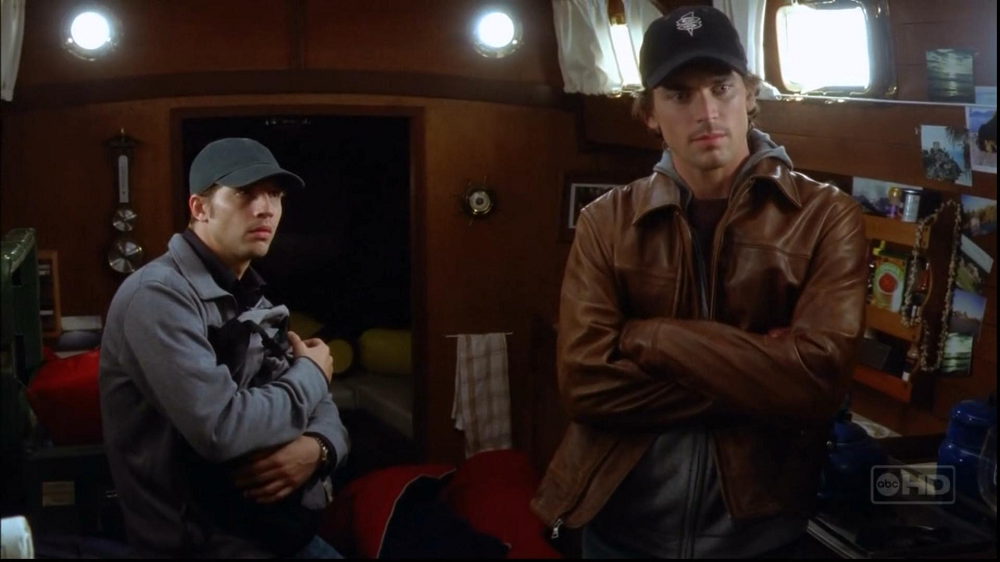
Traveler, 2007

While all this is going on, Traveler (X2 and X-Men: The Last Stand’s Aaron Stanford) – secretly an undercover agent for the Department of Homeland Security – is searching for answers of his own. Eventually, a conspiracy that may reach all the way to the White House is uncovered but by that point there were too few viewers to care, with ratings falling from 8.61 million to 3.55 million over the course of the series.

The final episode rebounded, adding more viewers, but by then the decision had been made to pull the show after just ten episodes. The story ended on a cliffhanger, as episode ten would have been a season finale anyway, with the three friends reuniting to find the evidence they need to expose the conspiracy, only for it – and the man they believed was actually responsible – to be blown up by a car bomb. You want answers? Back to Lost, then…

Studio 60 on the Sunset Strip (NBC): Part of a Monday night line-up on NBC that also included Deal or No Deal and the debuting Heroes, Studio 60 on the Sunset Strip was a look behind the scenes of a fictional live sketch comedy show, similar to NBC’s own Saturday Night Live. It was a premise with plenty of promise and might have succeeded had it not been for 30 Rock, NBC’s Wednesday night look behind the scenes of a fictional live sketch comedy show, similar to NBC’s own Saturday Night Live.

The key difference between the shows was that 30 Rock was a sitcom, created from its inception to be a vehicle for former SNL head writer Tina Fey, and Studio 60 was a drama. A drama about a comedy needn’t be humourless, however, and a strong cast with a comedic background including Matthew Perry, Amanda Peet, Sarah Paulsen, and Nate Corddry ensured the jokes hit their beats when they came.
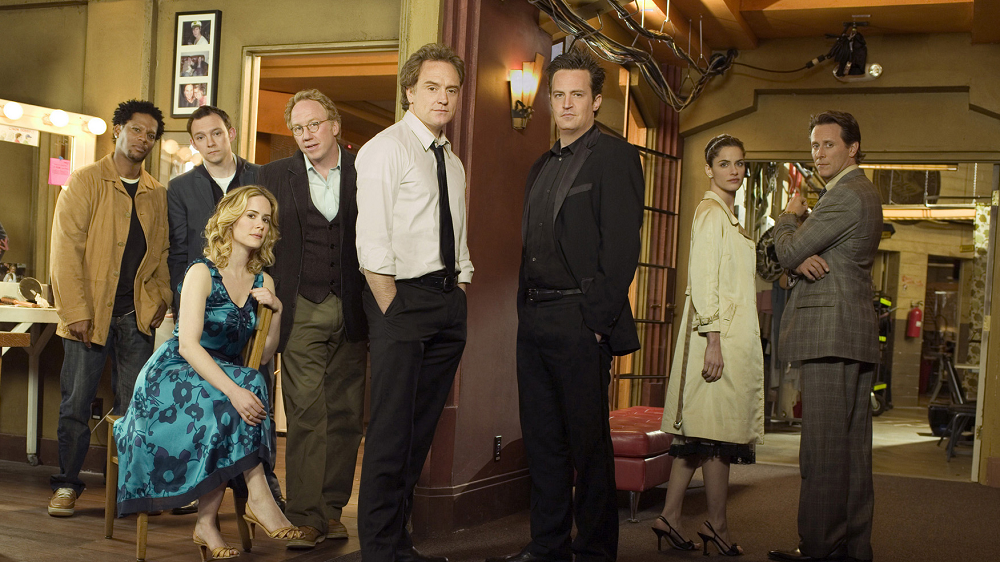
Studio 60 on the Sunset Strip, 2006

The show was created by Aaron Sorkin and he brought in his former West Wing star Bradley Whitford as Danny Tripp, the producer of the fictional show, playing on a past friendship between Tripp and Perry’s Matt Albie. Its prospects looked solid after NBC won a bidding war with CBS for the show and it was highly anticipated by both the media and the public ahead of its September 18th debut.

Critics to rate Studio 60 highly throughout its run but viewers disagreed; ratings feel from a high of 13.4 million for the first episode to a low of 6.1 million for episode sixteen, although they generally hovered around the 7 million mark. The show went on hiatus after that record low and when it returned it was shifted to Thursdays in the hope that Scrubs might provide a bump as its lead-in. In reality, the decision to cancel the show had already been made, a further fall in ratings seeming to justify the decision. In 2011, Aaron Sorkin appeared on an episode of 30 Rock‘s fifth season as a producer looking for work, telling Fey’s Liz Lemon to shut up when she mentions Studio 60, the only one of his shows never to get a second season.

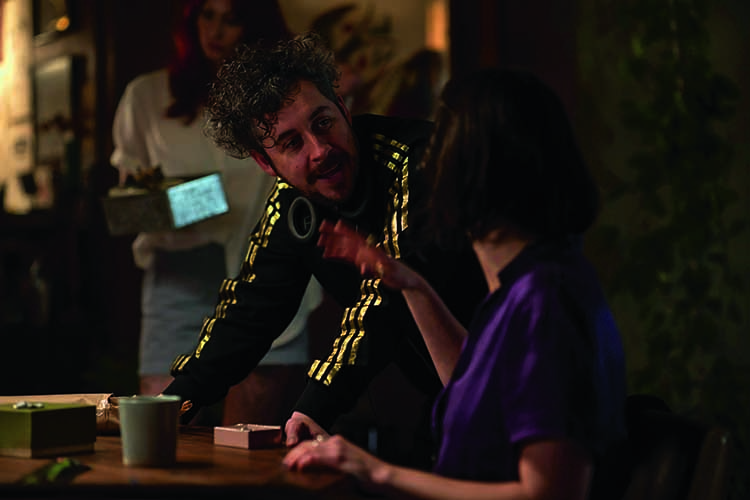
The Lost Room (Sci-Fi): At twenty past one (and forty-four seconds) on the afternoon of May 4th 1961, room ten at the Sunshine Motel outside Gallup, New Mexico, slid out of existence. The motel fell into a state of disrepair but no-one ever remembered it having a room ten, except that – in the years after what became known as The Event – people began to access the room from all over the world, as long as you could find the key.

This was the premise of The Lost Room, a 2006 mini-series on The Sci-Fi Channel created by Laura Harkcom, Christopher Leone, and Paul Workman. Leone and Workman first developed the idea while at Carnegie-Mellon University in Pittsburgh and when Leone later worked with Harkcom (also a graduate of that school, although they were not contemporaries) on the short film K7, he realised a project they were developing could be melded with his earlier concept, giving birth to The Lost Room.
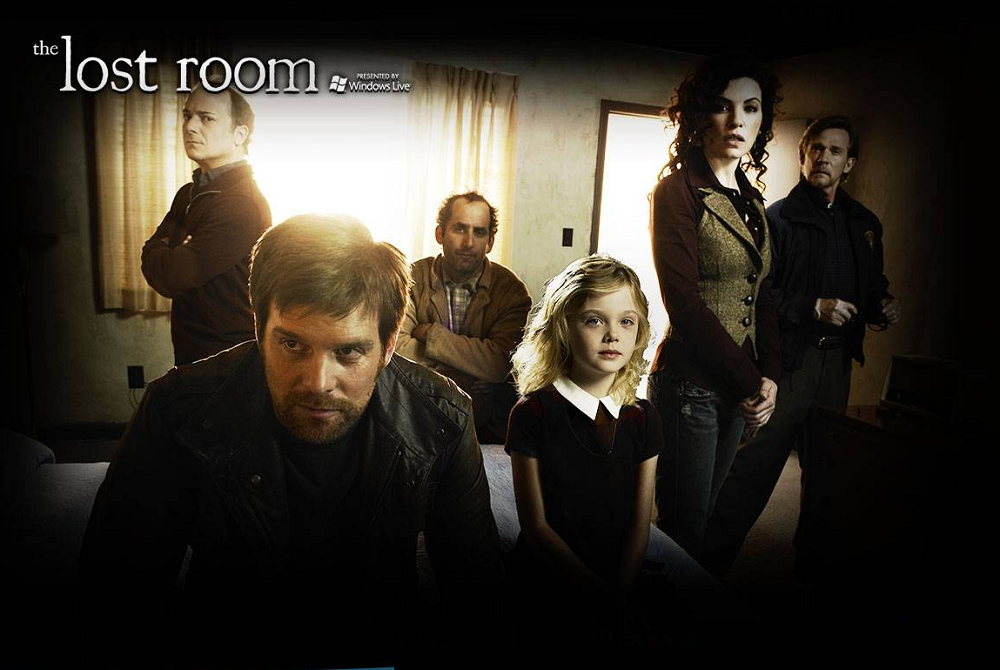
The Lost Room, 2006

Six Feet Under’s Peter Krause was put in place as Joe Miller, a detective who stumbles into room ten while investigating a murder, only for his daughter to disappear while in inside. Joe must now discover the secrets of the room, the Event, the mysterious Occupant, and the one-hundred objects contained within. These objects are the kind of things an ordinary hotel room might have but all with the potential to change the world when employed by three cabals that have emerged in the intervening years – the Collectors, the Legion, and the Order of Reunification.

Over three ninety-minute episodes, The Lost Room unfolds its story, completing the narrative of Joe Miller but leaving things open for further stories set within its world. Unfortunately, that’s all we got as critics were mixed on the show, and a promised comic book continuation in 2010 from Red 5 Comics never materialised. Harkcom and Leone returned with Parallels in 2015 – originally a TV show pilot named The Building – and properties including Locke & Key, Warehouse 13, and the 2019 videogame Control all mine similar territory, but so far the key to room ten remains lost…

Next time on The Telephemera Years: more failed shows from 2006 as we open The Dresden Files and more!

Check out our other Telephemera articles:

The Telephemera Years: 1966 (part 1, 2, 3, 4)

The Telephemera Years: 1968 (part 1, 2, 3, 4)

The Telephemera Years: 1969 (part 1, 2, 3, 4)

The Telephemera Years: 1971 (part 1, 2, 3, 4)

The Telephemera Years: 1973 (part 1, 2, 3, 4)

The Telephemera Years: 1975 (part 1, 2, 3, 4)

The Telephemera Years: 1977 (part 1, 2, 3, 4)

The Telephemera Years: 1978 (part 1, 2, 3, 4)

The Telephemera Years: 1980 (part 12, 3, 4)

The Telephemera Years: 1982 (part 1, 2, 3, 4)

The Telephemera Years: 1984 (part 1, 2, 3, 4)

The Telephemera Years: 1986 (part 1, 2, 3, 4)

The Telephemera Years: 1987 (part 1, 2, 3, 4)

The Telephemera Years: 1989 (part 1, 2, 3, 4)

The Telephemera Years: 1990 (part 1, 2, 3, 4)

The Telephemera Years: 1992 (part 1, 2, 3, 4)

The Telephemera Years: 1995 (part 12, 3, 4)

The Telephemera Years: 1997 (part 1, 2, 3, 4)

The Telephemera Years: 2000 (part 1, 2, 3, 4)

The Telephemera Years: 2003 (part 1, 2, 3, 4)

The Telephemera Years: 2005 (part 1, 2, 3, 4)

The Telephemera Years: 2008 (part 1, 23, 4)

Titans of Telephemera: Irwin Allen

Titans of Telephemera: Stephen J Cannell (part 1, 2, 3, 4)

Titans of Telephemera: DIC (part 1, 2)

Titans of Telephemera: Hanna-Barbera (part 1, 2, 3, 4, 5)

Titans of Telephemera: Kenneth Johnson

Titans of Telephemera: Sid & Marty Krofft

Titans of Telephemera: Glen A Larson (part 1, 2, 3, 4)

Titans of Telephemera: Quinn Martin (part 1, 2)

Titans of Telephemera: Ruby-Spears

Michael Witwer | D&D THE LEGEND OF DRIZZT VISUAL DICTIONARY

LEGEND OF DRIZZT Michael Witwer

by Ed Fortune

Michael Witwer is a New York Times bestselling author known for his work on the Hugo-nominated Dungeons & Dragons: Art & Arcana, the critically acclaimed Empire of Imagination: Gary Gygax and the Birth of Dungeons & Dragons, and the bestselling Heroes’ Feast: The Official Dungeons & Dragons Cookbook. His latest book details everything about everyone’s hero of the Forgotten Realms, Drizzt Do’urden. We caught up with him to find out more about the Dungeons & Dragons The Legend Of Drizzt Visual Dictionary. We caught up with him to find out more…

STARBURST: Why did Drizzt and his companions become so popular?
Michael Witwer: Drizzt is just about everything one could ask in a hero: brave, virtuous, and skilful, but what really makes him so compelling is that he chooses right in the face of extraordinary adversity. As Drizzt creator R.A. Salvatore says, Drizzt “does what’s right even when it hurts.” What’s not to love about a hero like that?  Just as important to the Legend of Drizzt are his ‘companions’ – his friends to the end – who are an amazing and dynamic cast of characters who bring every bit as much to the table as Drizzt!

What’s your favourite Drizzt story?
With such a storied franchise, it’s hard not to say the first book of the series [The Crystal Shard 1988], but my favourite might be Homeland, which is the fourth book in the series but a prequel and Drizzt’s origin story. One of the things I like best about Drizzt’s books is his personal journal entries, which really help you understand his depth and motivations. Similarly, reading Drizzt’s heart-breaking backstory in the Dark Elf Trilogy [Homeland, Exile, and Sojourn] really helps you understand where he’s coming from and what he’s about.

What’s your favourite location in the Forgotten Realms?
The Sword Coast metropolis of Waterdeep is pretty hard to beat. It has a little bit of everything, including the Forgotten Realm’s most iconic tavern [the Yawning Portal] and probably its most famous dungeon [the Undermountain], maybe for something less obvious, how about the Ivy Mansion in Longsaddle, which is the ancestral home of the Harpell family, a quirky family of wizards and friends to the Companions. The Ivy Mansion is full of illusions, magic gates, tricks and enchantments, it sounds pretty cool and a place you could get lost in… literally!.

What piece of information did you have to put in the book, no matter what?

Well, it wasn’t a single piece of information but rather a whole timeline’s worth! When you are doing a book that supplements and summarises a 40-book series, it’s very hard to know what stays and what goes; you only have so many pages, after all! You know you need to cover all the key characters and locations, which was not so simple to curate after this many books. We really wanted to put a Drizzt timeline in there that covers his whole story – about 200 years – to provide the proper context for the remainder of the material and allow this book to stand alone. It was a super challenging task to do in a single spread!

Are you currently playing D&D? Tell us about your game?
Yes! I started playing D&D in the 1980s and have been playing in on-and-off campaigns since then. Our current campaign is run by my brother [Riverdale‘s Sam Witwer] with a group of long-time friends, and we’ve been doing this one for about four years. We’re located across the US, so we play on a virtual tabletop.

Why do you think D&D become so popular recently?
I could write a whole book about that! In fact, I have, and it’s coming out in October!. The short answer is something like this: well-designed fifth edition rules with lots of testing and audience feedback + the popularisation of Actual Play streams/shows like Critical Role to help people learn the game + Hollywood and celebrity love of the game, and a public fascination with eighties nostalgia = blockbuster success!

If you woke up and found yourself in Mithral Hall, what would you do?
Ha! I would go straight to the Hall of Dumathoin and grab as many magical items as I could carry!

What’s your favourite illustration in the book?
This book is so beautiful. It would be impossible to choose just one! However, of the new illustrations that were commissioned for this book, I’d say my favourite is the illustration of Tier Breche, which is the Menzoberranzan cavern that hosts the city’s three colleges: Sorcere [wizardry]; Arach-Tinilith [clerics of Lolth]; and Melee-Magthere [martial combat]. There had previously been very few depictions of this locale, and we worked with one of my favourite D&D artists, Jason Rainville, who did an amazing job giving us the size, scale and aura of the place.

What D&D project would you love to handle next?
As I mentioned, I have a couple more, as yet announced, D&D projects coming out in the fall, as well as my first middle grade/young adult novel, Vivian Van Tassel and the Secret of Midnight Lake, which is not D&D, but unsurprisingly heavily inspired by TTRPGs!. I love the game and the brand, so I’m up for pretty much anything D&D related!

Dungeons & Dragons The Legend Of Drizzt Visual Dictionary is out now.


THE TELEPHEMERA YEARS: 1978 – PART 4

The New Fantastic Four, 1978-2

Ah, telephemera… those shows whose stay with us was tantalisingly brief, snatched away before their time, and sometimes with good cause. They hit the schedules alongside established shows, hoping for a long run, but it’s not always to be, and for every Street Hawk there’s two Manimals. But here at STARBURST we celebrate their existence and mourn their departure, drilling down into the new season’s entertainment with equal opportunities square eyes… these are The Telephemera Years!

1978-79

The 1978-79 season was a time for goodbyes, with the final episodes of All in the Family, The Amazing Spider-Man, Good Times, Starsky & Hutch, Welcome Back Kotter, and Wonder Woman all making grown men cry. Still, ABC’s massive comedy line-up – they filled the top five slots in the ratings chart with their hit sitcoms – must have been some succour, with Mork & Mindy the number three show in its debut season.

Other new shows included Three’s Company spin-off The Ropers, a put-upon Judd Hirsch in Taxi, lessons in harmony with Diff’rent Strokes, and radio station fun with WKRP in Cincinnati. Fans of telefantasy were treated to The Dukes of Hazzard, BJ and the Bear, and space opera in Battlestar Galactica, alongside their regular doses of Charlie’s Angels and CHiPs. But those were the shows that adults watched in 1978 – what about the kids? This is the story of a 1978 Saturday morning…

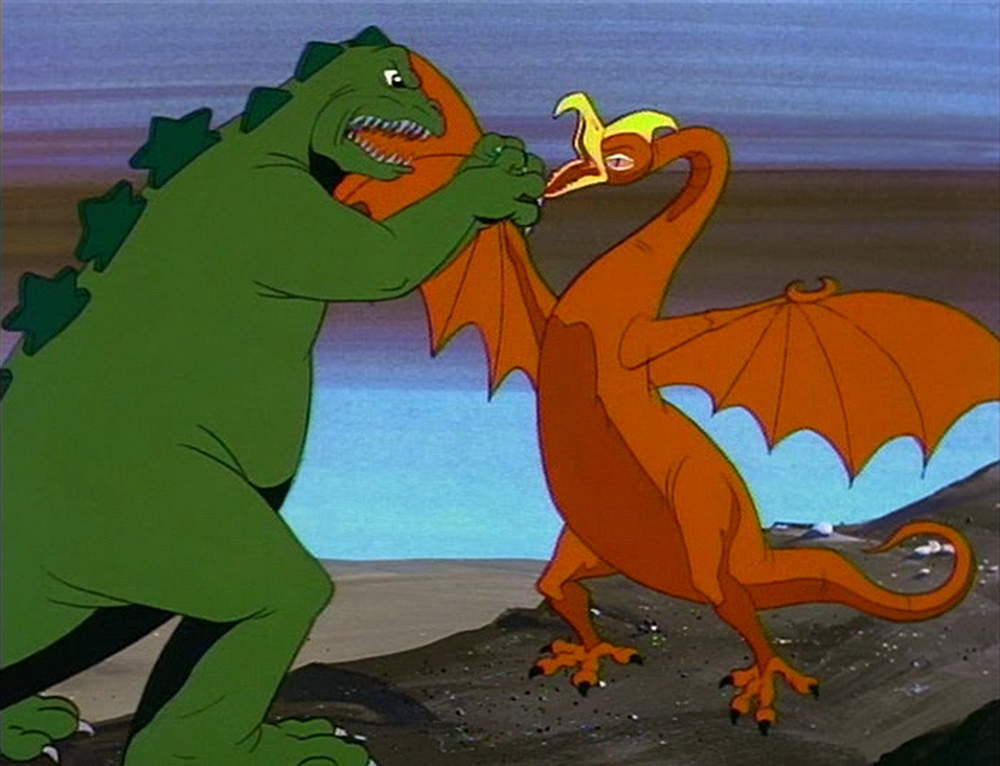
Godzilla (NBC): You all know the story of Godzilla by now, right? Mankind’s stupidity and eagerness to destroy itself results in an ancient creature being awakened which cuts a swathe of radioactive revenge across a Japan only nine years removed from the atomic bomb atrocities in Hiroshima and Nagasaki, eventually becoming the Earth’s defender against similar creatures from outer space, even though we don’t deserve him?

The big green lizard starred in fifteen Japanese films from the Toho studio between 1954 and 1975 when the series was halted following lacklustre box office receipts for Terror of Mechagodzilla, and most of these films found an American audience in dubbed versions shown in fleapits, drive-ins, and on late night TV. The lull in Japanese action meant the US was ripe for homegrown Godzilla fare and Marvel Comics were first out of the blocks with a comic book in 1977 that eventually ran for twenty-four issues.


Godzilla, 1978

Marvel was not the only company preparing fresh Godzilla for the American market, though, and Joseph Barbera of the Hanna-Barbera animation studio thought the character perfect for his own animated show, tasking Duane Poole and Dick Robbins with coming up with a structure that could showcase the might of the creature while keeping the light peril necessary for such a show. Poole and Robbins created the crew of the research ship Calico, led by Captain Carl Majors and scientist Quinn Darien (Darien’s nephew Pete acted as the audience identification figure).

A typical story would find the Calico stumbling into the kind of dangerous situation that only the intervention of Godzilla could solve, his signature tune ringing out as he emerged from the depths to save the day. Thirteen episodes of the show were ordered, partnered with Jana of the Jungle as The Godzilla Power Hour from September 9th 1978, ultimately leading to a second season which featured the horror that was Godzooky. Toho resumed making Godzilla films in 1985 and there have been several big-screen blockbusters starring the fire-breathing behemoth but for a generation of kids, there’s only one song they hear when they think of Godzilla…

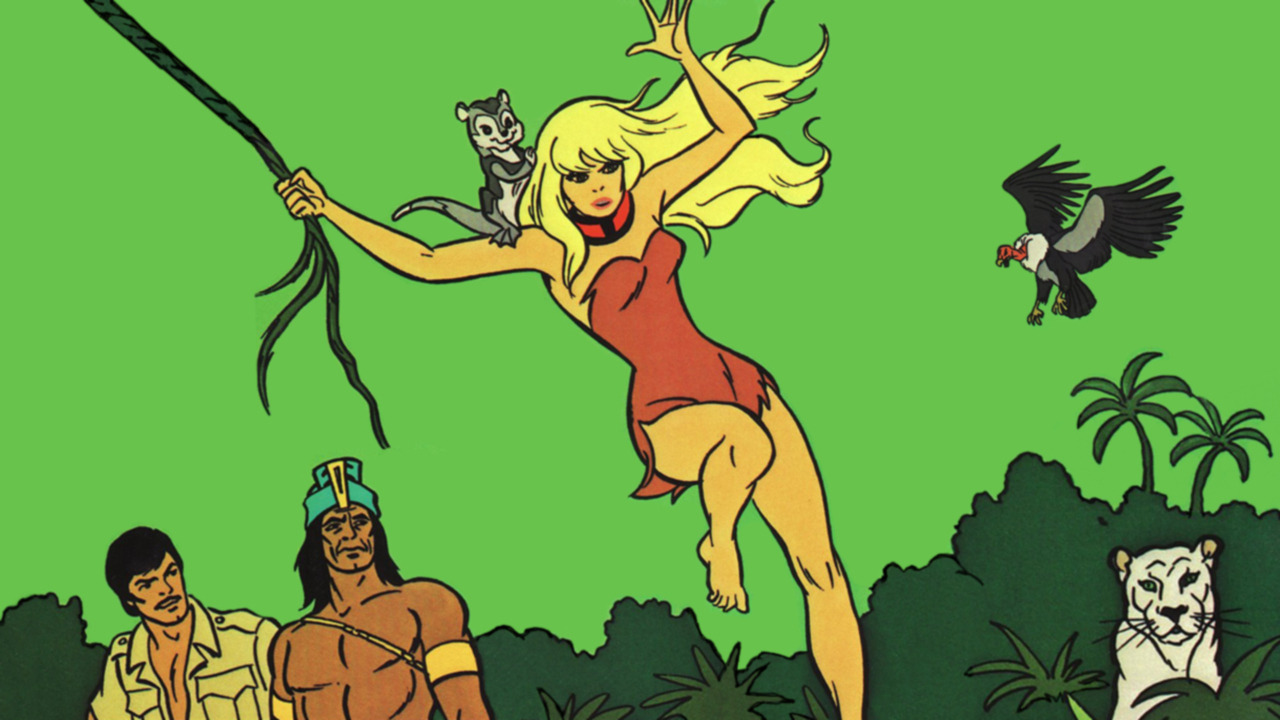
Jana of the Jungle (NBC): The other half of The Godzilla Power Hour was developed by Johnny Quest creator Doug Wildey but you didn’t have to look too far to discover Wildey’s inspiration for the show. Essentially a female Tarzan, Jana (BJ Ward in her first role) was rescued from a boating accident as a small child by Montaro, the last survivor of an ancient tribe who schools Jana in the way of his people (voiced by The Addams Family’s Lurch, Ted Cassidy).

Jana’s father was lost in the same accident, and she spends her time searching for him with the help of Dr Ben Cooper, a young wildlife scientist who took over her father’s reservation, and her animal friends, the white jaguar Ghost and comedy opossum Tico. As if this wasn’t enough, Jana also has to rescue miners from an exploding volcano, fight off poachers described as a film crew, avoid a war between the wolves and the pumas, and save Ben from a tribe of enormous women.

Jana of the Jungle, 1978

Jana was paired with Godzilla for the first two months of the season, thereafter welcoming re-runs of Johnny Quest to what became The Godzilla Super 90. In September 1979, Godzilla went it alone as Jana didn’t get the second season that may have eventually saw her find her father. As it was, the story ended without a denouement, meaning Jana is still out there somewhere searching for him, although she’d be in her sixties by now.

Interestingly, in 2007 a comic book called Jungle Girl was published by Dynamite Entertainment, created by Frank Cho and Doug Murray. Its protagonist was a young blonde woman named Jana, living in some kind of lost jungle world, but its creators maintain that is pure coincidence. Cho and Murray produced three series of Jungle Girl, which saw Jana up to the same kind of hijinks she enjoyed in the Hanna-Barbera series. It may not be cannon but it’ll do.

Bigfoot and Wildboy (ABC): The 1970s was a big time for Bigfoot. On the heels of the Patterson-Gimlin film of 1967, the hairy hominid was thrust into the public consciousness, with the 1970 film Bigfoot sensationalising the creature and leading to The Beat of Boggy Creek, Shriek of the Mutilated, and half a dozen more low-budget flicks. The real breakthrough, though, came when Andre the Giant portrayed the beast on a special two-part episode of The Six Million Dollar Man in February 1976. Even though the Bigfoot turned out to be – spoilers! – an alien robot, kids all over the world now added the missing link to their playground roll call.

That Bigfoot was now kid’s fodder was perfect for Sid and Marty Krofft. Since HR Pufnstuf in 1969, the brothers had made furry creatures their stock in trade and were given an hour-long showcase – The Krofft Supershow – in 1976 to bring more of their creations to the air. Working with Joe Ruby and Ken Spears, the Supershow featured three serials featuring Krofft creations – Dr Shrinker, Electra Woman and Dyna Girl, and Wonderbug – and when it returned for a second season in 1977, Electra Woman was replaced by a new story.

Bigfoot and Wildboy, 1978

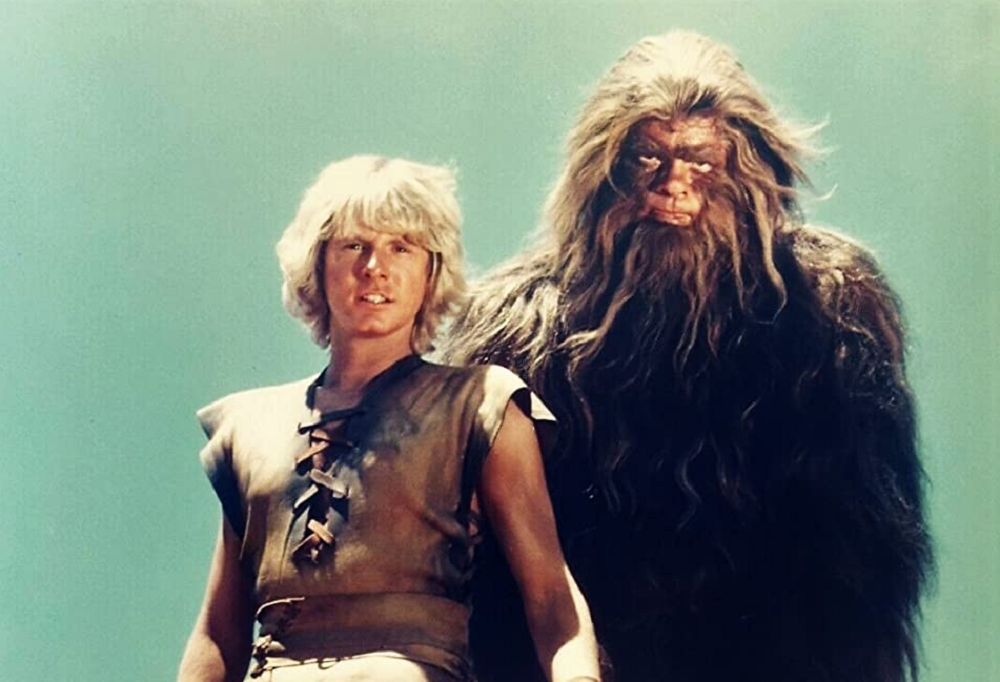
Bigfoot and Wildboy starred Joseph Butcher as Wildboy, an orphan lost in the wilderness and raised by Ray Young’s Bigfoot. Neither actor was new to the business, but this was the first starring role for both men (and really as good as it got for Butcher, who did just one episode of Knots Landing in 1980 before retiring from acting at just twenty-nine. The Krofft Supershow finished up in September 1978 but Bigfoot and Wildboy lived on, a second series of twelve-episodes given its own slot in June 1979.

Between them, the wild pair managed to see off evil tribes, sinister professors, a mummy, a vampire, and an evil bigfoot, all the while keeping an eye out for archaeology student Cindy who managed to stumble into more than her fair share of trouble. Along with The Krofft Superstar Hour’s Horror Hotel and The Lost Island, Bigfoot and Wildboy was the end of a run of Sid and Marty Krofft shows that became a staple of children’s programming throughout the 1970s. It was somehow fitting that their final show was about someone from an older world trying to guide the youth through a strange new one.

Yogi’s Space Race (NBC): Smarter than the average bruin, Yogi Bear made his debut in 1958 as part of Hanna-Barbera’s The Huckleberry Hound Show, graduating to his own show in 1961. The Yogi Bear Show ran for just thirty-three episodes which were then repeated in perpetuity, even after Yogi Bear and Friends arrived for a ninety-six-episode run in 1967. By 1973, even these 129 episodes were beginning to get stale in re-runs and so a new Yogi Bear show was commissioned, adding fifteen episodes of Yogi’s Gang to the mix.

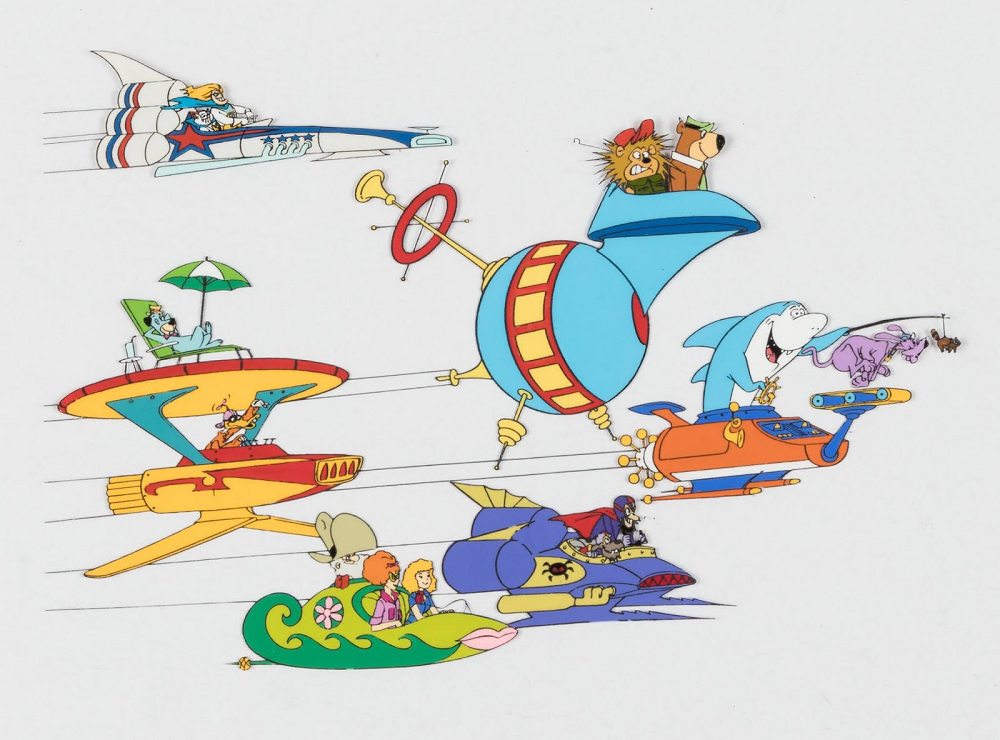
The third Yogi Bear show – 1978’s Yogi’s Space Race – was a reworking of Wacky Races, with the various competitors replaced by familiar Hanna-Barbera characters and the setting shifted to outer space and alien planets, its logo parodying the then-current Star Wars. Huckleberry Hound, Jabberjaw, and Yogi – who had led a team in 1977’s Laff-A-Lympics, H-B’s previous all-star sports show – were the main racers, with guest appearances from Fred Flintstone, Quick Draw McGraw, Grape Ape, and others.

Yogi's Space Race, 1978

Alongside Space Race were three other features, expanding the show to ninety minutes. The first – Galaxy Goof-Ups – featured Yogi, Huckleberry Hound, and others as space patrolmen, Keystone Kopping their way to hilarity and disco dancing, and was eventually spun off into its own show after two months. It was very much part of the main event with Space Race, whereas The Buford Files – which starred a sleepy bloodhound who solved crimes with a pair of teens – and The Galloping Ghost – the spirit of an old miner looks after two teenage girls at a dude ranch – were the supporting acts.

After Galaxy Goof-Ups got its own show, Yogi’s Space Race was reduced to sixty minutes, becoming a half-hour show on its own in February 1979 when the other two segments were combined into their own standalone feature. Just thirteen episodes of each serial were made, again repeated liberally over the next few decades and, thanks to Cartoon Network, into the twenty-first century. Yogi had to wait until 1985’s Yogi’s Treasure Hunt for his next headline slot but that Top Cat inspired madness can wait for another day.

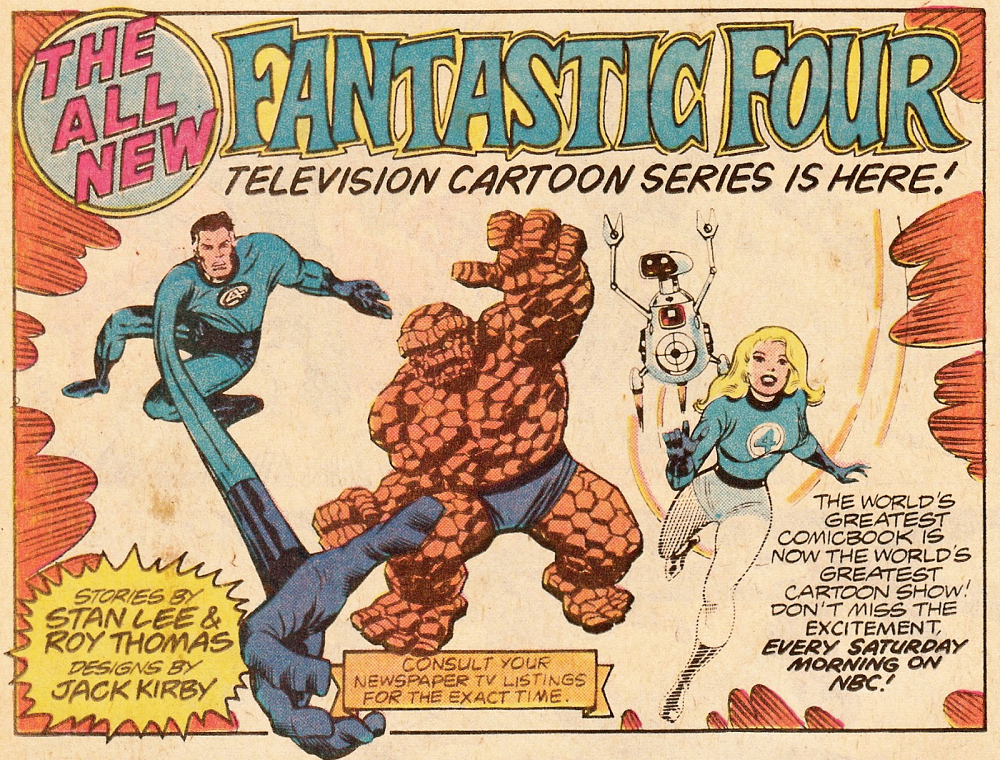
The New Fantastic Four (NBC): For two worlds so perfectly made for one another, the story of animated shows based on Marvel Comics characters took an awfully long time to get going. The barely-animated The Marvel Super Heroes show of 1966 was quickly followed by much better attempts at bringing Spider-Man and Fantastic Four to the screen, the former by nascent genius Ralph Bakshi.

The Fantastic Four show of 1967 was a Hanna-Barbera creation and largely succeeded in bringing the spirit of the Jack Kirby and Stan Lee comics to life on the screen. It should have been the start of a whole slew of Marvel cartoons but – while fans of rivals DC enjoyed seeing animated and live-action versions of Captain Marvel and the Super Friends – it was 1978 before Saturday mornings were graced once more by the House of Ideas. Once again, it was the Fantastic Four we got, but this was a very different Fantastic Four from that seen in the original cartoon or the pages of Marvel Comics.

The New Fantastic Four, 1978

Although the Fantastic Four had members outside its core quartet, it would be a brave man who developed a TV show without even one of them. This is what DePatie-Freleng were forced to do, however, when the rights for the Human Torch were tied up in a separate deal for a movie with Universal (that never got made). Understandable, then, that they would seek to replace the Torch with another member, even if the schoolyard talk was of fears that kids might imitate and immolate if he were featured.

Perhaps proving that Kirby was the ideas man all along, Lee pitched a cute robot as the new fourth member and Dave Cockrum was set to work creating its design. Famously, Cockrum hated the idea so much he walked off the job and was replaced by Kirby, back at Marvel after a spell with DC in the early 1970s, completing what would prove to be his final job for the company. The robot – H.E.R.B.I.E., backronymed to stand for Humanoid Experimental Robot B-Type Integrated Electronics – took his place alongside Mr Fantastic, The Invisible Girl, and The Thing, helping them see off the likes of Dr Doom, Magneto, The Mole Man, and The Skrulls but couldn’t prevent the show being cancelled after just one season.

Next on The Telephemera Years: Set the controls for 2006 where hedonism and pain await!

Check out our other Telephemera articles:

The Telephemera Years: 1966 (part 1, 2, 3, 4)

The Telephemera Years: 1968 (part 1, 2, 3, 4)

The Telephemera Years: 1969 (part 1, 2, 3, 4)

The Telephemera Years: 1971 (part 1, 2, 3, 4)

The Telephemera Years: 1973 (part 1, 2, 3, 4)

The Telephemera Years: 1975 (part 1, 2, 3, 4)

The Telephemera Years: 1977 (part 1, 2, 3, 4)

The Telephemera Years: 1978 (part 1, 2, 3)

The Telephemera Years: 1980 (part 12, 3, 4)

The Telephemera Years: 1982 (part 1, 2, 3, 4)

The Telephemera Years: 1984 (part 1, 2, 3, 4)

The Telephemera Years: 1986 (part 1, 2, 3, 4)

The Telephemera Years: 1987 (part 1, 2, 3, 4)

The Telephemera Years: 1989 (part 1, 2, 3, 4)

The Telephemera Years: 1990 (part 1, 2, 3, 4)

The Telephemera Years: 1992 (part 1, 2, 3, 4)

The Telephemera Years: 1995 (part 12, 3, 4)

The Telephemera Years: 1997 (part 1, 2, 3, 4)

The Telephemera Years: 2000 (part 1, 2, 3, 4)

The Telephemera Years: 2003 (part 1, 2, 3, 4)

The Telephemera Years: 2005 (part 1, 2, 3, 4)

The Telephemera Years: 2008 (part 1, 23, 4)

Titans of Telephemera: Irwin Allen

Titans of Telephemera: Stephen J Cannell (part 1, 2, 3, 4)

Titans of Telephemera: DIC (part 1, 2)

Titans of Telephemera: Hanna-Barbera (part 1, 2, 3, 4, 5)

Titans of Telephemera: Kenneth Johnson

Titans of Telephemera: Sid & Marty Krofft

Titans of Telephemera: Glen A Larson (part 1, 2, 3, 4)
Titans of Telephemera: Quinn Martin (part 1, 2)

Titans of Telephemera: Ruby-Spears

Can Movies & TV Shows Go Interactive?

movies go interactive

by Ben Bradley

Over the past decade or two, interactivity has become an important part of our entertainment. As such, some movies have tried to incorporate these elements into their historically rigid presentation.

Thanks to streaming services, with Netflix leading the charge, it’s more feasible to deliver interactive shows to people. Today we’re asking if these services can go interactive and how, with examples.

The Origins of Interactive Entertainment

Ignoring those old choose-your-own-adventure books, an early pioneer of interactivity in the digital age was the gaming and casino industries. On TV and now online, it’s possible to access live dealers and games that get played in real-time. It’s more social and builds trust, as the results of the game happen right in front of the audience. It’s effective with card games, naturally, but wheel games that could easily be automated still use live dealers, as seen with games like crazy time. These services understand that something is lost when there isn’t somebody to interact with and react to things that you do.

Some movies have come close to interactivity now and then. Mr Sardonicus used the idea in 1961 as a marketing gimmick while in 1985, Clue played a joke on its audiences by releasing multiple endings to different theatres. It’s close, but audiences didn’t know they were choosing a different ending when they bought tickets.

Source: Unsplash

The reason nobody committed to the idea was the expense. It’s expensive, especially in a movie environment, to film what is essentially multiple movies depending on choices the audience might make. Then there’d still be a favourite story path for audiences, making it seem like a futile endeavour. Cutting the movie together would have also been a mess with pre-digital filming and, for TV shows, they were written so fast-paced that stopping to run an audience competition would slow things down.

How Streaming Services Enable Interactive Stories

Now the processes of filming and editing are easier, and many of the costs are down, but that hasn’t stopped budgets from ballooning. An interactive movie was still a gamble but now we have companies rich enough to take the gamble, which is where Netflix stepped in.

Netflix has created several interactive experiences in the years since but it was Black Mirror: Bandersnatch that first caught a lot of attention. Black Mirror is critically acclaimed for its dystopian insight, so Charlie Brooker penned an interactive story that could only be told through a streaming service.

With streaming, individuals watch movies and shows at their own pace. This enabled Brooker and the Netflix production teams to gamify that, adding choices into Bandersnatch that you couldn’t pull off on cable television. In 2019 Netflix doubled down on this idea by working with Bear Grylls to produce You vs. Wild and its sequels.

The Future of Interactive Stories

As of right now, the slate looks clean where future interactive projects are concerned. Even if easier nowadays, it’s still labour intensive to create a choose-your-own-adventure film. While we don’t doubt that Netflix or a competitor will try it again, these projects often get more acclaim for trying out the concept rather than being praised on artistic merit.

Media is on a collision course with personalisation. The recent breakthroughs in generative AI and other mind-boggling technologies have shown that individuals may be able to conjure their own entertainment in the future. Does that count as interactivity if it’s something uniquely created for you?

If interactive movies and TV shows ever have their time in the sun, it’d be during this transitional phase where media can start from a shared point but then be personalised to the audience’s tastes. That way, we can still have water cooler conversations about the stories we create.

Lee Cronin | EVIL DEAD RISE

lee cronin evil dead rise

by Sol Harris

It’s been ten long years since the last film in the EVIL DEAD franchise was released. A fifth entry in the series is finally upon us in the form of EVIL DEAD RISE, written and directed by LEE CRONIN (The Hole in the Ground). We sat down with him to find out what we can expect when the deadites are unleashed upon cinemas once more…

STARBURST: After Sam Raimi, the director of the original Evil Dead trilogy, and Fede Álvarez, who made the 2013 instalment, you’re only the third person to ever helm an Evil Dead movie. What was it like taking on such a beloved and iconic series, and did you feel any pressure, given how it’s a series that’s managed to maintain a real quality of output?

Lee Cronin: It was a really exciting opportunity, first and foremost. I come from a place of being a fan of the franchise. It had a big influence on me in my younger years. I always thought I would love the opportunity to make one, but unlike some other franchises, you’d imagine there’s less opportunity. There hasn’t been an enormous amount of movies made underneath the title, and I think that’s what’s quite special about it.

I know speaking to Sam and Rob [Tapert] and Bruce [Campbell], they’re quite picky about wanting to do one, when they’ll do one and what it is. I had an approach and a vision for a new Evil Dead movie that got them excited – that felt fresh – like it’d move the compass. Three of the four movies before essentially took place in the cabin, and there was the continuity of Ash as a well-ingrained character at that point in Army of Darkness. I was taking on something where I was leaving not only the cabin in the woods behind but also Ash, which is the first time that has happened. I think that’s what’s quite unique about Evil Dead Rise.

I think Evil Dead fans are actually quite hungry for more. I don’t want to say they’re forgiving because they still want a great movie; there is always that percentage that are like, “No Ash? No movie”, and I can’t change what those people think. They’ll probably still watch it and can judge it in whatever terms they want. All you can do is make the movie that you want to make and the best movie that you can. And being a fan myself is one of the most challenging aspects, separating your fandom from it so you can create a story. I had a lot of fun when I was creating this movie, especially in the writing, at finding particular touchstones and references and certain things that I would play a new way. So I think there’s a huge amount there for the fans.

The development and writing of this movie were one of the smoothest processes I’ve ever had. They liked what I had to say from the start. You’d say, “I had them at ‘Hello'”. They liked the approach. They liked what I was trying to do. Once I pitched them an in-depth storyline, they were all on board. There are always opinions, but they were very, very trusting and, a lot of times, added and made suggestions that built on the things I was trying to do.

It was supportive and understanding, and I never felt like anybody was breathing down my shoulder. I just felt like people were there to give me a pat on the shoulder when I needed it. Sam Raimi is a filmmaker who would have inspired me had I made an Evil Dead movie or not, so in a weird way, it was already in my DNA. I didn’t have to think too hard. They showed me a lot of trust because I think they knew instinctively that there was no point in making another Evil Dead movie that in any way felt like a retread.

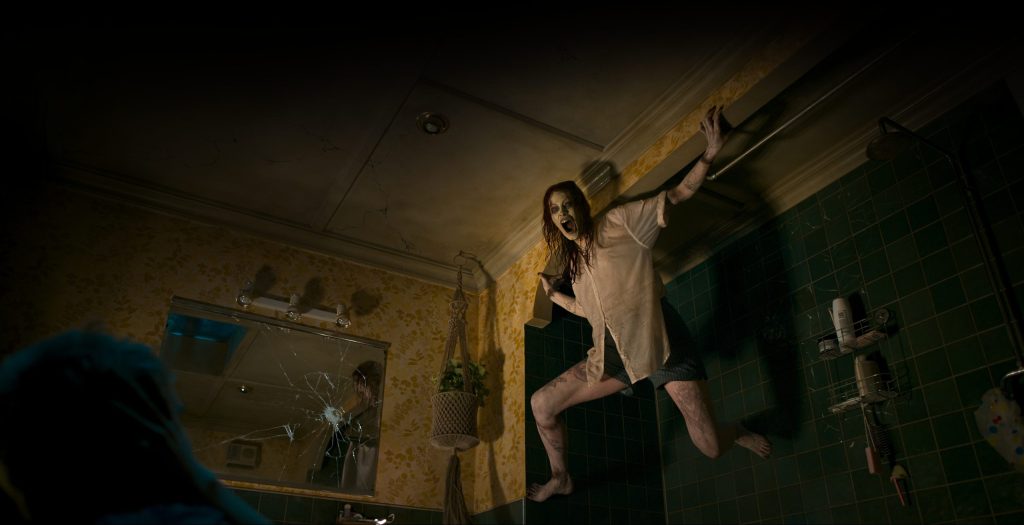
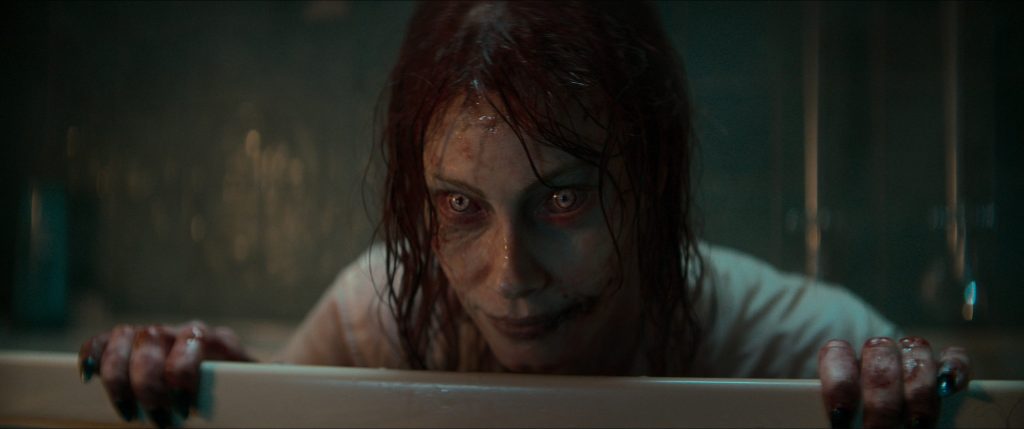
Evil Dead Rise swaps out the series’ iconic cabin in the woods for a high-rise apartment, the home of a small family. While it’s incredibly common to see children in horror films, they tend to be tamer and more psychological in nature. It’s still extremely rare to watch a film and see children put in such visceral, potentially violent danger as seems to be the case with Evil Dead Rise. What drew you to include children in the story?

The last three things that I’ve made all had children in the story. I think a lot of times when I think of ideas; I think of childhood. I also take influence from my own family — I don’t have children, but I have a lot of nieces and nephews. They love horror movies, and we talk about horror movies, and I tell them what I’m working on and tell them scary ideas, whatever they might be. There was no doubt in my mind that putting kids in the firing line [of] deadites [was] pretty hardcore, but I wanted it to be something new, and Evil Dead movies push the envelope. They test the limits. Certain things in the older movies test the limits, and this is testing a different limit.

The core idea was I wanted to bring the deadites into the home. I wanted to bring the deadites into somewhere familiar and around people that you’re familiar with, which pointed towards an urban environment and an apartment. It pointed towards family. It pointed towards children, so it was almost a natural step for me as a place to take it. It definitely raises the bar, and I think that makes this movie stand out in a particular way. This is certainly going to be up there in terms of the volume of blood versus children in a movie, you know what I mean?

Amazingly given how simple the original film was, the world of Evil Dead has developed a deep, interesting lore. This film is set within the same continuity as the other four movies in the franchise, so how exactly do the pieces all fit together?

It’s a funny world we live in; there’s ‘soft reboot’, ‘hard reboot’, ‘remake’, ‘requel’, and whatever you want to call it. To me, this is just a fresh direction inside the universe, and I always felt like more stories could be told in that world.  I think one of the things that Sam really vibed with when I said it to him was: “In Army of Darkness, there are three books. You had one, Fede [Alvarez] had one, I’m going to take that third one and do something else“. So that connectivity is there. It’s in the world where those three books exist, and we’re with this book in this story. There’s a direct line and a sequence within the movie that reflects on the existence of the book and of books. So where I see it, it’s happening in the here and now. It’s fresh; it’s contemporary; it’s of its moment. The timeline says The Evil Dead and Evil Dead II were when they were made, and similar to Fede’s movie, this is happening in the now.

Fans can probably repeat watch this movie and, each time they do, notice deeper references and deeper things that are in place that connect Evil Dead Rise to the canon. The Delta is not in the movie. There’s a new car. We made this movie during a challenging time of COVID, and getting our hands on a Delta was not always going to be straightforward. Again, they want to move the story forward, but there is a stylistic similarity. For example, the chainsaw is exactly the same shade of yellow as the Oldsmobile Delta. Evil Dead’s DNA permeates throughout the movie.

Of course, there’s more to making this a ‘real’ Evil Dead movie than just the surface-level trappings. The series is also famous for its distinctive and unique aesthetic. What was your approach to making sure Rise fit within the franchise from that perspective, and what can we expect to see tonally?

We shot the movie in New Zealand, and Ash vs Evil Dead and Evil Dead (2013) were also shot in New Zealand, so it was of great benefit. It was really additive to bring people who had worked as crew on past Evil Dead productions into that world. I was able to reflect with those people, especially when it came to some practical effects and physical effects and blood work and things like that. But I think what got the crew really excited in the early reads and prep was they saw we were making something that had my own unique vision and my unique tastes, and the choices I wanted to make.

I think the word ‘balance’ is the most important thing of all. Throughout the process of making a movie, you’re testing it with audiences and different people are seeing it. Some of these people are obviously fans, and one consistent thing people have said is, “Oh my god. It’s absolutely an Evil Dead movie“. There’s no escaping the fact. It rings true and holds true to what makes Evil Dead unique, which I think is the relentlessness when the horror kicks in. With Evil Dead, you know you have to cross the line; when you cross that line, you keep hammering and hammering and hammering. I would have looked to Evil Dead II, not in tonal ways, but just in terms of that relentless, refreshing entertainment where something happens and, just as you’re catching your breath, the next thing happens. There’s a familiarity to the experience for sure, but the context is different, and the characters are different. You’ve got the book, you’ve got insane deadites; you’ve got those deadites probably waging greater psychological warfare than we’ve seen before in an Evil Dead movie. I’ve amped that aspect up. And I think in a lot of ways, it’s just tuning all those things. That’s the balancing act.

I don’t think it’s a comedy in the Evil Dead II sense, but it does have levity. Sometimes, when you’re working, you leave little keywords around your laptop. I had one Post-it note that just had the word ‘entertaining’. To me, whatever the tone, whether it be the first film, the second, Army of Darkness, or Fede’s movie… they’re all entertaining on their own terms. And this one does have its own specific tone. It definitely hits hard, it’s relentless, and it’s brutal, but the visual style, the kind of visual verve, and the outlandishness of some of the things that happen raises laughter. It’s definitely the type of movie that, with a packed audience in the cinema, it’s going to have a vocal crowd. So, although it’s not jokes, there’s definitely levity and release through the scale and madness of what unfurls onscreen. It’s a very dense movie. It’s packed with detail, visual style, energy, and, in basic terms, just shots galore. There’s a hell of a lot happening inside the movie, and that’s a little bit of my own taste. I love the detail, and I love refreshing imagery for audiences and never really feeling like you’re treading through the same moment at all. It’s an Evil Dead movie, but on a very different canvas.

After laying somewhat dormant for a long, long time, the Evil Dead franchise really feels like it’s having a moment right now thanks to last year’s release of Evil Dead: The GameEvil Dead Rise, and word from Bruce Campbell that a new animated TV series is in development. Are there plans to continue the series with further movies after Rise?

Someone very wise who I worked with said, “The audience decides“. I’ve left two or three doors open. Specific doors that are open in terms of places that we could go. There’s connectivity within this story where you could go 100 years in the past if you wanted to. You could also go forward 10 minutes and continue that story further as well. Part of the plan in making Evil Dead Rise and moving the franchise forward, and breaking the mould ever so slightly was to create opportunities to continue to tell more stories within the Evil Dead world, which is something that I hope happens and something that I’d like to be involved with.

How does it feel knowing the film is being released soon? 

At the height of COVID, this movie was going ahead, as many movies were at the time, as a release on a streaming platform. But the film tested extremely well with audiences, and it was always created to be a theatrical experience with audiences, so the movie is ready to go. We’re very, very close to the world premiere and then people will get a sense of what this movie is.

I’m really excited for people to experience these characters and then realise, “Oh shit. We’re going to have to go to Hell and back with these people“.

EVIL DEAD RISE is in cinemas on April 21st

Julian Scherle | MISSING

by NICK SPACEK

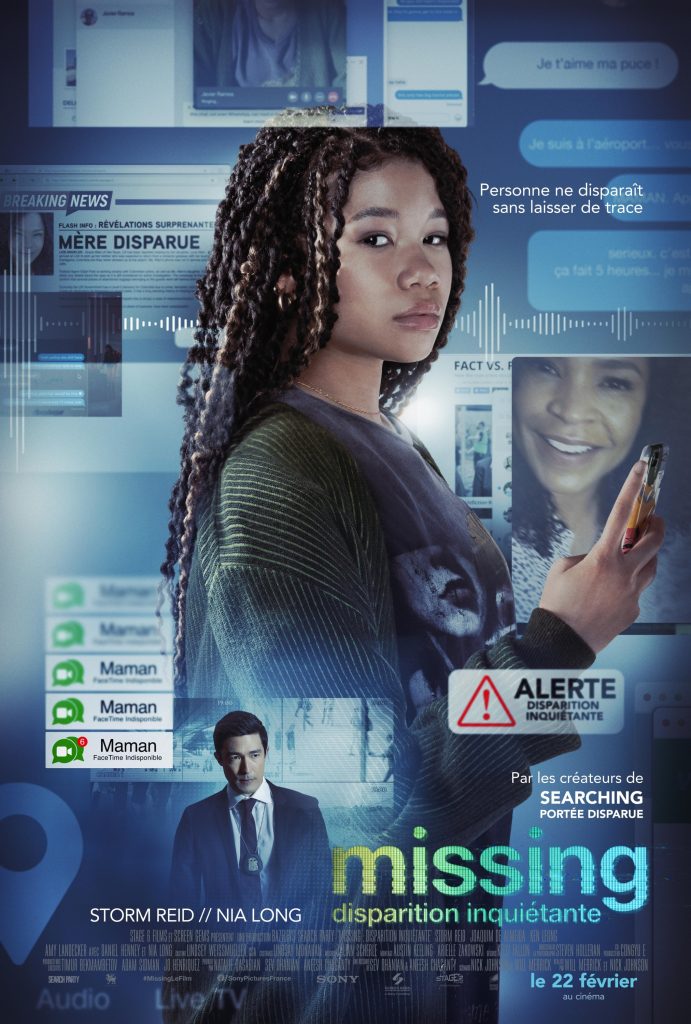
Composer Julian Scherle’s latest project is Missing from Sony Pictures. Releasing in UK cinemas soon, along with the soundtrack from Milan Records, Missing tells the story of June: “When her mother (Nia Long) disappears while on vacation in Colombia with her new boyfriend, June’s (Storm Reid) search for answers is hindered by international red tape. Stuck thousands of miles away in Los Angeles, June creatively uses all the latest technology at her fingertips to try and find her before it’s too late. But as she digs deeper, her digital sleuthing raises more questions than answers…and when June unravels secrets about her mom, she discovers that she never really knew her at all.”

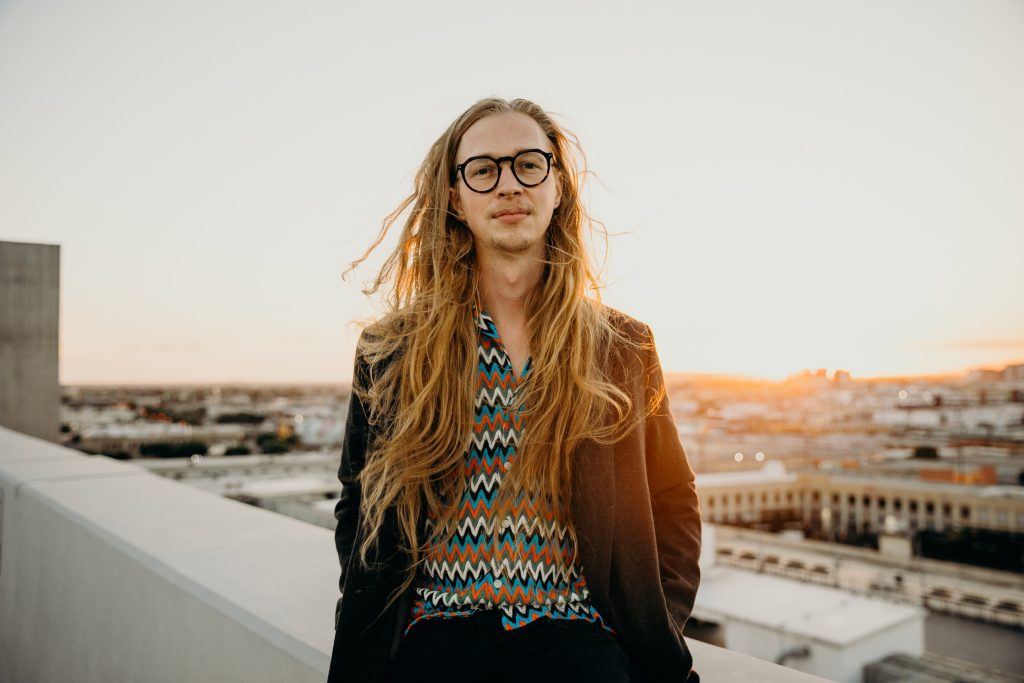
A continuation of his work with the filmmakers of Searching – whose storyline also unfolds entirely via digital screens – Scherle wrote an experimental score, exploring the musical possibilities of machine-learning to the point where he wrote his own code, took audio files and recompressed them with the worst possible MP3 converter about 5000 times. We spoke with Scherle about the work which went into Missing.

STARBURST: What work did we pull you away from – or can you talk about it?

Julian Scherle: Not a specific project. I do write music for myself and I was very engrossed in a piece of music that I’m working on right now. Whenever I’m not on a project, I just write music just for myself. I release music under different pseudonyms and kinda explore different aspects of my personality that way. I’m pretty active with just writing music nonstop.

We’ve talked to Mark Mothersbaugh about his scoring work, and he mentioned that he gets to work two hours before he has to start so he can just make stuff for himself before he has to do it for other people.

Right. Exactly. I mean, it’s ultimately still work for other people when you write a film score. It’s very refreshing to just write music for yourself. Kind of keeps the love alive.

One also imagines it keeps you limber, and you can explore different things that you cannot necessarily do with film score, which sometimes can also influence the film score side. Getting to play around without any sort of boundaries, you just come up with ideas and you can try things out without the time crunch of a release date.

Yeah, absolutely, and you’re the only person who’s going to give yourself notes.

Did the score for Missing come out of any experimentation you’ve done on your own?

Yeah, it actually did. I did release a concept album a couple of years ago under one of my pseudonyms, and the directors found that and were listening to it when they were working on the script. And then at some point, when it came to hiring someone to do the score, they were like, “Oh, we should find out who this person is,” and they found out it’s me. Coincidentally, I also knew one of the producers from years ago. We worked on a short movie together, so they brought my name to the producer, and she’s like, “Oh yeah, I know this guy. I worked with him before.” So yeah, they kind of found me exactly through one of my side projects.

So much of the score is technologically driven, either right from the synthesizers or via the various compression and distortion that you apply. How did it come about?

The movie Searching, the entire story is told through digital interfaces. You always just see computer screens, basically. Anything you see is basically represented on that screen. It uses a lot of technology to tell a story, and our very first basic area that we wanted to explore sound-wise was, “What’s the human-machine interaction and what kind of elements get lost on the way, compared to if you would have a human-to-human interaction?”

Face-to-face, we might interact differently than we do compared to being on a Zoom call or on a phone call. That was the basic concept and my first question was, “What is that to the audio part?” one of the first things was, “Well, there’s always compression involved.”

Whenever you have any type of digital transmission, that type of compression affects the way how we perceive audio. I found an interesting study that was basically exploring exactly that. It was using orchestral instruments and played those instruments one time, compressing them, and then playing that compressed audio to some random audience and basically just looking at what that does.

The findings were that basically the more compression you have, the more anxiety-inducing those signals become. I thought, “Well, that’s kind of interesting. What happens if we don’t compress it one time, but maybe thousands of times? Does that still basically apply? Does it get even more anxiety-inducing?”

The results were pretty, pretty interesting – just a soup of compression artifacts to the point where it’s not recognizable, but the original signal was still there. I applied that to all kinds of different acoustic sounds, electronic sounds, different – sometimes I use elements from production audio, so Storm’s voice for instance, just dialogue, snippets, and pieces.

Another one was that I used a microphone that would pick up electrical interference instead of audio signals that are transmitted through the air. It really just picks up on electric radiation, and with that, you can capture any kind of sound that electronic parts are radiating. If you have light sources or any kind of LEDs or any kind of board, it really just constantly emits some type of sound, and you can capture that with that microphone.

It’s really digital, harsh kind of sounds. They’re not picked up through air, so there’s no room sound. It really is just directly, basically in your face. It’s really good for creating this type of claustrophobic feeling that I was going after – really being really close to the main actor and really being kind of caught inside the machine.

And then the last part that I was very interested in exploring was to include AI and machine learning in the process of creating sounds. And I found this platform by Alphabet. It’s kind of like a research platform for resynthesis, and you can train your own modules basically with the set of input signals and create an algorithm and then retrain other things to apply basically that module to it and resynthesize those sounds.

I used all kinds of stuff from the other two elements that I described and trained that module with the electrical interference sounds and used some vocals or some audio material from Storm and saw what that did. A lot of trial and error. I was involved pretty early in the process, so I had a decent amount of time to come up with all that stuff. But yeah, all the technical technological stuff, all this is really for the very anxiety-inducing, stressful, uncomfortable part of the score. It was huge fun for me to explore this field and come up with all those crazy sounds.

Julian Scherle’s score for MISSING is available now via most digital streaming sites, while the film itself is out now to rent/buy digitally in the States, and in UK release cinemas on April 21st.


Alexandra Bracken | SILVER IN THE BONE

Alexandra Bracken

by Ed Fortune

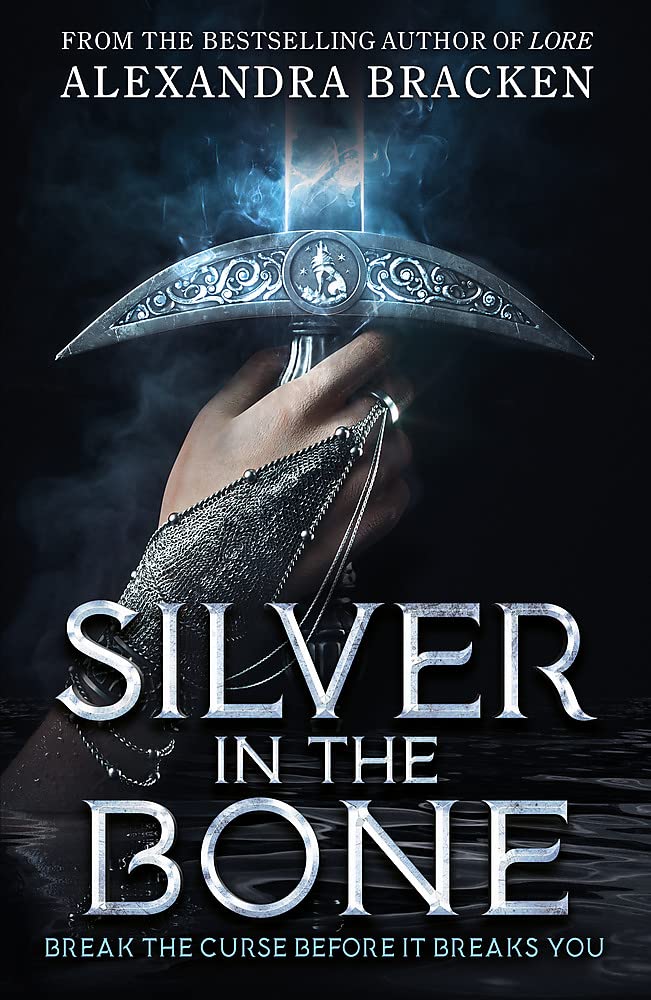
Alexandra Bracken is a New York Times bestselling American author known for her young adult thriller series The Darkest Minds and the time-travel duology Passenger/Wayfarer. Her latest book, Silver in the Bone, is a contemporary fantasy. We got in touch to find out more.

STARBURST: What’s your Elevator pitch for Silver in the Bone?
Alexandra Bracken: I’ve been pitching it as being like if Indiana Jones was a teenage girl, crossed with Arthurian legend and a dash of The Last of Us

How does this compare to your other novels? Was Silver in the Bone a challenge to write?
Silver in the Bone was a challenge but in the best possible way. I really wanted to write a story that touched on a less-explored part of King Arthur’s world, namely the Isle of Avalon. Getting to really imagine that world from the ground up, not to mention dream up a dark scenario to test its inhabitants down to their very souls–was an absolute blast.

Of my past work, this book is probably most like Lore, as it takes familiar mythology and legend and brings it into the modern world to tell an entirely new tale.

What was your favourite scene to write?
The athame scene at the lake, you’ll know it when you read it!

If you could take one of the characters from the book out for a drink, who would it be, and what would you say to them?
I feel like I owe the entire Isle of Avalon a round of drinks on me, honestly! From the main cast, I definitely want to take Tamsin, mostly so I can apologize for what I subjected her to in this book.

How would you describe your writing process?
I’m what some people call a headlights plotter, meaning that I don’t do massive, detailed outlines, but I don’t completely pants my stories either. Once an idea comes together in my mind, I know I’m ready to dive in when I know the main character’s arc, as well as the midpoint and the ending. Everything else is discovery as I’m drafting. So… lightly chaotic?

Which writers inspire you?
I’m continually inspired by so many of my author friends as they push themselves to hone their craft and write better and better books! I also love how Holly Black incorporates fairy tales and folklore so seamlessly into her work.

When you’re world-building, how does magic change a society?
When I’m thinking about magic and worldbuilding, I always start with how it has directly impacted the main character, and I let it all grow organically out of that. For example, in Silver in the Bone, Tamsin doesn’t have any magic of her own, and it intensifies her need to prove her worth beyond it, as well as makes her feel like an outcast from the hidden world of treasure hunters she’s part of. Like any concept of power, I think magic can absolutely bring out the very best and worst in people. I think a lot about how it defines different characters’ identities, what they believe about it, and, most important of all, its limitations.

If you weren’t writing books, what would you be doing?
Good question! I would probably have gone on to teach history, or I would have worked in historic preservation.

What’s your next big project?
I wish I could tell you, but it’s still a secret! Right now, though, I’m editing the sequel to Silver in the Bone and can’t wait to share the title of it with everyone soon!

Silver in The Bone is available now from all good bookshops.


THE TELEPHEMERA YEARS: 1978 – PART 3

Dr Strange, 1978

Ah, telephemera… those shows whose stay with us was tantalisingly brief, snatched away before their time, and sometimes with good cause. They hit the schedules alongside established shows, hoping for a long run, but it’s not always to be, and for every Street Hawk there’s two Manimals. But here at STARBURST we celebrate their existence and mourn their departure, drilling down into the new season’s entertainment with equal opportunities square eyes… these are The Telephemera Years!

1978-79

The 1978-79 season was a time for goodbyes, with the final episodes of All in the Family, The Amazing Spider-Man, Good Times, Starsky & Hutch, Welcome Back Kotter, and Wonder Woman all making grown men cry. Still, ABC’s massive comedy line-up – they filled the top five slots in the ratings chart with their hit sitcoms – must have been some succour, with Mork & Mindy the number three show in its debut season.

Other new shows included Three’s Company spin-off The Ropers, a put-upon Judd Hirsch in Taxi, lessons in harmony with Diff’rent Strokes, and radio station fun with WKRP in Cincinnati. Fans of telefantasy were treated to The Dukes of Hazzard, BJ and the Bear, and space opera in Battlestar Galactica, alongside their regular doses of Charlie’s Angels and CHiPs. But those were the shows that people remember from 1978 – what about those that didn’t even make it to series? This is the story of 1978’s failed pilots…

The Clone Master (NBC): Written by science fiction master Frederik Pohl, The Clone Master was Multiplicity years before Michael Keaton ever thought of cloning himself and with considerably less comical results. Pohl was engaged to write an anthology series based on his stories, only to find that the network was so enamoured by his first idea that they wanted to take it to series, abandoning the format the writer had agreed.

Pohl reluctantly agreed and a pilot was ordered, starring B-movie regular Art Hindle as Dr Simon Shane, a geneticist who develops a cloning process. When his mentor is kidnapped, Shane accelerates his research and tests the process on himself, producing a dozen clones who can communicate telepathically. Now he has to rescue Dr Louthin and evade capture by the shadow organisation that backed his research…

Clone Master, 1978

The script was developed from Pohl’s outline by John DF Black, a veteran screenwriter with a long list of credits including Mission: Impossible, Star Trek, Hawaii Five-O, and Wonder Woman. Black delivered a tight script with a neat twist, and the pilot was shown on Thursday September 14th 1978, in the slot usually reserved for Quincy, MD.

Although reaction was generally favourable, it was decided against taking the show to series, possibly due to the difficulty of filming a story featuring thirteen identical protagonists or maybe because Pohl was thoroughly disengaged from the process. Unlike many of his contemporaries, Pohl’s work was rarely adapted for TV or film and only his 1959 short story “The Bitterest Pill” would make the screen after the failure of The Clone Master, as an episode of Tales of the Darkside in 1986.

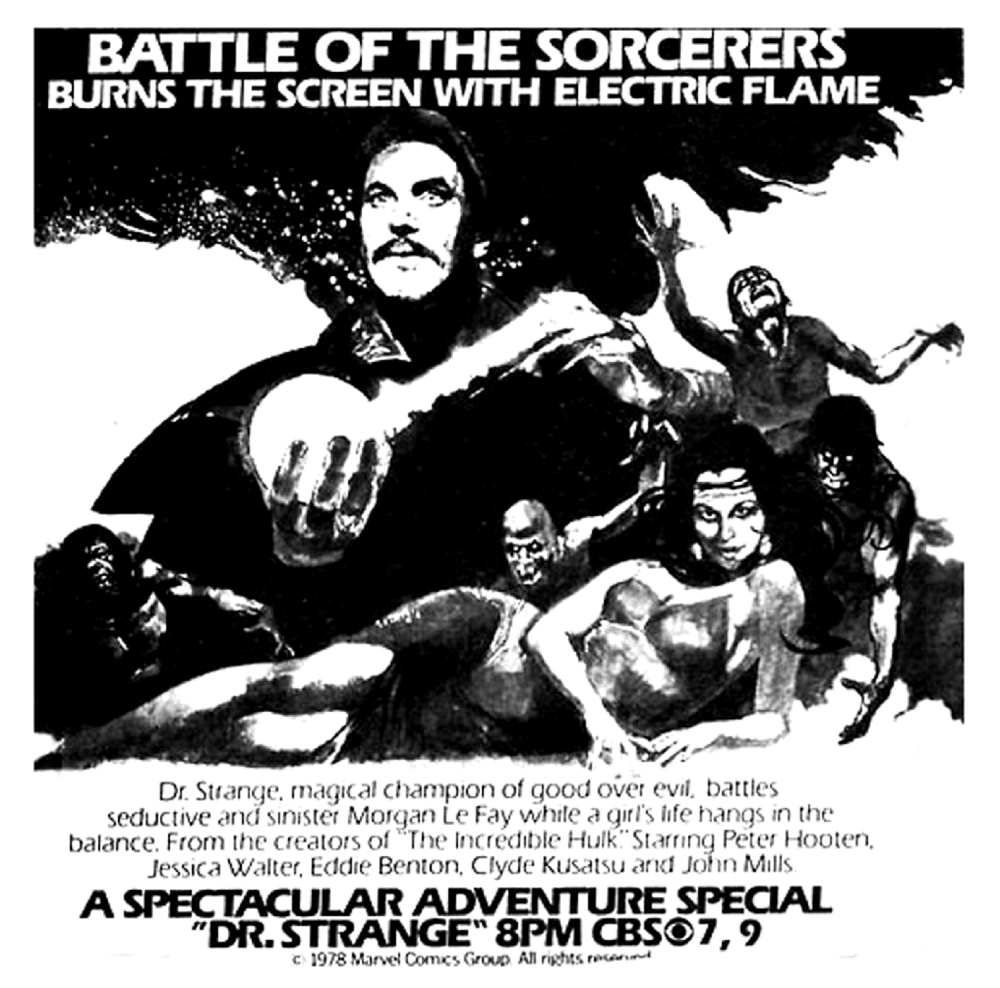
Dr Strange (CBS): In 1972, Stan Lee left the day-to-day running of Marvel Comics to Roy Thomas in order to assume the position of Publisher. As part of his duties as general champion for the company and its properties, Lee signed a deal with CBS to develop television series based on some of Marvel’s most popular characters, the first fruits of which resulted in September 1977’s The Amazing Spider-Man. A pilot starring Nicholas Hammond as a very cautious wallcrawler, The Amazing Spider-Man was given a full series run in April 1978 and next up was The Incredible Hulk in November 1977.

Again, The Incredible Hulk scored well enough with its pilot to receive a full series order, and Dr Strange was moved into production. Unlike Spider-Man and The Hulk, Dr Strange was not a top tier Marvel character but it was thought that he was different enough from the other two that his eventual series would not mine similar ground.


Dr Strange, 1978

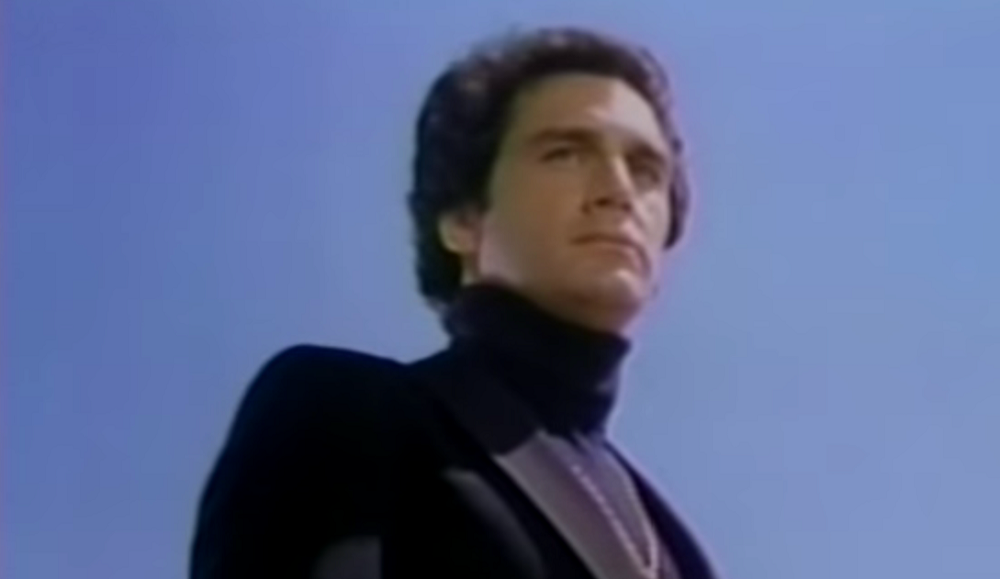
CBS regular Philip DeGuere was given scripting and directing duties, adapting Steve Ditko’s original origin story to include a previous Sorceror Supreme, Thomas Lindmer. Lindmer, played with some gravitas by John Mills, seeks out young surgeon Stephen Strange to succeed him in the role, fighting as much against Strange’s own preconceptions of science over magic as the film’s big bad, Morgan Le Fay. Eventually and despite attempts by Le Fay to seduce him to the dark side, Strange takes Lindmer’s mantle and vows to defend the Earth from magical threats.

Peter Hooten, in his first starring role, is good value as Strange but the general feeling was that DeGuere’s script and direction were too slow, despite Lee’s positive opinion of the film. Dr Strange did not get good ratings when it was shown as a pilot film in September 1978 and there would be no subsequent series. Instead, the Marvel bandwagon moved on to 1979’s Captain America, which is a story for another day.

Mandrake (NBC): Mandrake the Magician was a syndicated newspaper comic strip created in 1934 by Lee Falk, a dependable part of the Kings Features Syndicate line-up until 2013. Falk handed Mandrake over to Phil Davis shortly afterwards, moving on to his most famous creation, The Phantom. Mandrake was the inspiration for many other comic strip and comic book magicians, and in 1939 was given the film treatment, with Warren Hull starring in the twelve-episode Columbia serial.

A radio series followed in 1942, with a unsold pilot for a TV show coming in 1954, but otherwise Mandrake remained firmly on the printed page, at least until producer Rick Husky was given the task of bringing the immaculately tailored magician and his African assistant Lothar to TV in 1978. Husky wrote a script which put Mandrake and Lothar up against a psychopath who is murdering the patrons of an amusement park, engaging Harry Falk – no relation – to direct and casting Anthony Herrera as Mandrake.

Mandrake, 1979

Falk was a veteran director of mostly TV comedies, including The Patty Duke Show (he married Duke in 1965) and Get Smart, but moved into action in the 1970s with Hawaii Five-O and The Streets of San Francisco. Herrera was best known as a cheating husband on The Young and the Restless but acquitted himself well enough, with Ji-Tu Cumbuka a decent Lothar.

Mandrake aired in January 1979 as part of NBC Wednesday Night at the Movies but nothing short of a blockbuster rating could save it from an early grave, with critics savaging Falk’s direction, a plodding approach which drained all life out of Husky’s script, which wasn’t exactly a picture of health in the first place. Herrera returned to the world of soap operas and Mandrake to the printed page, only reaching beyond the funny pages in 1986 when he was part of Defenders of the Earth alongside The Phantom and Flash Gordon.

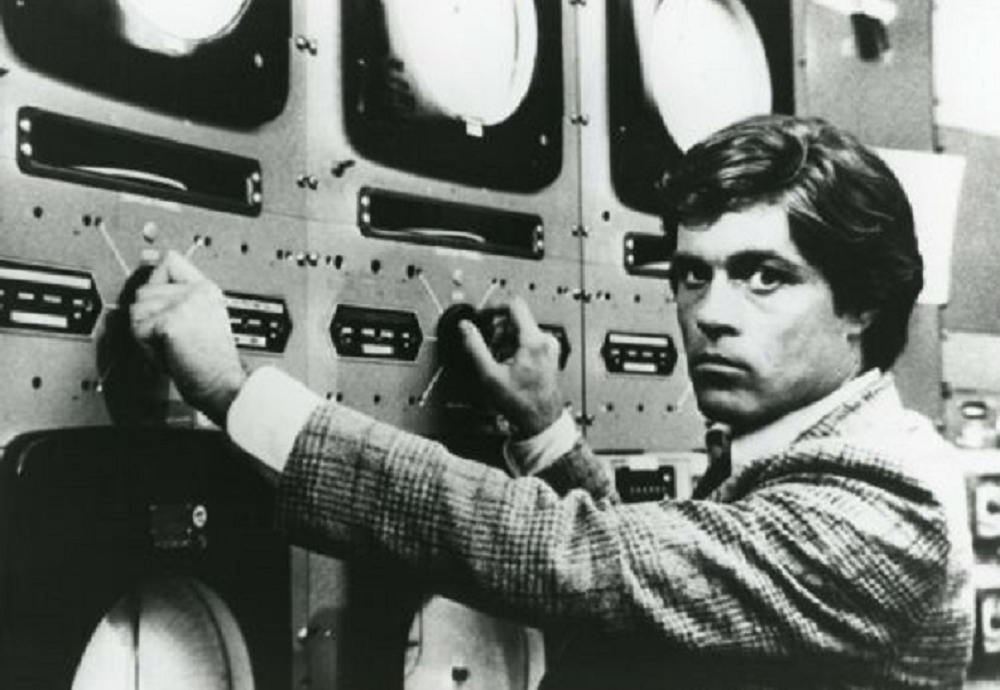
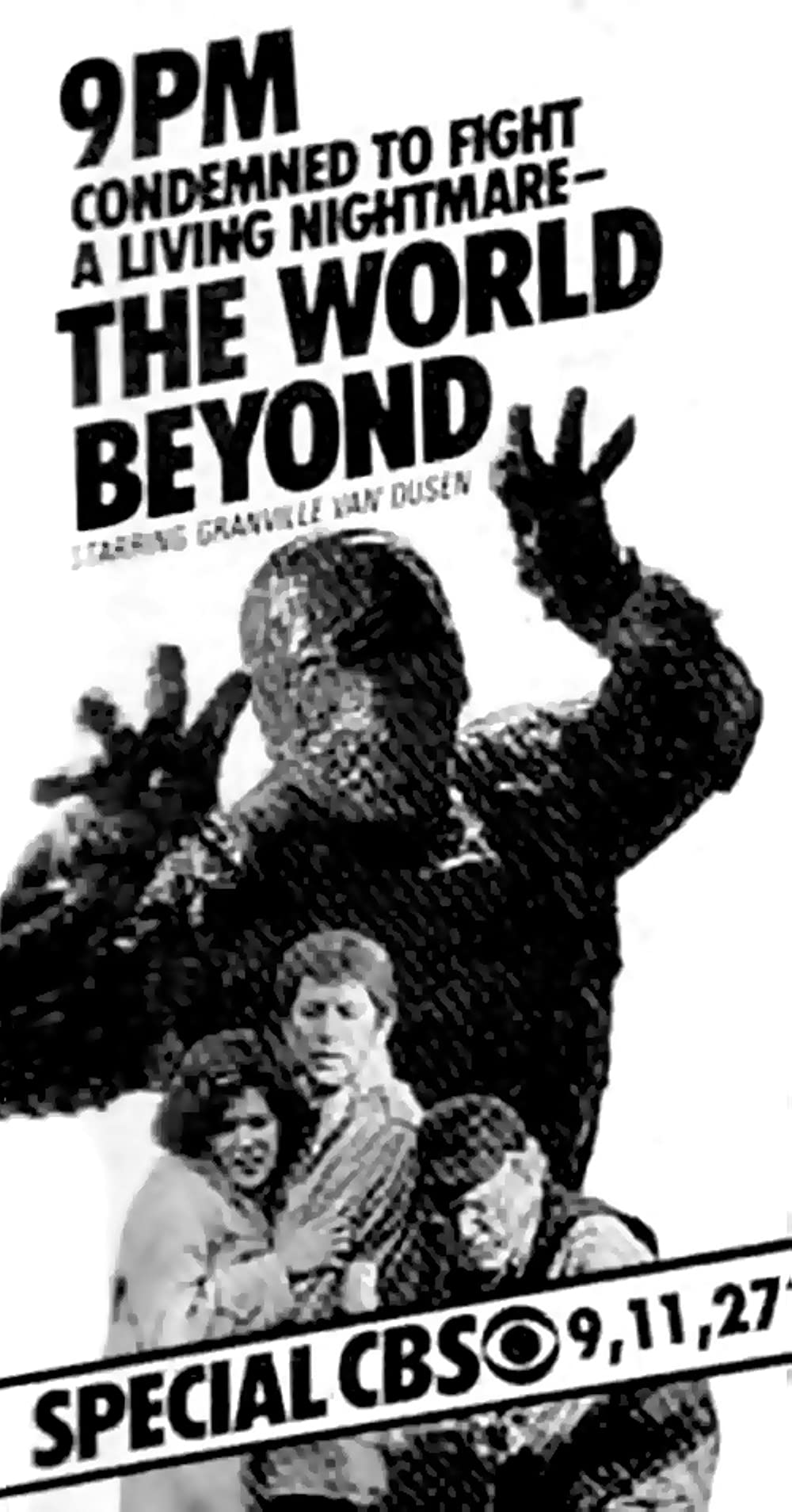
The World Beyond (CBS): The World Beyond was the second of two pilots starring Granville van Deusen as Paul Taylor, a sportswriter who dies for two minutes and thirty-seven seconds on the operating table, only to find that he is able to see and hear ghosts when he is revived. Taylor becomes a conduit for the dead to contact the living, embroiling him in all manner of adventures, or at least the two featured in the two CBS pilots.

The World of Darkness aired in April 1977, with Taylor drawn to a New England town where the patriarch of the Sandford family has apparently just committed suicide. Nine months later, Taylor was on the road again, this time to a remote island off the coast of Maine, whose inhabitants are under siege from a creature apparently made of mud and sticks.

The World Beyond, 1978

Created by Art Wallace, who had worked with Dan Curtis on what became Dark Shadows, although he turned down the role of producer. Wallace and Curtis wrote the series bible and first eight weeks’ worth of episodes, but Wallace preferred to vary his schedule with other writing jobs, turning out scripts for projects as diverse as Star Trek, The Bill Cosby Show, and Planet of the Apes.

The World of Darkness and The World Beyond were intriguing concepts that just didn’t land with the network or the majority of viewers at the time, although both films have a cult following and The World Beyond is available to watch on YouTube if you want a slice of occult detective drama. Sadly, Art Wallace did precious little work after Paul Taylor failed to land a series, with just a couple of scripts for Planet of the Apes TV movies, a run as story consultant on All My Children, and a single episode of the 1989 horror anthology series Nightmare Classics with The World… director Noel Black. He died in 1994.

Next on The Telephemera Years: Bigfoots, giant lizards, and female Tarzans all vie for the kids’ attention…

Check out our other Telephemera articles:

The Telephemera Years: 1966 (part 1, 2, 3, 4)

The Telephemera Years: 1968 (part 1, 2, 3, 4)

The Telephemera Years: 1969 (part 1, 2, 3, 4)

The Telephemera Years: 1971 (part 1, 2, 3, 4)

The Telephemera Years: 1973 (part 1, 2, 3, 4)

The Telephemera Years: 1975 (part 1, 2, 3, 4)

The Telephemera Years: 1977 (part 1, 2, 3, 4)

The Telephemera Years: 1978 (part 1, 2)

The Telephemera Years: 1980 (part 12, 3, 4)

The Telephemera Years: 1982 (part 1, 2, 3, 4)

The Telephemera Years: 1984 (part 1, 2, 3, 4)

The Telephemera Years: 1986 (part 1, 2, 3, 4)

The Telephemera Years: 1987 (part 1, 2, 3, 4)

The Telephemera Years: 1989 (part 1, 2, 3, 4)

The Telephemera Years: 1990 (part 1, 2, 3, 4)

The Telephemera Years: 1992 (part 1, 2, 3, 4)

The Telephemera Years: 1995 (part 12, 3, 4)

The Telephemera Years: 1997 (part 1, 2, 3, 4)

The Telephemera Years: 2000 (part 1, 2, 3, 4)

The Telephemera Years: 2003 (part 1, 2, 3, 4)

The Telephemera Years: 2005 (part 1, 2, 3, 4)

The Telephemera Years: 2008 (part 1, 23, 4)

Titans of Telephemera: Irwin Allen

Titans of Telephemera: Stephen J Cannell (part 1, 2, 3, 4)

Titans of Telephemera: DIC (part 1, 2)

Titans of Telephemera: Hanna-Barbera (part 1, 2, 3, 4, 5)

Titans of Telephemera: Kenneth Johnson

Titans of Telephemera: Sid & Marty Krofft

Titans of Telephemera: Glen A Larson (part 1, 2, 3, 4)

Titans of Telephemera: Quinn Martin (part 1, 2)

Titans of Telephemera: Ruby-Spears

Ron Wasserman | MIGHTY MORPHIN POWER RANGERS: ONCE & ALWAYS

ron wasserman power rangers

by Nick Spacek

Musician and composer Ron Wasserman’s ’90s output for Saban Films is legendary. In addition to having created, performed, and sung the seminal theme song of the Mighty Morphin Power Rangers, Wasserman also composed the theme for X-Men: The Animated Series and composed for Dragon Ball Z.

Wasserman has returned to the much-beloved series to score the upcoming 30th anniversary Netflix film Mighty Morphin Power Rangers: Once & Always. The new film, out April 19th, “brings back two of the original Power Rangers, Billy (David Yost) and Zack (Walter Jones), in their fight against the newly resurrected Rita Repulsa to stop her plot to go back in time and stop the Power Rangers from ever forming.”

We spoke with Ron Wasserman about his career, returning to the Power Rangers, and more. You can watch the full interview below…


Scout Taylor-Compton | THE BEST MAN

scout best man

by Andrew Dex

She fought Michael Myers in the Halloween franchise, and now she’s taking on terrorists in her brand-new action-packed thriller The Best Man. STARBURST catches up with actor Scout Taylor-Compton to find out what it’s been like to work alongside a brilliant cast on a Die Hard-inspired action movie that, interestingly, features a wedding taking place at the centre of it…

STARBURST: How did you get involved with the movie, and what made you want to work on a story like this?

Scout Taylor-Compton: I just got a call, just an offer. Nicky Whelan, who plays my sister Brook in the movie, texted me, saying, “I’m attached to this movie. They’re going to reach out to you. Please do it!” I love Nicky, I’ve worked with her on another movie, and now we are very close friends. When I read the script, it was a quick yes. I love action and anything that’s fast-paced. It’s always my vibe. It was a fast yes for me, for sure.

How did you prepare for a role that would see you playing a maid of honour within an action movie? What kind of research did you do for that?

I just made sure I drank a lot of water! Obviously, it’s hard to move in a dress, but my whole thing was making sure that I found shoes that weren’t going to be a pain in my ass when it came to running around. I already told the director that the shoes were coming off asap. I just need to be barefoot in order to keep up with Brendan Fehr moving fast. There wasn’t really much preparation, I feel like with action and horror, it’s a lot of movement. They go hand in hand, so it’s pretty easy.

What was it like to work on your character Hailey with the director Shane Dax Taylor, and what do you think he wanted to see from her within the movie? What did he want her to bring to the story?

What was interesting is that Hailey is spunky anyways. She’s a daddy’s girl. I’ve never played that sort of girl, so it was fun; she’s very flirtatious. She’s a go-getter and knows what she wants, which is a fun and confident role to play. Which was really fun in itself, and then as soon as shit hits the fan, she turns into this vulnerable, like, “Help me, save me!” kind of thing, but we definitely wanted to find the medium ground of she can also take charge, which you see in the movie, which was really fun to work on with Shane. There were a lot of times when I wanted to find Hailey’s courage and strength through this, and Shane was really helpful with that, making that colour palette work.

It’s an interesting idea, where a wedding turns into a hostage situation! So, I was wondering, what do you think the wedding side of the story does for an action movie like this? Like, maybe it makes the viewer care for the characters more?

Yeah, I think so! I mean, who doesn’t love Die Hard? So, it’s like it’s Die Hard, but at a wedding! I think that is what it did. We fell for these characters a bit more, and I would assume they’re more realistic. They are all different from one another too, which is really great; even with Nicky and my character, we’re polar opposites in the film. You follow a bride and a groom on what’s supposed to be the happiest day of their lives, but it ends up not being that. I’m getting married next year, and if something like this happened, I’d be mortified! And I would hope that my groom would protect me! Like Luke Wilson did with his bride.

You share a lot of scenes with Brendan Fehr, who plays Bradley, can you tell us a bit about what he was like to work with and what you think your dynamic brings to the movie?

I got really lucky working with him and have been a fan of him forever. We actually did a movie together where he played a dad figure! So that was hilarious. I said, “Guess what, Daddio, I’m now your partner!” It’s always interesting when you act with someone previously, and then when you collaborate again on another movie, you both play something completely opposite. That was really fun, but he is one of those actors where we work the same. It was really easy to manoeuvrer with him; we’re very laid back, and we’re goofballs in general, so it was very fun being able to work with him. We kind of snap in and snap out of the role, which was nice. Sometimes it’s a little harder when you’re working with someone who is like a method actor or so into it, where you’re like, “Hey! Let’s have a normal conversation not regarding our characters”. It was lovely working with him, and he brought out a lot in Hailey, a lot more playfulness, which is just fun. When you work with an actor, you never know what they’re going to give you until you hit that moment, and I think what we gave each other was magnetic. So, it was really cool.

What was it like to work alongside Dolph Lundgren as Anders, and what do you think his history with action movies brings to The Best Man?

Coolness, credibility! He is a legend, and I was starstruck, to be honest. He has a big presence and is just a big guy. It was just like. Sometimes I couldn’t even get words out; I couldn’t believe that I was standing next to him. He doesn’t have to do anything, and he is badass. You’re intimidated by him. He brought so much and didn’t even need to say a word, which is cool.

You yourself are no stranger to intense action sequences. Looking at the Halloween movies alone, you’ve had to work on some huge sequences. What was the most rewarding scene for you to work on in The Best Man, and why?

There are so many. I’m marrying a stuntman, so if I don’t know how to do stunts/action, he is going to kick me to the curb. Obviously, any of the fight scenes, I love doing it! I know he is a stuntman, but I often say, “I want to do my own stunts, I don’t need anybody”, but it’s really incredible what they’re able to do, compared to what you’re not able to do with your body and actually be OK. Any of the gun work too, when you’re holding machinery like that, you feel badass. So any of that stuff is really cool to do as well.

Saban Films will release THE BEST MAN in US theatres, on-demand, and digitally on April 21st, 2023