Ah, telephemera… those shows whose stay with us was tantalisingly brief, snatched away before their time, and sometimes with good cause. They hit the schedules alongside established shows, hoping for a long run, but it’s not always to be, and for every Street Hawk there’s two Manimals. But here at STARBURST we celebrate their existence and mourn their departure, drilling down into the new season’s entertainment with equal opportunities square eyes… these are The Telephemera Years!
1993-94
The top ten shows at the end of the 1993-94 season looked very similar to those from 1992-93, with 60 Minutes retaining top spot for CBS, and top five placings for ABC’s Home Improvement and Roseanne. Coach, Monday Night Football, Murphy Brown, and the CBS Sunday Night Movie all kept their top ten slots, and there was an enforced change as US viewers had to get used to life without Cheers. The big new hit was Seinfeld, now in its fifth season and finally becoming the show about nothing that said everything to US audiences, forming a solid sitcom quartet with Mad About You, Wings, and new arrival Frasier, a Cheers spin-off, that commanded Thursday nights for the peacock network.
Elsewhere, David Letterman moved from NBC to CBS and The X-Files arrived on Fox, southern belle Brett Butler gave ABC a new hit in Grace Under Fire, and there was plenty of new genre fodder with Los & Clark: The New Adventures of Superman, seaQuest DSV, Duckman, and Weird Science all beginning their runs to more than make up for the loss of Star Trek: The Next Generation. But those were all shows that people watched and remember (mostly) fondly; what about the ones that didn’t outstay their welcome? This is the story of four more of 1993’s been-and-gones…
Phenom (ABC): The great-great-granddaughter of George Washington Goethals, the man who built the Panama Canal, Angela Goethals began acting as a young child, earning her first professional role in 1986 at the age of nine when she understudied Sarah Michelle Gellar in the off-Broadway play The Widow Claire. Further stage roles led to her first film appearance alongside an also debuting Macauley Culkin in Rocket Gibraltar, followed quickly by Heartbreak Hotel, in which she played a young girl whose older brother kidnaps Elvis to cheer her up. In 1990, she teamed with Culkin again as his older sister Linnie in Home Alone but didn’t appear in the sequel. Instead, she took more theatre roles and a part in VI Warshawski, for which she was nominated for her third Young Artist Award as an orphaned teen seeking revenge for her murdered father.
Goethals also had some small roles on TV but in 1993 her big break came when she was cast as a teenage tennis phenomenon no doubt inspired by the headline grabbing 1990 debut of thirteen-year-old Jenifer Capriati, who made the semi-finals of the French Open in her first professional season. Phenom was the brainchild of Dick Blasucci, Marc Flanagan, and Sam Simon, an unlikely trio who’d first worked together on The Tracey Ullman Show for Fox, which Simon co-produced with James L Brooks. Blasucci had a background in Chicago improv theatre group The Second City, writing for all three of their TV shows between 1980 and 1984, while Flanagan had been hand-picked by Brooks after he saw Meryl Streep and Kevin Klein perform a sketch he wrote at a benefit.
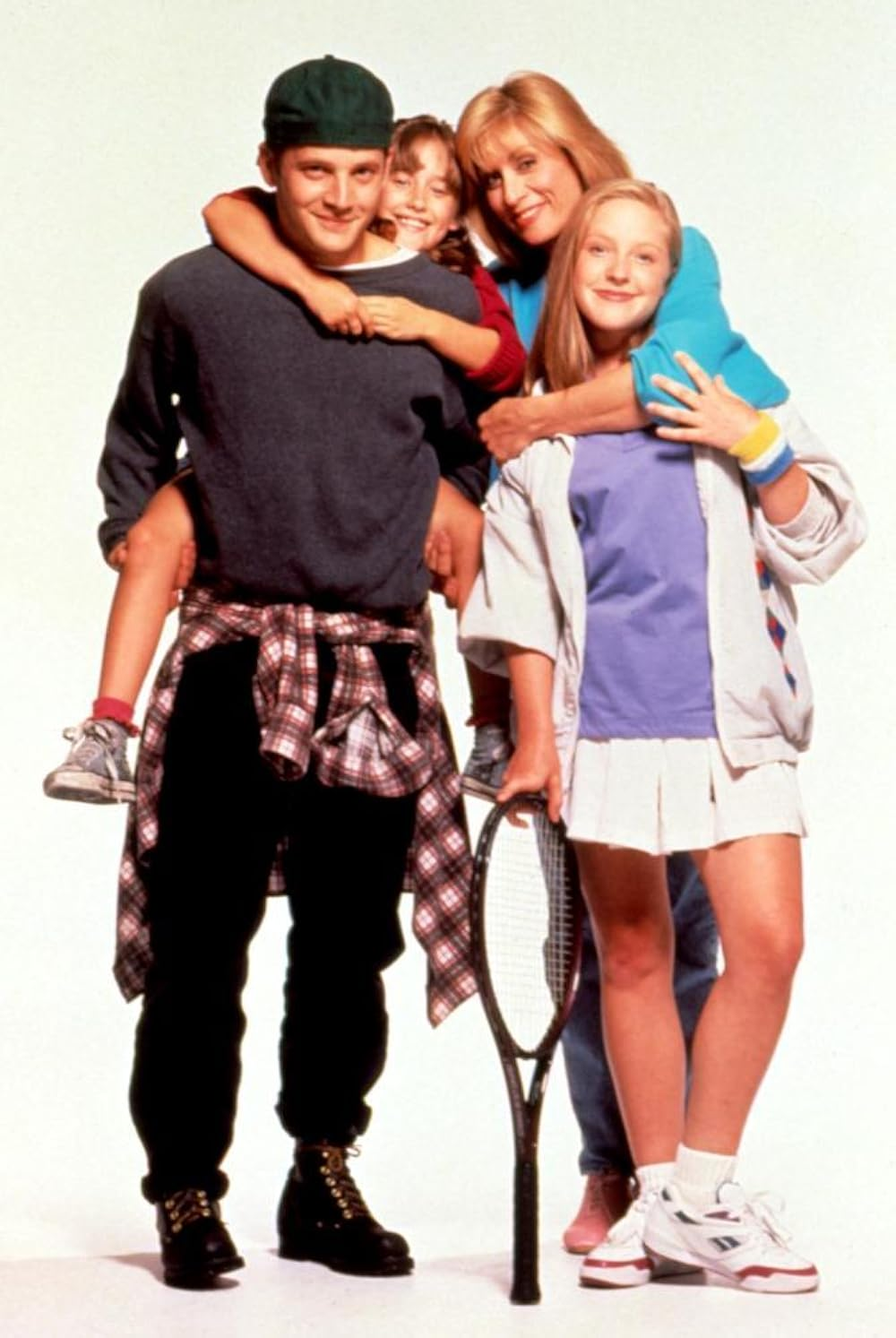
After The Tracey Ullman Show, Blasucci and another of the show’s writers, Joe Flaherty, worked on a pilot for CBS which was eventually picked up for a short run as Morton & Hayes, before he came back into Brooks and Simon’s orbit, teaming with Flanagan to write several episodes of sisters sitcom Sibs, which lasted for just one season on ABC. Blasucci and Flanagan’s partnership proved fruitful and two years later, they worked up Phenom with Simon, centred around fifteen-year-old Angela Doolan, who is trying to juggle the pressures of teenage life with a budding tennis career. Angela’s father has left the family to chase younger women, leaving her mother Dianne (Who’s the Boss?‘s Judith Light) to raise Angela, her older, slacker brother Brian (a showstealing Todd Louiso, clad entirely in earth tones), and tween Mary Margaret (Ashley Johnson from Growing Pains).
As the show starts, Angela is offered a place at a prestigious tennis academy run by demanding coach Lou Della Rosa. Della Rosa was played by William Devane, fresh off a ten-year run on Knots Landing, but he ended up uncredited after a row with the producers over whether he or Light would receive top billing resulted in him asking to have his name removed from the credits completely. The regular cast was completed by Another World‘s Jennifer Lien as Brian’s fiancé Roanne, and Randy Josselyn (from guardian angel sitcom Down to Earth) as Jesse, a teenage boy who competes with tennis for Angela’s affections.
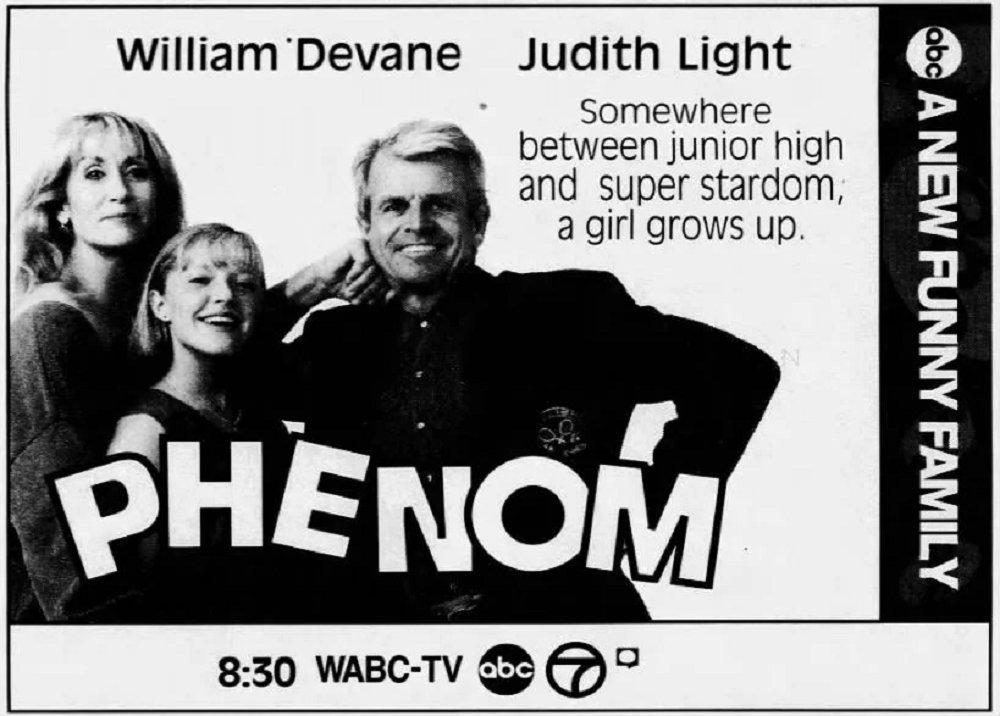
With a theme song sung by Carly Simon, Phenom debuted on ABC on September 14th 1993, joining NYPD Blue as part of a Tuesday night line-up with Full House, Roseanne, and Coach, all top ten shows the year before. It started cautiously, second in its timeslot to CBS reality hit Rescue: 911 on its opening night but built a solid audience as families settled in for an evening of comfortable sitcoms followed by Steven Bochco’s latest police procedural. Guest stars during the show’s run included George Burns, Dan Castellaneta, Kathleen Freeman, Ed McMahon, and Leave It To Beaver‘s Jerry Mathers, who stalks Brian after he gives his latest TV show a bad review. Real life sports stars Kareem Abdul-Jabbar, Vijay Amritaj, and Tracy Austin also appeared, with Austin also acting as tennis consultant for the show.
From a start of 11.3, ratings went as high as 15.1 but settled down at just under twenty-million viewers per show, a respectable draw which saw it finish twenty-seventh in the year end ratings list, ABC’s number twelve show, and rated ninth among young viewers. Unfortunately, it was seen as a drag on the network’s other Tuesday night offerings, unable to keep all of Full House’s audience and therefore reducing the through traffic to Roseanne. After discussions with Gracie Films about changing the direction of the show went nowhere, ABC cancelled Phenom in mid-May 1994, shortly after its final episode saw Angela torn between spending time with her friends and preparing for a tennis tournament. Brooks was not happy at the decision, issuing a statement that read, “I have no comment while I’m developing the muscle to lie about my reaction to what ABC did.” For the 1994-95 season, ABC replaced Phenom in the Tuesday night line-up with Me and the Boys, a sitcom set in a video store owned by a widower (Steve Harvey) who is bringing up three sons on his own. It was made by ABC themselves but fared no better, cancelled after nineteen episodes with an average rating that equalled that of Phenom but placed it higher – twentieth – in the year-end figures.
After Phenom, Goethals appeared in a revival of Picnic on Broadway and had a small role – as a teenage tennis star, natch – in Jerry Maguire, the 1996 Tom Cruise “show me the money!” hit that was produced by Brooks and Gracie Films, and which guest-starred Louiso in a role not dissimilar from his one as Brian (and one he perfected for High Fidelity in 2000). By the time the film was released, she was studying French at liberal arts college Vassar, graduating in 1999. After a clutch of roles in the early 2000s – including original Comedy Central movie Porn ‘n’ Chicken, time displacement sitcom Do Over and a recurring role on 24, she largely gave up acting in order to raise a family and now works as an audiobook narrator.
The Adventures of Brisco County Jr (Fox): Jeffrey Boam wanted to be in the movie business from the minute he saw Albert Finney in Tom Jones as a teenager, eventually enrolling as a graduate student at the UCLA School of Theater, Film, and Television where he intended to study directing. Unable to afford much in the way of film equipment, Boam did own a typewriter and directed his energies towards screenwriting, hoping to impress William Froug, a veteran TV writer teaching at the college. The two eventually collaborated on a screenplay called Johnny about infamous bank robber John Dillinger, only to discover that John Millius had beaten them to it. After finishing up at UCLA, Boam worked in film distribution for Paramount and 20th Century Fox, all the while writing screenplays with little success, at least until he was hired to write Straight Time by producer Ulu Grosbard, released in 1978 with Dustin Hoffman in the lead role.
His next project was an adaptation of Stephen King’s The Dead Zone, eschewing the novel’s parallel story structure into a shortened, simplified narrative. The script underwent considerable rewrites at director David Cronenberg’s insistence but won Boam acclaim for his writing, leading to a contract as a staff writer with Warner Bros, where he was tasked with polishing and rewriting scripts for high concept projects. Among the films Boam worked on were Inner Space, The Lost Boys, and Funny Farm, and he did uncredited work on Lethal Weapon, making Shane Black’s script less grim.
In 1987, Boam was brought in by Steven Spielberg to find common ground between clashing ideas he and George Lucas had about the third Indiana Jones movie. By this point, Boam had formed a partnership with another writer, Carlton Cuse, after being impressed with Cuse’s writing on the TV show Crime Story. Although he wasn’t credited, Cuse helped Boam develop what became Indiana Jones and the Last Crusade and both Lethal Weapon 2 and 3, and after forming Boam/Cuse Productions, they produced a pilot for a TV series based on The Witches of Eastwick for NBC, starring Julia Campbell, Catherine Mary Stewart, Ally Walker, and Michael Siberry, but the network ultimately passed on taking the pilot to series.
After the success of Indiana Jones and the Last Crusade, Boam and Cuse were contacted by Bob Greenblatt, head of prime-time programming at the Fox network. Greenblatt wanted the pair to do a similar job for TV, something in the spirit of old adventure film serials, and while Cuse was doing his research he noticed that the serials mostly fell into two genres: Westerns and science-fiction. Combining the two seemed a natural step and Cuse and Boam went one further, structuring each episode as a series of mini serials, each with its own title and cliffhanger. Boam acted as executive producer, with Cuse taking the showrunner role, and the task of scripting the pilot – and distilling all of Boam and Cuse’s ideas – fell to David Simkins, best known for Adventures in Babysitting. Like Boam, Simkins had been under contract to Warner Bros, where he’d developed a series based on old adventure serials which didn’t get made but did bring him to the Boam and Cuse’s attention.
Although Simkins’s early efforts were too expensive to realise on film, a happy medium was struck between imagination and budget, with a dedication to cartoonish violence and an absolute dereliction of duty towards historical accuracy. The pilot introduced the basic premise: after famous lawman Brisco County is murdered by a gang led by the notorious bandit John Bly, a group of robber barons hires his son, a Harvard educated lawyer turned bounty hunter named Brisco County Jr, to bring the outlaw to justice.
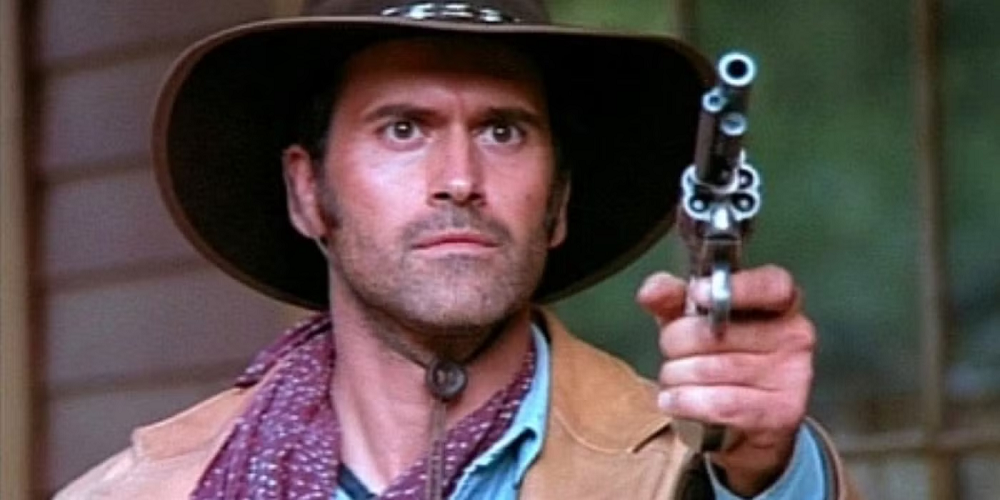
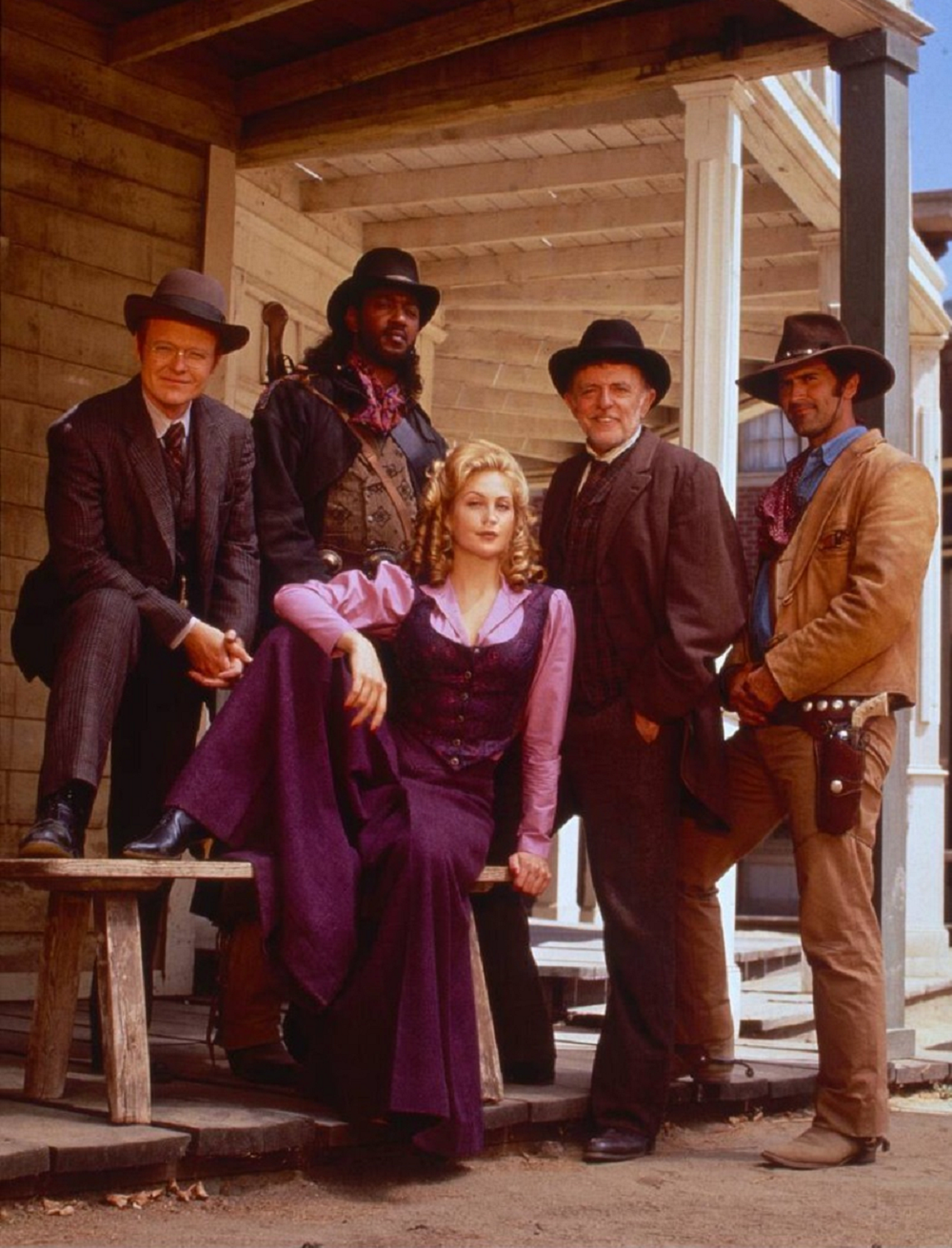
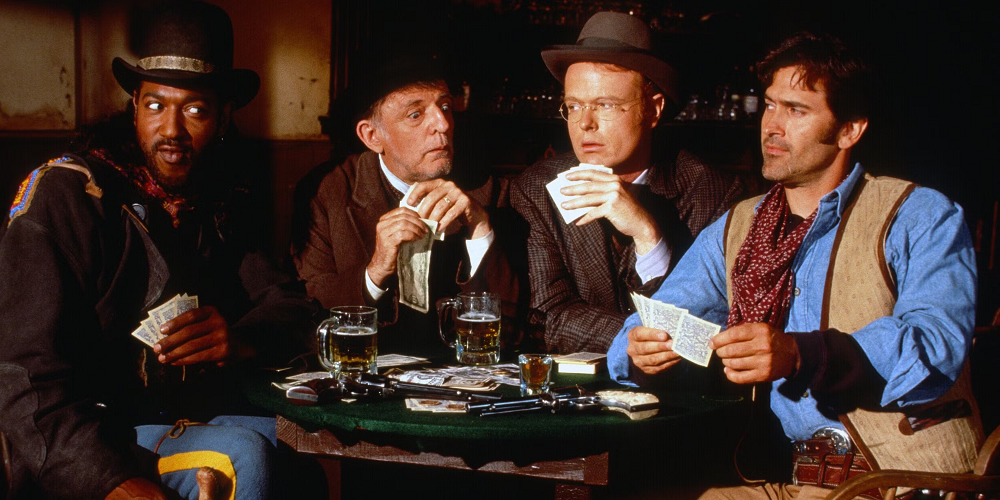
After a series of rigorous auditions, during which he was asked to provide he could handle the physical side of the role and responded by performing a standing flip, Evil Dead star Bruce Campbell was cast in the main role. Campbell started acting as a teenager, appearing in Super-8 movies he and his friends would make in high school. One of those friends, Sam Raimi, wrote a script initially titled Within the Woods, shot as a thirty-minute Super-8 film in 1978 as a way to attract investors for a feature version. Evil Dead arrived in 1981, with Campbell front and centre, and he retained the role in the remake/sequel Evil Dead II. He switched to play the bad guy in Maniac Cop but was back with the boomstick and chainsaw for Army of Darkness, the third film in the series, in 1992. His Brisco County Jr was accompanied by Socrates Poole (Christian Clemenson from Capital News), a lawyer in the service of Brisco’s employers, sent to ensure he does his job correctly (and lending a hand when possible).

The two would often butt heads with Julius Carry’s Lord Bowler, a rival bounty hunter based on Lord Baltimore from the classic Butch Cassidy and the Sundance Kid, and the cast also included Kelly Rutherford (who impressed in auditions so much as sultry saloon singer Dixie Cousins that her character was turned from a one-off femme fatale into an ongoing love interest), John Astin as madcap inventor Professor Albert Wickwire, and Billy Drago as Bly, who turns out to be an outlaw from the distant future on the hunt for the Orb, a mysterious object that imbues its possessor with fantastic abilities. Across the first season, Brisco encountered indentured Chinese labourers with superhuman strength, a town inhabited only by women, a landbound pirate, and “motorised steel horses,” all in pursuit of Bly and informed by Wickwire’s predictions of “the coming thing,” technology that largely echoed future inventions.
The show was filmed at Laramie Street, one of the last remaining Western backlots and the same set used by Blazing Saddles, Cheyenne, and Maverick. By 1993 it was in poor health and the crew had to shoot around a skyscraper Warner Bros were erecting on a neighbouring lot. Shortly after The Adventures of Brisco County Jr finishing shooting there, the lot was torn down and replaced by a suburban backlot, much more use in a time when Westerns were few and far between.
The show debuted on August 27th 1993, leading off Fox’s Friday night line-up and beating what CBS and NBC offered up as competition. Expectations were high and Fox ordered a complete season before the first episode had aired, a rarity especially with genre shows. After two episodes it was joined by another new show, The X-Files, which took Brisco’s lead-in audience and added another few million viewers, despite network speculation that it would be too scary for family viewers. There were several occasions when Brisco outperformed The X-Files and ratings hovered around the 6.0 mark, respectable enough for a Friday at 8pm but ultimately putting it in Fox’s bottom five shows. As the season wore on, much of the sci-fi element that made the show unique was dropped – The Orb storyline was wrapped with episode twenty – but the crew leaned into it nonetheless.
Chances of a second season were put at fifty-fifty, but in the end, the series saw out its twenty-seven-episode order and Fox confirmed the show’s cancellation in June, two weeks after the final episode aired without a hint of a finale, although all loose ends had been neatly tied up. It didn’t help that there was a campaign against the show led by a minor politician who reckoned it to be the most violent show on air, using an episode featuring a boxing match as an example and counting each punch thrown in the match as a separate act of violence. On an extra on the 2006 DVD boxset release, Cuse commented, “If the show could have survived into a second season, I think it could have ended up running for actually a long time. Some shows … stay on the air long enough to aggregate an audience. I think if circumstances had been different, Brisco could have had a much longer life.”
The end of The Adventures of Brisco County Jr also marked the end of Boam/Cuse Productions, but both men continued to work in film and TV. Boam’s next big thing was The Phantom in 1996, another thing which should have been a bigger hit than it turned out to be, but he fell ill shortly after, dying at just fifty-three-years-old from heart failure brought on by a rare lung disease.
Cuse moved on to oversee Fortune Hunter for Fox, before creating Nash Bridges and Martial Law at CBS. In 2004, he hooked up with Damon Lindelof, whose first break had come under Cuse on Nash Bridges, on a show created by JJ Abrams called Lost. Together they created a masterpiece of mystery box television, even if its ending did confuse some of the viewers who held on through six seasons of a purgatory drama few realised they were watching. He continues to work as a showrunner, on shows such as The Strain and Locke & Key, and last overseeing Netflix’s first medical drama, Pulse.
Acapulco HEAT (syndication): When Wes Craven moved from New York to Los Angeles in the wake of The Hills Have Eyes, his first project was Stranger in Our House, a TV movie more popularly known by the name under which it was given a theatrical release in Europe, Summer of Fear. The film was written by Glenn Benest and Max Keller, a pair of UCLA graduates, and produced by Keller and his wife Micheline, who was moving into film production after a career in law. Starring Linda Blair, Stranger in Our House received a mixed critical reception when it was aired on NBC on Halloween 1978, but the Kellers caught the bug and produced a series of TV movies and low budget features.
In 1991 Max became involved in the development of a new, syndicated Tarzan show, a co-production between US, French, and Mexican production companies, filmed on location in Mexico. Tarzán ran for three seasons and was joined in its last year by another co-production between Mexican company Balenciaga Productions, French network M6, French production house Les Films du Triangle Film Groupe, and the French government agency CNC, this time also including Max Keller & Micheline Keller Productions (later Keller Entertainment).
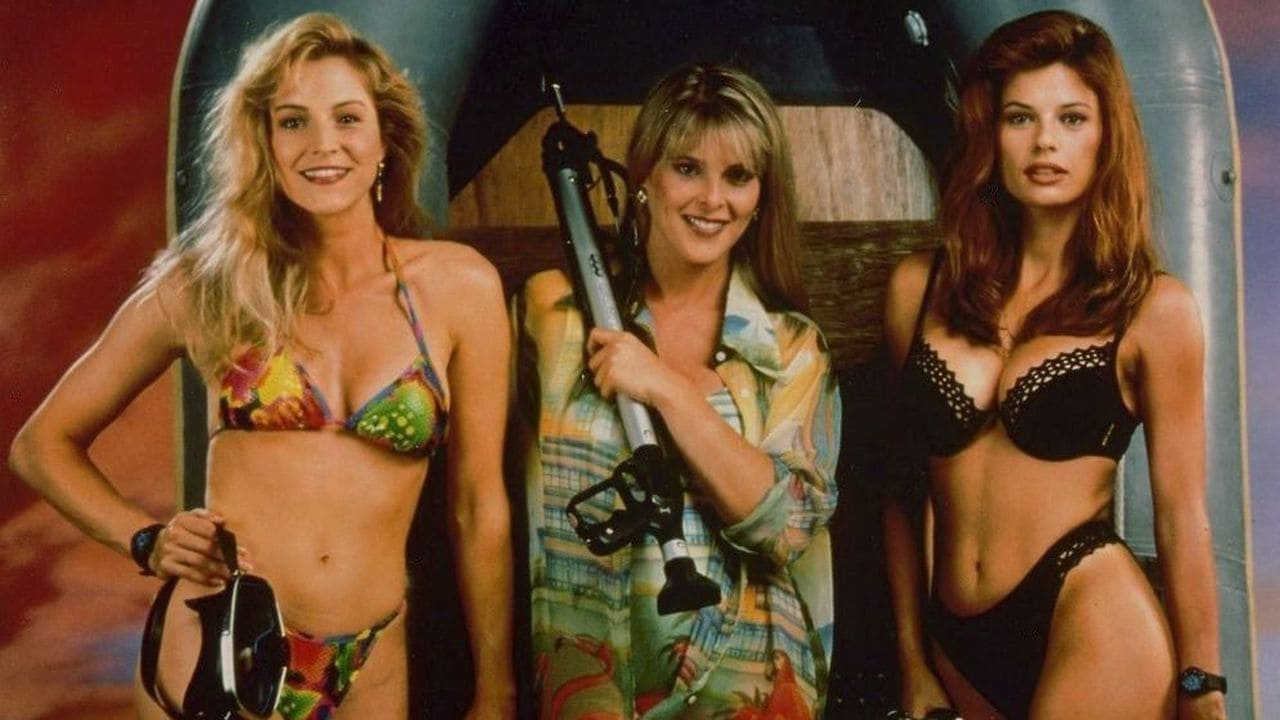
Acapulco HEAT was credited as created by the Kellers but the lion’s share of the scripting work on its first season was done by the trio of Daniel Fica, Molly Glenmore, and Steve Hayes. The HEAT of the title stood for Hemisphere Emergency Action Team, recruited by shadowy international agency C5 to fight terrorism and other cross-border crimes. Led by ex-CIA man Mike Savage (Irish actor Brendan Kelly) and MI6 agent Ashley Hunter-Cuddington (Dynasty‘s Catherine Oxenberry), the team receive their orders by videolink from the mysterious Mr Smith (Animal House‘s Dean Wormer, John Vernon) and operates out of an old Mayan temple. To undertake their missions in secret, the squad – which also includes French former cat burglar Cat Avery Pascal (ex-Playboy Playmate Alison Armitage), martial arts expert Tommy Chase (Michael Worth), ex-Navy SEAL Brett Richardson (Spencer Rochfort), computer genius Krissy Valentine (Holly Floria), and Mexican cop Marcos Chavez (Randy Vasquez) – posed as fashion models and photographers, living in a hotel whose owner was played by actual model (and seagull magnet) Fabio.
Debuting in syndication in September 1993, the HEAT team took down all manner of threats to international safety across twenty-two episodes, including assassins, nuclear blackmailers, white slavers, and drug lords. A second season was planned but the Kellers had trouble selling it into syndication and production was delayed until 1996, when another twenty-six episodes were produced, intended mostly for the international market. Only Armitage and Worth returned, joined by French model and actress Lydie Denier as former French spy Nicole Bernard, and American model and actress Christie Sauls as her computer expert protégé Joanna Barnes, this time as agents for hire. There was no third season, and the Kellers moved on to Conan the Adventurer, another co-production with Balenciaga, which ran for a single season in syndication from September 1997.
Dead at 21 (MTV): That MTV – Music Television – did not show music anymore became a popular trope towards the end of the twentieth century and, as with most of these things, there was a ring of truth to it. Between 1995 and 200, the station showed a third less music videos as the novelty of wall-to-wall video access wore off. Reality shows such as The Real World and Road Rules had joined game shows like Remote Control, Idiot Savants, and Singled Out, and animated shows including Liquid Television, Beavis and Butthead, and Æon Flux turned the network into a one-stop shop for cool tweens, teens, and twentysomethings. One area MTV was slow to move into, though, was scripted drama. Their core demographic was rarely a priority for the other networks, too, with failed experiments like TV 101 and The Outsiders offset against the occasional success story like 21 Jump Street.
All that changed in 1994 with the debut of Dead at 21 in July, although the network had begun showing the second season of Canadian band drama Catwalk in March, the first having been aired in syndication. Dead at 21 was created by Jon Sherman, a young writer who had been working on the Paramount lot while waiting for his big break. Through an agent friend, he got a meeting with MTV’s Tom Campbell, who listened to all his ideas and told him to go away and come back with more. Sherman would later say that he was too naïve to realise that the emphasis was on the first part of that statement and instead concentrated on the second, trying to work out what he could bring to the network that was different to what they already had.
Inspired by a recent viewing of The Prisoner and by an article he read about the amount of the brain the average human uses, Sherman developed an action adventure drama, something MTV had never so much as touched before, centred on Ed Bellamy, a young man who discovers on his twentieth birthday that he has been the subject of a government experiment to harness that unused brain power through a microchip implant that has made him a genius, but that the implant has a shelf life that will kill him on his twenty-first birthday. Determined to find a way to survive beyond that date, Ed enlists the help of a girl he just met named Maria but is forced to go on the run as the government order the termination of the experiment and anyone involved in it.
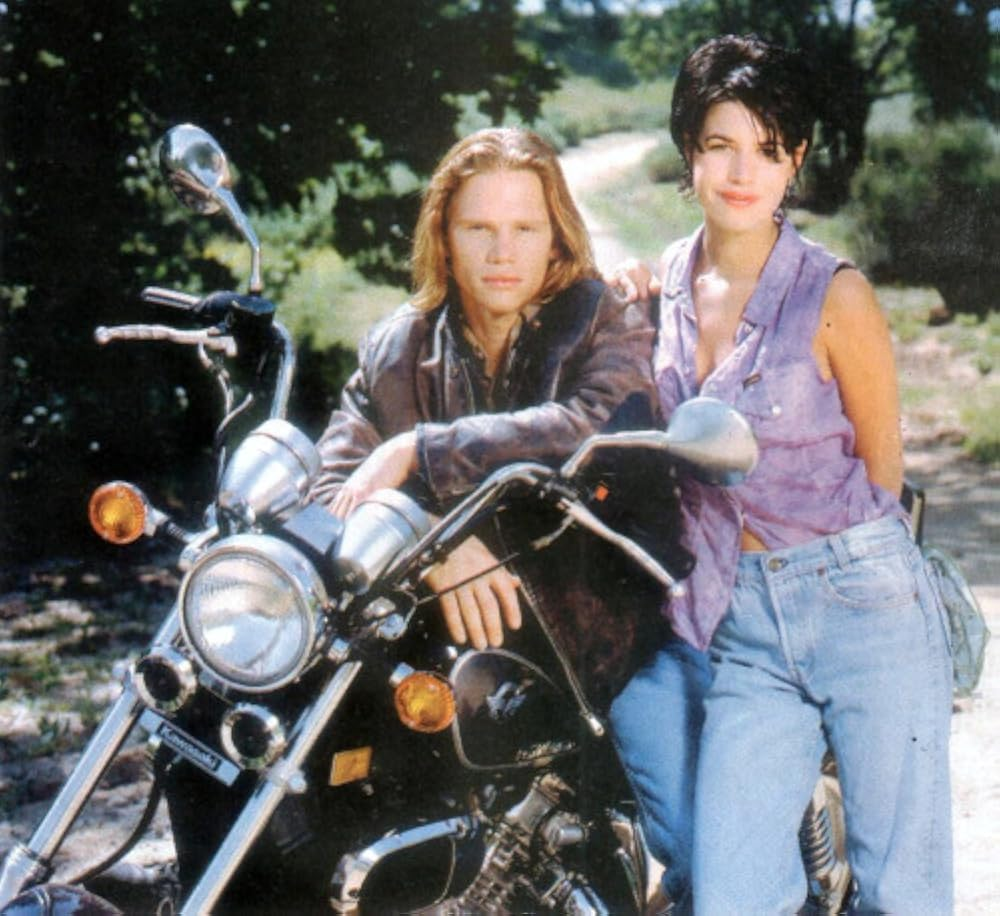
Other influences, such as the work of William Gibson and Sherman’s adolescent love for Dungeons & Dragons plated into the script, which Sherman delivered to his agent, but then – against her advice – took a job on a new PBS show, Bill Nye the Science Guy, relocating to Seattle to do so. While he was working on Bill Nye, his script was given a polish by Beauty and the Beast and Doogie Howser, MD writer PK Simonds and met with Campbell’s approval, necessitating a call to Seattle and a demand Sherman quit his PBS job and return to LA.
Jack Noseworthy from CBS sitcom Teech (and one of the kids in survival horror Alive) was cast as Ed, with Lisa Dean Ryan – who played Doogie Howser’s girlfriend Wanda for three years – signing on to play Maria, a girl who crashes Ed’s birthday party in the pilot. Another party crasher was Dan (Adam Scott in an early role), a fellow cybernaut who warns Ed of the oncoming danger, and that the government has sent Agent Winston (Whip Hubley from Top Gun, Russkies and Life Goes On) to take him out. Winston ends up killing Dan and the government pin his murder on Ed, leading to he and Maria fleeing for their lives as everything crashes around them.
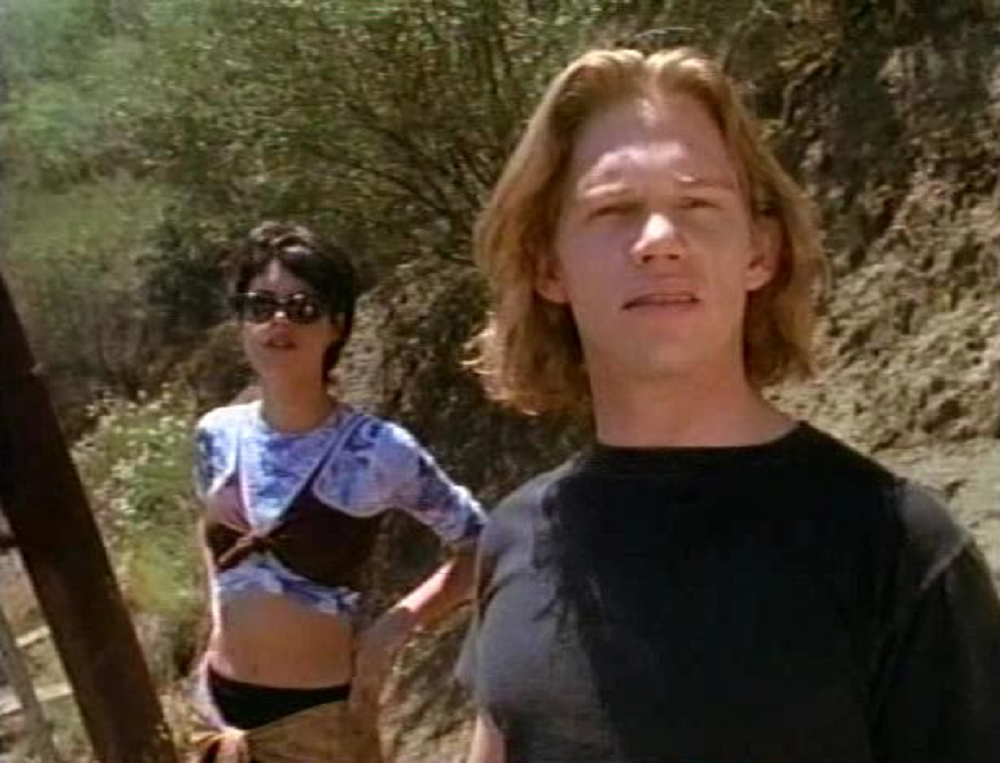
Rod Taylor, who had just finished two seasons on Super Force with his adult son Bruce, was brought in as showrunner, and his main task seemed to be ensuring that each show contained a sufficient amount of action and chase scenes that could be soundtracked by songs popular with MTV’s core audience. Among those featured on the soundtrack were Alice in Chains, Metallica, Nirvana, Radiohead, Sonic Youth, and Stone Temple Pilots. The action tacked through to a finale that saw Ed and Maria track down Dr Heisenberg, the man who created the “sib” program that Ed was part of, only to discover he was an imposter determined to make use of the virtual reality technology the implants allowed access to. As the episode came to an end, Maria was apparently killed, Winston realised he was working for the wrong side, and Ed and two other subjects were dying, their time up, only to get a glimpse of the real Dr Heidenberg and his daughter in the virtual reality cyberspace…
By this point, Sherman – who was part of a writing team that also included Simonds and Dr Giggles co-writer Manny Coto – had been largely sidelined by the Taylors, and the show would have continued without him if it had been renewed, his agent having found him a regular gig as story editor on Margaret Cho’s All-American Girl. As it was, the show was left to die – not at twenty-one, but after thirteen episodes – and has largely been forgotten, despite its place in MTV history. It would be five years before the network dipped its toe into the scripted drama pool again with Roland Joffé’s Undressed.
After All-American Girl, Sherman was hired as a producer on the first season of Sabrina, the Teenage Witch, and then did the same job of The Naked Truth and Encore, Encore, scripting a number of episodes for each show. His big break came when he was hired as a producer on Frasier in 1999, rising to executive producer two years later, a position he held through the end of the show in 2004, and has continued to work steadily since, notably on Royal Pains and American Princess.
Next time on The Telephemera Years: 1993’s unsold pilots, deerstalkered detectives and more cleavage than you can shake a stick at!
Check out our other Telephemera articles:
The Telephemera Years: pre-1965 (part 1, 2, 3, 4)
The Telephemera Years: 1965 (part 1, 2, 3, 4)
The Telephemera Years: 1966 (part 1, 2, 3, 4)
The Telephemera Years: 1967 (part 1, 2, 3, 4)
The Telephemera Years: 1968 (part 1, 2, 3, 4)
The Telephemera Years: 1969 (part 1, 2, 3, 4)
The Telephemera Years: 1970 (part 1, 2, 3, 4)
The Telephemera Years: 1971 (part 1, 2, 3, 4)
The Telephemera Years: 1972 (part 1, 2, 3, 4)
The Telephemera Years: 1973 (part 1, 2, 3, 4)
The Telephemera Years: 1974 (part 1, 2, 3, 4, 5)
The Telephemera Years: 1975 (part 1, 2, 3, 4)
The Telephemera Years: 1976 (part 1, 2, 3, 4)
The Telephemera Years: 1977 (part 1, 2, 3, 4)
The Telephemera Years: 1978 (part 1, 2, 3, 4)
The Telephemera Years: 1979 (part 1, 2, 3, 4, 5, 6)
The Telephemera Years: 1980 (part 1, 2, 3, 4)
The Telephemera Years: 1981 (part 1, 2, 3, 4)
The Telephemera Years: 1982 (part 1, 2, 3, 4)
The Telephemera Years: 1983 (part 1, 2, 3, 4)
The Telephemera Years: 1984 (part 1, 2, 3, 4)
The Telephemera years: 1985 (part 1, 2, 3, 4)
The Telephemera Years: 1986 (part 1, 2, 3, 4)
The Telephemera Years: 1987 (part 1, 2, 3, 4)
The Telephemera Years: 1988 (part 1, 2, 3, 4, 5)
The Telephemera Years: 1989 (part 1, 2, 3, 4)
The Telephemera Years: 1990 (part 1, 2, 3, 4)
The Telephemera Years: 1991 (part 1, 2, 3, 4)
The Telephemera Years: 1992 (part 1, 2, 3, 4)
The Telephemera Years: 1993 (part 1)
The Telephemera Years: 1994 (part 1, 2, 3, 4)
The Telephemera Years: 1995 (part 1, 2, 3, 4)
The Telephemera Years: 1996 (part 1, 2, 3, 4)
The Telephemera Years: 1997 (part 1, 2, 3, 4)
The Telephemera Years: 1998 (part 1, 2, 3, 4)
The Telephemera Years: 1999 (part 1, 2, 3, 4)
The Telephemera Years: 2000 (part 1, 2, 3, 4)
The Telephemera Years: 2001 (part 1, 2, 3, 4)
The Telephemera Years: 2002 (part 1, 2, 3, 4)
The Telephemera Years: 2003 (part 1, 2, 3, 4)
The Telephemera Years: 2004 (part 1, 2, 3, 4)
The Telephemera Years: 2005 (part 1, 2, 3, 4)
The Telephemera Years: 2006 (part 1, 2, 3, 4)
The Telephemera Years: 2007 (part 1, 2, 3, 4)
The Telephemera Years: 2008 (part 1, 2, 3, 4)
The Telephemera Years: O Canada! (part 1, 2, 3, 4)
Titans of Telephemera: Irwin Allen
Titans of Telephemera: Stephen J Cannell (part 1, 2, 3, 4)
Titans of Telephemera: DIC (part 1, 2)
Titans of Telephemera: Filmation (part 1, 2)
Titans of Telephemera: Hanna-Barbera (part 1, 2, 3, 4, 5)
Titans of Telephemera: Kenneth Johnson
Titans of Telephemera: Sid & Marty Krofft
Titans of Telephemera: Glen A Larson (part 1, 2, 3, 4)
Titans of Telephemera: Quinn Martin (part 1, 2)
Titans of Telephemera: Rankin/Bass
Titans of Telephemera: Ruby-Spears