Ah, telephemera… those shows whose stay with us was tantalisingly brief, snatched away before their time, and sometimes with good cause. They hit the schedules alongside established shows, hoping for a long run, but it’s not always to be, and for every Street Hawk there’s two Manimals. But here at STARBURST we celebrate their existence and mourn their departure, drilling down into the new season’s entertainment with equal opportunities square eyes… these are The Telephemera Years!
1993-94
The top ten shows at the end of the 1993-94 season looked very similar to those from 1992-93, with 60 Minutes retaining top spot for CBS, and top five placings for ABC’s Home Improvement and Roseanne. Coach, Monday Night Football, Murphy Brown, and the CBS Sunday Night Movie all kept their top ten slots, and there was an enforced change as US viewers had to get used to life without Cheers. The big new hit was Seinfeld, now in its fifth season and finally becoming the show about nothing that said everything to US audiences, forming a solid sitcom quartet with Mad About You, Wings, and new arrival Frasier, a Cheers spin-off, that commanded Thursday nights for the peacock network.
Elsewhere, David Letterman moved from NBC to CBS and The X-Files arrived on Fox, southern belle Brett Butler gave ABC a new hit in Grace Under Fire, and there was plenty of new genre fodder with Los & Clark: The New Adventures of Superman, seaQuest DSV, Duckman, and Weird Science all beginning their runs to more than make up for the loss of Star Trek: The Next Generation. But those were all shows that people watched and remember (mostly) fondly; what about the ones that didn’t outstay their welcome? This is the story of four of 1993’s less-celebrated entries into the TV annals…
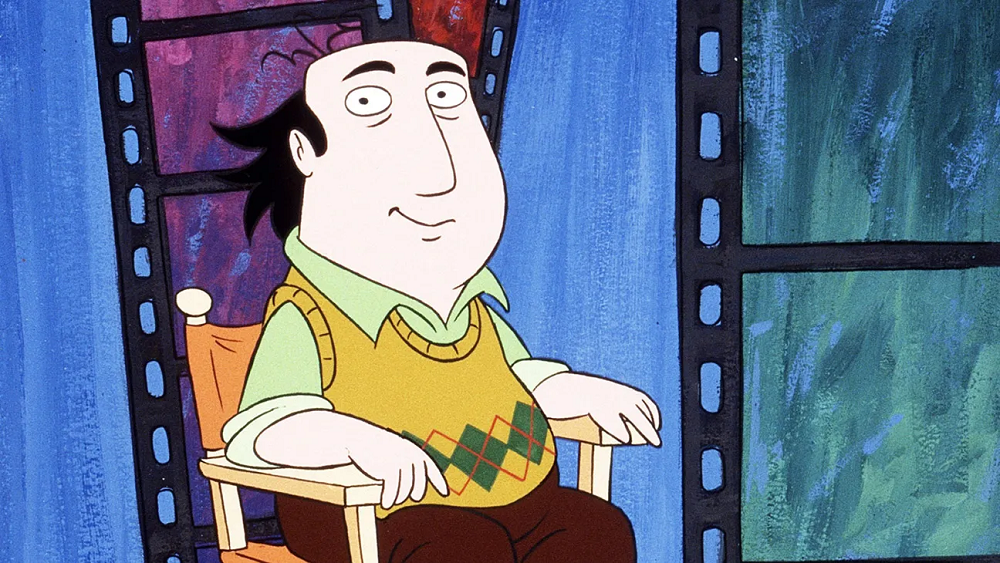
The Critic (ABC): Al Jean and Mike Reiss met at Harvard University, forming a wicked writing partnership with contributions to the Harvard Lampoon, leading to the pair being hired by the National Lampoon after graduation in 1981. As well as doing some joke writing for Airplane II: The Sequel, the duo began dabbling in writing for TV on the side, selling scripts to the TV version of 9 to 5 and the first season of eventual TV juggernaut Charles in Charge. Their first regular gig came as part of the writing team on HBO’s satirical sketch show Not Necessarily the News, with an engagement as joke writers for The Tonight Show starring Johnny Carson following soon after. Further sitcom work on Sledge Hammer!, ALF, and It’s Garry Shandling’s Show followed, and in 1989 they were hired as two of the first members of the writing team for The Simpsons, an animated spin-off from short segments on The Tracy Ullman Show that, it says here, became quite popular.
Jean and Reiss took over showrunner responsibilities on The Simpsons with season three, but after completing two seasons in the position, they were hired by the show’s production company Gracie Films to come up with ideas for new shows that Simpsons producer (and Gracie founder) James L Brooks could pitch to ABC. They had been asked previously by The Simpsons creator Matt Groening to develop a spin-off show for Krusty the Clown, imagining him as a single father living in New York who has an antagonistic relationship with his make-up lady and an eccentric boss based on CNN chief Ted Turner. Groening turned down the idea in favour of a live-action show starring Krusty’s voice actor Dan Castellaneta that ultimately went nowhere, but when Brooks suggested a show about a make-up lady on the Today Show, Jean and Reiss filled out the cast with other characters from that TV ecosphere and found they had more fun writing another cast member than the make-up lady, re-tooling their Krusty idea to centre on a TV film critic who faces a constant battle to keep his show on the air.
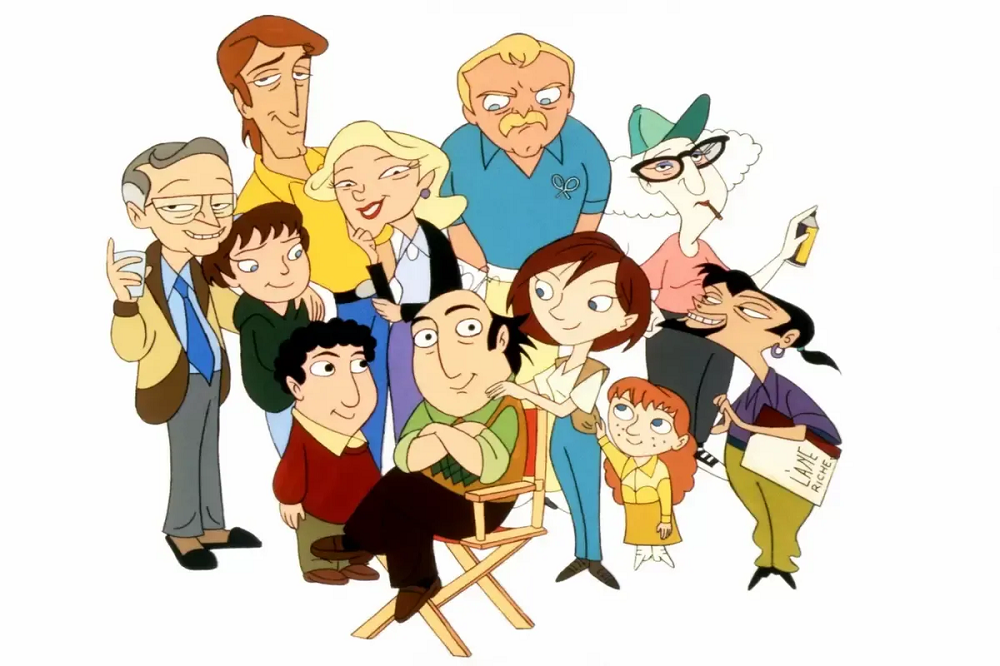
After working with him on several episodes of The Simpsons, Jean and Reiss based their lead character on Jon Lovitz and approached him with a view to taking the role. Lovitz turned them down; in the wake of A League of Their Own, he was busy making three movies and could not commit to a regular filming schedule. Brooks suggested Martin Short as a replacement, but Jean and Reiss were adamant it had to be Lovitz, realising that if the show was animated rather than live-action, the actor could probably fit it into his schedule. They were right and Lovitz signed on to play Jay Sherman.
Once the show’s star was in place, Brooks took the show to ABC. In an interview with Cracked magazine, Reiss claims that Brooks had a deal where ABC could basically not say no to a twenty-two-episode run for any show he pitched, and yet they found a way to do just that. Negotiations pared the run down to just thirteen episodes and the rest of the cast were put in place, with Christine Cavanaugh as Jay’s slacker son Marty, Nancy Cartwright as Margo (using her natural voice as the biological daughter of Jay’s adoptive parents), Simpsons script supervisor Doris Grau as acerbic make-up lady Doris (a part especially written for her), and Charles Napier as boss Duke Phillips. Character designs were produced by Family Dog‘s David Cutler, Duckman creator Everett Peck, and Rich Moore and David Silverman from The Simpsons. Alongside Jean and Reiss, the writing team included a young Judd Apatow, In Living Color’s Steve Tompkins, and Late Night with David Letterman and Garry Shandling alums Tom Gammill and Max Pross. Greg the Bunny creator Steven Levitan, former Tonight Show joke writer Patric M Verrone, and former Simpsons scribe Jon Vitti were also on board, with former Letterman staffer Ken Keeler keeping things consistent as story editor.
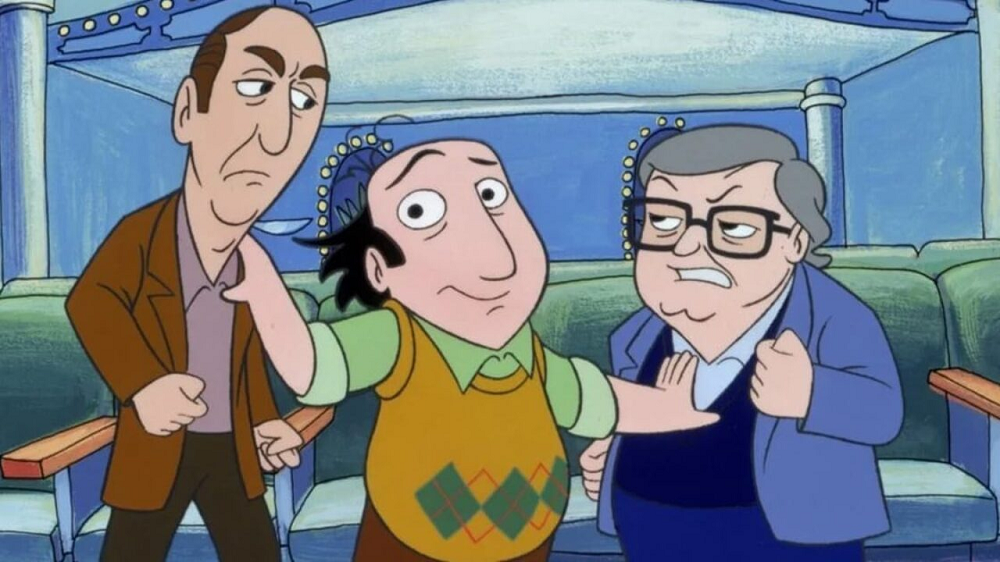
The Critic debuted on ABC on January 26th 1994 as a mid-season replacement in a tricky Wednesday night slot for the network. With top five shows Home Improvement and Grace Under Fire in the 8pm to 9pm slot, a good lead-in was vital, but Joe’s Life and George (starring George Foreman) had already been and gone by the time The Critic was given its chance. Among its guest stars were movie critics Gene Siskel and Roger Ebert, the only TV show they guest appeared in together, and The Critic was famously the only TV show they ever reviewed. Some sources describe The Critic as the first major non-family show animated sitcom to air in prime time, which quite frankly ignores a whole host of early prime-time cartoons before you even get to Top Cat (and Capitol Critters, which debuted on ABC two years earlier), but it was an unusual addition to the schedules, even with the pedigree that Brooks, Jean, and Reiss brought to it.
The show posted a decent 15.5 rating for its premiere and reviews were great, but hate mail began to pour into the studio from those who tuned in early for Home Improvement and hated the show. Numbers gena to fall, dipping below 7.0 by episode five, and although things picked up the following week once the Winter Olympics had finished on NBC, the decision was made to put the show in hiatus. Its replacement, ABC’s fourth attempt at finding something that would stick, and the Ed Asner-starring Thunder Alley finally earned some decent ratings in that slot for the alphabet network. The balance of season one’s thirteen episodes was burned off in June and July, but Brooks convinced Fox – home of The Simpsons – to pick The Critic up for a second season, selling them on a premiere episode that would cross over with the network’s top-rated show and sweetening the deal by promising Jean and Reiss would write two episodes of their former show.
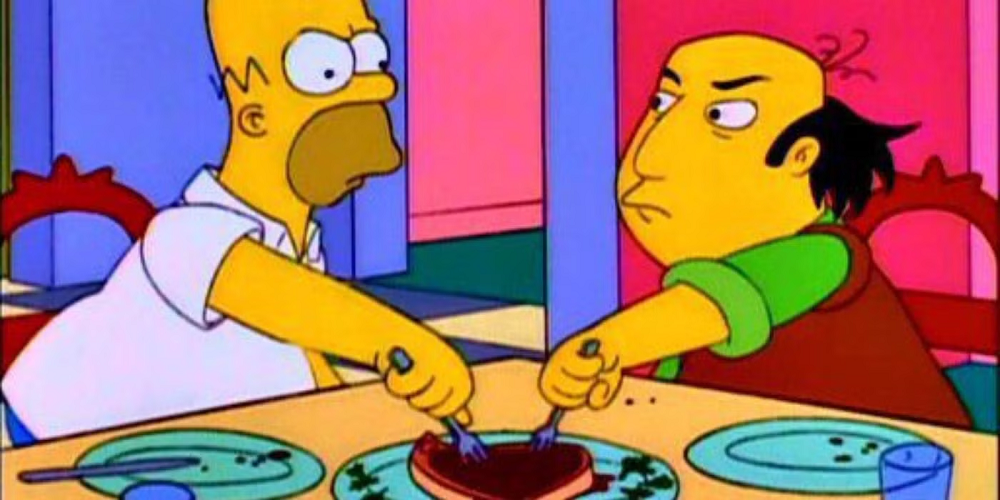
Season two of The Critic began on March 5th 1995 with the second part of that crossover with The Simpsons, which would act as its lead-in going forward. Groening was famously unimpressed with the crossover, which saw Sherman invited to judge a film festival instigated after Springfield is called “America’s worst city,” requesting his name be removed from the episode and calling it little more than a thirty-minute commercial for another show. Brooks hit back, pointing out that Groening was very happy to receive credit for other episodes of the show written and produced by Jean and Reiss, but Jean and Reiss themselves were stung by the criticism. The gambit paid off and the premiere scored an 8.4 rating, just half a point lower than its lead-in. Ratings did fall but remained respectable for a Fox show and work began on a third season, with nine scripts completed, but there was a change of management at Fox, with Sandy Grushow – who’d taken the network to seven days a week – departing in September 1995.
According to Reiss’s memoir of his time in television, 2018’s Springfield Confidential, Grushow’s replacement John Matoian hated The Critic and would call the creators after every show to let them know just how much he despised that week’s episode. Matoian dragged his feet, refusing to commit either way to renewing or cancelling the show, but eventually replaced it in the schedules with one of his own pet projects, House of Buggin’, leaving soon after to become President of HBO. UPN, which had launched in January 1995, were interested in taking The Critic but wanted to refocus the show on Marty and his school life, something Jean and Reiss were unwilling to do.
As The Critic was coming to an end, Jean and Reiss signed a three-year deal with Disney to develop shows for ABC but the only one that made the air – 1997’s Teen Angel – was cancelled seventeen episodes into its run. They returned to work on The Simpsons but amicably dissolved their partnership, although they reunited in 2000 when Brooks asked them to create more episodes of The Critic for the internet. The ten three-minute webisodes were available on AtomFilms.com and Shockwave.com, and one – “Cast Away: The Legend of Bagger Vance” – allowed viewers to choose from two endings. The webisodes were later included on a DVD of the complete series.
Jean continued to write for Homer and company, and the pair co-wrote The Simpsons Movie together in 2007. Reiss acted as a consultant on The Simpsons and created Queer Duck, initially for Icebox.com and then for Showtime, as well as writing the screenplays for movies including Ice Age: Dawn of the Dinosaurs, Rio, and critics’ favourite, My Life in Ruins, but is now semi-retired. In March 2025, Jon Lovitz began an internet campaign calling for the show’s return, posting on X that he’d been trying for years to bring the show back and claiming Al Jean was now on board. As of this writing, Jay Sherman remains retired and, frankly, it stinks.
Viper (NBC): At first glance, it might seem that Knight Rider, which ran for four seasons on NBC from 1982, and Viper, a mid-season replacement on the network in January 1994, bear some similarities. In Knight Rider, David Hasselhoff played police detective Michael Arthur Long, near-fatally injured and given a new face and new identity as Michael Knight, working for the Foundation for Law and Government as its chief operative, driving a technologically enhanced Pontiac Firebird Trans Am known as Knight Industries Two Thousand, or KITT. In Viper, James McCaffrey played getaway driver Michael Payton, near-fatally injured and given new memories and a new identity as Joe Astor, working for the Viper Project as its top driver, the only one who can handle a technologically enhanced Dodge Viper RT/10 Roadster known as The Defender. One important difference, though, is that Viper was cancelled once before it aired, only to be given a reprieve because of the involvement of a major sponsor…
Viper was created by Danny Bilson and Paul DiMeo, who’d moved into TV to oversee the transfer of another comic book character, DC Comics’ The Flash, to CBS in 1990, doing the same thing for another DC character, Human Target, a year later on ABC. Both shows lasted just one season, with Human Target burned off during the Summer months, and they were looking for a follow-up project when Paramount Network Television engaged them to create a show that featured a Dodge Viper, part of a deal the studio had struck with the Chrysler corporation, with the show already sold to CBS for a Fall 1993 debut.
James McCaffrey, with just a handful of credits to his name, was cast in the lead role as Joe Astor, with Joe Nipote (whose biggest credit prior to the show was in sex comedy Meatballs II) as sidekick Franklin Waters. Capital News‘s William Russ played the big bad, Mr Townsend, the head of a crime group known only as The Outfit who have laid siege to the near-future Metro City, sparking the creation of the Viper Project, with the temperamental car souped up by wheelchair-bound genius Julian Wilkes (Dorian Harewood).
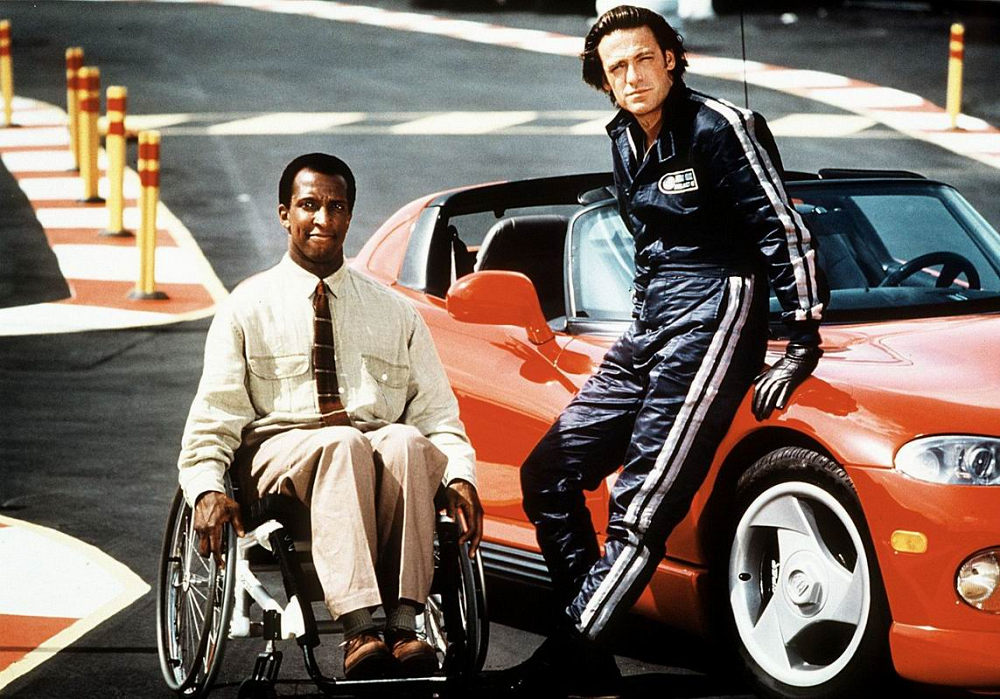
Just as filming was about to get underway in the Los Angeles area in early 1993, it was discovered that Stephen J Cannell was planning to call his new show Viper, in which Michael Dudikoff would play Robert “Scandal” Jackson, a former NAVY Seal gone AWOL who is near-fatally-injured and given a new face and a new chance at life, working for an undercover anti-crime agency as its chief operative, driving an AC Cobra that is, well, just a normal AC Cobra. Chrysler launched a lawsuit, leading to a delay in production on the Bilson and DiMeo show, with the outcome being that Cannell was forced to change the name of his show – and its fictional agency – to Cobra. Viper then hit another hiccup when CBS bosses declared the show too violent to air and cancelled it before a single episode had even been formally scheduled.
Production continued due to Chrysler’s backing – the company supplied fourteen custom Dodge Vipers for the show – and NBC picked it up as a mid-season replacement on Friday nights, replacing the cancelled Against the Grain which starred a pre-fame Ben Affleck. The show debuted, though, with a feature length pilot as an NBC Sunday Night Movie on January 2nd 1994, garnering a decent 15.3 rating, but once on Friday it began haemorrhaging viewers, eventually averaging a little over seven points. This time, even with Chrysler’s involvement, NBC decided to cancel the show, although there was no chance to tie the story up with any kind of resolution, especially the internal conflict between Astor and his memories as Michael Payton.
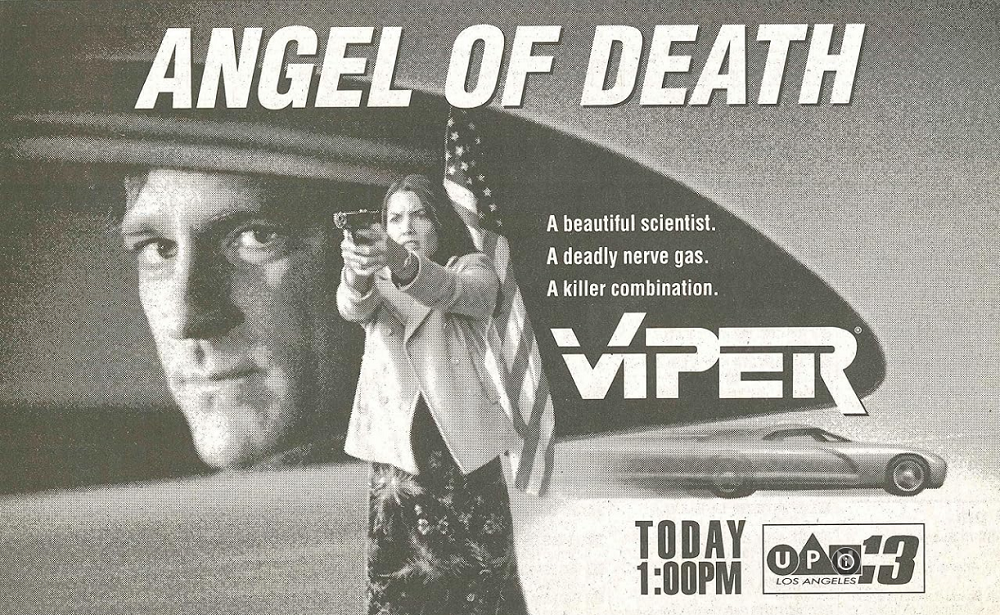
Chrysler and Paramount were determined to continue the show in some form and retooled it for the syndication market, using Paramount’s syndication unit as a distributor and the newly launched UPN network as a placeholder in markets where they could not sell the show to another channel. With Astor’s absence explained by his reassignment to deep undercover duties overseas, Jeff Kaake (from maverick cop drama Nasty Boys) was brought in as CIA man (and ace driver) Thomas Cole, heading up the resurrected Viper Project to combat the threat of a group of renegade ex-commandos led by Tim Thomerson’s Colonel Hanson Dekker. With mechanic Waters providing a soupçon of continuity, Cole was partnered with Metro City cop Cameron Westlake (Heather Medway, the future Mrs Danny Bilson) and aided by tech specialist Allie Farrow (newcomer Dawn Stern) in his new mission.
Season two – season one is now referred to by fans as “The Classic NBC Season” – debuted in September 1996 and did well enough that a third season, with multiple antagonists but no Dawn Stern – began a year later. In the season three finale, scripted by Danny Bilson’s father Bruce, the Viper Project is closed down, the Defender destroyed to keep it out of enemy hands, and Cole is reassigned to, yes, undercover work overseas.
Fans could have been forgiven for thinking that it was finally the end for Viper after several false finishes, but season four duly appeared in September 1997, this time with James McCaffrey back as Joe Astor, recalled from Europe to combat a crime wave that has arisen in the wake of the Viper Project’s dissolution. Working alongside Westlake, and with Dorian Harewood also back as Julian Wilkes, this time Astor drives a 1996 Cobalt Blue Metallic Dodge Viper GTS Coupe, tricked out to the same specifications as the original Defender. This time the story did come to a conclusion at the end of the season, neatly tying up not only the story of the Viper Project in all its incarnations, but also giving some kind of closure to the Joe Astor/Michael Payton conflict. By that point, Bilson and DiMeo were show running their next project, The Sentinel, for UPN, after which they would move seamlessly into videogames, working as creative executives for Electronic Arts and, later, THQ.
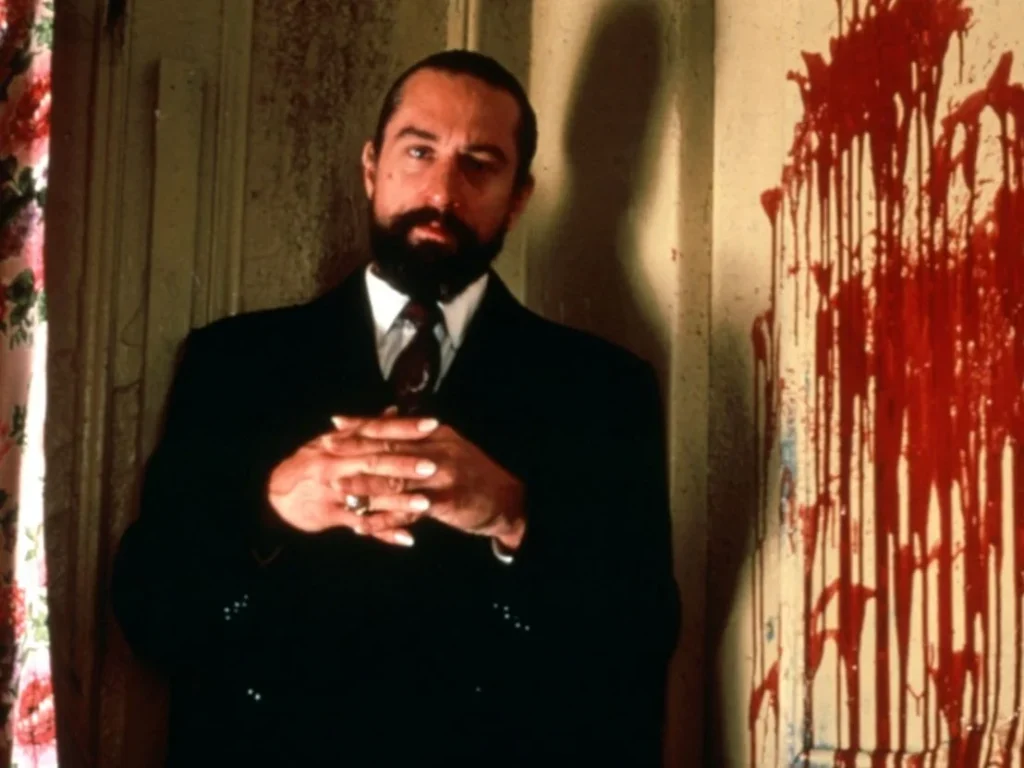
Fallen Angels (Showtime): William Horberg moved to Hollywood in 1986 with one intention: make movies based on the noir detective stories he’d secured the rights to back in Chicago. Still in his mid-twenties, and already having run a movie theatre, formed a company to distribute short films, and become a documentary producer, he had a slate of good stories by Nelson Algren, Chester Himes, and Mickey Spillane and just needed to find the right people to adapt them. Nothing came of a proposed movie adaptation of Algren’s short story collection Neon Wilderness, but his Mickey Spillane project found a home with producer Jonathan Demme and director George Armitage, with Fred Ward attached to star. That, too, fell through, but he secured an associate producer credit on Miami Blues – produced by Demme, directed by Armitage, and starring Ward – after he sold Ward on the novel by Charles Willeford it was based on.
Horberg did manage to sell Palace Pictures on an adaptation of Chester Himes’s A Rage in Harlem, which starred Gregory Hines and Forrest Whitaker, and in 1992 he followed a colleague from Paramount to Sydney Pollack’s Mirage Enterprises. It was there that he came back around to Mickey Spillane and, working with Steve Golin – whose Propaganda Films had just completed In Bed with Madonna – he developed Fallen Angels, a neo-noir anthology adapting classic hardboiled detective stories by some of the genre’s top writers, all set in a stylised Los Angeles sometime between the end of the Second World War and the assassination of John F Kennedy.
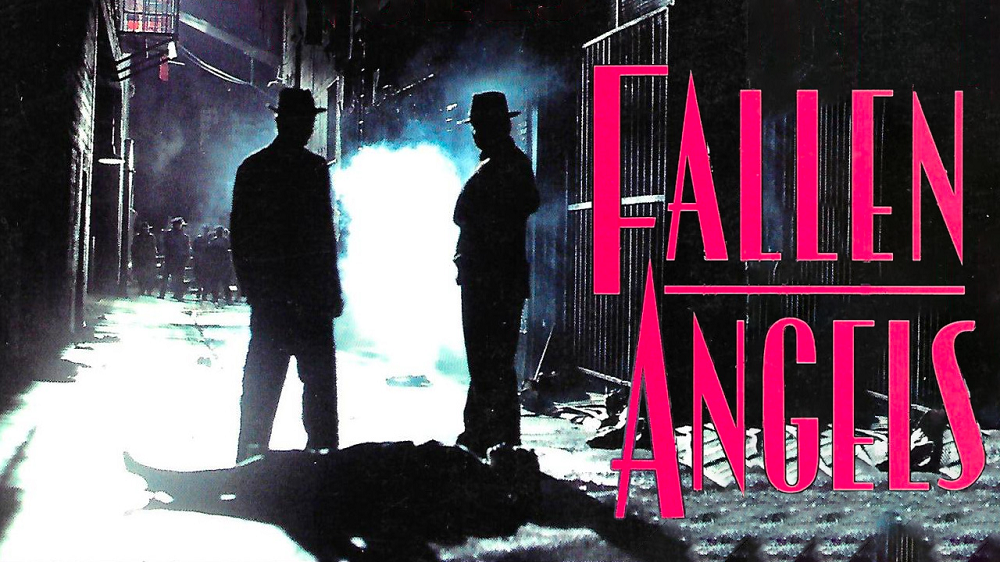
Although the Spillane stories were the catalyst for the project, none of his stories featured in the six-episode run, which found a home at Showcase for an August 1993 debut. Novelettes by William Campbell Gault, Raymond Chandler, Jonathan Craig, Jim Thompson, Cornell Woolrich, and James Ellroy were included, featuring a parade of vengeful flatfoots, recalcitrant molls, corrupt cops, and hopeless gamblers. With Pollack acting as executive producer and Propaganda’s name attached, Fallen Angels attracted some impressive talent, both behind and in front of the camera. Gary Oldman, Joe Mantegna, Isabella Rossellini, Laura Dern, Diane Lane, Gary Busey, and James Woods signed on to appear, with Rattle and Hum‘s Phil Joanou, Stephen Soderbergh, Jonathan Kaplan, first-timers Tom Hanks and Tom Cruise, and Alfonso Cuarón on his US debut completing the list of directors.
A book reprinting the stories adapted in the show and a soundtrack album – featuring torch songs by Billie Holliday and others – were released, and the run was successful enough that a second season was commissioned for 1995, this time of nine episodes. Again, the talent list was impressive, with Soderbergh, Kiefer Sutherland, Peter Bogdanovich, Michael Lehmann, Benicio del Toro, Miguel Ferrer, Darren McGavin, Christopher Lloyd, and Danny Glover all involved in adaptations of stories by Chandler, Woolrich, Dashiel Hammett, Walter Moseley, and – yes – Mickey Spillane. With a mixed reception from critics, no further series were forthcoming, although the show did enjoy some success in Europe, where it was known as Perfect Crimes.
TekWar (syndication): Killing time when filming on Star Trek V: The Final Frontier was held up by a Writer’s Guild of American strike in the Summer of 1988, William Shatner began sketching the plot of a movie that blended the science fiction of Star Trek with the police action of TJ Hooker. As the strike wore on, he wrote more and more until he had the outlines for a series of novels, the first of which – TekWar was published in October 1989. It’s now accepted that Ron Goulart, who wrote over a hundred pulp novels and film adaptations in the 1970s and 1980s, ghost-wrote the books, receiving an acknowledgment in the first for showing Shatner “the way into competing this novel.”
TekWar told the story of Jake Cardigan, a twenty-second-century cop who, as the novel opens, is framed for dealing Tek, an addictive drug that takes the form of a microchip and takes users to a dreamy, virtual reality world, of which Jake is a recovering user. Sentenced to fifteen years frozen in cryo-imprisonment, he is unfrozen after just four when Walt Bascom, the head of the Cosmos detective agency, offers him a deal: he’ll prove Jake’s innocence if he agrees to work for him, solving crimes related to Tek. Partnered with good-natured Sid Gomez, Jake hits the street in search of a missing scientist who may have developed an invention that could destroy the trade in Tek…
TekWar was a success and was followed by TekLords and TekLab in 1991, and Tek Vengeance and Tek Secret two years later, but Shatner had little luck selling an adaptation of the novels to movie studios, who felt that it would be too expensive to accurately replicate the twenty-second century of the books. It was with this in mind that Shatner, when approached by Marvel’s Epic Comics imprint about a comic book adaptation in 1992, insisted they set the story no more than fifty years in the future. TekWorld, written and drawn by Evan Skolnick and Lee Sullivan from Shatner’s original stories, was published in September 1992 and would eventually run for twenty-four issues before becoming a victim of Marvel’s financial woes in the mid-1990s.

The comic book adaptation caught the eye of Atlantis Films, who made a deal with Shatner’s own production company Lemli Productions to create a TekWar TV show. Stephen Roloff, who done similar work on Friday the 13th: the Series, Maniac Mansion, and Beyond Reality, was given the responsibility of translating the world of the books to a television budget, and his pitch book ensured that Atlantis struck a deal with Universal for a series of four TV movies. The deal almost hit a hiccup when Universal insisted Shatner’s name be added to the title, with Shatner concerned that if the series was a failure he would bear the brunt of any criticism, but he eventually acquiesced and TekWar: The Movie premiered in syndication as part of Universal’s Action Pack series on January 17th 1994.
Greg Evigan, who made his name on Broadway before starring in BJ and the Bear on NBC between 1979 and 1981, was cast as Jake Cardigan, with former NFL draftee Eugene Clark his beat partner at Cosmos. Tori Higginson added some glamour as Beth Kittridge, an android replicant who shares the memories of the original Beth, the only witness to the murder of Jake’s original partner, while Catherine N Blythe played Walter Bascom’s indispensable assistant Centra, and Shatner himself signed on to play Bascom. Shatner also directed the first movie, which guest-starred Sheena Easton as WarBride, an old flame of Cardigan’s. It followed the plot of the original novel, with the three subsequent films – in February, March, and May 1994 – adapting books two to four in the series.
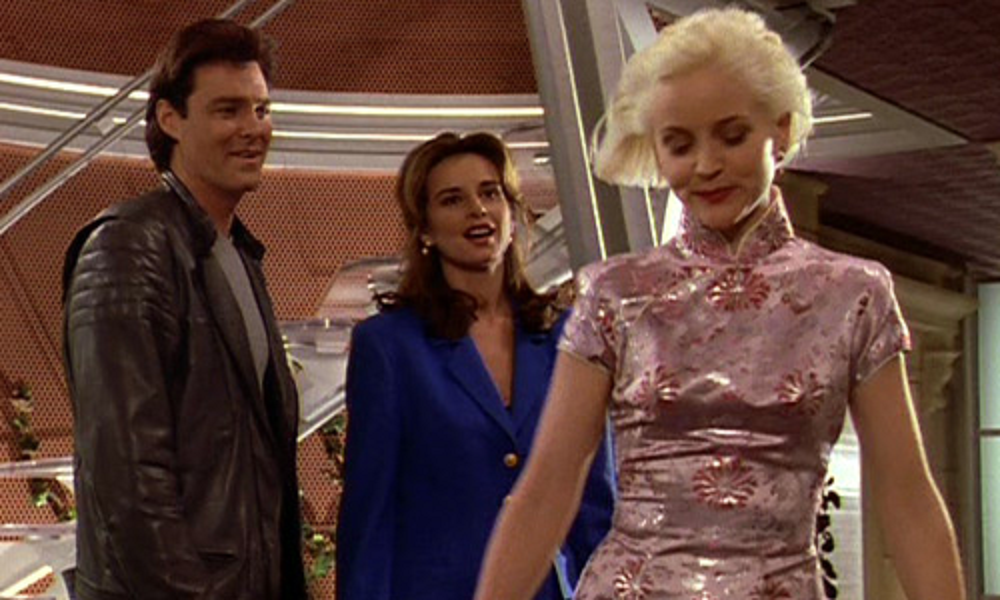
Although they received average reviews from the critics, the TV movies were very successful in their syndicated markets, with some channels reporting up to a 44% increase in viewers on previous shows in that timeslot. It was especially popular in Canada, where it aired on CTV, and that network partnered with Universal to commission a series of eighteen, hour-long episodes from Atlantis for a December 1994 debut in Canada, a month after the publication of the sixth novel in the series, Tek Power. In the US, where Universal sold the show to the USA Network, season two of TekWar premiered on January 16th 1995 with an original story that detailed a tech-mogul’s plan to put the addictive element found in Tek into his music players.
The main cast remained the same for the ongoing series, although Catherine Blythe departed, to be replaced by Natalie Radford as Nina, and Maria Del Mar arrived as Sam Houston, a new, sexier partner for Jake. The season premiere scored the highest rating for a debut on basic cable and as the series went on, the world of 2044 – the TV show keeping the comic books’ fifty-year gap – was further explored. Shatner again directed the first episode (and the season finale), but ratings declined after the premiere, particularly in the US where the USA Network made the decision to cancel the show in July 1995 after fourteen episodes had aired. Due to an unusual simulcast agreement, CTV also pulled the show from the schedule, with the final four episodes left unaired.
Sci-Fi picked the show up for re-runs, beginning a complete series repeat in late 1995, just as the seventh novel in the series – TekMoney – was published, eventually airing the four unseen episodes in January 1996. CTV took the opportunity to air those episodes, too, meaning that both sides of the border enjoyed the finish of the season as it should have been in February 1996. Two more novels appeared following the finish of the TV show – TekKill in October 1996 and TekNet a year later – and there was an announcement of the development of an animated TV reboot in 2021 from Pure Imagination Studios, which would allow viewers to interact with the story, but nothing has been heard since.
Next time on The Telephemera Years: more of the 1993-94 season’s passing fads, including tennis prodigies and Harvard-educated bounty hunters…
Check out our other Telephemera articles:
The Telephemera Years: pre-1965 (part 1, 2, 3, 4)
The Telephemera Years: 1965 (part 1, 2, 3, 4)
The Telephemera Years: 1966 (part 1, 2, 3, 4)
The Telephemera Years: 1967 (part 1, 2, 3, 4)
The Telephemera Years: 1968 (part 1, 2, 3, 4)
The Telephemera Years: 1969 (part 1, 2, 3, 4)
The Telephemera Years: 1970 (part 1, 2, 3, 4)
The Telephemera Years: 1971 (part 1, 2, 3, 4)
The Telephemera Years: 1972 (part 1, 2, 3, 4)
The Telephemera Years: 1973 (part 1, 2, 3, 4)
The Telephemera Years: 1974 (part 1, 2, 3, 4, 5)
The Telephemera Years: 1975 (part 1, 2, 3, 4)
The Telephemera Years: 1976 (part 1, 2, 3, 4)
The Telephemera Years: 1977 (part 1, 2, 3, 4)
The Telephemera Years: 1978 (part 1, 2, 3, 4)
The Telephemera Years: 1979 (part 1, 2, 3, 4, 5, 6)
The Telephemera Years: 1980 (part 1, 2, 3, 4)
The Telephemera Years: 1981 (part 1, 2, 3, 4)
The Telephemera Years: 1982 (part 1, 2, 3, 4)
The Telephemera Years: 1983 (part 1, 2, 3, 4)
The Telephemera Years: 1984 (part 1, 2, 3, 4)
The Telephemera years: 1985 (part 1, 2, 3, 4)
The Telephemera Years: 1986 (part 1, 2, 3, 4)
The Telephemera Years: 1987 (part 1, 2, 3, 4)
The Telephemera Years: 1988 (part 1, 2, 3, 4, 5)
The Telephemera Years: 1989 (part 1, 2, 3, 4)
The Telephemera Years: 1990 (part 1, 2, 3, 4)
The Telephemera Years: 1991 (part 1, 2, 3, 4)
The Telephemera Years: 1992 (part 1, 2, 3, 4)
The Telephemera Years: 1994 (part 1, 2, 3, 4)
The Telephemera Years: 1995 (part 1, 2, 3, 4)
The Telephemera Years: 1996 (part 1, 2, 3, 4)
The Telephemera Years: 1997 (part 1, 2, 3, 4)
The Telephemera Years: 1998 (part 1, 2, 3, 4)
The Telephemera Years: 1999 (part 1, 2, 3, 4)
The Telephemera Years: 2000 (part 1, 2, 3, 4)
The Telephemera Years: 2001 (part 1, 2, 3, 4)
The Telephemera Years: 2002 (part 1, 2, 3, 4)
The Telephemera Years: 2003 (part 1, 2, 3, 4)
The Telephemera Years: 2004 (part 1, 2, 3, 4)
The Telephemera Years: 2005 (part 1, 2, 3, 4)
The Telephemera Years: 2006 (part 1, 2, 3, 4)
The Telephemera Years: 2007 (part 1, 2, 3, 4)
The Telephemera Years: 2008 (part 1, 2, 3, 4)
The Telephemera Years: O Canada! (part 1, 2, 3, 4)
Titans of Telephemera: Irwin Allen
Titans of Telephemera: Stephen J Cannell (part 1, 2, 3, 4)
Titans of Telephemera: DIC (part 1, 2)
Titans of Telephemera: Filmation (part 1, 2)
Titans of Telephemera: Hanna-Barbera (part 1, 2, 3, 4, 5)
Titans of Telephemera: Kenneth Johnson
Titans of Telephemera: Sid & Marty Krofft
Titans of Telephemera: Glen A Larson (part 1, 2, 3, 4)
Titans of Telephemera: Quinn Martin (part 1, 2)
Titans of Telephemera: Rankin/Bass
Titans of Telephemera: Ruby-Spears