Stuart Ashen is a British film-maker, comedian, and critic who is occasionally mistaken for Simon Pegg. Riyad Barmania is a Canadian film-maker, director and story-teller whose work includes Polybius Heist and the award-winning horror short, Another Game.
Their latest project, Turn Back, is a horror story told in reverse, inspired by local English legends. It can be found on Kickstarter here. We caught up with them to find out more…
STARBURST: How would you pitch the movie to an elderly relative?
Stuart: I suppose you’d say it’s a horror film. Have you ever seen Memento? You know how that wasn’t told in order? Well, it’s going to be a bit like that. And it’s going to have a sort of slightly folk horror, eerie, Wicker Man vibe to it as well, I suppose. Yeah, that’s probably the best way of doing it.
Riyad: I think, emotionally, I would say it’s a film that is more atmospheric. We’re not into excessive violence. There’s an atmosphere and a creepiness and a strangeness and an oddness. Even with our comedies, they are underpinned by emotion as well.
Stuart:What I love about horror is the atmosphere. Anything with a proper creepy atmosphere absolutely grabs me. I’m less interested in, you know, slasher films. You’ve had things more like Hostel, and that doesn’t really float my boat at all. This is far more about the feeling of impending dread, as opposed to extreme torture or something along those lines. We were not in it for the gore not saying there won’t necessarily be any gore, but that certainly isn’t the focus.
What horror movies have influenced you the most?
Stuart: Even if you try not to be influenced by your favourite movies, you’re always going to be a bit. But yeah, I love The Wicker Man. I know people talk about it a lot, but for good reason, because it’s bloody great. There was an Irish film from a few years ago called A Dark Song, which I thought was fantastic. Very rarely mentioned by people. If you want the Blu-ray, you have to buy it from Germany. It’s a fantastic film. I’ve got about 30 horror films I absolutely love. I went through everything from French auteur Jean Rollin recently, and some of his films, like The Iron Rose, are almost content-free. It’s like you’re just sort of watching a sort of slightly moving painting at times. But again, he can nail this weird atmosphere, which is what I enjoyed about them.
Riyad: For me, one of my favourite films, horror or not, in the last sort of five, six years has been Get Out, the Jordan Peele film. I was so amazed that the guy who I loved, you know, as a comedian and a sketch guy, was able to do something with so much confidence with such good pacing. And I love that there’s such an interplay, there are so many layers to what was going on. Like it’s a straight horror film that goes into a weird house in the middle of the woods, but it just worked on so many levels.
Why have you chosen the legend of Black Shuck as the inspiration for this movie?
Riyad: One of the things so we knew that we were going to have a demon. And one of the themes in the film, through one of the lead characters without giving it away, is depression. So we were talking about these themes of depression and how that will reflect into the horror, and we started talking, you know, the black dog, you know, of depression. And Stuart said, don’t you know, there’s the legend of in East Anglia of the Black Shuck. And it was one of these amazing, like, organic things.
Stuart: And there’s a nice universality to it as well because there’s some sort of ghostly black dog folklore in nearly every culture. I think they use the term Barghest, if I get that right. But yeah, it’s even found in the Middle East of Africa, Asia, you know, the whole world has their own version of Black Shuck. We’re going for my local one, but it’s very much a sort of universal image.
Director-writer Christos Nikou, known for his acclaimed debut Apples, returns for his sophomore effort with Fingernails, a science-fiction romance starring Jessie Buckley, Riz Ahmed, Jeremy Allen White and Luke Wilson.
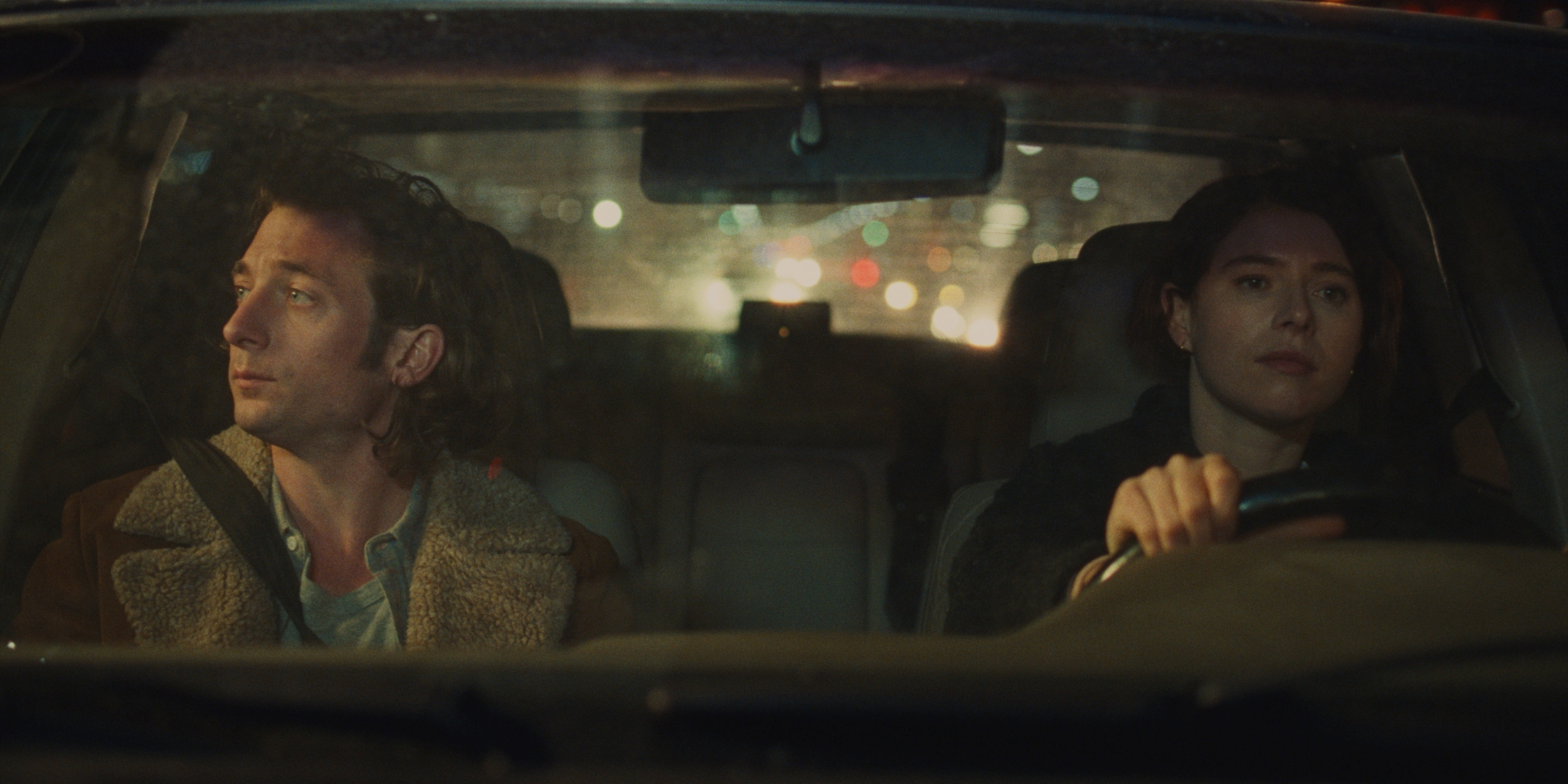
In Fingernails, Anna (Buckley) and Ryan (White) have found true love. It’s been proven by a controversial new technology to determine ultimate compatibility in romantic relationships. There’s just one problem: Anna still isn’t sure. When she then takes a position at a love testing institute, she further questions her connection with her supposed soulmate as she gets to know her co-worker Amir (Ahmed) and begins to develop a powerful connection with him. “I founded this institute to take the risk out of love,” explains Duncan (Wilson), company founder and Anna’s employer, at one point. “No more uncertainty, no more wondering if you’ve chosen the right partner, no more divorce.”
Ahead of its general release and while showing at London Film Festival, STARBURST sat down with Greek filmmaker Christos Nikou to discuss his latest work, his musings on love in the modern age, and finding chemistry between his lead actors.
Having authored the screenplay as well as directed the film, can you tell us about where you found inspiration and what sparked the key concepts for Fingernails?
Christos Nikou: I started writing it when I was trying to understand, what is love, and why is love so difficult? And especially, why is love so difficult nowadays? Why can I not fall in love like in the past, and what is wrong with me? At that point, I was also trying to understand the people around me and why they were going only through dating apps.
I begun thinking about how people would use their fingers to swipe left and right in order to find their perfect match; about how there was an algorithm to success in love instead of seeking it through more organic ways.
It’s interesting that you identify technology as one of the reasons for people’s growing loneliness and difficulty finding connection, when the film is actually devoid of most modern technology like phones and the Internet. What went into that decision?
Christos Nikou: Because we’re trying to make a direct comment on technology, the only technology device in the field had to be this test machine. Everybody goes into this one-room test machine to find the answers they’re looking for… It’s a much more powerful statement to talk about the impact of technology amidst a complete absence of modern technology. Everything is in the mind of the character – we wanted the film to feel more timeless, and the only real connection to our time is with the reference to Hugh Grant, because Hugh Grant is the only one who knows what love is.
In that spirit, can you speak on the visual tone and aesthetic of Fingernails? It’s particularly interesting that despite medical procedures taking place at the Love Institute with the removal of nails, the environment is completely opposite to the white, sterile environment of a hospital. In fact, it’s very warm and welcoming – what was the intent there?
Christos Nikou: We shot the film on 35mm in order to create something that was visually timeless. I like to think it looks like a move that was shot at the end of the 90s and put in a shoebox, almost like a prophecy. I also don’t think that conceptual stories should be clinical or distant. They need to be very, very grounded.
Were fingernails always going to be the body part used for testing?
Christos Nikou: When we were discussing this amongst writers, and Sam Steiner suggested that it be something taken from the heart, so that you’re taking a big risk to have your love tested. Then we wanted to make a comment about how everything goes through our fingers, and how our phones are extensions of that. Even when [in the film] they’re holding those certificates that state they’re 100% in love, it looks a little like the bandages are wedding rings. Like it’s a status thing to prove to the whole world that, oh look, we are in love. And losing a fingernail makes you feel a little bit more vulnerable, like your fingers aren’t protected. You’re sacrificing something and feeling the physical pain of love, so we thought that was the best thing to take as part of the test.
One of the key reasons why this film works so well has to be the chemistry between Jessie Buckley and Riz Ahmed. Did you know straight away that they would work well together? And what conversations did you have with them about their characters?
Christos Nikou: I always loved how Jessie surprises me, and Riz is a complete chameleon. And they’re both, in all their performances, very warm. Even if the film goes into very dark places, like Men, they’re always very warm on screen. And even though neither of them have done anything romantic before, I almost knew that they would have great chemistry. And I was right.
Building the chemistry was very easy because of who they are. But I was also playing this song before shooting every scene, so everyone was listening or singing along to the same song before the camera was rolling. So everyone on set is connected that way, and it helps everyone be on the same frequency.
And as a last question, we’re very excited to hear about your next project. What can you tell us?
Christos Nikou: I wanted to make a movie flowing a group of extras playing in famous movies. It’s about how we all try to be the protagonists in our lives. It’s an allegory on social media, how people are trying to lift themselves from the background to find their own role in this life.
Fingernails releases in select cinemas and on Apple TV+ from November 3rd.
On a surprisingly sunny Saturday morning in October, STARBURST was invited by writer and horror film location expert Lauren Jane Barnett to brave the crowds of Covent Garden and embark on a tour through central London, stopping at streets and buildings where scenes from many legendary horror movies were set and/or shot over the years, covering classics like Dracula (31), Scream and Scream Again, and Corridors of Blood to the more obscure likes of Womaneater and Tony, revered masterpieces (An American Werewolf in London, Hellraiser), even quirky Ringo Star curio Son of Dracula gets a mention.
Lauren’s tour, titled Terror in the Crowds-Exploring Horror Cinema Amidst the Bustle of CoventGarden, is an enthralling, fact-loaded amble through the crowds, conducted as part of the decade-old London Month of the Dead, which consists of a number of capital-based horror-themed events occurring throughout October. Lauren’s walk gives a fascinating insight into movies made in the area while also elaborating on their cultural significance, relevance today, and historical context of the time.
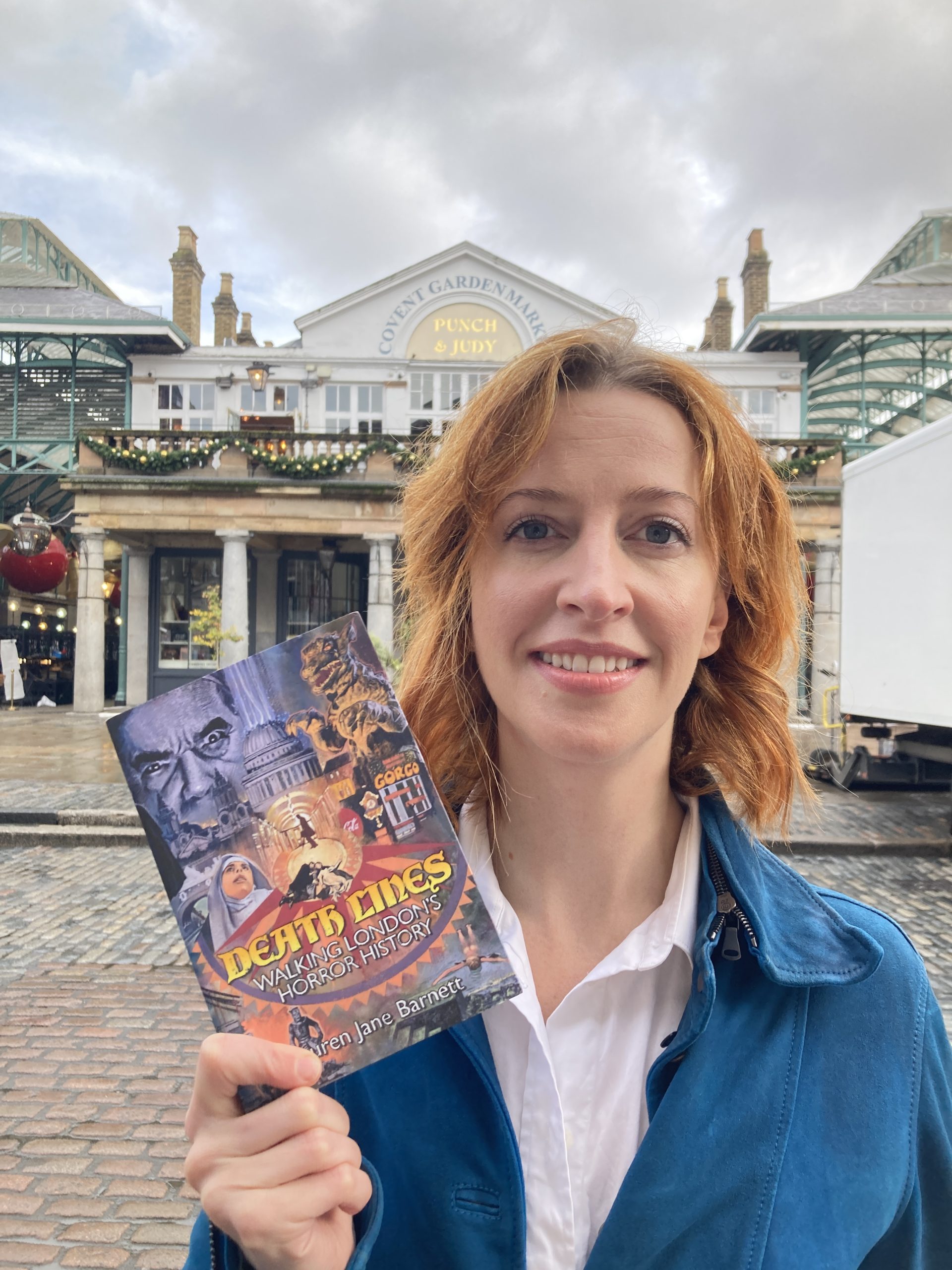
Lauren goes into greater detail about the movies (and much more) in her brilliant book Death Lines: Walking London’s Horror History, which includes insights into other London-based horror productions not touched on in the tour. The book is an absolute must for horror film and London history fans, made great by concise prose penned with professional precision and the heart of a true horror fan.
After the tour, STARBURST had the honour of catching up with Lauren for a quick interview and cheeky pint in Covent Garden’s Bow Tavern pub, where Alfred Hitchcock shot some of his penultimate film, Frenzy (also covered in Lauren’s book/tour). The pub is where the film’s protagonist, Richard Blaney (Jon Finch), worked and is now partly plastered with posters, promotional stills and photos from the production.
After getting in the beverages, we climbed the creaky, narrow staircase to the top of the pub, away from the roaring Saturday bustle and tourist hoards, to talk all things London horror lore with Lauren and learn how a young American came to the UK fired with a desire to write, perform and relay/pass on all she has learnt and loved about horror over the years, to both film fans and anyone with a passing interest in London’s macabre, past. As a bonus, Lauren also told us about how her writing the book led to her landing a film role alongside horror legend Linnea Quigley.
STARBURST: Tell us a bit about your background; how did you come to be here in the UK, doing what you’re doing?
Lauren Jane Barnett: I grew up mostly in North Carolina, on the East Coast of America. Not a super popular place but it was nice for a small town. My parents passed away when I was 18 so I lost track of applying for grad school. Then my teacher told me I still had time to apply in England, so I applied to do an MA in art history and acting here. I also applied to sell art on cruise ships and got into Sotheby’s, which was great! On the back of that, I ended up doing a PhD. I was really interested in dead body photography and how that has changed over the years. From Victorian-era death photography to the response to AIDS in the ’90s, so ended up writing my thesis on that.
When did you start doing the London horror walks?
While waiting for my Visa, I was bored and didn’t know the area well, so I started going on a lot of the London walks. I also loved horror movies and noticed there weren’t any horror walks back in the day, in 2013/2014. One of my friends suggested I do one, so I did and started writing them down. I’d then rotate them, so I wasn’t always doing the same one. It got to the point where I’d written down about twelve or thirteen, so I pitched it as a book idea to Strange Attractor Press, and they loved it. They’d done walk books in the past and love horror movies, so they told me to go for it. I then picked my favourites and went from there.
Have you always been a horror film fan?
Yes! In my family, the joke is that I’ve been watching horror films since the womb because my parents loved Alfred Hitchcock. My older brother Chris, who I am really close to, is eight years older than me and was watching those early ’90s late ’80s horrors. My parents were really blasé about what he watched and eventually said, “Well, if Lauren can handle it, she can, and if she can’t, she’ll leave the room”, so I got into it at a really young age and watched films like A Nightmare on Elm Street and The Evil Dead. I think it was good that I watched them with my brothers as they were always joking around and laughing at bits, so I never felt too scared as I was in a very friendly environment, not on my own in some dark cinema somewhere.
Do you have any memories of scenes your saw as a kid that struck a chord, scared, and stayed with you while igniting your love for horror?
One of those memories is from a really old-school Boris Karloff film called The Man Who Changed His Mind. Karloff’s character has the ability to swap his brain with others. I remember this scene where a woman thinks she’s talking to her boyfriend but really isn’t. It isn’t shock-scary, but I’ve since found the thought of talking to someone, but you don’t know who it is, extremely creepy. The other film was Halloween because, if you’re a young girl growing up in America, you’re going to be a babysitter. I remember being a babysitter at thirteen and was so terrified after watching that film I took a knife from our kitchen and put it in my backpack, so if Michael Myers came to the house, I was ready. That film had a really strong impact on me, but I loved it. I am still someone who gets scared easily, but I love that because it makes me feel brave without being in danger.
What led to you deciding to combine your horror passion and London history into a book?
I was at a pub with some friends. I told them I was thinking about writing a book and asked what they thought. At the time, I was thinking about writing more of an academic book as I was doing my PhD, but someone suggested merging it with the writing I had done for my walks. I got really excited by that because I realised that anyone could do the walk using my book as a guide when they wanted to. My American family could also do it too, online, so my brother got on Google Maps and did the online version using my book as a guide. It’s really cool that you can share that with people remotely, anywhere now.
Did you have a specific interest in London and the history and horror of the city before you came here, or did it happen after you arrived?
I always loved horror and had seen and loved films like Frenzy and all the Hammer Horrors, but I also love the feeling you get when you’re watching a movie and recognise a place you know. While watching The Devil Rides Out, someone mentioned a hotel, and I thought, “Oh wow, I know that – it’s in Mayfair” and had walked by it recently, so I think it was that novelty combined with the excitement of having recently moved to London that excited me about it.
We feel very nostalgic when seeing somewhere we know on screen, but how it was in the past. That is partly what made your work so interesting to us.
I know, it’s so cool if you’re living in a city and then suddenly see footage of it from many years ago. So many horror films have become great time capsules, offering glimpses into the past. I know we had Frenzy on our walk, but if you look at a film like The Haunted House of Horror, there’s a wonderful scene set in Carnaby Street, and you get to see that in the sixties. It’s definitely a new reason to seek out and discover or rewatch old movies.
Was writing the book a learning process for you, or did you start it armed with the knowledge you needed?
The thing that surprised me was that I had, very early, thought, “Oh, I’ve done a couple of walks, but I know there are about 80 more films”. Then, I ended up compiling a list of about 153. There are so many more films than I realised once I started digging.
So you could write a sequel?
I could write a trilogy! Not necessarily just about films that are solely London-focused, but horror films set here because it’s England’s base city. There are films that are all about London, but the ones I got weirdly interested in and ended up including in the book but didn’t originally intend to were those that would recreate London elsewhere. That was something I went back and forth about a lot because I initially thought, “Well, it’s not London, so maybe I shouldn’t take people to these places”, but it’s interesting to take people to a building and let them know that while the film might have said it was this place, it wasn’t. Then, let them know why and get them to think about it. From Hell is a really good example. In that, Cleopatra’s Needle was recreated using CGI because they couldn’t afford to film there for real. What I want to know is why they didn’t use a stock shot instead of digitally recreating it. I don’t know the answer, but it’s a good question.
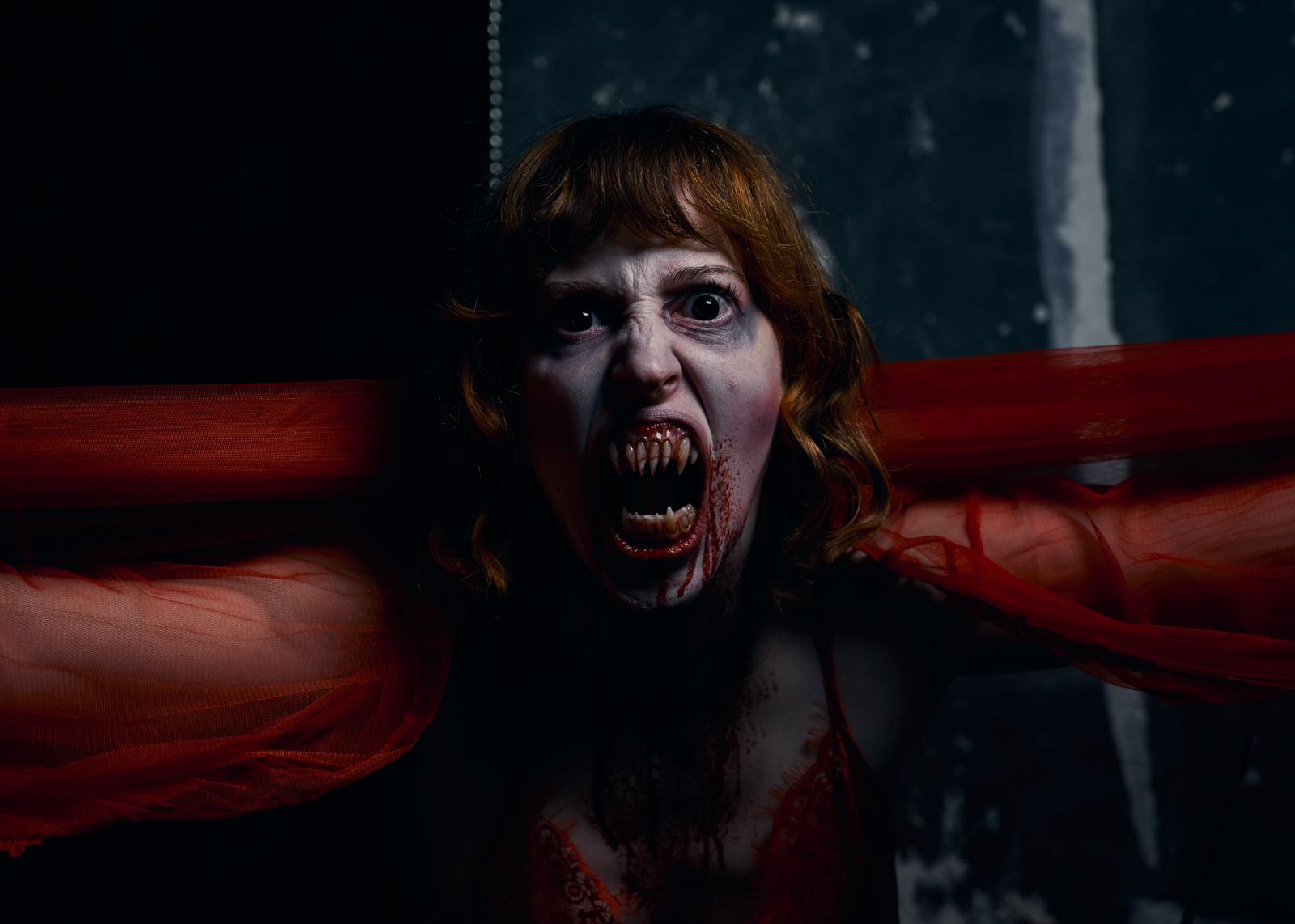
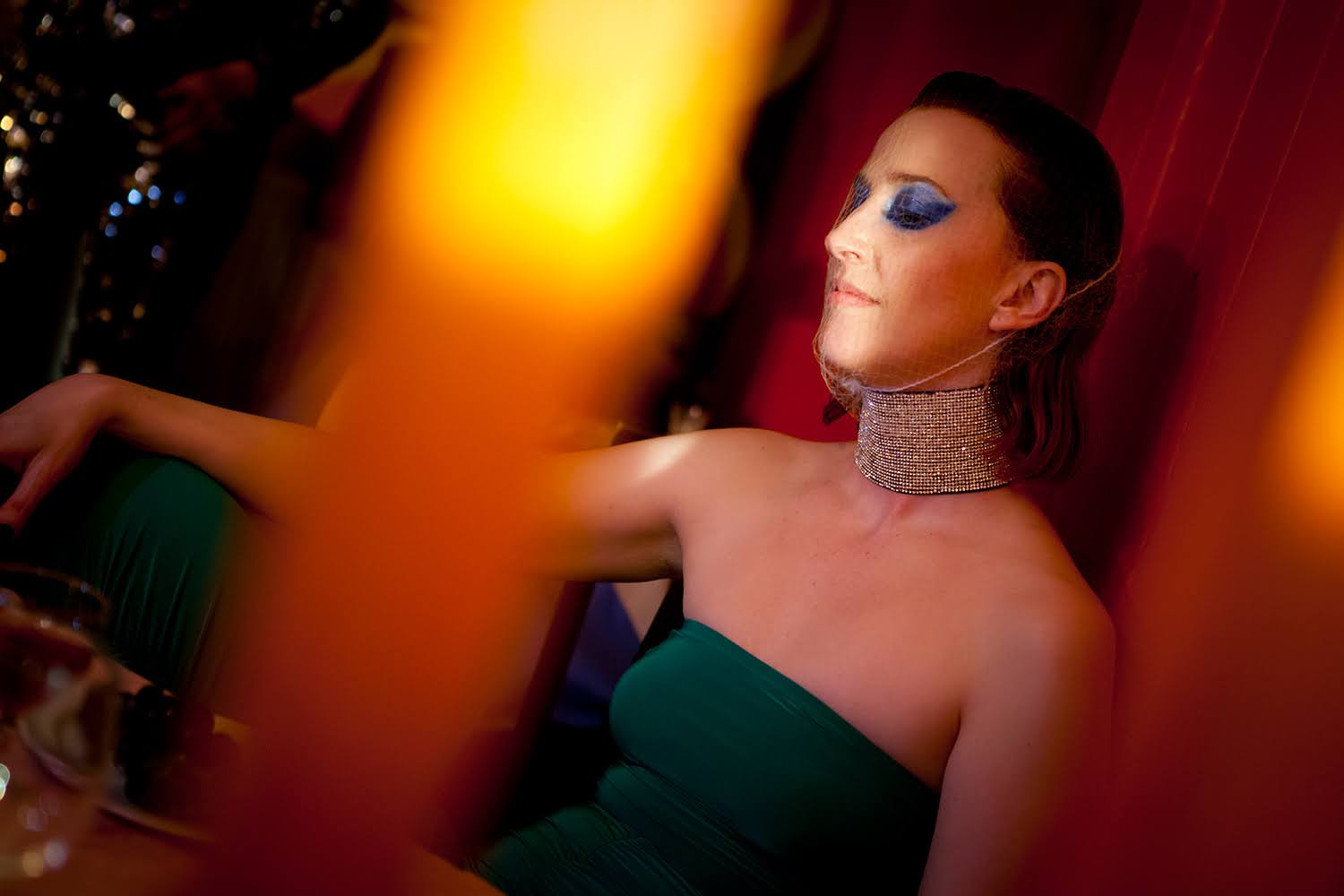
photo: David Ince / makeup: Tequila Carter (also main image)
Where do you think British horror is going, and how do you think the history of London will be incorporated into horror films in the future?
The thing that seems to be happening in horror, in general, is it’s telling a lot of old stories in unique ways. There was this recent re-telling/re-think of the classic ghost story called His House, which incorporated a lot of the modern refugee world of London into it. Even though London has a long history of immigration, His House gave a very modern look of that, which made it really interesting. Then you have the likes of Saint Maud, which brought back that Hammer Horror tradition of the Christian good but twisted it to make us wonder how much is in the protagonist’s mind and how much is real. You also have a lot of films which make a purpose of looking into the past, like Last Night in Soho, which, in that case, definitely isn’t a bad thing, but I do like it when horror movies break away from conventions and focus on trying to do something new.
You are also involved in horror filmmaking. Can you tell us a bit about that?
Yes, the weird little world of horror movie-making is where I have the most fun. I am acting in writer/director Tony Mardon’s film, The Witches of the Sands, which is completely off-the-wall bonkers with loads of pastiche and references to old horror. The film is very much about how extreme your response is to something and engaging the audience on that level. A bit like James Edward Newton’s films Katernica and Black Lizard Tales. Very different and very weird. Focused on making you feel and the emotion of the audience. It’s very interesting how Tony also combines different elements into the horror, like comedy and Gothic twee, but in a really unique way, making it more about the emotional journey that leads you to becoming afraid. It sounds a bit abstract, and I don’t know how big of a market it will end up having, but that’s where I am seeing the most interesting stuff in modern British horror at the moment.
How did you get into the acting and film production side?
When I came to London, I met Tony at DarkFest while promoting my book. He was also promoting a short film he made called Libra. We were introduced by Pauline Peart, an actress who was in The Satanic Rites of Dracula. We got talking about our love of horror, and he asked me if I wanted to be in his film, and I said, “Yes, please”. Since then, it’s been a lot of fun, and I’ve met a lot of different, interesting people. I also do a podcast called the London Horror Movie Club with my older brother, who got me into horror. In that, I talk about London, horror, and film locations. We also interview various people working on indie horror productions.
Lauren in The Witches of the Sands
So what’s next for you, more acting and writing?
Tony and I are working on a book about the history of plant horror. I’ll be coming at that from the academic side, and Tony will detail all the filmmaking practicalities, so it will combine history with production insights. That’s been a fun one to work on so far. We have gone all the way back to Werewolf of London (1935), which features this plant that ends up being the cure for lycanthropy. We’ll also cover weird mushroom horror, some Japanese horror, and other tons of great stuff. I’m really excited about it.
DEATH LINES: WALKING LONDON’S HORROR HISTORY is available now.
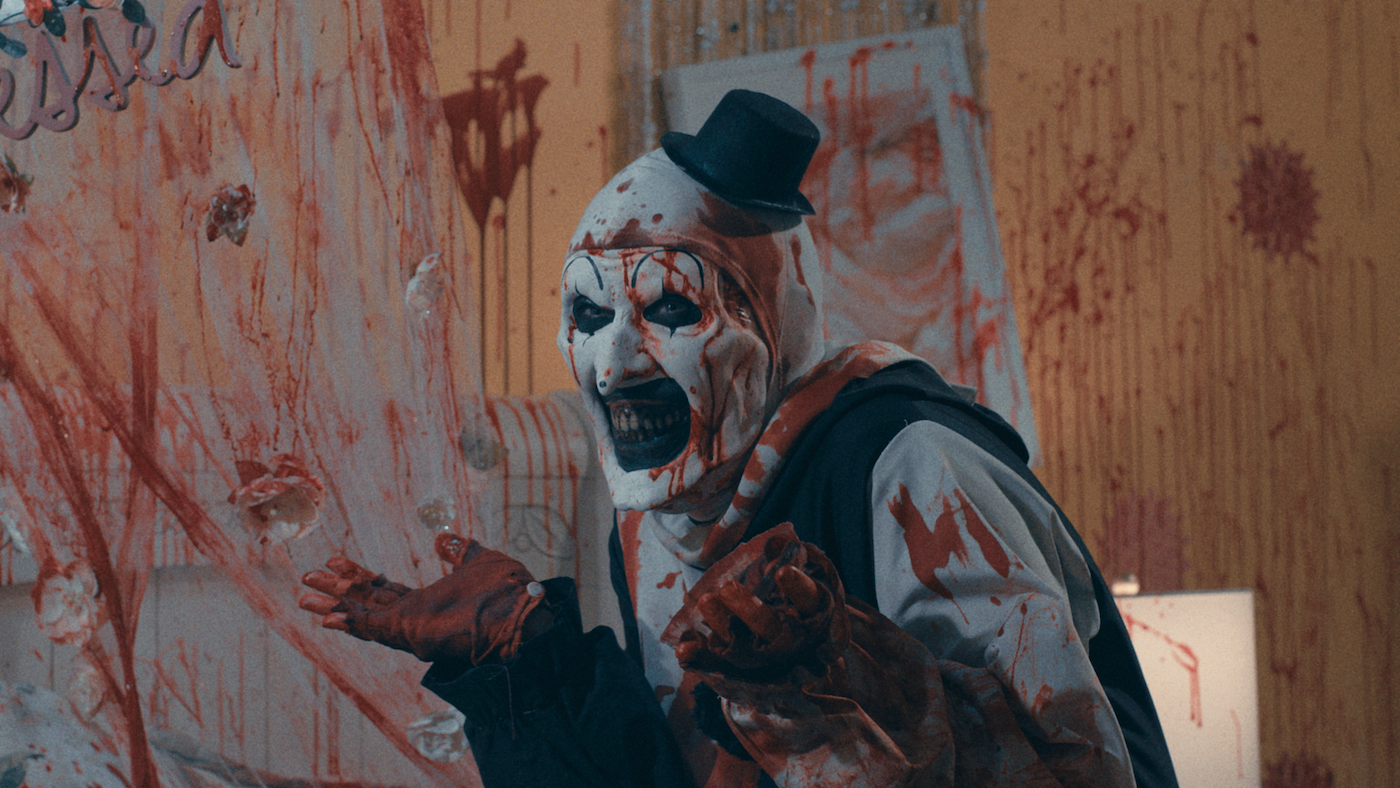
Brace yourself for our favourite killer clown’s cutthroat comeback – Art the Clown is bringing his bag of guts and gore to scare up screams in theatres once more. This November sees the US theatrical re-release of the slasher sensation Terrifier 2, which unleashes a special blood-curdling surprise – an exclusive teaser for the next instalment! We sat down with the mastermind behind the murderous mayhem, director Damien Leone, to slice open the secrets of the saga’s next chapter and find out who Art could team up with…
STARBURST: With a new Terrifier film on the way, what details can you give us so far? How gory are you going to get with it?
Damien Leone: Oh, as gory as you can imagine! And then some! We always have to one-up the previous instalment, especially now, because the expectations just grow and grow. People are really expecting us to make them vomit the next time around. I’m going to do my best to make you throw up in the theatre this time! We’re also continuing to follow the journey of Sienna [Laura LaVera] and her brother Jonathan [Elliott Fullam], and this metamorphosis, so to speak. How they’re dealing with the trauma and the events of Terrifier 2 and how that’s affected their lives, and seeing how Art gets out of the situation that we last left him in. We’ll explore what that evil entity is that brought back Art and why Sienna was sort of appointed to combat him and all those things. It’s going to be exciting, but it’s tonally shifting back to the atmosphere of the first Terrifier in terms of being a more gritty, dark, grindhouse slasher film, and I want this to be the scariest one so far. I want to see if I can balance those this time around. It should be fun!
Think Freddy vs. Jason; who would Art’s rival be in the horror universe if you were to make this sort of meta film?
I have two answers for that. I think I would love to see Art team up with, more than fight, Freddy because I think Art is kind of a silent Freddy. They have a very similar, charming, sadistic black sense of humour. I think the jokes that the two of them could do and play off each other would be fantastic. They’re both operating in these supernatural realms, so there is a way to have them cross paths. But I would love it if maybe Art fought Ash from The Evil Dead, and I’m thinking Ash in his prime in Evil Dead 2 would be amazing because he’s one of my favourite heroes, my favourite horror protagonist. That would be really cool.
With Halloween coming up, what’s your go-to film is for the season?
Oh my gosh, it’s so it’s so cliché, but nothing embodies Halloween for me like the original Halloween. I feel like this movie shaped what Halloween is and how we perceive it. It’s just an unmatched atmosphere that the movie was able to capture. It just does something so nostalgic to me. I love watching that whole franchise this time of year. It’s like part of my ritual.
We completely agree. We’re big fans of Halloween 3 – that’s our go-to!
One of the best Halloween atmospheres in that movie! It’s almost impossible to capture that nowadays in movies; there’s just something so magical and they nailed it. I always throw that one on as well.
TERRIFIER 2 is in select US cinemas from November 1st. You can read more from Damien Leone in the upcoming Issue 484 of STARBURST – available from November 30th here.
Comic book writer Dan Slott is known for his long-running work on Spider-Man and for an Eisner-winning run on Silver Surfer inspired by a particular Time Lord. With his new graphic novel, he’s finally getting to write for the original, you might say – the Doctor. We caught up with Dan to talk all things Who and find out what to expect from Once Upon a Time Lord.
STARBURST: So, Dan, you’re best known as a Marvel writer, but I hear you’re a massive Doctor Who fan?
Dan Slott: It is my favourite TV show of all time. Whenever there’s a convention, I ask, “Who’s going to be your guest from Doctor Who?” before I decide to do the convention or not. I don’t abuse my Spider-Man status for anything else really, other than Doctor Who.
When did you first get into Who?
I started watching in the seventies, on PBS. They would show whole adventures in one night, starting at 10 or 11. This was before VCRs, so once you started, you were going to watch an entire adventure all the way through, and that took amazing stamina for a small Whovian. So I started out at the beginning of Tom Baker’s era with chunks of episodes, because I kept falling asleep – but I’m pretty sure I made it all through Robot and Genesis of the Daleks.
And when I was a teenager, my family moved to the UK, and I was like, oh my God, I get to watch this for real now, the way it should be seen, serialised once a week. And I would go to Forbidden Planet and buy all the Target novelisations. I started with the First Doctor and An Unearthly Child and worked all the way through until I got to The Key to Time and I was all caught up.
And once the show relaunched in 2005, it was the greatest thing ever. Everything about it just got better. There are all these very clever things they did – I love the psychic paper. The special effects were better. The idea that he was the last of the Time Lords was really good; it gave him that kind of fun Superman: Last Son of Krypton feel.
And how exciting is the new era of the show looking, right?
You get to have your cake and eat it too! We have the return of David Tennant, and by the end of the specials, we get Ncuti Gatwa as well. When this thing goes onto Disney Plus and people meet the Fifteenth Doctor, he is going to be the Doctor for people around the world on a level that I don’t think Doctor Who fandom has seen before.
So, let’s talk about your new comic. How did Once Upon a Time Lord come about?
This has been one of my greatest frustrations of my career. I’ve been writing comics for thirty years, and the last twenty I’ve been exclusive to Marvel. And whenever I’d pop back into the UK to visit friends or family or do a convention, the lovely people at Titan Comics would take me out to dinner and say, “We know you’re a huge Doctor Who fan, would you like to write some Doctor Who?” I’d be like, “I can’t, I’m exclusive to Marvel.” It was absolute torture, cos I would kill to write Doctor Who.
But there was a time when my contract was up for renegotiation, I had a surprising amount of leverage, and they went, “Fine, you can do one Doctor Who comic a year.” And I ran to Titan. I was like, “I can do one a year. They didn’t say how big it was. So let’s do a giant issue. Let’s do a graphic novel.”
There really is a lot packed into this book – a 48-page main strip with the Tenth Doctor and Martha, followed by a ‘backup’ strip with the Ninth Doctor and Rose. And this takes place across alien planets, Earth history, and even a strange hell-like dimension. How did you go about plotting all that and choosing what to throw in?
It all felt very surreal to me finally getting a chance. I was like a can of soda being shaken for thirty years. When I finally got to tell a Doctor Who story, I wasn’t going to hold anything back. All my Whovian love was going to go all over the page. What if this is the only one I ever get to do?
So this is a big story that encompasses so much of Who lore – classic and new. But hopefully, even though it’s a very overstuffed sandwich, it all flows well, and so if you’ve never read or seen any Doctor Who before, you can follow it. It’s very new reader-friendly.
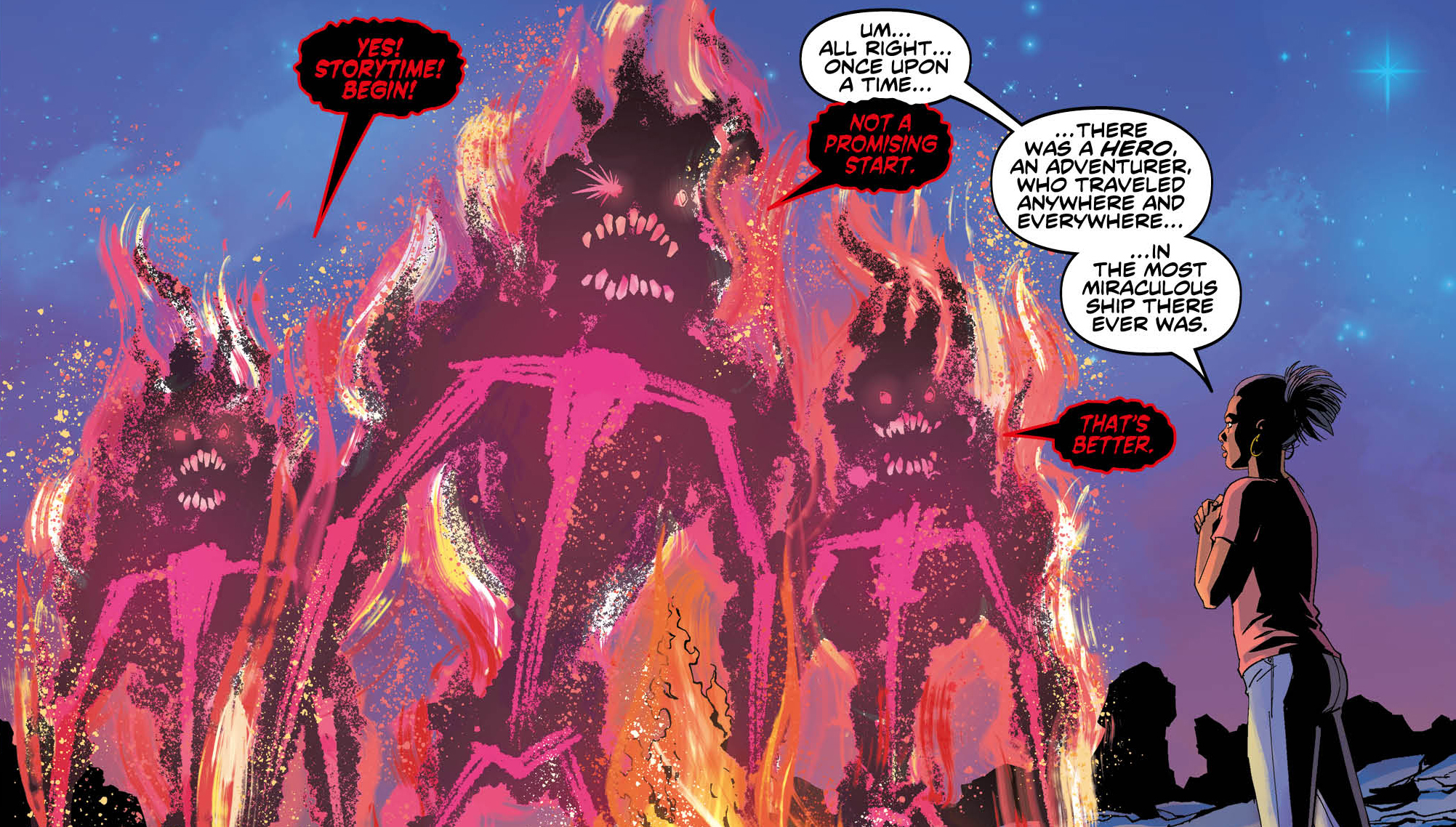
The main part of the comic is a series of adventures the Tenth Doctor goes on alone, and then there’s a framing story in which Martha tells these tales to the Pyromeths, aliens who feed on fiction. How did you decide to focus on the Tenth Doctor and Martha for this tale?
The main threat in this story is the storyteller’s dilemma, the Shahrazad problem. Something that every writer can relate to is that you have to keep telling stories, and if the next one isn’t as good as the last, you’re dead. That’s really what it feels like writing a comic book every month! So I wanted the companion who was the best storyteller, and that’s got to be Martha Jones, who walked the Earth telling stories of the Doctor.
So you’ve written for the Ninth and Tenth Doctors – how do you give each of the Doctors different voices?
The way I hear from talking to writers for the TV show is that they have a standard Doctor voice and they write the first season of any new Doctor like that. And inevitably, as the show progresses, mannerisms that are unique to that actor get folded in. The benefit I have is that all these seasons are already done, so I walk in with all these voices of these characters firmly set. And there are easy tricks – your allons-ys and your fantastics and your geronimos – things that, the minute you hear it, you’re going to hear the actor’s voice.
Can you talk about the three different artists who’ve illustrated the book?
The story with the Tenth Doctor and Martha has art by Christopher Jones, who has a longstanding history with Doctor Who and is amazing at likenesses, and Matthew Dow Smith, who has also been a legacy Doctor Who comic artist. Chris is the artist for the framing story, and Matthew is the artist for the stories within the story.
And the backup with the Ninth Doctor and Rose is being drawn by Mike Collins, who not only has the history of writing Doctor Who comics, he’s also a storyboard artist on the show. So he’s got some serious Who cred.
You’re slated to write two more Doctor Who graphic novels – was that always the plan, to do three?
I think once I do three, I can rest. There are many authors who just do their two or three episodes of the Doctor and then they leave. We’ve got all these big plans, so I hope this first one does really well, because boy, I want to do those two.
Doctor Who: Once Upon a Time Lord is released on November 7th from Titan Comics, via book shops, comic shops, and digital platforms.
And, buy STARBURST 484, available from November 30th, to read the extended version of this interview, in which Dan tells us about creating alien baddies the Pyromeths and his long-planned Doctor Who/Spider-Man crossover!
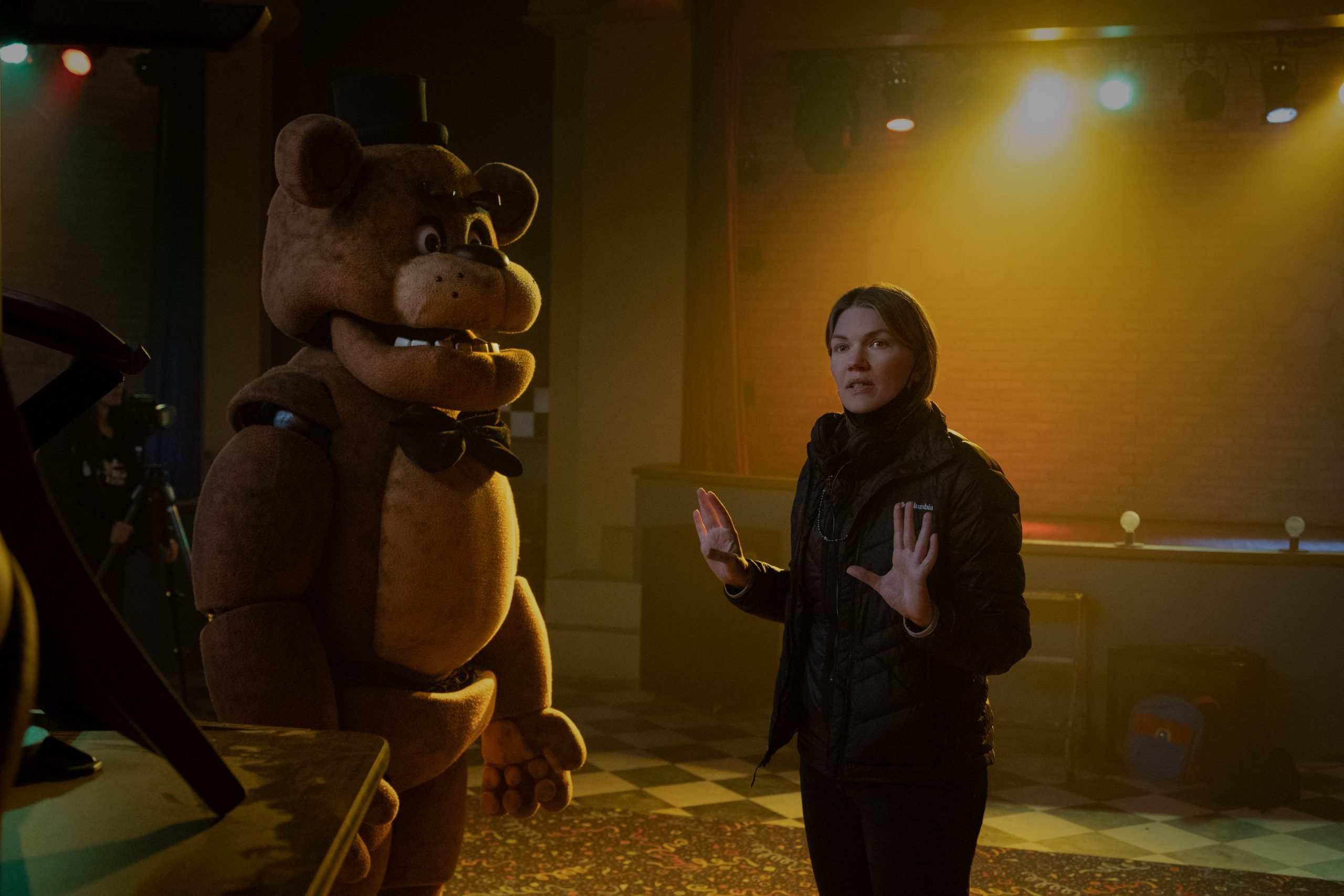
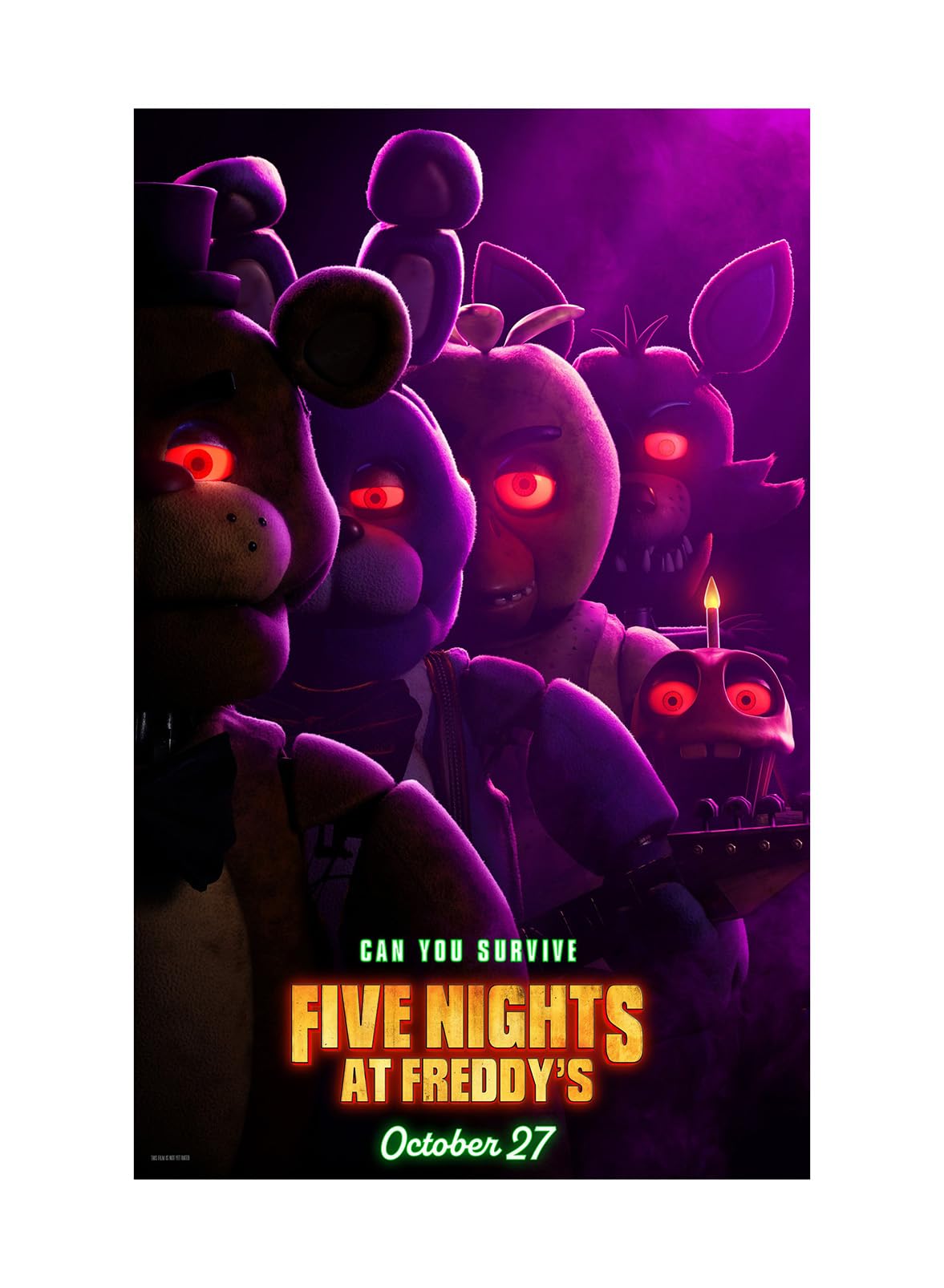
Ahead of the highly anticipated big-screen adaptation of Five Nights At Freddy’s, we had the pleasure of sitting down with director Emma Tammi to talk about all things animatronic!
STARBURST: The lore of FNaF is so interesting and deep and goes to some pretty crazy places, so it’s great to see a movie being made for new and old fans alike. How was the weight of that undertaking when you took the role as not only director but co-screenwriter as well?
Emma Tammi: Doing a pass on the script with Scott [Cawthon] and Seth Cutterbeck was the key part in nailing down the blueprint of how much lore to include and what other storylines that aren’t in the games to include and really find that balance to both satisfy the fans and create a dynamic film that can stand on its own two feet. In terms of finding that balance, Scott was a totally critical and crucial guide and adviser on if it should be included and if it was accurate to the source. And we really put our trust in him on that front, and by working together, we had the best script possible when moving into production. It was an amazing experience to work with him, especially at that stage of the process.
Scott is very prolific at keeping things under wraps, and his attention to detail is impeccable – how was it working with him in other stages of production?
He cares so deeply about the project and, of course, the franchise as a whole, and as a filmmaker, you have your producing partner, your department heads and your cast – a whole team of people who are giving 1000% of themselves to making the best possible movie that you can make – if you’re lucky, right? [laughs]
But as the filmmaker, on a cellular level, you care about it more than anyone and what made this one more interesting was the fact that I knew Scott cared about everything to do with this just as deeply as I did. And to have that level of an invested creative partner in this process is really an incredible experience. We were coming at it from different perspectives, and of course, playing different roles, but we were really respectful of each other and what each of us does best, and I think that made for an overall much better film at the end of it. I’m so grateful for that.
The FNaF fanbase is huge, and this is a massive project to undertake – what was it about this project in particular that drew you to it?
I kind of came at this from a reverse perspective, through the back door if you will, as I wasn’t familiar with the games or the amazing and passionate fanbase, which I’ve come to be a part of myself. It was actually Jason (Blum) who came to me with the idea for the project, and then I went and played all the games and read up on the world and the very expansive lore. Essentially, I came at it from a pure level. It started with “Here’s a script, here’s a story, here’s an idea”, and then I was able to help mould it with Scott and Seth into a great movie and utilise my specialities along with theirs. I’m so happy that my ideas were welcomed by Scott, and the fanbase has been so excited and supportive all along the way whenever any news drops or trailers are released. What I also love about this is that every single person involved in bringing the film to life has a connection to FNaF, be it them being a fan of the source material themselves or a relative being a fan of the games – so we all wanted to make the best movie possible, and everyone gave it their all, and I’m so pleased with how it turned out.
The film is full of Easter eggs and amazing set designs that bring the world of the game to life – but what were some of the challenges you faced during production to make the setting feel real and lived in?
I think the biggest challenge with prep and production is always a race against time, and with all of the departments and Scott, we were looking for opportunities every step of the way to pack in as many Easter eggs as possible and as many unique details that felt authentic to the FNaF world. We had so much material to pull from, which is incredible, and everyone was thinking of new ways of incorporating things that the fans would love. Our costume designer came up with the idea one day to print a frame from a mini-game on one of the character’s T-shirts. We were all so detail-orientated, and we had a phenomenal production designer. We added lots of new things, too, so we hope fans enjoy those as well.
The cast is absolutely stacked – you’ve got Matthew Lillard, Josh Hutcherson, Elizabeth Lail and the adorable Piper Rubio, along with, of course, Freddy and the gang. The Jim Henson Creature Shop did a phenomenal job with the animatronics. Were there any memorable moments on set with them?
Yes! The servos, which are the little engines that keep the animatronics moving, have a limited time in how long they can run without overheating – we had one day where, during a take, I heard someone say, “Foxy’s arm is on fire” so calmly, so we had to stop and put him out before we could get on with the show (laughs). Thankfully, that only happened once, so we were very lucky – the puppeteering team were amazing.
Five Nights At Freddy’s opens in UK cinemas on Wednesday, October 25th.
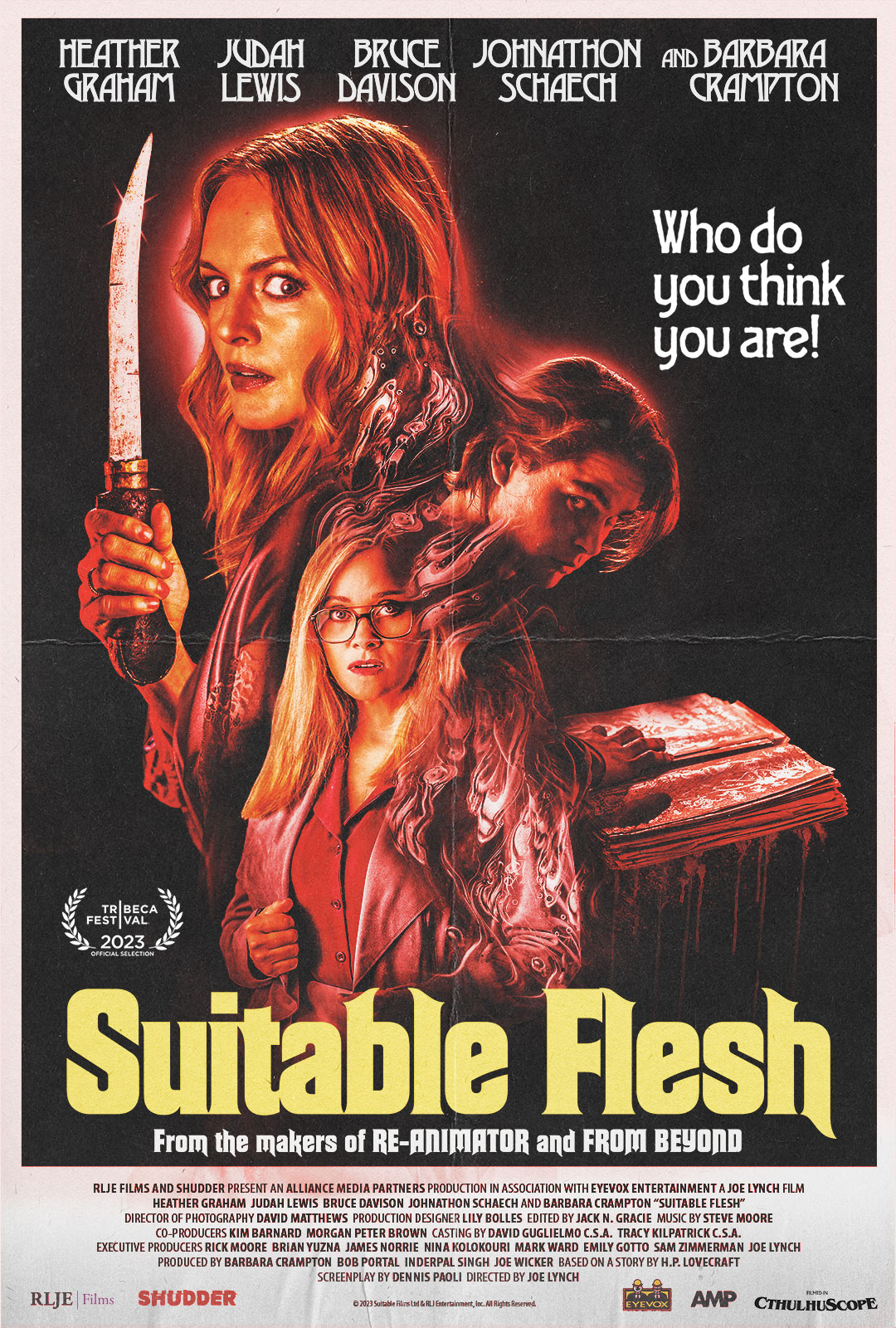
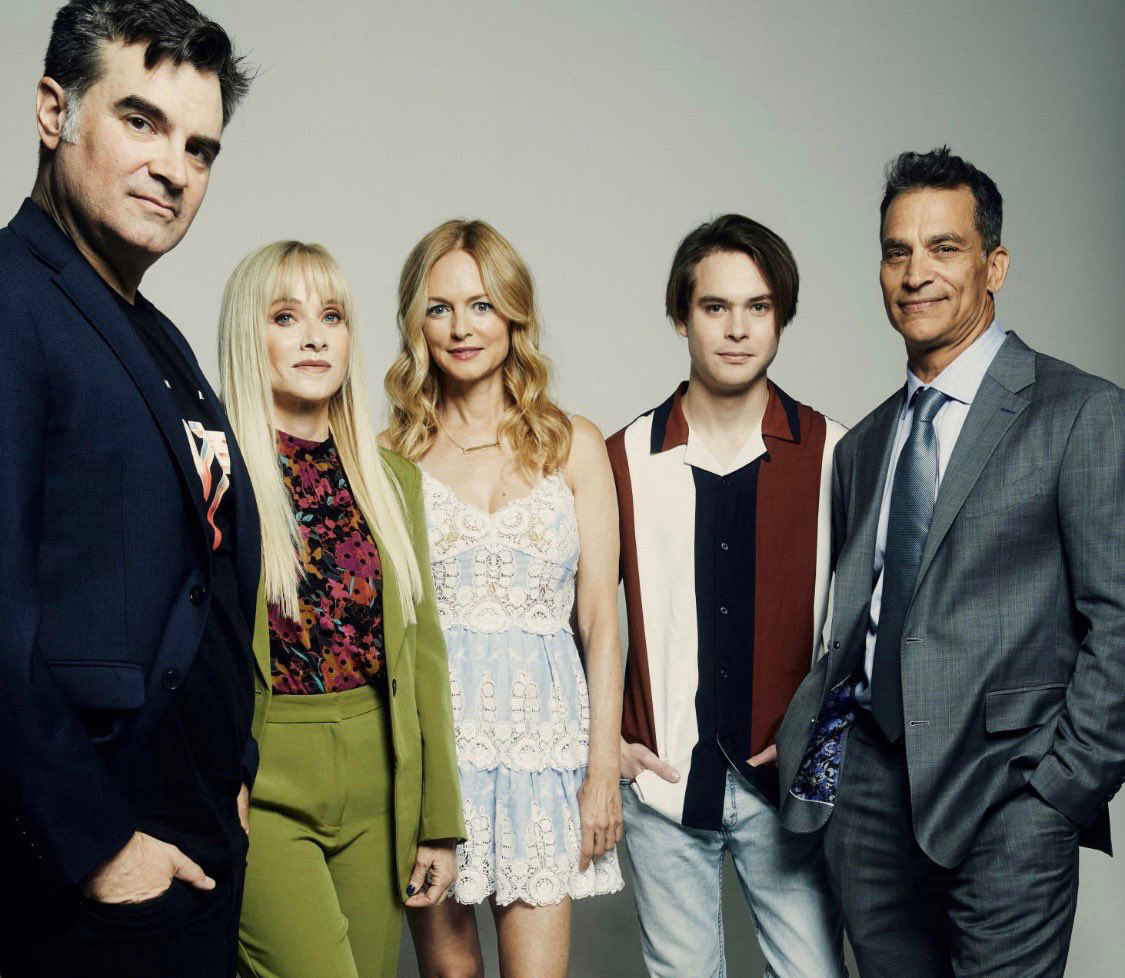
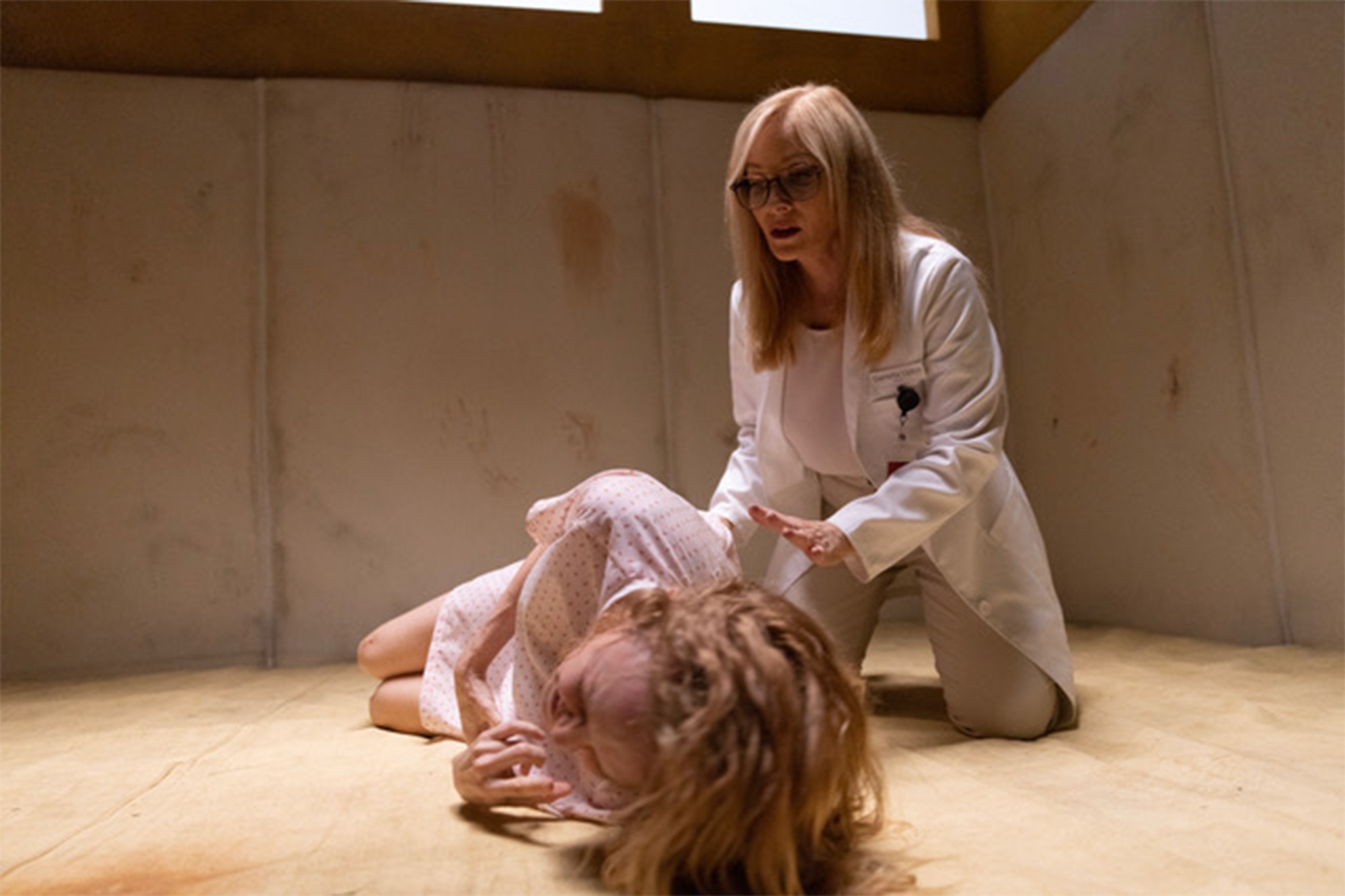
Ahead of the cinema and digital release of the body-switching H.P. Lovecraft adaptation Suitable Flesh, we caught up with director Joe Lynch to talk about tackling the superb and erotically charged horror movie…
STARBURST: How did you come to the film, and what was it like taking over the reins from Stuart Gordon when it comes to Lovecraft movies?
Joe Lynch: I had been a huge fan of Stuart’s, from Re-Animator to every single film that he’s made. He was definitely one of those filmmakers that I modelled myself after because he always took chances. He never did the same thing twice. Even when it came to Lovecraft. I had known that he was going to direct The Thing on the Doorstep, and as a fan, I was incredibly excited to see them get the band back together, but then he passed. So, colour me surprised when, six weeks into the pandemic, I got an email from Barbara Crampton saying, “Hey, we have this script. Would you be interested?” And immediately when I clicked on it, I saw The Thing on the Doorstep, written by Dennis Paoli, from a story by H.P. Lovecraft. I got both really excited but a little bit nervous because while it was exciting, and I knew the Lovecraft story, the way that it was written – and Dennis will be the first person to tell you – years ago. It just felt like it was a script that was of its time and not in a good way.
How so?
It felt like something that back in ’95, and you put Michael Douglas in one of the roles, you could have gotten away with that paradigm. With today’s point of view, I don’t think it would have flown or I think people would have rejected it. I went, “What if we changed the gender up and but not in a way that felt… again?” Do something that would really dig deep into the themes of what it would be like as an older professional woman in this situation, instead of it being an older, silver fox kind of guy, and then immediately everything became more exciting. Dennis and Barbara came back and said, “We dig this; let’s explore this a little bit more”. Three weeks later, we had a draft. And it wasn’t just them changing the names up, it was really getting under the skin of what this story would be like if we changed it up in a way that felt provocative and dangerous, sexy, and a little terrifying. That was where everything hit the ground running.
There’s also the gender flip with the relationship between Heather’s character and her on-screen husband (Johnathon Schaech) that’s interesting, as well as the fluidity of gender within the body-swapping of the characters.
Well, I’m glad that you brought up the word fluid because there are a lot of fluids in this movie! Not just fluids that are coming out of the body but sexual fluidity as well. That was something that I’ve been exploring a lot, even in my own personal life. I’ve been exploring those themes and what it means to be masculine. What it means to be heterosexual. What it means to be homosexual. What it means to be queer in film and life. There are so many different ways now that those kinds of points of view and those kinds of stories are being accepted more than ever. Once we were able to flip it, now instead of a femme fatale, I have Heather Graham. Now, instead of a doting wife, I have a shirtless Johnathon Schaech. Then, to be able to let Heather’s character play that Fred MacMurray character in a way was so much more exciting, not just from a story standpoint but from a sexual standpoint. That’s where we knew that sex was going to be a major component of the film. Thematically, it had to be there. It was our linchpin, and knowing that we’re now in a day and age in production – not that we weren’t before, or at least I wasn’t before – we have to make sure that there is a comfortability on set.
How did you handle the sex scenes?
I’ve done sex scenes before. I’d never done anything like this before, but I knew that it was such a huge component of the film. I wanted to make sure that every single department knew exactly what we were doing. I wanted to make sure that every cast member knew exactly where and how I was going to shoot it. Why I was shooting it that way. Thematically and stylistically, so that there were no surprises on set; the only surprise is that we’re going to be on set on those days with the chemistry between those two actors or three actors in certain cases! Our first day was the scene where we do Heather and Jonathan are having boring sex, and then Judah [Lewis] shows up in an active switch sort of situation. I had three actors in various degrees of undress. All laying there on the set, having a, you know, good time, but I made sure that they knew exactly what I was going to do using storyboards, using descriptions, so that none of them was uncomfortable. They were nervous in certain ways, but I took a lot of that out, and we closed the set. There was only me and the DP on set. It was just the actors and the playfulness that came out that made the scene so much sexier, especially when we do the little ‘flippity flop’ and then things become in her point of view or fantasy. There were things that they were doing that would have never come if I hadn’t explained so much about what we wanted to achieve. And once we did that, we allowed them to let the chemistry flow between them as naturally as possible.
There’s a very noir feel to the movie and visual tics that you don’t often see in films nowadays – big props to David Matthews, your DP – were there any particular films that you’ve looked at as reference?
Once I knew that we were going to be making the movie, I set my gears towards neo-noir and film noir mode. We watched a lot of movies, not just all the greats. You have Basic Instinct, and you have Body Heat, even stuff like Gilda and Double Indemnity, to try to get that film noir feel I wanted. I really wanted to recreate a subgenre and call it neo-erotica, like just the way that they in did the ‘90s. I wanted to bring some sex back into that because if you look at the way a lot of erotic thrillers in the ‘80s and ‘90s were filmed, they just cranked up the sexuality to 11. And that’s what I wanted to do here.
SUITABLE FLESH is in cinemas and VOD from October 27th. You can read our review here.
Actress, singer and creator Felicia Day needs little introduction, and has turned to hand to many cool things. She has worked on everything from Buffy The Vampire Slayer to Supernatural. We caught up with her about her scripted podcast, Third Eye.
How would you pitch third eye to a beloved elderly relative?
Third Eye is a fantasy comedy television show in audio. It’s TV for your ears. It’s a fantasy comedy about a failed chosen one. And it is a TV show that happens to be audio.
Where did the idea for this project come from?
I actually pitched this as a television show. I wrote the pilot, and then I thought it was the most brilliant thing I’ve ever written, and I pitched as a television show. And unfortunately, Hollywood did not think that, I mean, they liked it, but they did not buy it.
And a couple of years went by, but I still couldn’t let go of the concept. I’ve written many things that have never seen the light of day, but this one really stuck with me. And so when I had a meeting with Audible I brought it up, and they were like, great, let us see the pilot. And they read, and they were like, great, go, go ahead and make this.
And I was like, well, it’s going to be 10 episodes. It’s going to be a lot of hours. They’re like, we want more hours. That’s fantastic. So it was right before COVID started, and it was something that I just had to start running.
I ran and wrote it all the way over COVID.
Why is the chosen one narrative so popular?
Joseph Campbell. His work definitely influenced a lot of narrative. I know it was influential in creating Star Wars, and we have kind of a Chosen One narrative there. So I mean, it’s, it’s a very old concept. Joseph Campbell derives most of his theory from ancient Greek and ancient mythology. But I think because the tropes of the Chosen One certainly were influenced by Star Wars being tied to it.
So we have this heroic, usually teen male who is just destined to win, and they win, and that’s what a lot of our fiction is about nowadays. And I wanted to kind of tear that apart and flip it on its head and see what happens when someone who is faded to win actually loses and screws everything up in the process.
Is this more a fantasy parody? What’s the unique draw of Third Eye?
I don’t know if I’d say it’s a parody. I would say that I’m rebelling against a lot of tropes. So as you said, the Chosen One is a very familiar trope, and I turned it on his head and said, what if that Chosen One is a loser that everyone hates, and how do you live with yourself the best friends of my main character, Laurel, who is the chosen one, or former chosen one, her best friends are a vampire and a fairy princess. And yes, the vampire is not your cliched vampire. He is a tubby, bald, no fanged, complaining, loser kind of vampire and her fairy best friend from school is a grifter and super lazy.
You said that this was originally a TV show page that became a radio drama. How did that change the production?Because obviously with radio drama, you have an almost infinite special effects budget.
Well, this was quite a special effects budget as well. When they told me it would take six months to finish the episodes, I just honestly was floored. But when we got into it, I realized, Oh, we’re making the triple A movie of audio drama or audio pieces. And so it really did take that long to not only edit all the voices in pick the best takes, but spent a month figuring out what a portal sounded like, or what a magical effect would be.
It really is an incredible cast. How did that come about?
I know a lot of people, so this was a lot of favours. I believe only two or three actors in the cast I didn’t know personally. One of the spectacular finds for me was London Hughes, who plays Sybil. She is so funny.
And I didn’t have I had an archetype for her. My friend Jonah Ray, who I’ve worked on with on many things, he’s the voice director, and when I described who I wanted for the part, he was like, oh, you know, I worked with this comedian many years ago through stand-up. And I looked up 30 seconds of her YouTube videos, and I was like, sold, please. Please, let her do it.
Mostly it was just me typically calling my friends, mostly, and saying, will you do this? Here’s the part. One part I wrote for a friend specifically, was Will Wheaton. He plays Robigus and he is an antagonist, but also has a lot of layers that come out over the 10 episodes. So I hope that people can feel that there’s camaraderie and chemistry between everyone, because, well, we’re all friends.
So what was the first day on set like?
So the first day at on set, we were still recording under COVID protocols, so it was actually a lot of planning that we had to do in order to get people and what actors we could get in to record together, even though they were in separate booths, but together, because for me, again, a lot of audio performances feel like they’re cut together later, and you don’t believe people are in the room together. That was really important to me.
And one of the reasons I picked my friend Jonah Ray to voice direct, because he worked with me on a show that’s very like low budget, but also freewheeling and an improvisational feeling to it.
Simpsons or Futurama,
Off. You know, I remember seeing the very first Simpsons on the Tracy Ullman Show when I was like, six or seven, and I was in love with Bart. So I would have to say Simpsons.
Doctor, who or? Dr, no, oh.
Doctor Who, of course.
And finally, truth or beauty?
Oh, truth, truth. Because I’m from LA, I know you can buy beauty, I can’t find truth.
Susan Bonds and Alex Liu are the CEO and CCO of 42 Entertainment, the world’s premier alternate reality game creators. They are best known for the Halo 2 tie-in I Love Bees, the Nine Inch Nails ARG Year Zero (named after the album of the same name) and The Dark Knight tie-in, Why So Serious.
Their latest product is a Batman escape room experience in a box called The Arkham Asylum Files: Panic In Gotham City. We caught up with Susan and Alex to find out more…
STARBURST: What’s the pitch for The Arkham Asylum Files: Panic In Gotham City?
Susan Bonds: We’re actually following Harley Quinn, who is on the road to redemption herself. She is headed back to Arkham not as an inmate but this time as a therapist. So she got her old job back. And so, through her eyes, we actually open up the files of Arkham, and we get to explore the backstory. As you know, all of the roads go through Arkham at one time or another. So we get to explore who’s behind the latest crimewave in Arkham. But do it through the eyes of a therapist. Alex Liu: Essentially, you’ve got the iconic Arkham Asylum, which we know that many, many, many Batman villains have either been involved or have passed through those doors. It’s a revolving-door psychiatric hospital where our villains don’t always stay put. That gives us the world-building ability to see into all of the different villains in the Batman universe, whether they’re really well-known ones or some of the more comic-book-based ones. The Arkham Asylum Files essentially lets players dig through and learn about all of these iconic villains while there’s a major mystery unfolding within Gotham City itself.
The Arkham Asylum Files: Panic In Gotham City is a big box of toys that’s full of cool physical things. Why add the Augmented Reality aspect? Why does a board game need an app?
Susan: I think one of the things that it does is it unlocks digital assets, like live-action and animation. And as you know, when you’re watching those kinds of assets, you can really get connected to the characters and to emotions – you can see things happen dramatically. It gives you a lot of licence to take the idea of, “Hey, I’m playing a game with a lot of different pieces, I’m building a city, things are happening in the city”. You can overlay a lot of drama onto that by adding digital assets. The other thing that allows you to do is, you know, it allows you to immerse people deeper in the world.
It’s like, yes, you can build a building and that can move the story forward. But augmented reality actually allows you to penetrate the ceiling of that building and see what’s happening inside. And I think that breaking that plane is really just putting someone closer. It’s almost like a TV series, but like you’re actually in it. There are a lot of things that you can do that are just below the surface or that are brought to life. You can read the police report and hear that someone has let all the animals loose from Gotham City Zoo. Or you could use your augmented reality app and search the city and actually find all those animals in different places around the city. It opens up a different type of experience for people. And what’s great about it is that unlike virtual reality, where you put yourself in an artificial environment, here, you’re seeing the physical environment, and you’re still getting the benefit of all this digital content overlaid on it.
Alex: We didn’t want just to create another murder mystery puzzle box. What we do is tell stories, right? So, the reason for AR is that we found that it helps us really do these things well. There are over 45 minutes of animated content and live-action content. When we go from beginning to end, the experience itself with all the puzzles is much longer. But there’s this full episode of television in that box that you’re actually watching and engaging with. Even though the main storylines really are about Harlequin or villains from Arkham and Batman, it’s all brought to you by the Joker.
What obstacles did you face when creating a Batman-style mystery game?
Susan: The world of Batman, as you know, is incredibly fast. And there’s been a lot of characters in the comics that haven’t really had their moment to shine. I think that one of the advantages of storytelling is that you can tell the backstory of somebody’s character in pretty creative ways. That creates empathy with the audience.
I think that AR really brings a lot of opportunities and challenges you to think about the narrative differently. You know, because as you’re going through this experience, it’s essentially seven chapters. And you can either do each chapter at a time – it’s about the same time as a TV show – or you can binge it all as you do with your Netflix series on the weekend.
What was the biggest surprise that you had when you were playtesting this game?
Susan: What we knew going in was that there were going to be high expectations of the role of Batman. We’re targeting Batman fans and multiple generations of Batman fans, people who love mysteries and people who love escape rooms and board games.
But when we were playtesting, a group that came to the top was parents, and especially moms. While their kids may have gone into their digital caves with their Switches, PlayStations, and Xbox, the parents couldn’t really keep up. Family Game Night is something that we all went through collectively over the past few years. And I think this is a great kind of solution for that, where it brings a lot of different skill sets together.
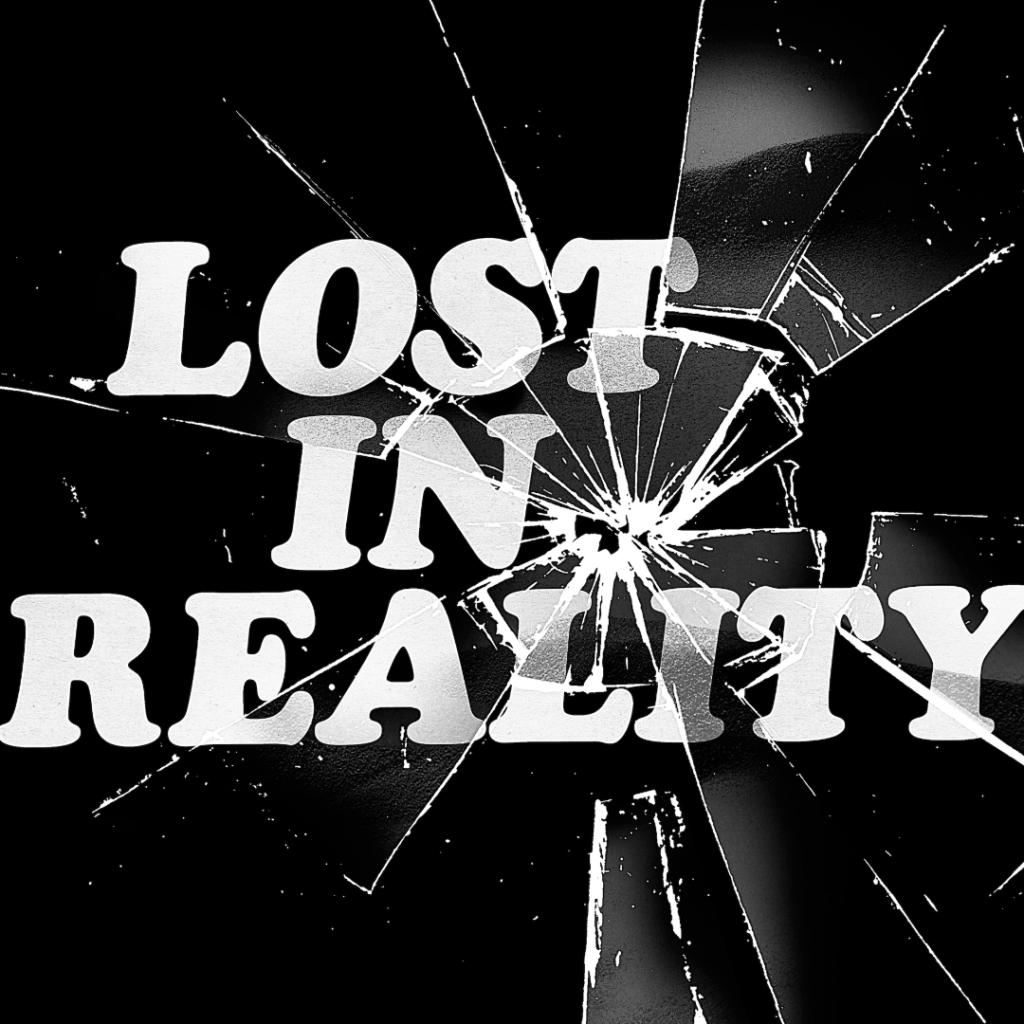
Metro Riders is the project of Stockholm’s Henrik Stelzer, who had always been obsessed with horror cinema – particularly the Italian horror films of the late ’70s and ’80s, as well as John Carpenter’s classics – and he does not hide the fact that he builds heavily on that vibe in his music. His sophomore release, Lost In Reality, came out last week, and the follow-up to his 2017 Europe By Night sees him taking the sound of Metro Riders further into the world of genre music while also crafting something wholly his own. We spoke with Henrik Stelzer about the evolution of Metro Riders…
STARBURST: So many cuts on Lost In Reality are named after films. Are you taking inspiration from the movies as a whole, or are you pulling from certain scenes?
Henrik Stelzer: There are definitely distinct references to both directors, movie titles and characters on Lost In Reality. But overall, I would say that Metro Riders is all about capturing a certain atmosphere.
Whether it’s from a certain scene from Zombi 2 (1979) or just a nostalgic take on experiencing a nearly broken VHS copy of some obscure horror movie from your local Blockbuster in the ’90s. The quality of my recordings and the cover design all become key elements to assist the consumers in placing themselves somewhere else.
On Europe By Night, you have a track named Bruno Mattei, and on Lost In Reality, you have a track named Lia Rousseau, after a character in Mattei’s Hell of the Living Dead. Why are you so attracted to Mattei’s work?
Bruno Mattei is often regarded as the Italian equivalent of Ed Wood in the horror genre. Similar to Ed Wood, Bruno gained notoriety for his frequent use of pre-existing footage, campy visual style, noticeable mistakes, subpar special effects, unconventional casting choices, peculiar storylines, and nonsensical dialogue.
What has always captivated me about Bruno is his unwavering determination to pursue his own ideas and artistic vision, regardless of the circumstances. Despite the limitations he faced, he managed to create something noteworthy and even enchanting if viewed through the right lens. In fact, I am so fascinated by his work that I may release an entire tribute album dedicated to Bruno in the future.
For me, music serves as a means of storytelling as well. Even without lyrics, the titles of musical compositions can serve as a fitting avenue to reference various aspects of our surroundings and pay homage to forgotten treasures.
What is your production methodology like to achieve this sense of age and distortion?
I don’t really have a specific method [laughs]. I rely on my sense of style and intuition to guide me. It took me some time to figure out different designs for the sounds, what equipment to acquire, how to distort them, and how to make them more interesting. However, the more I practised, the more captivating and improved the results became. Nowadays, I don’t panic as much. In the past, I had to depend on a particular tape recorder to achieve that distinctive tape-saturated sound. Nowadays, I know the old machines better and how to tame them for their pristine lo-fi qualities. Sometimes, some tracks took hours to fine-tune into the perfect tape-saturated sound, and sometimes, it was just there on the first take. I then usually let it rest for a day or two before coming back to it, only to realise, “What was I thinking?” And then I re-record again. [Laughs]
This album isn’t as drenched in tape hiss as your debut. What’s the rationale behind that decision?
I’m now more at ease using the obsolete reel-to-reel equipment in my studio. Some of the recordings on my previous album involved fewer takes and were more akin to live sessions rather than standard studio recordings. For me, that approach carried a certain level of risk as it did result in a higher level of noise in the final recordings.
The art for both albums has a certain library music feel. Who designs your covers, and is that what you’re aiming for?
I design the artwork myself; I believe it’s just as important for me to be a part of that process. I think the title credits of old Italian giallo and crime movies very much inspire a lot of the designs for Metro Riders. If you look at any of the titles from that time – like What Have They Done To Solange? for example – they were almost always designed using the typeface Eurostile. Something I was inspired by when doing the artwork for my previous album, Europe By Night, back in 2017.
When I was designing the artwork for Lost in Reality, I was looking into advertising typefaces of that time [’70s–’80s], and I ended up with a bag of references that I found searching old dusty X-rental logos and legal by-lines to the glass-breaking opening credits to Friday the 13th (1980). I always try to find inspiration close to where I want to position my music without being too obvious.
You can buy Henrik Stelzer’s Metro Riders music here.