Britt Ekland | THE WICKER MAN

britt ekland wicker man

by Daniel Goodwin

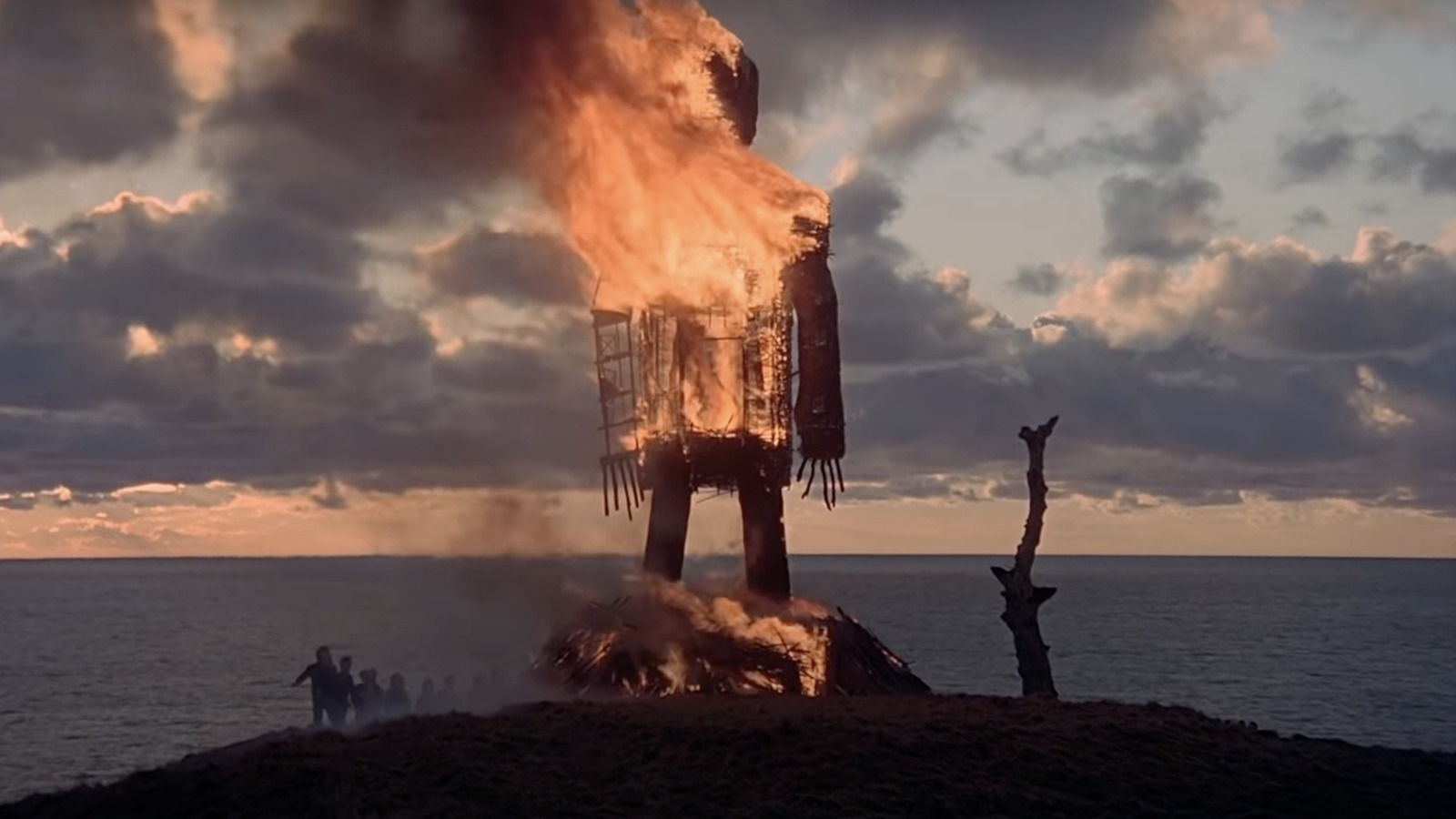
It’s hard to believe it’s been fifty years since that giant wicker man at the end of Robin Hardy’s classic was set ablaze on the cliff tops off Burrow Head, Scotland, in what became one of the most powerful and shocking film endings ever. The Wicker Man was part of a new wave of more mature horror movies that emerged in the early ‘70s alongside The Exorcist, The Texas Chain Saw Massacre and Don’t Look Now, signalling a sea change from the gaudy genre B-pictures and Hammer films that preceded it. Sadly, most of its key cast and crew have since passed away, but STARBURST was lucky to recently catch up with lead actor Britt Ekland (who played Willow) at StudioCanal’s office in central London.

Upon arrival at the glass-walled office, in a lobby occupied by various wicker creatures, Ekland was friendly, lively, and spirited, casually commenting on the dexterity of the ballet dancers we could see through the window in the building opposite.

She was also keen to discuss her memories of the production, how The Wicker Man led to her starring in The Man With The Golden Gun, and a planned but scrapped sequel to the folk horror classic that was nearly made in the 1980s.

STARBURST: It’s been fifty years since you made the film; how do you feel looking back? Do you have any good memories of the production? 

Britt Ekland: I didn’t actually realise fifty years had passed until my son said to me about a month ago that it’s his fiftieth birthday in June. Then I realised that The Wicker Man also turns fifty. Such a long time ago! I keep diaries but don’t have a good memory of specific things. The one thing that stayed in my mind from the production is this endless procession. Walking and walking and walking across the moors with nothing around us. We walked towards the sea, another time towards the Wicker Man, then towards the cave where Rowan, the missing girl, was hiding.

It looked quite a joyful production because there was a lot of singing and frivolity despite its darker moments. 

It wasn’t! We were meant to be wandering around a beautiful sun-filled island that had this good fortune of bearing fruit and being beautiful and gorgeous because it was set in the summer, but instead, we were on the west coast of Scotland, wandering in the typical UK weather in October and November so it was grey, damp, and cold. We were all wearing these… indescribable summer clothes. They weren’t modern, and they weren’t old. It was actually quite a brilliant wardrobe because the outfits could have been from today, but they weren’t particularly ‘70s, either.

Do you remember how you came about the project and what first attracted you to it? 

I had done quite a few films before it and my agent, who was a very close friend, said: “There is this film, it’s in Scotland, it’s low budget, not a lot of money,” but we are actors, we get paid for our work. If we don’t work, we don’t get paid, and this was the next thing that came along. I thought I could deal with the kind of nudity that I read in the script, but in the end, I only bared my breasts. They could not use my bottom, but they said it was fine, so that’s how I agreed to do the film.

Did you get on okay with the cast and crew? 

We were all kind of separate people. I was pregnant and felt very alone, but I did become friendly with Diane Cilento, who played the school teacher, Miss Rose. Not so much with Ingrid Pitt, Christopher Lee, or Edward Woodward. They were all solitary people, so from that point of view, it was a very lonely project. We didn’t have a community like on The Man With The Golden Gun where Maud Adams and I became best friends and are still best friends today. Roger Moore was very open and welcoming and fun on that. Hervé Villechaize was cute and fun, but he just liked to chase girls, so we never saw him outside of filming. He was very friendly and cheeky, but the minute he saw a skirt, he was off. We didn’t have that kind of community on The Wicker Man.
How did you find working with director Robin Hardy? 

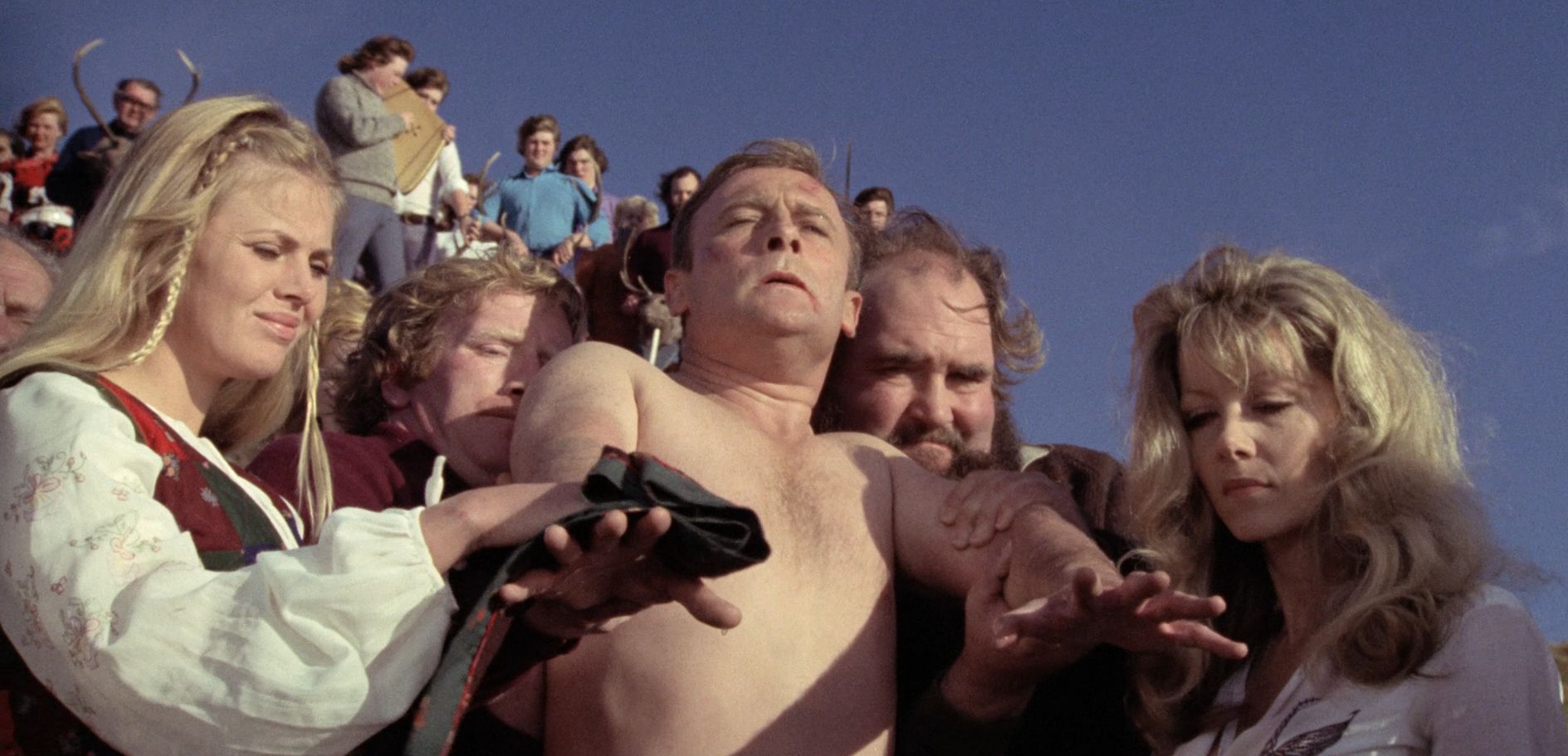
I don’t think he liked me very much, but he had his own problems. The film had problems with financing. Robin had heart problems, so I think it was hard to get the insurance, but ultimately, he didn’t like me. I think Ingrid Pitt wanted my role but because she was the Queen of Hammer and Christopher Lee was the King of Hammer, and this wasn’t really that kind of horror film. I think they felt if they put Ingrid and Christopher Lee in the leading roles, it would just become another so-called Hammer Horror. I know Christopher wanted to throw off his Hammer coat and become something else, and this was his first film to give him the opportunity to do that.

The Wicker Man was part of a new wave of more serious horror films that seemed to go against what Hammer represented at the time. Did you realise while you were filming that it was becoming something special? 

No, not at all. Because I was pregnant as soon as we finished filming, I did no promotion or interviews or anything like that. I should’ve checked my diaries, but I don’t remember ever even seeing the film until it was re-released, I think, in 2014, when I took my youngest son to see it. Now, when I watch it, I can see the merits, but it wasn’t a happy experience to work on.

Robin Hardy described it as a melodrama musical. 

It’s a different kind of horror, for sure, but the music and beat were important. Gave it an eerie, creepy feeling.

Is it right that there were marketing and distribution issues following the production? 

Oh yes, it just got buried. If we use Hammer as an example, marketing those films was easy. There were fangs, blood, and black capes with red that were very important. The Wicker Man didn’t have any of that. It did have the most shocking ending of any film ever. No one has ever done anything as spectacular as that, but I think it took a long time for the promoters to realise they could put it in a different niche. They put it in a double bill with Don’t Look Now, but I don’t think that did as well as they hoped. The Wicker Man’s reputation grew over time, and it’s fans have made it what it is today.
Did The Wicker Man open new doors for you in terms of getting more roles and job offers? We were wondering if the Christopher Lee connection may have led to you working together again on The Man With The Golden Gun

No, not at all. Golden Gun had nothing to do with Christopher. Apparently, Cubby Brocolli saw The Wicker Man and, as I was pregnant at the time and had beautiful bosoms, he thought I would be a good Bond girl. But even before that, I read the book by Ian Flemming and dressed up as the Mary Goodnight character, who was a secretary – in those days, we called the women who did that kind of job ‘the secretary’; properly dressed with her hair up, white blouse, and covered up. No high heels, just walking shoes. So I dressed just how I thought the secretary should and walked to Cubby’s office, as I lived just around the corner. I walked in and asked if I could see him. Because I was already a well-known actress, I could do that. Cubby told me they just take the title of Flemming’s books and re-write them, but he thanked me for coming.

Then, on the way out, Roger Moore came in. I had met Roger previously when I was married to Peter Sellers, so we said hello, and then I went off to America to do a movie and thought nothing more of it until on the plane back to London six or seven weeks later. I was reading an English newspaper that said: ‘Swedish girl, the new Bond girl’. And I thought, “Oh… wonderful”. But then I heard from someone else that Maud Adams got the part. When I got home, my agent called and said I’ve got to go and see Cubby Brocolli immediately. I was so naïve I thought Cubby was just going to apologise that he had to give the part to someone else. I literally got off the plane, rushed down to his office, and when I got there, he burst open the doors with the script in his hand and said: “You are Mary Goodnight”, and he handed me the script. It was very dramatic. I ran home after, all excited, knowing that a really fun and important adventure had just started in my life.

It sounds it. Many years later, Robin Hardy made a sequel to The Wicker Man called The Wicker Tree. Were you ever asked to be involved in that at any point? 

Well… let’s go back. I became very friendly with Tony Shaffer [The Wicker Man’s screenwriter]. Then in the ‘80s, when I was married to Slim Jim [Phantom, drummer of The Stray Cats], Tony came to LA and gave me a script for the second Wicker Man. There was a cocktail party with very influential people to raise money for it. So I had the script and photos of me and Tony Shaffer at this cocktail party… but nothing ever came of it. Then, in the ‘90s, I lived in London off Fulham Road by Chelsea Football Ground, and Tony’s studio was opposite Marsden Hospital, Fulham Road. We met up, and I went over to have lunch with him. We talked some more about it, but then he sadly passed away, so… I knew there was The Wicker Tree, and I was offered a role in a version set in Iceland where I had to live alone in a hut somewhere and speak a strange language that they made up. It was so far-fetched, but it never happened. After that, years later, came Robin Hardy’s film, and I said I couldn’t do that.

The original Wicker Man has since become such a cult classic and still seems to be influencing folk horror films today, like Midsommar and Enys Men. What is it about the original that has such appeal and longevity? 

I think it’s the ending. A lot of people do pagan ritual horror films now with characters masquerading as people they’re not, but no one has ever topped that ending. I think even if people come to the film for the first time and already know the ending, they like to see the build-up to it so you can watch in disbelief and false hope in maybe thinking that a helicopter will come and rescue him at any moment, but that doesn’t happen. The film just leaves you in this state of total disbelief, stunned with no sense of relief. I think that is the appeal.

STUDIOCANAL has restored all three cuts of THE WICKER MAN in honour of the 50th anniversary. All three versions of the film will be released in an exclusive Collector’s Edition and on 4K UHD for the first time on September 25th. The 5-disc Collector’s Edition will also include an exclusive EP from Heavenly Records, a 64-page booklet with brand new essays, 3 ‘Postcards from Summerisle’ and 2 posters of the new and original artwork. The film will also be released as a Steelbook and on Digital.  


Spotlight: KNIGHTS OF THE ZODIAC

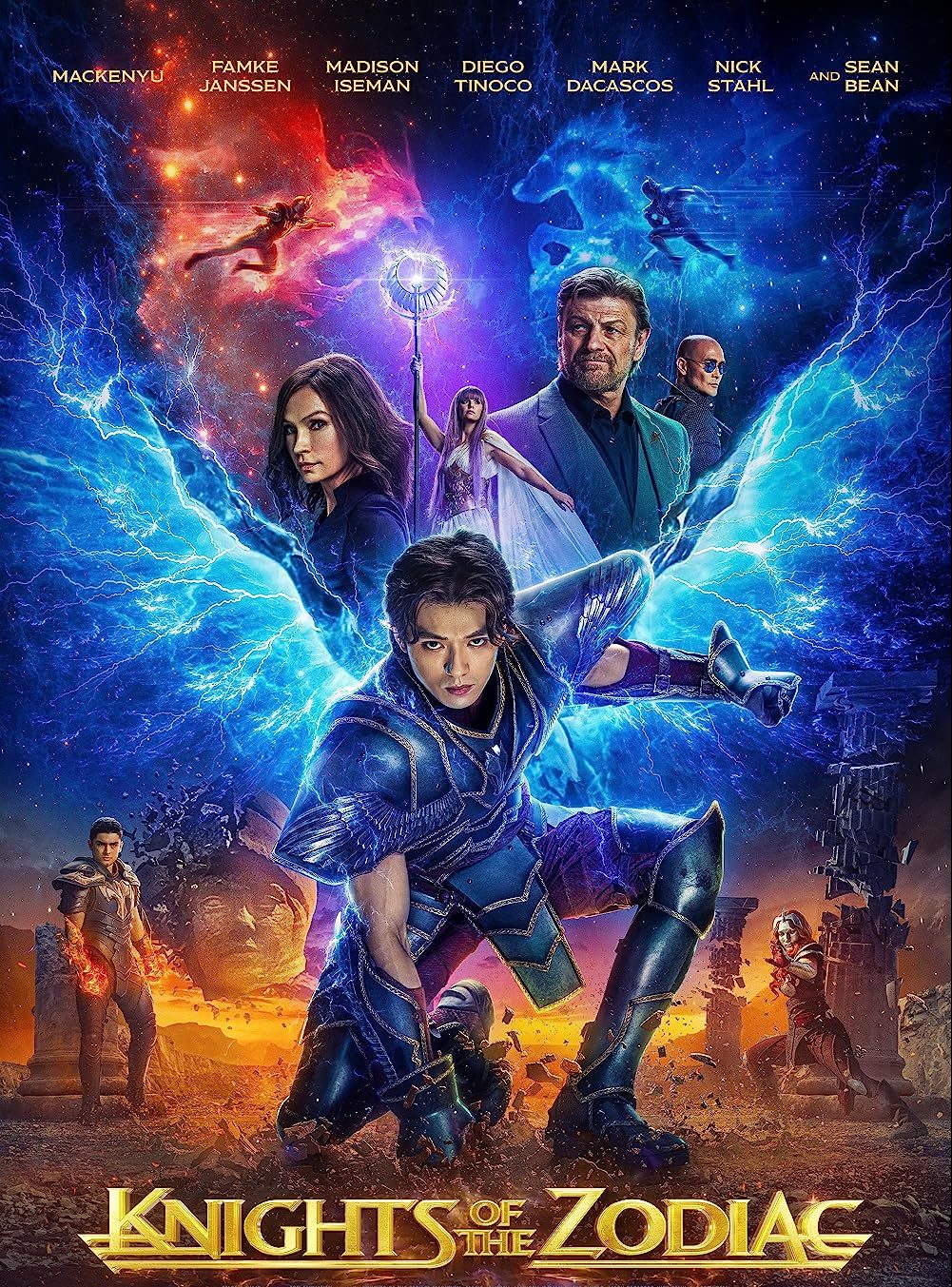
Cult franchise KNIGHTS OF THE ZODIAC has a massive global outside the UK and USA. The new live-action version of this classic anime and manga phenomenon – coming soon to Digital – features Sean Bean, Famke Janssen, and a whole host of special effects. STARBURST brings you up to speed…

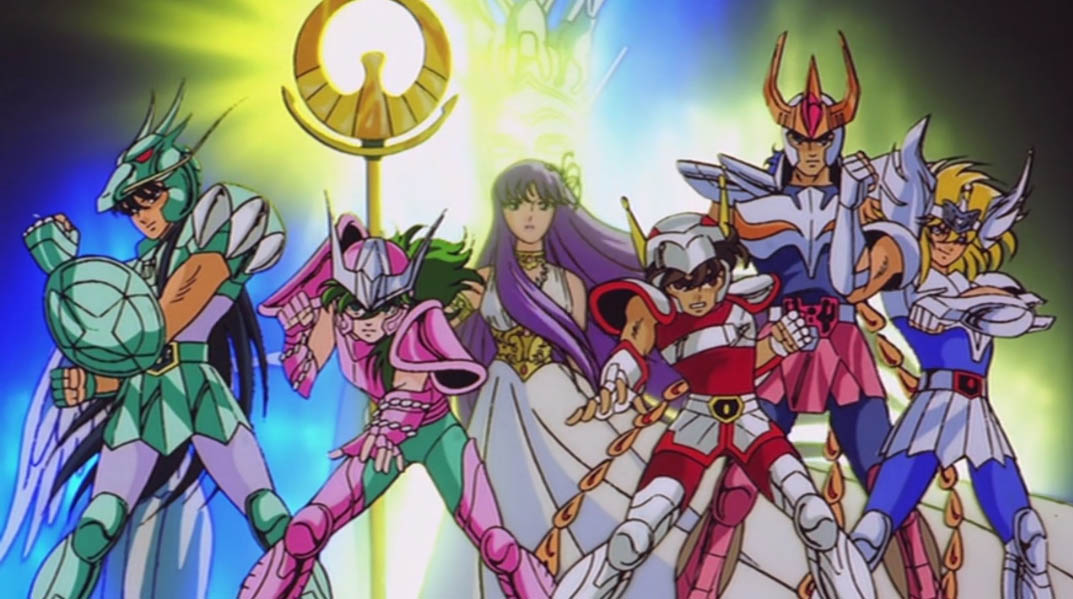
Knights of the Zodiac is better known to most of the world as Saint Seiya or, if you’re Japanese, Seinto Seiya. It’s a long-running manga that appeared in Japan’s Weekly Shōnen Jump magazine in 1986. It was created by the legendary Masami Kurumada. Originally intended as a sports drama inspired by The Karate Kid, the story quickly mutated into a tale of magically powered martial artists. Those powers come from cloths and magical armours that are powered by the constellations, and together, they protect the Goddess Athena, who in turn defends the Earth from all the other Greek gods. These 88 warriors (divided into bronze, silver, and golden ranks) use Cosmos Energy, which focuses the awesome power of the stars, allowing them to achieve amazing feats of strength and power. The animated show was developed simultaneously and ran for an astonishing 114 episodes before getting cancelled. Only the first two main story arcs from the comics (the Sanctuary Act and The Poseidon Act) originally made it to the screen.

Saint Seiya was rebranded as Knights of the Zodiac in the ’80s and ’90s for European audiences. Known as I Cavalieri dello zodiaco in Italy, Les Chevaliers du Zodiaque in France and Los Caballeros del Zodiaco in the Spanish-speaking world, the show picked up a huge international cult following. This is partly due to the ‘very violent for the time’ storylines that involved super-powered teens beating the snot out of each other and also because it has a very catchy and memorable theme song. Many of the adventures had a tournament format, with heroes and villains facing off for ridiculously over-the-top fights in almost every episode, with an added element of soap opera drama for spice.

In the 2000s, there was an attempt to launch Knights of the Zodiac in the US and UK off the back of shows like Sailor Moon and Power Rangers. Alas, much of the violence was edited out to widen the show’s appeal, and the heavy metal theme song was replaced with bland American rock. Up against shows like Samurai Jack, the rapidly ageing show fared poorly. Re-edited and reissued versions of the original anime and manga did gather something of a cult following in the US and were devoured by fans in the rest of the world, alongside a whole range of cool action figures from Bandai.

Fans would have to wait until 2002 before an animated version of the final Hades act made it to the screen. However, the show had a huge following in Japan, and the final act sparked a revival of interest in the franchise with new animated shows, comic books, toys and, of course, the inevitable Funko Pops.

Knights of Zodiac has been an incredible influence on the superhero martial arts genre, but as it’s almost unknown in the US, many American fans think that it’s corny as they’ve seen shows inspired by the franchise before seeing the original. This hasn’t stopped the rest of the world from enjoying it, though.

The live-action movie came out this year and is a special effects extravaganza that barely touches the lore of this epic franchise, focusing on the origins of Athena’s arrival on the mortal realm and the rise of her beloved protector, the knight Seiya. The movie is notable because it’s written as the first chapter in an ongoing series, touching lightly on the complicated lore behind the franchise’s success. With the exception of Seiya and Athena, many of the cast play characters considered minor by the fandom. We caught up briefly with some of the cast, mostly to talk about the movie’s spectacular combat scenes and effects.

Famke Janssen should be well known to STARBURST readers for her work in movies such as GoldenEye and the X-Men franchise. In Knight of the Zodiac, she plays the main villain, Guraad, who seeks to destroy Seiya. Famke was unfamiliar with the source material before beginning the project but told us she’s now a huge fan. She had much fun with the various effects shots during the production, especially with the virtual sets. “A lot of people use this new technology. It gives this very discombobulated feel because the background is attached to the camera movement. And so when you’re on set, it looks like your backdrop moves around. So everything sort of lunged when I stood up. I was like, what’s going on? But it’s a lot like doing green screen, which I’ve done it so many times.

Diego Tinoco plays Guraad’s main henchman, Nero. We asked him more about working with the various special effects. “It was my first time working with wires. I had no idea, and I had this first thought right when punching the camera. I was trying to perform an action, and suddenly, I got yanked backwards super fast! I go flying across the room, and I hit these padded mats. I had no idea that was going to happen. I mean, they prep people, but you can’t really prep for that feeling of flying into the air. So it was pretty crazy for me.

Nick Stahl is perhaps best known as John Connor in Terminator 3: Rise of the Machines. In Knights of the Zodiac, he plays the thuggish Cassios. He features in the movie’s many action-intensive scenes. “I was very glad I was able to train with the stunt team early on; I think I was there a month early. By the time we filmed, it was like we eased into it.

Madison Iseman plays the character of Athena. She told us, “There’s a scene where Athena has to float in the sky and be a goddess. There was a question of whether it would be wires or whatever. They made a rig where I was sitting on a bicycle seat, and they would lever me up into the sky. And it made so much sense because I was able to float without being hauled necessarily. They did such a great job on the heavy lifting!

KNIGHTS OF THE ZODIAC is available to buy on Digital from September 25th


An Oral History of THE (UNAUTHORIZED) I HATE BARNEY SONGBOOK

by Dylan Greenberg

I loved Barney And Friends as a kid. I had toys, tapes and even a Barney themed birthday party. As I approached tween-hood, I pretended to shun his teachings, but I still held a fondness for the kitsch creation and his crustaceous colleagues Baby Bop and BJ. To hate Barney was a blasphemy against my pop culture Jesus.

What I would soon discover was that Barney hate had been so deeply embedded into the cultural zeitgeist that in 1995, some unexpected names in the music industry created a musical roast of sorts for Sheryl Leache’s iconic creation. Unearthing this pop oddity set me on a new Barney journey, one that would lead directly to the players involved in this surreal undertaking.

First of all, what makes Barney so hateable? I asked Critical Inquiry editor W.J.T. Mitchell, a Gaylord Donnelly Distinguished Service Professor of English and Art History at the University of Chicago.

“I think it had to do with not just Barney, but with the whole tendency in children’s television to eliminate any trace of conflict, any kind of picturesque or gritty material. Barney was completely sanitised.”

Mitchell goes on to describe his studies on how young children would react to images of various dinosaurs.

[When] it came to Barney… it was really astonishing, they had all of these jump rope rhymes, jokes, my favorite being, ‘I love you, you love me, Barney gave me H.I.V.’”

So, I said, “Could you explain this to me?” These were first and second graders. Some of the kids said, “I still like Barney, what’s wrong with Barney?” Many of the others said, “Barney is for little kids. He’s for kids who can’t handle anything complicated or difficult.”

So, it was really about generational conflict between four, five and six year olds. By the time kids are six years old, they can’t bare Barney. If they have siblings, they say “that’s my little brother’s thing, and my little brother is stupid, he doesn’t know anything.”

Fifth Avenue Records and Tapes is where I discovered the genesis of this article. Some time last year, I was browsing the CDs, when behind some dusty glass casing, something caught my eye: “The Unauthorized I Hate Barney Songbook: A Parody”. I had to have it.

I initially assumed it was made by a few guys in their basement. The idea of an entire album dedicated to hating Barney seemed like something that wouldn’t have utilised any great talent. Then I looked on the back cover, and realized all the songs are sung by Freda Payne, who reached #3 on the Billboard charts with her hit “Band of Gold”, one of Rolling Stone Magazine’s 500 Greatest Songs of All Time. Prominently featured below was Tony Haynes, listed as primary songwriter. A quick search revealed Tony had written for such blockbuster acts as Earth, Wind and Fire, The Temptations, Robert Palmer, and the Pointer Sisters. This album didn’t just utilize talent, it was created by two music industry icons.

I knew I had to get to the bottom of this somehow, and I realized if I could get some of the people involved with this project to talk to me, I could create an oral history of the album. Over the next two weeks, I was able to interview three of the key figures involved in the album; Cindy Jo Hinkleman, the production coordinator, Tony Haynes, the primary songwriter, and none other than the legendary Freda Payne herself.

When I told Freda I wanted to interview her about this album, her initial response was one of bewilderment.

Freda: “Why are you interested in that?!”

Production coordinator Cindy Jo shed some light on the married couple that owned Dove Audio, the company responsible for the album:

Michael Viner and Deborah Raffin… owned Dove Audio at the time. Michael was a very powerful man in Hollywood, Deborah was an actress. She was in Death Wish 3 with Charles Bronson. It was one of the very first companies that did audiobooks… I was production coordinator on all their titles. Their approach to [marketing] audiobooks at the time, and one of the reasons they got Freda, was that they wanted only big name celebrities to record them. Michael was written up as one of the top ten most feared men in Hollywood. You did not cross Michael. Him and I got along great, we were the best of friends… but you didn’t cross him. For one of the ten most feared men in Hollywood to release I Hate Barney… It was just kind of bizarre!”

Tony Haynes: Michael Viner and Deborah Raffin… I had a deal with them, a joint venture to do kid’s audio projects.

Tony had previously created “A Day in the Lives of Dina and Darren Dinosaur” and realized Michael Viner was not going to pay him any royalties.

I’m doing all this work, and I’m not making any money from it. So I asked Michael to let me out of my contract. He says: “I’ll let you out of your contract, but you have to write an album of ‘I Hate Barney’ songs.” I say, “well, you know my oldest daughter is three, and she fucking loves Barney, and I watch Barney every day.” He says, “well, if you want to get out of your contract, do an I Hate Barney songbook.”

So I sat, and over a weekend, I wrote ten songs… I used the piano to write the lyrics. So, by Monday, the ten songs were written, which means they were sketched in a way that I wrote the lyrics, and I could sing them.

Tony worked with various producers, including Oji Pierce, who had produced “This is How We Do it”. Michael Viner ultimately made the decision to have the entire album sung by Freda Payne, who Tony had previously worked with on his “Dina and Darren” project.

Freda: I’d known Michael since I think about 1973, here in LA. It was before he’d established Dove Audio. He was always a fan-friend, more of a friend, I would say. He told me, “Freda, a lot of parents, you know that purple dinosaur on the TV for kids, it’s a dinosaur called Barney, kids are becoming obsessed with it, and a lot of parents are getting sick and tired of it.… we came up with an idea.”

Michael explained to Freda that Tony Haynes had written some parody songs skewering Barney and asked if she would like to sing on them. However, Freda had no personal animosity towards the dinosaur.

Freda: I could have cared less! I said, I have no animosity about Sesame Street, I have no animosity about the Electric Company. So, why should I have any animosity about Barney the dinosaur?

I had a son, but by that time, I think he was probably in his teens. Maybe if he had been younger than that, he may have been into [Barney]. I don’t even know if he was aware of it.

I was wondering why he wanted to do it in the first place. I said you want to do a whole album on this? I thought it was kind of way out. In a way, I felt that, if I agreed to do this, because I was getting paid to do it, I hope I don’t wind up regretting this. I hope it doesn’t come back to haunt me!

Cindy Jo: I remember that Michael said to me one day, “we’re doing an audio book,” even though it’s more of an album, “we’re doing… ‘I Hate Barney.’” I went, “excuse me? Why would you do that?” He was quirky and he loved things that were kind of controversial.

As they moved forward on the project, Michael excitedly told Cindy he had gotten Freda Payne to perform the songs and Tony Haynes to write them.

I thought, “you gotta be kidding me.” Freda Payne, you know, she tore it up, but I don’t know why she agreed to it. The music was fantastic, it’s too bad it wasn’t just some kind of album of great music, instead of I Hate Barney.

To Freda, it was just another project.

Freda Payne: When the record company says, “we think you should do some blues songs” or “we think you should do an album of all American songbook songs”, you know, you pick a theme. It was a deviation from the norm.

It was now up to these key figures at Dove Audio to deliver the songbook on time.

Cindy Jo: My role was… to make sure that all the steps in the process got done, that everything got recorded, that everything got mastered, that the artwork was done, and that it was delivered on time.

Tony Haynes: This project was very, “let’s just get it done”. The [songs] were all unique, written off the top of my head, from the beginning. Even though [Michael] got credit as producer, he didn’t produce the project. It was basically me.

Tony intended to create a narrative around the album, with some songs illustrating an inner conflict of a Barney hater.

Tony: Each song tells its own story – “I hate him, but maybe I hate him because I want to be him.” Most people don’t like things because they’re so simple… they want to make things complicated. They say “Barney’s not so complicated at all, but I hate him anyway.”

Tony may not have trusted Michael, but he still considered him a friend.

Tony: I really liked Michael a lot… He was ornery, he was mean, but you knew what you were getting. I loved his wife Deborah, gorgeous, great actress. You knew he was gonna fuck you, but at least you knew that he wasn’t going to do it behind your back, he’s just gonna do it.

Cindy Jo sheds some light on the power Michael held at the time. In 1995, during the height of the OJ Simpson trial, he became obsessed with capitalising off of it.

Cindy Jo: The next thing I know, he’s like “were gonna do a book.” I say “what?” He says, “Faye Resnick.” I say “who’s Faye Resnick?” He says “Faye was one of Nicole Brown Simpson’s best friends. We’re going to publish a book, it’s called ‘Nicole Brown Simpson, The Private Diaries of A Life Interrupted, by Faye Resnick”.

Reportedly, Michael had paid Faye Resnick enough to make a down payment on a nice house in LA in exchange for her information. When the book was released, Judge Ito summoned Michael personally to his chambers.

Cindy Jo: He said “Mr. Viner, you must cease and desist pushing this book” And Michael said “I won’t”. Michael proceeded with publishing his book, and Judge Ito called him in again. He said “you have to stop this.” And Michael said “I won’t”. And he didn’t… he got away with it. I remember, I walked into his office after the second meeting, and he told me about it, and I said “you are gonna get yourself thrown in jail!” But he didn’t. That’s an example of his power… It was wild.

Cindy recalls the first time she met Tony Haynes, during the Barney project.

Cindy Jo: He came by the office to pick me up and he pulled up in this older Rolls Royce… As we were driving I said “Tony! Your car is awesome!” he says “yeah, I bought it from Kenny Rodgers.”

Tony: Kenny Rodgers owned the Rolls Royce first, he drove it from Texas to California. He sold it to Lionel Ritchie, and Lionel sold it to somebody else, and that somebody else sold it to Gene Simmons. I met Gene Simmons, and I talked to him about the car over lunch. [Eventually] I bought it from a car lot in San Fernando valley. Tupac bought one because I had one, and he put the eyepatch on because I wear an eyepatch. A lot people liked the fact that a brother was running around in a Rolls Royce back in those times.

Once the book was released, the marketing for it was a bit unorthodox.

Cindy Jo: It was marketed as an audiobook, which was odd. I don’t think the target audience was children. The songs weren’t recorded as kid-sounding songs, they were more well produced, you know what I mean?

Tony Haynes: The target audience was parents who were sick of Barney and the kids who didn’t really like him. I wrote the songs to appeal to parents, but also appeal to youngsters who could dance to it. I didn’t make the quality as perfect as you’d want, so it would feel a little bootlegged, and feel a little like, “yeah, that’s how I feel, a little ornery.”

I asked WJT Mitchell to explain the psychology that would allow this album – or “audiobook” – to have had any sort of anticipated audience. What made Barney so unsavoury that the album could be placed into retail outlets all across America?

WJT Mitchell: If you wanted to go really deeply into it, there’s the whole theory of the transitional object. Donald Winnicott, the psychiatrist, studied things like security blankets, and he talked about the transitional object, the teddy bear is the classic, but kids adopt objects, security blankets, teddy bears, other stuff, toys. They get very attached. [An adult] can’t just grab the bear and do anything they want to it. It makes the kid very upset. On the other hand, they can do anything they want to it, and often they will be very violent with this thing they love. So, the transitional object is a very interesting object of both love and hate. That’s the more general phenomena, I think, that Barney was an attempt to market a transitional object that was pure goodness.

However, not everyone hated Barney. In fact, a lot of people were angry that Dove would release a work that mocked Barney, and let the company know.

Cindy Jo: There were reviews, and I remember the company got phone calls and letters, this was right before email. I think it was really because Barney was so beloved at the time, and the marketing for Barney was amazing at the time. Sesame Street got pushed aside, everything got pushed aside for Barney the purple dinosaur. Then this company comes out with this CD of “I Hate Barney”, and moms and dads from everywhere were just appalled.

Kaia PopTart is a 37-year-old artist who bought “The Unauthorized I Hate Barney Songbook” when she was 9 or 10.

Kaia: I picked it up at some bargain store when I was in elementary school. I got some rock music trading cards from the same store. That’s how I started getting into extreme music. I remember being very disappointed in it. I was under the impression that it would be a little more edgy, but it was just some lady singing parodies of Barney songs and not swearing at all… I probably only listened to it a couple times and went back to my Ren and Stimpy tape.

Tony Haynes: People hated it, because people love Barney so much, but Michael built his business [taking] popular culture and doing the opposite, nobody could do that better than him. I knew [this criticism] would come, so I also had songs on there that were complimentary to Barney, that give you a well rounded thing in between that. At the same time, a lot of people liked the fact because they didn’t like Barney. It was 50/50.

However, Freda says the public’s anger didn’t come near her.

Freda: You know, don’t harm the messenger. I mean, it wasn’t my idea, it was their idea.

An oft-repeated rhyme heard on many a playground and school bus is “I Hate You, You Hate Me. Let’s Get Together and Kill Barney.” Tony tells me wherever it came from, his album had nothing to do with that.

Tony: My lyrics are “I hate you, you hate me, we’re a wacko family, with a great big hug and a yuck from me and you, won’t you say you hate me too.” There’s no reference of killing Barney. We don’t hate him to that point. It’s all tongue in cheek, and not as mean as I could have gone. You don’t really want kids to be that mean, which is why we had the song “No and shut up”, and “Stupidee Dupidee Ideas”, and even with the Barney song, it’s irreverent to a point, but not to where Barney needs to go out and get security.

Soon after the album, many employees began leaving Dove Audio as it sunk into commercial decline.

Tony: Dove had its own problems with money, so they couldn’t market it the way they wanted, because people were suing them over other things, and the OJ book.

Cindy Jo: Michael started to publish more controversial things.. that was about the time I left. I got a call… [I was] asked “do you want a job doing all the artist interviews on American Top 40?” I said “Sorry Michael and Deborah, I have to go!” When I left they bought me an engraved Tiffany bracelet. I was so touched by that. This little CD you found has such stories!

Tony: This project helped me later, because I wrote for Animaniacs, Pinky and the Brain, Barbie, Looney Tunes, and now I’m out creating television shows and novels, and I’m out pitching stuff. This project was actually the project that showed me, I can write musicals, novels, and all the things, ‘cause it was out of my initial comfort zone but became the benchmark for everything. I’ve written 34 children’s books. This was a monumental thing looking back.

It seemed like everyone involved with the album went on to do great things. I asked what they were up to these days.

Cindy Jo: I’m currently acting, developing a feature film and developing a YouTube show. I’m also still working in audiobooks, directing, editing and proofing.

Freda Payne: I have a new EP that’s out now, it was released a few months ago, it’s a jazz album, and it’s called Let There Be Love. I did a duet with Johnny Mathis, I did with Kenny Lattimore, Dee Dee Bridgewater and Kurt Elling.

Tony Haynes: To see what I’m working on now, you can go on iamtonyhaynes.com.… I’m pitching and meeting with people to put shows out. The goal is to build a multi-billion dollar business. It’s like if you were the same guy who created The Blacklist, Two and a Half Men, Modern Family, that’s what I’m doing. I’m going to give you an example of my gift, I’m going to give you a gift. All you have to do is write your name on the left side of a piece of paper downwards. I’m gonna create a poem that spells your name within one minute. Then, give it a title. Something about you, in your life.

I chose the title “Grateful”, as I was grateful Tony had taken the time to talk to me. Off the top of his head, Tony recited this poem to me:

GRATEFUL

Daily I am grateful

Yesterday too

Looking at my future

And from that point of view

Nothing makes me more grateful

Gratitude is the key

Recalling things that were

Every day I am grateful for

Each new thing that occurs

Nothing compares to gratitude

Because it is the key

Everything about it

Reveals new

Grateful things in me

Tony had said it best; I was grateful for all the people involved who chose to speak with me, and for the fact that there was such an interesting story behind this seemingly simple concept. Most of all, however, I was grateful for Barney; for those who love him, and for those who hate him.

Marisha Ray | CANDELA OBSCURA

by Ed Fortune

Marisha Ray is an American voice actor, best known for their role as Keyleth in The Legends of Vox Machina.  Their credits include video games such as Persona 4. Fire Emblem and Metal Gear, though they are better known for their various beloved characters on hit actual play TTRPG show Critical Role. Marisha is also Critical Role’s Creative Director.  We caught up with her to talk about her latest role in a brand new live-play show, the horror based detective mystery, Candela Obscura:The Circle of Needle and Thread.

STARBURST: How would you describe Candela Obscura,The Circle of Needle and Thread, to a fan of Agatha Christie style murder mysteries?

Marisha Ray: Instead of investigating a murder, Candela Obscura is an investigation into the human condition under extraordinary circumstances. The Circle of Needle and Thread really leans into that concept. Horror is such a provocative genre that allows you to explore very real existential and systemic issues with a removed layer of reality separated by a thin layer of latex and exploding blood packets. This next chapter of Candela hosts a very thin veil between fiction and the global nightmares that keep us up at night. In a way, it’s very cathartic, albeit extremely vulnerable both from a player and an audience perspective.

Who is your character? And why did you make those choices? Did you draw upon anything specific for that role?

One of the many beauties of Candela Obscura, the game, is that you go through character creation with your fellow table members. This allows you to build characters with rich connections and integrated backstories. When I entered into this chapter, I already knew I wanted to play someone older and wiser, and a bit off type to what I usually play. But it was quickly revealed in our Session Zero, our kickoff where we build our interpersonal relationships, that these kids needed a mother figure! The more we all talked as a group, that informed Aunt Beatrix’s disposition and outlook on life. There was so much shared trauma – all of them broken and beaten from the choices of bureaucrats that none of them will ever meet. This pushed me in a direction to make Aunt Bee the optimist of the group. There needed to be someone with the heart of gold who defends the choice to fight for the good side of society, even if that same society is what broke you to begin with. It’s fraught, and flawed, and I love it.

How do you prepare for this role, and is it a different routine for Critical Role?

It’s certainly more intense. It’s like deciding to eat a packet of concentrated lemonade powder without diluting it with water – It’ll make your eyes water, and you’ll feel the burn, but damn that rush is worth it.

What draws you most to this particular world?

I’ve always been fascinated by anything that is weird historical fiction and adjacent. Those worlds that feel similar to our own, but are just a few clicks away into an otherworldly dimension. You’re allowed to have a certain amount of agency while simultaneously never being able to rest on your laurels. Everyday items, environments, or situations can quickly shift into an interdenominational cosmic nightmare that makes you question your entire reality. This world is nothing less than spine-tingling!

Why tell this story in this format? Why not an audio drama or a short story?

With Candela Obscura, and any TTRPG Live Play, there’s always two stories happening simultaneously: the communal story that the GM and the players are telling within the game, and the meta story that’s happening above the table as everyone is experiencing what’s unfolding together in real time. When it comes to horror, like with Candela, there’s a kick you get in your brain when you imagine what’s being described. And, as always, whatever you imagine tends to be far worse than if you had a visual representation. But then there’s a whole other layer of enjoyment watching people get the absolute shit scared out of them! HAHA!

Candela Obscura is a very specific genre, as is Critical Role. Is there another types of world/genre you’d like to explore, and if so, what and why?

Oh, so many. Truly, this is just the first of many worlds and genres we wish to explore. Whether it be a sci-fi space opera, or a gritty crime drama – ultimately, we just want to tell stories about the human condition. Various genres allow us to do that while informing the tone, pace, and backdrop. It’s always refreshing to mix things up. Variety is the spice of life, both in fiction and the real world.

If you were to rescue a piece of media/art and keep it safe until the sun died out, what would it be?

Can I say Drag? Just the entire art form that is Drag. Not that it needs rescuing, but it does need to be kept safe. Drag has always been very informative and important to me since my early days in theater. Even if you’re not a part of the LGBTQ+ community, Drag can introduce you to incredible ideas of self expression and freedom. If you haven’t been to a local live drag show before, GO! It’s a blast, and you’ll see some true artistry!

What recent piece of media has delighted you the most and why?

Kentucky Route Zero. I am almost evangelical about this game; I’ve never played anything like it. For those unfamiliar, I try to describe it as being like a point-and-click ‘choose your own adventure’, but instead of choosing how the plot of the story progresses, you choose how to view it and through which character’s perspective. Beyond that, the whole thing is an independent project made by a handful of creators with the help of crowdfunding. It’s a magical realism masterpiece that explores the horrors of debt, and the trickle down effect of trauma that it causes. Plus it’s got some great original bluegrass tunes! I’m always a fan of when people make something new out of an old toolbox, and KR0 is a great example of that. Even if you don’t like games, I highly recommend you check this out for the story alone.

What is the future of TTRPGs? Is it okay to pronounce TTRPG as ‘Titterpig?’

Well it seems the future of TTRPG’s is ‘Titterpig’ now doesn’t it? Done and done. 

Where can we see the show? Should we dress up?

This is absolutely your opportunity to pull out those Edwardian clothes you have in your closet that you wore once for Halloween that one year when Sweeney Todd was super popular. I love a good opportunity to dress up! And you can show off your sick duds at any of our Cinemark showings of Candela on Thursday, August 31st! You can also watch the premiere on Critical Role’s Twitch and Youtube at 7pm Pacific!

For more details on Critical Role and Candela Obscura, click here.

Luis Carazo | CANDELA OBSCURA

by Ed Fortune

Luis Carazo is an actor best known for his roles in the likes of The Last Ship and NCIS: Los Angeles. He’s best known to gaming fans for his role as Zerxus Ilerez in the D&D live play show Exandria Unlimited: Calamity. We caught up with him to talk about his latest role in a brand new live-play show, the horror-based detective mystery Candela Obscura:The Circle of Needle and Thread.

STARBURST: How would you describe The Circle of Needle and Thread to a fan of Columbo?

Luis Carazo: I believe the format of how a case begins in Candela is similar to Columbo, and part of what is compelling is watching how the investigators piece together clues and what they do to try to solve the case. But in Candela Chapter Two, there’s quite a bit of personal history carried by the characters that give it a certain kind of weight.

Who is your character? And why did you make those choices? Did you draw upon anything specific for that role?

I play Marion, who, to use Auntie B’s [Marisha’s PC] words, is a “sweet boy”. He’s a good kid with a good heart who never lost that as he grew up because he had to hold onto that part of himself due to what was taken from him as a child. In spite of that, he has a very pure and almost simple-minded way of seeing the world. He’s loosely inspired by one of my favourite stories, Pinocchio. I was really curious about exploring something parallel to how Pinocchio is trying to become ‘a real boy’ because he feels he would be discarded if he remains as he is.As things unfolded, I wanted to see what would happen if and when he was well on the other side of that lesson.

How do you prepare for this role, and is it a different routine for Critical Role?

The way I prepare for any role depends on the specific demands of that role and the story we’re in, but I always involve some way to try to get behind how they see the world and how they believe others see them. With Marion, I spent a lot of time thinking about a very specific event from his childhood and also some events in the war he experienced with Sean and Nathaniel, Brennan and Travis’s characters, and how that all shaped his POV and what he fears about and hopes for in the future. 

We last saw you in Calamity. That was intense. How does this compare?

I’ll just say… this is intense [laughs]. 

What draws you most to this particular world? Why this particular genre?

Ooooo, I really like the horror genre. I like dark stories, puzzles and mysteries. There’s so much potential for all of that in Candela. It’s exciting to me.  

What other roles in other worlds would you like to play?

I really want to play in a sci-fi futuristic setting, but it looks like I’m about to scratch that itch… 

If you were to rescue a piece of media/art and keep it safe until the sun died out, what would it be?

The Man Who Fell In Love with The Moon by Tom Spanbauer and The God of Small Things by Arundhati Roy. I know I picked two…

What recent piece of media has delighted you the most and why?

Pan’s Labyrinth. I know it’s not recent, but it will always stay with me.

What is the future of TTRPGs? Is it okay to pronounce TTRPG as ‘Titterpig?’

I’ve never heard titterpig [laughs]. Sounds naughty! More and more people are noticing the power of collaborative storytelling that is TTRPG. I think they’re only going to grow.

Where can we see the show? Should we dress up?

August 31st on the Critical Role Twitch channel, plus at select Cinemark movie theatres! As for dressing up, I’m all for it! And if you want to let me know what you think of Candela, or Calamity, or if you want to keep up with what I have around the corner, find me by just searching my first and last name on any social media, including Instagram, Blue Sky, Threads, and Twitter.

Dara Taylor | STRAYS

Dara Taylor | STRAYS

By Nick Spacek

Composer Dara Taylor‘s work can be found in films as diverse as the madcap comedy Barb & Star Go to Vista del Mar and the dramatic The Tender Bar, along with director Jessica M. Thompson’s modern vampire tale, The Invitation. Her score for the new NSFW animal comedy, Strays sees her working in both comedy and action, resulting in “a score that speaks to the heart of the film and its characters, which is finding your support and chosen family.” We spoke with the composer about her work for this new film.

STARBURST: What attracted you to Strays? The idea sounds like a kid’s movie, but then you see that first trailer, and it’s very much apparent this is not a kid’s movie.

Dara Taylor: No. No children allowed. I read the script, and it was hilarious. I had also worked with the director, Josh Greenbaum, before on Barb & Star Go to Vista del Mar, so I already knew his work and his directing style, and I know he makes things that are peak ridiculous and just so funny. This was just hilarious from start to finish.

What’s the process of getting started on this? The process of a movie with animals like this and how they make the film is a little bit different than the usual filmmaking process.

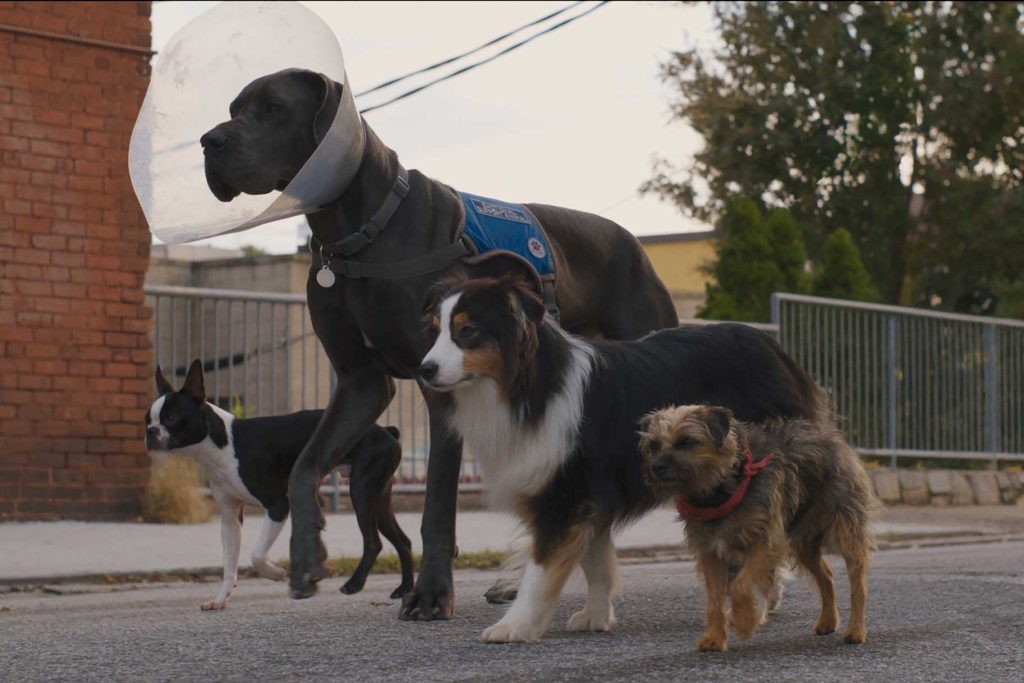
Yeah. And especially with four dogs almost all the time, they had to hit their marks, and they had to hit them together. It was fun to watch the different layers of VFX removing things over time or adding things. I think for the longest time, for most of my process, the mouths weren’t fully finished yet, so so I had just gotten used to hearing it as narration.

Other than that, though, it is like working on any other film or any other comedy. I started working while I think they were in production, and I started coming up with some thematic ideas and trying a few things out and sending those over and fine-tuning those until we were ready to start really getting into it.

Strays has this action-comedy vibe, which really demonstrates that, with each new project you work on, you add a new thing to your repertoire.

Yeah. Action comedy has definitely got a fine line that you have to walk between funny and rousing. A lot of it is taking the situation as seriously as the dogs take the situation but also not overplaying your hands, so it feels like a spoof. It’s definitely a fine line, and comedy, in general, is a fine line. I mean, I love comedy in general. If I’m watching something, it’s usually a comedy.

You’ve been able to work with the director twice – what does that allow you to do, in terms of your process, when you already have an idea of how they work, even though it might not be what they want for this film?

I think the best thing is being able to kind of refer back to both old music and old processes and old spotting things. Even old notes from the previous film were like, “Okay, remember how we fine-tuned this? Let’s do something like this timing-wise that we did before.” There was a scene in Barb & Star that had a lot of starts and stops for comedy, and there was a similar scene here. We referred back to that to see if we should play it like we played it then or play it slightly differently.

You came up with different themes for the four different dogs that are in this movie. How did you approach each of those?

There’s a main theme for Reggie, and that kind of became the main theme of the movie and for the journey. Then there’s a theme for Bug, and there’s a melody that refers to the two other characters in certain moments. I’m trying not to give spoilers as we talk about it. [laughs] But yeah, I mean, we didn’t go too Peter and the Wolf with it: “Okay, this person’s on screen, so let’s do their theme,” but some things felt recognisable throughout, and I really hung my hat mostly on Reggie’s theme ’cause that really became the melody of the movie and of the journey.

This film is out now, but we’re curious as to how what you do as a composer has been affected by the strikes that are going on.

I’m grateful to be working at the moment, but there is a time when I’m like, “Okay, I don’t know what the next thing is,” and it’s hard to find the next job because so many things are just paused. So yeah – not sending out nearly as many reels and submissions as I was before all these strikes happened!

The thing about the strikes is that, sure, the first one started in May, but it’s been looming since February, so there was trepidation even then. It’s been a very odd year overall, and we’re just all hoping that a fair resolution can be reached.

Strays is out now in UK and US cinemas.

Ariella Como Stoian | HIVE

Hive hero image (Credit: Graphic Design Lily McStocker) Image Description: The colourful silhouettes of two people - one slightly taller than the other - standing next to each other, facing forward with a dark purple background. The silhouettes are made from a collage of eldritch insects in different colours, reds and oranges in the centre of the figures, and blues and purples on their edges.

by Ed Fortune

Ariella Como Stoian is a queer playwright and immersive and interactive theatre-maker who specialises in speculative fiction and magical realism. Their latest work is Hive, a queer, cross-generational, sci-fi play exploring family, shared memory and the meaning of home. We caught up with Ariella to find out more.

STARBURST: How would you pitch Hive to someone who reads a lot of dystopian fiction?
Ariella Como Stoia: I would say Hive is an example of soft world building, where the impact on lives and relationships of a speculative world is shown in the everyday. I’d say while some elements of Hive’s dystopia are exaggerated and fantastical, a lot of it is close and recognisable, slightly heightened, but definitely not a world where humans have emigrated off planet to mine more silicon and live in a replicated exclusionary status quo run by a benevolent yet misguided AI or something.

It’s a gentle apocalypse, like our own. And the dystopian themes speak more to how we live with uncertainty and imagine beyond catastrophe, in this case, when we’ve lost someone or something, and we’re trying to reconfigure our sense of home and family anew. Where nothing is easily resolved and, in fact, gets more wildly, delightfully chaotic. So it’s not 1984. That’s what I would say. And then I’d probably ask what they were currently reading.

What makes this weird fiction?
That question is a bit of a spoiler! But I suppose it is weird fiction in how elements of the story sit at the axis of fear, awe, and the sublime, which can’t be understood in literal, pragmatic parameters. The play holds dread and fascination with the unknown, something that hardly fits in the human mind but is inspired by its imagination and limbic-system production value. This multiplicity and warring complexity are also the joy of the piece. I would say the strategies of weird fiction are central to how the characters in the play – Ria and Salve – connect, disconnect and reconnect, blending quasi-sci-fi with weird nature and inexplicable magic.

I hope I’ve been both subtle and informative here. I may have said nothing.

What inspired this show?
Like many things, it’s made of many parts.

At the beginning of the year, I was commissioned to write a piece for The Space on the Isle of Dogs, so Hive became situated through that relationship, sense of place and history of rapid development.

A lot of which sits close to my own experiences around the loss of home, family, and displacement. I’ve also weathered storms and heat waves and experienced disrupted migration patterns that have driven waves of moths into the cities they were flying away from. Plastering windows and doors to the point you can’t see out past their many legs and wriggling confusion.

I would say as well my experiences of grief have been key inspirations in this show, and my relationship with my mum, who is a single working mum like Ria. Whodathunk? I am a non-binary, queer writer, and the character of Salve is a non-binary teen whose identity is never in question in the play. They never have to explain themselves or come out. Rather their story is about processing radical changes in their family structure in a turbulent world and figuring out how to hold and remember someone who gave them acceptance, strength and love. To process a shared yet distinct grief together, as well as having to address the material impact of a loss and subsequent decisions around their home.

Casual representation of queer identities is hugely important to me, as well as discussions being had around grief and change that doesn’t try to solve or resolve anything fully but rather sit in the messy, loving strangeness that grief brings and how it transforms the world, whichever world that may be, but how we remember together.

Then all of these many ideas filtered through my brain, which happens to process and understand through storytelling, particularly through lenses of sci-fi, worldbuilding and the gloriously odd.

Who is this for? It is intended for a mostly queer audience?

I would say Hive is not just for queer audiences, though I’d obviously love all kinds of queers to show up. I think the central relationship between single mum/conservationist Ria and adventurous teenage kid Salve is very relatable for everyone, even if you’re not coming from a direct experience of their context. At the heart of it, the piece is a poetic romp about love, loss, and how you communicate with someone who is going through a very similar experience to you in a weird, complex world. Highly relevant to a number of folks, I’d imagine, and the story is very invested in this relationship between a parent and teen struggling to connect, as well as their previous multi-generational family dynamic.

Why theatre? What does theatre bring to this story that other formats don’t?

Great question. I’d say the imaginative possibilities that theatre provides. I’ve always felt that there was an expansive scope to theatre that could allow you to both question how we understand and construct our reality but playfully and joyfully imagine new possibilities. In a way, the play almost operates like a game of DnD where you’re being offered descriptions of a world that you’re imaginatively collaborating on, collectively making a story more real, more tangible.

Hive tells its story through the tensions between the aural and visual, expressing the inner and outer dynamics of its humans in an unusual, speculative setting. Their interweaving thoughts, whose rhythm is shared between characters, explore the relationship between a parent and child after the loss of the third pillar of their family, ‘Nan’, and their closeness throughout separate, similar journeys that occupy the same space. This world is built on stage through lyrical language and offers made to an audience’s imagination.

These poetics, the radical empathy this represents and this weird-fiction metaphor is uniquely expressed by theatre in this case and its potential for collaborative, non-naturalistic storytelling.

Why the Edinburgh Fringe?

The Edinburgh Fringe is a place of discovery and community with many willing audiences, and so you learn so much about your work. Hive is an experimental, non-naturalistic play in a lot of ways. Though sometimes when words like experimental are used, I’m a little like, is the way I think and experience the world experimental? I don’t know. Not deliberately. Categories for being a human… The fringe is a place of chance and connection. This is ‘Hive’s’ first outing, and we want to find lots of different folks it speaks to and offer this atmospheric, encompassing world to anyone we can. As well as taking a chance on many other worlds ourselves.

They are thousands of shows at the fringe. Why should Starburst readers seek this out?

It’s a unique experience, gorgeously immersive in its multidisciplinary design and wonderfully distinct in its style of storytelling. Honestly, it is a bit of an unexpected time. Beautiful and eerie, with love poured into it from every member of the team. It’s a brilliant bunch of people working together to realise an adventurous story. Taking you on a journey that allows you to feel and process without demanding a particular response from you, a gentleness held alongside its wild scope. Why wouldn’t you give it a go? It’s cool and genre work, human with a touch of eldritch. Someone said it was like Solaris; someone else said it was like if Annihilation met Studio Ghibli. I’m not sure I agree completely with these takes, but it’s obviously lovely to get the comparisons, particularly to Ghibli. I’m here for it all and looking forward to more references and responses. Nerds assemble.

The Mushmoss Collective list LARP as an inspiration. What sort of LARP have you drawn from in your recent works?

Another great question! Our recent show ‘You wake up/octopus’ (CPT, Theatre Deli, The Space) was developed structurally with inspiration from Nordic Chamber LARP, mixed with a more compositionally-driven, experimental (there’s that word again) play akin to happenings, or collaborative live rehearsals. ‘You wake up/octopus’ is about chosen self, transformation, becoming and memory. It’s a completely silly, otherworldly endeavour where you play one tentacle of a newly conscious octopus who might decide to go to space. So it’s like interspecies roleplay meets a TTRPG, but then you build a spacefaring vessel out of fabric and light with strangers, sharing in the creation of the story, world and soundworld.

Additionally, this show takes place in a shared archival space, filled with games and co-created artefacts, fairy lights, projections and flowers, called the ‘Memory Tree’. Visitor responses and contributions influence the stories that then take place in this archive, developing a collective, joyful, ongoing lore, repositioning what memories we value and how we might collaborate on empathy. (Did someone say tentacular thinking?) Structurally, we were both onboard into the world and shared ‘character’ through interaction and immersion with the ‘Memory Tree’ as well as debriefing post-shows.

‘Hive’ is not interactive, nor does it involve roleplay. It is a traditionally end-on play, but I would say it values these same principles and an imaginative relationship with an audience. Honestly, I’d love to do an immersive, interactive version of the story set in an actual multi-level construction site. But I guess one highly ambitious thing at a time.

How would you describe your process?

I would say my process is made-up of layering and finding resonances between ideas. I’m very driven by rhythms, musicality and humanity in my writing. My work is often referred to as poetic, but I think that’s more to do with a playfulness or irreverence toward language than any kind of sonnet stanning on my side. I’m intuitive, multi-disciplinary, and really excited and enlivened by collaboration between different practices. I’m a tad non-dramatic in my art and really like there to be space held open for audiences or players, as the situation may be. As you’ve probably gotten by the amount of times I’ve used the word, I highly value imagination and possibility. I’m very driven by story, even when it may not be the foremost way of creating meaning in a piece. I’ve only had one commercially viable idea in my life (for a reality tv show), and I hope one day it’ll fund more of our immersive art about jellyfish and space-moths. Or it’ll be stolen and make someone else millions because I keep bragging about it loudly in public. Either way, I won’t shut up about it until I’ve willed it into the world, and that’s my process too.

What media are you currently enjoying?

I’ve been playing Tears of the Kingdom, and as a part of playing TotK, I’ve been on Reddit reading about other people playing TotK and watching other people play TotK on YouTube, as well as consuming all the timeline and Zelda lore videos.

I don’t know if I’ve been enjoying this, though.

I’ve also been reading Ursula Le Guin’s ‘The Lathe of Heaven’ for the first time and watching Boots Riley’s ‘I’m a Virgo’.

What’s next?

While we’re in Edinburgh, we’ll be presenting a scratch of new work, ‘Do plants sleep’ for Summerhall Surgeries. It’s a WIP gamified experience about energy management and choosing to rest, equating everyday tasks with the scope and scale of adventure, i.e brain fog=swamp, etc. Interwoven with quiet reflections, found moments and mutual care with a plant. It’ll be on later in the year for Theatre Deli’s Social Model…& More Festival in London this November.

But we’re hoping Hive has a future life beyond the fringe. We’re looking for the right home!

Tickets for the 2023 Edinburgh Fringe run can be found here. You can find out more about Ariella’s future work here.


Catriona MacColl | ISAAC

Catriona MacColl | ISAAC

by Martin Unsworth

Independent British film Isaac gets its world premiere at this year’s Pigeon Shrine FrightFest as part of the New Blood strand. The film stars STARBURST Fantasy Award-winner for Best Performance Johnny Vivash and Kathryn Louise as a couple who enrol into a trial that involves raising a child created with genetic engineering. Genre legend Catriona MacColl plays the doctor working for the GM company. We caught up with her while the movie was being shot to find out more about her character and more…

STARBURST: What can you tell us about Isaac?

Catriona MacColl: Well, I can tell you that it is quite an ambitious project for a first film, but [writer/director] Tariq Sayed seems to be pulling it off! It’s a horror film, but it’s disturbingly close to home, despite the fact that it’s slightly futuristic – it could be possible. There’s no gore as such. There are some special effects, though. It’s psychologically terrifying, let’s put it like that. There were several reasons why I wanted to do it. The first one is that it’s very, very good. Secondly, the subject matter and the part that was offered to me. She’s a tough lady at the top of the game as a scientist, and it’s a challenging part to play.

How did you how do you approach this character?

As I grow older, I tend to be playing like this more and more. I don’t want to get give away too much of the story, but she’s fairly awesome and frightening from right when she appears, just through what she’s saying. It’s in a very cold and seductively calculating way. She is, nevertheless, a doctor, and the way I have approached the way she looks is terribly important. I had a discussion with Tariq about that. He had a very clear idea of what he wanted her to look like. He gave me the idea that helped me compose the part. I trust myself to be able to play those parts quite well and to be able to have a ball. So I went with my intuition. It seems to be right from what I’ve understood. Tariq seems to be happy with it! So hopefully, I’ve done it right!

Most people will know you from the Fulci films and the like – do you feel your presence brings a level of gravitas to the film?

Quite possibly. I guess I am known as a ‘cult’ actor, but it’s thrilling for me that these young directors want to work with me and that I represent something. I don’t mind at all if I just do short films at this point in my life. There’s a fresh energy to working with the younger generation. I feel I’m helping the younger generation to get off the ground, and that’s very exciting because they’re going to be the filmmakers of tomorrow.

Isaac gets its world premiere at Pigeon Shrine FrightFest on Saturday, August 26th. You can buy tickets here.


Marc Burrows | THE MAGIC OF TERRY PRATCHETT

The Magic of Terry Pratchet - Marc Burrows_photo credit Kim Burrow illustration Andrea c White

by Ed Fortune

Marc Burrows is an award-winning comedian, author, journalist and musician. In 2020 they wrote The Magic of Terry Pratchett, the first-ever full biography of the beloved author, which won the 2021 Locus Award (non-fiction). Their new show, The Magic of Terry Pratchett, is currently on at the Edinburgh Fringe before it tours the UK. We caught up with Marc to find out more.

STARBURST: How would you pitch The Magic of Terry Pratchett to someone who has heard of, but has never read, Terry’s work?

Marc Burrows: This man, Terry Pratchett, was the most-read living author in the English language in the UK for a lot of the ’90s. Whatever ideas you have about the type of books he wrote or the type of people that read them, I promise there’s more to it. That many people can’t be wrong, can they? (Ignore that pile of Fifty Shades of Grey in the corner of the bookshop). I’ve worked really hard to make sure this show will work for people who have never read a Pratchett book as well as it does for people that have read all of them multiple times. It’s the story of a man with a fascinating life who wrote great jokes and had a really interesting worldview. After you’ve seen it, you might even want to pick up one of his books.

Why was the Discworld series so beloved?

That might be the biggest question of all, you know. I can tell you why Terry’s books are great, how nuanced, fascinating, funny, angry, and exciting his work is, how well he understood people, and how vivid his imagination was. But those are just… factors. They’re not explanations. It’s like when someone you love asks you why you love them. You can list a million things you love about them, but you can never really define why you love them.

Why did these books capture the imagination? I’ve got theories. Firstly, it’s that they’re funny. And they’re funny before they’re anything else. That’s important. Secondly, I think Terry understood people, our lives, our thinking, our society, our weird foibles, our strange desires, the best of us and the worst of us better than any other author since Dickens. I mean that sincerely. He could see how and why the world ticked. Something about that resonates. It makes his work addictive, and his characters are people you fall in love with. You read his books, and you want to read another one.

How different is this show from your work with The Men That Will Not Be Blamed For Nothing?

That’s a fantastic question, actually. Because on the one hand, obviously, it’s totally different – The Men is a punk rock/metal band – it’s loud, it’s shouty, it’s a wee bit obnoxious, and it has guitar solos and considerably more swearing.

But… it’s not a massive stretch to see that there’s considerable crossover between Terry’s fans and ours. I think 90% of people who love our band (and there are, weirdly, quite a lot of them) are also Discworld fans. There’s a lot of thematic cross-over. Terry LOVED the Victorian era, and our band is entirely Victorian-themed. He also had a sharp sense of injustice and a filthy sense of humour, both of which we do as well, although remarkably, I’m the only Pratchett fan in the band, despite Andrew, our guitarist, literally being in Good Omens 2.

Why this show? Why now?

I suppose the obnoxious answer is, “Why not?” There’s never a bad time to celebrate Sir Terry. It may as well be now. More broadly, though, I always knew I wanted to turn my book (of the same name) into a stand-up show, although in truth, the show moved quite a long way from the book. Terry’s life is a great story, and his message is powerful – think for yourself, don’t suffer injustice, don’t tell people who they should or shouldn’t be. Have a large brandy. That’s good advice, whatever the year, but in 2023, amid all the fractured identity politics, propaganda, fake news, media saturation, oligarchy, patriarchy and cryptocracy, it feels like a message worth hearing. I just want people to remember him. To say his name. To pick up the books. I think we need it now more than ever.

What is the appeal of the Edinburgh Fringe?

Great falafel and pubs that open late. But aside from that, it’s a completely unique setting. You can see comedy and theatre anywhere, but there’s specific magic to having so much of it in one place. As a comedian, it gives you a chance to write a real show with a beginning, middle and end, something that says something about who you are and your worldview, which isn’t always easy to do in a club set. It’s a rich creative opportunity. It’s also a place where audiences take chances – they’ll go and see something weird, they’ll take a flyer and pop into a show on the off chance they’ll like it. Also, many comedians and performers in such a small, concentrated space for such a long time always run the risk of punching a hole in space-time, and that’s an annual rollercoaster. Terry would use a metaphor here with weights on a rubber sheet, I’m sure.

Why theatre? What does theatre bring to this story that other formats don’t? They are thousands of shows at the fringe. Why should STARBURST readers seek this out?

‘Theatre’ is an interesting word, isn’t it? Is this show ‘theatre;? My natural inclination is to think of it as a stand-up comedy show, which isn’t necessarily the same thing. A “one-man show” is theatre, but stand-up is always stand-up, and though this is a show that can be at times very earnest and deals with some tough subjects, I never wanted to lose sight of writing a comedy show. I was very keen for it to be in the “comedy” part of the Fringe brochure. Terry was a comic author – he was hilarious. The first sentence of the first page of the first Discworld novel has a great honking pun in it “on an astral plane that was never meant to fly”. I wanted the story to be funny, and funny works best out loud. Terry’s jokes sing on the page, but they SCREAM when you read them out. You could also call it a lecture, which is technically true, but I promise I’m funnier than most of your lecturers.

As for why this one? It’s a good story, I promise. It really is. Terry’s life was fascinating, and it’s a joy to be allowed to share it. Plus, you get a free booklet of Terry Pratchett writing unseen since the ’70s. You don’t get that from free-entry improv shows, I promise you that.

What’s your favourite Terry Pratchett work?

My answer to this changes week on week and probably day on day. I think his very best book is probably Nation, a staggering YA story about a young Pacific Islander whose entire world is wiped out by a Tsunami, leaving him to rage at the gods. It’s his masterpiece in every sense of the word. My other favourite is Night Watch, the 29th and angriest Discworld novel and the closest Terry gets to writing a thriller. It’s a really special book.

What’s your next project?

Currently, I’m consumed with Fringe stuff. I’m taking this show, plus its companion show The Magic of Terry Pratchett: The Footnotes, which is a full-on fan core nerd-out in a smaller space straight after the main one, and I’m doing a straight stand-up show every night, Marc Burrows In the Glom of Nit [at City Café at 11.15pm], so that’s kind of filled my thinking. We’re doing a big London performance of The Magic of Terry Pratchett in October at the Bloomsbury Theatre and then touring it next year. Then there’s something that Rob Wilkins, who runs the Pratchett estate, and I are working on together, but I can’t tell you anything about that just yet. I’ve also got a book about Nirvana coming out if I ever get time to finish it, and I want to do a sequel to my last book, The London Boys, which was about Bowie and Marc Bolan’s teenage careers in the ’60s. The next one will deal with their ’70s pomp. And like everyone else, I want to write a novel. Oh, and I’ve started writing songs for the next Before Victoria album, which is my little indie-rock off-shoot from The Men That Will Not Be Blamed For Nothing.

I’m not sure which of these counts as my “next” project 😬.

What media are you currently enjoying?

Predictable answer, but Good Omens 2 is BRILLIANT. Neil has done such a wonderful job of capturing what worked in the first series. I really hope they do a third. I’m also devouring Star Trek: Strange New Worlds season 2, which is, I think, the best season of Trek we’ve had since the ’90s. And in a year that also had Picard Season 3, that’s really saying something. Music: new albums by Blur, Nicky Wire, Tim Arnold. Podcasts: The Inadvisable Trapdoor by Andrew O’Neill.

How can we help?
Say. His. Name. The message of the show is to keep talking about and celebrating Terry Pratchett. With Good Omens 2 being written entirely by Neil Gaiman – and John Finnemore, who has done a great job with it, I want to remind everyone that Terry is sewn into its DNA. Terry still lives while we talk about him. While the ripples are still spreading. As far as the show goes – spread the word! Come see! Find me on social media! I’m @20thCenturyMarc on pretty much everything.

Where can we see the show?
At the Edinburgh Fringe, at the Gilded Balloon Teviot, 2-28th August, with a day off on the 14th, with The Footnotes show straight after at 7pm. Then we’re doing the Bloomsbury Theatre in London on October 14th, which will be a big celebration for the 40th anniversary of Discworld with some really special guests and a tour next year.

The Magic of Terry Pratchett will be performed at 5.30pm in Gilded Balloon Teviot (Dining Room) from August 2nd – 28th (not 14th).

Read our Five Star review of the show here.


Eric Rose | TOMORROW’S CHILD

by Ed Fortune

Eric Rose is the Artistic Director of Ghost River Theatre and the Co- Sound Designer, Director and Adaptor of Tomorrow’s Child, a show based on the Ray Bradbury story of the same name. We caught up with Eric to find out more about this show, which is currently on at the Edinburgh Fringe. 

STARBURST: How would you pitch Tomorrow’s Child to someone new to the fringe?

Eric Rose: Tomorrow’s Child is a one-of-a-kind blindfolded listening experience that brings Ray Bradbury’s retro-futuristic sci-fi world to life through audiences’ imaginations and a high-fidelity soundscape.

Why this particular Ray Bradbury story?

Bradbury is one of the world’s literary sci-fi giants, and he’s at his classic best with Tomorrow’s Child [also published as The Shape of Things in 1948]. Bradbury wrote Tomorrow’s Child coming out of WWII in the late ’40s, imagining the futuristic world of 1988. For audiences in 2023, it’s a retro-futuristic world that is full of a symphony of mechanisms, buttons, motors, and machinery.

In other words, Bradbury’s world is full of mechanical gadgets that make sound, unlike our silent contemporary digital devices. 

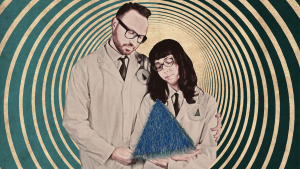
Not to mention Tomorrow’s Child poses some fun and unique sci-fi challenges. For example, creating what it sounds like to be born into the fourth dimension. Or even better, conceptualizing the sounds of a baby in the fourth dimension who appears to everyone as a blue pyramid. These lush audio challenges are a fantastic starting point for a piece of immersive theatre. 

Tomorrow’s Child is mastered for high-fidelity sound featuring more than 10,000 individual sounds created by over 50 artists – making it an extremely vivid, deep listening experience for our blindfolded audiences.

The other reason we chose Tomorrow’s Child is its story. At the time we were making Tomorrow’s Child, I was a new dad, and the struggles of the main character Polly had a significant resonance for me. 

The story follows Polly as a new mother who, in isolation, suffers from postpartum depression, trying to navigate caring for a baby who is different. I believe Polly’s story is especially relevant at a time when the world is emerging out of physical disconnection with a renewed focus on mental wellness. Indeed, the story challenges our assumption of what is ‘normal’ and how we treat families and individuals that don’t conform to traditional ideas of what people or families look or act like. 

Hang on, blindfolds? What does theatre bring to this story that other formats don’t?

Tomorrow’s Child is part of a larger body of Ghost River Theatre’s work which explores what happens to the boundaries of narrative when you focus on stimulating the audience’s senses. When you take away sight – our primary gateway in the world – how do our imaginations open up to narrative? How can being deprived of sight prime us for a unique performance experience? 

At the forefront of Ghost River Theatre’s work is the question of liveness: how we unearth and reveal the world differently for audiences based on the immediacy and interactivity of the performance experience. Tomorrow’s Child, along with our other blindfolded immersive work, challenges us in our devised practice to better understand and trust the imaginary space our audience needs, to fully engage in the live performance experience.

How different is this from other Ghost River Theatre projects?

Tomorrow’s Child is part of a collection of sensory-based immersive experiences produced by Ghost River Theatre over the last decade. 

Would you adapt other classic sci-fi works? 

YES! I am a huge sci-fi fan and love the strange shifting experience of working on stories that ask us to exist between the past, present and future. I am endlessly fascinated by how science fiction defines the present moment by the way we imagine a fictional future. 

As a sidebar, we have had a number of academics write about our production, including an article in the Canadian Theatre Review titled: “Nature Exposed to Our Line of Questioning”: Tomorrow’s Child as Quantum Theatre. Cool, eh?

Why did you bring this particular project to Scotland? 

Scotland has an incredible, complex and rich history that offers a vast perspective when imagining our future. Every day in Scotland, you can’t help but be confronted with architecture, artefacts and monuments that often push up against the contemporary present. So, the Scottish are primed to imagine the retro-futuristic world of Tomorrow’s Child. Also, Edinburgh is renowned for being a city of audiophiles.

Why should STARBURST readers seek this out?

To experience a rare and adventurous immersive audio experience that is surprisingly visual even though the audience is blindfolded! Also, if you are a lover of rich sound and Sci-fi, this experience is for you!

What media are you currently enjoying?

I am a big fan of podcasts (Radio-Lab, The Stranger, Serial, Love and Radio, The Moth) along with TV Series like The Foundation, Westworld, and The Twilight Zone) and am just finishing the classic Stephen King novel, The Tommyknockers.

What are your plans after the Edinburgh Fringe?

Our hope is that we will build a tour for Tomorrow’s Child out of our run in Edinburgh. Immediately after the Fringe, however, Ghost River Theatre will be going into post-production for a new Cli-fi (Climate-change Science Fiction) streaming series, So Dark The Sky, that I co-wrote and directed.

Tomorrow’s Child runs at the Edinburgh Fringe until August 28th, 2023. You can find out more about Ghost River Theatre here.