PRISONERS OF THE GHOSTLAND

prisoners ghostland

In a post-apocalyptic frontier town, a dangerous criminal is press-ganged into a mission for a monstrous warlord. The man known as ‘The Governor’s’ granddaughter is missing, and he wants her found. Nicolas Cage’s ‘Hero’ is strapped into a leather bodysuit, covered in bombs, and released off onto the job. “So cool,” exclaims an awestruck onlooker as Hero rides out into the wasteland on an undersized bicycle. We would tend to agree.

This sense of awe pervades Sion Sono’s Prisoners of the Ghostland. It’s evident that Sono and Cage had a blast working with one another – this post-apocalyptic Samurai Western is a collision of two unique, gonzo, uniquely gonzo sensibilities. Cage has been doing some incredible genre work of late – Mom and Dad, Mandy, Color Out of Space, Willy’s Wonderland, Mom and Dad and Pig, to name but a few. The trend continues here, where he’s great fun as the surly, weird antihero, undermining any badassdom with a series of odd kinks and tics.

With Nicolas Cage all wound up, threatening to ‘karate chop’ people all over the place, Prisoners of the Ghostland is a hard film to take seriously. Thankfully, it doesn’t take itself all that seriously either. Sono’s dystopian hellscape is more Terry Gilliam than Mad Max – an absurdist Escape From New York, infused with its Samurai influences. Meanwhile, Bill Moseley hams it up as the film’s villain, in his best role and performance since The Devil’s Rejects.

Between Cage and Moseley, Prisoners of the Ghostland isn’t lacking in manic energy. Balancing it out, Sofia Boutella is altogether more restrained as the Governor’s granddaughter. While the story of her emancipation is disappointingly weightless, Boutella holds her own against her scenery-chewing co-stars. No mean feat, in a movie in which sees Nicolas Cage screaming about his testicle while Bill Moseley stomps about the place dressed like a 19th Century Plantation owner.

Prisoners of the Ghostland is sometimes too self-consciously cool for its own good; an indulgent odyssey that lets its narrative focus and action sequences slide in favour of eerie visuals, eccentric performances and jarring one-liners. Depth is there if you care to look for it – the lost and the disenfranchised, held prisoner by the ghosts of their own past – but it’s buried under layers of weird cult chanting, creepy mannequins, sneering villainy and… Nicolas Cage screaming the word ‘testicle.’

In the end, we’re all prisoners of a Ghostland – watching, quietly awestruck, as Sion Sono and Nicolas Cage do their thing. And what a thing it is. So cool.

Prisoners of the Ghostland is out on Blu-ray and DVD from November 15th

ETERNALS

Eternals

Critics of the Marvel Cinematic Universe – and even some of its fans, in truth – often complain that the films have a tendency to play safe, to stay true to the tried and tested formula that has pulled in an impressive gazillion dollars (or something closely approximate) at the box office since Iron Man made his debut back in 2008. Marvel has generally clung to the ‘if it ain’t broke, don’t fix it’ truism but, after twenty-five hugely-successful films, it’s inevitable that, in an attempt to avoid audience fatigue and ennui,  Marvel are going to be tempted to rewrite their own rule book to give audiences something a little different, something they might not be expecting. Here comes film number 26, and it’s Chloé Zhao’s Eternals, loosely based on Jack Kirby’s frankly bonkers short-lived 1976  cosmic comic book series and it is indeed a marked change of direction – to an extent – for Marvel, most notably in that it’s not very good. Eternals is dull, it’s boring, and it’s quite epically uninvolving.

The omens were really rather good for Eternals. An Oscar winner in the director’s chair (although the film was long in the can by the time Zhao picked up her statuette last year for the acclaimed Nomadland – kudos to Kevin Feige and the Marvel Bunch for spotting her potential and giving her the gig long before the awards started flying in her direction) and an impressively diverse and inclusive cast; what could possibly go wrong?  On the evidence of the achingly-long film now on our screens – this unwieldy, clumsy thing weighs in at over two and a half hours – almost everything beyond Ben Davis’ stunning, widescreen cinematography that gives the film a sense of the epic, its script and story never remotely lives up to. There’s precious little flair from the director’s chair up on the screen; it’s as if Zhao leapt at the challenge of directing a big-time, big bucks Marvel movie – she had a hand in the script too – but became quite overwhelmed by the process of actually delivering a pacey, interesting movie full of well-rounded, likeable characters.

Eternals is the story of a bunch of superannuated space beings (apparently from the planet Olympia) who have been hiding on Earth for centuries, having seen off a race of bland beasties called Deviants. In Kirby’s original comic, the Deviants were a wily, intelligent species with their own society and civilisation but here they are little more than convenient, rather dreary cannon fodder.  The Eternals each go their own way once the Deviants are demolished but, having been unable to interfere with the affairs of Man in the intervening centuries,  are forced to regroup when the Deviants rear their ugly, CGI heads again… only to find that they themselves are not quite who they thought they were and that an even greater, more CGI threat is lurking under their very feet. As the Deviants break cover again and start to appear at the most inconvenient times in the most inconvenient places, the Eternals are forced to call upon their extraordinary abilities – the usual stuff; flying, throwing bolts of light around, laser beams from the eyes, etc – to keep the beasties at bay. Slowly they begin to reassemble from all around the world as they prepare to fight an enemy that threatens the future of the entire planet. It all sounds quite exciting if a bit generic, but the execution has none of the pace and excitement of even one of the weaker previous MCU entries (Thor: Ragnarok and Captain Marvel spring to mind) because the script is all over the place and the narrative is never allowed to build up any momentum. No sooner have we watched a noisy, rather samey CGI battle sequence that at least briefly piques our interest, than we are plunged into another interminably tedious talky bit where two of the Eternals stand somewhere very pretty – on a beach, on a cliff, on top of a mountain – and gaze dreamily into the middle distance whilst pondering the story so far and their place in the great cosmic plan and how hard it is to be a God hiding in plain sight on a planet of warlike primitives. Repeat and rinse for the better part of three hours. A game cast does its best to enliven the proceedings but they’re hampered by a wildly schizophrenic script that wants to be portentous and pretentious but has to throw in a few classic Marvel quips and one-liners as a bit of an insurance policy in case the audience is too jolted by the shock of the new.  Eternals is a film that would like to be new and bold and different but somewhere along the line Marvel has bottled it and decided that they’d quite like it to be a bit unusual but also quite similar to everything that’s gone before.

Superhero movies really need warm, intriguing characters for the audience to invest in and to help them navigate that difficult ‘suspension of disbelief’ pitfall. Eternals really has none. Gemma Chan plays the empathetic Sersi but there’s precious little life in her dialogue or her performance and almost no conviction in her centuries-long love for Richard Madden’s Superman-ish Ikaris. Kumail Nanjiani’s Kingo, a Bollywood superstar when he’s not an Eternal, is tasked with providing the film’s humour but it’s Marvel comedy-by-numbers, jokes for the sake of it and none of them land with anything than other than a dull splat. Elsewhere we have Lia McHugh as the childlike Sprite, Brian Tyree Henry as Phastos, the MCU’s first openly-gay superhero, Lauren Ridloff as superfast Makkari and a handful of others who are really just there to make up the numbers. Angelina Jolie serves up the only real bit of charisma as the balletic, magic staff-wielding Thena who stands around in the background far too much and Salma Hayek is rather wasted the Ajak, the group’s wise spiritual leader.

For all its bombast and its faux bluster, Eternals really doesn’t amount to anything much and certainly doesn’t amount to anything interesting. It commits the cardinal superhero sin of being really, really boring for a really, really long time. Marvel may be commended for realising that they need to ring the changes but they’re done nothing of the sort here and Zhao has simply delivered a slightly schizophrenic, horribly uneven and desperately pedestrian film that’s neither one thing nor the other. It’s a massive Marvel disappointment.

Eternals is in cinemas now.

FINCH

finch

Hollywood tends to end the world with either a bang or a whimper. We either go down in flames, screaming, in bombastic spectacles like Independence Day and 2012 or we are extinguished with a little more dignity and grace, contemplating the fragility of our humanity and our place in the scheme of things in films such as The Quiet Earth and Z for Zachariah. Originally entitled Bios, Miguel Sapochnik’s Finch, starring the ever-dependable Tom Hanks, falls much more squarely into this second category, delivering a poignant, touching, rather poetic – and refreshingly low-key – road movie that really does encapsulate that hoary old SF cliché “what it means to be human” and how the human spirit can be kept alive by the most remarkably mundane and unselfish dramatic imperatives. On the downside, though, the film also features a supporting robot character who often veers dangerously close to Chappie territory in being the most toe-curlingly irritating artificial intelligence in the history of movies before finding a redemption of his own.

Hanks plays Finch, one of the last men on Earth in the wake of an appalling environmental catastrophe that has turned the surface of the planet into a ferocious and inhospitable wilderness. His only company is his beloved dog. But Finch knows that his own time is running out and he finally manages to build a hugely intelligent – if initially naïve – robot to whom he can entrust the care of his dog when he dies. The robot is initially yappy and tiresome and it threatens to upend a quietly-thoughtful and unshowy post-apocalyptic movie that focuses on character and philosophy rather than action and incident – until it too slowly begins to understand its purpose and its place in the scheme of things. Their home compromised by another surface upheaval, Finch, Jeff the robot (played by Caleb Landry Jones) and the dog set off across the devastated country to San Francisco, Finch’s home… but their journey turns into a race against time as Finch is haunted by his own memories of his past failures and weaknesses and time is running out if he is to teach Jeff all he needs to know about bonding with and looking after Finch’s dog.

In many ways, Finch, due for cinema release last October but which has now largely bypassed the multiplex and found a home on Apple TV+, is a companion piece to last year’s moody George Clooney vehicle The Midnight Sky which told a similar understated story of one ailing man finding a reason to stay alive in his last days in a world no longer fit for purpose. Finch is also a story that pays only the barest lip service to the action movie genre – there’s one eerie scene here where Finch, Jeff and the dog flee a devastated city in a hurry, pursued by aggressors who we never see – because it really isn’t about the end of the world itself, more how our protagonist has come to survive it and how his priorities are no longer his own welfare but that of his four-legged companion and how, even as the light of life on Earth flickers, Finch finds a reason to carry on against all the odds just so he can leave his mortal coil safe in the knowledge that his best friend can live on without him.

Finch will probably test the patience of an audience looking for more simplistic action movie fare because it really isn’t that kind of movie. But with some stark, beautiful cinematography, another measured, everyman performance by Hanks and a story that manages to boil down the nature of humanity to its absolute essence – our need to protect those we love and cherish – Finch is a captivating, strangely beautiful and mesmeric movie that will gladden the heart even as it tells its story set at the very end of the human age on Earth. But remember to make allowances for Jeff’s childlike exuberance and keep your teeth gritted until he finally finds and grows into his own sense of purpose.

Finch is available to stream on Apple TV+

THE BOSS BABY 2: FAMILY BUSINESS

boss-baby-2-starburst-review

Back in 2017, it is safe to say that few expected Tom McGrath’s The Boss Baby to be the near $530 million hit that it was for Dreamworks. Inspired by the picture books by Marla Frazee, The Boss Baby was undoubtedly a film that fully played off its central concept and despite it receiving an Academy Award nomination (yes, that really happened), the film was not so much what you’d call Laika, Ghibli or Pixar pushing. So, with this in mind, it is fair to say that few expectations were raised for the return of Alec Baldwin’s bossy chappy in a nappy, but y’know what? This sequel is not bad.

The film is set three decades after the first, as Tim Templeton (James Marsden, who replaces Miles Bakshi and Tobey Maguire) is now an adult, in fact he’s a husband and a father, one whose creativity often runs wild. However, when he finds his own toddler Tina (Amy Sedaris) is an undercover agent at BabyCorp, he must work with his now estranged and super-rich younger brother Ted (Baldwin), as they are technologically de-aged for one last mission to save parent kind from a teacher with a nefarious plan!

The Boss Baby 2: Family Business is a picturesque sequel that aims to hit the mark for adults and kids alike, and while it does not quite manage that feat effortlessly, this sequel still has an unshakable energy level that is so non-stop, that eventually it just about wins you over with its messages of positivity. Plus it has baby ninjas, a mentos volcano and a creepy kid.

Behind the giddiness of its premise though, this is a well-meaning film about appreciation. Appreciation of family, of childhood, of life and of our diverse talents as people. Admittedly you have seen many of these ideas played out before but Michael McCullers’ screenplay and McGrath’s direction keeps on throwing the heart at you, as well as conjuring up some impressively madcap set pieces and some visual magic to boot.

It helps no end that there is an equally energetic set of vocal performances here too, with Baldwin making some of the sardonic gags work best, as this film seems to tone down some of the more poopy jokes from before thankfully. Meanwhile Jeff Goldblum’s (who is always a welcome presence in any movie) pop slurping baddie especially soars, stealing multiple scenes, while James McGrath’s Wizzie (Tim’s childhood sentient wizard alarm clock) is an unsung joy in multiple moments. As is an attitudinal pay called Precious.

The Boss Baby 2: Family Business is a silly animation, and it owns that. But it is also one that sometimes speaks to kids, and then to adults in constant succession. To some this may urge them to ask who the core audience actually is but c’mon, we all know the answer to that. Family Business means well and is nice, inoffensive and colourful family entertainment, that accomplishes its task of returning to this unexpectedly successful baby-verse and finding something fun to do in the process. Even if this writer didn’t go gaga, likely some of the kids will and, well, they are kind of the target audience after all aren’t they.

THE BOSS BABY: FAMILY BUSINESS is showing now in cinemas

LANTERN’S LANE

lantern's lane

Writer/director Justin LaReau’s follow-up to A Demon Within is a melting pot of ideas. Urban legends, remote locations, past friendships, and a slasher are all squished together in Lantern’s Lane and the resulting soup isn’t that flavoursome.

Layla (Brooke Butler) has returned to her home town to meet up with an old friend, Missy (Ashley Doris). While she’s waiting for her to finish working in a bar, she sees a few faces from the past. One being Shana (Sydney Carvill), the younger sister of a school friend who died by suicide. Against her better judgement, Missy convinces Layla to go to Lantern’s Lane, a place they used to hang out that has all manner of mystery. Shana and another of their friends, Jason (Andy Cohen) go along, Jason being the designated driver for the night so the girls can party. Once they get to Lantern’s Lane, amongst the high jinks something very sinister begins happening.

Lantern’s Lane suffers from unoriginality, sure, but that’s not what sinks it. Not only does it take too long to get going, but when it does, there are a little too many false jump scares that lessen the effect of any actual fright that might happen later on. The actors do well with the material, but are let down by the stretches of logic and – particularly in the climax – unreal injury endurance!

None of the characters are particularly likeable and that’s a problem when we’re meant to be concerned for their outcome. The sound mix doesn’t help with build tension or believability, either, particularly in the opening scenes where the ambience is off. The fantastic location is not used to its potential but certainly looks great, which is a credit to the cinematographer Tate McCurdy.

Lantern’s Lane isn’t a complete right-off, but seasoned horror fans are suggested to look elsewhere.

Lantern’s Lane is released theatrical/VOD in the US on November 5th.

THE HARDER THEY FALL

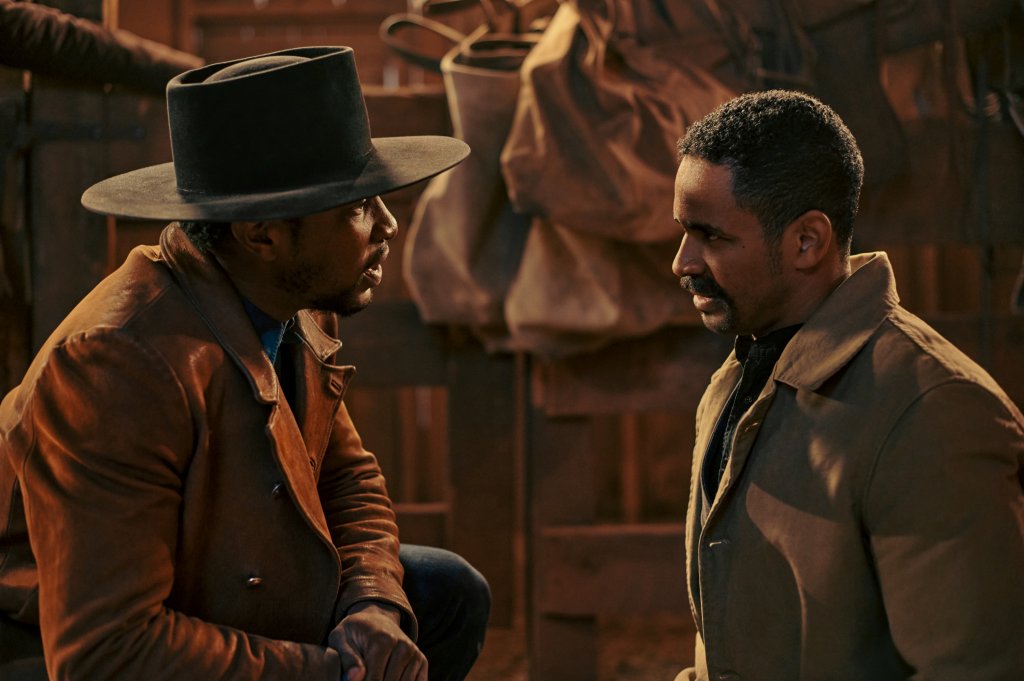
Jonathan Majors and Zazie Beetz in Netflix Western The Harder They Fall by director Jeymes Samuel

A high-impact, ultra-glossy revenge Western from first-time director Jeymes Samuel (also known as British musician The Bullitts), The Harder They Fall reclaims the quintessentially American genre with killer style and ice cool confidence.

When Nat Love (natural born movie star Jonathan Majors) discovers that the man who brutally murdered his parents, his sworn enemy Rufus Buck (an impassive Idris Elba) has been freed from prison, he rounds up his rag-tag team of outlaws to track him down and seek revenge.

Jonathan Majors as Nat Love and Damon Wayans Jr in The Harder They Fall

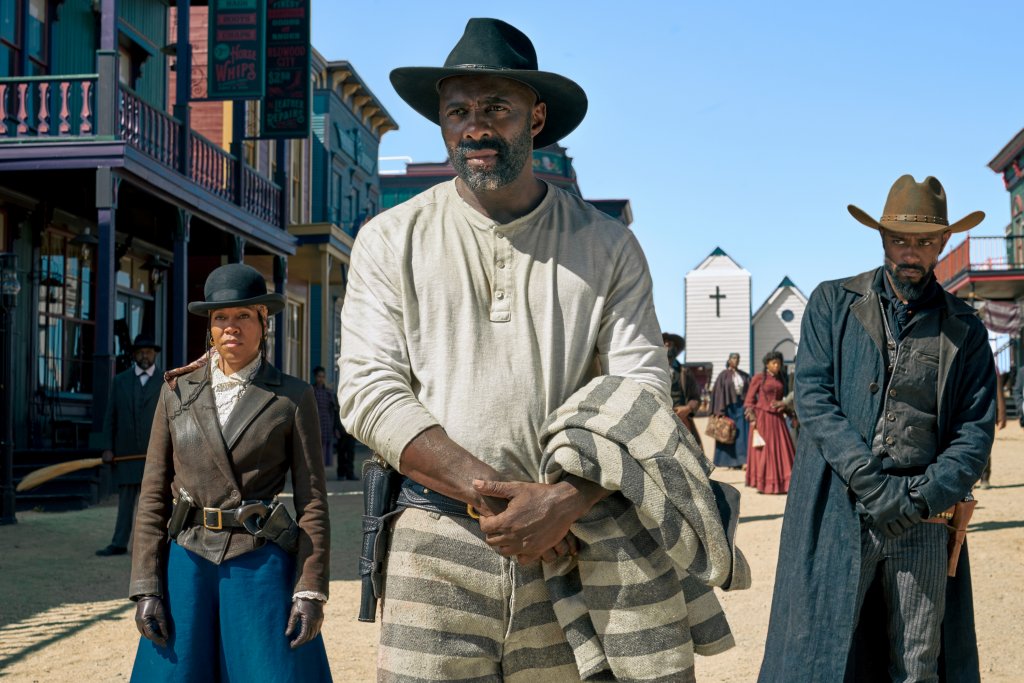
Love’s team includes the level-headed sharpshooter Bill Picket (Edi Gathegi), the trigger-happy Jim Beckworth (RJ Cyler), the quietly assured Cuffee (Danielle Deadwyler), local marshal Bass Reeves (Delroy Lindo, in all his usual glory) and of course, Stagecoach Mary (Zazie Beetz, single-handedly bringing top hats back into fashion), with whom Nat is still desperately in love. Riding at Rufus’ side meanwhile, are certified badass, “Treacherous” Trudy Smith (Regina King) and the oh-so-slick Cherokee Bill (LaKeith Stanfield).

The screenplay is textbook Western, a straightforward story that depicts a crime, an ensuing pursuit of the wrongdoer, followed by the hero enacting his revenge – complete of course with arid landscapes, rowdy saloons, pistol-twirling, and creatively staged shootouts. Yet the fact that The Harder They Fall abides by the expected genre beats makes its assertion all the more potent: the Old West was not the whitewashed world Hollywood thinks it was.

Idris Elba, Regina King and Lakeith Stanfield in The Harder They Fall

Veteran actors like King, Elba, and Lindo bring the easy magnetism the film needs to re-envision Westerns’ deeply embedded iconography. The lone figure on horseback is a Black woman. The weary sheriff is a Black man. The saloon owner wears her hair in a proud afro. The Western belongs to them, and didn’t it always?

To be clear though, this isn’t a case of Hamilton-ising history – if you will: “While the events of this story are fictional,” punches the opening card, “These. People. Existed.” The idea of rival factions of Black cowboys does not require any stretch of the imagination; in fact, many historians now estimate that over a quarter of 19th century cowboys and gunslingers were Black. Likewise, though their stories may be fictionalised, The Harder They Fall’s outlaws are drawn from real-life figures.

This is made yet more impactful by the fact that Samuel’s characters exist in a mostly self-contained world, one where whiteness is kept to the side lines and those rare sightings (“Maysville (it’s a white town)”) are used only for comedic effect. In the past where Westerns have included Black characters, the parameters of their existence have been established in relation to whiteness. Whether oppressed by it, saved by it, or trying to escape it, whiteness is all too often a defining force of Black representation in the genre. But just like its characters, The Harder They Fall flatly refuses to play by anyone else’s rules and casts its story through a sleekly modern lens.

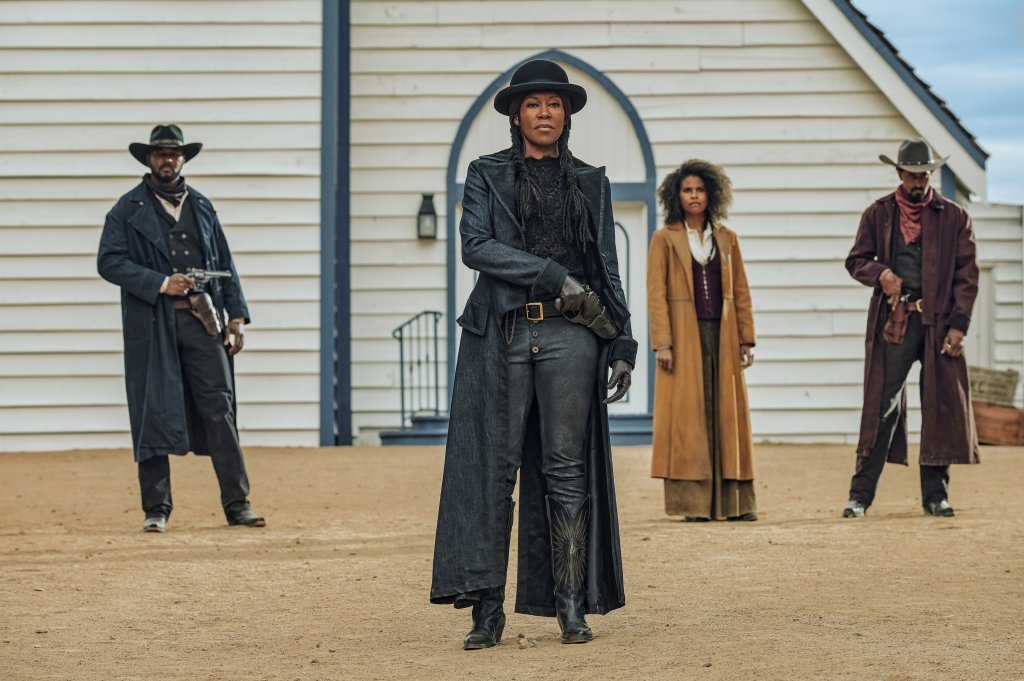
Regina King, Zazie Beetz and LaKeith Stanfield standoff in The Harder They Fall

The killer soundtrack contributes a lot to that feeling, featuring original songs by Jay-Z (who also produces), Ms. Lauryn Hill, Kid Cudi, Koffee, Seal and more, spinning sounds from reggae, Motown, soul, dancehall, and hip hop into a rich and evocative companion piece to the on-screen action. The latter of which does not disappoint; flashes of grindhouse violence build to an epic showdown with a body count to match.

Everything, from the unflinching violence, inspired costuming, and theatrical dialogue, work to push the point that style of this level can be its own sort of substance. The Harder They Fall doesn’t need to justify its existence to be meaningful, nor does it owe it to anyone an explanation; it can just be a cool, gung ho, pulpy Black Western.

The Harder They Fall releases on Netflix from November 3rd. Watch the trailer below and read our interview with star Edi Gathegi

ANTLERS

antlers

The filmography of Scott Cooper is thematically dark. The weight of guilt and regret, of suppressed emotion and the darkness of the human soul run through his films and characters, whether it is Christian Bale’s troubled veteran soldier in Hostiles (2017) or Jeff Bridges’ washed-out country singer in Crazy Heart (2009). When you blend that filmmaking sensibility with Guillermo del Toro’s creative, often monstrous flare you have a rich well from which to draw. The result is Antlers, a dark, unflinching horror fantasy that channels the talents of both men.

In a decaying blue-collar Oregon town, Sheriff Paul Meadows (Jesse Plemons) attempts to reconnect with his recently returned sister Julia (Keri Russell) while dealing with the town’s drug problem and the discovery of a mutilated body. Julia has taken a job in the local school and becomes interested in quiet kid Lucas (Jeremy T. Thomas) and perhaps identifying something from her own past in his behaviour, starts to delve into his home life.

There is little light, either literally or metaphorically in Antlers. From the feral, animalistic affliction that has overtaken Lukas’ father to the past siblings, Paul and Julia are struggling to overcome. Cooper brings his usual intensity to a tale – based upon Nick Antosca’s short story – that in lesser hands may have become exploitative. Tensions drawn by familial abuse and reluctant duty simmer under the surface, while the mythical spirit of the Wendigo provides a physical representation. What’s most impressive, is that Cooper doesn’t temper the horror. More than with his previous films, the internal struggle is given form and does not disappoint.

There are moments that perhaps don’t work as well, from some necessary exposition to a ‘final battle’, but the performances are supremely engaging and with the atmosphere as intoxicating as the town’s opiate problem, you’ll quickly forgive.

Antlers is in cinemas now.

MIRACLE VALLEY [FrightFest Halloween 2021]

miracle valley

A sinister blood-worshiping cult, strained relationships, an angry biker, remote desert setting, and a rare hawk all play a part in Greg Sestero’s directorial debut. Greg’s the guy who wrote The Disaster Artist so we can only assume Miracle Valley is a homage to the Tommy Wiseau school of filmmaking.

David (Sestero) is so convinced that snapping a photo of an ultra-rare silver hawk is going to make him his fortune that he takes his girlfriend Sarah (Angela Mariano) both out of hospital and away from her dying mother. While on the road to the desert hideaway, David annoys a biker who was travelling a little too close behind him. He later confronts David, but on seeing Sarah, Father Jake (Rick Edwards) swiftly changes his tone and invites the pair and their friends to an ‘awakening’ being hosted nearby. It’s at this meeting they realise Jake is the leader of a cult, with Sarah opening up more than she should.

There are so many shifts in tone in Miracle Valley that it might be hard to keep up. It gets to a certain point and you just give up and enjoy the insanity for what it is – OTT fun. The dialogue and preposterous choices the characters make aren’t going to impress, the gore level increases in the last half-hour, which certainly picks up the entertainment value. For all its flaws, Greg Sestero has clearly thrown himself into the project, writing, directing, and playing the lead. While it isn’t particularly successful as a straight horror-thriller, there’s definitely a camp value to be gleaned from the madness.

AMULET [FrightFest Halloween 2021]

amulet

A bold debut feature from Romola Garai, Amulet may be too dense for some but rewards the curious.

Tomas (Alec Secareanu) is a former soldier working as a labourer, but surviving day to day by sleeping with other refugees in a rundown squat. When he happens to meet Sister Claire (Imelda Staunton), she introduces him to Magda (Carla Juri), who lives in a house in dire need of repair while looking after her invalid mother. The nun suggests Tomas does jobs around the place in exchange for a room to stay. Despite the reluctance of both parties to engage, Tomas soon sets about working on the house and eventually begins to get to know Magda. His terrible memories of his previous life – and a discovery of mysterious amulet – disturb him as does the strange noises he hears in the house.

Amulet is a powerful film that isn’t easy to watch at times. Not from the elements of horror, more the stirring uneasiness that the atmosphere provokes. When you think the narrative is going to familiar territory, Garai twists things and add more layers to the mystery. For every psychological beat, there’s a physical scare waiting. All three main actors are all superb – particularly Secareanu, who has a melancholic charm and a brooding intensity. It’s a movie that you’ll perhaps not be sure of, but it will stay with you after you’ve seen it.

LAST SURVIVORS [FrightFest Halloween 2021]

last survivors

Jake (Drew Van Acker) and his father Troy (Stephen Moyer) have been living deep in the forest since the collapse of civilisation and World War 3 twenty years ago. Troy is insistent that to stay safe they must remain hidden from any survivors there may be outside. Whenever anyone strays too close to their compound, they are swiftly killed and buried. Jake is uneasy with this but knows little else since he was only a child when the world fell and his father rushed him away to safety. His curiosity about what’s beyond the forest increases when he comes across a woman, Henrietta (Alicia Silverstone), who he tells his father he killed.

Directed by Drew Mylrea, Last Survivors treads the well-worn path of post-apocalyptic films but manages to keep things engaging particularly after the revelations that come after the movie’s first quarter (which are not too hard to guess, but we won’t spoil here). The script, by Josh Janowicz, manages to avoid too many clichés allowing the characters to have an authentic edge even to the point of giving Troy some horrendous misogynistic traits. Both he and Henrietta share a common trait that they have removed themselves from a situation that they were unable to deal with, and Jake is stuck trying to make sense of both sides. Julián Estrada’s cinematography makes the most of the icy Montana locations, giving a believability to the secluded existence.

Last Survivors uses its premise to highlight some unpleasant aspects of the patriarchy (Troy keeps telling Jake “This is not a democracy”) and, in particular, isolation (something we’ve all experienced to a degree over the last year or so) but ultimately gives the characters hope and a renewed sense of self. By not getting too bleak, Mylrea gives us an easier watch than we’d expect.

Last Survivors had its UK premiere at Arrow Video FrightFest Halloween.