Richard Vergez | BLOOD FEAST

Richard Vergez | BLOOD FEAST

by Nick Spacek

When Covid hit, many film festivals went virtual and have continued on in hybrid form over the last year or so as things have opened up. While that means you can check out films from the comfort of your own home, rather than queuing up outside a theatre and hoping for enough seats, the real treat of a genre festival isn’t just the cinema, but the various events which take place around them.

Panels, Q&As, performance pieces, and concerts are just a few of the things which make attending in person such a joy, to say nothing of riding in an elevator and discovering you’re standing next to one of your favourite actors. That’s why we wish we could hop a flight down to Fort Lauderdale and South Beach, Florida, for the ninth annual Popcorn Frights Film Festival, running August 10th – 20th.

While much of the fest’s viewing options will be offered virtually, worth making the trek is a 60th-anniversary screening of Herschell Gordon Lewis’ shot-in-Miami-Beach gore-fest masterpiece, Blood Feast, which will receive a one-night-only immersive presentation, thanks to a live original score performance by Miami artist Richard Vergez. We had to know how this came to be and what might come of it, so we spoke with Vergez about it.

His introduction to Lewis’ films came via Something Weird Video, says the musician…

“My buddy had a DVD compilation of all their trailers,” Vergez explains. “We used to have a Goth DJ night in Fort Lauderdale at this place called Roxanne’s and would play this stuff on the TVs in the bar. Since the volume on the TVs was turned off, whatever records we were spinning would kind of score the video imagery. Seeing some of the clips, there led me to seek out the original films, which in turn led me to Blood Feast.”

As to how this all came about?

“It was all Igor [Shteyrenberg, co-founder and co-director of Popcorn Frights]’s idea,” says Vergez. “He came to me with a few films to rescore, and Blood Feast is the one that stuck.”

Blood Feast does have an original score already present, so we were curious as to how one goes about rescoring a movie. We ask Vergez if it helped that, in this case, the original score was pretty minimal.

“I appreciate the fact that the score of the original is pretty minimal, with those rattling drums being the overall theme,” the musician continues, saying his aim in rescoring it will retain some of that minimal, pedestrian quality. “You won’t be hearing any epic arpeggios or crunchy beats. I like to keep the sound palette specific to that era, so expect some found percussion, twangy guitar, and campy organ sounds. It’s all about the atmosphere.”

And the atmosphere is definitely part of it because, as Vergez goes on to say that with all of his live scores, the structure is mainly improvised…

“So if it is performed again, it will be a different experience,” meaning this is a once-in-a-lifetime opportunity. Although, concludes Vergez, “If it goes over well, maybe Popcorn Frights will have me on again!”

Blood Feast screens at the Savor Cinema Fort Lauderdale on August 11th. You can book tickets here.

Jeff Richard | CULTS OF RUNEQUEST

Jeff Richard - CULTS OF RUNEQUEST

by Ed Fortune

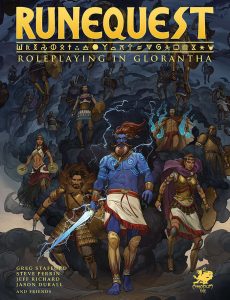
Jeff Richard is a Californian-born games designer who is also the Vice President and Creative Director for Chaosium. He is the lead author of the Guide to Glorantha, HeroQuest Glorantha, and RuneQuest: Roleplaying in Glorantha, as well as numerous other supplements and articles.  His latest books are  Cults of RuneQuest: The Lightbringers and Cults of RuneQuest: The Earth Goddess, both of which are keenly anticipated supplements to the classic RPG. We caught up with him to find out more…

STARBURST: What is Cults of Runequest?

The Cults of RuneQuest is a series of books detailing the mythology and the cults of the setting. Player characters join cults dedicated to a deity or hero – that’s how they get their magic! One’s cult is an important source of community, resources, and direction for most characters.

The first book released is the Prosopaedia – an encyclopedia of gods and heroes, followed shortly by the Lightbringers and the Earth Goddesses, which includes many of the most popular player character cults. After that comes a book of great personal interest for Greg Stafford and myself, the Mythology Book, which is an overview of the mythology of the setting. and in my opinion, one of the most unique things I have ever written or published. Then back to more cult books – The Lunar Way, Solar Gods, Darkness, Water, The Lords of Terror, The Horned Man and Spirits, and The Invisible God. There’s a lot there!

What does it add to the world of RuneQuest?
It greatly expands the setting and gives players far more options for magic, skills, and goals. Each cult can be equated to a Class (or even several) in D&D or a clan from Vampire the Masquerade. Each cult has its own understanding of the world, its own goals, its own place in society, etc.

Why is RuneQuest such a cult hit?

RuneQuest uses the Basic Roleplaying Game system – actually, it is the source of that rules system – just as Call of Cthulhu and Pendragon do.  It is both gritty and intuitive, using an easy-to-understand percentile system to determine success or failure. Combat is fast, exciting, visceral, and dangerous, which forces players to really think about the stakes involved. Characters have passions and Runes, which means every character is unique.

It encourages you to dive into the setting, its mythology and to make it yours. One moment you might be haggling with merchants over some bison and scraps of armour you managed to take, and the next moment, you are briefly wielding the power of a god. It is a game with one foot in the realm of gods and spirits and the other in the gritty (and often brutal) Bronze Age setting.

What makes Glorantha so different from all the other fantasy settings?

Glorantha is, in my opinion, the greatest fantasy setting, period. It is perhaps the only RPG that is built off the underpinnings of fantasy – mythology – and lets us explore myth while still having one foot in the gritty mortal world. It is a setting both broad and deep, and unlike most other fantasy settings, it is not derived from the Medieval West. It draws upon the ancient world, upon Gilgamesh, the Iliad and the Mahabharata, and upon Campbell, Leiber, and Zelazny, rather than the tropes of Tolkien and medieval Europe.

Why are TTRPGs so popular now?
I think the greater awareness of TTRPGs thanks to social media, actual play, and general popular culture has greatly changed the market for TTRPGs, but more importantly, I think TTRPGs are one of the few social pastimes where we all get to be active creators, rather than passive spectators and consumers of other peoples’ creations. They let us experience something that is not our own daily life – in a TTRPG, I can be a completely different person from that in daily life. And I think there is a great interest in both of those things, especially nowadays.

What was the most fun bit to do?
In the Cults series? For me, the most fun was actually the art process. I worked with several incredibly talented artists – Loic Muzy, Agathe Pite, Katrin Dirim, and Simeon Cogswell to put together the look and feel of these books. The art in these books looks utterly unlike anything in RPGs, and watching them bring my writing to life was incredible fun.

If I’ve been playing RuneQuest for decades, why do I need this book?

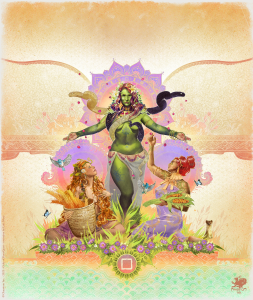
This is the long-promised take on all the cults you’ve been waiting for since Cults of Terror. Orlanth and all his sub-cults,  Ernalda, Babeester Gor, Eurmal, Maran Gor, Asrelia, Valind, Ygg – you name it, they are in there. Cults, sub-cults, associated deities, new Rune spells, myths, history, and so much more! You know you need these!

If I’m new to RuneQuest, what one piece of advice could you give me to make my first game more fun?

Start small. Start by learning the setting through play – and tie your character to a community such as a cult, a temple, a clan, or whatever. Your character will get involved in things great and small, and the setting will become yours.

And learn to negotiate or run away from many possible foes. If you try to fight everything in your way, you are going to end up dead. Although violence is always an option, there is always another way!

What’s next for RuneQuest?
Besides the Cults books, we’ve got a Guide to Dragon Pass, a GM book, a Sartar book, and a big campaign book on the way.

The excellent RuneQuest Starter Set can be found here, and you can find out more about the Cults series and RuneQuest in general here.

Noel Byrne | CASTING THE RUNES

casting the runes

by Ed Fortune

Noel Byrne is the co-artistic director and founder of Box Tale Soup, an inventive theatre company which combines classic literature and puppetry to bring fantastic shows to audiences. Founded in 2012 by Noel’s wife, Antonia, the company has a very strong and recognisable style. They are bringing the MR James ghost story Casting The Runes to the Edinburgh Fringe. We caught up with Noel to find out more.

STARBURST: How would you pitch Casting the Runes to someone new to the fringe?
Noel Byrne: It’s a classic ghost story, a supernatural thriller, but with a twist –  it features unique puppets alongside the actors, fantastic original music, and dance-like choreography with a transforming set. Don’t come alone, though – there are a few good scares too!

Why are we so fascinated with this sort of horror?
We like to be scared a little. We like something that gives us a thrill, and sets our heart racing and spine-tingling, but in a safe environment. So I think that’s a big part of it. You can watch or read a ghost story and get that sense of excitement, that fear, but all the while knowing you can close your eyes, shut the book if it gets too much! I also think there’s a fascination with the unknown, the possibility that there is something else out there that we don’t yet understand, and it’s fun to explore that in a good ghost story.

Why puppets?

As a company, we love working with puppets, and puppetry features in all our work in some form. Puppets are magical, instantly transportive, with an otherworldly quality that engages an audience’s imagination immediately. I love the fact that they allow us to show and do things that would otherwise be impossible on stage. For a ghost story, I think they’re perfect. Used in the right way,  puppets can seem unnerving and unnatural, and in a ghost story, where isolation is important, puppets can make an actor seem alone even when there are other characters onstage. I’m really proud of the puppets we’ve made for this show too, and I think our mysterious villain, Mr Karswell, is pretty intimidating!

What is it about MR James that keeps bringing us back?
Although the style is certainly of its time, his work is still very popular today, and there’s a good reason for that. He’s cited as an inspiration by so many of the horror writers who came after him, from  Lovecraft to Stephen King, so his influence runs right through the genre. When you read his stories, James’ gift for slowly, subtly building tension and creating this incredible atmosphere is immediately clear. Like any great ghost story, you can imagine people listening,  gathered around the fireside, silently drawing closer as the dread
increases. Some of the images he conjures really stick with you – his stories can haunt you, and that gives them a lasting appeal.

What does theatre bring to this story that other formats don’t?
Theatre is a great medium for a story like this because it gives you a  sense of presence and immediacy that you just don’t get from anything else – you’re there, and the story is unfolding live, right in front of you.  Are you safe in the audience? Perhaps, perhaps not… And the audience themselves add to the atmosphere – you can feel the tension growing in the room, hear the gasps or nervous laughter around you. Being there, in the same room as the action, sharing it with other people, that all heightens the experience of a story like Casting the Runes.

What makes the Edinburgh Fringe unique?
For starters, it’s the largest arts festival in the world by quite some margin, and if you’ve never been, I think it can be hard to imagine what that’s like. Venues everywhere, literally thousands of shows, some from all over the world. You could watch shows from 10 in the morning until 3am, and be constantly amazed by the breadth and variety of what you’ll find. If you’re performing or working there, it’s also great (if exhausting) that it goes on for the whole month. That length gives a rare chance for many shows to have a good run, really develop and grow, and it allows for word-of-mouth hits, unheard of shows that find an audience at the Fringe and take off – harder now, perhaps, but it still happens. Finally, the city itself is an incredible, beautiful and dramatic setting unlike anywhere else, and I don’t think you can overstate how important that is in giving the Fringe its unique character. I’ve visited Edinburgh so many times, but I still find it breathtaking.

Why should STARBURST readers seek this out?
If you like good theatre, I think you’ll enjoy this show. We’re really passionate about what we do. The company creates everything – script, puppets, music, set, costumes – and we really work hard to make it all the best it can be.If you like a ghost story, or a thriller, something that’ll have you on the edge of your seat, then I think you’ll love ‘Casting the Runes’. It’s spooky, tense, and pretty frightening at times. There’s no gore or violence, though – it’s definitely not that kind of horror. If you’re up for something a little bit different, I think the puppetry,  the transforming set, and the storytelling will really get your attention. People often tell us they’ve never seen anything quite like it!

Finally, if you’re a fan of classic horror movies, this should be right up your street! Films like The Haunting – 1963 version, of course, Drag Me To Hell [2009, loosely based on Casting the Runes], and naturally, Night of The Demon [1957] were part of our inspiration for the show, and in fact, there are even a few easter eggs to spot for those who really know the genre!

How would you describe your process?
Inventive, holistic, and respectful of the source material. When we start a new piece of work, we try not to limit ourselves and any idea, no matter how crazy, can be on the table, but we always return to the source material for inspiration and guidance. Then we work backwards from there, trying to find a way to get as close to that idea as reality will allow! Because we write the script, design and build puppets and sets, and create the music, it means that everything really can be connected and developed together in a complementary way. A lot of creation happens in rehearsal too, and we devise and rewrite as we go, with an emphasis on movement and flow – what’s happening onstage should always be engaging, and even the scene changes should be beautiful! As I said before, I think now we’ve developed a very strong, individual style, and I hope that’s part of what people enjoy. We’ve certainly found a supportive audience at the Fringe, and we’re very grateful to everyone that keeps coming back!

What media are you currently enjoying?
We listen to a lot of audiobooks while we’re making; over the last few months, we’ve really enjoyed Maggie O’Farrell’s Hamnet and I Am, I Am, I Am, Andrzej Sapkowski’s Witcher series = brilliantly read by Peter Kenny – and John Fairfax’s Benson and De Vere series. We’re late to the party, but we’ve been making our way through Succession, which is great. Severance was an incredible series that we watched earlier this year – a fantastic concept, really well executed. Andor was possibly the best Star Wars spin-off we’ve seen. On the movie front, Ruben Östlund’s Triangle of Sadness was great, and we really enjoyed Guardians of the Galaxy Vol.3. Music-wise, we’ve had some Agnes Obel, Massive Attack. We also love Voka Gentle – if you haven’t heard of them, you should check them out. I like something a bit heavier when I’m painting set though, so Nine Inch Nails, Rollins Band, and Mick Gordon have been on the headphones!

What are your plans after the Edinburgh Fringe?
After the festival, we’ll be taking Casting the Runes out on tour around the UK – if you can’t make the Fringe, you can check our website for upcoming tour dates. That will continue touring into Spring 2024, and in the meantime, we’ll also be doing some international performances of our previous show, Gulliver (available to watch online), and Christmas shows at the Stables, Milton Keynes and the Exchange, Twickenham. So we’re keeping pretty busy!

Casting the Runes can be found at the Pleasance Courtyard during the 2023 Edinburgh Fringe, and tickets can be booked here.

Boo Cook | VOID RUNNERS

by Ed Fortune

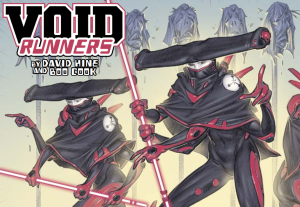
BOO COOK is a British comic book artist, best known for his work on ABC Warriors, Judge Dredd, and Elephantman. His latest work is VOID RUNNERS for 2000 AD, in collaboration with David Hine. We caught up with Boo to find out more…

STARBURST: What’s the pitch for Void Runners?

Boo Cook: Something along the lines of Moby Dick meets Dune in space on a bus driven By Ken Kesey and Tim Leary. On acid!

Why psychedelic sci-fi?

Sci-fi has been hardwired into my brain since my very earliest memories plus i guess you could say that a period of self shamanism in my youth had a profound and prolonged effect on the way i think and approach life. All this coupled with a schooling in comics over the years from the likes of Brendan Mccarthy, Moebius, Shaky Kane, Druillet, and Frank Quitely etc has meant that I have a deep yearning to create comics that encapsulate all that stuff. And who better to do that with than the uk’s most psychedelic man, Dave Hine.

How much does void runners owe to the 1960s?

Dave would probably answer this better than me as I wasn’t around… But certainly, the exploits of the heavy hitters of the lsd explosion in america around the summer of love have a strong bearing on events in void runners. There’s strict control from despotic overlords, there’s widespread distribution of mind-expanding drugs, there’s the promise of new freedoms. But as with the ’60s void runners towards the end of series one starts to question those freedoms in deeper detail and how they affect the bigger picture – it may not all end up sweetness and light…

What’s your favourite moment of chaos in the story?

I think my favourite moment of chaos in the story so far is the big bang sequence in part 6. The protagonist captain shikari has ingested a heroic dose of Kali’s dust – the mind expanding drug grown inside the body-minds of planet sized space jellyfish called pleroma. The sequence starts with the void before time then expands outward from the big bang spawning an infinite myriad of consciousness and creatures which populate the universe and through enlightenment and despair the cycle continues again… Great fun to draw.

What’s the ‘most’ fun to write?

Well Dave’s the writer but there’s a fair bit of strange alien cuneiform writing cropping up amongst the art which was indeed fun to write.

Is it for the squeamish?

I think the squeamish will have no problem with this strip for the most part. Quite often any moments of violence are quickly subverted by shikari’s ‘cosmic take’ on life which tends to put things such as horror and death into a profound reverse spin.

Which bit is going to make the readers grin the most?

When David asked me to draw a massive space anus inside the brain of the Pleroma and have the crew climb inside the glutinous rectum to recover hoards of Kali’s dust I knew we’d be onto a winner, or at least a grinner. The page got quite a lot of interest online, more than any other things i posted lately and the original page sold in a flash. It has since become known as the ‘Spanus’.

How does it compare to other 2000AD strips? Is it closer to Dredd, Ace Trucking co, Shakara, or something else?

I’d say it’s definitely less Dredd and more Ace/Shakara. There’s even some of the irrelevance of DR and qQinch and a smidge of an early Nemesis vibe to it – lots of aliens, lots of oppression!

What would you say the biggest influence on this book is?

I’ll go out on a limb here and say possibly LSD?

Which creators inspire you?

I mentioned above some of the creators which really formed my early art brain. I also should definitely mention artists such as Roger Dean, Chris Foss, Tim White – all artists who were really kicking it in the 80’s when my art brain was forming… Other creators of note would have to include David Lynch, Panos Cosmatos, Jodowrosky, Gaspar Noe, Philip K Dick, Iain M Banks, Robert E Howard, Killing Joke, Can, Pere Ubu, Beak>, yes… I could go on.

What tropes do you personally avoid the most?

Personally I try to avoid the trope of cold hard reality if I can – with my creativity and probably in general. It’s much more difficult than psychedelic space fantasy and much less fun.

If you could preserve one work of art, and have that last forever, what would it be?

Good question! Possibly ‘The Great Day Of His Wrath’ Painted By John Martin in 1851-3…. Or maybe Episode 8 of Twin Peaks: The Return… Vitamin C by Can…. Again I could go on for hours here!

If we like this book, what other books do you recommend?

I would definitely recommend Kosmik Musik by Ben Wheatley and Joe Currie – it’s sci-fi, it’s psychedleic, it’s hilarious and ingenious. On top of that it has a soundtrack by BEAK>. Only a fool would ignore this…

VOID RUNNERS can be found in current issues of 2000 AD. You can find out more about the Galaxy’s Greatest Comic here. 


David Hine – VOID RUNNERS

by Ed Fortune

David Hine is a British comic book writer and artist, best known for his work on Bulletproof Coffin and Silent War. His latest work is Void Runners for 2000 AD, in collaboration with Boo Cook. We caught up with David to find out more.


STARBURST: What’s the pitch
 for Void Runners?

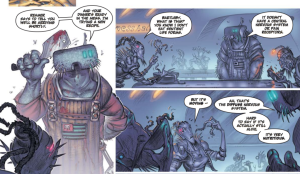
David Hine: Do you want the tag line, the log line or the elevator pitch? We originally went with ‘Moby Dick meets Dune’ but it could equally have been ‘Star Trek meets Jason and the Argonauts’. Boo Cook and I put together a pitch package for 2000AD with a breakdown of the story and beautiful character and concept sketches by Boo. The story is basically this: Humanity has spread through the universe, mingling with other alien species and cultures to form a Federation of states that is dominated by a priest élite, known as Ankorites, whose mystic visions give them the authority to rule. These visions are dependent on a psychedelic drug found only inside the Pleroma – massive creatures who roam through space, feeding on unimaginably large quantities of irradiated space dust, which they turn into a psychedelic substance known as Kali’s Dust. The Pleroma are hunted by Void Runners, and our heroes are the crew of the Nautilus, whose captain, Shikari, has ‘accidentally’ ingested a fair bit of Dust. Her private agenda is to share her resultant enlightenment with the rest of the crew and ultimately with every sentient creature in the universe.

Why psychedelic sci-fi?

I began reading science-fiction during my formative years and encountered psychedelics at key moments in my life. Putting the two together seemed like the obvious thing to do. Also Boo asked me if I fancied pitching a psychedelic sci-fi story to 2000AD. Boo had done a fabulous cover for an issue of Richard Starkings’ comic book ‘Elephantmen’, which I had written and drawn. We had also been following one another on Instagram, where we were both posting a lot of trippy images. We clearly had similar tastes and we met up at the Lawless Judge Dredd Convention in Bristol to thrash out the concept.


How much does Void Runners owe to the 1960s?
Percentage-wise, about 90%. I grew up in the 60s. I watched the first transmission of Dr Who in 1963, shortly after my parents bought our first TV. I had never encountered science-fiction before that and the concept of Time And Relative Dimensions In Space really did blow my mind. I got hooked on science-fiction, particularly Ray Bradbury and the British New Wave writers from New Worlds magazine – Michael Moorcock, Brian Aldiss and JG Ballard. The whole culture of the sixties was transformative. My older brother was bringing weird stuff into the house, The Mothers of Invention, Captain Beefheart, Moondog and Hawkwind on vinyl and also underground magazines like Oz, international Times, Frendz and the underground comics of Robert Crumb, Vaugh Bodé, Gilbert Shelton and Greg Irons. These were mind-expanding times and it all culminated with Ken Kesey’s Magic Bus trip across the U.S.A. turning on the nation with acid. Void Runners is going to be our Magic Bus trip through space.

What’s your favourite moment of chaos in the story?

There’s a moment when Moondog blasts some Dust into Shikari’s nostrils in imitation of a ceremony performed by Amazonian Shamen. The ensuing scene melted the pages of my copy of 2000 AD.

What’s the most fun to write?

The interactions between Shikari and Moondog are always enjoyable to write. Shikari is a totally anarchic hedonist and Moondog appears to be a miserable old grouch whose life’s work is to keep her under control. They actually adore one other and I love writing their interactions.

Is it for the squeamish?

There’s a scene where Shikari and Moondog strip off to wriggle through the slimy intestines of a giant Pleroma, a kind of space-roaming jellyfish. It’s going to be yucky or sexy, depending on your taste.

Which bit is going to make the readers grin the most?

There’s a scene where Shikari and Moondog strip off to wriggle through the slimy intestines of a giant Pleroma…

How does it compare to other 2000 AD strips? Is it closer to Dredd, Ace Trucking Co, Shakara, or something else?

I’m embarrassed to admit that I have never read ‘Shakara.’ I haven’t been a regular reader of 2000AD since about issue 1000, which is ages ago now. I should know it because I love Henry Flint’s art and Robbie Morrison’s writing. I had a quick look at it online and it looks closer to our story than the Ace Trucking Co. Dredd is a very different. He’s dour and humourless. Shikari and her crew are all about having a good time and finding enlightenment. I can’t imagine Dredd being interested in either of those activities, except to bust the perpetrators.

What would you say the biggest influence on this book is?

Kesey’s concept of taking a travelling circus across American with the ambition to create a bloodless revolution of the mind was anarchic and fun but also a very serious ambition. It influenced a lot of science fiction writers like Robert Silverberg and it has become part of history. I don’t think we could have created Void Runners without the Magic Bus. I guess we were all influenced by the French comics that came out of that era too, Moebius above all, but also Caza and Druillet.

Which creators inspire you?

There isn’t really a short answer to that. I have read a lot of books and comics, many thousands, and all of them have inspired me to some extent, but at the top of the list right now I would have to put William Burroughs as a writer, Moebius and José Munoz as artists, Charles Burns as a writer/artist. I am also very inspired by my collaborations with Mark Stafford and Shaky Kane and more recently with Boo on ‘Void Runner.’ Nothing is more stimulating than working with uniquely talented artists.

What tropes do you personally avoid the most?

I don’t really think about avoiding tropes. You use the motifs and imagery that are most appropriate to the theme of your story. Having said that, I did reach a point where I realised that I should probably stop using the Zombie Apocalypse as a metaphor for the breakdown of the social order. I’ve done it four times and that’s probably three times too many. In my defence I would have to say that three of them were work for hire on existing concepts: ‘The FVZA’ for Radical, ‘The Night of the Living Dead’ for Avatar and one that I can’t talk about that stalled before publication, based on a computer game. The only one that I stand behind 100% is the ‘Hateful Dead’ episode of ‘The Bulletproof Coffin’ with Shaky Kane. Living dead Vietnam Vets on a rampage through time. That was class.

If you could preserve one work of art, and have that last forever, what would it be?

It’s a toss-up between ‘The Bulletproof Coffin’ and ‘Void Runners.’ But apart from that, Part 8 of David Lynch’s third season of Twin Peaks. As a standalone piece, it’s the greatest moving-image work of art ever created. An absolute masterpiece.

If we like this book, what other books do you recommend?

I don’t know if these are necessarily similar to ‘Void Runners’ but I do like ‘Saga’ by Brian K Vaughan and Fiona Staples, ‘The New World’ by Ales Kot, Tradd Moore and Heather Moore, and ‘Upgrade Soul’ by Ezra Clayton Daniels. And Did I mention ‘The Bulletproof Coffin’?

Void Runners can be found in current issues of 2000 AD. You can find out more about the Galaxy’s Greatest Comic here. 

Jim Cummings & PJ McCabe | THE BETA TEST

jim cummings in the beta test

Described by writer, director, and star Jim Cummings as “a Michael Douglas erotic thriller from the ’90s that we’re doing the MacGruber thing for”, The Beta Test tells the story of a ruthless, manipulative, and soon-to-be-married Hollywood agent who receives a mysterious letter inviting him to an anonymous sexual encounter. After some uncertainty, he accepts, but euphoria soon turns to paranoia as he becomes ensnared in a world of lies, infidelity, and murder.

In line with the film’s release on Blu-Ray from Arrow Video, STARBURST spoke with the Thunder Road and The Wolf of Snow Hollow filmmaker, alongside his co-director, co-writer, and co-star PJ McCabe, about this scathing satire of toxic masculinity and the hollowness of Hollywood.

What inspired The Beta Test’s premise?

Jim Cummings: I used to say that we had the idea because PJ and I were talking about a letter service that would use an algorithm or an AI to connect people for anonymous rendezvous. And I was like, what would you do if you got a letter like that? And he was like, I wouldn’t go because first off, my wife would kill me. And then I was like, I don’t think I would, either. But what if you were somebody that would go? That was the origin of that but really, for the four years before we had that idea, we were already making fun of people lying and cheating in Hollywood and making fun of talent agents – so this was us feeling like we had to get this fuller conversation out of us. This film was just the perfect lens through which to do that.

PJ McCabe: To be totally honest, when we first sat down to start writing this, we were trying to write a contained, easy-to-shoot horror movie.

Jim Cummings: [Laughs] It spiralled into throwing everything we wanted to talk about into one story. We were able to weave a bunch of different narratives into one and it just worked out into the big, crazy, final piece that is The Beta Test.

What is it about talent agents that riles you up?

Jim Cummings: Oh man… this is only a 20-minute call! [Laughs] I guess when you see something like Entourage, it has this glorifying effect on the position, but it’s just very petty, very sad people. I was interested in it because it affected us – it was a non-overlapping industry that a lot of people who are younger in the space feel like they need to appease in order to get any work. And I never really believed that; I was demystified by that very quickly, but I find it to be so interesting!

PJ and I talk about that all the time, about how with growing technologies and social networks, we don’t really need these antiquated agent positions. And even the famous people that we talk to all say that the work they get is always through someone having seen one of their movies and reaching out directly. It has very little to do with having good representation.

We also just hate the industry. Like an overall hatred for the industry, because they don’t make movies. They tell their parents that they make movies and try to seem as cool as possible but never lift a finger, and I hope they choke to fucking death.

jim cummings in the beta test

PJ McCabe: Talent agents just represent a lot of what’s problematic with the industry and all the walls we’ve run into to make stuff. We just don’t want to deal with that anymore because it doesn’t get us anywhere and we don’t make anything trying to play by their rules.

Jim Cummings: It’s politics. I didn’t get into doing this stuff for politics. I’m a nice person, I’m a diplomat, I always listen, I take notes and shake hands and kiss babies. But if something is actively harming what is possible to be made in an art form, or the support of an entire generation of young people who need help, then fuck ‘em. Is that any different in the British film industry?

I’d say the independent moviemaking industry seems a little more accessible, but the overall entertainment sphere still skews toward the Hollywood way of things.

Jim Cummings: Yeah, that’s the thing that we noticed in going to London and talking to film students: everybody is applying for grants. In America, there aren’t really any grants at all, so filmmakers are forced to do the Duplass brothers’ thing of picking up a camera and running a Kickstarter campaign. They’re far more industrious because they have to be, because America doesn’t really care about the arts. But in the UK and Ireland, I’ve seen that independent filmmakers become a bit lethargic and they’re just waiting, sometimes for a year, to find out whether or not they’ve won the lottery. That’s just not something that I see in American films – people are getting their friends together on a weekend and running crowdfunding campaigns to make stuff. I really want to see more of that in the UK. I think the people that we’ve brought out to our lab in Malibu who are English or Irish go back very industrious and end up making a name for themselves. But I think like, the technology is there now that you can do it and not have to rely on any antiquated systems.

PJ McCabe: I feel like 80 per cent of making a movie is figuring out how to make the movie. I mean, just getting a crew together and whatever small budget you can and problem-solving to get it made. It has gotten easier with technology, but it still forces you to solve a lot of problems and figure things out for yourself, which I think lends itself to better filmmaking in the long run.

Jim Cummings: I like the idea that in England, it’s all these very calm, quiet, Ken Loach-type filmmakers and then in America, it’s more like Uncut Gems – it’s just a fucking nightmare and everybody’s stressed out.

As champions of independent moviemaking, what do you see the future of the industry look like? Do you think that big studios will eventually collapse on themselves, or will indie cinema always be the underdog of the entertainment industry?

Jim Cummings: Putting on my Adam Curtis brain, I think really what’s happening is there’s this exponential, insane growth in technology that is happening. It’s incredibly exciting for giant tech companies, as well as smaller independent artists, who can make stuff that competes at the level of Marvel, visually or auditorily. And that is incredibly exciting for us as well.

But audiences haven’t really changed – they want to see the big new thing. And sometimes that big new thing is something that’s made by four people on a VFX team that then goes on to win Best Picture, like Everything Everywhere All at Once. So I think that is what I anticipate for film over the next few decades: young, independent filmmakers, probably American, who are able to compete at the level of craft that Marvel and Disney and A24 are producing, and for them to deliver a further unsanitised, rock and roll product to an audience of perverts that are desperate for good stuff that isn’t watered down by development executives, and has all of the funny jokes taken out.

I think the technological increase is going to deliver a better product across the board, and then I think audiences are going to become further dissatisfied with no sex, no violence, and no cursing in movies. They’re becoming adults, and they want to watch adult films. I think that will drive what is cool, and people always go to what is cool.

PJ McCabe: I mean, I love that the studios are just pumping out and churning out the same stuff over and over again. That gives us a chance to carve our own part of the sandbox and make unique stuff. There’s a huge hunger for that, and the technology is just making it easier for us to do big-budget-looking stuff out of Jim’s garage. I think this is good for us.

pj mccabe and jim cummings in the beta test

In your opinion, what makes satire such an appealing way of addressing the very toxic, very anger-inducing topics that The Beta Test broaches?

Jim Cummings: There’s a good quote from one of the Greeks, that laughter is the mind sneezing. And it’s so true. If you can get somebody to laugh, it’s involuntary. And so, if you can make something that is funny, you can win the audience and get them to take their medicine. But broadly, satire is something that makes fun of the powerful, which gets general audiences to feel – for one brief moment of laughter – that they are more powerful than the people who hold them down every day. And I think satire is incredibly powerful because a lot of the systems that we have in place make people feel like they don’t have the ammunition to render the powerful, powerless. And it’s a great tool to give people. When we introduced the film at Beyond Fest, we told the audience, “Every time you laugh at this film, an agent dies.” And it feels like that! If an audience is laughing, they feel like the power is returning to them, and that’s a great feeling to give to people.

PJ McCabe: I also think it helps you talk about issues that are usually uncomfortable to talk about. And if you can laugh about serious things, it means you don’t feel so queasy or uneasy, and you’re not being beaten over the head with how awful everything is. It’s about finding a more clever, nuanced way to connect with audiences and have a conversation about it.

And finally, what projects do you both have coming up?

Jim Cummings: We’ve written a really great Victorian horror film, that PJ and I really want to make. I think it’s our masterpiece. I think it’s fucking incredible, and I would love to do it. Before I die, that’s the thing that we’re going to do together. And then we’re working on an exorcist film right now that we’re hoping to shoot in October, and that neither of us is acting in. It’ll be very good – knock on every piece of wood!

PJ McCabe: That’s another one that will have lots of genre-blending and layers. I think if we can stick the landing, it’s going to be pretty special.

It’s funny, because horror really has so much in common with satire.

Jim Cummings: Yeah! It’s no wonder that something like Get Out is made by a sketch comedian. It’s all punch lines: just set-ups and pay-offs. Horror, when done well, is comedy.

The Beta Test is out now on digital and home entertainment via Arrow Video.

By Laura Potier

Jamaal Avery Jr and Michael Olson | STAR WARS: YOUNG JEDI ADVENTURES

by Mark Newbold

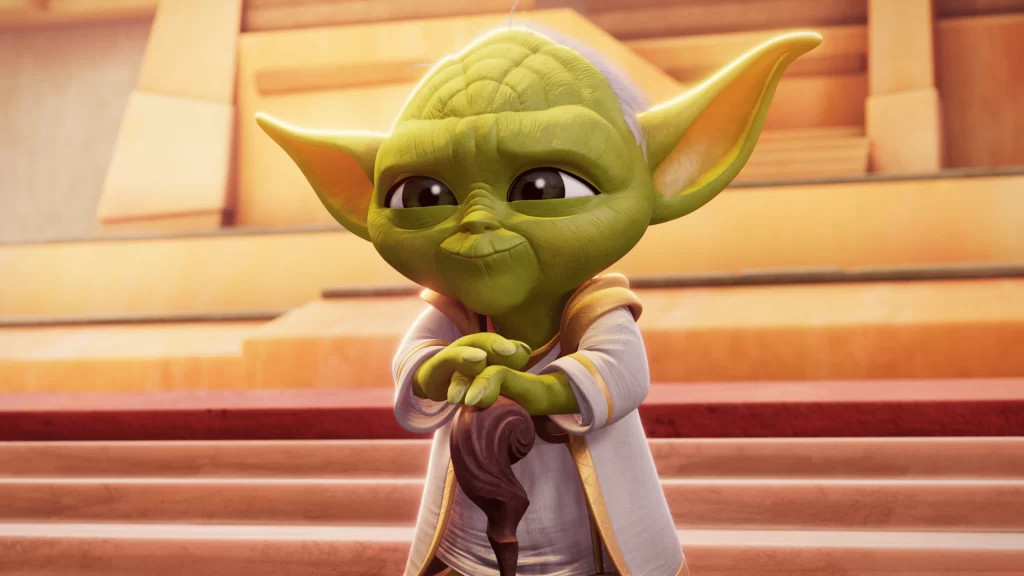
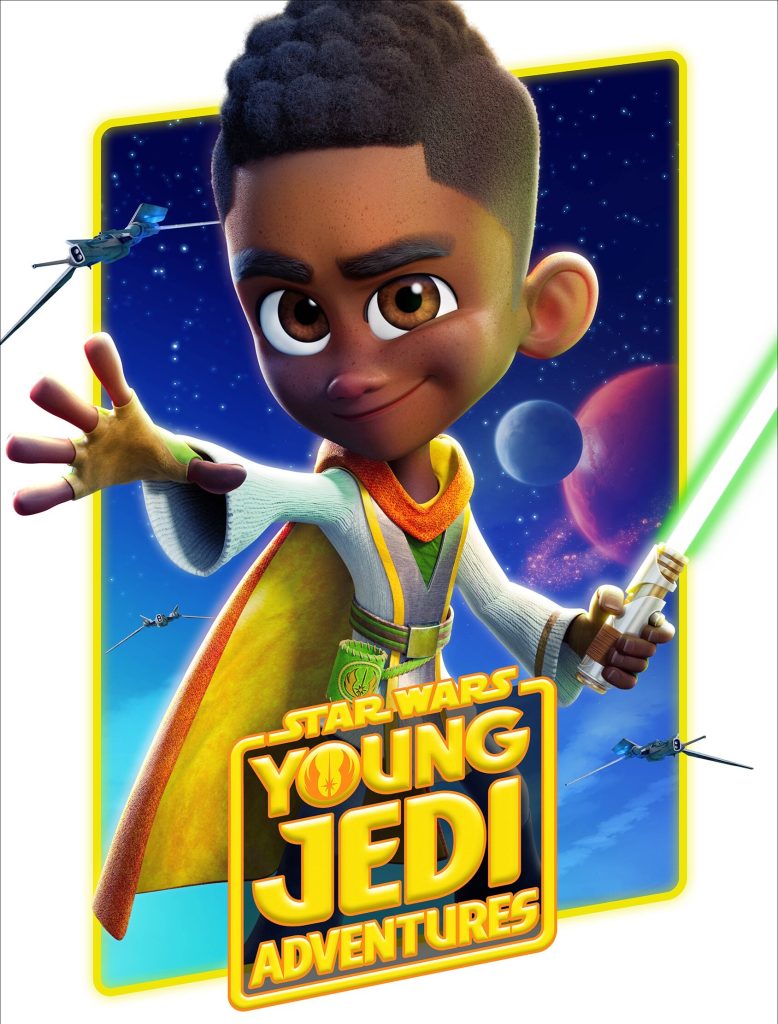
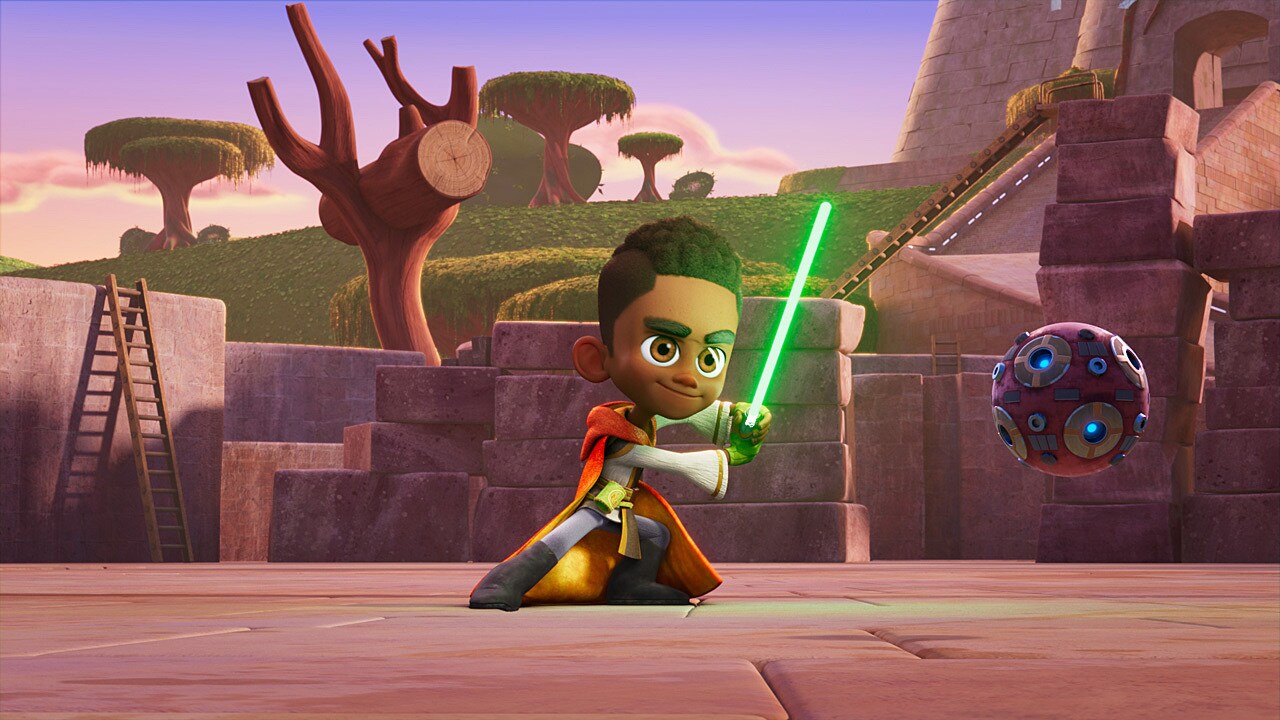
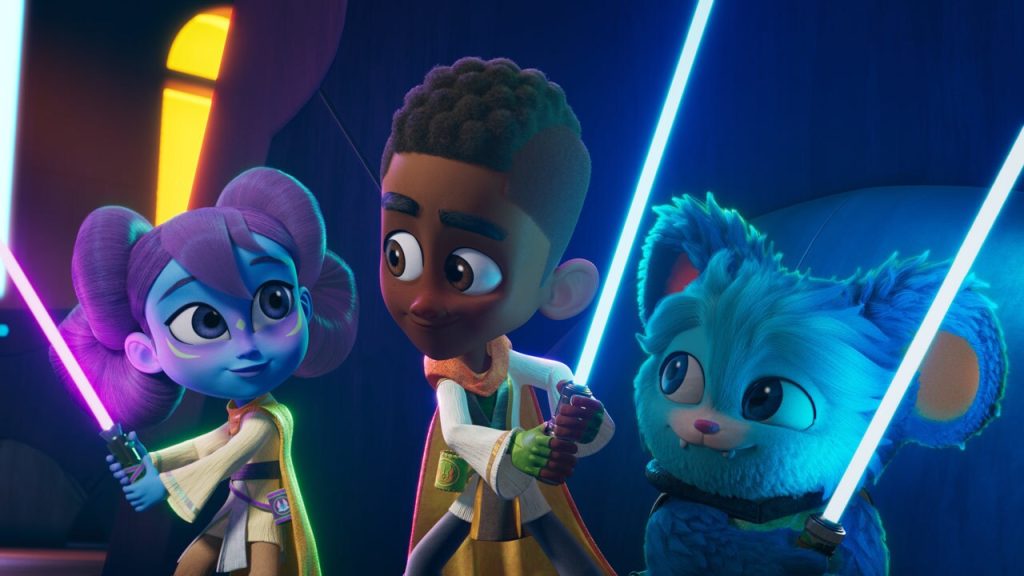
Designed with a younger audience in mind, YOUNG JEDI ADVENTURES is an energetic, fun, light-hearted series that shows a very different side of STAR WARS. Just in time for its second round of episodes dropping on Disney+ soon, we caught up with voice actor JAMAAL AVERY JR and co-creator MICHAEL OLSON to talk about the show….

STARBURST: Jamaal, how did you get the role, and how did you feel when you knew you’d been cast as Jedi youngling Kai Brightstar?

Jamaal Avery Jr: I was really excited to get the role of Kai. They told me I had it, and I was like, ‘What, that’s awesome!’ And then when I found out it was Star Wars, I didn’t believe them [laughs]!

Michael, was the show being developed before the general public heard about The High Republic?

Michael Olson: At the time we cast Jamaal, I’m not sure even the first Phase One book [Light of the Jedi] had come out, so he probably wasn’t aware that initiative was coming out, but I do recall me, him, and his parents had a really nice conversation and being able to say ‘hey buddy, you get to be the lead in a Star Wars show, buckle up. Little kids are going to pretend to be you!’ Even last night, my son was in bed reading the Young Jedi Adventures book, holding a green lightsaber which he was using to light up the bedroom because he’s scared of the dark and calling himself Kai Brightstar. It was really sweet, and that’s because of Jamaal. He gave such an incredible performance and embodied this character so well that kids are falling in love with him.

Not everybody gets to have Yoda’s very own training lightsaber; what a cool moment for any character to have!

JAJr: That was really cool. When I read the script, I was like, ‘Did he just get Yoda’s lightsaber?’ I had to read it back a couple of times. When you see Master Yoda fighting, that lightsaber’s been through a lot!

Have you seen any of the Hasbro figures that have been released for Young Jedi Adventures, and if so, what do you think of them?

JAJr: I think the character design is really spot on. I was thinking of getting some. I was reading the book and thought, ‘We should get some of the figures,’ so now I’m begging my dad, ‘Can we get some?’

Michael, as the show develops and the concepts come together, how intertwined is Young Jedi Adventures into the wider story, and are there considerations for what you’re doing?

MO: So this show definitely takes place during The High Republic, and one of the things that was really important for us was to place it in its own little corner of the galaxy a little bit farther away from some of the tragic events that are happening in the High Republic. Thankfully these Jedi kids are, for the most part, unaware of the grander galaxy-wide things that are happening, but James Waugh [producer] has mentioned in interviews that we have a few tie-ins here and there with the High Republic, so we will see some High Republic characters and maybe some locations as well.

Jamaal, from Season One, what’s been the most interesting and exciting thing that’s happened so far?

JAJr: I can’t really choose just one, but it’s between the episode where Kai Brightstar and Master Zia Zanna go on a mission, and Kai learns more about Master Zia when she was younger. Fighting is not the only thing that Jedi do. I also really liked when the Jedi first meet the pirates, I think that interaction was really cool and fun. I was watching it back with one of my friends from school, and he thought they were based on our own movement and actions, and I said no, I can’t do a backflip.

MO: You need to work on that, man!

Michael, as the show develops, we get to meet new characters, and one of those has been the pilot Nash Durango and her droid RJ-83. Is the hope over time to grow from this core group of characters and to other locations away from Tenoo?

MO: The lead of the show is Kai Brightstar, and he will always be the anchor and centre of the show, and secondarily, we’ve got Nubs and Nash to round that out, but we will certainly get to know new characters and younglings as they’re introduced to the temple as well as dastardly bad guys who become part of the world. There are definitely more relationships to be built. Kai gets to be involved with some of our secondary characters, which will lead to some interesting payoffs down the line, but the show is really focused on these core four characters.

Hopefully, down the line, there will be more ancillary products being released, so are you happy for other avenues to tell stories set during the era of Young Jedi Adventures?

MO: Oh, yeah, I’m so thrilled. I grew up playing with Star Wars action figures, and they were always second-hand or hand-me-downs from cousins or whatever, so that was primarily how I engaged with Star Wars. We had one VHS copy of it, which I could only watch at certain times, so I’m thrilled with the idea that there are action figures and toys so that kids can make up their own stories and extend their experience with our show because that’s what I did when I was a kid. In terms of the books, I love that stuff. My son is reading the latest book, well, I’m reading it to him at night. I love that the show gets to exist within the Star Wars ecosystem, so to speak. Jamaal mentioned the Young Jedi video games on Disney Now, so that’s part of the fun, seeing the toys, the books, and the video games; I’m here for it all and excited that people want to take these characters in different avenues.

Jamaal, now you’re a lead actor in a Star Wars project; how has it been telling your friends now that it’s ‘out there’?

JAJr: Yeah, I had to explain to a couple of my friends that it’s before anything in Star Wars. They asked, ‘do you get to fight Darth Vader?’ [Laughs]

You can’t do a Star Wars animated project without Dee Bradley Baker being involved somehow…

MO: Oh man, I love Dee Bradley Baker. I’ve worked with him on a number of projects in the past, so when I was coming up with the character of Nubs, he was the first and only person I was thinking of to play him. When he came in that first day, he asked a bunch of really insightful questions. He’s an actor’s actor, an incredible voice actor who can do all sorts of crazy sounds, but a true actor who really dug into who Nubs is and what motivates him and then went to town. That voice came out of him, and we were all ‘yes!’ That was the first thing that he did, we didn’t even have to change it, and it was perfect. He’s such a gift to work with, such a kind person, an incredible actor and a Star Wars legend, so I’m thrilled he got to be a part of our show.

Nubs, what a character. People seem to be latching onto him; he’s cute and cool and gets into a lot of mischief in the show. We’ve got Grogu in The Mandalorian and BB-8 in the Sequel trilogy, amongst many other such characters, so are you guys ready to ride the Nubs rollercoaster?

MO: Nubs Nation all the way! He’s been a lot of fun. When it’s really clicking for the audience across all age ranges, there’s usually a character in Star Wars that every person in each age range identifies with, and little kids might really see themselves in Nubs because he is expressing those big emotions and wears his heart on his sleeve like so many young kids do. I have two kids under three years old, and they gravitate to him and laugh when he comes on screen, so getting to see that has been really fulfilling, and I’m excited to see where this character goes. We’ve got some wild things planned for him, and I think the fans are going to be delighted.

As the show moves on, is the intention to see the characters grow?

MO: The challenge with this kind of show is that we’re making it for a very specific audience. We definitely want to invite parents and older kids to watch, but truly my North Star for who this show is made hasn’t changed, so we will definitely see our characters grow and hopefully get to the point where we see them make their lightsabers and do their challenges on Ilum, but for the foreseeable future the goal is to keep these characters a bit more evergreen and evolve the show through the kind of stories that we’re telling and exploring the galaxy and meeting new villains.

We may be a few centuries before Ilum becomes Starkiller Base, but we do have the opportunity to see some of the trials and training a Jedi goes through. Jamaal, are there any of those trials that you’re looking forward to performing as an actor?

JAJr: I’m looking forward to all of them, but I’m most excited about performing the scene – if they do – where they go to Ilum and get their Kyber Crystals to build their lightsabers. I’d be really excited to do that, which seems like fun.

Jamaal Avery Jr

The music is wonderful. Michael, do you have any involvement with that?

MO: Oh yeah, 100%. We went through a very rigorous process of finding our composer, and we landed on Matthew Margeson, who is an immense talent and who has such respect for John Williams’ work. It’s been fun watching him step into those shoes, and he did a phenomenal job. We meet with him every other week as we’re spotting different episodes and referencing all kinds of movies, not just Star Wars movies. We usually land on some John Williams movie because it seems like he composed the score for nearly every movie of my childhood. It’s been a true, true pleasure for me. We recorded the opening theme with a live orchestra in Vienna. Unfortunately, I couldn’t be there, so it was over Zoom, but man, that was an experience. Several dozen musicians playing the theme song for our show, and it sounded incredible, and Matthew did an incredible job of getting great performances from everybody.

Jamaal, of all the merchandise that you could possibly have your character become, what would you like to see Kai turned into?

JAJr: This is really funny, but [laughs] I would love to see Kai on a bedsheet! I’d go to sleep with my character on.

MO: I’ll feel like we’ve arrived when we have Kai Brightstar on diapers!

Episodes 1-6 of STAR WARS: YOUNG JEDI ADVENTURES’ debut season are available to stream on Disney+, with a new set of six being released via the platform on August 2nd!

Josh Winning – BURN THE NEGATIVE

Joh Winning Burn The Negative Cover

by Ed Fortune

Josh Winning is the senior film writer at Radio Times as well as a nostalgia nut, book/film lover and author of The Shadow Glass, and co-host of the movie podcast Torn Stubs. His new book, Burn The Negative,  is about a series of murders on the set of a horror-themed TV show. We caught up with him to find out more.

STARBURST: How would you describe Burn the Negative to a fan of the Scream movies?

Josh Winning: It’s sort of like if Gale Weathers visited the set of a Stab movie, and found herself getting drawn into a fresh spate of killings. Which I guess is kind of the plot of Scream 3, so maybe I’d just say, “It’s a bit like Scream 3, but different.”

Why Horror?

I’ve always been drawn to horror. As a teenager, I read Point Horror and Christopher Pike, and I grew up watching those great, gloriously weird ’80s fantasy films like The Dark Crystal and The NeverEnding Story, which came with their own scary elements (Skeksis! The Nothing!). Horror has the best characters, the best villains, and the best concepts.

Why LA?

Clearly, it’s the heartland of movies. This is a town entirely focused on one industry, and that industry is obsessed with stories. But it’s also a cutthroat environment where nobody’s livelihood is ever safe, paranoia runs rampant, and horror can easily spill into real life. It’s the perfect setting for a horror story.

What was the hardest piece to write?

The beginning of the second act. This is the part where weird stuff is happening, and Laura is trying to get her head around it. Navigating her mental state as history begins to repeat itself was a fun challenge because I really had to step into the shoes of a person who’s been through some heavy stuff and figure out just how she’d react.

What’s the most fun to write?

I loved writing Laura’s first visit to the guesthouse set. As a film journalist, I have been lucky enough to visit a number of sound stages where amazing sets have been constructed. It’s always awe-inspiring, and I loved writing that setup from Laura’s perspective – she’s somebody who left Hollywood and movie sets behind a long time ago and would rather be anywhere but there.

Is it for the squeamish?

I’d say there are some grisly moments in Burn the Negative that hint at some horrific occurrences, but this isn’t a massively gory book. I was more interested in evoking a spooky, paranoid atmosphere.

Is the horror genre simply the crime/thriller genre but supernatural? Or is there more to it than that?

I think there is more to it than that. Horror digs into the darkness in a different way from the crime/thriller genre, and not all horror is supernatural. It is very different ‘to thrill’ than it is ‘to horrify’, which I think is where the line could be drawn. Horror wants to horrify you and also explore horrific things, whereas horrific things can happen in thrillers, but that isn’t the focus.

Do you have other books planned in a similar vein?

Yes, I’m drafting my second horror book with Putnam, which also uses pop culture and Hollywood as a springboard. It’s very different to Burn the Negative, though, with different movies as inspiration. I’m excited for people to read it in the summer of 2024!

Is horror more accessible as a genre these days?

There’s more of it, which certainly makes it easier to find! Horror is really booming, particularly in the book world, which means there’s a horror for everybody. It’s such a fantastic time to be a horror reader, as there’s so much to choose from depending on your mood. I personally hop between Paul Tremblay, Ally Wilkes, Riley Sager and Catriona Ward, as they all deliver something very different, but always in the horror space.

Why are we so fascinated with gruesome death?
Morbid curiosity! That’s definitely a part of why slasher films are so popular. We’re curious about what it would be like to die in these horrific ways – and horror films give us the opportunity to experience that without actually having to experience it – thank goodness!

What character is the most fun to write?

I loved writing Yvonne Lincoln, the Hollywood screenwriter who is in jail for the murder of her husband – although she claims that the movie villain, the Needle Man was really responsible. I love a jaded, world-weary character, as it’s so freeing to write somebody who just doesn’t give a shit and makes no effort to make anybody around them feel comfortable.

Which character seriously needs to have a word with themselves?

Mike! In Burn the Negative, he’s Laura’s ex-boyfriend and current boss at Zeppelin magazine. He’s still not over the end of their relationship, even though it’s clear that Laura doesn’t feel the same way. He deserves better!

What would you say the biggest influence on this book is?

Various 90s horror movies, but in particular Candyman. I love that as an example of a really classy grown-up slasher film and one where you’re never quite sure if the monster is all in Helen’s mind or if he is a reality. That, to me, is a fascinating set-up, and one that I tried to pay tribute to with Burn the Negative.

Which writers inspire you?

Any writer who manages to finish writing a book! My big go-to authors are Riley Sager, CJ Tudor, and Taylor Jenkins Reid. They have such a firm grasp of character, pace and plot. I find their ability to write gripping novels hugely inspiring.

What tropes do you personally avoid the most?

I tend to embrace tropes because they really lend themselves to reinvention. I would say that the only ones that really jump out at me as total no-nos are “the black character dies first” and “if you have sex, you die”. They’re so outdated, and you can have more fun playing with other tropes.

If you could preserve one work of art and have that last forever, what would it be?

Labyrinth, the Jim Henson movie. It was such an important film for me growing up, and it continues to be. If I could preserve it for future generations until the end of time, I would.

If we like this book, what other books do you recommend?

Definitely check out Harrow Lake by Kat Ellis, which is a great horror novel about the daughter of a horror film director. If you’re looking for an edgy female lead, give Maeve Fly by CJ Leede a whirl – spoiler warning: it is very dark but very good! And if you like the mixed media elements of Burn the Negative, A Head Full of Ghosts by Paul Tremblay has some great articles slotted in amid the plot.

Burn The Negative is out now.

Emma Lister – INSOMNIAC’S FABLE

Emma Lister

by Ed Fortune

Created by ballet dancer Emma Lister and contemporary circus artist Sakari Männistö, Insomniac’s Fable is a surreal dreamscape with evocative choreography by Ludovic Ondiviela and images created by Angela Annesley from her woodcuts. We caught up with Emma to find out more…

STARBURST: What is Insomniac’s Fable?

Emma Lister: It’s the merging of juggling and dance to tell a loose story with big set pieces, eclectic music and a healthy dose of surrealism.

How would you explain it to someone unfamiliar with performance art?

I think it was theatre/film director Sam Mendes who said of the semi-recent craze for 3D movies…I paraphrase here…”What’s the point? Theatre is already in 3D”.

No dialogue?

Nope!

Why this story in this format?

We made our own story, but it slyly references a lot of tropes of rom-coms and dramas… boy meets girl kind of stuff. We aren’t trying to compare or contrast ballet and juggling in terms of the format. Those were just the tools we had. If we were opera singers, we would have sung it.

What should we expect?

Juggling balls, juggling rings, juggling clubs, an enormous wolf, pirouettes, several costume changes, falling snow… and one blonde wig.

What was the hardest thing to do?

There’s always one section in any piece that is the hardest to get right – that you’re never quite satisfied with, that doesn’t sit well with the next scene, or what have you. It’s like you’re digging a tunnel, and you’re just in darkness. In this piece, it’s a dance with juggling balls to some techno music, the first big scene. I wasn’t really happy with it til now, I think we cracked it! We dug through to the other side!

How does this compare to your other work?

Our work always has elements of story, circus, dance and film references…but never an interval, so have loo break before we start.

What’s the appeal to readers of STARBURST?

It’s on at 11am. You can have a little lie-in, have a nice coffee at one of Edinburgh’s many fine coffee establishments, rock up to see our show and be out in time to see four more.

What media are you currently enjoying?

I’m a big podcast fan recently, I’ve liked:

The Turning: Room of Mirrors (dance)

You Must Remember This (movies)

The Bechdel Cast (movies)

You’re Wrong About (movies)

and The Rest is Politics, I find soothing. It’s two people from ‘opposite’ political ‘sides’ having a civilised conversation.

What are your plans after the Edinburgh Fringe?

I actually have a podcast myself called MOVERS SHAKERS MAKERS. It’s about performing arts and dance…I’ve got a miniseries coming up about the use of ballet in horror movies.

Insomaniac’s Fable is running at the Summerhall through out the Edinburgh Fringe, check listings for dates and times.


Neil Marshall | THE LAIR

by Andrew Dex

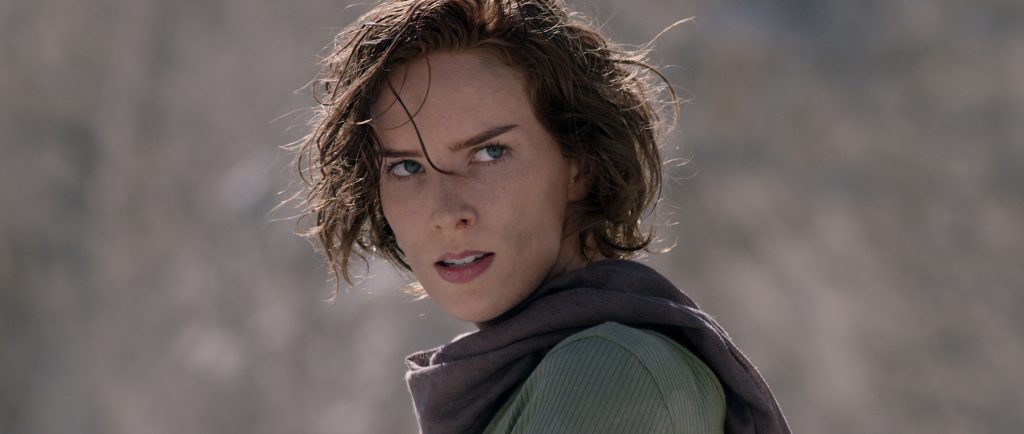
After a successful decade in the TV realm, taking on huge projects such as Game of Thrones and Lost In Space, director/writer Neil Marshall has now fully returned to the movie format, to bring us some more of his classic horror style! Collaborating with actress/writer Charlotte Kirk (The Reckoning) once more, Neil is back with The Lair, a monster-filled movie based in Afghanistan. Confirmed by Neil as a distant cousin to Dog Soldiers, The Lair sees Neil amp up on gore, action, and gallows humour like one-liners…

STARBURST: This is your latest collaboration with Charlotte Kirk. Can you tell us about how you first started working together and how this then led to the creation of The Lair? 

Neil Marshall: I guess we first started working together when we were just literally sitting around talking about ideas, stories we’d like to tell, films we’d like to make, and things like that. The first one that originated was actually the film that we did last year, a film called Duchess, which we’ve shot, but it hasn’t come out yet. Then after that, we wrote The Reckoning, and then we wrote The Lair. That came about basically because of COVID. At the time, we were stuck in LA, and a friend of mine approached me and said, “I know some friends who have a house in the desert; maybe we could put a little crew together and shoot something around this house in the desert? Would you fancy that?” And that came and went very quickly. It was a nice idea, but it never happened. But something stuck in my head like, “Well, during COVID, maybe we could shoot something in the desert? Maybe it could be like about some home invasion or something like that!” As always happens with me, what started out to be a very low-budget, simple idea of like a home invasion in the desert, suddenly became, “Oh, it’s in Afghanistan, and it’s Aliens! There are underground complexes!” I started throwing in ideas from other scripts that I had had for ages about this underground lair and stuff like that. Bit by bit, it just expanded into this B-movie, war movie, alien movie thing. So yeah, that’s how it came about.

Can you tell us about what Charlotte brought to The Lair as Capt Kate Sinclair, and what kind of military training she had to do for the part?

I was trying to get her to go up in a tornado, but we didn’t manage to arrange that, but otherwise, we found an RAF pilot who she did a lot of research with. She interviewed, talked to, and got a sense of the language and the whole vibe of the thing through that. Then we did a lot of action training for the film, fight training, and weapons training which is the main thing, because, as I discovered when making it, because it’s an all-British cast, not many British actors have experience handling firearms. You go to the States, and like every actor, at some point, has done a cop show, or a movie, or something like that. They’ve all handled firearms at some point. Over here it’s a lot less prominent in the industry, in some cases, it was an actor’s first time even seeing a firearm, let alone even handling one. So we had to go through some rigorous training with all of them, through like a boot camp of military training, and weapons training, and stuff. Charlotte did all of that as well. Obviously, she cut off all of her hair, stuff that actors do for their roles. Just to give a different look from The Reckoning and things like that. She really got 100% into the role.

The start of the movie instantly felt like The Thing, with the music and the way it was shot. Can you tell us about the movies that inspired The Lair, and maybe how you wanted the overall tone to feel for the viewer?

The overall tone I wanted to feel like a classic B-movie, I grew up with those great B-movies like Alligator, and later on, things like Anaconda and stuff like that. They’re great monster movies, but they’re just meant to be entertaining. They’re not striving for any kind of pretensions at all, they’re just meant to be fun and entertaining, and I love those kinds of movies. I thought that I just wanted to make a full-on B-movie, with monsters, and soldiers, and larger-than-life characters, with things like that in it. So that was kind of the origin of it. Then obviously, I’m inspired by movies like The Thing, certainly. Both versions. The original, and the Carpenter one, obviously the Carpenter one, is a lot darker and more serious, but the first one is like a classic B-movie in its own right. And Aliens, anything with soldiers, so, and I call it a distance cousin to Dog Soldiers because it kind of exists in a similar universe, with soldiers fighting monsters, it has that kind of vibe to it. So that was the thing. I wanted to make something that was just fun. My previous film, The Reckoning, had got bogged down in maybe being a little bit too serious, trying to tell a worthy story. I think it does tell a worthy story, but after doing that, I was like, “No, I just want to have some fun and give the audience some fun, let’s explode some heads and do lots of fights and explosions, and stuff like that.”
Neil Marshall | THE LAIR

In a similar vein to say, Aliens, where you’ve got Hudson and his humour-filled one-liners, there’s a similar feel with The Lair! How do you balance outrageous one-liners like that with a plot that is actually, truly terrifying?

I think the lines only work if they come from the character. Like, they have to emerge from the character because Hudson was that guy. So anything he said makes sense for his character, so it’s the same for this, and it’s the same for Dog Soldiers, and it’s the same for everything. It’s like, the best kind of humour in these situations emerges from character, and I find that people under extreme duress, and extreme pressure, sometimes their sense of humour inherently shows through it. It’s gallows humour, it’s trench humour, which I really love, and it’s a very kind of British thing as well. But yeah, that kind of gallows humour. I think it’s really funny. And then giving some of the best lines to the least obvious candidate, the Afghan freedom fighter guy who is like cracking some of the most choice lines.

Great! So can you tell us about how the look of the Ravagers originally came together, and what did you really want to see from them on-screen?

Teeth! Mostly. Yeah, I kind of wanted to. You take away things like eyes and stuff like that and just leave, essentially, teeth. They’re alien, so you don’t really know how they see or sense things around them. It’s like, “Let’s just leave that to the imagination”, and I thought, well “Let’s give them a kind of built-in body armour of, like, skin that’s as thick and as tough as Kevlar; we can shoot them a few times, and they’re going to get up, and come back again.” So there are a lot of elements behind the design process, like when the guys would design the whole thing, I was like, “Can we do this, can we do that?” There’s a specific phobia called trypophobia, a fear of textures that have lots of holes in them. You’ll see it online; it’s like certain textures that have lots of holes in them. People have a real phobia of it, and it makes them want to vomit. So I thought, how could we apply that to the creatures, so their face came from a thing, where it’s just like, loads of holes, and things come out of the holes, and stuff like that. So the design idea there was if they look so repulsive, then some people will have a physical reaction to it, so that’s pretty good.

You’ve always been a huge fan of practical effects. That is quite clear from the projects you’ve worked on. So, we have to ask, what do you love the most about working that way, and what has practical effects brought to The Lair?

It’s just that ability to have the creature in the room with you when you’re filming it, and interacting with the actors, interacting with the light, interacting with the dust, and the dirt, debris and god knows what else is flying around on set, and you get happy accidents. You get things happening that if you contrived it in CGI, then everything would be perfect. Whereas you get happy accidents of things bumping into things, reactions to things. Which I love about practical effects. It holds up on camera because it is there, it’s not faked in any way, and so I just kind of used the same technique that Guillermo does on his movies, where you do like 90% practical, and then enhance that practical with some CGI stuff, be it like blinks, eye movements, things like that. In my case, it was with the mouths, I wanted the mouth to open wider than it possibly could, so we did a few CG shots, where we extended the jaw and put an extra set of teeth in there and things like that. But those are the only kind of CG enhancements to something I’ve done practically on set. The other thing is, I don’t know how many ravagers you thought there were in the film, but we only had two suits. One hero suit and one backup suit. So we managed just to do editing, and a couple of visual effects duplication shots, to make it look like there were a lot more. When you find out that James Cameron only had eight Alien suits for Aliens, it’s like, right, you can work wonders!
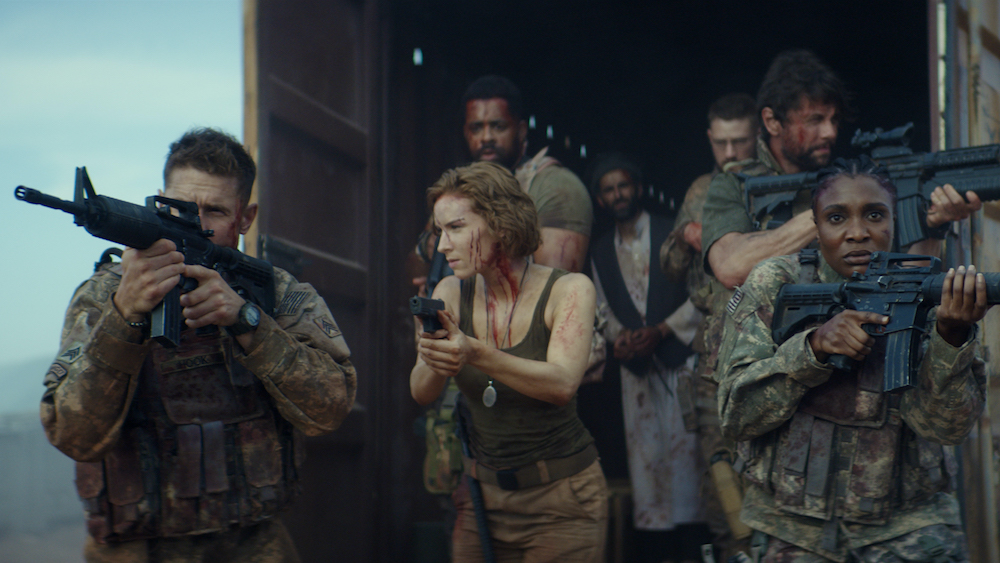
You put this movie together in Budapest. Can you elaborate on what it was like to work there and how you went about making it feel like the middle of Afghanistan?

That’s the thing, you wouldn’t look at it and go, “Oh, that’s Budapest.” We just worked in Budapest on The Reckoning, so we knew the infrastructure there, and we knew there was a good kind of tax credit and incentive to go there. I was dubious at first because I was like, “Why aren’t we going to Morocco, or why aren’t we going to Jordan or somewhere like that.” They were just too expensive at the end of the day, so we went out to Budapest, I was a bit cynical, and we started doing a tour of all of the major quarries near Budapest. Outside of town, we found these really massive quarries, and in the summertime there, it was like 40 degrees heat anyway, so we had the sunshine, we had the heat, and we had the dust and the quarries, and then just with some very clever visual effects, set extensions were added into the surrounding desert for the shots that needed it. I mean, the actual fort, we built that on top of a hill, next to a quarry. It was surrounded by green fields and things like that. In the movie, we managed to make the few shots that you can see in its situation. We replaced all of that with desert. These visual effects guys are phenomenal. I don’t even ask how they do it, but if it looks good, I’ll take it!

What was that particular scene when the team are examining the Ravager like to work on, and is there anything special you did to capture it?

I don’t know if I’ve seen many films like that, but at some point, I just thought, “Wouldn’t it be awesome if this Ravager that was there with its guts hanging out, suddenly woke up, and attacks them, right when you least expect it.” So I thought that would be a lot of fun, and then when we shot it, we ran it several times, it was absolutely hilarious, that moment when it gets up, and everybody is running, diving, bumping into each other, screaming, and shouting. You’ve got somebody trying to hit it and blow it up, stuff like that. We ran that as a master shot from a few different angles. Each time it just got more and more hysterical and hilarious. I wanted that energy in the film; I wanted that, from going into a very quiet scene, as you said, this is one that very much is a homage to The Thing, like the autopsy scene, where they’re pulling its guts out, and all of this stuff, they think “It can’t be alive now” and then boom, it suddenly comes alive.

And going on from that, and this might be a tough question, but what was your personal favourite scene to put together in The Lair, and why?

Well, I do like the scene we just spoke about. It was a lot of fun. I kind of liked the madness in the elevator at the end because it was an idea I actually conceived of for The Descent: Part 2, which got rejected for budget reasons or whatever. So I kept this idea in the back of my pocket of being stuck in an elevator that is hooked up to the winch on a car, and then the elevator gets stuck, and it drags the car into the elevator shaft, and everything is kicking off in the elevator before the car crashes down the elevator shaft, and I thought that that was a lot of fun. I just like that idea of like lots of different things going on, and one thing leads to another, leads to another, etc.

You and Charlotte have a couple more movies coming up together. At this point, is there anything you can tell us about these upcoming projects?

So yeah, we shot Duchess last summer, it’s all finished, and it played in Cannes. We’re just looking for a distributor on that one at the moment, that’s a violent gangster movie, and then we’ve just finished filming a thriller out in Malta. It’s like a slasher movie, an erotic thriller kind of thing. So we’ve only just finished filming that, and we are editing that at the moment.

THE LAIR comes to Blu-ray, DVD, and digital on July 17th