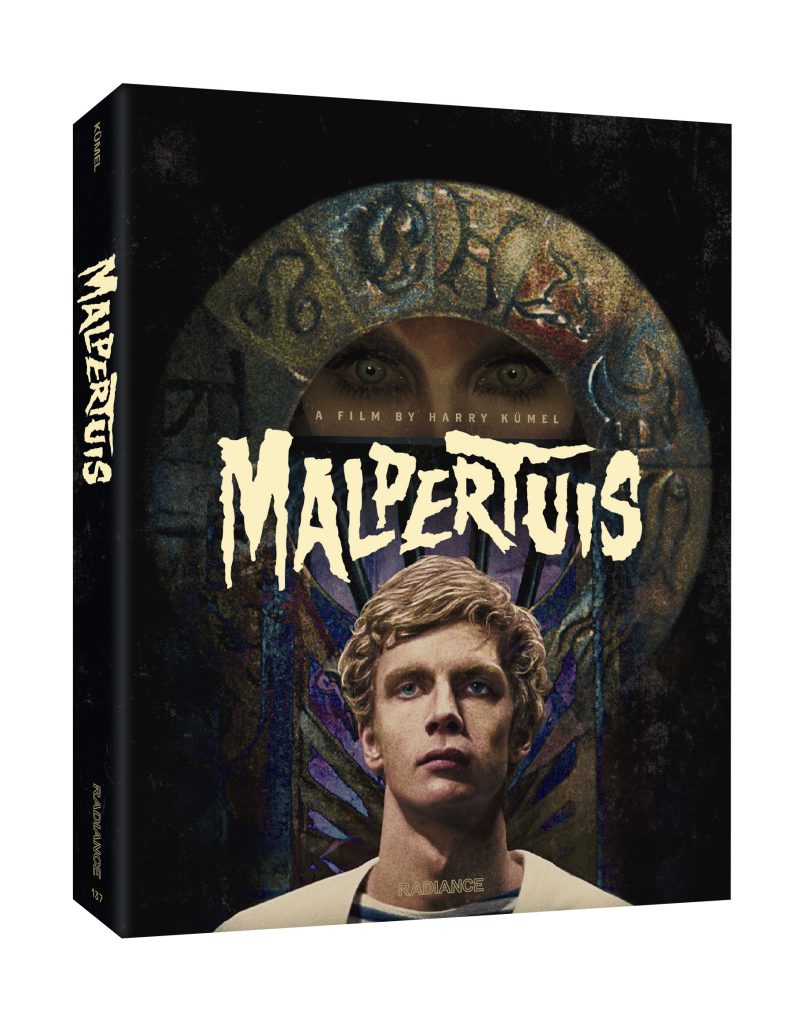
Belgian auteur Harry Kümel’s bold cinematic flair transformed European genre filmmaking in the 1970s. Now, two of his most striking and subversive works originally released in 1971, Daughters of Darkness and Malpertuis, have received brand new 4K restorations which premiered in August at FrightFest.
Both films will receive limited edition Blu-ray box set releases from Radiance Films this month, with Daughters of Darkness also getting a limited edition 4K UHD/Blu-ray box set. The “unforgettable gothic nightmare, set in an eerily deserted seaside hotel” of Daughters and the “haunting tale of ancient gods, crumbling mansions and cursed bloodlines” which is Malpertuis are absolutely essential viewing for anyone who wants “cinematic experiences that are as unsettling as they are unforgettable.”
We spoke with director Harry Kümel about his work on both films, as well as his lengthy career.
STARBURST: As you’ve been a teacher for so long, do you find that you have students who come to participate in your classes because they’ve seen your films?
Harry Kümel: I guess I do. They hired me every time in schools because of that. I mean, that’s normal. The, shall I say, good students appreciate it.
How has the response that the students have to your films has changed over the years?
It gets better every year. I’m extremely surprised. Actually at my age, that is what is my extraordinary surprise in general is that the films I made, there are very few, but young people seem to like them, which is very surprising because they have absolutely no relation with them whatever, except some films that are getting made now that begin to go back to something normal, shall we say. A satire is again a satire or dares to be a satire, like Eddington, for instance.
One of things we greatly appreciate about your filmography is the fact that you have directed so many films that are adaptations of novels and stories, except one. What’s the the appeal of adapting stories?
Because it’s easy. It’s easy. First of all, they’ve always asked me to do, except that when I wrote myself and with somebody, which is a satiric comedy nobody knows overseas anyway. I’m a director for hire and producers have a tendency, rightly so, to prefer to shoot novels because the story all is all there.
They don’t do it very well often, but it plays in stories. That’s always been the case.

You worked several times from scripts with Jean Ferry. What made you want to direct his scripts so often?
Well, I met him, and it stopped because he died. That’s very unfortunate. He’s the best I ever had. And I’ll never have an equal, just like Gerry Fisher was the best director of photography. Even if I had very good directors of photography, he was the best. I always hope to find the nice good one.
Jean Ferry, he was recommended to me by a French publisher, which I went to interview for television and I asked him, “Do you know somebody who could adapt Malpertuis, by Jean Ray? It is a very difficult job,” and he said, “There’s only one. That’s a person they have buried,” who had written 50 films, and with the greatest filmmakers, but was reduced to television work, which in France is really the dumps.
I went to see him and it was love at first sight. I mean, he understood immediately. And the fact was that I made Daughters of Darkness before Malpertuis because I was asked by the producers and I sent him the treatment we wrote, which was supposed to be an exploitation film and he made of it what it has become.
Both of these films that are getting these new restorations could have been very salacious pictures, but they became something else. How do you take a movie about lesbian vampires and make it something that is for the ages?
But salaciousness is very interesting. Only the British have problems with that. A certain category and films become what they become because of the filmmaker and the people who are around it. That is something one doesn’t control. I’ll make a parallel.
I just saw – because now you can see everything on YouTube, certainly via the Russian sites, who don’t care about author rights – a film nobody talks about called DuBarry Was a Lady which was made in ’43. An Arthur Freed production with Gene Kelly. Now the film is okay, but gets boring at certain moments, but every time Gene Kelly appears on the screen, everything explodes.
Also, the cameraman, the movements of the camera, the whole direction, everything changes. Of course, because he directed the musical scenes, but still, it is his appearance, and that’s the miracle of film. That’s the Marilyn Monroe problem every director tearing out his hair makes and then seeing the dailies and rushes at night and then you forgive everything because it’s something one doesn’t control in cinema. Films become what they are because they are what they are.
I consider myself one of the lucky people in filmmaking because my films remain, and with such a small production, that’s a very agreeable thought. It’s mostly mainstream cinema that has a tendency to grow, but not always.
I was talking about Eddington, which is shown in our country in art houses but to great success, fortunately and despite some mainstream media not liking it, of course, but it’s a film about the times, the changing times and that is also important, but it’s in the interior. It is not because it’s talking of that film about masks and, and COVID and everything or the rigmarole.
No, because underneath it, something moves it along. One can compare it to the terrible movie called The Brutalist. Boring thing, it schleps along and will never, never, never survive. Miller’s Mad Max films will survive. Strangely enough, not a very agreeable person.
I think you touched on something that really explains why Daughters of Darkness continues on – because it is about lesbian vampires, but when you have a vampire in any film, one of the things you can look to is someone who is trying to constantly be part of the present, despite having come from the past. Any vampire story is about a character trying to adapt to changing times.
Among other things, it’s a more sexual thing than anything else. And that’s demonstrated – not in the latest vampire thing – but in the Coppola film. Obviously, that’s one of the great movies ever made, even if he didn’t like it himself. Very strange.
In Daughters of Darkness, the main character is is represented by the image of a movie star of the ’30s. And I only chose that because that is an eternal image. The iconic effect of Marlene Dietrich – it is, of course, “immortal vampire”. That is the whole thing, but I’m not thinking that much about what I’m doing. I mean, that I leave to arthouse filmmakers.
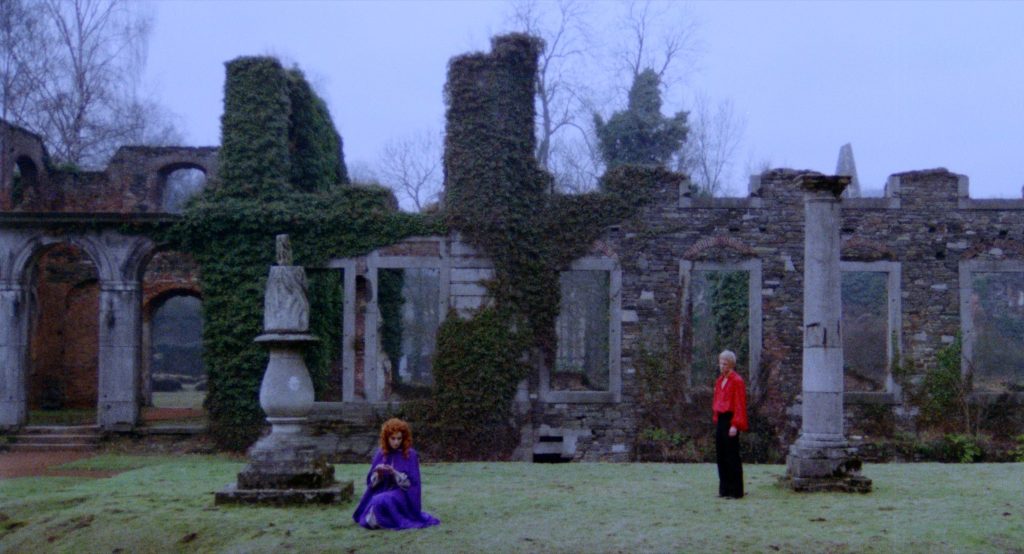
Given that both Daughters of Darkness and Malpertuis are getting these very lovely restorations, how is it for you, getting to see these films look as good or if not better than the day they came out from a freshly struck print?
Oh, that is very normal. Digital is much better than analogue. It is very simple. I can do anything. I can control the skin colour, for instance, of the countess in Daughters of Darkness, that is continuous. That was impossible. One can separate everything so everything is manipulated and little things which are not changed for instance, as in Daughters of Darkness, a moment when the companion of the beautiful Andrea puts a red cloth muslin thing on a lamp because the lights disturbs her.
In the analogue film, it was done with a dissolve and a curtain. It was all right, but now it is perfect. The light comes out. It’s the effect I wanted, but I couldn’t do it. I couldn’t achieve. These little things – not little, the whole effect – but one must beware very much not to become too digital. One must keep always in mind it was a film. And so I like to destroy a little bit the sharpness and that kind of thing that that we do routinely. Unfortunately, digitalisation, the restorations are not very good generally, except the ones that belonged to, that went to Turner from MGM, and they had mostly the three for the Technicolor – the three negatives to make it.
At that time there was still in China a Technicolor machine. Now everything has disappeared. The greatest idiocy of all time. But we can still get those things. But now we can do that again more or less digitally by separating, even if we have only the negative by separating the three colors, and readjusting them and then you get everything right. I didn’t do that yet. I’m going to do it for my next restoration, which is not a Technicolor film, but there I can control the depth of the color and everything. That’s something unimaginable before.
One of the reasons Daughters of Darkness has lived on for as long as it has, in addition to the film, is François de Roubaix’s score. We were astonished when, a couple of years ago, it got an actual release for the first time, 50 years afterwards. There’d been a 45 single, but the fact that these this release came out – what was that like for you? Not just the film surviving, but the score having enough interest to where this sold out almost instantly?
Yes. Immediately. I always tell that, that my idea of the music was much more intellectual. That was Hungarian operetta music and the only one who could have done that was the Belgian composer who had done my first film, or the one who did Malpertuis [Georges Delerue], who you could ask everything musically. When I said to him, “When the light comes on the window, use the two first notes of Gounod’s ode he sings to Marguerite in Faust” and he executed that perfectly. So, Malpertuis, who cares among the public that I put in a Gounod note in? That’s for my pleasure.
But here, I didn’t have at all what I expected, first of all, because Francois was great, great guitarist and a fine jazz guitarist, and a fantastic jazz person. Very good. Didn’t understand the first thing about classical music. He was used to jazz notations, where you don’t write the notes like you do normally, but you only give clusters little things, and when I said I would like to have a cimbalom on there, and he looked at me with eyes of a deer looking at headlights and he said, “What is a cimbalom?”
And I said, “This is Hungarian instrument,” and he used it. He was very surprised to hear that instrument, which he had never, and he reused it for other things he used in it, but it never sounds Hungarian. My main producer was enthusiastic about the music.
I wasn’t, but the director never knows how this film does. We have an idea and then that doesn’t come out. Usually, an idea doesn’t come out like one wishes and boom, you are stuck with it. And you think, “Oh, yes, and I could have done better. You can always do better,” and that kind of thing. Every director will tell you that.
And in this case, slowly, I can’t say the music grew on me, but what I can say is that it has been sampled to the skies everywhere. What do you do against such a thing? Nothing. You just tell the truth and you say, “Well, I didn’t like it,” and, “Well, I thought is was – not ordinary in English – but low level,” and I thought, “Oh my goodness.”
Malpertuis was not commercial, not in that sense, but it was the best music he had ever written. That he said himself. I said to George at that time, “You didn’t make one sou from that film,” and he said, “I don’t care. I make so much money with the other trash I’m making for Godard with music I take out of my drawers. When I put music on your film, I don’t need to adapt the music to the film. It falls exactly.”
I don’t want to compare anything. I consider myself – because of my very small output – not such a big deal. But what epitomises a good director is rhythm. And you can see that in the most perfect form with the good films of Lubitsch, for instance, where everything goes like clockwork. You see that with John Ford also in his good films. It goes like a metronome. It works better because it changes naturally and that characterises films that have a tendency to remain because then they approach what a good painting is, and certainly what good music, is that it is it’s based on seven notes and afterwards comes the miracle.
That’s a saying somewhere, and that that is miracles, you don’t control anyway.
Malpertuis releases on October 13th and Daughters of Darkness releases on October 27th, both from Radiance Films.