THE GIRL WHO GOT AWAY

Decades after kidnapping and murdering four young girls, a notorious serial killer escapes prison to go after the one who got away. Christina Bowden (Lexi Johnson) managed to escape Elizabeth Caulfield’s (Kaye Tuckerman) killing spree as a child, but she may not be so lucky the second time around. Worse, Bowden has a ward of her own to think of – a young girl who might be the perfect age and type for Caulfield’s monstrous M.O.

Even worse than that, with Christina waking up every morning covered in cuts and bruises, her bare feet filthy with mud, it becomes apparent to investigating cop Jamie (Chukwudi Iwuji) that the girl who got away has some secrets of her own. Has Caulfield returned for revenge, or is Christina literally sleepwalking her way into murder?

The story is deceptively simple, recalling the murder mysteries of Wes Craven, and the slash-em-ups of John Carpenter’s Halloween. Writer and director Michael Morrissey effectively sets up the showdown between killer and kidnap victim, employing likeable characters and a solid central mystery to be solved. Flashbacks to Christina’s time in captivity keep the story ticking along, even as the plodding pace threatens to bore.

Iwuji is a strong presence as the sensitive, decent town copper, but the rest of the cast struggle to keep up. The writing requires a bit more from Johnson than she is entirely capable of, leaving her floundering during the more emotional sequences – more bemused than distraught or horrified. The film remains sharply shot and compelling to the end, but squanders the goodwill built up during that opening half. Morrissey and Johnson give it their all (or most), but ultimately fail to hold on to what they had.


OCCUPATION: RAINFALL

rainfall

Occupation: Rainfall is a sequel to the 2018 low budget Australian alien invasion flick Occupation, written and directed by Luke Sparke that, whilst well-reviewed, failed to make much of an impact at any box office and appeared to sink without trace. Curiously, it performed well enough on Netflix in the US to enable Sparke to get this lavish sequel greenlit and whilst as a film, it’s not hugely interesting and doesn’t really do anything new with the ‘humanity flattened by aliens’ trope, it’s an admirable achievement in its own right delivering an astonishing display of visual spectacle on a comparatively meagre 25 million Australian dollar budget.

Sparke has thrown literally everything at the screen here – we’re pretty sure we saw his kitchen sink hurtle past at one point. For those who may have missed Occupation (i.e. virtually everyone), a quick opening narration brings us up to speed as we’re told that two years have passed since the alien ‘Greys’ came to Earth and groups of human resistance fighters continue to fight the good fight, aided by alien defectors who are sympathetic to the human cause. Word comes of a mysterious device known as ‘Rainfall’ connected to a former military base at Pine Gap and a group of plucky humans (mostly characters from the first film) set off to find it in the hope that it might provide a valuable asset in their ongoing struggling with the vicious, armoured aliens.

What follows is over two hours of bombastic action, endless explosions, CGI aerial dogfights and a fantastically ambitious storyline that seriously cuts no corners in bringing some real visual oomph to the screen. Occupation: Rainfall looks extraordinary; frankly it has the scale and pallet of a film with a budget five times higher, topped and tailed by massive air battles with aircraft and alien fighter ships and studded with spectacular set-pieces throughout its running time (the best being a ground race between pod-like hoverships) and any number of alien lifeforms from the reptilian aliens themselves to strange dog/horse hybrids that roam the landscape, not to mention a sequence with a hideous arachnid creature and a cheeky lightsabre-lite fight. The CGI looks terrific on the small screen (although any deficiencies may be accentuated on a cinema screen) and it’s all stunning stuff but the downsides to the film frustratingly detract from the shock and awe of the massively accomplished visuals. The story itself is a bit dreary and unimaginative – and uninvolving  – with the attention tending to wander when the attention focuses on the drab human characters – and the film is ultimately far too long and far too loud. There’s really not enough narrative here to justify a two-hour-plus running time and the inclusion of clunky comic relief sequences with The Hangover’s Ken Jeong feel not only misjudged but completely out of place in a film that is otherwise po-faced and humourless. By the time the film reaches its explosive conclusion it’s really hard to care what happens because we’ve been beaten around the head by the visuals and the sound design for two hours at the expense of interesting character dynamics and in the absence of standout performances from a largely-bland cast.

In the end Occupation: Rainfall is an incredible accomplishment on the available budget and this is clearly a labour of love from Sparke who has so clearly given this project his all. This alone makes it a worthwhile experience as proof that it’s not just Hollywood that can churn out big, brash sci-fi adventure movies and that sometimes these films really don’t need $200 million budgets to make their point. The ending suggests the potential for a third chapter in the story but next time we’d like to see equal time and energy expended on both the script and characters and the headache-inducing visuals.

Occupation: Rainfall is available on DVD/Blu-ray/VOD now. Read our interview with director Luke Sparke here.

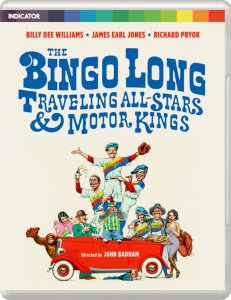
THE BINGO LONG TRAVELLING ALL-STARS & MOTOR KINGS

bingo long

Released way back in the balmy summer of 1976, a decade with very different social attitudes and expectations, The Bingo Long Traveling All-Stars & Motor Kings was a breath of fresh air. Released in the shadow of Watergate and Vietnam and wedged between the summer smash of Jaws in ’75 and a year before the arrival of Star Wars, this baseball-based sports film dealt with topics far more substantial than one of America’s favourite sports. Starring soon-to-be galactic stars Billy Dee Williams and James Earl Jones, Bingo Long also featured the white-hot Richard Pryor, seven years away from his adventures with Kal-El in Superman III and already one of the States most incendiary comedians in a role that made him even more infamous.

The film, based on the 1973 novel by William Brashler, sees dissatisfied pitcher Bingo Long (Billy Dee Williams), tired of being treated appallingly by the owner of the Ebony Aces Sallison Potter, pulls together his own team of all-stars from other black teams in the segregated African American baseball league. Utilising the talents of big-hitting Leon Carter (James Earl Jones, 13 years before his more famous baseball movie Field of Dreams) and Pryor as Charlie Snow, a man who dreams of playing in the majors. Despite being boycotted by black teams, they take on minor league white teams, essentially becoming the Harlem Globetrotters of baseball, engaging in distracting routines and pure skill to throw off their opponents and going on a winning streak that leads back to the Negro League as championship-winning equals.

Directed by John Badham a year before his own smash-hit Saturday Night Fever, it’s a fun, vibrant and oftentimes sobering account of life for black sportsmen in the United States of the ’30s. Modern audiences may find some of the content troubling, and it’s brutally honest where it needs to be, but look beyond that, and you see the determination and grit of a team to prove themselves not only to the bigots of the era but also to themselves. This, and it’s clear to see why Billy Dee was cast as Lando Calrissian, his effortless charm oozes off the screen, as does the charisma of the entire cast. Well worth a watch or a rewatch for viewers old and new.

DON’T BREATHE 2

Name a horror character, any horror character. The odd Laurie Strode or Ashley J. Williams aside, chances are, you probably just named a Freddy, Jason or Michael. No matter how horrible they might be, it’s an inevitability that the most popular character in any given horror franchise is its villain. That’s why Halloween III, for all its fans, never really got off the ground. The same is true of Fede Alvarez’s 2016 home invasion movie, Don’t Breathe, which pit a monstrous old blind man (Stephen Lang) against a gang of would-be burglars.

Alvarez and co-writer Rodo Sayagues did their best to turn audiences against Norman Nordstrom, with a controversial mid-movie twist which revealed the old man to be a kidnapper and rapist, as well as a murderer of hapless teens. So effective were Alvarez and Sayagues in making Nordstrom impossible to root for that it makes this sequel’s sudden about-face feel especially jarring. Taking the helm as director, Sayagues turns Norman Nordstrom into the hero of Don’t Breathe 2, fighting for the life of his young ward.

Hoping that audiences might not remember all the kidnapping and the raping Nordstrom did in 2016, Don’t Breathe 2 casts him as its grizzled antihero, his home once again invaded by a gang of ne’er do wells. This time, however, Norman’s uninvited guests are a collection of ex-military men and well-trained heavies, more than capable of holding their own against the blind Gulf War veteran. Norman acknowledges his sins early in the film, but never specifies the worst of them – some things are beyond redemption – so Sayagues and Alvarez just kind of dance around the elephant in the room, hoping no-one remembers the things Norman did with his turkey baster.

Unsurprisingly, Lang snaps back into the role with ease. Doing away with the first film’s horror beats in favour of gritty, brutal action, Sayagues keeps the film moving, with one sharply choreographed fight sequence after another. Its villains – the ones the film want you to dislike – are a muddled lot, their motivations shifting in the wind. Are they a gang of opportunistic organ harvesters? Meth dealers looking for their MacGuffin? Something altogether more personal? The answer is yes to all of the above, and it only gets sillier as the film approaches its endgame. As Norman’s, uh, ‘adopted’ daughter, Madelyn Grace does her best, but she’s kicked from pillar to post; a plot device to give Norman and his enemies something to fight over.

Don’t Breathe 2 is a solid action film, but it’s a disappointing sequel to what was a fairly decent horror thriller. Its redemption of Norman Nordstrom is repellent, the story repetitive and obvious. Few will see the film’s various twists and turns coming, but even fewer will care. This is a film full of horrible and ridiculous people doing horrible and ridiculous things to other horrible and ridiculous people. In trying to make a hero of a rapist, there’s no-one left to root for.

PARANORMAL ACTIVITY LIMITED EDITION (2007)

PARANORMAL ACTIVITY

For anyone who doesn’t know the story, Oren Peli’s 2007 Paranormal Activity is about a young suburban couple harassed by a malevolent demon. A straightforward premise, expertly executed for a reported budget of $15,000 (although reshoots and a new ending added a little more), that went on to recoup almost $200 million. It is the most profitable film ever, inspired a franchise and, like Jaws and Alien, has entered popular culture; if you haven’t seen it, you know about it.

So, why do we need a new Blu-ray release? The truth is you don’t.

The problem is that the film’s structure and concept are based around surprise and intrigue, the much-quoted and oft-maligned ‘quiet, quiet, BANG’ approach to filmmaking so prevalent in lesser found footage productions and modern horror in general. Once you’ve experienced that initial viewing, any subsequent watch will inevitably dilute the experience. While there is much more to Paranormal Activity than that simplistic generalisation suggests, the point remains relevant.

What is so easily forgotten is how influential a film this is. While The Blair Witch Project spawned the found footage moniker several years before, it was Paranormal Activity that really demonstrated what could be done. For independent, aspiring filmmakers, this changed everything. Since 2007 there have been almost 200 films produced that fall into this genre, with the majority made on limited or small budgets.

The extras here are fine, largely consisting of cast and crew interviews, and the clarity is certainly improved. But really, the only reason to purchase this new release is if you don’t already own it. Paranormal Activity is an important film, but one that doesn’t necessarily require repeat viewing.

Paranormal Activity Limited Edition Blu-ray from Second Sight is available on September 30th.

KAREN

karen

Hollywood has a habit of misunderstanding what makes great movies tick. After the first few Bourne films came out, action movies became so quick-cut that they were incomprehensible to watch, as filmmakers didn’t have quite the same skill with action as Doug Liman and Paul Greengrass; following Saw, torture porn became pervasive in the horror genre, as filmmakers failed to realise that the mystery is what makes James Wan’s film tick, as opposed to its more gruesome scenes; and in the wake of Get Out, parts of horror have focused on trying to portray racism and the modern black experience, while not realising that the Sunken Place is the true horror of Jordan Peele’s film, not the racism of its white characters.

It is this final category into which Coke Daniels’ Karen falls. This is a film that attempts to say something big, but is so ham-fisted and obvious in its approach that it fails to say anything at all, coming off in the end as preachy and uninteresting, with nothing at all to redeem it.

Karen is based on the Twitter meme of the same name, which stereotypes a certain kind of white woman as ‘Karens,’ meaning selfish and entitled to the point of endangering others, particularly people of colour through the weaponisation of their whiteness. It follows young couple Malik and Imani (Cory Hadrict and Jasmine Burke, who do almost passable work given how little they have to work with) as they move into a rich, white neighbourhood, quickly finding themselves terrorised by their racist neighbour (the titular Karen, played here by Taryn Manning).

It’s hard to pinpoint exactly what’s wrong with Karen because it’s a film whose very foundations are unengaging to the point of repulsion. Many audience members aren’t interested in stories of black suffering anymore, particularly when there’s little point to it. Karen adds nothing to a worthy conversation, and instead seems more interesting in ripping off better genre fare and exploiting its black leads. People don’t want entertainment about black suffering in 2021 because we’re past it – but watching Karen, you wouldn’t think we are.

So the very idea behind the film is a rotten one. Is it at least somewhat entertaining? Nope. Its poor story basis results in a woeful script that gives audiences mere whispers of characters who feel about as real as that pig flying past your window right now. Every single line of dialogue is geared to exposit, leaving no room at all for any actual character growth – we know things about Malik and Imani because we’re told them, and we know they love each other because they seem to be in a competition to see who can call the other ‘baby’ the most times in one conversation. It’s nauseating.

Then there’s Karen herself. There are tweets with more character than this woman – she’s so clearly inspired by the meme that she has no other characteristics, making everything she does predictable and dull. Taryn Manning is almost decent with poor material, but she’s so cartoonish that she’s impossible to take seriously at all. And in yet another misunderstanding of Get Out, she’s the ultimate horror – there’s no Sunken Place, no commentary on the commoditisation of black bodies, nothing of any substance or interest. Just her. And when she’s written like this, one white woman isn’t enough to carry a horror movie.

Karen is nothing short of a failure. Wholly derivative of better movies, it’s entirely unable to add anything productive to the conversation around racism and the weaponisation of whiteness. Make no mistake, these are certainly conversations that need to be had – but this isn’t the way to do it. People like Karen exist in the real world – we know this. We don’t need to watch a feature film about a white woman exploiting her race against black people, because it happens enough in real life. There’s no entertainment value in simply regurgitating real life whilst adding nothing to the conversation. If there’s one film to steer well clear of like a racist anti-masker, it’s Karen.

Karen is out now in the US.

WIRED SHUT

Wired Shut poster

If there’s one thing Stephen King has taught us, it’s this – writers shouldn’t live in an isolated house in the woods. Bad things happen. And such is the case in Wired Shut, a film that very much feels like one of King’s works, but isn’t.

Reed Rodney is a famous, best-selling novelist. He’s middle-aged, a recovering alcoholic, and has suffered a serious injury in a car accident. His jaw has had to be wired shut while he recovers, which renders him unable to speak or eat solids. He retreats into seclusion, unable to answer the phone, and is on a liquid diet. His self-imposed exile comes to an end when he is visited by his abrupt and abrasive daughter Em. The third and final cast member is Em’s unstable boyfriend Preston. His arrival starts a night of torture and peril for Rodney – who is of course unable to summon help.

Director Alexander Sharp creates an unsettling atmosphere, with slow and deliberate pacing. As in a Stephen King novel, time is taken to establish the characters properly before the meat of the story is reached. Blake Stadel plays the seriously flawed Rodney in a way that evokes both sympathy and revulsion. He’s a man that has succumbed to his weaknesses and has driven his wife and daughter away. Yet, he’s a man trying to recover from those weaknesses and is earnestly trying to do better.  Natalie Sharp’s Em is on her way to college. Her difficult childhood has left her bitter, angry, and confrontational toward her father. Her cold indifference toward him, contrasted by his post helplessness gives her a swaggering sense of menace. Preston, though is a tour de force of rampant, unpredictable psychosis, driven by rage played to perfection by Behtash Tazali

Overall, more of a suspense thriller than a horror film. Not in the menacing league of Misery as far as writers in peril are concerned. Wired Shut is actually pretty tame by comparison – but it’s a decent film nonetheless.

WIRED SHUT is released by 101 Films on DVD and Digital September 6th

THE MADNESS INSIDE ME

madness inside me

Madison (Merrin Dungey) is a forensic psychiatrist who spends her working days talking to often dangerous criminals assessing their psychological suitability for parole. When her husband is killed during a botched burglary, her life is shattered. Despite picking the killer (Devon Graye) out in a police line-up, she testifies in court that he wasn’t the man, leaving him to walk free. Over the subsequent weeks, however, she becomes obsessed with photographing strangers in the street and following Francis, the man who killed her husband. The infatuation doesn’t lead to revenge, however, but something more intimate.

Written and directed by Matthew Berkowitz, The Madness Inside Me is quite a difficult film, since it’s hard to empathise with a character who goes out of their way to be close to someone who killed her husband. The film doesn’t even want us to try. We are not really meant to judge her; however, when her sister-in-law is appalled by her actions, our instinct is to side with Madison. The character is someone who fights for the rights of those who could be a danger by day, but eventually embraces that danger by night. The risk involved is a sexual as well as emotional thrill; a power struggle she has never risk take before.

The cinematography – by Mattia Palombi – is stunning and the decision to present the first act in the 4:3 ratio, before moving to 16:9 when the two very different characters finally sit down to talk, is interesting, as though Madison’s world has opened up too.

The Madness Inside Me is an interesting psychological study of a person forced to discover themselves following a trauma. It doesn’t provide many answers but is an engaging watch nevertheless.

The Madness Inside Me is out now in the US.

DEMENTER [FrightFest 2021 Digital]

dementer

Chad Crawford Kinkle’s second film after his superb debut Jug Face has been a long time coming and is much more experimental, both visually and audibly.

Katie (Katie Groshong) takes up a job caring for special needs adults. She lies about where she’s living – she sleeps in her car and washes in gas station toilets – and is clearly trying to escape a disturbing past. We’re shown through flashbacks that she was a victim of some kind of occult group (led by Larry Fessenden), and bears the scars to prove it. She develops a bond with one of the clients in the home, Stephanie (played by the director’s sister), who has Down Syndrome. When Stephanie falls ill, Katie becomes convinced something evil is behind it and attempts to help her with incantations.

There’s a documentary feel to the care home scenes, with the clients and workers essentially playing themselves. These moments are shot with care, and there’s never a feeling of exploitation of the people in the home, but more that they enjoyed being a part of something fun. The satanic story crafted around these scenes is discomforting and alarming and has a surreal quality.

Dementer is full of discordant chimes, ominously hushed voiceovers and screeching violins that add to the sense of unease more than the fractured visuals ever could.

Kinkle’s sophomore film is a difficult watch, and won’t be for everyone. As the movie builds to its climax, the nightmarish imagery and sound design take over. As a coherent narrative feature, Dementer doesn’t entirely succeed, coming across instead as a disturbing art piece.

Dementer is released on Blu-ray from Arrow Video (with Jug Face) on October 4th. 

EVIE [FrightFest 2021]

Evie

The latest film from Dominic Brunt (Before Dawn) – who co-directs with Jamie Lundy – is a brooding, psychological family thriller with a touch of mythology.

An idyllic family living by the sea are faced with upheaval when young Evie (Honey Lundy) finds a necklace bearing a strange sigil. Once she starts wearing it, she begins acting up. She becomes awkward, walking out during a church service and arguing with her parents (Joanne Mitchell and Liam McMahon) and getting a reputation at school as ‘freaky Evie’. Fast forward almost 25 years later, and grown-up Evie (Holli Dempsey) is stuck in a job she dislikes and has a troubled life. She has spent a lot of time in care and foster homes and has a history of mental health trouble. She drinks and makes dubious choices with men. When her withdrawn brother, Tony (Jay Taylor), suddenly comes back into her life telling her he is living in their family home and her father, who she thought was dead, is alive but very ill. He’s also written a book that he has self-published based on her obsession as a child called The Selkie.

With trepidation, she returns to the house she grew up in, while Tony and the local priest (played by the wonderful Michael Smiley) are concerned that she might not have gotten over what happened that fractured the family unit, nor does she fully understand or perhaps remember that time.

Filmed during lockdown, Evie makes the most of the isolated location with sweeping seascapes and windswept dunes. This isn’t the standard psychological or monster movie. Still, there’s a brooding unease throughout, and Dempsey’s portrayal of Evie is naturalistic rather than unhinged and is all the better for it. As the younger Evie, Lundy is fabulous, suggesting that perhaps she’s suddenly been possessed by a mythical creature. Occasional flashes of ‘something’ add a chill but are unnecessary as the true horror comes from the suggestion of past traumas and is second place to the human drama taking place in the modern-day. Evie struggles with her place in the world and is a relatable character, even if it’s not one we’d necessarily want to be ourselves.

Brunt’s go-to composer Thomas Ragsdale provides a provocative score that provides a pensive accompaniment, particularly in the scenes of high drama. It’s Brunt’s most emotive film since his debut Before Dawn and would work just as well without any mythical qualities.