Ben (Oded Fehr) is in prison for murdering his wife and daughter. His lawyer (Alexandra Gilbreath) is convinced his colleague, Steven (Corey Johnson), has some culpability since he gave him an item that was allegedly possessed. She believes this got into his head and caused his mind to become warped. Seeing an opportunity to make money and possibly provide some credence to Ben’s story, Steven decides to rent out an apartment and rig it up to monitor a family’s reaction to various ‘cursed’ items. In town for a break, Carly (Alana Wallace) and Maria (Aislinn De’Ath) and her daughters Joey (Anya Newall) and Lilly (Lara Mount) are the subjects of his experiment. However, after a few nights, Steven becomes convinced that something supernatural is truly going on.
With the interesting but familiar premise of a possession causing a massacre, Lair doesn’t waste time getting into the absurdness of someone rigging up an apartment with cameras and security protocols. While Steven becomes a creepy voyeur, the family are dealing with their own issues, which provides a tension of its own. The sudden shift to the evil goings-on is too predictable and how it’s dealt with following a slaughter is entirely unbelievable.
Lair is most effective in the scenes in which the family are (almost literally) tearing themselves apart. The four females – even the kids! – provide the best performances too. Corey Johnson is saddled with some awful dialogue and doesn’t really redeem himself with what he can offer acting-wise either.
Writer/director Adam Ethan Crow has some good ideas here that are not fully realised but he manages to conjure a few good scares along the way. On the plus side, it looks fabulous thanks to Stuart White’s cinematography and there are some genuinely creepy moments.
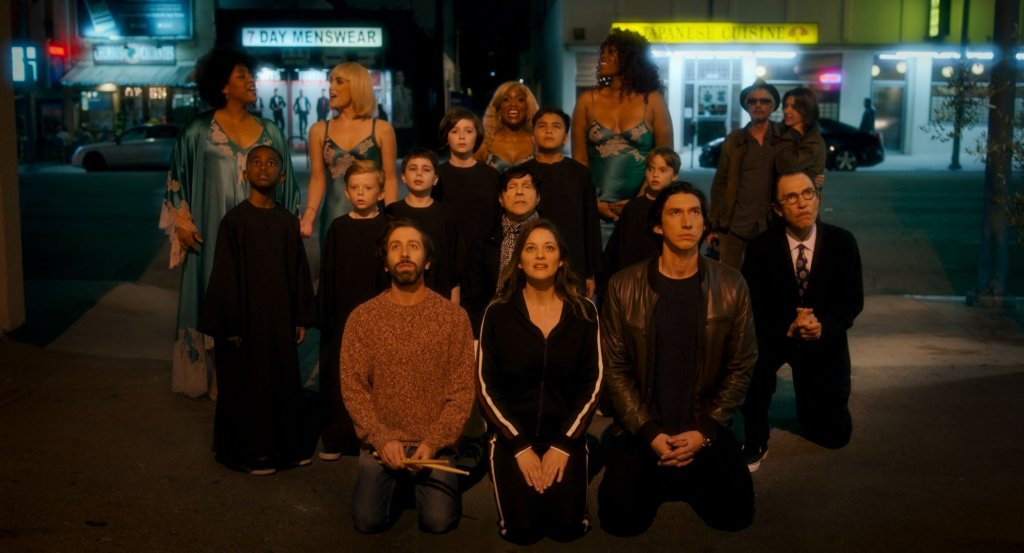
Nine years after dropping the masterpiece that is Holy Motors in our collective lap, French filmmaker Leos Carax makes his English-language and musical film debut with Annette, a sprawling rock opera born from his collaboration with Ron and Russell Mael (better known as the cult, genre-defying band Sparks).
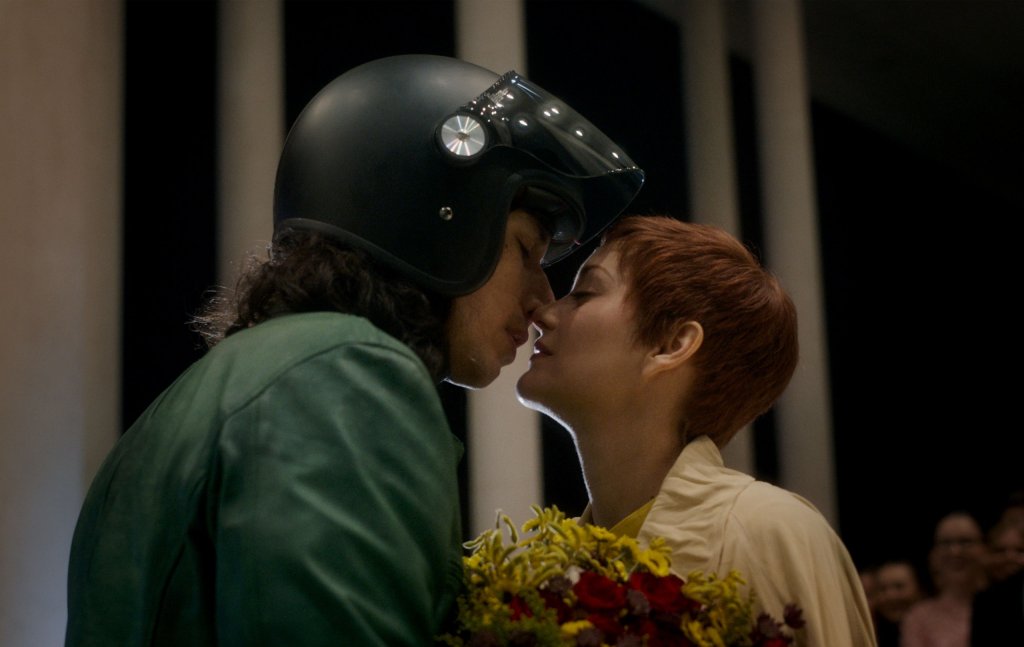
The film opens on Carax, sat with his daughter behind a mixing board, as he politely asks: “So, may we start?”. The question becomes the hook to Annette’s overture, which sees the cast and crew head out of their recording studio and march together in song through the streets of Los Angeles. In a long tracking shot, the audience bears witness to Adam Driver and Marion Cotillard’s transformations, as they slowly move from versions of themselves and into character. He dons a dark wig, green leather jacket and motorcycle helmet; she takes a tan trench coat and climbs in the back of a black SUV. Driver and Cotillard disappear, replaced by Henry and Ann.
Henry McHenry is a controversial comedian and the self-dubbed “Ape of God”, who enters his shows in a “Rocky-era boxer meets grumpy old man” robe and smoking a cigarette, baiting the crowd with furious rants and gravelly singing intervals. He isn’t funny; what’s important is simply that his audience roar with laughter on cue, and that they be the sounding board to his hostility. Ann Defrasnoux is a world-renowned singer, a fragile-feeling, exquisite opera soprano who is destined each night to die a tragic death. Henry is in love with Ann, and Ann is in love with Henry. These two “love each other so much,” they like to sing, even as reminding us of that fact demands Henry surface for air mid-cunnilingus.
But make no mistake, Annette is not a love story. First comes love, sure, but then comes a creepy marionette baby (who lends her name to the musical), career suicide, a crumbling marriage, a dramatic shipwreck, possible murder, a supernatural haunting, and viral fame. Not that the plot matters much. Central to the narrative is Henry’s unravelling – his arc serves as a dissection of male egotism and entitlement, shines a spotlight on the price of fame and what horrors the public will excuse away in the name of creative “genius”, and perhaps even works as a commentary on child celebrity culture and artistic exploitation.
Yet despite treading thematic ground ripe for exploration, Annette is too far distanced from its own events and characters to do more than just suggest surface-level analysis. What the film lacks in substance and narrative heft however, it makes up for in both style and spectacle (Carax was, after all, a founding member of le cinéma du look). From the Renaissance art quality of its set pieces to the daring use of ethereally beautiful, fantastical elements, there’s no denying that Annette is visually stunning. Also deserving of praise is the acting: from Driver’s commanding, unyielding performance and Cotillard’s understated turn, to Simon Helberg single-handedly providing the musical its heart and warmth as Ann’s lovesick accompanist.
None of that proves enough to erase Annette’s flaws, however. Not only is Carax’s musical narratively and thematically flimsy, its characters mostly archetypes, and its runtime far too long, but most of the songs aren’t great either – which, for a musical, is an issue. Sparks’ hyper-literal lyrics do little to convey the characters’ state beyond generic and obvious emotions, nor do they advance the story. And so, despite all it has working in its favour, Annette remains vague and glib.
There will be people who will love Carax’s latest exactly because it is so uninterested in audience gratification, and will praise its bravery and rejection of narrative convention. For this reviewer however, there’s just not enough substance to Annette to support its own massive frame. Call it a film to be admired, but not necessarily enjoyed.
Ryan Andrew Hopper’s debut feature delivers an intriguing but ultimately frustrating mash-up of a string of admirable if confusing contemporary cinematic influences. A dash of non-linear Tarantino storytelling here, eccentric Coen brothers supporting characters there, a Scandi-noir location (albeit relocated to the wilds of West Wales, such as they are), and a very Spaghetti Western aesthetic (emphasised by Rael Jones’ evocative and sparse score). The end result, perhaps inevitably, is a film that doesn’t quite know what it is or what it wants to be, pulling in several different directions and trying just a little bit too hard to make a mark as it battles to stand out in a crowded low budget filmmaking marketplace.
A surly and unnamed loner (the always-watchable Michael Smiley) mans a toll both on a barely-used and partially-overgrown road in West Wales. He’s a man with secrets and a past he’s keen to distance himself from. A chaotic and fruitless armed robbery and an encounter with a figure from his past (Gary Beadle) leads to an investigation by determined local Police officer Catrin (Anne Elwy) that threatens to disturb the toll operator’s own shady activities and his associations with would-be local hardman Dom (Iwan Rheon) and the witless Cliff (Paul Kaye). Throw in three hapless criminal triplets (all cleverly played by Gwyneth Keyworth), a female Elvis Presley impersonator and her mute sidekick, and a delicious cameo from veteran Julian Glover as a crime lord with a grudge, and the end result is a busy, if slightly haphazard and schizophrenic film that sometimes gives the impression that it’s throwing as much mud at the wall as it can in the hope that some of it sticks. And in fairness, some of it does hit the target with some nicely realised observations on rural life in darkest Wales – a signpost identifies Pembrokeshire as “where the English go to die” and we meet Catrin wielding a speed gun next to a sign proclaiming “one death in one year on this road.” Elsewhere there’s also a magnificent visual gag involving iPads. The Toll balances the parochial nature of life out in the sticks with the extremes of its characters and its often-confusing narrative thanks to performances both lively and low-key with the wild, bleak locations adding to the film’s sense of wilful dislocation.
The Toll packs a lot into its eighty-minute running time and the film’s ambition and sense of scale is impressive even if there’s a sense that Cooper and writer Matt Redd are aiming slightly beyond their reach at this point in their careers. The unorthodox narrative structure will confound and even annoy many but patience is always a virtue and the pieces fall more or less into place by the time reaches its Tarantino-esque climax. An uneven debut, The Toll has enough going for it to make it worth your cash and it’s likely to be the gateway to better and more confident future efforts from both Cooper and Redd as they hopefully manage to forge their own identifies rather than paying homage to their forebears and inspirations.
THE TOLL is out now to buy digitally, and to rent from Sep 6th
It’s inevitable that after the last 18 months, pandemics and the like will be more commonplace in genre films. Shot in Taiwan by Canadian-born writer/director Rob Jabbaz, The Sadness takes contagion into nastier realms.
A pandemic of the Alvin virus has spread throughout the world, but most of the symptoms haven’t been life-threatening. However, as the world re-opens following a lockdown, people start getting lapsed with their precautions and the virus has mutated. This strain causes the infected to become sexually violent and murderously reckless. A young couple, Jim (Berant Zhu) and Kat (Regina) are separated across the city and must fight their way through hell to get reconnected. Kat has also to contend with a sleazy businessman who won’t leave her alone.
The Sadness is a brutally nasty film, the infected acting like rampaging zombies but with a sexual appetite. So it must come with a massive trigger warning, not only for the graphic depiction of the acts but for anyone susceptible to anxiety over our own pandemic. Sure, it might have brought a few crazies out of the woodwork, but at least they’re not gleefully causing bloody mayhem. What’s terrifying about the infected in The Sadness is that they retain their cognitive functions. It’s less like a zombie outbreak and more a removal of inhibitions. It’s as though these hideous qualities are within us and it just takes a twist of fate – in this case, a virus, to unlock it. There are some truly sickening moments, both of sexual assault and bone-crunching, bloodthirsty chaos, but it’s not without its humour. This, too, is in bad taste though.
Strong stomached fans of gore-filled horror will have a blast with Jabbaz’s film. Others will no doubt find it tasteless and excessive. If you can detach yourself from the current global situation, it’s a very well made, shocking but enjoyable romp.
Former dancer Eva (Eugénie Derouand) has been confined to a wheelchair for a while and still misses her former life. Her friend Sophie (Honorine Magnier) gifts her a vintage wooden advent calendar, which has some rules that come with the gifts within. What she finds is each sweet comes with a consequence. It could be something good happening to her, or something terrible happening to someone close to her. One gift allows her to use her legs, but only for a short time. She becomes convinced that by December 25th, she’ll be able to walk again, even if it means people must die.
Writer/director Patrick Ridremont has crafted a stunning-looking film that is dripping in atmosphere. The ornate advent calendar is a great plot device that is both anxiety-producing and beautiful. There are people who Eva meets that deserve everything they get. A guy who tries to force himself on her meets a nasty end in his car when Eva’s pet dog mangles a toy automobile that pops out of the calendar, for example.
Even as Eva becomes increasingly obsessed with regaining the feeling in her legs, she still has a moral compass. Figuring out what the calendar is capable of, she makes a concerted effort to verbalise that she doesn’t want certain people hurt. It’s a fabulous concept that remains intriguing throughout but is somewhat let down by the climax.
The Advent Calendar is available on Shudder from December 9th.
In 1992, Basic Instinct was released onto VHS to the sound of a thousand young men pausing and rewinding their copies. The film redefined the erotic thriller, pushing at the boundaries of acceptable taste and revelling in its controversy. It made writer Joe Eszterhas a household name and while Basic Instinct remains a career highlight, earlier scripts hinted at what was to come. None more so than with 1985’s Jagged Edge.
When San Francisco socialite Paige Forrester is brutally slain in her beach house bedroom by a masked intruder suspicion falls on her husband Jack (Jeff Bridges). He hires a reluctant Teddy Barnes (Glenn Close) to defend him against an aggressive district attorney and things become predictably complicated.
But as predictable as that story is, Jagged Edge manages to retain your attention, largely due to the strength of the performances. There is an essence of pantomime about much of what takes place, but the cast commits to their roles with welcome conviction. Bridges inhabits Jack with enthusiastic vigour, playing with the audience’s affections as much as with his lawyer’s, who is, of course, unable to resist those charms. Robert Loggia – nominated for an Academy Award for his part – growls and grumbles throughout as an old school private detective, and you can almost hear the boos when Peter Coyote’s prosecutor appears on screen.
Jagged Edge is erotic, pulpy fun and worth revisiting, only there is little in the way of extras to make this Blu-ray an essential purchase. But if it is your first viewing, and you don’t see the barely hidden twist coming, you need to have a quiet word with yourself.
Trying to cope together following the death of their parents, brothers Lucas (August Maturo) and Tom (Mike Manning) live in the middle of the woodland, away from everybody. Lucas, however, is constantly getting into trouble with the local police. Being only a few years older than Lucas, Tom doesn’t know how to measure punishment for his waywardness so he created a game: slapface. Each boy slaps the other as hard as they can. Assumingly, this way Tom can rid himself of any guilt chastising Lucas might bring.
When Lucas is bullied into going inside an abandoned hospital by a group of girls, he is confronted by a monster. However, despite his initial terror, he finds the creature means him no harm, and the two become friends. Unfortunately, anyone who might want to hurt Lucas won’t be so lucky.
With a fantastic creature at the centre of the story that is not given too much screen time, you would naturally expect more horror than we see. Slapface isn’t a traditional monster movie, nor is it even a horror film, more a family drama with added fantasy. How much of that fantasy is in Lucas’ mind is open to debate. The location is used to its full potential, creating a lonely, desolate playground for a teen to play, but also the hunting ground of bullies, who are female in this case. Lucas is keen on one of them, but she wants to keep any proper relationship between them secret, as she’s terrified by the peer pressure of the others. So rejection plays a big part in his psyche, perhaps even believing his mother rejected him by dying? It’s only the monster who accepts Lucas for who he is.
Jeremiah Kipp’s film is a haunting story of wayward innocence and family strife. How not having a proper moral guidance can be a problem. It uses everything it has to the best potential, but is still a difficult film to fully enjoy.
Sharyn (Ashlynn Yennie) is admitted to hospital with a ruptured appendix, but when she wakes up she’s in a sparse room that looks like a prison cell and is hooked up via a drip to a strange liquid. The doctor (Louis Mandylor) won’t tell her what’s happening and there appears to be no way out of the corridors that all look alike. She finds out from the other patients that it is an experimental lab where they are horrifically mutilated then ‘cured’ by the mystery antidote. Severed limbs and tongues are just a couple of things that grow back thanks to a potion. But why is she there and what has it got to do with her past?
Ashlynn Yennie doesn’t have much luck when it comes to doctors, does she? The Human Centipede star excels in this (she also co-produced), even though she’s the best thing in it. As she has numerous attempts at escape, we see some of the atrocities that are taking place there. It’s not too hard to work out what’s going on (the conclusion is completely foreseeable to anyone with even a modicum of genre knowledge), but the occasional gory moment keeps the interest. The physical effects are impressive enough, but the woeful CGI in the climax squanders any goodwill the bloodletting might have given it.
The biggest problem with the film is that it’s rather repetitive. Endless shots of Yennie walking the otherwise deserted corridors (or the one, just dressed slightly differently) don’t add anything to the tension that some more conflict would have. Comparisons to Saw and Hostel are unfair since they delivered the goods at some point. Antidote doesn’t even leave a ‘sorry we missed you’ note. It’s not a complete waste of time, but predictability doesn’t do it any favours.
It’s hard to come up with a new idea for a horror film. This is what the three artists find in Killer Concept when they team up to write the screenplay for a project. It’s not just hard, it’s murder.
Seth (Coley Bryant) and Holly (Casey Dillard) bring in Mark (Glen Payne) to help bounce some ideas for a new screenplay they are writing based on a local serial killer. There are two big problems, though. The killer is still at large, meaning they won’t have an ending, and Mark is actually the guy doing the slaying.
As well as taking on the role of Mark, Payne directs this fun low budget piece, which highlights the struggle of integrity vs commerciality in horror filmmaking. Seth wants over the top, bloody kills, with plenty of naked nubile women. Holly is the voice of reason, who sees this clichéd approach for what it is, as well as being very disrespectful to the victims. Dillard is credited for the script, too, so it’s likely this is her battle cry against the industry itself.
Killer Concept comes alive when the writers’ are trying to formulate the story, and we’ve no doubt that the situation will ring true to many indie creatives. As things progress and we focus more on Mark’s intentions, the film loses its direction somewhat. However, Payne and his crew punch way above their weight to produce an enjoyable, if inconsistent, movie that proves you don’t need a big budget to make a fun flick.
Three women wake up in a hospital with no idea how they got there. One can’t speak, one can’t hear, and one can’t see. When they find each other, they have to band together to escape.
This taunt, haunting movie was written and directed by Mexican filmmaker Alex Kahuam, who lets the visuals do the talking as it’s almost completely dialogue-free. It’s hauntingly filmed in long, fluid shots that heighten the frantic panic of the women it follows. It’s split into chapters, each named after the three women (Jessica Ortiz, Alejanda Zaid, and Alejandra Toussaint), who find that they are not the only ones who are being punished in this nightmare of a hospital.
The sound design is probably more important than ever here, and Gilda Garcia and Hugo Wini do a superb job of disorientating and drawing the viewer into the situation (warning for tinnitus sufferers, though, as chapter two might cause you problems!). Forgiveness is packed full of disturbing imagery with a surreal edge and is terrifyingly mesmerising.