TOP GUN: MAVERICK

Tom Cruise as Pete 'Maverick' Mitchell in Top Gun: Maverick

Top Gun: Maverick, the long-awaited follow-up to Tony Scott’s 1986 film, is both the perfect summer blockbuster and a masterclass in crowd-pleasing moviemaking. It’s the kind of edge-of-your-seat, fist-pumping, adrenaline rush of a spectacle that will gratify every one of your brain’s pleasure centres. It’s what the big screen was made for.

Top Gun fast became a pillar of 80s pop culture: a seductive celebration of rugged individualism, Reagan-era chauvinism, found brotherhood, and – most importantly – of homoerotic beach volleyball, it propelled Tom Cruise from heartthrob to megastar and made an indelible mark on visions of Americana. Joseph Kosinski’s Maverick effortlessly taps into the best parts of that ‘80s vibe without succumbing to sickly nostalgia. Top Gun: Maverick might feel familiar, but it also feels deliciously fresh.
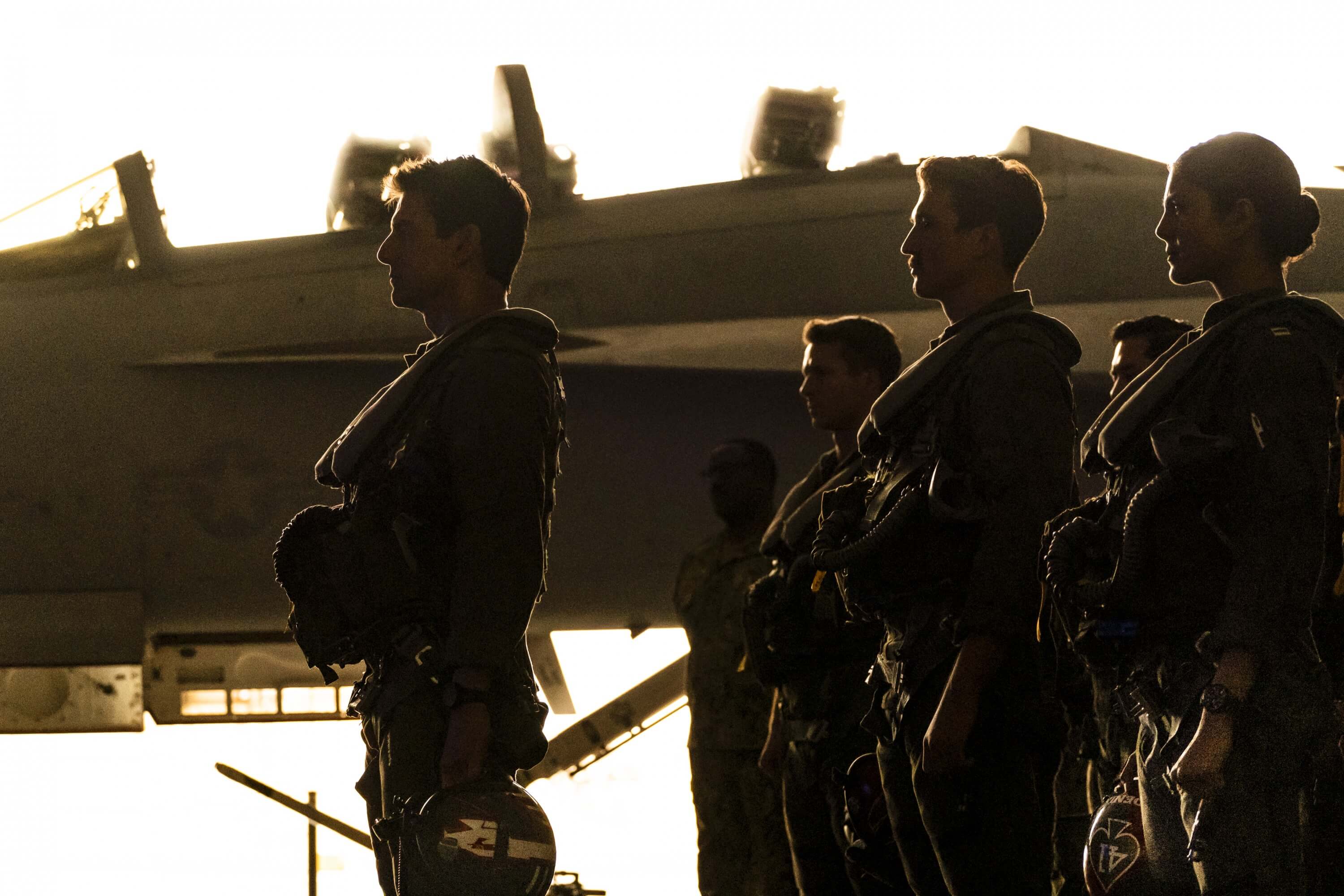
Tom Cruise, Miles Teller and cast in Top Gun: Maverick


In its opening scenes, we reunite with Captain Pete “Maverick” Mitchell (Cruise) who works as a test pilot for hypersonic reconnaissance jets. Admiral Cain (Ed Harris, always on call when Hollywood needs a hard-ass in charge) soon shows up to shut down the programme, with a vague digression about how human pilots are relics and drones are the future – ignore for a moment that the film’s entire raison d’être is an affirmation of the contrary – that merely provides an excuse for Maverick to remind everyone that he’s… well, a maverick. Cue him disobeying orders, achieving the impossible, then going too far but shrugging it off. He’s back, baby!

It’s not long until Mav gets called back to Top Gun Academy to teach the “best of the best” to fly a mission impossible on a very tight deadline. The details don’t much matter and, much like the original Top Gun, the enemy is kept purposely name- and face-less, but the gist of the objective is this: a uranium enrichment plan has been detected on foreign soil which will become operational within three weeks. Before it can power up, two pairs of F-18s need to fly a mountainous obstacle course under the radar, bomb an impenetrable underground bunker, climb an absurdly sharp peak, and get out before the enemy planes catch up – all the while avoiding the many surface-to-air missiles (SAMs) posted around the compound.

It seems that the top brass, namely Vice Admiral Cyclone (Jon Hamm, making us question yet again why the man doesn’t get more roles) has accepted this to be a suicide mission. Though doubtful of his ability to teach the recruits, Maverick is nevertheless determined they all make it home safely – a fervent desire made starker by the fact that one of said recruits, call sign “Rooster” (a robust Miles Teller) is none other than the son of Mav’s fallen best friend, Nick “Goose” Bradshaw. It’s with their relationship that Top Gun: Maverick cements its emotional bedrock.
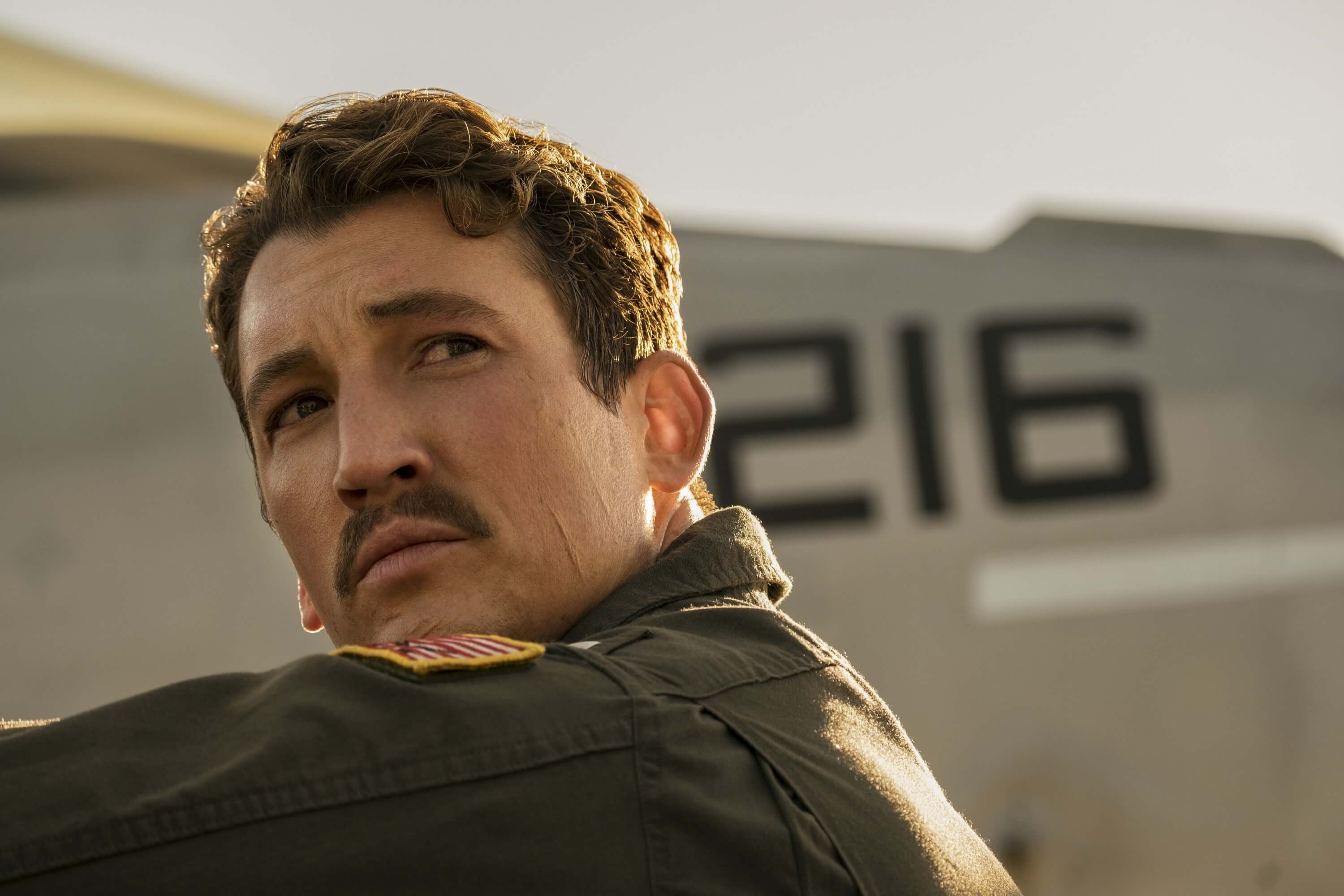
Miles Teller as Bradley 'Rooster' Bradshaw in Top Gun: Maverick


More complexly than before, Maverick is a man haunted by past mistakes. The guilt he still carries about Goose’s death is transformed into an obligation to protect Rooster, even if it means the latter will resent him for it – and he does. In a fraught exchange, it’s revealed that Maverick pulled Rooster’s application to the Naval Academy and set his career back four years. The relationship between the two men, coloured by love, bitterness, remorse, and misunderstanding, grounds the film even as it soars above the clouds.

A host of characters orbit the story: there’s his old flame Penny (Jennifer Connelly) whose romance with Maverick feels out of sync and perfunctory, at least until the latter half of the film; there’s the excellently-played, asshole hotshot Hangman (Glen Powell); and of course, there’s Val Kilmer returning as Iceman. His brief screen time with Cruise provides the film’s warmest and most moving elements, Iceman’s health issues reflective of those suffered by Kilmer, and gently handled by the script. Yet even as these characters function as worlds in their own right, they are still just satellites to Cruise’s blazing sun.

Asserting himself – once and for all – as the last movie star of a lost age, this is Cruise’s film through and through. Age has lent both actor and character an air of existential loneliness, and a defiance of impending obsolescence, that makes his megawatt grin all the brighter. Of course, at no point is Cruise more Maverick than when sat in a cockpit, fearlessly breaking the laws of physics and common sense.
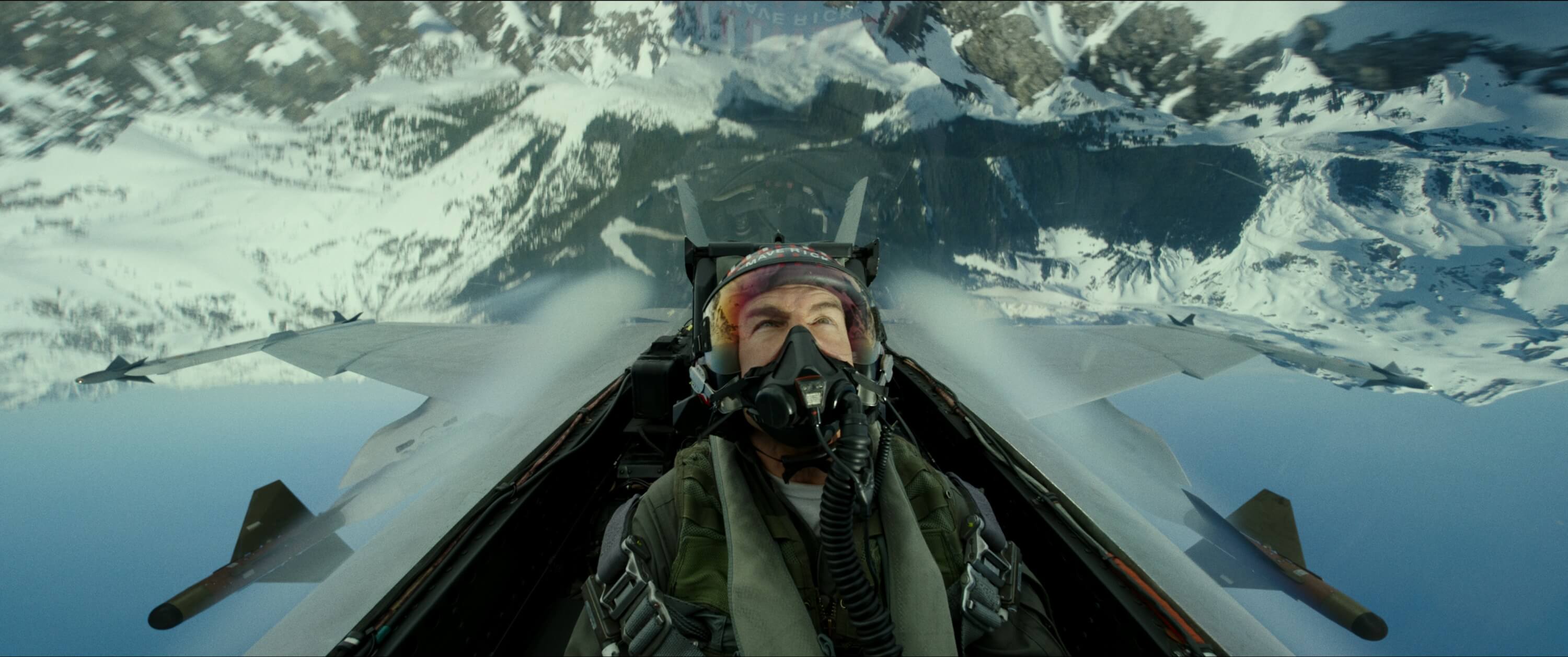
Tom Cruise as Pete 'Maverick' Mitchell in Top Gun: Maverick sequel


The aerial stunts, jaw-droppingly spectacular and fabulously analogue, are a feat of cinema. It takes unbelievable skill for something this ambitious and boundary-pushing to feel so effortless, a testament to the magical talents of Kosinski and DOP Claudio Miranda (the two previously collaborated on Tron: Legacy and another Tom Cruise movie, Oblivion). It’s the kind of exhilarating, euphoric heart-in-your-throat action that demands to be seen on the broadest and loudest screen possible.

There’s hardly anything to critique here and, even if one finds fault with Top Gun: Maverick, it’s impossible not to be swept up in the undertow of just how epically fun this film is. Kenny Loggins rocks out alongside Lady Gaga; the state-of-the-art camera work is overlayed with a vintage sheen; Maverick is pushed to accept the past and embrace the future. Narratively improving on its predecessor whilst keeping a faithful hold on what defined Scott’s original, Maverick is a film suspended out of time, revelling in old-school cheese and thrills without feeling stuck.

It’s hard to imagine that there’ll be a more intoxicating, rapturous cinema trip to leave you beaming from ear to ear this year, so do yourself a favour and do not miss it. God bless the movies.

Top Gun: Maverick releases in cinemas on May 27th. Watch the trailer here.

FAYE

Faye (Sarah Zanotti), a successful self-help writer is struggling with her next book so her publisher sends her to a cabin on the bayou to get away from the day-to-day stresses. Unfortunately, she lost her husband in a tragic car accident (which left her physically scarred as well as mentally), and consoles herself by talking to him as if he’s still there. The solitude of the cabin, combined with an excess of alcohol convinces her that there’s something supernatural there.

Zanotti gives a masterful performance as the disturbed Faye – the only person we see on screen – as well as co-writing with director Kd Amond. The film is presented in chapters, as a self-help book would be, and interspersed with Faye giving a talk, straight to the camera, as if it were a book reading. The mixing of the two styles, added with the powerful display of acting, keeps the viewer on edge throughout. The confident Faye reveals aspects of her upbringing and likens things to horror films she’s seen such as Halloween, while the struggling Faye, alone at the cabin with the projection of her late husband and a book that she’s having difficulty cracking, is facing demons more terrifying than she’s faced before.


faye


It’s almost a shame that Amond resorts to showing us things that Faye imagines at times, but all can be forgiven when the story untangles the trauma that the writer is facing. Someone who doesn’t actually practice what she preaches, Faye is relatable while not wholly likeable as a character but Zanotti is mesmerising in the role. The film may not be as chilling as a regular ghost tale, but it’s a powerful, haunting picture of grief and loss.

Faye is available on digital now.


HAZARD (aka H4Z4RD)

h4z4rd

This crazy Belgian film defies expectations and becomes a riotous, funny action film.

Noah Hazard (Dimitri ‘Vegas’ Thivaios) adores his souped-up car as much – if not more – than his wife and child. After dropping his little one off at school, he heads to pick up his brother Carlos (Jeroen Perceval), who has just been released from prison. Now boasting a face tattoo, he tells Noah they must pick up Kludde (Frank Lammers) to do a job, with Noah as the driver. The job in question involves stealing a prototype drug and the owner isn’t happy at all, and the trio only barely get away intact. What follows is an edge-of-the-seat nightmare that is as funny as it is terrifying.

H4Z4RD (the lead’s vanity plate), directed with vim by Jonas Govaerts (Cub), is filmed almost entirely from the point of view of inside the car and becomes as claustrophobic as you can imagine. It also provides the chance to experiment with some inventive shots that make the movie feel a lot bigger than it is, including the use of parking cameras and rear-view mirrors. A hallucinogenic scene when Carlos tries the drug they stole is also a highlight.

The soundtrack is full of the type of Eurodance music you’d hear pumping out of flash cars (why do those with the loudest sound systems have such bad taste in music?) but it fits the frantic pace of the story. The situations and dangers involved are equally bizarre and nightmarish but always fun. Even if you don’t relate to the characters or situation, it’s easy to be drawn into the human aspect of what’s going on and go along for a wild ride.

stars

HAZARD is released in the US on May 10th. 

VORTEX

vortex

Gaspar Noé’s latest isn’t a brash, showy affair but a sombre, thoughtful piece that is no less distressing. Mother (Françoise Lebrun) and Father (legendary horror director Dario Argento in his first and – he claims – last leading role) are living out their twilight years in their cramped apartment. Ephemera from their careers as, respectively, a psychiatrist and a film critic, line the bookshelves and is stacked in every possible place. Father is writing a book about the relationship of cinema with dreams whilst spending more of his time fretting over his wife, who is suffering from the later stages of dementia. Their son, Stéphane (Alex Lutz) is an ex-drug addict who tries to help as much as he can but is faced with resistance when he suggests moving them into assisted housing.

Vortex presents us with the couple’s existence – it can’t really be called a life at this point – with the screen split into two 4:3 frames that show us the pair’s routine, or lack of. Mother wanders outside after writing a prescription for herself and gets lost in the local store while Father researches his book by re-watching old films (we see the ‘buried alive’ scene from Carl Dreyer’s 1932 masterpiece Vampyr, which is as metaphoric as you could get) and attempting to get hold of his mistress. Keeping the pair in separate screens, only crossing into each other’s lives occasionally, or as in one tender moment, to reach out and offer comfort, highlights a fragmented relationship and a discordant mind. It’s not a gimmick – it’s certainly not as showy as the forgotten slasher Wicked, Wicked (1973) – but evokes anxiety, particularly when Mother gets lost or when she decides to ‘clean’ Father’s desk, flushing his work down the vortex of the toilet.

The recent Argentinian film Nocturna Side A – The Great Old Man’s Night handled the subject of dementia with supernatural elements while Noé sticks to harsh and equally harrowing reality, blinking transitions replacing jump cuts. The film is dedicated “to all those whose brains will decompose before their hearts”, and Argento’s character observes at one point, “life is a dream”. It can also be a nightmare, and no matter how inevitable the conclusion might be, it’ll always be heartbreaking.

Vortex is in cinemas from May 13th.

DOCTOR STRANGE IN THE MULTIVERSE OF MADNESS

There is a lot to enjoy and even more to question in Doctor Strange in the Multiverse of Madness. Sam Raimi’s inaugural MCU entry is brisk, messy, and campy genre fare that feels caught between studio-mandated story beats and its director’s love for intimate horror. The result – a reasonably diverting superhero flick that never fully taps into Raimi’s morbid imagination.

The first third of Multiverse of Madness is one of the roughest opening acts of any MCU instalment to date. It’s unfocused, overly serious, and devoid of humour and feeling. Raimi’s visual style is as distinct and absorbing as ever; it’s the screenplay that suffers. Multiverse of Madness is, unfortunately, a wide step in the wrong direction. Writer Michael Waldron (Loki) has a bad habit of breezing through gut-punch-y character beats simply to get to the next moment, resulting in an impatient story that feels too perfunctory and careless for viewers to ever get emotionally invested. Even heavy-hitters such as Elizabeth Olsen’s Scarlet Witch fail to impress. The introduction of Xochitl Gomez’s America Chavez is equally underwhelming.

That said, Waldron does a commendable job with his set-ups and payoffs. Doctor Strange’s character arc is made clear early on, and the thrust of the story carries the Avenger to a sweet resolution. The “Doctor Strange” part of the title is the only aspect that feels sufficiently explored. It’s the “Multiverse” and “Madness” sections that feel the most incompatible with Marvel’s formula.

With those points in mind, it pains us to say that Multiverse of Madness falls far short of its potential. It’s a confounding mishmash of Raimi’s signature B-movie aesthetic and Marvel Studios’ proclivity for pop and polish. Everything about its monsters – from the ropey multiversal demon in its opening scene to the shrieking wights wriggling free of Strange’s dilated pupils – evoke its director’s best, most twisted indulgences, but Marvel’s continuity-conscious parameters sadly keep him from wandering even further into his wheelhouse.

CHILDREN OF SIN

CHILDREN OF SIN

Change, beg God’s forgiveness, or die. There is a straightforward choice to be made in Christopher Wesley Moore’s Children of Sin, but the themes within are anything but. Homophobia, abuse, rape, self-mutilation and suicide are central to a narrative about the evils of conversion therapy. And while Moore is clear on this last point, there are questions to be asked over whether these subjects should be so clumsily and disrespectfully used in what is, essentially, a B-movie slasher.

Pregnant teenager Emma (Meredith Mohler) and her brother Jackson (Lewis Hines) are sent by their mother – under the manipulative influence of their devout new stepfather – to a retreat which specialises in bringing troubled souls back into God’s fold. Or not.

Children of Sin is at its moderate best when Moore leans into the B-movie aspects of his film. The slasher kills are bloody, and the retreat’s matriarch Mary Esther (Jo-Ann Robinson) provides an interesting villain, fearsomely doling out swift and violent punishment to any of her charges who dare to step out of line. And a synth soundtrack harks back to the glory days of the slasher.

Yet tonally the film is inconsistent. The retreat’s victims are just that, abused physically or mentally, but their interactions are almost comedic, sharing their stories as if discussing their favourite television shows. There is no sobriety to the subjects being discussed, with the characters simply cyphers for whatever ‘crime’ they have committed.

Ultimately, Children of Sin feels more misguided than malicious. And within the slasher genre, the reasons for the potential victims being in the same place is less important than how you dispatch them.


Children of Sin is available on digital in the US.

THE UNBEARABLE WEIGHT OF MASSIVE TALENT

the-unbearable-weight-of-massive-talent-starburst

We certainly have no shortage of films that skewer the pomposity of Hollywood and its stars but director Tom Gormican’s The Unbearable Weight of Massive Talent is a treat on even more levels.

Starring Nicolas Cage as Nicolas Cage, the film sees Cage pile all his hopes on a big new project only for them to be dashed. Feeling down about his fading Hollywood star, he accepts a $1 million job to appear at a super rich fan’s birthday party, but in this fan Javi (Pedro Pascal) he finds inspiration…until the CIA tell him all is not as it appears! Don’t you just hate when that happens?

This is a film that will find a devoted fanbase. Deconstructing the filmmaking and writing process, this meta action/comedy is filled with loving references to Cage’s wild career and life. At times feeling like Alan Partridge: Alpha Papa meets Once Upon A Time in Hollywood, with Tropic Thunder mixed in, it’s a fun and novel twist on the buddy action movie, that is constantly referential and filled with a witty, bordering on obsessive, love for cinema and all things Cage.

The third act may not be quite as masterful as the previous two (even though the film acknowledges the “mainstream hook”) and it could go crazier (as bonkers as the film still is – with Cage also playing his Wogan show inspired Wild at Heart ego-driven conscience) but it’s a helluva good time, and begs for revisitation.

Cage is superb as a more exaggerated (well, maybe) version of his walking meme self. But it’s his chemistry with the sublime Pedro Pascal that is when the movie comes alive best. They are a duo to really behold in this fun Cage caper!

WE’RE ALL GOING TO THE WORLD’S FAIR

The last couple of years have presented filmmakers worldwide with various obstacles and have, in some cases, forced them to think outside the box. Thankfully, this has resulted in some of the most intriguing and unique films in recent memory and that is definitely the case with Jane Schoenbrun’s debut feature indie-smash-hit, We’re All Going To The World’s Fair.

Blurring the lines between reality and myth, the narrative follows Casey (Anna Cobb in her feature debut), a young teenager who decides to take part in a viral challenge called “The Worlds Fair” in which you offer a blood sacrifice and recite the words “I want to go to the Worlds Fair” whilst watching a trippy video. Soon after taking part in this ‘challenge’, Casey begins to document herself and posts it online and strange things start to happen – but is this story to be believed or is the viral nature of other people’s stories taking over and becoming reality?

In an age where a lot of us take in huge amounts of content in various forms on a daily basis, it is clear to see that a lot of people today take what they read or watch online as gospel. Schoenbrun’s use of this very real core and adding a unique spin on it by truly making you as the audience member feel a part of the narrative by making you also question what is real is nothing short of genius. A brilliant blend of screen-horror, similar to that of Unfriended, a sampling of what feels like found footage and underlying tones which also make this a coming of age tale all together creates a remarkable slow burn of unease that will sit with you for many hours after the credits roll.

Although this form of storytelling may not sit easy with everyone due to its feeling very new, We’re All Going To The World’s Fair stands tall on its own as something visually interesting and unique that will cause unease and crawl under your skin.

HELD

held trailer

The Barretts are having a rough time in their relationship. Emma (Jill Awbrey) is distant and Henry (Bart Johnson) is working all hours. It’s their anniversary, though, so Henry has booked a swish place away from it all for the weekend. The house has a state-of-the-art security system, a pool, acres of trees, and a vintage rotary phone. Emma gets there first and after being unsettled by her Uber driver (Rez Kempton) but is soon in the bath and relaxing with a glass of wine. Henry joins her later and the pair settle down with drinks, although Emma is still a little cold with him. The next day, however, they wake and their clothes have been replaced, phones taken, and an ominous voice tells them to obey…

Held was written by Awbrey and directed by Travis Cluff and Chris Lofing, and one has to wonder what sort of relationship traumas she has been through, as the ordeal the couple go through is pretty intense. Naturally, we won’t go into spoiler territory, but the reason for the Saw-esque taunting of the pair and seemingly moral stance the ‘voice’ in the house takes is pretty messed up. Cluff and Lofing manage to create some incredible tension within a context that we’ve essentially seen done many times, and luckily, the story takes enough unique turns to keep it on the right track.

Without relying on jump scares, Held keeps the viewer on edge throughout most of the running time, even after we’ve found out what’s going on. It might be a good idea to cancel that anniversary weekend away.

Held is released on DVD and digital platforms on April 25th.

THE LOST CITY

lost city

In an early sequence in The Lost City, exasperated writer Loretta Sage (Sandra Bullock), frustrated by the demands placed upon her by the continued success of her novels chronicling the vapid exploits of adventurer Dash McMahon, hurriedly flees a disastrous book launch pursued by airhead model Alan Caprison (Channing Tatum) who portrays Dash on the covers of her books. On a wall in the background, we see a literary poster proclaiming “Romancing the Page” and it’s a sly and knowing acknowledgement that the makers of the film – directors Adam and Aaron Nee and their co-writers Oren Uziel and Dana Fox – know exactly what they’re doing and the type of movie they’re trying to recreate. We’re right back in the dizzy post-Indiana Jones 1980s where the likes of Michael Douglas and Kathleen Turner embarked on unlikely, good-natured high stakes escapades in exotic locations hotly pursued by gun-brandishing boo-hiss baddies. The Lost City knows what it wants to be and hits the spot with almost marksman like precision.

Oddly, The Lost City, despite being crafted from bits and pieces lifted liberally from innumerable illustrious and not-so-illustrious cinematic forebears, is terrific, joyous stuff, happy to poke fun at its genre and itself, delivering gag after gag and outrageous visual set piece after set piece, the whole thing powered by the formidable onscreen chemistry generated by Bullock and Tatum. Squeezed into an uncomfortable glittering catsuit  for the Press junket, Loretta is kidnapped by unlikely multi-millionaire Abigail Fairfax (Daniel Radcliffe) who, realising that she had based her books on her own historic research conducted with her late husband, forces her to decipher an ancient map that will reveal the whereabouts of the  location of the long-lost “Crown of Fire.” You know the score. Bumbling Alan enlists the aid of former Navy SEAL stud Jack Trainer (Brad Pitt) to rescue her from Fairfax’s jungle lair and eventually Loretta and Alan have to fight their way across hostile terrain, evading Fairfax’’s thugs, as they try to make their way back to civilisation.

Their journey is packed with action, incidents, and laugh out loud humour. The Lost City is a film you’ll watch with a fixed grin on your face. It’s clever, absurd, ingenious – it knows precisely which buttons to press and its Dominican Republic location is eye-achingly beautiful and stunningly photographed. Bullock and Tatum are a comedy match made in Heaven and even as we’re never quite convinced by the still-boyish Daniel Radcliffe as a ruthless fanatic, the film doesn’t shy away from the apparent absurdity of the casting when one character comments “I thought he was a little boy but he’s got a full-grown beard.” Priceless. The Lost City is a warm, big-hearted treat, a delight from start to finish, a glorious throwback to simpler times, simpler stories and shameless, brazen high adventure.

The Lost City is in cinemas now.