Anthology films are popular as if you don’t like one section, you haven’t got long to wait for another. Bad Candy – directed by Scott Hansen and Desiree Connell – unfortunately, doesn’t have enough that stands out to make it a Halloween treat.
The stories are anchored by the linking section that features radio DJs Chilly Billy (Slipknot singer Corey Taylor) and Paul (Zach Galligan). The former enjoys entertaining the listeners with fittingly sinister yarns for Halloween. Each tale is linked by a common element – Bad Candy the clown, a suitably evil-looking jester. Unfortunately, with more than the usual amount of segments, there are more that miss than hit, and some are given more screen time than others.
While most of the stories contain the usual horror movie tropes, one featuring Haley Leary, who’s called into her job in the morgue when out partying but after mixing her drink and drugs, proceeds to mount a corpse in a scuzzy-looking morgue, at least gives us something new.
Gremlins star Galligan isn’t given too much to do as Chilly Billy’s sidekick, but the pairing of him and Taylor works well. Naturally, there are bound to be caparisons drawn between Bad Candy and Michael Dougherty’s Trick ‘r Treat, which doesn’t favour this film. The lack of originality at times really hurts, and the segments are not really given time to develop. On the plus side, favouring mostly practical gore effects is great to see. Thanks to the cinematography of co-director Scott Hansen and Blake Studwell, the movie looks great, but the visuals can only do so much. There are a few too many tricks in this bag of sweets.
BAD CANDY is on DVD and Digital from October 4th, courtesy of Kaleidoscope Entertainment
We all know people who join exclusive golf clubs tend to be self-centred idiots looking to status rather than real issues. The club at the centre of this high-class community has just installed a new fertiliser that allows the grass to be played on even when the rest of the town is full of thick Canadian snow. We all know where this is going, right? Young André (Iani Bédard) has been lumbered with his baby sister and must try to protect her when their mother comes home from work and turns into a rampaging flesh-eater. He teams up with a survival nut security guard Dan (Roy Dupuis) to escape the assault on the residents of Peacock Island.
A very different type of zombie film, this French-Canadian production has an eco-message but doesn’t get bogged down with it, preferring to get straight into the neck-munching. There is an alt-right radio DJ who gives the filmmakers more chance for some satire. Writer/director Julien Knafo opts for fast-moving zombies but gives them some algae growing on them. For the most part, it’s an amusing and well-made movie, but don’t be expecting a gore-filled romp.
There’s a lot of heart in the story, though. From André reluctantly looking after his sister, to Dan’s resistance at accepting his daughter is a zombie. Amusingly, he puts her head in a cage so she can’t bite anyone and when her arm falls off, they carry it around to open her mobile phone (the only one they have access to with that’s charged).
It might not be the all-out zombie film you want it to be, but Brain Freeze is fun and action-packed.
BRAIN FREEZE is released in the UK and Ireland on September 6th
Parker (Rachell Sean) has mental health problems, so she visits the latest in a long line of psychotherapists. Robert (Danny James) – who is keen to point out he is not a ‘doctor’ – asks plenty of questions, which Parker answers with the replies she thinks he wants to hear. She seems to be enjoying winding him up, too. He deserves it, as he’s more interested in his rules and doodling on his pad than taking notes and listening. His response to her recurring dream about a man murdering her mother in front of her is the next time it happens, face the fear and kill the mystery assailant. As their sessions continue, Parker has a proposition to give Robert that she thinks will help her.
Presented across four acts in stark black and white, writer/director Stephen Simmons’ debut feature is an almost two-hander that touches on plenty of material that some would consider ‘triggering’. This is handled well and never resorts to exploitation, but the subject matter would be troubling for some. However, this is something horror does well. It allows the unspeakable to be played out as catharsis, which is what Parker ultimately does.
Both leads are fantastic, even though neither character is particularly likeable. Simmons intersperses the therapy sessions with visions of Parker’s real-life – often contradicting what she’s saying – and when the pair share recurring dreams, the nightmarish images are incredibly effective. Also impressively used is the soundtrack, which is as oppressive as the visuals.
The Parker Sessions is heavy going but a brilliant example of what can be done in independent cinema.
Last year’s Blind introduced us to an actor, Faye (Sarah French), who loses her career when a botched cosmetic procedure blinds her. She withdraws to her hilltop house, only interacting with a few people. She’s then stalked by someone who’s obsessed with her and who kills those close to her. Spoiler warning for those who didn’t catch the film, it concludes quite abruptly with the hulking murderer in a creepy ‘pretty boy’ mask stood over her while she’s in bed. Pretty Boy, the film is a continuation of the story from that moment, with the killer carrying Faye through the neighbourhood and gate-crashing a Valentine’s Day party with bloody results.
The group partying is a mixed bunch, which allows for some fun kills as Pretty Boy makes his way through the house. Unfortunately, once he’s done with them, it’s on to a new location and the dynamic shifts. It takes a much slower, dialogue-led approach; it’s also darker in tone than the Friday the 13th-esque first hour.
Genre regular Maria Olsen is an addition to this entry of the saga (yes, we can probably expect it to continue…) and is always watchable. She’s particularly creepy here, but she’s not enough to enliven the film when it’s sagging. The giallo-like soundtrack is suitably eerie and provides much of the tension and atmosphere. Director Marcel Walz orchestrates a few effective kills, one that will even get a laugh thanks to the reaction of a blindfolded man, but it’s a moodier movie than the first, which was played more for suspense.
The students in a small coastal town are preparing for their Prom night, but a danger is coming from the sea in the form of some bloodthirsty horseshoe crabs. One kid not looking forward to partying is Phil McCalister (Dylan Riley Snyder), a scientific genius who’s a wheelchair user and is trying to invent a contraption to enable him to walk. His girlfriend Maddy (Allie Jennings) and Radu (Chase Padgett), a foreign student with an offensively exaggerated accent and ‘comical’ mannerisms, might be the only people who can save the town.
The debut feature for writer/director Pierce Berolzheimer, Crabs! aims for Tremors-style fun and action, but while it delivers on the fun gore also has some woeful CGI (but even that probably works in its favour). There’s massive potential here for a cult following, but not necessarily for the right reasons. It’s likely it might contain the best Prom massacre since Carrie, but there are also homages to plenty of beloved monster classics and a bar scene ripped straight from Gremlins. The humour is crass and the story’s over the top, particularly when it comes to what we’ll call the ‘MacGyver’ moment, but even that is surpassed by the ridiculous climax.
Crabs! is preposterous in the same way The Asylum and Troma movies are. If you can get over the offensive stereotypes and take it in the spirit in which it was no doubt made, you could have a lot of fun.
It’s hard to describe the level of squalor that the former Hotel Poseidon now exists. It’s no longer used as a place to stay, but owner Dave (Tom Vermeir) wanders, almost in a state of somnambulism, the premises interacting with an ever-increasing bizarre level of people. He’s distraught that his auntie, who he insists is just ill, is very dead. It’s her pension that pays the bills for Dave to continue perhaps not living but existing in the hotel. The hotel’s ballroom will soon host a party, hired out by Jacki (Dominique Van Malder). It’ll be an elaborate affair, with a big band, cold meat buffet, and a live autopsy. If things can’t get worse for Dave, he has a seemingly normal woman, Nora (Anneke Sluiters), who insists on booking a room since she found the place in an out of date guidebook.
Hotel Poseidon, like the place that bears its name, is a scrappy, surreal movie that is practically impossible to do justice to. Writer/director Stefan Lernous populates the film with pasty-faced characters who look like they should be extras on Carnival of Souls. Everything is exaggerated, even the grimness of the building and all its contents. You almost feel the need to constantly wash your hands (and probably your eyes) while watching it. Sadly, however mesmerising some moments are, it left this writer somewhat cold – and I revel in the strange!
It’s lazy – and disingenuous – to liken Hotel Poseidon to David Lynch’s Eraserhead, largely because you can conjure some understanding from that film. What we have here is mostly weird for weird’s sake, and unfortunately, it doesn’t provoke the desire to check into the hotel again any time soon to attempt to try to figure it out more. It’s certainly an interesting picture, but not one you’d hang on your wall.
Documentaries about filmmaking have become commonplace. The trials and tribulations of independent directors tend to make the most interesting and are certainly the most relatable to most people who attend genre film festivals. Paul Hunt and Julie Kaufman’s The Brilliant Terror focuses on an unrelated group of indie artists whose passion for making movies won’t be quelled by something like money.
With an interesting mix of interviews with the filmmakers and footage of scenes coming together, it’s a great look behind the scenes into the indie scene at the very lowest level. As one of the commentators says: “We are damaged people playing for damaged people”. Most of the movies and shorts being made here lean to the extreme side of things. It’s something that will always sell a film at this level. But, while they know it should be about story, there’s also the realisation that – and we quote: “Blood and boobs make a great horror film”.
The Brilliant Terror isn’t a celebration of that attitude, though, as we have some sobering insight from the people who write about film. LA journalist Heidi Honeycutt, in particular, has some harsh truths to say about the type of person who makes horror movies because they love watching them and are obsessed with the genre. It’s not a total sausage fest when it comes to the directors covered, either, as several female directors have their say. Along the way, the young filmmakers’ thoughts are complemented by some psychological commentary about why people are drawn to the genre.
Likely, you won’t have heard of most of the people or movies highlighted in The Brilliant Terror. Still, their grit and determination shine through, and their stories will resonate with both horror fans and indie filmmakers alike.
Kate (Lora Burke) lives out in the woods with her daughter Beth (Tessa Kozma). Away from society, this is a safe house after her husband was imprisoned for killing a child. When he commits suicide in prison, things get strained in the household. Things are also tense with her liaison, Hal (Colin Paradine), particularly when she comes onto him. Kicking him out of the house when he turns her down, Kate and Beth are set to be victims of a very personal home invasion.
Directed and co-written (with Ian Malone) by Craig David Wallace, Motherly asks how much will a parent do for their child. It’s difficult to get into the narrative too deeply since the more the audience knows beforehand will taint the enjoyment of their viewing. As the story unfolds, our perception and understanding of the situation are continually shifting and it’s wonderfully handled.
Wallace’s pedigree is mainly in serial TV shows such as Todd and the Book of Pure Evil, and he adapts wonderfully to a long-form feature. He creates a tense, claustrophobic atmosphere that’s brilliantly complemented by Spencer Creaghan’s brooding score and Christoph Benfey’s fluid camerawork.
Motherly is highly recommended, but try to go in as cold as possible.
It’s worth noting that Nia DaCosta’s Candyman is not a remake but a sequel to Bernard Rose’s 1992 version, which itself spawned two inferior sequels. Candyman is based on Clive Barker’s short story ‘The Forbidden’, with the Liverpool setting swapped for Chicago’s Cabrini-Green public-housing project.
While Barker’s story explored the British class system, the feature film delved more deeply into racism and a divided society, presenting us with Tony Todd’s horror hall-of-fame portrayal of the urban legend known as Candyman. Say his name five times in front of a mirror and he comes to life, stalking you with a hook for a hand and a mouth full of bees. Candyman (2021) picks up re-establishing this legend three decades later, directly referencing Helen Lyle (Madsen) – a character from the first film – who urban legend says went mad after investigating Candyman.
The story intrigues artist/photographer Anthony McCoy (Abdul-Mateen II), living in a gentrified Cabrini with his art director girlfriend Brianna (Parris). His art depicts black suffering, occasionally bought or displayed by misunderstanding rich white people. His new interest spawns a creative awakening but leads to obsession, resulting in a radical transformation and danger for the people around him as he brings the urban legend of Candyman back to life. Cue some gory reckonings for some pretentious Chicago art enthusiasts and high school mean girls…
Whilst the film is a chronological continuation, today’s Candyman is essentially showing that things have not really changed. Under the scope of the Black Lives Matter movement and meta storytelling, the film could not be more timely – the injustices from centuries ago, decades ago, a few years ago are still happening today. Rather than just asking you to watch, it’s asking you to think, and talk, and keep these stories alive, literally telling the audience to ‘say my name’.
The Candyman is not just one person – it’s a collective subconscious of an estranged and oppressed community. The victim of gentrification, the victim of racism, the victim of a system that not only marginalises them but hopes to dispose of them in a cruel and indifferent way. Much like the Candyman himself, who is a direct response to this suffering, being summoned into an existence that cannot be ignored as long as people say his name (five times in front of a mirror, to be precise).
Whilst this message is powerful, it also muddies the waters of the film a little with a lot going on at the same time. Although it’s easy to laugh at some of the purposefully OTT characters, they occasionally seem almost too obvious (example: a racist cop). Exploring the history, existence and ‘purpose’ of the Candyman in relation to society whilst trying to give us an entertaining horror movie with creative kills and occasional jokes is a juggling act that doesn’t always work.
Nonetheless, it’s a bold sequel to, and retelling of, Candyman that will undoubtedly make people afraid of their mirrors again.
(Whilst it’s bad news for mirrors, it is good news for bees, who’ve had to wait 13 years since The Wicker Man remake to regain their horror street-cred…)
Marvel’s first Asian-led MCU entry wastes no time laying down its rules of engagement. Sure, it makes a point to throw in a couple of references to the Blip and the events of Iron Man 3 as a reminder of its tangential connection to the wider ‘verse, but Shang-Chi and the Legend of the Ten Rings has its own story to tell. Setting the opening scenes in China with the opening narration and dialogue entirely in Mandarin, Shang-Chi quietly and confidently establishes itself as a cultural milestone for Asian and AAPI audiences – subtitles are hardly a novelty, and yet their inclusion in a Disney tentpole still feels surprisingly refreshing.
Director Destin Daniel Cretton and co-writers Dave Callaham and Andrew Lanham go a step further by taking the signature Marvel fare and melding it with key aspects of Chinese culture: deploying quinggong aerobatics and kung fu fighting styles, borrowing from traditional Chinese mythology, and paying homage to the wuxia genre. The result is a wistful, fantastical visual style that’s distinctly its own.
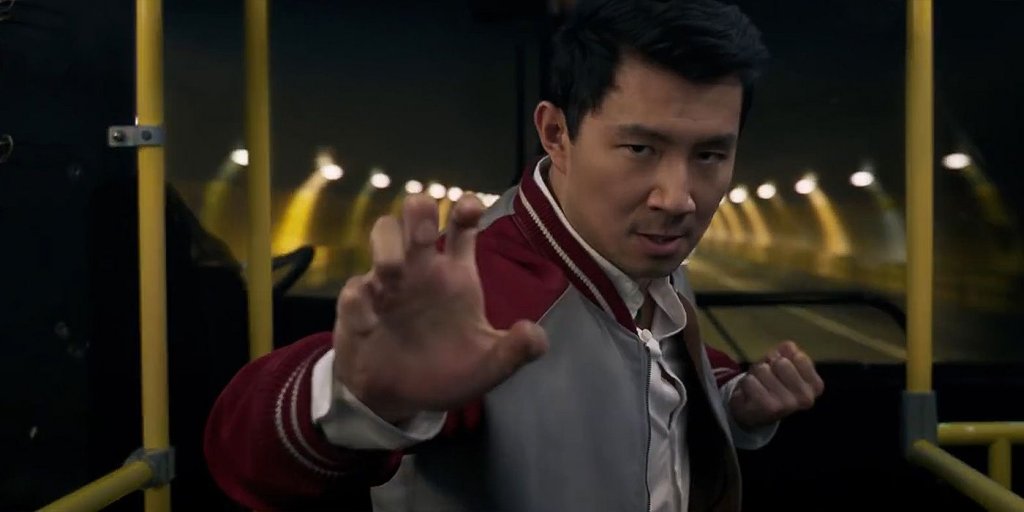
Shang-Chi (Simu Liu), whose imaginatively chosen “in hiding” name is Shaun, works as a valet-parking guy in San Francisco with his best friend Katy (Awkwafina). His covert identity is soon shattered, however, when a group of hitmen – including a large Romanian man with a retractable blade for a forearm – attempts to take the necklace gifted to him by his mother. After a Speed-style escapade, complete with cut brakes and Katy taking the wheel à la Sandra Bullock, the pair travel to Macau to find Shang-Chi’s estranged sister Xialing (Meng’er Zhang) and get some answers.
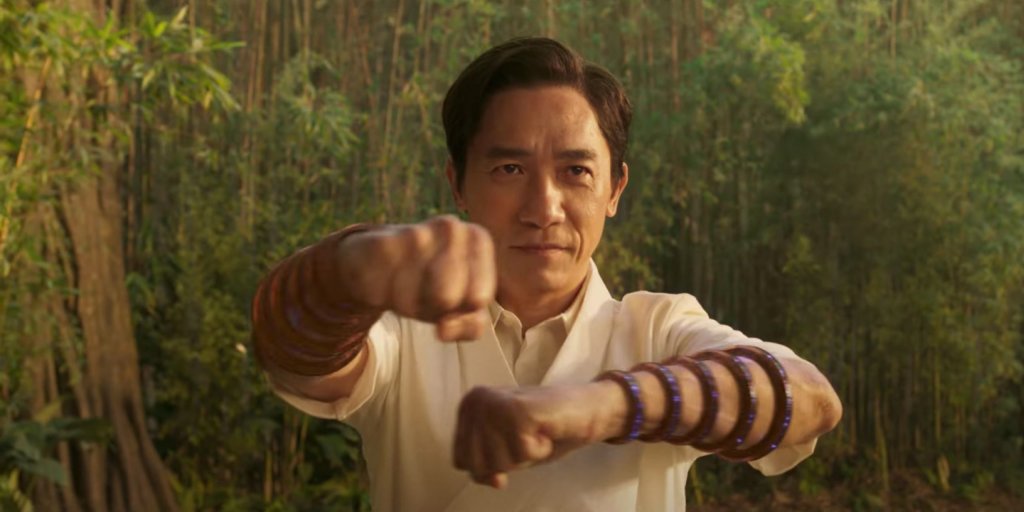
Without venturing too far into spoiler territory, Shang-Chi is essentially about two kids and their ageless father (Hong Kong legend Tony Chiu-Wai Leung, whose sex appeal even Disney cannot fully contain) reckoning with their grief – the loss of their mother and wife, Jiang Li (Fala Chen). This grief is the driver of Shang-Chi’s various narrative threads, pushing the newest MCU hero to reckon with his past and embrace his legacy.
The issue at the heart of Shang-Chi is that it cannot decide where its priorities lie: does it want to introduce a new hero into the MCU, or expand the scope of the franchise’s world-building? Wandavision and Loki may have succeeded in doing both but, with a runtime of just over two hours, Shang-Chi sets itself up for failure trying to tackle it all.
As magnetic as Liu is in the lighter and more action-driven scenes (he leaves no doubt as to whether he can carry the franchise in years to come), he gets somewhat lost in the quieter character moments. The script unfortunately gives its hero more backstory than personality, which makes it hard to reconcile the sunny, karaoke-loving man shown on screen with the darker, tortured son of Wenwu we are mostly just told about. In fact, no matter the character in question, their functional use within the story is placed ahead of genuine characterisation, while exposition is put above both. It’s only thanks to the sheer star-power and energy of the cast that the characters feel at all substantial.
The obsession with Shang-Chi’s backstory and mythology also takes its toll on the film’s overall momentum, which goes in fits and starts from stunning martial-arts sequences to extended information dumps. Which is all to say, Shang-Chi’s biggest problem is being overstuffed.
However, it offers enough thrilling set pieces, spectacular choreography, and colourful backdrops to offset any boredom. The aforementioned, confined fight scene on a speeding bus, as well as a neon-lit sequence across a skyscraper’s scaffolding, are nothing short of breath-taking: they are a fitting tribute to stunt coordinator Brad Allan’s work and memory, and an assertion of Simu Liu’s leading-man stature.
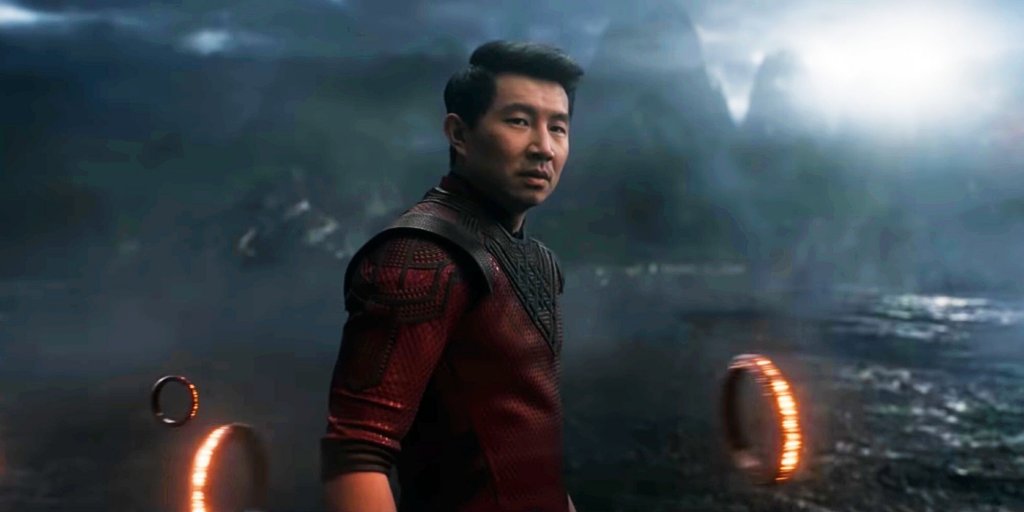
It’s therefore all the more disappointing when, in its last act, Shang-Chi buries its top-calibre practical effects and stunt work in what can only be described as hideous CGI. The climactic showdown may be set in the colourful, fairy-tale village of Ta-Lo, yet Cretton insists on shooting it with a sludgy, grey haze that renders the action both ugly and incoherent. The last thirty minutes are simply drained of the magic and energy of the first half and could even be called the worst final act of any Marvel film in recent memory.
None of this detracts from the fact that Shang-Chi and the Legend of the Ten Rings deserves credit for its push forward in big-budget filmmaking. It also counts a (mostly) impeccable choreography, undeniable star-power, and daring genre-mixing amongst its virtues. Sadly, by trying to do too much and by throwing in Marvel’s signature ‘big move’ – drowning the climax in far too much CGI – Shang-Chi sabotages its grander ambitions: it’s a fun and refreshing change of pace for the MCU, but Shang-Chi falls short of being something great.
Shang-Chi and the Legend of the Ten Rings releases exclusively in cinemas September 3rd.