CANDYMAN (2021)

candyman

It’s worth noting that Nia DaCosta’s Candyman is not a remake but a sequel to Bernard Rose’s 1992 version, which itself spawned two inferior sequels. Candyman is based on Clive Barker’s short story ‘The Forbidden’, with the Liverpool setting swapped for Chicago’s Cabrini-Green public-housing project.

While Barker’s story explored the British class system, the feature film delved more deeply into racism and a divided society, presenting us with Tony Todd’s horror hall-of-fame portrayal of the urban legend known as Candyman. Say his name five times in front of a mirror and he comes to life, stalking you with a hook for a hand and a mouth full of bees. Candyman (2021) picks up re-establishing this legend three decades later, directly referencing Helen Lyle (Madsen) – a character from the first film – who urban legend says went mad after investigating Candyman.

The story intrigues artist/photographer Anthony McCoy (Abdul-Mateen II), living in a gentrified Cabrini with his art director girlfriend Brianna (Parris). His art depicts black suffering, occasionally bought or displayed by misunderstanding rich white people. His new interest spawns a creative awakening but leads to obsession, resulting in a radical transformation and danger for the people around him as he brings the urban legend of Candyman back to life. Cue some gory reckonings for some pretentious Chicago art enthusiasts and high school mean girls…

Whilst the film is a chronological continuation, today’s Candyman is essentially showing that things have not really changed. Under the scope of the Black Lives Matter movement and meta storytelling, the film could not be more timely – the injustices from centuries ago, decades ago, a few years ago are still happening today. Rather than just asking you to watch, it’s asking you to think, and talk, and keep these stories alive, literally telling the audience to ‘say my name’.

The Candyman is not just one person – it’s a collective subconscious of an estranged and oppressed community. The victim of gentrification, the victim of racism, the victim of a system that not only marginalises them but hopes to dispose of them in a cruel and indifferent way. Much like the Candyman himself, who is a direct response to this suffering, being summoned into an existence that cannot be ignored as long as people say his name (five times in front of a mirror, to be precise).

Whilst this message is powerful, it also muddies the waters of the film a little with a lot going on at the same time. Although it’s easy to laugh at some of the purposefully OTT characters, they occasionally seem almost too obvious (example: a racist cop). Exploring the history, existence and ‘purpose’ of the Candyman in relation to society whilst trying to give us an entertaining horror movie with creative kills and occasional jokes is a juggling act that doesn’t always work.

Nonetheless, it’s a bold sequel to, and retelling of, Candyman that will undoubtedly make people afraid of their mirrors again.

(Whilst it’s bad news for mirrors, it is good news for bees, who’ve had to wait 13 years since The Wicker Man remake to regain their horror street-cred…)

CANDYMAN is in cinemas from August 27th 

SHANG-CHI AND THE LEGEND OF THE TEN RINGS

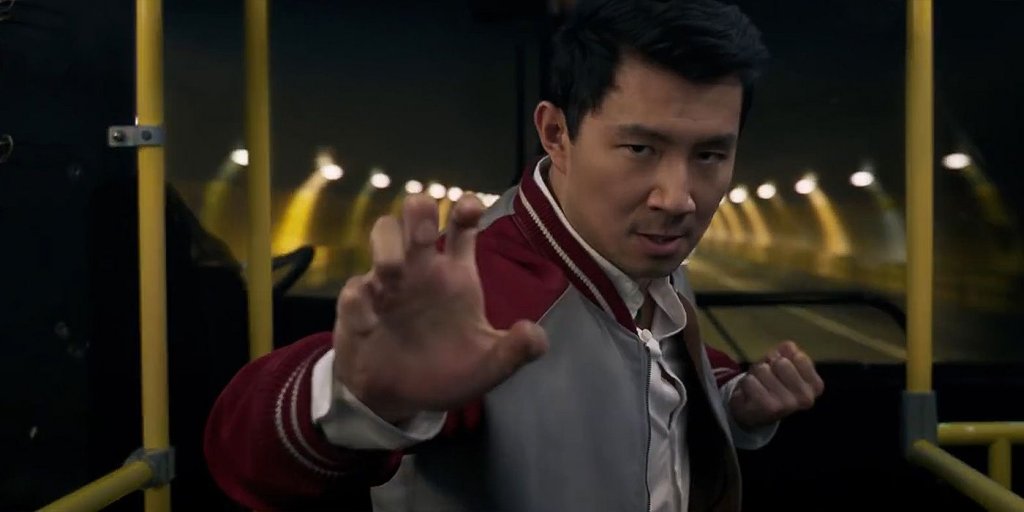
Simu Liu as Shang-Chi in MCU

Marvel’s first Asian-led MCU entry wastes no time laying down its rules of engagement. Sure, it makes a point to throw in a couple of references to the Blip and the events of Iron Man 3 as a reminder of its tangential connection to the wider ‘verse, but Shang-Chi and the Legend of the Ten Rings has its own story to tell. Setting the opening scenes in China with the opening narration and dialogue entirely in Mandarin, Shang-Chi quietly and confidently establishes itself as a cultural milestone for Asian and AAPI audiences – subtitles are hardly a novelty, and yet their inclusion in a Disney tentpole still feels surprisingly refreshing.

Director Destin Daniel Cretton and co-writers Dave Callaham and Andrew Lanham go a step further by taking the signature Marvel fare and melding it with key aspects of Chinese culture: deploying quinggong aerobatics and kung fu fighting styles, borrowing from traditional Chinese mythology, and paying homage to the wuxia genre. The result is a wistful, fantastical visual style that’s distinctly its own.

Simu Liu as Shang-Chi in Marvel's Phase 4 beginner Shang-Chi and the Legend of the Ten Rings

Shang-Chi (Simu Liu), whose imaginatively chosen “in hiding” name is Shaun, works as a valet-parking guy in San Francisco with his best friend Katy (Awkwafina). His covert identity is soon shattered, however, when a group of hitmen – including a large Romanian man with a retractable blade for a forearm – attempts to take the necklace gifted to him by his mother. After a Speed-style escapade, complete with cut brakes and Katy taking the wheel à la Sandra Bullock, the pair travel to Macau to find Shang-Chi’s estranged sister Xialing (Meng’er Zhang) and get some answers.

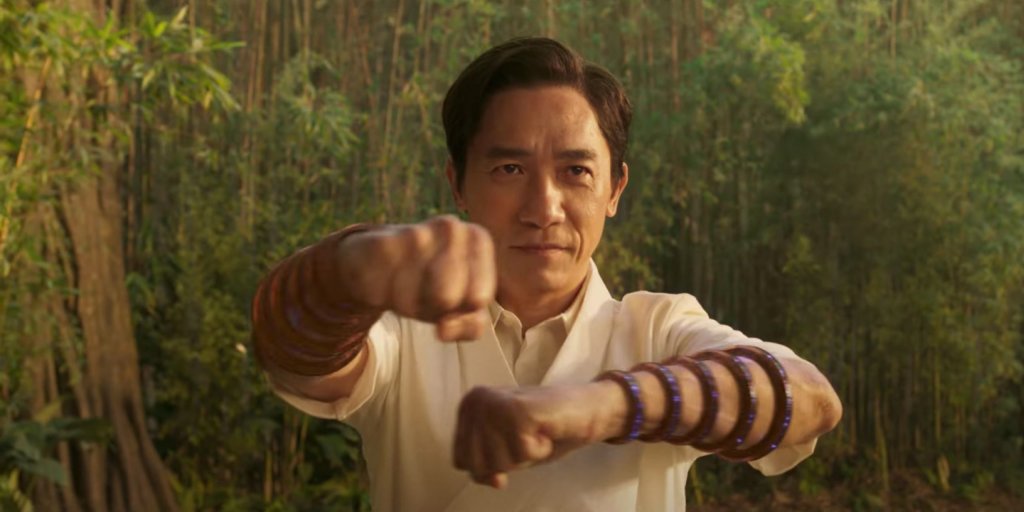
Without venturing too far into spoiler territory, Shang-Chi is essentially about two kids and their ageless father (Hong Kong legend Tony Chiu-Wai Leung, whose sex appeal even Disney cannot fully contain) reckoning with their grief – the loss of their mother and wife, Jiang Li (Fala Chen). This grief is the driver of Shang-Chi’s various narrative threads, pushing the newest MCU hero to reckon with his past and embrace his legacy.

The issue at the heart of Shang-Chi is that it cannot decide where its priorities lie: does it want to introduce a new hero into the MCU, or expand the scope of the franchise’s world-building? Wandavision and Loki may have succeeded in doing both but, with a runtime of just over two hours, Shang-Chi sets itself up for failure trying to tackle it all.

Tony Leung as Wenwu/the Mandarin in Shang-Chi and the legend of the ten rings

As magnetic as Liu is in the lighter and more action-driven scenes (he leaves no doubt as to whether he can carry the franchise in years to come), he gets somewhat lost in the quieter character moments. The script unfortunately gives its hero more backstory than personality, which makes it hard to reconcile the sunny, karaoke-loving man shown on screen with the darker, tortured son of Wenwu we are mostly just told about. In fact, no matter the character in question, their functional use within the story is placed ahead of genuine characterisation, while exposition is put above both. It’s only thanks to the sheer star-power and energy of the cast that the characters feel at all substantial.

The obsession with Shang-Chi’s backstory and mythology also takes its toll on the film’s overall momentum, which goes in fits and starts from stunning martial-arts sequences to extended information dumps. Which is all to say, Shang-Chi’s biggest problem is being overstuffed.

However, it offers enough thrilling set pieces, spectacular choreography, and colourful backdrops to offset any boredom. The aforementioned, confined fight scene on a speeding bus, as well as a neon-lit sequence across a skyscraper’s scaffolding, are nothing short of breath-taking: they are a fitting tribute to stunt coordinator Brad Allan’s work and memory, and an assertion of Simu Liu’s leading-man stature.

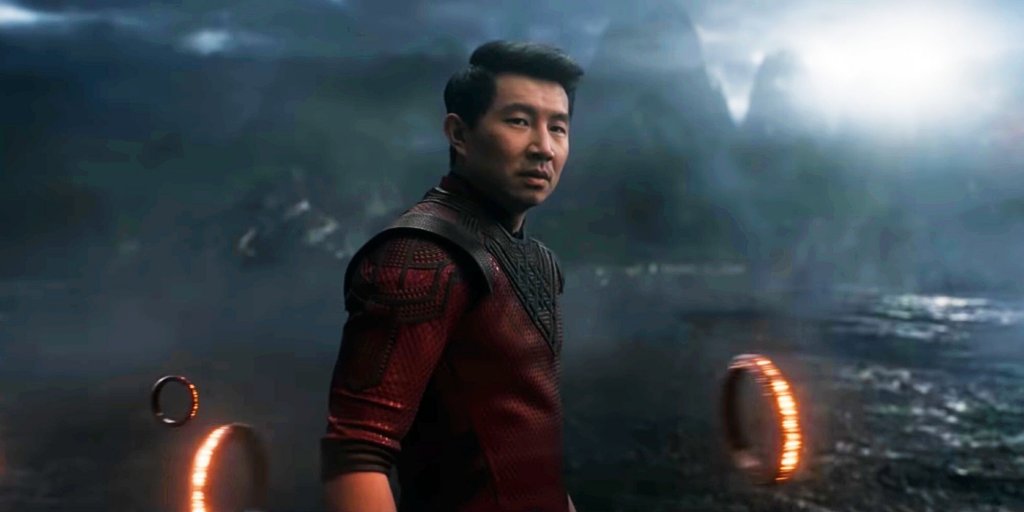
Simu Liu as Shang-Chi

It’s therefore all the more disappointing when, in its last act, Shang-Chi buries its top-calibre practical effects and stunt work in what can only be described as hideous CGI. The climactic showdown may be set in the colourful, fairy-tale village of Ta-Lo, yet Cretton insists on shooting it with a sludgy, grey haze that renders the action both ugly and incoherent. The last thirty minutes are simply drained of the magic and energy of the first half and could even be called the worst final act of any Marvel film in recent memory.

None of this detracts from the fact that Shang-Chi and the Legend of the Ten Rings deserves credit for its push forward in big-budget filmmaking. It also counts a (mostly) impeccable choreography, undeniable star-power, and daring genre-mixing amongst its virtues. Sadly, by trying to do too much and by throwing in Marvel’s signature ‘big move’ – drowning the climax in far too much CGI – Shang-Chi sabotages its grander ambitions: it’s a fun and refreshing change of pace for the MCU, but Shang-Chi falls short of being something great.

Shang-Chi and the Legend of the Ten Rings releases exclusively in cinemas September 3rd. 

REMINISCENCE

The Greatest Showman duo consisting of Hugh Jackman and Rebecca Ferguson has returned to the screen in the form of another dangerous relationship. Set in climate change struck Miami, waters have risen, wars have taken place, and now humans have no choice but to live a nocturnal lifestyle. Nick Bannister (Hugh Jackman) alongside Emily ‘Watts’ Sanders (Thandiwe Newton) own a sensory deprivation tank that preliminary provides visitors a nostalgic trip into their past, revisiting their finest moments. They also help with other tasks, like crime cases, or even lost items. It’s a great premise that shouts Minority Report, and it could actually make an intriguing TV show if given a chance.

Our story begins when May (Ferguson) walks into Nick’s life. They instantly fall for each other, but then out of nowhere, May decides to disappear without saying goodbye. This sets in motion a series of life or death fights as Nick floats around a sunken Miami. He desperately seeks answers like an impatient detective working on a frustrating, unexplainable case. Strong visuals and cinematography are at play throughout.

On his – at times, long-winded – pilgrimage through not only Miami, but own memories as well, the stakes become even more extreme, and you can’t help but wonder if the average human would go to this length to find someone who left them like that? Will the truth behind May’s disappearance all be worth it? You’ll just have to find out. Nick’s committed level of aggressive obsession is portrayed well, his emotions get thrown all over the place, and through rooftop fights and drug dealer shootouts, it does boil into that classic Hugh Jackman rage at the right moment.

This directional movie debut from Lisa Joy (Westworld) is an interesting neo-noir, sci-fi combination that lines up with a long list of legendary influences, from an Inception-like opening, to narration that screams The Prestige, and a detective feel that evokes Blade Runner. Also, for those who love the Black Mirror episode San Junipero, you’ll enjoy the similarities here. Reminiscence tips its hat respectfully to many of its predecessors, but behind that, it struggles to stand out on its own. Reminiscence still shows promise for whatever Lisa Joy decides to do next, and it will also be debated by all that view it for years to come.

REMINISCENCE is out now in UK cinemas

SCARE ME

scare me

Witty, intelligent, and entertaining, horror-comedy Scare Me is a joy to watch. The film is based on the simple premise of countless horror anthologies: writers locked away in a remote setting tell each other ghost stories. But Scare Me approaches the set-up and execution of the idea in a way that’s both inspired and unexpected.

Reeling from a messy break-up, aspiring horror writer Fred rents a winter cabin in the woods to work on his manuscripts. But inspiration and words are in short supply. His fortunes change when he meets Fanny, a confident and self-assured horror author who’s on a writing retreat of her own. The difference between the two is an immediate cause of friction: Fanny is a published and acclaimed writer in the genre; Fred is neither. When the electricity fails, Fanny calls on Fred and this seemingly ill-suited pair begin to narrate and act out scary stories for each other. As the hours pass, their spooky tales become more elaborate and their unusual relationship begins to develop.

Writer-director Josh Ruben, who also stars in the film as the frustrated Fred, delivers a complex and assured story, the majority of which unfolds within the confines of a cramped log cabin and which relies on a cast of just five. For most of the run time there are only two characters on screen, but the richness of the interaction between Fred and Fanny (Aya Cash) keeps up the dramatic momentum and viewer attention. Ruben has created two flawed and believable characters, drawn together by a shared love for the horror genre, whose identity is bound up with their ability to tell compelling stories.

As the pair act out their tales, the talents of cinematographer Brendan H. Banks and sound designer John Moros and his colleagues come to the fore. Scare Me is superbly framed, shot, and lit. Music and sound design build the tension, punctuate the narrative and underpin the impact of every stage of each storyteller’s work. Throughout each storytime, the listener (be it Fanny or Fred) provides a real-time critique to the narrator: raising objections to lame clichés in the plot, or pointing out when something’s ripped off from another writer. But there’s support and encouragement too when an improvised story builds its way out of hokum towards something genuinely scary.

Postmodern, self-referential horror filmmaking is rife with risk. It’s now become such a commonplace technique that writers often push things too far in the hope of securing audience buy-in. Dialogue weighed down with cult references can end up feeling smug rather than astute. Ruben’s script steps through this minefield with great skill, and crafts stories-within-the-story that, whilst genre literate, are clever as well as familiar.

Later in the proceedings, Chris Redd arrives on scene, as enthusiastic pizza delivery guy Carlo: the trigger for the first of two switches in the film’s tone and dynamic. Redd is great as the third volunteer to join the storytelling party, but it is the impressive performances of Ruben and Cash, and the shifting dynamic between their two characters that lifts and sustains the film.

Scare Me does have things to say about the role of gender and stereotyping in horror fiction and the baleful influence of sexism in the film and publishing industries. But the movie’s most subversive quality is its determination to circumvent the expectations of the genre and to gleefully deconstruct its methods and motifs.

SCARE ME is new to DVD/Blu-ray, and available to stream through SHUDDER

SUPER HOT

SUPER HOT

Written and directed by Taylor King, Super Hot is an indie vampire flick that harks back to the buddy comedies of the nineties. Watch as Star Wars-obsessed friends take on sorority house bloodsuckers in the ‘burbs. Think Kevin Smith’s dialogue-heavy ‘View Askewniverse’, like Mallrats (1995) or Dogma (1999), and you’ll get the idea. Geeks vs the world! Unfortunately, sarcastic wit can’t hide how reluctant Super Hot is to show its fangs.

Disgruntled with yet another rude customer, Jackie quits her job as the pizza delivery girl for Super Hot, opting to spend the last few weeks of summer with her best friends, Sam (Elijah Cooke) and Kevin (Coleson Berlin). She is also crushing hard on her friend Carmen (Sierra Michelle), which is problematic for two reasons. Firstly, Carmen has a boyfriend, Brad (Sam Watkins), and secondly, unbeknownst to anyone, she has moved into a sorority of vampires.

But I’m getting ahead of myself! Sensing that Jackie is feeling dispirited, Sam proposes a plan: Order a Super Hot pizza to be delivered to the sorority. Get Jackie her job back – for one night only – so she can be the one to deliver the pizza. Carmen will open the door excited to see Jackie (“I didn’t order a pizza!“), and invite her to join the party. What could possibly go wrong? We did mention this was a sorority of Nosferatu, right?

As sorority leader (and head vampire!), Monica (Lissa Carandang-Sweeney) hopes that their newest pledge will be the sacrificial virgin they need to resurrect Dracula himself! And if not, well… Jackie and her friends seem nice! Fortunately for our unlikely heroes, Warren (Nobuaki Shimamoto), a Japanese descendent of the Van Helsing, has been hunting the undead cult and will ‘try’ to keep Jackie and her friends alive.

Scribed with frequent references to nerd culture – everything from Army of Darkness to Gundam – Taylor King’s Super Hot is a love letter to cult fandom; a movie that, for better or worse, overindulges in the back and forth geekery between its lead characters. To quote Kevin Smith: “Nothing can be happening in a movie, and two people can be sitting in a room for the whole flick, and as long as the dialogue pops, it’s there“.

For Super Hot, this banter does indeed ‘pop’ at times, provoking a genuine smile, but this only serves to distract the audience from the movie’s ultimate sin. There is minimal visual style, hindering Super Hot‘s ability to generate suspense and sucking all excitement out of this creature feature (pun intended). SFX is also limited – a casualty of Super Hot‘s shoe-string budget – resulting in most of the action appearing off camera.

Fortunately, Super Hot‘s fairly inexperienced cast sink their fangs (puns!) into their respective roles – particularly Kandace Kale, Elijah Cooke, and Nobuaki Shimamoto – the final act teasing their return in the sequel, Van Helsing. Produced by Sean King, New Zealand Son Films has crafted a low-key, quirky indie comedy that is closer to Clerks than Fright Night. Despite a few disappointing bites, Super Hot has just enough topping to be a mildly entertaining slice of cult cinema.

Super Hot is available to stream via Prime Video now.

EYE WITHOUT A FACE

eye without face

Anybody mistaking this for the classic French film Eyes Without a Face (1960) is in for a surprise. Despite the similar title, this is in no way a remake or reimagining of the earlier film. And the clever titling is only the first of several surprises in store. This Eye Without a Face refers to a webcam, the one eye we often overlook, and the one that sees a lot of our daily lives.

Henry is an agoraphobic, anxious loner. The result of a traumatic childhood, at the hands of a brutally dysfunctional father. He spends his days staring at his computer screen, having hacked into the webcams of six women living in the nearby vicinity. Anonymously, he watches their every move.  Until one night, he becomes convinced that one of the girls is a serial murderer with a taste for human flesh.

This is a horror film that draws on both voyeurism and the slasher genre, but to a larger degree is a character study of a vulnerable person’s psychological breakdown. The emotionally crippled Henry is sympathetically played by Dakota Shapiro in a memorable performance. His counterbalance is roommate Eric, a loud, brash outgoing YouTube ‘celebrity’, trying to get his acting break to make some money to pay the rent. Vlada Verevko dominates every scene she appears as Laura with a menacingly icy allure.

The film can easily be described as a Rear Window for the digital age, and justifiably so. Producer, director and writer Ramin Niami has clearly taken a slice of inspiration from Alfred Hitchcock and has built a twisted story upon it that is both a little bit familiar and very original. This is a textbook exercise in tension, paranoia and unease worthy of the Master himself, and is a timely lesson in making sure your webcam is off. A cautionary tale for the modern age.

Eye Without a Face is available on digital platforms from August 23rd.

PIG

After someone kidnaps his prize truffle pig, a broken man sets off on a gutwrenching and emotional quest to get her back in Nicolas Cage’s best performance in decades, Pig.

Firstly, this film could have been completely throwaway and predictable from the synopsis alone, but it is so much more and will stay with you for a long time after the credits have rolled. Robin Feld (Cage), a former chef who has recently lost his wife, retreats to a cabin in the woods of Oregon, void of daily human contact. His closest ally, the titular truffle pig – the only being he can connect with on a spiritual level. After a routine transaction of selling truffles to a local supplier Amir (Alex Wolff), Robin is ambushed during the night and his dear friend is kidnapped sparking him to set off on the most unique and melancholic quest to get his pig back.

Cage has always been synonymous with over the top and quirky personalities and moments, but this story of a man torn down by grief and sorrow accentuates his breathtaking talent to bring a humanised and real character to life in an unbelievable manner. As the narrative progresses, Cage’s body language and delivery of philosophical proclamations in a forceful and raw undertone make us as audience members truly delve deep into how we would react in a similar situation when you must fight for someone or something that you truly care about.

With arguably Nicolas Cage’s best-ever performance in a feature film, a deep psychological and humanised story and a striking score by Alexis Grapsas and Philip Klein, Michael Sarnoski’s feature debut is a true tour de force.

Pig is out now in UK Cinemas and available on VOD on August 23rd.

LIKE A DIRTY FRENCH NOVEL

like a dirty french novel

Filmed in 2020 during the height of the Covid, this self-proclaimed “grindhouse thriller” by director Mike Cuenca fruitlessly attempts something in the vein of Pulp Fiction laced with a dash of Contagion. Made up from multiple, seemingly disparate crime-caper narratives that take place in the midst of an unnamed (and strangely inconsequential) global pandemic, this tame tale is ultimately a total swing and miss attempt at a kitschy, ’70s-style exploitation flick.

After a laughable desert-bound prologue featuring some of our unconvincing actors “sinking” into “quicksand”, the real story begins. It’s a collection of four long vignettes that offer little drama or fun, only thin hints of an insubstantial plot that’s kept secret until the very end. Firstly, bored Crystal (Jennifer Daley) and jigsaw enthusiast Hue’s (Robby Valls) mundane relationship is distracted by a mysterious phone caller – a Spanish-tongued seductress who happens to be the narratives’ through-line. Exotic and sultry, The Caller’s (Laura Urgelles) full face and location is not revealed, being defined only by her red lips dragging on a cigarette. She flirts with and tempts Hue, using some racy dialogue, but this light amusement is truncated as the movie crisscrosses between its further stories.

Next is the flatly comedic saga of Forester (Grant Moninger) who is mistaken for his robber twin brother and thusly held at gunpoint by two bumbling hitmen; following this is the mystery of Lane’s (Amanda Viola) bicycle friend, Jake (Aaron Bastos), who is suddenly presumed dead. Peppered between are ribald but pointless episodes of a famous comic book cosplayer and the obsessive attention she receives. And finally, the film re-joins Hue on his search for the now-missing Crystal, where he ultimately learns of the humdrum conspiracy of love, crime, and betrayal that binds these characters together.

The writers devoted legit thought to this revelatory ending, but it’s not enough to justify the 60-minute slog we’ve just witnessed. This is the overall issue of Like a Dirty French Novel. Ambition and creativity are somewhat present; the characters aren’t engaging but their interplay is humorously absurd at times, and the filmmakers deserve credit for attempting to shoot safely during a lockdown and on a low budget. However, the stifling effects of this are felt; the constant apartment locations enhance the monotony of the plot, which at no point lives up to its title. There’s nothing sexy or edgy to sink one’s teeth into; what transpires is not lurid exploitation, but more boring lockdown fever dream – accentuated by a dizzying repetitive musical score.

The coveted retro style is the film’s final downfall. On top of its heartfelt little references and cameos by old movies, pulp novels, and comic books, director Cuenca fixes his digitally-shot picture with a grain filter that vainly recalls aged celluloid. It’s erroneous both technically and thematically. Given that the surprisingly chaste content resembles sleazy Grindhouse affairs in no way, it feels desperate, incongruous, and even treacherous of Cuenca to dress it up as one. Like a dirty French novel? More like a tepid TV serial.

LIKE A DIRTY FRENCH NOVEL premieres at the Dances with Film Festival on August 28th, 2021

SNAKE EYES

snake eyes

To give some perspective, this isn’t a continuation of the narrative started in the first two G.I. Joe films. The clue is in the original subtitle. This is both a reboot and a prequel of sorts, but more of a reboot. Snake Eyes is the enigmatic member of the worldwide peace-keeping force codenamed G.I. Joe. He dresses like a futuristic ninja and is their martial arts specialist. But who is he really?  How did he get so dangerous? Snake Eyes seeks to answer these questions.

From the outset, it becomes clear that this isn’t your normal G.I. Joe film, where the evil COBRA organisation launches another plot for world domination only to be defeated by the Joes and their toy product placement arsenal. The high level of incredible gadgetry, weapons and vehicles aren’t as front and centre as normal. Strange as it may seem, for a film based on a long-running series of toys by Hasbro, this is a little less explosively action-packed and frantic than usual. In fact, compared to its two predecessors, it’s actually quite understated and grounded. Rather than a two-hour extended toy commercial with cardboard characters lurching from one improbable chase to the next, we have a martial arts epic, with themes of divided loyalties, betrayal, and redemption.  This is a refreshing change of direction for this franchise.

As a child, Snake Eyes saw his father executed and swears to devote his life seeking vengeance. As an adult played by Henry Golding, he becomes a dominant fighter on the underground circuit before being recruited by the Yakuza then moves on to join a Ninja Clan. Here, he receives his formal training and three tests – one of which involves entering a nest of sacred giant Anacondas. Although the action is fast and frantic, particularly the fight scenes of which there are plenty, Henry Golding doesn’t have the screen presence to carry the longer dialogue scenes. But then again, he is playing the part of, basically, an Action Man doll. And if his delivery seems a bit tedious, the audience can be assured that we’re never far away from the next action sequence, so it all balances out.

All in all, it’s a more involving film than we’d expect, given its pedigree – despite its subplot involving a deadly ray emitting jewel. It’s not deep, it’s not going to change your life or your philosophy. It’s a big, loud summer tentpole movie designed solely to while away a rainy couple of hours. The cinematic equivalent of a Big Mac and Fries. And who doesn’t enjoy one of those once in a while?

SNAKE EYES is in UK cinemas now

MIDNIGHT IN THE SWITCHGRASS

MIDNIGHT IN THE SWITCHGRASS

If you’re setting out to create a largely formulaic serial killer movie – and we can only assume that was prolific producer Randall Emmett’s intention with his directorial debut Midnight in the Switchgrass – then certain genre clichés must be adhered to. Firstly, you need a creepy bad guy and here Lukas Haas as the God-fearing prostitute killer does his job well. You need a cop on the edge, someone with a ‘to hell with it all’ kick-ass attitude and a hint of recklessness; enter Megan Fox as driven FBI agent Rebecca Lombardo.

If you’re really targeting the VOD market, and your misguided ambition is to be found in the section ‘there’s nothing else to watch and I’m desperate’ then you need a healthy dose of misogyny, and boy, does Emmett really go all out here. Women are beaten up, gagged, scantily clad, abused, and bitten. Even Fox, who despite being set up as a saviour in this male-dominated world, is introduced with a shot Michael Bay would have been proud of in Transformers.

And then if you’re really shooting for the stars, you bring in a former A-lister looking for an easy paycheck; introducing a waxwork replica of Bruce Willis looking as bored as the audience and appearing in fewer scenes than he does in the trailer.

No, Midnight in the Switchgrass is one to avoid. Haas makes the best of his role and Emile Hirsch as the time-weary local cop makes what he can of a weak character, but they deserve better. Everything from the direction to the plot to the tragically unsatisfactory finale is all blandly mediocre.

MIDNIGHT IN THE SWITCHGRASS is out now on DVD, Blu-ray, and Digital