AQUARIUM OF THE DEAD

aquarium dead

We may be creeping back towards some sort of normality after a year or more in various lockdowns but it seems that the world is still not quite right and that the natural order of things remains completely out of kilter. Allow us to present to you as evidence Aquarium of the Dead, the latest low-budget effort from Asylum Studios, shameless purveyors of cash-strapped mockbusters (Ape vs Monster being another recent effort, riffing on… well, we can’t begin to imagine) since the late 1990s. Aquarium of the Dead is piffle, of course, but it’s actually not bad and there’s a reasonable chance you won’t feel like shooting yourself in the head when the credits roll out of sheer embarrassment at having sat through the whole thing.

Directed by Glenn Miller (not that one) and written by Marc Gottlieb, Aquarium of the Dead takes us to a (curiously-deserted) aquarium off the coast of southern California. Here a couple of fish fodder fools… sorry, aquarium employees… are attempting to save the life of an ailing octopus. They inadvertently inject it with contaminated epinephrine (a link to previous aquatic Asylum efforts that have sadly passed us by) and the creature comes back to life, kills the two hapless employees and escapes into the aquarium’s air ducts where it spreads its bacteria to assorted starfish (seriously), crocodiles, sharks (inevitably), and even a dolphin and a walrus. Much shrieking and running around from assorted stereotypes trapped in the building ensues along with the usual obligatory shonky CGI. Aquarium of the Dead is knock-off nonsense (its release timed to coincide with Zack Snyder’s Army of the Dead) but it has a strange charm all its own. Despite its budgetary deficiencies, it’s actually competently directed and actually looks like a film, not something thrown together in a warehouse and the acting is nothing if not enthusiastic (special mention for Madeline Falk, whose turn as Dr Karen James is hilariously over-the-top/just plain bad…you decide). Gottlieb’s script is refreshingly self-aware too; there’s a neat gag riffing on the Sharknado franchise, some decent character banter, and a scene where one of our heroes rages “I ain’t dying today” before… well, dying today. The effects are as bargain basement as ever but they get the job done, although a sequence where characters are attacked by static, motionless starfish isn’t quite as terrifying as all the on-screen screaming and panic might suggest it is.

Ultimately, we all know where we are with an Asylum movie. It’s fast food for the brain but at least Aquarium of the Dead is well-cooked and presented in  a nice bun [sorry? – Ed] and is unlikely to make you throw up when you’ve digested it all. You won’t go back for a second serving of this particular dish but we’re betting you’ll be tempted by something on Asylum’s menu again sooner or later. Now, about Ape vs Monster

Aquarium of the Dead is available… appropriately… on streaming services.


ROAD HEAD

A young couple (Damian Joseph Quinn and Clayton Farris) and their third-wheeling friend (Elizabeth Grullon) head out on a road trip to the Mojave Desert. Their being attacked by the local hillbilly contingent comes as no surprise – but the Executioner (Adam Nemet) coming after them with chainmail and a massive sword surely does. Those expecting yet another Wolf Creek or Texas Chainsaw rip-off are in for a big surprise.

As is the third wheel herself, Stephanie. Kidnapped by the Executioner and his desert-dwelling cult, Stephanie battles would-be rapists, a murderous sex cult and condescending visions of her toxic ex. Grullon gives a spirited performance, but is let down by Justin Xavier’s overly talky script. The writing raises a smile every now and then (if you like swearing), but isn’t half as sharp as it thinks it is. Grullon’s Stephanie is annoying, but so is everyone else – save for a show-stopping, movie-saving performance by one Misty Violet as, uh, Felicity Fellatio Bones. The film is at its funniest when it embraces the crudity and runs with the double-entendres and dick humour.

Road Head is a refreshing change from the abject monstrousness of its peers, prioritizing arch humour over gore or violence. It could afford to push the envelope a little further in that respect, but its dedication to the bit is to be admired.

THE CONJURING: THE DEVIL MADE ME DO IT

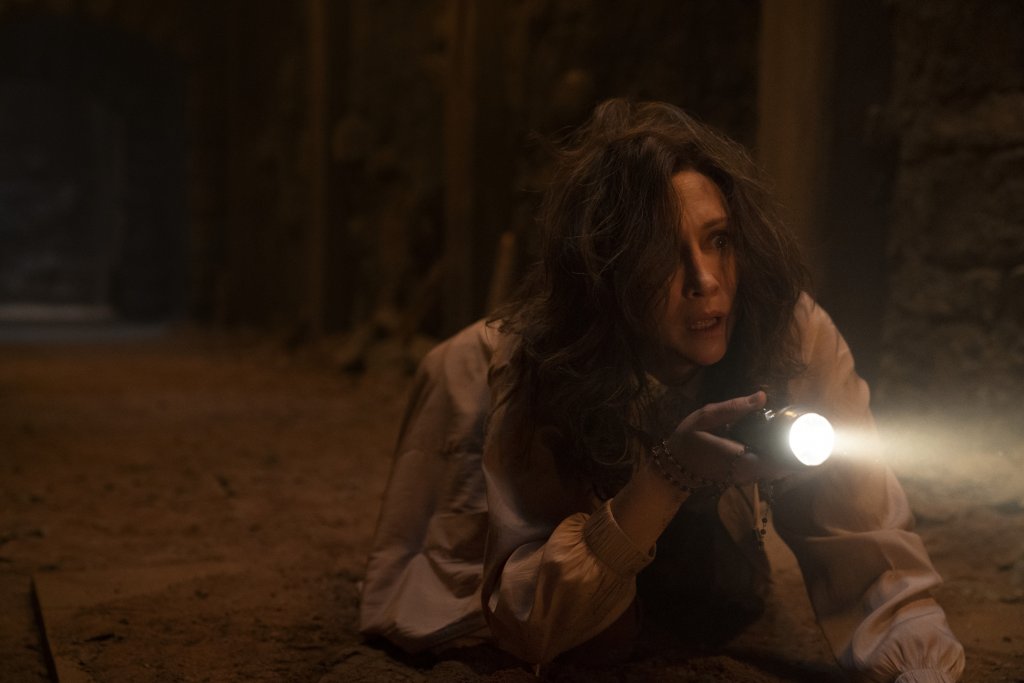
Vera Farmiga and Patrick Wilson star in the third Conjuring film, The Conjuring: The Devil Made Me Do It

Ed and Lorraine Warren are back in The Conjuring: The Devil Made Me Do It, the latest instalment of James Wan’s horror franchise from director Michael Chaves (The Curse of La Llorona). With The Conjuring franchise having branched off into spinoffs like Annabelle and The Nun, it has been a long five years since Patrick Wilson and Vera Farmiga starred as everyone’s favourite demonologist couple, and we reunite with them in 1981 Massachusetts.

The Conjuring 3 tackles one of the Warrens’ most high-profile cases, that which concerned the trial of Arne Cheyenne Johnson (played by Ruairi O’Connor), who was the first man in US history to plead “not guilty” to the murder of his landlord by reasons of demonic possession. That historic court case is sometimes referred to as the “Devil Made Me Do It” case, lending the film its full title.

Vera Farmiga as Lorraine Warren in The Conjuring 3: The Devil Made Me Do It

The Conjuring: The Devil Made Me Do It breaks from the haunted house tradition that defined its predecessors and blends its classic horror roots with an investigation narrative, broadening the story’s scope and weaving in a number of side plots. This decision unfortunately causes the film to lose much of its sense of claustrophobia and nerve-shredding tension, which was one of the foundational strengths of the earlier entries.

Even the goriest scares can’t quite match the horror of the first two films, failing as they do to creep under the skin – though Chaves, aided by brilliant cinematographer Michael Burgess and Joseph Bishara’s eerie score, ensures that gore hounds will leave the theatre satisfied. The scares might be predictable and lacking some of that shock factor, but they are unarguably well-executed – case and point, the extended opening scene offers a delicious homage to The Exorcist, with a truly terrific performance from Julian Hilliard.

The diverging storylines also mean the audience is allowed time to breathe, away from the movie’s horror elements – which then requires more work on the viewers’ part to actively buy into the supernatural dimension of the case. And though the Warrens’ encounters with various cynics (chiefly among them, a lawyer and detective) work well to elicit the film’s few laughs, The Devil Made Me Do It still struggles to weave the realism of its procedural framework with its horror elements. The ensuing lack of cohesion and focus causes the story to stall in the second act, leading to an unconvincing and anti-climactic conclusion.

Still from the latest Conjuring film, The Devil Made Me Do It

Meanwhile, Wilson and Farmiga are as engaging and charming as ever, once again asserting that for all the horror and sinister tales, the ghost hunting pair are very much the franchise’s beating heart. Their quiet love and complete trust in one another firmly anchor the otherwise uneven storytelling, providing the stakes even when we know they’ll be alright. A special shout-out also goes out to an underutilised John Noble whose scenes, though few, are completely engrossing.

For fans seeking to follow the Warrens’ adventures and who are satisfied with some jump scares, The Conjuring 3 will provide. However, for those hoping for an entry of the same calibre as its predecessors, The Devil Made Me Do It is not quite that film.

The Conjuring 3: The Devil Made Me Do It releases in UK cinemas May 26th. 


THE TUNNEL

Tunnel

The Tunnel is proof that you don’t need a silly Roland Emmerich-style Hollywood budget to deliver an absorbing and enthralling disaster movie. In fact, The Tunnel suggests that you can actually look a bit further afield than Hollywood to deliver those particular cinematic chills and spills as the film takes us to the cold, snowy hillscapes of a pre-Christmas Norway and a tale of fire, smoke, choking and dysfunctional family angst.

A few hours before the festive period and everyone in Norway is in a hurry to get back home to the warmth of the family bosom. Our attentions are drawn to tough, grizzled firefighter Stein (Thorbjørn Harr), a widower whose daughter Elisa (Ylva Fuglerud) refuses to accept her father’s new relationship with Ingrid (Lisa Carlehad) and clearly isn’t keen on spending Christmas with her father and his new squeeze when she is still processing her birth mother’s death. Elisa flounces off in a huff and boards a coach in an attempt to distance herself from her father’s new circumstances. A blizzard is raging and, as bad luck would have it, a petrol tanker crashes in a crowded tunnel and quickly bursts into flames. A wall of choking smoke rolls along the tunnel overwhelming the backed-up traffic that, inevitably, includes the coach bearing the gloomy Elisa. Worsening weather conditions impede the attempts of the rescue services to reach the scene and the survivors of the conflagration are forced to fight their way through the chaos and the choking acrid smoke with the help of anxious emergency services call worker Andrea (Ingvild Holthe Bygdnes), who quickly realises that the situation is desperate and getting worse with every second.

By its very nature as a disaster movie, The Tunnel is unable – and very probably unwilling – to avoid the over-familiar cliches of the genre. Many characters are little more than thumbnails, quickly disposed of as we focus on Elisa as she steps up to the plate to try and find a way out of the tunnel, a couple of young kids separated from their parents and trapped in the chaos and, of course, Elisa’s dad as he discovers that his daughter is trapped in the tunnel. With conditions deteriorating fast and preventing the rescue services from mounting a full-scale rescue mission, Stein takes his life into his own hands and plunges into the carnage to find his daughter and anyone else who may be fighting for survival in the hellish inferno.

Watching The Tunnel is a bit like meeting up with an old friend in an unfamiliar environment. The story is predictable, the character beats are ones we know by heart, and there’s very little new here for lovers of the disaster movie genre. But the bitingly cold and challenging Norwegian setting refreshes the formula and the focus isn’t entirely on the spectacle; once the tanker explodes we’re left staggering blindly through the smoke in a claustrophobic tunnel and it’s a genuinely stifling and uncomfortable visual experience pretty much guaranteed to leave the viewer feeling hot under the collar. The Tunnel ticks all the disaster movie boxes without even attempting to reinvent the genre and there’s absolute nothing wrong with that and no reason at all why it should even try.

The Tunnel is available now on digital platforms.


VOYAGERS

voyagers

Previously, director/writer Neil Burger tackled a teen-dystopia sci-fi affair with 2014’s Divergent, a Hunger Games knockoff that didn’t do much for the YA genre. With Voyagers, Burger takes another stab at the genre, this time with a bunch of cloned teenagers on a spaceship that’s on course for an uninhabitable planet, ready to be populated by their future children and grandchildren. It’s also revealed that the teens have been given some medication that makes their personalities more docile and reduces their sex drive. When the two male protagonists stop taking the drug, chaos starts to ensue on the ship. It may seem like a decent enough premise, but it devolves into ‘Lord of the Flies in Space’ with elements of High-Life and Passengers thrown in for good measure.

The plot is very much a mishmash of ideas and concepts that we’ve seen done before and have been done better, but that’s not to say that it still can’t be enjoyed on its own. Indeed, it is a watchable film, and Berger can make a movie palatable and even enjoyable for the casual viewer (The Illusionist and Limitless are perfect examples of this). Still, they aren’t going to leave any lasting impact whatsoever, and Voyagers is precisely that. The subject matter of teens discovering hormonal urges of violence and sex should feel more hard-edged and adult than it is, but Voyagers comes across as relatively tame in places.

The occasional sluggish pacing and a dull lead performance from Tye Sheridan certainly don’t help matters. Still, the production design is effective, and some of the supporting performers work efficiently well. Fionn Whitehead perfectly nails the incredibly violent and hormonal sleazeball causing chaos, while Lily-Rose Depp delivers a quietly nuanced performance as the love interest that’s trying to keep everything together.

Despite having some sound ideas at its core as well as some decent performances, Voyagers is a pretty safe, by-the-numbers film that delivers what you’d expect and nothing more. It’s the storytelling equivalent of a software update: it’s not an entirely original thing, it takes a while to install and once finished, you’d hardly notice any difference whatsoever.

PSYCHO GOREMAN

psycho goreman

When young siblings Mimi (Nita-Josee Hanna) and Luke (Owen Myre) stumble across a buried space gem during a routine backyard game of Crazyball (don’t ask), trouble arrives in the form of an ancient alien warmonger intent on bringing the universe to its knees. Unfortunately for this cosmic monstrosity (the Psycho Goreman of the title, though he’d prefer to still go by The Archduke of Nightmares), Luke and Mimi’s new MacGuffin grants the latter ultimate control over him, thus enslaving PG to the folly of a precocious 12-year-old girl. (And control is something Mimi takes very seriously – just ask her long-suffering brother.) Meanwhile, on the other side of the galaxy, an alien council conspire to destroy Goreman for good, and nothing is going to stand in their way…

Paying loving homage to the forever-fertile ‘kids befriend fantastical creature’ concept so well-trodden in the ‘80s (from the sublime, E.T., to the subpar, Mac & Me), Steven Kostanski’s Psycho Goreman subverts this classic tale by steering away from the safety of Amblin and instead filters its story through the lens of Troma. As such, heart-warming bonding gives way to heart-plucking and bondage, with the outrageous gore played solely for comedy effect. There’s a generous amount of laughs to be had over its pacey 99-minute runtime in fact, and not just courtesy of the gross-out carnage – the deftly written dialogue also impresses throughout. From the suddenly redundant bravado of Goreman, to the pitiful bemoaning of the children’s useless father, Greg (Adam Brooks), every character gets to deliver an abundance of comedic beats that far excel the quality you might have come to expect from a schlocky shocker such as this.

Performances are equally as impressive across the board, with special mention going to the movie’s young leads, Hanna and Myre; Psycho Goreman marks their feature film debuts, and both are destined for great things based on their excellent work here. Sure, Mimi’s relentless cockiness and antagonism of all around her may grate on occasion, but given that she could be seen as the movie’s true villain, it’s entirely believable that this is intended!

The story is admittedly quite slight beyond its fantastic set-up, but with lots of wildly inventive, retro-inspired practical effects to marvel at (there are more rubber monsters here than in an entire season of Doctor Who), genuine laughs aplenty, and enough claret spilled to satiate the thirstiest of horror hounds, Psycho Goreman is a gift for lovers of no-holds-barred creature features of yesteryear.

UK Release Date: Out Now (Shudder)

THE DJINN

Home alone in the new apartment he shares with his father, a boy uses the time to commune with a higher power. Using an ancient spell book to summon himself a genie – the Djinn – Dylan (Ezra Dewey) hopes to ask it for, quite literally, a voice. Blaming his mutism for the absence of his mother, he sees the Djinn’s gift as a stopper for the emptiness he feels inside. But, as anyone who has ever read The Monkey’s Paw or seen Wishmaster will attest, nothing in life is free…

Dylan ain’t never had a fiend like the Djinn. Its price? Survive the night. And so it manifests throughout the night, taking the form of various dead people and sinister faces. It can be hurt and given pause, but nothing can truly stop it before the stroke of midnight. In the Djinn’s unstoppable barrage of attacks, it’s more It Follows than Wishmaster. The Evil Dead, with a baby Bruce Campbell. Again and again, the Djinn comes at Dylan, determined to put him down before he can claim his gift. David Charbonier and Justin Powell’s supernatural horror film purports to be a modern fairy tale, but is, at its heart, a home invasion movie.

The story is slight but effective; a fraught game of cat-and-mouse between a boy and a demon. Little Ezra Dewey puts in a great performance as Dylan, and without an ounce of precociousness. The lack of dialogue throughout probably helps, in that respect. Its message is well-worn – be careful what you wish for – but what else did you expect from a film about an evil genie? The Djinn is an old story, effectively told – a brutally tense and stylish little shocker, with a standout performance from its young star. What more could one ask for?

The Djinn is available now from digital outlets.

THE FOUND FOOTAGE PHENOMENON

THE FOUND FOOTAGE PHENOMENON

It’s been the go-to subgenre for filmmakers on a limited budget for years now, and this documentary delves deeper into why the found footage format is still popular.

It didn’t start with The Blair Witch Project, but it certainly put the conceit on the radar for the general cinema-going public. Quite rightly, directors Sarah Appleton and Phillip Escott go beyond the obvious trappings by taking a deeper dive into the style. There’s input from numerous filmmakers who have utilised or made their names with first-person shot movies and academics who have studied the subject.

We all know that Cannibal Holocaust is the granddaddy of the format and formed the basis of what we know as found footage, but the argument is made that the Bram Stoker novel Dracula sowed the seed for the way the found footage style presented the story. Dracula’s diary entries and recordings certainly fit in the same mould of what would come nearly a hundred years later.

The controversial TV show Ghostwatch is given the right amount of kudos, of course, and so does the often overlooked Belgian pseudo-documentary Man Bites Dog. Host was a big hit during the recent times of lockdowns when everyone in the world is experiencing the same emotions and fears and represents the evolution of equipment that is accessible to the general public and not just movie makers. As such, we can assume that the found footage subgenre and all its offshoots will be around for years to come.

The best documentaries can make the audience interested in something that they might not normally be. The Found Footage Phenomenon does that easily.


The Found Footage Phenomenon is out now on Shudder.

TOM & JERRY

tom jerry

The new film, Tom & Jerry, might not be the first time the titular animated cat and mouse have interacted with live-action people – that honor goes to 1945’s Anchors Aweigh, which saw Jerry Mouse tap-dancing with Gene Kelly – nor their first feature-length picture – that being 1992’s Tom and Jerry: The Movie – but it might be the first feature featuring the pair to really get things right.

Notably, the 1992 film saw the pair speaking, with Tom and Jerry voiced by Richard Kind and Dana Hill, respectively, a choice not at all well-received by critics. In this latest incarnation, director Tim Story and writer Kevin Costello seem to be going for a format inspired by the live-action versions of The Chipmunks or Garfield, wherein the longtime characters behave as they have since their first appearances, but inserted into a modern context.

Actually, ‘formula’ may be a more accurate word than ‘format’, because the plots of these films are essentially interchangeable: the animated characters do their thing, the situation goes awry, the real-world people learn some things, the animate characters help fix the problem that they’ve cause, and everything ends with a happy song. Hooray.

Tom & Jerry does manage to one-up everything, because when it comes to the cat and mouse duo, the film keeps it true to the characters’ roots. The live action Tom & Jerry movie is exactly the 100% dumb comedy worth watching after a long, stressful day, as it is stupid and violent and full of bad jokes. Tom and Jerry beat each other up, cause massive amounts of chaos and damage, with a general aspect of mayhem pervading their every interaction together.

That said, they are animals. The rest of the film is filled with main characters who constantly fuck everything up with lies and/or self-indulgence: Kayla (Chloë Grace Moretz) lies to several people in order to get her job at the Royal Gate Hotel and actively gaslights Terence (Michael Peña), who then tries to ruin the wedding of Preeta (Pallavi Sharda) and Ben (Colin Jost), the latter of which doesn’t seem to care much what his soon-to-be bride wants in her own wedding.

The only good people in the film are tertiary characters who try their hardest and manage to be smart, good folks who know what they’re doing and have good ideas, like Joy the Bell Girl (Patsy Ferran), doorman Gavin (Daniel Adegboyega), and bartender Cameron (Jordan Bolge). Not for nothing are they the only human characters who aren’t exasperating.

That said, the animation is good, and the idea to have every single animal – be it the pigeons flying in the city, butterflies, or the two massive elephants – as animated characters is a really clever stroke, which lends a bit of world-building to any otherwise silly comedy aimed at kids. There’s also a Droopy the Dog cameo that ought not be spoiled in its details, but will leave those who get it gasping for breath with laughter.

While not perfect, it’s perfectly serviceable entertainment for a weeknight post-dinner couch viewing, and will leave kids and adults alike satisfied.

Release Date: out now (Digital), May 24th (Blu-ray/DVD)


THE LOCKDOWN HAUNTINGS

The Lockdown Hauntings

As an exercise in ‘creativity through adversity’ it’s difficult to take issue with the ambition and confidence of writer, director, and cinematographer Howard J. Ford. This DIY filmmaker has scripted and shot a contemporary horror-thriller that’s premised on the very thing that’s dominated the cultural zeitgeist over the last year and more: the Covid-19 pandemic and the resultant lockdown.

Ford deserves credit for bringing to the screen a movie that has immediate social resonance, and leverages the constraints of Covid restrictions as key plot points. This is, though, the main things that The Lockdown Hauntings has going for it. It lacks the clarity and sense of urgency essential to an effective shocker.

In the first weeks of lockdown, several young women living alone struggle to adjust to the isolation and the loss of normal life. For each of them, online communication tools become indispensable for keeping in touch with partners, family and friends. Yet through the long hours of solitary existence stuck indoors, several come to question their sanity. Not least as they begin to suffer the destructive attention of a suspected poltergeist. Their predicament (being ‘locked down in a haunted home’) is explained by an online vlogger, and specialist in all things occult, who’s keen to share his expertise. He explains to anyone who cares to subscribe to his channel how the context of Covid has provided conditions in which nefarious spiritual forces can invade people’s homes unseen.

The opening acts show a hidden presence disturbing the lives of lone individuals in lockdown across the city. Combined with drone shots of eerily empty urban streets, this is the film’s strongest section. It’s a juxtaposition of claustrophobic confinement with evocative images of depopulated urban streets that emphasises the feeling of personal vulnerability. Locked up in your own space, no-one can hear you scream. The sense of jeopardy is reinforced by the authorities’ withdrawal from the public realm: the detective investigating these phenomena has to rely on the technologies of ‘remote working’.

As the mystery of the hauntings unfolds, things don’t gel quite as well as they should. For a drama about the miseries of isolation, there are too many characters vying for attention and too many narrative threads. And while the presence of Tony Todd (as the voice of exposition) gives some genre gravitas, his from-the-couch Zoom performance is far from being his best work. The strong sound design helps to deliver some of the film’s key shots, and underscores the bloodier moments well. But at several points the mix oversells things to an absurd degree (a suitcase being unzipped by an invisible hand sounds more like the gates of Mordor being opened).

A British indie lockdown horror is the kind of movie that STARBURST readers should be be predisposed to like. But the context that made for a challenging shoot is not enough to secure a creative free pass. The Lockdown Hauntings is a laudable exercise in exploring the challenges of filmmaking during a pandemic, and it’s a creditable stab (albeit an over-enthusiastic one) at a present-day domestic horror. A sharper and shorter version of the same material, pared back to the essentials, might have convinced more members of its target audience to stay indoors and pay attention to this film. This is, after all, a horror fiction set in the alarming and unsettling world that we’re only now beginning to escape from for real.

The Lockdown Hauntings is available now from digital outlets.