BEGINNING

Beginning

Early on in Beginning, main character Yana tells her husband that her life has become something she doesn’t recognise anymore. She looks into a mirror and doesn’t know who is looking back. It’s as if she is waiting for something to begin, or for something to end, she says.

No surprise perhaps that the film’s title, therefore, is key to interpreting this complex and hypnotically told story of a woman experiencing a breakdown of sorts.

In a small rural community in the country of Georgia, Yana is married to David, the head of a local branch of the Jehovah’s Witness religion. They aren’t particularly welcome – the community is Christian Orthodox and, in the film’s absolutely stunning opening scene, this is made very clear indeed. You won’t see a better, more assured curtain raiser in any film all year.

This shocking first scene establishes a tension that rarely lets up as we learn about Yana’s unfulfilled life, the dreams she gave up to support her husband, her role as a mother, and the part she plays within the religious sect.

David goes away for the majority of the film leaving Yana and her son alone, and the arrival of a different, corrupt man threatens her stability even more. Increasingly, incidents happen that bring one part of Yana’s inner self to an end only to see another begin, setting up a slow chain of momentum that will lead to an almost inevitable outcome.

To say more about the plot of Beginning would be unfair as it’s less a film about a story and more a film about a person, Yana, and as played to perfection by Ia Sukhitashvili, she’s a fascinating character.

Beginning is told with great skill and considered economy by first-time feature director Déa Kulumbegashvili. Her style is formal – she shows rather than tells, she allows the camera to stay fixed so that sometimes character speak out of view and we’re not sure what they’re doing, she takes her time (there’s a mesmerising static seven-minute shot of Yana’s face at one point which is pure cinema). There are shots in the film that are like paintings, stunningly photographed, exquisitely lit, utterly captivating. She’s part Hanneke, part Von Trier, and all her own.

Beginning is striking for many reasons – its opening scene, its static camera, its superb performances, its signaling of a major new directorial talent. It’s also striking for something more allusive, a sense of unease and horror, (particularly during an extremely disturbing scene of sexual assault), but one in which we aren’t given easy answers. Yana is neither a victim nor a hero. Hers is a life determined by men and religion but the film isn’t about empowerment, revenge, awakenings. It’s far more subtle than that and, as such, not easy.

Endings and beginnings are interlinked and the start of the film, a Biblical lesson about Abraham being stopped from killing his son as a test of faith by the angel Jehovah, returns in a less spiritual sense at the film’s climax, one which refuses to let us, the audience, off lightly. Yana’s motivations are her own, despite what we might want or expect. Even the final shot, a quasi-religious moment of something surreal, provides no easy answers.

Consequently, Beginning will haunt you.


Beginning is available to stream on MUBI and to buy on digital outlets.


HONEST THIEF

honest-theif-starburst-review

CERT: 15 / PLATFORMS: AMAZON PRIME, SELECT CINEMAS / RELEASE DATE: OUT NOW

As we approach 15 years since Pierre Morel’s unexpected hit Taken (we know, right?) marked an action star career transformation for Liam Neeson, the formula is still going remarkably strong, as are the now 68 year old actor’s knees even more remarkably (this writer struggles with brief uphill jogs)! And the latest entry into the Neeson season action genre is director Mark Williams’ Honest Thief, which received a slight cinema run last year during that brief bright spot of a re-opening and now is getting a bigger release on Amazon Prime (as well as a select few cinemas again).

The film sees Neeson play Tom Dolan, a man who has found love in Annie (Kate Walsh) but hides a secret, he is the mysterious master thief (dubbed “The In-and-Out Bandit” much to his chagrin) that has successfully eluded the cops, and stolen a large combined sum of money from numerous banks. Now, older and wiser, he is ready to turn himself in and give all the money back, hoping to secure a fair deal and prison sentence with authorities that will mean he can have a life with Annie. But some corrupt FBI agents might have other plans, urging the former criminal into desperate action to fight for love, justice and life.

The concept is not without its shakier logical elements that is for sure, and there is no doubt about it that some of these beats sound rather familiar (because they are) but, like The Commuter and Non-Stop before it, Honest Thief has a throwback charm and knows precisely what it needs to do as a movie. As a result, it is another much welcome entry into Neeson’s action CV. Landing somewhere on the scale (or the Starburst Badass-Neeson-O-Meter) between Unknown and Run All Night.

Needless to say, clearly Liam Neeson can always be relied upon to lead these types of pictures and we have yet to tire of seeing him do so, and all this time on he remains on sterling form, this time as the criminal with a heart and moral code stronger than a bank vault. Walsh also delivers a strong supporting performance as the likeable Kate, while Jai Courtney does the villainous duties as unscrupulous a-hole agent John Nivens. There are also some surprising welcome familiar faces that pop up like Robert Patrick and Anthony Ramos and make a mark on the plot.

Williams keeps the pace going at a constant lick, and the film drives forward engagingly for its whole 99 minutes, delivering precisely the kind of fun that was promised on the bullet hole riddled tin. Honest Thief is precisely the kind of film that passes an evening film night really nicely and ought to please the fans of Neeson’s quick hands leading man thrills, with car chases, corrupt pillocks getting their deserved comeuppance and decency winning the day. You even get a window fall for good measure. What more do you want people?

If you are sitting down to watch Honest Thief, you get precisely what you want here and there’s a real joy to be had in that, especially nowadays. Great fun.

THE WOMAN IN THE WINDOW

woman window

A victim of the COVID cinema massacre, The Woman in the Window finally finds a release on Netflix, where it will no doubt find a much bigger, more appreciative audience. Directed by Joe Wright (Darkest Hour) and based on a bestseller by A.J. Finn, it’s a cineliterate piece that doesn’t quite hit the lofty heights that it hopes for but remains an entertaining watch.

Anna (Amy Adams) is a child psychologist who’s suffering from anxiety and agoraphobia. Her only solace is watching classic films, speaking to her estranged husband (Anthony Mackie) and daughter, and watching the neighbourhood go about its business from the windows of her impressively roomy house. Her visiting psychiatrist (played by the film’s screenwriter Tracy Letts) toys with her about her knowledge of everything going on outside without actually experiencing it, and is under the impression she has stopped drinking with her meds – which she hasn’t. A new family moving in opposite heralds terrifying things to come for Anna. The son of the family, Ethan (Fred Hechinger), is a 15-year-old with a strange quality that makes Anna curious to how he’s being treated at home. Mother Jane (Julianne Moore) pays a visit and is equally off-beat. The man of the house, Alistair (Gary Oldman) is a short-fused hothead who wants to keep his family away from Anna. More so when she witnesses Jane being stabbed to death through her window. When it turns out that Jane is still alive (and now played by Jennifer Jason Leigh), Anna’s sanity is brought into doubt.

It’s clear that director Wright embraces the comparisons people will make to Hitchcock’s Rear Window, and also many more noir-esque classics. And yes, we’re presented with the kind of narrative we’ve seen so many times before, but the often stunning cinematography of Bruno Delbonnel (Amélie) keeps things looking fresh, whether it be with some stylish shots of Adams watching TV (although if Ethan thinks Anna has a lot of films, he should come around some of the STARBURST teams’ houses) and dizzying views down the staircases. There’s an overpowering feeling produced when Anna attempts to leave the house and during a scene where she’s confronted by the police, her neighbours, and her lodger (played by Wyatt Russell), which replicates a panic attack a little too closely for comfort. The house is photographed and lit beautifully and the feeling of being ‘trapped’ within its walls is something we can all relate to after this last year.

There are a few things that are too on the nose, though. A couple of examples of ‘Chekhov’s gun’, for example. A number of the ‘surprises’ are obvious too, but are presented well. That said, Amy Adams is top-notch as Anna, showing genuine vulnerability and confusion. Gary Oldman – although not appearing as much as we’d like – is as imposing as we’d expect. While The Woman in the Window isn’t as memorable as the films it pays homage to (we loved the composition of Adams with Salvador Dali’s dream sequence from Hitchcock’s Spellbound), it’s entertaining enough and perhaps more suited for its streaming destination than fighting for attention on the big screen, where it could have been a disappointment.

Where to watch: Netflix

ARMY OF THE DEAD

Dave Bautista walks through a pile of bodies

How things change in Hollywood. Much like the zombies in Army of the Dead, Zac Snyder’s career seems to have taken on something of a resurrection. A director whose filmography is loved and loathed in equal measure, (Dawn of the Dead, Watchmen on the plus side, Sucker Punch, Batman vs Superman on the other, 300, well…), the fan demands for his version of Justice League to see the light of day heralded his return to favour as much as it signposted Joss Whedon’s demise.

So which side does his new take on the zombie genre fall on?

The plot combines elements of zombie films that we’ve seen before with an Ocean’s 11 riff, as a walled-in Las Vegas has become a containment area for a zombie outbreak, and a group of heisters is hired to get in, steal money from a casino’s vault and get out before the place is nuked. Of course, it goes horribly wrong.

So, on one hand, Army of the Dead is terrific, exhausting fun. Despite its two and a half hour runtime, it whips along at a cracking pace which, following the initial setup, rarely lets up. The combination of heist and zombies is a good one, adding an extra layer of thrills to the proceedings. Snyder does a fine job at setting up and delivering on the action, for this is an action thriller rather than a genuine horror, with only one scene that’s actually scary. As you’d expect, it looks great too – Snyder really knows how to make something look good.

There are some terrific moments amongst the set pieces, the zombie tiger being a particular delight, and the film is packed with homages to other films, Aliens being the most obvious, given that entire lines and one scene are lifted straight out of it.

The cast too are compelling, only a few suffering from the ‘Star Trek extra’ fate of being the obvious ones to get killed off early. Dave Bautista is always worth watching, his physicality never gets in the way of his vulnerability – he’s as at home in Blade Runner 2049 or Dune as he is chasing zombies and dollars in this. And, in a sentence nobody ever expected to write, Tig Notaro’s performance as a Tom Cruise type helicopter pilot all but steals the show.

And yet, on the other hand…

Snyder sets up the film to be about more. We know he’s a director keen to work with myth, religion, society, and it’s all here, to a point. There’s commentary about immigration, about Trump (providing the film’s funniest line), and about humanity. The idea that the zombies have evolved and have a society and rules is not new, borrowing from the novel I Am Legend, and all of this is set up neatly in the first hour. But it all seems to get abandoned for the sake of some shoot-em-ups and cheap emotional exchanges designed to make you care.

Something really interesting could have been made out of the relationship between the humans and the evolved zombies but, in the end, there’s nothing that those zombie’s heightened awareness brings to the film. They may be organised but if they’re still just used as bullet fodder, what’s the point?

As with many of Snyder’s films, there’s nihilism at work too, the last scenes stealing us of hope much as the end credits of his Dawn of the Dead did.

In the end, the film, much like the evolved zombies, allows its hinted at smarts to lead nowhere and that’s a shame because, whilst it’s a fun ride, it could have been a more substantial one.

Release date: May 21st on Netflix

OXYGEN

oxygen

We all have a morbid fear of being buried alive; nothing terrifies more than the thought of waking up in the cold and the dark in a small, enclosed environment with no way to get out and no idea how long our air supply will last and what will happen as we gasp our last breath, scrabbling away at our surroundings in a desperate and feeble attempt to free ourselves. Rodrigo Cortes’ 2010 film Buried, starring Ryan Reynolds, perfectly encapsulated the raw, naked horror of this hideously unthinkable predicament and it’s a theme Alexandra (Crawl) Aja returns to in Oxygen, a French language space thriller (don’t worry, there are dubbed and subtitled versions available) starring  Melanie Laurent. Oxygen  has much of the stifling sense of unease of Buried but its futuristic setting affords it a greater distance from our deepest, primal fears and allows us to watch it with a sense of curious detachment rather than spine-tingling, nerve-shredding dread.

Laurent plays a woman who wakes up in a futuristic cryogenic suspension unit; the glowing, flickering control units all around her instantly defuse some of the discomfort we might feel as outsiders observing at her situation. She has no idea who she is, where she is or why she is there. Her only point of contact is the calm and reassuring voice of computer system MILO (Mathie Amalric) whose only form of solace to assuage her mounting panic is to offer her a sedative. Her panic is entirely understandable too – as well as quite palpable; her oxygen supply is down to 33% and time is running out if she is to make contact with anyone who can help her before she suffocates. She communicates with people who offer help but none is forthcoming and she is troubled by odd flashbacks, disconnected images from a life she can’t remember. With her oxygen level dropping rapidly, she makes contact with someone who offers a glimmer of hope but the woman is forced to come to terms with who she is and why she is trapped in this strange, isolated place.

Oxygen is an impressive chamber piece even if it (thankfully) lacks the real, hard edge of Buried. We still feel the woman’s sense of dislocation and helpnessness, trapped in her hi-tech tomb but it’s really her lack of identity and her lack of self-awareness that bears the story’s dramatic weight. As the film progresses – and it spends perhaps a little too long establishing the predicament rather than how the woman can even begin to deal with it – it starts to offer up answers to the questions that have been tormenting both its protagonist and the audience. How satisfying you find those answers  is another matter but suffice to say there are a few surprises, an unexpected but quite welcome gory jump-scare moment, and a resolution that seems a little bit convenient even as it’s quite effective and uplifting.

Filmed in July 2020 – yes, there was a 2020 – Oxygen manages to encapsulate all those feelings of isolation, despair and uncertainty that characterised a year in lockdown far more successfully and artfully and other less subtle pandemic-themed thrillers. Melanie Laurent’s performance is sensational and the coldly sterile space setting delivers a very different and marginally less visceral type of ‘buried alive’ experience but which is, perhaps inevitably, rarely less uncomfortable and disconcerting.


Oxygen is available now on Netflix


WRONG PLACE, WRONG TIME

wrong place time

From the off, it is somewhat difficult to tell whether Wrong Place, Wrong Time is pastiche/homage or straight-up serious fare. Is it aiming for that cult status so often chased by indie filmmakers, whom so often forget that it is an audience that makes a cult film rather than the auteur themselves, or the second prize of ‘so bad its good’?

A group of mercenaries (comprising of the psychotic one, the ‘badass’ hooded one, the gun-loving one, the tech one, the ‘caring’ one etc.) take on the big money job that leaves them at the mercy of an evil creature ‘out for blood’. Plot wise, nothing new to the genre, but one that still merits its oft-trotted out status for the amount of conclusions available to its formula. Formula being the operative word here. The film takes its tried and tested tale and sticks rigidly to it and the twist… well, we’re firmly in From Dusk Till Dawn territory here.

That said, there is nothing wrong with the kind of movie that asks nothing of its audience once in a while. Disregard the clunky script and stay for the splatter. Disregard the lighting and enjoy the costumes, set, and monster effects. While the editing can be a little jarring, characters appear and disappear seemingly on a whim in some scenes, WPWT is an entertaining romp.

Pastiche or serious action/horror? That will be for you to answer, as it is unclear what the filmmaker’s intentions were on that count – there is little by way of humour and the seriousness is just slightly too underplayed to warrant a knowing wink from the cast. However, sit back and enjoy an unashamedly low-budget fun-filled flick that asks only an hour and a half of your time and very few brain cells to countenance.


Wrong Place, Wrong Time is available on digital platforms in the US. UK TBC

THE HAUNTED HOTEL

haunted hotel

Filmed across two undoubtedly intense five-day periods at the disused Great White Horse Hotel in… er… Ipswich, The Haunted Hotel is a brave and ambitious portmanteau horror movie that hits the mark more often than it misses, particularly given the circumstances in which it was created. Be warned though; if you’re expecting terrifying tales of ghostly apparitions and weird hauntings then you’re likely to be disappointed. These are generally pretty tame tales delivering little more than the odd predictable jump-scare with only one instalment having the potential to unnerve or raise the odd goosebump.

The Haunted Hotel is comprised of eight short tales told, non-chronologically, across a 150 year period. Each segment is written and directed by a different name so inevitably there’s an unevenness of tone across the whole film but its structure does lend itself to a certain sense of agreeable unpredictably in terms of story content even if some of the stories themselves play out in a predictable manner. For example, no-one is likely to be surprised by the resolution of Thomas Winward’s charming ’40 Years’ in which an aging couple reunites for a romantic weekend, or Robbie Sunderland’s ‘The Contraption’, set in 1925, in which a paranormal investigator can’t quite recognise what’s right under her nose. Other stories are a bit spicier. In Daphne Fox’s ‘Watching’, Charles Dickens receives inspiration in the night from a mysterious visitation, and ‘The Writer’, written by Amy Feeley (who also directs one segment) sees a struggling author terrorised by a mysterious painting on his hotel bedroom wall. The wheels come off slightly when the film leans too far into comedy; Paul Saxton’s ‘Ghost of a Chance’ is a bit too arch for its own good despite a game Julie Walters-lite performance from Kate Cook. Best of the bunch is undoubtedly Joshua Dickinson’s ‘Housekeeping’ in which a new housemaid finds herself baffled and frustrated when her attempts to clean up one particular room are confounded when she finds it returned to its previous distressed state when she re-opens the door. Quirky, eerie, and creatively directed, ‘Housekeeping’ is only let down by a slightly annoying ambiguous ending.

The Haunted Hotel is an interesting grab-bag of tales with – hardcore horror hounds apart – something to offer for everyone and it’s far more consistently enjoyable and well-realised than we might have otherwise anticipated from a British film low on funds and high on ambition. As long as you don’t sign in expecting a five-star TripAdvisor recommendation, you’ll find that a stay at The Haunted Hotel isn’t an unpleasant experience even if it’s not necessarily one you’ll feel compelled to revisit.

The Haunted Hotel is available now on Amazon Prime Video

SPIRAL: FROM THE BOOK OF SAW

Chris Rock character poster for Spiral From The Book of Saw

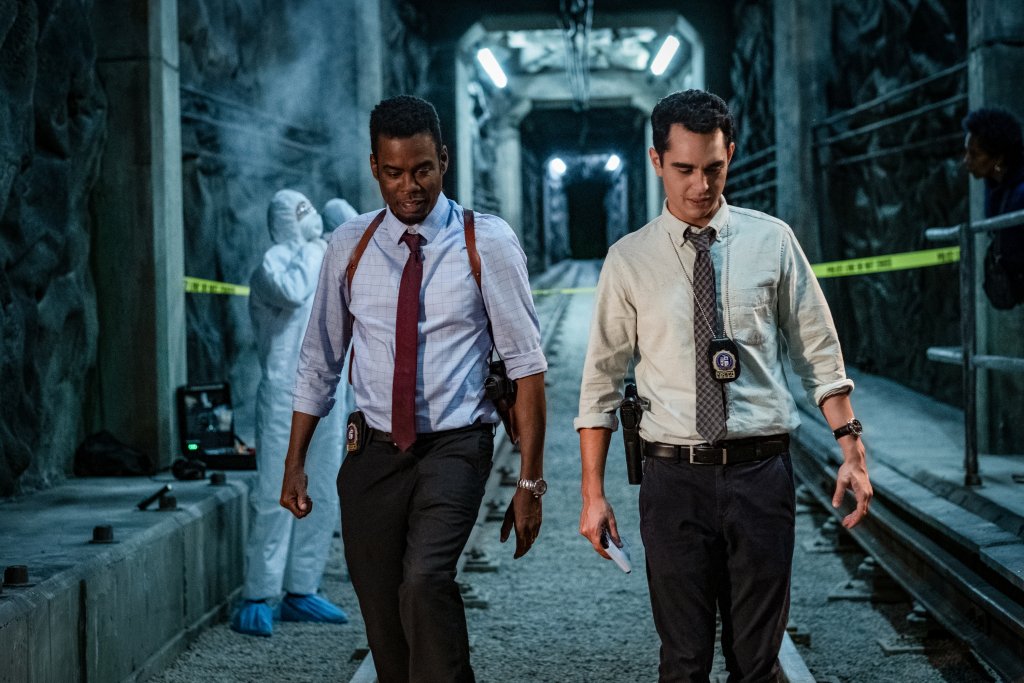
Chris Rock stars as Ezekiel “Zeke” Banks in Spiral: From The Book Of Saw, a brash detective alienated from his colleagues for turning in his partner twelve years prior. Now forced to work with rookie partner William Schenk (Max Minghella), Zeke takes charge of an investigation into a series of brutal murders eerily reminiscent of the city’s Jigsaw-coloured past. Soon enough, Zeke finds himself at the very centre of the mystery killer’s game.

The ninth instalment since the original Saw movie in 2004, Spiral is the first in the franchise not to feature Tobin Bell as John Kramer/Jigsaw, signposting a much-needed refresh for the beloved yet faltering horror series.

Instead, the iconic villain gets an update by way of ACAB. The copycat killer is targeting the city’s corrupt cops (of which there is no shortage), provoking a feverish and paranoid investigation into identifying who this killer – and their potential victims – might be.

Chris Rock as Zeke and Max Minghella as William in Spiral from the book of Saw

Spiral is a bold and confident companion piece from Saw veteran Darren Lynn Bousman, thanks in no small part to Chris Rock’s involvement. Who would have thought that the multi Emmy and Grammy award-winning comedian would be the magic ingredient to revitalise Hollywood’s most successful horror franchise? Rock lends Spiral a healthy and valuable dose of humour, throwing the scenario ever so slightly off-kilter so as to keep the audience guessing.

The supporting cast is equally good, even if Marisol Nichols is rather thinly sketched as Captain Angie Garza. Max Minghella in particular shines as the wide-eyed rookie who Zeke reluctantly takes under his wing, while Samuel L. Jackson lends his signature magnetism and energy to the role of Zeke’s father and veteran police captain, Marcus Banks.

Spiral cleverly repurposes Saw’s building blocks, honouring its legacy whilst moving it forward. After all, the spiral is a symbol of progress, is it not? The film certainly doesn’t skimp on the horrifying, sadistically memorable traps that gore hounds have come to expect, but the story is not defined by its horror centrepieces. The narrative that ties it all together is rich with thriller and mystery elements, as well as exhibiting a keen interest in deeper character studies. And while many will likely see the ending coming, nine films in, it is admittedly very difficult to both sneak one past the viewer and make the twist make sense.

All in all, Spiral is an unexpectedly daring entry which retools the best parts of the Saw franchise and reinvigorates the series in a style that is firmly its own. And friendly advice to other waning, long-running properties: just hire Chris Rock and let him wax lyrical about Forrest Gump. You’re most welcome.

Spiral: From The Book Of Saw releases on May 14th in the US, and May 17th in UK cinemas.

Watch our interviews with stars Max Minghella, Marisol Nichols, and director Darren Lynn Bousman.

GREAT WHITE

Great White

CERT: 15 / PLATFORM: DVD, DIGITAL (REVIEWED) / RELEASE DATE: MAY 17

The shark movie subgenre is often a murky one, with the misses most certainly outweighing the hits. Now, from director Martin Wilson, comes another ominous dip in the ocean in the form of Great White – and it’s time to see whether this toothy feature manages to keep its head above the water.

After an opening that is very much the standard tone-setter for such movies, Great White introduces us to the core five characters upon whose back this tale will be carried. When Michelle (Kimie Tsukakoshi) and Joji (Tim Kano) need a pilot to take them to a remote island locale where they can pay their respects to Michelle’s deceased grandfather, they turn to Charlie (Aaron Jakubenko) and Kaz (Katrina Bowden) to help them get to where they need to be. Throw in Charlie’s buddy and colleague Benny (Te Kohe Tuhaka), and away we go.

You just knew it was never going to be plain sailing for this five, and the dead body of a shark attack victim is immediately spotted as soon as they make it to their destination. Deciding to explore the waters for possible survivors, things quickly take a turn for the terrifying as a Carcharodon carcharias – or, y’know, a great white shark – makes its presence known. With their seaplane swiftly out of commission, our protagonists are left with nothing but a raft and their senses as they find themselves stranded in the middle of shark-infested waters in a battle for survival.

Great White is an effective, tense thriller that finds itself drenched in claustrophobic dread once the shit hits the fan. And that’s not just down to the shark element, for Wilson’s picture does a great job of clearly establishing animosity between certain characters, which only further ups the stakes when the bickering parties are thrust into this gnarly situation.

Performance-wise, all of the main cast deliver when called upon, with Te Kohe Tuhaka and Kimmie Tsukakoshi particular highlights when on-screen. As for how the film is framed, Great White – like other similar pictures – very much shines when the ‘less is more’ principle is adhered to. That’s not to say that the sharks themselves don’t look solid, but more that the suspense of what lurks below or what has just swam by works better for Great White. As such, the film maybe starts to dip a tad as we get more close up and personal with this offering’s apex predators, especially when some of these close ups don’t look quite as impressive as the sharks seen in other recent releases. But hey, we have to remember that Great Whtie was put together on a pretty minimal budget, so some leeway can be given here.

For those with a penchant for shark movies, Great White is well worth taking a bite out of. And even for those who aren’t all that keen on shark flicks, there’s still plenty to enjoy with this one.

UNDERGODS

Undergods

Chino Moya’s directorial debut Undergods is an anthology movie that uses the subgenre’s classic storytelling device to explore ideas of domesticity and family – and for the most part, it’s a success.

Moya’s setting is dystopian Europe: parts of the continent have been ravaged and left looking rather like Chernobyl, and parts of it are operating normally. Our primary narrators, Z (Géza Röhrig) and K (Johann Myers), are scavengers, looking for people and bodies to sell to factories to make a living, and telling each other stories on their travels.

While the storytelling device used is hardly revolutionary, the way Moya uses it is what makes Undergods so intriguing. Each narrative layer is more interesting than the last as the stories grow increasingly desolate. The tales are linked by ideas of domestic intruders bent on disrupting familial bonds, and the ending of each tale is deliberately unsatisfying. Moya isn’t interested in happy tales of the nuclear family: what he explores is domestic desolation, plain and simple.

This might be too bleak for some (because goodness knows this is a bleak movie), but there are rare moments of hope scattered throughout. The ending in particular is something of a happy one: the contrast between Z and K’s contentment and the dissatisfaction of the families in the stories we’ve just listened to is a fantastic note to end the movie on. It goes to show that, ultimately, family is what you make it, regardless of who’s involved or where you are.

That setting is something that clearly matters to Moya: his world-building is incredible, and always intriguing. We never do find out what happened to parts of Europe, but it doesn’t matter – what matters is the people we find there. Moya’s excellent screenplay combined with stellar performances all-round mean that we’re able to engage with his characters really easily, no matter how much time they spend on screen. Hats off to the film, too, for 2021’s first “holy shit Burn Gorman is in this!” moment.

As a whole piece, Undergods is something of a Marmite movie. It’ll work for some, but not for others. For some, its relentless futility and nihilism might be too much, but if you can work with that and find the hope within, then you might just end up loving it. And anyway, regardless of how you end up feeling about Undergods, there’s no denying that Chino Moya is a fascinating genre voice that we should all be paying very close attention to going forward.

Release Date: May 17th (cinema and digital)