UNDERGODS

Undergods

Chino Moya’s directorial debut Undergods is an anthology movie that uses the subgenre’s classic storytelling device to explore ideas of domesticity and family – and for the most part, it’s a success.

Moya’s setting is dystopian Europe: parts of the continent have been ravaged and left looking rather like Chernobyl, and parts of it are operating normally. Our primary narrators, Z (Géza Röhrig) and K (Johann Myers), are scavengers, looking for people and bodies to sell to factories to make a living, and telling each other stories on their travels.

While the storytelling device used is hardly revolutionary, the way Moya uses it is what makes Undergods so intriguing. Each narrative layer is more interesting than the last as the stories grow increasingly desolate. The tales are linked by ideas of domestic intruders bent on disrupting familial bonds, and the ending of each tale is deliberately unsatisfying. Moya isn’t interested in happy tales of the nuclear family: what he explores is domestic desolation, plain and simple.

This might be too bleak for some (because goodness knows this is a bleak movie), but there are rare moments of hope scattered throughout. The ending in particular is something of a happy one: the contrast between Z and K’s contentment and the dissatisfaction of the families in the stories we’ve just listened to is a fantastic note to end the movie on. It goes to show that, ultimately, family is what you make it, regardless of who’s involved or where you are.

That setting is something that clearly matters to Moya: his world-building is incredible, and always intriguing. We never do find out what happened to parts of Europe, but it doesn’t matter – what matters is the people we find there. Moya’s excellent screenplay combined with stellar performances all-round mean that we’re able to engage with his characters really easily, no matter how much time they spend on screen. Hats off to the film, too, for 2021’s first “holy shit Burn Gorman is in this!” moment.

As a whole piece, Undergods is something of a Marmite movie. It’ll work for some, but not for others. For some, its relentless futility and nihilism might be too much, but if you can work with that and find the hope within, then you might just end up loving it. And anyway, regardless of how you end up feeling about Undergods, there’s no denying that Chino Moya is a fascinating genre voice that we should all be paying very close attention to going forward.

Release Date: May 17th (cinema and digital)

STEALING CHAPLIN

Stealing chaplin

Stealing Chaplin is a weird premise for a comedy crime caper. Two idiotic British conmen  living in LA decide that the best way to pay off their debts and maybe make a bit of money is to kidnap a famous person; specifically Hollywood Legend Charlie Chaplin. As this movie is set in the modern day, Chaplin is conveniently dead, so they decide to dig him up. It’s a quirky idea for a feature that doesn’t quite live up to its promise.

Low budget crime comedies are a tricky thing to pull off –  comedy is hard and making crime exciting and interesting without being too grim requires skill, timing and good performances.  For the most part, Stealing Chaplin finds the balance, but when it slips it does slip quite bady. Much of the action and humour revolves around the characters of Terry and Cal, played by  Doug and Simon Phillips.  The problem is, weirdly, that the chemistry between the two is just a little off – both come across as genuinely bad people rather than hapless idiots and this makes the humour a little darker than intended, despite solid performances from both of them. They come across as an grim-dark version of the Chuckle Brothers in places and this just doesn’t quite work.

You can clearly see what the movie is intended to be; a smooth slapstick drama in which two fools navigate their way through Hollywood’s underbelly with a hare-brained scheme that just about works. Instead what we have is a very choppy story;  little time is given to develop some of the characters and in an attempt to create a whacky ‘pile-on’ where multiple factions are chasing the corpse of Chaplin, the con-men or both, we end up losing track of both the plot and the comedy.

There’s also a noticeable shift in tone in the second act; it’s as if the creators decided to flirt with ‘Tarantino but lighter’ approach and then suddenly changed their mind. This is jarring and it’s a pity as if it was a little more consistent this would be a much better movie.

They are some nice touches; the movie is divided into chapters,  each using a Chaplin quote and some of the set gags really work. Alas the overall experience is all over the place.  Stealing Chaplin is a fun, forgettable and not terribly well put-together flick. It’s worth a watch as it has some stand-out moments but it’s not one to make too much effort to seek out.

Release Date: Out Now (US)

FRIED BARRY

Who or what is a fried Barry? Abducted by aliens after his latest bender, a junkie (Gary Green) plays unwitting host to an extra-terrestrial bodysnatcher. His consciousness switched out for that of the alien invader’s, Barry takes a backseat as it wanders the streets of Cape Town in his body. First on its tour of Earth? The seediest nightclubs Cape Town has to offer, wasting little time in getting acquainted with the pleasures of the flesh.

This grimy, seedy sci-fi film takes the basic concept of 2013’s Under the Skin and substitutes the lovely Scarlett Johansson with a repulsive Frank Gallagher-alike. It’s The Man Who Fell to Earth with Libertines-era Pete Doherty instead of David Bowie. Gary Green is perfectly cast as Barry, his otherworldly features convincing both as alien and (with no disrespect to Green) drug-addled weirdo. Director Ryan Kruger gets his appeal though and, just as the men and women of Earth can’t help but succumb to Barry, we too are inclined to agree that there’s something strangely alluring about the man.

As per Under the Skin and Brandon Cronenberg’s recent Possessor, story plays second fiddle to the visuals. Fried Barry is a torrent of bizarre, unsettling and occasionally even horrific imagery; sometimes dreamlike, sometimes nightmarish. While there are times that the film resembles a glorified music video, it never feels overly padded out or inert. There are over ninety minutes of Fried Barry; none of them wasted. Novelty starting to wear off? Here’s an impromptu chainsaw fight with a child-kidnapping psychopath.

This wacky, grotty work of sci-fi body horror won’t be for everyone, but there’s no denying its drug and alien-addled charm – bursting with humour, wit and… yes, even warmth. Who or what is a fried Barry? Fried Barry is a trip, and an unforgettable one.

Release Date: May 7th (Shudder)

JOHNNY MNEMONIC (1995)

JOHNNY MNEMONIC

William Gibson novels are famously hard to adapt to the big screen. There’s the long-gestating version of Neuromancer we have yet to see; Michael Mann’s take on Count Zero that never manifested itself; Mona Lisa Overdrive, which has been acquired but as yet remains un-adapted; and Pattern Recognition, which at one point had Dead Poets Society’s Peter Weir in the director’s chair. And that’s one of the reasons why Robert Longo’s Johnny Mnemonic is such an oddity: not only is it one of the few Gibson stories to successfully make it to film, but it’s one of the most bonkers, silly, downright enjoyable genre movies of the 1990s.

The film, which celebrates its 25th anniversary this year (it hit UK cinemas in 1996, several months after the US), follows Keanu Reeves’ Johnny, a data courier who carries files internally thanks to an implant in his brain. However, after accidentally taking on too much data that risks his own life and being chased across the world by the Yakuza, Johnny finds himself in a race against time to get the data out of his head and into the hands of its recipient before it’s too late.

Thankfully, the film as a whole is about as ridiculous as it sounds – and it’s all the better for it. Too many genre movies fall into the trap of taking themselves extremely seriously, and it’s always to the detriment of the final product. Luckily for us, Johnny Mnemonic is not one of those movies. Yes, it’s complete nonsense, and no, it shouldn’t work – but if you switch off and enjoy the ride, there’s plenty of fun to be had.

It’s a good job the film is so fun, because, honestly, a good deal of it is less than impressive. The dialogue, characters, and performances in particular are pretty poor. The pre-Matrix Reeves hasn’t found his rhythm in serious roles just yet, but is still a joy to watch. Whether he’s overacting or underplaying, he’s undeniably hilarious – though one does have to question why Johnny takes on the 320GB data packet when he knows his storage is only 160GB, and anything over that runs the risk of killing him. But hey, we don’t come to films like this for logic, do we?

Opposite him is Dina Meyer as Jane, a cybernetically-enhanced bodyguard who sticks by Johnny at the promise of a $50k paycheck at the end of it. Neither character is particularly deep or interesting, but the pair’s chemistry is fun enough to keep us engaged, and thankfully comes without a shoehorned-in romantic subplot. There’s also Dolph Lundgren, whose so-called ‘Street Preacher’ is massively underused, as he’s one of the film’s best components. Whether Lundgren is good or bad in the role is irrelevant, because he’s absolutely hilarious in it. The Street Preacher is basically a Terminator with more charisma – and as a result, all Dolph has to do is punch some people and shout lines like “Jesus is here!” before stabbing someone in the face. Good stuff.

The film’s world-building is particularly interesting: some of it works, and some of it doesn’t. Its visions of the Internet in 2021 are, frankly, adorable, with Reeves at one point donning gloves and a headset to find some information – given the tech of the time, these sequences are fairly well-realised, but so off the mark it’s almost cute. The NAS virus is the only real component that lets it down: it’s mentioned briefly in the opening crawl but barely comes up again until the ending, where we realise it’s actually really important. Now, we’re not saying that more information about a world-crippling virus is exactly what we want in 2021 – but it certainly wouldn’t have done Johnny Mnemonic any harm.

As a whole piece, the movie just clicks. It’s sprawling and silly and has no right to work at all, but it somehow just does. It’s not a masterpiece by any means, but it was definitely misunderstood at the time. As genre movies go it’s heaps of fun, and more than worth your time – just don’t try to overthink it.

Release Date: May 10th (Digital)

IN ACTION

in action

There’s an art to making a decent film with next to no money. You have to be creative with what you do have. For In Action, writer/directors/stars Sean Kenealy and Eric Silvera just have themselves and a neat story, and it works so well.

We’re thrown straight into the heart of the story as Kenealy and Silvera are tied up in their underwear in what appears to be an interrogation room. How did they get there? Well, we’re shown that they were old friends who meet up again at a mutual friend’s wedding. They decide to write a screenplay for an action film, with the action taking place at the wedding of the President’s daughter. After weeks of emailing ideas back and forth, they team up for what they hope to be a fruitful writing session, until… well, that’s where we came in.

Full of energy and verbal fireworks, this two-hander is like watching an improvisation troupe having fun as they make it all up as they go along. It’s clearly a carefully scripted piece, though, with wonderful wordplay and ingenious staging. With just two actors (and the occasional ‘shot from behind’ extra), it’s full of film references and it’s obvious that the pair are having fun with the material. The movie’s subtitle – A Gimmick to Film a Movie Over Some Weekends With No Money – sums it all up and could describe most indie films. Locations are reused and redressed, scenes are played out in animation form, and action takes place just off-screen to give the impression of a bigger scenario playing out that we’re missing out on. It’s simple but it works thanks to the fact the characters’ relationship and dialogue is believable.

The acting is so energetic that it’s infectious and makes us wonder why the conceit hasn’t been done to death already. In being so upfront with the lack of resources, the pair end up with a film that looks much more than the sum of its parts. The bar has been set that little bit higher for low budget filmmakers.

Release Date: May 11th (US Digital)

CEREBRUM

CEREBRUM

We fix brains here,” explains the enthusiastic tech assistant to his only-here-for-money volunteer subject, being wired-up in a makeshift desert lab. Moments later, he’s given a copy of the insides of his cranium ‘in digital form’ that’s been captured on a new experimental device called the Noggin. The aim is to treat degenerative memory loss by reinstating earlier snapshots of a patient’s brain. Yet the maverick lead researcher is frustrated that the process is unstable, and that the person’s consciousness and memories soon revert to their old patterns.

Such scientific challenges are made worse by the dysfunctional relationship between the doctor and his son (who’s also the incredulous test subject). The pair have never addressed the recriminations that followed a close family bereavement. Might the effort to cure memory loss through the ‘surrogate loading’ of saved brain signatures into different bodies also allow this father and son to better empathise with each other’s misunderstood choices?

Cerebrum sets out its high-concept premise within the first few minutes of screen-time – and the filmmakers deserve to win an award for the “best use of a Slinky for exposition purposes” in the process. But rather than make the most of the ‘mind-swap’ malarky, writer-director Avri Ragu adds in elements of a whodunnit, a theft caper and a father-son fallout to over-complicate matters. The result is an unfocused film that, at its two-hour run time, is easily thirty minutes too long.

The movie pivots around the character of Tom Davis (Christian James), who’s forced to return home from the city to work for his estranged father. But Ragu’s script does little to sketch out Tom’s personality before circumstances compel him to accept the brain patterns of other people and ‘become them’ for a short while. James does a reasonable job in the acting stakes, but the impact is lessened because his “own” character is so thinly drawn to begin with. He’s not helped by Ragu’s credibility-busting conceit that Tom is able to become a world class brain researcher when the plot demands it. The best performance in the film by far is James Russo as the gruff and only slightly-mad scientist Kirk Davis. But his character ends up being underused.

The desert locations are striking enough, but the cinematography of Cerebrum does little to evoke a sense of place. The way that the film is shot is unnecessarily flat and, the way it appears on screen, the action could be set anywhere. The only real visual interest comes from the flickering memory collages that accompany the brain import process.

A well-executed final showdown brings some overdue clarity, before an irritating coda muddies the picture once again. Cerebrum is a film about the importance of memory. But its makers appear to have forgotten that less can, in fact, be a great deal more.

Release Date: Out Now (US)

SOUND OF VIOLENCE

Jasmin Savoy Brown as Alexis in SXSW 2021 horror Sound of Violence

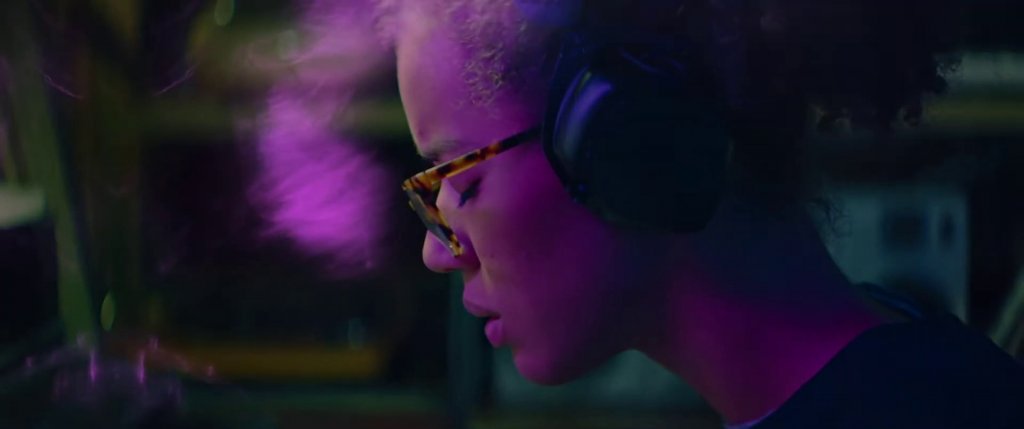
On the surface, Sound of Violence has an intriguing hook: Alexis (Jasmin Savoy Brown, The Leftovers) is a young musician who, as a child, was miraculously cured of her deafness by murdering her dad with a meat tenderiser, right as he himself was killing her brother and mother in the midst of a PTSD-induced break. By killing her father, she both regains her hearing and discovers her synaesthesia.

The opening scenes in which this background is established are both thoughtful and gut-wrenching. A young Alexis follows strange, bass vibrations travelling through the walls to find her father hunched over her mother, bludgeoning her body. They suggest a sensitive and complex film concerned with how trauma and violence affect its protagonist’s perception of the world. Alas, Sound of Violence is not that film.

Director Alex Noyer is unconcerned with building on this setup in any way; it’s merely a means for Alexis to discover her violence-triggered synaesthesia, the high of which motivates her ensuing murder spree in hopes of completing her “musical”. And that’s about all the depth this film can muster.

Sound of Violence premiered at SXSW Festival 2021, starring Jasmin Savoy Brown and Lili Simmons

Neither abstract or imaginative enough to be deemed experimental, nor gritty enough to make for good horror, Sound of Violence is a messy and tonally dissonant attempt at something greater. The deaths are clearly intended to be the film’s centre pieces, with the rest of the story feeling like a hastily thrown together way to get from one gore fest to the next, complete with hammy dialogue, paper-thin characterisation, and a pointless investigation side-plot.

Granted, some of the murders are pretty creative, and one scene involving a harpist proves appropriately disturbing. Yet for the most part, Alexis’ killings are so elaborate and outlandish that they quickly tip into comedic territory. Not great for a movie that, by all indications, wants to be taken seriously.

There’s also issue to be had with the portrayal of Alexis’ relationship with her friend Marie (Lili Simmons), for whom she has clear romantic feelings. Things go south when Marie starts dating Duke (James Jagger), which spurs the film’s sole queer character to violently lash out because her best friend doesn’t reciprocate her feelings.

What keeps Sound of Violence from being completely awful is lead actress Brown’s clear commitment to her character (even if the script gives her very little to work with), the editing, and the visualisation of her synesthetic episodes. But that’s definitely not enough to make this movie worth seeking out.

Sound of Violence screened as part of SXSW 2021 Festival, and will release on demand May 21st in the US, and August 31st in the UK.

WRONG TURN

wrong turn

Even in a world where reboots, remakes and re-imaginings are commonplace a new entry into the Wrong Turn film franchise appears at first glance unusual. From the series debut in 2003 through to the proposed reboot Wrong Turn 6: Last Resort in 2014, the films varied greatly in quality and popularity, never quite achieving much in the way of credibility or cult status. But here we are with another entry titled Wrong Turn and against all expectations it’s rather good.

While hiking the Appalachian Trail in West Virginia a group of friends fall foul of a self-sufficient community known as The Foundation and events take an unpleasant turn.

While it may be pedantic to point out the group never actually take a wrong turn, but simply wander off the trail, this is largely irrelevant for the plot itself. Alan McElroy who penned the original film has written a good old-fashioned folk tale, where lines between good and bad, right and wrong blur – although become more distinct as the film progresses – and questions relevant to the modern world are raised. But this is also a genuine horror film. The jump scares are well executed, there is gore and violence aplenty, and the performances are consistently strong; with Modine and Vega particularly impressive.

Do not be distracted by that title. Simply called The Foundation or frankly anything other than Wrong Turn, this film would garner and rightly deserve greater attention. This is a good horror film, a worthy Friday night fright, and a considerable improvement on what’s gone before.

UK Release Date: February 26th (Digital Rental), April 26th (Digital Purchase), May 3rd (DVD/Blu-ray)

A GHOST WAITS

GHOST WAITS

Everyone loves a haunted house film, but A Ghost Waits is a little different. Rather than going bump in the night, it has a thumping heart and is all the more endearing for it.

Jack (MacLeod Andrews) is a handyman tasked with checking over a house following the sudden departure of the latest in a string of tenants. His ‘friends’ won’t get back to him with a place to stay, so he sleeps on the floor while he takes a few days going over the place. It’s not long until the house’s resident ‘spectral agent’ Muriel (Natalie Walker) makes her presence known. Although freaked out at first, Jack has a job to do – he’s a decent guy despite not having anyone who appreciates it.

Presented in a greyish monochrome that, surprisingly for a haunted house film, doesn’t emphasise the darks as much as the light. This is certainly fitting since first-time director Adam Stovall’s A Ghost Waits isn’t a horror film. It’s best described as a romantic fantasy; it owes as much to Topper and The Ghost and Mrs Muir as it does Beetlejuice. Some shots even have a touch of Bergman to them. Surprisingly, Jack and Muriel hit it off when they begin talk, even though the spirit is adamant that this isn’t what’s supposed to happen.

As well as being amusing, the film reflects on what it is to have an identity, a meaning, and someone in your life. Slight musical interludes are not as out of place as they sound in theory, and the songs are much more haunting than any of the action in the best way possible. The climax may not be for some people, but is deeply emotional and beautifully affecting.


THE VIRTUOSO

virtuosa

Opening with a narrated approach, know-it-all hitman The Virtuoso (Anson Mount) pulls the audience into his dark, gruesome, and ultimately, mysterious world. Anthony Hopkins (who is on top form right now after another Oscar win for The Father) plays The Mentor, a damaged soul with an unfortunate background that sets assignments for our main killer. For the latest mission The Virtuoso descends upon a quiet town to find and knock down the target White Rivers.

One of the most gripping parts of the film is where The Virtuoso breaks down through narration every figure at the bar he is in. From Abbie Cornish as The Waitress, through to David Morse as the deputy, there’s a fantastic cast just in that one room. It briefly has the feel of something like The Hateful Eight, and displays a noteworthy direction idea from Nick Stagliano. As The Virtuoso ventures to find out who White Rivers is – with many unforeseen elements attempting to ruin his task – he assesses every situation in advance, and crosses people off his list in the most hitman way possible. We’re frequently given an inside look at how the mind of a hitman might work. At the depths of the plot, The Virtuoso is fighting a mind battle, as he just doesn’t want to do this horrendous, soul destroying job any more. He has become detached from reality, and doesn’t know how to act in the real world. Anson Mount does well to capture this character’s redemption within a slow tempo screenplay.

The Virtuoso can sadly feel unnecessarily dragged out. There’s an interesting story here, it’s just tough to cut through the lengthy style to get to it. Hitmen are obviously renowned for being emotionless, but a film about one shouldn’t be so monotone. Overall, this hitman vacation is held up by the unpredictable back and forth conversations between The Waitress and The Virtuoso, as well as any intense dialogue delivered by Anthony Hopkins.