The Death of Snow White is an independent fantasy horror film written, produced and directed by Jason Brooks. Presenting an ‘alternative’ version of the classic Grimm fairytale, the film stars Chelsea Edmundson as the Evil Queen. They were both good enough to speak to us recently about the challenges they faced and the fun they had in making the film…
STARBURST: Were you aware of the ‘other’ film that was due to come out around the same sort of time?
Jason Brooks: We were definitely aware of the timing. Originally, the other Snow White film was due to come out a year earlier, but in extending that date, it worked out better for us. But the project came about because of Sanae Loutsis, who played Snow White. Her family thought she’d make a great Snow White – too bad she couldn’t be in that one, so it evolved into us making our own.
How did you come on board, Chelsea? Was it a part you went after, as it looks like you’re having a great time?
Chelsea Edmundson: I had so much fun, the most I’ve had playing any role. I was approached by one of the producers, and after an audition, I got the part.
So, the role allowed you to let loose, to see where you could take it?
CE: Yeah, definitely. It’s very freeing to play a character that’s so extreme. It was fun to play someone with a truly evil soul. I really enjoyed it.
We understand you returned to the Grimm stories, which are quite short in their original form and have been embellished over the years. Was there something in there you felt you had to bring to your film, and equally were there touchpoints from other versions you felt you needed to include to give the audience some familiarity?
JB: I wanted to make sure we hit all the major points, the milestones of the movies that people expect to see, and also want to see. The apple, the kiss… I really wanted to make sure we have all the bits about the heart, where the Queen sends the Huntsman out for it. We changed it a little from the original story, but even the Grimm brothers had various iterations of their story. We wanted to go deeper, so we delved into the lore a little, to define things more and bring more life to it. So, while hitting those milestones, we could add more depth, and in that way, I could tell the story I wanted to see.
For you, Chelsea, did you draw on the original character or was there a particular villain from history that you sought to channel?
CE: I think she was kind of a hybrid of the ones I really like. I’m a huge movie buff, I watch tonnes of movies, and think she became a hybrid of Angelina Jolie from Girl, Interrupted, Angelica Houston in Ever After, and Anthony Hopkins in The Silence of the Lambs. All villains I love, and I always wanted to play one so those three were the ones I kept popping in there a little. And the rest is me, as scary as that is to say! [Laughs]
Casting is always important, and you’ve been bold here. You have a lot of characters, and importantly they all feel fleshed out. But the Dwarves were always going to be the key area, especially in the light of the ‘other film’. How was that process?
JB: It was quite difficult. My partner Naomi, who also co-produced and co-wrote the film, her father was a dwarf. A very well-known one who fought for the disability act. So, we knew right away we wanted to put LP actors in the film. The biggest problem was location and availability. Not a lot of LP actors were up in the North West [United States] where we were filming. And this also turned out to be a non-union film, which made it more difficult to find certain actors who were able to participate. So, it was quite the process, but as it turned out, we found a great bunch of actors who all had a great time, and I love them all dearly.
You’ve also been bold, and successful with your use of budget, which we believe was around $750,000. What you see on screen looks expensive, and it looks like practical effects for the most part. Was that always the plan, to push what you could get on screen, to see where you could take it?
JB: I run a special effects company and we knew going in we could bring this to the table. We knew we could do more than your normal independent film. With the Queen, we researched what had been done in the past so everything she does has been done at some point in history. Which is always scarier than make-believe. Also, it’s another way to stand out in this genre. I’ve not seen a Snow White film do this kind of thing, so that was one of the ways.
Was there a particular scene that you found more challenging than others, Chelsea? You get leeches, blood baths…
CE: There were a lot of challenges but they weren’t in the script. The first day was really hard as I wore this metal corset; I couldn’t breathe, my armpits were bleeding…it looks great but was so hard!
For you, Jason, how did it work being in the film as well as wearing your director hat, producer hat, and so on?
JB: I absolutely enjoyed it, but it was difficult, and I’d have to thank my team. Our director of photography Kody Newton stepped in many times when I was on screen, so that helped enormously.
Watching your film, we get elements of Willow and Krull, the sort of heightened fantasy that contains humour and has almost the style of a ‘romp’. Was that style important here?
JB: So glad you asked that, as I grew up on those movies and I love the rollercoaster of having fun moments with fun characters, but then going to dark places. So many movies now choose to stay dark and don’t vary. I like that we had worlds colliding and you see darkness coming to the light side – it’s more like real life.
From 1988 until 2000, Alex Cox and Mark Cousins presented a series of cult films every Sunday night on BBC Two. Over 200 eclectic movies were shown across twelve seasons including Barbarella (1968), Assault on Precinct 13 (1976), and Psychomania (1973). Now, Moviedrome returns with screenings of cult classics at BFI Southbank during a two-month season, The producer of the original TV show and curator of the new season, Nick Freand Jones, spoke to us about it.
STARBURST: During Moviedrome‘s development, you had access to the BBC archives, which had a significant library of films, some of which had never been broadcast on British television at that time. Why was the decision made to screen cult films and obscure oddities?
Nick Freand Jones: Good question. Well, we’d been running a series called The Film Club on BBC Two in the few years prior to Moviedrome, which was a more conventional mixture of art house, foreign language, a couple of Hollywood films, but broadly with a slightly more dignified cultural remit, you could say. And those were introduced by directors, writers, actors, actresses, film critics – all sorts of people came in and spoke. It was usually a double bill and they would choose the films or at least speak about them in favourable terms, in critical terms.
And that was on Saturday nights and it had been going for a while, and as I recall, the idea was – what could we do that was a little bit bolder, a little bit cooler, and would be in a Sunday night slot where you could be more experimental with the kinds of films that you put in… potentially single films or double bills, as came to be the case later in the series. So, that was it really. We realised we had all these films. Some of them were quite odd. You could either just plonk them into late night or not play them at all, which sometimes happened. But they weren’t films for morning or daytime or primetime. They were definitely films that were darker or more obscure or sometimes trashy.
I’d lived in London for a few years at that point. When I first came to London, there were cinemas that programmed these sorts of movies all the time on Fridays and Saturdays. You’d go along at 22:30 or after the pubs are closed, and there’d be maybe a couple of movies back to back, and you’d sit there and watch them… fall asleep in one and wake up in the other, or enjoy them both, whatever. So, the kinds of films that I’d seen in that context seemed like a very good template for this potential strand. And we had so many films – there were thousands of films in the BBC vault at that point. Some owned in perpetuity like the RKO library, but many were films that were licensed for five years or seven years at that time. So we had them for a long time, and there were often movies that just languished and didn’t get played or were chucked away late at night. It seemed like, okay, why don’t we contextualise them? And Alan Yentob, who was the controller of BBC Two at the time, was a very film-oriented guy – he had a lot of interest in cinema, he had good connections in Hollywood, from Mel Brooks to David Lynch – so he was very in favour of the notion.
Alex Cox had been hired to present a couple of movies in The Film Club strand and did a great job, looked amazing, was very kind of cool and super informed. He had a great combination – he was a working film director, he’d made his own batch of cult films by this time – Repo Man [1984], Sid and Nancy [1986] – so he introduced the double bill of Point Blank [1967] and The Long Goodbye [1973] for The Film Club, and clearly had the knowledge and the interest. He was British but was working in America. So we spoke to him and he was up for Moviedrome and that first season of films was assembled. We shot the intros back to back in a studio in Television Centre. That’s kind of the story.
For Moviedrome‘s debut episode, an extended version of The Wicker Man was broadcast, which we believe was from a negative acquired from Roger Corman? It’s a fascinating story, and now for the BFI’s Moviedrome retrospective, you are screening The Wicker Man: The Final Cut. In curating Moviedrome, for both television and the BFI’s retrospective programme, how much freedom did you have?
Yeah, we had very little interference, if any. I can’t remember an instance of interference actually. We were trusted. I mean, that’s what we did in that department, we programmed films, so we had a very experienced team of people who knew what worked where on BBC One, BBC Two. There were only two channels, obviously. There was no iPlayer. And so there was plenty of editorial knowledge within the department. And when a film like The Wicker Man came along, my colleague David Thompson – he had programmed The Film Club and was a great film expert – said, I think I’ve heard there’s a version in the States that may or may not be substantially longer. We weren’t quite sure because it wasn’t like they could send us a link to view what they had. So, we waited with bated breath for this… as I remember, it was something like a tape. It might even have been a U-matic or something. And it arrived finally, only about a week before the broadcast, but there was a great deal of worry, would we actually have a longer version to show or would we not? But we did. It turned up and it was a little bit longer and a little bit different to the version that I’d seen on a double bill with Don’t Look Now [1973] when it was released initially as a B feature. Now, if you’re going to ask me exactly how different it was, I’m not sure I can remember, because there have been so many versions since that I get a bit confused. I think Alex refers to some scenes that were additional, but there were still missing scenes. It was no way as complete as any of the subsequent longer cuts, but it was at least a nod in the right direction.
The selection of films for Moviedrome has always been strikingly eclectic, from creature features to spaghetti westerns. Were there any movies that you personally wanted to broadcast but never had the opportunity, maybe due to licensing?
My god! I mean, of course, yes, there were many. What we didn’t have necessarily was a free reign to spend, you know? So, Moviedrome was really seen as a way of using existing library. And then, I suppose when deals were being done, we’d say, oh, that could sit well in Moviedrome, for instance. It might affect the selection of the additional features that were coming in these big packages that were being bought from Universal, Warner Bros, whoever. But we didn’t have an open cheque book.
We did buy some films. Alex was obviously a great enthusiast for the spaghetti western, so we purchased films with his taste specifically in mind, or films that he’d identified as being worth having. I’m thinking of A Bullet for the General [1966] for instance, The Great Silence [1968], which was a film that had not been seen in the UK at all actually until we screened it on Moviedrome. And then there were odd little horror films that might have come, not even from a studio, but from a sales agent somewhere in the US, like Carnival of Souls [1962], which again, what such a strange, fascinating, perfect little film, you know? But yes, we never showed, for instance, Eraserhead [1977], which would have been very high on my list. There were there were lots and lots of films that either we didn’t have because Channel 4 might have had the rights, or Sky Television might have owned the rights.
But yes, the selection you see, the 200-odd films that played over that 10-12 year period, were largely made from existing lists. or lists that we could then adapt as the series grew in stature, I suppose, or became a regular feature, because under Alex, Moviedrome would have played every year for seven years. So, that was already well over 100 films by the time you add those up. But The Wicker Man was the perfect start.
When we were speaking with Alex, we discussed that a notable aspect of Moviedrome was the freedom he had to be critical of the movies selected for broadcast. He could discuss interesting factoids, but was also highly opinionated and passionate about the films and their flaws. Do you agree that this is what distinguished Moviedrome from other TV series that preceded it, like The Film Club?
Definitely. From the get-go, it was obvious that we shouldn’t put words into his mouth, because that was why we wanted him. He was outspoken, he was very political, he didn’t suffer fools gladly, and he had very distinct tastes. I think that meant that some people who watched the series were annoyed by him, and found his opinions, for whatever reason, incorrect or abrasive or whatever. But a lot of people did like that!
I work a lot with Mark Kermode now, and in some ways they’re not dissimilar. They’re not the same, but they’re not dissimilar in that Mark has very, very strong opinions about some films and will defend movies that I think are terrible to the death. With Alex, it was really important to allow him his free reign, really. And my only editorial note was if you’re trashing a film, if it’s The Terminator [1984] and you really hate it, well, find something interesting to say, you know, because otherwise why are we here?
I’m preparing some clips for the panel discussion on Friday, and I was watching a few intros that I pulled out, one for THX 1138 [1971], the George Lucas film, which he also doesn’t particularly like, but he’s very interested about its evolution and some of the talent in it. And at the end, he says, “I think it’s not a great film, but…” So, I’d rather have someone saying that to me than trying to soft-soak me into thinking it’s a work of genius or whatever. I’d probably be more intrigued by an intro like that, with some personality. I was also watching his introduction to 200 Motels [1971], the Frank Zappa rock doc, and he begins by saying that he and I have been programming and presenting this thing and occasionally we’ve strayed from the path. And we now wish to atone for our sins for showing films like The Terminator by showing a genuine 100 percent cult classic: 200 Motels. So, there was some wit and humour and a sort of admission that sometimes you did things for the ratings, you know?
Alex did mention The Terminator…
I would argue that sometimes big budget hits can also have cult appeal. And I think The Terminator is one of those movies. Usually the big budget films that become cult films are the ones that are total box office flops. Hudson Hawk [1991] or something like that, when millions and millions have been spent on it and it’s failed to find its audience. Or a film that Mark Kermode loves, Howard the Duck [1986]. So, there’s lots of those kind of films, but the thing about The Terminator was that it was a massive success at the time and spawned all the sequels. I still think it’s got the components of a cult movie about it. You know, I would still defend that decision. And Alex was quite right to to lodge his complaint at the time.
Cult film is such a broad definition. Moviedrome lasted seven seasons with Alex Cox and ended in 1994. What led to its revival a few years later in 1997 with Mark Cousins?
I think at the time that Alex finished, we thought, okay, let’s draw a full line under that, put a full stop next to it. Then its lack of existence was felt, and the idea came that we could bring it back but we don’t need it to be exactly the same. It could be with a different presenter, who would come with a different style. So, the question then was who, and we thought about all sorts of people. I remember Peter Jackson [Bad Taste, 1987] was one of the names that came up in meetings. There were various directors around who might have the right set of qualifications.
But I was working with the Edinburgh Film Festival at that point and I’d met this guy, Mark Cousins, who was the artistic director, who was poles apart from Alex in some ways. He looked very different, he had a whole different style. Alex was much quieter, more dry, I guess. His humour was drier. Mark was much more passionate, much louder, and also had films that he loved that I knew wouldn’t necessarily fall into Alex’s canon and vice versa. So, we talked to Mark and he was very excited by the idea. And I think it was his participation really that sealed it to come back as it did in ’97, and then I worked on two seasons with him only, because in ’98 I left the BBC to start the Film4 channel.
I wasn’t around any more, so I had to leave it then to my colleagues who had taken over – Andrew Abbott was one of the producers – and they worked with Mark, I think, for another two years. So, I think he did four years altogether, and it was very interesting to see how he was different to Alex. He was a younger man. He came from a different background. He had very different tastes, although shared some of the same tastes. And his whole way of talking about things was just different. It was important that he didn’t try becoming Alex Cox Mark II. Very, very big boots to fill, but I think Mark did a very good job in his own way, in his own right.
There is a social aspect to curated TV programming like Moviedrome, so how do you feel about the shift from public service broadcasting to algorithm-driven VOD platforms?
I’m not great with algorithms. If the machine tells me I’ll like this because I liked that, I tend to think I’m never going to watch that, but that’s just me. I think the world has moved on so massively, really, in terms of film distribution. I work with Mark Kermode on the BFI Player. We do a thing every week where we pick a movie or he picks a movie, then talks about it. It’s not a million miles away from Moviedrome. It’s slightly more settled in its format, you know, and Mark is a critic, not a filmmaker. So, I think that curation is still there.
I think MUBI have anf interesting way of curating films, in the way that they program. Netflix, who knows? Sometimes there’s good stuff on there, sometimes there isn’t. The iPlayer, I’m slightly disappointed in the BBC, because it still has a lot of films on its books, not as many as it did back in those days, but the iPlayer could be a great forum for that sort of curation. You know, you could do it very easily and present little seasons of films, or groups of films, or maybe a version of Moviedrome. I’m not saying it should come back, because I think it was great then and let’s enjoy that. I do a show with Mark on Radio 4 called Screenshot, which is also a kind of deep dive into genre and themes. Each week we take a theme and explore the cinema or television timeline with that. So, I think stuff is still happening, and on YouTube there are fascinating video essays out there to be found.
But, we’re talking about a time in the ’80s when this started with four channels and a little bit of satellite TV and nothing else. VHS was the medium. It was still the case that if you wanted to see something, you had to hunt it down, maybe at BFI Southbank [previously known as the National Film Theatre] or in another cinema somewhere, or hope it was on VHS and you could import it. But now everything’s available all the time. It’s kind of overwhelming. Moviedrome was about trying to celebrate film, and pique people’s interest, and get them to go off and explore other things. I’m very touched by how much fondness there is for it, and how many episodes are available on the internet. The BBC, of course, have wiped everything. So, hilariously, they’re doing a couple of movies on BBC Four around the time of this BFI season, and they contacted me to ask if I could help them with materials for the original intros. I said, well, try YouTube. That’s where I’ve been looking.
I think it would be lovely if somebody could reinvent this in some way and do it again. But maybe people are different now. I always tell this story – one of my kids when he was in his early teens, I found him listening to the Bonzo Dog Doo-Dah Band, the most obscure ‘70s rock band with a guy called Vivian Stanshall, the lead, and another guy called Neil Innes, who went on to work for Monty Python. The weirdest most obscure tributary of music to find a 13-year-old listening to. I said, wait, how did you find that? How did you get there? And he said, well, I was on YouTube and I was watching someone, and then I was sent to another guy who was doing something, and that’s how it works! It’s sort of like a relay race, you know, the baton is handed. So, I think there is a curation out there, but it’s much more scattershot than it was in the ‘80s and ‘90s.
From 1988 until 1994, Alex Cox presented a series of cult films every Sunday night on BBC Two. Over 100 eclectic movies were shown during his seven season tenure, including Django (1966), Witchfinder General (1968), and Vamp (1986). Now, Moviedrome returns with screenings of cult classics at BFI Southbank during a two-month season curated by the show’s original producer, Nick Freand Jones.
STARBURST: Before presenting Moviedrome, you were involved with another BBC TV series, The Film Club; a curated collection of classic films presented by notable British directors. How did your involvement in The Film Club contribute to you getting the opportunity to present Moviedrome?
Alex Cox: I think it was because of the location in which we shot my introductions for The Film Club. As you say, The Film Club featured a selection of very notable British film directors, and really important people like Lindsay Anderson [The Old Crowd, 1979] and Nicolas Roeg [Don’t Look Now, 1973]. But they would be interviewed in their house because the deal was most film directors, if you want to be a film or a TV director in England, you have to live in London. So they would go to Lindsay Anderson’s house, or Nicolas Roeg’s house, and they’d end up shooting in front of the fireplace, you know, so you’d see a corner of the mantelpiece over the shoulder.
But I didn’t live in London, so when they asked me to do it, I said, where? “At your house?” Well, my house is in America. And so they said, “Okay, well, somewhere else then… somewhere in London”. So, I said, what about the Lloyd’s building [aka the Inside-Out Building], which at that time was a fairly new, very postmodern edifice that had been built in the style of the Pompidou Center in Paris. Very different from the traditional architecture of London. We shot in the Lloyd’s building with the result that the introductions that I did had these magnificent backgrounds, and I think that was why I got the job. Because when they saw Lindsay, or when they saw Nic, they just saw a guy sitting in front of the mantelpiece, but when they saw me, they saw this incredible, bizarre Blade Runner-type world!
When Moviedrome began in 1988, it debuted with an extended version of The Wicker Man (1973). And now, for the BFI’s Moviedrome retrospective, The Wicker Man [The Final Cut] has been selected for the opening screening at BFI Southbank. How involved were you in the curation of each Moviedrome season, and now for the BFI’s retrospective programme?
No, no, Nick [Freand] Jones. Nick was the curator. He was the director and the producer of the programme, and he thought up the concept because the BBC had a lot of films… a lot of feature films under license that they didn’t know how to program… They didn’t know where to put them, so Nick came up with this idea of Moviedrome, and that would provide the frame for all of these diverse films that the BBC had, including The Wicker Man, Yojimbo (1961), Ace in the Hole (1951), and all these other movies. And so, it was down to his genius.
I wonder if the version of The Wicker Man that they’re going to show at BFI… do you think that’s a new version and they’ve gone back to the negative, because as I recall, the 2001 Director’s Cut was fairly funky in the sense that it would cut to material that was considerably poorer quality and then go back to the original cut. And I wonder if they’ve gone through the whole thing and done a whole new restoration.
During your introduction to The Wicker Man for Moviedrome, you asked what constitutes a cult film. You said: “a cult film is one which has a passionate following, but does not appeal to everybody.” I think a notable aspect of Moviedrome is that many of your introductions were critical of the movies involved. You weren’t afraid to discuss a film’s failures. Do you agree that this approach is what helped Moviedrome gain its own passionate following?
Yes, I think that’s why, because it was kind of unique in that I didn’t have to just be a booster… a mindless booster for the product. You know, I could say, ah, this film isn’t very good, but there’s this great sequence where such and such happens. Or if it was a really great film like Sunset Boulevard [1950], it didn’t really need an introduction at all. So yeah, I think that the freedom that was available for me to talk discursively about the films probably added to the popularity of the series, because it was a little bit different.
Would you say you and Nick [Jones] were rebelling against the BBC’s programming ethos of the time with Moviedrome?
Well, I think it was interesting, because they were always looking for some kind of context to show films. There had to be a reason they were showing the film. But this was such a diverse collection of films that it was really impossible to put them all under one generic lid, you know? And I think the interesting thing was that Nick’s idea for Moviedrome, that it would be this sort of series of cult films, was very smart because that enabled him to program an enormous diversity of movies. So yeah, I think that the idea of Moviedrome that he came up with enabled us to show things that otherwise might not have got screened at all, like The Long Hair of Death [1964].
How has your definition of what constitutes a cult film evolved in the years since Moviedrome?
It hasn’t changed at all. I mean, the thing is, you can’t decide to make a cult film. And Hollywood has quite frequently spent vast amounts of money on projects that it thinks are going to be a cult film, and they always fail! If you intend to make a cult film, you will fail… you will fail really, really badly. But if you don’t intend to, you may be surprised.
We think you’re right, it doesn’t really work… and, especially with the major studios, it feels almost insincere.
It’s totally insincere. It’s totally bogus, you know, but that’s the way of the studio… to be totally bogus and insincere.
For the BFI retrospective, you are re-introducing in person [at BFI Southbank] cult films that were originally broadcast during Moviedrome‘s original run, like Sweet Smell of Success (1957). Would you say any of your original critique from Moviedrome has changed over the decades?
I don’t really know, because I don’t really remember what I said 20 or 30 years ago. I watched The Wicker Man again recently and I appreciated it more this time. I think it really bears multiple viewings. It’s a very interesting film and there’s nothing quite like it… That was the thing about Moviedrome, all the films had some merits. We weren’t just showing bad films so people could have a laugh at them. All the films that we showed actually had some virtue and we were pleased to show them. We didn’t feel embarrassed by showing any of them.
Well, cult film, it’s such a broad definition…
I think it was kind of bogus that we showed The Terminator (1984), because it isn’t a cult film, The Terminator is a big studio production. I don’t really think, with Arnold Schwarzenegger, that The Terminator franchise belonged on Moviedrome, but I understand why they programmed it.
As a director, you have a cult reputation yourself, and in a later season of Moviedrome [Season 5, 1992], you were given the opportunity to introduce the UK television broadcast of one of your own movies: Walker (1973). Your approach to remain impartial was to read a negative review from the BFI’s Monthly Film Bulletin. And now, Walker is now included in the BFI’s Moviedrome retrospective programme. If you had the opportunity, would you have introduced more of your own filmography during Moviedrome‘s original run?
No, no, that would be wrong. I’d be taking advantage of my privileged position. I was surprised they showed Walker, but I was glad they showed it too, because I wanted people to see it.
Was that Nick’s decision to include Walker?
Yes! I guess the BBC had probably bought it as part of a package, you know, with several other Universal films, but it was Nick’s idea to show it on Moviedrome. You can’t critique your own stuff because you’re too close to it.
Are there any cult films that you would have liked to have introduced for Moviedrome‘s original run, but never had the opportunity due to licensing, or concern from the BBC due to a film’s controversial content?
I think we were pretty lucky in the sense that we were able to license some Italian westerns which had never been officially shown in Britain before. We probably should have shown some more musicals. We didn’t show many musicals, but I imagine the obvious candidates would have been This Is Spinal Tap (1984) or The Rocky Horror Picture Show (1975). And I’m sure that they had been snapped up by another broadcaster, because either one of those films would have been a perfect way to begin any movie series.
For many, Moviedrome became their education in cult cinema. It was an introduction to obscure films that wouldn’t necessarily been shown on the BBC, if not for Moviedrome. How do you feel about the shift from curated TV programming like Moviedrome to today’s algorithm-driven streaming platforms?
I think that Moviedrome was a little bit like going to the video shop, you know? You would go in and there would be a whole row of films in one section, so you might find the film that you were looking for, but you might find something that you weren’t looking for as well. And when the algorithm decides, then you’re just at the mercy of this massive corporation… Netflix or Amazon or Apple making the decisions for you, essentially. So I think that, yeah, it’s a very unfortunate situation. It’s like going to the library. If you can’t browse the shelves in the library, if you only can go up to the librarian and say I want such and such a book, then you might get the book you’re looking for, but you’re not going to have that broader experience of all the other books adjacent to the book that you’re looking for, and what they might have to report on the subject.
Moviedrome was on at the time when there were only four television stations in Britain… so when we showed The Terminator, it would play on national television and 20 million people watched it, which is pretty amazing. But that was a different time.
STARBURST spoke to Alex Proyas – director of The Crow, Dark City, I, Robot, Knowing and Gods of Egypt – about the special release of Dark City on 4K UHD from Arrow Video. We also spoke about his love of science fiction, existential dread, AI, remakes, Marvel, ‘the death of the big screen’, Stanley Kubrick, and his new film R.U.R.
STARBURST: It’s been 27 years since Dark City. What can we expect from the new release?
Alex Proyas: I’m thrilled to be seeing it myself for the first time when I present it at The Prince Charles Cinema [in London] in a few weeks’ time [14 July]. It’s my director’s cut, which I’ve never seen on the big screen before, so I’m excited about that. It’s great to present a properly restored 4K UHD version of the film. I’ve seen the transfer, but I’ve been watching on a computer screen. To see it on a big screen, I’m excited, the way it was intended. The theatrical cut was quite compromised. Arrow Video have done an amazing job. It’s extraordinary the amount of effort they’ve gone to, they’re a great mob.
Your films deal with big concepts. Dark City deals with Last Thursdayism, characters wanting to break free. A lot of people say it influenced The Matrix. In the 1990s, we had these sorts of films that resonate now. Why do you think they still resonate, and how did they influence today’s society?
More than ever, we feel the angst, the existential dread that I channelled in Dark City and some others did also. It’s more relevant today than ever before. When social media creates our little personal bubble, the algorithms give us a false reality that we can inhabit. From a consumerism perspective, they keep giving us more of the same stuff, as they know that’s what we want, that’s what we buy effectively.
I started writing Dark City in 1990. It was around for a long time before I made the movie. All of Hollywood read that script. No one wanted to make the film because it was ahead of the curve. It was only when I got to make The Crow that anyone seriously entertained giving me the money to make Dark City.
My influences – everyone says the shadows on the wall in the cave, the myth that inspired it [referencing Plato’s Allegory of the Cave]… it’s not actually that at all. I was aware of that myth, but I was more influenced by science fiction. I’ve been a huge fan of science fiction since I was a kid. I remember particularly reading a Brian Aldiss novel, Non-Stop, about history being falsified, and created, and the world was started around the year 1900. Everything before was a fabrication, I think by the state. It touched upon the idea that even humanity was fabricated and created in a test tube. That blew my mind. That’s really where the essence of the Dark City universe comes from, rather than other things that have been cited.
The thing about today, the world we live in right now, I think it’s all coming true. I keep saying we are living in an age of science fiction. When I was a kid, science fiction was off in the future somewhere. Even when I made I, Robot, it was science fiction. Now it’s kind of science fact. AI and social media and all these influences are driving progress so quickly, at a pace that I think many of us, as human beings, are having a hard time keeping up with.
Speaking of I, Robot, in this era of AI and drones and bots, where do you think this leaves us in terms of a society, and filmmaking in the next 20-30 years?
I think it’s all the same. The issue spans across every industry, every part of life. Every bit of commerce. We’re all suffering from that existential crisis where we don’t quite know whether we’ll have a job tomorrow. Not just in the film industry. It’s a fact of life. In the film industry right now, there’s a huge debate going on about the use of AI. One day I’m optimistic and hopeful, the next day I’m pessimistic, and I vacillate between these two extremes. I think the only real answer is, it’s going to happen whether we like it or not. It’s a fact of life that AI will take over. It already is. We just have to learn how we can retain our humanity and our sense of human identity through this construct, which will change everything. I think that’s the only hope. We have to learn to live with it.
It doesn’t help to negate it and stick your head in the sand. That’ll get you nowhere. Film is a technological medium; it always has been. Even in my relatively short career, we’ve gone from shooting on celluloid and editing bits of that and looking at the trims to non-linear editing, to digital cinematography. I’ve embraced every part of those things. For a human creator, it only makes our lives easier, and we can get to that fundamental emotion in our work that we’re trying to get to. It gets us there faster. Even writing has changed, from typing on a typewriter and using Tipp-Ex to make changes, to being able to work on any part of the script instantly, digitally. We have to learn to embrace this stuff. Much of it is very good. And retain our human identity and continue to collaborate with other humans as well as AI.
You touched on The Crow; the remake came out last year. You and others were against it, and it was critically and commercially panned. There seems to be a lot of remakes and reboots these days. Do you think some films should be left alone? Is it just a money grab, or are people out of ideas, or is something else at play?
I think it’s even worse than that. I think it’s the death of the big screen. The devaluation of original intellectual property has been off the charts for many years now. A shocking lack of imagination or acceptance of anything new from the powers that be, the financiers who run the industry, it’s been crazy.
I’ve been saying for years now, when Marvel dies, as it seems to be doing now, there’ll be nothing to replace it. All the studios have put all their eggs in one basket. People who have disputed that idea over the years say Hollywood has always been about franchises and particular genres. I say, yes, that’s true, but Hollywood has always had multiple genres running at the same time. When Westerns went out of fashion, the cop movie took over. There’s never been a time where it’s only been about people in spandex flying around. You put all your eggs in the one basket, and you’ll be dead. I fear that’s where we’re at now.
I see it when I pitch ideas of my own. Every time when science fiction with original intellectual property comes out and fails at the box office, I am distraught because I know that’s one more nail in the coffin. Some get through, but a decreasing number don’t. We’re not in a good place.
On the positive side – forget about plagiarism for a moment – it drives down the cost of producing film, a cinematic story. That’s a good thing for creative people. In terms of plagiarism, if you’re going to plagiarise something, you really don’t need AI to do that. That’s about the mindset of the people doing that. If you’re using AI, there’s ways of getting away from the potential of plagiarising other people’s work.
You’re working on a new film – your first since Gods of Egypt – R.U.R. It’s an adaptation of Karel Čapek’s Rossum’s Universal Robots. What attracted you to it?
It’s absurdist. It’s a satire. It’s where the word robot comes from, which I’m told in Czech means ‘worker’ or ‘exploited worker’. It’s about the capitalist system, how it’s fundamentally flawed, and it posits a Marxist view of the world. It was written in 1920, but it was a satire. I’ve reframed it in our AI age, as a kind of Kubrick-style Dr. Strangelove for the AI generation. I went back to Čapek’s original work because when I re-read it, I thought it was really cool. This is the origin of the robot story, the origin of any exploration of AI. And here we are in a world that is being overcome by AI.
The only way I can really comment as a filmmaker on our AI era is by going right back to the origin of it and making it a spoof as Kubrick did with Strangelove, where his only response to the imminent Armageddon of his era was to lampoon it and make it a complete farce. Once again, I’m inspired by Stanley Kubrick as I have been with pretty much everything I’ve ever made.
What attracts you to science fiction so much?
I read a lot of it as a kid at a formative age, and sat there imagining the movie as I read these wonderful books. It opened my imagination. This was in the 1970s when there wasn’t a lot of science fiction being made. I was inspired by movies like 2001: A Space Odyssey, which I saw as a kid, and my dad took me along. I saw it in 70mm, and it blew my mind. I had no idea what was going on, and neither did my dad, but I knew this was what I wanted to do. I was six or seven years old. When I discovered I couldn’t find more of the same in movies, I started reading these wonderful stories in literature. Then I was hooked on the genre combined with cinema. I wanted to grow up and make more movies like 2001. The arrogance of a young man! Not realising how hard it was to do that, let alone the market forces not wanting you to do that.
I’ve been offered a spin-off of 2001, which I find sacrilegious! Going back to your question about remaking stuff, I got offered a spin-off about HAL 9000! A modern spinoff of HAL. I was like, ‘are you fucking crazy?!’ You don’t touch that.
Going back to The Crow, yes, there are movies you should not remake. I don’t agree with any movies being remade. I’ve been offered many, and I go ‘why would I make this to be compared to a film that was brilliant in the first place?’ It’s diminishing returns.
The Crow is one man’s legacy, and it should remain that.
The 4K UHD version of DARK CITY from Arrow Video is out now.
With Ncuti Gatwa’s departure from the TARDIS, we caught up with a couple of his predecessors to reflect on their time on Doctor Who, and to speculate on their thoughts for the future (they are Time Lords, after all). So, at Nottingham’s EM-Con, STARBURST took the opportunity to chat with Peter Davison and Paul McGann about their time as the Doctor…
STARBURST: What was your favourite episode or audio drama of Doctor Who to film/record?
Peter Davison: Caves of Androzani. It was the last story I did. It is a close run between that and Earthshock, which was a Cyberman story. That was very exciting, but in the end, it was the last story that I did. TheCaves of Androzani was written by Robert Holmes, who was a really well-known Doctor Who story writer, we had a great cast, and it was very well directed. So, it was my favourite. Apart from the last thirty seconds when I turned into Colin Baker, which kind of spoiled it for me really, but up until then I think it was my favourite.
Paul McGann: If I tell you that I have only ever been in one episode, that’s the answer. I was recently in Jodie Whittaker’s last episode. Although I have been in Doctor Who for nearly thirty years it’s the only episode I have ever been in. Because my Doctor lives almost entirely on audio adventures, so that’s the answer. It’s a no-brainer! My favourite audio adventure… I am sentimentally attached to a couple, but probably An Earthly Child, for the simple reason that my son [Jake McGann] was in it with me, playing effectively the Doctor’s Grandson or Great Grandson.
What’s your favourite episode overall?
PD: I really like one of those stories, but I can never remember the name of it. It was the story where they had the kind of gas mask children? The Empty Child! I thought that was a terrific story. But I don’t know if I want to mention anyone else’s stories apart from mine really!
PM: Through the years, the one that I was most impressed with was the one called Blink, with the Weeping Angels. It was so old-fashioned and brilliant. They are so almost childlike and childishly simple, but all the better for it. You can think of the most elaborate monsters that you like, but having something that is simply that, primarily scary, if you blink it comes towards you. So, I was really impressed with that, and I wish I had been in it.
Who is your favourite Doctor?
PM: When I was a child, it’s the first one that you see. And the first one that I saw was the very first one, Bill Hartnell. I watched them as a child, and I was amazed. In later years, I thought Jodie Whittaker was fantastic but I’m probably edging more towards Peter Capaldi.
Do you still watch the show nowadays?
PD: I don’t watch the show now, no. I haven’t watched it for some time. Not because I didn’t like it, it’s just that I used to watch it with my kids and when they stopped watching it and left home and went off to university, there is no real reason to watch it.
What about when your relatives are in it?
PD: I do watch the odd episode. I watched one of the most recent ones where David [Tennant, his son-in-law] was doing it.
As the Doctor, how would you explain Billie Piper coming back?
PD: I don’t know what Billie Piper is doing. I have just read about it, and I don’t know what it’s about. It’s a completely mad idea. I don’t think she is the Doctor. I think it’s kind of just a hand grenade thrown into the final episode to try and go “whoa, what’s this?” And then it’s almost like “get out of that”. I love Billie Piper; I think she was the best companion there’s been. But that is partly because she was written in a different way from the other companions, it was almost like she was the centre of the story. You were seeing the Doctor through her eyes. I thought she was a fantastic companion, but she’s got a great career, and she’s got options galore. I don’t know why she would voluntarily choose to go back to Cardiff for a year.
When you were on the show, did you ever think it would be as big as it is now?
PD: Well, it was quite big then but if you asked me would it still be being made? Then no, no way, and also not that I would be remembered. That’s the most surprising thing. I just assumed that I would leave, someone else would take over and they would be the Doctor, and it would carry on for as long as it carried on for. But no one would be interested in it past but it is quite the opposite.
PM: It was already big anyway, but I’m surprised that thirty years later you and me are still sat here talking about it. But I’m no longer surprised that it has lasted this long. I mean probably you and I could talk again in twenty years’ time, and it’d still be here. I think just because nowadays it’s been run and looked after by fans. Russell T Davies and the likes of Steven Moffat and the people who do the audios, even the people that do the conventions are all fans that have kept it going.
When I first was in it, my agent at the time said “this is like no other job you will ever do,” and I said “how do you know?” And she said, “because I was in it.” And she had been in it in some other life, and she said “it ain’t no other acting job.” [His agent was Janet Fielding, who played Davison’s companion Tegan]. Well, I didn’t quite believe her, but now I do!
If you could go anywhere in time and space in the TARDIS, where would you go?
PD: I would like to see what history was really like. So, I would go back in time, I would like to go to Britain in the 1700s. It was a great time, books were coming in, printing was just coming in, all sorts of things were going on in the world. You can read every history book you like, but you never know what it was really like. There are other times I would like to go back to. I’m reading Boswell’s Life of Samuel Johnson at the moment, and it just seems a fascinating time to really have been around.
PM: I’m tempted to say Breck Road in Liverpool in the middle of April 1977 so I could catch the fella that stole my new bike. Catch him in the act! Get it off him!
What was it like being in a show with this much of a legacy? Did it feel any different from other jobs?
PM: When you step into a role that other people have done really well, it’s a bit nervy because there is a bit of pressure. What if they don’t like me? What if I’m not as good as the last one? That kind of thing. But then the more that I thought about it, I thought well it’s no different than doing Shakespeare or anything else where other actors have played the character. So, you might as well not worry and do your own thing.
I was lucky when I started, because the Doctor that I took over from was Sylvester McCoy, who happened to be a friend of mine and he was there and able to calm me down, hold my hand and tell me that I was okay.
If you could describe your time in the show and audio adventures in three words, what would they be?
Todd Stashwick is an American actor and writer, best known for his role as Captain Liam Shaw in the final season of Star Trek Picard. Prior to that he worked with Picard showrunner Terry Matalas on 12 Monkeys, where he played Deacon, and the two are now working together on the MCU’s upcoming Vision series. As a writer, he co-created the comic series Devil Inside and has written for several video games, including the upcoming Marvel game 1943: Rise Of Hydra. He’s also a passionate D&D fan, and creator of the upcoming ProgCore Fantasy: Dark Age of Theer. He’s currently filming in the UK, so STARBURST recently took the chance to geek out with him…
STARBURST: For people who don’t know, what are you doing over here in the UK?
Todd Stashwick: Currently, I am working on the third in the WandaVision series. It’s the Vision show from Marvel and Disney+.
We’re sure you’re not going to answer this, but can you please tell us the entire plot of Vision Quest? Don’t worry about your NDA.
So, there’s a man named John McClane, and he gets trapped in the Nakatomi Tower, and terrorists take over, and he’s got to rescue his wife.
That sounds completely plausible. Anyway, you’ve got very impressive nerd credentials. Are you an MCU fan?
I am, I love it! My favourite MCU film is probably The FirstAvenger. I think my favourite MCU character is Tony Stark. I love the Guardians films. And I do love the character of Vision.
You should probably get him in there somewhere! This is your third collaboration with Terry Matalas after 12 Monkeys and Picard. What’s the appeal of working together for the pair of you?
Terry and I met at an audition for 12 Monkeys in 2014, and the thing about Terry is he and I are cut from the same cloth. We share sensibilities, and so we have an absolute great shorthand together when he needs to communicate to me direction, ideas, and thoughts. And we share a very similar sense of humour as well, and so that alone makes for a very collaborative working relationship.
Going back to Picard, how did the role of Captain Shaw come around? Were you offered it, or did he make you audition?
Terry called me, and he said, “So we’re writing the role of a Starfleet captain for you.” And I said, “Well, that’s great. I can’t wait to get to see who plays it.” Because it never works out in LA that when someone writes a role for you that you actually get to play it, because so many other parties weigh in with with the network and the studio. But he was a man of his word, and it was, you know, what a gift of a role.
It’s you second Trek role. I’m guessing this probably meant more to you than the role on Enterprise? [Stashwick appeared in season four playing a Romulan].
Enterprise was really fun, but I thought that was going to be it. There it is. There’s my contribution to Star Trek. And then, along came Shaw. And Shaw was a big arc, and a big deal to be part of that cast.
Was there anything in particular about Picard that made you geek out?
Having a bridge of my own ship. That was pretty darn cool. That was really cool, going “yep, it’s my ship, that’s my captain’s chair.” So much fun! And I had my crew. It’s cool.
Did you get to visit the Enterprise-D?
I walked the set, yeah, and I sat in his [Picard’s] chair, because he certainly sat in mine. So, payback. Had to pay it back. And then I did get to just sort of privately walk the Enterprise-D, which was cool.
Were you at all worried taking on kind of an antagonistic role and going up against really popular characters, or did you just really get into it as much as your character did?
Yeah. I mean, that’s, that’s the stuff you want to do. You want to get into it, butt heads with these characters and mix it up, as opposed to just sort of going “here’s your tea, Mr. Picard.”
You weren’t worried about maybe alienating fans?
Quite honestly, I think the fans loved it. They say they hated me, but they loved it. They loved the feeling. I mean, we want those kinds of scenes with meat on the bone. And so, I think they appreciated the character was such a thorn in their side.
I think they liked the way he grew throughout the season. When he started off, he really was the dipshit from Chicago.
Well, that’s how he was written. You needed to start there so there would be a place to go.
Your biggest scene in the whole series was probably the holodeck scene where you talk about Wolf 359. What are your memories of filming that?
So, Jonathan Frakes was the director of that episode, and I was obviously working with Patrick and Ed Speleers, and it was such a beautifully written piece of television. And then Jonathan allowed me every time to reset the monologue when we have to do different sizes and move in and push up and closeups. He let me reset the monologue from the very beginning and do it all again so that I could go through all of the changes in the piece rather than trying to pick it up in the middle. I could do the arc of it the whole time.
The monologue is based on the U.S.S. Indianapolis speech from Jaws…
It’s inspired by it. That’s why my character was called Shaw.
Did you look at it for reference?
[Shakes head] I know it so well. I grew up with it.
Terry’s said that if Legacy ever happens, he’s got plans for bringing you back. Has he told you what it is, and have the two of you talked about Legacy recently?
Yes. Recently? We talk about it all the time. We want to do it so bad. And we’ve got ideas, definitely. You haven’t seen the last of this dipshit from Chicago.
You did look pretty dead.
Well, so did Spock!
True, but it’s Star Trek. You can get better…
I’m saying. I bounced.
As a genre fan, do roles in shows like Trek, Buffy, and Terminator mean more to you than non-genre roles?
Look, I did a show called The Riches, which I loved, with Eddie Izzard – Suzy now – and Minnie Driver. It’s always only about the writing. If the writing is good, it’s good. But I do love doing genre roles, because those are the things that inspired me to want to become an actor.
Any other roles or shows on your bucket list?
I would love to do a Star Wars, definitely. I would love to do a Lord of the Rings. I’d go to Middle-earth.
So, this is awkward. I want to ask you about 12 Monkeys. I’ve got to admit, I’ve never seen 12 Monkeys.
That is an awkward one. It’s the finest science fiction show ever made! As a nerd, I can say without any reservations it is one of the best time travel shows, if not the best. It might be the best time travel show ever made. The characters, you care deeply about them, and it’s funny and it’s scary and it’s thrilling and it’s heartfelt, and it’ll bring a tear to your eye and put a smile on your face. It’s so good, you’ll be like, “why did I wait so long?”
You’re also a writer. You’ve done a comic series, Devil Inside…
I did a comic series for years, and then I write video games. I worked on a Star Wars video game that never came out. I’m currently working on a Marvel video game with Captain America and Black Panther called 1943: Rise of Hydra. I wrote on a game called Forspoken. So, yeah, I really enjoy it. And then now I’m currently working on a Dungeons and Dragons project called ProgCore Fantasy: Dark Age of Theer.
We were going to ask you about ProgCore. How’s it going?
Well, the Kickstarter has closed, and now we are working on the book, the animation and the music. The candle is finished, and the actual play will be shot in August.
What is the appeal of D&D to you?
It’s gathering with friends to make up a story and have a laugh, have a snack, have a drink, and a fantastic memory that can only be witnessed by the people in the room at that night. It’s the best.
We have to ask you about your nerd lair. It looks amazing. Can you describe it?
I wanted to spend my adult life living the childhood of my dreams. And so, I wanted to recreate a ‘70s basement. I’ve got the orange shag carpet. There’s a there’s a brown wood table. I’ve got a CRT TV. I’ve got an Atari 2600, I’ve got stand-up arcade games. I wanted it to feel like this because D&D started for me in 1979, and that’s where my sort of nostalgic heart lives. So, I bring all my toys, I put them in this room. I have a fridge full of drinks and snacks, and it is where me and my friends and family go to play.
I remember seeing the video on Instagram of when you had Jeri Ryan in there. She looked terrified.
She wasn’t terrified, she was playing it up for the camera! She had a blast. She was laughing her butt off. She had a great time.
Finally, you’re really not going to tell us the entire plot of Vision Quest are you?
Everyone keeps calling it Vision Quest. That’s just what they’re calling it. I don’t know if it has an official title. What can I tell you? I’m having a blast watching the fan speculation, so I follow them down the rabbit hole, and it’ll be interesting to see how people react when it comes out. But I have a Disney sniper trained on me and a cyanide pill that I have to bite if I say too much!
The Vision show is coming to Disney+ in 2026. Star Trek Picard and 12 Monkeys are available to stream now. To learn more about ProgCore Fantasy: Dark Age of Theer (and to see Todd’s magnificent nerd lair) visit its Kickstarter page.
With its work-based comedy approach, which normalised the gaming world for a wider audience, Mythic Quest went on to become one of the coolest TV shows of the 2020s. After a four-season run and an accompanying show perfectly called Side Quest, the story came to an exciting end in March.
Now setting her sights on the future, Mythic Quest actress Ashly Burch is here to tell STARBURST all about her passion project show, I’m Happy You’re Here. With its crucial focus on mental health, balanced with puppets and the appropriate amount of comedy, it’s a show that supports adults who feel like they’ve been left in the wilderness to deal with everything life has to throw at them.
Ashly reflects on the finale and impressive immediate legacy of Mythic Quest, whilst revealing everything you need to know about I’m Happy You’re Here…
STARBURST: Jumping straight in, you both acted in and directed Heaven and Hell, the finale of Mythic Quest. What was that like, and without giving away too many spoilers, was there anything that you really wanted to see, or bring to the finale?
Ashly Burch: It was a really good experience. I didn’t know that I was going to be directing the finale. Originally, one of the other EPs [executive producers] was going to do it, and then they just got bogged down while they were trying to finish the show. So they asked me if I would. It was a nice feeling that they trusted me with what ended up being the series finale. So, it was a really cool experience. I had directed one other episode that season [Second Skeleton], which I had also acted in. It was interesting because, within that episode, all of my scenes were with David Hornsby, and they were extremely fun. Both of us were kind of loopy, in a way that was very fun. With the finale, I really had to lock in. It was a little bit of putting stuff together and trying to figure things out, like “How are we going to emulate the front of an airport without actually going to an airport?” It was a really cool challenge. I mostly wanted to make sure that we did right by the Ian and Poppy storyline. Obviously, the whole episode was my focus, but that was a big part of it.
It’s also amazing that you got to give the whole show the ending you wanted; that rarely happens. How was an update like that even possible?
We’d done it once before in the show. Fans will know that we have standalone episodes. In the second season, there’s a standalone episode about C.W. Longbottom, who was played by F. Murray Abraham. It’s called Backstory!. The actor who plays young C.W., Josh Brener, obviously does not look like Abraham; he does, but he doesn’t. So, in the very first episode of Mythic Quest, where you see C.W. holding up a Nebula Award – and obviously originally we used Abraham for that, because it was the very first episode – after Backstory!, the EPs thought it would be cool to go back to that episode and replace that picture with a picture of Josh holding the Nebula. Since we had established in that episode, that he wins the Nebula, and that Josh plays him. So we had done it once before.
It’s the cool thing about being on a streaming service: all of the episodes are accessible, and you can do that. It’s almost like patching a game. So, that had been discussed a little bit, like, “We’ll have this one ending, and if it ends up being that this is the last season of the show, then we have this other option that we filmed.” It seems like the EPs decided that that’s how they wanted to end the show. We filmed both options on the day, and it’s an interesting thing to be able to do, and I haven’t heard of many other shows doing something like that. So, it’s kind of cool. Like I said, it’s like patching a game in a way, so it’s an appropriate thing for our show to do.
Looking back on the show, why do you think it went on to become such a huge hit, and what do you think it’s done for the representation of the gaming community in general?
I think people really responded to the show, mostly because of the characters. It’s a unique workplace. Ultimately, any workplace comedy lives and dies on the characters and the character dynamics. People really loved and connected to our characters and our cast. It’s a really funny show. There’s not a ton of shows, at least there weren’t when Mythic Quest was coming up, that were like hard comedies. There were more dramedies, or perhaps shows that had comedic elements that were mostly about the narrative through-line. And Mythic Quest had some of that, we had the more dramatic or more emotional episodes, but we still had all the same characteristics of a cosy workplace comedy. In the same way that people love Parks and Recreation or The Office, it was a similar experience of getting to be with these people in a space that you like and want to return to. For me, I think it helped to legitimise the games industry, making it not a thing that’s just this niche interest, that only a few people engage in, but rather this very relevant, cultural pastime. Because I think that a lot of people still view games that way, even though they’re a multi-billion-dollar industry.
Ashly Burch as Rachel in Mythic Quest
How did the idea for Side Quest come about, and what did you want it to bring or add to the world of Mythic Quest?
Side Quest came about because, with every season of Mythic Quest, we would have a standalone episode that would focus on some of our characters, or maybe focus on people that you’ve never met before, but the story would be thematically relevant to that season. For the third season, we were trying to figure out what the standalone episode would be, and we just filled up an entire whiteboard with all of these ideas, and we were like “I guess this could just be its own show.” When we were making Mythic Quest, we talked about how our main cast were almost like gods, creating this universe. They saw themselves that way, especially Ian and Poppy, they’re like the gods that have created the world of Mythic Quest. So we talked about what it would be like to focus on the mortals that the gods impact in Side Quest.
You can see that a lot in the different episodes that we made. In the last episode, The Last Raid, which takes place almost entirely in-game, the game is glitching a ton, because Mythic Quest has just neglected to update the servers for the original game. We wrote it, at the time that we knew in the main storyline, all of our devs would be focused on playpen or battle royale, and that original World of Warcraft-style version of Mythic Quest was being neglected. So, we thought that was an interesting way in. The eye of Sauron has turned away from this particular version of the game, now there’s all of this glitching that’s happening. This affects this group of friends who are trying to finish this raid, and it’s bringing up all of this interpersonal stuff that they have been burying. So, we really liked the idea of focusing on that sort of story. What is it like to talk about the fans, and the people that helped make this thing a reality, but they don’t necessarily have the same sort of power that our main cast in Mythic Quest did.
With Season Two of The Last of Us just finished, it seems like a good time to ask about the character you play in Part II, Mel. You have one of the most brutal parts in one of the most brutal games, so what was that like to take on, and what do you remember the most from that script?
I was really excited to be a part of that game, because obviously, The Last of Us changed our industry in so many ways. It’s such a monumental game. It changed the way we thought about narrative, about characters, and player characters, in the games industry. So, I felt really honoured to be a part of the second game and to continue that story. It was so cool. And yeah, poor Mel! She has a rough go of it. I remember a lot of the story. After you find out what happens to Joel, basically midway through the game, you switch to Abby’s point of view, and I’m one of Abby’s companions. And so, you’re with these people that have killed this character, that, if you’re a fan of the first game, which you loved, and now, all of these people are being humanised, it’s a very complicated experience for the player, obviously. It’s like switching to the viewpoint of the ‘villain’, when the game is showing us that everything is a shade of grey, not just black and white.
Mel occupies an interesting space where she’s probably the closest to occupying how the player feels about Abby at the beginning. Like the player ends up feeling, Mel has a complicated relationship with Abby as well, where I think she both respects and appreciates her, and also deeply resents her. So I think she complicates Abby’s storyline and Abby’s morality, and it creates this feeling of complexity between all of the relationships. Their crew is a very muddy, relational crew. So I think a lot about the storyline, with Abby and Mel, where they go on a mission together, and you see that they have a repartee, before everything goes wrong… It’s an interesting and very clever way of getting the player to relate to and to humanise Abby, Mel, and the rest of that crew, and then to complicate it as things continue.
You said you’ve been working on I’m Happy You’re Here for what feels like a thousand years, so when did the idea first come about, and how did it evolve over time?
I think I first came up with the idea over ten years ago now. I’ve always struggled with different mental health stuff. I have an anxiety disorder. When I was young, I had really bad OCD, and I didn’t understand what was happening to me for a long time. I just thought I was going cuckoo. It wasn’t until I went online and found forums of people talking about OCD and anxiety disorders that I realised that these are conditions that people have. As difficult as they can be, or as painful as they can be, I’m not crazy, it’s just the way that my brain is structured, it does these certain types of things. I found that so comforting, because before that, I had no framework and no understanding of how this stuff worked or why it was happening to me. So I found that the more I learned, and the more I understood, then the more I could accept it and the calmer I felt about it.
That process of dealing with different difficulties, and having to go through that process, it didn’t stop in my childhood; it continued. The older you get, the more complicated your life gets. More things come up that you don’t know how to navigate. I had this thought of, I really wish there was some sort of show that helped to support adults, in the same way that I got that support when I was younger from going online and seeing other people that were dealing with the same thing as me. Culturally, I feel like at a certain point, adults get pushed out of the nest, it’s just like “You’ve got this! You’ve got it all figured out.” And I feel like all of us are like “No, I don’t know what I’m doing!” I know so many people who just got diagnosed with ADHD, and they’re in their late 30s or early 40s. Or, they’re going through a divorce, experiencing postpartum depression, or just got diagnosed with bipolar disorder. There’s no playbook when it comes to how you deal with that, and there’s also the added pressure of “Well, you’re an adult, so figure it out!” And so, I’ve had this idea for over ten years, and it’s just stayed with me, because unfortunately, it continues to feel like a thing that people need. So, what if we had a show that was funny, cosy, and calm, that also helps with adult issues and stuff that adults need support around?
The first episode that we made is about anxiety. We take you through what’s happening in your brain. What chemicals are being fired, and why is it happening? Then all the way to, “Where does anxiety come from, and what can you do to help it?” I’m biased, obviously, but I think it turned out really great. I just think that it would be awesome to continue to make something like this, because we could focus on all sorts of different topics, like ADHD or addiction. Adult stuff like divorce, postpartum depression, bipolar disorder, and grief. Because I think we all need some help. So, that’s really the purpose of the show, to be that help for people, who maybe don’t know where to get it otherwise.
Mental health is such a huge discussion with so many types and categories to it. How did you know which parts of it you wanted to focus on first?
I knew I wanted to start with anxiety because I’m the most familiar with it, because I have an anxiety disorder. I have a lot of knowledge about it, I’ve talked to a lot of experts about it, for the course of my own life, and trying to manage it. So that was where I wanted to start. And in episodes that we’ll hopefully be able to make in the future, honestly, it’s just what’s coming up, what I notice in the zeitgeist, what people feel like they need help with managing.
ADHD is a really big one for people. Executive dysfunction is a huge thing for people. My husband, for example, has ADHD, and he only, in the last couple of years, started to accept it, and talk about it, as a thing that really impacts his life. Before, I didn’t understand it really, I’d be like “Why can he not keep a schedule, why is he forgetting this stuff? I’ve asked him to do this thing”, you know. So it wasn’t until he started really embracing that he has this thing, and he started educating me about it, and then I started educating myself, and I was like, “Oh, his brain works completely differently than mine.” It was this really huge thing for both of us, I think. To realise that this was a thing.
I think this is a problem that people with ADHD struggle with, because their brains operate differently than neurotypical people, or with the way that our culture is set up, that they can feel like they’re lazy. I’ve heard a couple of friends with ADHD say they feel like everyone else got a handbook on how to be an adult, and they just didn’t get the handbook. So, there’s a lot of shame with it as well. So I think demystifying it, and being like “No, you’re not messed up, your brain just functions and operates differently” than quote-unquote neurotypical people. Unfortunately, we live in a society that only supports neurotypical people. So, “What is it like to have ADHD, what does it mean, what are the effects of it? How can we help you with it?” – I think it’s a thing that a lot of people have been talking about or thinking about recently. So that was definitely one that I would want to talk about.
And yeah, I just think, unfortunately, there’s no end to the topics of episodes that we can make. In an ideal world, we’d be able to tackle all sorts of stuff. Because the other point of the show is not just to help people that are going through something feel seen, it’s also like, if you have an anxiety disorder or OCD, you can send the episode to one of your loved ones, being like “I don’t know how to talk about this” or “This is too hard for me to explain, just watch this”. It’s a digestible and funny educational thing, to be like “Oh, this is what it’s like to have ADHD” or to be depressed. So, to just help facilitate that communication.
It sounds like you’re working with some really interesting people, Matt Arnold and Freddie Wong to name a few. Can you elaborate on some of the team that you’ve assembled for this project, and why they’re the perfect choice?
With Matthew and Freddie, I approached them to ask if they’d direct. I’ve known them for a really long time; I worked with them at RocketJump. They recently made their first feature film, We’re All Gonna Die, and I was the lead in it. First of all, they’re extremely funny, and I really want this project to be funny. It gets emotional at times, but to me, the biggest thing for this kind of subject is for it not to feel heavy, because the experience of any of these conditions is heavy enough as it is. So it’s like, “Let’s talk about it, but let’s also laugh about it” and that’s also a big reason as to why the show is filled with puppets, because puppets are funny. It’s easier to talk about more difficult subjects when you’re seeing a puppet go through them than when you’re seeing a person go through them. So, Matthew and Freddie are really funny, and that was part of the reason, and they’re great directors.
Also, when we were trying to figure out how to do the show, there was a lot of workshopping at the beginning, of like, “Do we want one of those crazy LED walls?” It turns out those are very expensive, so we didn’t end up doing that. It was like “What would be the best way to do this?” I wanted it to feel reminiscent of something like Blue’s Clues, but I didn’t want it to look like Blue’s Clues. Matt and Freddie are known for being VFX savants. Freddie, in particular, when he first started on YouTube, all of his shorts were VFX-heavy comedy shorts. So that kind of made them the perfect fit. I just knew that they would have a clever, interesting take on it. They did a test with one of the backgrounds that we had.
The art is done by Hans Tseng, who worked on Bee and PuppyCat, Steven Universe, and all of these other amazing animated shows. Matt and Freddie had this really great idea of, if we have a physical element in front of this 2D art, but we match the lighting, then everything looks really cohesive and part of the whole. They showed us the test, and we were like, “This is awesome!” It was like, “These are the perfect people to be doing this!” So yeah, I’m so happy that they were on board with it.
Is there something that you really want the viewer to take away with them after watching I’m Happy You’re Here?
My goal with it is really for people to feel seen, and also feel like they have something to take away that could help them in a difficult moment. Which, anecdotally, I have found that different members of our crew have told me that that has been the case. So, Brina Palencia, who is the EP on it, and also a voice actor in it – I call her the queen of anime, she’s been in every anime that you’ve ever loved – she’s also a musician, and she wrote a couple of songs that are in the episode. The second song is all about tips for anxiety. I’ve had a couple of people who worked on the production reach out to me and be like “I started feeling anxious, or my friends started feeling anxious. I remembered the song, and I remembered the breathing exercises that are in the song, and I used it, and it helped.” Or it was like “My partner was getting kind of panicky”. There’s a tip in the song that says if you chew something, you can help activate a nerve in your brain that calms you down. So she was like “My partner was feeling really anxious, and so I gave him a piece of gum, and he started chewing it, and he felt better.” That kind of thing to me is so validating, because it is sticking with people and it’s helping them in their day-to-day lives, which is really the whole point.
Mythic Quest and Side Quest are available to stream on Apple TV. Here’s the first episode:
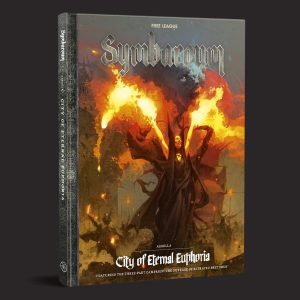
Mattias Johnsson Haake is a games designer and creator, best known for his work on the award-winning Dragonbane and Symbaroum TTRPGs. We caught up with him to find out more about Symbaroum – City of Eternal Euphoria, a new book for your Symbaroum campaign.
How would you pitch Symbaroum – City of Eternal Euphoria to your casual Game of Thrones fan?
Generally speaking, Symbaroum shares some similarities with Game of Thrones‘ political fantasy drama and human-centric societal structure, but the town of Agrella has no clear parallel in Westeros. Even if the analogy is far from spot-on, I’d rather compare the setting and story of the Agrella module to a cold war agent thriller in fantasy shrouding.
And how would you pitch it to a fan of the Symbaroum range?
I’d invite them to experience a different take on the main themes of Symbaroum. A few previously published adventures have also been set in urban areas, such as Wrath of the Warden and The Darkest Star, but this new book has even more focus on intrigue and faction play. It has a real cloak-and-dagger feel to it, without turning away from what is at the heart of Symbaroum.
What was the selection process for the artwork?
All art for the Agrella module was specifically commissioned, which is how we always do it. The writers are prompted to come up with a motif for every 8-10 pages of the manuscript; they write a description (sometimes including other images for inspiration), which is then forwarded to the artist. Of course, there is always a discussion about which motifs to choose, and sometimes the project lead (me, in this case) will step in to tweak or make changes. But as a rule, the designers and writers must decide what should be illustrated.
Is it possible for Symbaroum to get darker?
Haha, for sure! I would argue that there is quite a lot of light, joy, beauty, and pure intentions in the world of Symbaroum, even if they are mostly there to accentuate the darkness. It is a balancing act – if the setting grows too dark and serious, without contrasts, you will end up with something that feels only gray.
Does this setting work with the 5E rules set as well? Are the rules important to the atmosphere?
The Agrella module has not yet been converted to our 5e gameline, called Ruins of Symbaroum, but it probably will. The rules are important, even crucial when it comes to Symbaroum, as they highlight and gamify the core concepts of the setting: corruption, spiritual shadows and the sense of “real” danger. Both available rulesets (original Symbaroum and Ruins of Symbaroum 5e) are built to reflect said concepts, and playing in the setting without those elements would not be the same.
What is the biggest influence on the Symbaroum setting?
If I have to rank them, I would first and foremost say our world, as perceived by us designers, writers, and artists. Second would be the continuous adventure campaign for Swedish Drakar och Demoner (now Dragonbane) that me and my friends played in our youths. Honorary mentions should go to Game of Thrones, Princess Mononoke, and French sociologist Pierre Bourdieu.
Has social media ruined TTRPGs?
Not for me. On the contrary, I believe that the boom in roleplaying (and gaming in general) over the last decade owes a lot to social media.
What’s the toughest part of the creative process for you?
The finishing touches, no doubt. Having ideas and even penning them down in an orderly fashion is a pleasure, but the closer you come to the finish line, the closer you get to readying the print files, the tougher it gets – especially when it comes to 176-page adventure modules that must function as instruction manuals for thousands of gamemasters with different preferences, tastes, and backgrounds in gaming.
What other projects would you like to work on?
I am fortunate enough to work at Free League, meaning that I get to write and edit manuscripts inspired by a wide variety of genres – sci-fi, post-apocalypse, horror, magical realism, and different flavors of fantasy. Currently, what I long for the most is to start designing the new main setting for Symbaroum: the City States.
Simpsons or Futurama?
Lisa Simpson and Bender. That would be a show!
Dungeons or Dragons?
Easy: Forests and humans (the latter being my favorite monster).
Truth or Beauty?
Truth (as opposed to willful lies) is beautiful, and seems to grow rarer by the day.
What’s the elevator pitch for Black Panther: The Intergalactic Empire of Wakanda?
Take a few misguided individuals from the most technologically advanced nation on earth. Shoot them into space, where their plans go awry and they’re forced to survive by starting a new colony that quickly turns into an intergalactic empire spanning various planets. Then, take a man – no, a legend, from the old world – who does not remember his own name, but whose coming awakens rumors of a saviour who will liberate all under the empire’s brutal rule. Slot that man into the rebellion. Put this in a blender. Mix.
Why should I read this book?
Why shouldn’t you? It’s the Ur-story, isn’t it? A legend, a prophecy, an oppressed social underclass under brutal rule. A promise of liberation via hard-fought wins. But there are two caveats. One is that every powerful institution, however benevolent its roots, possesses the same capacity for brutality and oppression – power corrupts, after all. And two, colonisation can happen anytime, anywhere, and by anyone. Wakanda may be an analogue for imagined possibilities for Afrodescendant peoples in our real world’s history beyond the suppression, minoritisation and marginalisation they have long suffered. But with power comes responsibility – wield it unwisely, and it could just as easily turn one into an oppressor.
What was exciting about writing a prose adaptation of an existing work?
Ta-Nehisi, for one. I could see how much thought he’d put into the work, the roots, drawing from both African and African-American history to build this larger-than-life intergalactic world. And of course, writing the interstices, the stories between the adaptations – it’s like threading a bracelet, see. What needs to happen here to take us from this point to that? It’s more than just filling in the gaps. It’s being in constant conversation with the writers, artists, worlds, lore, and characters that have come before you.
What advantage does prose have over sequential art?
I don’t know about advantages per se. I like to think each form offers opportunities the other does not – the question is how we make use of them. Working with prose as the sole medium offers, for instance, opportunities to communicate on multiple fronts. A carefully chosen turn of phrase, syntax, punctuation, for instance, may offer information, tone, history, emotion, etc, all at once. Literature can cut across time and space within the frame of a few words in a way still images can’t. However, I still learned a lot from looking at the images and digging deep, wondering: What are they thinking? How do they feel? And then seeking the words to capture that.
If you could sit one of the characters from the books down and have a word with them, who would it be and what would you say?
I liked spending time with Nakia. She’d once been a subject of the intergalactic empire – a perpetrator of its brutality, even – before switching over to the rebellion. Characters who switch allegiances interest me, because it means deconstruction (or propaganda, even) has been successful on some level. I’d like to ask: What was the moment you realised you couldn’t be this person anymore? How hard was it to leave behind everything you knew and loved and commit to something nebulous and potentially doomed?
Which character was the most fun or interesting to write? That’ll be shared between Bast, Captain N’Yami and Emperor N’Jadaka. The amphibious Teku-Maza, in general, were the most interesting to write about, and N’Yami being the most prominent of them gave me some time to think about how they perceive themselves. Then, the uphill task of portraying the brutal emperor N’Jadaka as a gentle, family man – tyrants contain multitudes; who knew? And then, Bast as a brash and prideful goddess, forcing us to question the expected wisdom of gods. I enjoyed making a seemingly all-powerful deity squirm, asking the reader to reckon with the fallibility of gods.
What invention or special ability from the book would you want to have in the real world? Teleportation. It’s dangerous, actually, for the human – you disintegrate someplace and re-form someplace else. One has to wonder if it’s the same person on the other side. In the book, the Manifold teleports relentlessly, as transport, as weapon. For the savings on transport alone, I’d love to have that, consequences be damned.
What’s the toughest part of the writing process for you? Locking down the tone and voice of the work. Sometimes, it’s part of what first arrives, when the rest of the work is still being formed in the mind. Other times, you’ve gotta work at it. It’s the latter that’s hard, you know? Pinning down how you want the work to sound when you haven’t yet figured out the shape of the work itself. But we get there somehow, whatever the route. I sure did with this book, however circuitous the path.
What other projects would you like to work on? Star Wars, probably. Huge fan of Andor and the Mandalorian lore. I could totally see myself working in that world.
Sam Riegel is best known for his work as a cast member on hit D&D show Critical Role. The voice actor is also well known for roles including Dontello in 2003’s Teenage Mutant Ninja Turtles and as Phoenix Wright in theAce Attorneygames. He’s also the Dungeon Master for Wildemount Wildlings, a short actual play Critical Role show set in a fantasy summer camp. We caught up with him to find out more.
How would you pitch Wildemount Wildlings to an Antarctic explorer who’s never seen D&D?
First, I’d say, come in, get out of the cold! Next I’d ask, what century are they from? Cos is this gonna require me explaining what computers are first…? But to answer your question – I’d say it’s a silly and sweet coming-of-age story about four down-on-their-luck would-be adventurers at a summer camp who are learning how to control their powers and be confident in themselves!
This game is inspired by a home game you ran for your kids. What similarities between the two games surprised you?
It’s amazing what out-of-the-box decisions the kids make in our home game. They’re always surprising me with the strange ways they tackle encounters. And I gotta say – even though we have adults playing kids in this miniseries, they really did some weird stuff. Especially Aleks – he captured the off-the-wall thinking of a kid brain. In the best possible way.
How much of your DM-ing is planning, and how much is pure chaos?
I plan a lot! Probably too much! But that’s what I need to do to feel confident enough to throw it all in the trash and let chaos reign. If I have three different plans, then I’m OK with a fourth way that I’m not ready for, cos I know I have backup plans galore.
In the past you said you wanted to play a brain in a jar, will we see that any time soon?
That’s my eternal backup character. Just a powerful wizard brain in a jar. Other people have to carry me around and feed me and stuff. It would be the perfect lazy man character. Maybe campaign four…
What was the process for picking the players? It’s an interesting collection of folk.
Marisha and Ashley were first on the list cos they talked about visiting the camp at the end of the Bells Hells campaign. And Brennan was an easy choice because of his extensive summer camp background. For the others – they’re just folks I’ve been dying to play with! My sister is brilliant and I’ve been searching for a way to get her on our channel. And Libe and Aleks are such talented voice actors, I knew they would shine.
Was it your idea to ask your sister to play, or did they ask? How did that conversation go?
Eden had never played D&D before, so I invited her and her family over to play at my house the week before we shot. Not only did she love it, but her son took to it with such excitement that he is now part of two campaigns!
How mindful of the lore did you have to be with this one?
Lore schmore! My main goal was to establish this camp as a platform for folks to run home games. It’s perfect for family or kid-centered campaigns and so I wanted to flesh it out for folks to be inspired.
If you were creating your own Scout organisation, what would be its first rule?
Wilde Out is a pretty great principle. Be a kid. Be wild. Be different. Rules are made to be broken.
What’s the best bit of advice you have for younger D&D Players?
Young players are sometimes scared of failure – they keep asking to reroll dice or bend the rules to succeed. So I’d advise them to embrace the failure. It’s a group game. If you fail, it’s a gift to your fellow players – now you’ve created a new problem they get to solve! Failure is the best gift to a table.
What’s next on your list of dream projects?
I’d love to run a serious campaign with intrigue and darkness and pathos and heartache. But I’ll probably just run a Fart Campaign or something instead.
You can find out more about Critical Role‘s show on Beacon.TV, and you can catch up with Wildemount Wildlings via Beacon.TV or YouTube.