Jen Williams | THE BITTER TWINS

bitter twins

Jen Williams is a London-based author best known for her thrilling fantasy novels. Her first series, The Copper Cat Trilogy, was critically acclaimed and her new series, The Winnowing Flame, has continued to impress fantasy fans. The latest instalment is called The Bitter Twins. We caught up with her to find out more.

 STARBURST: What’s the elevator pitch for The Bitter Twins?

Jen Williams: It’s tricky to do an elevator pitch for the second book in a series, isn’t it? Assuming you’ve read the first one: the old enemy has returned, and things are looking dire for the world of Sarn. The few war-beasts that have been born in the Ninth Rain are confused and young, and it’s up to Vintage, Tor and Noon to make sure they survive. Or I would just say it’s Lord of the Rings meets Princess Mononoke meets Voltron: Legendary Defender.

How would you describe the series to an elderly relative?
Probably pretty much how I’d explain it to anyone… You know the elves from Lord of the Rings? Well, what if they were bastards, and a bit like the British Empire? And what if they discovered they could only keep their immortality by drinking human blood? And then it all goes horribly wrong.

Why are we all so fascinated with dragons? What has been your favourite dragon to write so far?

I very much enjoyed writing Y’Ruen, the goddess of destruction in the Copper Cat books (who just happens to take the form of a dragon) simply because she has no compassion or complicated feelings – she exists to kill everyone and everything, and there’s something quite gleeful about that. On the other hand, Vostok, the dragon war-beast who appears at the end of The Ninth Rain, is very much more of an actual character, and is therefore easily the most fun to write. She’s imperious and snobbish, vain and extremely forthright – with the added bonus that she can incinerate you.

The books seem to have a great love for mythological beasts. What’s your favourite sort of beastie and why?

Griffins. I love a griffin. I’ve managed to squeeze them into both trilogies and I’m very pleased with myself about it.

Where did you draw inspiration for the Winnowry from?
In a general sense, from all around us. The idea of women being persecuted and degraded simply for existing is not, unfortunately, an idea I had to make up purely for the book. Specifically, I was on a bus one night going down The Stand, and I saw a young woman walking under a street lamp. She was wearing a big heavy rucksack and the light made her face look like it was covered in a fine grey powder – that image triggered something in the back of my imagination somewhere, eventually leading to the fell-witches. As for the giant bats, who doesn’t love a giant bat? I loved the idea of creating a version of witches that were some distance from our traditional idea of them, but still had hints of the gothic.

If you were casting the movie of the book, who would play Vintage, Noon, Tor and Bern?

This is such a tough question! Vintage I can see as the awesome and gorgeous Gina Torres, and Daniel Henney (also gorgeous) would make a brilliant Tor, I think. Bern inevitably would be played by Chris Hemsworth. Noon I find a little harder to pin down, but maybe Claudia Kim – she does such an excellent job of being a badass as Khutulun in Marco Polo.

Which character would you most want to go out on the town with?

Vintage, no question. She’s rich, can buy her way around the fanciest bars, and she knows quite a bit about ordering a decent bottle of wine. Plus, she’s enormously good company and I suspect she’d also make sure you got home safely.

Which character would you most like to sit down and have a quiet word with?

Probably Tormalin the Oathless. I think I share with Vintage a slight exasperation with him, and if anyone needs to listen to sensible advice for once, it’s our lost Eboran lord.

What was the most fun scene to write?

In The Bitter Twins, there were several scenes between Hestillion, Tor’s estranged sister, and the Jure’lia queen. I enjoyed these the most because they were the most challenging to write: Hestillion’s motivations are murky and complex, to the point where I don’t think she even quite understands why she has done the things she has done (or at least, she doesn’t want to look too closely at her reasons) – while the Jure’lia queen is a completely alien character, attempting for the first time to understand something of the creatures she has habitually attempted to exterminate.

How different is The Winnowing Flame series from your previous trilogy, The Copper Cat?

There are some similarities – they’re both fantasy, they both centre around three main characters, and there’s still a strong emphasis on snappy dialogue – but whereas The Copper Cat was, in many ways, a love letter to sword and sorcery stories, the Winnowing Flame is very much an epic fantasy trilogy. This mostly means that the story is much more sprawling, the stakes much higher, and I’m exploring different themes, such as memory, trauma, and the ghosts of history.

Will we see any more of the Copper Cat?

There aren’t any plans for more novels in the series, but I do have a Patreon where people can get access to the Copper Cat Correspondence. Each month I post up a letter from Wydrin, or Sebastian, or another character, which usually reveals a little more about their past or the wider world. It’s a fun project, and an interesting way of providing extra content.

What’s next after the end of this series?

Honestly, I am not sure. I’m in the midst of writing the third and final book, The Poison Song, and while I’m up to my ears in that it’s difficult to imagine what might come next. It’s possible, I think, that I might try writing something completely different – or at least something much shorter.

Is the world of fantasy literature as welcoming and as broad as it hopes it is?
That’s a complex question. I have certainly felt very welcome, and the fantasy community is a close and friendly one. On the other hand, I have also been told, in the wild territories of the internet, that I am inherently less skilled at my job because I am a woman. There is still, I suspect, an odd disconnect going on somewhere that perpetuates this idea that fantasy is a ‘genre for men’, when actually women have been reading and writing it forever.

Who are you reading at the moment? What are you top fantasy book recommendations?

I am currently reading The Crimson Petal and the White by Michel Faber, which isn’t fantasy but is fantastic. After that I have Den Patrick’s Witchsign to read, which I am very excited about. As for my top fantasy recommendations, I would, as ever, recommend Robin Hobb’s Realm of the Elderlings series for a sprawling, exciting world and characters you will remember for ever, and for something quite different and utterly charming, Uprooted by Naomi Novak.

The Bitter Twins is available as an eBook from March 8th, and can be found in paperback from August.

Fiona Sampson | IN SEARCH OF MARY SHELLEY

Fiona Sampson

Fiona Sampson, MBE is an internationally renowned and award-winning British poet and writer. With twenty-nine books to her name, her work has been translated in to many languages. We caught up with her to talk about her book In Search of Mary Shelley: The Girl Who Wrote Frankenstein.

STARBURST: What’s the elevator pitch for In Search of Mary Shelley: The Girl Who Wrote Frankenstein?

Fiona Sampson: Mary Shelley was a real person, not a cartoon character, and as full of contradictions. Uncover the real person, and we uncover how she could create Frankenstein, one of the most enduring stories of our time, when she was only a teenager.

Are we in danger of forgetting who Mary Shelley was?

Yes and no. There’s been lots of specialist historical and biographical research (and I’ve done it all again, and some original research too, myself). But that’s different from bringing her to life for today. Mary Shelley’s reputation has suffered almost as much as she did in person from her marriage to the poet Percy Bysshe. For a long time, she was represented simply as good or bad for him – the great poet. And as part of that, Percy Bysshe Shelley’s biographers and admirers of his poetry floated a false story that he really wrote, or co-wrote, or massively improved Frankenstein. A mere girl could never have written such a masterpiece, they decided. Now that the original notebooks in which she wrote the novel are free to view online, no-one should buy this story any more. But incredibly, there are still fusty academic men peddling this story to the press: Frankenstein’s bicentenary has made them all come out of the woodwork.

What’s the thing most people don’t know about Shelley?

Apart from that she wrote Frankenstein? Probably that she had a long and distinguished life as a writer, publishing further novels and biography; and that ironically it was she who created Percy Bysshe’s reputation by collecting, editing and fair-copying his work.

What are the challenges in writing a book like this?

For me the thing that was most important was to carry out absolutely scrupulous research in the original sources, and to invent nothing. Even the weather, where I describe it, is researched in the meteorological records. And then to digest all that research so thoroughly that I can make the story come properly alive. The evidence is all painstakingly there, recorded page by page in the Notes at the end of the book, but the book itself should be a good read, a page-turner, and an emotionally intelligent one at that. I hope that’s how it’s come out, by and large. But it does irritate me beyond belief when people think that just because they enjoy reading it (lovely!) it can’t be scholarly. It is, actually – it’s just that as I’m a writer, I believe in storytelling. I can’t stand dull writing: I think it’s a crime.

What is the thing that people often get wrong about her work?

We usually remember Frankenstein from the 1931 James Whale film, not the actual story she wrote about the way blue sky research creates fresh ethical dilemmas as it goes. In Mary’s novel, the creature is incredibly articulate, intelligent and emotional, and is driven to murder by a series of rejections by the humans he tries to live among. She makes him really understandable and relatable, not just into a kind of hulking beast.

Is it ever correct to call Frankenstein’s Monster simply Frankenstein?

No! Sort it out, guys!

Is it fair to describe Shelley as the inventor of science fiction? Are there other/better claims?

I think it’s absolutely fair. Her message is in fact wider in a way: because she tells the same story about scientific hubris twice in the book. There is a parallel story about an Arctic explorer. But this is the first fully-fledged story about scientific invention and the risks involved in it that is also a story asking questions about how to make a sort-of-human prototype. In 1818 there had long been stories about alchemists raising the dead or creating spirits and ghouls. In fact, they were so fashionable at the time Mary was writing that her own story had its origin in a competition between writers to see if they could come up with something similar. But they called it a “ghost story”, and the supernatural, as we know, is not science fiction.

If Shelley was suddenly around in 2018, what do you think she’d make of her legacy?

I’m sure she’d be delighted. She was delighted to discover, when she came back to London in 1823 after being widowed (she was all of 26 by now), not one but two West End productions of Frankenstein. “I found myself famous,” she boasted to a friend.

How important is Frankenstein to modern genre fiction fans? Is Frankenstein really a must read?

Yes! It’s a must-read. It really shows the depth of the form, there right from the beginning, And it’s the archetypal story. It’s also fairly short and a very good read, even though it’s two hundred years old.

What are you working on next?

An opera about Daedalus: the first inventor, and the one whose son Icarus flew too close to the sun and fell to his death. So, another story about hubris… A Radio 4 sound poem about Mud (4.30pm BBC R4 Sunday April 8th.) And the documentary rights of In Search of Mary Shelley have been optioned, so if it gets commissioned I’ll be doing quite a lot of consultancy on a TV mini-series.

You’re doing a talk at London Book & Screen Week 2018. What’s the appeal of that sort of event?

It’s great to meet fellow enthusiasts for Frankenstein and Mary Shelley – that’s true for me as much as for the audience! Also I love meeting readers, and readers often like meeting the people whose books they read. And unfortunately Shelley can’t be there in person, so…

Simpsons or Futurama?

Simpsons. Despite my own surname. Brilliant characters!

Macbeth or Hamlet?

Macbeth. Less dignified and so more true to life. Everyone can relate to an anti-hero…

Doctor Who or Doctor No?

Doctor No. You’ve got to go classy sometimes, haven’t you?

Truth or Beauty?

Truth. Can’t relax with beauty alone.

Fiona Sampson is author of In Search of Mary Shelley: The Girl Who Wrote Frankenstein (Profile Books) and will be speaking at London Book & Screen Week on Tuesday, April 10th. Tickets are available at www.londonbookandscreenweek.co.uk.

Brian Froud | THE DARK CRYSTAL

brian froud

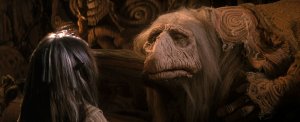
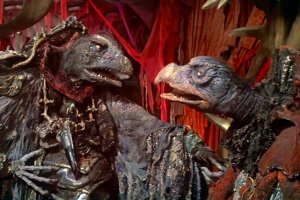
The first time this writer saw The Dark Crystal in the cinema, I was probably too young to be there with my older brothers, given that the Skeksis are the stuff of utter nightmares. But it’s that dark side that draws so many fans like me to this film, it’s deep and strange and striking. It inspires us to believe that being different can still be beautiful. I was instantly enchanted, occasionally terrified, and a love affair with fantasy and puppetry was born. This makes it all the more exciting to hear that Sony Pictures is releasing The Dark Crystal on 4K Ultra HD when it returns to Blu-ray and DVD in celebration of the film’s 35th Anniversary.

Fans and collectors will be delighted to know the new Blu-ray version has most of the features included in the previous release but with some added goodies that will make even the angriest of Fizzgig’s happy. Both the DVD and Blu-ray will feature Original Skeksis Language scenes featuring screenwriter David Odell as well as The World of The Dark Crystal documentary. But only the Blu-ray includes the new featurette The Myth, Magic and Henson Legacy, which includes stories from Lisa Henson (daughter of Jim Henson and current CEO and President of The Jim Henson Company) and Toby Froud (son of creative director Brian Froud and star of the next Henson/Froud collaboration, 1986’s Labyrinth).

Additionally, the Blu-ray is beautifully presented in a collectable, 30-page booklet featuring rare photos and stories from the set. Those who want to take an even deeper dive into this iconic film should check out the new companion book The Dark Crystal: The Ultimate Visual History, by Caseen Gaines. This deluxe book features in-depth looks behind the scenes, script pages, candid photos from the set and sketches from Henson. It also includes an introduction by Brian Froud and his wife Wendy, a prolific fantasy artist in her own right who met Brian on-set when she was tasked with bringing his Gelflings to life.

If that’s not enough for fellow Dark Crystal diehards, the film is getting a special, four-screening release at The Prince Charles Cinema in London starting on March 17th. There is nothing like seeing this film on the big screen but this new 4K release is going to come ridiculously close. It was an incredible honour to speak with Froud about this latest release and what it means for his legions of fans.

STARBURST: You and Jim Henson began working together on The Dark Crystal as early as 1978, but it would be a few years before your film finally hit the screen. What was it like in those initial developmental stages?

Brian Froud: It took five years, I had a meeting with Jim in the early days when he was working on The Muppet Show in England and I went to see him. He said, “I’ve got this idea for a movie,” and he hadn’t got much of an idea, but he wanted to push puppetry into a new area. He thought that my designs would be a good basis for some of the characters, and so he invited me over to New York. We had about nine people in the Muppet workshop. We started to push ideas around and I was drawing and people started to make things.

Jim had seen my art, but he hadn’t realised that I also sculpted and did strange puppets. I mean, I did puppets that were made out of snail shells and chicken bones and that sort of thing. And so it meant that while I was there in the early days I actually made things, I made little maquettes of the characters which very clearly showed my work in three dimensions. I could help people start to develop the creatures. But I had to learn quickly how to articulate what I wanted. I was used to dealing with myself and a drawing board and solving my own problems. But to work with other people with other skills, I had to learn really quickly how to not do it myself. I’d be like Mickey Rooney – doing the whole show in the barn!

I had to learn how to tell people what to do, and figure out what the obstructions were. And that was my big challenge. You know, I was just saying recently that I didn’t know if I could do it. I mean, Jim sort of thought I could do it. But obviously, I did do it, because in five years of my life he didn’t fire me! We ended up together at a Royal Premiere.

We’ve never understood why the film wasn’t the initial success we feel it should have been. Was it frustrating seeing something you all had put so much work into not being initially received as the beloved classic it became?

Yes, it was disappointing. One of our problems I think is that we had no idea. We were in a golden time because we just made the film that we wanted to see. We didn’t consider anybody else [laughing] we didn’t actually figure out who was going to come see this. Now you couldn’t do that, now it has to be really carefully worked out about marketing and who precisely it was for. So we were happy with it all, but then people just looked at it and went, “What is this?” It was stranger, darker than anybody thought.

What they missed was that Jim Henson was a genius. And he never stayed still. He was always pioneering something, he was always looking for another thing. A new way of doing things, new ideas, so this was his dream that he was pushing puppetry. Pushing the boundaries of what you could do with a puppet and visually what you could do with it. And so I think we were ahead of our time.

There was, I don’t know, about ten years, maybe more than that, after the film, I remember I was at Sony Pictures looking at what they were just developing there: 3D animation. They were showing me stuff and I was asking questions to this man, “That’s really interesting, but can you do this?” And he said, “Well no, not quite yet,” and then I said, “Oh, that’s great, but can you do that?” And after a while, he got really frustrated with me and he said, “You know, you should watch a film, it’s called The Dark Crystal.” And I just laughed, he hadn’t realised who I was.

But it did show that we were doing things for real that CGI couldn’t do yet, and that’s how far ahead we were. And indeed I think what’s happened now, over all the years – although CGI in many ways can be brilliant – in many ways, it’s a bit, well… lumpy. It doesn’t always contain the emotions that a bit of a rubber and a stick and a bit of string that we were doing incorporates. They can’t do it, but we did it, and it still shows up in the film when you look at it now, it’s still an amazing feat.

It’s incredible, the realness behind the artistry of this film is very special. It’s one of the many reasons it resonates so deeply with audiences these 35 years later.

I think that The Dark Crystal somehow incorporates magic because it’s made of real things. We brought on board many people with different disciplines because indeed, puppets aren’t that brilliant, they don’t do very much! They do very little and the trick is to get them to do a few things beautifully, it creates the illusion they do so much. And in that, indeed is the artistry.

It is the performance – I really believe in being part of making costumes that were extraordinarily beautiful and intricate. Because that helped the puppeteers in them understand what their character was. They rose to the occasion because they had an extraordinary thing that they were manipulating and because it’s made out of mulitextuals – things are hard, things are soft, things that are sculpted, things that are just draped. It accrues a lot of life. That shows on a screen, and it still does. Whereas CGI can flatten everything out.

Also, I think as a puppet, we’re bound by the laws and the physics of reality. Whereas those dear people that do CGI just pull and stretch and do all these things that then you think, “I don’t believe this anymore.” Whereas everything that we did was for real. There are hardly any special effects in it at all, it just was Performance that these things would walk across the stage, would do things, and would articulate emotions. And that, in many ways, the film is just a record of that.

That’s why it still has a resonance now when you see it. And also, it’s historic in terms of nobody had made a puppet film like that before, and, in fact, nobody has made one since. It fits in a space that’s out of time, it’s timeless, and yet it seems to have a meaning, it keeps accruing meaning throughout the years.

And that was the other thing I found in meeting people, was the reaction they’ve had to the film. Indeed, to go back to your question earlier, we were disappointed that it was not a financial success, but we were absolutely proud – Jim was in particular – proud of our achievements of making this thing because it is an extraordinary film. And we’ve found over the years people’s reaction to it has been that. They say that “It changed everything for me when I saw it when I was young,” you know, “I wanted to either get into the film industry,” or “I wanted to draw, I wanted to paint,” or “I wanted to write.” But it’s always been a creative reaction, which has been great. Jim Henson would have loved to hear that, and I think that’s his legacy, is that he left that behind and it’s still as vibrant and alive now as it ever was.

You can count this writer as one of those people directly inspired to embrace my creativity because of your work! Speaking of legacies but changing gears: one thing I’ve always loved about your story is that you and your wife Wendy first met while working on the film, does that give it an entirely different kind of sentimental value for you?

Jim was very good at finding people, seeing something in their work that he thought was in tune with what he was doing. And definitely, when he saw Wendy’s dolls in the early days it was precisely that. Because Wendy has this extraordinary ability to encapsulate soul instantly in her work. And he knew that’s what he wanted to get into the film. So it was like he brought that to get us together because of the vision of the film, but he had no idea that the two of us personally would link up. And we’ve been married all these years and the extraordinary thing is that we both work from home and we both get on with each other that much. We spend every day with each other but we respect each other as artists. Also in the past years, we’ve been collaborating on books together, and that’s been wonderful to do.

Actually, speaking about your collaborations we’re also celebrating the release of The Dark Crystal: The Ultimate Visual History, a gorgeous, immersive compendium by Caseen Gaines. You and Wendy wrote the introduction, what was it like looking back together at your time on set?

We did the introduction and a few interviews for it and I have to say the new book is wonderful. It’s great to see all the stuff together again. It’s also really well researched and I think there’s a lot of things historically that have been reinstated. Because sometimes when you read about what went on in the film you think, “It wasn’t quite like that,” or “Where was I? Did we mention my bit in that?” But this seems to address or redress a balance. And so I’ve had so much fun dipping into it and reading it and going, “Oh yeah, I remember that,” or, “I don’t quite remember that!

A few years ago, I did a commentary for The Dark Crystal and Labyrinth and I sat there as they played the film and did it. But I frightened the sound engineer because I said, “Well I hope I can do this because I was never there.” And he said, “Oh my god, what do you mean, you’re doing this voiceover?” And I said what I mean is that I didn’t have time to be on the set. I was either on the next set visually checking that out or I was in the workshop getting the puppets ready so there’s no time to be slumming around on the film set. But unfortunately, so many people are going or dying now that I thought I’d better just do it. Apparently, I haven’t heard it, but there was a review I noticed that said, “Don’t buy the DVD if you think it’s going to be new technology and better, it’s still just as good as it was, but buy it for Brian Froud’s tart comments.” And I thought, well what did I say?

You’ve contributed to several illustrated works set in Thra. Have you enjoyed being part of creating such an expansive universe?

Yes! When we were developing the film we knew that we wanted to create a world that felt like it had this vast history. What we had to do visually, in sort of a shorthand is to show that the history [was] thousands and thousands of years old and we were part of this mythic story. And so we knew that we achieved a great depth to it and it did seem a pity that we couldn’t explore more of it. And that’s why when we’ve been doing the comic books it’s been great to be able to go to the periphery of the world and find out what happened then and find out there are new creatures and all, that’s been really exciting.

For years, I have been going to Comic-Con and saw that films gradually sort of took it over. Every year you’d go there would seem like another mile had been added to the building and then it would be all media. And the comics seemed to be pushed into a corner somewhere and I thought, there’s something really special about the comic books, they’re like a receptacle for great art. This is where young people learn their craft, learn how to express themselves through images. Now comic books have come back much stronger than they’ve ever been so to be able to be part of that, part of that world-creating ability, has really been wonderful for me.

Can you give us anything to tide us over about the upcoming Netflix prequel series, The Dark Crystal: Age of Resistance until its rumoured 2019 release?

No, I’m not really allowed to talk about it, all that I can say is that we’ve been trying to get a Dark Crystal 2 going for years and it’s gone through various incarnations. At some point, there’s been 3D animation and various things but I think what’s exciting is that through the vision of The Jim Henson Company and Netflix – it’s going to be puppets, and that’s the most exciting thing. So it’s a return to all that, to everything that was best and great about the original Dark Crystal film is going to be in ten glorious episodes and that’s all I can say.

The film is coming back to cinemas soon thanks to four special screenings at The Prince Charles Cinema in London, any plans to get out there and catch it on the big screen this month?

I hope so. I have to say the experience of seeing the film on the big screen is quite extraordinary. But you get to see a lot on the DVD, which is great about it. In viewing it again, you get to see all the details on the same screen you go, “Gosh I really didn’t notice that little creature in the corner, doing all that.” The fun is the game of trying to figure out what everything means because the secret of The Dark Crystal is that everything is linked to each other, everything has, as Jim Henson sort of said, “Everything. We’re all connected to everything.

THE DARK CRYSTAL is on 4K Ultra on Blu-ray now. To further celebrate the 35th Anniversary, Park Circus is partnering with Prince Charles Cinema to host four screenings through the month of March. Tickets can be purchased online via Prince Charles Cinema.

Tristan Risk | ALIENS ATE MY HOMEWORK

Tristan Risk Aliens Ate My Homework

Here at STARBURST, one of our huge favourites is the delightful and fascinating Tristan Risk. Having caught up with this modern horror fave at several points over the past few years, we sat down to grab some time with Little Miss Risk to discuss her foray in to the world of more family-friendly content with the hotly-anticipated Aliens Ate My Homework adaptation. In addition to that, we also had a good ol’ natter about Tristan’s work with the marvellous Caravan of Creeps circus sideshow, her experiences in the horror realm, Canadian lake monsters, her love of snakes, mermaid escape acts, making her directing debut with the upcoming Parlour Tricks, and a whole, whole lot more.

STARBURST: How did you end up involved with Aliens Ate My Homework?

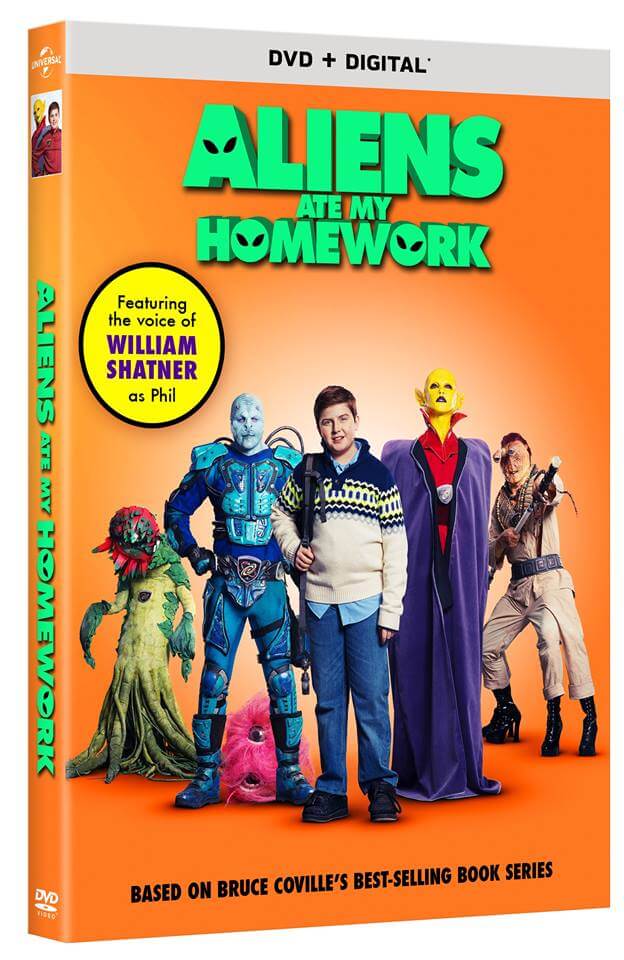
Tristan Risk: Oh gosh. MASTERSFX were the people who were producing this film as well as doing all of the practical and visual effects for it. There’s a female character named Madame Pong. They’d asked around, “Do you know of anyone who’d be suitable for this role?” It was a lot of prosthetics, and if you’re not used to working with them then they can be a little bit difficult. As Doug Jones has proven, it takes the right person to bring those types of characters to life. And Todd [Masters – producer and MASTERSFX founder] threw my name on the table. I auditioned for the producers, they liked what they saw, and that is how I became Madame Pong, who is the Diplomatic Officer of the Starship Ferkel.

You seem quite giddy about that?

Yeah! I grew up reading Aliens Ate My Homework, My Teacher is an Alien… the very first one I read was Jeremy Thatcher, Dragon Hatcher. It was different in the fact that the protagonist has cerebral palsy, and you barely ever see any main characters in literature who are differently abled. So that was the first thing that caught my eye. Second was that it had this really great story about this boy raising this dragon and just kind of dealing with the daily challenges of being someone who is differently abled. Not everything is as accessible as you would hope in the world for people like that. It was a really great book. Just having the chance to make a film based on one of the books I grew up reading gave me such pleasure. It’s amazing. I’m such a literary nut. I grew up in the library at school.

With the prosthetics for Madame Pong, how did that compare to the vast amount of prosthetics you’ve done for your horror output and performance shows over the years?

Well, she’s got these huge pointy ears, very elf-ish. She looks like this alien space fairy princess. I don’t know if I can sum it up any better than that. Because of the nature of her head and everything, it was a full head piece. So it’s face, head, everything down to my neck was covered. I had caps on all my fingers to elongate them. Then I was also wearing high-heeled platform shoes to give me extra height. I had a floor-length cloak. It was very much just my hands and my face and my eyes, and then there were the other aliens who suffered so much more than I did! Alex [Zahara] who played Tar, he had to wear an extra set of legs on the outside of his legs. Then he had animatronics, little eyes that were looking around and were controlled by somebody else. He had these two little slits to look out of. We all had dental teeth caps as well as fingers, and he had the fingers, too. He had fingers, face covered, animatronics, and he was sweating so much at one point that it actually shorted out the electronics. Brad [Proctor] who was playing the space plant Phil – who’s voiced by William Shatner – he was doing the classic ‘arm straight up’ then the other arm trying to keep everything going, trying to make this character come alive without dying from all the weird positions and the extensions that you’re having to hold to keep this character up. And Dan [Payne] who plays Captain Grakker, he was in a scuba suit, and it was hot, and there was motocross gear on top. He’s on a Disney show where he plays a villain who also wears a lot of prosthetic make-up, so he was an old hand at doing the suit work, but it doesn’t get any easier with time.

As uncomfortable as I might have been at times, I’d look over at those guys and think, “Yeah, I might be a little uncomfortable, but those guys… those guys are not complaining at all, and I am not going to be the one to say my feet hurt or this dress is tight. Those guys are suffering WAY more than I am”. The thing is, it’s not a ‘forever’ discomfort. Yes, it’s not the most comfortable, but you also know that you’re not going to be doing it for 24 hours. There’s a light at the end of the tunnel. I don’t have to put it on or take it off, I just have to maintain. I literally have the easiest job out of everybody else.
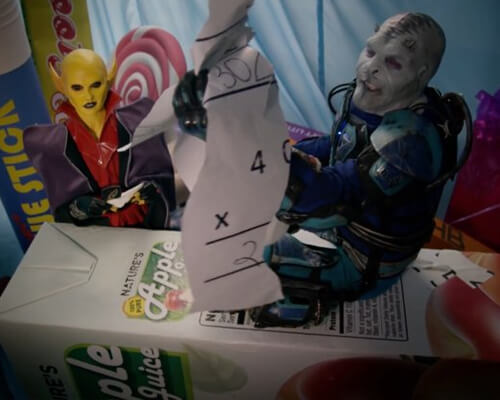
Tristan Risk Aliens Ate My Homework

Tristan as Madame Pong alongside Dan Payne’s Captain Grakker in Aliens Ate My Homework


How long was the process of becoming Madame Pong?

Four hours!

And how many days were you on set doing that every day?

I think I had about eight to twelve days. It was last year, and I can’t remember what I did last night! I remember it wasn’t a super long time. They tried to make sure that they get as much in on the days once you’re in there, so it’s not like they’re dragging it out and making you go through this for a ridiculous amount of time. They’re pretty mindful about that, which was really awesome.

How did it work in terms of the sets for you guys? Did they just make overblown, oversized sets, or were there elements of CGI?

Yeah, it was pretty awesome. Do you remember Honey, I Shrunk the Kids? It was kind of like that. When we would walk on set and there’s this giant spaceship leg and we’re on a kid’s desk, and there’s all this school stationery stuff floating around. Then there’s another set where we’re inside of his knapsack and we’re eating these big strips of math homework. They made it out of this special paper so we’re able to bite in to it and chew it up. It was pretty cool. It was really funny running around on set with all of these oversized items. Then there’s a few things that are green screen, but it’s not about making it as green screen as possible, it’s about having practical effects in place.

What was the reaction like when people saw you fully done-up as Madame Pong for the first time, and what was your reaction to the rest of the cast in their outfits?

It was like, “Oh, so this is what we’re gonna look like in this movie?” We got to set much earlier to do the make-up. We had to be there at like 4am or 5am, then we were in make-up for four hours. We were getting finished just as the crew was breaking for lunch. So the first time anyone saw us really was when we were going to the craft services to get fed. Afterwards, the make-up artist would have to touch up all our faces because we’d been eating. It was funny because the kids would be there filming all of their stuff. Then we’d film our crossover alien stuff with them as much as possible afterwards, because kids can only be on set for so long as we don’t want to exploit small humans – that’s wrong! We would have a limited window where we were aliens on set and when they were on set, so they never saw us without make-up on ever! They only know us by our alien selves.

And you’ve never met the youngsters since filming wrapped?

No! I’d be like, “Well, maybe ignore the more adult things I’ve done. Younger audience. Hi guys!”
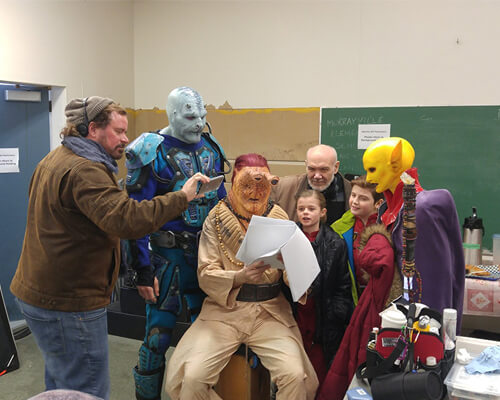
Tristan Risk Aliens Ate My Homework

On the set of Aliens Ate My Homework


As you touched on, a lot of what you’ve done is horror, blood, gore, sex, more adult-orientated themes. Did it feel strange to now be doing something more family-friendly and targeted at children?

I’m happy to do something that’s not evil or demonic or supernatural for a change. It was a little bit of an adjustment in my mind knowing now that I’m going to have a younger audience in some respects. I’ve never tried to be a role model, but it’s just now being mindful of how I present myself. As an adult woman and as someone who still works very much in more adult themes, I’m not going to apologise for what I do but I am also going to make sure that if there were kids to see this then it wouldn’t be a terrible influence in any kind of way. You know, I have the hope that kids get in to this movie and that they really like Madame Pong, so when they are, like, maybe in their 20s they Google me and go back and be all, “Oh my gosh, Madame Pong was in Penthouse in Germany! What is life?!” I’m not opposed to it, it’s my secret gift to any future fans I have [laughs].

Over the past few years, have you found yourself consciously becoming more wary about what you put out there and let people see of ‘Tristan the person’ as opposed to ‘Tristan the actress’?

There’s definitely been in my life recently a change in how I present myself on social media. It’s a powerful tool and it’s one of those things that it doesn’t go away. And we’re seeing it now with the #MeToo thing where some guy will post some sort of comment, and then sure as shit if he’s posted something that’s contradicted that then you know one of the ladies on his friend list will put something up and be, like, “Oh yeah, that’s not what you were saying two years ago!” I think that that’s something now we’re developing our technical memory. I like to think of putting more positive stuff out there than negative, and sometimes I can be cynical, and sometimes I can be very wordy about how cynical I am on certain topics. I think that if it’s approached in a humourous way, it can be funny and people can appreciate it without it sounding like being negative or poorly reflected upon. I’m a big fan of fine British humour, because you’re able to get that point across without coming across as offensive. It’s a little more of a witty humour, which is what I’d prefer to be perceived as with my grumpy, bitchy point of view. So I think it’s something that I’m very aware of. And also, too, as we get older I don’t really feel like I have as much to prove now in terms of being the biggest badass on the block.

I used to want to be the loudest and most outrageous, and I feel like I’m pretty satisfied with a lot of the work that I’ve done in that regard. Now I’m exploring other things in my life, like I’ve restarted painting again and more of my writing, and working on bringing my visions to life in terms of directing some of the stuff I write. That’s kind of where I’m shifting my focus to these days.

Was there a certain moment that triggered that change or did it just seem like a natural progression?

There was that, but also I’d been touring frequently in the last few years. I toured very hard from 2005 to 2010, and then I took a break from touring. I was a burlesque dancer with a band. That was a big chunk of my 20s. I spent the last few years doing that, and doing a lot of conventions and film festivals. Those are all really great, but I find that the touring takes it out of me these days. I can’t do it on the scale I want to at the comfort level that I would prefer, so I don’t. Conventions, I’m kind of disenchanted with them because I find that there’s always something about them in terms of there being an element of disorganisation or the behaviour of some of the other male guests towards the female fans. There’s just things I find distasteful about them that I don’t really enjoy. That’s my own personal feeling. And also when people come to see you and they want to buy all the things on your table and support you, but I feel that it’s kind of a weird thing. I think this is why I’ve started my Patreon account, because I feel that, like, okay, instead of paying me money for an autograph and a selfie at a convention, let me give you more of actually what I am – which is blogs, writing, behind the scenes stuff where it’s more, like, if you really want to see a chunk of my brain, let me give you your money’s worth at least. I’m planning on recording some of my performances and just editing them for video, so it’s like short films. It’s kind of like being able to go on tour without going on tour. It also gives people direct access because I might not be going on tour but people might want to see me perform. And if I do end up performing live, that’s something I can add in there for people to see, to see behind the scenes and to see the backstage situation there.

I think the other thing too – it’s fun to get invited to these things as a guest, absolutely – is just the degree of seeing how much some guests are taken care of compared to other guests. You’ve got people who are brilliant artists who are at these things flogging their work and their souls and their blood, and they’re shoved to a basement part of the building. These are the original people who are creating the content that everybody’s a fan of! Like, why are you not valuing the writers and the artists as much as the actors and the directors? Are we not all of equal artistic value and integrity? All I do is show up to work and do what I’m told. I’m not saving lives and I’m not curing cancer. You don’t really get as much time to talk to people individually. It’s more, “Hi, how are you? I’ll take your money and I’ll take a photo,” and then you’ve got to shuffle them along.

When I used to work as a stripper, people weren’t really paying to see me naked. We all know that there’s the Internet, and there’s a lot of nudity on the Internet. People don’t want that when they go to the club. What they want is the experience, what they want is that interaction. I think that’s why these people do go to these conventions. They want that little bit of interaction. Just seeing it be forced in to being just two seconds – bless every guest who stays behind and waits for every fan who waited in line for them. I find that extremely respectful to the fans, and when I see people who show up and they’re late or they’re flippant or they’re hungover or still drunk… I realise you’re here to have a good time, but at the same time don’t forget why you’re here.
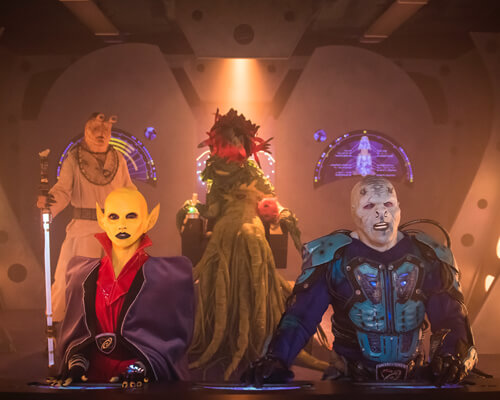
Tristan Risk Aliens Ate My Homework

On the Starship Ferkel


Going back to Aliens Ate My Homework, you said you didn’t get the chance to meet the kids without your make-up on. Did you get to meet William Shatner at all during the production, or did he just record his vocals elsewhere?

I didn’t get a chance to meet Shatner, no. He did his own ADR once the footage was shot. But it’s so cool that he’s involved in this and he gets introduced to another fresh generation who can be, like, “The plant guy was the guy riding the spaceship? Are you kidding me?” “Yes, yes Timmy. Once, Phil also looked after the Enterprise!”

In Bruce Coville’s book series, Aliens Ate My Homework is the first of four stories. Obviously it’s early days and these things are always dependent on success and finances, but are there any tentative plans that you’re aware of to move forward with a sequel should this film do well?

It’s my understanding that they would like to do all of the books as films, but again it comes down to how this one is received. If this one is received well, it’s then kind of where it’s going to go from there. I do think that they left it open and with enough interest that everyone’s going to go, “But mom, what happens next? There’s a big reveal, and now we need to know what the next step is” in a Harry Potter sort of way.

And you’d be fine with returning for four hours a day in make-up?

You know what, there’s so many other jobs I’d rather not do. Sitting there, letting someone else do all the stuff for me? Sure, I’m in to it [laughs].

Last time we spoke back in 2016, Frankenstein Created Bikers was just coming out and you’d just finished working on Ayla. You were also attached to Boogeyman: Reincarnation, which was originally looking for a release in 2016. Do you have any idea what’s happening with that?

I’ve not seen that either! I keep hearing about it. I think it was a TV series that was happening, then wasn’t happening. I think the most scary thing about Boogeyman Reincarnation is the ghost of a chance that we might actually get to see it at some time [puts on creepy laugh].

We saw the teaser trailer which had you pegged as an ‘American Scream Queen’…

Like, not really. And it had Laurence advertised for it too, Laurence R. Harvey. It was, like, “Cool, we get to do a film together… but I don’t know who’s going to get to see it!”

Laurence joined us at our inaugural STARBURST International Film Festival, and, of course, you’ve worked with him on Jill Gevargizian’s Call Girl and James Bickert’s aforementioned Frankenstein Created Bikers. Were you aware that there’s actually a Call Girl manga out there, and if so, any idea how that came to be?

They’d screened Call Girl at a Japanese horror festival. The people who put it together were so in to Call Girl, and the concept itself is also very J-horror. It’s very dark, and just when you think it’s dark, it gets even darker. I love anime and manga so much, like misplaced white girl appropriation. I grew up on Sailor Moon and Bubblegum Crisis and Akira and Pokémon, so being in a Japanese manga based on a film I was in was really, really, really, really exciting. I really hope to get a chance to go over to Japan because their type of horror just appeals to me so much.
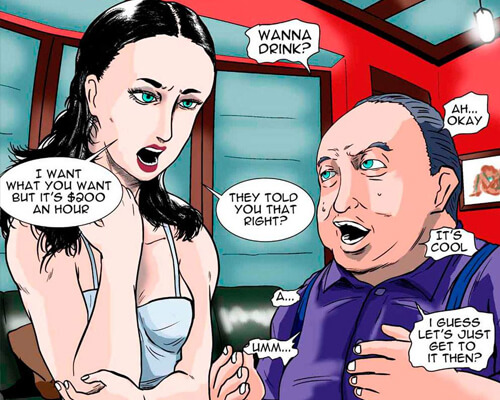
Tristan Risk Laurence R. Harvey Call Girl

Daiju Kurabayashi and Hiro Fujii’s Call Girl comic


You must be ticking off a personal bucket list by this point. You’ve got your own Japanese comic, the Soskas kind of put you in to a Guardians of the Galaxy comic – which, by the way, we hope you have framed!

I’ve got a copy. There’s my comics that I read, then there’s the comics that mean something to me. Having Kitty Pryde being called Little Miss Risk by Rocket Racoon was pretty fucking cool! The Soskas said that Marvel tried to change that, then they were, “We noticed you made an edit. We would like that returned to how it was before.” They were all, “Are you trying to incept Tristan Risk to be Kitty Pryde?” and they were just, “Yes!” I’m probably the most Kitty Pryde person on the planet; my partner is turning in to a purple space dragon! What else do you need?! I’m not really a computer hacker, but I’m really good at turning computers on and off again, and that usually fixes everything, right?

Your partner is Burns, and the last time we spoke he’d had horns and a split tongue done. What’s next in terms of body modification?

He’s basically modded out. He’s going to have a few more transdermal implants, he’s going to get his tongue re-split for a deeper V split, and then he’s going to be tattooed from head to toe in a motif. They look like dragon scales now that they’ve healed, and the idea is that when the tattoo is done then it will give the texture of dragon scales, too. It’s not something where you can just go to Mexico or Thailand for a month and get all the surgery done. I mean, you could but it would cost a lot of money and it would be a lot for you body to absorb and handle all at once. So Burns has been spacing it out. He beat the Guinness World Record for the world’s longest tattoo, then someone beat him for it. Now he’s going to beat that record again by ten hours or so. He’s like, “I need to beat the World Record. I’ll get all of this tattoo work done, then all of a sudden I’m fast-forwarded to being this dragon.”

What’s the record at now?

He got it to 51 hours, then the person who beat him got to 52. You get a five-minute break every hour. That means you can go for three hours straight then go for a 15-minute break. Burns isn’t allowed to sleep while he’s getting tattooed, and the tattoo artist obviously has to be awake the whole time. That’s how that works. And we found out that the tattoo artist – Brandon Fancie from Lucid Tattoo & Design – he had a lot of blood pooling in his ankles at one point, so he had to elevate his legs while he was tattooing. It’s things you don’t think of when you’re doing tattoos for nearly three days.

How are things doing with the Caravan of Creeps right now? From social media, it seems like you guys have some ridiculously cool things going on all of the time!

It’s doing really well. We’re going to be performing on the gala night on February 25th [this interview took place just before the 25th] at the Vancouver Badass Film Festival since Burns and I and a few other Creeps are in a number of films that are being screened throughout the weekend. Game Over is our big games expo and performance dance party that’s happening at the end of April. I’ll also be running the only circus sideshow tent at the 4/20 protest and rally in Vancouver.
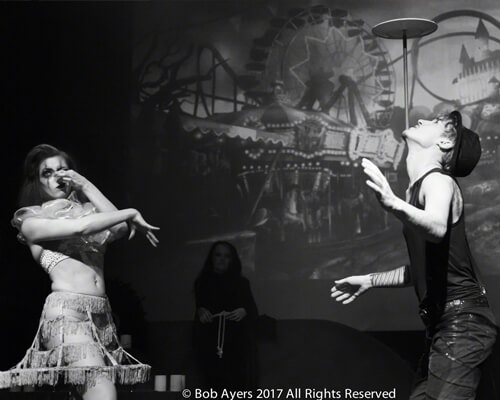
Tristan Risk Burns Caravan of Creeps

Tristan and Burns performing at Lost Girls Burlesque Halloween Ball


How much do these shows take out of you? Is it just a breeze now, or do you usually need a bit of downtime afterwards?

It depends. I don’t think I need a lot of downtime afterwards, more I need more prep time to make sure that we have all of the things that we wind up breaking or destroying in the show, that all of the flammable materials are all ready to go and that our fire safety kit is on point, whoever is on our fire safety is well briefed on what to do in case of any given emergency. It’s more in the prep work, whereas afterwards I can just relax and enjoy. If I’ve had grinder spray then it’s getting metal flecks off my back, but it’s nothing afterwards where I have to lie down flat for an extended period of time. That’s more after a strenuous dance session at a festival. That’s like, “Oh my god, I can’t dance for two hours straight anymore… but that was so good!”

Of all of the acts you’ve done over the years, is there any particular one that stands out where ahead of time you were a bit “Oh shit, this could go really wrong”?

There’s a trick that Burns and I do with a whip, where when we do it I hold a newspaper out and he cuts it in half with the whip one way. Then I hold it the narrow way and he whips it again the narrow way. Then I take a rose and he whips the blossom off the rose, then I take another rose and put it between my teeth. When I’ve got the rose between the teeth at a Halloween show – and this is our first time performing this in front of an audience, but we’ve been fine in rehearsal every time – he caught my arm just a little bit when he was doing the newspaper, but I didn’t flinch. I didn’t let anyone know, I was ice-fucking-cold, I was rock steady. I’ve got that rose between my teeth and I’m leaning out, and I just think, “But what if…?” Then I tried to think of how many times did he hit the vape pen before we started this, and before you know it the blossoms gone and the moment’s done. But there was that moment of “Huh… well I probably shouldn’t worry too much or think about it too hard, because you don’t wanna manifest the wrong thing”.

The last time we spoke, you mentioned the Okanagan lake monster. What exactly is that legend?

Lake Okanagan has a sea serpent. Much like Loch Ness has Nessie, Okanagan has Ogopogo. There’s some funny parallels to Okanagan that there are to another river monster that’s in British Columbia. People try to disprove the existence of Ogopogo by saying it’s a giant sturgeon that’s coming up, that you’re seeing it on the top of the water. But there’s been enough reports from people to say that it’s definitely not something that’s just flat on the water, that there’s definitely something sticking out from the water. Okay, it might be some sort of giant eel, it might be some sort of reptile. We don’t know. In Quesnel, north of there is a place called the Wells and they do this big thing every year called The ArtsWells Festival. The last time we were there, I noticed there was a painting on the side of one of the buildings, and I was just, “Hmm, this looks like an indigenous design. I should ask about it… the big sea snake thing out there, what’s that about?” So, the legend is that there’s this big sea snake thing that travels to the rivers through the tunnels in the mountains. Now you’ve got this thing that started with just the rivers, it now actually travels through the mountains as well and it can go from place to place to place. That’s really cool, but that’s no relation to anything to do with Ogopogo. So okay, there’s obviously something going on, whether it’s a big frickin’ snake or something, there’s clearly something to this. So that is the myth and the legend of Ogopogo in Okanagan.

What do you believe?

I haven’t seen it disproved. We’re finding new lifeforms all the time out there in the main oceans, so there’s no reason not to assume that the same changes and mutations aren’t happening in the Okanagan as well. Because of the sheer depth of it, we can’t check. So it’s, “Alright, well we don’t know. You can’t tell me there is, you can’t tell me there isn’t”. Until people prove to me without a shadow of a doubt that it does not exist, I’m willing to believe that there is something down there. And that is why I don’t swim in Lake Okanagan, ‘cos fuck that shit!

You’re happy to swim with sharks, though?

Yeah, we’ve been studying sharks! We’ve not been studying Ogopogo! Sharks, okay, we know don’t pet it [laughs].
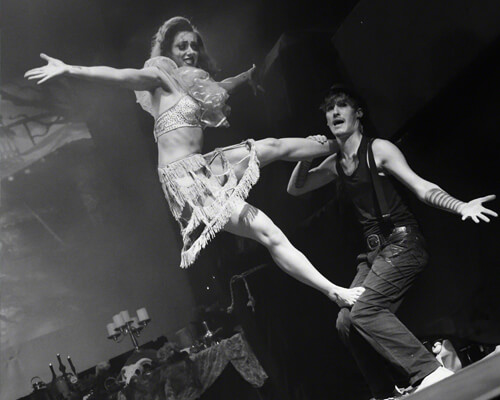
Tristan Risk Burns Caravan of Creeps

Tristan and Burns performing at Lost Girls Burlesque Halloween Ball,
Photograph courtesy of Bob Ayers, 2017


Previously you’ve said about how you’re always usually given great scrips. Have you had anything since then where you’ve thought, “No, this is too much”?

It’s not because they were extreme, it was because they were just bad scripts; they were poorly written. I was, “Yeah, maybe I don’t get the vision of this, or I’m having difficulty visualising what you want out of this”, but the dialogue was so… I don’t think I could’ve done anything with it myself, and I feel like it was coming from someone who was definitely a first-time writer/director. It was, “I don’t think you really know what you’re doing here”. It was just a lot of repetitive kind of dialogue. It wasn’t like it was bad or, like, “Oh my god, that’s in such bad taste!” It was just, “I don’t think I can do this, I’m gonna pass on this one”. I appreciate being thought of, but I just don’t feel like I was appropriate for that part. And they weren’t happy with that. Some people can be a little bit more persistent, but thankfully, “Okay, cool. Thanks for the feedback, thanks for reading it,” and just go and have someone else, which is totally fine. But there’s some people who are more, “But why, but why?” “Because I fucking said no, that’s why!” It’s like going to a bar and asking to buy me a drink. “No”, “Why, will your boyfriend get mad?” “No,” “Do you have a boyfriend?” “No, I just don’t wanna fucking talk to you and I don’t want your drink. I said no, I don’t have to justify it, I just said no!”

One big question we have to ask you, if you could play American Mary’s Beatress or Frankenstein Created Bikers’ Val one more time, which character would get the nod?

Beatress! I love Val, but oh my god, to be able to play Beatress again – that would be so awesome! It’s hard to choose. It’s like having to choose your favourite daughter. Val, I love and she was so fun, and so cathartic, but Beatress has done me a lot of favours. I would love to continue to give life to that character because there’s so many people who got a kick out of her.
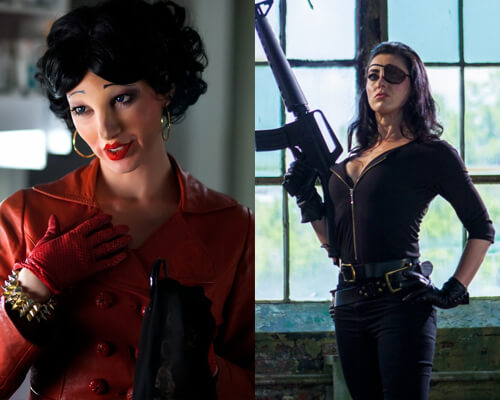
Tristan Risk Beatress Val American Mary Frankenstein Created Bikers

American Mary‘s Beatress and Frankenstein Created Bikers‘ Val


You and the Soskas are best friends these days, and they just so happen to be developing a remake of David Cronenberg’s Rabid. Is there any chance of you making an appearance in that film?

Possibly. I don’t know who they’re casting for the main roles, but I would love to be involved in Rabid if there was a place for me. We’ll see if there’s a role that’s suitable for me to audition for. I’ve not ruled it out.

Speaking of the Soakas, we’ve been absolutely dying to check out their horror game show Hellevator, but it’s somehow yet to be picked up here in the UK.

It’s one of those shows that, because the Game Show Network is on every accessible channel, it has opened people up to not just the Soskas but to horror. It’s like, “Oh, this is kinda scary and kinda fun. We’ll watch this! This is kinda cool. Hey, they do actual horror movies, we should check these out! They recommend these titles, we should check these out.” And that helps put horror in to mainstream culture. 

You’ve mentioned before about your love of creature features, but what would be the ultimate dream project you’d love to tackle?

I really want to play a mermaid on film really badly. I’ve got my custom mermaid tail coming soon, and I’m going to be posting probably an obnoxious amount of photos and videos of that. I really want to play a mermaid on film because I was so inspired by seeing Daryl Hannah in Splash years and years ago. It was the one thing where I was like, “See! She’s a mermaid, I can be a mermaid!” To be able to do that on film, and to show off my ability to swim under water. And Daryl Hannah did all of that swimming herself; that was not a stunt person, that was all her. So I’ve got a huge amount of respect for that lady. I really enjoy swimming and diving, so I would like to show off my mermaid skills and possibly even bring some of my other mermaid friends along to show off what they can do.

See, this is just one of the reasons why you’re so awesome to chat to – you have mermaid skills and mermaid friends! Would this mermaid suit be for out at sea or is salt water a no go, though?

Oh no, it’s good in salt, it’s good in chlorine, it’s good in fresh water. It is good to go. It’s made from the same material that your wetsuits are made of, then it’s got a silicone latex on top which gives the illusion of scales. It is good to go anywhere, but after chlorine and salt I would rinse it off. I have a few mermaid tales from an installation I did a few years ago, and a lot of those are just fabric that’s been printed over the top. I took them in to a pool once but they just got chewed up. But the chlorine isn’t so rough on the other materials. 

And we’re guessing you’ve already got ideas on how to incorporate a mermaid act in to the Caravan of Creeps shows?

I really want to get a tank on stage that I can be submerged in. I do an underwater escape act. Actually, when I was living with Lola Frost years and years ago, she came home to me in the bathtub with the straitjacket on. She said to me, “Promise me you will not practice this when you’re home by yourself again!” Now that I have practiced that, I really want to do it in the mermaid tail because I think it’d be extremely rad.

We’re imagining it’d be extremely difficult, too?

Meh, anything worth doing is worth doing well.
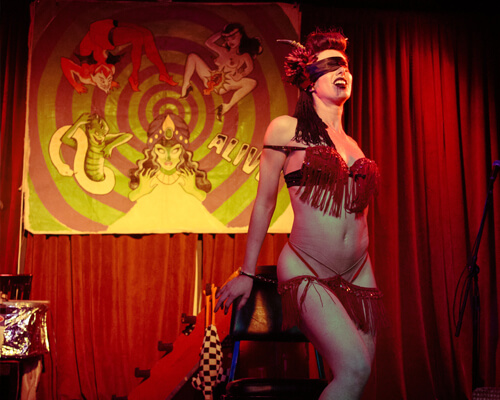
Tristan Risk Caravan of Creeps

Tristan performing with the Caravan of Creeps


You’ve already mentioned conventions and how you’ve changed your approach in how you put yourself out there as your career has progressed. What’s the best and most bizarre fan experience you’ve had over the years?

There’s been a variety of different experiences. I don’t know if this would be counted as a fan experience, but I remember I was coming home from work one day. I live a 10-minute walk to work from my house, so I walk to work every day. And I was probably wearing headphones. I get home from work one day, I put on my computer, I make a cup of tea, I go on Facebook and there’s a message from someone I don’t know. I was all, “Hey new friend!” And he was all, “Hey, it was good to see you before. I saw you when you got off work today and I wanted to say ‘hi’, but I didn’t know how so I just followed you until you went to your house. Then I got too shy to say anything, so I just decided to write you this note instead.”

That’s how horror films start!

Meanwhile, I’ve gone and locked all of my doors, wondering if he can still see me. Now he knows I’m home, does he know I’m home by myself? All these things go through my head. I’m fucking terrified because I had no idea I was being followed home from work! It was off my radar, I had my headphones in… I was so, so scared. I slept with all the lights on that night, and I slept in the bathtub because I can lock the bathroom door. I was living in the basement suite, so I was, “Oh god, this is how I die!” And I slept with a knife under my pillow, so, “If anyone finds me or anyone comes in, I will gut them like a fish or die trying!” That was probably one of the most unsettling moments I’ve had.

That almost sounds like the title of an autobiography, “Gut Them Like a Fish or Die Trying”.

It was someone who lived locally and obviously didn’t know that that was something that would scare the crap out of a person. I don’t really know even who I would call or what charges I would press. They didn’t do anything, it’s not stalking, it was just a one-time thing and I’ve never heard from this person since. I couldn’t really tell who they were and it’s hard to get a sense of who they were from the few Facebook photos they had. So sometimes when I’m walking around the main drag by my house, I don’t know if the person is there or not. It’s really unsettling to go through life being, “Huh, are you my potential killer? Or is it you that’s my potential killer? I don’t know, it’s hard to say.” This person clearly didn’t have an idea that that is a terrifying thing for a woman to deal with. It made me really aware that I can’t not be aware. What if that person hadn’t just been socially awkward? That could’ve really been a trap – I could be dead by now or had acid thrown in my face or who fucking knows. It’s really scary.
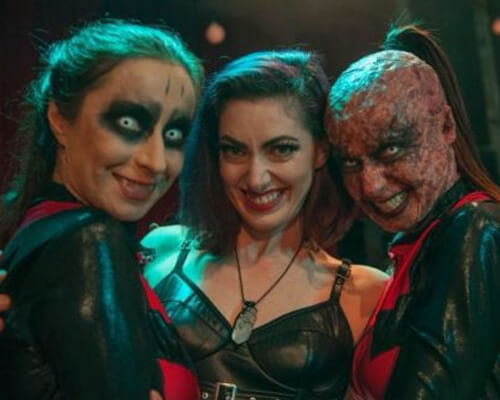
Tristan Risk Jen Sylvia Soska Twinpool Blood Drive PSA

Tristan with the Twisted Twins on the Twinpool Blood Drive PSA


You seem to be constantly busy all of the time, so what are you currently working on at the moment?

Well, I’m going to be directing my first short film that I also wrote called Parlour Tricks in the beginning of March. I have an awesome cast for that who are a few Creeps and a few non-humans, then also some awesome Vancouver cabaret artists. And I’m also excited for the Badass Film Festival at the end of the month in Vancouver. They’re screening Ayla, they’re screening The Mother of Beauty, they’re showing the Soskas’ Blood Drive PSA. It’s very much a film family jam, which is nice. Going to so many other festivals, it’s really nice to have it in my hometown, in my neighbourhood. It’s a 20-minute walk from my house, or stumble depending on how things go.

I am giving my first snake dance workshop in Vancouver, for women or men if they are interested. That’s basic snake handling tips, then how to do choreography and dance work with our legless ladies, because it can be a little bit of a problem. Burns and I will often once a month give a snake handling workshop out of our home. We’ll also do a dance workshop, and we’ll also do a photoshoot with a professional photographer and with all five of our snakes just to have for their own portfolio. We’ve done really well in the joys of handling snakes and giving people a chance to get used to handling them, getting a chance to ask somebody what to do in different situations before they go out and buy one. A lot of people will just get them and figure it out as they go without giving further thought to whether this is really right for you.

Something Burns and I also do is we take rescue snakes as well. People can’t care for their snakes anymore, or they get a boyfriend or girlfriend who doesn’t like snakes, or whatever. So if the snakes need any work, are bitey at all, need to be calmed down, or they just need assisted handling before they’re ready to be adopted – we do that. Then when they’re ready we put them up for adoption. Most people who do our courses who are interested in snakes like to come by and meet the snakes to see if they like them. We’re more interested in finding personal home solutions for snakes rather than people rushing out without thinking about what the care entails… and then us ending up with the snakes at the end [laughs].

And how many snakes do you and Burns have between you right now?

Six snakes. We’re fostering one snake right now that’s not ours. We’ve got a bearded dragon, a roughneck monitor lizard, and one fat orange tabby cat who’s around here somewhere.

You’ve talked about having so much on your doorstep. What’s the reaction locally when people see Tristan Risk walking around?

I like living where I live because I like that it’s made up of a lot of people like me who are all artists and we all support each other. You see people you know in the neighbourhood who you work with and you live with. It’s kind of a small town feel without actually being in a small town. Downtown is only 10-minutes away, but we’re on the east side because that’s where the artists can afford to live, where we make our art. You know when you go and see a film that’s made up of a great ensemble cast made up of a lot of cool people? It’s kind of more like that. I’m part of a constellation rather than being a single star.
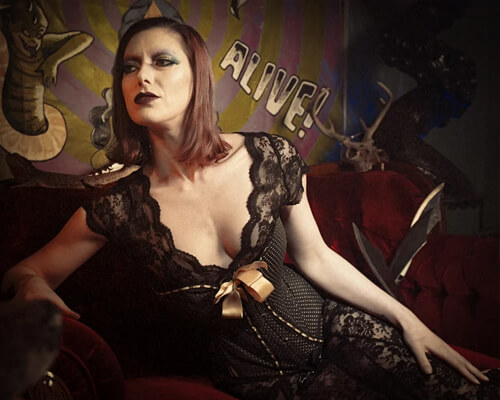
Tristan Risk

Photo courtesy of Tom Gould Photography, make-up by Make Up Jems


Is there anything you can tell us about your directorial debut Parlour Tricks right now in terms of plot and story?

Well it is horror-based, but it’s also a comedy. It’s a short film, and it’s going to be shot locally here in Vancouver in the beginning of March. We’re all going to come together and work on Parlour Tricks, which takes place in a Victorian parlour and has to do with a Ouija board and the summoning of some spirts and the problems that the crew have with that.

When did you first realise that you wanted to direct something?

It’s something that’s been brewing in my head just because I had the concept of doing more short films based around what I was doing. Again, I didn’t have to tour or if I wanted to show somebody what my vision was then it’s more a complete vision versus what I can do on stage live. I had that little thing sitting in the back of my head for a while. I’d written a bunch of short scripts that I thought were pretty funny or were worth putting together as films. Strangely enough, my first AD Topher Graham, I was trying to get him to direct Parlour Tricks. He was more, “Okay, you should really direct this,” “No, no, I’m not a director, I don’t know technical shit!” Then we were going over our shot list and I was all, “Ooh, this, can we do this?!” So Jordan, our DoP, was just looking at me, then Topher was looking at me, then Burns was staring at me going, “Just direct it already! You’re already directing it!” I was, “Okay, but I don’t know how to do lenses and stuff,” and the guys were, “We can do that! Just tell us what you want!”
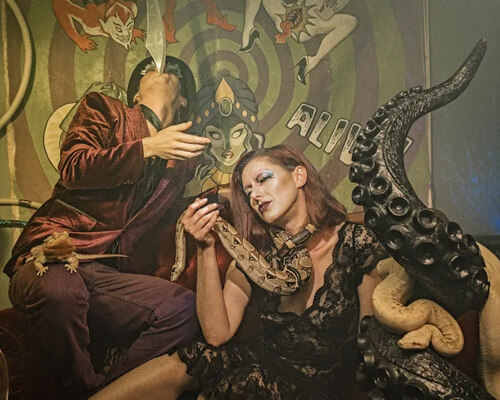
Tristan Risk

Photo courtesy of Tom Gould Photography, make-up by Make Up Jems


Reading back through our previous chats, a certain quote stands out amongst the rest. You said that you don’t think you’re a particularly good actress, just an accomplished liar to the camera. Do you still think that’s the case or do you now have more confidence in yourself as an actress?

I still feel that I wake up on a lot of days and feel like a fraud. I’m constantly worried I’m going to get called out. And every time I do a live performance, I have that self-doubt of, “Am I doing something that’s entertaining? Am I engaging? Am I accomplishing what I want as a performer?” And I feel like that on film, too. But film is easier just because between what I’m doing, and the director, and the editor, and whoever’s doing the sound, it comes together and they’ll make it work on film – which is why I feel like more of a fraud there. If I’m doing something live and it sucks, there’s no way I can fucking hide it. Sometimes I don’t always feel like I’m accomplished in any way. Sometimes I feel really good about what I do, then other days it’s more of a struggle to see the good in my work. But that just means it’s more of a drive for me to want to do better constantly. It’s like that old thing, “Again, only better!”

Before we wrap things up, what’s the details for your upcoming Patreon page?

It launches in March. I’m actually going to be shooting my pitch video in the next week or two so people know what they’re buying. Then I’ll be just trying to put it together so that at least if you’re taking the trouble to go to the Patreon, it’s going to be very clear what you’re getting. It’s good quality, it’s confident, it’s my commercial basically. I want it to be well done and make people feel excited about donating, not just, “Well, I’m throwing money down a nasty black hole here.”

Aliens Ate My Homework is released on digital download and home release on March 6th. To keep up to date with Tristan’s work and her Patreon page, be sure to follow her on Twitter and Instagram.

Aliens Ate My Homework

Mark Perry | BANANAMAN THE MUSICAL

Mark Perry Bananaman the Musical

Bananaman is a much-loved British comic-strip character who has been parodying super heroes since the ‘80s. The adventures of Eric, a schoolboy who transforms into a superhero by eating a banana, have been available in comic and cartoon form for years, but the unlikely hero is now coming to the stage. Bananaman the Musical is playing at Southwark Playhouse, London from December 15th to January 20th. We caught up with the director Mark Perry to find out more.
STARBURST: Why should we go to see Bananaman the Musical?

Mark Perry: It’s the first time Bananaman will be live on stage! Having been a Beano and Dandy favourite character for years and years, and also an ‘80s TV series, this is the first time you can see the Man of Peel himself in the flesh. For all of those who remember him from the comics and cartoon, they will recall what a fun and funny character he is, and on top of this they can introduce a whole new bunch of Bananafans to 29 Acacia Road. The show is slapstick comedy, silly jokes, brilliant songs (amazingly sung), MAGIC! and a perfect festive night out.

Why did you want to turn Bananaman into a musical?

Superheroes are hugely popular at the moment – Batman, Captain America, Spider-Man. Bananaman is the most useless of all of them and the funniest. I have always loved Bananaman. I grew up reading about his adventures from a very young age and his bumbling ways have stuck with me since then. I think Bananaman is not only a funny parody of the superhero genre, but he is a brilliant character in his own right. His buffoonery and idiocy work perfectly within a musical.

How did DC Thompson react to your proposal?

Interestingly enough, DCT had already had a proposal for a musical sent to them shortly before we spoke to them and had turned it down. As you can imagine, this made them fairly cynical when we turned up! I explained that I wanted to take the musical right back to the original comic strips and portray Bananaman as he was: loved by kids but really funny for adults, too. The fact that we were going for such a genuine representation of the Bananaman character meant that they went for it!

Are you ever alert for the call to action?

I’d say I am. My wife would probably disagree…

Given the amount of superheroes out there, does the world need Bananaman?

Bananaman is not like any other superhero. For a start he’s terrible at being a superhero. He only saves the world by accident, but he always does it with buckets of charm and a massive grin on his face, making him the most loveable.

What’s your favourite song?

Leon Parris’ writing is so consistently witty that I find it very hard to choose… however, there is a song in the show when Bananaman is having a moment of soul searching, self-doubt. He sings, “I feel so blue, oh so blue… with bits of yellow, too.” I must admit that is a personal favourite.

What was the trickiest part of the production so far?

The transformation. Eric has to eat a banana and turn into BANANAMAN! No matter how you look at it, that’s quite tricky to stage…

Is it harder to do musical comedy than, say, Brecht or Shakespeare?

No, not really, they all have their challenges. What Leon Parris has done, which does makes this hard, is that the whole show is a constant moving mixture of song and dialogue, always dipping in and out from one to the other so everything has to be timed to perfection. We’ve also got a great deal of slapstick comedy, which requires thorough planning and specifics so that it can look as spontaneous as possible. Much like Shakespeare!

If you had a bigger budget for the show, what would you do with it?

We’d have more bananas. We’d also have the Banana Car. It’s what the Batmobile is to Batman. If we had a bigger budget we’d have that, and then I’d adopt it as my mode of transport long after the show had finished.

What where your favourite moments during the development process?

One of my favourite moments was when we did our very first workshop. This was when, after years of seeing the words and music on the page, they were brought to life and made three-dimensional by some very talented actors. We had always been excited about this show, but hearing it come off the page we were more excited than we ever could have predicted.

How would you introduce the cast to a curious member of the royal family? (Note: This is a cute way of asking you to tell us more about the cast).

Our muscle-bound, muscle-suit-wearing hero is Matt McKenna – he’s so charming he’d probably give Harry a run for his money with Meghan. Jodie Jacobs (who plays Crow) has the voice of a rock star angel and the biggest heart – I’d send her off to entertain Prince George and Charlotte. What we love about our cast is all of them are unique and have spent the whole rehearsal process laughing their heads off and falling in love with the characters of Acacia Road. If Queenie was interested, I’d say they represent the best of British, though I wouldn’t include Doctor Gloom and General Blight in that…

What should we look out for?

Keep an eye out for our villainous villains. Doctor Gloom, General Blight and the Mad Magician are all after Bananaman but they have a unique rivalry all of their own. Also in our production, the character of Fiona is the only one to have had a 21st century Beano update; she’s a feisty one and fun, too.

Why are British comics so unique?

British comics have both exciting storylines and great visuals and the ability to laugh at themselves. There is an irony and ‘knowingness’ which is unique to them. I think they manage to tread the line between action and parody perfectly.

Do you have more theatrical ventures like this planned?

Lots. One in particular which is very exciting which we hope to announce next year, so watch this space…

Truth or beauty?

Bananaman sometimes struggles with the facts, but he’s always 100% sure that he’s a handsome hero. So, I’d have to go with Beauty.

When can we catch the show?

Bananaman the Musical opens at the Southwark Playhouse on December 15th running until January 20th. Bring a bunch of bananas, your family and friends and settle in for an A-PEEL-ING show!

Tickets can be booked via southwarkplayhouse.co.uk.

Jonathan Green | NEVERLAND – HERE BE MONSTERS!

neverland

Jonathan Green is one of the UK’s most prolific creators of franchise fiction. The freelance writer’s credits include Fighting Fantasy, Warhammer 40,000, Doctor Who and Sonic the Hedgehog. He’s also responsible for all sorts of steam punk, science fiction and fantasy novels. His latest project, Neverland Here Be Monsters!, mashes up Peter Pan with Sir Arthur Conan Doyle’s novel The Lost World to create a unique choose your adventure style fantasy gaming experience. It is currently seeking funding on Kickstarter.

STARBURST: What is NEVERLAND – Here Be Monsters

Jonathan Green: NEVERLAND – Here Be Monsters! Is a brand-new choose your path adventure gamebook, very much in the same style as Fighting Fantasy or Lone Wolf gamebooks, in which you take on the role of the automaton avenger Peter Pan or the shipwreck survivor Wendy Darling.

It’s an old school solo-RPG but with design elements inspired by modern developments in video games. There is not only one way through the adventure and so re-playability is a key element of the gamebook. And if the Kickstarter hits all its stretch goals, you will also be able to play as the heroic hunter Tiger Lily or the notorious pirate Captain James Hook himself.

How would you explain NEVERLAND – Here Be Monsters! to an elderly relative?

Do you remember King Kong? Do you remember the Skull Island, where he lived? Well imagine that Skull Island and Peter Pan’s Neverland were actually the same place. And then imagine being able to influence the course of the story, rather than just being a passive reader, by taking on the role of one of the characters from Barrie’s book. And that, in a nutshell, is NEVERLAND – Here Be Monsters!

Why mash-up Barrie with Doyle?

Why not? But in all seriousness, I suppose it really began after my first ACE Gamebook, Alice’s Nightmare in Wonderland, was published. It was well received and people asked if I was going to write a sequel, but I had already included Through the Looking-Glass, And What Alice Found There in the first gamebook and so I needed to look elsewhere.

The next logical step, for me at least, was to give The Wonderful Wizard of Oz the Alice’s Nightmare in Wonderland treatment, and so The Wicked Wizard of Oz was born. In Alice’s Nightmare, the reader guides Alice through a nightmarish version of Wonderland, but in Oz the reader takes on the role of one of the characters from Baum’s original, each with their own abilities and different encounters in the adventure. NEVERLAND – Here Be Monsters! continues this theme.

But I had also wanted to write a gamebook inspired by King Kong for a long time, and also had another idea featuring pirates (a subject my gamebooks have experimented with before) and it just seemed to make sense to combine them with Peter Pan. After all, I’m not the world’s biggest fan of Barrie’s original, and everything’s better with dinosaurs. Right?

The last fact, which just seemed to make the mash-up too good to be true, is that the novel Peter Pan and Wendy was published in 1911 and just a year later Doyle’s The Lost World was released.

What is it about Peter Pan that we keep coming back to?

It’s a classic of children’s literature and Disney’s 1953 animated interpretation of it means that many people have been exposed to the most well-known elements of the story without necessarily having read the story themselves. On top of that, it has enjoyed many stage adaptations and has become a staple of the pantomime circuit. And of course, children love to dress up and play as pirates, which is a vital element of the Peter Pan mythos, if that’s not too big a word for a rather twee 20th Century fairy-tale.

Doesn’t Pan have quite dark origins?

The primary theme of Peter Pan is the conflict between the innocence of childhood and the responsibility of adulthood. There’s also a puckish quality to Peter and other aspects of his character make him more pagan nature spirit than carelessly-abandoned human child left to be brought up by fairies. And then there’s also the rather uncomfortable romantic element, which many adaptations probably wisely choose to admit, with Wendy’s flirtatious desire to kiss Peter, Peter’s desire for a mother figure, and his conflicting feelings for Wendy, Tiger Lily, and Tinker Bell, each of whom represents a different female archetypes. And then there’s the symbolism of Peter’s fight with Captain Hook, who in stage productions is traditionally played by the same actor as Wendy’s father. I’m sure Freud would have a field day!

Why The Lost World?

Well, as already mentioned, there’s the fact that it was published a year after the novel Peter Pan and Wendy, and it has dinosaurs in it, but it also has the Accala tribe who I have chosen to replace Barrie’s Picaninny tribe who have become horribly culturally dated (never mind the fact that they were a racial slur in the first place).

How does NEVERLAND – Here Be Monsters! compare to The Wicked Wizard of Oz or Alice’s Nightmare in Wonderland?

The three books form a loose trilogy but each one is a progression from the last. Alice introduced the ACE Gamebooks concept and rules set, Oz added the option of playing the adventure as different characters with different abilities, and NEVERLAND will introduce companions to the mix.

What hasn’t changed is Kev Crossley fantastic artwork, which will ultimately adorn all three books in the series, helping to give them a unifying look.

Why is traditional gaming making such a comeback?

I think it’s the same reason why café culture is so popular at the moment; people have gone online and discovered all it has to offer, but have always realised that there’s nothing quite like actual face to face human contact. The tactile experience shouldn’t be forgotten; there’s something very satisfying about opening a box of game components, are painting a miniature, or feeling the weight of an actual book in your hand and taking in the heady scent that comes from the printed page.

Why Kickstarter?

It’s a great way of taking pre-orders and raising the funds for artwork. And by artwork, I mean quality hand-drawn art as opposed to regurgitated digital art with the cut and paste function being used far too readily. It’s strange that digital art, particularly black and white or grayscale digital art, can end up feeling flatter than hand-shaded pen and ink work, when, in theory at least, the opposite should be true.

How does this compare to your work on the Fighting Fantasy series?

My work on NEVERLAND – Here Be Monsters! and the rest of the ACE Gamebooks has grown out of the work I did for the Fighting Fantasy series. Through writing FF gamebooks I learnt what makes a good gamebook, in terms of game design as well as quality of writing. However, the ACE Gamebooks let me try things that I wouldn’t be able to do with a conventional FF adventure and help demonstrate how far the gamebook medium can be taken.

People who enjoyed my later FF titles, particularly Howl of the Werewolf and Night of the Necromancer, can expect the same sort of action-packed adventures from my ACE Gamebooks, and NEVERLAND – Here Be Monsters! especially. After all, it could equally be subtitled Pirates Vs Dinosaurs!

What’s happening next with the Fighting Fantasy books?

Next April, or thereabouts, Scholastic is going to release another six titles, Steve Jackson’s Creature of Havoc, Appointment with F.E.A.R., and Sorcery! book 1: The Shamutanti Hills, Ian Livingstone’s Deathtrap Dungeon and Island of the Lizard King, and Charlie Higson’s brand-new The Gates of Death. As Charlie is new to writing gamebooks, despite being a fantastic and established author, I have been giving him a hand with the gamebook mechanics side of things.

Will we see more YOU ARE THE HERO?

I actually have two more titles in the series tentatively planned. One would be a continuation of the history of Fighting Fantasy gamebooks, to be published around the time of the series’ 40th anniversary in 2022, and the other would be a history of other gamebook series, such as Lone Wolf, Fabled Lands and Destiny Quest.

What franchise series would you love to write for next?

I would love to write something for Stranger Things, but I have long held a desire to write for Batman. In fact, I would love to write a Batman adventure gamebook. I would cram it chock-full of my favourite Batman villains, such as Killer Croc, Solomon Grundy and Clayface.

What’s next?

I’m actually writing a short story at the moment that I hope will become part of an ongoing series and I have various other short stories to write for other people. I may be editing another anthology next year and am also working on ideas for a new novel.

In terms of gamebooks, after NEVERLAND – Here Be Monsters! I would like to get my teeth into Beowulf Beastslayer, which has been on my To Do list for the last four years.

Where can we found out more about your work?

Via my website/blog at www.JonathanGreenAuthor.com. I’m also on Facebook and tweet as @jonathangreen.

NEVERLAND – Here Be Monsters! Is currently running on Kickstarter until December 2nd.

Claire North | THE END OF THE DAY

claire north

Claire North is one of the pen names of prolific author Catherine Webb, who is also known to younger readers as Kate Griffin. As Claire North, she has written three science fiction novels, including the award winning The First Fifteen Lives of Harry August. We caught up with her to talk about her recently released novel, The End of The Day.

STARBURST: Why the multiple pseudonyms?

Claire North: At first, it was because I was getting old. The irony! When I first started scribbling I was a teenager, and I wrote books that were groovy for teenagers, because I write for my own joy and happiness. Whether writers mean it or not, what they write tends to reflect who they are; my writing reflected that I was a young adult. Then I hit my early twenties. I was changing and so did the books. As a result my publisher decided to slap the equivalent of a PG warning on my stuff, a sort of ‘it’s like the books of Catherine Webb, but with more swearing’ tag. The fastest and easiest way to do that was to have a soft pseudonym, and become Kate Griffin. It’s a way of declaring ‘like this but different’.  Also if you look at most bookshelves, ‘W’ as a surname is in a very inconvenient place, whereas ‘G’ is bang smack at eye height. This stuff can actually matter….

Then a bit more time passed, and I wrote The First Fifteen Lives of Harry August, and once again my publisher was a bit like ‘oops you’re changing what you do, shucks’ – or words to that effect – and it was pseudonym o’clock. Becoming Claire North, however, was less about the health warnings and more about how genre is perceived. I absolutely believe that science fiction and fantasy can tell some of the most incredible, exciting, thought-provoking stories out there, while being full of joy and wonder – actual wonder, a thing that leaves you gaping at the power of imagination and full of hope for humanity. But sometimes people equate it to simply orcs and aliens. Which is fine. It can be exactly that, and that’s great. Entertainment, the joy of a romping adventure – these are things to be valued and cherished for the delight they bring, not to be looked down upon.

But with the Claire North books, my publisher judged that there was probably space for these books to be seen as both SF, but also as something a bit broader. And so Claire North popped into existence, as another way of differentiating what I write now, from what I have written before.

Also ‘N’ is at a very handy height on the bookshelves…

What’s the elevator pitch for The End of the Day?

Hi.

Death is coming.

Asked me to send you his best.

Have a lovely day!

How would you describe The Sudden Appearance of Hope to an elderly relative?

I only have one elderly relative, and she summarised one of my recent books as: ‘I could actually read this one,’ so you are setting a bit of a challenge here.

Probably: ‘Gran. You love me very much. I love you very much. I’m proud of this book. It’s about a woman no one can remember. I’d be really happy if you felt like giving it a go, and if it’s not your thing then that’s ok, we need never talk about it ever again.’

I know it’s not detailed.  But it’s honestly what I’d say.


How did the process for writing The End of the Day compare to The First Fifteen Lives of Harry August?

This is gonna sound awkward, but… I’m struggling a bit to remember. The End of the Day was finished about two years ago. Harry August was finished six years back. I wrote Harry August while working as a lampie at the National Theatre, and The End of the Day travelling between shows, so it’s a bit of a blur of snatched moments between cues.

Both had logistical challenges. In Harry August, it was tricky keeping the ages of various characters in order, and both books required attention in terms of places visited and the details that bring them to life.

Other than that… I can never really remember much about the act of writing. I remember stories, images, sounds and voices. I remember… colours as much as anything, the colour that a chapter had, or the way something tasted as it was written (synaesthesia is a bit of a family trait).  I remember looking up and being in certain spaces – the Blue Room at the National Theatre, or Manchester Central Library – but actually writing words? My brain doesn’t really clock the process. Just… feelings and tangled bits of sense. Some words feel square, heavy; others are hot, some are light and fast and fluffy, others are… something else again. Harry August felt solid, four beats to a bar, different shades of blue. End of the Day was more full of popping noises, of shimmering things that come and go, reds and oranges. That’s how writing feels, all the time. Which doesn’t make this answer any more useful for you, I’m afraid, but remains the truth.

Why are we so obsessed with the end of all things?

Naturally – we’re scared of dying.

Because, of course – we’re scared of living.

Let’s face it, dying itself… yes, it’s a scary thought, but what’s actually petrifying? A live lived in pain.  The ones we love being left behind. The hurts we never healed. The things we never achieved. A life without meaning. An existence without purpose. Being forgotten. Our achievements melting away into nothing more than a carbon footprint on a withered world. Having spent all our days in a haze of minor misery and distress, justifying the tick-tock of our existence with ‘maybe tomorrow it’ll be better’ when it isn’t, and never will be, and we blame ourselves for being prisoners of misery.  Being shunned. Being alone. Living our lives in hardship and greyness and never giving to others the joys we seek for ourselves. The end of everything isn’t about the snap-pop of existence fading, or even the promise of an afterlife in which we are punished or rewarded for our actions. Afterlives just serve to enhance the great big terror of today: what is my life worth?

What am I doing with my life?

Day by day, we live with this question by never thinking about what happens after tomorrow, and after the tomorrow after that.

But the end of all things throws that question into terrifying, sharp relief.

If my life ends today, what was it good for?

And from that, the scariest question of all: who am I, really, when push comes to shove?  What will I do, when tested at the last?

It’s the big question we spend our days exploring, with an answer that we never really wanna know.

Which of the Horsemen would you most like to invite for tea and scones?

Either War or Death. Famine would eat all the scones, and conversation with Pestilence will probably turn you off your supper. Whereas War will probably have incredible anecdotes, even if the entire evening ends in tears; and I can’t imagine Death caring much if you have the wrong kind of jam.


Which character in End of the Day was the most fun to write?

Probably Death.

I mean, Charlie was lovely to write, because he was kind. It’s not that often I write characters who value kindness so intensely in their souls.

But Death sits both outside the trivial furies of the world, above and beyond it, while also being such an integral, fundamental part of life that it creates an opportunity to do something… different.  Death is also seen, in this book, through the eyes of the beholder as something unique to everyone, which makes him/her/it a reflection of their beliefs in ultimate form.  And that was tonnes of fun.

claire north book


Is there a bit that you didn’t get to put in the book? Is there an element of the story that didn’t fit?

I feel like yes? I feel distinctly like we lopped 30,000 words off this book, but for the life I me I can’t remember what they were, which does imply that they weren’t very important….

I also seem to recall a lot of chopping and changing. One of the flaws of the book (and arguably there are plenty) is that the story isn’t a linear ‘there is a problem’ – ‘ah now we must solve the problem!’ narrative. When death is inevitable, unavoidable, and the very essence of every story we meet is that it must end, this is kinda a needful thing. But as humans we are drawn to stories that encapsulate something neat, and forward. This book isn’t really that, and there was a fair amount of wiggling to try and shape it into something that could be both true to the story it tells, but also to the stories we as readers’ desire.

What’s next?

My next book is called 84K and is out in spring 2018, I think. It’s the story of a dude called Theo, whose job it is to audit the value of someone’s murder. If you can afford to pay for the life of the person you killed, then you get off free, and there is nothing in society which can’t be bought or sold, if the price is right.

Theo is just a civil servant, part of that universe, until it all goes wrong.

I’m also one of three writers contributing to an anthology of novellas for Black Mirror, which I believe is also due to be published early 2018.

And I’m writing another book as well, just to keep things ticking along, and beginning to dabble – very cautiously – a little bit in film and TV.

Apart from that: there’s always another show to light!


If you were writing in someone else’s world, what world would that be?

Roger Zelazny’s Chronicles of Amber, which permits its characters to go anywhere you can conceive between the twin poles of Chaos and Amber while weaving in massive tales of politics, family and revenge. Although I probably wouldn’t, because I’d be too scared of screwing it up. But that’s sorta the nature of some of the greatest worlds out there, isn’t it? Earthsea, Discworld, the Culture… these are incredible, beautiful places to sink your senses into. But as much as every reader has a unique experience in every book, every writer’s best work is something that is from deep within themselves, whole and true.


Which of your works would you most like to see adapted to other media? Why?

Controversially… the Kate Griffin books (controversial ‘cos I haven’t written one for a while!). Urban fantasy. Things going boom! London! Magic! Dragons! Think of the hours of fun!

Also these books probably lend themselves to going beyond anything I ever wrote, if adapted for TV, and taking on a life beyond the page. I think that’s a lovely thing. I think it might be the point.

What’s the cleverest thing you’ve ever done?

Fixed an unresponsive projector that had its menu stuck upside down… and in Mandarin.

What’s the silliest thing you’ve ever done?

Well… I did choose to spend my career writing books for cash while being a theatre lighting designer and technician. As choices go, it’s pretty up there.

Apart from that blip, I’m pretty dull. Although if given a choice between hanging out talking about literature, or sneaking away to go play on trampolines, it’ll be bouncing all the way. Did you know there’s a street near the Excel Centre in Silvertown that has trampolines in the roads? That you can go and bounce whenever you want? How did we have to wait for the 21st century for this to be a thing?


Why is genre fiction so popular now?

Hum… you mean, popular with lotsa people as well as the millions of joyful souls who’ve totally known about this stuff for decades?

Because geeks have been around forever, and so the change in the perceived popularity of genre fiction has to be seen as a two-fold thing. 1. It is getting more popular, yes. But also 2. It’s now ok to be a geek, sorta. You’re less likely to be shunned or bullied. Geeks are coming out of the woodwork and there’s a lot more of us than anyone thought….

It’s worth highlighting this geek thing, because humanity has an uncanny ability to define its self-worth by diminishing others. I am better than you because I read Nabakov. He is better than she because he reads Proust. It’s horrifying that something as beautiful, as humane as books should be co-opted into this dance of self-worth, given that books fundamentally are exercises in empathy. It is also a very human instinct to define ourselves by what we are not. We are not geeks. We don’t like books with violence. We’d never be caught reading soft porn on the Piccadilly line. Or Harry Potter.  Whatever. Because we send signals to the world, constantly, about who we are and how we wish to be perceived, and what we read is part of that dance.

So part of the shift, I think, in the popularity of genre is that it’s getting ok to read what you like reading. For it not to be another thing, like body image, which is used to shame or cruelly define us.

Films have helped, because there comes a point where you have to admit that Marvel films are fun, that Arrival is pure SF, as is Gravity and the Martian, that Game of Thrones really does have dragons too, and that Doctor Who is something the grown-ups enjoy. And that as well as being enjoyable, sometimes they have ideas too.

By opening up these universes in a huge way, I think it makes it easier for SF/Fantasy to not be ‘that weird geek thing’ but to be an accepted part of our cultural landscape. There’s still a way to go.  A huge amount of genre fiction is still tagged as ‘speculative fiction’ or ‘magic realism’ as if 1984 or Brave New World or Frankenstein or Handmaid’s Tale aren’t, in fact, SF.

Genre has its uses. It serves to help us find more books that may be like the books we adore. But it is also occasionally a tool for drawing lines, for dressing ourselves up in borrowed clothes to project the image of who we think we should be, rather than celebrating the diversity of what we love and who we are.

Is the world of genre fiction as open and as accessible as it thinks it is?

Yeap. Firstly, you’ve used ‘genre’ here, which I’m gonna assume for a moment includes crime, thrillers, romance etc., as well as SF/fantasy. All of which are frequently accused of being too accessible, whatever that means. “It’s just a bit of pulp,” is I believe the phrase used to cover stories from the genres that brought us Raymond Chandler, John le Carre, Agatha Christie, Stephen King, Doris Lessing, David Mitchell, Arthur Conan Doyle and I’d argue could also cover Jane Austen and Emily Bronte.

So…. Yeap.

If you just wanna zoom into SF for a moment, then sure, I get where the question might come from.  It’s easy to be thrown into the deep end, into warp drives and fire magics and so on – into a landscape that feels distant. But when we watch medical dramas on TV, or anything much of that ilk, we tolerate CT scans and PETs and MRIs and ‘third lymphoplastic spinal nerve’ or such like, not because we understand it, but because we understand the emotion that lies beneath it. We embrace that when someone says “intubate stat!” what they also mean is “and I still love you!”

Science fiction is no different. But it’s easy to be scared of genre. It asks you to set aside your preconceptions and let your imagination soar over some of the hardest questions out there. What is humanity? What is life? What is death? What if? What if what if what if? These are scary questions.

They are also beautiful questions. They are at the heart of every piece of our daily struggle to find out who we are, and whether what we do matters as both individuals, and a species.

And what’s best, is we can ask these questions in genre while having a shit-tonne of fun. It is the most accessible thing ever. It is the questions of the philosophers packed up in spacesuit, given a laser and told to go get that asteroid.

Genre is awesome, and it welcomes you with all its heart.

Where can readers find out more about you?

@ClaireNorth42 and www.kategriffin.net.

Claire North, author of The End of the Day (Orbit, £8.99) is shortlisted for the 2017 Sunday Times Peters Fraser + Dunlop Young Writer of the Year Award, in association with the University of Warwick. Claire will be speaking at a panel event with the other shortlisted authors at Waterstones Trafalgar Square on November 28th (6.30-8.30pm). The winner is announced on December 7th. www.youngwriteraward.com.

Andy Weir | ARTEMIS

andy weir

Andy Weir is an American novelist whose debut novel, The Martian, was later adapted into a film of the same name directed by Ridley Scott in 2015. His eagerly anticipated novel, Artemis, is out now.


STARBURST: What is the elevator pitch for Artemis?

Andy Weir: Artemis takes place in a city on the Moon in the early 2090s. The main character is a woman who is a small-time criminal who gets in way over her head.

Does the world have enough space heist novels?

No! I love heist stories and I love sci-fi. So naturally, I’d love to see more sci-fi heist novels. I remember liking The Stainless Steel Rat series back when I was a kid.

How realistic is the moon base of Artemis?

It’s very realistic. At least, as realistic as I could make it. I worked out how they built it, how their air and water closed systems work, and most importantly, how its economy works.

Your stories tend to put your characters in constant peril. How tempted are you to kill off scores of heroes?

Nah. I write light-hearted stories for the most part.


What is about the character of Jazz that made you make her the protagonist?

Jazz was originally going to be a minor character in a completely different story idea I had (one that also takes place in Artemis). I didn’t like that story, but I did like Jazz. As I went through revisions of story ideas, her role kept growing and growing. I eventually realized she was the most interesting character, so I centred the story on her and things fell into place.


Will we see more from the world of Artemis? Will we see other characters from this book in other stories? Will we see more of Jazz?

That’s my hope. I want Artemis to be the setting for many books revolving around many characters. I have lots of ideas for the little city on the Moon. But first I’m going to see how well received Artemis is and what feedback I get from readers. If they don’t like certain things I’ll try to change them (or not focus on them). What they do like, I’ll emphasise more in future books. That sort of thing. And, of course, if they don’t like the book at all, I won’t make a sequel.


Are we likely to see Artemis on the silver screen?
Hard to say. Fox bought the film rights, so they certainly have an interest. But everything has to line up just right for a film to be greenlighted. There’s no way to know. My guess is Fox will wait to see how well the book sells before thinking about it further.

artemis

What’s next?

I’d love to write another book taking place in Artemis. I have the bones of the story worked out, and it centres on a different main character.

ARTEMIS by Andy Weir is published in hardback by Ebury.

Burt Ward | BATMAN VS. TWO-FACE

Burt Ward Robin Batman vs. Two-Face

Holy interview time, Batman! Following the return of Adam West and Burt Ward’s Dynamic Duo in last year’s animated Batman: Return of the Caped Crusaders, now comes a follow-up in the form of Batman vs. Two-Face. Recorded in October 2016 and before the sad passing of the iconic West this June, the sequel sees William Shatner join the action as the nefarious Harvey Dent. To coincide with the film’s release, we were lucky enough to catch up with the legendary Burt Ward to discuss playing the Boy Wonder once more, his thoughts on Shatner’s Duplicitous DA, what it was like to have fame thrust upon him at such a young age, his thoughts on how the animated Batman features can still continue despite the tragic passing of Adam West, and a whole lot more.

STARBURST: How was it to return to the fold with last year’s Return of the Caped Crusaders and now Batman vs. Two-Face, and do you still get the same kick out of playing Dick Grayson/Robin?

Burt Ward: Well, let me tell you, this movie is so incredibly spectacular. Last year’s movie was very good, it got tremendous reviews, but this is like a warp speed advancement. Much wilder, much bigger, everything – it is a mindblower! The people who have seen it, the reaction has just been unbelievable. I get emails from people saying, “This is the greatest animated Batman we’ve ever seen, period!”

One of the big talking points about the picture is William Shatner coming on board as Harvey Dent/Two-Face. How great of a fit was he for that role?

He is so unbelievable. The job that he did as Two-Face and Harvey Dent – the alternate identity – it was nothing less than spectacular. I thought he was a great actor, but what he did with this was out of the stratosphere. In my opinion, he was absolutely fantastic. At the world premiere at New York Comic Con, there was a standing ovation, cheering, screaming after the movie. We did a panel and I sat next to him, and that man has an incredibly sharp wit. He is so quick, he is razor-sharp and hilarious and funny. The two of us were teasing each other. I had no idea how sharp this man was. He’s an incredible actor and just an absolute delight to work with.

Batman vs. Two-Face William Shatner

The role of Robin was your very first acting gig, but did you ever imagine that Batman would become so incredibly successful and that, as a result, you would be thrust in to the public spotlight so much?

Nobody knew when we went in to it, we were a mid-season replacement for the ABC network. Nobody knew how successful or not successful it was going to be. The opening night, they had a 55 share. That meant that 55% of all televisions in North America – that includes the United States, Mexico and Canada – 55% were watching Batman, and the other 45% was spread out between all kinds of other networks and local and regional channels. This was the equivalent of a bigger audience than the Super Bowl. That’s how huge it was!

Having landed the Robin role at just 19 years of age, how was it dealing with that huge level of instant fame at such a young age?

For me, because I was a young actor, I had not been rejected for any other roles. I just had a wonderful open attitude. I didn’t think I’d change as I was the same person with or without the costume on. I was amazed how people just went bananas. You had kids who were running around with bath towels around their neck held together with clothespins, jumping off their couches. You had the adults that were just crazy over Batman because of the nostalgia, the comic books. And then you had that audience that no networks could get at the time. That was the teenagers and college kids. They didn’t want to watch TV at that time because it wasn’t cool. But Batman? Oh, they needed to see it because of the insinuation and the highly suggestive moves we made – which, of course, got us in to trouble with the censors every other week – but nevertheless, they loved it. We had something for everybody.

Batman vs. Two-Face Batman Robin Adam West Burt Ward

Of course, Adam tragically passed away earlier this year. Cesar Romero, Burgess Meredith and Frank Gorshin have all sadly not been with us for many years now, yet Joker, Penguin and Riddler replacements were brought in for these two recent Batman animated efforts. Do you think it would be at all possible to do another animated feature without Adam, though?

Absolutely! I will go one step further, it’s possible they’ll have Adam. Not exactly like you would think, but it’s possible. Remember, all of those 120 episodes, all of that dialogue was recorded, and so many things could be reassembled and put together from that show. I don’t know what the future’s going to hold, I don’t want to speak out of turn, but I can tell you that if this film’s successful this will not be the end of Batman animated features. This will be a new beginning.

Batman Robin Adam West Burt Ward

Over the past several decades, you’ve dedicated yourself to creating a revolutionary dog food that is geared to extending the lifespan of man’s best friend. Dubbed “half the price, twice the life,” what can you tell us about Gentle Giants?

We’ve found a way to double and triple the lifespan of dogs. We have dogs living as long as 27 years! Giant breeds as well as small breeds. Dogs that only live five or six years living in to their late twenties. We’ve devoted the last 23 years of our life and millions of our own dollars to develop technology. It works beautifully. You can read about it on our website www.gentlegiantsdogfood.com and www.facebook.com/gentlegiantsdogfood. And by the way, it’s coming to the UK!

Batman vs. Two-Face is out now on Blu-ray and DVD, and you can find our full chat with Burt in STARBURST Magazine #443 – on sale November 17th!

Tobin Bell | JIGSAW

Tobin Bell is one of the most respected and sought-after character actors working in film and television today, with an enviable list of credits including Tootsie (1982), Mississippi Burning (1988), Goodfellas (1990) and In The Line Of Fire (1993), in which he played a counterfeiter who meets Clint Eastwood’s Frank Horrigan at the outset of the film. Back on screen in the title role of the latest Saw film, Jigsaw, due for release this Halloween, Bell is destined to play all kinds of games with horror fans in the hugely successful franchise. In person, like the very best horror actors, Bell is a likeable individual, with a well-read mind and some refreshing insights into his career and films. STARBURST had the pleasure of recently speaking to him ahead of Jigsaw’s Halloween release.


STARBURST: Jigsaw is another of the horror genre’s key franchise characters. What would you say is his enduring quality, given what he has done to umpteen victims over the years?

Tobin Bell: It’s an interesting question. The appearance of Jigsaw in 2017 will resonate given the climate. The perspective of people is going to be different with this film from previous appearances and films. I think a lot of the reaction will be based on what people bring to the theatre. We don’t talk about the political context with this film, but it will be felt when people are watching Jigsaw on a sixty-foot cinema screen.

You were part of the famed Actor’s Studio graduates, which have included the likes of Pacino and Brando. What was so special about training there and how did it help you develop as an actor?

The Actor’s Studio was run by Lee Strasberg. I was based at the Neighbourhood Playhouse and I auditioned and got into the Studio in 1968, the same year as Al Pacino. The Studio was a Workshop for Professional Actors and not a Studio as such. It runs on Tuesdays and Fridays and people would come in and do pieces and monologues and then we would critique the various performances. In terms of how it helped develop me as an actor, it certainly helped me in the two decades before I got my first professional break.

How does a horror director vary from a mainstream one in your opinion?

Hopefully, not at all! As an actor, I work on a character regardless of whether it is a lawyer or a police officer or Jigsaw. You work on the same things and hopefully, any director with skill and talent will bring the human and character elements to the performance and film.

You have set designers for set design and you have effects people for special effects. Both actors and directors are there to bring the human qualities and elements to the piece.

Finally, what would you say is your proudest moment in your career?

I would say going back to square one when Alan Parker cast me in Mississippi Burning (1988). My first scene was walking into a cobbler’s shop with Gene Hackman and it was my first speaking role, having done thirty-five films where I didn’t say a word and this was my first speaking role. On balance, that was my proudest moment.

JIGSAW will be playing more games in cinemas from October 26th.