Michael Ironside • Liverpool Comic Con

With over 300 acting credits to his name, it’s impossible to sum up the incomparable impact of Michael Ironside’s acting journey thus far in just one interview. Ahead of Liverpool Comic Con, we take a deep dive into his portfolio and extensive collaboration with director Paul Verhoeven. We take a behind-the-scenes look at Total Recall and Starship Troopers, whilst digging into his organic voice acting approach on the Splinter Cell series, as Sam Fisher! With his recent narration work on Late Night with the Devil, Ironside continues to steer towards incredible projects, and all of us here at STARBURST can’t wait to see what he does next!

STARBURST: What do you remember the most from initially getting involved with Scanners?

Michael Ironside: When I auditioned for Scanners, through David Cronenberg, it was the flashback scene, with the therapist, it’s in black and white in the film, Cameron Vale, who you later find out is my brother. That was the scene that I was shown, and as far as I know, the Darryl Revok character really wasn’t filled out yet when David presented that script. The original contract was only for two days, to act for two days, and in those days, the actor scale for two days was something like 140 dollars a day, back in 1979. David asked me, “Are you doing anything right now?” I said, “No, I’m actually doing a little roofing on the side to pay the bills.” He said, “Good, because I may have something for you.” It felt like the character was written and created on the run. I sometimes got scenes a day before, two days before we were going to shoot, and rewrites and stuff like that.

When the film was first released, what memories stood out to you the most from that time?

What I do remember is the interesting thing is, when the film was sent to festivals, David and the top brass went off to Berlin, to some of the big film festivals, and I was sent down to Madrid to a festival there, I’d never been to Europe, or anything. I was fairly green at that time, I was pretty much in my Northern American element. I was in Madrid, and I was representing Scanners. I heard that in London, at the opening, there were these huge billboards of me, in that dynamic pose, with all of the veins and stuff. And in the late ’70s early ’80s with skinheads, there was a very huge problem, all over the world actually, heavily in the UK, people were graduating with BAs & MAs, and MFAs, and there was no work place for them, so to get the dole they had to go to three job interviews a week. So you had guys with PhDs and MFAs, and well-trained engineers, and teachers and philosophers, who had to go and apply and sign up for jobs as chimney sweeps, floor cleaners, and shelf stockers to get the dole, to get the welfare. So what they’d do is mess themselves up, so they wouldn’t get the part. So they’d dye their hair red, or go to work in a dress, or shave half their head so they couldn’t go to the job interviews. It was really a huge protest against the way the job market and the education system were in Europe. That was the original skinhead stuff. There was a big poster in Piccadilly Square of Darryl’s character, and they were quoting a line from the movie, which was “Just because you made me, doesn’t give you the right to kill me.” So they were all chanting that. So I’m watching it all via a newsflash on some TV in Europe, before heading to London. I turned to the two people who were supposed to be my security, I thought I’m not going to London! So that’s what I remember, I remember the reaction, because in those days, we didn’t have broad releases like we do now. You’d have 20 – 26 prints, and in Europe or England, they’d move it around; it was released in Europe and England before it was released in the US.
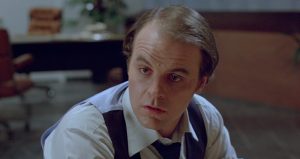
What was it like to work with the legendary Tony Scott on the set of Top Gun, and how do you think his vision, and creative process helped to make the film go on to become so iconic?

Tony and I got along well. I had already done Extreme Prejudice and stuff like that, and he says, “It looks like you were born in a uniform.” I said, “Let’s talk about the character”, and he said, “Let’s not worry about it, the script isn’t that deep” he said, “There’s a lot of talking between the flying and action sequences, that’s what the film is about.” I said, “How the hell are you going to shoot this?”, and he said “I’m going to take everything that they normally do at 35,000 feet, and I’m going to bring it down to 1100 feet, and just do it in conjunction, so that people can see the action, and what they are doing in conjunction to the landscape.” Because it doesn’t look fast or dangerous, or anything, there’s no point of reference when it’s way up in the air. So if you put it in a point of reference, you’ve got a hill, or a mountain, or a set of trees. He said, “It’s going to be a blast”, and it was. Tony was an absolutely enthusiastic guy to work with; he just loved it.

What was it like to work opposite Arnold Schwarzenegger in Total Recall?

Arnold, I class as a good, he is a friend, we’ve known each other for quite a long time now. He is an amazingly talented and intelligent guy. We were shooting in Mexico, Paul Verhoeven [director] had taken over the whole studio. I rushed off to the production office to use the production phone (we didn’t have cell phones in those days) to call Canada, because my sister had been diagnosed with cancer, and she was in the hospital, and I wanted to check on her as much as I could. Arnold noticed that I was doing that, he said, “Where do you go every day?”, and I said, “I’m using the phone.” He said, “Come to my trailer, I’ve got a special phone,” and being married to Maria with her connections in Washington, he had a special phone in his trailer, so I called my sister on the phone, Winnifred, and she said, “Where are you calling me from?” I said, “From the set, in Mexico, in Schwarzenegger’s trailer”, she said, “What?” He said, “Give me the phone” he said, “Winnifred, you have to eat this and this.” All of a sudden, he stopped, he looked at the phone, and said that she wanted to talk to me, and I said, “Winnifred, what’s up?” She said, “Who the hell is on the phone?”, and I said that’s “Arnold Schwarzenegger”, and she said “What, give the phone back to him”. They talked for about half an hour. He was talking about diet, he referenced a doctor, if they wanted to reference a doctor for the type of cancer that she had in Los Angeles, and how he was going to look after her. It blew my mind, he was just that attentive. He said, “Thank you very much”, hung up, and went back to work. When the film was over, I didn’t know this, because she told me later on, she took it for granted, every day at lunch, he called her, for five weeks, until she was out of the hospital. He didn’t tell anybody, he just called her up to see how she was doing. That’s the kind of guy Arnold is. Working with him was great.
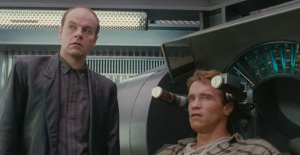
There’s an iconic sci-fi scene in Total Recall where the character you play, Richter, loses his arms. What was that whole sequence like to work on and just how fun was it to put together?

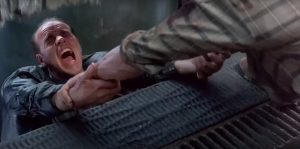
That scene, where I lose my arms. I remember that one, because to climb into the rig, we were on the second unit, and we had Vic Armstrong, head of our stunts. We were shooting that whole sequence, and it was on an elaborate set, where the elevator went up, and my body goes behind a very thin wall, and I’ve got my real arms behind my back, and the fake arms get blown off. There were actually six explosives in each shoulder that went off simultaneously; they blew just as I hit the wall. Arnold says, “See ya at the party, Richter!” and then the arms go away. Climbing up the ladder, I kind of stumbled a bit, because my knees were really bad from roofing and football from when I was younger, I’ve blown out my knees a couple of times. I had about twelve operations at that time, on my knees. I had this ear protection that I had to wear because of the explosions in my shoulder. I was going up the ladder to get into the rig, with my arms behind my back. Then I go up, and the elevator goes up. It was about three stories high. As I’m climbing the ladder, I stumbled, and it kind of caught me off guard. After the shot was over, I came down, and Vic Armstrong said, “What happened?” I said, “Vic, I can’t roof any more”. He said “What?” I said, “My knees are gone, I can’t even work on ladders any more.” He said “Right, let’s have dinner tonight.” At dinner, he threw my resume in front of me, he said, “See this guy? Look at all of the work he has done, and he is now starring with the number one box office star in the world, I don’t think he has to worry about roofing any more.” That was really cool, because I still had that working class neighbourhood approach.

Did the scene come together OK in the end?

We did two major takes of that, on the arm scene. The second one up, I was so preoccupied with making sure that my legs didn’t give out going up the ladder, that I forgot to put my ear protection in. So I’m in the rig, and then I realise, so as the camera came close, I screamed to close my ear canals, and that’s the shot that’s in the movie. That last three and four seconds of it, where he looks up, and he screams, that’s me, because I have no ear protection. It was a lot of fun. That film took six months to shoot. Paul’s an artist and a genius. He is an amazing director.
What else do you remember from working with Paul Verhoeven on Total Recall?

My oldest daughter, Adrienne, who is now a documentary filmmaker, working on a feature herself, was on the set, and at the time she was 12/13 years old. She’d come down to Mexico to visit with me, from Canada, where she’d been with my first wife, her mother. So, there’s that scene where we first land on Mars, we march through, and there’s the lady who’s in the immigration line. They follow me all the way around. I go all the way to the elevator, stop, turn around, look at the camera, and say, “Quaid! That’s Quaid!” The lady kicks off, the head malfunctions, and it opens up, and everything goes crazy. So we shot the scene all in one shot, it’s a steadicam from getting off the landing elevator, through immigration, all of us marching in time, with the troops, and everything, onto the elevator, then I turn, look at the camera and go “Quaid?” So we shot it, two or three times. It had about 200 extras, and all the lights and technicians wanted it in one shot. So when it stopped, we were in our first month of shooting the film, and Paul always wore this blue sweater around his shoulders, or arms. He had it in a knot in front of him, and he said, “Ok, ok, I want to talk to everybody. Everybody comes in.” I love Paul, and any story I tell about him is not to disparage him in any way. So everyone gathers, he says, “This was not a complicated scene, it seems complicated, there are a lot of elements.” He says, “I know what I’m doing, and I want people that work with me to know what they’re doing.” He says, “If you think this is complicated, you will not be able to handle what’s coming ahead, because we have very complicated scenes.” He started working it up, and he has got this energy going, he says, “If you can’t do your jobs, there’s nothing wrong, just step forward and we’ll pay you off set, and we’ll get someone who can.” While he is in the middle of that, we hear someone laugh. He stopped, looked around, off the set, and went, “You!” Everyone looked, and then they all looked at me. I look, and it’s my daughter, sitting in his chair, against the wall, about 40 yards away, watching on a monitor. He is marching towards her, saying, “You think this is funny!?” I’m down off the elevator, and on my way. He is saying, “Do you think this is a joke!? To waste millions of dollars, because somebody is incompetent?” She says, “You got your shot, didn’t you!?” And he stopped dead in his tracks, and completely changed his voice. There were only three of us, her in his chair, him, and me right behind him. He goes, “Yeah, yeah, I got the shot.” He looks up and says, “Have you read the script?” She says, “No!” He says, “Get off my set until you’ve read the script.” She went, “OK, that’s fair.” She had been on sets with me since she was five years old, and she wandered off, and I realised that it had all been an act, the whole tirade. Doing a performance, to make everyone conscious of one, his voice and two, that he was in charge. For whatever reason, it worked. He turned around and said, “You’ve all heard what I’ve said, I meant every word, now, let’s get back to work.” He smiled at me.

The next morning, it was my one morning off, and I didn’t have to get to work until later that day. I woke up, it was a beautiful morning with lots of sun, I checked in on my daughter in the adjoining room, and she was not there. I go to the transportation guys at the front of the hotel – we basically took over the whole hotel – and I ask if they’ve seen my daughter, they said “Oh yeah, she was in the first car this morning, she went to the set” and I went, “What!?” I go to the set, which is 45 minutes from the hotel. I get there, I walk in, and Paul has her in a chair beside him, and they’re sitting there both with their own script, and they’re discussing stuff. She was questioning why he had done stuff. I get up, and he looks at me, and he goes, “You’re not in until later today, why are you here?” And I looked at my daughter, and I said, “Are you alright?” Adrienne says, “I’m fine.” Paul says, “While you’re here, you may as well get into make-up, we might use you.” He dismissed me. She was there for about a month, and then she had to go back to school. When she left, he wrote her a letter, saying, “If you ever want to pursue anything in this field, please feel free to say that I endorse you. You belong in this industry.” The absolute professionalism and care. People are not what they say; they are their actions. We work and live in an industry that is all an illusion. It’s really about illusion, dreams, and storytelling.

You have a classic speech within Starship Troopers, where your character Jean Rasczak speaks to Rico’s Roughnecks before going to battle, introducing your mechanical arm…

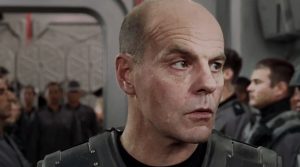
That was an interesting scene. We’d overrun our set, which means that we were shooting quickly. We shot that in South Dakota, in the northern part of the US. In the last couple of months, we were in the studios, in Century City, in Los Angeles. We were so ahead that the set wasn’t going to be ready for another two days, so they only had three walls set up, the back wall, and the two side walls, and part of the ceiling; they hadn’t constructed everything. We finished one sequence, and I was on my way back to wardrobe, I saw Paul and Jost Vacano [cinematographer], standing there. They had a camera rig that we just used on another running shot, and Paul was like, “How could this happen?” I said, “What’s going on?” he said “, The set’s not ready.” It was going to be the reveal of the mechanical hand and the reintroduction of my character, so for me, it was an important scene. I went over, and I said, “What’s going on?” Jost said “Paul doesn’t want to shoot this, we can’t do it because they don’t have a full set. They want to get three walls and part of the ceiling.” Sitting there, I went, “I have an idea!” Because we had worked together on Total Recall before, Paul turned around and said, “What?” And I went, “What if we open up with just a hand on camera, and you follow the hand down past all of these people in line. It creates the question of, who is this? And then he walks right down the ranks talking, and as he turns, it reveals me in a close-up as I walk back, that way, we don’t have to use the fourth wall, you don’t have to worry about the construction. Rico’s Roughnecks get introduced.” Paul looked at Jost, and he said, “Yeah!” We went over and walked it, and he said, “Costume change.” That night, we were walking back to our cars, and I was hanging out with some of the other actors and technicians. Paul was by himself in front of us. He stopped, turned around very abruptly, and said, “You!” Everyone scattered and left me alone, and I went, “What?” He walked up, and he said, “I took an idea from you today”, and I said, “Yeah, you did.” He smiled, put his hand on my shoulder and said, “We’ve come a long way, haven’t we?” Then he turned around and went to his car.
How did you get involved with the world of Splinter Cell? Taking on the classic gaming role of Sam Fisher?

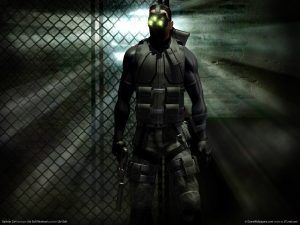
I’m not a gamer, and still not to this day. It was sent to me while I was doing a miniseries in Montreal, and Ubisoft sent it to an agent; it was a very small company at the time. They had a small setup in Montreal, in the middle of the city. Two and a half floors of a building. They sent me the script, and the offer was a lot of money. I thought they wanted me to narrate it. The story was very vague, but I read most of the dialogue. I told them, “The dialogue is very techno geek, it’s not really human, not kind of, organic.” At that time, there were still five owners of Ubisoft, two or three of them were like, “What are you talking about!?” Stefan, the one fella who was very hands-on, great guy to work with, he said, “What do you suggest?” I went in, and talked to him, and I said “OK, I’ll do it”, and when I went to see the set-up, they were going to do all of it in a sound booth, I said “No, wait a second, you want an organic thing, right?” So we restructured Sam’s character, because the acting is only 8-10% of the game, the rest is action, and animation. I said, “Here’s what I’d like you to do, I’d like to get the actors together, who are going to be the voices, let’s just have one day of rehearsals, just to get to know each other, so we have this empathy towards what we’re doing. Because a lot of us will be doing it in sound booths, by ourselves, while no one else is around, just the technicians. So let’s get to know one another and compare notes.” And we did do that. Stefan allowed me to re-construct Sam Fisher, a character that couldn’t give affection, and couldn’t accept affection, I’ve played those characters before, like Richter in Total Recall, very similar. I said, “If you’re going to go forward with this game, then let’s make sure that we build in a history for Sam, where his family were killed, or something happened to create this personality defect, that allows him to do this.” They agreed, so we went ahead and did it.

How else would you describe your working collaboration with Ubisoft at that time?

The thing that I remember the most from doing that first game was… fames were new to the market, especially for acting. Ubisoft was a small privately owned company; they hadn’t gone public. They had broken it into shares; it was a shared company. They offered me this chunk of money, and I said, “I tell you what, I’ll take a third of that money, give me the rest in shares, because I believe in this game.” I really thought that they were going to go somewhere, because of their acceptance of an artistic point of view. I’d been around a lot of different companies, and they were very open. So I called the union, and they said, “No, you can’t do that.” I said, “What do you mean?” And they said, “Well, how do we get our end of it? Our 10/9%.” I said, “Why not set up a corporation that you and I are partners in, and the money goes into that”, and they said “No, it’s too complicated, won’t work. You’ve got to take the cash deal”, so I said “I’ll do it out of another union then”, and they said, “If you do that, we’ll ban you.” So they basically handcuffed me to take the cash deal. Ubisoft did go public, if I bought the stock at the time it would have been around 2.75 cents Canadian a share, then by the time the fifth game came out, it had split six times. I bumped into Stefan just before they did the sixth game, before they changed the voice of Sam for another actor. I bumped into him in the American Airlines lounge in Kennedy Airport, in New York. He said, “I was just doing numbers last night”, he said, “If you had taken that deal, and they had let you, do you know how much money you would have had today? 17.6 million dollars!” I sat there, and I said, “Thanks, Stefan, I’ve got to go on a plane now, and fly to Bucharest, and that’s all I’m going to think about.” The cool thing was that somebody from the union called before COVID, and they asked if I had an original draft of using and sharing back-end profits for video games. So I sent them all of the paperwork, but I don’t know if they’re going to use it. Everything happens for a reason, and I was paid an extraordinary amount of money for that job, and for all five or six games that I did, I loved the process, and they allowed me to be a part of that creative team. It really helped a lot of actors, especially in and around Montreal. Ubisoft took off, and they ended up buying that whole building, that whole block in Montreal. Then, they opened up another outlet in Toronto and another place in Los Angeles. They just made a fortune, as they should. A couple of the owners I think are now living on private islands somewhere, Stefan, as far as I know, is still very hands on. He is a very creative guy.

Looking back over this length of time, how would you say gaming has progressed in general?

My dad used to say, “Humanity’s biggest problem is its ability to be bored. Even when things are going good, you get bored” he said that “a lot of people’s artistic integrity comes from boredom. It causes change.” Video games have gone that way as well. It was a huge sensation for about a decade, and then the audience started to demand more. The audience not only wants realistic, but they don’t want to see real blood, or feel the impact of the gun or anything, but they want empathy, they want a certain amount of storyline, they want to know why they’re playing the game. They want integrity in their characters. I think that games are starting to go towards that. An audience has control by not showing up, by not buying or playing. Some games tank after a while, because it’s so repetitive. You can only have so much violence before the gamer gets bored; there has to be something more.

There’s an anime and TV series of Splinter Cell on the horizon, right?

I came back and did a couple of guest spots for Sam, and a couple of other games. I’m really excited. I haven’t seen it yet, but it got sold, and they’ve made a limited series. They shot in South Africa, and Liev Schreiber played Sam. Which I think is a brilliant choice for live action. It’s already shot, as far as I know. So, they’re waiting for the anime to run its cycle, and then they’re going to have this miniseries on.
Late Night with the Devil is one of the best horror movies of recent years. How did you get involved with the movie, and what do you think sets it apart?

I got involved via the producers, as we were looking for a project to do together. It was a co-production between New Zealand, Australia, and Canada. I couldn’t be fully involved with Late Night with the Devil, because I was involved with another film at the time, doing this shooting sequence. So they went ahead and did it, and we came up with the idea of doing the voice introduction to it, very much like Network (1976), which is a brilliant film. At the beginning of Network, there’s a narration that goes on about this newsman, and the rise and fall of Howard Beale. So we were talking about it, and we were like, “Why not do a whole narration at the beginning of it, and we’ll do it like Network narration”, and they said “Oh that’s brilliant.” So that’s what they did. So they covered the whole backstory in the introduction. It was a fun film. What I loved was the discipline with which they shot it, the discipline of three TV cameras, like an on set studio. Like The Tonight Show, which stars Johnny Carson, and the different nighttime talk shows. They did a really good job. Also, the poster and the artwork that they used for the ad campaign were well done. It’s good, I was at a Comic Con, and they were bringing up posters, it was the first time that I saw the poster, and the artwork. I saw it, and it was so good. I wish nothing but the best for those guys, the whole production team, the producers, the directors, the writers on that, because they’re a really creative bunch, and I hope they get more opportunities.

How excited are you for Liverpool Comic Con? It’s great to see that so many of the Starship Troopers cast are there!

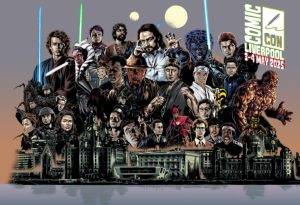
Yeah, that’s what I’ve heard. They’ve weathered the storm and aged a little bit better than I have because I was their age when I did it. It’s been about 30 years! I’m looking forward to the convention. A couple of my good friends live near there, so I’ll be able to visit them and say hi, and I will get to see Liverpool! The last time I was there, my wife went on a Beatles tour, got on the bus, and they all sang the songs. She came back a puddle of nostalgic tears. I’m really looking forward to it. The great thing about doing Comic Cons, I hadn’t done them the last couple of years, because of COVID, and there wasn’t a lot of work, I kind of got muscled into doing it, and I liked it. I kind of like having a first-hand connection with the audience again, talking with people. I don’t want to rush people through, I like to spend some time, and chat with them. There’s a saying, “That there are three components that are important, the audience, the piece of work, and the author. All are equal. If the audience and the piece of work go in one direction, it’s none of the author’s business.” He said, “It’s so important that they are conscious of each other.” In film, I think a lot of people aren’t conscious of the audience. They’re conscious of feeding them the publicity, or the propaganda, or whatever they want to do to sell the product. But actually getting out there and meeting people brings a theatrical, live performance feel to it. It’s cool.

So, what other projects do you have coming up on the horizon, and is there anything that you can tell us about them just yet?

I’m superstitious, I don’t talk about work until it’s in the can. I just did a film, and we’re going to do some pick-ups on it. I did it just before Christmas. It’s called Deep Tissue, and it’s kind of a tongue-in-cheek comedy and action film. It’ll probably be out this fall. It was a fun thing to do. I’m working on three films. One I’m actually going to direct sometime this year, called Motel. Hopefully, if I get the opportunity, the quality of the Coen brothers with a bit of Martin Scorsese at the end. It all happens in one night, in a motel in 1964. We’ve had it for a couple of years, and things got in the way. Hopefully, we’re going to shoot it outside Calgary sometime in October.
Find out about Liverpool Comic Con.

Check out Michael Ironside’s legendary acting portfolio on IMDb.

Late Night With The Devil received a 5-star review rating from STARBURST, and it is streaming on Shudder right now!

Casper Van Dien • Liverpool Comic Con

For many, their first memory of Casper Van Dien is as Johnny Rico in the classic sci-fi film Starship Troopers. With its combination of satire comedy, intense moments, and huge battle sequences, the film went on to become a global sensation, and rightly so! Outside of this, Casper has also taken on the Headless Horseman in Sleepy Hollow and Christoph Waltz in Alita: Battle Angel. Ahead of his appearance at Liverpool Comic Con, STARBURST catches up with Casper to discuss his acting past, present, and future…

STARBURST: When you look back, what do you remember the most about reading the script for Starship Troopers for the first time? What stood out to you?

Casper Van Dien: That’s a great question, and I have a great answer. When I first read it, I said, “Wow, I remember this book from when I read it as a kid,” and then we had to read it for military school. I read the script, and I go, “I don’t remember this satire, I don’t remember this sense of humour.” How did I understand that when I was a kid, because I loved the book so much. I went back and re-read the book, and I went “Oh, it’s not in the book” that was totally Paul Verhoeven and Edward Neumeier. So I went, “Oh, okay I get it now!” I thought it was brilliant. I loved it, I thought it was surreal, I thought it was incredible, and it was a lot different from the book. Dizzy was a boy in the book, and Rico and Dizzy didn’t have that thing. There were a lot of different things in it. The bugs were different; they had guns and weapons, and then there were the skinnies. So there were a lot of different things. So when I read the script, I went, “Wow! I want to know this mind!” Edward Neumeier, who wrote it, also wrote RoboCop, and he has become one of my best friends, so I’ve got to hang out with him a lot over the years. It’s just been really interesting to see the way he works, and to see his mind, and to understand that. It was great. The funny thing is, when I read it, and we started shooting it, I was like, “Come on guys, this is so on the cusp” Paul would be like “It’s subtle” and I’d be like “It’s so not subtle.” When it came out in America, it went over the heads of a lot of people; I had to go back to Paul and Ed and go, “You were right, it’s subtle” that was kind of hard. When I went over to Clapham Commons, for the premiere in the UK, everywhere in Great Britain, they got it! Because they just plastered the tunnels with war propaganda, with posters saying “It’s war!” It was so brilliant, but that’s because you guys have a really sick, perverse sense of humour, and I appreciated that. Most of the people in America get it now. a lot of younger people will come up to me, and say they read an interview with me that said, “People didn’t get it when it first came out, and I don’t believe you!” I’m like, “Yeah, you’d think” and they’re like “I just don’t believe it, there’s no way that people didn’t understand this. It’s not subtle at all.” I think that’s why it’s had longevity, that sense of humour is one of the reasons why, it’s a film that people keep coming up with different scenarios for why the war started, or who started it. They keep coming up with new things, new ideas about it, and I think it’s always brilliant. It creates great debates for people, both sides of the political party, and ideologies, and for me, that’s always fascinating, because then at least there’s a discussion. I saw Paul Verhoeven last year. He said, “I watched the film again, and it’s a really good film!” and I thought, “Yes, Paul, it really is!”

There are some huge battle sequences within the film; which one was the most rewarding for you to work on, and why?

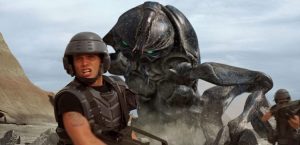
I think the big drop when we’re all going in, and it starts it all. That was huge. We had so many battle scenes, but that was such a massive one. We had 1400 extras, 30 actors, 30 stunt guys, all of us with live blanks. 1400 extras with rubber guns. Then the big gun is firing off, and there are big explosions going off, the visual effects are going off, and then there’s the CGI that they’re putting on top. Because we had the bottoms of the dropships, but we didn’t have the tops. Those were all CGI’ed in later, and then the big bugs that were CGI’ed in later, but then the explosions that were coming from them, they were part real, and part CGI. It was super intense. I remember looking over, and that day, being out there, it’s at night. Everything was going off. We had 238 crew, and 138 second unit crew. All of these visual effects people. 1400 extras, everybody. I look over, behind the camera and I see the director, Paul Verhoeven, the director of RoboCop, Edward Neumeier, the writer of RoboCop, Jon Davison the producer of RoboCop, Phil Tippett the visual effects genius behind RoboCop, and I look and I went, “Wait a minute, Peter Weller is number one on his call sheet, and I’m number one on mine, so I’m Murphy [From RoboCop]!” I’d buy that for a dollar!

You continued to play Rico in the sequels; how would you say the character has grown/changed since the first movie, and what was that progression like to work on?

It’s been an amazing journey. It’s 28 years later, and we’re still talking about this movie, and we have Cons where we are all going together, more so now than we ever did before. I just did the voice over for two video games last year. One for Starship Troopers: Continuum, which is a 16-person shooter that I stream all the time on Twitch. I play with a lot of different people. I play as Rico, but I play on Twitch as Casper Van Dien. People are like, “I can’t believe you’re playing this game!” I say to them how I wanted this when the movie came out! At the time, I said they needed to make a video game, and they said, “We make movies, not video games!” so I felt a bit like a dork. But now that my kids are all grown, I’ve started to play again, because this game is awesome. I also did the voice over for VR games. Then, there’s Helldivers 2, which is a big popular one that everyone says is a lot like Starship Troopers. Eventually, I’m going to maybe try that game as well, but right now I’m just having so much fun playing the Starship Troopers one. There’s also Terrain Command that I have no involvement with, but I play that. It’s surreal to me. Playing him over the years has been great because of the evolution. First, he joins up for a girl, as we all do stupid things when we are young, to try and impress. Then we realise that he became good at what he was doing, and then he starts caring about his troopers more over the years, even more than The Federation is. He starts to see the humanity in people. I like that he has had that kind of arc, from just being this kid that signs up for whatever reason. He’s not thinking right. Now he’s realising that he is good at what he does, but he also realises that they are just fresh meat for the grinder. He has a sense of humour about that, but he also does care. I like that, and I think there’s been an arc. That’s been shown in Starship Troopers 3: Marauder, into Starship Troopers: Traitor of Mars, and then into the video games! With the video games, even with the way they wrote it, I went and talked to the guy who wrote Extermination, and I said, “Did you work with Edward Neumeier on this, because he would have written all of this?” and he goes, “No, I didn’t!” And I said, “Well, You nailed it!” He said that he takes that as a huge compliment. I said, “Yeah, you should, because he is a brilliant writer, and I’ve read a lot of his scripts.”

Was it a similar creative approach with the games?

As he has progressed, I’ve gotten older. When I was doing Starship Troopers, sometimes Paul would go “Casper! Your voice is too deep. Go drink some coffee. Wake up!” Because he wanted me to be a youthful boy. It’s like “Come on, you apes, you want to live forever!” I always tried to be up in a higher register. Every morning, I sound even worse than I sound right now. When I was young, it wasn’t as bad, but he just wanted me to sound like a boy, because I was playing a boy, and then I became a man. Over the years, I’ve had people yell different quotes from the movie at me, even lines that I never said, and it felt like they became mine. Now that I’ve done the video games, I’ve pretty much said everything everybody else has said in pretty much every other thing, and they’ve all become mine in a way. I feel like that’s for all of us. All of the actors, when I go to these Cons, and we get together, these quotes are theirs too. It’s just part of our film, it’s part of our thing that we’ve done together. We were all a team in that, and we’re still a family all these years later, which is pretty awesome.

Going back, after Starship Troopers, you got involved with Sleepy Hollow! There’s a great sequence where you die fighting the Headless Horseman, how fun was that to work on, and put together?

That was a blast to put together. Kevin Yeager, who did the cast for my leg for Starship Troopers, cast my head for Sleepy Hollow. He was also one of the original writers for it, so the story concept idea was by him as well. They just used the same leg from Starship Troopers that they did in Sleepy Hollow, because instead of getting stabbed by a bug, a knife goes through my leg, and so we used that. That was awesome. Then working with Ray Park [AKA Darth Maul], who is an incredible fighter, the stunt coordination for that was amazing. It was incredible. The horse was incredible. I was working with an amazing horse coordinator called Steve Dent over there. I had an amazing animal that I got to work on. It was the original black beauty from the TV series, named Sam, 18 hands, which is huge. My horse, which was a quarter horse, was 15.3. Her name was also Sam, which is funny. And that was a big horse. It was incredible riding that horse, doing the stunts, fighting. It was incredible to work with Tim Burton, who I idolise and I think is just beyond brilliant. He is just a good man, and I love him to death. I think he is intelligent, funny, and just an icon. He has done so much for the film industry in a way of making other things cool. I think he is amazing.

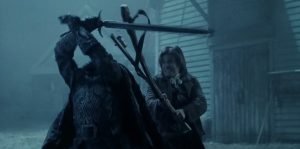
Casper Van Dien fights the Headless Horseman (Ray Park) in Sleepy Hollow

You got to play Amok in Alita: Battle Angel. Can you tell us about what those sets were like to work on as an actor? It was all motion capture, right?

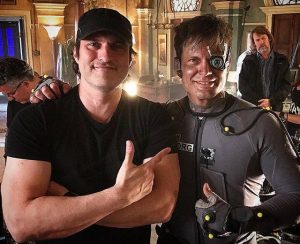
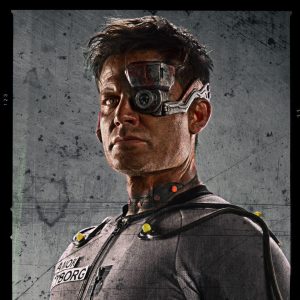
A lot of it was, but there are some sets in there. I’m also working with Christoph Waltz [Dr Dyson Ido] in that scene, so just to be brought in for one day, that was amazing. That’s because my buddy, Garrett Warren, was the stunt co-ordinator; he was creating a stunt role, and he goes, “Hey, Casper, you should put yourself on tape for this”, and I go, “I’m working on something.” He goes, “I don’t care, just put yourself on tape”, I’m like, “I don’t know.” He says, “Just do this this this.” So I did whatever he told me to do, sent in the tape, and then went off back to work. And then I get a call later, and he says Robert Rodriguez was looking at the tapes, and it was going to be just a stunt role, but Robert said, “Wait a minute, is that Casper Van Dien?”, and he goes, “Well, he has got the role.” So I got it, and then all Robert wanted to talk about while I was on set was Johnny Rico, from Starship Troopers. That’s it. So the whole day, I’m there with Christoph Waltz & Robert Rodriguez, who has got his guitar, and all he wanted to talk about was Starship Troopers. Telling me all of the things that he loved, and what he thought about the film. It was amazing. He was also like, “Amok is a bit like Rico, if he got hooked to drugs in the future.” I was like, “Ha, cool, I like that!” So it could have been that. What an amazing set to be on, what an amazing crew, an amazing director. Robert is so creative, and I can see why he is such a force to deal with in this industry. His studio is massive, and the people around him love him. That’s what I noticed with Paul, and Tim Burton, they know how to have control of their sets. In an amazing way, and they’re very kind.

Casper Van Dien and Robert Rodriguez – Photo by Garrett Warren

And is there anything that you wanted to bring to the character of Amok?

I would have loved to have been more involved in the film as a character. For me, it’s the turning point for Christoph Waltz’s character, and it shows why he becomes who he is, because I destroy his daughter. I smash her in a chair. Maybe I’ll have more time in the next one!

What do you remember the most from watching Alita: Battle Angel when it first came out?

What’s amazing is that I went to the premiere, of course. I went with my family and my friends, so we took 50 of us to the theatre, and we all went to see it, and there were 50 other people in the theatre. I had some of my daughters there, and my wife now, a whole bunch of our friends. Everyone’s sitting around. When I smash the daughter, in the film, all my friends were like “Yeah!” They stood up and cheered, and one of my director friends was there; he said, “Two people were like What is wrong with these people?” He said that they were so disturbed, because everyone cheered at that one point! They stayed after, and got a picture with me, but at the time, they didn’t know that I was there. So, it’s kind of surreal!

In 2022, you unleashed the movie Daughter! The movie is really intense, so what was that atmosphere like to work within as an actor?

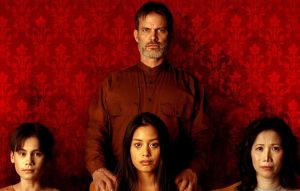
You know, that was a great crew, and a great cast. I really loved it. Mostly Vietnamese, and mostly women. Our director, Corey Deshon, was dating a lead actress, the daughter. They were a couple, and they put this together. It was amazing to see this, and when I read it, I went “Oh yeah, I think I can do this!” I came up with the beard and the hairdo. I said, “Can I do my hair like this?”, and he goes, “Yes!” Sometimes he would say no to things. We worked together on a lot of things. I was in my house, combing my hair like that, as I came downstairs, my wife and children were like “What are you doing, it’s gross, and disgusting.” They said that I was creeping them out, and I go, “Perfect!” Then I go to the set, and I come back, and I’ll still have that hairdo on. They’re like “Oh my god, I’m so disturbed.” They were always disturbed. So even that set the stage for it. It was interesting to shoot it all in film and be there. The fact that it was based on a short story, of some real things that had happened. People do take control, in a horrific way. It was surreal. I really loved that script, and I wish that more people could have seen it. I hope they do see it, because I think it’s disturbing. I had somebody yesterday saying that they’d saw Daughter, and it was “One of the creepiest and most disturbing things, and it still bugs me when I even think about it with you. I know you’re not anything like that, but it just really bothers me, and if I close my eyes, and I think about it, I’m just disturbed.” And I’m like, “I’m sorry, but I am very happy that you’re saying that to me.” The person said that they knew it was a movie, but they were so creeped out by it. They said I was  so disturbing, and I said, “Thank you!”

You’ve got Guns of Redemption coming up! Have you always been a fan of western movies?

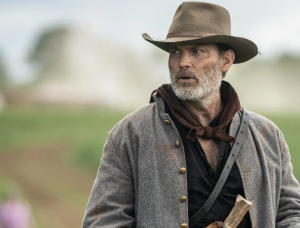
My favourite genre of movies is western, and it always has been. The Searchers, I go back to them all the time, even Star Wars is a western to me, a western in space. Starship Troopers is definitely a western. That’s how I see them, and view them. I pretty much watch a western every day, and I love the classics. When I read the script, I said, “This could be such a good movie; this is such a good western.” I’ve made a couple, but this one was the favourite script that I read. And then when we were making it, I was like, “This is really good!” I ride a quarter horse in it, a good-sized quarter horse. It was a Paint, I rode a Bay. I’m a horse person, so I used to have a lot of horses. I get on this one and ask, “What’s the horses name?” They’re like, Paint! I go “Yeah, what’s Paint’s name!?” They go, “Paint!” I go, “Yup, That’s perfect! I love it!” Everything was perfect, like that. It was such a cowboy thing to say. There are different kinds of horses: a Bay, Appaloosa, and Palomino. That’s just the colouring of the horse, and the Paint is, it’s got two different shades of paint on it. That’s why they call it Paint. So it was just so perfect when the cowboy said that to me. I loved it! I got to do all of the horse stunts on that. I loved doing everything, and I had the best time.

Can you tell us about the script and what working with Sean Astin and Jeff Fahey was like?

The script was amazing, and I loved making it. I haven’t seen it yet. I did a press tour yesterday, and everybody that saw it, told me how much they loved it, and that it’s a great western. We have a small theatrical release over here, and it’s going to be on demand over here. I don’t know about the UK. I’m looking forward to seeing it, I’m excited! I loved working with Sean Astin; he plays a preacher in it. My character Luke is looking for redemption. Hence the name, which is perfect for the title. He is looking for redemption for the mistakes that he has made. Trying to see if he can deal with it, and cope with it, as often we do, when we get older, for the mistakes we made in our youth, when we were dumb, and full of testosterone, and just stupid in general. We try to make up for things. So this guy is definitely trying to do that. He is also trying to come to terms with the fact that he was a Confederate, but they lost the war. Now he is trying to deal with the repercussions of the things he did during the war, and then, all hell breaks loose! First, he finds this guy, and this guy tries to help him. He sees potential in it, this preacher, he sees potential, and as he starts to come to terms with it, he is like “I can deal with this” and then all hell breaks loose, and then he keeps trying, and then he gets shot, and then he tries for something else, and then he gets shot, then he gets in trouble. It’s tortuous and I think brilliant. I can’t wait to see it. I’m very excited about this one; it’s one that I’m really looking forward to, and I love the trailer that I’ve seen, but I haven’t seen the movie yet. Some of the guys were telling me that the music was great. Everything turned out great. Jeff Fahey is amazing. I’ve done several things with him, and he is a good friend, and he plays the creepiest bad guy in this. He is from the North. So it’s interesting, because my character is from the South, which is usually the bad guys, and they still were, they were the ones that lost the war, and that’s part of his struggle, but he is a guy trying to be good, and trying to be better. The guy from the North is taking advantage of women, enslaving some of them. That’s kind of like some of the things that did happen. So, even though he is with the good guys, he is one of the bad good guys! It’s a good script. It was intelligent writing, and it was fun to make.

Finally, how excited are you about Liverpool Comic Con? There will be a lot of the Starship Troopers gang there!

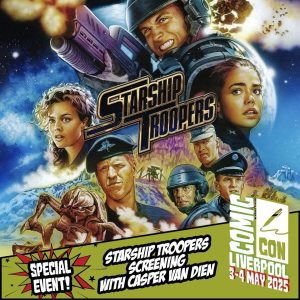
Yeah, I love going with my Starship Troopers family. I love hanging out with them, and there are a lot of us going there. So it’s going to be great fun. I’m going to be doing a screening of the movie on Saturday evening, I’ll be there for that. A couple of my moderators on my Twitch channel, where I stream video games, they’re from Liverpool, so two of them are going to be there, which is fun. I have about 5/6 moderators on my channel. So, the people I play video games with are going to be there. I know there will be some guys in Starship Troopers uniform, I know there always are. I love it, and I love that over there, and across the pond, people really get it, and the sense of humour, and they all have a really dark, sick, perverse sense of humour! So, it’s perfect for Starship Troopers, and they get it, and that’s what I love.

Find out more about Liverpool Comic Con

Book Liverpool Comic Con – Starship Troopers screening with Casper tickets! 

You can follow Casper Van Dien on Instagram

Check out Casper Van Dien on Twitch

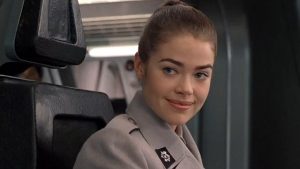
Denise Richards • Liverpool Comic Con

Whether it’s saving the planet in The World Is Not Enough or fighting thousands upon thousands of bugs in Starship Troopers, Denise Richards has been a part of some of the coolest movies in cinematic history! With Liverpool Comic Con and the release of her new reality show ‘Denise Richards and Her Wild Things’ on the horizon, STARBURST talks with the actress herself to nostalgically look back on a superb acting career…

STARBURST: Wild Things went on to become a cult classic; what was John McNaughton like to work with, and what did he initially want to see from Kelly Van Ryan?

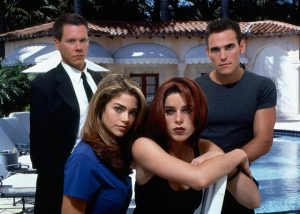
Denise Richards: John McNaughton was amazing to work with! Once I was cast, after a few auditions and testing with Neve Campbell, I met John, and I recall him being very surprised that I was also from Illinois and that my dad worked for the phone company, Illinois Bell. I believe he was told I was from a wealthy family. I don’t know who said this to him, but it couldn’t have been further from the truth! I am so grateful to whoever did, I think it helped convince him that I could play Kelly Van Ryan. I think him learning that I was from the Midwest where he was from and lived, helped him see that I could also bring a likeability to the character.

Can you tell us about what it was like to play Carmen Ibanez, and how do you think she compares to the other main characters in Starship Troopers?

I loved playing Carmen Ibanez. She cared so much for Johnny Rico, but was a strong, determined, young woman. She was put in a position of having to make a choice of being with a partner or having a career. She chose having a career.

When you look back, why do you think Starship Troopers has gone on to become so iconic? What makes it stand out?

When I look back at Starship Troopers, of all the movies and TV shows I’ve done, it’s always the one I consider my favourite. I always remember where I was in my life and mostly, what happened off-camera. Starship Troopers is one of my fondest memories working as an actress. We were all so innocent, nobody knew who we were except for Clancy Brown and Michael Ironside, of course. We were so excited to do this big movie that was going to be in theatres, and Paul Verhoeven was directing after he had done Basic Instinct and Total Recall. It was just one of the most memorable times of my career and most of us are still really close friends. I really don’t know why it’s become so iconic, I’m just so grateful that it has and people still enjoy watching it.

How did you get involved in the world of James Bond through The World Is Not Enough as Dr Christmas Jones, and what do you remember the most from when you got the part?

When I auditioned for The World is Not Enough, myself and other actresses had to screen test with Pierce Brosnan in London. I was so excited when I got the part! I was a huge fan of our director, Michael Apted. However, I had never seen a Bond movie. When it was announced on CNN that I was the next Bond Girl, I remember calling my agent asking why is it on the news that I am doing the James Bond movie. He said, “I don’t think you realise how big this movie is.” Well, I quickly did, and I am honoured that I will forever be known as a Bond Girl!

What was the most rewarding scene to work on within The World Is Not Enough, and why?

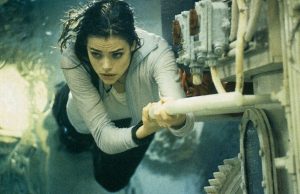
The most rewarding scene was my very first day on set. I believe I had one or two lines with Dame Judi Dench, and I was terrified to do that scene. I couldn’t sleep the night before, I was so nervous, going over and over and over my one or two lines, which sometimes is harder than doing a full scene. I think she could sense how scared I was and couldn’t have been nicer to me. The most rewarding ‘action’ scene was all of the action sequences in the submarine. It was incredibly difficult to film those scenes, I got very lucky. The stunt coordinator and director was Vic Armstrong, from Starship Troopers, he helped me so much. I felt very vulnerable and insecure, and it was wonderful for me to have a familiar face.

Scary Movie 6 has been announced; looking back on the third instalment, what was this interesting idea like to be involved with, and why do you think the movies go down so well with audiences in general?

I’m so happy about Scary Movie 6, I think there is nothing like movies in the ’90s and early 2000s!

How excited are you for Liverpool Comic Con in May?

It’s brilliant to see so many of Rico’s Roughnecks in one place! I have recently been to Comic Cons and I love them! Without fans, I wouldn’t have a job. It’s so humbling and wonderful to connect with people who take the time to see me. And I always love reconnecting with the actors! We are very blessed.

Find out more about Liverpool Comic Con 

Follow Denise Richards on Instagram

Watch her show here: Denise Richards & Her Wild Things 

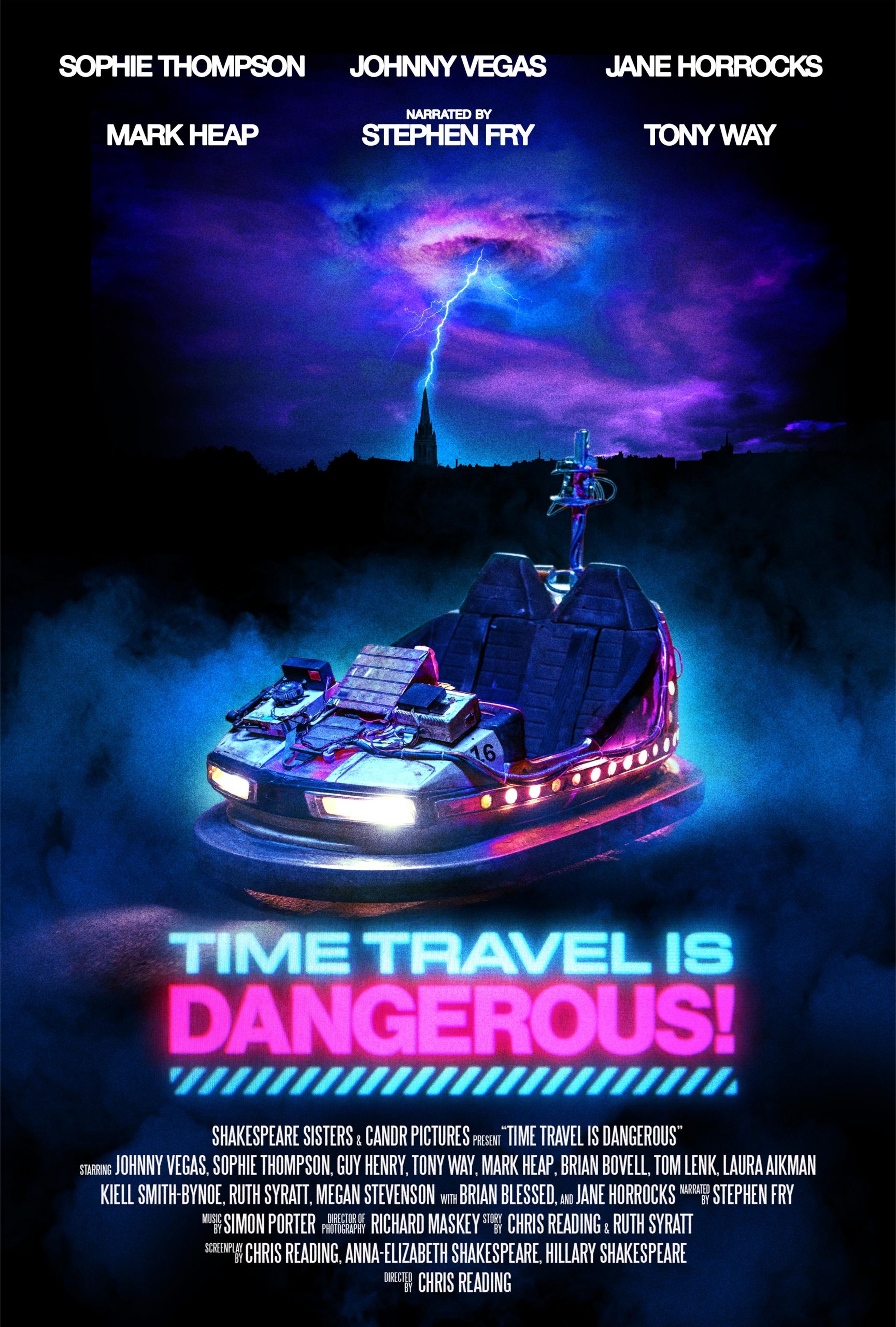
Set Report: TIME TRAVEL IS DANGEROUS

After successful screenings at many major festivals worldwide, the sci-fi comedy Time Travel is Dangerous hits UK cinemas on March 28th. Back while the movie was being shot (under the title The Unreason), STARBURST visited the set and spoke to some of the key creatives involved with the production.

The film follows a pair of vintage shop owners in Muswell Hill, Ruth and Megan (played by real-life vintage shop owners Ruth Syratt and Megan Stephenson), who try to find objects to sell wherever they can. While scavenging for stock one day, they discover what looks like an old souped-up Dodgem car. Taking it back to the store, they find it’s actually a time machine and use it to travel back in time to ‘procure’ items to sell in the modern day.

Partly filmed as a documentary, the film crosses several genres and is constantly entertaining. Way back in time, we quizzed director/co-writer Chris Reading and co-writer/producers Anna-Elizabeth and Hillary Shakespeare about the genesis of the movie. “It started live a few years ago as a Sci-Fi London 48-Hour Challenge,” Chris told us. “It was one of those things where you don’t know anything about it other than the title they give you and a couple of props to work with. I went to Ruth and Megan’s shop and had this idea. I knocked together something like a time machine from some junk we found. I know we found some transit van seats on the street. That was the time machine.” But what about the documentary aspect? Chris continues, “That’s how I knew how to shoot. I knew how to make it make sense in a documentary style. The realistic style sells all the ridiculous parts of the story.” And how did the Shakespeare sisters get involved? Anna tells us, “We already knew each other really well, and by the time we came on board, Chris already had a first draft of the script.” Hillary continues, “The short film with Ruth and Megan was really cool. Chris wanted to make it a feature, so we started working on the script with him. When we were working on it more and more, we started thinking about casting on it, and it snowballed into us producing it.”

The real essence of the film is the story of how the time machine came to be in the first place. Two inventor friends, Robert (Johnny Vegas) and Ralph (Brian Bovell) built the machine while they were working on an old TV science show The Future, Today. While testing the machine, they were stuck for a while in a horrific realm known as the Unreason, something that mentally scarred Robert and split their friendship. Johnny told us, “He sees that his friend has moved on, but he hasn’t. I suppose he’s never had closure, as the Americans would say. I think the time machine being rediscovered and them ruining the fabric of time and space gives him a sense of purpose, to try and fix it rather than rocking back and forth in the corner on his own.” Jokingly, in the way we’d expect from the comedian, “It’s quite a nice take on that cliché ‘if you mess with time, it’s going to kick you kick you in the bollocks’.”

Brian – a massive sci-fi fan who appeared in the prison arc of the superb Star Wars series Andor – has a little more history with the film, “I saw the short version in the 48-hour film challenge. I’d moved near the area of Muswell Hill, and I used to walk around and see what was going on. One day, I found a little shop down an alleyway, and they sold vintage clothes. I walked into this place and saw these two ladies, and we started chatting,” he tells us, “Every so often, I’d pop in there and say hi. Anyway, I was watching this 48-hour film challenge and then their short film came up, and I thought it was funny. It was brilliantly presented, but they weren’t at the screening. So the next weekend, I went to the shop and said, “Now, girls, what’s going on?” I’ve just seen your film, all the people were laughing. Where were you?” They were so nonchalant, “Oh, it was just a thing…” [laughs].” Brian’s friendship with the director when they met at the festival, and persistent interest in the film paid off, “You want to encourage people to express themselves if they’ve got that passion. Chris is a good director. He’s a grafter, and he’s got good ideas. Out of the blue, one time, he says, we’ve got the money!” And if Brian hadn’t been given a role in the movie? “I’d have been in the background of every shot. Always dressed as a different kid, just walking by.”

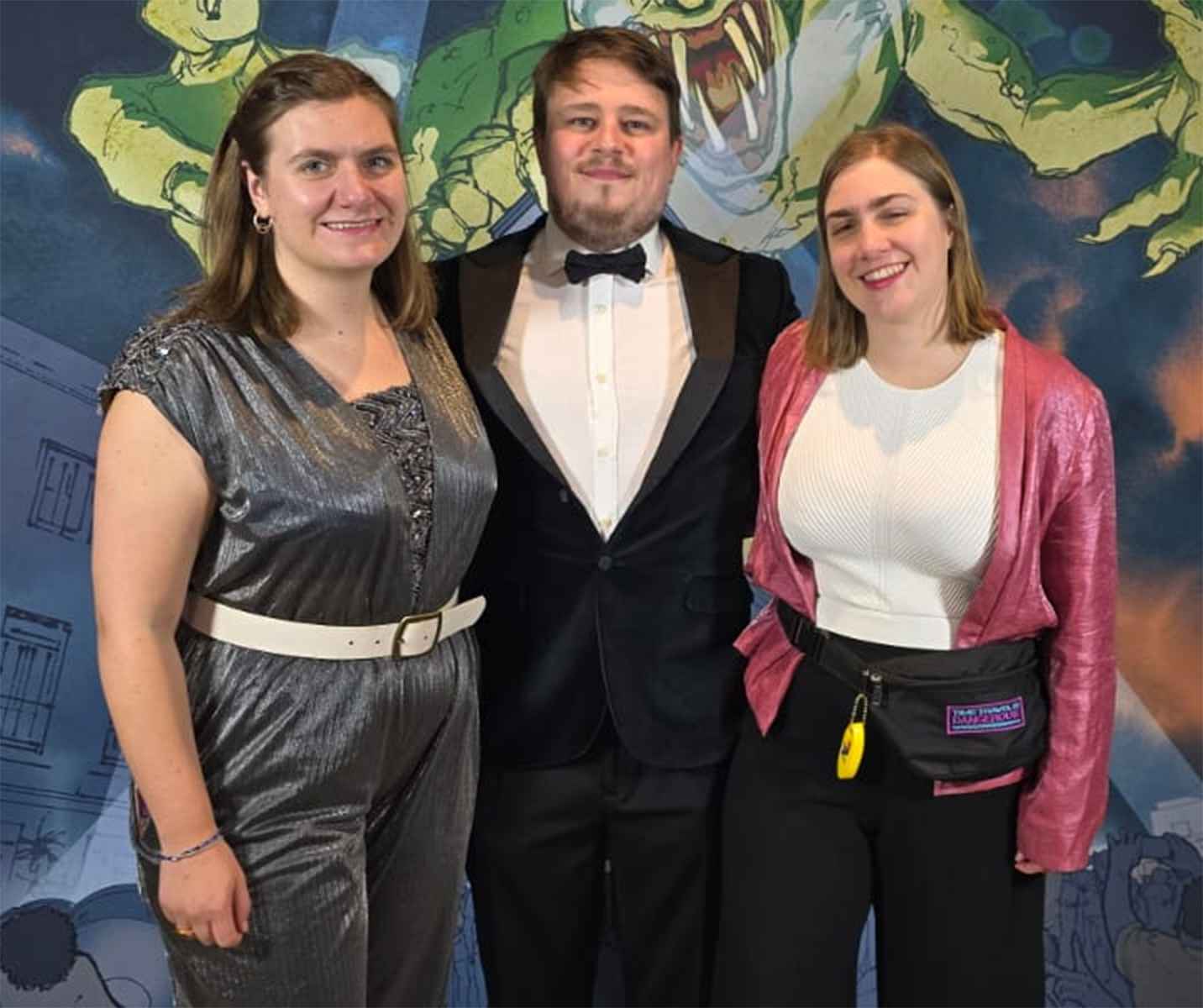
Chris Reading and Anna-Elizabeth and Hillary Shakespeare

The film also includes many other famous faces – and voices – including Stephen Fry, Brian Blessed, Guy Henry, Jane Horrocks, Tom Lenk, Tony Way, Mark Heap, and Sophie Thompson. Sophie’s character, Valerie, also starred in the TV show with Ralph and Robert (who only appears on screen as an inquisitive robot, Botty). Playing the young Valerie is Laura Aikman, who was very honest about her role, “The sci-fi is a lot for my brain. Comedy is more my world. However, I’m doing quite a lot of science explaining in my scenes, so I’m just waiting to get it all wrong.” She laughs, “I did a year on Casualty when I was younger, so I got good at saying things out loud that I don’t understand.”

As we wrapped our day on the set, we asked the team where they’d choose to go if they had a time machine. Laura, without hesitation, said, “I’d go to the ‘60s. It seemed like a good time. Some good music and good fashion.” Chris suggested, “I’d go back to when the dinosaurs were about because I love dinosaurs… or maybe back to 1993 when Jurassic Park first came out [laughs]. Anna sees herself in the Tudor period since she likes the look until Hillary reminds her of the toilet situation. Hillary, meanwhile, plumps for the ‘90s. Brian has a more philosophical answer, “There was a lady I was supposed to meet at a station once, and I got there late. This was before we had mobile phones and could go, “Look, I’m on my Way, please wait”, but she was gone. The other one would be to see the pyramids being built. I want to know who did it and how they did it!” However, the last word must go to Johnny Vegas, who, in his own inimitable way, nails the answer. “I’d go back and do some really fucking surreal cave paintings. The most accurate self-portrait of me in a way that they can interpret that I invented the wheel because I’m needy and I want that kind of credit. I want to be the guy that says, “All civilisation, you want me a massive thank you.” I’d do cave paintings of classic movies. Imagine some guy going into a cave in Northern France or somewhere, and there were scenes from Casablanca.” When we suggested Star Wars, too, it sets Johnny off further, “Yeah! Oh god, me as a Jedi! I’d go back to 1977, and I’d beg George Lucas to include a chubby Jedi in Star Wars. One that can’t quite run fast, though his mind can. That’s why I’m amazed there’s no there’s not that many obese Jedi, because you don’t have to move from the couch [motioning his hand out to use the Force], kettle! Biscuits!”

TIME TRAVEL IS DANGEROUS is in cinemas from March 28th.    

Martin Gooch • Argh and the Quest for The Golden Dragon Skull

Martin Gooch is UK/US based indie film maker who is responsible for cult comedy movies such as The Search For Simon, Atomic Apocalypse and The Gatehouse. We caught up with him to learn about his latest project, a fantasy movie which is also an homage to 1980’s gaming, called Argh and the Quest for The Golden Dragon Skull. Ahead of it’s opening screening (details here), we caught up with him to find out more. 

How would you pitch Argh and the Quest for The Golden Dragon Skull to fans of the game Dungeons and Dragons?

It’s the first film to be entirely filmed using 25mm miniatures and with the blessing of John Blanche (Legendary Fantasy Artist and Games Workshop/Warhammer) featuring the godfather of gaming Sir Ian Livingstone. Written and Directed by a fan of D&D since 1982. Can’t get much more D&D than that!

And how would you pitch it to fans of Game of Thrones?

Less nudity. More laughs.

It’s an unusual idea for a movie, how did it come about?

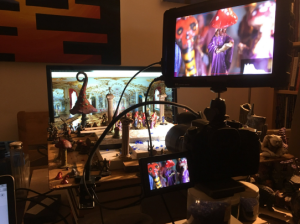
I love fantasy (and SF) movies and always wanted to do one – but without a budget it is tough, especially as Argh is an epic quest with a cast of hundred! Impossible to do without a big budget but my creative itch must be scratched so I decided to make an epic fantasy film using my old D&D and Warhammer 25mm miniatures (most of them 30-40 years old!). I love Monty Python and The Holy Grail, which is one of my favourite films, and I think that when you have a low budget then comedy is more forgiving, so audiences are more likely to suspend their disbelief if something is funny. Like the LEGO movies, I think it’d be hard to do a totally serious movie about a tough issue with LEGO

I bought a macro lens for my Lumix Camera and off I went. I wrote it first with the help of Brad Moore and Mark Felgate who helped with all the gags and general silliness. Then I filmed all the live action actors shots –  I actually made a short film to show the actors how to shoot their own shots, and got lots of them to shoot it themselves and send me the rushes. Then I edited the whole film just for dialogue – so there is a version of the film that just has actors talking heads – without any miniatures or VFX etc or music or sound design. I asked my friend Trevor Moore to help with the sound design and his work lifts the film up and it’s amazing how many audio jokes he put in which I think helped the movie immensely.

I shot the whole thing at home mostly on the dining room table. It was good fun building all the sets and painting (badly) all the minatures.

How can I see this movie?

We are having a special screening on the 25th of March in London – tickets might still be available then after that I am looking for a distribution option.

How can I help more people see this movie?

Spread the word! Mention Argh on the socials and then maybe if it gets a following a decent Sales Agent will take up the Quest!

Why did you make this movie?

I’ve been a film and Tv director for many years, but it’s very difficult to get work, everyone always wants a famous director and I’m just not that famous! I’d love to direct fantasy and SF film and TV but kept getting rejected as producers would say “Ah yes, but you haven’t actually directed a fantasy film…” which is nonsense as the genre is just the wrapper to performance and emotional connection is what is important, so I just thought I’d direct my own fantasy movie. And if you can’t go big go small. Without a huge budget I decided to shoot this using what I already had which was loads of miniatures and bits and bobs about my flat.

ARGH and the Quest for The Golden Dragon Skull Cast

What’s your favourite gag from the movie?

There are several running jokes. In the land of Mushroomia they use mushrooms as currency, then in the middle of the film, it’s bananas and then at the end it’s gone to pickled onions! This made me laugh a lot. When I was filming it at home I had to get a jar of pickled onions to put on all the miniatures like little hats, and of course under the lamps they all started to pong and dry out so I had to film all those scenes in one go which took about a day, but there was a vaguely pickled onion smell about the flat for a day or two…


Has AI ruined Fantasy?

Not yet. AI has many incredibly application in the medical world, cancer detection and many other areas, so it’s not all bad, But the genie is well out of the bottle. The danger is that AI gives those who are not creative the illusion that they are creative, but they are not.


What other projects would you like to work on? 

I have always wanted to direct Doctor Who, I was a shadow director on Kazaam! With Jodie Whittaker, and really felt I could direct Who to the next level. Now there is a D&D TV series on the way I dream of being involved with something like that – I’d gladly give the next ten year of my life to working on an awesome show. C’mon universe it’s not that big an ask.

I’m actively seeking the next project so open to new work.


What can you tell us about forthcoming work?

I have so many irons in the fire and spinning plates as they say, that I’m excited about any that don’t come crashing down or set the forge alight. I have a Short film in Post entitled Kafka’s Appraisal which was all shot on a volume stage in Manchester last year. It’s a two-hander starring Paul Ready and Alix Wilton Regan written by 2000AD scribe Kek W. Hope to have that finished soon.

I’ve been working on a novel entitled Whirled World which is complete and with my editors, hopefully this is the last draft and then see if there is any interest. I have also written a TV series called Agatha Mistress of Swords, starring fabulous actress Claira Amy Parr (who was in my previous feature film Darkheart Manor) and Carol Cleveland from Monty Python. The pilot has been made and, again, looking for production partners to take it to the next stage.

I’ve been working on an Indy  film entitled The Dragon Detective for a few years all about a man who believers Dragons exist and sets out to prove it. I’ve already shot some of it – so would love to find a producer to finish that – I can’t finish it on my own.

I have a serious SF TV Series entitled Breakaway Station which I am very passionate about and would love to see realised. Whilst Argh is a comedy and very silly, I am still a drama director and would love to tackle a serious SF. Actors and crew can work on all sorts of different genre films and TV, so why can’t a director explore different genres? Ridley Scott has tackled all sorts of genre’s as a director. I’m up for it.

Simpsons or Futurama?

When I was at “Film School” in Canterbury (UK) our Head of Department was named Phil Simpson, so he actually did a lecture with an episode of the Simpsons. It was probably the least boring lecture I was at. All the rest were incredibly dull about New German Cinema and other such movements that sadly, did not excite me.

So, Simpsons.

Deathstars or Dragons?

Tricky. Star Wars (A New Hope) is a near perfect movie IMHO. But then DragonSlayer with the arch dragon Verminthrax Pejorative was one of the greatest cinematic adventures I had as a child. I was in love with DragonSlayer for Decades. If the question is which would I like to direct then I would love to do a Star Wars movies/Series. But realistically I don’t think they are going to call, so maybe Dragons are more realistic (pun intended).


Truth or Beauty?

Hmm, Context would be good here!

I’m reminded of the old picture of a skull that from another angle looks like a lady at her dressing table in front of a mirror – all is vanity – it’s called I think. So ultimately truth is what we should all be seeking but isn’t it nice to gaze upon beauty once in a while?

No Pain All Gain – Talking NOVOCAINE

If you’ve ever wondered what would happen if your favourite ‘80s action hero had the pain tolerance of a brick wall but the emotional sensitivity of a golden retriever, then buckle up – Novocaine is here to answer that question with a punch (that our hero won’t even feel). Directed by best friends-turned-filmmaking duo Dan Berk and Robert Olsen, this action-packed, unexpectedly heartfelt film brings humour, heart, and a whole lot of chaos to the big screen. Featuring Jack Quaid as the hero getting his ass kicked and Amber Midthunder as the woman who shakes up his world, Novocaine is a fresh take on action-comedy that will have you laughing as much as you’ll be wincing.

When Dan Berk and Robert Olsen first came on board to direct Novocaine, they knew they had something special in Lars Jacobson’s script. “The original script was different from the movie that you see now,” Berk explains. “What we identified very early on was a core concept that was just crazy sticky, commercial, and that we couldn’t stop thinking about. So, we came on board, and thankfully, the producers took to our vision and allowed us to make some wholesale changes to the tone and to put our print on it.” One of the biggest changes from the initial script was that in the beginning, “There wasn’t a lot of humour in it, but Lars had a brilliant concept that still shines through.”

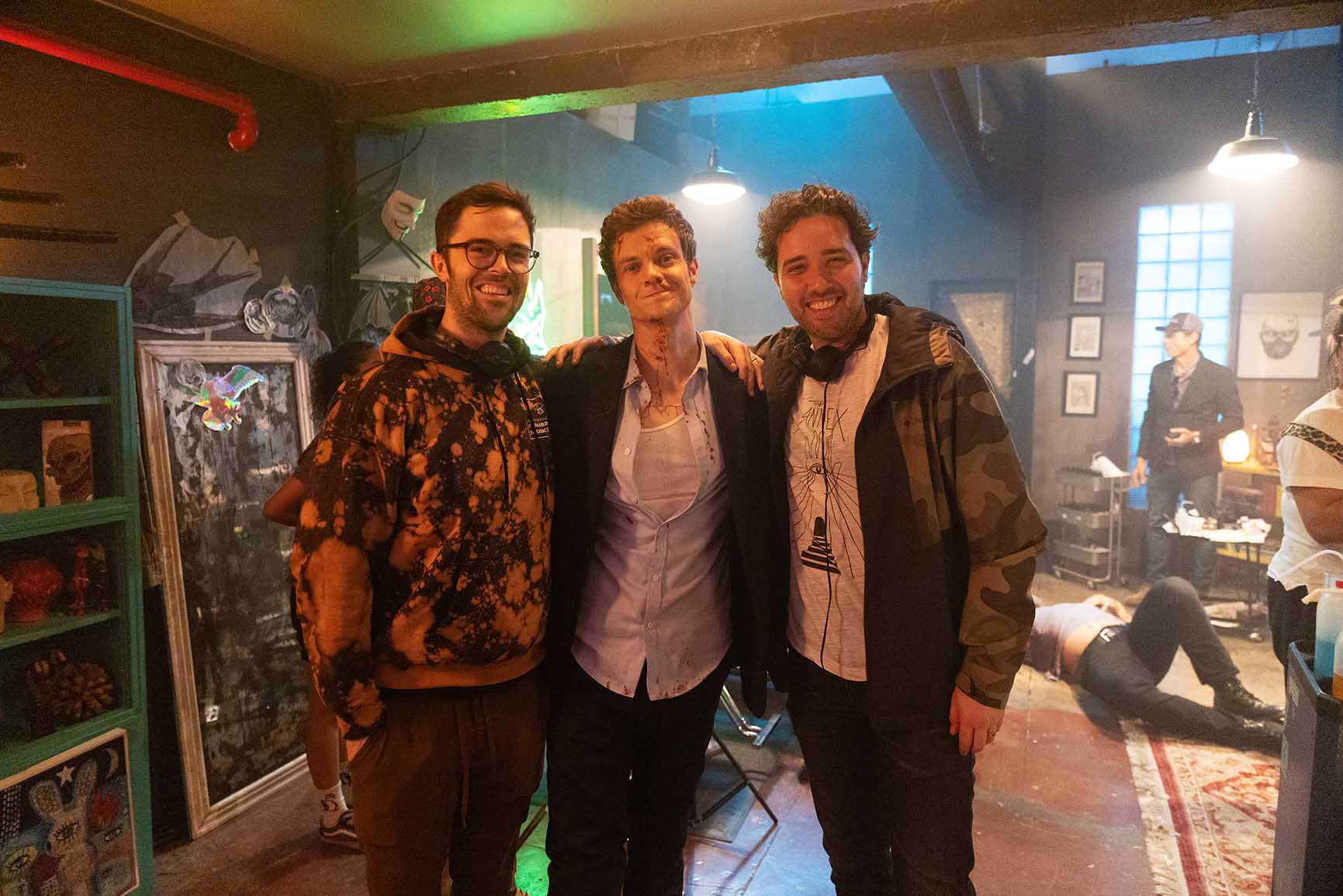
Director Robert Olsen, Jack Quaid as “Nate”, and Director Dan Berk in Novocaine from Paramount Pictures.

The balance between action and humour was crucial for the film. “You don’t want to make it a straight comedy, or else the stakes take a dip. We use films like Lethal Weapon, Die Hard, and Midnight Run as examples of movies that are high-stakes action films, but funny,” Berk says. “And Jack [Quaid] is so good at handling the comedic moments – he’s a physical comedy genius – but he’s a capital ‘A’ actor as well, who can really handle the more emotional scenes. You try your best as a director to convey tone, but you can only get so far without great actors. We were so lucky to get to work with Jack, Amber [Midthunder], Jacob [Batalon], and a host of others who really understood what we were going for here.”

Casting Quaid in the lead role of Nathan ‘Nate’ Caine was a decision that felt natural from the start. “When Dan and I do a rewrite, we always try to keep a specific actor in mind because that way, we’re both writing with the same voice. We’d been watching The Boys at the time, and really, from the moment we read the script, we knew Jack Quaid was the perfect guy for this,” Olsen recalls. “It’s very rare that you end up with that person actually in your movie, but we got really lucky. It was this perfect storm of Jack having the clout to be able to star in a film like this, and also to be interested in doing it… I think he could almost tell how much the script had been written in his image, you know.”

Quaid himself was drawn to Caine’s unique qualities as an action hero. “I think the concept of an action hero in this unlikely way was really enticing. I’m not necessarily a person you look at and think, ‘Oh, this guy can kick a lot of ass’,” Quaid laughs. “I just love that with Nate, it’s about the hits he can take, and the fact he’ll keep getting back up. I thought that was incredibly cool.” At the same time, however, “we wanted to make sure this movie harked back to some of the more character-driven action movies of the ‘80s and ‘90s. The draw is the character, which is why we all really dialled in on Nate being the ultimate sweetheart. What sets him apart from any generic action hero is who he is, not necessarily his condition.”

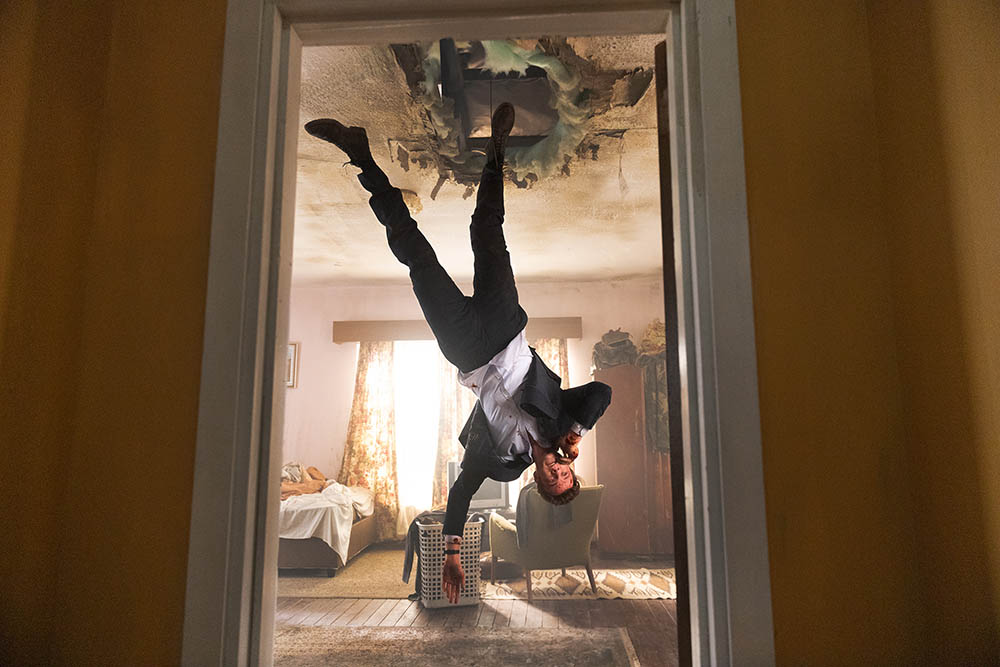
Amber Midthunder as “Sherry” and Jack Quaid as “Nate” in Novocaine from Paramount Pictures.

The actor goes on to explain that, when we meet Nate, “He’s a very lonely guy. I think his condition isolates him, because he’s immune to pain, but that doesn’t mean he can’t still get hurt. He could step on a nail and not even know; he’s very much a fan of indoor activities, and all the corners in his apartment are baby-proofed so that he doesn’t accidentally hurt himself. He drinks his coffee with ice so he doesn’t scold himself. He has all these systems in place to ensure he doesn’t get hurt and so, for his own safety, he has to isolate himself and put a wall up between him and the outside world.” Quaid continues: “That doesn’t necessarily get him down, but when he finally meets Sherry, it motivates him to take risks. He goes out with her to a restaurant, which has a million things that could poke him, burn him, or choke him. But Sherry gets him out of his shell. I think he has a great arc in the movie because he starts off quite sheltered but grows more and more confident. I find his arc really inspiring.”

That’s a large part of why the directors knew that finding the right actress to play Sherry, Nate’s love interest, was key to making the film work. “We had loved Prey, which starred Amber Midthunder,” Berk explains. “Man, should that movie have come out in theatres! We met with her and she was so funny, charming, and magnetic. And from the jump, she and Jack had such wonderful chemistry. The whole movie falls apart if, ten minutes in, you aren’t already rooting with every fibre of your being for these people to end up together. Because otherwise, you just don’t care. Thankfully, they’re both such charismatic people and are such a dream to work with.”

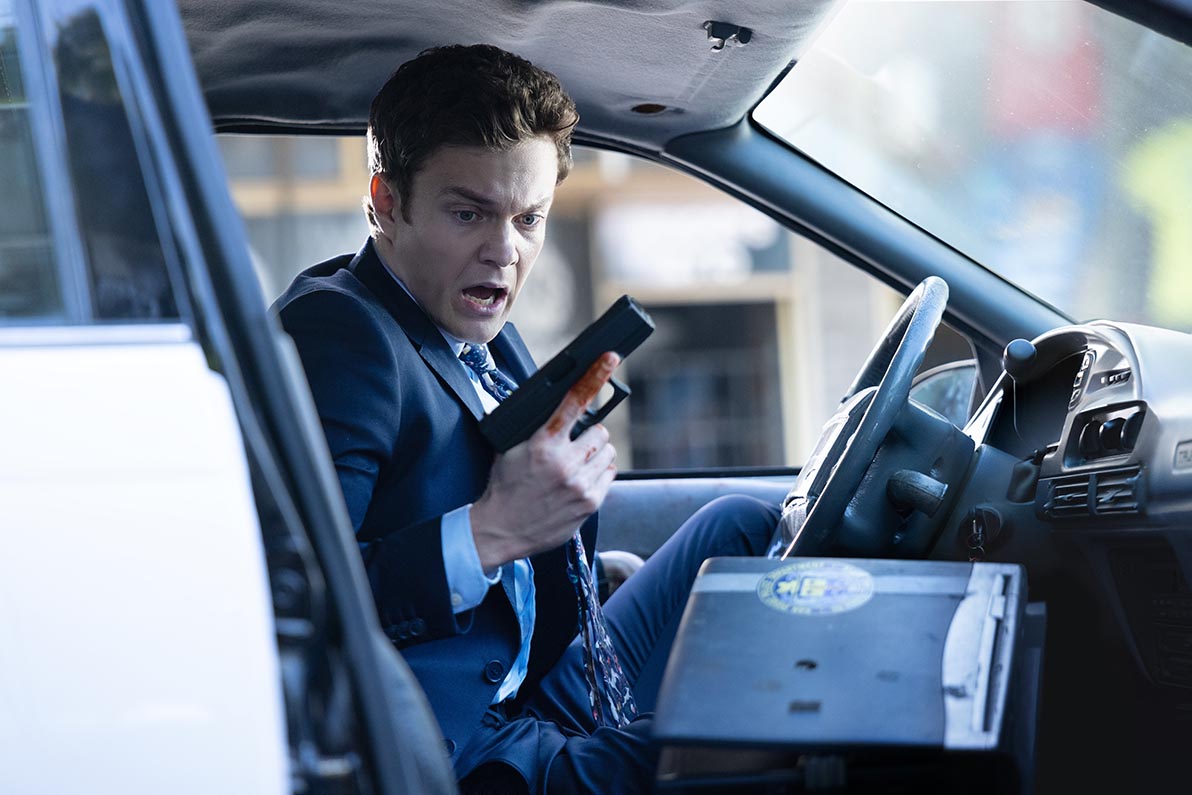
Jack Quaid as “Nate” in Novocaine from Paramount Pictures.

For Midthunder, playing Sherry was a refreshing change of pace. “I’ve never gotten to play a girl who’s just a girl,” she jokes. “I also was interested in her because, where it could be easy to overlook her as just a damsel in distress, you still find a lot of humanity in her character. Another film might have had her be very one-dimensional, but that’s not what Dan and Bobby were interested in. It was great, and I felt safe in their hands.”

The chemistry between Quaid and Midthunder was further developed through two weeks of rehearsal before filming. “Jack is such a wonderful actor, and I couldn’t have asked for a better scene partner or a better Nathan Caine. That just made everything very easy, and getting to know him also meant we clicked on camera.” As much as she loves an action film (and the action is “incredible, and needs to be seen on a big screen”, Midthunder emphasises), “There’s something really beautiful about the fact that, at the heart of it, it’s about Nate fighting for love. It’s a very simple idea, but also one that everyone understands and can connect to.”

After all, “emotional pain is very real for Nate”, despite his condition, Quaid explains. “I wanted to make sure that it was clear in the movie that this is a man who feels emotions very intensely. I took a lot of inspiration from Nate. I think he’s an incredibly resilient character.”

Visually, Novocaine was crafted to reflect Nate’s personal journey. “We brought on a cinematographer who we were big fans of, Jacques Jouffret, who shot Gran Turismo,” Olsen explains. “We wanted to create something visually unique but grounded enough that it still felt commercial. We don’t have the budget that big Marvel movies do, but we hoped that, since this was going to be a theatrical release, the viewer wouldn’t feel like this was a small, indie project.”

Berk adds that the cinematography plays a huge part in the tonal progression of the film. “The first section of the movie really establishes this character as somebody who has to adhere to a very lonely way of living. Then, once he meets Sherry, the film kicks into an action movie and his whole life changes. And we wanted the visuals to highlight that.” The first half “is much more like a rom-com, with locked-off frames and more of a boxed-in feeling. Once the action kicks in, though, things get more handheld and chaotic. We’re actually using two different sets of lenses: anamorphic in the first part and then spherical for the action.” Berk goes on to explain that the viewer “is a little more unmoored visually, just as Nate is as he jumps into this new chapter.”

This being their first straight action movie, it may be surprising to hear that the directors fell into the genre very easily. “It was like wearing a pair of gloves that fit properly for the first time!” Berk exclaims. Not that it was all smooth sailing, and the directors admit that “the enormity of a movie like this was a little scary,” before praising the fantastic team of stunt actors and coordinators that made this movie possible.

Jack Quaid as “Nate” in Novocaine from Paramount Pictures.

For Quaid, one of the biggest challenges in playing Nate was learning how not to react. “It was so hard! I had to learn that, when someone punched me in the face, my face should move but I wasn’t allowed to wince. It’s ruined me for fight scenes on other projects, because now I’m just very locked into not showing pain,” he laughs. The physicality of the role also had to change as the film progressed. “In the beginning, he’s not super comfortable with the outside world, so I’m trying to be a little stiffer in my body. Then, by the end of it, Nate’s a lot looser and more confident in himself, so he moves with more certainty. The stunt team did such a great job of coordinating these fights that look really gnarly, but are also a lot of fun. Audiences are gonna have a really good time with this.”

Midthunder agrees that the action is a standout feature. “This movie is so big and so fun that everybody working on it wanted to give audiences something they hadn’t really seen before. You have these ridiculously fun, sometimes gory circumstances, but they’re balanced with this great big heart that lives inside the movie.”

Despite the intense production schedule, the cast and crew found ways to bond. “Jack taught me to play Backgammon. I, being an iPhone game queen, taught him about iPhone games. We had fun,” Midthunder laughs.

Quaid also fondly recalls filming in South Africa. “We were in Cape Town, all of us American transplants. The bonding was really intense, which was great. We were all more or less living in the same area and we’d all hang out together, go watch films, and it was absolutely incredible. The whole experience really did change my life.”

As for a potential sequel? The directors and cast are game. “I think exploring how Nate grew up with this condition would be so interesting,” Quaid says. “I also want to see where him and Sherry go from here, and where him and Jacob Batalon’s character go from here as well. Jacob is unbelievably funny, and I love how the characters’ dynamic really blossoms over the film.”

For Berk and Olsen, working together on Novocaine was the culmination of years of collaboration. “Neither of us are specialists. We’re both generalists, so we do everything 50/50. It’s been years of creating a process and an approach that works and, with this being our fifth feature, we’ve gotten pretty good at it,” Berk states. “It also helps that Bobby and I are best friends. We were randomly assigned roommates in our freshman year at NYU, so we were best friends for seven years before we ever started making movies together.”

And no production is complete without a little behind-the-scenes mischief! “The cast and producers were all like, let’s get a tattoo! So Bobby and I got them,” says Berk, showing off their cherry pie tattoos, “and then no one else went through with it!” “We’re putting them on blast, especially Jack,” Olsen quips.

In the end, Novocaine isn’t just an action flick – it’s a high-energy, laugh-out-loud, heartwarming ride that proves even the toughest guy in the room can still be a total sweetheart. With an intensely lovable cast, jaw-dropping action sequences, and just the right amount of absurdity, it’s a movie that reminds us why we love the genre in the first place. And who knows? If the sequel happens, maybe the directors will get their revenge on their tattoo-shy team.

NOVOCAINE is in cinemas on March 28th.

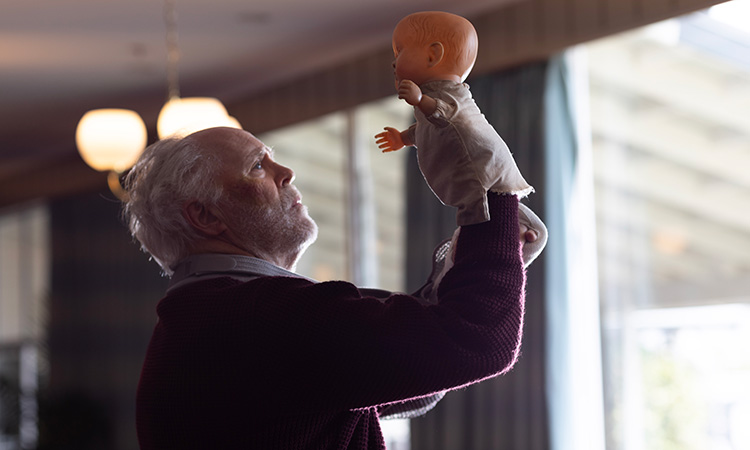
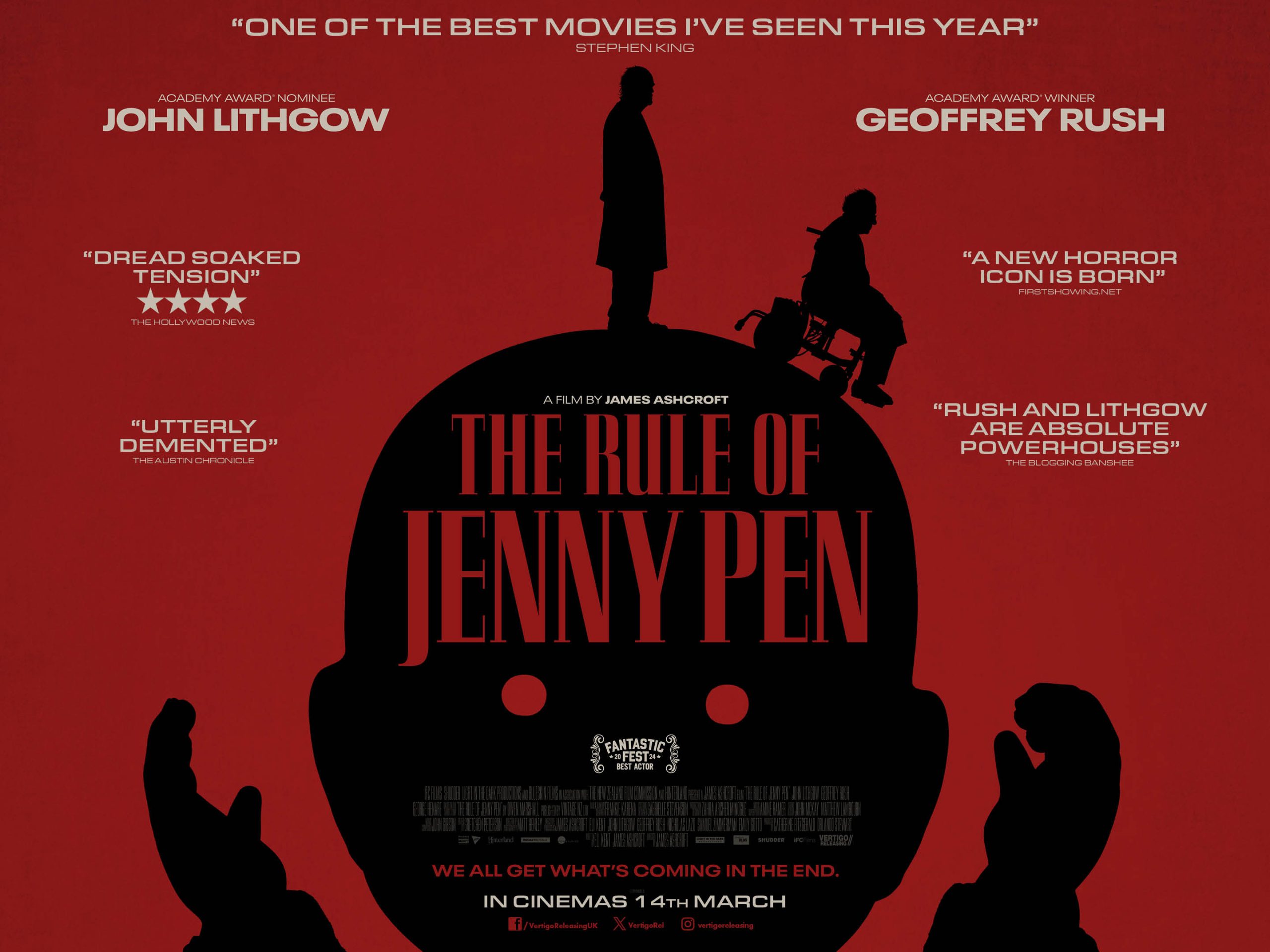
James Ashcroft • THE RULE OF JENNY PEN

After releasing his feature debut Coming Home in the Dark in 2021, New Zealand director James Ashcroft has terrified the festival circuit with his tense follow-up that has finally arrived in UK cinemas. Starring Geoffrey Rush and John Lithgow, The Rule of Jenny Pen follows Stefan Mortensen (Rush), a judge forced into retirement by a massive stroke that also sees him move to a care home. Once there, he crosses paths with fellow resident Dave Crealy (Lithgow) who has made it his mission to terrorise those around him with the help of his trusty hand puppet Jenny Pen.

Following its premiere at Fantastic Fest in 2024, the psychological horror has been met with rave reviews – with its lead star Lithgow even sharing his terror over appearing in it. To coincide with its release, STARBURST sat down with Ashcroft to discuss the film’s approach to aging, developing the complex protagonist of Crealy, and how its seasoned lead stars approached the more difficult scenes.

STARBURST: How did you develop your idea for the film and get the production rolling?

James Ashcroft: It started with a short story by Owen Marshall, a prolific short story novelist from New Zealand. This story and Coming Home in the Dark which was my first film, were both based on two of Owen’s works. Owen’s written about 60 stories – including two really dark ones – and those were the two that I optioned. This was the first work that Eli Kent, who co-wrote the film with me, started together nearly 12 years ago. We’ve now worked on about 10 projects, things like Devolution and How to Sell a Haunted House, so this is sort of the foundation that’s our relationships built on as well.

We did a lot of research – Eli stayed in a rest home for a couple of weeks, which was a great experience in terms of getting the authenticity and solving some of the structural issues with the script. Once we’d got it all written, we weren’t able to get the budget we wanted because, as a first-time director, it was more than we could imagine, which is why we pivoted to Coming Home in the Dark. The intention was always to do this as the follow-up.

Geoffrey Rush and John Lithgow were incredible in the film. How did they get involved with the project?

Geoffrey Rush and John Lithgow were always in the back of our minds when we started writing as a sort of fantasy. Like, “ Wouldn’t it be great if…” And then when we actually got it [the script] to them. I think John took about a week to respond and had a meeting – he wasn’t going to say yes, it wasn’t in the bag, and he wanted to know who the hell is this weirdo from New Zealand, writing this terrible, terrible stuff. But he signed on immediately after that meeting, and Geoffrey signed on after three days. I always tell them that even back then, before they knew the other was involved, there was this little rivalry going on. Once they were on board, that’s when I started moving forward. I was thinking “Be careful about meeting your heroes, lest they disappoint you as human beings,” because they’ve been long-time heroes of mine and Eli, but they were even better as people than they are as actors.

We see a lot of horror films about the perils of ageing and many are criticised for how they represent ageing and elderly people, but a lot of commented how The Rule of Jenny Pen subverts that and is sensitive while still staying true to its horror. What was important to you for that to come across?

My mother is Māori, indigenous in New Zealand, and my father is English. Growing up within a Māori family, there’s this concept of keeping your elderly with you at home – it’s fundamental to our culture. We built a little house for my parents on our property after the pandemic, because we wanted them to be three meters from the front door so that we can look after them and they have that relationship with their grandchildren. My view of the elderly has always been that it’s not mysterious, and they’re a natural part of your wider family. As your parents or your guardians looked after you when you were most vulnerable as a child, you, in turn, repay that favour. What struck home when I read this story was that, as a parent, I’m aware of bullying. I’m conscious of it in the schoolyard, but I’d never considered that that could be a fate that awaited my ageing parents in a rest home. That’s what scared me the most and what resonated with this story.

Having spent a lot of time with elderly people, I think a lot of people think of the elderly as something to be sort of pushed aside and not listened to, which is completely untrue. Just because you age doesn’t mean things change in terms of who you are and your experiences. As we age, people remove their filter of politeness and become very blunt and frank about sharing those emotions, which I think is a great thing. That’s why a rest home is a hot environment. One pleasantly surprising to learn at one of the homes we went to is there’s probably a lot more sex going on than there is at a college. Those are the sort of conversations that we should be looking at about elderly characters, the community they offer and the liveliness.

The use of the hand puppet Jenny Pen and the title itself danced with the idea of the supernatural being involved, but we don’t go there. Was there ever a temptation to go down that route?

It was never an intention, and it’s not there in the source material. For me, the truly frightening thing that trumps the supernatural is what people are capable of doing given the right circumstances, the right pressure, and the right moment in time. I’m drawn to that light and darkness we always have to negotiate within ourselves. Even though it’s called, The Rule of Jenny Pen and the puppet is a very strong icon in the story, it’s all just symbolic of dictatorship and tyranny. I think people are responding to that given we live in quite tyrannical times at present.

Dave is an interesting character in that he is terrifying, but there are moments when he just seems lonely and craves companionship. What went into developing him as this complex antagonist?

I’m very fond of Dave, as one has to be with their characters. We wanted to cast John specifically in this role because Dave is really a tragedy. His existence is one of isolation, and his footprint in the world is very, very small. He probably didn’t venture further afield from this town where the story is set. He lives with this incredible loneliness, and we can all feel isolation, loneliness, sadness, and depression over time. But those things can mature into something much more insidious things like bitterness, envy, jealousy, and cruelty. We wanted an actor who had a deep sense of joy in their work and their performance because this is about a monstrous person, but if you’re a dictator, you’re having the time of your life. It’s like Richard the III having fun doing these terrible things. And of course, like all dictators, they get drunk on the power and it starts to get messy. The wheels fall off, and as soon as that crown goes on the head, it’s all downhill from there.

John spoke to Forbes Magazine about the film and said he was “scared to death” by it. Were there any scenes in particular you found that he or Geoffrey found difficult?

If you’d had come on set while we were filming, you would have thought we would have made a comedy! It’s always the way – the darker the material, the more fun and laughter there is in the making of it. I think overall, for both Geoffrey and John, the fear that they had about the intensity of the story was around just how far people can go. They abandon all their morals and deal with the consequences, and there are some very confronting moments. The scene in the day room where Dave attacks the woman who has severe dementia and her blind husband was challenging for all the actors. We were always very clear about what the intention was in every scene – even the worst scenes aren’t just about gratuity, there’s an intention and a psychological grounding as to why someone is doing something and what the effect is in the story. That’s all the reassurance actors need, if you’re asking them to bear themselves in that way, you have to be very clear with with the intention and how you’re going to land that.

Both John and Geoffrey appear naked in the film at different points, which they were very adamant about doing because we don’t get to see age in that way. Usually, it’s something that’s that’s either made fun of or criticised in some way. It’s all about exploring those levels of vulnerability, so I think the whole package scared them. But at the same time, I know they had the time of their lives doing it, and they probably slept for a month afterwards because it was a pretty exhausting shoot.

THE RULE OF JENNY PEN is out now.

David Arquette • Horror Rock and Wrestle Fest

He took on Ghostface in the Scream franchise, fought spiders in Eight Legged Freaks, and even put together an intense documentary about his return to wrestling! David Arquette’s career is diverse and legendary, and ahead of his upcoming appearance at Horror Rock and Wrestle Fest in Manchester this weekend, STARBURST MAGAZINE caught up with him to take a look at some of his most significant moments in entertainment!

STARBURST: Taking it way back to the first Scream movie, what do you remember the most about reading the script for the first time, and what stood out to you?

I really loved it. I loved the self-aware aspect of the writing, referring to the horror genre. That it wasn’t taking itself too seriously, but it was serious nonetheless. I was reading it to see the different characters at first, because they were interested in me for different characters, but when I read the Dewey role, I was like, “Oh!” I really connected with that, and I felt like I could bring something really unique and interesting to it. Then, when I went and met with Wes Craven, I told him that, and he said, “Wow, that’s interesting, I never considered that.” Dewey was originally written as this big jock character, a kind of meathead. And he was like, “That’s interesting”, and luckily, they took a chance with me.

And looking back at the franchise, why do you think that Dewey stands out so much?

Wes and I had a lot of really fun stuff. Kevin Williamson wrote an incredible script, but we also found these little moments, like these really interesting moments. I love the fact that he was a person of authority who didn’t get any respect. That was just really funny to me, and then it just kept building, where he tried to be tough, and reality would come crashing down on him. So yeah, we found all of these little comedic moments. Wes had a really funny sense of humour, really sly. A little different than mine, but we just found this common ground, and he had a really sweet side to him as well. Which I think we also found in the character.

What was the most rewarding sequence to work on while playing Dewey?

There are so many. I loved all of the stuff with Rose McGowan’s character – Tatum Riley, my sister – and Neve Campbell as Sidney Prescott as well. Those scenes were really fun and really sweet to show, like a cop who has a bullying sister. It was really funny, and she was so wonderful in that role.

But I’d say the most impactful of all of the films was two-fold, definitely, with the Gale Weathers character and Courteney Cox. There’s a scene where a car is coming, and we roll off. I remember Wes coming up to me and saying, “Just look at her like you’ve been searching for a person like this your whole life.” And so when she says, “Is that what you’re looking for?” And you say, “My whole life.” It’s just such a sweet moment of direction, and I think we kissed there for the first time, and I said that line. It was just really impactful. In my real life, it led to us co-parenting a daughter named Coco. It had a real, important impact on my life.

But also, during Scream 2, I was going through a really hard time because my mum was sick and dying. Wes sat me down after one of these scenes at the college. We were at UCLA, and he gave me such an incredible father-and-son-like mentor talk. He said that I should really focus and that I have a lot to give to the world. He was such a great guy, and he knew that Courteney liked me, but I had to get my stuff together. He had such a gentlemanly way of looking out. It’s something that you don’t run into a lot, someone like Wes Craven who really showed such kindness and caring beyond the film and my role in it.

What was it like to return to the franchise after so long with the fifth film?

It was hard because they had given me the script, and I read it, but they hadn’t told me anything about it. So I was reading it and I was like, “Oh wow, Dewey’s got a really good role in this one”, and then that part came, and I was like “Oh, that’s why.” But it was great, I loved playing the role, and working with all of the people on the film, and being able to have that final scene with Gale Weathers, it was really powerful, and important. There was a lot of backstory. It was a role that lasted 25 years of my life, at least. It was very impactful, and it meant a lot to me. I think the directors, Matt Bettinelli-Olpin and Tyler Gillett, did a really great job in giving Dewey a real hero moment at the end before he blows it again! I think they had done it well. It was still a really difficult film to be a part of; it was really sad. I know that fans felt that way too. I still feel like they didn’t honour Wes in a sense. Like, Wes kept me alive for the first one! So for them not to do that, I did get it because they had to re-launch the brand, but it did feel kind of sad.

Dewey has his own theme tune; how did that happen?

It was Wes, and the amazing composer, Marco Beltrami! I remember Wes coming up to me, saying, “Dewey has his own theme music now!” I was like, “What! That’s so incredible! Thank you!” It’s just so sweet for him to think that way. He was a really thoughtful person. He thought in a very complex way. Like chess moves down the line, he really thought of the impact of it, and how important it was, even before I even knew really what he was telling me.

In the late ’90s, you got to work on Muppets from Space. Can you tell us about what it’s like to act opposite the Muppets? 

What a turn! It was incredible, I’ve always been a fan of the Muppets, especially The Muppet Movie and The Muppet Show. So to then be able to work with them was really one of the greatest days on a set. You get to see behind the curtain and meet all the people behind the voices. You see all of the technical stuff that goes into bringing them to life, and when you have scenes with Kermit, for instance, it becomes alive, and it becomes Kermit, this character that I’ve loved my whole life. Then being able to act opposite him was just so fun. It really was, I was in awe. I got to do press with Frank Oz, Dave Goelz, and a bunch of the original voice people, and that was really fun, it was really surreal. It was a highlight, for sure.

How fun was it to play Cleaves in Ravenous, and can you tell us about some of the filming locations for it as well? They looked intense!

It was a wild movie! They had this original director, Milcho Manchevski, and he was really interesting, but he was going far out. I had dreadlocks in the beginning, almost like primitive man. I think something happened, and he got let go from the project. Antonia Bird came on, who is an amazing director, but we had been there in the Czech Republic for a couple of months. So it was random, and we were really there for a while, and then it all came back together. They had built these forts, and we also filmed in Slovakia. So yeah, it was a really wild experience. I got to work with really wonderful actors. It was fun, but it was also one of those things where when you’re in an ensemble like that, a lot of the time, you’re creating a backstory. Half the time, what you’re doing may not even be on camera. So there was a lot of character exploration on that. Finally, some of my stuff they did use, I didn’t even know they were filming certain parts. It was just interesting. It was another wonderful group of filmmakers to work with.

Eight Legged Freaks went on to become a cult classic. What was this world like to act in, and why do you think it still holds up to this day?

Wow! I love the creature features, which is what it was taken from in the ’50s. The idea of bringing that style of scary movie back was really interesting to me. There was all this discussion at the beginning about having some conflict or something to make fun of me about. It became my goatee in it! I don’t know how it ended up just being the goatee. Like, after all of this discussion about what this thing is going to be, it ended up being a goatee. It was just such a weird thing.

It was amazing. Dean Devlin is an incredible producer, and Ellory Elkayem [director], he did a great job. And he had these really strong producers. So, sometimes that’s tricky with the director and Dean Devlin’s partner, who was also a strong producer. They did Independence Day, Patriot, and all of these crazy films. So they had this whole system of how to make things look big, but we’re a smaller-budget movie. So they did things like making sure there was fog, but what it ends up doing, the reality of that, to have fog like that, is then there’s this crew of special FX guys, just running with these hoses all over this landscape. These poor guys, putting all of these hoses down, and then having to run them out before the mist leaves, getting the shot, and then having to run back and put it down. There were elements that were really strange about it. But it was a really fun movie to do. It was a lot of green screen. You have to use your imagination, obviously.

You know, the funny thing is, when it came out, you had no idea how many people were so scared of spiders that they might not even go to the movie theatre to see it. There’s this weird dynamic with them where they really hate spiders, and it’s a way bigger number than you might think. So I think that had an effect on it at the theatre, but I’m glad it caught on. I think it’s a really fun movie.

Tron: Uprising was a much-loved Tron animation show. What do you enjoy the most about working in animation?

Well, my friend Charlie Bean was a part of that, and that’s how I was invited on, and also, Paul Reubens was in it. So I remember those were my two most exciting aspects to it. It was a smaller role. The art and direction of it were cutting-edge and really beautiful. They spent a ton of time on it. I’d always been a fan of the original Tron when it first came out. So to then be a part of that universe was a really cool thing. And, just being able to see Paul Reubens, I think one day, he recorded right before me, so I saw him there, which was really fun, and working with my friend Charlie Bean.

How did you end up getting involved with Bone Tomahawk, and what do you remember the most from working on it?

The director S. Craig Zahler had called me up. It was really one of those things where sometimes a project just falls into your lap, and that happened on this. I think I only shot for two or three days, which is really quick, but I got to work with Sid Haig, which was such an honour because he’s a legend in the horror space. It was really wild, I liked that it opened up the movie.

I kept asking them to make sure they do something with my character’s death. I was like, “Do I just disappear? You never even see me! There’s no resolution to it?” And no, there wasn’t. I kept trying to fight it. I was like, “Even if you don’t use it, I’m here.” So, I kept trying to get some kind of resolution to it, but they never did. But it was a really fun thing to be a part of. I remember one time, I was helping Sid get up this hill as we were trying to run away, and he was an older guy, but then I lost my footing, fell down and pulled him with me.

How did the idea for You Cannot Kill David Arquette come about, and how rewarding was that whole experience for you?

I had this heart thing happen to me, and I had two stents put in. They put me under, and I had this big heart operation, and then when I came out, I said to my wife Christina, how I kept thinking about wrestling. She was like, “What are you talking about?” She might have known that I’d done Ready To Rumble or something way back then. I don’t think she knew about the title run and the intricacies of it. This funny thing happens when you’re facing possible death; you start reflecting on your life, you know, “If this is it, then what?” I have a wonderful family, and I love them, and they love me. I’m very fortunate that I have experienced that, so I’m not dying with all of these resentments or some unfinished business. So I started to go over all that stuff, and then, for some reason, I started thinking about wrestling.

For years, I’d be the butt of the joke, like, “That’s a worse idea than making David Arquette a champion.” Even after this documentary, it still comes up, but it doesn’t hurt as much! I really wanted to go back and find out why they hate me so much. Like, what is it about wrestling, and what did I miss? I understood that I was an actor that hadn’t been trained. I always thought about it as wish fulfilment. Every fan’s dream is to be the champion. I didn’t put the pieces together, and you really have to earn it. It derogated the belt and all that kind of stuff. So then, going back, doing the documentary, and meeting all of the people. The funny thing about wrestling is you find out, once you’re there, the cameraman, the wardrobe, the makeup artist, the announcers, other wrestlers, the trainers, the reporters, everybody is a wrestling fan. In that whole world, everybody loves wrestling; they’ve loved it their whole lives, and it’s why they got into the business of wrestling.

It sounds like a relentless process…

The reality of driving, city to city. Getting injured all of the time. If you smash your elbow, or you twist your ankle, there’s a saying, like, “Don’t worry if your ankle hurts right now, your back is going to hurt much more.” In wrestling, you keep treating all of these injuries! Like, one thing hurts, and then another thing hurts even more, so then you start worrying about that, and then another thing takes over that pain. And then, sometimes, when it gets too intense, you have to have painkillers. There’s a lot to take in. There are all of these little lessons that the wrestlers are teaching you. Different personalities and different matches. Ego has a lot to do with it. Some people take their gimmicks seriously and don’t really get the performance element. There were all of these little things. Like a wrestler will say, “Oh, he does a piledriver”, and then I’ll ask the wrestler how is that, and they’ll say, “That sucks!” Wrestlers will never say, “That hurts so bad.” They’ll never say that because it’s a macho thing. So they’ll say, “It sucks.” Unless you know that “It sucks” means, “It hurts really bad, you shouldn’t let him do that to you”, then you’ll say, “OK, it sucks, but I’ll still try it.”

You’ll wrestle some people, and with the legends, you can wrestle them every day of the week; they’re so good at what they do, and they’ll make it look really great. You’ll be doing spectacular stuff and still, soft landings. It’s incredible when you wrestle with really great wrestlers. Then you work with someone who’s stiff, or you want them to prove themselves, or they’ve just had a bad day, or whatever it is, and then they’ll lay it in even more. They’ll drop you hard or try to hurt you. When you’re really put in a position to trust them. There’s a lot to learn. It was a really wonderful experience, and I loved that I went back.

Who else did you encounter along the way?

I learned so much from the legends that I worked with. I got to wrestle and tag team with Shane Helms, which was a highlight because he was my stunt double on Ready To Rumble. There’s an amazing wrestler named King Brian Anthony, up at Northeast Wrestling, who I had a bunch of really great matches with. I got to wrestle Jerry Lawler at one point, The Honky Tonk Man. There were some really memorable moments. Being in the same ring when the Mouth of the South came in with The Honky Tonk Man. Moments like that. With Greg Valentine, they wouldn’t let me in the same ring as him. RJ City and myself did a lot of tag teams together, and he was really wonderful, he was protective, and he pulled me out because Greg Valentine was going to teach me a lesson. There are some things that you don’t know until you do it. It’s tough. I see these guys that are doing it still, and they’re doing it every week, and I still have pains from doing it, from the little that I did over those two or three years. It’s really intense, and I have so much respect for it.

There are also other elements to it, like I learned a lot about acting. They say some of the gestures are really over the top – the gestures and the promos, but you’re selling to the back of the arena. Essentially, a lot of the time, it’s pantomime, and you don’t have a mic. You’re trying to sell the story with just the visuals. Some things you can hear, but then little things, to make moments where the audience feels throughout the place, and they really connect with it. The storytelling that you learn how to do when you do it right, you’re really getting the crowd. The one match I had with Nick Gage was when I went into that room, and they hated me. It was the personification of the internet within this room – all of the hatred, and all of the spite, and all of the anger. But then, when I left, because I bled for him and gave my body up, they were cheering. Nick Mondo, a famous death match wrestler, was like, “I’ve never really seen what I saw that day. Like, how they hated you so much, and then they were cheering at you when you left.” Even though some people frown on the death match wrestling style, there was something about it where I really kind of spoke to that crowd that hated me so bad.

How excited are you for Horror Rock and Wrestle Fest, and what can attending fans expect?

I’m really excited, I mean, I’m like a fan going there. There are going to be so many amazing wrestlers, horror icons, and rock n roll legends. I feel like it’s going to be a mixture of the best fan experience but a bit of a rowdy time! I don’t drink any more, but if I did, I have a feeling that the pubs near there are going to be rocking. The whole place is going to be a big party. The funny thing is, rock n roll, wrestling, and horror, and wrestling and horror in general, cross over quite a bit. It’s always been a part of what I talk to people about, it’s part of my calculations and a part of certain things that I do. It speaks to certain fan bases. So, to bring it all together is just amazing. I think it’s going to be a really fun time. I think there’s going to be some great shows and really great opportunities for fans to meet people they’ve been fans of for a long time.

Find out more about Horror Rock & Wrestle Fest here.

You can follow David Arquette on Instagram here. 


Composers Anna Waronker and Craig Wedren Talk YELLOWJACKETS Season 3

Composers and songwriters Anna Waronker and Craig Wedren returned to score the highly anticipated third season of Yellowjackets, once again delivering a haunting and visceral soundtrack that deepens the show’s psychological intensity. Both ’90s veterans – Waronker from That Dog and Wedren from Shudder to Think – their music channels the era’s raw energy while embracing the show’s signature mix of nostalgia and creeping dread. We spoke with both Wedren and Waronker from their homebase in Los Angeles about their partnership, their approach to Yellowjackets over the course of its run, and their favorite needle drops from the Showtime series.


YELLOWJACKETS Season 3 is available on Paramount+


Martin Campbell • CLEANER

The action thriller Cleaner sees Daisy Ridley as a former elite soldier who is now working as a high-rise window cleaner following a dishonourable discharge. While scrubbing away one day, she comes across a hostage situation. She uses her skills and position to intervene. We caught up with director Martin Campbell (Casino Royale) about making the film and much more…

STARBURST: So many people, as soon as they see the trailer might immediately think Die Hard, or any of these other action movies that are of a similar ilk. What attracted you to the script for Cleaner initially, and what do you think makes it stand out?

Martin Campbell: When I read the script, it was a page turner, number one. Secondly, it’s very different to Die Hard. Of course we’re going to get compared to that because it’s a lone window cleaner on the side of a skyscraper. It happened that Bruce Willis was inside the building as opposed to outside. But really that’s where the story differs completely, obviously. A group of so-called terrorists are eco-warriors and the interesting thing for me, apart from Daisy, who it was great to have a woman protagonist, basically, and she’s just a window cleaner. That’s all she is. And the bad guys with Clive Owen playing the Marcus character, and of course Taz Skylar playing Noah… what Clive Owen is doing is, of course, totally legitimate. Yes, he’s making a big statement by taking all these hostages and so forth, but he’s anti-violent. Yes, threatening. Of course, he is. He wants to make a big statement, he’s a veteran activist and the company are sleazebags. This is an energy company that’s broken just about every rule in the book in order to up the shareholder price and so forth. So I think what he is doing is absolutely correct, and I think honourable, albeit that yes, he’s breaking the law and so forth by taking them hostages but nevertheless, what he believes is you have to make a big statement in order to change anything. What makes it interesting is of course there’s another faction within his own group of people who literally pull a coup d’etat. In other words, we then have Noah who believes we’re not going nearly far enough. And, in fact, he is what’s known as, is really an anti-humanist group who simply believe the planet is being destroyed by human beings, which is, by the way, probably a true sentiment. But he believes the only way to solve the problem is to wipe out all human beings and then the planet will repair itself. It’s psychotic in a sense, obviously. But he believes that it’s not enough to block up motorways, throw paint on pictures, throw rotten eggs at public figures and so forth. It gets you nowhere, and what he believes is you need something really huge for it to have an impact with the press in order to change anything. So that part is very interesting.

A lot of what you’re talking about that sets Cleaner apart is its villain, right? As a director who’s worked with these big stars, you’ve worked with Daniel Craig and you’ve worked with Ryan Reynolds and Antonio Banderas, how does working with Daisy Ridley and, of course, Taz Skylar and the rest of the cast compare?

Well, obviously Daisy, I love working with her. She’s very good. She worked very hard. She’s very good in the film, and Taz is new to most people. That’s what was exciting about him. I think most people have probably not seen. I think he was on a successful TV series [One Piece] and still is on that series, but I think he’s a new face and he did a great job. So those two were fantastic and Clive Owen I’ve directed before, so it’s like old friends meeting and so forth. And he’s a funny guy, actually. He’s a very funny guy. We have a lot of laughs together when we work together.

You mentioned that you work with a couple of these people over and over again. Do you really think that is something that makes a Martin Campbell film? Do you think that you really put your own fingerprint on the project or do you let the project dictate its own terms?

Well, he always, as a director, any director puts his fingerprint for better or for worse on any project. And I often think that the director’s personality comes out on the screen. So in so far as I directed it, I guess I didn’t put my stamp on it, if you see what I mean. But obviously, you follow the script. You’ve had a whole process of working on the script with the writer, and then when you direct it, you just give it your best shot.

You’ve directed so many action scenes at this point, from sword fights to shootouts, to power ring battles. Do you approach them in their own unique way or do you have a particular method?

No, the thing is this, that when you get script and there’s action in it, I just about always rewrite the action myself with the stunt arranger. You can look at Casino Royale. The opening scene in Casino Royale was six lines in the script. That’s all it was, which meant that we had to come up with a whole sequence that was never, other than, I remember the quote was, “We’re going to have the best parkour chase we’ve ever seen on film.” I think was some crazy quote like that. Basically for the director to work out that scene. That’s the way, and I often change the action. In fact, in just about every instance I develop the action, make it bigger normally than this, because most writers, there are some very good writers of action, but most writers aren’t very good at action. And why should they be? They they concentrate on the characters and the development and so forth. And because I work with obviously a stunt arranger and so forth, we’re in a position to come up to take the basic idea and come up with something based on that idea that is developing it much further than is in the script.

CLEANER is out now in the US and available on SKY Cinema.