[ENDED] Win a Copy of the GHOST STORIES Soundtrack

Ghost Stories

Right now, one of the most hotly discussed movies of the day is the long-awaited big-screen take on Ghost Stories. And to celebrate the movie’s cinema release, we’ve got a CD copy of the film’s soundtrack to give away courtesy of Select Music.

To be in with a chance of winning this excellent prize, simply answer the below question:

Ghost Stories star Martin Freeman famously played with character in Peter Jackson’s Hobbit trilogy?

a) Gollum

b) Bilbo

c) Gandalf

Email your answer, along with your address details, to [email protected] labelled Ghost Stories by midnight on Sunday, April 22nd.

The official word on Ghost Stories reads:

Professor Phillip Goodman, psychologist and skeptic, has his rationality tested to the hilt when he stumbles across a long-lost file containing details of three terrifying hauntings. Shaken by what he reads, Goodman embarks on a mission to find rational explanations for these ghostly stories. As Goodman investigates, he meets three tormented people, each with a tale more frightening and inexplicable than the last.

Ghost Stories is in UK cinemas now!

[ENDED] TERRIFIER 12″ OST Giveaway from Marilyn Manson’s Guitarist!

TERRIFIER

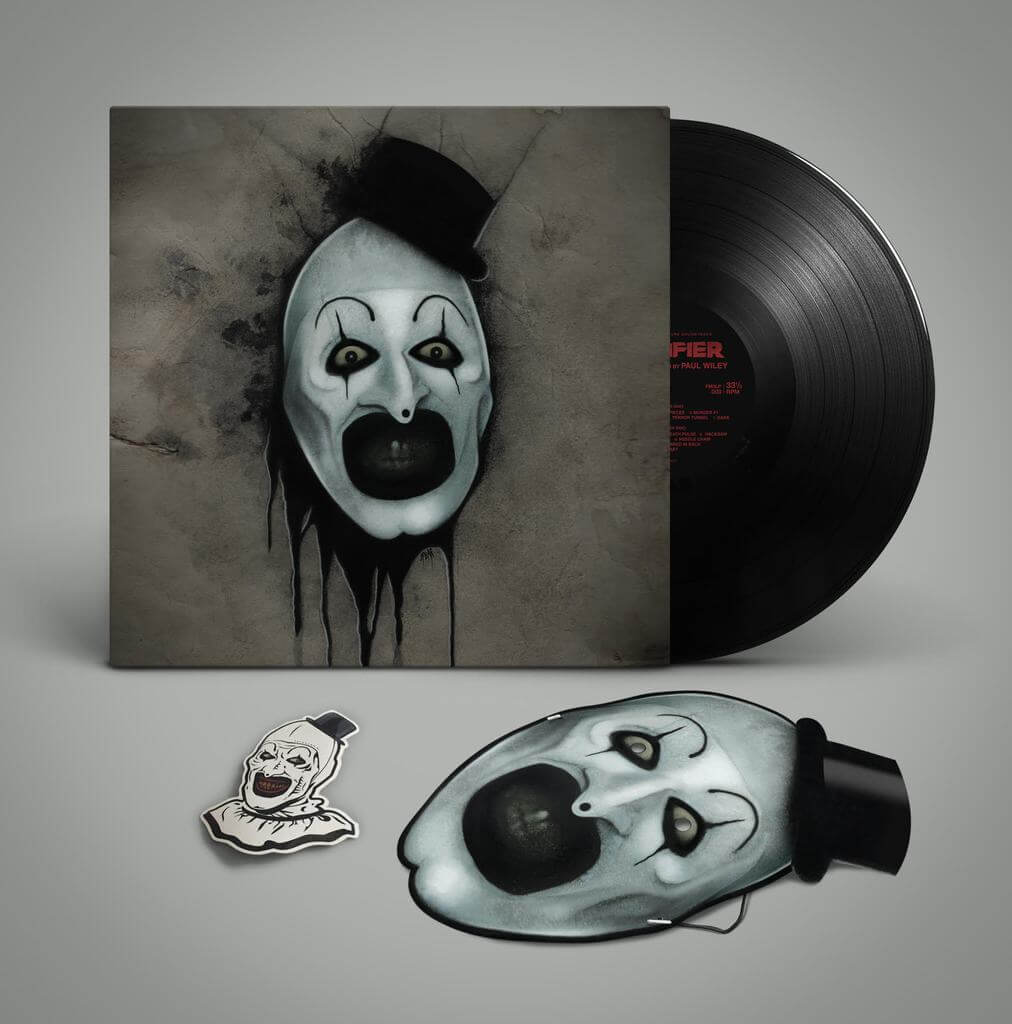
To celebrate the release of TERRIFIER – out now on Digital HD and DVD – we are giving away the DVD and the official soundtrack, composed & performed by Marilyn Manson’s guitarist Paul Wiley, on limited edition 12″ vinyl!

To be in with a chance of winning this fantastic prize, simply answer the below question:

What is the name of Stephen King’s legendary tale centred around Pennywise?

  1. IT
  2. Them
  3. They

Email your answer, along with your address details, to [email protected] labelled Terrifier before midnight on Sunday, April 22nd.

Terrifier OST

A hair-raising homage to the grindhouse slashers, Terrifier is a thrilling, gory horror that introduces a new murderous icon in the form of Art the Clown. Set to haunt nightmares for many years to come, Art is an unstoppable force who will slay anyone who gets in his way – and he doesn’t go easy on the grue.

“A thrilling, brutal, gory 80’s throwback” ★★★★ Arrow in the Head

“Dares to go where few films would even consider” ★★★★ Bloody Disgusting

Order the DVD on Amazon: po.st/TerrifierAmazon

Order the 12″ vinyl on Forever Midnight: https://bit.ly/2JzXv3m

Save Your Last Breath: Revisiting DeepStar Six

deepstar six

There was clearly something in the water in Hollywood in the late 1980s. Having apparently exhausted the potential of the spaceborne sci-fi saga in the dozen or so years since Star Wars changed the movie game forever, Tinseltown’s movers and shakers – the great and the good (and, as it probably turned out, the not-so-good) – decided to look a little closer to home for the next big thing in blockbuster cinema. News that wunderkind director James Cameron, who had caused a stir with The Terminator in 1984 – a film whose reputation was growing exponentially in relation to its modest box office – was working on a science fiction spectacular set underwater sent studios scurrying to greenlight their own aquatic adventures in the hope of stealing a march on Cameron’s somewhat more ambitious and, as it turned out, cerebral salty sci-fi saga.

DeepStar Six was actually in development in 1987 and went into production almost concurrently with Cameron’s The Abyss. The film was directed on a modest eight-million-dollar budget by Sean (Friday the 13th) Cunningham, stepping into the breach when original director Robert (The Hitcher) Harmon dropped out, from a script by Geof Miller and Lewis Abernathy who at the time was a close friend of Cameron. Not surprisingly, Cameron was concerned at the prospect of two similarly-themed SF movies arriving in theatres at the same time and when Cameron’s request to Abernathy that the two films should not compete with one another was ignored, the two men fell out, their friendship only resuming nearly a decade later when Cameron was deep into the production of a little-known real-life disaster movie called Titanic. As it turned out though, Cunningham’s DeepStar Six arrived in cinemas with almost indecent haste in January 1989 and, perhaps unsurprisingly but certainly disappointingly, it sank without trace, barely covering its production budget in ticket sales. Cameron’s The Abyss, a troubled and complex production, was released in October the same year and while it also performed fairly poorly at the box office, it established itself as the ‘go-to’ movie in a run of waterlogged washouts which also included Leviathan, The Rift, and Lords of the Deep.

DeepStar Six introduces us briskly to the eleven-strong crew of the titular deep sea US naval facility as their six-month tour of duty six miles below the surface – conducting research into the potential for underwater colonisation alongside a slightly more covert operation to install a nuclear weapons launch platform – starts to wind down. The crew’s geologist discovers a hitherto undetected cavern system under the ocean bed but, with time now at a premium, project leader John Van Gelder (Marius Weyers) orders the destruction of the cave system with depth charges, much to the disgust of the team’s marine biologist Dr Scarpelli (Nia Peeples), denied the opportunity to study a fascinating and possibly primordial long-lost ecosystem. Oh well, them’s the breaks…
deepstar six

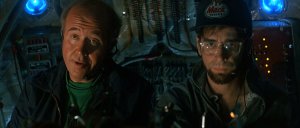
Inevitably, things go to hell in an undersea handcart fairly quickly. The depth charge explosions cause a massive collapse in the seabed itself and when a remote probe sent into the subsequent fissure goes silent, two DeepStar submarine pilots voyage into the crevice to investigate. Bad move, guys. They find the probe but also pick up a large and inexplicable sonar trace… cue lots of screaming, followed moments later by an ominous permanent radio silence. DeepStar’s observation pod quickly comes under attack by something fairly monstrous that is lurking in the murk; the pod becomes suspended over the edge of a ravine leaving one of its crew, Burciaga (Elya Baskin) mortally injured and the other, Joyce Collins (Nancy Everhard) trapped inside the compromised vessel. DeepStar Six’s Captain Laidlaw (Taurean Blacque) and hunky hero pilot – also Joyce’s squeeze – McBride (the semi-legendary Greg Evigan) mount a rescue mission. Burciaga doesn’t make it out alive but then neither does Laidlaw who gets trapped by a rapidly closing hatch door before sacrificing himself for the sake of the other two.

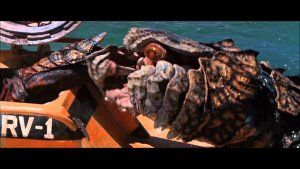
With the base now in danger from something very nasty, the remaining crew decide to abandon DeepStar but an attempt by technician Snyder (a scene-stealing turn from the late Miguel Ferrer, best known from his roles as OCP Vice President Bob Morton in 1987’s RoboCop and FBI Agent Albert Rosenfield in Twin Peaks) to secure the nuclear missile platform backfires when he misunderstands the computer protocol. The nuclear warheads detonate and the shockwave from the resulting explosions further damage the DeepStar. With their life support failing, the survivors race against time to repair the systems necessary to facilitate the decompression procedure before they can return to the surface. Engineer Richardson (Matt McCoy) ventures out in an atmospheric diving suit to effect repairs but he too is attacked by the creature, which forces its way into the airlock and bites him in half (sadly off-screen) – and that’s your money shot poster image right there. The handful of remaining DeepStar crew now face a fight to stay alive, desperate to finish their repairs but with a voracious, ravenous prehistoric creature – the film identifies it as possibly a giant eurypterid (yes, we’ll wait while you Google it) – hiding somewhere in the rapidly flooding base.

It’s inarguable that DeepStar Six is very much a generic monster movie that plays unashamedly – and fairly unimaginatively – with the long-established tropes of genre movies that trap a handful of characters in an isolated location, throws something monstrous and murderous into the mix, gets them to behave irrationally and entirely illogically considering their situation and then sits back and waits for the inevitable bloody fireworks. But the film – horribly underappreciated and given bad reviews back in 1989 (The New York Times described it as “a film that makes the exotic undersea world not much more interesting than the average bedroom closet” and Time Out declared that it “simply rehashes the phony trappings of countless TV shows”) – has dated rather better than most of its contemporaries. Less pretentious and ponderous than Cameron’s late-to-the-party The Abyss, Deepstar Six has a lot of fun playing with its clichés and although it’s not for one moment smart enough to subvert them, it’s certainly a more attractive and enjoyable experience than it’s throwaway reputation might suggest.
deepstar six

What’s fairly undeniable is that DeepStar Six’s cause isn’t particularly helped by its moderately parsimonious production values, which actually aren’t, in truth, as cheap and cheerless as its critics were keen to suggest. We’re in a cramped, stifling, technological undersea facility so we’re treated to the usual mundane banks of light-blinking computer panels and associated clunky hardware, a fairly stark and bland visual aesthetic that does the job of reminding us that we’re in a sterile and rather unearthly and uncomfortable environment. T Dow Albon’s miniature effects – mainly the base itself and the crippled observation pod – aren’t exactly Gerry Anderson standard but they’re more than adequate and certainly not “laughably unconvincing” as The New York Times patronisingly declared. Where the film does take a bit of a stumble and where it genuinely deserves much of the mud thrown its way, unfortunately, is perhaps where it really needed to be at its strongest. Traditionally, the big ‘reveal’ of the monster is the moment the audience, if it’s inclined to stick with a creature feature, is waiting for; the big pay-off for a gradual escalation of tension and terror. In DeepStar Six, the audience is kept patiently waiting for the better part of an hour for its first proper look of the eurypterid and when we finally see it in its glory, moments after it’s snapped engineer McBride in half, we can’t help feeling just a little disappointed by the rather random collection of tentacles, slavering jaws and rubbery bits and pieces that heaves itself out of the water to turn its attention on the rest of the crew. But then again, we need to remind ourselves that this is a low budget film made in 1989; in another Hollywood studio, James Cameron was testing the boundaries of special effects in The Abyss but widescale affordable CGI was still years away at this point. Today’s FX wizards would undoubtedly be able to rustle up something truly terrifying, but Deepstar Six’s effort, designed by Chris (The Fly, Gremlins) Walas and realised by Mark (X Files, Buffy the Vampire Slayer) Shostrom does tend to deflate the drama despite Cunningham keeping his camera at a distance as much as possible so we’re rarely subjected to bruising close-ups of a costume, which, as  Variety observed “never seems real… more like a goof on a 1950s horror movie monster than a true threat.”

Fortunately, the monster’s shortcomings are largely mitigated by a nippy and well-observed script that clearly takes its lead from Dan O’Bannon’s work on Ridley Scott’s Alien. We join the DeepStar base at the end of its crew’s tour; they’re tired, a bit jaded, keen to go home. Tensions have grown and relationships have developed, people are on edge. Some of the dialogue is perfunctory, some of it is fairly dull and meaningless technobabble, but it generally serves to create characters out of stereotypes to the extent that the crew feel like real people rather than cyphers or redshirts. Evigan and Everhard (a firm of solicitors in waiting if ever there was) are the film’s love interest, a couple thrown together by their circumstances; but he’s the strapping alpha male who doesn’t think he’ll ever settle down until the crew are slowly whittled away and – spoiler alert – it’s just him and Joyce battling to make their way to an escape pod when everyone else has been dissected, electrocuted, or exploded. Which brings us neatly to Miguel Ferrer’s Snyder, the inevitable snarky, wise-cracking comic relief who carries the film’s strongest character arc as he inadvertently detonates the nuclear warheads and accidentally harpoons a fellow crew-member, which causes him to become consumed with stress and guilt. This leads to his most ill-advised decision of all when he requisitions an escape pod in a desperate attempt to flee the DeepStar without undergoing the decompression procedure first. Hurtling up towards the surface he pops like a burst balloon and it’s probably the film’s ickiest and most satisfyingly horrifying moment. Joyce and McBride, meanwhile, make their way to the surface where Cunningham pulls an agreeable if slightly cheesy post-climax ‘jump scare’ stunt that may be familiar to fans of the director’s Friday the 13th and, in fairness, innumerable other genre movies that like to fool their audiences into believing that it’s all over and our heroes are safe and sound at last.
deepstar six

DeepStar Six can’t hold a candle to The Abyss in terms of scale, ambition, or tone, but its simple mission statement and its sheer lack of pretension makes it a better bet for an audience in search of some lively, action-packed monster mayhem from the days before CGI made almost anything possible and took a lot of the heart and much of the sheer unadulterated homespun fun out of the genre. DeepStar Six and its bedfellows failed to find favour with their contemporary audiences but they paved the way for later waterlogged potboilers such as Deep Rising (1989), Deep Blue Sea (1999), The Rig (2010), and Ji-hoon Kim’s Sector 7 (2011), a line that continues later this year with The Meg, in which Jason Statham probably punches out a seventy-foot shark as he attempts to rescue the crew of a sunken submarine. It seems it’s still not safe to go back into the water…

DeepStar Six is unapologetically a schlocky, disposable and often rather silly B-movie and yet it’s obviously not really designed to be anything else. Intended purely to capitalise on the anticipated success of a bigger, bolder film that, in the end, it predated by several months, it joins a lineage of unpretentious popcorn monsters movies and has nothing else on its mind other than to entertain its audience and provide a few cheapjack thrills. To that end alone, DeepStar Six is something of a ‘guilty pleasure’ success and it’s heartening to note that, in the years since it was stillborn at the box office, it’s been somewhat rehabilitated and re-evaluated and whilst no-one’s ever likely to suggest that it’s a genre classic or destined to be anything other than a footnote in the history of sci-fi cinema, it’s now being reassessed as a frothy, breezy, occasionally silly and frequently narratively-ludicrous but competently realised monster romp – and sometimes that’s exactly what we all need.

Dive to the depths of terror with DEEPSTAR SIX when it screens on Horror Channel. Sky 319, Virgin 149, Freeview 70, Freesat 138.

JOHN KRASINSKI | A QUIET PLACE

john krasinski

John Krasinski is riding a wave of critical and imminent commercial success in light of the release of his latest directorial effort, the futuristic horror film A Quiet Place, which he co-wrote and co-stars with his wife, actor Emily Blunt. The latest release through Paramount and courtesy of Michael Bay’s Platinum Dunes production company, it is a tense and taut cinematic experience that has already wowed audiences at the South by South West Film Festival and is generating the same level of buzz as the award-winning Get Out. STARBURST had the pleasure of meeting John during his recent press tour in London…

STARBURST: You are directing your wife and co-star Emily Blunt in A Quiet Place. What are her creative strengths in a film like this?

John Krasinski: Everything. I know that this was always going to be my greatest collaboration. I knew she was extremely talented and funnily enough, I was in an editing bay where they were editing Mary Poppins and the director, Rob Marshall, said to me that I would see how talented she was when she was working on this film.

A Quiet Place is one of the latest films from the Platinum Dunes brand, which has been responsible for the likes of The Texas Chainsaw Massacre and Hitcher remakes. How much influence and involvement does Michael Bay, one of the founders of the brand, have on a film like yours, given his reputation for directing big-budget spectacles like Pearl Harbor and Transformers?

Michael, though he is one of the producers of the film and one of the founders of the Platinum Dunes brand, was actually very supportive of me in terms of actually securing the directing gig on A Quiet Place. He also understood and appreciated that it would be my experience primarily.

We read an interview with Emily recently where she mentioned that you shot A Quiet Place in six weeks in New York State, which is one week longer than it took Clint Eastwood to shoot Pale Rider in 1985. Did working a TV schedule like your work on The Office shape the rapid completion of this film?

Absolutely, one of the biggest pieces of advice given to me was actually during my work on The Office and it was more about getting to the truth of the piece and say the lines honestly. In the case of The Office, if they laughed then fine, if not, equally so.

You recently mentioned that you weren’t a big fan of horror films. Now that you have done one, what have you learned from the experience?

A whole lot. It is an incredible storytelling medium and at times it is not as bound in reality than if it was if you were making a film about a divorce. I knew that I wanted to do a movie that was a metaphor about a family and the art of survival.

What other genres do you wish to focus on as a director in the future?

Anything that hits me emotionally. I would love to do another horror film if they let me, but I would like to do other things in the future.

A Quiet Place is in cinemas now. You can read our review here.

[ENDED] Win an I KILL GIANTS Tie-in Graphic Novel

I Kill Giants

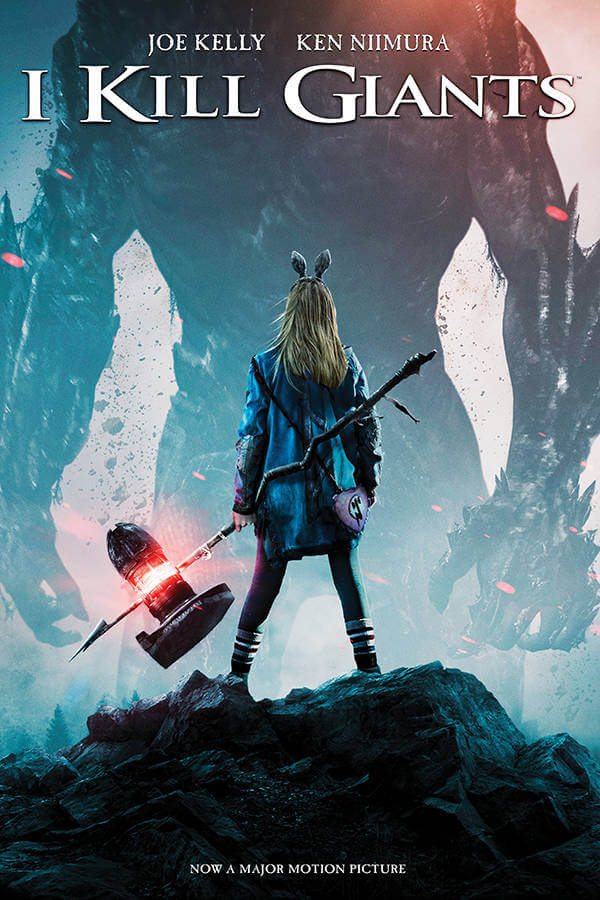
With I Kill Giants in cinemas this week, we’ve managed to get our hands on a tie-in graphic novel to give away to one lucky winner.

Based on Image Comics’ tale from Joe Kelly and J.M. Ken Niimura, I Kill Giants is released on April 6th, and to be in with a chance of winning this graphic novel you simply need to answer the below question.

Zoe Saldana is one of the stars of I Kill Giants, but which character does she play in the Guardians of the Galaxy movies?

a) Star-Lord

b) Rocket Raccoon

c) Gamora

Email your answer, along with your address details, to [email protected] before midnight on Sunday, April 15th.

To give you an idea of what to expect from I Kill Giants, be sure to check out the trailer below:


The official word on this hotly anticipated picture reads:

I Kill Giants tells the story of Barbara Thorson (Madison Wolfe), a teenage girl who escapes the realities of a troubled school and family life by retreating into a magical realm fighting evil ‘giants’ – colossal monsters who attack her quiet coastal town.

With the help of her new friend Sophia (Sydney Wade) and her school counsellor (Zoe Saldana), Barbara will learn to face her fears – tackling the mean bullies at school, coming to terms with her difficult home life and battling the mythic giants that threaten her world.

I Kill Giants is produced by Chris Columbus (Harry Potter and the Prisoner of Azkaban) and directed by Academy Award-winning director Anders Walter. Based on the critically acclaimed graphic novel by Image Comics’ Joe Kelly and J.M. Ken Niimura. The coming-of-age fantasy adventure premiered to acclaim at the Toronto International Film Festival (TIFF) last September.

I Kill Giants

Kaleidoscope presents I Kill Giants at Cinemas 6 April and Digital 4 May.

Image presents the I Kill Giants Movie Tie-in Edition graphic novel 4 April at https://forbiddenplanet.com/245515-i-kill-giants-movie-tie-in-edition/.

John Russo | NIGHT OF THE LIVING DEAD

john russo

The Criterion Collection has released a brand-new 4K scan and restoration of George Romero’s classic NIGHT OF THE LIVING DEAD. Restored by the Museum of Modern Art and The Film Foundation, the zombie film that started it all is now available the way it was meant to be seen, along with a plethora of extras, including a work-print edit of the film entitled NIGHT OF ANUBIS, as well as commentary tracks from the 30th anniversary, interviews, and behind-the-scenes stories. Being as how this marvellous release is now available, and considering the film also celebrates its fiftieth anniversary this year, we spoke with the film’s co-screenwriter JOHN A. RUSSO, about the restoration.

STARBURST: How long was this restoration in the works?

John Russo: Probably about a year and a half. I didn’t directly supervise it, but for about fifty years, Russ Streiner and I have been the trustees of the corporation that made the movie, so I was involved with the contracts and what was going on. When the actual restoration was going on, George Romero was able to sit with the person doing picture and sound perfections, before he passed away in July.

I had the negatives at my house. I had all the materials that were needed, because the laboratory had shut down and the sheriff was coming to close down the lab in 2005, and the manager of the lab called me up and said, “You better get your stuff out of here.” I had to hire a truck and get a couple of people to help me load those negatives into a truck and get them to my house. I kept them in a cool, dry place, just like a lab was keeping them.

Gary Streiner and Russ came to my house, and our inspection of the materials was filmed, at my house.

We have that, in case we ever want to make a documentary about this. We then drove the materials to the Museum of Modern Art restoration facility in Pennsylvania, and the negative examiners looked at the material and declared it was in very good condition, and the restoration procedure began.

We like the fact that the restoration centre is in Pennsylvania. It feels like that’s very appropriate.

The movie was shot in Evans City, Pennsylvania, which, as you probably know, is about 40 miles north of Pittsburgh, because that’s where the farmhouse was. The negative restoration place is in the middle of the state, out in the country someplace that’s hard to find, even if you have GPS. The woman in charge of all of this [restoration], named Katie Trainor, happened to be the niece of a friend of mine, from my old hometown. So, that’s another coincidence that ties in with what you’re saying.

The fact that it’s out in the middle of nowhere, much like that farmhouse, makes it seem like everything came full circle.

Yeah! It’s almost like a secret installation you might find in a James Bond movie.

Were you amazed when you finally saw the restored version of Night of the Living Dead; has it ever looked this good?

Actually – everybody’s amazed by it, and we’re gratified by it, but I wasn’t expecting to see anything much different than what we saw back in 1968, whenever our first print was pulled – because that was a pristine print, made from the 35mm negative, which was hot on a 35mm Aeroflex camera. That was the same camera that was used on most pictures back then, so the film, now, with the restoration, looks like it did back in 1968, which is something amazing, and something to be proud of.

NIGHT OF THE LIVING DEAD is out now as part of the Criterion Collection on Blu-ray. John Russo’s latest film MY UNCLE JOHN IS A ZOMBIE is appearing at film festivals. 

[ENDED] Win a Stunning Book Showcasing the Art and Making of TOMB RAIDER – In Cinemas Now!

To celebrate the release of the new movie TOMB RAIDER, in cinemas now, we’re giving you the chance to win a copy of Tomb Raider The Art and Making of the Film  Packed with concept art, behind the scenes photos and contributions from cast and crew, the book is perfect for #TombRaider fans!

In this brand-new movie adaptation, Lara Croft is the fiercely independent daughter of an eccentric adventurer who vanished when she was scarcely a teen. Advised to face the facts and move forward seven years on, Lara feels driven to finally discover the secrets behind her father’s mysterious death. Feeling as though she has no real purpose, she leaves everything she knows behind and heads off in search of her father’s last-known destination: a fabled tomb on a mythical island somewhere off the coast of Japan. Armed with only her sharp mind, blind faith and stubborn spirit, the stakes have never been higher for Lara. If she survives, this could be the making of her, earning her the title of Tomb Raider.

To be in with a chance of winning this amazing prize, simply answer the following question:

Tomb Raider is a big adventure with intrigue, huge scope and scale, incredible action, and a kick-ass heroine at its core. Name this heroine:

  1. Laura Cruz
  2. Lara Croft
  3. Lauren Crosby

Email your answer, along with your address details, to [email protected] before midnight on April 1st.

Like TombRaiderMovie on Facebook, and follow @WarnerBrosUK on Twitter and Instagram for all the latest TOMB RAIDER news and information.

Catch TOMB RAIDER in cinemas now.

© 2017 Warner Bros. Entertainment Inc. and Metro-Goldwyn-Mayer Pictures Inc. All Rights Reserved.

TOMB RAIDER and LARA CROFT are registered trademarks or trademarks of Square Enix Ltd.


Terms and conditions

  1. April 1st
  2. No alternative prize is available

ISSUE 446 – OUT NOW!

447 NS

STARBURST gets ready to welcome both TOMB RAIDER and READY PLAYER ONE to the big screen by taking a look at video games in the movies!

As well as previews of both big films, we look at the previous attempts to bring LARA CROFT to the screen and countdown the Top 20 game-to-film adaptations.

There’s also a look forward to the Kaiju sequel PACIFIC RIM: UPRISING starring John Boyega and a catch up of everything you need to know about JESSICA JONES before she returns for a second season.
That’s not all! We barricade the doors against home invaders in anticipation of THE STRANGERS: PREY AT NIGHT and chat to PRIMEVAL star ANDREW LEE POTTS about his web series WIRELESS.

In our regular features, we take a look at Michael Winner’s shocker THE SENTINEL, heading to HORROR CHANNEL, and Independents Day talks to Tony Newton, the producer of 60 SECONDS TO DIE.

Plus all your favourite COLUMNS, NEWS, REVIEWS and much MORE from the worlds of SCI-FI, HORROR and FANTASY!

[ENDED]Win a Dual Format Edition of RE:BORN

Re:Born

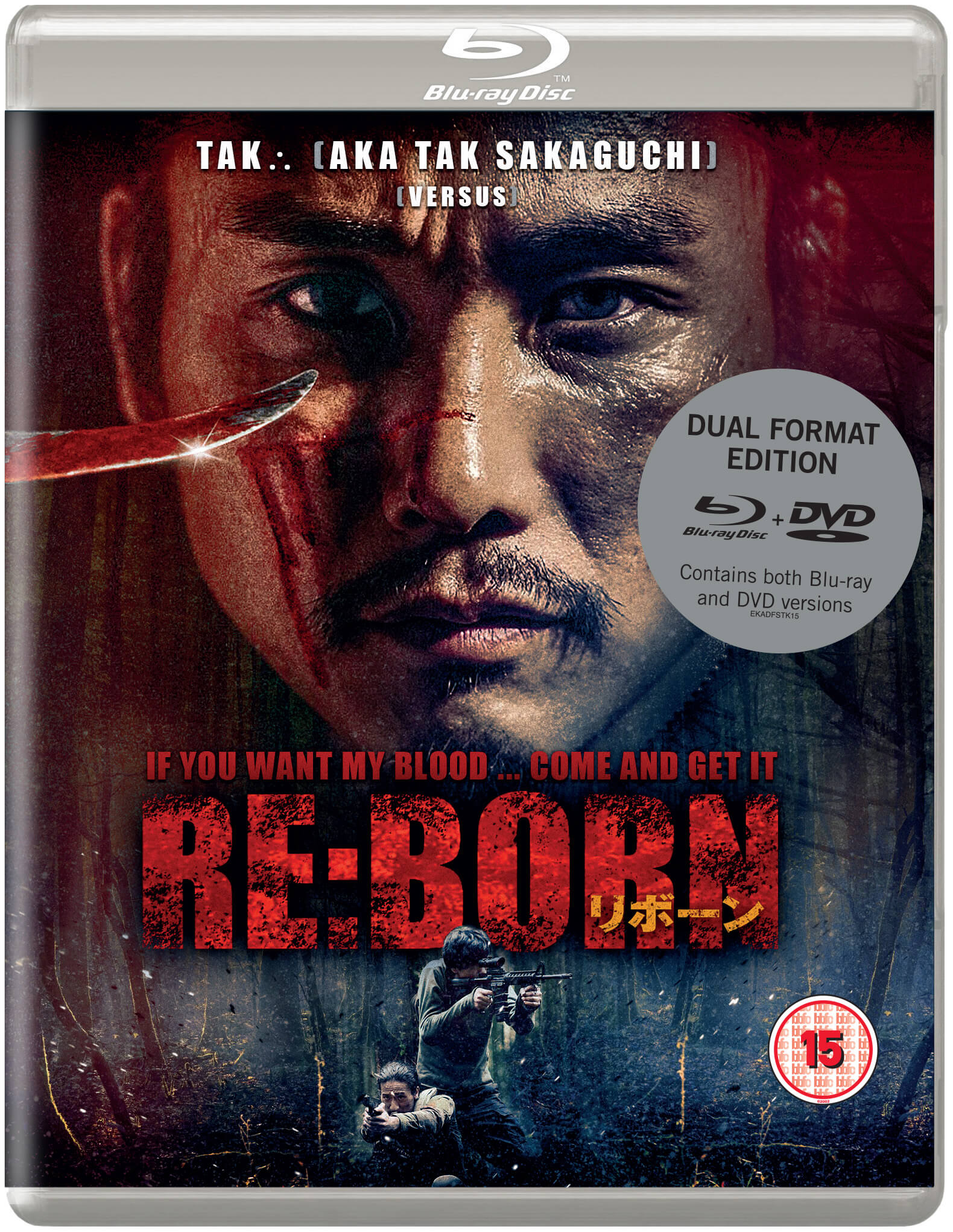
With Eureka Entertainment having now released a Dual Format edition of the impressive Re:Born, we’ve got three copies of this new release to give away.

To be in with a chance of winning yourself a copy of Re:Born, simply answer the below question:

Tak’s Toshiro character in Re: Born is a former what?

a) Chef

b) Dancer

c) Special forces operative

Email your answer, along with your address details, to [email protected] labelled Re:Born before midnight on Sunday, March 25th.

To give you an idea of what to expect from this intense martial arts actioner, be sure to check out the trailer below:

The official word on Eureka’s latest release reads:

Toshiro (Tak, formerly Tak Sakaguchi, Versus), a former special forces operative, now lives a quiet life in the Japanese countryside. Despite his seemingly peaceful existence, Toshiro struggles to contain the destructive impulses that once made him the top soldier in an elite unit of killers. When his former commanding officer, the enigmatic Phantom (Akio Ôtsuka), comes out of the shadows seeking revenge, Toshiro goes on a kill-crazy rampage against a squad of ruthless assassins.

Utilising an unorthodox form of close-quarters combat (referred to by the director and lead actor as “Zero Range Combat”) Re:Born features some of the most stunningly choreographed martial-arts fight sequences in recent years, and Eureka Entertainment is proud to present the film in its UK debut on Blu-ray and DVD. 

Re:Born

RE:BORN, a breath-taking, no-frills martial arts film featuring fast, furious and expertly choreographed fight sequences and starring Tak ∴ (formerly Tak Sakaguchi), is available for the first time on Blu-ray in the UK in a Dual Format (Blu-ray & DVD) edition on 12 March 2018. Available to order here.

Fiona Sampson | IN SEARCH OF MARY SHELLEY

Fiona Sampson

Fiona Sampson, MBE is an internationally renowned and award-winning British poet and writer. With twenty-nine books to her name, her work has been translated in to many languages. We caught up with her to talk about her book In Search of Mary Shelley: The Girl Who Wrote Frankenstein.

STARBURST: What’s the elevator pitch for In Search of Mary Shelley: The Girl Who Wrote Frankenstein?

Fiona Sampson: Mary Shelley was a real person, not a cartoon character, and as full of contradictions. Uncover the real person, and we uncover how she could create Frankenstein, one of the most enduring stories of our time, when she was only a teenager.

Are we in danger of forgetting who Mary Shelley was?

Yes and no. There’s been lots of specialist historical and biographical research (and I’ve done it all again, and some original research too, myself). But that’s different from bringing her to life for today. Mary Shelley’s reputation has suffered almost as much as she did in person from her marriage to the poet Percy Bysshe. For a long time, she was represented simply as good or bad for him – the great poet. And as part of that, Percy Bysshe Shelley’s biographers and admirers of his poetry floated a false story that he really wrote, or co-wrote, or massively improved Frankenstein. A mere girl could never have written such a masterpiece, they decided. Now that the original notebooks in which she wrote the novel are free to view online, no-one should buy this story any more. But incredibly, there are still fusty academic men peddling this story to the press: Frankenstein’s bicentenary has made them all come out of the woodwork.

What’s the thing most people don’t know about Shelley?

Apart from that she wrote Frankenstein? Probably that she had a long and distinguished life as a writer, publishing further novels and biography; and that ironically it was she who created Percy Bysshe’s reputation by collecting, editing and fair-copying his work.

What are the challenges in writing a book like this?

For me the thing that was most important was to carry out absolutely scrupulous research in the original sources, and to invent nothing. Even the weather, where I describe it, is researched in the meteorological records. And then to digest all that research so thoroughly that I can make the story come properly alive. The evidence is all painstakingly there, recorded page by page in the Notes at the end of the book, but the book itself should be a good read, a page-turner, and an emotionally intelligent one at that. I hope that’s how it’s come out, by and large. But it does irritate me beyond belief when people think that just because they enjoy reading it (lovely!) it can’t be scholarly. It is, actually – it’s just that as I’m a writer, I believe in storytelling. I can’t stand dull writing: I think it’s a crime.

What is the thing that people often get wrong about her work?

We usually remember Frankenstein from the 1931 James Whale film, not the actual story she wrote about the way blue sky research creates fresh ethical dilemmas as it goes. In Mary’s novel, the creature is incredibly articulate, intelligent and emotional, and is driven to murder by a series of rejections by the humans he tries to live among. She makes him really understandable and relatable, not just into a kind of hulking beast.

Is it ever correct to call Frankenstein’s Monster simply Frankenstein?

No! Sort it out, guys!

Is it fair to describe Shelley as the inventor of science fiction? Are there other/better claims?

I think it’s absolutely fair. Her message is in fact wider in a way: because she tells the same story about scientific hubris twice in the book. There is a parallel story about an Arctic explorer. But this is the first fully-fledged story about scientific invention and the risks involved in it that is also a story asking questions about how to make a sort-of-human prototype. In 1818 there had long been stories about alchemists raising the dead or creating spirits and ghouls. In fact, they were so fashionable at the time Mary was writing that her own story had its origin in a competition between writers to see if they could come up with something similar. But they called it a “ghost story”, and the supernatural, as we know, is not science fiction.

If Shelley was suddenly around in 2018, what do you think she’d make of her legacy?

I’m sure she’d be delighted. She was delighted to discover, when she came back to London in 1823 after being widowed (she was all of 26 by now), not one but two West End productions of Frankenstein. “I found myself famous,” she boasted to a friend.

How important is Frankenstein to modern genre fiction fans? Is Frankenstein really a must read?

Yes! It’s a must-read. It really shows the depth of the form, there right from the beginning, And it’s the archetypal story. It’s also fairly short and a very good read, even though it’s two hundred years old.

What are you working on next?

An opera about Daedalus: the first inventor, and the one whose son Icarus flew too close to the sun and fell to his death. So, another story about hubris… A Radio 4 sound poem about Mud (4.30pm BBC R4 Sunday April 8th.) And the documentary rights of In Search of Mary Shelley have been optioned, so if it gets commissioned I’ll be doing quite a lot of consultancy on a TV mini-series.

You’re doing a talk at London Book & Screen Week 2018. What’s the appeal of that sort of event?

It’s great to meet fellow enthusiasts for Frankenstein and Mary Shelley – that’s true for me as much as for the audience! Also I love meeting readers, and readers often like meeting the people whose books they read. And unfortunately Shelley can’t be there in person, so…

Simpsons or Futurama?

Simpsons. Despite my own surname. Brilliant characters!

Macbeth or Hamlet?

Macbeth. Less dignified and so more true to life. Everyone can relate to an anti-hero…

Doctor Who or Doctor No?

Doctor No. You’ve got to go classy sometimes, haven’t you?

Truth or Beauty?

Truth. Can’t relax with beauty alone.

Fiona Sampson is author of In Search of Mary Shelley: The Girl Who Wrote Frankenstein (Profile Books) and will be speaking at London Book & Screen Week on Tuesday, April 10th. Tickets are available at www.londonbookandscreenweek.co.uk.