Dracula: Eighty Years In His Shadow

alt

Is there any hope for the human race? Vampires are everywhere, and there’s nothing we can do about it. We can’t escape them, and we certainly can’t fight them. There has been a recent invasion of vampires in popular culture, spread across TV, films, books and comics like the blood of their victims. Twilight is, of course, the big name at the moment (forgive me, I’ve not seen the films or read the books), but we also have True Blood, Buffy the Vampire Slayer and so many, many more.

However, whenever Halloween comes around, which vampire is represented with the highest number of costumes? Spike and Dru? Blade? Edward? No, it’s all about Bela Lugosi, his accent and that hungry, terrifying smile of his.

It has been eighty years since Universal released their version of Dracula, and this short black and white feature still has a grip on the public imagination that no other vampire has been able to touch.

The film is based on a theatrical production which first toured the UK, and then – following a few changes – America. Whilst the reviews weren’t all spectacular, the play was hugely successful. At first Universal wished to make a big-budget adaptation of the novel, but once the Depression really set in, the expense couldn’t be justified. The rights were bought for the play, and the film eventually went into production.

Of course, I didn’t see the film on its release or even on the big screen. In fact, until recently I hadn’t even seen the film all the way through at all, believe it or not. Yet, I have always known the film well.

Opening to Tchaikovsky’s stirring Swan Lake, the first scenes set the tone for the rest of the film. A lone carriage travels the crumbling roads of Western Europe, with dark night approaching and heavy clouds in the sky. Renfield (Dwight Fry) is on his way to Castle Dracula. A brief stop, and conversation with the locals illustrates the fear that they have of the castle and the night.

The Castle itself is decrepit and gothic and filled with so many classic horror icons that it feels almost like a dream, or nightmare. Huge cobwebs stretch across rooms, the walls are crumbling, the windows smashed. Bats fly amongst the rafters and – oddly – armadillos live amongst the shadows. The castle is no longer a home to a civilised man, but is becoming consumed by nature. The Count descends the grand staircase, candle in hand and wrapped in his cloak. In the distance, a lone wolf howls, and the classic line ‘the children of the night. What music they make’ is heard on screen for the first time.

The following scene is a perfect example of Lugosi’s Dracula. He leads Renfield to a warm, welcoming room and provides food and wine. He is at once a courteous host, and also very threatening. Renfield is offered food and ‘very old wine’, although Dracula does admit that he never drinks… wine.

Once Dracula leaves, Renfield is joined in his room by three vampire women, all dressed in flowing white nightgowns. As is well known, this image was one of the first that came to Bram Stoker that led to the book being written. In the novel it is sexually loaded, but here less so, due, undoubtedly, to the strong censorship in Hollywood at the time.

A ship  – the Vesta – arrives at England, and the entire crew is dead, killed by Dracula. We see the shadow of the Captain, tied to the ship’s wheel. It is truly horrific. Investigators hear manic laughter, and find Renfield staring up at them. Even now, I find this scene chilling.

We see Dracula in London. He’s a predator in the city. A very symbolic little scene, I think. He is a parasite, living off civilisation. This just seems more apparent in a city, than in ruined castles. It is here that he meets Mina (Helen Chandler), Lucy (Frances Dade) and John Harker (David Manners). I find these three the weakest characters of the film. This is probably because they have been the most diluted from the characters in the novel. Harker in particular doesn’t serve any purpose, and has nothing to do for most of the film.

Van Helsing is investigating the unexplained deaths that Dracula’s presence has brought. He quickly deduces that they are being caused by a vampire, or Nosferatu, and sets out to prove his theory. He eventually catches Dracula’s lack of reflection in a mirror.

Director Tod Browning made his name on several successful silent horror films, and he uses many of the techniques he learnt with them in Dracula. Indeed, it almost seems as if he is reticent to make the jump to sound – many of the most iconic shots are silent. This silence, though, really helps to create a sense of being alone with the vampire. These shots often feature Dracula by himself, shrouded in mist. He seems mysterious, dangerous and lonely. There are also some great close-up. It is almost as if we have become transfixed by Dracula himself, and are being pulled in against our will.

Dwight Fry gives an amazing performance as Renfield; tortured, terrified and insane. His manic, throaty laughter is truly disturbing, even now.  I believe that he wants to eat insects and rats, and that he serves Dracula, but also that he wishes to escape. There is still some part of him that remains human, and at times, he understands what he has become.

Edward Van Sloan as Van Helsing is also worthy of note, carrying an authority that makes it believable that he can match wits with the Count. He had played this character in the stage version, and the experience he had working with Bela Lugosi is evident.

Of course, most praise must go to the star of the piece, Bela Lugosi. He had been playing the part on stage for some time, and it shows that he understands the character of Dracula. His Hungarian accent, along with a lyrical, carefully paced delivery creates an eerie quality to the Count, as if he is hypnotising everyone who is listening. The Count can be both courteous and menacing at once. Amazingly, Lugosi wasn’t the first choice for the role, despite having played Dracula on stage, and had to fight for it. Some of the exaggerated moves that he used on stage make it into the film. The clawed hands, the swirl of his cape, and his unnerving stare.

So much that is now associated with the character of Count Dracula comes from Lugosi’s performance. It is difficult to really appreciate how much his version of Dracula has become a part of popular culture. Of course, some very big names have played Dracula over the years. Christopher Lee, Gary Oldman and Frank Langella spring to mind. Each of these actors has brought something different to the role, but each has been judged in comparison to Lugosi.

At the end of the night, he is Dracula.

Cold Mirrors


This is the first collection of short stories from CJ Lines but, given the effortless way that he manipulates the format, I’m willing to bet that it won’t be his last. Ranging from visceral modern updates of the classic English ghost story to heartbreaking uses of modern technology, these are all dark tales, but that’s to be expected from an author whose first novel Filth Kiss was applauded by bastions of horror like Rue Morgue Magazine. In the interests of full disclosure I have to admit that I don’t read a lot of horror fiction, primarily because I take umbrage at the way a lot of prolific horror writers take one good idea and spin it out for 600 pages, but do you know where something like that isn’t a crime? In a short story.  Every one of CJ Lines’ stories is built on a brilliant conceit, and while some work better than others I admired the range of subjects that he wanted to tackle and the variety of voices that he brought to the different tales.

Of the fourteen collected stories, my favourites were Lambkin, channelling the spirit of M R James, Debut, a thoroughly disturbing look at Victorian puppetry, and The Trending, a beautiful and haunting meditation on grief in the modern age. My biggest complaint about Cold Mirrors would be that The Trending was the first story in the book and it absolutely towers above everything else in the collection. It’s wonderful to read an author at the height of his power, when all the pieces come together and create something timeless and powerful, but it was disappointing that none of the other stories in the collection made such a strong impression on me.

As a package Cold Mirrors serves as an introduction to a bold British author that deserves to be known more widely. At his best he filters the human condition through a dark aesthetic that we all look for in horror and at worst I had no complaints about Cold Mirrors that I wouldn’t level against mainstream short story writers like Stephen King. Cold Mirrors is a professional collection of stories from an independent British publisher and it deserves to rise above the clichéd mess of contrivances that most high-street retailers are trying to sell you as Horror. Watch closely for where CJ Lines goes from here.

————————————-

Because this is Starburst and we pride ourselves on giving you more for free than most magazines would give you for a handful of dirty cash, I tracked down CJ Lines for an interview, giving him one last chance to convince you to buy his book:

For anybody not already familiar with your work, who is C J Lines?

I’m the author of one novel, Filth Kiss (2007), and one collection of short stories, Cold Mirrors (2011). I started to write when I was a little kid, after seeing Clash of the Titans. There was something about hooded skeletons in rowboats and crawling green snake-women that sparked my young imagination and I wanted to replicate it by any means possible. As I grew up, the obsession with horror and monsters never went away. Although I moved from Birmingham to London and wrote music and film reviews for awhile, I yearned to write about monsters again so I enrolled in some Creative Writing classes at nightschool which totally relit the (Hell)fire. After a few years of tormenting classmates with short stories, I retreated from the classroom to the bedroom and plucked up the courage to try my hand at a novel. This eventually ended up being Filth Kiss.
 
What sort of an experience can a reader expect when they open one of your books?

Hopefully something different every time! The last thing I’d want to be is predictable. I think Cold Mirrors is a broad showcase of styles. There’s dark speculative fiction in there alongside more light-hearted stuff, some gothic period pieces and a couple of straightforward, sting-in-the-tail horror stories. Filth Kiss is a different beast. I originally wrote that as an experiment in how far I could take things, as well as a tribute to the 80s pulp “nasties” and while it took on its own distinct voice away from that, it’s still a brutal and unpleasant read. I like the idea of occupying a middle ground between your more abstract, atmospheric or cerebral horror and that gleeful balls-out mania of the genre at its daftest extremes.

Can you name any other authors or artists that you would consider to be your peers?

I’ve not found many authors who seem to have similar aims when it comes to horror. There’s a lot of really scrappy, unimaginative, grammatically questionable writing on the gorier end of the spectrum in small press which is bad. But on the other side, I find much of the more “mature” horror far too dry; lots of outdated Poe and Lovecraft imitation with little of interest to offer. I’d hardly call him a peer as he’s both a far greater writer and rightly more successful than I am but John Ajvide Lindqvist is definitely investigating the same avenues. Let The Right One In (the book, not the film) is an incredible mix of disturbing, hyper-violent horror, beautiful writing and emotional depth. Likewise, I loved Handling The Undead, in which he took a really old, overdone trope (zombies) and turned it into something both very shocking and moving. It’s great how he uses violence and grotesquery within deeper, more sophisticated narratives and I very much aspire to do the same.

What have been the biggest influences on your development as a writer?

When I was too young to rent all the 18-rated video nasties I longed to see, I naturally moved on to horror books because they didn’t have an age rating and I could buy them in the newsagent. I figured it was certainly worth honing the old reading skills if it meant the ability to access the impressively depraved levels of filth plied by Guy N. Smith, Shaun Hutson and Clive Barker at the time. There’s no question that this stuff sculpted my creative mind. It’s weird because, as a teenager, I found a lot of the stuff Channel 4 would show late at night – films by directors like Peter Greenaway, Derek Jarman and Ken Russell – would be another excellent way of accessing the kind of sex and violence that I wouldn’t normally be able to watch so I would stay up late and catch all of those. I saw so many genuinely brilliant films that way, many of which remain favourites even today. It’s weird to think how much cultural influence stemmed from an adolescent search for tits and gore! Yet somehow it all went in and, one way or another, it all comes out in my writing.

Since you mentioned them, I have to ask, which was your favourite Video Nasty and why?

Yikes, that’s a tough one. Even if we’re sticking with films that were actually on the official DPP list of “nasties”, I have a lot of love for so many of them. I’d say Flesh For Frankenstein is probably my favourite overall. It’s got a little of everything. Horror, comedy, vile gore, a surprising beauty at times and even a little genuine dramatic flair. Udo Kier’s performance is career-defining too! Close runners-up would be The Beyond and Evilspeak. The last fifteen minutes of the latter, despite being a blatant knock-off of Carrie, are some of the most frenzied of any horror film. Very underrated!

Have you ever written for any other mediums or do you prefer to stick to prose?

I stick to prose in general because it’s what I feel I’m good at. I’ve written one screenplay for a short film, there are some songs locked away in a dusty drawer somewhere and I occasionally write light poetry but this is largely for my own amusement.

Do you have another project lined up yet? Will we be seeing another full-length novel anytime soon?

I don’t have another project lined up, although I’m working on a few things. I tend to avoid talking too much in interviews about things I’m working on since they don’t always ever see the light of day. I wouldn’t want to get anyone excited for something they’ll never read! There are a couple of projects that I’ve been giving my attention to this year but I’m not sure which one will get carried through to completion. They’re both novels. One is a more sombre, literary effort about angels and the other is an unrepentant gorefest about a killer priest. Opposite ends of the spectrum, basically. I’m not a prolific writer at all and I tend to edit myself to the nth degree so whichever I choose to work on, it’ll be awhile before anyone reads it!

What Makes a Judge Dredd Epic?

alt

He’s the 21st century’s longest-serving law man with 54 fictional years of meting out justice under his belt. Since the second edition of 2000 AD, Judge Joe Dredd has lost his eyes, been shot, broken, tortured and aged every day since 1977. So what’s his secret?

While the early part of his career is occasionally revealed in snippets, his adventures were primarily open-and-shut cases until 1979, bar some multi-part exceptions and ambitious storylines like The Robot War instigated by the Spartacus-esque Call Me Kenneth (considered a mini-epic in its own right). Then Pat Mills penned The Cursed Earth, setting the blueprint of what would be the Judge Dredd epic.

The Cursed Earth

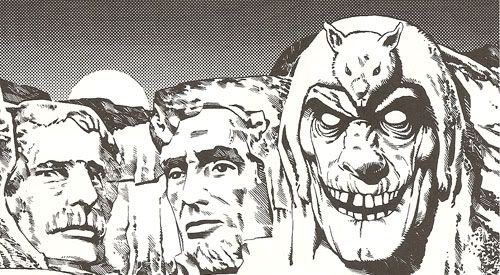
Mount Rushmore - Cursed Earth style
Mount Rushmore – as seen in The Cursed Earth

The Cursed Earth was spoon fed in 25 parts from progs 61 to 85 and saw the lawman’s universe expand dramatically. Up to then he had been focused on Mega-City One but a mission of mercy saw him sent 1,000 miles west across the Atomic War scarred plains of North America to Mega-City Two with a vaccine for the cannibal-causing 2T (FRU) T virus.

Michael Molcher, spokesman for 2000 AD publisher Rebellion, said: “It’s not so unusual in British weeklies for long-running stories – look at Charley’s War or Darkie’s Mob in Battle, or in 2000 AD something like Return to Armageddon (which ran for 34 weeks) or Meltdown Man (50 episodes). With five pages of black-and-white art turned around in a week on average, these stories could be generated over a long period of time.

“Epics are a good chance to explore Dredd’s world and establish environments (Cursed Earth) or take Dredd out of his natural environment (Judge Child). Most of the time, they simply shake up the status quo.”

The Cursed Earth took six months to tell in the weekly magazine and was mainly a daisy chain of one and two-part stories pitting Dredd against superstitious villagers plagued by the Devil’s Lapdogs (flying deadly rats), vampire medic robots charged with keeping the last president of the United States alive and taking in such landscapes like an army of war bots at Death Valley and Mount Rushmore –with the addition of a mutant face wearing a possum for a hat.

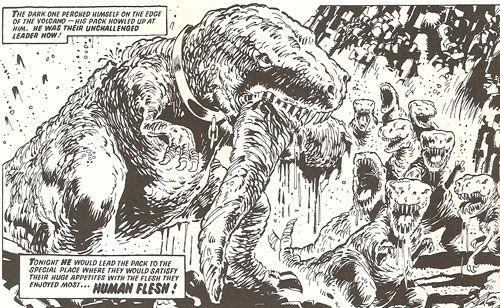
The future saga also beat Michael Crichton to the punch by resurrecting tyrant lizard Satanus the Unchained from the series Flesh through cloning for a national park devoted to dinosaurs – preceding Jurassic Park by 12 years.

Satanus

Satanus showing why he’s leader of the pack

Despite the satire, some stories hit a little too close to home, with two John Wagner stories banned from future reprints as they infringed on the copyright of burger lords McDonalds and Burger King. Dredd and reluctant ally Spikes Rotten Harvey end up captured by the two camps, force fed fast food by one and put on trial by the other for eating it. A Dr Moreau creation of the Jolly Green Giant didn’t help in the second story.

Against insurmountable odds, injury, the death of his allies and a lot of weirdness, Dredd crawls the last leg of his trip to the stricken Mega-City Two with vaccine intact – setting the formula for future epics which got bigger and better.

That formula, said Molcher, is “usually some threat that affects the entire city – see Necropolis, Judgement Day, Apocalypse War – where it comes down to Dredd to save the day, or Dredd has a mission to complete – Cursed Earth, Judge Child. Latterly, epics like The Pit or Tour of Duty have been built on smaller stories that grow to a bigger picture, allowing for a big cast of supporting characters”.

The number of Dredd epics out there is debatable. Some are clear cut cases of fitting the trend. Others, while shorter, are no less ambitious or status quo-shaking. By our reckoning there are 12 to 15 of these must-read Dredd stories.

The longest Dredd epic to date is the recent Tour of Duty – a 46 prog parter, running from July 2009 to August 2010.

Dredd is technically aged 67 but was ‘born’ aged five in a clone lab, physically making him 62. Whichever number you plump for, is he getting a little long in the tooth – and are epics getting too long and scaring new readers away?

 Molcher said: “Not really, we haven’t seen Dredd physically limited by his age at all. His character has developed over the decades so he’s probably more sympathetic than he was 30 years ago, more introspective.

“Summer is the traditional time for a new epic – if you advertise it and give enough teasers, there’s no reason why people can’t jump on board.”

The Day the Law Died

Judge Cal is watching
Like his namesake, Judge Caligula was a truly mad monster

Back in October 1978 and flush with the success of the marathon Cursed Earth, 2000 AD couldn’t wait to get Dredd started on his second 20-prog saga, beginning with a three-part prequel to The Day the Law Died.

Dredd has barely got back to Mega-City One and flopped into bed when he is awoken by the Gestapo-esque Special Judicial Squad, arrested for murder. Clearing himself, Dredd makes an enemy out of the squad’s boss, Deputy Chief Judge Caligula, and finds himself in the sights of a sniper’s rifle. Shot in the head, Dredd is not the only casualty as the chief judge is slain and Judge Cal assumes the highest office.

Kleggs
The fearsome Kleggs and their war cry turned the tide for Cal during the citizens’ revolt

This epic was written by Dredd co-creator John Wagner under his John Howard pseudonym and had more humour than The Cursed Earth. Despite lacking a road trip, this epic had the perfect anti-Dredd foil in Judge Cal, equal parts mad and funny.

On his elevation to office, Cal appoints his goldfish to the position of Deputy Chief Judge – who delivers the infamous “bloop!” law which no one understands but everyone fears as it comes with the death penalty. Cal also orders the city to report for execution in alphabetical order, beginning with Aaron A. Aardvark.

The Judge Child

Angel Gang
Mean Machine, Junior, Link and Pa Angel put the screws on the Judge Child’s kidnapper

The Dredd epics got a break until prog 156 when Wagner, later joined by long-time writing partner Alan Grant, sent Dredd on another road trip, this time mainly in space, in the 25-part Judge Child saga.

Mega-City One faces doom in the year 2120, claims a dying precog, unless Owen Krysler, a boy born with the mark of the eagle of justice, is found. Dredd again finds himself in the Cursed Earth looking for the boy, ending a garbage pharaoh’s dirty reign and locking horns with the boy’s kidnapper in the larger-than-life Texas City.

Popular Dredd villains The Angel Gang intervene and spirit the Judge Child to outer space, sending Dredd on a cross-planets trip, notably the planet Lesser Lingo where everyone hires their bodies out to personality-replacing biochips and the living Hungry Planet, which gobbles up Dredd’s ship until he nukes his way out.


Not many can claim to have killed Dredd, like Murd the powerful black magician

The hunt ends for Dredd on Necros, domain of the powerful Murd the Oppressor, who kills the lawman only to return him to life for the enjoyment of his pet, the giant toad Sagbelly. Dredd feeds the dark magician to the beast and homes in on a lead to the Angels on the wacky planet AB – the highlight of the epic where artist supremo Brian Bolland shows his geometrically-perfect style with the Jigsaw disease, a wasting illness that causes random body parts to vanish.

Jugsaw disease
The Jigsaw disease in action

The tale ends on the planet Xanadu when Dredd takes out the Angel gang one by one and looks into the suspect Judge Child’s eyes – only to find evil in them. In a shock twist Dredd turns his back on the object of his quest and leaves the boy behind.

But the Judge Child would later return in the abortive epic City of the Damned under the guise of the powerful Mutant, the form of the predicted disaster in 2120.

To get there Dredd and Psi Judge Anderson take their first time travel trip – only for writers Wagner and Grant to realise they don’t like time travel stories and begin wrapping up the saga which cost Dredd his eyes before it has barely begun, coming in at 14 episodes.

The Apocalypse War

Apocalypse War
The Soviet forces of East-Meg One invade in The Apocalyspe War

Arguably the best Dredd epic – and the one that nailed the formula of an uber-threat – was the gargantuan Apocalypse War. It tricked the readers with a mini-epic in its own right, Block Mania, when the entire North American city erupts in civil violence over a dropped ice cream cone.

As imaginatively titled housing blocks (each containing 50,000 residents and up) like Joan Collins, David Niven and Martin Sheen wage war on their neighbours, badly depleting the judges of men and armament, Dredd hunts down the man responsible, Orlok the Assassin, who has been poisoning the city’s waterways with mind-bending chemicals.

Dredd is outdone by the super-spy when he sabotages weather control and its infected rain falls on the last remaining parts of the city without Block Mania – and reveals all this was an overture to invasion by the Russian East-Meg One.

This epic had it all – unique villains with enough character to steal the scene but ultimately set up to die, the death of important Dredd characters like Judge Giant, numerous spreads filled with warfare and detail, a lengthy storyline long-reaching consequences that can fuel more stories for years and, most importantly, a horrific body count.

Button
Dredd kills 500 million people with the press of a button at the conclusion of the war

The writers’ true purpose was to cull Mega-City One down to a manageable size, bothered as they were by the limitations of getting Dredd from one side of a city that touched Canada in the north to the other side where it met Florida.

Apocalypse War killed 150 million Mega-City One residents in its opening salvos, and wiped out the southern sectors, leaving a city focused on its north east remains. East-Meg One fared worse, it was obliterated and half a billion killed when Dredd pressed the button of the Total Annihilation Device. This wasn’t be the last time Dredd killed a city with a touch of a button.

Two billion were killed in the Wagner/Garth Ennis Dredd crossover with Strontium Dog’s Johnny Alpha in zombie epic Day of Judgement when Dredd nukes Mega-City Two. Before that 60 million were killed by Judge Death and his death judges in the Necropolis storyline.

No official death tally is kept by Rebellion, but they believe in terms of the overall strip “you’re looking at three, maybe three and a half billion killed in total. The numbers Dredd’s killed on the street are pretty paltry”.

Since then the population of Mega-City One hovers around 400 million. Now Dredd has just embarked on his latest epic, Day of Chaos. A new mayor needs electing but doom is predicted by a promising new psi-cadet. Mysterious terrorists are in the city and legendary serial killer PJ Maybe is on the loose.

What the status quo will be after the Day of Chaos remains to be seen. To find out see 2000 AD, published every Wednesday.

The Captains


Once a month in Hollywood, California, the Hollywood Mortuary screens upcoming and classic films on the back of a large mausoleum that doubles for a screen. It’s the closest thing to a drive in theater experience as a communal feeling of the love of movies envelopes the patrons who bring blankets and picnic baskets filled with goodies.

Some celebrities that are buried here are Alfalfa Schweitzer from the Little Rascals, Hattie McDaniel from Gone With the Wind, Toto from the Wizard of OZ, Peter Loree, Valentino and the late, great Johnny Ramone.

Excited Star Trek fans entered the front gates in a well-behaved, orderly fashion (some dressed in uniform), for a rare treat to see William Shatner’s documentary on the Captains who also appeared introducing his film.

The Captains deals with Shatner’s journey of discovery as he candidly talks with the actors who played the leads in one of the most beloved series ever created.

Interviews with Patrick Stewart, Avery Brooks, Kate Mulgrew, Scott Bakula and the new Captain Kirk, Chris Pine, open up and tell their stories about their early years, how they got chosen for their roles in Star Trek and what impact it had on their lives.

We also discover a little more about William Shatner and his beginnings on stage standing in for (then an unknown actor) Christopher Plummer when he was taken ill one night while performing Shakespeare.

It’s a fascinating (no pun intended!) behind-the-sceens look at the mythos of these characters and how they influenced the lives of millions of people.

Patrick Stewart is very reflective, while Kate Mulgrew is emotional with moments of humor. Avery Brooks, a jazz composer and teacher by trade, has a fun time with metaphors, Scott Bakula is analytical as he sings and Chris Pine is humble and respectful even when he’s arm wrestling with the Shat to see who the real captain of the Enterprise is.

Shatner has created an interesting look at the roles, even coming to grips with himself so that he is now content with being indentified as Captain Kirk (something he fought against for a long time). Perhaps it’s the fact that our hero is 80 years old (hard to believe it) and that in his winter years he now looks back with pathos, realizing how many people his character influenced all over the world to do great things with their lives.

That’s not a bad legacy to leave behind.

It’s a must have for any Star Trek fan.

The Captains will be available in the UK on Blu Ray and DVD later this year.

Hack To The Future: The Wealth of Nations


Dear readers: this column will be something of a departure from the last
several. Normally, I make it a point of reviewing movies, games or books, but
this review is as much a report on some breaking Internet news as it is about a
game, or rather, several games. If you are looking for snarky opinion, come
back next month when I rip apart The Smurfs 3: The Revenge of Azrael. If you
are still with me, sit down, put on your thinking caps, and be prepared to look
at the Big Picture.

It’s a game. It’s a business. It’s a future business model. It could
revolutionize the future of currency markets. It’s a threat to governments all
over the world.

It is Denarius.

Denarius is three things rolled into a package. It is a virtual world. It is a
virtual currency exchange game. It is also a revolution. This is not mere
hyperbole, dear readers. This is one of those rare games that shakes the
foundations of heaven and hell and promises change on a global scale.

Have I built it up enough for you? No…I can tell…by that smirk on your
face. You are skeptical. Very well; allow me to make with the exposition.

There have been a number of games over the years meant to simulate buying and
selling of goods. The intrinsic challenge of capitalism lends itself to
gamification: money is the way the world keeps score, after all. What makes Denarius unique is that it is the first game that allows trading of other
virtual worlds’ currency.

Blown away yet? Let me restate. If you play World of Warcraft, you can use
gold pieces in Denarius to invest in the Linden dollars of Second Life, the
Florins of New Renaissance, or even the U.S. Dollar. It is full currency
trading, regardless of source. Your guild can now purchase stakes in the economy of
ChampionsOnline, or buy stock in a real estate business in Second Life. You can
make money, then exchange it for real-world cash at they appropriate in-world
exchanges or sell your shares to another investor in-game. It is economy
without borders; the nations are virtual and real-world economies intermingling
in a way that would make Milton Freeman proud.

And your government is probably shitting itself over it.

Denarius is run by Swedish serial entrepreneur Sigurd Magnusson. How does
Sigurd manage to handle all this currency without being taken down by objecting
governments? Get this: the servers are housed in space. Yes…in space.
Magnusson was one of the early investors in Space X, the privatized spacecraft
venture owner by Elon Musk. When regularly scheduled orbital flights commenced
last year, Magnusson placed his own bank of satellites in orbit. These are the
currency exchange servers, placed well beyond the impotent grasp of more
Terrestrial governments.

I know, I know. Why, Chris, are you telling us about this? Shouldn’t you be
reviewing movies?

Yes, of course I should. But this will change your life…unlike the latest Superman reboot.

Imagine this: you have money invested in your favorite MMORPG. A new one comes
out. It has a trading station on Denarius. Instead of starting from zero, you
can purchase the currency of the new game in Denarius, and get a leg up on your
playing.

…or, your guild produces some high quality virtual goods. Investors who might
not play the game but who know a business opportunity when they see it can
invest in your business as you sell shares on Denarius.

…or you are looking to fund your own project. Cash poor but game-currency
rich can invest in your venture and you can exchange the currency for cash
through the Denarius Paypal exchange.

But Chris, you say, I thought this was a game?

Yes, yes. It is. You can use Denarius in one of two modes. The first is what
we’ve been talking about, called Live Mode. In Live Mode, all trade require actual verified capital (virtual or real-world) to buy in. You trade much as you would on Wall Street. The other is Fantasy mode, wherein you
gather virtual funds to invest, purchase, and trade. No actual money changes hands, but you can chart your success or failure over the long term to hone your skills. There are achievements,
there are scores, and there are very few rules. Both modes are the free market,
taken to a logical extreme. It is possible to move from Fantasy to Live Mode
for a small fee, when you feel up to getting some skin in the game.

It is making waves.

So, far, only France has openly outlawed the game, but it looks as though other
countries will follow. Why? They cannot collect taxes — they do not get their
cut. The British Parliament is openly debating the legality of mixing virtual
and hard currency. The U.S. Senate has taken on the subject from two angles:
the first, can they regulate it and if not, two, can they take campaign
contributions through it?

Ayn Rand would be so proud. I say that with only a small amount of irony.

Some economists have been sent into twitching fits by all of this. In the three
months since Denarius launched, certain early adopters (both technology and
business) have made a ton of money, and the mainstream economists cannot figure
out why. Not so for Kent State Professor Bryan Pirnat, himself a student of
virtual economy guru Edward Castronova. Pirnat suggests that all economies have
been virtual for a very long time.

“In the U.S., our paper money has had no actual value ever since Nixon took us
off the gold standard. Yet we all act as if it is something more than just wood
pulp and metal tracking RFID tags. Why? Because we can use it to get things we
want. That’s what value is…trading desirable objects for other desirable
objects.”

There have been other attempts at developing a generic online currency, but they have ultimately failed. The most well known, Bitcoin, finally collapsed in 2013 due to general apathy. The idea of basing an ecomony on CPU processing cycles, while novel, ultimately lacked something that Castronova pinpointed in this 2011 post:

“How do I know these things are bad? I know because I play games. Game designers could have made currencies on the Bitcoin model many years ago. They didn’t. One thing we know about game currencies: People like them. We know this because the objective of the game designer is to make people happy. Game currencies are good currencies. What are the features of those currencies?

  • You get money only by doing things that can be interpreted as “productive work.” No freebies or handouts, and nothing abstract. You don’t solve puzzles to get coin, you run FedEx quests.
  • Mild inflation. As in the real world, mild inflation makes people happiest. Small enough to be unnoticeable in the short run, yet gives people a sense over time that their wealth and power is rising (even if it isn’t).
  • It assumed that the currency will be hacked and exploited. A strong central authority is in place to seize illicit funds and roll back damage.

    Bitcoins don’t have these features.”

How does Denarius measure up?

First off, they learned from Bitcoin: do not start a currency. Start an
exchange. While there were Bitcoin exchanges for buying and selling Bitcoins
with real-world money, the realization that the value proposition was not in
starting a new currency but in leveraging virtual currency against one another
was sheer brilliance.

Secondly, the users/buyers/sellers/players are trading coinage that is of
value, produced by actual work, be it working for a real-world business or as
part of a World of Warcraft Guild.

Third, fluctuations in the market, inflation and deflation of currencies is
possible. This is nothing new, just an extension of real-world economic
conditions. That sense of accomplishment that Castronova speaks of may be
coming over time; in truth, it is too soon to tell.

Finally, the idea that the technology will be hacked is part of any software
enterprise. The way to deal with this is simple; you take the exchange offline
until the problem can be addressed. All trades are frozen, no money is lost.

Magnusson may be on to something. What, exactly, is his goal? (Beyond the
businessman’s usual goal of PROFIT, that is…). In a recent interview with
Xeni Jardin of Boing Boing, he had this to say:

“It has been shown that the gamification of systems leads to more active participation in the system
and more dynamic evolution of the system in a shorter amount of time. The mingling of the
virtual and real-world economies has been coming for a long time, and it seems
to me that change on an economic level through a system like Denarius could wipe
out some of the cruft engendered in the current economic systems of terrestrial
origin. Understand, I am not saying that economic change in virtual space will
result in a utopia…on the contrary, it will be a bloodbath. However, our
older systems no longer serve any useful purpose; they are stuck in a morass of
antiquated regulations that stifle creativity and competition. By releasing
Denarius to the world. I am hoping that a better, more informed group of
motivated people who are invested in the current and future technologies yet
still grow and foster working communities will rise up and leave the old models
behind.”

Madman? Revolutionary? Savvy businessman? All of the above? You make the call. The reality is that the exchange is starting to take hold. According to sources inside the gaming industry, Valve is about to roll out the ability to purchase games on the Steam platform with virtual currency. The Electronic Frontier Foundation is accepting memberships purchased with virtual coin. Electronic Arts is reportedly working on a way to move virtual currency from other games into The Sims 4. Admittedly, we’re a long way from Amazon taking gold pieces to buy that new Jim Butcher novel, but if Magnusson is successful with Denarius, that day may yet come.

My advice to you? Check out the site. Follow the news on Boing Boing, on The Command Line Podcast, even in the mainstream media. See which politicians embrace it, and which attempt to squelch it. I will admit to being too cowardly to start putting my own funds on the line, but I am playing in Fantasy mode, and the results have been surprising. If you have a tolerance for risk in your virtual portfolio, you might be able to make this system work for you in ways you never thought possible.

At the same time, watch how the governments of the world react. Watch who benefits, and who is left behind. It is my firm belief that some system like this will take hold, if not this one, then one in the future. As the things we value become more virtual than real, it is only natural that the currencies we use follow the trend. We are a long way from a single currency, and if the past is any guide, it may never happen. Denarius will be a great experiment, and we have as much to learn from its possible failure as its improbable success.

That’s all for me this month, my little capitalists. Look for me in the usual places, the social networks, and now, inside Denarius on the trading floor. Until next time, be well, buy low, and sell high.

Parody Of The Planet Of The Apes


Normal
0
0
1
1318
7516
62
15
9230
11.0


0


0
0


Rise of the Planet of the Apes marks the
seventh big screen outing for the Apes franchise and what Fox will hope will be
the start of many more. It’s now ten years on from the failed Tim Burton reboot
and 38 from the end of the original franchise. The extended absence has done
nothing to diminish the series’ place in pop culture though, with TV shows,
adverts and films referencing the Planet of the Apes saga in all kinds of ways.
Here, we run down the ten best send-ups to work out what’s the finest Parody of
the Planet of the Apes.

1. Stop the Planet of the Apes, I Want to
Get Of
f (The Simpsons)

A three-way parody, this majestic send-up
from seventh season episode A Fish Called Selma is a highpoint for The Simpsons
and pop culture parodies as a whole. Looking to relaunch his failing career and
clinch the sidekick role in McBain IV: Fatal Discharge, Troy McClure embarks
upon a relationship with Marge’s sister Selma. “The marriage thing is very
in these days,” his agent, the magnificent named MacArthur Parker, reminds
him. Alas, the couple eventually split, and McClure ends the episode rejecting
the sidekick part in favour of the lead in self-penned magnum opus The
Contrabulous Fabtraption of Professor Horatio Hufnagel. In between comes this
masterpiece of parody. Part Apes satire, part riff on Falco’s Amadeus, part
musical theatre spoof, it features some of the show’s most quotable lines
(“I hate every ape I see/From chimpan-A to chimpann-Z”) and a
toe-tapping finale that may even better the original’s ending. The Simpsons
writers have a long history with sci-fi parodies and in particular Apes
references (listen out for Jerry Goldsmith’s The Hunt music during riot
scenes), and it’s the fidelity to the source that really make Stop the Planet
of the Apes
stand out. From the clothes to the backgrounds to the awkward
movements of the apes’ mouths, this is just like watching the real thing.

2. Spaceballs

One of the original and still one of the
best, Mel Brooks’ Star Wars spoof also found time to reference Apes in its
farcical conclusion. When President Scroob, Colonel Sandurz and Dark Helmet’s
dastardly plan is foiled, their ship Mega Maid (a gigantic Statue of
Liberty-esque woman, just with a vacuum instead of a torch) is blown to
smithereens, plunging the trio, along with Mega Maid’s head, into a nearby
planet. Which just happens to be inhabited by talking apes. “Dear
me,” says one to the other as the three villains descend, “what are
those things coming out of her nose?” “Spaceballs?!” comes the
reply. “Oh shit, there goes the planet.” Like The Simpsons, it’s
Brooks’ fidelity to the source that makes the Spaceballs parody work, with the
set-up, the make-up, even the eerie crashing of the waves upon the shore all
perfectly replicating the original. Of all the film’s riffs and references,
this is comfortably the best.

3. Charlton Heston, Saturday Night Live,
1993

Charlton’s Heston’s relationship with the
Apes series was surprisingly affectionate considering many stars of his stature
tend to look down upon sci-fi. He spoke fondly of the films in the 1998
documentary Behind the Planet of the Apes, and would go on to make a brief
cameo in the Tim Burton remake three years later. He was also happy to appear
in several skits parodying the series, most notably during his hosting spot on
Saturday Night Live in 1993. Having fallen asleep just before the show starts,
Heston wakes up in the Studio of the Apes, a dark inversion of the SNL studio
populated entirely by talking simians. “Oh, my God! It’s happening
again!” says Heston as he runs for his life. He’s eventually captured in a
neat play on the original film’s hunt sequence and brought before an enquiring
ape audience, who refuse to believe he’s anything but a talking mutant. The skit
ends with Heston reprising his famous madhouse dialogue from the film and
continuing with the show. After all, even an ape audience is better than no
audience at all.

4. Jay and Silent Bob Strike Back

“In this world gone mad, we won’t
spank the monkey; the monkey will spank us”, so says Jason Mewes during
Jay and Silent Bob’s minute long take on the Apes saga. It’s a tour de force
for Mewes, who embraces the nonsense concept with his trademark manic glee.
Highlights include a surprisingly realistic Ape City, cameo appearances from Clerks
duo Brian O’Halloran and Jeff Anderson and the sight of Jay taking Heston’s
place on the original film’s beach-head. Planet of the Apes with Jay instead of
Heston? Now that’s something we’d like to see!

5. Siskel and Ebert and Jay and Alice (The
Critic
)

Simpsons writers Al Jean and Mike Reiss’s The
Critic
only ran for 23 episodes between 1994 and 1995, but even in that short
period they managed to fit in a host of movie references and jokes. Planet of
the Apes
‘ moment in the spotlight came at the start of second season episode Siskel
and Ebert and Jay and Alice
, in which Jay is forced to partner with both the
famous movie critics after their successful partnership comes to an end. Before
all this, Jay fronts his own show in which he discusses 1970s sci-fi classic Planet
of the Dogs. The clip references the famous stinking paws line and stars an
unusually friendly Doctor Zaius. “Quit rubbing my leg you bloody
bowsers,” indeed.

6. Return to Beneath the Planet of the Pigs
(The Muppet Show)

No list of parodies would be complete
without The Muppets, and this entry dates back to the very start of the phenomenon
in the mid-70s. Jim Henson produced two pilots for the series before it was
officially picked up: the first, The Muppets Valentines Show, aired in 1974,
the second, the curiously named The Muppets: Sex and Violence, hit screens a
year later. It is this episode that features the Apes parody. In a similar
set-up to The Critic, we’re introduced to a movie programme, Film In Focus, where
the presenter informs us of the latest “pseudo-epic from Colossal
Pictures”, Return to Beneath the Planet of the Pigs. It’s not one of the
Muppets’ finest movie parodies, but it scores points for capturing the Planet
of the Apes
atmosphere perfectly and creating an uncannily realistic Muppet
version of Charlton Heston. Kudos too for the punchline, where our, of course
totally unbiased, piggy reviewer praises the film for its realism.

7. Planet of the Aches (The Simpsons)

Another one from The Simpsons, though this
time it’s Itchy and Scratchy who are sending the series up. This is a unique
entry into this top ten, being the only one to reference one of the series’
sequels, in this case Beneath the Planet of the Apes. Itchy traps Scratchy
behind a wall and when the embattled cat emerges some 3000 years later he’s
greeted by Itchy’s ancestors who have grown massive, throbbing brains and
telekinetic powers like the subterranean humans in Beneath. They bathe and feed
Scratchy, but the kind treatment doesn’t last long. He’s eventually sliced and
diced (telekinetically of course) and left for dead. Bart, watching on, is
unimpressed. He’s wrapped up in a movie parody of his own, acting as Jimmy
Stewart to Ned Flanders’ Raymond Burr in the episode’s main parody: Rear Window.

8. Go, God, Go XII (South Park)

Tenth season South Park episode Go, God, Go
is a bit of a treasure trove for sci-fi fans. Brazil, Logan’s Run and Aliens
are among the films referenced by Trey Parker and Matt Stone in a story that
sees Cartman freeze himself in a bid to make the three-week wait for a new
games console go quicker. Sadly all does not run smoothly and, when he awakens,
Cartman finds himself in a nightmarish future where otters ride ostriches and
Nintendos don’t exist. Parker and Stone have always been masters of sly
references and the image of the otters riding the ostriches, along with the
horn-blast sound that goes with it, is as neat and surreal a reference to the
original film’s hunt sequences as I’ve ever seen.

9. The Apes of Wrath (Garth Marenghi’s
Darkplace
)

Apes took centre stage in the fourth
episode of Garth Marenghi’s Darkplace, a show that made a virtue of sending up
sci-fi and horror tropes of the 70s and 80s. Though there are no direct
references to the series – save the use of the central concept and some subtle
hints at Goldsmith’s score in the music – this is the most consistently funny
clip on this list. Great scenes come thick and fast (the bike chase through a
forest is particularly good) as do the notable lines, which come loaded with
‘highly political subtext’. “Maybe we shouldn’t do anything,” says
Richard Ayoade’s medical chief character. “No-one takes days off any more,
everyone’s grooming each other and the doctors are literally working for peanuts.”
Reports that David Cameron is seeking his own ape workforce are so far
unfounded.

10. Serta Mattress commercial

This 1998 advert for an American mattress
company isn’t a parody, but for sheer weirdness it had to get a mention.
Dreams, the commercial reminds us, are the realm of the impossible, where
anything can happen. One can have afternoon tea with your childhood
sweetheart…and Cornelius from Planet of the Apes. Someone’s been eating too
much cheese…

How DC Could Stop Worrying and Learn to Love the Fangirls


Normal
0
0
1
659
3757
31
7
4613
11.0


0


0
0


The highlight of the San Diego Comic Con
this year turned out not to be hot movie news, but old-fashioned comic book
controversy. DC Comics have been generating column inches ever since they
announced their ‘New 52’, but thanks to one persistent Batgirl cosplayer (known
only as Kyrax2), the Jeremy Paxman of Comic Con, the focus was instead put
firmly on the role of women in comics, as creators, characters and fans. Didio
was dismissive and downright confrontational when this Batgirl asked why the
number of female creators and characters had dipped in the relaunch. Defending
his lack of female creators, Didio referred to Marvel’s similar imbalance. His
timing couldn’t have been worse. Because while DC were getting a tough time
from their neglected female fans, Marvel were announcing a female-led TV slate.

They currently have three live-action TV
shows in development: AKA Jessica Jones, Mockingbird and Cloak and Dagger. All
three feature women in leading roles, and two have black leading men. While DC
are doing nothing but ticking off their vocal minority of female fans, Marvel
are actively catering to them and trying to bring more on board. And, in a very
savvy move, they are doing that through a more female-friendly medium: TV.

Ever since Buffy the Vampire Slayer
(although it seems unfair to overlook The X-Files), sci-fi and fantasy
television shows have had a strong female appeal. Iconic female action heroes
were suddenly everywhere, from Sydney Bristow in Alias to True Blood’s ballsy
Sookie Stackhouse via River Song. The real indication that the tide had turned
came when the Battlestar Galactica reboot recast Starbuck as a women – and made
her one of the best female characters of all time. Women are increasingly
taking over message boards on even male-heavy shows, like Game of Thrones and Supernatural.
Maybe that’s just down to the leading men being really ridiculously good
looking. But I hope that the real reason is that sci-fi and fantasy shows are
growing up. The clever balance of comedy, drama, scares and action make these
shows equally appealing to both men and women. The fact is, you don’t need a
female lead to attract a female audience. These days people come to a show if
it’s good, regardless of the gender of the lead character.

Comics are a different beast, though. To an
outsider, they are dense and intimidating, with their decades of tangled
stories. New readers wouldn’t know where to start. The fact that, up until now,
you actually had to venture into a comic book shop in order to buy one also put
a lot of people off. Comics have never been the most inclusive medium. Luckily,
TV can act as a great gateway drug to the harder A-class comics. DC has had
prior success with Smallville, a show that introduced many fans to Clark Kent
and the wider DCU, as the cast of characters grew to include Green Arrow,
Aquaman, Black Canary and the JSA. Smallville – and before it Lois and Clark:
The New Adventures of Superman
– attracted an adult audience in a way animated
shows can’t. DC tried to capitalise on this again with their Wonder Woman
pilot, but weight of expectation (and a shoddy script) sunk it before it could
get going.

There’s nothing to say Marvel’s new TV
slate will make it beyond development, but since Marvel is owned by Disney, and
since they also own ABC, the channel that will show these programmes, we can
assume it’s a fairly safe bet. The fact that they are using these shows to
attract women and non-white viewers, traditionally untapped market in comic
books, is especially smart. DC is currently talking up a TV series centring on
the Teen Titan Raven, but compared to Marvel their TV and film schedule is very
flimsy. Comics on their own are unlikely to attract new demographics. Films and
TV shows make more people familiar with comic book characters. Digital comics
make it easier for people to buy them. But they won’t keep those new audiences
unless the comics themselves are up to scratch. And it seems the Batgirl of San
Diego has scored a victory: DC have just announced more projects by women, and
they’ve taken some projects about women out of mothballs. I’m a DC fangirl, and
in my opinion they have more and better minority characters (and in the comic
book world, that includes women) than their chief competitor. I just wish they
had a media strategy that would make more people aware of that. Because without
it, I fear Marvel is going to sink them.

Star Wars Begins


This new feature-length fan-made documentary on the classic 1977 movie is a real labour of love for Jamie Benning, and an absolute must-see for all Star Wars obsessives. Also known as ‘Jambe Davdar’ (don’t ask me, folks!), the 34 year old Londoner works as an editor in sports television, and has already produced two earlier documentaries, Returning To Jedi and Building Empire (as to the content, the clues are in the titles).  Star Wars Begins has been four years in the making, and the hard work is clearly evident in the final product. If only the official dvd extras were this good! Thus far there’s been no clampdown by Lucasfilm and one can only hope the great bearded one himself has seen (or been made aware of by his young apprentices) this remarkable achievement. I particularly enjoyed the clips from the film that showcase the original on-set audio; Dave Prowse’s voice is just hilarious as Darth Vader, and one wonders how on Earth the man ever thought that Lucas would keep his West Country tones on the soundtrack. Behind-the-scenes footage of Ford, Hamill and Fisher in action highlight the camaraderie between the three young actors, and it’s particularly refreshing to see and hear Mr Ford apparently enjoying himself, if only the crusty old bugger would crack a smile or two these days!

Benning first saw Star Wars in 1980 on a double bill with The Empire Strikes Back, and that was it. He collected all the action figures, the comic books, and anything else he could get his hands on. After all these years, and countless re-issues of the original trilogy on video and dvd, I asked him why he felt the need to produce his own documentaries:

Jamie Benning: The DVD release of the trilogy in 2004 had a good documentary but it was a straight  forward talking heads affair. I wanted more deleted scenes and anecdotal interviews with the cast and crew. I also thought that the DVD commentary idea could be pushed into the visual realm given the amount of material available for the series.

Starburst: But four years?

JB: Star Wars Begins was made over a four year period but it took about one year to research and produce. The reason it took four years was because I had kids, moved house and I have a busy job taking me all over the world. The very nature of making something like this without being paid means that it’s hard to be motivated and find the time to work on it.

SB: Despite the deafening silence coming from Lucasfilm, it seems that the fans themselves have taken your films to their hearts.

JB: I’ve had nothing but positive reactions really. The videos have now had 2.7million views on YouTube since Feb 2011. I’ve also been interviewed by BBC radio, FHM in Australia, dozens of websites and had reviews in far flung places, from The New York Times to a small based Culture magazine. I receive dozens of emails each week from people thanking me. It’s been a great few months.

SB: But an endorsement from the great man himself wouldn’t go amiss, surely? The flip side, of course, is Mr Lucas feeling a bit miffed at being shown how to do his job. Are you worried that your hero could become your nemesis?

JB: Lucasfilm have not been in touch. They are definitely aware though. They have not requested my videos be taken down so that’s about as much of a reaction as I expect from them. I do have a contact who knows people at ILM who said they loved it.

Interestingly, Lucasfilm have added a new commentary from archival cast and crew interviews to the Blu-ray. That may be in reaction to my work! I’ve always stated that these projects are non profit making. In fact they have probably cost me a couple of thousand pounds overall. So Lucasfilm shouldn’t be too worried. The minute you start selling DVDs with copyrighted material on them you are entering into a different and dangerous arena. I’ve never done that and never will. Some people find it unbelievable that I haven’t made money from all this work but that was never my intention. I just did it for fun and for the fans.

SB: But it’s the fans that really matter, I suggest, and you must be heartened by their response?

JB:  Initially I tried to reply to every comment and piece of feedback. But one day back in February I got 270 emails over night. I knew at that point that I would have to take a bit of a step back. Six months on, things have calmed down a bit so I am able to answer most emails again. Everyone has been so kind. It’s great to hear that I have helped rekindle people’s interest in the original film amongst an otherwise diluted franchise.

I’ve had a couple of thumbs down on YouTube. But with 2.7 million views that’s pretty good going. There have been no actual negative comments.

SB: And are there more documentaries on the cards for the fans to start salivating over?

JB: I initially made Building Empire in 2006, Returning to Jedi in 2008 and Star Wars Begins in 2009. I have already made some good progress on Raiding the Lost Ark, it should be out in the next 6-8 months. They are some of my favourite films. I love The Empire Strikes Back and I think it’s the best of the trilogy. But it couldn’t exist without the first, groundbreaking film. Order of preference? Star Wars, Empire, Jedi. I am not a fan of the prequels. Some of the fans can’t believe that of me. But more Star Wars isn’t necessarily a good thing.

And on that sacrilegious note, it only remains for me to give Jamie a massive metaphorical slap on the back and thank him for his almighty efforts in enriching the lives of Star Wars fans the world over. A job at Skywalker ranch can only be a matter of time.

STAR WARS BEGINS can be viewed on YouTube (until Mr Lucas says it can’t)

It’s ON like DONKEY KONG!

This year marks the 30th Anniversary of the release of everyone’s favorite chest beating, barrel tossing primate, Donkey Kong. The game also introduced a secondary character, who almost by accident became the biggest gaming icon of all time.

A very select group of people are instantly identifiable by a single name: Cher, Madonna or Dave (of Chas and Dave) all share this distinction but a certain Italian plumber leaves them all in the dust… ‘Mario’ is all Nintendo need to mumble to cause a reaction by a million fanboys that would make Pavlov’s dogs look positively cotton mouthed at lunch time. Bookend ‘Mario’ with ‘New’ and ‘Game’ and you’ve got all the ingredients for a full scale geek riot.

But I’m getting ahead of myself…

1981 was a good year. No, 1981 was a GREAT year. In fact, until I started researching this article, I’d forgotten what a peach it was: Adam and the Ants were dominating the charts with ‘Prince Charming’ (ask your Mum), Samantha Fox was doing her plucky best to struggle through a shirt shortage (ask your Dad) and Roger Moore was raising a single eyebrow for Queen & country (ask the Ed). On TV, Peter Davidson succeeded Tom Baker as the new Doctor (OK, Davidson brings the curve down, but still a damn good year). I checked if Chocky was released in ’81 but it turns out that was 1984. Danger Mouse was on though, so that’s something.

I was a young man in my mid 30’s struggling to put my life back together after a messy divorce. I’d lay in bed for weeks, too depressed to move. One day I decided: Enough was enough! I got up and pulled on my fingerless gloves and Crackerjack T-shirt and set off to my local arcade.

‘Dave’s Digital Dungeon’ had been a favorite haunt of mine for years. I spent most of my free time & money there, bathed in the 8-bit glow of whatever new game was available, struggling on obsessively, until I’d mastered it. This had been the cause of many arguments and nights on the sofa and was cited in the legal paperwork as a contributing factor in the break up.

I was about to settle in to my usual routine; 8 hours of Pac-Man followed by pizza and Quincy reruns, when something in the corner caught my eye, a new game? I stepped away from my old favourite, I had the top three high scores anyway (Who’s the ‘loser’ now, Rebecca?), and made my way over to the new cabinet. I looked it up & down. Emblazoned on the side were the words ‘Donkey Kong’. I’d not heard of it and was excited and confused by the name, what could it mean?. My stomach turned over. It might have been the Wham bar I ate on the way over, but I didn’t think so.

I stood there staring for a little while; I wanted to take it all in. The artwork was bright & vivid. An empty High Score screen seemed to beckon me, a siren’s cry as plaintive and irresistible as Subway on payday. My senses were on fire. I took a deep breath; it still had that ‘new cabinet’ smell. My Magnum P.I. rucksack dropped to the floor (on purpose) and I settled in. I knew I’d be there for some time.

After forking over 10p, I watched as an ape grabbed a woman and carried her to the top of a screen full of horizontal girders, the ladders disappearing as he went. On reaching the top, he stamped a foot causing the platforms to skew to slightly less horizontal angles. I played a nameless carpenter (who I later discovered was called ‘jumpman’), tasked with rescuing the girl. How hard could it be? What followed was an blur of barrels (some ablaze!) and the most random rogues gallery I’d ever seen.

I fought on for hours, smashing stuff with my hammer, dodging pans, springs and barrels. It was a truly epic battle. Before I knew it the arcade was empty apart from me and my new obsession. Dave was locking up. I begged for 10 more minutes but Dave was unmoved. He motioned towards the exit with his ‘good’ thumb (long story) and yanked the plug from the wall.

Dave was always a bit of a dick.

I’ve been playing games most of my life and have many fond memories. This is up there with the best.

Created by gaming legend Shigeru Miyamoto (pictured below) after Nintendo tasked him with revamping the failed game ‘Radarscope’.  Miyamoto, realising, if you try to polish a turd all you do is ruin a perfectly good duster, decided to build a new game from scratch. It was to be a love triangle between a girl, an ape and a handyman, influenced in roughly equal parts by Popeye, Beauty & the Beast and King Kong.

Donkey Kong, considered by some as the first true platform game, was certainly the first game where a character could jump (The name ‘Jumpman’ was intended to cash in on the popularity of the Walkman & Pac-man). In 1981 jumping was all the rage and Donkey Kong became a worldwide sensation and Nintendo’s biggest selling game to that point. It made over $100,000,000 in the first year alone, making Pac-Man look like Ms. Pac-Man. Shockingly, Donkey Kong was the first game Miyamoto ever designed.

Even the name, ‘Donkey Kong’ was a source of furious debate; there are many legends as to how the name came about, from the mistranslation of ‘Monkey’ as ‘Donkey’ to a misunderstanding resulting from a blurred fax. Miyamoto, sick of the fan boy flame war cleared up the confusion, stating that he used the word ‘Donkey’ to convey a sense of stubbornness and ‘Kong’ to invoke the image of a gorilla.

The ‘Kong’ part was of special interest to MCA Universal, who sued Nintendo soon after the game’s release for copyright infringement of the movie classic King Kong. The similarities were blatant. I imagine Universal’s lawyers were nudging each other in the ribs and giggling in court when they unveiled exhibit ‘A’: a picture of King Kong, then with a cry of “Ta-Dah!” they whipped the sheet off Exhibit ‘B’: a picture of Donkey Kong with an arrow pointing to the ape and the ‘Kong’ bit underlined. Surely the most barefaced copyright infringement of all time.

The prosecution were in mid ‘chest bump’ while shouting ‘BOOM!’ when the judge glanced at the paperwork and pointed out that MCA Universal didn’t in fact hold the rights to King Kong. MCA Universal’s ‘face palm’ for a blunder this colossal probably resulted in a trip to A&E.

Miyamoto didn’t stop with Donkey Kong, in fact, he was just getting started. In addition and by extension, Miyamoto created Donkey Kong Jr (a chimp of the old block… what?!) & Mario. He went on to create The Legend of Zelda, Star Fox and many more seminal, genre defining titles. It’s an impressive resume that continues to grow to this day.

I would be difficult to overestimate the effect Donkey Kong had on the industry, not only by popularising the ‘platform’ game, but also it was the first game to have a real narrative & cut-scenes and a character that, over the years has matured and aged.

Ageing in video games is pretty rare, but there are a few examples. Solid Snake’s a bit long in the tooth now, while Sam Fisher (Splinter Cell) favours the Benjamin Button approach and has been getting steadily younger with each new instalment.

Donkey Kong was the first character to show real signs of age and and hint at a life off screen. I’m not talking a middle age spread or some greying around the temples either. Since 1981 he got married (to Wrinkly Kong), had a son (Donkey Kong Jr), a grandson (Donkey Kong in Donkey Kong Country) and is now a bitter, old bearded curmudgeon Called Cranky Kong, who dispenses sarcastic game play advice. (If Namco tried this with Pac-Man he’d look like a jaundiced testicle by this point).

We don’t know what happened between the girl & Jumpman but it had a massive effect on his ego. He changed his profession from carpenter to plumber and changed his name from Jumpman to ‘Mario’. That seemed to work out pretty well, though if I were him, I’d ditch Princess Peach. Tease.

To properly understand how obsessed people can get with this title, I’d recommend watching King of Kong: A Fistful of Quarters (2007). An amazing documentary that chronicles the epic battle between two fanatical players; Steve Wiebe (a likeable ‘everyman’) and Billy Mitchell (mulleted, obnoxious loud mouth who dresses like America just threw up on him). Compulsive viewing.

Happy Birthday Donkey Kong!

San Diego Comic Con ‘Ghost Rider: Spirit of Vengeance’ Panel

At the recent San Diego Comic Con fans were treated to a sneak peak of the new Ghost Rider movieSpirit of Vengeance. It’s a darker version of the first and it promises to include more action and outrageous stunts from the team of Mark Neveldine and Brian Taylor who brought us the two Crank movies (a third entry is in the works but star Jason Statham’s involvement is tentative – surely Crank without Statham would be like making a Magnificent Seven movie without Yul Brynner and Steve McQueen!)

While the Spirit of Vengeance footage looked good, we have to remember that Neveldine also wrote the poorly received Jonah Hex movie, which saw him totally ignored Hex’s origin replacing it with a paint-by-numbers story with cliched bad guys that would piss off Roy Rogers, Tom Mix and Hopalong Cassidy’s ghosts (who are probably waiting for Neveldine when he rides off into the sunset). Talk about a spirit of vengeance!

This time, Johnny Blaze is hiding out in Eastern Europe dealing with his angst of being the Ghost Rider only to find himself tasked with protecting a 10 year old boy with a world-threatening secret.

Apparently, Neveledine didn’t read any of the Ghost Rider comic books and created a whole new story. Having not read the script, I can’t comment on it, but with the amount of comics that were published in the Ghost Rider series there could have been a lot to pull from.

On hand at the comic con panel were Neveldine and Taylor as well as actors Johnny Whitworth, Fergus Riordan and the film’s star, Nicholas Cage who was kind enough to give me a few minutes of his time as we’re a couple of old school guys that started in the trenches way back when.

WSB: Nick, great to see you!

NCYou too, man.

WSB: Certainly is a far cry from when we were ushers back in the day. You at the Fairfax theater and me at the Bruin.

NCYeah, some good times. Good memories.

WSB: You know they closed the Fairfax down. Probably will put up a mini mall or something else the world doesn’t need.

NCYeah, that’s a shame. They tore down the Gilroy drive in too. Now it’s a baseball field.

WSB: Your new film, ‘Ghost Rider: Spirit of Vengeance’, what’s different about this sequel?

NCIt’s darker. Closer to the comic books with dark humor, action and lots of scary stuff thrown in. I really got into the character enhancing the weirdness of him creating a deeper dimension. I’d walk around with these dark contacts on during the shoot while staying in character on the set and I think it really set the mood for the film.

WSB: Did you do any of your own stunts?

NCI did some, but the insurance people would only let me do so many. Still, it was great to get on that bike, except for the part where I’m spinning upside down holding my handles back. That was a scary and long day.

WSB: I’ll bet!

NCThe director was a great guy to work with and understands the comic book genre. There used to be a time that if you read comic books, you were a freak.

WSB: I’ve always been a comic book freak.

NCMe too! And now look around you. Comic books are acceptable entertainment now.

WSB: I guess 200,000 people here at San Diego Comic Con can’t be wrong. Will this be in 3D?

NCWe didn’t shoot it in 3D, but it all depends on what the studio wants to do with it.

WSB: I’m burned out on 3D. If it’s a good story, it doesn’t need it.

NCI agree and this is a great story.

WSB: So, when do we expect the Ghost Rider to come blazing across our screens?

NCThere’s still some visual effects that need to be added, but principal photography has been completed so we’re looking at early 2012.

WSB: Looking forward to seeing it. Nice talking with you.

Ghost Rider: Spirit of Vengeance is released in the US on the 17th of February 2012, and the UK on the 22nd.