THE SCHOOL FOR GOOD AND EVIL

starburst magazine the school for good and evil movie review

CERT: 12 / PLATFORMS: NETFLIX / RELEASE DATE: OUT NOW

It has been a long time since Harry Potter hasn’t it? Ever since the lightning-scarred boy wizard conquered the world across the 2000s, we have seen countless other (usually book adapted) young adult fantasy strive to conjure up the same box office magic. 

Some have found their own mammoth success (regardless of quality) like Twilight and The Hunger Games, others have just felt second tier (The Maze Runner and Divergent series), and others have been disastrous failures (Mortal Instruments). Hell, even the wider Wizarding World has struggled (hello there The Secrets of Dumbledore). Now Netflix is attempting to get some stuff going with their adaptation of Soman Chainani’s bestseller. Does it? Well, let’s just say that ending sequel tease is hopeful to say the least.

The film sees two young women Sophie (Sophia Anne Caruso) and Agatha (Sofia Wylie) who are the best of friends, isolated from their community of Gavaldon, and they only have each other. But when one aspires for a life greater than she has, and makes a wish, they find themselves transported to a fantastical world and the (don’t call me Hogwarts) School For Good and Evil, divided into two camps – The Evers and The Nevers. Only problem is Sophie and Agatha have been separated and Sophie in particular does not think she belongs in the school she has been placed in.

Bafflingly cut and released as a feature film instead go a TV series/episodic format, which would have better suited its concept and narrative, The School For Good and Evil is a bit of a hodgepodge. Like Ghostbusters or Last Christmas, watching this makes you yearn for Paul Feig’s higher calibre work (Spy, The Heat and A Simple Favour). 

In fact, this one starts off really really badly, feeling like a tooth grindingly flat little theatre production of Potter and ye olde fantasy cliche, thankfully finding more of a footing after the first hour with a handful of more poignant notes, but its thin line between evil and good themes do race around in a story that has more and more chucked into it, and much to its overall detriment.

Packed with Gen Z needle drops (some fine, some awkward) and modern colloquial sass to appeal to the kids, some may have fun but anyone of any age will have seen far better, and for all its attempts, far bigger fare than this. Which, for all the effects and action, just feels rather wooden and stilted.

Once again Charlize Theron finds herself in a film she far outclasses, while Sofia Wylie and Sophia Anne Caruso’s great efforts go some way in providing heart but things just eventually spiral out of control. While a plethora of other bigger name stars are utterly wasted in disposable roles. 

The School For Good and Evil is an overlong and over-packed uneasy mash-up of Harry Potter’s Wizarding World and The Descendants which starts off threatening to be nigh on unwatchable, never finds its groove enough to be magical, and in the end just emerges as a mess.

THE INVITATION

The Invitation 2022 starburst movie review

It feels to have been some time since we have had a film like The Invitation on the big screen, but after more than doubling its budget at the box office (to the surprise of many), maybe we will get more. It is perhaps giving the game away to say the film was inspired by Bram Stoker’s legendary text Dracula but the marketing has made little effort to hide its toothy reveal. Plus, early on, you know exactly where the film is going, in what is a Ready or Not style genre-spliced take on the well known vampiric character/backstory.

The film sees aspiring artist Evelyn (an excellent and charismatic Nathalie Emmanuel) working to make ends meet as a freelance caterer, serving rich dismissive douchebags. Having lost both her parents, she takes a DNA test, curious to see if there is anyone out there she can call family, to her surprise she gets a response from a wealthy family in England. Meeting up with her distant posh cousin Oliver Alexander, she takes his invitation to attend a wedding at a mansion home in Whitby overseen by the attractive Lord Walter De Ville (Thomas Doherty). Everything seems grand (in more ways than one) but a great, and historic darkness lies in this home and it wants something, or rather, someone.

Needless to say you have probably put two and two together by now, and if you haven’t, you will early into Jessica M. Thompson’s very well dressed film. Aesthetically enchanting, with a sense of Gothic and a Hammer-like vibe, this film has plenty of atmosphere at its disposal. While its slow burning blend of romance and horror largely offers an engaging experience. 

Sure, you know precisely what is going on and yes, the film perhaps takes on far too much all at once, as it combines horror thrills, with a sweeping (or not) love story, a stab at social commentary on class/racial division (that’s all done in rather broad strokes) and that aggrandised climax, and odd sequel baiting ending, but it’s all decent fun really isn’t it? Nothing to re-invent the wheel certainly, and not always subtle but still effectively entertaining and with some nice little references for fans of the lingering source material.

Led by a fantastic lead performance by Emmanuel and a strong supporting turn by Doherty, as well as the likes of Sean Pertwee, Stephanie Corneliussen and Carol Ann Crawford, The Invitation works. It is really, in spite of some modernised interjections, quite an old fashioned fanged tale, that makes for a visually seductive viewing, if not always a full-blooded scare-fest…though that bit with the fingernail at the spa. Bleugh Bleugh Bleugh!

SOFT & QUIET

Stefanie Estes as Emily in Soft & Quiet

In a Church Hall, like so many others in and around small-town America, a group of women meet to shoot the breeze and share some cakes. It’s a scene many will recognise from soap operas, Hallmark movies and daily life. Singleton Marjorie (Eleanore Pienta) is looking for a man. Leslie (Olivia Luccardi) is hoping to raise funds for the group by selling vintage clothes. Mom Kim’s (Dana Millican) car smells like feet. As the meeting begins, ringleader Emily (Stefanie Estes) unveils the table’s pastry centrepiece – a pie with a swastika baked into it.

The group breaks into nervous giggles. The first meeting of the Daughters for Aryan Unity is in session.

In this incendiary one-shot thriller, director Beth de Araújo puts the spotlight on the all-too recognisable racism of its characters. Each is distinct, but terrifyingly plausible, and realistically depicted. The Nazi punk. The resentful worker drone, flirting with racism. The blue-collar soccer mom.  The middle class agitator. These women come from disparate backgrounds, but find a bond in their shared skin colour and hatred of the other.

Deftly observed interplay between the group gives way to something even nastier when the women venture from the Church Hall to Kim’s convenience store. There, an altercation between Emily and two young women (Cissy Ly and Melissa Paulo) boils over into very real violence. As the Daughters break into the sisters’ home, it continues to escalate until the actions playing out on screen become the reverse of the film’s own title. As a home invasion movie, it’s more Hate Crime than The Purge – loud, upsetting and genuinely difficult to watch. This is easily the most horrifying film of the year.

Some may question the choice to focus on the aggressors rather than the sisters and their lives, but that would be the point. The film’s single take (well, four, composited into one) gives its audience no respite from these horrific characters nor their hateful actions. Soft & Quiet is an angry, abrasive experience, with no interest in making its villains sympathetic or conflicted in their actions. This is not easy viewing, but nor is it supposed to be.

Soft & Quiet holds up a mirror to a growing chunk of white America… and then smashes that mirror over its audience’s head.

WEIRD: THE AL YANKOVIC STORY

Daniel Radcliffe as Weird Al and Rainn Wilson as Dr Demento in Weird: The Al Yankovic Story

The musical biopic genre has been having a busy few years – Bohemian Rhapsody, Rocketman, Elvis, that dreadful Bowie one where they didn’t have the rights to his songs. The latest addition to the genre is Weird: The Al Yankovic Story, starring Daniel Radcliffe and co-written by Yankovic himself.

The film covers all of the beloved parody musician’s life, starting with his troubled childhood, as his tough blue-collar father tries to suppress his musical ambitions. But after young Al sneaks out to an illicit polka party, his destiny is set.

As you may have guessed, this is not at all a truthful recounting of Weird Al’s life. Like his songs, it’s a parody. All the tropes of the music biopic are ridiculed; one scene cuts repeatedly between a radio stuck playing the title line of ‘My Sharona’ and Al’s housemate’s pack of bologna, providing the inspiration for his first hit.

The silliness piles up as the film progresses, recounting Al’s tempestuous relationship with Madonna, his fury when his original song ‘Eat It’ is parodied by Michael Jackson, and a dramatic encounter with Pablo Escobar. The reliance on this high-concept take on recognisable tropes does mean that scenes can be hit and miss, but there are more than enough laughs to make it a fun time all the way through.

It’s held together by Radcliffe’s energetic performance – he’s clearly having a great time, letting the royalties from that wizard franchise allow him to focus on independent, odd projects like this. Look out as well for plentiful cameos from notable comedy actors as various musical icons.

Weird: The Al Yankovic Story is available now via The Roku Channel.

LEGEND OF HAWES

LEGEND OF HAWES

There is an odd juxtaposition at the heart of Legend of Hawes, the latest from one-man production line Rene Perez; this is the 28th  film in barely a dozen years from the writer, director, cinematographer, composer and, we assume, caterer. With a running time of 75 minutes, Perez has made a film that feels both underdone and tediously long, with the bland central characters delivering languid sections of heartfelt exposition to each other while partaking in some heavily scored, admittedly scenic wandering.

The plot itself is a rather thin and familiar affair: a homestead is attacked by marauders; the survivor employs a drunken gunslinger to exact revenge. Think True Grit meets The Hills Have Eyes and you’re moseying into the right territory. And the marauders themselves are rather interesting foes, attired as they are like Leatherface impersonators on Halloween night, growling like a rabid King Kong. But their presence is largely wasted, these almost supernatural beings too easily dispatched and their malevolence inconsistent; sometimes they murder, sometimes they kidnap and murder, and sometimes they just horde women and children for no perceived purpose.

It all feels a little rushed; a selection of reasonably well-made and bloody – whatever budget existed has predominantly been spent on plenty of gory effects – encounters connected by a wafer-thin message-laden narrative extolling the virtues of religion and how faith will overcome evil. It’s fine, mildly interesting late-night festival fare. But you wonder what could have been had Perez perhaps spent a little more time in pre-production and on that script. There’s something interesting here, it’s just hidden beneath a disappointing veil of mediocrity.


Legend Of Hawes is released on November 11th.

DAWN BREAKS BEHIND THE EYES

dawn breaks

Margot (Luisa Taraz) and Deiter (Frederik von Lüttichau) have inherited a large castle and hope it’ll make them some money. It’s very old and will need a lot doing to it, but Deiter is keen to look around so heads to the basement. Startled by a bat, he drops his car keys. He then experiences something that terrifies him. Margot catches a glimpse of something in the corner of her eye. They want to leave, but Deiter doesn’t want to go back down to the cellar in the dark. Spending the night in the place might be the last thing they wanted to do and it could well be…

Dawn Breaks Behind the Eyes is a film that’s hard to describe without ruining the experience for the viewer. A German film co-written and directed by Austrian Kevin Kopacka (Hager), it poses questions about time, relationships, and filmmaking. It’s stunningly filmed; the majority of the action takes place in the castle, which acts as both a tomb and playground for the characters.

Kopacka is clearly influenced by ‘70s Euro-horror. Even the font on the film title evokes the feeling of the brightly coloured and beautifully shot nightmares of Mario Bava and Jess Franco. There’s even an overt nod to Jean Rollin’s La Rose de Fer with a character holding a skull in front of her face. While it’s more atmospheric than terrifying, there is one brilliant moment that will make all the males watching wince.

As the film descends into a trippy world of orgies and fiery visuals, there’s a lot to take in. At a little over 70 minutes, Kopacka has crammed plenty into the picture. It might take a number of views to decipher it all, though.

Dawn Breaks Behind the Eyes is released in UK cinemas on December 2nd 

NEPTUNE FROST

neptune frost

It’s hard to do justice to the plot of Neptune Frost, described as a musical using intersex characters and Afrofuturism. It’s hard to knock its dazzling visuals and regardless of what you’ll make of the story, which requires the utmost attention and is often mesmerising, it’s impossible not to be moved by the visuals and superb soundtrack.

Neptune (Elvis Ngabo) is an outcast sort who, following a meeting with a priestess praying to the ‘Motherboard’ awakes in female form (Cheryl Isheja) in a shanty town made up of computer components. She begins a relationship with Matalusa (Bertrand Ninteretse), a situation that has massive repercussions.

Throughout all the disparate situations and locations, the throughline is all about connection and autonomy of the self and ideas. Neptune Frost comes across as some mass, surreal music video, but co-directors American rapper Saul Williams and Anisa Uzeyman make sure the music is surprisingly organic and naturalistic.

For every familiar object or situation, there’s an otherworldly or sci-fi element. The characters’ mobile phones are onyx-type octagons, for example. Neptune and Matalusa work as coltan miners, the ore from which some components for electronic components are found. For all the advancements we have seen as a race, the exploitation of certain people will also be there. Thankfully, the ever-important spirit of rebellion and individualism permeates through the film powerfully.

You probably won’t see another film like Neptune Frost this year, and you won’t regret giving it a chance.


Neptune Frost is in UK cinemas now.

WATCHER

Ever had that feeling that somebody is watching you? Well in writer/director Chloe Okuno’s (V/H/S/94’s “Storm Drain”) feature-length debut, that feeling is what essentially powers this contained Hitchcockian suspenseful horror/thriller. 

In life, there are many things that get under our skin, but one of the most persistently prickly, is that feeling that we are being watched, followed or stalked. It is a near-universal fear among all of us, and this film’s effectiveness lies in its capturing of that primal unease, as it evokes that very uncomfortable feeling and presents it to us in a slow and steady story, which addresses whether such fears are simply in our heads or are very much a shuddering reality.

The story sees American couple Julia (It Follows’ Maika Monroe) and Francis (The Neon Demon’s Karl Glusman) relocate to Bucharest, moving into a new apartment, as Francis pursues his career. However, one rainy night, Julia notices that a figure at an apartment window across from them is seemingly staring at her, and from there on in events begin to escalate, as she believes she is being followed by this mysterious onlooker, while some horrendous crimes are also occurring in the local area.

Watcher is a deliberately slow burn affair, with the horror methodically breathing out across the taut and yet barely over 90-minute running time. Okuno truly takes her time in getting into not only the headspace of her protagonist but the feelings that so many of us, in general, have felt. People who find themselves supporting a partner on a professional venture in a place and/or world unbeknownst to them, and deal with that fear of the new that comes with this change of scenery. This film taps into that undeniable fear of the unknown but also highlights the darkness of man, as this horror/thriller becomes a Rear Window-esque game of “is this really happening?”

A gaslighting tour de force, Watcher is a very human and very contained story of patient and horrifying unease, which builds and builds towards a climax that pays off in the most simple but effective fashion possible. Taking in the frustrating experience of a person – or more specifically a woman – who is largely dismissed when relaying her unnerving experiences. Watcher is a film that paints an imposing picture of a deadly voyeuristic force within a community going about its business. A great almost predatory darkness freely running amok. And it is a notion that is uncomfortably all too real.

Monroe is brilliant as the seemingly unravelling yet assured Julia, who is convinced that the figure she sees in that apartment window is more than just a random neighbour. While Burn Gorman offers very unsettling support here, and Glusman plays the supportive-to-a-point partner rather realistically.

Watcher is a chamber piece horror story that some may be expecting more from, and undoubtedly patience is required in getting the most from it, but Watcher’s effectiveness lies in its simplicity and this film reflects on some of the most omnipresent of human worries, with a concentrated quality that makes it an undeniably chilling and relatable affair.

A tense and often uncomfortable viewing experience that just might make you draw the curtains tonight, especially if the lights are on across the street. 

WATCHER is in select UK cinemas from November 4th

BRIDGE OF THE DOOMED

bridge doomed

It won’t come as much of a surprise to anyone to hear that Bridge of the Doomed isn’t much good. It’s rubbish, in fact. The acting is poor, the script is lifeless and the whole thing is enlivened only by endless scenes of people being divested of ropes of intestines which are then merrily munched on by groups of wonky-looking zombies. Cleary whatever passed for a budget here was spent on fake intestines and to that end, at least, it was money well spent.

The story, if you must know, is set during a worldwide zombie apocalypse (and you thought we’d moved beyond this?) revealed via a number of increasingly alarming TV news reports. Our heroes are a bunch of A-grade unconvincing soldiers tasked with protecting and holding a small bridge which is apparently critical to the survival of civilisation as we know it from falling to the zombie hordes (usually about six of them at any one time). Beardy General Vasquez (Robert LaSardo) is the group’s top man and in the first thirty minutes alone there are a dizzying number of scenes set in his thinly-dressed command tent where a succession of soldiers and civilians wander in and everyone salutes one another before spouting some nonsensical pseudo-military dialogue. It’s tortuous and interminable and there’s probably a salute-based drinking game here somewhere; it’d certainly alleviate the tedium of cringing at the inept acting.

Things improve slightly – and it’d be hard to imagine how they could get much worse – when the film moves outside and we discover that there’s something nasty and blood-thirsty (and not zombie) lurking under the bridge. Sadly it’s just a man in a fairly ropey monster costume. The group are picked off one by one (and occasionally they pick each other off) as tough nut Sgt Hernandez (Kate Watson) finds herself fighting for her life against this new threat even as the zombies close in and threaten the security of the bridge.

There’s nothing here we’ve not seen before and it all feels tired, derivative and desperately amateur. Director Michael Su keeps things moving along and he’s clearly at home with the action and the gore with some sturdy practical effects in place of way-beyond-the-budget CGI but an uninspiring plot, shoddy acting and cliché-ridden script mean that this one’s dead on arrival for all but the most determined zombie zealot.


Bridge of the Doomed is released in the US on November 4th.

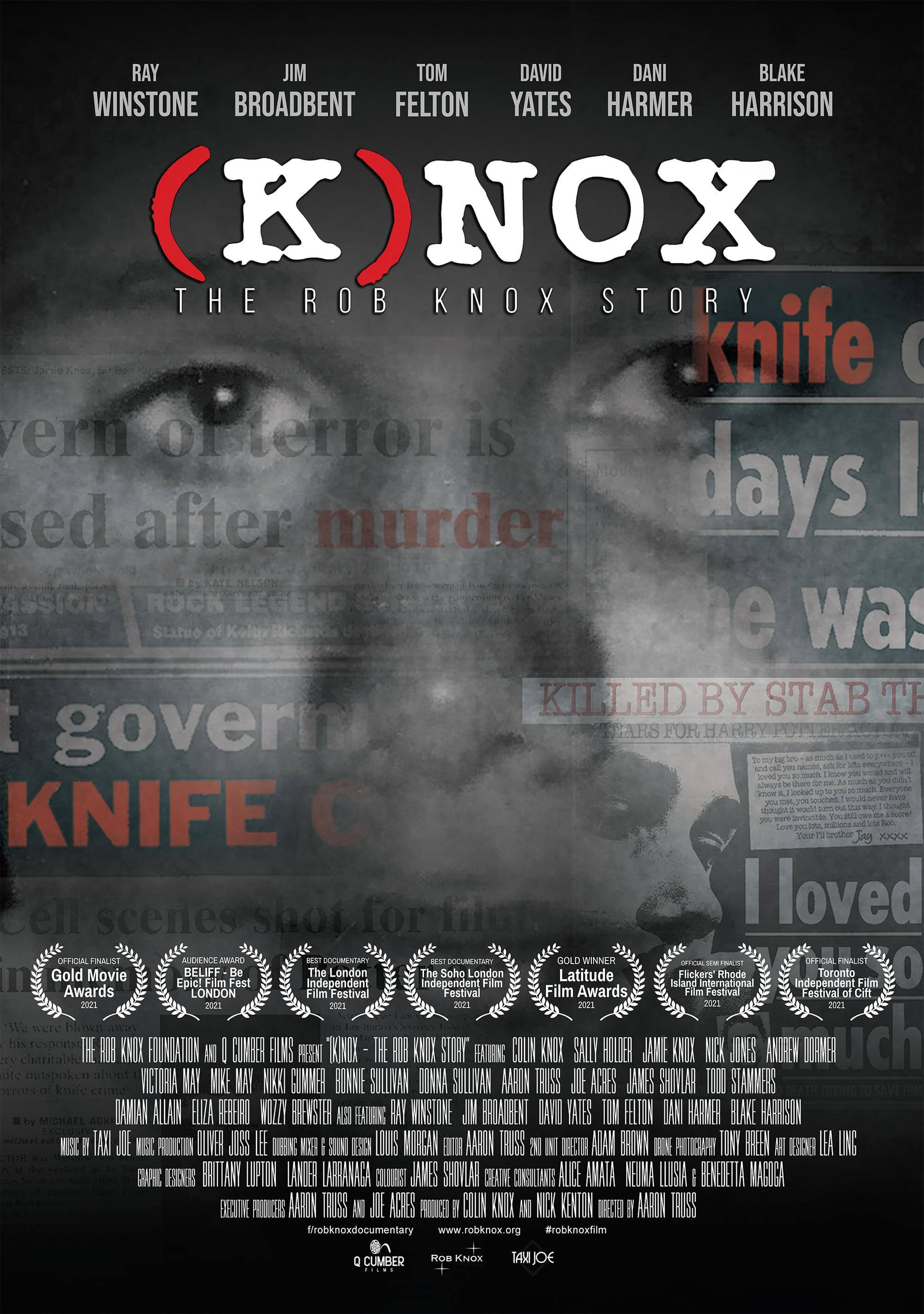
(K)NOX: THE ROB KNOX STORY

knox story

The murder of Rob Knox was a tragic event that made newspaper headlines, more for the fact the young actor had been in a Harry Potter film than the appalling situation that is sadly a regular occurrence on UK streets.

Aaron Truss’ documentary chronicles Knox’s all-too-short life and covers the circumstances that led to his death sensitively. It’s hard not to feel upset when listening to his parents, brother, and friends discuss his loss. The vivid description of what happened that night will affect anyone listening and the trauma and horrific are hard to hear, but it’s important to have that visceral impact.  Truss (who also made Cult of VHS) was a school friend of Knox so is perfectly placed to present his life, and bring out his early enthusiasm to entertain.

Various members of the Harry Potter cast and crew – including Tom Felton, Jim Broadbent, and director David Yates – appear to share their reminisces and there is some behind-the-scenes footage that shows how playful they were when they were not working.

As much a vehicle to highlight the horrors of knife crime as a tribute to an enthusiastic actor, the documentary is powerful and often harrowing. It’s hard to imagine that anything positive could come out of the situation, but like so many families that have lived through a tragic event like this, there are now foundations and charity initiatives that are helping get kids off the streets and highlighting the dangers of carrying a knife.


You can keep up to date with the film and its release here:

Instagram & Twitter: @robknoxfilm