PASSENGER

Passenger

In any other year, Andre Ovredal’s Passenger would very probably be hailed as an outstanding horror road trip movie full of genuine tension, jump scares and a pervading sense of there’s something-in-the-dark creeping dread. Unfortunately, the film arrives in the wake of Damien McCarthy’s impressive Hokum and the genuine cultural phenomenon that is Curry Barker’s extraordinary Obsession. To compound the film’s problems, Kane Parsons’ Backrooms arrived in theatres the week after  Passenger’s debut, and in a period where a new breed of horror movies is clearly busily reinventing the genre, there was always going to be at least one casualty that doesn’t quite make the grade. Sadly, Passenger looks set to take the hit.

But in truth Passenger isn’t a bad movie, just a badly-timed one and whilst its story of a young couple travelling across America in a camper van inadvertently attracting the attention of a demonic serial killer has its moments – several, in fact – it does have a whiff of ‘seen it all before’ about it and after the first two promising acts that crank up the fear factor, the last half-hour spirals out of control as the film hurtles towards an unconvincing and painfully-convenient climax. Following a creepy pre-credits sequence (you’ll have seen it in the film’s first trailer), we meet loved-up New Yorkers Maddie (Lou Llobell) and Tyler (Jacob Scipio), who interrupt their open-ended road trip when a car crashes in the road ahead. They stop to investigate, unaware that in doing so they have acquired a new “passenger”, a supernatural killer who haunts, terrorises and eventually kills luckless travellers. They carry on their adventure, but soon Maddie is seeing images of the mysterious ‘passenger’, and in the film’s most hair-raising sequence, she is stalked across a parking lot at night as she makes their way back to their van.

Passenger loses momentum as it struggles towards the finishing line with garbled explanations for what the ‘passenger’ actually is – “He’s a highwayman from Hell!” gasps Melissa Leo’s Diane, a fellow road-tripper they meet early in their journey, at one point – and our heroes chance upon the way to rid themselves of their tormentor with a combination of extraordinary luck and staggeringly unlikely coincidence. But the film’s nicely put together, the lead performers are likeable, and whilst it doesn’t bring much new to the old trope of innocents terrorised by something nasty they cross paths with in the middle of nowhere, it’s broadly entertaining but doomed to be lost in a year of horror that has already gifted us some wonderfully original material.

stars

Passenger is in cinemas now

MASTERS OF THE UNIVERSE

Masters of the Universe starburst magazine review

It’s been almost 40 years since He-Man’s rippling abs last graced the big screen, and this reboot of the beloved Mattel toyline, which is equally as inspired by the likewise cherished ‘80s animated series and the now-cult 1987 feature film adaptation, has been a long time coming. Undergoing a lot of changes over its years in development, it is by the power of Grayskull that this new film has found its way to summer blockbuster season.

Masters of the Universe sees young Prince Adam thrust to Earth, as he has to flee his planet of Eternia due to the invading forces of Skeletor. Losing his sword of power and in turn his way back, he grows up on Earth, never forgetting his home and never giving up on a way to return. And when he finds the sword, he must assemble a team of old allies to reclaim Eternia from the clutches of evil and become the hero he was born to be.

This is the perfect He-Man film, and one we all could have never imagined getting; in fact, it’s a film some have waited a lifetime for, ever since playing with those toys as tikes. Director Travis Knight has warmly embraced the source material’s joys and delivered the kind of movie that Hollywood has slowly stopped making. A pure cinematic thrill, and this generation’s answer to Flash Gordon, only on an even grander scale, this is the most fun film you’ll see this summer.

The craft on display dazzles, with Eternia bouncing off the screen with explosive colour and imagination, and great special effects sitting comfortably alongside some wowing practical sets and costumes. All while Daniel Pemberton’s score (of the year) rocks the house with rousing guitar work, and some by the legendary Brian May, and even a sequence backed by Queen’s banger “Princes of the Universe”. What’s not to love?

It never takes itself too seriously, and yet it knows when to be serious, resulting in an ‘80s-style fantasy adventure romp, all-embracing of its own ridiculousness but never to the point of mockery. This affectionate film feels made by fans and for fans but also with an accessibility for a wider crowd not in the know, much like Dungeons & Dragons: Honor Among Thieves.

It’s popcorn summer blockbuster entertainment with cultclassicinthemaking sensibilities. From Battle Cat MGM logo roar to one particular stellar cameo, the nostalgia is powerful, cheeky and fun, but not all that drives the movie forward. Particularly effective is the film’s honest heart, and genuinely strong message of true strength and acceptance of self, one particularly perfect for young lads of today.

Nicholas Galitzine cuts a mighty charismatic figure as He-Man/Adam, with great supporting turns by Idris Elba as Man-At-Arms and Camila Mendes as Teela, among a subtly impressive cast of familiar faces and voices. However, while he is very much cinema marmite to many, the film is stolen by a nigh-on unrecognisable Bane-meets-Ian McKellen Shakespearean vocal tour-de-force by Jared Leto as Skeletor, in one of his greatest ever performances. His Skeletor has a strong claim to being the villain of 2026 on the big screen. Moustache-twirlingly evil, hilarious, scary and theatrically grand, he is an utter joy whenever on screen and reminiscent of a bygone age of show-stealing golden age villainy.

Go and see Masters of the Universe, folks! It kicks ass. No, seriously. This is the kind of gleeful summer fantasy that barely exists at all anymore. Action-packed, hilarious, poignant and with true heroic flair and villainous deliciousness. Not to mention a third act that resists being the atypical crash, bang, wallop fare in favour of something rather more interesting, thematically breaking down the idea of muscle-bound heroism in the climactic face-off. Oh, and stay for all the credits too!

Masters of the Universe is a colourful, hopeful blast from start to finish. This seriously has the power!

Masters of the Universe is out now in UK cinemas.

MASTERS OF THE UNIVERSE

he-man and the he-team in the live-action Masters of the Universe trailer

Travis Knight’s Masters of the Universe almost nails it. It’s a funny, vibrant reboot with a big heart and even bigger designs on the definition of machismo, compartmentalising nostalgia so that something more earnest and forward-facing can emerge. It’s also an ugly and frustrating film, because despite being packed with great moments and ideas, it can’t help but feel messy, fragmented, and unwilling to commit to itself.

The plot is straightforward: Adam Glenn (Nicholas Galitzine), prince of the fantasy planet Eternia, escapes to Earth after the warlock Skeletor (a pitch-perfect Jared Leto) imprisons its rulers. Entrusted with a magical sword he’s since lost, Adam spends his days daydreaming about how to return to his homeworld. When he does get home, he finds himself at the centre of a desperate war for Eternia’s soul, one that only he can stop.

Masters of the Universe offsets its negatives with a doozy of a positive: Jared Leto. The guy makes for a tremendous Skeletor, losing himself in a hurricane of villainous theatrics and outclassing everyone around him. He’s deliciously one-note, too, something the movie straight-up tells us on numerous occasions. That’s the confidence, the shamelessness we need to see, and that’s precisely what Masters of the Universe lacks.

Besides Leto, Galitzine, and Idris Elba as Man-at-Arms, Masters of the Universe doesn’t bother to develop its supporting cast. Teela (Camila Mendes), a sloppily rendered Cringer (voiced by Tom Wilton), and Evil-Lyn (a lost-looking Alison Brie) are present but lifeless, moving from scene to scene without anything substantial in which to ground their performances.

Masters of the Universe‘s top priority is to broaden our definition of strength, to establish He-Man not as a caricature of machismo, but as someone who prefers talking to fighting, whose true power lies in his empathy. To sell this new version of the character, though, the script needed to showcase his ability to solve problems and relate to people without decking them. We never see that happen, which makes his eventual revelations about himself – the revelations that allow him to win the day – feel unearned and out of left field.

There’s also the matter of its humour, which often undermines the rampant – and necessary – cheesiness of any self-respecting Masters of the Universe movie. During the final act, we get a triumphant, slow-motion group shot of He-Man and co. walking through a cloud of dust. It’s a fabulously corny shot, but rather than let that moment exist as is, the filmmakers rush into an easy visual gag.

It’s a franchise built on a bunch of Mattel action figures. Let it be campy.


stars


BACKROOMS

Backrooms

What began as a viral YouTube series makes its feature debut in Kane Parsons’ horror film of the same name. Most YouTube filmmakers could only dream of doing so for A24 though – let alone scoring actual Chiwetel Ejiofor as their star. In that respect, Backrooms is of a classier vintage than most.

Sure, Backrooms loyalists may baulk at the big-name actor (or actors, depending on where you place Mark Duplass) and move toward traditional filmmaking. At their heart, the original shorts were a smattering of found footage films which bore more in common with a V/H/S segment than your average A24 film. Not so this feature-length adaptation, which largely eschews the found footage approach in favour of a tale about one man’s desperate need for validation, and the woman responsible for talking him down. Boiling it down more than that? It’s The Simpsons’ Treehouse of Horror IV meets Severance.

Ejiofor plays furniture salesman Clark, who discovers an entrance to the titular Backrooms in the basement of his strip mall showroom. Immediately hypnotised by this labyrinth of beige carpets and magnolia walls, what he soon comes to realise is that he’s not alone. There’s more lurking in the back (rooms) than wonky-looking furniture and headache-inducing ceiling lights. Enter the man’s therapist, Mary (Renate Reinsve) becoming involved when Clark leaves a chilling message on her answering machine. Full of worry for her patient, she enters the Backrooms herself. Will she, like so many dead seagulls and lost souls before her, find only her demise there? Or does something even messier await in the flickering shadows?

That’s more depth than some would have liked from a series founded on creepy visuals and shaky camerawork. With it, a sneaking suspicion that something has been lost in translation. Could Parsons have spent two hours just vibing it with a handheld camera? Sure. Should he have? That’s up for debate. Regardless, the story’s structure should ultimately help Backrooms cater to an audience wider than those who’ve discovered the word ‘liminal space’ within the last five years and made it their whole online personality.

Ejiofor is delightfully messy as the whiskey-chugging, showroom-sleeping Clark, and a fine vessel to traverse the Backrooms with. It’s hard not to draw a parallel from his plight to that of the modern AI user, especially as he falls further down the rabbit wonky chair hole. And then there’s Reinsve’s Mary, who finds something entirely different in this pocket dimension – a man who would rather surround himself with Broken Mirror imitations of reality than take accountability for his actions. And the more literal monsters, of course.

However one feels about the approach, Backrooms still manages to do justice to its setting. The visuals look tremendous, having lost nothing in the transition from YouTube to the big screen. It’s still gratifyingly real, throbbing with a disquieting wrongness which pervades every frame. The 1990s setting helps get across that essential feeling of nostalgia, while Parsons and co-writer Will Soodik extend the scope in a manner which feels natural yet true to the location. Those worried that the film might over-explain its unknowable locale can rest assured – it’s denouement is every bit as baffling and obtuse as the YouTube series which preceded it.

Its approach may divide opinion, but Backrooms emerges as one of the year’s most striking horror films. It’s Backrooms for the masses, but has lost none of the core weirdness which made it so enthralling in the first place.

BACKROOMS is out in UK cinemas now.

THE MANDALORIAN AND GROGU

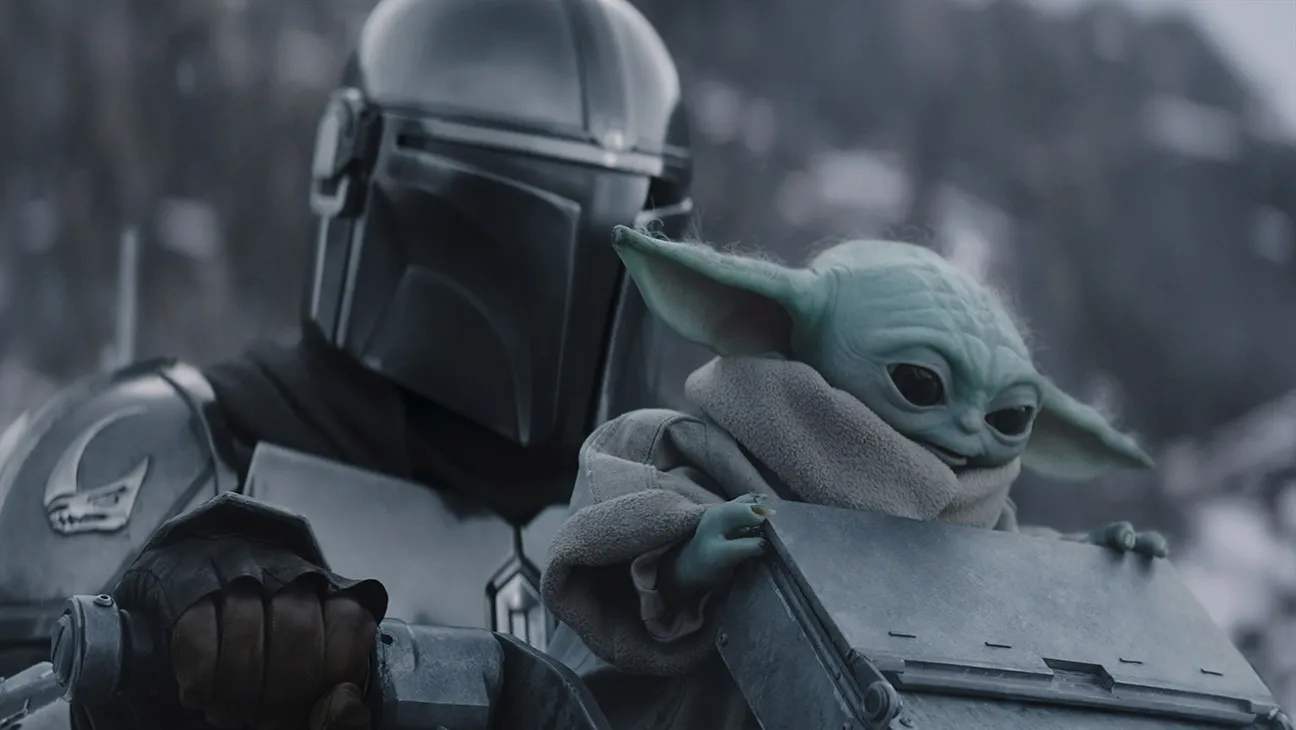
pedro pascal as din djarin in the mandalorian and grogu star wars film

As the opening credits roll on Star Wars’ first feature outing since 2019, Reba McEntire’s lyrics pierce the darkness: “A single dad who works two jobs, who loves his kid and never stops, with gentle hands and a heart of a fighter,” hailing the return of a helmeted Pedro Pascal and baby Yoda – those two jobs being, of course, relentless bounty hunter by trade and emotionally tortured lone wolf by compulsion, a man so committed to stoic isolation that he somehow ended up the most devoted father in the galaxy.

At least, that was our original pitch for The Mandalorian & Grogu. In reality, Din Djarin and his green son’s return is accompanied by Ludwig Göransson’s excellent score, but we stand by our desired introduction.

The actual story finds our reluctant hero conscripted by the fledgling New Republic, who have decided that what their fragile galactic democracy needs is a beskar-clad gun-for-hire and his Force-gifted toddler to go and rescue Rotta the Hutt in exchange for information on an important target. On the way, they’ll face space gangsters, a gladiator ring, war criminals, and a giant water snake.

grogu in the mandalorian and grogu

The storyline and pacing make it clear that this feature is just three episodes of The Mandalorian’s previously planned fourth season, stitched together for a cinema release. Despite that, we’re also happy to confirm that if you’ve never seen a single episode of the Disney+ series, you will be fine to follow along. Jon Favreau has been generous enough to treat the whole enterprise as something of a soft reset, accessible to newcomers but still loaded with Easter eggs for the devoted faithful.

Visually, The Mandalorian and Grogu is doing a lot. Perhaps too much. Favreau wears his influences proudly — the ice-swept opening sequence carries a satisfying echo of The Empire Strikes Back, and across its runtime the film nods appreciatively to Top Gun, Blade Runner, Apocalypse Now, and, delightfully, Gremlins, with additional flavours of the western, kaiju movies, and samurai cinema seasoning the whole thing. It’s a great mood board, except that none of it coalesces into anything genuinely beautiful. Favreau geeks out (visibly, enthusiastically, and at considerable length), but the film never quite achieves the visual poetry of the works it’s so clearly in love with.

Where the film does succeed technically is in its creature work. Grogu and the Anzellans carry that old-school animatronic warmth that CGI will never fully replicate, a tactile physicality that grounds the film and endears the audience. It’s one of the most deliberately nostalgic choices in a film chock-full of them, and it works well.

the mandalorian and grogu

The cast is more variable. Sigourney Weaver appears to be operating under duress – an actress of her calibre deserves better than whatever she’s been handed here, and her scenes have the vaguely glazed energy of someone waiting out their contract. Elsewhere, Jabba’s nephew Rotta the Hutt is, against all odds, surprisingly lovable, though it’s worth noting that Jeremy Allen White’s voice has been so heavily processed that the casting barely registers. A brief cameo from Martin Scorsese as a Chef-inspired food truck-owning alien is, frankly, exactly as wonderful as it sounds.

The fight choreography is genuinely solid, the score is robust and inventive, and there are set pieces (particularly that aforementioned opening sequence) that remind you of the genuine craft at the project’s core. The wolf-and-cub structure gives the film a clear emotional throughline even when the actual plot refuses to provide one: the story, as we’ve said, is episodic and lacks the discernible beats that make a feature – which makes it all the more baffling when the film fumbles the one moment it should have been able to land in its sleep.

We’re talking here about the handling of Mando’s de-helmeting, which is given away like a free supermarket sample in the trailer. It’s a moment the series has always treated with near-religious gravity, and is here afforded roughly the same tonal weight as a scene transition. It lands with a jarring thud, the emotional architecture around it conspicuously absent.

For all its shortcomings, The Mandalorian and Grogu is nonetheless hard to resent. Made by people who love these references deeply, who want to share that love, and who haven’t quite figured out how to synthesise it all into something coherent, it’s simply too earnest a film to dislike wholly. As love letters go, it’s illegible in places. But the affection is real, and that counts for something.


stars


THE MANDALORIAN AND GROGU

The Mandalorian and Grogu

When The Force Awakens arrived in December 2015, Star Wars was untouchable, but despite over $2bn at the global box office and the remaining films in the trilogy bringing in north of a billion dollars there was trouble ahead. Rogue One made a billion, despite a troubled production, while Solo hit the skids at the box office, and The Last Jedi divided opinion. With nothing on the big screen since The Rise of Skywalker in 2019, much rides on the success (critical and financial) of The Mandalorian and Grogu. Can it reunite a fractured fandom? No pressure then….

First, the good news. The film is a lot of fun, with dizzying action, on-point humour (there’s more genuine laughs than most comedies), memorable music and visual effects. The film skilfully builds the world Din Djarin and Grogu inhabit, Pedro Pascal is effortlessly cool as Mando, Grogu remains a charming addition to the canon, and Jon Favreau directs with a steady hand… so (to paraphrase our beloved Princess) surely we have everything we need.

Despite all of that, there are issues. The plot is paper thin, with little at stake other than the continued existence of our lead characters, while the leaders of the Imperial Remnant range from incompetent to underwhelming. The Twins (first introduced in The Book of Boba Fett) are the film’s main villains, secure in their headquarters on Nal Hutta and presiding over a menagerie of creatures (and there are a LOT of aliens in this creature feature, including a four-armed Ardennian chef voiced by Martin Scorsese). There are child-friendly jokes and brutal kill scenes right next to each other (Mando is a wrecking machine), while the action regularly flits from stunningly cinematic to scenes reminiscent of the small-screen streaming series.

Jeremy Allen White voices tortured teen Rotta the Hutt (present far more in the film than one might expect and speaking basic rather than Huttese), while Sigourney Weaver is very welcome but underused as Colonel Ward. Look out for a number of cameos from faces that usually reside behind the camera, and if the fantastic Zeb (voiced by Steve Blum) doesn’t make you want to go back and re-watch Rebels, nothing will.

Fun, visually impressive, packed with action, and coming after the substantial feasts of Andor and Maul – Shadow Lord, it’s probably the right film for the right time as we head towards the 50th anniversary. Let’s hope the fandom agrees.

stars

THE MANDALORIAN AND GROGU is in cinemas from May 22nd. 

OBSESSION

Inde Navarrette as Nikki in Obsession

A feel-bad horror film for any man who’s ever whined about being ‘friendzoned’ without considering the damage his unrequited, unfair infatuation has wrought. A relationship drama for anybody who’s ever been in one that’s just a little too intense. A profoundly uncomfortable account of one woman’s agency and individuality being stripped away to satisfy a man’s ‘love’. Definitely not for cat lovers.

All these things are true of Curry Barker’s Obsession, a supernatural horror film that does for the friendzone what Get Out did for white liberals. Young Bruce Campbell slash Dave Franco lookalike Michael Johnston plays Bear, a man who definitely hasn’t seen that one episode of Buffy the Vampire Slayer. Unable to pluck up the courage to ask out long-time crush Nikki (Inde Navarrette), he cracks open the mysterious ‘One Wish Willow,’ and makes his, uh, one wish.

It immediately becomes clear that he should have chosen his words more carefully. Or, better still, wished that his poor dead kitty was still alive instead. Even so, Bear’s initial qualms don’t stop him from enjoying the spoils of his wish, and he’s able to ignore some of nu-Nikki’s quirks in the name of love. Stifling, toxic, co-dependent love.

Barker takes a simple idea and boils it down to its unpleasant core. It’s essential that Nikki’s turn is so abrupt and so very obvious, not excusing Bear of his outright crimes for a second. There’s one shot, soon after their restaurant date, which is simply done, but perhaps the most harrowing in the whole film. Similarly, her monologue about Hansel and Gretel deserves to go down in the history books (preferably in the page next to Mia Goth’s Pearl) as one of the greatest things a horror film has done in the last ten years. Never date a writer.

It’s easy to understand why Bear might be taken with Nikki though. Navarrette is a revelation in the role, constantly leaving the audience trembling in fear as to what she might do next. Often hidden in shadow and moving in broken, puppet-like bursts of unnerving activity, she’s a force of nature, turning on a dime between Deadite and doe-eyed Disney Princess. She’s the manic pixie dream girl turned nightmare, and Navarrette owns the screen for every second of her time. When she’s not on it? You’ll be terrified as to what she’s been up to in Bear’s absence. The key, of course, is that neither she nor Barker lose sight of the young woman trapped inside. The film’s most powerful, primal moments are those in which she emerges – the bleak reality behind Bear’s one wish laid, ah, bare.

Lee Cronin may have only recently unwrapped his show-stoppingly horrible version of The Mummy, but Obsession comes hot on its tail as a contender for most disturbing film of the year. It’s a supernatural horror film which relies on none of the usual cheap tricks. Instead, it builds an air of suffocating malignancy from its leads’ performances. We’ve trodden this path before, the silly conceit is grounded in raw emotion and good humour, making its thrills and spills feel, if not natural, then inevitable. It’d be funny if it wasn’t so horrifying; touching if it wasn’t so deeply upsetting. In that respect, Obsession is the ultimate anti-romcom.

OBSESSION is out in UK cinemas now.

THE HOUSE WAS NOT HUNGRY THEN

The House Was Not Hungry Then

Not one for the thrill-seekers, this atmospheric, unnerving study of identity, connection and place builds its appeal through the creeping terror of what might be about to happen. This is a world away from a derivative haunted house flick.

The House Was Not Hungry Then unfolds in a surprisingly spacious empty house over countless, timeless days. The silence is only broken when an estate agent arrives to show prospective buyers around; visitors who, if the house needs sustenance, will never leave. While the agent lives in fear of the house’s vengeance, the building makes an unlikely connection with a squatter who moves in, a young woman struggling to emotionally reconnect with her ailing father, who’s been transferred into a care home.

Until the final scenes, the film is shot in a stubbornly obtuse way; locked-off cameras frame everything in static mid-shot in lengthy, unbroken takes. The ‘voice’ of the house, audible only to those it reveals itself to, is rendered noiselessly by simple on-screen ‘captions’. This could all come across as pretentious arthouse affectation. But there’s enough thoughtfulness stitched into the narrative to dilute those accusations.

Although Clive Russell (the agent) and Bill Paterson (the voice of the father) add acting gravitas to the modest cast, it’s Bobby Rainsbury (the girl) who carries the film’s emotional weight. Yet it’s the inanimate, sentient house that remains the lead character of the story. Writer-director Harry Aspinwall knows that he’s produced a film certain to divide audiences, sections of which will tune out and turn off after twenty minutes. But those who stay the course might find themselves drawn into a surprising, immersive, and extremely unusual quiet horror.

stars

THE HOUSE WAS NOT HUNGRY THEN is available on streaming platforms in the USA.

AFFECTION

Affection

After being run over by a car following a terrifying chase, Ellie (Jessica Rothe) wakes in a bed in a home she doesn’t recognise with a man, Bruce (Joseph Cross), who claims to be her husband. There’s also a young girl, Alice (Julianna Layne), who is distraught that her mother doesn’t know her. Ellie is convinced she’s actually named Sarah, has a son, and a completely different husband. Bruce attempts to convince her that they are false memories caused by her ‘accident’.

She’s surrounded by mementos she doesn’t remember, and Bruce insists she stays at the remote house he’s taken to assist in her recuperation. The strange recollections she experiences come to a head when she sees a body wrapped in plastic in the woods, something Bruce can’t find. Her paranoia leads her to search the surrounding buildings, and what she discovers is more disturbing than she’d ever imagine.

Far from a routine memory-loss drama, writer-director BT Meza has crafted a thriller that delves deeply into Cronenberg territory but never loses sight of its real subject. At its heart, this is a tale of accepting loss. The family dynamic, complete with the horrors of gaslighting and coercion, is seen through the eyes of all three characters, giving us insight into the antagonist’s motivation. Both Bruce and Ellie are desperate to restore their lives to what they once were, with Alice stuck in the middle, fearful of losing everything.

Rothe shines in the role of the amnesiac wife who doesn’t even recognise the person staring back at her in the mirror, and Cross is understated as the seemingly patient, caring husband. When Affection moves up a gear, it becomes a completely different beast, with gooey body horror and baffling technology.

Affection pulls inspiration from several genres but could have gone further into the implications and ethics of its horrific technological aspects.

AFFECTION is on UK and Ireland digital platforms from June 8th.

HOKUM

Adam Scott in Hokum

After attempting to take his own life in one of its rooms, antisocial novelist Ohm Bauman (Adam Scott) returns to the grounds of a supposedly haunted hotel hoping to make amends. Discovering a suitably bleak conspiracy, he’s at risk of crossing over to the other side himself when he’s locked in the nightmarish honeymoon suite where an ancient witch supposedly resides. A load of old hokum? Ohm is about to find out firsthand that sometimes things do go bump in the night.

The latest one-word feature from Damien Mc Carthy, Hokum is another cinematic oddity from the Irish writer-director. One caveat: Scott’s jerkass novelist starts out so thoroughly unpleasant that some might struggle to get past the film’s first half hour. To be sure, let him die in there!

When he returns to the remote Irish guesthouse, Ohm is alarmed to hear that hotel employee Fiona (Florence Ordesh) has disappeared. Blaming himself (she did walk in on his dangling body, after all), he lets himself into the honeymoon suite in search of answers. There, he’s confronted by ghosts both physical and metaphorical, and forced to reckon with manifestations of his own childhood trauma. Set in an isolated hotel during off-season and featuring a troubled writer in a haunted room, it’s a cross between Stephen King’s The Shining and Room 1408. There’s even a Pennywise figure in the rabbit-eared weirdo glimpsed in the film’s most unsettling scenes.

Well-trodden setup aside, Hokum takes an unexpected approach to the supernatural horror story. There’s plenty of black humour to be found within the hotel’s walls, but Mc Carthy largely plays the scares straight, setting Scott’s Ohm on a well-oiled rollercoaster of efficiently delivered scares. Given the unenviable task of playing an absolute asshole, Scott does great work, although the screenplay does tend to overplay his misanthropy a bit too much at times.

A welcome strain of black comedy runs through Hokum’s veins, making its segues into outright terror hit even harder. Its jump scares are too telegraphed in advance to land as they should, but its bizarro imagery keeps the blood nicely chilled.

HOKUM is out in UK cinemas now.