PLAYHOUSE

Written and directed by Fionn and Toby Watts, Playhouse is a brooding, captivating haunted house (well, castle) film that shows the great potential of the Watts brothers.

Jack Travis (William Holstead) is a playwright who has bought a grand old Scottish castle for him and his belligerent daughter, Bee (Grace Courtney). Jack is planning on using the castle to create an immersive walk-through play. What he doesn’t realise is that the castle has a morbid history that will soon take over his mindset. When neighbours Callum and Samantha (James Rottger and Julie Higginson) get involved, and things get much worse.

The Watts brothers make splendid use of the glorious location, and the castle itself – actually just a very large, impressive house – is suitably creepy, with brick-lined spiral staircases and stories of bricked-in bodies and tortured spirits. Andy Toovey’s cinematography adds plenty to the atmosphere, too, with some spectacular shots, particularly towards the climax.  The few visual effects on show may be a tad generic, but that – and some of the more histrionic acting – can be forgiven due to the low budget. That said, it’s certainly an engaging story and offers much for fans who like a haunted house film with a difference.

Playhouse is Fionn and Toby’s debut feature and certainly shows plenty of flair, we’ll certainly be interested to see what they come up with next.

JAKOB’S WIFE

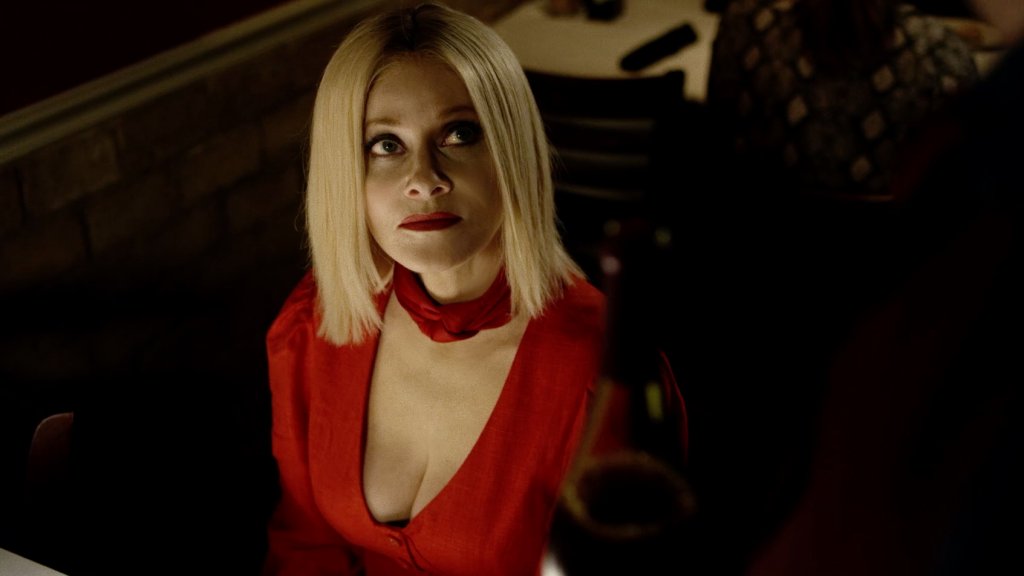
Jakob's Wife starring Barbara Crampton and directed by Travis Stevens, screened at SXSW 2021.

Horror legend Barbara Crampton finally lands a lead role in her home genre with Jakob’s Wife, a slice-of-life vampire story from Girl on the Third Floor director Travis Stevens. Co-written by Mark Steensland, Kathy Charles and Stevens, Jakob’s Wife casts Crampton as Anne Fedder, the church mouse wife of the town preacher (Larry Fessenden).

Anne spends her days doing housework, cooking breakfast for her husband, lifelessly following along to exercise tapes, and tending to their front lawn. Round and round it goes, with little to break up the monotony of daily life. That is, until a young parishioner (Nyisha Bell) mysteriously disappears and an old flame of Anne’s returns to town. She agrees to meet the latter (Robert Rusler) at a diner to reminisce, their casual and flirty rapport hinting at the freer, happier woman Anne used to be before she was “Jakob’s wife”. Their journey down memory lane eventually takes them back to an old, abandoned mill on the outskirts of town that the pair would sneak out to for romantic rendezvous. All is going well – until a crateful of feral rats decide Tom looks like a filling lunch, and a dark figure engulfs Anne.

Barbara Crampton as Anne Feddler in Jakob's Wife, SXSW 2021 by director Travis Stevens

Jakob’s Wife turns in an entertaining commentary (if at times a little on-the-nose) on the disillusionment of women in their late-middle-age, their desexualisation, and the long-term impact of traditional gender roles on women’s psyche. Undoubtedly seeing much of her own story in Anne’s, Crampton gives an excellent and charming performance as the meek housewife turned undead femme fatale, as she embraces her newfound power and sexuality.

The honeymoon period proves fairly short however, and as the body count rises and the police close in, Anne is forced to choose between her marriage with Jakob and The Master’s (The Nun’s Bonnie Aarons) offer of a new life. Though its straightforward plot and comic tone sometimes come at odds with its higher-minded social commentary, Jakob’s Wife is an enjoyably old-school vampire flick that gives Crampton her chance to shine as a leading woman.

Jakob’s Wife releases in US cinemas, Digital and VOD on April 16th.

I BLAME SOCIETY

society

“No film justifies hurting others, does it?” It’s a stark question that confronts a filmmaker fixated on murder poses in the pitch-black horror comedy I Blame Society. Gillian is a would-be cinematic auteur, pushing back against industry rejections and the ignorance of those that refuse to recognise her talents. She’s matter-of-fact about the obvious solution to her exclusion: she’ll combine her interest in making movies with her commitment to killing those in her life that deserve to die. When Gillian recognises that full-disclosure of her plans risks alarming those around her, she chooses a more secretive path. One that has the advantage of ensuring that both witnesses and critics are silenced.

I Blame Society is an evident labour of love for Gillian Wallace Horvat, who co-writes, directs and takes the kind of leading role which sees her character feature in every scene. Her on-screen representation of her filmmaker-self is unsparingly, delightfully spiteful. Her fictional equivalent is a bullying narcissist who’s devoid of empathy and blind to the needs of others. Some of those working in the real-world film industry might guess her character’s occupation based on that description alone,  but her shocking behaviour is as much a consequence of her frustration with being blocked at every turn as it is a reflection of any innate character flaws.

What makes the film’s macabre comedy work so well is that the character of Gillian is both guileless and completely devoid of moral integrity. The effect of this stark honesty is that everyone who is able to escape her attention runs for their lives, her boyfriend included. Gillian meanwhile ensures that her own life unfolds under the watchful gaze of the camera lens. She frames the intimacies of sex and of murder with the same attentive cinematographer’s eye, narrating the drama as it unfolds.

This is an inventive and highly unusual satire on the celebrity culture of screen media, voyeurism and the business of making movies. As well as having its moments of gore, brutality and callous gallows humour, the film is bursting with meta references to the craft of movie making and the tropes and travesties of horror cinema. “Going meta” can be a mood killer, but thankfully there’s wit and intelligence in the film’s caustic reflections on art and culture.

As the body count rises, Gillian relies on the nihilistic logic of the sociopath to justify her actions. If anything, or anyone, is to blame for the loss of life that her film requires, it’s clearly the obstacles to her success that other people erect. The tiny budget and the need to rely on authentic ‘selfie’ filming motifs, makes the movie feel small scale. But the social critique in I Blame Society is far more scathing, more perceptive and infinitely better crafted than the overwrought crassness of Natural Born Killers: a movie with which it shares many of the same preoccupations.

Release Date: April 19th

GODZILLA VS. KONG

A few years after the events of 2019’s Godzilla: King of the Monsters, Godzilla reappears to seemingly attack Apex Cybernetic bases out of malice, whilst Kong is being monitored on Skull Island. When Kong is transported in order to discover the entrance to the Hollow Earth, Godzilla senses the other alpha titan, kicking off the monstrous clash for supremacy that takes centre stage throughout Adam Wingard’s spectacular Godzilla vs. Kong.

The MonsterVerse has been around since 2014, with this being the fourth and potentially final instalment. The biggest criticisms of the previous movies have centred on the lack of action and the heavy focus on human characters. GvK bucks that trend and delivers a fierce, powerful and crowd-pleasing balance of city-levelling kaiju battles with the right level of human-based exposition to keep the narrative steaming along. The two concurrent human storylines actually benefit the final product, with moments that don’t feel overbearing at all.

The visuals and cinematography are the best of the franchise, with the titular fan-favourites looking their best and the sprawling cityscapes – including a neon-soaked Hong Kong – breathtaking to look at as these Alphas level the skyscrapers.

JunkieXL had the difficult task of providing a score fit for two Kings, but he delivers on all fronts, with the right level of emotion mixed with a hearty degree of triumphant action and the classical tones of Ifakube’s iconic score.

Godzilla vs. Kong is the perfect titanic blockbuster to kickstart the reopening of cinemas across the world. It’s tremendous amounts of fun, with hard-hitting action, gorgeous cinematography and jaw-dropping visuals all wrapped up in a smash hit package.

If this is indeed the end of the big-screen outings for the MonsterVerse, the franchise goes out with one hell of a glorious bang.

Godzilla vs. Kong is out now to rent via PVOD in the UK, and in Cinemas and on HBO Max in the US.

I SAW BLACK CLOUDS

black clouds

We were pretty impressed with the previous films from Ghost Dog Films The Singing Bird Will Come (2015) and Crucible of the Vampire (2019). Writer/director Iain Ross-McNamee managed to make low budget indie films that were both atmospheric and entertaining. The latest project from the studio sees the director venture into new territory – the choose-your-own-adventure film. Taking the lead from Black Mirror: Bandersnatch, I Saw Black Clouds allows you to dictate the direction of the story. Available on the Steam platform, it’s a bold move that pays off.

Following the suicide of her friend, Kristina (Nicole O’Neill) attempts to find out more about why Emily (Carla Cresswell) would kill herself. Along the way, she uncovers secrets about the institution where Emily was committed and is pursued by the ghost that may have haunted her friend to the grave.

What happens to the characters is down to the viewer, though. We’ve ‘played’ the film-game for over four hours and have only uncovered two out of the four endings. Take Kristina the wrong way, and you could be scolded by Emily for failing her. A different choice could introduce a whole new subplot and characters. Ross-McNamee has really been brave with this mammoth undertaking. For those who enjoy psychological indie films, it’s a treat. The acting is engrossing, and it’s beautifully shot. The jumps between some of the choices (particularly if there’s music in the background) are less than seamless, but it’s a small niggle that you get used to after a while.

As a gimmick, the conceit works well since the story deviates so much with the different choices (there’s an option to skip the scenes you’ve viewed if you don’t fancy re-watching it as a full film, although that defeats the purpose to us film fans). Stats are available to see how compassionate our choices are, amongst other things, which adds an additional level of interest. We can’t see the average Steam-player getting much out of it, though.

We’d be interested to see the definitive story played out as a ‘proper’ film as what we get in this version is captivating and disturbing in equal measures. In the meantime, we’ll be heading back in to search for those other endings.

You can check I Saw Black Clouds out on Steam.

CHAOS WALKING

chaos walking

Chaos Walking is one of those painfully frustrating Hollywood films that takes an original premise, throws an obscene amount of money at it and then butchers it for approximately 120 minutes.

The premise in this case is supplied by Patrick Ness, author of The Knife of Never Letting Go, on which the film is based. A few hundred years into the future, humans have fled the now uninhabitable Earth and have settled on the aptly named New World, a planet rich with land and resources but with one slight hitch. On New World, the unfiltered thoughts of men are visible to all, swirling around their heads in the form of purple clouds known as The Noise.

We open on Prentisstown, an all-male New World settlement, ruled by the eponymous Mayor Prentiss (Mads Mikkelsen in his signature villainous role). Here, we meet teenager and main protagonist Todd Hewitt (played by Tom Holland, who is perhaps the only thing worthy of praise here), who is struggling to embrace life in the all-male colony. The action begins when a spaceship crashes on the outskirts of town and Todd meets its sole survivor, a young woman by the name of Viola (Daisy Ridley). Mysteriously, Viola has no Noise and the men of Prentisstown are immediately suspicious. After a few intimidating conversations with Mikkelsen’s sinister Prentiss, Viola and Todd go on the run.

Daisy Ridley and Tom Holland try their hardest to give Chaos Walking some credibility but there is not much that can be done with the cliché-laden script to lift it above YA fan-fiction status. The film’s attempts to ride the post-Hunger Games wave of dystopian fiction are astoundingly blatant and if this were 2013, they might have worked, but now, such attempts feel staggeringly outdated. This obsoleteness is due, in part, to the film’s tumultuous production process. It began filming in 2017 but after poor test screenings in 2018 and a delay to accommodate Holland and Ridley’s other commitments, reshoots commenced in 2019. Cue a global pandemic, a change in director and umpteen script redrafts, Chaos Walking arrived approximately 2 years later than scheduled as something of a narrative mess.

Each character, story arc, and narrative beat feels derivative of another flick in the YA-dystopian genre. Even something as original as the Noise is engineered to feel cliched. What has the potential to generate a relevant commentary on the male psyche becomes a vehicle for Tom Holland’s character to mentally exclaim, ‘pretty girl!’ and ‘kiss her!’ every time he sees Ridley’s Viola. It’s bordering on infantile. What is perhaps most frustrating about Chaos Walking, though, is the undeniable potential it has. With such a stellar cast, unique premise, and eye-watering budget you cannot help but wonder how it all went so wrong. This could have been the beginning of an epic and original trilogy. Instead, we are left scratching our heads over a clumsy and derivative disappointment.

Chaos Walking is available for premium rental at home on all digital platforms from April 2nd .

RIGHTEOUS VILLAINS

righteous villains

We’ve had a few properties dealing with gods on Earth scenarios: American Gods, Good Omens and the like recently. Righteous Villains is a low budget but high concept entry in that subgenre.

Conman Jeremiah (Jamie Crew) and foul-mouthed former prostitute-turned-publican Jolie (Lois Brabin-Platt) are tasked to save a child captured by the ‘New World Order’ and held on a distant island. Jolie is full of rage following the murder of her husband Micky (played by CSI’s Gray Dourdan), which we see within the opening quarter that establishes the characters of our two anti-heroes. Their journey will take them to the depths of Hell in this surreal, nightmarish narrative.

Writer and director Savvas D. Michael (Original Gangster) provides plenty of off-kilter visuals here, but unfortunately not everything works. We have inserts of the wonderful Steven Berkoff ranting as only he can, naked bodies, and religious symbolism as Michael throws all he can afford into the mix. There are some gorgeous images amongst things, with Argento-esque colour washes cover the cracks in the mise-en-scène. Michael perhaps uses too many narrative shifts in such a short film (running around 75 minutes, including credits), leaving the viewer breathless trying to keep up with everything.

It’s possible that Righteous Villains will find an appreciative audience to give it the cult status it deserves, but a mainstream crowd will no doubt be left scratching their heads if they come to this expecting a regular gangster drama.

Release Date: April 19th (DVD and Digital)

HONEYDEW

honeydew

Sam (Sawyer Spielberg – yes, his son) and Rylie (Malin Barr) have a weekend of camping planned, but are forced to move by the farmer upon whose property they pitched. Even more annoyingly, their car battery if flat so they have to trek through the woods to find civilisation or at least cell phone reception. They do find a nice big house, and the owner, Karen (Barbara Kingsley), despite being elderly and a little strange is very hospitable and offers to put them up for the night until a neighbour can give them a jumpstart. During the night, though, things take a turn for the sinister as Sam develops a craving for Karen’s steaks and the old woman’s son – an overweight, catatonic man who just sits watching vintage cartoons – starts behaving even more peculiarly.

The debut feature from writer/director Devereux Milburn, Honeydew is a disturbing and unsettling trip into backwoods horror that takes its time getting to the meat of the story, but is full of very uneasy moments. Karen, the old lady, could have come straight from Eraserhead with her odd behaviour, but that’s not to say that it’s derivative. The cinematography by Dan Kennedy (who co-wrote the original story) is superb, often incorporating split-screen to see two differing shots, and at times has a ‘70s grindhouse sheen to it.

What’s going on isn’t hard to guess, but fortunately, Milburn manages to keep a few surprises for the audience. Some setups work better than others, but on the whole, the twisted delights on offer will satisfy the hunger of a horror-savvy viewer.

Release Date: Out Now (Digital)

SYNCHRONIC

SYNCHRONIC

Steve and Dennis, a pair of New Orleans paramedics, encounter a series of bizarre deaths involving people dying from injuries seemingly impossible for them to have sustained, all somehow linked to a new designer drug. They soon find themselves pulled into a surreal underground of altered perception, which begins an inexorable encroachment on everyday reality.

Like director duo Jason Benson and Aaron Moorhead’s previous work with Spring and The Endless, Synchronic is certainly a genre movie, but one difficult to classify simply. To attempt to do so would be something of a spoiler and ruin much of the film’s early mystery, and would also oversimplify its setup to the point of doing it a disservice. As with the pair’s other work, this is a very human tale of people who happen to get caught up in cosmic events beyond their comprehension that they are pulled into and must learn to navigate if they want to make it out the other side.

The film opens with some beautifully shot but contextually baffling scenes that take some time to take on any narrative relevance, but once they do they become an intrinsic aspect of the tapestry of chaos being woven on the streets of the ancient city.

The story largely focuses on Steve as the hectic challenges of his job make way for the surreal madness that awaits him. Terminally ill, he sleepwalks through an empty existence of anonymous sex and recreational drug use in an attempt to fill the empty black pit in the depths of his soul wherein used to reside hope for the future and the will to carry on. He gradually uncovers the mystery of the titular narcotic and how it’s connected to the disappearance of Dennis’ teenage daughter, and with his illness leaving him uniquely attuned to the drug’s capabilities that other matured minds are denied (in the process tacitly referencing Stuart Gordon’s sophomore Lovecraft take From Beyond), he decides that her rescue might be perhaps the one thing he can do that will allow his truncated life to take on some meaning.

His partner Dennis, proving that Jamie Dornan is actually capable of expressing recognisable human emotion when the material actually allows him to do so, provides a more functional perspective on life, the family struggles he undergoes being painfully relatable and refreshingly banal. Some humour interspersed between the tales of human strife and confusion – a running joke about their terrible ambulance driver being a highlight – alleviates the emotional turmoil the characters and the audience are otherwise perpetually subjected to.

Meditating on mortality, the passage of time and the cycle of life, Synchronic is a deep and meaningful experience that requires some thought to fully absorb the significance of. The message at its heart suggests that life is to be cherished as you can never be certain how much of it you will have. Even in the face of the infinite complexities of the universe, simple humanity is a gift not to be squandered, and the connections we make with one another leave a mark on the world long after we have left it.

Release Date; Out Now (Digital), April 5th (DVD/Blu-ray)

THE DEVIL BELOW

the-devil-below

Who doesn’t love a good creature feature? The best of them can go on to become esteemed cinema classics (Tremors), heck even the worst can go on to attain a cult following (Sharknado), while some others become underseen items of niche midnight b-movie stardom (C.H.U.D), hard to say what director Brad Parker’s (The Chernobyl Diaries) The Devil Below will become in the future. Though sadly, we cannot see it being all that strongly recalled. Which is a pity, as there is a good concept here, just misguidedly delivered.

Decades back a mining community was abandoned and all but erased from history. But why? To find out, a research team led by a wilderness tracker venture to the source of this supposed mining incident, only to discover something far more sinister than an accident occurred here, and still resides.

The Devil Below is not as utterly irredeemably dreadful as its current 0% on Rotten Tomatoes might connote. However it is a film that grows incredibly disappointing as it goes on, failing to make the best uses of a wealth of resources at its disposal. The story has its familiar elements (young people going where they ought not, locals warning against it, scientists doing science that is pretty darn stupid) but Parker’s film is blessed with a strong setting in its abandoned mining community, and the story benefits from an initially decent build as the remnants of said community, led by a father (played by the reliably excellent Will Patton) who lost his son there, have dedicated their lives to containing the horror from beneath that brought it down all those years prior.

Unfortunately the film’s major failing is not in its flimsy characters or trope-embracing plot (true those are problems but could be forgiven if it got other areas right) but in its delivery of the actual toothy terrors that await in the abandoned corridors of the underlying mine system. The film’s budgetary setbacks are laid bare, as it tries to hide its creatures with hectic camerawork, smudgy long shots and blurred vision scenes but instead of going smaller to work with this approach, the story bafflingly opts to go bigger and in doing so exposes more of its limitations, as well as making the writing’s widening logical gaps harder to shake off. Especially when the creatures world is opened up and feels like a low budget rip-off of Aliens…only in a tunnel.

That said, there are some redeeming qualities among the cardboard cut out cast and misguided direction, in Alicia Sanz’s tracker Arianne (who does seem a bit young to fully convince but plays the role well) and Will Patton’s (the film’s brightest light) gravitas-guaranteeing keeper of the land Schuttmann, who desperately seeks to keep the devil below (see what we did there) where it belongs. As well as moments of strong scoring and cinematography by Nima Fakhrara and Morgan Susser respectively.

Truth be told The Devil Below would perhaps have played far better as a found footage offering, especially if it had have leaned harder into the monster mythos (here only visible in a few fleeting wall etchings and paper sketches) and avoided the unnecessary lengths to be grander than its means allow. Shame, really.