THUNDER FORCE

thunder force

We should have expected the worst really. This limp, laughter-free superhero ‘comedy’ is the work of Melissa McCarthy’s old man Ben Falcone and together this dangerously high profile Hollywood power couple have already gifted us the likes of The Boss, Tammy, and Superintelligence, films that are the closet the modern world has come to recreating the experience of the medieval torture chamber. Thunder Force is, however, their cruellest, most agonising effort yet, a film so inexcusably appalling that it’s hard to imagine how and why Netflix thought it deserved a streaming release when really it should have been locked away in a lead-lined case and buried in a pit of lime, its very existence destoned to become nothing more than a grim fairy tale designed to terrify tiny children.

The conceit here, such as it is, suggests that Melissa McCarthy and Octavia Spencer (she won an Oscar for god’s sake, what’s she doing here?) are estranged college students Lydia and Emily reunited when dumb Lydia (McCarthy) inveigles her way into a high-tech laboratory facility owned and run by Emily (Spencer). Emily is now a top boffin and she is just about, conveniently, to test a new serum she has invented that will give its subjects super powers that they can use to combat the growing threat of Miscreants, super-powered sociopaths given extraordinary abilities when the Earth was bombarded by cosmic rays from space years earlier. Lydia is accidentally imbued with super strength so Emily has no choice but to follow suit and she is gifted the power of invisibility. With absolutely no hilarious consequences, this plus-size pair squeeze themselves into heavy rubber costumes (“They stink!” screams McCarthy at any available opportunity) and battle to get in and out of a Lamborghini because… well, they’re big, geddit? This hapless, hopeless twosome team up, calling themselves Thunder Force (Thunder Thighs, geddit?) to fight local politician  and Miscreant ‘The King’ (Bobby Cannavale) who is planning to become mayor of Chicago with the help of his Miscreant pals Laser (Pom Klementieff) and Crab (Jason Bateman).

In a cinema world now dominated by superheroes, there’s surely plenty of scope for a decent, clever, well-judged superhero spoof movie that could take a few loving sideswipes at the current predominant film genre. But Thunder Force isn’t that movie and it has no interest in being that movie. It exists solely to allow McCarthy to show off in the clumsiest, basest way. Roar as she gurns and pulls faces, fall overs, keeps calling someone Jodie Foster because she thinks they look like Jodie Foster, spends ten minutes in a witless slapstick cereal-eating scene and a toe-curlingly embarrassing improvised dinner date sequence with Bateman’s Crab. There is no screen chemistry between McCarthy and Spencer (who, in fairness, looks alternately bored, baffled and embarrassed throughout) and the normally-reliable Jason Bateman, who should also be hanging his head in shame, provides the one moment of vague amusement here as the Crab who enters and leaves rooms walking sideways.

Let us speak no more of this atrocity. Thunder Force is an absolute Thunder Farce – and not in any good way – and clearly has only been created to serve the minuscule talents of its leading lady. The best we can really say in its favour is that it runs for only 100 minutes (even though it’s 98 minutes too long) and doesn’t descend into the utter vulgarity and grossness of many American comedy movies. But that’s really the only kudos we’re going to give this inept, lazy, smugly self-satisfied travesty. This reviewer is now going to attempt an act of amateur self-brain-surgery in an attempt to locate those cells where the memory of this nightmare remains, and then remove them and kill them with fire.

Available now on Netflix.

AT NIGHT COMES WOLVES

night wolves

The strongest card that this new left-field indie-flick has to play is the unpredictability of its often baffling narrative. At Night Comes Wolves is anything but a derivative take on the domestic thriller genre, in which the wife uncovers the husband’s disturbing past and secret identity. The plot does lift familiar beats from that playbook, but does something very different with them. Unfortunately, the end result of that inventiveness is more chaotic than it is clever.

Keen to salvage her failing, unsatisfying marriage, Leah’s attempts to rekindle some passion in her relationship with husband Daniel end in disappointment. Her incredulity about her husband’s indifference is met with his signature caustic misogyny. Sick of the psychological and emotional bullying, Leah finds the courage to flee the family home and heads out in her car without preparation or packing. Running out of gas, she finds solace and reassurance at a diner in the company of engaging young drifter Mary. This encounter draws her into the orbit of Davey Stone, a would-be Shaman and DIY chemist who, along with Mary, is one of the last adherents of a collapsed doomsday cult. This unlikely trio discover that they share unexpected personal histories: a revelation that will inspire all three to join a fateful new conspiracy.

Writer-director Tj Marine is keen to do as much as possible to keep the audience off-balance. Marine adds to the already unsettled atmosphere with the use of flashback sequences that punctuate the timeline and fill in some of the blanks. The script is crammed full of different themes and concepts. The focus flips between them in a filmic style that switches between the quietly naturalistic and the more self-consciously staged. When filmmakers embrace that kind of nonlinear style of storytelling, illustrating a collage of different concerns, the risk is that developments in the plot feel arbitrary. It’s a trap that At Night Comes Wolves quickly becomes entangled in, culminating in a ‘shock’ finale that the film simply has not earned. It all adds to the sense that there might be less going on here than meets the eye.

With so much formulaic filmmaking out there, it might seem churlish to criticise a movie so keen to do something unexpected. If you want to sit down to an unusual mystery-thriller, and watch a movie the outcome of which you will not be able to predict, then At Night Comes Wolves more than fits the bill. But prepare to be as frustrated by its randomness as you are entertained by its originality.

Available on digital outlets in the US. 

VOICES

voices

Disability and motherhood are the two main themes of Nathaniel Nuon’s Voices, but neither of them are explored to any great effect. The story follows blind and pregnant Lilly (Valerie Jane Parker), who can talk to ghosts. She discovers that her unborn baby has been chosen to be a vessel for a soul stuck in limbo to be reborn. Sadly, while this premise is an interesting aspect, Voices itself has barely anything good to its name.

For one, it’s horribly tedious. Clocking in at 108 minutes it’s a good 20-25 minutes too long, and absolutely nothing of consequence happens until the last twenty minutes, making the first three quarters of the film a serious drag. Nuon tries to make things interesting by showing flashbacks from Lilly’s childhood, detailing the accident that blinded her and killed her mother, and her subsequent relationship with her aunt, but these scenes are just as dull as those set in the present day. Valerie Jane Parker’s narration doesn’t help proceedings, either: it disappears for long stretches, but each time it returns it’s somehow more boring than the last.

It’s also a film that reeks of misogyny: given its cast features far more women than men we might hope it says or does something interesting – but sadly not. Every single woman in the film is defined only by her potential as a mother and her relationship to children. There isn’t a single conversation between female characters that doesn’t mention pregnancy, or babies, or children, and it’s utterly nauseating.

Many of the film’s problems can be traced back to its script: not only does it treat its women awfully, but the general dialogue is horrible to listen to. Every conversation feels geared to try to exposit some character information to the audience, or impart some spiritual wisdom onto them. It doesn’t work. None of the characters ever feel like real people, and because of that we’re never given a reason to care about them. And if we don’t care, we can’t be invested. The poor acting across the board certainly doesn’t help the film in any way.

There’s also Lilly’s disability to consider. When settling on a disabled protagonist, in any type of media, there are really two options: the first is to try and tackle societal prejudices around that disability, in an attempt to start a conversation; and the second is to simply have a disabled lead character and not mention it, in an attempt to normalise audiences seeing disabled people on screen. Either of these are fine – but Voices does neither. Lilly’s blindness is talked about so much, but nothing is ever actually said about it. It feels well-meaning on Nuon and Hathcock’s part, but is sadly entirely unsuccessful.

None of these issues are helped along by the fact that Voices can’t seem to decide what it wants to be. It has elements of horror, thriller, and drama, but never settles on one long enough to make the viewer comfortable. There aren’t enough attempts at being scary for the film to be called a horror; the thriller aspects of the story are thrown in at the last minute for no reason at all; and the drama just isn’t intriguing enough to keep the viewer interested.

It’s a shame, because the bare bones of Voices should work – they just don’t. Instead, what viewers are left with is a lumbering, haphazard, uninteresting mess of a film that’s far better left unseen.

WITCH HUNT

SXSW 2021 Elle Callahan director Witch Hunt, starring Gideon Adlon and Abigail Cowen

In a modern America where witches are persecuted and practicing magic is illegal, Witch Hunt sees teenager Claire (Gideon Adlon, seen in The Craft: Legacy) be forced to challenge her own prejudices and help two fugitives leave the country.

Claire’s mother Martha (Elizabeth Mitchell), despite her daughter’s objections, is part of an underground network smuggling witches out of the U.S. and over the border into Mexico, where witches are granted asylum. The family’s home is one of the last stops before the border wall – just one of many references to the Trump era –, an old farmhouse with a maze of crawl spaces between the walls. Tensions rise as the federal Bureau of Witchcraft Investigations begin to close in, right as Martha’s newest intakes are scheduled to be transported south. These two sisters, Shae (Echo Campbell) and Fiona (Abigail Cowen, The Chilling Adventures of Sabrina) have no choice but to extend their stay with Claire and her family until the way is clear.

Writer-director Elle Callahan finds an interesting tonal balance between the campy, teen fantasy fun of the aforementioned Chilling Adventures or The Craft, and the grave socio-political allegory of The Handmaid’s Tale or Snowpiercer. Though it forgoes much character exposition or world-building, there is a distinctly grounded quality to Witch Hunt. Swap out witches for undocumented immigrants, and the FWI for ICE, and there’s little to differentiate this fictional America from our own. The political commentary does not stop there: a montage of newsreels and dashcam footage shows police shooting unarmed women in the same way we see Black Americans repeatedly gunned down; witches hiding in attics as enforcement goes door to door conjures images of Nazi Germany; mass incarcerations; mob paranoia; media propaganda. The list goes on. It’s by no means subtle, but it gets its point across.

With this in mind however, though the high-minded concept of Witch Hunt is appealing, there is something uncomfortable about the fact that all the witches we see victimised are white women. When witchcraft appears employed as an allegory for race, it’s concerning that it might try to equate the persecution faced by women for something hidden to the historic and systemic racism of today.

And though Witch Hunt’s setup has great potential, the second half of the runtime slips into – perhaps by comparison – a disappointingly conventional supernatural drama. The slow, thoughtful pacing gives way to stock genre elements and cheap scares that take away from the narrative and ambience. Ultimately however, while it falls short of the high expectations set in its first act, Witch Hunt remains a smart, memorable film with captivating performances from Adlon and Cowen that tackles issues of xenophobia, intolerance, and prejudice with appropriate force.

Release date TBA. Witch Hunt screened as part of 2021’s SXSW Festival.

FOR THE SAKE OF VICIOUS

sake vicious

Written and directed by Gabriel Carrer and Reese Eveneshen, For the Sake of Vicious is a brutal ride that will please the gorehounds and keep viewers’ on the edge of their seats with its simple, yet effective setup.

It’s Halloween and a nurse, Romina (Lora Burke), is heading home after a gruelling shift. Rather than relax and later pick up her child, she’s faced with a situation that no one could image. On the floor of her kitchen is her landlord, Alan (Colin Paradine), blooded and beaten. In the corner is Chris (Nick Smyth), his intention unknown at this point and a chase begins with Romina and Chris battling as best they can. It turns out that she isn’t the intended victim here, as Chris has abducted Alan as he is convinced he abused his daughter. She isn’t as convinced, and is certainly not happy about this kangaroo court taking place in her kitchen, so she unties Alan and allows him to make a call that “will sort all this out”. Unfortunately for everyone, a gang of heavily-armed masked men will soon come calling, and they don’t want any treats.

As an almost one-location film, For the Sake of Vicious has a lot of scope. It moves from essentially a three-hander conversational piece with the occasional outburst of violence to a full-on siege situation in which the walls will turn red. The first half evokes memories of Big Bad Wolves, with similar sickeningly moments of body trauma, but when the story shifts up a gear, it can be described as a much bloodier, bone-crunching, knee-capping Assault on Precinct 13. The gore effects are fantastic, but where the movie succeeds is the sound design. Each stomach-turning thud and slice is gloriously reproduced aurally. You can look away from the gore, but you can’t escape the reaction. As everything resorts to one big, continual fight, it’s refreshing to see ‘normal’ people react in natural ways, meaning they don’t suddenly become superheroes who can pack a mighty wallop.

For the Sake of Vicious may be thin on plot, but it’s high on action and once it gets going, is a totally manic, visceral ride.

WE STILL SAY GRACE

grace

After their vehicle breaks down while travelling across America, three 20-something friends, Fisher (Dallas Hart), Randy (Frankie Wolf) and Luke (Xavier J. Watson), stumble upon a family farmhouse, headed by Howard (Bruce Davison), a fervidly religious husband and father who lives there with his wife, Betty (Arianne Zucker), and two daughters, Maggie (Holly Tailor) and Sarah (Rita Volk). The friends are invited to stay while Howard fixes their vehicle but when the repair is delayed and the visit extended, the three guests wonder whether their presence is being purposely prolonged.

Writer/directors Brad Helmink and John Rauchelbach (The Lodge) present a serene, golden-lit world which seethes with unease and burgeoning menace as the story progresses. Characters and relationships are efficiently set then slyly sown nuances augment tension as discrepancies shape suspense. Fissures form between friends and family when it’s obvious the three friends don’t share the same religious views, and when Howard’s daughters start expressing carnal interests in the visitors, their father steps in to re-enforce the family values and correct the incongruities.

Bruce Davison delivers a career-best performance, bolstered by a solid supporting cast which, when combined with Helmink and Rauchelbach’s film-making savvy, makes We Still Say Grace prevail as an often excruciatingly creepy, slow-burning horror. Disappointingly, it doesn’t quite deliver the gut punch frights and apt pace in the second half to intensify the tension and up ante enough to make it more than just sufficient. The story slackens and glides when it should hasten, however, Helmink and Rauchelbach retain an unsettling atmosphere with Hitchcockian cogs which slink under the skin enough to rankle but not frighten.

Release Date: May 3rd

PLAYHOUSE

Written and directed by Fionn and Toby Watts, Playhouse is a brooding, captivating haunted house (well, castle) film that shows the great potential of the Watts brothers.

Jack Travis (William Holstead) is a playwright who has bought a grand old Scottish castle for him and his belligerent daughter, Bee (Grace Courtney). Jack is planning on using the castle to create an immersive walk-through play. What he doesn’t realise is that the castle has a morbid history that will soon take over his mindset. When neighbours Callum and Samantha (James Rottger and Julie Higginson) get involved, and things get much worse.

The Watts brothers make splendid use of the glorious location, and the castle itself – actually just a very large, impressive house – is suitably creepy, with brick-lined spiral staircases and stories of bricked-in bodies and tortured spirits. Andy Toovey’s cinematography adds plenty to the atmosphere, too, with some spectacular shots, particularly towards the climax.  The few visual effects on show may be a tad generic, but that – and some of the more histrionic acting – can be forgiven due to the low budget. That said, it’s certainly an engaging story and offers much for fans who like a haunted house film with a difference.

Playhouse is Fionn and Toby’s debut feature and certainly shows plenty of flair, we’ll certainly be interested to see what they come up with next.

JAKOB’S WIFE

Jakob's Wife starring Barbara Crampton and directed by Travis Stevens, screened at SXSW 2021.

Horror legend Barbara Crampton finally lands a lead role in her home genre with Jakob’s Wife, a slice-of-life vampire story from Girl on the Third Floor director Travis Stevens. Co-written by Mark Steensland, Kathy Charles and Stevens, Jakob’s Wife casts Crampton as Anne Fedder, the church mouse wife of the town preacher (Larry Fessenden).

Anne spends her days doing housework, cooking breakfast for her husband, lifelessly following along to exercise tapes, and tending to their front lawn. Round and round it goes, with little to break up the monotony of daily life. That is, until a young parishioner (Nyisha Bell) mysteriously disappears and an old flame of Anne’s returns to town. She agrees to meet the latter (Robert Rusler) at a diner to reminisce, their casual and flirty rapport hinting at the freer, happier woman Anne used to be before she was “Jakob’s wife”. Their journey down memory lane eventually takes them back to an old, abandoned mill on the outskirts of town that the pair would sneak out to for romantic rendezvous. All is going well – until a crateful of feral rats decide Tom looks like a filling lunch, and a dark figure engulfs Anne.

Barbara Crampton as Anne Feddler in Jakob's Wife, SXSW 2021 by director Travis Stevens

Jakob’s Wife turns in an entertaining commentary (if at times a little on-the-nose) on the disillusionment of women in their late-middle-age, their desexualisation, and the long-term impact of traditional gender roles on women’s psyche. Undoubtedly seeing much of her own story in Anne’s, Crampton gives an excellent and charming performance as the meek housewife turned undead femme fatale, as she embraces her newfound power and sexuality.

The honeymoon period proves fairly short however, and as the body count rises and the police close in, Anne is forced to choose between her marriage with Jakob and The Master’s (The Nun’s Bonnie Aarons) offer of a new life. Though its straightforward plot and comic tone sometimes come at odds with its higher-minded social commentary, Jakob’s Wife is an enjoyably old-school vampire flick that gives Crampton her chance to shine as a leading woman.

Jakob’s Wife releases in US cinemas, Digital and VOD on April 16th.

I BLAME SOCIETY

society

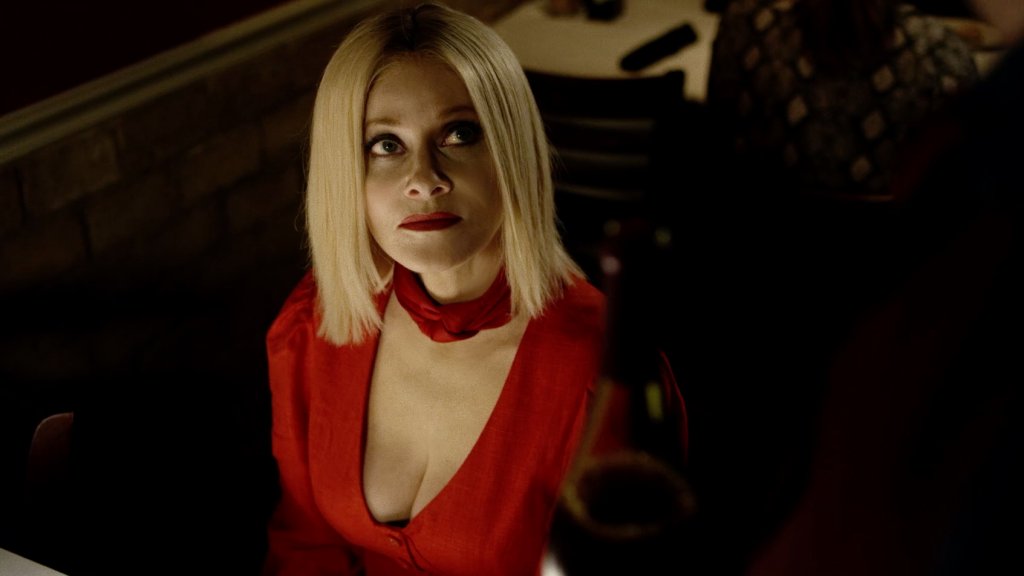
“No film justifies hurting others, does it?” It’s a stark question that confronts a filmmaker fixated on murder poses in the pitch-black horror comedy I Blame Society. Gillian is a would-be cinematic auteur, pushing back against industry rejections and the ignorance of those that refuse to recognise her talents. She’s matter-of-fact about the obvious solution to her exclusion: she’ll combine her interest in making movies with her commitment to killing those in her life that deserve to die. When Gillian recognises that full-disclosure of her plans risks alarming those around her, she chooses a more secretive path. One that has the advantage of ensuring that both witnesses and critics are silenced.

I Blame Society is an evident labour of love for Gillian Wallace Horvat, who co-writes, directs and takes the kind of leading role which sees her character feature in every scene. Her on-screen representation of her filmmaker-self is unsparingly, delightfully spiteful. Her fictional equivalent is a bullying narcissist who’s devoid of empathy and blind to the needs of others. Some of those working in the real-world film industry might guess her character’s occupation based on that description alone,  but her shocking behaviour is as much a consequence of her frustration with being blocked at every turn as it is a reflection of any innate character flaws.

What makes the film’s macabre comedy work so well is that the character of Gillian is both guileless and completely devoid of moral integrity. The effect of this stark honesty is that everyone who is able to escape her attention runs for their lives, her boyfriend included. Gillian meanwhile ensures that her own life unfolds under the watchful gaze of the camera lens. She frames the intimacies of sex and of murder with the same attentive cinematographer’s eye, narrating the drama as it unfolds.

This is an inventive and highly unusual satire on the celebrity culture of screen media, voyeurism and the business of making movies. As well as having its moments of gore, brutality and callous gallows humour, the film is bursting with meta references to the craft of movie making and the tropes and travesties of horror cinema. “Going meta” can be a mood killer, but thankfully there’s wit and intelligence in the film’s caustic reflections on art and culture.

As the body count rises, Gillian relies on the nihilistic logic of the sociopath to justify her actions. If anything, or anyone, is to blame for the loss of life that her film requires, it’s clearly the obstacles to her success that other people erect. The tiny budget and the need to rely on authentic ‘selfie’ filming motifs, makes the movie feel small scale. But the social critique in I Blame Society is far more scathing, more perceptive and infinitely better crafted than the overwrought crassness of Natural Born Killers: a movie with which it shares many of the same preoccupations.

Release Date: April 19th

GODZILLA VS. KONG

A few years after the events of 2019’s Godzilla: King of the Monsters, Godzilla reappears to seemingly attack Apex Cybernetic bases out of malice, whilst Kong is being monitored on Skull Island. When Kong is transported in order to discover the entrance to the Hollow Earth, Godzilla senses the other alpha titan, kicking off the monstrous clash for supremacy that takes centre stage throughout Adam Wingard’s spectacular Godzilla vs. Kong.

The MonsterVerse has been around since 2014, with this being the fourth and potentially final instalment. The biggest criticisms of the previous movies have centred on the lack of action and the heavy focus on human characters. GvK bucks that trend and delivers a fierce, powerful and crowd-pleasing balance of city-levelling kaiju battles with the right level of human-based exposition to keep the narrative steaming along. The two concurrent human storylines actually benefit the final product, with moments that don’t feel overbearing at all.

The visuals and cinematography are the best of the franchise, with the titular fan-favourites looking their best and the sprawling cityscapes – including a neon-soaked Hong Kong – breathtaking to look at as these Alphas level the skyscrapers.

JunkieXL had the difficult task of providing a score fit for two Kings, but he delivers on all fronts, with the right level of emotion mixed with a hearty degree of triumphant action and the classical tones of Ifakube’s iconic score.

Godzilla vs. Kong is the perfect titanic blockbuster to kickstart the reopening of cinemas across the world. It’s tremendous amounts of fun, with hard-hitting action, gorgeous cinematography and jaw-dropping visuals all wrapped up in a smash hit package.

If this is indeed the end of the big-screen outings for the MonsterVerse, the franchise goes out with one hell of a glorious bang.

Godzilla vs. Kong is out now to rent via PVOD in the UK, and in Cinemas and on HBO Max in the US.