Your Lie in April is a musical theatre adaptation of the eponymous manga. Initially a one-shot, then developed into a manga, or serialised comic, which ran for several years, the story has legions of fans who have taken both the characters and the story to their hearts. So beloved is the story that it has already been adapted into an anime for television, a live-action film, and a straight stage adaptation – with music, but not until now a fully-realised musical. There are also probably a couple of formats we’re missing out on, such is the fervour with which this story has been greeted.
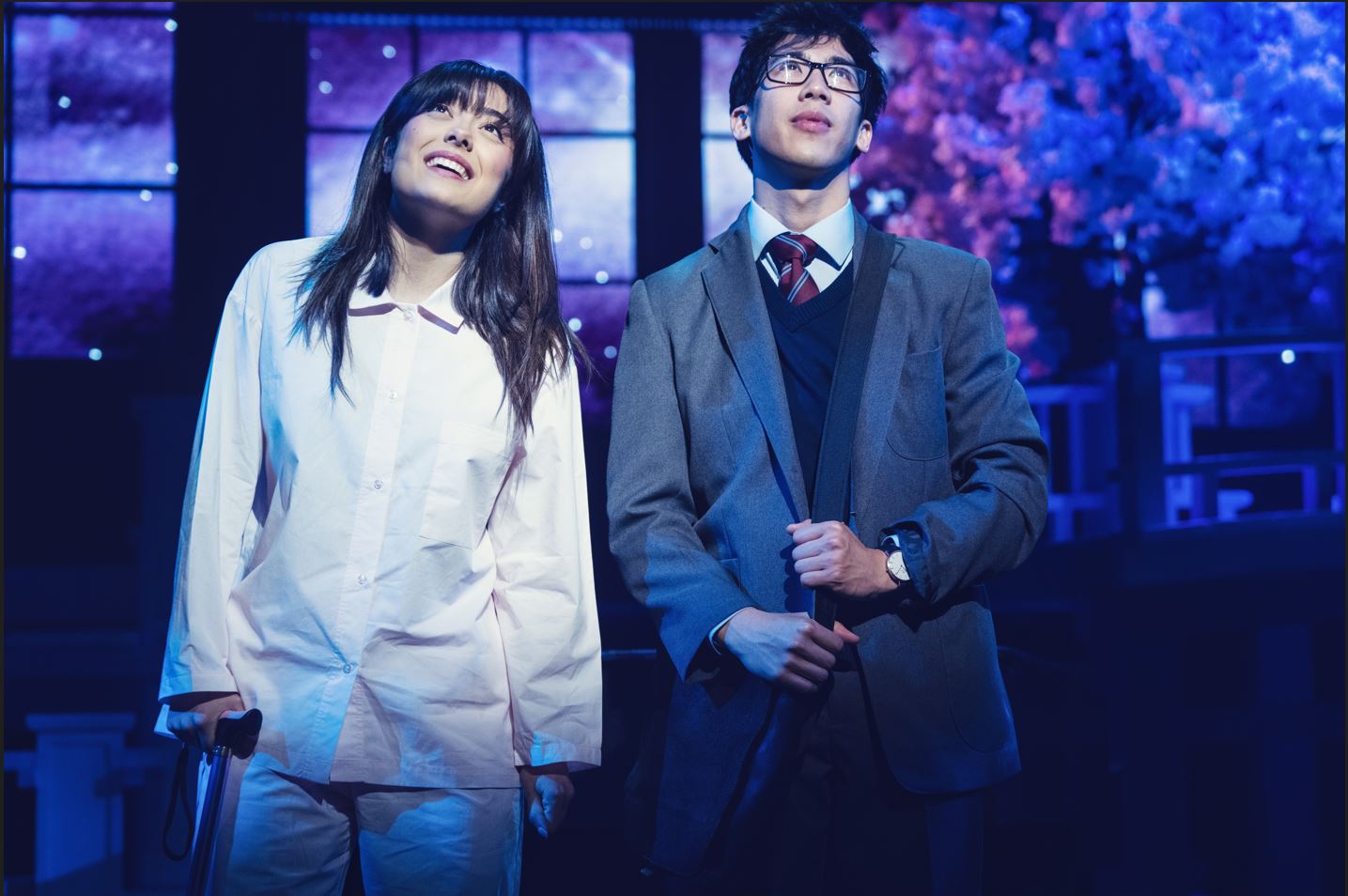
For those unfamiliar, this is an epic teenage tale of love, loss, and musical ambition. Kōsei Arima (Zheng Xi Yong, Barbie), a talented pianist, has been unable to hear his piano notes since his mother’s death, who taught him to obey all the ‘rules’ of music with military precision. Two years later, there’s a new girl at school: Kaori Miyazono (Mia Kobayashi). Forcing her way into Kōsei’s orbit via his friends Tsubaki (Rachel Clare Chan) and Ryota (Dean John-Wilson), Kaori, herself a talented but free-spirited violinist, eventually persuades Kōsei to act as her accompanist at a competition.
So far, so relatively straightforward. Things become more complicated when not one but two love triangles arise as teenage hormones kick in and burgeoning feelings develop. Just as that seems to be being dealt with – to the ultimate disappointment of two of the characters, it becomes obvious that Kaori is ill. Dismissing her condition as just a result of stress arising from school exams and the worry of competing, Kaori lies to Kōsei regarding the severity of her condition: the ‘Your Lie’ of the title. The narrative continues on a trajectory that could be described as ‘The Fault in Our Cherry Blossom’, such as the similarities that can be drawn to John Green’s 2012 novel, The Fault In Our Stars.
Much of this narrative has survived the transition to the stage, although some cuts have been made to supporting characters and some other small changes that the devoted fan will notice but the more casual fan will probably not realise. Indeed, the story will make sense to audiences unfamiliar with the source material.
The biggest cuts have been made to the introductory section of the story detailing Kōsei’s mother’s death and Kōsei’s subsequent two years of seeing the world in monochrome. We are told what has happened, and snippets of this prologue are interspersed and woven through the production, as Kōsei recalls his earlier childhood and the illness and hospitalisation suffered by his mother, but no attempt is made to show a world being lived in black and white.
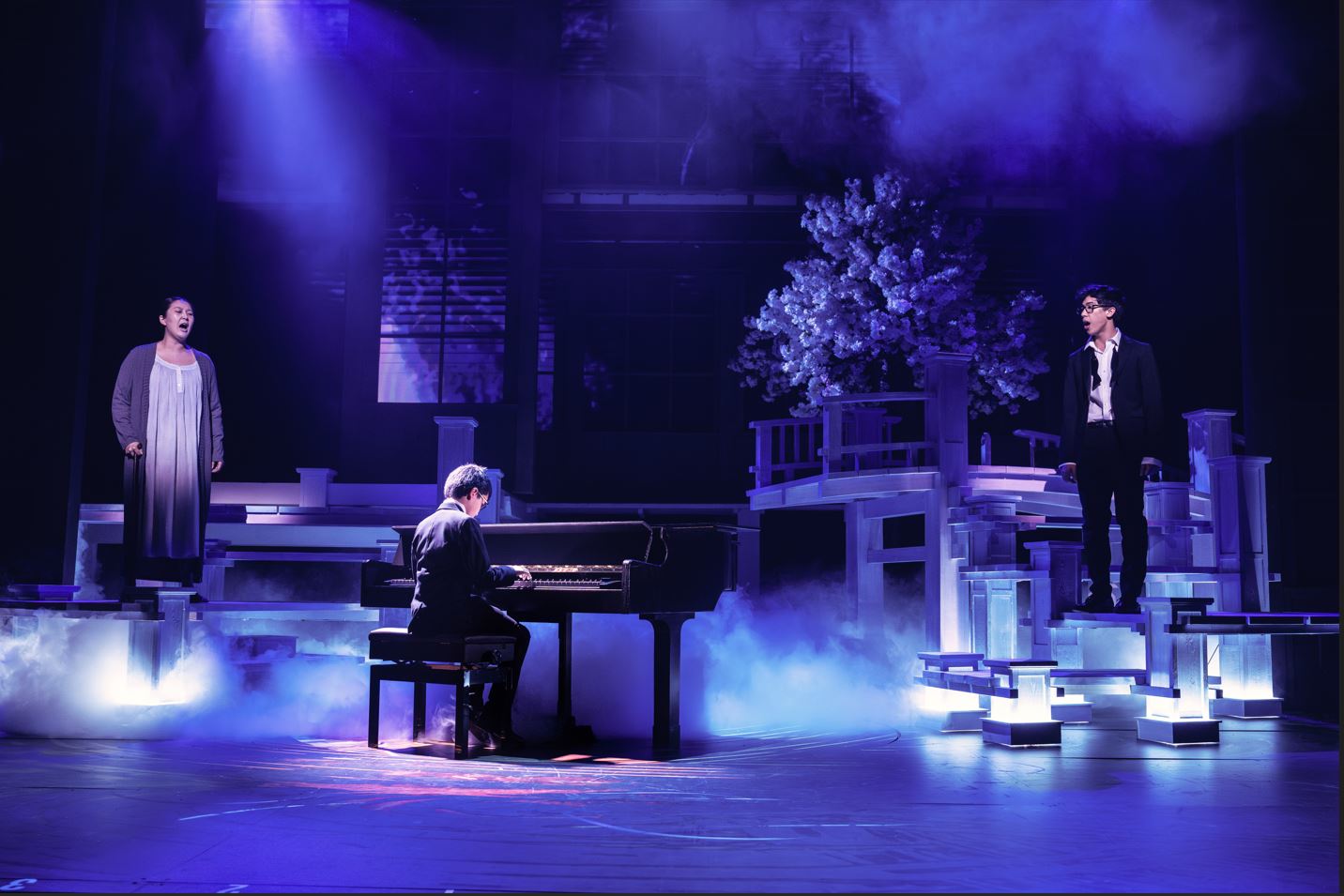
The biggest problem with Your Lie in April is an issue with the original narrative, which would be impossible to change without radically altering the overall narrative and compromising the story. That problem is that not one but two women die for Kōsei to emotionally develop – and one of them fully plays into the ‘manic pixie dream girl’ trope. It’s a issue that we’d hoped had been progressed from, and it slightly mars what is otherwise an excellent story.
There are a number of challenges in bringing this story to the stage, not least due to the epic and long-running nature of the manga, which was published on a monthly basis for some four years. However, the musical form and that of the graphic novel have some similarities: a heightened reality, the ability to observe a character’s inner monologue, or a suspension of time to allow a character to confess their innermost thoughts and feelings to the reader or audience member. The songs here run the full range of those possibilities, including a jaunty number to accompany a ‘last minute dash’ bike ride.
Manga itself is difficult to adapt, with its often relentlessly upbeat outlook and characters with often exaggerated facial expressions. It’s a testament to the acting skills on display that the melodrama and big reactions are conveyed successfully but without seeming too over the top.
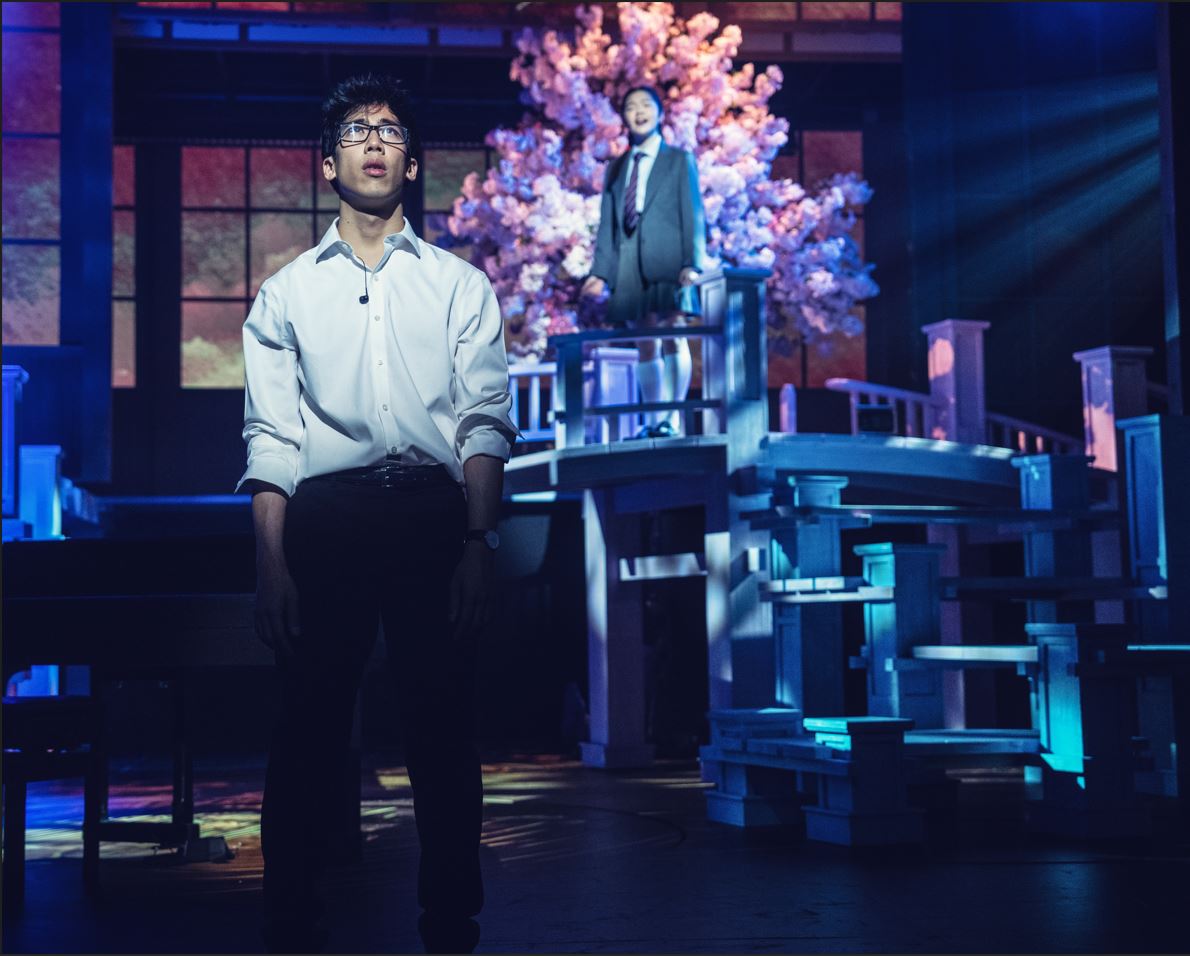
The requirement for a large number of locations has been skillfully tackled by set designer Justin Williams, who has filled the stage at the Harold Pinter theatre with large bold pieces of set, referencing classic Japanese iconography, rendered in pastel blue and pink, which lighting designer Rory Beaton’s work tricks us into believing is other colours, and other places, as the narrative develops. There’s also a video wall at the rear of the stage with scrolling projections, which will be familiar to manga readers, but almost meaningless to anyone else.

While the piano is the focus of many scenes, in others, it’s an unwelcome distraction, occupying a large portion of the playing space and occasionally making it difficult for the actors to move around the stage easily.
Being based within the world of classical music, the melodies here venture into more upbeat territory, and One Hundred Thousand Million Stars, in particular, is highly memorable. The rest of the songs are largely forgettable after only one listen, which is a shame given the overall musical theme of the narrative.
The performances, however, are excellent. Zheng Xi Yong really is playing the grand piano that occupies much of the stage, and the ‘stunt violinist’ of Akiko Ishikawa, playing for Kaori’s musical performances is similarly outstanding.

Away from the excellent musicianship, Chan and John-Wilson throw themselves into the often comedic nature of their roles, demonstrating deft comic timing and an understanding of the pathos of the production. The revelation, however, is Kaobayahi, making both her professional and West End debuts in this production and imbuing Kaori with a sense of joie de vivre in the most difficult and troubling of circumstances.
Despite the small number of issues identified, this is a production with an immense amount of heart, and the creatives involved have an obvious deep appreciation for the original manga. Producers Carter Dixon McGill appear to be developing an expertise in this area, having previously staged Death Note: The Musical in a concert version in 2023. These productions sit well alongside the Barbican’s forays into adaptations of Japanese narratives, in productions of Pluto, and My Neighbour Totoro. The West End production of Spirited Away also represents a welcome extension to the number of productions telling Japanese stories currently showing on stages.
This is a beautiful adaptation of a much-beloved story that should appeal to fans of the original manga, manga and anime fans, and those interested in seeing musicals with original music and lyrics.

YOUR LIE IN APRIL continues at the Harold Pinter Theatre, London, until 21st September 2024.