ALL OF US STRANGERS

It’s rare that remembering a moment from a film a few days after having seen it can bring you to tears. Such is the power of memory, of emotions strongly felt, and such is the power and emotion of the extraordinary All of Us Strangers.

What if you had the chance to revisit lost loved ones years later and forge a new relationship with them as the authentic you, not the child they left behind? What if this started to unlock your ability to truly, genuinely, love?

Lonely Adam is a writer, trying to evoke memories of his childhood for a script, so he spends his days emerging himself in old Top of the Pops re-runs and photographs of his family. He has only one neighbour, Harry, in a tower block where they’re the first residents. Later, Adam decides to visit his childhood home where, with no sense whatsoever of the fantastical, he is welcomed by the parents he lost to an accident 30 years ago. As Adam’s several visits to them progress, so does his relationship with Harry.

This film is remarkable on every level, as a (gay) love story, a possible ghost story, and a meditation on loss, grief, and memory. Andrew Haigh has crafted something special, brought achingly to life via four brilliant performances. Claire Foy and Jamie Bell are tremendous, but Paul Mescal and Andrew Scott give us the two best performances of the year.

In the controversy over award-nomination snubs, the biggest mystery of all is that Scott won’t be walking away with all of them. There are heartbreaking moments here that will live in your memory, perhaps forever.

stars

ALL OF US STRANGERS is in cinemas now.

THE LODGE

The Lodge

Snowbound cabin-at-the-lake chiller The Lodge, first released in US cinemas back in 2019, is now finding a new, bigger audience and greater critical acclaim in the UK on Netflix. Although it carries the Hammer name, this slow-burn psychological terror offers none of the glorious operatic excesses of that studio’s heyday. It is, however, a completely compelling horror, which blends a disturbing ghost story with the devastating fallout from a family broken by personal tragedy.

Aidan and his young sister Mia are devastated by the suicide of their mother, Laura, following their parents’ separation. Their father, Richard, plans a lakeside Xmas break for the three of them and Grace, his new fiancée and the sole survivor of a doomsday cult. His hopes that this new family will connect over the holiday break are interrupted when he has to return to the city. Left alone together in the wilderness, Grace must try to win over two resentful children who are far from ready to see their mother replaced.

The film is delivered by an excellent small ensemble, but as recovering cult escapee Grace, Riley Keough delivers a standout performance as a woman pushed beyond the edge. The cinematography and sound design are both superb. The claustrophobic cabin interiors and the endless bleakness of the snowy wildernesses outside are both rendered with atmospheric precision. It’s an extraordinarily bleak and deeply unsettling foray into human beings’ reaction to profound loss or abuse – especially when that response loses all moral and mental tethering. The Lodge’s haunting final scene confirms that the filmmakers have no interest in teasing a sequel. With deserved confidence, this salutary tale takes its characters well beyond the point of no return.

stars

THE LODGE is available in the UK now on Netflix

ARGYLLE

Matthew Vaughn’s films don’t always hit the target, and they’re often accused of being tonally misjudged, but there’s no denying that he knows how to craft an exciting, adrenalised action film full of wit, invention, and often ludicrous spectacle. He’s done it again with Argylle, a witty and clever spy thriller from a script by Jason Fuchs that constantly surprises with the ingenious twists and turns of a plot that borders on the ridiculous yet never quite topples into extreme parody.

Argylle confounds its audience’s expectations from the off in a high-energy action scene clearly intended as a parody of old-school Bond as superspy Argylle (Henry Cavill) pursues the sultry LaGrange (Dua Lipa) around vertiginous coastal roads in Greece, and it’s as corny as hell. Then we discover that what we’re watching is a sequence from the latest spy thriller novel written by Bryce Dallas Howard’s slightly mousy cat-loving author, Elly Conway, being read to a breathless audience at a book launch reading. Elly has had huge success with a series of books based on her imaginary spy, Argylle, and when she finds herself facing writer’s block trying to find a suitable ending for her fifth book, she takes a train trip to visit her parents in Chicago in search of inspiration. But on the train, she meets up – coincidentally? – with Aidan (Sam Rockwell), an actual spy who quickly and creatively saves her from being attacked by a group of assassins from a criminal organisation known as the Division. It turns out that her novels have uncannily predicted the future of their operations, and they’re keen to find out what she knows and what’s going to happen next.

The subsequent two-plus hours are a dizzying, helter-skelter thrill ride of increasingly absurd (and frankly impossible) action scenes and wild globe-trotting wound tightly around a plot that gives a new meaning to ‘far-fetched’ and yet is irresistibly enjoyable because it all works and comes together inside the world the film has created for it. Howard and Rockwell are having a great time, and it’s clear that the rest of the cast are indulging themselves, too. There are great turns from Bryan Cranston, Samuel L Jackson, Catherine O’Hara and Chip the cat and while audiences may have been led to believe that Henry Cavill’s the star of the show here, his brief twinkling cameos are terrific fun.

Undoubtedly, some might find Argylle’s knowingness insufferable and a bit smug and become exasperated by the overuse of CGI/green screen, another example of the film playing with its own sense of unreality. But if you’re in the mood for some fast-paced, non-stop, irreverent action that turns its own genre inside out, then Argylle’s the one for you. Vaughn’s plans to launch a new franchise off the back of the film might not fly if early box office is any measure, but c’est la vie. Perhaps the campaign to get Vaughn on board to direct the next Bond film (if there ever is one) should start here – based on Argylle, he clearly knows just what it would take to shake 007 out of his doldrums and launch him back into the centre of action cinema again. But for now, if nothing else, Argylle is guaranteed to blow away those February blues.

stars

ARGYLLE is in cinemas now

SLOTHERHOUSE

Slotherhouse is as crazy as you can get with a horror comedy, a rollercoaster that will have you laughing throughout. The film follows Alpha, a psychopathic sloth ripped from her natural home to be the mascot of a sorority. Initially loving the limelight and being the undisputed royal of the house and on social media, things take a dark turn. We get a bloodbath of silly deaths, all at the hands of this little sloth. From the start, you will find yourself laughing, thanks to likeable characters like Emily (Lisa Ambalavanar), Zenny (Bianca Beckles-Rose) and, of course, Alpha. Though it’s a horror comedy, it succeeds in focusing on deep topics like poaching and the toxic obsession of social media followers. In all, it’s a perfect mix of comedy, horror, and ethical messaging.

While it could have been a really cheap-looking, awful creature feature that relies on blood to stay interesting, it’s the complete opposite – it’s a near-masterpiece. You’ll find yourself hooked throughout as the story follows this murderous sloth taking out each girl, one at a time. But you’ll also find yourself sympathising with Alpha, as she’s just a creature who wants to return to her home in Panama, giving this film a depth you don’t usually see in horror comedies.

Slotherhouse should be on everyone’s radar. It’s the perfect film to put on at a party that will appeal to everyone, even your non-horror friends, and let’s be real, who doesn’t want to see a sloth go on a killing spree? Don’t miss out on this one; it deserves a whole lot of love.

stars

SLOTHERHOUSE is available on Paramount+ and is released digitally on February 12th.

BLUE GIANT

When Dai Miyamoto first hears the legendary musical genre Jazz, he is inspired for life and sets off on a journey of a lifetime in Yuzuru Tachikawa’s spellbinding adaptation of the celebrated manga of the same name, Blue Giant.

Dai Miyamoto, a young man in his late teens, has one goal in life – to be the best Saxophone player of all time. However, he must train to accomplish this, so he sets off to Tokyo, where he stays with his old friend Shunji and meets a prodigy pianist, Yukinori. Together, the trio form the band Jass (with Shunji taking up the drums to be a part of this special voyage). Yet, although these three are committed to being the best in their field, like with any goal, there are plenty of hurdles along the way that challenge their friendship and ambitions.

Director Yuzuru Tachikawa, whose previous works include Mob Psycho 100 and Death Parade, was the perfect person to helm this project. His attention to detail and undeniable flair for this art form allow this already inspirational and captivating story to come to life in a special way. Every frame of the film is jaw-droppingly gorgeous, the musical score is unique, and it captures the euphoria and emotion with live musical performances. To cap it all off, the voice acting brings untapped sentiment to every line of dialogue.

Blue Giant is not your average anime film. It tells a story that will resonate and enthral people of all ages and backgrounds – we all have goals in life, and it is up to us to chase those dreams and accomplish them. It’s visually gorgeous; the score is tantalising and will have you in floods of tears by the end credits. You do not want to miss this one.

stars

BLUE GIANT is out now in select UK cinemas.

LACED

Fans of claustrophobic, moody chamber-piece thrillers will find much to enjoy in Laced, the feature film debut from Kyle Butenhoff, who also appears in the film as the victim of what, at first blush, might appear to be the perfect crime. Those who prefer a bit more action and pace might find their attention wandering. Molly (Dana Mackin) and her husband Charlie (Blutenhoff) are holed up in an isolated cabin as a ferocious snowstorm rages outside. They’re not exactly trapped, but they’re not inclined to leave either. There’s some tension between the two, but it’s only when Molly laces Charlie’s food with poison that we realise their relationship isn’t exactly a match made in heaven. There’s a history of toxic abuse here (although the film could perhaps have made a few more efforts to make Charlie into more of a bastard as he doesn’t seem too unreasonable – a bit boorish, maybe – when we meet him), and we find out what Molly has conspired with her lover Victoria (Hermoine Lynch) to remove the one obstacle standing in the way of them being together. But when Molly’s brother Austin (Zach Tinker) arrives, battling his way through the storm to join the couple, Molly and Victoria’s plans quickly go off the rails and spin out of control…

Laced is not without interest and atmosphere, but the story unfolds at a snail’s pace, the characters aren’t hugely sympathetic, and the single locale quickly becomes stifling and restrictive. As an exercise in low-budget filmmaking, it has its moments (and a couple of jump scares), and it finds a much-needed fresh energy in the last act, but ultimately, it comes across as a better proposition for a stage play than a film.

stars

LACED is available on digital platforms in the US. 


THE CARD COUNTER (2021)

Ever wondered about ‘The Card Counter Movie’? Starring Oscar Isaac as William Tell, the film features a world of high-stakes poker and personal pasts.

Paul Schrader directs this movie, combining deep psychology and poker drama.

We’ll explore Tell’s intricate story, memorable performances, and some bonus film trivia, no spoilers included!

An Introspective on The Card Counter: Quick Recap

The Card Counter presents William Tell, a lonesome veteran who’s now a top-class poker player.

His life orbits the gaming table, signaling his inward battles. Skillfully counting cards isn’t just a part of his plan for winning—it’s also how he copes with his troubled past.

William navigates the tricky gambling world on his redemption path while tackling past events.

The plot thickens as he becomes a guide, teaching strategies and poker rules to Cirk, a revenge-driven youth, and La Linda, a secretive poker agent, nudging him toward the World Series of Poker.

William Tell by Oscar Isaac: Military Interrogator to Pro Poker Player

Oscar Isaacs portrayal of William Tell, a man who’s swerved from military life to professional poker, is thrilling.

Isaac’s acting illuminates his strategic prowess at poker tables, a testament to his silent and precise nature, shaped by his time in the military.

Isaac’s portrayal of Tell reflects the military precision and discipline he once practiced as an interrogator.

His routines and methods clearly echo his past, making his character one of the most intriguing in recent cinematic history.

Tiffany Haddish as La Linda: A mysterious poker agent

Tiffany Haddish, as La Linda, is a poker agent who becomes an influential figure in Tell’s life. Her character is layered and mysterious, pushing Tell towards the high stakes of the World Series of Poker.

Haddish’s performance adds a new dimension to the narrative, making it even more compelling with its riveting performances.

Tye Sheridan as Cirk: A young man seeking redemption and revenge

Tye Sheridan portrays Cirk, a young man with a troubled past seeking redemption. His character is driven by a thirst for vengeance against a military colonel he holds responsible for his father’s fate.

Sheridan’s performance adds an element of tension and urgency to the narrative, making his character’s journey one of the most emotionally charged aspects of the film.

Paul Schrader’s Cinematic Mastery
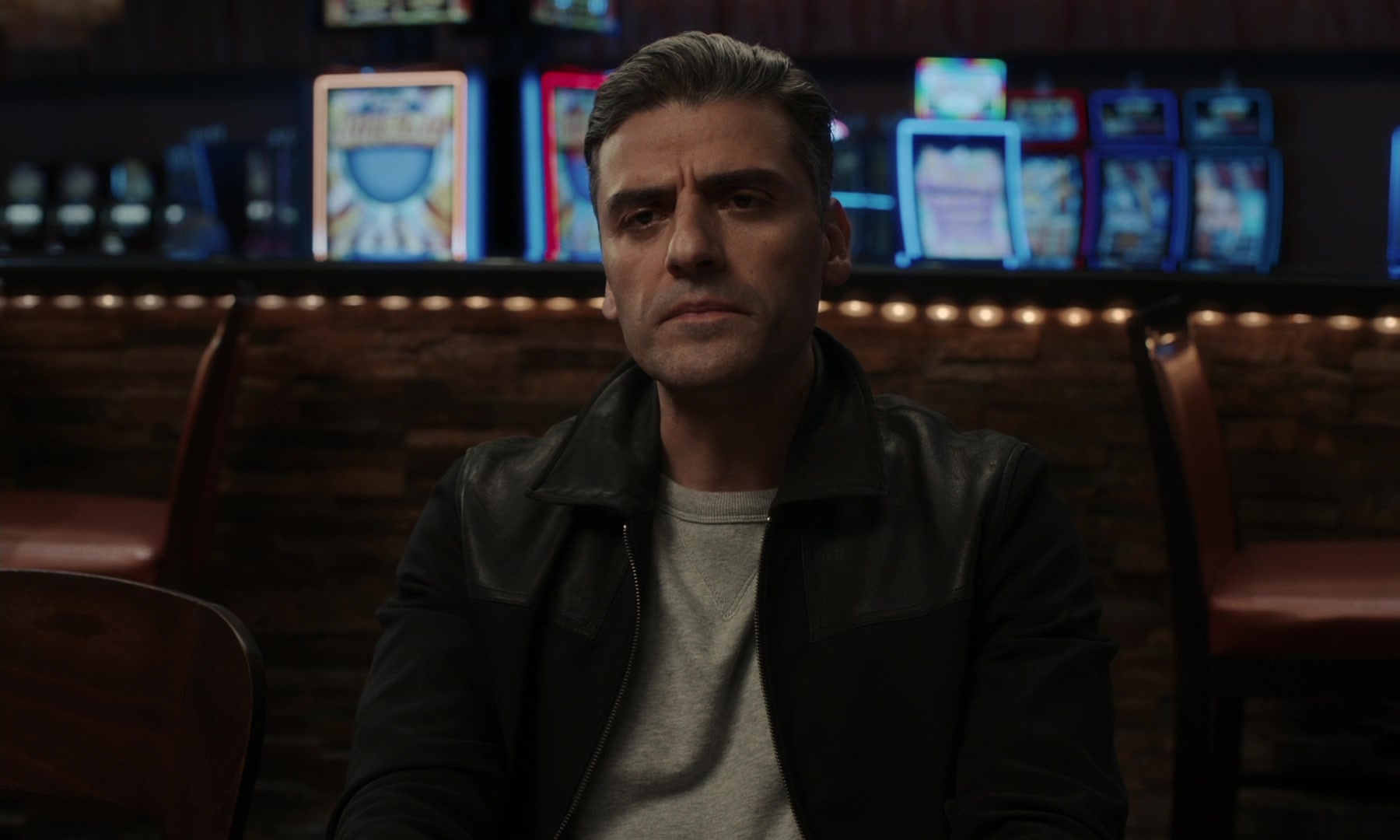
Director Paul Schrader’s unique style is evident in “The Card Counter,” a film that can be seen as part of Paul Schrader’s lengthy inquiry into complex characters and their inner struggles.

Schrader’s direction showcases a meticulous cinematic style marked by minimal camera movement and an absence of music cues to craft unsettling atmospheres, embodying Schrader’s trademark cinematic intensity.

His use of transcendental cinema motifs and specific framing techniques are employed throughout the film, including purposeful play focusing on isolating the protagonist or blending him with his surroundings, making it an authentic Paul Schrader experience.

Pictorial narrative: Unraveling the use of ordinary sheets in roadside hotels

The movie’s pictorial tale is distinctive and grabs attention, featuring intense acting in this retribution-related suspense.

Confusing imagery and regular sheets in motel rooms mirror the main character’s distressing history, giving the viewer a disquieting feel.

In the Venice Film Festival, the movie makers used a 220-degree fisheye lens to present a visual analogy for an abuse and trauma mark.

Subjects of remorse and atonement: The serious part of Abu Ghraib and military jail.

The suspense story of “The Card Counter” introduces notions of remorse and atonement through its leading character, William Tell.

Tell shoulders guilt for his past as a jail officer in Abu Ghraib, which is revealed through his interactions with a young man who harbors his father’s legacy tied to the same incidents.

This movie stretches beyond just Abu Ghraib or card counting, but builds an overall story to explore more expansive ideas of personal accountability and the ethical fallout of past actions.

Recap

To summarize, “The Card Counter” interweaves a captivating story of remorse and atonement. It effectively combines character building, a captivating plot, and a unique pictorial narrative.

With careful direction by Paul Schrader, the combined performances of Oscar Isaac, Tiffany Haddish, and Tye Sheridan piece together a powerful tale that connects with viewers.

 

DJANGO (1966, 4K)

Sergio Corbucci's Django

First and foremost, Sergio Corbucci’s Django is a very good film. Violent, moodily atmospheric and influential, it is a seminal Spaghetti Western, with Corbucci’s blue-eyed anti-hero (played spectacularly by Franco Nero) perhaps only second to Eastwood’s Man with no Name as the most significant and recognisable character in the genre.

Yet, Django is more than that. Corbucci’s film is as angry as it is poignant, filled with its director’s intense hatred for fascism while refusing to allow any character what could be truly defined as a happy ending or arguably even redemption.

This new release from Cult Films is as beautiful as you would expect, the 4K restoration rendering the already strong visuals even more stunning than before while the audio is, at times, a barrage on the senses.

Included here are four interesting on-disc extras, including an introduction by Alex Cox (good), an interview with Franco Nero (interesting), and an interview with Cannibal Holocaust director Ruggero Deodato (entertainingly combative). Of most interest, however, is the new documentary Django & Django, a presentation by Quentin Tarantino, which, despite focusing on the genre itself and his own Once Upon a Time in Hollywood more than Django itself, is a thoroughly engaging watch. With a substantial booklet also included, this is a well-stocked release.

That said, if you’re a big fan, you likely already own the Arrow 4K, or at least a good version of the film. And while the extras are worth the effort, the Tarantino documentary is on Amazon should you really wish to view it. What we’re saying is that Cult Films has a good job on their release, but it falls just short of being an essential purchase – one for completionists and those yet to purchase a version.

stars

Cult Films’ release of DJANGO in 4K UHD is out now

MIDNIGHT PEEPSHOW

midnight peepshow

A drunken, crestfallen city worker, Graham (Richard Cotton) is wandering the streets of London’s Soho at night and comes across a neon-lit, seedy peepshow and tentatively enters. However, rather than watching a young woman gyrate in the booth, she tells him three tales that are a little too close to home.

The linking element of the stories is a site on the dark web called Black Rabbit, which allows people to make money by acting out the viewers’ fantasies. The first instalment, Personal Space, directed by Airell Anthony Hayles (They’re Outside), shows a terrifying home invasion and its disturbing outcome. Ibiza Undead’s Andy Edwards provides the middle story, Fuck Marry Kill, which takes the Saw approach with three men – two of which have been sleeping with the same girl, one a random stranger – tied up and ready to be tortured if they don’t ‘play’ the game. It’s down to Jake (Razor Blade Smile) West to lift the lid on the sad man’s life with The Black Rabbit, which recounts how his wife got involved with the seedy site and how Graham is to blame for his own situation.

Enveloped by the linking story (directed by Ludovica Musumeci), all three tales build up a gritty, sleazy atmosphere fitting for the Soho location, albeit leaning more to its heyday as the UK’s 42nd Street. Each story makes the viewer complicit in its nastiness. Like the websites alluded to in the movie, by watching we are both taking part and taking pleasure in what’s occurring. That’s not to say the filmmakers are moralising – far from it, this is exploitation pure and simple, but it still allows for a little food for thought when it comes to the more extreme elements of cinema.

Massive props must go to cinematographer Vince Knight (Wolf Manor), who brings out the dinginess of Soho and transports it back to the vice-den days of the seventies. Anthologies have come a long way since Amicus ruled the format, and Midnight Peepshow is one of the most cohesive entries to the subgenre we’ve seen for quite a while.

stars

MIDNIGHT PEEPSHOW is released on DVD in the US and digital worldwide on February 13th.

SOCIETY OF THE SNOW

The story of the crash of Uruguayan Air Force Flight 571 in 1972 in one of the remotest parts of the Andes and into the most hostile terrain imaginable has been revisited time and again in documentaries and feature films – most notably 1993’s Alive! directed by Frank Marshall. But there’s a reason the story remains so compelling; it’s an extraordinary tale of survival against impossible odds and the implacable determination of the human spirit in the direst of circumstances. J.A. Bayona has adapted the book by Uruguayan journalist Pablo Vierci and has used his experiences in making the powerful 2012 film The Impossible, the story of the 2004 Indian Ocean tsunami in Thailand, to revisit one of the most remarkable, tragic and yet curiously life-affirming real-life stories of recent memory.

When a combination of turbulence, shocking weather and co-pilot inexperience causes the 571 to come down in the Andes, many of the crew and passengers – including some of the young members of a Uruguayan rugby team travelling to Chile – are killed outright. Others die in the blistering cold in the days to come. Food supplies are scarce, and the weather never lets up. With their strength weakening and no sign of help on the way, the dwindling band of survivors are forced to make a harrowing decision involving the frozen bodies of those who perished if they are to have a hope of surviving the bitter winter.

Bayona brings the story to the screen by focusing on the bravery, heroism and stoicism of the survivors and presents the manner of their survival as a simple and unavoidable judgement call. There’s no sense of outrage here or sensationalism in depicting what the boys must do just to stay alive. Eventually, a couple of the boys set off across the snow-capped mountains and, against the odds, find their way to civilization. The ensuing rescue scenes – 16 of the boys survived – are incredibly emotional, and the evidence of their physical deterioration when they eventually get home is shocking and sobering. Society of the Snow is more gripping and terrifying than any horror story, but in the end, it’s a testament to what human beings can do when they are forced to work together rather than fight one another.

stars

SOCIETY OF THE SNOW is streaming on Netflix now.