SASQUATCH SUNSET

Like the beloved documentaries of David Attenborough, David and Nathan Zellner’s unmissable movie is constantly enthralling, profound, relatable, touching, and hilarious.

Over the course of a year, we follow a family of Bigfoot as they traverse the North American forests. As they learn how to survive and communicate, several dangers come to the fore as some very human traits in our mysterious hairy friends come to the fore.

While Steve Oram’s grunt-filled Aaaaaaaah! (2015) was a crass, experimental mess, the Zellners’ film uses the lack of recognisable language excellently. We easily learn the different nuances of the various characters and are drawn to actually caring about their plight since they are so relatable. Surprisingly, underneath the impressive makeup are a pair of big names, Jesse Eisenberg and Riley Keough, alongside Christophe Zajac-Denek and Nathan Zellner. With no discernible CGI, the actors brilliantly convey the simian-like Sasquatch’s emotions. Their voyage of discovery touches on such elements as procreation, interaction with other critters (occasionally with hilarious and sometimes deadly consequences), as well as the primitive etiquette amongst the group. Initially, we’re unsure in what age the journey takes. That is, until they come across evidence of humans. Firstly, they see a deserted tent and then they’re shocked and apparently distressed to see a road passing through the forest. As there’s no one to be seen, however, this could still be post-apocalyptic. It’s an enigma that’s largely irrelevant, as interaction with Homo sapiens would rob the film of some of its magical atmosphere.

Sasquatch Sunset is deftly directed by the Zellners. It’s a simple premise that rewards in spades. If this were an animated movie, it’d be on par with Watership Down in the empathy we feel for the mythical, missing-link characters. Words are not needed when the results are so impressive and powerful.

stars

SASQUTCH SUNSET has its UK Premiere at Sundance Film Festival London June 8th-9th .  Book tickets: Sundance London website
Releasing in UK cinemas from June 14th, with Previews + Q&As from June 10th. Official website

 

FURIOSA: A MAD MAX SAGA

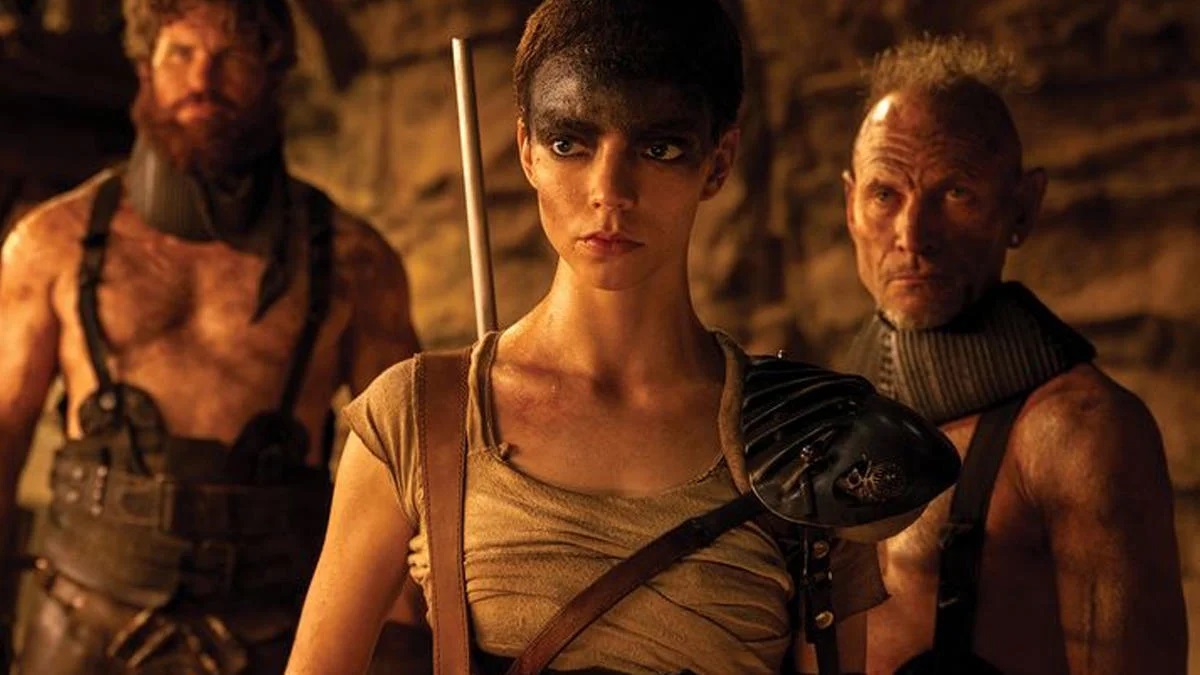
still of anya taylor-joy as furiosa in george miller prequel film furiosa: a mad max saga

Tying itself to what is unequivocally the best action film of the 21st century – if not ever – was always going to prove incredibly challenging. And while Furiosa might not reach the dizzying highs of Fury Road, director and co-writer George Miller succeeds in delivering a gritty, mean, and wildly unhinged origin story for his world’s most fascinating character.

Furiosa: A Mad Max Saga – Warner Bros’ prequel to 2015’s Mad Max: Fury Road – broadens the known horizons of the franchise’s apocalyptic mythology, riding deeper into and away from Australia’s reddened wasteland. Places like Gas Town, the Bullet Farm, and the Green Place (back when it was still green and not the putrid bog portrayed in Fury Road) are rendered on screen for the first time but feel lived-in, while old characters are given new dimensions. And while Furiosa enacts a leaner, meaner, and in many ways more primal vision of this world than its predecessor, as a two-part story, the two chapters wind together seamlessly.

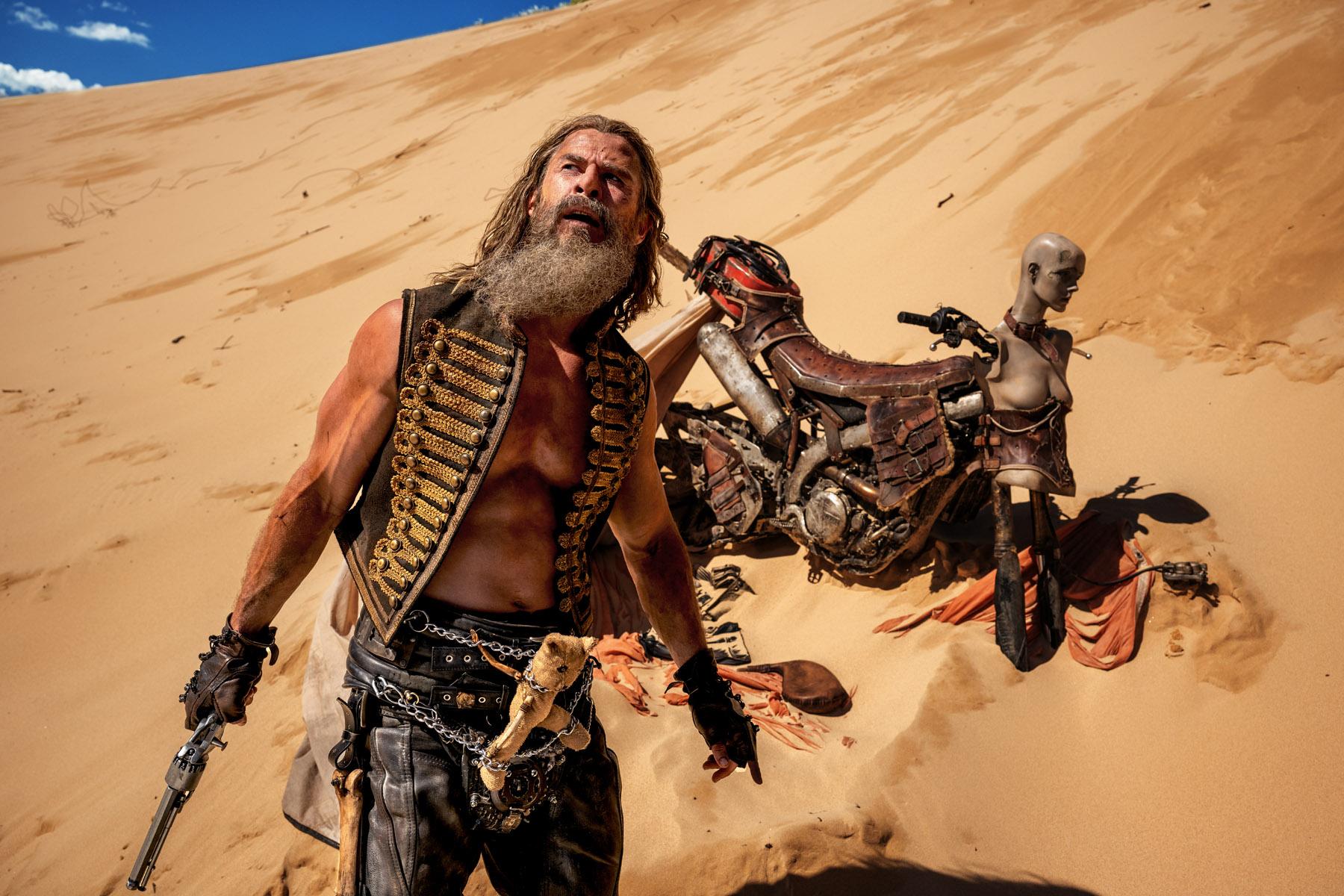
Played in Fury Road by Charlize Theron, her younger self is now played by a phenomenal Anya Taylor-Joy (and as a child by a well-cast Alyla Browne) whose inescapable gaze is a magnet for our undivided attention. Furiosa was just a child, born from a hidden community in a richly verdant oasis, when she was ripped away by Wasteland warriors and taken to the chariot-riding biker king Dementus, the strangely constructed villain played by Chris Hemsworth in a long beard and prosthetic nose. Furiosa then passes into the hands of a younger and more cautious Immortan Joe, now played by Lachy Hulme, as part of Dementus’ bid to take over Gas Town. She escapes a fate as one of Immortan Joe’s breeders by fleeing into the tar-smeared depths of the Citadel as a boy, eventually coming to assist Praetorian Jack (Tom Burke, with whom Taylor-Joy shares searing chemistry), a rig driver who quietly takes Furiosa under his wing.

chris hemsworth in desert as dementus, still from furiosa: a mad max saga by george miller

It’s a story of survival and revenge, of cutting oneself up and rearranging the pieces into something harder to break, all while clinging to hope that the past might be returned to. Appropriate, then, that Furiosa is itself fragmented into five chapters, each an episodic glimpse at key points of transformation for the slave-turned-warrior. It’s both desolating and stirring, bleak and beautiful, and never does the fact that the audience already knows Furiosa’s fate lessen the journey’s gripping tension.

However, if you thought any of that meant that George Miller has fallen into a more reflective and quieter style of filmmaking, let us dispel any such notion. Furiosa is still deliciously, brutally, thrillingly action-packed with unbelievable (and, as always, practically rendered) set pieces. Though it lacks some of the comedic absurdity of Fury Road – no flame-throwing electric guitars in this one, sadly – the prequel still worships that same flavour of madness that makes this world so wretchedly engrossing.

anya taylor-joy in furiosa: a mad max saga

Furiosa only falters with Hemsworth’s Dementus. While the imposing actor does infuse some interesting layers – like the spark of ill-expressed paternal care he feels for Browne’s young Furiosa – to his performance, Miller’ and co-writer Nico Lathouris’ characterisation is too erratic (and at times cartoonish) and makes his unpredictability more confusing than it is terrifying. Particularly when placed in opposition to Immortan Joe, it’s somewhat difficult to view Dementus as the real threat.

In the light of Taylor-Joy’s sensational performance, though, Dementus feels like a detail. With this dialogue-light role, the actress effortlessly affirms herself as an action heroine who’s as skilled in her stunt physicality as she is at flooding emotion into a lingering glance. Theron could not have wished for a more perfect predecessor (or is it successor?). Witness her.

Furiosa: A Mad Max Saga is in cinemas from May 24th. Watch the trailer here.


stars

STING

It’s been quite a while since we last saw a giant spider movie in UK cinemas (ignoring French film Infested’s recent limited run). With so many cut-price DTV efforts slinking onto streaming platforms, it’s great to finally see a giant spider movie with style, clout and a budget make it onto big screens. While Sting doesn’t quite provide the potent freak out that Arachnophobia did in 1991, it’s a dark and zany ghost-train-like ride with jump scares, gore, colourful characters and a punchy plot, which makes it well worth watching.
The story centres on Charlotte (Alyla Browne), a creative pre-teen processing the break-up of her parents and the arrival of mum’s new boyfriend, building supervisor and wannabe comic book artist, Ethan (Ryan Corr). Charlotte and Ethan bond over their mutual love of comics, but conflicts arise after she discovers an alien Redback in her grandmother’s apartment. Charlotte keeps the arachnid (which travelled to Earth on a comet), calls it Sting and feeds the spider until it grows and seeks bigger things to devour.
Writer/director Kiah Roche-Turner (Wyrmwood) delivers a gruesome jaunt that sometimes feels a tad off-kilter and ill-toned when coupled with surprisingly poignant family drama and spiky frights, as though part of its skewed MO was to appeal to audiences the same age as its protagonist. Supporting characters also feel like those you would find in a Saturday morning children’s TV show, yet Sting delivers oodles of fun, guts and feisty action, blending Tim Burton and Sam Raimi style aesthetics/Dutch angles within an urban Gothic setting, weaving eerie sound design into a jovial romp that entertains more than it rivets and astounds.
stars

HOARD

Hoard

This debut feature by writer-director Luna Carmoon is an extraordinary and original psychological study that takes evident delight in its refusal to be easily classified. A mix of kitchen sink, coming-of-age and postmodern family drama, Hoard explores how the impact of longing, disconnection and loss together shape the life choices of a rebellious but far from robust young woman.

In 1980s Lewisham, seven-year-old Maria (Lily-Beau Leach) lives a chaotic life with her loving but dysfunctional mother Cynthia, a compulsive hoarder. At school, she’s seen as an oddball and an outsider and spends most of her time caught up in Cynthia’s obsessive rituals. When Social Services intervene after a domestic crisis, a disconsolate Maria is placed in the family home of a warm-hearted foster mum. Ten years on, seventeen-year-old Maria (now played by Saura Lightfoot-Leon) is still seen as a weirdo by her peers, and is struggling with her identity. As she navigates the challenges of adolescence, her small social circle provides invaluable support. But any hope of stability disappears when the return of Michael (Joseph Quinn), a former foster child, becomes the catalyst for an explosive and intense romantic entanglement. But for Maria, despite the messy fallout of this abnormal affair, the experience ultimately proves cathartic.

Beautifully evoked and shot, with riveting and risky performances by Lightfoot-Leon and Quinn, Hoard blends life-affirming, alarming and awkward moments in a wild and unpredictable tale. Carmoon’s distinctive storytelling and visual style immediately mark her out as an auteur to watch. It’s easy to see why Hoard won the backing of both BBC Films and the British Film Institute. This is unusual, unsettling, and irresistibly vivid, next-generation British filmmaking.

stars

HOARD is available in the UK now on a limited cinema release.

THE REMARKABLE LIFE OF IBELIN [Chicago Critics Festival 2024]

The Remarkable Life of Ibelin is a documentary about the life of Mats, a World of Warcraft gamer. The 25-year-old died from the degenerative muscular disease that kept him in a wheelchair most of his life, leaving his parents with immense regret that they could not offer him a ‘normal’ social life full of acceptance. Through his WoW account and blog, his parents and viewers can discover the place where Mats didn’t just escape into but thrived in and became a kind-hearted, loving, and beloved young man.

The story of Ibelin is the story of a generation. Those elders who, as young people, snuck into their private lives through bedroom windows are trying to understand the children who enter their screens for the same effect. The current wave of young adults escaped their households by diving into Discord servers, MMORPGs, Instagram DMs, and other digital spaces. The places children feel truly seen are now created online in social media spaces, audio chats, or sandbox and roleplaying games. How can they explain to their parents the significance of ‘ranking up’ in a game or the digital ‘wartime’ bonds they’ve created in FPSs with people they’ve never met?

Mats’ persona as Ibelin is a kind-hearted, loving adventurer. He shows such attention to everyone around him in ways that would be more challenging for Mats to express in real life. But his impact was real to the people who knew and loved him as he was, without having seen the adversity he overcame in real life. Rather than simply using the digital plane to hide, he used it to improve other people’s lives. Perhaps we all could more easily bridge the generational gap if we took a cue from Mats and Ibelin.

stars

CUCKOO [Chicago Critics Festival 2024]

Strange in the most terrifying ways, Cuckoo lives up to its title with a bonkers concept. Gretchen, a teenage daughter played by Hunter Schafer, discovers that living at a resort with her dad’s new family has a few odd quirks to it. As she unravels high-concept horrors, Gretchen discovers the truth about her new step-family. To say any more of the plot would be to spoil its treasures.

The cast’s off-the-wall performances make this into a whacked-out oddity. Even the charming Hunter Schafer, a mostly grounding element, contains elements of genre trope self-awareness. Her reactions pull audiences along through imaginative horrific delights that feel so fresh you can smell them. Cuckoo is a strong candidate if you’re looking for a horror movie that you need help getting a grip on. The rabbit-hole approach can drag on, but it’s worth it for the film’s queasy reveals. By its end, when every element is in place, you feel you’ve been on a nonstop rollercoaster, even when the slow and dull build to understanding that’s taken place was actually pretty cookie-cutter.

Gretchen’s story feels like another self-validating one. Many who grew up in splintered families might characterise new blood as invasive to the status quo. Here, that fear is literalised in an almost childish way. Like a fairy tale that’s a metaphor for not being afraid of the dark, Cuckoo delivers a simple allegory for adults to deal with a juvenile issue. Cinema like this has found a welcome place among a generation that feels like kids in adult drag. Although Cuckoo is a fine picture, it’s a shame that the talents behind it couldn’t create a more culturally productive work.

stars

CUCKOO is in UK cinemas on July 23rd.

YOU CAN CALL ME BILL

Director Alexandre O. Philippe has established a name for himself with a number of smart, unconventional documentaries exploring various pop culture icons; whether it’s David Lynch in Lynch/Oz, Alien in Memory: The Origins of Alien, zombie movies in Doc Of The Dead, Star Wars in The People vs. George Lucas, and even an entire movie devoted to dissecting Psycho’s shower scene in 78/52.

Like Lynch/Oz, his latest, You Can Call Me Bill sees Philippe direct his focus on an individual, in the shape of William Shatner. As usual, eschewing the traditional documentary approach – there’s no interviewees save for the great man himself – and little direct focus on his life of career, the director turns the camera on Shatner and just lets him talk.

Anyone who’s seen Shatner interviewed or onstage will know that he’s one of the world’s great raconteurs. He’s able to pontificate for hours on whatever subject takes his fancy with a wry humour and an intelligence that belies the comic persona he often likes to play into. And while his frequent Star Trek convention appearances often see him playing the hits and telling the same, often fanciful stories of his time as captain of the Enterprise (for example, contrary to what he likes to tell people, he did not single-handily save Paramount from burning down during filming of The Search For Spock, he merely posed for photos with a hosepipe after), he frequently goes off-script, and talks about whatever’s on his mind. And he has a lot on his mind.

It’s this more insightful Shatner that Philippe goes for here. Gone are the tales of frequently hiding tales of Leonard Nimoy’s bike (that one’s true as far as we know), and instead, Shatner is given leeway to talk about the subjects that interest him. Now in his 90s, mortality is on his mind, and he expounds on his thoughts on death, as well as other subjects, including climate change, travelling into space, fame, love, comedy, and his oft-mimicked acting style. Shatner has said that, as he nears the end of his life, he wanted to make the film for his family to help them remember the real him. And while you never feel that Philippe entirely gets under his skin (there’s little in the way of cross-examination), this may be as close as it’s possible to get.

If this all sounds a little dry and overly serious, don’t worry. Besides his interviewees’ natural charm, Philippe peppers the film with numerous clips from throughout Shatner’s career. Trek unsurprisingly features frequently, as do the likes of Boston Legal, The Twlight Zone, Kingdom Of The Spiders, T.J. Hooker, Airplane 2, and his gentle onstage teasing of George Lucas (“may I call you George? You can call me Mr Shatner.”) Philippe also includes clips from Shatner’s frequently mocked singing career, including his infamous Rocket Man, to more recent (and far better) work, expounding on travelling to space and, in the epilogue, his thoughts on death and his somewhat unconventional desire to be have his ashes planted under a tree, giving nourishment back to the Earth. It’s a typically unconventional insight into an unconventional man, and typical of the film’s offbeat approach to approaching Shatner, which may give us more insightful look at the man than many conventional documentaries.

stars

YOU CAN CALL ME BILL is released on Blu-ray on May 27th.

IF (IMAGINARY FRIENDS)

Written, directed, and produced by John Krasinski (who also features in the cast), IF (Imaginary Friends) is a film that doesn’t really seem to know what audience it wants. It’s part Toy Story/Monsters Inc. – big friendly fluffy doofuses and wise-cracking anthropomorphic animals and insects – and it’s part adult wish fulfilment stuff about lost youth, lost innocence, and a yearning to be back in simpler, kinder times. Tearing itself in two directions, IF is a film that’s likely to frustrate both audiences who will find the parts not aimed at them uninteresting, distracting and, at times, downright dull.

Bea (Cailey Fleming) is an almost impossibly cloying 12-year-old whose mother passed away from cancer and who now finds herself staying with her grandmother (Fiona Shaw) at her New York apartment whilst her father (John Krasinksi) is in hospital awaiting heart surgery. She meets up with Cal (Ryan Reynolds), who has an apartment in the same block and a menagerie of colourful creatures who, he explains, are ‘imaginary friends’ abandoned and forgotten by generations of children as they grow up. Bea decides to help Cal in his mission to help match the disenfranchised IFs with new children and, eventually, to evoke memories of their IFs in grown-ups long since swallowed up by the chaos of adulthood.

That’s pretty much it for your plot. Kids may be briefly delighted by the colourful creatures (voiced by the likes of Steve Carroll, Phoebe Waller-Bridge, Emily Blunt, George Clooney, Bradley Cooper, Matt Damon, Sam Rockwell, and even Brad Pitt) but as characters, most of them are underdeveloped and don’t really do anything particularly interesting or amusing beyond Carrell’s lumbering Blue. Adults may be charmed by the film’s shameless attempts to tug at the heartstrings by playing the “remember how wonderful and innocent it was to be a kid” card, but there’s nothing else going on here beyond mawkish sentimentalism.  It’s quite an old-fashioned film – refreshing to an extent, perhaps – in that there’s no action, no high stakes, no villain.  But as a consequence, there’s no real drama and absolutely no excitement as the characters just stand around gazing wistfully into the distance or mourning the passing of more innocent times.

Krasinski previously created the thrilling world of A Quiet Place, and this new effort sees him move in an entirely different direction and that’s to be commended. But IF is unlikely to capture the attention of a younger audience because it focuses too heavily on its determination to resonate emotionally with adults at the expense of anything colourful and exciting for the children. Well-intentioned, well-executed and not without the odd moment likely to bring a brief tear to the eye, at the end of the day IF misses the mark because it’s trying to hit two targets but doesn’t have enough to offer to engage with either. Ultimately, it’s a film that commits the cardinal sin of being really rather boring.

stars

IF (Imaginary Friends) is in cinemas now.

SLEEP [Chicago Critics Festival 2024]

Sleep

Sleepwalking has always been a frightful real-world phenomenon. This delightful South Korean film takes those fears to the next level when a wife must contend with her husband’s fearful late-night escapades. This marriage exploration has the couple test their limits of how much they can take of one another when these late-night walks heighten to dangerous levels for themselves and their newborn. As the story goes on, both husband and wife have to deal with each other’s peculiarities and decide where to draw the line between self-preservation and independent violation of their marriage vows to take on problems together.

Directed by Jason Yu, Bong Joon Ho’s second unit director on Okja, Sleep feels as much a character drama as a horror movie. The family at its centre can stand in for your own; the metaphor works well for any significant other’s behaviour, especially one that involves mental illness. Through jump scares from unexpected places and fearful moments of high suspense building towards revelatory horror, the film taps into a primal fear inherent to tethering yourself to someone for the rest of your life. Love itself is the real conflict. When your loved one becomes inherently untrustable outside of their control, only the strongest can stick around through it all.

What elevates Sleep above more complex horror movies this year is its focus on the audience’s thoughts. The story anticipates and explains away our solutions, while the cinematography keeps a distance from the characters, allowing us to feel like we’re commenting on the crazy lives of our neighbours. By keeping the horrors imaginative yet believable, we are made to participate in this psychological horror’s twists in sickness and in health, for better or worse.

stars

HANDLING THE UNDEAD [Chicago Critics Festival 2024]

Handling the Undead takes the zombie formula and slows it to a crawl. In all three of its storylines that make up a World War Z-like tableau, a family member returns from the dead in a dazed, unspeaking, clearly zombified state. As their undead nature is uncovered, each of the three families must grieve the final loss of their loved one. Shot with low energy and unobtrusive observation, Handling the Undead is the kind of film that has one looking up synonyms for ‘slow’. Executing its family dramas mostly wordlessly, the leisurely plot doesn’t add much new to the zombie canon. The few scares are rare and far between, tossed between sluggish storylines that never crystallise into much of anything.

We lose interest from the moment the unhurried families each take in their slogging undead members. These are zombies, grey, rotting, and barely breathing. Audiences already know what zombies do and how they work, leading to frustration with the characters. There are lethargic moments in which loved ones try to feed them food, speak to them, and cuddle them; as you can guess, it doesn’t go so well! The whole thing plays out exactly as expected but without excitement. The lackadaisical film wants to be a study of grief, loss, and the psychology of letting go, but its lack of personality and characterization and its over-leaning on archetypes and standard zombie tropes leave us feeling hollow.

This failed experiment in horror is, like this year’s In a Violent Nature, an attempt to elevate the genre while executing its simplest version. The story of the first day of a zombie apocalypse is a monomyth now; to make that story torpid, stagnant, and loitering is a supreme miscalculation.

stars