SEW TORN

Sew Torn

Adapted from his own short film by writer-director Freddy MacDonald, the plot of indie comedy-thriller Sew Torn is threaded through an inspired conceit – imagining just how far the talents of a nimble seamstress could be adapted to manipulate the world around her. While this neatly crafted film is set amidst the mountain ranges of Switzerland, Sew Torn possesses the ambience of a French left-field arthouse flick; imagine the whimsy of Amélie or the absurdity of Delicatessen woven into a crime caper.

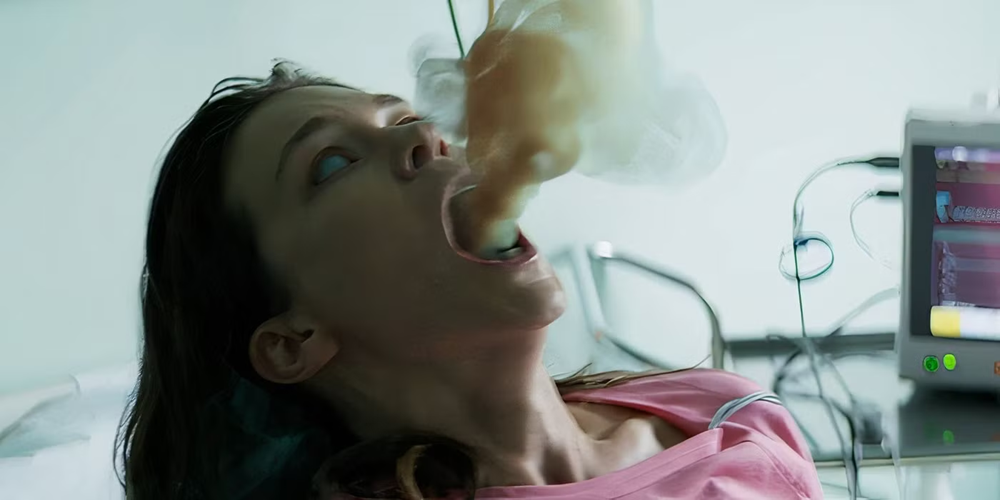
The sewing business that Barbara (Eve Connolly) has inherited from her effortlessly successful mother is in financial trouble and facing closure. On the way back from a meeting with a toxic client, Barbara drives past the scene of an accident on an isolated mountain road: two prone motorcyclists injured and sprawled out amidst crashed bikes, a stash of drugs spilt on the tarmac, a locked suitcase and two pistols. It’s a potentially life-changing moment. What follows is a Run, Lola Run-style pursuit of the consequences of three equally fateful decisions that Barbara could make while she’s still alone on the scene.

MacDonald’s script revels in exploring how Barbara’s skills with a needle might be used to extricate her from the jeopardy her poor choices entangle her in, as suspicious locals, crime gang members, law enforcement officials, and an outraged client all try to stitch her up. The film’s strong visuals and bright colour palette make good use of the arresting Swiss landscape, but what entertains throughout Sew Torn are the elaborate ruses, traps, and set-pieces that Barbara improvises from her sewing kit.

While Connolly is great as the resourceful dressmaker, it’s the supporting ensemble of weird and wonderful characters which makes Sew Torn shine. In particular, John Lynch makes light work of the role of mob boss Hudson Armitage, while the redoubtable K Callan clearly relishes the role of the oddball but by-the-book Ms Engel (the village’s combo cop and wedding celebrant). While this is larger-than-life storytelling, it’s witty, stylish and – while MacDonald sometimes overstretches his fabric – never loses the thread of its own ridiculousness.

SEW TORN is available now on streaming platforms, including Amazon.

THE UGLY STEPSISTER

The Ugly Stepsister

A tale as old as time (no, not that one) is re-told from another perspective in this grim fairytale by writer and director Emilie Blichfeldt. All Elvira (Lea Myren) wants is to marry the handsome Prince, but with the conventionally beautiful Cinderel- sorry, Agnes – also in the running, she doesn’t stand a chance. She is the ugly stepsister, after all. Charming.

Twisting beloved fairytales into grotesque horror films has become all the rage recently (see also: 2024’s Cinderella’s Curse2025’s Rumplestiltskinand the disturbed Peter Pan’s Neverland Nightmare), but this Norwegian body horror brings more to the table than hollow trend-chasing. In its story of a young woman desperate to reinvent herself in order to win over the Prince, it’s more The Substance than whatever is going on with the Winnie-the-Poohniverse at the moment.

Opulent visuals and an evocative score contrast with depraved violence as Elvira undergoes her quest to become the fairest of them all (no, not that one either). These sphincter-torturing acts of self-mutilation committed (occasionally with the help of a doctor) include the horrific removal of a set of braces, the surgical instalment of fake eyelashes, a prehistoric nosejob and, most stomach-upsettingly of all, guzzling a tapeworm egg in an attempt to shed the pounds.

Anyone familiar with the original fairy tale might be expecting some amount of toe trauma, but The Ugly Stepsister is so much more harrowing than one could ever be prepared for, making Blood and Honey look like 1950’s Cinderella by comparison – Bridgerton by way of David Cronenberg. Myren gives a revelatory performance as the titular stepsister, her eyes conveying boundless levels of hurt, hope and humiliation amid the ever-escalating horror – each harder to watch than the last. Its satire is about as subtle as a chisel to the nose… and just as effective. Which is to say, ouch.

Not for the weak-kneed nor dainty of countenance, The Ugly Stepsister rewards perseverance with snatched moments of beauty, in the delicate cinematography by Marcel Zyskind and sumptuous costume design by Manon Rasmussen. This is made even more impressive, given that this is director Blichfeldt’s first feature film, demonstrating a sense of confidence and vision that excuses its excesses and occasional bloat.

A ferocious, unrelenting Cinderella story, rich in both style and substance.

THE UGLY STEPSISTER is out in UK Cinemas from April 25th and available to purchase across digital platforms from May 9th.

WARFARE

Since it first emerged and developed as an art form, cinema has created and refined numerous genres. Used as a marketing tool, and to allow an audience to make an informed choice of what to watch, the principle of any genre is that you know what you are going to get.

Warfare has been placed firmly within the ‘war movie’ genre. The marketing, from the poster to the numerous interviews with the cast and co-writer and director Alex Garland (Civil War; 28 Days Later; Dredd) has focused on the camaraderie built amongst the ensemble cast, and how the story is based on the memories of the real team who fought this mission.

But Warfare is not trying to be a typical genre movie, and Garland has explained repeatedly why he believes that he and the film’s other co-writer Ray Mendoza have taken a sledgehammer to the conventions and expected character tropes.

Much has been made of the cast’s pre-production period bonding, with them shaving each other’s heads, undergoing a three-week bootcamp, and even going so far as to get matching tattoos. The real veterans who served on this mission were also present on set, and there has been frequent mention of this all being for the benefit of squad member Elliott Miller (Cosmo Jarvis: Shogun; The Alto Knights), badly wounded during the mission, and with little memory of what happened to him. All of this is intended to make us believe that this is not merely a standard issue ‘guns with hearts of gold and a definitive narrative arc’ war movie.

In some ways, Garland and Mendoza really have smashed expectations to smithereens. In most war movies, we’d spend the first half of act one developing the characters in the squad. You’d probably learn all about the family background of Tommy (Kit Connor: The Wild Robot; His Dark Materials; Heartstopper), the young newcomer on his first mission. Someone would have a wife at home expecting their first child. Grumpy Lieutenant Macdonald (Michael Gandolfini: Daredevil: Born Again; The Many Saints of Newark) would either be revealed to have a heart of gold, or an appropriately grizzly back story.

No such careful development here. The audience has to glean everything it can about the characters in a pre-title card sequence that also features the only music in the entire film: Eric Prydz’s 2004 floor-filler ‘Call on Me’, known for its video pastiching a 1980’s keep-fit class. The characters’ reactions to this: all of them varying degrees of hyper-masculinity, and unquestioned by anyone, is all the introduction we are given before we find ourselves plunged into the action.

Whilst complaints about ‘dumbing down’ of films and other pop culture texts are all too prevalent, Warfare perhaps swings too far in the opposite direction. The only explanation for anything within the movie is that ‘MAMS’ stands for ‘Military Aged Males’. Everything else must be deduced by the audience.

Whilst an American audience might realise that the squad is a US Navy SEAL unit, a British audience is unlikely to be able to draw this conclusion, and will probably guess that the squad consists of regular army soldiers, similar to those the British Army sent into Iraq in the same period when the events portrayed here occurred. This mis-understanding probably won’t make much difference to the average response of a British audience watching this film – but it will mean that the fetishisation of the Navy SEALS within the US Military may not register.

As the film’s story and script are based on the memories of the real SEALS, there are points when what is happening is unclear, especially when the action explodes, and characters talk over each other. This is perhaps to be expected, although it is also perhaps surprising just how few lines some of the characters speak.

The overall lack of dialogue, and non-existent back stories have given the cast a mountain to climb. They acquit themselves well. Gandolfini is quiet and aloof, but mostly sensible and in control. Joseph Quinn (Stranger Things; A Quiet Place: Day One; Gladiator II) as Sam gives a moving performance which also manages to encompass one of the film’s few humourous moments.

We are also given barely any background about why the squad are where they are – although the thrust of this can be gleaned as the main action of the film begins. Whilst an American audience may be familiar with the nuances of the second Battle of Ramadi, a British audience which was never as keen on the Iraqi War happening, is less likely to understand how the team, and the US forces, have got to the point of undertaking the kind of mission shown here.

Technically, the film is extremely accomplished. When the film is loud, it is ear-shatteringly so. As you’d expect from a war movie set in this century, the gunfire is loud. The air support brought in to provide ‘a display of total force’ is so loud you may think your seat is shaking. But for much of the first half of the film, what is notable is how quiet everything is.

The quiet, and the sense of anticipation, allow for the world of the film to be appreciated. Mark Digby and Michelle Day’s work on the production design is astonishing. The entire film has been shot on location in south east England, and Digby and Day constructed the Ramadi house and surrounding streets and buildings on a disused airfield. It’s a quite brilliant realisation. And a sobering thought that the sheer normalcy of the houses, and the lives of those who live in them, can be disrupted so fully, forcefully and unexpectedly.

We should however ask how accurate all of this is. Given that much has been made of the fact that everything on screen is based on memory, then it must be said that some people involved appear to have the most incredible and detailed memories of very precise moments. Given that Connor’s Tommy cannot even identify that it was an IED that causes the central point of tension, and that D’Pharoah Woon-A-Tai’s (Reservation Dogs) Ray appears to be disassociating for much of the final act of the film, it is only reasonable to question the veracity of the claims to vérité that the film-makers have emphasised.

What a reader may wish to know is whether the film is ‘good’ or ‘bad’, but this is far too simplistic a binary for this specific film, which is as much an exercise in unconventional film-making as it is a constructed version of a reality. There is much to fascinate and interrogate here, from the choices made by the co-writers, to the choices made by Fin Oates in the editing suite.

At the end, the Americans vanish, as quickly as they arrived, leaving a restored calm behind, but a trail of destruction in their wake. If Garland and Mendoza’s intention was to produce a film which acts as a metaphor for American colonialism in the twentieth and twenty-first centuries, then in this they have succeeded.

However, they have still made a war movie. And irrespective of how terribly young many of the characters are, and even if it is ‘based on memories’, this is still a movie in which the Americans are the good guys, feeling entitled to take whatever they want in a foreign land, destroying everything they touch when the locals have the audacity to fight back.

On a cautionary note, you may expect that, even though this is a war movie, that conventions around how injuries to individuals are depicted will be adhered to. This is not the case, and there is an awful lot of blood, and a number of scenes that contain some very graphic shots of dead and severely injured fighters. This may well be regarded as a step too far for some audience members used to a more stylised or even sanitised presentation of traumatised bodies. Be warned that no punches are pulled, and this section of the film can be difficult to watch.

Where Warfare succeeds is as an epic experiment in film-making: long takes; extended moments of quiet; a muted colour palette; the lack of a soundtrack; a requirement for the actors to immerse themselves into their roles – even when they have no lines for extended periods.

Warfare is a film that exists to allow one man to witness what happened to him on the day that changed his life. In that, it is undoubtedly successful. As a challenge to the expected tropes of the war movie genre, it must surely also be judged as a success. That the successes the film does have come at the expense of a more traditional narrative arc and character developments, must surely be regarded as a feature, not a bug.

There is no resolution within the film. No feeling that either side has ‘won’, merely a sense of relief and surprise that most of the combatants, on both sides, have survived.  This is very much a film which demands that you think. And that time spent in reflection may lead to us asking ourselves a deeper question, concerning why we demand that stories based on the truth must be tidily resolved, when we are all too aware that real life so often fails to offer such neatness.

Ultimately, Warfare is worth seeing as a reminder that, however much technology evolves, war involves two forces fighting against each other, and that the casualties will inevitably be the young men, and the unwilling residents dragged into a conflict outside their control.

Warfare is released in cinemas in the UK on Friday 18th April 2025 

PSYCHO THERAPY: THE SHALLOW TALE OF A WRITER WHO DECIDED TO WRITE ABOUT A SERIAL KILLER

Psycho Therapy

The English language debut of Turkish director Tolga Karaçelik, Psycho Therapy: The Shallow Tale of a Writer Who Decided to Write About a Serial Killer is a challenging film to classify.

In simple terms, this is a dark comedy whose premise is based around a supposedly retired serial killer keen to narrate the story of his life to a struggling writer as inspiration for a book. What Karaçelik has actually created is a film delivering uncomfortably relevant life lessons via the prism of dysfunctional marital harmony and existential dread. And it’s a fascinating, engaging one at that.

Keane (John Magaro) is a writer whose idea for a new book is, as everyone tells him, terrible. His wife, Suzie (Britt Lower), is barely interested in anything her husband has to say and wants a divorce, while his agent could not be any less supportive. Then he meets Steve Buscemi’s Kollmick, who decides to show Keane how a serial killer works, in a very practical sense.

Psycho Therapy… is initially a considered, almost ponderous film, but as the various layers are exposed, it reveals itself to be an intriguing, enjoyable farce-like affair full of crossed wires and confused intent. The three leads deliver strong performances, with Lower the standout as her story arcs toward a surprising yet satisfying conclusion. The off-kilter tone ensures you’re never quite on a firm footing, unsure of where the film is going or how it’s going to get there.

In short, an impressive, often absurd, darkly comedic film that just about delivers on its ambitions.

DROP

Meghann Fahy in Drop

For those not in the know, a ‘drop’ is a feature on Apple iPhones that allows you to wirelessly share files, photos and videos with other nearby Apple devices.

This feature is key to the plot of the latest Blumhouse-produced thriller from veteran genre director Christopher Landon (Happy Death Day).

It’s a bad time to have a smartphone for Violet (Meghann Fahy), a single mother on her first date since the death of her abusive ex and father to child Toby (Jacob Robinson). In a swanky rooftop restaurant in Chicago, Violet meets the handsome and seemingly ideal man, Henry (Brandon Sklenar).

We’re introduced to a range of interesting supporting characters: comical waiter Matt (Jeffery Self), nervous older man Richard on another date (Reed Diamond), sleazy pianist Phil (Ed Weeks), helpful barmaid Cara (Gabrielle Ryan Spring), and Violet’s younger sister (Violett Beane) at home babysitting Toby.

No sooner has the date started than Violet starts receiving increasingly menacing drop requests from a stranger. What at first seems like a harmless prank turns into a terrifying ordeal as Violet learns someone is going to kill her sister and son if she doesn’t fulfil tasks set by the mysterious Dropper, who always seems one move ahead.

At first, Drop feels like an intimate play or an ode to Hitchcock, with a few red herrings thrown in for good measure. Everyone’s a suspect. Faces in the crowd are enigmatically focused upon before changing. The acting is solid, as is the direction. The tension is well-earned and, although at times you have to try not to think too hard, you can’t wait to see what happens next.

However, Drop lets itself down in the final 10 minutes as it descends into silliness and the suspension of belief wanes. It’s a shame as it’s gripping at times and stretches what could have been a quickly tiresome plot device into an entire film.

stars

DROP is in cinemas now.

STRAIGHT ON TILL MORNING [PANIC FEST 2025]

Straight on Till Morning

Love is scary. So goes the tagline to this brutal backwoods horror film by director Craig Oullette. Even scarier, it turns out, are those who would stick their oar into your relationship, making what should have been a sweet and tender romance into something out of a ’70s Tobe Hooper picture.

Rocker Dani Dupree (Kelsey Christian) is on the road when she meets cute Kaitlin (Bonnie Jean Tyler, rocking the Marilyn Burns look). Fireworks fly as the pair flirt over a free cup of coffee, and Dani can’t resist asking Kaitlyn to drop everything and join her in a grand American road trip. Packing up and running away from her abusive man (who, needless to say, is named Darrel), Kaitlin is happy to oblige. Unfortunately, love’s young dream turns into a nightmare when the pair are caught with their pants down by a family of backwater (and backward) locals.

Waking chained, gagged and chastity-belted in the Robinson household, Dani and Kaitlin suddenly find their tentative romance severely tested – not least by mask-wearing, chain-wielding weirdo Virgil (Michael Gmur), who is set on making one of the women his bride.

Combining Black Mirror’s San Junipero with The Texas Chain Saw Massacre, Ouellette and co-writer Neal McLaughlin offer a bold new take on the hillbilly horror film. Much will feel familiar, but the genuinely affecting romance at its heart sets it apart – and both leading ladies deliver powerhouse performances in the face of astonishing amounts of abuse. The Robinson family aren’t particularly original additions to the canon, but Lilly and Rubin (Maria Olsen and Bill Hengstenberg) are effective monsters, played in a way that makes them fun to hate.

While its themes aren’t for the faint of heart, nor is the film salacious in its depiction of the women’s captivity or the torment suffered. The film’s strongest suit is its sensitivity to Dani and Kaitlin’s plight – and what a plight it is. Many have paid homage to Tobe Hooper and his iconic family dinner over the years, but few have brought this level of sphincter-tightening trauma to the table. Love, as they say, hurts, and Straight on Till Morning makes its lovers hurt a lot.

This stomach-churning violence (just the sound of bacon fat will send shivers down the spine!) is in stark contrast to the crisp cinematography of the film’s opening sequence and the fist-thumping soundtrack and score which plays through the first half. Such depth of beauty remains even as the film descends into total darkness, finding notes of levity and warmth amid the otherwise gruelling terror on display.

Love, as the other adage goes, conquers all. Whether that’s really true remains to be seen, but Straight on Till Morning depicts the battle at its bloodiest and most passionately fought.

STRAIGHT ON TILL MORNING played at Panic Fest 2025.

SHUDDERBUGS

Shudderbugs

An immersive meditation on the themes of grief and loss, Shudderbugs adopts the motifs of a whodunnit thriller to explore a daughter’s reaction to the unexpected and potentially suspicious death of her mother.

Thirtysomething Sam (Johanna Putnam) returns to her rural childhood home to take responsibility for her mother’s affairs. As an only child, and following the tragic drowning of her father in the farm’s lake two years earlier, she is left to deal with the estate alone. As memories flood in, colliding with Sam’s growing sense of unease, the isolation begins to trigger what might be paranoia. Photo albums, scrapbooks, answerphone messages and reminders set on smart devices, all reinforce the reality of her mother’s absence, and deny her any sense of solace. Apart from unsettling phone calls with officials, administrators, and distant friends, her only face-to-face contact is with her solitary, socially-awkward neighbour, and childhood friend Noah (Brennan Brooks, also director of photography), whose motives Sam begins to question. As her doubts about the cause of her mother’s death multiply, the vast and beautiful bucolic landscape becomes an oppressive, suffocating companion.

The strength of Shudderbugs comes from its meticulously crafted sense of the psychology of loneliness. The film’s powerful aesthetic is built through some impressive cinematography, rich sound design and potent visuals – in which bugs and insects feature prominently. As scriptwriter, director and producer as well as lead actor, Putnam has the weight of the film on her shoulders. She delivers a grounded and believable performance as a woman thrown off balance as her world is upended. Much of the film’s pacing could be described as languid, and Putnam’s desire to arrive at an ambiguous ending will frustrate some viewers. Yet Shudderbugs deserves attention for its inventive and emotionally perceptive approach to the craft of atmospheric indie filmmaking.

stars

SHUDDERBUGS is available to rent/buy digitally in the UK from Prime Video and Apple TV+

SATAN’S BLOOD (1978)

While out for the day, expectant couple Andres (José María Guillen) and Ana (Mariana Kerr) are flagged over by a couple who seemingly know them. Bruno (Angel Aranda) claims to have gone to school with Andres, and he and his wife, Berta (Sandra Alberti) insist that the pair follow them to their home to catch up. They are welcomed to Bruno and Berta’s house, but things seem a little ‘off’, particularly as they are manipulated into staying there for the weekend. Not only do they discover the pair are into witchcraft and some seedy sexual goings-on, but they are also increasingly in danger.

An often overlooked Spanish entry to the Satanism/witchcraft subgenre, Satan’s Blood delivers a solid, if sordid, story and makes the most of the then-current interest in witchcraft amongst the middle class. Full of gratuitous nudity, it’s a sleazy but entertaining pulp tale that grips from the start (well, once we get past the tacked-on sensationalist Satanic ceremony), featuring some stand-out sequences, including one with a very creepy doll. With a fairly limited cast of characters, and the action mainly taking place at Bruno’s opulent home, it could almost pass as a seedy Spanish chamber piece. The film’s twist may not be groundbreaking or surprising, but it’s a satisfying tale that unfolds at a rapid pace.

Treasured Films’ release presents the movie looking fantastic, and it’s backed up by a host of interesting extras, with very little crossover from previous releases. Features exclusive to this disc include the inimitable Kim Newman waxing lyrical on producer Juan Piquer Simón and esteemed writer Stephen Thrower showing his appreciation of the movie. More general themed pieces are also worthy of note, including Darrell Buxton’s video essay on ‘70s Satanic cinema and a talking head piece on Spanish horror.

SATAN’S BLOOD is out now on Blu-ray.

SCREAMBOAT

When Steamboat Willie landed in the public domain last year, it opened the floodgates to new iterations of the character. Steven LaMorte, director and co-writer of Screamboat, might not be the first to release, but his homicidal rodent is closest to Disney’s classic, as it’s a disturbing follow-up to the tale.

The free-to-ride Staten Island Ferry runs 24/7 and has been doing so since the early nineteenth century, when the boat was run by steam. While things were updated over the years, one aspect has been carried over, and he’s mightily pissed off. This means an orgy of murder for the ferry workers and the late-night passengers. Lowly ferry worker Pete (Jesse Posey) is unexpectedly (and reluctantly) promoted over the course of the short time it takes for the boat to cross the Upper New York Bay as the captain and others fall prey to the critter.

Screamboat boasts great production values thanks to utilising an actual decommissioned ferry, something that makes up for the rare green-screen moment. Incorporating the original Steamboat Willie is a masterstroke, particularly when the ‘missing years’ are recounted through old-school animation. David Howard Thornton, now legendary thanks to his portrayal of Art the Clown (several producers on Terrifier 2 and 3 also produce here), provides the physical embodiment of Willie, and he’s mastered the whimsical mannerisms of the Disney character right down to the whistle and hop. We’re sure Uncle Walt wouldn’t have approved of the bloodletting, though. It’s mostly physical gore, too, which adds to the impact. We’re always happy to see annoying drunk women and obnoxious blokes being offed in ever more elaborate and visceral ways.

We’ve been inundated with knock-off and low-budget horror over the years, so it’s always a pleasure to find something that lives up to the expectations it makes for itself. Screamboat deserves the cult following it’ll no doubt receive.

SCREAMBOAT is in cinemas on April 4th.

DISNEY’S SNOW WHITE

From the fair (Cinderella) to the fairly awful (The Little Mermaid; the further adventures of The Lion King), Disney has a mixed track record when it comes to their live-action remakes. Rachel Zegler headlines the studio’s latest plundering of their catalogue, starring as the original Disney Princess. Entering the woods after being condemned to death by her Wicked Stepmother, she encounters seven Uncanny Valley-dwelling beings who take her in. Evil Queen Gal Gadot is on her trail, though, and will stop at nothing to claw back her crown as the fairest of them all.

‘Princess Problems’ and ‘Waiting on a Wish’ are among the new songs by Dear Evan Hansen men Benji Pasek and Justin Paul, settling in alongside classics ‘Whistle While You Work’ and ‘Heigh-Ho’ to keep the energy up. And there’s a lot bringing it down besides, including Gadot’s performance (so wooden she’ll give you splinters, one deliciously camp villain song aside) and the frequently horrific VFX.

Leading the charge as Snow, Zegler is the film’s shining light (unforgivable Lord Farquaad bob aside), singing and dancing up a storm opposite seven CG abominations and not-Prince Charming Jonathan (Andrew Burnap, giving Flynn Rider vibes). Elsewhere, the 1937 animation’s story is padded out with Snow’s rise to folk hero, uniting the downtrodden masses to overthrow her Stepmum. Spider-Man wrangler Marc Webb does fine work with an unenviable task and, grotesque mine creatures aside (Andrew Barth Feldman’s Dopey is particularly disturbing), he almost makes the colourful action and cheery musical routines work.

This is not exactly a failure when compared to the soullessness of The Lion King and Pinocchio, but it’s far from the heights of the original work either, rarely feeling like more than a cynical money-spinning exercise. Its already dismal reputation is not fully deserved, but nor will the film do much to win over hardened naysayers. No, Disney’s Snow White was doomed from the start, poisoned by behind-the-scenes drama, poor casting decisions, and Internet loudmouths acting in bad faith.

Extolling a story of a nation in uprising against a cruel and murderous regime, its message is a valuable one, marred by messy controversies, ugly visuals, and discourse that’s rotten to the core.

stars

DISNEY’S SNOW WHITE is in cinemas now.