DOCTOR WHO THE COLLECTION – SEASON NINE

By Paul Mount

It’s 1972, and Doctor Who is cooking on gas. Three years on from its first cancellation crisis in 1969, the show, given a last chance to justify itself following tumbling ratings towards the end of Second Doctor Patrick Troughton’s era and with no viable replacement option having presented itself, had triumphantly reinvented itself for the bright new age of colour television. Flamboyant Third Doctor Jon Pertwee had fully cemented himself as the face of the rogue Time Lord and teaming him with the bubbly Jo Grant (Katy Manning) in his second season and broadening the show’s ‘Earth exile’ format to allow the Doctor to venture back into space at the behest of his Time Lord superiors allowed to show to properly flex its creative wings. Season 9 arrives as the latest in the BBC’s Collection Blu-ray boxsets and – despite the fact that, ironically, the final two stories in the season are noble (and rare) Pertwee-era failures – it’s another superb release demonstrating the care and devotion lavished upon these sets by a behind-the-scenes team determined to make them the absolute last word in Doctor Who on physical media.

Season 9 was potentially a difficult set of episodes to prepare for delivery on the more unforgiving Blu-ray format – several of the stories were amongst the last casualties of the BBC’s 1970s policy of wiping or destroying master tapes of productions no longer deemed of commercial value. Stories such as Curse of Peladon and The Time Monster were ultimately either returned to the BBC from overseas broadcasters or retained only as black-and-white prints. Previous VHS and DVD releases have utilised available technology in attempts to restore them to an acceptable quality, but slightly blurred images with washed-out or indistinct colour betrayed their provenance as episodes sourced not directly from the BBC Archive. This eight-disc boxset is an entirely another matter, though; the soundtracks have been improved immeasurably – there’s even a 5.1 option for The Sea Devils, the classic third serial from the season that pits Pertwee and the Royal Navy’s finest against both the Master and the aquatic cousins of Season 7’s Silurians – and the images for Peladon, The Mutants, and The Time Monster are hugely improved, the former having lost much of the fuzziness of earlier releases. They’re still not perfect, of course, and never will be, but it’s surely a given that it’s not possible for them to ever look better than this, and only the most ardent, nit-picking fans [In Doctor Who fandom, are you sure? – Ed] would be minded to bother finding fault.

The stories themselves are, by and large, classics of the era. Day of the Daleks sees the return of the show’s most famous metal meanies after a five-year absence, and it’s a thrilling and imaginative action story let down by the fact that the BBC clearly only had three Dalek props available and had forgotten to employ the actors who provided the original, memorable voices (the upgraded ‘special edition’ version with new series voices, extra Daleks and a few new scenes, is also included here). Curse of Peladon continues the show’s clever contrivance to break the potential monotony of the Doctor’s Earth exile by virtue of the Time Lords dispatching the Doctor into space to sort out some bit of cosmic dirty business they’d rather not get involved with. It’s an immersive Gothic tale full of intrigue, betrayal, gloomy corridors, and palace intrigue – and a nice plot twist regarding a familiar old enemy. The ‘greatest hits’ theme of the season continues in The Sea Devils, one of the most memorable (and oft-repeated) stories from the classic series, a landmark serial from the Pertwee era despite the fact that none of the UNIT (United Nations Intelligence Taskforce) regulars often associated with this period make an appearance. Despite the fact that the story could have been hand-crafted for them! The series is rounded off by two ambitious but flawed – and, it has to be said, slightly tedious – serials. The Mutants sees the Doctor and Jo dispatched to Solos in a thinly-disguised anti-Colonialism parable where the native Solonions are fighting for independence from their human ‘masters’ and The Time Monster is a rather silly pot-boiler that sees the Master (the irreplaceable Roger Delgado) trying to control an embarrassingly-unconvincing creature called Kronos for purposes of his own via an extended and largely uninteresting runaround in a very stagey-looking Atlantis where Hammer star Ingrid Pitt attempts to give her dialogue more gravitas than it deserves.

Even slightly shaky Pertwee-era Who is worth a look, though and despite the failings of its last two serials, Season 9 is still an essential purchase for fans and collectors. The specially-commissioned new features are again a highlight. The absence of an extended Matthew Sweet interview with some contemporary alumnus from the show is keenly felt, but a new ‘making of’ for The Time Monster taking Katy Manning and John Levene (UNIT’s Sergeant Benton) back to the filming location is good value, as is a feature looking at the work of veteran stuntman Stuart Fell, Katy Manning revisiting the season’s other locations and a fascinating piece on the career of director Michael E. Briant. There are some other new bits from the archive, including convention footage and features from the previous DVD releases and a lavish and informative booklet on the making of the season. Here the late Pertwee is quoted on his desire to turn Doctor Who into a science fiction version of James Bond; Season 9, looking bigger, brighter and better than ever on Blu-ray, is probably as close as he got to making that particular dream come true.

Doctor Who The Collection – Season 9 is available now on Blu-ray.

stars


DOCTOR WHO: DEMON QUEST

demon quest

By Beth McMillan

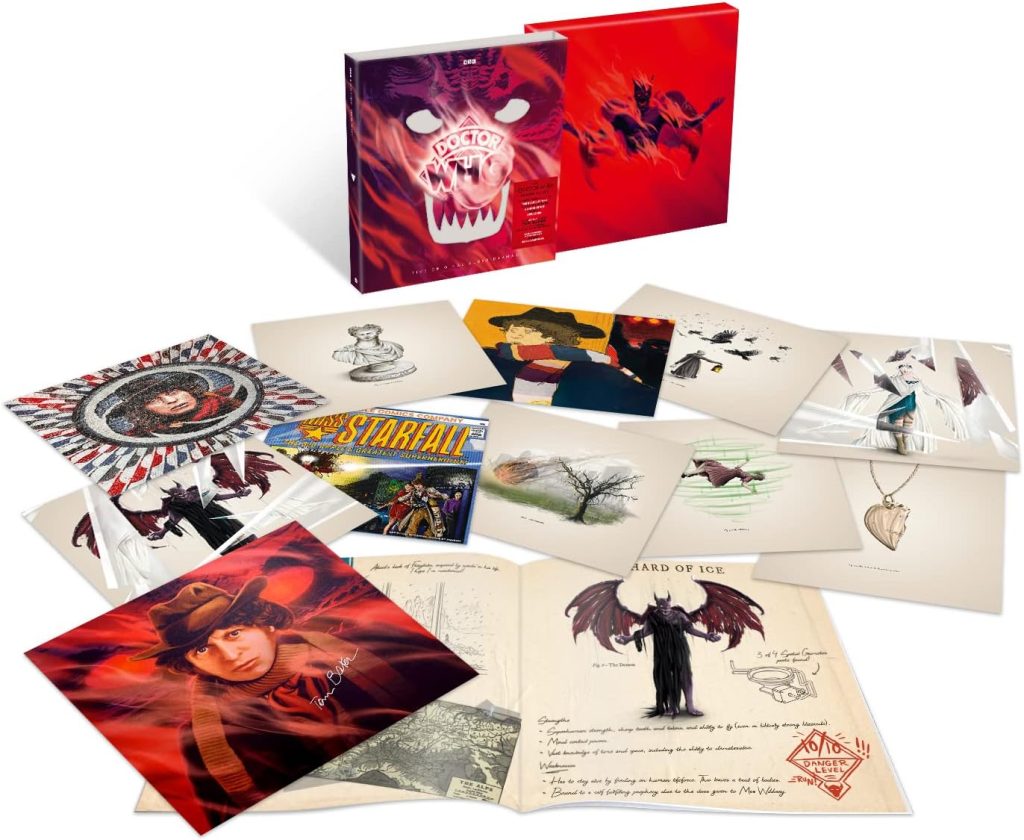
Opening this limited-edition vinyl set from Demon Records feels like entering a true treasure trove for any fan of the Time Lords. Originally released by BBC Audiobooks in 2010, Demon Quest, the sequel to the popular Doctor Who audio story Hornets’ Nest, is a truly immersive affair when experienced for the first time through the magical medium of LPs.

Starring Tom Baker as the Doctor, Susan Jameson as Mrs Wibbsey, and Richard Franklin as the trusty Mike Yates, this series of unique audio adventures from writer Paul Magrs, produced by Kate Thomas, doesn’t disappoint. After several key TARDIS components are mistakenly sold by the Doctor’s housekeeper Mrs Wibbsey to a mysterious stranger in exchange for a bag of equally mysterious artefacts, the Doctor, with a reluctant Mrs Wibbsey in tow, must undertake a perilous journey through time to retrieve them. Each object leads the unlikely pair, along with Captain Yates, to new space-time coordinates where danger awaits. As the trap set by a mysterious pursuer begins to close around them, they realise all is not as it seems…

An original soundtrack accompanies the familiar series theme, and the legendary Tom Baker delights as always, backed by a talented supporting cast including Nigel Anthony, Samuel West, Jan Francis, Trevor White, Lorelei King, and Finty Williams. However, certain elements of Demon Quest’s plot could be said to be a little contrived. Susan Jameson brings warmth and humour to her character, but the ‘house-keeper’ caricature and the somewhat domestic, historical setting and sense of mystery in the story lean a little too far towards a Sherlock Holmes novel. The idea of the Doctor having rented a countryside cottage without the provocation of some sort of galactic catastrophe or intervention from the Timelords grounding him on Earth might seem a little out of character to some fans!

The vinyl package itself is stunningly designed and presented. A removable outer sleeve reveals a lidded box featuring the Demon itself. Inside are ten individual, beautifully illustrated LP sleeves containing the 10 x 140g alternating Red and Black vinyl discs.

To top it all off, each box set includes an exclusive, personally signed portrait of Baker as the Fourth Doctor. The Time Lord’s battles with the mysterious Demon are detailed in The Doctor’s Journal, a 16-page booklet featuring notes and illustrations from the epic journey through Time.

A must for any Doctor Who fan!

stars


THE DOCTORS – THE TOM BAKER YEARS – BEHIND THE SCENES VOL 2

THE DOCTORS - THE TOM BAKER YEARS - BEHIND THE SCENES VOL 2

This latest dispatch from the Reeltime Pictures archive revisits the Tom Baker era, still probably the most popular period in the history of ‘classic’ Doctor Who, the era that properly imprinted the series into the bedrock of British culture. This second Baker release follows the familiar Reeltime format but Disc One is of particular interest as the three lengthy interviews with Baker-era alumni are of more recent vintage, despite the episodes under discussion being themselves well over forty years old. First up is  Philip Hinchcliffe, the only surviving producer from the original Doctor Who series, chatting amiably with Nicholas Briggs off-stage during a 2008 convention. Even now (or then, if you prefer), deep into his retirement, Hinchcliffe takes his career and his work and its legacy quite seriously and it’s always fascinating to hear one of the architects of the show’s most creatively-fruitful periods talking about how he crafted one of the best-remembered eras of Doctor Who, moving it away from the rampaging rubber-monster image it had gained during the Pertwee years and ensuring that it appealed to the adults in the audience with some grittier, tougher stories. Interviewed in 2006, script editor Christopher H. Bidmead – often a controversial figure when discussing his time on the show at the tail end of Baker’s era – is as candid as ever, explaining how he came to work on the show without really knowing what a script editor actually did and how he wrenched the show’s writing style away from what he felt was the ‘hackwork’ of some of its more seasoned writers into something a little more challenging as the series struggled into the 1980s. Disc One is rounded off by a 2022 interview by the affable Robert Dick with director John Black who steered the Baker era to its close with The Keeper of Traken before moving on to work on Peter Davison’s first recorded serial Four To Doomsday.

Disc Two digs deeper into the archive with a  vintage chat with FX designer Mat Irvine at his home in 2000. The story of his rise through the ranks of the then in-house BBC FX department in interesting enough but we were captivated by the exploration of his storeroom, piled high with boxes and crates full of long-abandoned props and models, old Doctor Who rayguns, battered models and an original Liberator model from Blake’s 7 looking much the worse for wear as its components are lifted out of an old box for inspection. Disc two is rounded out by more convention panels. Gary Russell moderates a 1988 panel – the original show was still in production and the upcoming (and final) season is discussed – with costume designers June Hudson, Dee Robson and Roland Warne along with Richard Gregory who redesigned the iconic Cybermen for their 1980s rebirth. Finally, incidental music legend Dudley Simpson is on stage with sound effects supremo Dicks Mills for a 1980s convention, which is interesting in itself but both men have already featured on individual pieces on earlier Reeltime releases so many of their anecdotes are inevitably a little familiar.

We’ve said it before but it always bears repeating. Not only do these releases deliver over five hours of stimulating and fascinating behind-the-scenes Doctor Who chat from many creatives no longer with us, but they provide a massive and comprehensive visual record of the making of one of the most popular and enduring TV shows in the world.

DOCTOR WHO: THE POWER OF THE DOCTOR

The Power of the Doctor poster

The Power of the Doctor has a big mission statement – to bring to a close Jodie Whittaker’s time as the Thirteenth Doctor, and Chris Chibnall’s time as lead writer, and also, as part of the BBC’s Centenary, to act as a celebration of the show’s 59 years so far.

So, in a fittingly large-scale story, the Doctor is faced with a team-up of her three greatest enemies: the Master, the Daleks, and the Cybermen. But she’s not fighting them alone. As well as companions Yaz and Dan, and UNIT leader Kate Stewart, she’s joined by friends from her past, Ace and Tegan, both last seen on the show in the 1980s.

The episode starts with an edge-of-the-seat heist sequence on a bullet train in space, and rarely drops this pace. It’s 90 minutes long but doesn’t stop for breath, with the Doctor and friends uncovering a sprawling plot that includes the Master disguised as Rasputin in 1916 Russia, a moon made of Cyber technology, and the Daleks blowing up volcanoes across modern day Earth.

As with last year’s Flux, it’s a very complicated plot that Chris Chibnall has come up with, and not all of it adds up – the Master’s main reason for the Rasputin disguise seems to be to set up a dance number, and Vinder (another returning friend) very conveniently falls through a hole into the plot just when he’s needed. There’s also a brief thing about the Master vandalising a lot of famous paintings with his own face, which doesn’t really go anywhere.

But – unlike Flux – the story is well constructed enough that, for the most part, it’s the fun kind of dumb rather than the annoying kind of dumb. Ra Ra Rasputin is very catchy, after all. Director Jamie Magnus Stone gives flair and pace to the action sequences, and Segun Akinola’s energetic score ties everything together. This is the best Doctor Who’s ever looked and sounded – the stiltedness of Jodie Whittaker’s first series is long gone, as is the awkward COVID-restricted nature of the previous few episodes.

The Cybermen benefit most from this high production value, and as with their arc in Series 12, continue to be the most threatening they’ve ever been. One gripping sequence sees Cyber-leader Ashad brutally blast his way through the UNIT base in a long camera take that seems to want to shout out how far this show’s come – from the era of wobbly sets to being able to square up to much bigger-budgeted action movies.

But the most interesting part of the villain triple-threat is the Master, and this is down to two factors. Firstly: Sacha Dhawan’s performance, relishing in the camp of the silly bits, bringing maximum sass to his reunions with old companions, and allowing himself to be truly nasty when left alone with Yaz. Secondly: the episode has, for the first time since the Twelfth Doctor’s doomed attempt to reform Missy, a meaty idea of something to do with the Master – his hatred, or perhaps jealousy, of his old frenemy leads him to want to become the Doctor, literally.

There’s a lot to unpack in this ‘forced regeneration’ story, but after the twee fun of him trying on some old costumes, the episode doesn’t have time to scratch the surface of it. Dhawan’s tragic delivery of “don’t let me go back to being me” as the process is reversed is the one insight into the character’s deeper motivations, and it begs the question of what could have been done with the Master-Doctor character had there been fewer other things taking up space elsewhere in the plot.

It’s the Daleks, meanwhile, that lose out. Whereas the New Year special, Eve of the Daleks, emphasised how threatening a small number of them can be, here they seem to be back to the more generic role they play in bigger scale episodes. There isn’t much at all to their part of the story; they’re here for the sake of it, because this is a Big Important Special and so the producers wanted the Doctor’s main enemies to be in it.

And for something so big, it feels inconsequential; we saw a whole Dalek war fleet get rather easily defeated in Flux, along with two Sontaran invasions of Earth, and so the Daleks’ latest scheme to take over Earth, via blowing up all the volcanoes at once, feels like yet another recurrence of tropes we’ve seen in various combinations many times before – as inevitable as the Doctor finding a big button to press that will reverse it all.

Meanwhile, the return of Tegan and Ace adds spark to otherwise stock bits of the plot. Janet Fielding and Sophie Aldred deservedly get their names in the opening credits, and the fun they have facing their old enemies once again is infectious, while their nervousness at reuniting with the Doctor, and frustration at this Doctor’s lack of time for them, sets up the more interesting moments to come.

You see, they’re not the only returning faces – multiple past Doctors make surprise appearances too. Doctors Five through Eight, plus David Bradley as the recast First Doctor, appearing as the Guardians of the Edge is a nice touch, fitting into the plot without feeling too crowbarred; it certainly makes amends for only Tom Baker getting to do the fiftieth anniversary.

But the real key scenes are those in which Tegan and Ace are reunited with their respective Doctors – touching conversations that allow us to reflect on how far their characters have come, and in Ace’s case, close off a storyline that was left incomplete when the show went on hiatus in 1989.

These two scenes are not just throwbacks but are important to the one big theme of the episode: how the Doctor’s fast-moving life, and changes in face, affect those left behind. Whereas other anniversary stories have focused on the character of the Doctor, The Power of the Doctor is more interested in the companions, and how the true ‘Power of the Doctor’ is, as Yaz tells the Master, that “she’s spent her life gathering friends”. It’s very fitting that the episode ends with various companions, recent and much older, together in a form of support group.

It’s ironic, then, that like a lot of this Doctor’s era, it’s the incumbent companions who are most let down. John Bishop’s Dan was never much more than a third wheel anyway, so him deciding to trot off after the pre-titles isn’t much of a surprise. But Mandip Gill’s Yaz has been present throughout Whittaker’s tenure as the Doctor, and it’s pretty remarkable how casually she’s shunted out at the end of the show.

This is particularly egregious given that the past two episodes have focused on Yaz’s unrequited attraction to the Doctor. Some kind of payoff was to be expected, but across The Power of the Doctor’s ninety minutes, there’s not a single reference to the storyline. Compare this to Martha Jones’s arc back in Series 3, which was also about her unrequited attraction for the Doctor, and which ended when Martha realised that the Doctor would never love her back and made the decision to move on – taking control of her own ending.

Yaz gets no such agency. Just “I want to be alone now, bye Yaz.” One simple scene of her deciding it’s time to move on could have made all the difference, and it’s a particularly missed opportunity not to deal with this in an episode where several other past companions are present to guide her to this conclusion. And from the Doctor’s perspective, to have so much of the episode reflect on her having ended companion relationships on a bad note and avoided the unfinished business, before uncritically showing her make the same mistakes again is… well, actually, it’s an unsurprising ending for the Thirteenth Doctor era’s poor handling of its lead character dynamics.

Perhaps Chibnall is leaving this for a future showrunner in a future anniversary special to write a scene in which a much older Yaz expresses her finally-found independence to a hologram of 70-year-old Jodie Whittaker.

Overall, The Power of the Doctor is a step up from the past few episodes – an exciting ride which complements its returning villains and companions with a couple of interesting thematic ideas. But its plot falls into some familiar tropes, and it fails to really scratch the surface of those ideas, with its own era’s characters being let down once again. A promising but unsatisfying end to a promising but unsatisfying era.

What the show needs is some fresh new faces to inject some originality back into the show. Or the return of Russell T Davies and David Tennant. That could be good too. Just thirteen months to wait.

DOCTOR WHO – THE ABOMINABLE SNOWMEN

who abominable snowmen

Financial issues have led to the suspension of the BBC’s ongoing animated reconstructions of missing (or largely missing) 1960s Doctor Who serials and on the evidence of this final release, 1967’s The Abominable Snowmen, perhaps it’s just as well. The problem has always been that these stories were never meant to be animated; they were live-action productions and as a result the budget-price animation often lacks pace and energy and…well, a sense of animation. The occasional previous release – Evil of the Daleks, for example – manages to overcome many of these problems thanks to a genuinely good, well-structured script. The Abominable Snowmen is very probably a decent enough story too but across these six animated episodes it’s stodgy, laboured, repetitive and actually a bit dull.

The TARDIS lands in the foothills of the Himalayas in 1935 (the famous location filming in Snowdonia replaced in animation by more accurate but rather generic snowy mountains and landscapes) and the Doctor (Patrick Troughton) seizes the opportunity to return to the nearby Det-Sen monastery a holy relic he was entrusted with on his last (off-screen) visit. But all is not well; the local, previously-gentle Yeti are besieging the monastery and a strange alien being is working in the shadows, planning its conquest of the planet.

There’s not really enough story here to pad out six episodes. Once the setting is established, the characters introduced (Jack Watling, father of Deborah Watling who appears in the serial as the Doctor’s companion Victoria, is good value as a brusque explorer in search of the Yeti) and the threat manifested, there’s really not much going on here. On TV, the Yeti (actually robot servants of the alien Great Intelligence… although we’re not quite sure why it really needed robot servants) looked big and cuddly as they bounced around the slopes on location but they still looked vaguely threatening. In animated form, they’re just big brown splodges that move about occasionally and don’t really do very much. Once again the performance of the expressive Patrick Troughton is not best served by the very rudimentary animation and there are a number of dialogue-free scenes where the extremely good quality audio leaves the animators baffled as to what might have been going on so we’re left with a number of scenes of characters wandering about aimlessly like avatars in an early 1980s computer game.

The Abominable Snowmen is often regarded as one of the true classics of the Troughton era and it’s quite possible, certainly on the evidence of the surviving second episode, nicely scrubbed up and included on this new three-disc release, that it actually is. But it doesn’t really work in animated form and “creative reimaginings” to the visuals as seen on screen (the possessed master of the monastery Padmasambhava, played with breathless, echoey malevolence by Wolfe Morris, has been animated as a wonky-mouthed doodle apparently drawn by a distracted three-year-old) only serve to muddy the waters further and turn this into an interpretation of the story rather than a proper representation of it. Fortunately, the set includes a number of worthwhile special features including commentaries, censor snippets from the missing episode four, cine camera behind-the-scenes footage filmed by Jamie actor Frazer Hines, an archive interview with serial co-writer Mervyn Haisman and a brand new ‘making of’ documentary that sees Hines reunited by make-up artist Sylvia James in the uncannily-unchanged Snowdonia location with the redoubtable Toby Hadoke on hand to jog hazy memories. All in all, though, a bit of a damp squib to bring the curtain down on the animation range.


Doctor Who: The Abominable Snowmen is out now on Blu-ray.


DOCTOR WHO – THE ANDROIDS OF TARA

androids tara

If any serial from the classic run of Doctor Who can lay claim to being a ‘ripping’ yarn then it’s almost certainly 1978’s Androids of Tara. Written by David Fisher, who also scripted Stones of Blood, the previous serial, this was the fourth story in the Key To Time sequence that encompassed the entire 16th season. It’s a ripe, slightly camp capture/escape/recapture romp that shamelessly ‘borrows’ from Anthony Hope’s 1894 adventure novel The Prisoner of Zenda in its tale of the feudal planet Tara that possesses sophisticated android technology and a plot that involves a fiendish moustache-twirling bad guy scheming to take control of the kingdom, the Doctor frequently buckling his swash, imprisoned Princes and Princesses and an imposing and impregnable castle surrounded by a moat. The story was a colourful frippery that allowed Tom Baker to give full reign to the eye-boggling excesses that by now characterised his portrayal of the Doctor as he locked horns with the devious Count Grendel, a gorgeously-ripe performance from the late Peter Jeffrey. Sumptuous location filming in and around Leeds Castle in Kent gave the serial a sense of scale that happily bolstered a rather thin, simplistic story.

Originally novelised by Terrance Dicks in 1980, David Fisher revisited his original scripts several years ago for a new adaptation for BBC Audio and it’s this version, slightly re-edited, that now arrives in print as one of the latest batches of BBC/Target books publications four years after Fisher passed away in 2018. Running to just 143 pages this is another snappy, punchy little book but Fisher is clearly having a great time adding some much-needed colour and flavour to his world; we learn about the history of Tara and the ruthless and staggeringly-misogynist Gracht lineage, a plague that ravaged the planet, wiping out the peasant population and leading to the rise of android technology and, perhaps most importantly, an amusing explanation for why the Taran Wood Beast (now renamed a rhino-bear) that famously “terrorised” the Doctor’s companion Romana in Episode One looked so rubbish. Here and there throughout the text, Fisher adds delightful little flourishes and witticisms – quite Douglas Adams in tone in places – that actually manage to turn Tara and its florid inhabitants into rather more believable and interesting people than the caricatures they appeared on television.

The Androids of Tara is never destined to be recognised as one of the Doctor Who ‘greats’ but this lively, likeable novel goes some way towards rehabilitating its reputation and is another commendable addition to the revived Target range.


Doctor Who – The Androids of Tara is out now.

THE DOCTORS – THE PETER DAVISON YEARS: BEHIND THE SCENES

Davison years

Reeltime’s latest 2-disc release of classic Doctor Who behind-the-scenes interviews (refreshingly this time including an all-new piece) focuses on the Peter Davison years – but in truth, the connection between most of these interviewees and the Fifth Doctor is pretty tenuous and gets little more than a passing mention. Much of the talent interviewed here worked on the series across a number of years and inevitably they had some involvement with the Davison era albeit often on a one-story basis. This is more of an observation than a criticism though; as usual, Reeltime has assembled a fascinating collection of thorough and well-considered interviews that spend as much time chronicling the lives and careers of its subjects and the changing face of British TV production as it does concentrate on Doctor Who, behind the scenes or otherwise.

Disc One kicks off in fine style with a terrific 2007 interview with sci-fi writer Stephen Gallagher, a name in the genre ascendance when he contributed the first of his two Doctor Who serials way back in 1980. A fairly deadpan character, Gallagher speaks with passion about the highs and lows of his writing career, his moments in the sun and the periods when he couldn’t get a written word published. He’s remarkably stoic about his achievements and he speaks of his first TV writing gig, 1980’s Warriors’ Gate, a troubled and challenging Doctor Who production for Tom Baker’s last season and his  1983 contribution, Terminus (which provides the Davison connection), which was a smoother experience although it’s generally regarded as the inferior show. Genre TV fans will enjoy his recollections of his early fantasy shows such as the under-appreciated Oktober, which he directed and wrote) and the BBC’s Chimera. Gallagher may not be a barrel of laughs but his insights into the life of the struggling professional writer whose preferred genres drift in and out of fashion are as salutary today as they were 15 years ago.

Equally fascinating is a chat with veteran actor/writer Barbara Clegg, whose sole contribution to Doctor Who (despite several subsequent pitches) was the imaginative 1983 Davison serial Enlightenment. Interviewed in 2009 Barbara was suffering from ill health at the time and was recovering from a stroke and whilst her memories are sometimes elusive she often speaks with fondess of her long career – she was a popular regular on 1960s hospital drama Emergency Ward 10­ – and the creation of her Doctor Who serial. Happily thirteen years on Barbara is still with us.

Sadly the same cannot be said for writer/director Peter Grimwade, interviewed here at his home by Nicholas Briggs in 1987, three years before his tragically early death in 1990. Best known for his work in the Davison era (he directed the first-season Davison classic Earthshock that returned the Cybermen to the series for the first time in five years) Grimwade presents as a slightly reticent interviewee, mannered and defensive and referring to himself, in that peculiarly English way, as ‘one’. But he soon opens up and reveals more about his working techniques; perhaps the best moment in the set is the scene where Grimwade takes Briggs up to his attic office to display the magic of his massive word processor and Briggs marvels at its ability to “delete and move” text.

Over on Disc Two, we spend time with lively director Graeme Harper, famed for his “pace and energy” on set when he directed Caves of Androzani (Davison’s swansong) and Revelation of the Daleks in the 1980s. Always good value Harper, in an interview hailing from 2000, is full of anecdotes about his time progressing through the old BBC ranks. Harper would return to the rebooted show in the 21st century, of course, helming many of its new classics but it’s a shame that his ambitions to move into feature films were never realised. The new interview here features  Margot Hayhoe, retired Assistant Floor Manager/Floor Manager on many classic series episodes. Interviewer Robert Dick adopts a chattier style: “You also worked with… what was that like?” is an approach that can backfire if the subject isn’t as warm and open as Hayhoe, whose memories involve working on many ambitious BBC period dramas alongside the likes of Sir Anthony Hopkins. The release is rounded off with an hour-long retrospective chat with sound engineer Dick Mills in retirement in 2006, where he discusses his long career at the BBC, his involvement with the creation of the famous Doctor Who themes and his proud record of working on Doctor Who from 1971 until its expiration in 1989.

All in all, despite its sometimes only tangential connection to its apparent subject matter, it’s another winner from Reeltime, a fine addition to its growing invaluable archive in this series of unfussy, direct, and often surprisingly probing and insightful interviews with the people who brought Doctor Who to the screen against sometimes impossible odds.

THE DOCTORS – THE JON PERTWEE YEARS: BEHIND THE SCENES VOL 1

doctors pertwee

Reeltime Pictures’ latest 2-DVD presentation of archive Doctor Who material from their previously-on-VHS series takes us to one of the most interesting, exciting and enduring eras in the show’s long history. With the series skirting close to cancellation at the end of the black and white 1960s era, it fell to incoming producer Barry Letts and his script editor Terrance Dicks to refashion the show’s format as it relaunched in colour with Jon Pertwee taking over from Patrick Troughton in the lead role. Doctor Who’s long-term prospects were far from guaranteed and Pertwee’s first season in 1970 could well have been his only run and the show’s final roll of the dice if the audience hadn’t taken to the new Earthbound format imposed upon by Letts and Dicks by both the BBC are their production office predecessors. To this extent then, Letts and Dicks and probably the most important creatives ever to have left their mark upon the show (original producer Verity Lambert and relaunch supremo Russell T Davies notwithstanding) because of their terrific five years on the show and their dedication to making Doctor Who the best it could possibly be pretty much guaranteed the show’s place in TV’s history books.

Disc One of this new archive release is devoted to two long interviews with the pair, conducted by a young Nicholas Briggs and it’s fascinating, charming stuff. Letts and Dicks are no longer with us, of course, so this opportunity to spend time with them in their post-Who pomp as they wander amiably down memory lane, gently guided by Briggs, is an absolute delight. They briefly recall their own early days and careers before starting their chronological journey through their Doctor Who years, reminding one another of some forgotten anecdote or other, correcting one another when the memory has cheated and generally glorying in their years reinventing and refining  Doctor Who for the 1970s. Long-time fans are unlikely to find too much really new here – many of these anecdotes are familiar territory for the hardcore – but there’s unbridled joy in watching these titans of Doctor Who telling these stories in their own words and the strength and depth of their friendship and admiration for one another shines out from every fascinating frame.

Disc Two is no less interesting even if it ventures from ‘behind the scenes’ to ‘in front of the camera’ in places. Vintage convention footage sees Letts and Dicks (with some stories we’ve enjoyed on Disc One) joined on stage by 1970s writer Bob Baker and a rare appearance from writer Don Houghton who crafted 1970’s seven-part serial ‘Inferno’ widely championed as one of the very best Doctor Who serials from the classic era. Volume 1 of ‘the Directors’ sees Christopher Barry and Paul Bernard, both no longer with us, talk fondly about their extensive work on the series. A timely inclusion sees Damaris Hayman, who passed away only recently, discussing her iconic role as local white witch Olive Hawthorne in 1971’s acclaimed serial The Daemons, ‘Day of the Daleks’ actors Anna Barry and Valentine Palmer recall their time on the 1972 serial, which saw the Daleks return after a five-year absence and Terence Lodge remembers his trio of Doctor Who appearances in the 1960s and 1970s.

These Reeltime releases remain an important resource for anyone interested in the history of Doctor Who, offering the opportunity to see and hear the people who were there talking about how and why it all happened and how a low budget family sci-fi series became a national institution. As the passage of time distances us evermore from the show’s roots and its original glory days and with so few of its 1960s and 1970s behind-the-scenes talents still around to tell their stories, Reeltime’s archive – hopefully Vol 2 of this Pertwee-era series isn’t too far away –  is invaluable and essential, a form of time travel that the Doctor him/herself would surely approve of.

DOCTOR WHO THE COLLECTION – SEASON 24

who season 24

It’s generally agreed that Season 24 of ‘classic’ Doctor Who – the first to star the lively Sylvester McCoy as the seventh Doctor – is pretty much the nadir of the original series. Where just ten years earlier the show was in its Gothic prime, presenting chilling, complex tales like The Deadly Assassin and The Talons of Weng-Chiang, its 1987 incarnation entertained audiences with McCoy pratfalling and playing the spoons on guest star Kate O’Mara’s chest and later dicking around with companion Bonnie Langford in a rundown holiday camp on Barry Island. It was a slap in the face – if not a stab in the back – for long time fans who couldn’t quite get their heads around what had happened to their family favourite sci-fi adventure series.

Time is, though, if not necessarily a great healer in this case, capable of allowing us to put the series into a proper perspective thanks to the accumulated knowledge of the following years which has explained quite how this season came into being in the face of utter disinterest and disdain from the BBC who would really have quite preferred it if the entire series disappeared into a wormhole and never showed its face again. Doctor Who was on the backfoot in 1987, its confidence and popularity still reeling from Michael Grade’s attempt to kill it off forever in 1985 and, as we now know, it was living on borrowed time, the axe swinging above its head every step of the way for the next three years. Producer John Nathan-Turner, desperate to move on to other projects after six years steering the show through increasingly turbulent waters, handed much of the show’s narrative heavy-lifting to incoming script editor Andrew Cartmel who attempted to rebuild the show from the ground up once the dire and hurriedly-written season opener Time and the Rani – scripted for previous Doctor Colin Baker and giving McCoy little to do except play the clown because he wasn’t directed to do otherwise – was out of the way. And in fairness, with the benefit of hindsight, the following three stories have a lot of potential but much of it untapped due to the show’s broad, light entertainment tone and production styles that were looking increasingly old-fashioned.

This lavish new eight-disc Blu-ray set does its very best to rehabilitate this lacklustre run of fourteen episodes with varying degrees of success. Fortunately (or unfortunately, depending on your point of view) plenty of cut-offs and unscreened material for this season lurked in the BBC Archive and much of it has been dusted down and presented for public approval or disapproval here. There are several ‘extended’ episodes, deleted material seamlessly reinstated and much of this works rather well and to the benefit of the stories. For example, the first episode of the aforementioned holiday camp romp Delta and the Bannerman now runs to just under thirty minutes and adds several scenes that give the episode a bit more room to breathe – there’s one interior TARDIS scene that was cut entirely from the transmitted version, for example – but few will welcome the arrival of extended episodes of Time and the Rani.  There are clearly attempts here to find a new path for Doctor Who as McCoy started to find his feet and Cartmel began to shape scripts rather more to his taste and design, a so-called ‘masterplan’ that worked best in the following season before falling apart in McCoy’s third and final year. But the tone is all wrong, everything is too breezy and comedic even when it’s trying to throw a dramatic punch or two and the whole season has an unwelcome stink of broad, slapstick children’s television about it that makes it an unpalatable experience for those who had revelled in Doctor Who’s glory days only a few years earlier.

In truth, Season 24 isn’t actually quite as dire as our memories might remind us – perhaps this is just because the rebooted show endured such indignities and genuinely shockingly bad episodes between 2010 and 2017 and we can now recognise that however shonky Season 24 is, it does at least look and feel like Doctor Who, trying to tell actual stories with proper dramatic beats, albeit targeting a younger demographic. Scrubbed up on Blu-ray and with new sound mixes season 24 has a certain throwaway charm – Delta and the Bannerman is actually quite good fun and ‘Dragonfire’, introducing new companion Ace (Sophie Aldred)  has its moments despite that inexplicable cliffhanger to episode one. The draw here, as usual, are the reams of specially commissioned supporting material, the best of which is easily Matthew Sweet’s fascinating conversation with Sylvester McCoy whose life story outside the world of Doctor Who is possibly far more intriguing and fascinating than anything on the show itself. The Doctor’s Table sees McCoy, Langford, Aldred and ‘Paradise Towers’ guest star Clive Merrison enjoying a meal and sharing memories at the Ivy in Richmond, Here’s To The Future is an eighty-odd minute documentary that tells the whole story of Doctor Who’s parlous state in 1987 and the set also includes a new 45-minute making-of for Bannermen and Behind the Sofa in which McCoy, Aldred and Langford and a quite grumpy Peter Davison and his on-screen early ’80s companions Janet Fielding and Sarah Sutton watch and comment on the episodes. There are also literally hours of raw studio and location footage which will surely tax the patience of even the staunchest Who completist and, of course, all the bonus material already available on the previous DVD releases of the episodes.

Season 24 is probably still the nadir of classic Who but at least this new set gives us the opportunity to make allowances for its shortcomings and allows us to actually appreciate those moments where it gets things right as it does the very best it can under the circumstances in which it was made.

DOCTOR WHO – THE ICE WARRIORS

who ice

First – and only – broadcast on BBC1 across November and December 1967, The Ice Warriors was a classic Second Doctor-era serial typical of the time’s predilection for what has become known as ‘base under siege’ stories. During Doctor Who’s fifth season, producer Innes Lloyd and script editor Peter Bryant decided that the show’s budgetary needs were best served by centring the action around one big ‘centrepiece’ set that would be the focus of the show’s action and its dramatic imperative. This coincided with a predominance of classic stories that largely followed the same format but featured many of the show’s greatest monsters – the Daleks, Cybermen, Yeti – pitting themselves against an enclave of humanity based in one focal point location. The Ice Warriors, by Brian Hayles, is a fine example of the type as the Doctor (Troughton) and his companions Jamie (Frazer Hines) and Victoria (Deborah Watling) arrive on Earth during a new ice age at a base cleverly installed in an old Edwardian mansion fighting to hold back the advance of glaciers threatening to overwhelm the British Isles. But something nasty lurks in the encroaching ice in the form of a troop of lethal frozen aliens who, when thawed, hatch a diabolical plot to take over the planet.

Frustratingly, Episodes Two and Three of the serial are missing from the BBC Archives (although they were subsequently animated and released on DVD in 2003) and this entire soundtrack, now released as the latest in Demon Records’ lavish presentation of classic Who soundtracks, has previously been released on CD. As usual, this is a beautiful package, three discs on glorious ice blue vinyl, presented in a chunky box with each album in its own illustrated sleeve that, when assembled, creates a mosaic of the cover Ice Warrior illustration. The soundtrack itself is crisp and crystal clear with Frazer Hines’ linking narration usefully filling in those awkward onscreen dialogue-free moments and the story is fairly typical of an extended six-part serial with plenty of captures and escapes, subtle (and sometimes not so subtle) story padding and the odd head-scratching plot holes and inconsistencies. But the Ice Warriors themselves (this is the first appearance by the reptilian rotters who would return to confound the Doctor in the following season and appear twice in third Doctor Jon Pertwee’s era before being ‘reimagined’ several years ago for the modern series) are a terrifically threatening presence, their sibilant voices and lumbering gait underpinned by an ominous score by the reliable Dudley Simpson. The whole serial also benefits from a solid cast of 1960s  TV character actors like Peter Barkworth, Peter Sallis, Angus Lennie, Michaael Attwell and, most extraordinarily, Carry On regular Bernard Bresslaw, cast as the imposing Ice Warrior leader Varga thanks to his towering physicality.

TV soundtracks might seem like a curious anachronism in a digital age – the story is available on DVD and on the Britbox streaming service – but these Demon releases are so lovingly and sympathetically designed they’re hard to resist as collectors’ items for completist fans and those with an eye for their very special visual aesthetic.