DOCTOR WHO – FRANKENSTEIN AND THE PATCHWORK MAN

The latest in Penguin’s series of books in which various incarnations of the Doctor encounter variations of famous characters from history and/or fiction sees writer Jack Heath create a fearless and sometimes surprisingly raw re-invention of Mary Shelley’s legendary Modern Prometheus. The book hurls us back to 2005 and the rebirth of Doctor Who in the 21st century as the Ninth Doctor and Rose Tyler pitch up at a small village just outside Cardiff in the 19th century. Something strange is stalking the misty woods and graveyards, and locals have gone missing. The travellers encounter a scientist named Vincent Frankenstein who, inspired by Shelley’s novel (and, conveniently, sharing the lead character’s surname), has been experimenting with creating a new type of life. But his experiments with his “Patchwork Man” have allowed an ancient electrical sentience – the Voltigrades – to awaken and turn its attention to dominating the human race.

Frankenstein and The Patchwork Man clearly takes its lead from 2005’s classic Unquiet Dead episode – swap the gaseous Gelth with the electrical Voltigrades, swap Charles Dickens with Dr Frankenstein – and it even borrows the Cardiff-centric location (although Heath, writing in Australia, clearly has no idea about the geography of Wales as his descriptions later in the book are far more Universal movie Romania than 19th century Wales, all rugged terrain, wreathing mists, Gothic castles and… err… lochs). It’s surprisingly dark, though, for a book aimed at any kids who might still be interested in Doctor Who, with its body horror themes and imagery of a mongrel monster animated by electricity looming out of the gloom. Heath adopts the Season One tone of telling stories largely from the perspective of Rose Tyler and she very much leads the narrative here, often energising the Doctor when he’s run out of steam and ideas. He’s captured the perky relationship between the two with the dialogue sparking and sizzling, and it’s easy to imagine Christopher Eccleston and Billie Piper striding through the story, which has much of the vibrancy and energy of the best episodes from that first season. As the current show becomes ever more cluttered and convoluted, it’s actually a little nostalgic reading a story that evokes so well the freshness and energy of Doctor Who when it first emerged from its near-sixteen-year TV exile. Ah, them were the days…

A brisk and action-packed read, Frankenstein and The Patchwork Man is a welcome addition to this quirky new range of novels, and we’re rather looking forward to the next title as Paul Magrs takes the first Doctor and his team to Whitby in October’s Dracula!

DOCTOR WHO – FRANKENSTEIN AND THE PATCHWORK MAN is available now from Penguin/Puffin Books

DOCTOR WHO: THE COLLECTION – SEASON 7

Classic Doctor Who doesn’t get much more ‘classic’ than Season 7, finally receiving the glitzy Blu-ray treatment as the latest in the ongoing Doctor Who Collection series. Declining viewing figures had sent the series sailing close to cancellation at the end of the 1960s, but in the absence of any suitable replacement format presenting itself, the BBC gave the show a final chance to reverse its ailing fortunes – and the turnabout was quite remarkable.

Now in colour, with Jon Pertwee cast as the flamboyant, charismatic Third Doctor, the show was reborn in the 1970s. This extraordinary season of 25 rugged episodes, with the Doctor now exiled to Earth by the Time Lords, is the closest the show ever came to becoming ‘adult’ science-fiction. The season was very intentionally crafted in the image of Nigel Kneale’s iconic and legendary Quatermass serials, with the Doctor, now forced to work with the militaristic UNIT (then the United Nations Intelligence Taskforce), tangling with slightly more sinister and tangible threats than some of the clanky silver-foil adversaries that bedevilled his two earlier incarnations.

Fifty-five years on, these episodes still feel urgent and contemporary and often touch upon issues that are as worryingly relevant today as they were decades ago. Internet fanboys scream about modern Who being ‘woke’ and ‘lecturing’, but the four serials here are all about paranoia, xenophobia, and the risks unchecked technology can pose to the future of the human race.

Fans will know these serials like the back of their hands – and rightly so. The glossy four-part Spearhead From Space (shot on film due to some industrial dispute or other that made the BBC Television Centre studios unavailable) drags the series into the bright lights of the 1970s. Its pace and scale of storytelling bears little real resemblance to the often-stagey stories screened just a few months earlier in black-and-white.

The return to the familiar film/studio mix in the remaining serials is slightly jarring – and a little disappointing to those who might have hoped the series was finally going to be as slick as the popular ITC filmed series of the day – but the quality of the storytelling soon makes up for any fears that the show’s production values were on the slide.

The remaining three serials each run to seven episodes. While occasionally the pace might slacken and the storytelling appear a little laboured, the show has never felt less like a harmless children’s teatime adventure show.

Doctor Who and the Silurians is a compelling and often chilling look at how humanity reacts when faced with the species that preceded them, a sophisticated reptile race that ruled the Earth long before man evolved (although the Doctor is often given to referring to them as ‘an intelligent alien species’). And, Inferno (often cited as the best ‘classic’ Who serial, and who are we to disagree?) sees man’s hubris in daring to attempt to harness the raw, primeval power of the core of the planet itself threaten to consume the world in flame.

If there’s a weak link, then it’s Ambassadors of Death. This story defeated the credited David Whittaker and required significant input from writer Malcolm Hulke (amongst others) to turn it into a slightly unfocussed adventure that’s nevertheless hugely enjoyable in its own right.

Much of Season 7 works so well because it’s the “shock of the new”, and if it’s a format that wasn’t built to last – the overlong serials led to some audience drift by the end of the run and a retooling for the following season – it remains a powerful, edgy set of stories that dispenses with much of the ephemera of the past (the TARDIS is barely referenced after Spearhead From Space) and redefines the Doctor for the 1970s.

The last three serials, as previously presented on physical media, are slightly washed out or colourised prints returned from overseas broadcasters (or with colour recovered courtesy of the remarkable ‘chroma dot’ technology). But they’ve been upgraded yet again and they’ve not looked this good since their original broadcast. There are occasional moments where the imagery is a little soft or fuzzy and, by the nature of their production, they can never look as sharp as Spearhead, but it’s hard to imagine that they can ever look better than this.

As usual, The Collection: Season 7 is blessed with an embarrassment of ‘special feature’ riches. Actor Nicholas Courtney (Brigadier Lethbridge-Stewart) finally gets a long-overdue profile. Presented by comedian/Big Finish vocal stand-in Jon Culshaw, it’s occasionally a bit self-indulgent and, at one or two points, entirely misjudged, but there’s more bad than good here in a largely respectful tribute to a real Who legend.

John Levene, one of the last stars of this era of the show still with us, is often a divisive and controversial figure. Here the Sergeant Benton actor is interviewed by Matthew Sweet. While the actor wears his heart (and, in fact, most of his internal organs) on his sleeve and is clearly extremely sensitive (and legendarily outspoken), in this 65-minute interview, he’s on fine form and hugely grateful to everything that his relatively minor role in the show has given him during his long and often-troubled life.

A 50-minute piece hosted by Robin Ince at the Leicester Space Centre is surprisingly enjoyable, marrying Doctor Who’s relationship to science with real-world science, and a selection of rare and fascinating archive clips suggests that the two weren’t actually that far apart.

In Terror in the Suburbs, Matthew Sweet revisits the famous Ealing High Street locations from Spearhead From Space and explores how this particular era of the series saw the show becoming more grounded and making increasing use of real-world locations.

Best of all, though, is Toby Hadoke’s engrossing exploration into the life of writer Malcolm Hulke, who passed away in 1979. Little is known about the life and times of this most thoughtful of Who writers, and Hadoke makes contact with some of those who knew and worked with him to paint a living image of a man who is little more than a writer’s credit on a screen to so many.

There’s also another skippable Escape Room feature and another set of the increasingly tiresome Behind the Sofa spots, in which various more contemporary Who alumni watch edited versions of the stories and try to make some sense of them. This particular set is rendered especially irksome due to the over-excitable presence of Matthew Waterhouse (Adric from the early 1980s series), who loudly pretends that he doesn’t know what’s coming despite having been a hardcore fan when he was cast in the show and therefore being as familiar with these episodes as any common-or-garden fan.

Brand new 90-minute edits of Doctor Who and the Silurians and Inferno (in the style of the recent BBC4 edits of The Daleks and The War Games) are remarkably successful as both stories have plenty of (enjoyable) flab/padding whose removal turns the stories into much more direct and pacey experiences.

Features from previous DVD releases are, of course, ported over (in standard definition) to complete this ultimate collection for the ultimate classic Doctor Who season.  Quite simple, brilliant, and quite simply unmissable.

stars

DOCTOR WHO: THE COLLECTION – SEASON 7 is available now from the BBC

DOCTOR WHO THE COLLECTION – SEASON 25

Revisionist Doctor Who fans still insist that the Sylvester McCoy era (1987-89) of the ‘classic series’ represented some sort of extraordinary uptick in the show’s creative fortunes. The truth is that the dying show never recovered the ground lost by its infamous ‘hiatus’ (that saw the planned 23rd season postponed and entirely restructured), and any temporary improvement in quality is almost entirely accidental and not the result of some grand ‘masterplan’ created to kick the show back into TV’s first division.

Sylvester McCoy’s first and third seasons – already available as part of The Collection Blu-ray series – are still largely unwatchable. His first season is a catastrophic collection of broad, camp, overlit pantomime romps and his third is torpedoed by haphazard scripts from new writers unfamiliar with the structure of coherent TV storytelling and then rendered incomprehensible by poor editing. Season 25, McCoy’s second season, arrives on Blu-ray at last and is a blessed relief from those that preceded and succeeded it. The stories here generally work as stories; McCoy’s performance has settled into something far less manic, and he’s well-matched to his boisterous new companion Ace (Sophie Aldred). It’s understandable that, despite still-low viewing figures and audience appreciation reactions, fans felt that here there were still signs of life in Doctor Who’s battered body and, if nothing else, this impressive new set serves as a decent final hurrah for a show long since abandoned by the BBC who had wanted rid of it for several years.

There are a couple of genuinely great Doctor Who stories here, though. Season opener Remembrance of the Daleks is not only the best Dalek story since 1975’s Genesis of the Daleks. it’s a great piece of late ’80s TV. It crackles with the enthusiasm and brio of a team that really believes it has the capacity to turn the show around. McCoy is on good form in a serial that effortlessly recaptures the show’s 1970s UNIT glory days and the four episodes, breezily directed by Andrew Morgan, are full of impressive action scenes and special FX set pieces that bely the show’s notoriously small budget. The season finale (the show had been reduced to just 14 episodes by now), The Greatest Show in the Galaxy, is probably the last quality serial of the classic run and sees the Doctor and Ace arrive on the quarry-like surface of the planet Segonoax where they attend the infamous Psychic Circus. Making good use of traditionally creepy circus imagery and filled with weird and wonderful supporting actors (and a fine villain in Ian Reddington’s Chief Clown) ‘The Greatest Show in the Galaxy’ also finds time to gently parody Doctor Who fans and their limpet-like devotion to a show that they believe is long past its best but they can’t bring themselves to let go of. The Happiness Patrol, the second story, is a witty and wordy political parable featuring the bizarre and notorious Kandy Man in his Kandy Kitchen, and a sluggish pace largely lets it down, some hammy acting and stuffy, claustrophobic, studio-based production. The 25th-anniversary three-parter Silver Nemesis audaciously tells the exact same story as Remembrance but adds Cybermen and a few clunky would-be Nazis chasing after a powerful and deadly artefact to the mix.

As ever, the Season 25 set is supported by a slew of enticing new supporting material. Toby Hadoke’s tasteful documentary Looking for Dursley is easily the high point here, a sensitive exploration of the life and times of talented young actor Dursley McLinden (who starred in Remembrance as an impossibly macho soldier) who passed away in 1995, a victim of the AIDS crisis. The documentary avoids mawkishness and offers up endless reminiscences from friends and colleagues (including a typically ebullient Russell T Davies) across a career cut tragically short. Matthew Sweet conducts three hour-long interviews with alumni of the period; Sophie Aldred is back again, largely ruminating on her return to the show in 2022’s The Power of the Doctor, former director Chris Clough (now an acclaimed producer whose most recent success was ITV’s acclaimed Mr Bates versus The Post Office earlier in the year) discusses his career on shows like Brookside, The Bill, and, of course, Doctor Who and McCoy-era script editor Andrew Cartmel continues to bang his drum proclaiming that this era marked a new golden age for Doctor and that it was firing on all cylinders when it left the screen in 1989. The Behind the Sofa features return for each story and remain watch-once affairs. Sophie Aldred (again) catches up with her Happiness Patrol co-star Lesley Dunlop, and there are lots of new BBC archive treasures dredged up alongside the extra material previously available on previous DVD releases of these stories.

Each of the four stories also benefits from an abundance of previously-unseen deleted scenes woven back into the episodes, sympathetically updated special effects (The Happiness Patrol is massively opened up by new CGI shots that establish the story’s location as a planet and not just cramped sets in Television Centre) and both ‘Remembrance’ and ‘Silver Nemesis’ are enlivened/improved by little touches bound to be appreciated best by long-term fans. There’s plenty more, too, and some might even be tempted to endure the Escape Room feature and the hours of unused studio and location footage, which remind us that if the BBC had little time for or interest in the show, the people bringing it to the screen were determined to do their very best in horribly straightened circumstances.

Season 25 isn’t Doctor Who at its best – those days had long gone by now – but this set certainly serves as a terrific testament to troubled times in the show’s history. The Blu-Ray transfer is as sparkling as it can be for 36-year-old episodes largely shot on video or OB, and, as ever, it’s heartening to see the inventiveness of the new special features and the absolute dedication of the team who compile these sets to present even the weakest eras of the show in the best possible light.

DOCTOR WHO THE COLLECTION – SEASON 25 is available now on Blu-ray

DOCTOR WHO – THE CELESTIAL TOYMAKER

Despite the odd stumble and creative misfire, the BBC’s mission to animate (hopefully) every missing episode from the 1960s era of Doctor Who continues apace. This latest release takes us back to 1966, towards the end of William Hartnell’s time in the role of the Doctor, and one of the most bizarre and surreal stories in the show’s history and one that leans quite heavily into the new style of storytelling established by Russell T Davies in the latest series. Of course, the Toymaker himself was resurrected by Davies last year in the third 60th Anniversary special The Giggle, which pointed quite clearly to the supernatural-tinged theme of several episodes in the current run with the Toymaker serving as one of the harbingers of a great evil from the Doctor’s own past resurrected in the season finale. Apart from its last episode, The Final Test, The Celestial Toymaker is absent from the BBC Archives, and its absence has allowed its animators – Australian motion capture animation specialists Shapeshifter Studios in conjunction with Big Finish in the UK – free reign in recreating the serial in a manner way beyond the tiny budget of the 1966 original. The Toymaker’s domain is rendered here in distinctly psychedelic tones full of whirling, spinning shapes, weird and angular and distorted backgrounds and settings and the Toymaker’s pawns are presented as nightmarish distortions of humanity – living playing cards, creepy dancing dolls, grotesque parodies of familiar childhood archetypes.

It’s the animation that has been the cause of much consternation amongst certain sections of Doctor Who fandom, in addition to the fact that the animators have chosen to reinterpret the story’s visuals wildly. But the animation simply mirrors the intention of the story in creating a weird and disturbing environment in which the Doctor (Hartnell, invisible for two episodes to give the actor a much-needed break) and his companions Steven (Peter Purves) and Dodo (Jackie Lane|) – who do most of the dramatic heavy-lifting – have to play the Toymaker’s twisted games if they are to return to the TARDIS and escape his unnatural dimension. Here, his world is much more unnerving and convincing than anything the tiny Riverside Studios in London could possibly hope to achieve in 1966. While it’s understandable that fans might be aggrieved that the story is not being recreated ‘as seen on TV’, their refusal to accept that animation offers the potential to bring stories to the screen in a more imaginative way is sadly typical of a very vocal section of Who fandom tied irrevocably to the past that refuses to accept that even the show’s history is organic and can be reimagined to make it more palatable for a modern audience.

Character animation is a very different matter. Motion capture gives the characters a greater fluidity and a far better range of expression than the 2D animation we’re used to. Steven and Dodo are particularly well-realised – fortunate as they carry much of the story – and Michael Gough’s Toymaker is quite malevolent, moving magically throughout the story in ways well beyond the technical capabilities of the original production. Hartnell is a tougher sell; here, he looks a bit like a caricature, his features pinched and sharp, and the animation doesn’t always capture his quirky mannerisms and eccentricities.

Ironically, for all its innovative animation, what lets The Celestial Toymaker down is the story itself. The crisply-restored soundtrack betrays its studio origins as it’s all clumpy wooden floors, doors, and clattering props and the story itself really just isn’t that interesting. The animation doesn’t make the games Steven and Dodo play any more engrossing or understandable, and the storyline’s sluggish pace and repetitive nature make it all a bit of a slog. Enlivened by beautifully colourful animation (it’s also available in black-and-white for reluctant purists), the release is supported by a brief ‘making of’, a couple of archive bits, a new restoration of The Final Test and a bafflingly unwatchable 73-minute feature that sees Peter Purves, Maureen O’Brien (former companion Vicki) and Big Finish regular Lisa Bowerman trying to solve clues to help them find their way out of an Escape Room. Seriously, life’s too short…

The Celestial Toymaker has been brought back to life in the only way that could make it work with a style of animation that suits the story perfectly but might not work so well on a more traditional and grounded adventure. It’s probably an inessential piece of Who history despite its (unwarranted) reputation but with the Toymaker himself having re-entered the modern world of Doctor Who, it’s probably more relevant than it might have otherwise been. An odd and curious footnote in the history of Doctor Who.

stars

THE CELESTIAL TOYMAKER is available now in the UK on DVD and Blu-ray.

DOCTOR WHO – PEST CONTROL/THE FOREVER TRAP

Originally released back in 2008 during the imperial phase of David Tennant’s run as the Tenth Doctor, these two BBC exclusive audio adventures – narrated by Tennant and his then co-star Catherine Tate (the redoubtable Donna Noble) – are now given a new lease of life thanks to Demon Records. Six brightly-coloured yellow 12-inch discs – three blood red, three in sparkling yellow – are housed in a sturdy, well-illustrated box with three separate discs devoted to each adventure. With Tennant recently back in the Who spotlight thanks to his turn as the Fourteenth Doctor last year (alongside Tate returning as Noble), this set might well fall into the more niche category of Doctor Who merch, but it’s sure to be irresistible to completists and Tennant devotees alike.

Peter Anghelides’ Pest Control is quite a grim and uncompromising affair, read with gusto by Tennant in his native Scottish accent but slipping into his more RP on-screen tones when voicing the Doctor and delivering a creditable impersonation of Tate’s strangulated pronunciation when Donna takes centre-stage. Fans of classic Who will recognise several plot elements here – the smoky, grimy warzone reminds of the opening sequences of 1975’s Genesis of the Daleks, and the presence of an obsequious journalist evokes 1968’s Web of Fear. There’s even a whiff of 2007’s Tennant-starring The Doctor’s Daughter here and there. The TARDIS pitches up on the war-torn surface of an alien planet where the human race (obviously) is fighting a war of attrition with the planet’s centaur-like inhabitants. Throw in humans transforming into man-sized beetles, a giant sentient robot, a bit of effective body horror, and, of course, the Doctor and Donna separated and isolated from the TARDIS, and you’ve got a fast-paced, witty, well-observed Doctor Who action-romp studded with the odd sound effect and a few atmospheric musical stings.

Dan Abnett’s The Forever Trap has its roots sunk deep into 1987’s Sylvester McCoy romp Paradise Towers, a serial whose dark affectations were scuppered by clumsy production and pantomime performances. Abnett refashions the story here, as a piece of futuristic spam mail arriving in the TARDIS leads the pair to ‘The Edifice’, a futuristic compound where a wild array of alien lifeforms live shoulder-to-shoulder, all of them in fear of something evil and sinister lurking amongst them. Tate is clearly having a great time with this one, demonstrating a vast array of voices – many of which quickly become a bit grating and annoying, admittedly – but she steps effortlessly back into her TV role as the feisty Donna and even makes a decent stab at capturing Tennant’s lively, excitable, ten-words-a-second interpretation of the tenth Doctor.

A handy reminder of the true glory days of modern Doctor Who, this new release is a shot of pure, if recent, nostalgia. It’s likely to find favour not only with hardcore collectors but also those who might be finding the show’s brash, anything-goes new incarnation a little hard to come to terms with.

stars

PEST CONTROL/THE FOREVER TRAP is released in a vinyl boxset from Demon Records on May 24th.

DOCTOR WHO: THE COLLECTION – SEASON 15

DOCTOR WHO: THE COLLECTION - SEASON 15

Broadcast from September 1977 in the UK, Season 15 of Doctor Who arrived just as the Star Wars phenomenon was sweeping the world. Doctor Who, cheap and quaint by comparison, began to look a little old-fashioned and a tiny bit embarrassing for the new breed of sophisticated big-screen sci-fi fans. A recession-squeezed budget didn’t help Doctor Who’s cause. Neither did the fact that its imaginative and determined producer, Philip Hinchcliffe, had been ousted from his position in the wake of continued lobbying from TV clean-up campaigners who felt that the teatime sci-fi staple was becoming a little too big for its boots and a little bit too mature for its apparently-intended junior audience. Hinchcliffe was replaced by the less contentious Graham Williams, whose three-season run, beginning with Season 15, saw the show lose its more mature edge as star Tom Baker began to exert more control over his portrayal of the character, introducing more wide-eyed juvenile humour to what was becoming a more child-friendly version of his previously dark and unknowable Time Lord.

Season 15 makes its debut as the latest in the BBC’s Blu-ray collection, and whilst it’s clearly a show fighting its lack of funds and in a period of creative transition, it stands the test of time better than we might have expected. Three of the serials are minor Doctor Who classics, and the others are well-intentioned, noble near misses. Season opener Horror of Fang Rock by veteran writer/script editor Terrance Dicks is very much a hangover from the Hinchcliffe era. Baker delivers probably his last great, brooding performance as the Doctor and his companion Leela (Louise Jameson) materialise on Fang Rock island, where a lonely lighthouse is about to become besieged by an unearthly visitor from deep space. Gritty and atmospheric, Fang Rock, recorded at BBC Pebble Mill in Birmingham due to lack of available studio space in TV Centre in London, is a wonderful chamber piece dripping in danger and menace, buoyed up by rich performances from a game cast of 1970s British TV character actors including Colin Douglas, Alan Rowe, and Ralph Watson. The original four-part version is still available on the new collection but there’s also an updated edition with new CGI effects, which generally work quite well although the ‘new’ Rutan monster in Part Four loses some of its effectiveness by replacing the original fuzzy amorphous blob with something a bit more generically tentacular. Story three Image of the Fendahl is an eerie Quatermass-flavoured tale of an evil from the dawn of Time being awakened at a research facility deep in the English countryside. Story four, Robert Holmes’ The Sun Makers, is a witty and well-written commentary on capitalism (crafted by Holmes in response to a particularly bruising tax demand) let down only slightly by very obvious budgetary limitations. The three remaining serials are patchy at best. The Invisible Enemy is an ambitious space opera way beyond the show’s finances. It remains notable mainly for introducing robot dog K9 into the show’s mythology. Underworld is a genuinely boring four-parter scuppered by the decision to mount much of its action on model cave sets utilising crude and unconvincing early green screen techniques (or Colour Separation Overlay as it was known at the time). The season finale (as it wasn’t called back then) sees the Doctor apparently in league with hostile aliens intent on taking over the Doctor’s home planet, Gallifrey. Written on the hoof by Graham Williams, Invasion of Time is sloppy and random and remains most noteworthy for its memorable fourth-episode cliffhanger, which reveals that – spoiler alert – the Doctor’s old enemies, the potato-headed Sontarans, have been working behind the scenes all along.

Season 15 may well be a season of two halves but, as ever, the show has been done proud by its special features. There’s plenty of content ported over from previous DVD releases of the stories, but the highlights here are a slew of new documentaries specially made for this release. The highlight is, obviously, a wonderful ninety-odd minute retrospective on the life and times of Graham Williams, an ambitious but ultimately frustrated talent who did his best to bring 26 episodes of Doctor Who to the screen for three years but who, despite a long and productive career, never achieved his full potential within the industry. His family, friends, and colleagues contribute to Chris Chapman’s thoughtful piece, and for those who may only be vaguely aware of the twists and turns of his life post-Who, his story ends with a gut punch that will and should surprise many. Elsewhere there’s a lively new ‘making of’ for Fang Rock where superfan Toby Hadoke takes Louise Jameson to a real lighthouse (a luxury never afforded to the serial itself), a long and absorbing Matthew Sweet interview with the vivacious Jameson, who reflects on her long career and, of course, her relatively brief stint as the Doctor’s ‘savage’ sidekick Leela, more glorious interview snippets from Tom Baker and the usual ‘behind the sofa’ features for every episode where various Who alumni watch the episodes and try to make sense of them.

Season 15 sees Doctor Who starting its struggle to stay relevant as its genre grows up around it, and it’s perhaps unfortunate that the BBC imposed so much change upon it at a time when it really needed consolidation of its strengths rather than being slightly watered down in an attempt at pandering to tiresome criticism. But hindsight remains a wonderful thing and buffed up and looking good on Blu-Ray and supported by an extravagance of new and archive content, it’s a season that manages to punch above its weight despite its weaknesses and its reputation, and it’s a welcome and valuable addition to the growing archive of Doctor Who on Blu-ray.

stars

 Doctor Who The Collection Season 15 is available on BBC Blu-ray now.

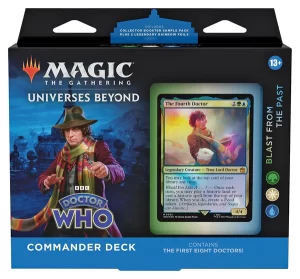
MAGIC: THE GATHERING – DOCTOR WHO BLAST FROM THE PAST

who-2-the-fourth-doctor magic the gathering

Magic: The Gathering has not been shy about its cross-media tie-ins. The entire premise of Magic involves multiple realities, and the heroes tend to be creatures that can flit across reality at will. So Doctor Who is a natural match for Magic: The Gathering, even though it just feels like a bit of a novelty cash grab.

The Doctor Who-themed release involved a range of booster packs and four pre-built Commander decks, each focusing on a slightly different part of the 60-year-old franchise. However, only one of these decks made it to STARBURST’s Secret Gaming Thunderdome. Fortunately, it was the best one, Blast From the Past, a deck filled with classic Doctor Who characters and companions.

At its core, Blast From the Past is a green, white, and blue Commander deck. This means it packs a decent punch, fortifies its creatures and is a little bit tricksy. Perfect for the Fourth Doctor.

Four is, of course, our Commander, the lead card that everything else hinges on. Magic: The Gathering quite rightly considers The Doctor to be a Legendary Creature. The deck comes with a version of The Doctor from one to eight, and they are separate characters so you can re-enact your favourite crossover event. (You could easily do the Five Doctors, there’s even a specific card for that.) We don’t advise creating a Dimensions in Time deck, as there are currently no EastEnders-related Magic cards. We await the inevitable Dot Cotton Commander tech with eager anticipation!

There are a lot of synergies between the Doctor, his companions and his equipment. Though the deck focuses on the Fourth Doctor, you could easily rebuild it to work with The Fifth Doctor with Peri Brown and Ian Chesterton if you wish. Want to build a battle-based deck in which Jamie, K9 and Ace team up to beat up everything else, while the Sixth Doctor softly chuckles in the back, divining opponents’ power levels and building up his own power base? This deck lets you do that. 

Blast From the Past is a fun example of how Magic: The Gathering, for all its mechanical coldness, is really just about storytelling. The deck also comes with ten planechase cards – an optional rule that randomly adds blanket conditions to the game. Of course, they’re Doctor Who-themed, and include the likes of the TARDIS bay and the Cheetah Planet. The latter fills the field with cats, which inevitably cause a ruckus.

Accessories include a box to put all the cards in, a cardboard ‘wheel-based’ life counter, some oversized tokens, some smaller round tokens, a black envelope to put the planechase cards in, and a sparkly blue six-sided dice with only two symbols on it; Gallifrey and the Planeswalker emblem, also used for Planechase. The tokens have to be popped out of the box; very little of the packaging is wasted here. 

This is a good value set for folk looking to have fun playing Magic. It’s not the sort of deck you can strip for parts; it’s very specific to Doctor Who, but it’s colourful and filled with character. It’s an absolute must for the Magic-playing Doctor Who fans.

stars


THE FANZINE BOOK: THE GOLDEN AGE OF THE DOCTOR WHO UNDERGROUND PRESS

Today’s Doctor Who fans can find out the latest news, views, and opinions – oh, yes, the opinions – at the click of a mouse. Doctor Who fandom largely lives online these days, for better or (all too often) for worse. But it wasn’t always this way. Although there were some early iterations of Doctor Who fan activity in the 1960s and into the early 1970s, it was only in the mid-’70s that properly organised fan appreciation of the series began, largely due to Tom Baker’s hugely popular student-centric portrayal of the Doctor as an iconoclastic and unpredictable free-thinker with precious little respect for authority figures.

The Doctor Who Appreciation Society (DWAS) arrived in 1976 and quickly gained official recognition from the BBC Doctor Who production office as it published monthly newsletters and its fan magazine, TARDIS. This “centralisation” of fan activity encouraged Who devotees all over the country – all over the world – to produce their own magazines (some of which were little more than pamphlets at first), and an explosion of titles arrived in the late 1970s and well into the 1980s. Fans, many of them enthusiastic teenagers with access to crude photocopying and duplicating facilities, would discover and debate the history of the show, conduct interviews with cast members old and new, create often-impressive art inspired by the series and as the years rolled by and printing facilities became more sophisticated the early crudely-compiled and stapled magazines became ever more professional. Alistair McGown’s extraordinary – and huge – new book commemorates and explores this very particular era in Doctor Who fandom; 21st-century fans will look on in bafflement and astonishment at the book’s pages and pages of illustrations of magazines that, to them, might as well be cave-paintings. But for those fans who were there – this writer included – this is a massive and delightful nostalgia hit, a reminder of more innocent and enthusiastic times and page after page rolls by with a gasp of “I remember that one!” or “I used to get that one!” as the covers of long-forgotten and discarded primitive magazines, gorgeously reproduced across the book’s generous 280-plus pages, loom from its glossy pages.

The book’s text is necessarily dense and dry, chronicling the comings and goings not only of various magazines but also those fans who worked on them, but it’s also intricate, immaculately researched and generally presented with only the slightest of critical opinion. The development of the DWAS is fairly central to the book as the Society was very much the hub around which the rest of this independent, underground fandom revolved, but it’s extraordinary to be reminded of this explosion of Who-inspired creativity and fascinating to see how those early crude publications either floundered and fell by the wayside or flourished into more professional, slicker product that would often rival the likes of the rapidly-established newsstand Doctor Who Weekly/Magazine. If we’ve any real criticism of the book, then it’s a little frustrating to see McGown writing about magazines and referring to their content or inner layout without any reproductions illustrating his point, but then to do so would probably have required a book twice the size.

Tiny reservations aside, The Fanzine Book really is a remarkable piece of work, an invaluable snapshot of a very specific time in Doctor Who fandom, an era where the written word was king (supported by often very decent artwork) and the magazines commemorated here encouraged many of their contributors to take up carers in journalism and script-writing or else to express their creativity in other mediums. It’s a book best appreciated by those who were there, but some of today’s keyboard warriors could learn a thing or two from its enduring story of proper fans with a yearning to express their passion constructively instead of spitting empty venom into cyberspace in the name of clickbait. Hugely recommended.

stars

The Fanzine Book is available now from Telos Books.


DOCTOR WHO THE COLLECTION – Season 20

With Doctor Who’s 60th-anniversary episodes now just a few weeks away, the latest BBC Blu-Ray Collection boxset from the ‘classic’ series whisks us back in time forty years as the show celebrated its 20th anniversary in Fifth Doctor Peter Davison’s second season. The series was just starting to exploit its history at the time as producer John Nathan-Turner, basking in the success of the 19th season’s Earthshock, which saw the return of the Cybermen to the series after a six-year absence, decided to court continued fan approbation by seeding elements from the past in every serial in an anniversary year run that would end in spectacular style (for the 1980s) with the all-star reunion feature-length special The Five Doctors in November 1983. Season 20 ended up being a curious beast; Nathan-Turner’s promise turned into a bit of a damp squib with ‘returning elements’ amounting to nothing more than a rematch with 10th-anniversary adversary Omega, the return of the Mara from the previous season, three stories linked by the reappearance of Valentine Dyall’s Black Guardian from the 16th season (with a long-overdue guest turn from UNIT’s Brigadier Lethbridge-Stewart, now retired and working as a teacher in a boys’ school in Mawdryn Undead) and another TARDIS team tussle with Anthony Ainley’s Master to bring an underwhelming season to an underwhelming close. A Dalek serial planned to round the season off had to be abandoned due to one of the bouts of industrial action that often bedevilled the BBC in the 1970s and ’80s, and indeed, several other serials were almost lost but were salvaged and remounted – Nathan-Turner’s plans would have been utterly torpedoed if the season had been abandoned after only twelve episodes had been recorded.

Season 20, scrubbed up and sparkling on this lavish new nine-disc box set (three discs are devoted to various iterations of the anniversary special), is a frustrating experience. Fairly typically of Doctor Who, the episodes are bristling with big, bold and often rather clever ideas, but all too often, they’re undermined by standard-issue contemporary BBC studio production problems – clunky, clumpy sets, horribly unsympathetic lighting and flat, unimaginative direction. The season also feels a bit dreary as it doesn’t really offer any memorable “creature” designs, with most of the Doctor’s adversaries here being distinctly humanoid. Season opener Arc of Infinity is a dreary four-parter that involves too much creaky melodrama on the Doctor’s home planet Gallifrey (and some runaround location footage shot in Amsterdam for no other reason than just because) and a ludicrous chicken-headed alien called the Ergon, Stephen Gallagher’s Terminus offers a new spin on the creation of the Universe but its script is far too ambitious for the BBC’s mid-’80s resources and The King’s Demons is a frivolous two-parter that sees the Master downgrading his usual galaxy-dominating ambitions by plotting to foil the signing of the Magna Carta. However, Mawdryn Undead offers an interesting take on the curse of immortality (a busy serial that reintroduces the Brigadier and debuts duplicitous new companion Turlough, played with sly menace by Mark Strickson) as does the imaginative and atmospheric Enlightenment in which the immortal Eternals entertain themselves by organising races across space in spaceships resembling historical sailing vessels – a wonderfully Doctor Who idea. Best of the bunch, though, is Christopher Bailey’s Snakedance, a highly literate and intelligent script that sees the Doctor’s companion Tegan (Janet Fielding) still under the thrall of the insidious snake-like Mara from the previous year’s Kinda.

A bland and often too colourless collection of episodes is again enlivened by some generous and hugely entertaining special features dominated by the presence of Janet Fielding, who now fully embraces and understands her place in Doctor Who and the show’s importance in popular culture. She and her co-stars Sarah Sutton (Nyssa) and Peter Davison are all over the special features like a rash, and they’re a joy to spend time with as they bicker and take potshots at one another in a way that only people who have been friends for over four decades can. The special features here are an embarrassment of riches; Davison, Fielding and Sutton travel across Europe by car to attend a German convention, and the trio (and Strickson) nip across to Amsterdam by train (the long sequence of the quartet shooting the breeze during the journey is fascinating in itself) to revisit the Arc of Infinity locations (also making the day for a group of location-visiting fans), Matthew Sweet is back to interview Sutton and Fielding who also take a tour of Jodrell Bank where their interview was taped, Fielding spends time with actor Martin Clunes whose first TV appearance in Snakedance, resplendent in a fetching toga, is often wheeled out to embarrass him in chat shows. Add to the mix the usual ‘Behind the Sofa’ features where the episodes are viewed by the cast and other luminaries such as Sophie Aldred, Katy Manning, Sylvester McCoy and Colin Baker, archive material ported over from previous DVD releases and lots of newly-discovered old treats, updated effects on several episodes (and three different versions of The Five Doctors) and once again, despite the frankly disappointing run of episodes themselves, it’s another stellar presentation of classic Doctor Who, assembled with staggering thoroughness. 1980s Doctor Who isn’t the show at its best by any means, but with so many of its cast and crew fortunately still round to tell the tale, the attendant boxsets are always a delight and, despite the inessential nature of many of the episodes, the Season 20 boxset is right up there with the best of the sets previously released offering up hours of engrossing entertainment.

stars


DOCTOR WHO: SERPENT CREST

by Beth McMillan

Demon Records has truly outdone themselves with their latest release, the Doctor Who: Serpent Crest special edition vinyl boxset. This limited-edition collection presents the third and final instalment of the ‘Nest Cottage’ audio adventures, featuring the legendary Tom Baker reprising his role as the enigmatic Doctor and Susan Jameson returning as his long-suffering housekeeper and everyone’s favourite Mrs Wibbsey!

Published for the very first time on vinyl, these five gripping audio adventures will definitely bring about a sense of nostalgia for any older die-hard Whovians when sampled with the distinctive sound of a record player. There can be no doubt vinyl brings a certain je ne sais quoi to the listening experience.

The first thing that hits you about this box set is the beautiful presentation. Everything from the packaging to the contents shows great attention to detail. A die-cut, removable outer sleeve reveals a Skishtari (the villain of the story!)-infested box lid, hinting at the dangerous adventures contained within! The accompanying 16-page full-colour booklet, featuring the Doctor himself’s unique notes and illustrations, adds an extra layer of immersion and complements the stories perfectly, allowing listeners to follow along with the adventure.

Lucky owners of the set also receive a hand-signed, frameable portrait of the Fourth Doctor, autographed by the iconic Tom Baker. With only 1200 copies available, it’s a must-have for any dedicated Doctor Who enthusiast!

Spread across 10 alternating Black and Green vinyl LPs (complete with beautifully illustrated individual sleeves featuring cast and credit details for each of the five captivating stories), the audio adventures are brought to life by a stellar cast, including Richard Franklin reprising his role as Captain Mike Yates of UNIT, and David Troughton, son of Patrick Troughton following in his father’s footsteps and making a surprise appearance as ‘The Visitor’ a mysterious figure who may or may not be the second Doctor!

Accompanied by the BBC Radiophonic Workshop’s signature Doctor Who theme and original sound design, listeners will be transported to a distant galaxy where the Doctor and Mrs Wibbsey become entangled in a gripping war against the deadly, snake-like Skishtari.

Following on from the events of the previous Doctor audio adventure Demon Quest, the story takes an intriguing turn as the duo stumbles upon a dangerous Skishtari egg, leading them to the 19th-century town of Hexford and a world of treasure and genies. The plot unfolds with thrilling twists and turns, culminating in a climactic encounter between the Doctor and the Skishtari.

Despite the story having some occasionally cheesy and predictable dialogue and, like Demon Quest before it, a somewhat domestic feel that might not appeal to all Whovians, Doctor Who: Serpent Crest on vinyl is a true collector’s gem that captures the essence of the beloved series. With its impeccable production quality, stunning artwork, and the opportunity to own a piece of Doctor Who history, this limited-edition release is an essential addition to any fan’s collection. Demon Records has delivered an unforgettable audio journey through time and space that will keep listeners captivated from start to finish.

stars