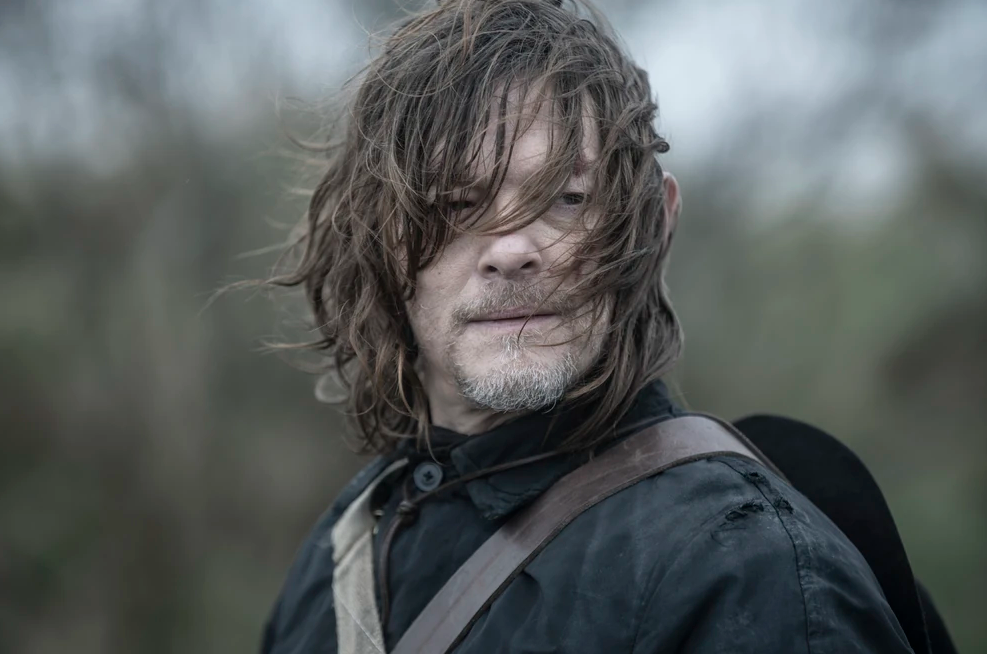
The lure of home and family has been one of the defining themes of this first season of Daryl Dixon. The tension between Daryl’s yearning to get back to the country he knows, and the growing sense of connection with the people he has found himself cast adrift with reaches a thrilling point of no return in the events of Coming Home.
The thrilling opening sequence, which returns to last week’s cliffhanger, adds a special frisson of surprise as prisoners are locked into a fight to the death with some hyper-animated undead. Those combat scenes have both energy and a welcome element of unpredictability. The grotesque cadavers, jacked up by the injection of an experimental serum, are unstoppable, driven by an insatiable need to dismember the living. Their ‘burner’ blood is only one of the extra threats with which those fighting them have to battle.
Yet the newly augmented breeds are unstable and vulnerable to self-destructing – much to the frustration of Genet. Some are motivated to attack other walkers, a hint perhaps of the scientists’ hopes of engineering assassin (or hunter-killer) zombies. It’s certainly canon-stretching stuff, regardless.
The arena sequences are choreographed with a visceral, explosive tension, as Daryl fights alone before being shackled to a disbelieving Quinn and forced to confront multiple opponents. There’s a cinematic flair and texture to this, as director Daniel Percival goes all out to extract maximum impact from set-ups more reminiscent of high-concept monster flicks than the carefully considered world-building of The Walking Dead. This includes a memorable reworking of the idea of “running it up the flagpole” and some first-rate axe-wielding from Daryl. It’s all really entertaining, not just because it’s thrillingly executed but because it contrasts so well with the show’s immersive, character-driven conceits.
After Fallou’s team interrupts proceedings, triggering chaos in the arena, there’s a well-paced, high-stakes escape through the catacombs. On the wrong side of a locked gate, Daryl convinces Laurent to do something he considers unconscionable in order to save his aunt’s life – and learn a lesson about moral relativism in the process. It’s one of the episode’s two heavily melodramatic moments, but the symbolism remains powerful.
There have always been questions about enforcer Codron’s motivations and sense of loyalty. That ambiguity is highlighted by his unexpected reaction to his patrol’s interception of the fugitives. It’s clear that the showrunners feel there’s too much untapped potential in the Codron-Dixon dynamic to wrap up their mutual antagonism here.
The group’s arrival at Mont-Saint-Michel, the sanctuary of Isabelle’s religious order, marks a shift in the episode’s tempo. It’s a visually arresting location, and Percival renders the tidal island and the gravity-defying buildings that cling to its steep sides to great effect on screen. Expecting an attack on the citadel, Daryl begins to train some of its civilian population in the business of defence. The real-life history of Mont-Saint-Michel suggests that the impregnable structure of their fortress is likely to be more significant than the military prowess of the island’s occupants.
As the travellers take stock, character issues come to the fore. The growing closeness of Laurent and Daryl is given additional momentum, building on a dynamic that’s run through the previous five episodes. The respectful relationship between Daryl and Isabelle also becomes more intimate now that the immediate pressures on them have lifted. Daryl has become the father figure in a new proto-family, which means that the idea of leaving France is an emotional wrench in a way he could never have imagined when he first brokered the deal with Isabelle at the monastery. The script, by Jason Richman and Laura Snow, manages to use these personal entanglements to build up Daryl’s dilemma without becoming emotionally mawkish.
As he makes his way towards the coast to board the first vessel in the boat-hopping journey that will transport him back across the Atlantic, Daryl stumbles across an unexpected connection with his own family’s past, which for one of the Dixon clan ended on a French beach, just like the one Daryl washed up on. As a reflective moment, it’s a little overdone, but it hammers home the key themes of home, community, and sacrifice.
Lauren’s fear of abandonment leads him to make yet another disastrous decision (he’s good at those), that leaves the homesick Daryl with what’s effectively no choice at all – and sets up the storylines of Season |Two, the first episodes of which are already filming. It’s now common knowledge that Melissa McBride (Carol) will be joining the main cast of Daryl Dixon for the second season. Her on-screen return in the closing scenes of Coming Home adds to the growing sense of anticipation as Carol sets out to discover the whereabouts of her missing compatriot.
In its opening year, Daryl Dixon has raised the bar for spin-offs from the parent show on pretty much every level: storytelling, characterisation, design, atmosphere, pacing and originality. And while this finale is a little less action-packed than last week’s Deux Amours, it’s no less powerful for that – as questions of character and commitment secure the attention that the scriptwriters have earned the time to address.
The first season of THE WALKING DEAD: DARYL DIXON premiered on AMC and AMC+ in the US

Read our previous reviews of THE WALKING DEAD: DARYL DIXON below:
Season 1, Episode 1, L’ÂME PERDUE
Season 1, Episode 2, ALOUETTE
Season 1, Episode 3, PARIS SERA TOUJOURS PARIS
Season 1, Episode 4, LA DAME DE FER
Season 1, Episode 5, DEUX AMOURS