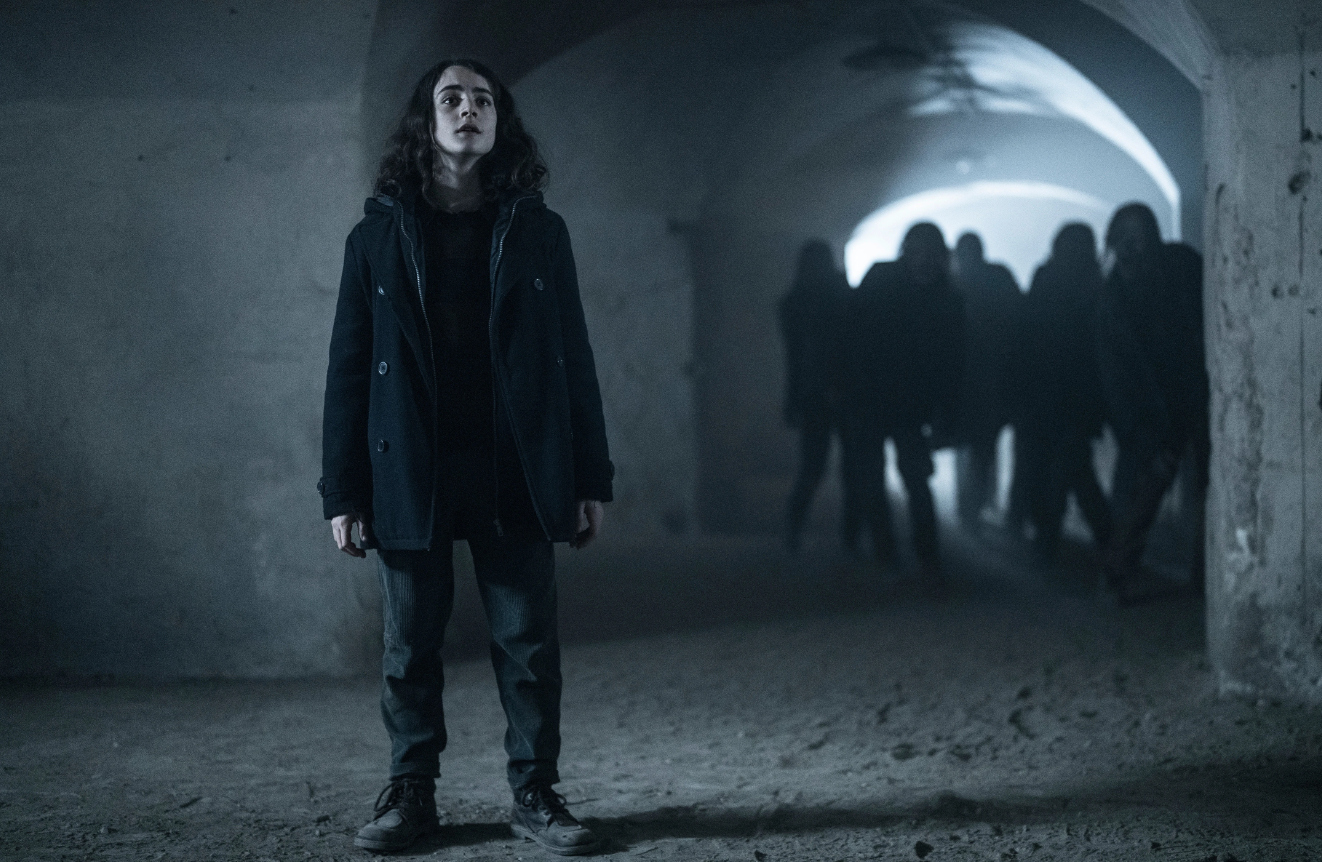
It’s a truism that all screenwriters telling stories set in the French capital are duty-bound to find a reason to send their characters to the foot of a certain wrought-iron lattice tower on the Champ de Mars. It’s a requirement that incoming scriptwriter Shannon Goss handles rather well in this fourth episode. Wide-eyed and distracted, Laurent is drawn to the now-damaged landmark as he wanders lost through the city, unaware of all of the different forces closing in on his location.
Picking up on the Episode Three cliffhanger, La Dame De Fer (‘the iron lady’, the Eiffel Tower’s evocative nickname) first tracks the different stories of the members of Daryl’s group who’ve scattered following the Guerriers’ raid on the Demimonde club. These sequences include a startling misdirect about the supposedly messianic Laurent’s real nature, which teases (and then rips away) a wholesale rewrite of the show’s mythology. There’s no time for Daryl to catch his breath before he is rudely awakened from his reverie to find himself underwater and under threat. Walkers-in-water is a recurring motif in The Walking Dead universe, but this brief combat sequence confirms director Tim Southam’s flair in handling the high action quotient required by the episode.
Once again, Daryl’s status as an ‘American abroad’ is given real purchase and impact as he wanders through the suburbs of Paris, with no local knowledge, zero grasp of the language and with no idea of how to find his way back to Isabelle’s old flat. To their credit, the showrunners of Daryl Dixon have resisted the temptation to ‘Americanise’ their depiction of France or to dilute their hero’s status as an ill-equipped outsider. Daryl remains excluded from many of the conversations that impact him (while non-Francophile viewers are required to follow significant parts of the plot on subtitles).
The Parisian setting is again brought hauntingly to life on screen, with a surprisingly large sense of scale and depth. The Eiffel Tower provides an arresting backdrop for a rescue mission, an extended skirmish with a wave of walkers, and a nearly-thwarted kidnapping. It’s the episode’s most cinematic visual moment. But just as effective are those scenes in the city’s dilapidated backstreets and tenements and on the banks of the river Seine, all of which are equally atmospheric.
Pigeon breeder Antoine’s storyline comes to an abrupt end, but other more combative members of Fallou’s underused group are given far more to do here as they join the mission to rescue Laurent from Quinn’s clutches. The different elements of their attack unfold with a great sense of pace. As the Molotov Cocktails fly and the machine guns rattle their fire, parallels with the wartime efforts of the French Resistance are easy to spot – although Southam does not overplay the symbolism, even as the attire of many of the combatants echoes that of the Maquis. It’s just another way in which the Gallic identity of the show is evoked.
The Demimonde owner’s reaction to the revelation of his connection to Laurent has sparked entrepreneurial rather than warm paternal feelings. Quinn is more interested in brokering a deal with Genet and her enforcer Codron, although the full story of their group’s motivations (and their interest in freakish experiments with walker lab rats) still remains unclear. Genet is focused on snuffing out the faith that the followers of the Union of Hope have in their saviour.
When Daryl interrogates one of the kidnappers he detained at knifepoint, Goss’ script turns to explore Isabelle’s reaction to his recourse to violence and torture. Daryl might expect her to blanche in the face of what he considers necessary, but she instead expresses a steely resolve that the ends, in this case, do justify the bloody means. This key character moment connects to something seeded into the show from the start: the development of a complicated connection between Daryl and Isabelle as their mutual respect grows. Clémence Poésy has been excellent from the outset, but the emergence of unseen aspects of Isabelle’s nature over the last two episodes has given her the chance to show the full extent of her character’s determination and resilience. And while she is a very different proposition to Carol Peletier, it’s clear that Daryl has once again found a form of close affinity with an intelligent, articulate and self-assured woman.
Daryl’s own moral compass has been shifted by that connection and by his growing sense of responsibility for Laurent. As he passes the Pont de Grenelle Statue of Liberty on his departure from Paris, it seems like he is now further from home than when he first made landfall in France – although he is no longer a lone refugee. Intelligent, distinctive and unformulaic, The Walking Dead: Daryl Dixon is already a candidate for the most innovative spin-off show the original series has yet produced.

New episodes of THE WALKING DEAD: DARYL DIXON premiere on Sundays on AMC and AMC+ in the US
Read our previous reviews of THE WALKING DEAD: DARYL DIXON below:
Season 1, Episode 1, L’ÂME PERDUE
Season 1, Episode 2, ALOUETTE
Season 1, Episode 3, PARIS SERA TOUJOURS PARIS