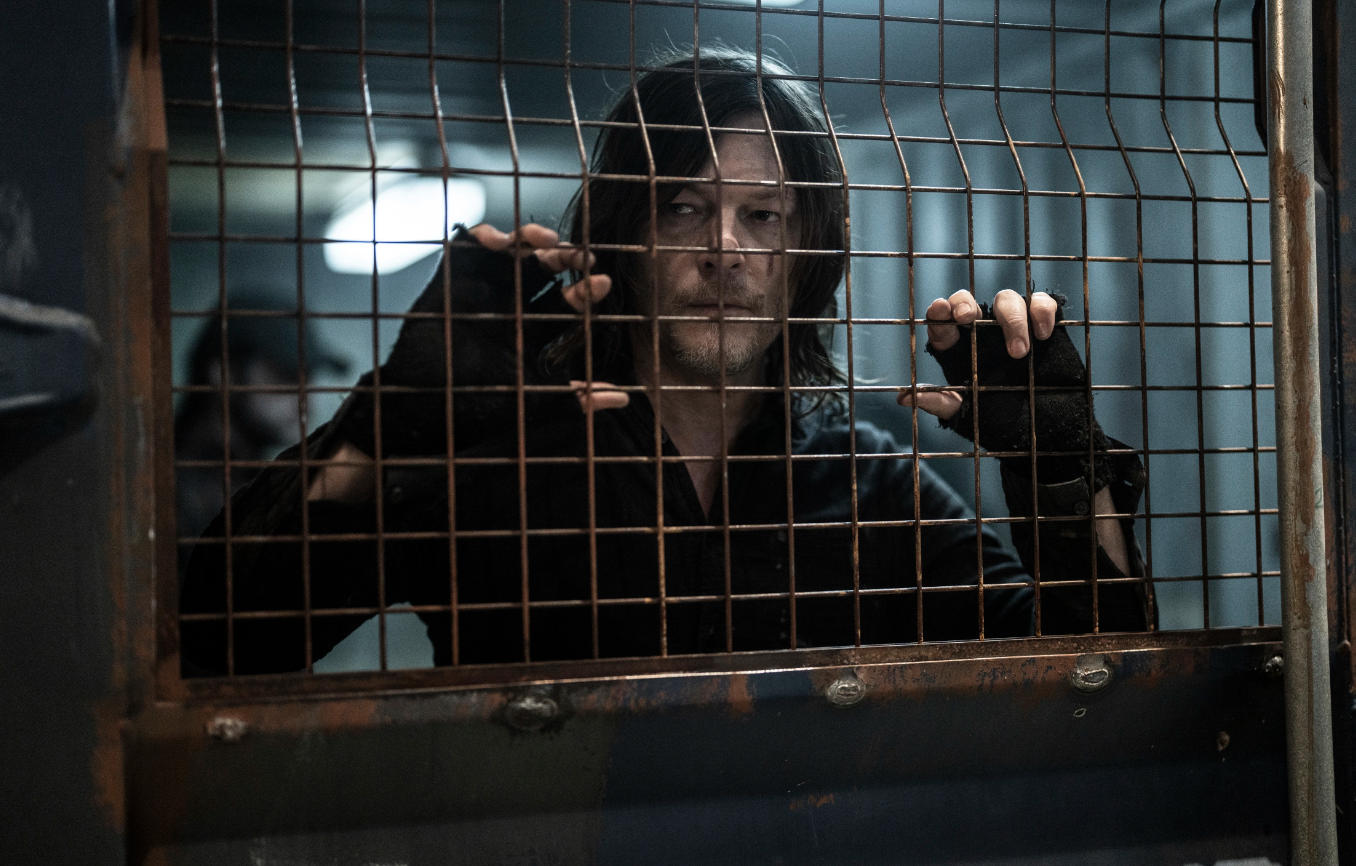
The extended penultimate episode of Season One of Daryl Dixon delivers on so much in the build-up to its jaw-dropping cliffhanger that you could be forgiven for mistaking it for the show’s first-year finale. Blending separate storylines and timelines, the plot of Deux Amours is constructed using some inspired flourishes that maximize the narrative impact of those switches. Producers of certain other Walking Dead spin-off shows take note: this is how it should be done.
Deux Amours also unveils the backstory that led to Daryl’s enforced departure from the East Coast of the USA: a startling tale in its own right that the showrunners have wisely held back on revealing until now. If that weren’t enough, whilst he’s still on US soil, there’s the shock of a never-before-heard radio conversation between Daryl and a close associate who reveals an intriguing (but partly inaudible) piece of news from home.
After Isabelle sacrificed her own freedom to ensure that Quinn would give Azlan’s boat safe passage out of Paris in La Dame de Fer, Daryl and Laurent make their way west towards Normandy and the sanctuary of the Nest. Now, in the role of protector and surrogate father, Daryl tries to teach the sheltered youngster essential survival skills. In conversation with Azlan, he reflects on the events that led him to the shores of France. Now reduced to the status of a trophy in Quinn’s gilded cage, Isabelle wrestles with terrible choices – each of which will seal her fate. A triumphant Genet, whose control over Paris is increasing, plans a celebration to announce the birth of the Sixth Republic and to unveil a terrible new weapon.
Throughout Deux Amours, it’s the richness of the storytelling and the careful attention to detail that impresses. Whether it’s the thoughtful characterisation of Azlan, the growing familial bonds between Daryl and Laurent, or the acute moral conflicts facing Isabelle, it’s all brought to life with exceptional skill by a cast able to grasp the emotional intelligence of David Zabel’s and Jason Richman’s taut script.
Norman Reedus is rewarded with his character’s single most powerful moment in the series to date. When Laurent does something catastrophically stupid out of the fear of losing his new mentor, Daryl lashes out at him with anger that’s caustic and misdirected. Horrified to recognise the echoes of his own father’s treatment of him and his brother, Daryl immediately regrets the cruelty of his words, apologising to the fragile Laurent and ending any sense of distance between them. It’s a pivotal, potent scene, but it’s far from being the only one in the episode to pack a punch. One of the things that the series has done so well is to allow the space to tease out more of Daryl’s hitherto hidden emotional architecture. That’s something that’s been of huge benefit to the show.
The trio’s boat journey is wonderfully evoked on screen as mist and fog encircle the river and its wooded banks, and the group seek shelter amidst long-abandoned stone ruins. The Stateside flashbacks, which are threaded into the progress of their mission, reaffirm just how different the tenor and aesthetic of Gallic life is. It’s an astute dramatic conceit, which – while keeping things spoiler-free – is used to illuminate what’s a surprising explanation for Daryl’s deportation (which few viewers will be able to guess in advance). That leads to a tense, fraught battle with wild walkers on the high seas before events circle back to the series’ opening scene.
It’s not only Reedus that gets the chance to flex his acting muscles here. Clémence Poésy does great work, too, as an agonised Isabelle is tormented by impossible moral choices. As she’s torn between greater sacrifice and bloody vengeance, she wonders if she can deny others the same opportunity for redemption she herself seized. Living in isolated luxury, Quinn is oblivious to her distress. The lack of recognition of his true social status costs him dearly as soon as he overplays his hand in Genet’s lair. The character of Quinn has evolved into much more than a hustler who got lucky, and Adam Nagaitis is great at showing how Quinn’s obliviousness leads to his calamitous fall from grace. If Quinn is self-obsessed, Laurent, in contrast, is captured and disempowered precisely because of his selfless determination to protect those that he cares for. As the proto-saviour, Louis Puech Scigliuzzi seems to be growing in confidence in parallel with his character.
The show’s evocation of the wartime occupation of France and the spirit of the Resistance, especially in those scenes set on the streets of Paris, is reinforced in the final scenes of Deux Amours. As she struts between the torture cells of her regime’s prison and declares that her Pouvoir group will deliver a new French dawn, Genet is channelling any number of delusional Nazi dictators (or Vichy collaborators, for that matter).
As the travellers are reunited and compelled to watch Genet’s big reveal, the show makes its canonical handbrake turn. It’s an audacious shift but wholly in keeping with the confidence and inventiveness the show’s producers have displayed throughout this first season.
New episodes of THE WALKING DEAD: DARYL DIXON premiere on Sundays on AMC and AMC+ in the US

Read our previous reviews of THE WALKING DEAD: DARYL DIXON below:
Season 1, Episode 1, L’ÂME PERDUE
Season 1, Episode 2, ALOUETTE
Season 1, Episode 3, PARIS SERA TOUJOURS PARIS
Season 1, Episode 4, LA DAME DE FER