With the Fear Street trilogy for Netflix, writer-director Leigh Janiak not only created a new vision for the world conjured up by the series of young adult horror novels from writer R.L. Stine but also shot three films at once to create a wholly unique universe. It’s a massive undertaking and one that has had horror fans champing at the bit to see since the films were first announced several years ago. Ahead of the first film of the series, Fear Street Part 1: 1994, hitting Netflix today, we spoke with Janiak about bringing Fear Street to the screen.
STARBURST: What is necessary to build a trilogy all at once. Where do you begin or what’s your starting point?
Leigh Janiak: [laughs] I think your starting point is blissful ignorance, I would say. And then, a really amazing team of people that are all of our brains working at once, trying to stay creative, trying to be engaged in this like mammoth task. I think we all had a little bit of kind of blissful ignorance of like, “Yeah, of course, this is just like doing a series.”
I don’t know. There was something very exciting about doing this thing, which hasn’t been done very much – if at all – and also reminding ourselves, “We are telling one story,” too. Keeping in mind that thing was important, but yeah – a lot of blissful ignorance.
It seems like you started with putting visual clues and building everything right from the start. That opening scene has some nods to the books right there and hints are being sewn from the very beginning.
Yeah, totally. That was something I’m glad that you noticed. I’m happy about that. That’s good to know. Definitely: there was a lot of time spent on like, “How can we start weaving this stuff in very early? Where can we add it later?” It existed as far as little Easter eggs that narratively would hold more weight when we got later into the movies. Then, also kind of visually, as we were shooting, we were able to revisit frames, revisit spaces and places and have those echoes. We called them “echoes” as we were shooting. It was very much part of the experiment and the fun of making the three movies was finding ways to do that.
The fact that you used the word “’fun’ is perfect because one of the things that’s so fun about Fear Street is that it is just so jam-packed with music. Where did that idea come from?
For me, I think that whenever I’m coming on to a new project, I make a playlist and that’s the easiest way for me to start really living what I want the movie to feel like. With Fear Street, it was the same thing: I made playlists very early on when I was first pitching the project to my producers and to the studio, then that playlist continued to grow. I had one for each movie, and then I shared that with the cast, with the crew.
It was always kind of a way to remind ourselves of “this is the era, this is the tone. This is what it feels like to live in the ’90s with this grunge or this gangster rap” or whatever it may be. In the ’70s, it was a good, healthy dose of disco and then also Buzzcocks and Bowie and everything. I was super important, super important.
It was also one of the things I think I was the most nervous and scared about because I wrote Bowie into the script. Having Bowie and Nirvana in the script and to have it crafted around this moment and then just have all of our fingers crossed that we’re going to get the support that we need on the backend to actually include these songs was huge. Netflix was amazing for that. They all understood and they really backed us up and gave me everything that we needed and we wanted for the movies.
The series is all about building its own mythology, but then you’ve got this series of books that has its own sort of mythology. How do you make it to where you’re paying homage to R.L. Stine’s past work, but also creating something new?
That was a challenge for me because I was a huge fan of the books as a teenager and so I kind of knew that they’re – first of all, there are hundreds of them – but there’s not really a unifying mythology across the books. There are certain things that repeat obviously: Shadyside is the unifying thing of the world of Fear Street and Fear Street itself is a character in these books, and there’s the Goode family and there’s the Fier family and all of these things exist, but part of the fun of the books, I think, is the fact that the universe does seem infinite. Anything kind of crazy can happen in them.
Our challenge was, “How do we create something that feels complete and satisfying across these three movies?” and what we ended up doing was kind of, yes, reinventing a mythology that’s specific to our story, but then trying to preserve the spirit of the books which I loved so much, which was a little bit of subversive edge around it and also fun, more than anything else.
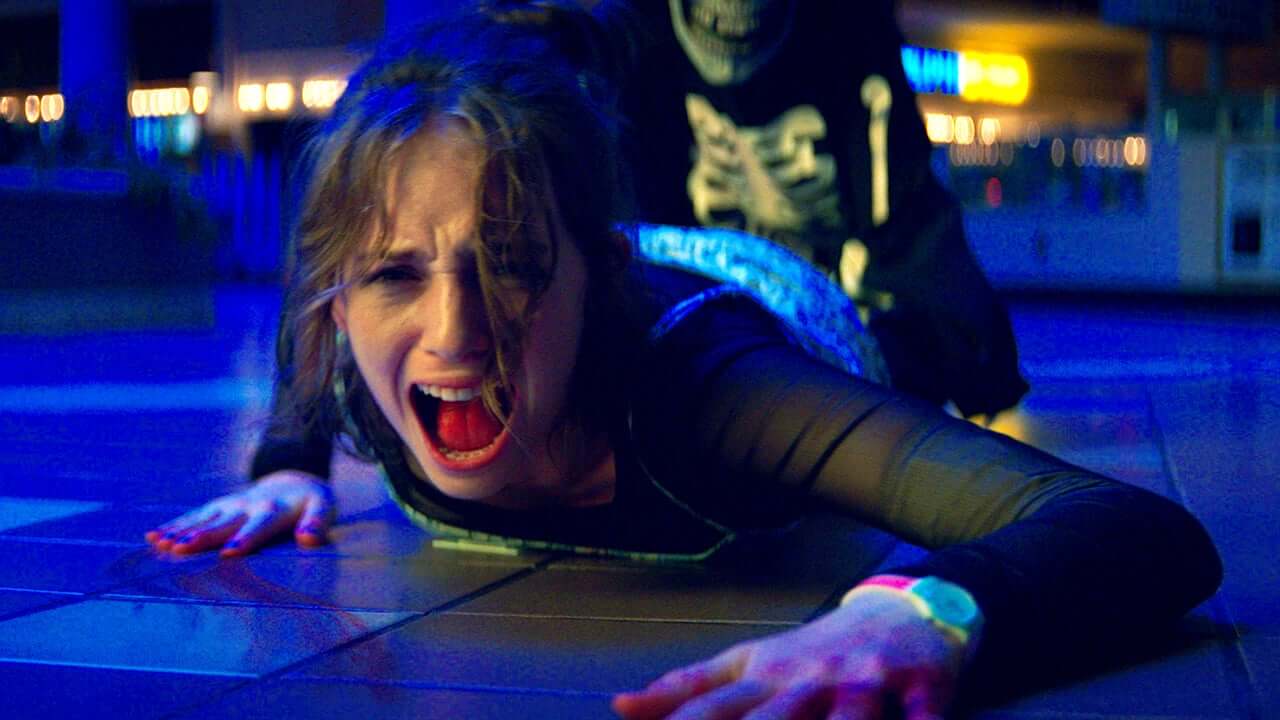
Speaking of subversive edge – because this is the opening scene and it’s not really spoiling anything for anybody – you kill Maya Hawke in the mall.
Yes, I do.
Was that something along the lines of, “Hey, Netflix, will you let us do it?”
Totally. 100%. And my husband [Ross Duffer] is actually one of the co-creators of Stranger Things, so there was a lot going on in that scene.
That’s a meta in-joke, right there.
We were obviously paying homage to Scream and Drew Barrymore and the amazing opening of that movie, and then there was a lot of other things going on, too. [laughs]
That adds a third layer because you directed a couple of episodes of the Scream series for MTV. What’s it like as a director, working with these already extant properties, but coming about it in a new way?
Yeah. I mean, Scream was interesting that, because obviously, I was stepping into that as an episodic director, so it wasn’t a world that I was creating, but even when I was doing those, it was about looking for ways that we could pay the respect that those, that those movies deserve and then also try to keep them new and fresh.
With Fear Street, it was the same thing with the books. I wanted to make sure that we were sending a proper love letter to them and then also, to the films of that era, which I was a huge fan of as a moviegoer. The conversation was, “How do we do this and not just make it nostalgia? How do we warrant and justify making three movies?”
For me, that came back to the characters and being able to craft the three movies around characters that normally haven’t had their day in the sun and haven’t had a chance to be protagonists or heroes. It’s not often that you have a young black queer woman that’s leading three horror movies. She’d usually be dead before the movie even started, so that was a cool opportunity for me to balance doing the thing and then also making it new.
With the Fear Street trilogy, you’ve gotten to do your Wes Craven movie and your ’70s Carpenter movie, and you got to make a Dave Eggers folk horror movie. Now that you’ve gotten to do these three things, what’s next for you?
Well, what’s next practically is that I’m going to go and shoot a couple of episodes of The Staircase with my friend Antonio Campos which is also very horrific, but very horrific in the real world, based on a terrible event that happened in reality. As far as slashers and things like that? I don’t know. I’m excited about kind of the opportunities that the Fear Street universe holds. I’m really interested in a ’50s Night of the Hunter-esque kind of a slasher thing, so that is something that I’m also thinking about a lot.
Fear Street Part 1: 1994 releases globally on Netflix on July 2nd, Fear Street Part 2: 1978 follows on July 9th, and the series concludes with Fear Street Part 3: 1666 releasing globally on Netflix on July 16th. More information can be found here.