There’s a somewhat muddied and confused narrative currently prevalent regarding Todd Phillips’ mesmerising and utterly confounding Joker: Folie à Deux, the unexpected – and initially unwanted – sequel to his stunning 2019 Joker. It’s hard to remember a film that’s been more vilified, more pilloried and, ultimately, more misunderstood than this vital, edgy, dark, disquieting yet gloriously magical film that isn’t exactly a sequel to the original but rather the second half of a story that we didn’t realise hadn’t been fully told. In many ways, Joker: Folie à Deux is the second piece of a two-piece jigsaw; it not only completes this story of Joaquin Phoenix’s troubled, psychotic Arthur Fleck, but it also ties up all the loose ends and unanswered questions from the first film in a way that’s beautiful, heartfelt and even morbidly appropriate.
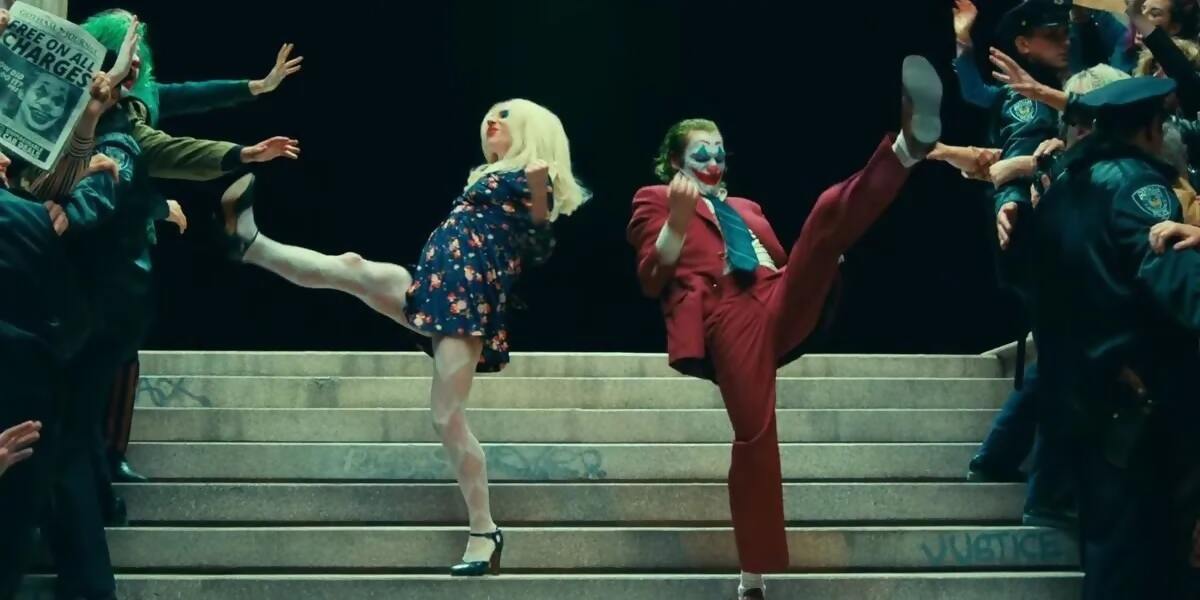
Perhaps the reasons for this huge wave of hatred that has risen up towards the film are two-fold; the casting of Lady Gaga as Lee Quinzel led many to believe that the film was going to take the well-worn path of creating the infamous Joker/Harley Quinn criminal dynamic from the DC comics and the revelation that this was going to be a ‘musical’ caused many to throw their arms up in despair and wail that the fans were being betrayed and let down and not given what they wanted. To hell with that.Joker: Folie à Deux is, in fact, not a musical – at most, it’s a jukebox musical, and its musical numbers (gorgeously staged and performed, incidentally) are clearly figments of Arthur’s twisted, struggling imagination and Todd Phillips and Phoenix would never have been interested in doing the obvious and just turning Joker/Harlequin into the criminal lunatics we’ve seen time and time again. This isn’t the story of the Joker as we’ve seen him in comics and films over the decades. This is a new spin inspired by that character, but it is not slavishly recreating him and his story. This Joker is as different to Heath Ledger, Jack Nicholson, and César Romero as the Batman played by Christian Bale, Ben Affleck, George Clooney, Robert Pattinson, and Adam West are from one another. This is a Joker whose destiny isn’t to become the Clown Prince of Crime; this is a Joker who is just a lost, abused, isolated, disturbed loner, and fans who were expecting this take on the character to be twisted into something they more readily recognise from comic book/cinematic history were always on a hiding to nothing. But to rise against the film and decry it for what it is – a work of art and not a more traditional comic book movie – seems to suggest that there’s perhaps a huge portion of the original Joker film audience didn’t really understand at all. Joker and Joker: Folie à Deux are resolutely not comic book movies – and they’re all the better for swimming against the still-prevailing cinematic tide.
Joker: Folie à Deux leans heavily on the events of the first film – of course it does, it’s a continuation of that story. Arthur Fleck (Phoenix delivering another astonishing performance that easily deserves him a second Oscar nod for the role regardless of the film’s box office) has been in prison in Arkham for two years, awaiting his trial for the murders he committed in the first film. He’s constantly bullied and abused by the prison guards, especially the sneering, sadistic Jackie Sullivan (Brendan Gleeson). Arthur tries to present as a changed man, but his Joker persona is never far from the surface, and when he chances upon Lee Quinzel (Lady Gaga) in the prison, the pair form a bond that soon seems to turn romantic. As the trial begins, Arthur plays to Lee, apparently released from Arkham as Arthur is felt to be a bad influence on her, in the gallery as the DA Harvey Dent (Harry Lawtey) presents a strong case against Arthur. Arthur eventually dismisses his attorney and represents himself. The film spends most of its time either in Arkham or the courtroom. The court sequences are magnetic, Pheonix delivering a performance of barely-contained insanity that finally boils over when he decides to speak for himself. It’s spicy, jagged stuff, and as Arthur becomes more and more convinced that he’s found his soulmate in Lee, his musical fantasies become more extravagant, simultaneously joyous and yet full of dark portent. The film quite literally explodes in the final act as Arthur races headlong into his only true destiny…
Joker: Folie à Deux clearly isn’t a film for everyone – but then what film or work of culture ever is? But despite whatever Rotten Tomatoes pundits, foaming clickbait-obsessed YouTube ‘critics’ and even the wider, professional critical world might tell you, this is by no degree a bad film – it’s far too immaculately-crafted for that to be even a remote possibility. It isn’t, clearly, what many of them wanted or expected, and that has led to a degree of exasperation and vitriol that’s wildly out of proportion to the actual quality of the film; it’s almost as if they’ve closed off their own proper critical faculties purely because it’s a film that swerves off into areas that they can’t quite come to grips with. And that’s exactly what we have – a film that confounds all expectations, subverts them, and upends itself into something quite unlike any other movie that takes its cues, even as remotely as this, from the world of comic book legend. People clearly don’t like Joker: Folie à Deux and that’s fine. But the winners here are the people who get it, understand it, embrace it, and appreciate its beauty and genius. Joker: Folie à Deux is definitely not what we might have expected, and it’s probably not even what we deserve. But like its predecessor, it’s an extraordinary, extravagant, and audacious piece of filmmaking that makes us feel uneasy and uncomfortable and, at times, fills us with joy. Joker: Folie à Deux is anything but a cinematic folly. Outstanding.

JOKER: FOLIE À DEUX is on general release now