Boo Cook | VOID RUNNERS

by Ed Fortune

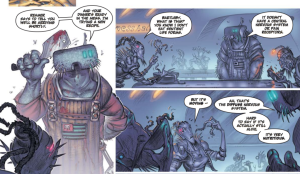
BOO COOK is a British comic book artist, best known for his work on ABC Warriors, Judge Dredd, and Elephantman. His latest work is VOID RUNNERS for 2000 AD, in collaboration with David Hine. We caught up with Boo to find out more…

STARBURST: What’s the pitch for Void Runners?

Boo Cook: Something along the lines of Moby Dick meets Dune in space on a bus driven By Ken Kesey and Tim Leary. On acid!

Why psychedelic sci-fi?

Sci-fi has been hardwired into my brain since my very earliest memories plus i guess you could say that a period of self shamanism in my youth had a profound and prolonged effect on the way i think and approach life. All this coupled with a schooling in comics over the years from the likes of Brendan Mccarthy, Moebius, Shaky Kane, Druillet, and Frank Quitely etc has meant that I have a deep yearning to create comics that encapsulate all that stuff. And who better to do that with than the uk’s most psychedelic man, Dave Hine.

How much does void runners owe to the 1960s?

Dave would probably answer this better than me as I wasn’t around… But certainly, the exploits of the heavy hitters of the lsd explosion in america around the summer of love have a strong bearing on events in void runners. There’s strict control from despotic overlords, there’s widespread distribution of mind-expanding drugs, there’s the promise of new freedoms. But as with the ’60s void runners towards the end of series one starts to question those freedoms in deeper detail and how they affect the bigger picture – it may not all end up sweetness and light…

What’s your favourite moment of chaos in the story?

I think my favourite moment of chaos in the story so far is the big bang sequence in part 6. The protagonist captain shikari has ingested a heroic dose of Kali’s dust – the mind expanding drug grown inside the body-minds of planet sized space jellyfish called pleroma. The sequence starts with the void before time then expands outward from the big bang spawning an infinite myriad of consciousness and creatures which populate the universe and through enlightenment and despair the cycle continues again… Great fun to draw.

What’s the ‘most’ fun to write?

Well Dave’s the writer but there’s a fair bit of strange alien cuneiform writing cropping up amongst the art which was indeed fun to write.

Is it for the squeamish?

I think the squeamish will have no problem with this strip for the most part. Quite often any moments of violence are quickly subverted by shikari’s ‘cosmic take’ on life which tends to put things such as horror and death into a profound reverse spin.

Which bit is going to make the readers grin the most?

When David asked me to draw a massive space anus inside the brain of the Pleroma and have the crew climb inside the glutinous rectum to recover hoards of Kali’s dust I knew we’d be onto a winner, or at least a grinner. The page got quite a lot of interest online, more than any other things i posted lately and the original page sold in a flash. It has since become known as the ‘Spanus’.

How does it compare to other 2000AD strips? Is it closer to Dredd, Ace Trucking co, Shakara, or something else?

I’d say it’s definitely less Dredd and more Ace/Shakara. There’s even some of the irrelevance of DR and qQinch and a smidge of an early Nemesis vibe to it – lots of aliens, lots of oppression!

What would you say the biggest influence on this book is?

I’ll go out on a limb here and say possibly LSD?

Which creators inspire you?

I mentioned above some of the creators which really formed my early art brain. I also should definitely mention artists such as Roger Dean, Chris Foss, Tim White – all artists who were really kicking it in the 80’s when my art brain was forming… Other creators of note would have to include David Lynch, Panos Cosmatos, Jodowrosky, Gaspar Noe, Philip K Dick, Iain M Banks, Robert E Howard, Killing Joke, Can, Pere Ubu, Beak>, yes… I could go on.

What tropes do you personally avoid the most?

Personally I try to avoid the trope of cold hard reality if I can – with my creativity and probably in general. It’s much more difficult than psychedelic space fantasy and much less fun.

If you could preserve one work of art, and have that last forever, what would it be?

Good question! Possibly ‘The Great Day Of His Wrath’ Painted By John Martin in 1851-3…. Or maybe Episode 8 of Twin Peaks: The Return… Vitamin C by Can…. Again I could go on for hours here!

If we like this book, what other books do you recommend?

I would definitely recommend Kosmik Musik by Ben Wheatley and Joe Currie – it’s sci-fi, it’s psychedleic, it’s hilarious and ingenious. On top of that it has a soundtrack by BEAK>. Only a fool would ignore this…

VOID RUNNERS can be found in current issues of 2000 AD. You can find out more about the Galaxy’s Greatest Comic here. 


Joe Abercrombie – Wisdom of Crowds Exclusive Excerpt

Fans of grim-dark fantasy know that Joe Abercrombie is the finest writer in the field. His latest novel, The Wisdom of Crowds completes The Age of Madness series and we’ve been able to bring you an extract of this new exciting novel ahead of release.

You can pre-order the novel: here, and if you’re lucky enough to live in Scotland, you catch a live interview courtesy of the Cymera Festival here. If you’re not in Scotland, don’t worry, the event will be live-streamed, you can find out more details via the link.

You can find out everything about Joe’s work on his website,  joeabercrombie.com and follow him on twitter @LordGrimDark, and find out about future books from Gollancz via @gollancz


Change

‘You must confess,’ said Pike. ‘It’s impressive.’

‘I must,’ said Vick. And she wasn’t easily impressed.

The People’s Army might have lacked discipline, equipment and supplies, but there was no arguing with its scale. It stretched off, clogging the road in the valley bottom and straggling up the soggy slopes on both sides, until it was lost in the drizzly distance.

There might’ve been ten thousand when they set out from Valbeck. A couple of regiments of ex-soldiers had formed the bright spearhead, gleaming with new-forged gifts from Savine dan Brock’s foundries. But order soon gave way to ragged chaos. Mill workers and foundry workers, dye-women and laundry-women, cobblers and cutlers, butchers and butlers, dancing more than marching to old work songs and drums made from cookpots. A largely good-natured riot.

Vick had half-expected, half-hoped that they’d melt away as they slogged across the muddy country in worsening weather, but their numbers had quickly swelled. In came labourers, smallholders and farmers with scythes and pitchforks – which caused some concern – and with flour and hams – which caused some celebration. In came gangs of beggars and gangs of orphans. In came soldiers, deserted from who knew what lost battalions.

In came dealers, whores and demagogues, dishing up husk, fucks and political theory in tents by roadways trampled into bogs. There was no arguing with its enthusiasm, either. At night, the fires went on for miles, folk drawing dew-dusted blankets tight against the autumn chill, blurting out their smoking dreams and desires, talking bright-eyed of change. The Great Change, come at last. Vick had no idea how far back that sodden column went now. No idea how many Breakers and Burners were part of it. Miles of men, women and children, slogging through the mud towards Adua. Towards a better tomorrow. Vick had her doubts, of course. But all that hope. A flood of the damn stuff. No matter how jaded you were, you couldn’t help but be moved by it. Or maybe she wasn’t quite so jaded as she’d always told herself.

Vick had learned in the camps that you stand with the winners. It had been her golden rule ever since. But in the camps, and in all the years since she left them, she’d never doubted who the winners were. The men in charge. The Inquisition, the Closed Council, the Arch Lector. Looking down on that unruly mass of humanity, fixed on changing the world, she wasn’t so sure who the winners would be. She wasn’t sure what the sides were, even. If Leo dan Brock had beaten Orso, there might have been a new king, new faces in the Closed Council, new arses in the big chairs, but things would’ve stayed much the same. If this lot beat Orso, who knew what came next? All the old certainties were crumbling, and she was left wondering whether they’d ever been certainties at all, or just fools’ assumptions.

In Starikland, during the rebellion, Vick had felt an earthquake. The ground had trembled, books had dropped from shelves, a chimney had fallen into the street outside. Not for long, but for long enough, she’d felt the terror of knowing all she’d counted on as solid could in a moment shake itself apart.

Now she had that feeling again, but she knew the quake had only just begun. How long would the world shiver? What would still be standing when it stopped?

‘I notice you are still with us, Sister Victarine.’ Pike clicked his tongue and nudged his mount down the slope, towards the head of the bedraggled column.

Vick had a strong instinct not to follow. But she did. ‘I’m still with you.’

‘So you are a convert to our cause?’

There was a hopeful piece of her that wanted to believe this could be Sibalt’s dreams of a better world coming true and was desperate to see it happen. There was a nervous piece of her that smelled blood coming and wanted to cut out that night and run for the Far Country. There was a calculating piece that reckoned the only way to control a mad horse is from the saddle, and the danger of keeping your grip might be less than the danger of letting go.

She looked sideways at Pike. In truth, she was still trying to work out what their cause really was. In truth, she reckoned there was a different cause for every one of those little dots in the People’s Army. But this was no time for the truth. When is? ‘I’d be a fool to say I’m not at all convinced.’

‘And if you said you were entirely convinced, I would be a fool to believe you.’

‘Since neither of us is a fool . . . let’s just say maybe.’

‘Oh, we are all fools. But I enjoy a good maybe.’ Pike showed no sign of enjoyment or of anything else. ‘Absolutes are never to be trusted.’ Vick doubted the two leaders of the Great Change riding towards them across the grassy slope would have agreed.

‘Brother Pike!’ called Risinau, with a cheery wave of one plump hand.

‘Sister Victarine!’

Risinau worried Vick. The one-time Superior of Valbeck was considered a deep thinker, but far as she could tell he was an idiot’s notion of a genius, his ideas a maze with nothing at the centre, heavy on the righteous society to come but light as air on the route they’d take to get there. The pockets of his jacket bulged with papers. Scrawled theories, manifestos, proclamations. Speeches he whined out to eager throngs whenever the People’s Army halted. Vick didn’t like the way the crowd greeted his flowery appeals for reason with shaken weapons and howls of approving fury.

She never saw more damage done than by folk acting on high principle. But Judge worried Vick a lot more. She wore a rusty old breastplate rattling with stolen chains over a ball gown crusted with chips of cracked crystal, but she sat her saddle astride not aside so the flounce of tattered petticoats was gathered up around her thighs, her muddy bare feet shoved into battered cavalry stirrups. Her face was like a bag of daggers, lean jaw angrily clenched, black eyes angrily narrowed, her usually flaming crest of hair turned brown by the rain and plastered wetly down one side of her skull. Principles only interested her as an excuse for mayhem. When her Burners had taken the courthouse in Valbeck, her jury had found no one innocent and the one sentence she’d given was death.

If Risinau was forever gazing up, no thought for the wreckage he was stepping through, Judge was glaring down, trying to trample everything she could. And Pike? There were no clues on the ex-Arch Lector’s burned mask of a face. Who could say what Brother Pike was after?

Vick nodded towards grime-streaked Adua, its pall of smoke inching irresistibly closer. ‘What happens when we get there?’ ‘Change,’ said Risinau, smug as a rooster. ‘The Great Change.’

‘From what, to what?’

‘I am not blessed with the Long Eye, Sister Victarine.’ Risinau giggled at the thought. ‘From the pupa alone it is hard to know what kind of butterfly might emerge to greet the dawn. But change.’ He wagged a thick finger at her. ‘Of that you can be sure! A new Union, built from high ideals!’

‘The world doesn’t need changing,’ grunted Judge, black eyes fixed on the capital. ‘It needs burning.’

Vick wouldn’t have trusted either one of them to herd pigs, let alone to herd the dreams of millions into a new future. She kept her face blank, of course, but Pike must have caught some hint of her feelings. ‘You appear to have doubts.’

‘I’ve never seen the world change quickly,’ said Vick. ‘If I’ve seen it change at all.’

‘I begin to think Sibalt liked you so because you were his opposite.’ Risinau laid a playful hand on her shoulder. ‘You are such a cynic, Sister!’

Vick shrugged him off. ‘I think I’ve earned it.’

‘After a childhood stolen in the camps,’ said Pike, ‘and a career of making friends to betray for Arch Lector Glokta, how could you be otherwise? But one can be too cynical. You will see.’

Vick had to admit she’d been expecting the Great Change to collapse long before now. For Judge and Risinau to move past bickering to tearing each other apart, for the fragile coalition of Breakers and Burners, moderates and extremists, to shred into factions, for the resolve of the People’s Army to dissolve in the wet weather. Or, for that matter, for Lord Marshal Rucksted’s cavalry to crest every hill she saw and carve the ragged multitude to pieces.

But Risinau and Judge continued to tolerate each other and the King’s Own made no appearance. Even now, as the rain slacked off and they marched into the ill-planned, ill-drained, ill-smelling maze of shacks outside the walls of the capital, water spattering from the broken gutters and into the muddy lanes below. Maybe Orso’s forces had been fought out against Leo dan Brock. Maybe there were other uprisings to deal with. Maybe these strange times had stretched their loyalties in so many directions they hardly knew who to fight for any more. Vick knew how they felt as the sun showed through, and she caught her first glimpse of the gates of Adua.

For a moment, she wondered whether Tallow was in the city. Fretted that he might be in danger. Then she realised how foolish it was to worry over one person in the midst of all this. What could she do for him, anyway? What could anyone do for anyone?

Risinau nervously eyed the damp-streaked battlements. ‘It might be wise to take a cautious approach. Deploy our cannon and, er—’

Judge gave a great snort of disgust, dug her bare heels into her horse’s flanks and rode forwards.

‘One cannot fault her courage,’ said Pike.

‘Just her sanity.’ Vick was rather hoping for a shower of arrows, but it never came. Judge trotted on towards the walls, chin scornfully raised, in eerie silence.

‘You inside!’ she screamed, reining in before the gate. ‘Soldiers of the Union! Men of Adua!’ She stood in her stirrups, pointing back at the horde crawling up the soggy road towards the capital. ‘This is the People’s Army, and it’s come to set the people free! We only need to know one thing from you lot!’ She held high one clawing finger. ‘Are you with the people . . . or against ’em?’

Her horse shied, and she ripped at the reins and dragged it around in a tight circle, that finger still extended, while the thunder of thousands upon thousands of tramping feet grew steadily louder. Vick flinched at an echoing clatter from behind the gates, then a slit of light showed between the two doors and, with a creaking of hinges in need of oil, they swung slowly open. A soldier leaned from the parapet, grinning madly and waving his hat.

‘We’re with ’em!’ he bellowed. ‘The Great Change!’

Judge tossed her head, and dragged her horse from the road, and with an impatient flick of her arm beckoned the People’s Army forwards.

‘Fuck the king!’ screeched that lone soldier, to a wave of laughter fromthe oncoming Breakers, and he took his life in his hands by shinning up the wet flagpole to tear down the standard above the gatehouse.

The High King’s banner, which had flown over the walls of Adua for centuries. The golden sun of the Union, given to Harod the Great as his emblem by Bayaz himself. The flag folk had knelt to, prayed to, sworn their loyalty to . . . came fluttering down to lie in the puddle-pocked road before the gate.

‘The world can change, Sister Victarine.’ Pike raised one hairless brow at Vick. ‘Just watch.’ And he clicked his tongue and rode on towards the open gates.

So it was with almost over-heavy symbolism that the People’s Army marched into Adua, trampling the flag of the past into the mud.

The Wisdom Of The Crowds is available from 18th September and pre-orders can be made by clicking here.

Simon Barrett | SEANCE

seance

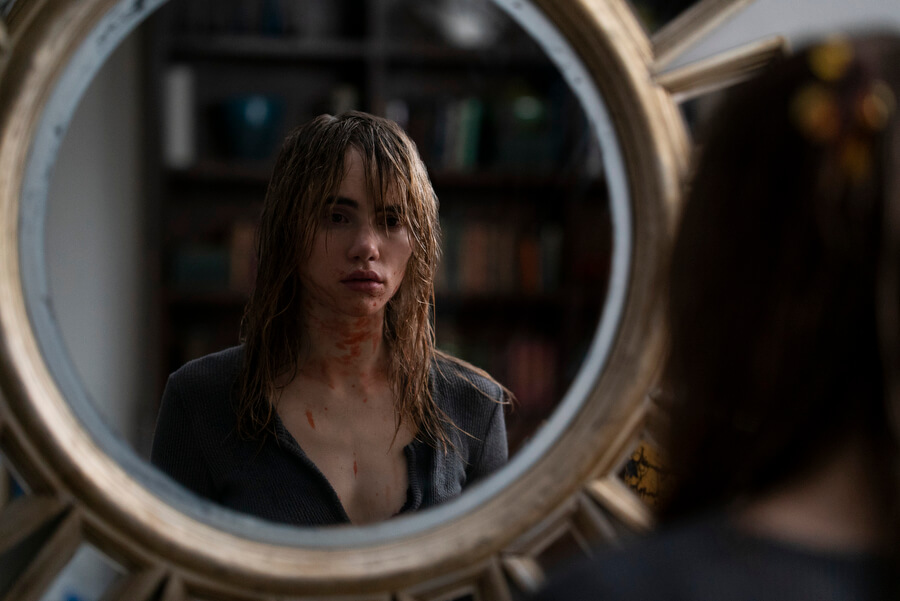
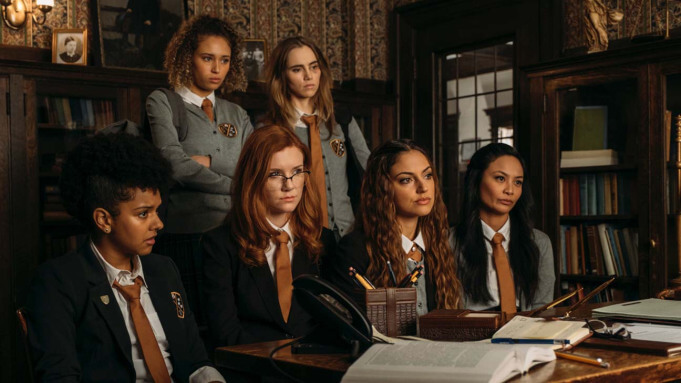
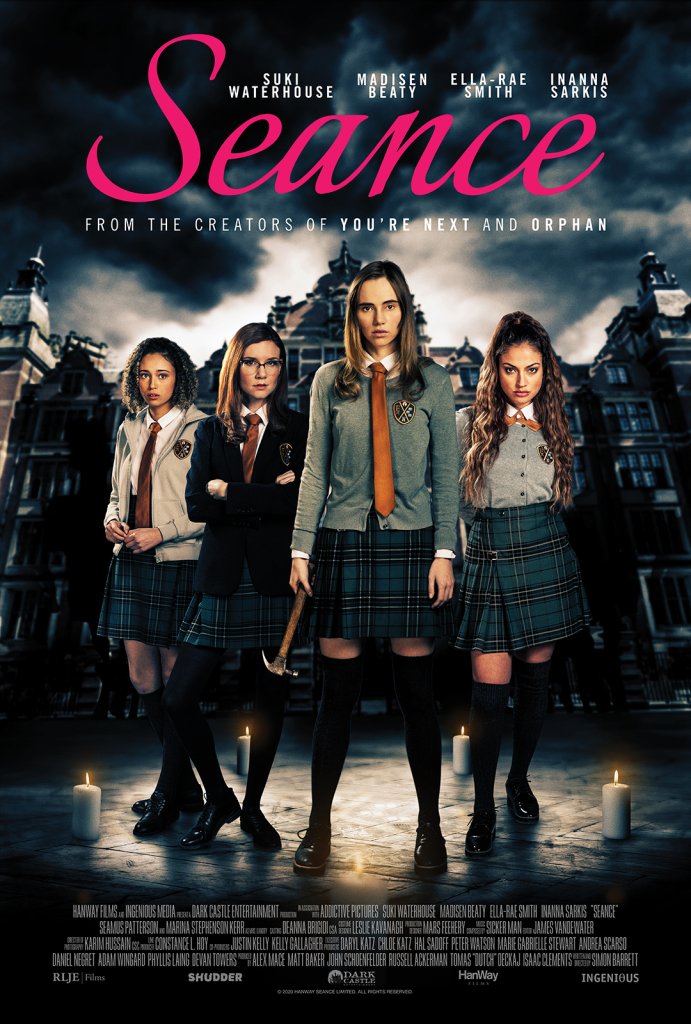
Writer Simon Barrett has been the scribe behind such genre faves as home-invasion thriller You’re Next, action-slasher The Guest, and the reboot/sequel Blair Witch, frequently collaborating with director Adam Wingard. However, Barrett’s latest script is also one he’s directed. Seance marks the writer’s feature-length directorial debut, and sees Camille Meadows (Suki Waterhouse), the new girl at the prestigious Edelvine Academy for Girls, dealing with some terrible things when, soon after her arrival, six girls invite her to join them in a late-night ritual, calling forth the spirit of a dead former student who reportedly haunts their halls. But before morning, one of the girls is dead, leaving the others wondering what they may have awakened.

It’s a blast and a half, and Seance balances haunted house scares with moments of tenderness and introspection. We spoke with writer-director Barrett about his new film and the process of putting it all together…

STARBURST: One of the things we love about what you’ve done with this movie, in terms of promotion, is the Twitter thread where you go through all of the various influences behind it. Smack dab there in the middle is The House On Sorority Row. That made us really excited to watch Seance.

Simon Barrett: The House On Sorority Row – there’s a reason I put that in the first ten of that list. I mean, the reason I started posting that list on Twitter is because I feel like, in all these interviews, a fairly common go-to question’s the direct inspirations. I think it’s especially because with films like You’re Next and The Guest, Adam [Wingard] and I – clearly we’re referencing films in ways that maybe weren’t totally obvious. Like, I’m not sure if people realize that the arc of the butterfly knife in The Guest is exactly the same as the arc of the butterfly knife in Face-Off until Adam and I were announced doing a Face-Off sequel. Then I think people went back to The Guest, like, “Oh, they just completely have a story arc from Face-Off just lifted into the film.” And it’s not an easy story to lift, ’cause it’s a pretty strange series of events, but they’re in there in both movies, ’cause I love Face-Off so much.

With Seance, people watch it and it’s so clearly working in this genre between murder-mystery and slasher that we would traditionally think of as the Giallo space that I wanted to be clear that I’m not just influenced by “good” movies – you know, the acknowledged classics or whatever. Suspiria is not going to appear on that list because the truth is I wasn’t very influenced by Suspiria ’cause it’s an impossible film to imitate. Either version of Suspiria is an impossible film to imitate, especially on a low budget. However, House On Sorority Row was itself a fairly low budget film that has a wonderful narrative and approach to its character and is an extraordinarily clever, well-made movie with great setups and payoffs that made a huge impression on me as a kid and, as an adult, I revisited on Blu-ray and was just like, “I love this movie. I want to do something like this.”

Seance

Among other things, Seance is what I guess you’d call a “prank-based slasher film” where the inciting incident is a juvenile prank gone wrong, to a certain extent. Nobody really understands how it went wrong or what happened and it’s about figuring that out. A lot of those are kind of lousy, but then you have your Terror Train, which is amazing. There’s a lot in that genre that I love, but I think House On Sorority Row – and, to a slightly lesser extent, its 2009 remake – both do an excellent job of putting you in this reality where everyone is just kind of lying to each other all the time, and then it just gets more kind of crazy from there. I just think those scripts for The House On Sorority Row and even its remake are both really underrated murder mysteries that hold up under a microscope, way better than most acknowledged murder mysteries. If you actually look at what those narratives are doing, they work better than a lot of what’s out there.

A couple of years ago, we got to talk to Cal Everett, who’s the frontman for the band 4 Out of 5 Doctors, who are the party band in The House On Sorority Row, and it turns out he’s a huge horror fan.

Their music really helps that film. The fact that the band in that movie is actually pretty fun – Bloody New Year‘s another film that actually has a pretty good band incongruously in a slasher film – and the movie’s aged really well because of that. Hopefully, it’s the same for Sicker Man’s music for Seance – it’s the kind of thing that people still enjoy 20 years from now.

The way that Sicker Man’s score goes from being score to being diegetic music coming out of people’s headphones and stuff is seamless and works so well. Watching the movie and reading all the credits, we were full-on just like sitting at the computer, head-nodding as that last song plays out because it is such a banger. How did you come to know the music of Tobias Vethake, but also end up using it in such an interesting and novel way within the film itself?

You know, the funny thing about being a first-time feature director making an independent movie that’s financed by sales companies: no-one’s really looking over your shoulder, telling you creatively what to do, so you can make these weird, impulsive decisions that, in some cases, turn out disastrous and in some cases, turn out just utterly perfect. I was just, with Sicker Man, a fan. I really discovered him through my filmmaker pal E.L. Katz, who did the last season of Channel Zero and Cheap Thrills and stuff. He had an album by the hip hop artist Serengeti that Sicker Man did the beats for called Doctor My Own Patience that we were listening to one night and I went out and bought the vinyl. I mean, I love Serengeti. I had all his early stuff, but this was such an interesting, sad album. It’s one of the saddest hip hop albums I’ve probably ever heard. It’s just about being depressed and relationships not working. And I was like, “Who did this music? It’s so strange,” and I looked up Sicker Man and I started getting into more of his music and I realized that his big thing was he did a lot of theatre scores. It was just a lot of weird experimental compositions for German theatre productions, and I was just like, “Well, that’s perfect. If he’s doing German theatre productions, he’ll be interested in working with me,” so I sent him a Facebook message and I just said, “Hey, you know, I’m a big fan of Sicker Man and I’m doing this movie and I kind of want a Brian Eno soundtrack.” I sent him a track from The Jacket that Brian and Roger Eno did and he was just like, “Okay, here’s some tracks. I’m interested in this project. Here’s some sample tracks,” and literally just sent me the Seance score, about seven tracks. And I was like, “Yeah, this is amazing. We’re going to hire you. We don’t really have any money,” but he was like, “Oh, it’s fine. I’m happy to be involved.” He was just so good-natured throughout the whole thing, but what he gave me was the ability to play those tracks to the cast and actually have them in my ears when I was going to set in the morning and stuff.

seance

How Adam and I always used to work – I mean, now we’re working in a more direct way on some of these bigger projects – but the way it used to work, back in the day, was Adam would have no idea what I was writing. When we were kind of coming up with our next projects, he’d be sending me music just being like, “I want to use this track, so make sure you’re writing something that can support that tone,” and Sicker Man gave me that straight out of the gate. I was like, “I want something beautiful that’s kind of the theme between these two characters and their connection.” I knew I was going to be doing the thing with the headphones where, when the audience is really with Suki’s character, we hear things the way she hears them but when we’re outside and she’s opening up a little, we hear things more from Helena – Ella-Rae’s perspective. I was working with the sound mixing team I had from You’re Next to The Guest to Blair Witch. Jeff Pitts is our sound editor. He’s won an Emmy. I just knew they’d be able to pull that off. It was just a weird thing where Sicker Man sent me these tracks and I was just like, “This is my favourite music. Let’s work together forever,” and he was just like, “Okay.” He’s already written, by the way, all the needle drop music that I’m using in my V/H/S ’94 segments. I literally just went to Tobias again and I was just like, “I’m doing another thing: here’s what I need,” and he sent me seven tracks and I was like, “Okay, this is perfect,” and then I was able to play them for my crew and cast on set and say, “This is what she’s going to be listening to,” and direct that way.

I hope to collaborate with him for the rest of my career. I feel like when we did The Guest, I feel like Survive, who ended up doing the Stranger Things score, was kind of a similar situation where an artist people maybe weren’t totally aware of just kind of blows up in a big way because they find kind of the right project that really allows people to understand their style, and I’m hoping that’s what happens here but, as far as I can tell, Tobias borderline doesn’t care. I mean, he’s happy and he likes work, but I don’t think he is really necessarily looking to do more film scores. I mean, maybe he is, but I think he’s just such a prolific talented artist that I can barely keep up with all his projects. He’s released three albums, like while we were finishing Seance and you know, he’s kind of unstoppable. Anyone reading this, just like look up Sicker Man on Bandcamp or some other ethical place.

seance

Speaking of people on the rise, as the lead, Camille, you’ve got Suki Waterhouse, as well as Madisen Beaty, who was just stellar in The Clovehitch Killer.

That’s why I cast her. Madisen Beaty is a genius and, truly, one of the best things about Madisen is she’s kind of a director herself, so she really thinks about scenes in a story-based way. She’s not afraid to look ridiculous or appear foolish if it’s what the scene needs. She really is like one of those just true zero-ego actors and randomly, so is Suki Waterhouse who, as far as I can tell, is absolutely happy when she is just utterly covered in fake blood in the midst of a fight scene and completely exhausted.

It feels like that’s when she really gets in her zone. I was randomly at the world premiere of The Bad Batch because Adam and I were kind of friendly with Ana Lily [Amirpour], who directed that movie. I’m just kind of a fan of her. I really loved A Girl Walks Home Alone at Night. So, I was at the Toronto premiere of The Bad Batch and was there when Suki got up on stage with Jason Momoa and I was like, “Oh, this person’s really kind of cool and interesting.” Then, when she was proposed for Seance, I was just kinda like, “Well, I don’t know how that’s going to work. She’s this famous model and we’re going off and making this movie where her character just takes damage for 90 minutes straight.” Then I sat down with Suki and realized that she’s as introspective and strange a person as anyone I’d met. I know a lot of other people, ’cause I’m a paranormal investigator. I do martial arts. I make horror movies, but Suki and I just instantly got along. I was just like, “Oh, I totally get all the ways in which you have a dry sense of humour and stuff.”

I was just really confident that she could do this. I think, you know, for me, it was just I was just kind of amazed that she trusted me enough to let me kind of direct this sort of hard-boiled performance that I was trying to get, because I think it’s sometimes hard for an actor to be kind of told to do very little, to really play everything very small. I think Billy Bob Thornton in The Man Who Wasn’t There, it was a very interesting performance, just how little he’s doing and how little physical movement and expression he uses to get a feeling across. I was interested in working in that mode. I was thinking more like Gabriel Byrne in Miller’s Crossing you know, with Suki. She really trusted me and was willing to experiment with that, from take to take. I’m really thrilled. I have a cool cast.

seance

With Madisen, I’d seen Once Upon A Time In Hollywood and I thought it was a masterpiece but you can’t judge someone on their performance in a hundred million dollar Tarantino film. But you can judge someone off something like The Clovehitch Killer, which doesn’t look like it cost that much more than Seance. The fact that she is doing such nuanced work in that role, in that film, let me know that this was a really serious performer who I could really trust and relate to. I feel like I directed Madisen the least. I changed a bunch of blocking and camera movement and stuff, and with Madisen, I was just like, “Just do what you’re doing!”

RLJE Films and Shudder will release SEANCE in US theatres, On Demand, and digital on May 21st. 

BOOK WORMHOLE: JONATHAN STRANGE & MR NORRELL – VOLUME III

When I finished Volume II, I was so sure that this novel would end in some epic battle, be it Norrell v. Strange or Norrell and Strange v. the gentleman with the thistle-down hair, and I imagined sitting down to write this review and spending most of the time gloating over how right I was. I have, after all, spent three months reading and analyzing this book within an inch of its papery life.

I was right…if the word “right” looks startlingly like the word “wrong”.

My great fallacy, I think, is that for all that this is a book published in the twenty-first century, I forgot the fact that it is written about—and like—a book from the 19th century. Massive climactic battles are not a hallmark of fiction from the era. Instead it’s introspection, and while I can’t deny that I am a tad disappointed that there was no huge fight as I had long assumed there would be, it doesn’t make me love the novel any less.

And oh do I love this novel.

When we last left off, Strange had gone to war and Norrell had squirreled away more magical books and then, having diverged so much from the opinions of his teacher, Strange abandoned his position as a pupil under Norrell’s tutelage. All the while, the enchantments that had ensnared Stephen Black and Lady Pole wound themselves tighter, and Arabella Strange, poor, sweet, loved Arabella, became the prey of the gentleman with the thistle-down hair. In Volume III we see the aftermath of the gentleman’s attentions to Mrs Strange in the havoc it wreaks with her husband. I’ve discussed Arabella and Strange’s relationship before, how typically 19th century it is all distance and decorum. Neither reader nor other characters could believe that Strange cared anything for his wife at all. Suffice it to say that Volume III does everything to dispel this notion, and does it with such skill that my heart ached for them. And how can’t it, with lines like: “‘There is an ache here.’ [Strange] tapped his heart. ‘And something hot and hard inside here.’ He tapped his forehead. ‘But half an hour’s conversation with Arabella would put both right, I am sure.’” Strange’s loss is written so wonderfully that it is able to do what all good literature should do: elicit a visceral reaction from its readers. Clarke uses both words and plot to accomplish this, because it’s not just that Arabella is gone and Strange is distraught, it’s how Strange communicates his distress that makes it so powerful. The above passage is sad, but it’s made even more so in context: Strange has been trying to purposely make himself go mad in order to better perform magic and to, ultimately, summon a faerie. At this moment, he is so mad that he thinks he’s Norrell’s friend Lascelles! As far as he’s concerned, he’s another person altogether, and yet he still thinks about his wife, and her absence is felt so acutely that it’s physical. This technique makes Strange’s narrative a powerful one, and gives weight to both his actions and to other character’s reactions to it.

It is this relationship that has always been one of the defining differences between Norrell and Strange, a difference that is made even more clear after she falls to the gentleman with the thistle-down hair. In fact, I would go so far as to say that Strange’s relationship with Arabella pretty much sums up his and Norrell’s differences of character. Strange is emotional, youthful (in every sense of the word), bold and open-minded; Norrell is unemotional, old, cruel, and close-minded. Norrell says early on in the novel that magicians have no business being married, as it only serves as a distraction from what is most important: learning magic. Emotional attachments are useless to Norrell, which becomes more and more obvious as the novel progresses, and horribly so. You would think that after having such a loyal, caring person like Childermas as a companion (while technically a servant, Childermass hardly holds to the role), Norrell would have some attachment to him. You would think that Norrell would care when he gets hurt and would trust his advice and, generally, not act like such an ungrateful jackass. But Norrell doesn’t have an attachment to anything except his books, and this sterility of emotion is detrimental to him. People need social interaction, and until he moved to London it appears that Norrell received little of that. A decade later, his improved (although still limited) social interaction appears to have done nothing for him. For all that Norrell is extremely manipulative, he’s not the best judge of people, taking what they say at face value and never considering that maybe, with some people, he shouldn’t. This sterility of emotion is not only what keeps Norrell from growing as a character, but it also keeps him from growing as a magician. Norrell is certain that marriage—emotional attachment—is a weakness, but it is while married and thus steeped in a heavily emotional relationship that Strange makes some amazing magical discoveries. He truly becomes, I think, the Greatest Magician of Their Age, and not because he’s studied hard and conned the competition, but because he loves, and no matter what love is more powerful than intellect.

It is this love which completes the comparison of Strange to Merlin that Clarke began in Volume II, when the Duke of Wellington gave Strange the nickname of Merlin when they were fighting in Spain. In many versions of Arthurian myth, Merlin’s death is always tied to a woman: Nimuë (aka Viviane, or the Lady of the Lake, depending on the work). According to the myth, Nimuë seduces Merlin and uses an enchantment (often times magic that Merlin has taught her himself) to trap him in a tree, a stone, or a cave. Sometimes she is willfully malicious, sometimes contrite, and it’s the latter that links most closely with Arabella, the novel’s Nimuë figure. Like Merlin, Strange finds himself put under an enchantment, with Arabella as an indirect cause as she doesn’t perform the enchantment herself. In fact, she doesn’t perform any magic, nor does any other woman. A female magician is mentioned in having existed in the novel’s past, and we are told that some women do take an interest in magic after Norrell and Strange resuscitate English magic (one such woman appears at the end of the novel), but of the primary women in the novel, Arabella Strange and Lady Pole and (in Volume III) Flora and Aunt Greysteel, none of them show any interest in practicing magic themselves. However, in a way this does tie Arabella closer to her Arthurian counterpart: Nimuë’s exposure to magic in some versions is through Merlin, who teaches her magic; similarly Arabella’s exposure to magic is through her husband, the Merlin figure of the novel. Arabella’s not having performed the enchantment turns her into a more sympathetic character than Nimuë, who even in her contrition still cursed Merlin by her own hand. It is also what makes Arabella and Strange’s relationship even more tragic, especially when you take into account that this was Merlin’s death.

I’ll leave it to you, readers, to find out for yourselves whether or not this was Strange’s death as well.

Overall, this is a fantastic novel. Clarke has made her alternate history incredibly rich, so much so that despite three reviews I have barely scratched the surface. The plot is well-crafted, everything interconnected and no character forgotten. From my own experience writing prose, I know how difficult it can be keeping track of a large cast, and I am extremely impressed that she is able to do so with such skill. The characters are also well-rounded, complex and flawed and wonderfully human. They feel so real sometimes, and as I said previously it is a hallmark of good fiction when a writer is able to elicit a visceral reaction from their readers. There were times when characters—particularly Norrell—frustrated me so much that I swore out loud and had to suppress the urge to toss the book across the room. There were also times, in the third volume especially, when I could feel myself hovering on the edge of tears and in fact did end up crying, so very heartsick. I know some might think it silly to get so wound up by fictional characters, but isn’t that what storytelling is supposed to do? For centuries it has been a tool used to inspire, to comfort, to warn, to make someone laugh; to have the message within the story resonate so much with its audience that they will go away with the desire to apply its teachings to their lives and to the world around them. This is why stories last so long, why thousands of years later we are still reading The Iliad and why Shakespeare plays still sell out theatre seats: stories leave an impression on our souls.

Of course, it’s not a perfect novel. I don’t think those exist, even with the Pulitzer Prize winners. Clarke’s use of antiquated spelling such as “chuse” instead of “choose” and “shewed” instead of “showed” in order to more firmly place the novel as something belonging to the 19th century still, even after a thousand pages, continued to trip me up. They are used far too sparingly, I think, allowing you no chance to grow accustomed to them, and instead of pulling me deeper into the narrative every rare occasion that I saw them only served to violently eject me from the text and remind me that that’s all it was—words. It made the novel appear self-conscious, and frankly I think the book would have been better served if she had stuck with the modern spellings that she uses for the other 99% of the novel.

What also proved frustrating were the footnotes. I’ve said before that the footnotes can be appreciated in hindsight. They make Clarke’s alternate history richer, more fleshed out and real, but there were many times when I was speeding through the action and suddenly there was a footnote, interrupting my momentum and keeping me from the building narrative, sometimes for pages, and I know much swearing occurred. As a writer, I can understand why Clarke uses them; she has spent so much time constructing a detailed world and doesn’t want to see her hard work go to waste, and the book is so much a history text that footnotes serve to emphasize and support this structure. As a reader, however, for all the more wonderful things that the footnotes taught me about the novel’s universe, the fact that it kept distracting me from the narrative I was most invested in proved so annoying that there were times when I considered ignoring the footnotes altogether.

I didn’t, and as I said, in hindsight I know that was a good thing to do.

Quite a while ago, reviews and reviews ago, I commented on the presence of genre fiction outside of the genre fiction sections in bookshops. Books like Slaughterhouse Five and 1984 aren’t in the same department as Terry Pratchett, regardless of the presence of dystopian futures and time travel which link them. Jonathan Strange & Mr Norrell, for all that it is clearly fantasy, was found months ago among the literary fiction, in the same section of Waterstone’s as Margaret Atwood and Angela Carter. When I purchased it I wondered why it was there, and even after reading it I’m still wondering. Is it because it’s an alternate history—alternate historical fiction—and as other works of historical fiction are shelved outside of the genre fiction area, Clarke’s novel went the same way? Is it because it was shortlisted for an award (the Whitbread First Novel Award)? But then that assumes that genre fiction is only literary when it is award-winning, and many sci-fi and fantasy books have won Hugo Awards (among others); is it, then, only non-genre fiction awards that make it literary? It sounds incredibly snobbish to assume that just because it was acknowledged by something open to works of multiple genres that Clarke’s book has been somehow…elevated. Because that implies, erroneously, that genre fiction is less important than literary fiction, and I’m sure you know now how little I believe that. To be honest, I can’t think of a good reason why Jonathan Strange & Mr Norrell wasn’t with the rest of the fantasy novels, but I doubt that it was a quirk of the bookshop staff.

I wholeheartedly recommend this book. It is intricately and carefully constructed, so much so that you can see how much effort the author put into it. The characters are real and the plot is engaging, and for all of its flaws it is a worthwhile read. It’s a commitment of course, due to its length and depth, but like many things it’s worth the time you decide to give it.

And with all of the bits I’ve left out, aren’t you just dying to find out the rest of the story?

[Article originally published in October 2011]

BOOK WORMHOLE: THE CASTLE OF OTRANTO

“Good writers borrow from other writers. Great writers steal from them outright.” So says Aaron Sorkin, writer and creator of The West Wing, and while that programme doesn’t have much to do with the genre fiction I’ve been reading (although there was a lovely episode subplot involving a Star Trek pin), the quote itself is completely applicable to Horace Walpole’s famous novel. And not because Walpole plagiarized.

            No matter what you write, no matter the topic or the plot or the characterization, every writer is inspired by those who came before them. Some, like James Joyce, take that inspiration to great heights, reworking previous works of literature as he did in his novel Ulysses, which was a retelling of Homer’s The Odyssey. Others take a quieter attitude, turns of phrase and small plot points a mere echo of the work that inspired them. That’s not what Walpole has done here. Instead, his work has acted as an inspiration for dozens of other writers, even those who have never heard of The Castle of Otranto before.

            The Castle of Otranto was first published in 1764 (500 copies on December 24, to be exact), and for the most part has been in print ever since. The subtitle of the first edition was “A Story”, but in later editions that changed to “A Gothic Story”, an indication of Walpole’s work having heralded a new genre: gothic fiction. The online Encyclopedia Britannica defines gothic fiction as “pseudomedieval fiction having a prevailing atmosphere of mystery and terror”, which is very true of Walpole’s novel, which is set in the time of princes and armor-clad knights.  Gothic fiction also contains supernatural elements, such as ghosts, which while seen in previous works (such as Shakespeare’s Hamlet) becomes something completely different when combined with such staples of modern day horror fiction as haunted houses, gloomy castles, and characters under curses. Gothic fiction fascinated many of the time period, resulting in a revival of gothic architecture and the birth of many classic works of literature. I would go so far as to say that it’s probably one of the most influential works of genre fiction, or at least one of the works that had the most influence on genre fiction. It is because of Walpole’s novel and gothic fiction that we have Mary Shelley’s Frankenstein and John William Polidori’s The Vampyre. Frankenstein, with a plot based heavily in the scientific realm instead of on the sorcery of The Castle of Otranto, has been said by some to be the first science fiction novel. In that vein, without Walpole’s book we wouldn’t have the works of HG Wells and Jules Verne, works which lead to George Orwell and Isaac Asimov; Douglas Adams and Philip K Dick; Star Wars and Star Trek and Doctor Who.

            A world without the Doctor scarcely bares thinking about.

            Polidori’s novel, in turn, paved the way for a heavy tradition of vampire fiction, most notably in the late 1800s with Bram Stoker’s Dracula. Dracula has spawned decades of vampire fiction (and helped Transylvanian tourism), and while vampires in the twenty-first century are a far cry from their gothic ancestors (the less said about Twilight the better) they still have a rich and fascinating literary and cinematic history. Gothic fiction also touched more mainstream (I hesitate to use the word “literary”) works. One of Charles Dickens’ most famous books, whose adaptations, be they faithful or filled with Muppets, are watched every year by thousands of people, and is a ghost story. Emily Brontë’s Wuthering Heights not only has many gothic themes, but also has elements of plot that are extremely similar to The Castle of Otranto. Henry James’ The Turn of the Screw is a classic gothic horror story, and the works of Edgar Allen Poe are steeped in the gothic tradition.

            Modern fiction and cinema haven’t abandoned gothic fiction, even though it’s been over two hundred years since Walpole’s book was first published. Every vampire and demon on our screens, every alien and ghost, every tortured soul and Saw sequel is connected to this one book, which is frankly magnificent. But then, as I said previously, every work of literature is connected in some way to the ones that came before it. The presence of ghosts in the novel isn’t a new idea or a happy coincidence; Shakespeare used ghosts (as well as faeries, witches, and other supernatural beings) in his work, and before him there were the ghost-like creatures in The Iliad and the ghost in Aeschylus’ Oresteia and ghosts in works across the globe, as like tales about dragons every culture contains ghost stories. Literature where characters discover long lost relatives, which contain arranged marriages, and where nobles are disguised as peasants and priests were also present before Walpole’s time. In fact, as I read the novel I was reminded rather heavily of A Winter’s Tale, which I read over the holidays last year. The thematic devices that Walpole uses aren’t new, but at the time of publication the way he used them most certainly was. Its uniqueness is, in part, what must have driven many to read it, and although there are better works out there, at least in my opinion, it’s a testament to its originality that no matter how many people pluck things from it The Castle of Otranto is still published today.

            While its history is fascinating, it’s the novel itself I’m sure you readers are most concerned with. I must admit that I had difficulty getting into it. The last time I read something from the eighteenth century was years ago when I was studying for my undergraduate degree, and in recent months I haven’t ventured farther than the twentieth century. Consequently, I found it a very dense text, and I mean that both literally and metaphorically. The novel’s language is noticeably antiquated, although still comprehensible once you get into it. There are many thee’s and thou’s in the dialogue, and the prose itself reminds me heavily of Jane Austen. The layout of the text, however, is what I had most difficulty with, which when paired with the language is probably why I found it troubling. The only paragraph breaks are those that separate ideas (as paragraph breaks are supposed to do), but that’s it. There are no breaks for dialogue. It’s all squished together without any quotation marks and it takes keen concentration, especially when you first start reading, to decipher which bits of text are dialogue and who is speaking. After a while, I did find myself getting into a rhythm and my reading becoming easier, but heaven forbid I get up to pee because once you step out of that rhythm it does take effort to get it back again. Losing your place also becomes extremely problematic when you have to navigate through great blocks of text in order to find the exact word you left off at.

            Some of this is, of course, personal preference. I am someone who likes clear dialogue tags and the type of page layout that we’ve been using since the Victorian Era. It’s probably why I spent so much time in Victorian Lit classes.

            As for the story itself, it’s a good one, although something that modern eyes will likely find rather familiar. The novel opens with Manfred, prince of Otranto, preparing to marry off his sickly son Conrad to Isabella in the hopes of keeping his family’s hold on his kingdom secure. Of course, the marriage doesn’t go to plan and Manfred’s actions post-botched wedding end up with himself and his castle being beset by ghosts and supernatural omens. There is much secret plotting and misunderstandings which make the story very reminiscent of Shakespeare for me. The story on its own is good, but I found it was a more fascinating read when it was combined with my knowledge of the literature that followed it. It was so interesting to see phrases like “[h]er blood curdled” knowing that they were used before they became such clichéd phrases. So was taking note of how much the plot surrounding Mandfred, Conrad and Isabella mirrored the one that formed around Heathcliff, Linton and Cathy in Wuthering Heights. There are other moments like that throughout the novel, where you see what it has given to the works that have come after it. Sometimes I wondered what reading the novel would have been like without this knowledge—what it was like for the people in eighteenth century Britain who had never seen something quite so extraordinary before. Those phrases that make us roll our eyes or, if you’re an editor, get out a big red pen must have been chilling when they first appeared. The Castle of Otranto is one of those novels that, unfortunately, kept me continually aware that it was a novel, that it was something I could critique and could relate to other works instead of enjoying purely for its own sake. It’s like that for many reasons, its text structure and style and its connectedness to other writing which, for the last bit, isn’t its fault, at least not entirely. I could have worked harder to separate it in my mind, to put my entire focus on the story, but with the struggle I was having with the text I found it nigh on impossible.

            Maybe on a second read I’ll have better luck.

            As this is a column that reviews genre fiction, I think it’s about time I start talking more about the ghosts, and the giant pieces of armor, and the prophecy that really is the catalyst for every action Manfred takes. I know I said in a previous review that, especially after over a decade of prophecy-steeped storyline in the form of Harry Potter, that it’s a rather tired literary device. It’s been used for centuries, but it seems so overused now. At the time, however, it was both a classic idea and a fresh one. Oversaturation wasn’t a problem when the mediums for expression were limited, and two hundred years ago people didn’t have to contend with prophecies in the books they read and the television they watched and the films they went to see. In any case, prophecy is used rather wonderfully in the novel, acting as a motivation for each of Manfred’s actions, even the ones that preceded the action we the reader get to see at the start of the novel. The prophecy is why Manfred is having his fifteen-year-old son get married, why after the wedding fails he is driven to more desperate acts making those around him completely miserable. The supernatural is used as both a tool of the prophecy, thwarting Manfred’s attempt at circumventing it, and as a warning to Manfred to stop what he’s doing and let the prophecy unfold. The ghosts and animated portraits aren’t just there to make the story scarier or to make it different from the other novels of the time. They serve a purpose, much like the supernatural does in Hamlet and Macbeth. They are even more striking—and even more useful—when the entirety of the first edition’s title page, as well as the introduction, is taken into account.

“From the original Italian of Onuphrio Muralto, Canon at the Church of St Nicholas at Otranto”, it reads, sighting this work not as something created by Walpole but rather as a found text. Walpole explains why he did this in the preface to the second edition, saying that he thought that the novel would be more readily accepted if it was believed to have some foundation in reality, i.e. if the novel was actually an account of real events. What Walpole wanted to do was have supernatural elements be reacted to realistically, which at the time wasn’t the fashion in literature. “An improbable event never fails to be attended by an absurd dialogue” he says of romantic stories, and because that was the norm he felt it prudent to fake the novel’s origins. In doing so, in having characters react in realistic, human ways, he has, and the novel even more striking, both to me and to the novel’s original audience, and it is very likely another way in which The Castle of Otranto inspired other writers. I would even go so far as to say that it influenced film as well. After all, when one artistic medium becomes more realistic it’s only logical that others will follow. I admit, it’s a stretch, because emotional realism in film (and on stage) started becoming popular years and years after it became popular in literature. Nevertheless, I like to think there’s a connection.

All in all, it’s a rich text. It’s short, which given my struggles with it is probably for the best, but it doesn’t leave you bereft. There is so much to think about with this novel, and while it can be difficult at times and needs great focus, I think for those of you who want to see one of the birthplaces of genre fiction it is well worth a read.

            And for all of us hoping to become great writers, it’s good to know where to steal from.

[Article originally published in November 2011]

BOOK WORMHOLE: JONATHAN STRANGE & MR NORRELL – VOLUME II

Or, The One Where Jonathan Strange Goes To War And Annoys Lord Wellington. Or, even more appropriately, The Tipping Point, because this is the volume where so much changes.

When we last left off, the magician Mr Norrell had removed himself from Yorkshire to London to bring about a renaissance of English magic. We’d been introduced, briefly, to Jonathan Strange and to a number of other characters: Sir Walter Pole and his wife, Lady Pole; the beggar magician Vinculus; Norrell’s London friends and helpers Drawlight and Lascelles; Sir Walter’s servant Stephen Black; and a host of others, including the gentleman with the thistle-down hair, who is given no other name but with the information given through dialogue and footnote I can’t help but guess at his identity. We had also been left with the foreknowledge that the second volume would bring Jonathan Strange to London, to Norrell’s doorstep, and that he would become his pupil. And he does, but not because he asks, rather because Norrell does. It’s a bit surprising even though we know it’s coming, because Norrell has done everything to ensure that he is the only practicing magician in England, but that’s very much a part of it. What better way, after all, to ensure that his authority goes unchallenged than to have the only other practicing magician subordinate to him?

Norrell’s authority is a constant in both volumes of the novel, and I know it will continue into the third volume as well. It’s one of the—if not the—primary characteristics he has, and one of the first things we know about him. From the beginning of the novel, when Norrell agrees to perform magic for the York Society under the conditions that they will give up studying magic (even if they never perform it), we are told that what he wants is authority over magic. He doesn’t just want to be the best magician, he wants to be the only magician, and in order to accomplish this he will seemingly do anything, including threatening people and hording all magical knowledge for himself. Strange threatens this authority, but as I said Norrell’s taking him on as a pupil circumvents this threat, at least in his eyes. Norrell will have Strange studying until they both die, which will maintain their teacher-student relationship and allow Norrell to continue to be the authority on magic; Strange will never get a chance to grow above him (especially when Norrell keeps books that would likely facilitate this growth locked in his library in Yorkshire). As the volume progresses, it continues to be made painfully clear that Norrell is absolutely terrified of losing his position as the authority on English magic, and nothing makes this so prevalent as when Norrell agrees to persuading Strange to go to war, to prevent the possibility of Strange getting his hands on some newly-available books of magic.

Which, for someone who desires stasis, is a very stupid thing; war is never static.

In my review of Volume I, I mentioned how Clarke works with the historical period her story is set in, including having historical figures appearing within the novel alongside the fictional characters. Volume II is where she makes ample use of this, beginning right when Strange heads to Spain and the troops led by the not-as-yet Duke of Wellington. At first, Strange is useless. Wellington doesn’t want him, Strange can’t think of anything to do, and overall the army appears to not be in need of his services at all. But Strange refuses to just turn around and go back to London, and eventually is able to use his magic to aid the army. Spain, quite literally, is never the same.

It’s during his three years helping Wellington that Strange’s opinions really start to diverge from Norrell’s. They have always had differing opinions about some things (faeries and the magician the Raven King being two big ones), but for the most part Strange appeared largely content to be Norrell’s pupil. But on his own using magic outside the safety of a London sitting room, to such great purpose, Strange begins to wonder if he wouldn’t learn more away from Norrell, who seems so stifling when Strange finally returns. As I said, war is not static, and neither are the people who participate in it. Strange saw all the worst of humanity, the things we can do to each other for glory or victory or when faced with our mortality down the barrel of a gun. And Strange didn’t just observe, he did things for the sake of helping his country that made him question the sort of magic he was performing, as he “was obliged to invent most of the magic he did, working from general principles and half-remembered stories from old books”, as he did before he became Norrell’s pupil. One of the most striking images of Strange during his time in Spain is when he reanimates seventeen Neapolitan corpses. Strange watches them come to life “apparently without emotion”, altogether appearing rather nonchalant and the antithesis of the gentlemanly magician Norrell would want him to be. A portrait of Strange painted with the Neapolitans, whose enchantment lasts and who stalk Strange, begging to be returned to full life, shows what dialogue and description up until that point have not: what his experience, both with war and with magic, has done to him.

“In the picture Strange is seated on the ground. His gaze is cast down and his arms hang limp at his sides and his whole attitude speaks of helplessness and despair. The Neapolitans crowd around him; some regarding him hungrily; others have expressions of supplication on their faces; one is putting out a tentative finger to stroke the back of his hair. It is, needless to say, quite different from any other portrait of Strange.”

Even after his three years, Strange joins Wellington at Waterloo and has an experience I’m certain will be significant in the next volume. Strange is confronted by a French cuirassier on horseback, sabre raised, and “[w]ithout thinking” Strange prepares to “smash horse and horseman out of existence” with one single spell. But then, he freezes. He had told Wellington, once, that “‘[a] magician might, but a gentleman never could’” kill a man using magic, and it appears that for all that he has used magic to misdirect and frighten and raise the dead, when faced with killing a man who stands inches in front of him, Strange is a gentleman. After, “[h]e believed he wandered about in a dazed condition”, although he can’t really remember, and I’m sure that he will be faced with this again, this very human decision to having to stand there, look someone in the eye, and decide whether or not to kill them or risk himself—or someone he cares about—being killed instead.

Strange returns to Norrell, Norrell who has been occupied with the same tasks as he was years before, with the same people, living comfortably in his house in London instead of sleeping on floors and trekking through muddy fields. Norrell has remained in his desired static state, the only thing that appears to have changed being his age, and when he meets Strange he meets his worst fear: a very real, and very willing, threat to his magical authority. Who he meets is a man who embodies everything about the nickname Wellington bestowed upon him in Spain: Merlin. I found this an extremely apt nickname, and not only because Strange was a magician and Wellington the heroic knight. Geoffrey of Monmouth’s take on Merlin’s origins have him being the son of a demon (specifically an incubus) and a nun. A cruel father and a wronged mother; this is very allusive to Strange’s own origins. Merlin also worked for the betterment of Britain, like Strange, and his relationship with Wellington is very much like Merlin’s relationship with King Arthur, one of advice and aid. Wellington himself is Arthurian, a hero of Britain, and the book Reinventing King Arthur: The Arthurian Legends In Victorian Culture by Inga Bryden gives examples of this comparison having been made by Wellington’s contemporaries, such as in a political cartoon that depicts Wellington in a very Arthurian manner. Strange’s state of shock during the Battle of Waterloo is also rather allusive to the Vita Merlini, a version of Merlin’s life which has him going mad after a battle. Of course, as yet it’s not a complete comparison; Merlin is primarily defeated by a woman (Nimuë), and thus far Strange has not been defeated by anyone. But he does have a wife, Arabella, and after they first met Norrell said that “‘[m]agicians have no business marrying.’” At first I thought that this was just Norrell being Norrell, resenting any distraction in the pursuit of magical knowledge and now in his spending every waking moment with his new pupil. But now I can’t help but wonder, is it more than that? Is it foreshadowing? Is Arabella a (possibly unwitting) Nimuë?

It’s looking more and more likely the more pages pass.

Strange’s relationship with Arabella is in the background. We rarely see them alone together (although, to be fair, for a good chunk of Volume II he is away from her in Spain), and consequently we only see the typical Romantic relationship, all politeness and distance and, very much on Strange’s part, indifference. But in both their public interactions and the brief private ones were are allowed to see, I found them rather complimentary. Arabella is practical where her husband is impractical, polite where he is rude. If it weren’t for the magic he performs and the grace of his wife, Strange probably would have been kicked back to Shropshire long ago. Arabella says as much, telling Lady Pole that she has been “‘obliged to go in and rescue him before he says something he had much better not.’” She saves him, she says, and towards the end of the volume we are given a glimpse into just how much Strange actually cares about her, and at the risk of spoiling everything, it appears that Strange will get a chance to save her (although a part of me would love it if she saved herself).

Arabella needs saving for the same reason Lady Pole does, and Stephen Black. The gentleman with the thistle-down hair, who I mentioned oh-so briefly in my review of Volume I, is a character whose best description is as the villain, although I’m not quite sure it’s so simple as that. He is a faerie, one of the race that Norrell steadfastly claims magicians need not align themselves with, which is ironic because Norrell is the one who brings the gentleman with the thistle-down hair into the story to begin with.

Hypocritical Norrell; is it any wonder that I have difficulty sympathizing with him sometimes?

Norrell performed a spell early on in the novel, something more than what Strange did during the war, and employed the use of someone he claimed that he had no need of in order to accomplish it. He tried to make it without consequences, but there they were: ones that he didn’t bear but Lady Pole did. And Stephen Black. And as the novel progresses the gentleman with the thistle-down hair is becoming more prominent, and manipulating the human world more and more, and now there’s Arabella, who didn’t do anything except marry a magician and make Lady Pole her friend. The gentleman with the thistle-down hair isn’t only attracted to her, he wants to use her to get to the magicians he hates. It’s unclear at this stage whether or not he will be able to get to Norrell. As said, the Strange that returned from Spain is a man dissatisfied with his place as Norrell’s pupil, who no longer believes that it is where he is supposed to be and who is more willing to voice his contrary opinions; a Strange who threatens Norrell’s stasis, and in fact turns Norrell’s stasis against him. The new Strange has had worlds more practical experience than his teacher, and is more ready to embrace the ideas and practices Norrell rejects, and to in fact be the kind of magician that, from what we are told, is rather reminiscent of the Raven King: the inventor, the prodigy, the Greatest Magician of an Age.

The whole volume is a set up for Volume III, building on Strange and Norrell’s relationship and then, piece by piece, disagreement by disagreement, picking it apart until we are left certain that at some point they are going to clash. In Volume I, I was sure of it. They will be allies first, then enemies, the entire thing smacking of a relationship that reminds the comic book aficionado in me of Professor X and Magneto. But now, with two volumes completed and the final one begging to be read, I’m not so sure anymore. The man with the thistle-down hair has become a common antagonist for Strange and Norrell, both because of who he is and who he has hurt, and I can easily see them joining forces. Suppositions aside, however, Clarke works with this volume beautifully. Its density is sometimes a struggle, the level of detail and depth she provides to her constructed world seeming almost too much, as something in the way of the primary action you are aching to get to. Once you get to that action, however, I found that it was worth reading every lengthy footnote. This isn’t, after all, just a fantasy novel Clarke is writing, it’s an alternate history, and the richer and more detailed this world and its characters become the more you can believe that they could have existed, that in some alternate universe they did.

The entire function of the volume as a place of transition can, I think, be summed up in one single paragraph from the novel. It encapsulates every feeling and every foreshadow, and is strengthened by the richness of its speaker’s character, sending a shiver carving its way down your spine:

“Until this moment it had never seemed to him that his magicianship set him apart from other men. But now he had glimpsed the wrong side of something. He had the eeriest feeling—as if the world were growing older around him, and the best part of existence—laughter, love and innocence—were slipping irrevocably into the past.”

How right Strange is. I can’t wait to read more.

Article originally published in September 2011

BOOK WORMHOLE: JONATHAN STRANGE & MR NORRELL – VOLUME I

After two books greatly steeped in aliens and androids and lasers, I thought it was time to delve into one of the other areas of genre fiction, specifically fantasy. I’ve read fantasy before, and in fact loved it first before I fell for science fiction. I’m not sure how far back it goes; The Wizard of Oz was a definite start, The Chronicles of Narnia another. I fell hard and fast for Harry Potter and spent six months reading The Lord of the Rings (and somehow managed to do all of my school work too). It was somewhere between Order of the Phoenix and Half-Blood Prince that my dad read an article about book recommendations for Potter fans, and pointed out Jonathan Strange & Mr Norrell to me in a bookshop. At the time, it was in plain black hardback, striking and intriguing, but daunting in its size (and this from the girl who later read Deathly Hallows in two days).

I ignored it.

Now, seven years after its original release in 2004, I have finally decided to give it the attention it deserves—volume by volume. Because at 1006 pages the paperback makes a satisfying thump when you set it on a table; the hardcover could probably kill someone. If I have one criticism it’s that it would be far easier to read if it was broken up into three separate books, one for each volume, much like a number of editions of The Hitchhiker’s Guide to the Galaxy have been. Carting it around to coffee shops and on spontaneous holidays is difficult when you have to put it in a separate canvas bag because it won’t fit in your purse.

Set in early 19th Century England, the text reflects it, although I’m not sure if it’s to the novel’s betterment. While the prose has that formal Austen-esque tone to it, it’s not as weighty; not as rife with semi-colons or paragraph-long sentences. In fact, it’s a surprisingly easy read. Clarke does, however, throw in the occasional Romantic spelling, such as “chuse” and shewed” (in fact, I believe those are the only two words spelt differently in the whole of the first volume), and I can’t say I’m a fan of it. As opposed to the stylistic nod it’s probably supposed to be, I found it jarring, each use a stone in the text making my eyes trip and stumble right out of the narrative. But it’s the only thing that does, as aside from the prose there is also another nod to 19th Century literature: pictures.

For the most part, pictures are now firmly relegated to children’s books, however, illustrations have been used in literature for centuries—literature firmly aimed at adults. Charles Dickens’ Oliver Twist was illustrated, for example, and I happen to have a lovely copy of Jane Eyre from the 1930s that is filled with block prints. The illustrations are beautiful, almost haunting, and by artist Portia Rosenberg. They are reminiscent of the ones in the American editions of the Harry Potter books (drawn by Mary GrandPré), although they are lacking in the shocked expressions—wide eyes and round mouths—that seem so prominent in GrandPré’s work. There’s something sinister about them, something hazy, the edges smudged and all done up in shades of grey. They’re like flashes from a dream, and they support the text wonderfully, bolstering ones image of the described characters rather than serving to paint another picture of them entirely.

Supporting the text are also copious footnotes, sometimes ones so long that they go on for pages, but always giving more detail, always serving to make the alternate universe Clarke is creating fuller. Many of the footnotes regard texts mentioned by Mr Norrell, or stories mentioned in passing in the primary narrative. It’s all very Terry Pratchett to me (as footnotes are one of his trademarks), although in this case while the deviations are enjoyable, sometimes their length can become distracting.

The first of the three volumes is titled “Mr Norrell”, although it hardly starts with him. Instead, the book opens with The Learned Society of York Magicians, who instead of waving wands and brewing potions “read each other long, dull papers on the history of English magic”. These so-called “gentleman-magicians”, who can no more practice magic than we readers can, “enjoy[ed] a reputation as some of the wisest and most magical men in Yorkshire”, and yet, at the behest of one of their newest members, they contact a “practical magician”: Mr Norrell. It’s an interesting contrast, the academic magicians versus the practitioner, and one can’t help but wonder if Clarke is making some kind of comment on those who spend their lives talking about something without ever actually having experienced it themselves. The researcher versus the scientist? The critic versus the writer? In any case, the York Society is painted as being ineffectual and silly which, if a comparison does lie within the narrative, doesn’t bode well for researchers, critics, and academics. When they do meet him, Mr Norrell isn’t at all like the York Society expects, being “small” with a quiet voice “as if he were not used to speaking his thoughts out loud”. Appearance is a common theme within the book, and within 19th Century literature as well, the motif’s typical operation being that a character’s personality reflects in their physical appearance. Fair faces and blonde curls mean innocence and virtue, while dark hair and sharp eyes mean cruelty and intelligence and, in women, wild sexuality. George Eliot’s The Mill on the Floss uses this very motif to juxtapose two of her characters, the primary one not, in fact, being the virtuous blonde, and many more authors have both made use of this motif and subverted it.  Clarke seems to be doing a bit of both, because often times the expectations many of the characters have of magicians are dashed. Magicians are supposed to look like Vinculus, “lank hair and a dirty yellow curtain”, doing spells on the street and, generally, swindling people. They are not supposed to be small men who wear wigs and read books, although cheating people seems to be something both Norrell and Vinculus have in common. It’s early on in the volume that Norrell offers to show the York Society practical magic, all for the price of them renouncing their titles as gentleman-magicians and ceasing their study of magic. It’s a perfect example of Clarke’s subversion of the motif, because just as none of the characters would mistake Norrell for a magician on sight, neither would they think he would be so cruel as to try and stamp out others’ pursuit of magic.

In Norrell, there’s a very interesting (and very real) contradiction of ideas, because as I said, he hordes all knowledge and practical magical application for himself, however, his move to London is exactly the opposite: the desire for a Renaissance. Like works such as Vanity Fair, Jonathan Strange & Mr Norrell does not shy away from the political occurrences happening within the book’s time period. The novel opens a few years into the Napoleonic Wars (which ran from 1803 to 1815), and it plays a key part in the first volume. Mr Norrell uproots himself from his home in Yorkshire to London, with a desire to use his magic to help defeat the French, and to revive practical English magic. But for all that he yearns for English magic to flourish, he wants to be the only one wielding it. This kind of dichotomy is typical of 19th Century fiction, two forces—two worlds—often opposing one another. Rich versus poor and man versus woman are very popular, and there are numerous examples here in this novel: the British versus the French; magical versus non-magical; self-interest versus selflessness; fairy world versus human world. Even the brief glimpses we are given of Jonathan Strange via footnotes and some not-terribly-cryptic foreshadowing lead one to wondering if Strange and Norrell will be pitted against one another. Their introductions are very different, after all, because for all that it is Norrell’s volume, there are glimpses of Strange in there too.

The first time we’re introduced to him, on the first page, is through a footnote, a reference to a book he had written. There are many more like that, some even referencing Strange as Norrell’s pupil, and I’m not entirely sure I like that. Granted, it does make one wonder, as the volume progresses, how Norrell eventually acquires Strange as a student. Is Strange a distant relative? A homeless boy taken in á la Oliver Twist? One of those Vinculus-like charlatan magicians who actually has magical talent? However, revealing the nature of Norrell and Strange’s eventual relationship is almost disappointing and, for all that I am still unsure about whether or not I like it, it took some of the magic out of their story for me. Nevertheless, after numerous footnotes, in Chapter 14, we are introduced to Laurence Strange, Jonathan’s father. Laurence Strange is Ebenezer Scrooge without the tragic past, without any qualities that would make him redeemable save for allowing his son to grow up largely away from him (although even that is due to a desire to “avoid[ing] paying for the boy’s food and clothes for months at a time”). The chapter is largely devoted to him, although we get glimpses of his son: Jonathan Strange who is quiet, Jonathan Strange who hides sherry bottles in odd places, Jonathan Strange who doesn’t appear to have any magical aptitude at all.

Of course, with two more volumes before us, it is only a matter of time before Strange the Younger develops an interest in magic, one that holds his attention longer than any other profession he’s entered into before. A prophecy also heralds his interest, a popular plot device in fantasy fiction. I will admit that, post-Harry Potter, another fantasy story with its leads entangled in a prophecy is a little bit eye-roll worthy. However, prophecy has a long history in fantasy literature, reaching back into what could be called the beginnings of fantasy: ancient myth. Not only did the ancient Greeks firmly believe in the divinations from the Oracle at Delphi, but their myths are riddled with prophecies, most often concerning what happens when they are ignored, such as with the Trojan War. Clarke even borrows a plot device from the aforementioned war myth, casting Vinculus in the role of Cassandra, who delivered the prophecy of the destruction of Troy at the hands of her brother Paris.

Stupidly, no one believed her.

Despite readers being bluntly told that Strange becomes Norrell’s pupil, it does make one wonder how easy it’s going to be for that to occur. Strange, who is wealthy with an estate in Shropshire, is hardly likely to stroll up to Mr Norrell’s front door in London asking to be tutored, and Norrell is hardly likely to take him on seeing as he would rather be the only magician in Britain. But obviously it does happen, and it is something that keeps you moving towards the second volume. To Clarke’s credit, Norrell’s campaign to revive English magic is not an easy one, adding a realism which I love. Prior to his move, one of the members of the York Society, Mr Segundus, writes “AN APPEAL TO THE FRIENDS OF ENGLISH MAGIC” in the hopes of drumming up support, but it isn’t instantaneous, and since Norrell is as solitary and socially awkward as any massive bibliophile can be (and I say this as a bibliophile myself), he ends up acquiring assistance in order to do what he wishes to do: help in the war.

How Norrell goes about convincing the government of his usefulness is when magic truly starts to take hold in the novel. Oh, magic was performed before, but the enchantment used at the beginning of the volume pales in comparison to what comes later. The novel is not about the kind of magic that makes you think of sunshine, that enchants teapots and does the washing and turns bees to butterflies. Instead it’s the kind of magic that makes you think of winter, the very opening month of the book, January with slate-coloured skies and frigid breezes and everything cast in cold blue light. It’s the kind of magic that tricks armies and does unnatural things, with consequences this volume only touches on.

Because this early on, things can only get worse.

The first volume of Jonathan Strange & Mr Norrell is set up rather brilliantly. It introduces the titular characters, major themes, as well as an antagonist known only as “the gentleman with the thistle-down hair”. While the content of the next two volumes is hinted at, it’s just enough to keep you reading, as, of course, is the prose, modeled after Romantic writers and wonderfully crafted. It does everything that a good book should, to ensure that its readers will refuse to put it down.

I know it’s cast its spell on me.

Article originally published in July 2011.

BOOK WORMHOLE: DO ANDROIDS DREAM OF ELECTRIC SHEEP?

Blade Runner is my dad’s favourite film. All the while I was growing up, not a month wouldn’t go by that it wasn’t on the television, be it because he put in the VHS (and later, DVD), or because he had found one of the stations playing it and couldn’t resist even having it on in the background. It has been a nigh-constant presence in my life, always hovering, but I never actually sat down to watch it. As a kid, the dark cinematography was unappealing. Reading books and wearing out my tape of The Wizard of Oz seemed a better use of my time. Later, Japanese anime and Victorian fiction and spending time with my friends overcame any desire I had to watch my dad’s film.

Teenagers…

Now, as an adult (or as adult as I’ll ever get), my tastes have changed—widened—and my foray into science fiction has led me to a classic not just of the genre, but also of film itself. Imagine my surprise to discover it was first a book?

I’m not sure why Ridley Scott et al changed the title, aside from it being a bit of a mouthful, but Blade Runner was first penned as Do Androids Dream of Electric Sheep? by Philip K Dick in 1968. Said title is a question that never gets answered, but the rest of the book more than makes up for it. Rick Deckard is a bounty hunter, tasked with ‘retiring’ six androids. With the money he makes, he hopes to buy a real sheep, to replace the electric one that sits on the roof of his apartment building amongst everyone else’s real animals. Because in this post-World War Terminus Earth, those who hadn’t packed up and headed for Mars are obsessed with owning real animals, with the hope they can feed them and breed them and, someday, make Earth like it was before birds started dropping out of sky. Of course, androids and toxic nuclear fallout don’t make it easy.

The book is vastly different from the film, and not just in the change of the title and the tweaking of names (the Rosen Association of the book becoming the Tyrell Corporation, for example). Many of the primary themes of the novel are absent from the film, and while it makes the film no less entertaining, I believe the novel is far richer for their presence. And it is a rich book; Dick’s use of language is fantastic, and I could go on and on about his lovely turns of phrase like “despotic force of time” and the way language works with character and his vivid, almost cinematic imagery. There are a number of plotlines within the book as well that aren’t fully fleshed out within the film, such as John Isidore’s, a “special” (those with “distorted genes” and a low IQ courtesy of the nuclear fallout) and the sole occupant of an apartment building who makes friends with androids, a character who is sweet and painfully human. But the novel’s complexity isn’t overwhelming, and it’s a surprisingly quick read. Which, I think, is the best way to do it, because it’s a bleak book; not only in action, but also in how many of the themes of the novel play out.

Nature is one of the big themes—if not the biggest—of the novel. The toxic state of the planet affects everyone’s daily lives, from their having to dress in protective gear such as an “Ajax model Mountibank Lead Codpiece” to living in nigh-constant fear that the nuclear fallout will erode their brain and twist their DNA until they’re labeled “special”—defective. But it is in animal ownership that this theme is strongly and unceasingly displayed, starting first with Deckard’s electric sheep. Owning an animal is a status symbol, more so in the novel than it is for us now, with celebrities carting around doll-like dogs in their designer handbags, like the dog was something that came with their piece of Prada. But it isn’t just status that has people keeping horses and goats on the roofs of their apartments—it’s necessity. It’s unheard of, in the novel’s alternate 1990s, to find an animal in the wild, and because of their scarcity, they dominate most of the dialogue. Deckard keeps a well-thumbed catalogue with him at all times, called “Sidney’s Animal & Fowl”, and his thoughts are consumed with replacing his electric sheep with a real animal. It is, I think, the driving force behind everything he does. Oh, sure, he questions other things (his feelings towards androids, for example) and he needs the money he makes for supporting himself and his wife, Iran, but those are always passing thoughts. It’s the animals he dwells on. It’s like being back in the 19th Century, or any time before technology and urban sprawl reduced our reliance on, and subsequently the importance of, animals. In many cultures, animals were traded, used as a form of currency, and in fact a conversation between Deckard and one of his neighbours, Bill Barbour, sounds very much like one that might have happened between farmers years ago, when having prime livestock was the focus of their lives.

The psychological aspect of pet ownership has been a frequent focus in twentieth century psychology. Pets provide companionship and security, but within the novel, the way characters cling to animal ownership demonstrates just how important animals are to human life. Not just having a pet—a dog or cat or rabbit—but having nature present in our lives. The environmental message in the book is huge, and one that, as an environmentalist, I eagerly devoured. As previously stated, the world of the novel is one almost bereft of nature. The air is toxic, the flora brittle and contaminated, and the fauna almost non-existent. It’s the very definition of a wasteland, one that it is obvious humans can’t sanely inhabit. With so many people living in cities, you might think that you would get on fine without pigeons dirtying your car windscreen and flies invading your home. Ants and mosquitoes and spiders, hell, life would be perfect without insects ruining picnics and the clothes you forgot to stuff full of mothballs. But imagine walking down a street, with a shining sun and wind in the trees and there is…silence. Imagine strolling through the country with only the sound of your footsteps, with only your footsteps, because there are no squirrels on branches or sparrows in trees. Imagine barely being able to recall what a sparrow even looks like.

There are reasons why green spaces in cities are so important. Not just for human physical wellbeing, but for emotional and psychological wellbeing too. It’s not purely for estheticism that there are trees and hedges decorating carparks and that there’s always one potted plant in every home. People need nature in their lives, need the sense of connection it gives us to our evolutionary and historical past when we weren’t so removed from it. We need the sense of calm it brings, the joy, and we need it to remind us that no matter how advanced we become, no matter how much we construct and how much we take, nature is always the superior force. So much of what happens on our planet is outside of our control, and while acts of natural disaster can be taken at face value—as disaster—they can also been taken as a reminder of our own insignificance. At the heart of it, we are animals, and like animals we are subject to and reliant on the planet we inhabit. Because like I said, we need nature; it’s why groups like Greenpeace and World Wildlife Fun exist, and it’s something everyone in the novel has come to learn, in a way hopefully we don’t have to. The fate of the environment (both earth and animals) always hovers in the background of the novel, a desperate, didn’t-know-what-you-had-until-you-lost-it hope that it will recover and be like it once was.

Unfortunately for Deckard and everyone else, it seems to be a useless hope.

The film’s primary focus is the androids, and while I saw the environmental message as something greater, I also found it constantly at war with the presence of the artificial within the novel. And it’s not just Deckard vs. the androids, it’s other things as well. In a world so consumed by a desire for the natural—who believe its superiority over those manmade androids and pets—it is perfectly all right for humans to fabricate their emotions. The first glimpse of Deckard and Iran that we get is of them being awoken by their “Penfield Mood Organ”, a piece of technology that allows them to “dial” specific emotions, even “a setting that stimulates [their] cerebral cortex[es] into wanting to dial”. The only way of identifying an android is even through emotions, as they cannot feel empathy, and yet this supposedly highly-held hallmark is being willingly degraded. And I say degraded, because while alone in their apartment, Iran says she “heard the…[e]mpty apartments” and felt nothing, and “realized how unhealthy it was, sensing the absence of life, not just in [the] building but everywhere and not reacting”. This moment is a jumping off point for everything else in the novel, as for every question Deckard has about androids, every doubt, every time he looks within himself and wonders at his feelings towards androids, is because if he can figure that out—if he can find a definitive difference that is more than just biological—then he can be safe knowing that for all that he is chipping away at his own humanity, he is still separate from androids. But of course, that isn’t an easy quest, and Deckard frequently finds himself in existential crises concerning the androids. “‘Do you think androids have souls?’” Deckard asks, at one point, gun still hot from ‘retiring’ one; “Empathy towards an artificial construct? he asked himself. Something that only pretends to be alive? But [the android] had seemed genuinely alive; it had not worn the aspect of simulation.” He desperately tries to find a way to explain his sudden, naturally-occurring feeling, to find some sort of truth. If something is man-made, it isn’t alive. It may have the skin of a living thing—a talking doll or toy dog that can walk or electric sheep—but it’s a machine. It doesn’t feel. It’s no better than your toaster. But when does it get to the point that technology has replicated life? Is life personality? Unprompted speech? Independent movement? Is it taking up an occupation or owning an animal or, even, having a relationship? When does a machine stop being a machine, and start being…something else entirely?

There is a definitive difference between humans and androids that is made clear in the novel: belief. The easiest way this is shown is through Mercerism, the religion that greatly resembles Christianity, from the animal symbolism (important animals are “[t]he donkey and especially the toad”) to miraculous healing (making “the dead return[ed] to life”) to the promise of a Second Coming for the Christ-like Mercer (“He had sunk down into the tomb world. He could not get out until the bones strewn around him grew back into living creatures; he had become joined to the metabolism of other lives and until they rose he could not rise either.”). In itself, it’s fascinating to see that the human ability to believe in a godly figure doesn’t appear to have faded even after nuclear disaster. The religions we know may have died, but another took their place, and while Wilbur Mercer’s religion is interesting on its own, the notion that just like humans can’t live without nature neither can they live without the ability (and the option) of believing in something far greater than themselves is far more fascinating.

That’s what the entire novel comes down to, in the end: belief. If there is one overarching theme throughout this book, it is the question for reality—for truth. The whole book is filled with lies, fictions within a work of fiction; everything is questioned, from the androids to the animals, even the veracity of Mercerism is called into question, and there is a desperation, so poignant that as a reader you can feel it, to find something that is truthful.

Belief is the truth of the novel.

The human ability to believe, in a concept or a person or a religion, to believe that things will get better, is something that cannot be replicated. The characters in the novel spend massive amounts of money on animals, feed them and care for them, firmly believing that it makes a difference. People remain on a planet that is slowly killing them, because they believe that there is a chance that it may get better. Androids operate on facts, on things that are tangible, and while they have an academic understanding of belief, they don’t understand it. Towards the end of the novel, a climax of action although there is, I think, a second much more internal one for Deckard’s character, there is a revelation, but it doesn’t lead to the victory the androids were hoping for. “‘They will have trouble understanding why nothing has changed,’” one character remarks, because for we humans, sometimes the facts don’t matter. Sometimes, it’s not the messenger that’s important but rather the message itself. One of the trademarks of humanity is that we hold on to hope even in the bleakest of situations, and that is a truth put on brilliant display here, even if that hope appears to be rather hopeless.

Do Android’s Dream of Electric Sheep? is a beautiful novel and, I think, a great companion to Blade Runner. As I read and watched, I didn’t find myself preferring one over the other, rather I found that they acted as compliments (and from what I’ve read, Dick agrees with me).  Of course, it’s not perfect; there is a trope used in the novel, albeit briefly, that I’m sure for its time was innovative. But it’s become such a science fiction cliché that for all the action, I found myself somewhat bored with it. Luckily, as I said, the use of the trope is brief, and I’m not about to condemn a forty-year-old book for twelve pages. It does, of course, speak for the power of the book that such a trope has continued to be used in fiction for decades. There is a timelessness to the novel, for all that it is set in a 1992 that (thankfully) never came to pass. Its message is just as relevant now as it was then, and in fact, even more so. It’s a warning of what our future could be, if we don’t do something to change it.

We just have to believe we can.

Originally published in June 2011

BOOK WORMHOLE: STRATA

strata

Discworld is flat, as flat as a coin, balanced on the backs of four elephants that stand ceaselessly on the shell of the giant turtle the Great A’Tuin, who swims through space always, his wrinkled flippers spreading the stars like sea foam. And on the Discworld is a city, and in that city are witches and wizards and Death’s adoptive family; magic and mayhem and a man named Mort.

This is not Discworld.

It’s a world, of course, and it’s a disc, but two years before he wrote the first in the Discworld series (or would what be epic? Because after all it is deserving), Terry Pratchett wrote Strata, where three aliens are tempted to explore a world that is flat, a world that by all rights of physics and technology and Company law should not exist. But it does. And Kin Arad is two hundred years of bored human who, despite the wear of age and the press of human technology, finds her natural-born curiosity undiminished. Along with her is Marco, the frog-like kung with four arms and a grin that “was a red crescent with harp strings of mucus”, and Silver, the bear-like shand with “binocular vision and a domed skull and several walruses in [her] ancestry”. Marco is a top pilot and Silver a linguist and Kin the best the Company has to offer—the best at what she does.

The Company makes planets.

Our three main characters are brought together by their skills, by curiosity and bribery and just plain asking (in Silver’s case, at least), by a man who has been to the disc world before and wishes to return, which is not easy. But once there, Kin, Silver and Marco are left on their own to explore the disc. To discover what makes it tick, and more than anything, who built it in the first place.

Above all else, Strata is a novel about construction. And not just in the basic terms, the hard-hat-and-cement, the building planets from nothing and giving them history, fossils in the earth and myths in the mist. It’s also about other types of construction, from changing the colour of your hair to your own personal identity. Everything is constructed, everything has an element of falsehood, a lie embedded in the centre of the universe. That is, until our three characters enter the disc world, and then everything starts coming apart.

Genre fiction, many say, focuses on plot, while literary fiction focuses on character (which, consequently, makes it superior, a line of thought I wholly disagree with). Strata is plot-heavy, I won’t lie. It moves swiftly, arrestingly, forcing you to read and read until suddenly it’s 1AM and you have to work the next day and where on earth did the time go, did I even remember to eat dinner? But that’s not to say character development is ignored, or that the novel itself isn’t affecting. There is development, subtle but present, and the plot is part of the reason why it is so thought-provoking. To do this, Pratchett uses dialogue. The prose is sparse, not weighed down with description, and while it works (fantastically), there were times when I did miss the kind of description that is so vivid and thick you can feel the words in your mouth like peanut butter. But as I’ve said, the dialogue makes up for it. The dialogue, the kind that punches you between the eyes, gives you insight into the characters, gives them dimension and personality, and gives us the kind of succinct philosophy that Pratchett is known for. The thoughts of Kin Arad, our reader’s proxy, serve the same purpose, the only time Pratchett strays from either dialogue or neat description being to delve into her head. “We dismiss each other with a few clichés, she thought. It’s the only way we can live with one another. We have to think of aliens as humans in a different skin, even though we’ve all been hammered by different gravities on the anvils of strange worlds…”

It’s well worth the deviation.

The novel is construction within construction within construction. A book is a constructed thing, physically, made from ink and paper with a laminated cover. The text itself is constructed, individual words that by themselves hold singular meaning but when strung together form a greater whole. A picture; the curve of a spine or the line of a building or the swell of a moon—spaceships and robots and the dumbwaiter which makes all of their meals because cooking for yourself has, apparently, become a thing of the past. And within those shapes created by words are characters who construct things, who make lives for themselves, and in this case who build planets and solar systems and whole damn universes. It’s a continuous creation, one that is mirrored within the novel in a theory Kin once heard: “that races arose, and changed the universe to suit themselves, and then died. And then other races arose in the ruins, changed the universe to suit themselves, and then died. And other races arose in the ruins, and arose, and arose, all the way back to the pre-Totalic nothingness…There had never been such a thing as a natural universe.” And there is no such thing as a natural novel, or a natural anything. Even what we think of as natural is constructed. A seed falls from a tree to the ground below, is fed by the water cycle and sprouts to be fed by the sun. Human interference adds to the construction, but even left alone, nature constructs itself. Nothing just happens; there are reasons behind everything, invisible hands and invisible machines moulding and shaping our world from the smallest atom. One of the primary themes of the novel is the natural versus the unnatural, starting from the very first pages where Kin stares out over “a palm-fringed lagoon”, before turning her attention to a strata machine and “another metre of beach spill[ing] out of the big back hopper”. Planets in Strata are unnatural, the animals on them “vatbred” and everything from the mountains to the swamps are made by machine. There is no natural construction, although as the novel progresses and more is learned about the history of the universe, the more the use of the strata machines seems like a natural act. In fact, many of the things we the readers would view as unnatural have become natural to the characters. Kin prefers an artificially constructed sleep, and even her longevity is a construction, not something from natural evolution but payment from the Company. “It paid in extended futures”, and that’s not just a play on words.

It becomes the great irony of the novel that the only time Kin, Marco and Silver act naturally—act according to their natural biological construction—is on the most unnatural of places. “The disc was inside a transparent sphere sixteen thousand miles across, and the stars were…fixed to this.” It isn’t even fitted into the universe, separated in a shell that acts like a two-way mirror, the disc world stuck as if in a snow globe. And yet it is here that our characters are able to let go of their constructed selves, acting instinctually instead of intellectually, shedding their identities in favour of something more distinct. Because there’s an issue within the novel that we already see in our own world: “You can’t apply humans’ values to aliens. But you keep trying,” Kin thinks. Strata’s aliens have largely conformed to human social norms, and it is apparent not only in statements like the one mentioned but also in dialogue and narration. Of course, I say largely, because there are certain cultural things that remain (Silver’s eating habits, for example), and it is because of those things that humans know intellectually that they shouldn’t judge alien actions and culture by a human measure. But they do anyway, because they’re human. And it’s the same for us, in 1981 and in 2011, where differences from one culture to another are sometimes so vast that what one calls a ritual another calls a human rights violation. Debate rages on, about what is right and what is fair and how we should form planet-wide laws when countries can differ so immensely. In Strata, it is even more complicated, but on the disc everything seems simpler. Our characters are different, and they need no justification or attempt at conformity.

Humanity and race are both huge issues in the novel, Kin’s humanity seemingly degraded by time and Marco’s a falsehood. Biologically he’s a kung, but having been born on Earth and raised by a human foster family he claims he is “legally human” for most of the novel, and while most of this has to do with the kung idea of the newly born being a reincarnation of a spirit from their surroundings (in this case, Marco is the reincarnation of a human, no matter his four arms), it is a cultural construct, one that he cannot hold on to forever. On the reverse, Silver doesn’t deny that she is a shand, but is so human in action and conversation that thanks to the sparse description you wouldn’t think otherwise until she eats. Food plays a key part in the novel’s plot and in the development of the characters, using it to highlight their differences by their cravings and their biology and their culture. The dumbwaiter—a food-producing robot—acts almost as a fourth character, hovering in the background both physically and mentally, and further proves how different Kin’s time is from our own. “Why waste space and weight hauling this junk?” Kin asks when confronted with frozen food on a spaceship, our idea of natural construction—cooking—eliminated in favour of an unnatural production by a robot. Although, you can see the appeal: after a long day’s work, who wants to bend over steaming pots and sizzling pans? However, there is something inherently wrong with never seeing fresh ingredients. But I doubt the current ready meal generation will see it that way.

Humanity and race and population are huge presences, and it is only on the disc world that this is so heavily highlighted. The disc world is not an equalizer. For all that their physical appearances are distinct, Silver and Kin and Marco are largely the same. Sometimes, their dialogue even contains a similar cadence. But once on the disc world, it becomes startlingly clear that they are different. They have evolved from different creatures on different planets, and while those differences are not insurmountable (and in fact serve to make their interactions more interesting), they exist. And are acknowledged. There is no more human washing. There is that character growth so many say genre fiction lacks, embedded within the battles and the clever twisting of human history and religion atop the disc world. In fact, the whole thing culminates in one single epiphanic line of thought: “Aliens, [Kin] thought. I called them aliens. Oh shit.”

Of course, I could go on. The whole debate I’ve spent paragraphs outlining is later summed up in a more eloquent way (one devoid of swearing). But at the risk of spoilers, I’ll leave it out. Suffice it to say, that diversity really is the spice of life. It is the backbone of a planet, hell, of a universe. Without diversity, in people and culture and occupation and knowledge, we crumble. Ultimately, it isn’t wrong to think of people as different from yourself—for Kin to think of aliens as aliens. Different is not a negative word. Unity is overrated.

Strata is a brilliant novel all on its own, but as I have said before, it was also a precursor to the Discworld series, the first book, The Colour of Magic, having been written and released two years later in 1983. Many of the things that came to populate Discworld are seen scattered throughout Strata’s disc, in the oceans and deserts and forests. There are demons and genies and flying carpets; a robotic Death with a “power-scythe” and an invisibility cloak and a giant turtle whose shell is mistaken for an island. Great A’Tuin, perhaps, before he was so great? Although, the concept of a flat Earth that “rested on the backs of four elephants” which stood on “a giant turtle swimming endlessly through space” is addressed early in the novel, separate from the case of mistaken identity, and is dismissed as human “racial myth”. Which isn’t wrong: North American, Chinese and Indian mythology all contain a “world turtle” myth (although India is the only country with a “world elephant” myth as well). It’s as if Discworld was always there, hovering on the edges of Pratchett’s mind just waiting to spill out onto the page, and it is fascinating—even to someone like me who has such a limited knowledge of the Discworld universe—to see droplets of it scattered throughout an early work.

I think those who have said that Strata can be seen as a sort-of prequel to the Discworld series aren’t wrong in their assessment. As a stand-alone novel, it is wonderful, entertaining and intriguing and full of things that make you think about yourself and the world in which you inhabit, like all good writing should. But it also functions well as a teaser for a greater universe, one that, while isn’t straight science fiction, holds shadows of the universe we readers were able to spend so short a span of time in. The novel tackles a lot of themes, and I have pages upon pages of notes about them that, were it not for the threat of spoiling the entire plot for those who are looking to this review as a way of finding their next bit of reading material, I would be happy to share. This book is packed. It’s not fluff. You can ignore the themes and symbolism and still find the story enjoyable, however, I found that I loved the book even more when I took the time to consider what some of the patterns I saw in the writing meant. Although some of those patterns really didn’t need pondering.

The writing really does punch you right between the eyes.

Originally published in May 2011.

NYFF58: BEST OF THE FEST

letitia wright in mangrove

Today marks the last of twenty-five days of world cinema at the 58th New York Film Festival, screened both virtually and at NYC drive-ins. STARBURST has rounded up a selection of the best movies the Festival has to offer across its Main Slate, Spotlight, Currents, and Revivals categories.

As an aside, it’s worth noting that this list is based solely on the selection of films available for press & industry preview; some notable titles such as David Byrne’s American Utopia from director Spike Lee, Sofia Coppola’s On the Rocks, and German-French drama Undine were not given early access, hence their absence from this round-up. Now, and without further ado, let’s delve into our Best of the NYFF Fest!

Steve McQueen’s SMALL AXE Anthology

Produced by the BBC and Amazon Studios, acclaimed director Steve McQueen created five films as part of his Small Axe anthology. Three of these opened New York Film Festival: Mangrove, Lovers Rock, and Red, White and Blue. Set between the ‘60s and mid ‘80s, each film centres on the experiences of London’s West Indian community “whose lives have been shaped by their own force of will, despite rampant racism and discrimination.”

SMALL AXE

McQueen also added that although the films “are about the past, they are very much concerned with the present. A commentary on where we were, where we are and where we want to go.” Black Panther’s Letitia Wright stars in Mangrove, the first instalment of the series and a gripping dramatization of the events surrounding the landmark 1970 trial of the Mangrove Nine. It shines as a sharp indictment of the systemic racism in law and order, as timely a retelling as there could be in 2020.

Lovers Rock is the second film, the only one in the series to not recount true events and possibly the most beautiful and enthralling among them. Lovers Rock perfectly captures a moment and feeling in time celebrating Black joy, music, and love. And lastly, Star Wars’ John Boyega gives a career-best performance in Small Axe’s final film, Red, White and Blue as real-life figure Leroy Logan. A member of the London Metropolitan Police Force, this biopic traces the early years of Logan’s career as he witnesses and experiences the organisation’s racism, one which he would eventually try to dismantle.

NOMADLAND, from Marvel’s THE ETERNALS director Chloé Zhao

Frances McDormand stars in Zhao’s beautifully sensitive third feature, adapted from Jessica Brudger’s 2017 nonfiction book about the lives of itinerant older Americans. McDormand is self-effacing in her performance as Fern, a widow who travels the American West in search of seasonal work after losing everything to the recession; Nomadland is also populated with a supporting cast of non-actors, playing versions of themselves. A compassionate portrait of those left behind by the 2008 crash, Nomadland is unmissable.

THE HUMAN VOICE, the English-language debut short from Pedro Almodóvar

Tilda Swinton is hypnotic as a woman traumatised by the end of an affair, adapted from Jean Cocteau’s 1930 play of the same name. Drifting across her apartment in haute couture, Swinton gives a theatrical performance which proves surprisingly timely: trapped alone between four walls, trying to find connection in phone conversations, this short film proves to be a resonant portrait of loneliness. Stylish and featuring stunning set pieces, The Human Voice is above all a 30-minute visual delight.

THE HUMAN VOICE

FRENCH EXIT, starring a phenomenal Michelle Pfeiffer

Closing the 58th New York Film Festival is French Exit, an absurdist satire from director Azazel Jacobs which brings together an all-star cast which includes Michelle Pfeiffer, Lucas Hedges, Imogen Poots, Valerie Mahaffey, Danielle Macdonald, and Salem Saberhagen (looking notably sleeker and richer than he did in the 90s). At times uneven and slightly meandering, French Exit is nonetheless wryly funny and worth watching for the power of Pfeiffer’s performance alone.

IN THE MOOD FOR LOVE, at 20

First released in 2000, In the Mood for Love is one of eleven films selected for NYFF’s Revivals slate. Wong Kar Wai’s gorgeous art house romance stars Maggie Cheung and Tony Leung as next-door neighbours in 1960s Hong Kong who discover their respective spouses are having an affair. The absence of their spouses leaves room for a platonic romance to blossom, as Wong teases a deliberately paced, “will they, won’t they” love story.  The cinematography alone is reason enough to seek out this swoon-worthy classic.

IN THE MOOD FOR LOVE