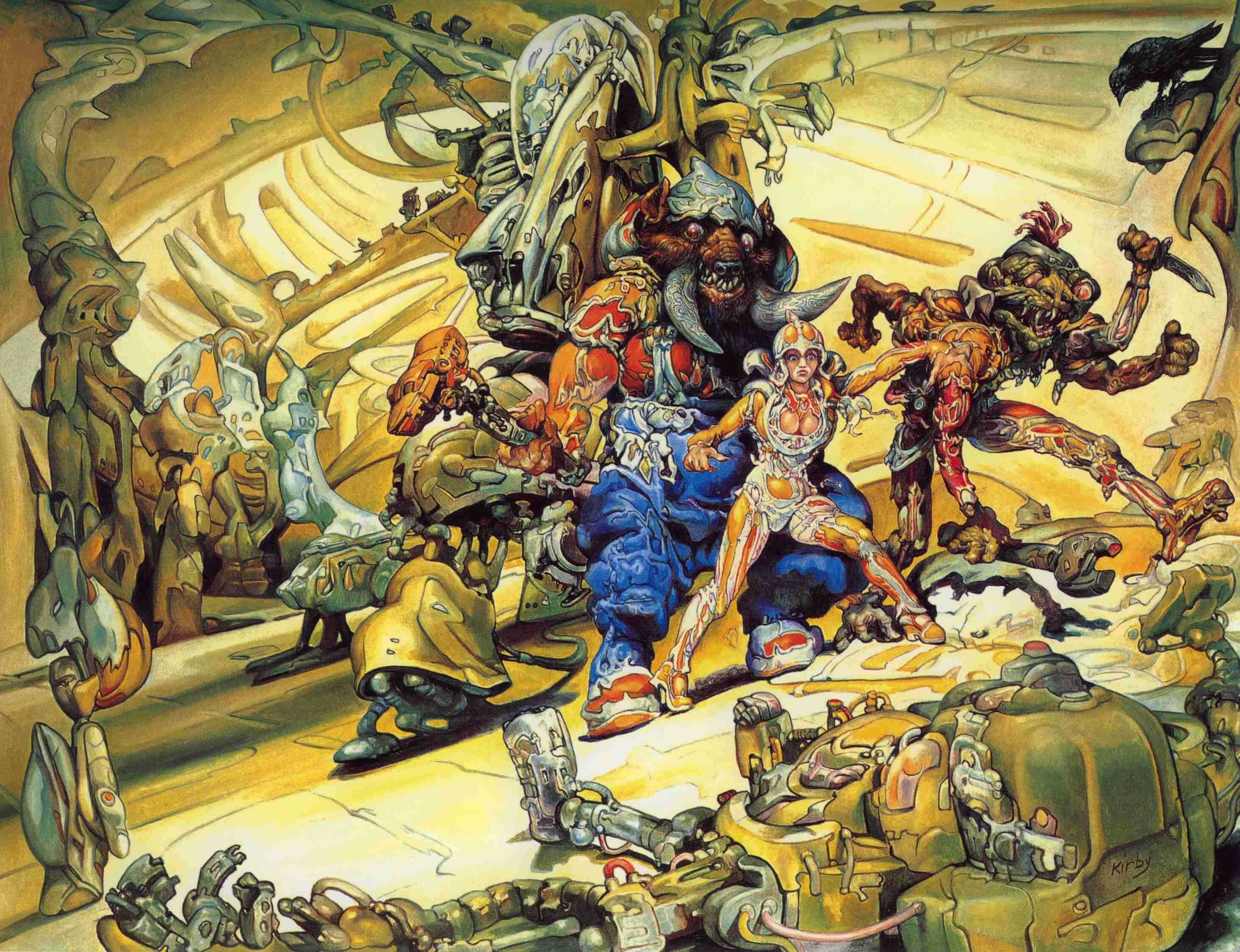
Discworld is flat, as flat as a coin, balanced on the backs of four elephants that stand ceaselessly on the shell of the giant turtle the Great A’Tuin, who swims through space always, his wrinkled flippers spreading the stars like sea foam. And on the Discworld is a city, and in that city are witches and wizards and Death’s adoptive family; magic and mayhem and a man named Mort.
This is not Discworld.
It’s a world, of course, and it’s a disc, but two years before he wrote the first in the Discworld series (or would what be epic? Because after all it is deserving), Terry Pratchett wrote Strata, where three aliens are tempted to explore a world that is flat, a world that by all rights of physics and technology and Company law should not exist. But it does. And Kin Arad is two hundred years of bored human who, despite the wear of age and the press of human technology, finds her natural-born curiosity undiminished. Along with her is Marco, the frog-like kung with four arms and a grin that “was a red crescent with harp strings of mucus”, and Silver, the bear-like shand with “binocular vision and a domed skull and several walruses in [her] ancestry”. Marco is a top pilot and Silver a linguist and Kin the best the Company has to offer—the best at what she does.
The Company makes planets.
Our three main characters are brought together by their skills, by curiosity and bribery and just plain asking (in Silver’s case, at least), by a man who has been to the disc world before and wishes to return, which is not easy. But once there, Kin, Silver and Marco are left on their own to explore the disc. To discover what makes it tick, and more than anything, who built it in the first place.
Above all else, Strata is a novel about construction. And not just in the basic terms, the hard-hat-and-cement, the building planets from nothing and giving them history, fossils in the earth and myths in the mist. It’s also about other types of construction, from changing the colour of your hair to your own personal identity. Everything is constructed, everything has an element of falsehood, a lie embedded in the centre of the universe. That is, until our three characters enter the disc world, and then everything starts coming apart.
Genre fiction, many say, focuses on plot, while literary fiction focuses on character (which, consequently, makes it superior, a line of thought I wholly disagree with). Strata is plot-heavy, I won’t lie. It moves swiftly, arrestingly, forcing you to read and read until suddenly it’s 1AM and you have to work the next day and where on earth did the time go, did I even remember to eat dinner? But that’s not to say character development is ignored, or that the novel itself isn’t affecting. There is development, subtle but present, and the plot is part of the reason why it is so thought-provoking. To do this, Pratchett uses dialogue. The prose is sparse, not weighed down with description, and while it works (fantastically), there were times when I did miss the kind of description that is so vivid and thick you can feel the words in your mouth like peanut butter. But as I’ve said, the dialogue makes up for it. The dialogue, the kind that punches you between the eyes, gives you insight into the characters, gives them dimension and personality, and gives us the kind of succinct philosophy that Pratchett is known for. The thoughts of Kin Arad, our reader’s proxy, serve the same purpose, the only time Pratchett strays from either dialogue or neat description being to delve into her head. “We dismiss each other with a few clichés, she thought. It’s the only way we can live with one another. We have to think of aliens as humans in a different skin, even though we’ve all been hammered by different gravities on the anvils of strange worlds…”
It’s well worth the deviation.
The novel is construction within construction within construction. A book is a constructed thing, physically, made from ink and paper with a laminated cover. The text itself is constructed, individual words that by themselves hold singular meaning but when strung together form a greater whole. A picture; the curve of a spine or the line of a building or the swell of a moon—spaceships and robots and the dumbwaiter which makes all of their meals because cooking for yourself has, apparently, become a thing of the past. And within those shapes created by words are characters who construct things, who make lives for themselves, and in this case who build planets and solar systems and whole damn universes. It’s a continuous creation, one that is mirrored within the novel in a theory Kin once heard: “that races arose, and changed the universe to suit themselves, and then died. And then other races arose in the ruins, changed the universe to suit themselves, and then died. And other races arose in the ruins, and arose, and arose, all the way back to the pre-Totalic nothingness…There had never been such a thing as a natural universe.” And there is no such thing as a natural novel, or a natural anything. Even what we think of as natural is constructed. A seed falls from a tree to the ground below, is fed by the water cycle and sprouts to be fed by the sun. Human interference adds to the construction, but even left alone, nature constructs itself. Nothing just happens; there are reasons behind everything, invisible hands and invisible machines moulding and shaping our world from the smallest atom. One of the primary themes of the novel is the natural versus the unnatural, starting from the very first pages where Kin stares out over “a palm-fringed lagoon”, before turning her attention to a strata machine and “another metre of beach spill[ing] out of the big back hopper”. Planets in Strata are unnatural, the animals on them “vatbred” and everything from the mountains to the swamps are made by machine. There is no natural construction, although as the novel progresses and more is learned about the history of the universe, the more the use of the strata machines seems like a natural act. In fact, many of the things we the readers would view as unnatural have become natural to the characters. Kin prefers an artificially constructed sleep, and even her longevity is a construction, not something from natural evolution but payment from the Company. “It paid in extended futures”, and that’s not just a play on words.
It becomes the great irony of the novel that the only time Kin, Marco and Silver act naturally—act according to their natural biological construction—is on the most unnatural of places. “The disc was inside a transparent sphere sixteen thousand miles across, and the stars were…fixed to this.” It isn’t even fitted into the universe, separated in a shell that acts like a two-way mirror, the disc world stuck as if in a snow globe. And yet it is here that our characters are able to let go of their constructed selves, acting instinctually instead of intellectually, shedding their identities in favour of something more distinct. Because there’s an issue within the novel that we already see in our own world: “You can’t apply humans’ values to aliens. But you keep trying,” Kin thinks. Strata’s aliens have largely conformed to human social norms, and it is apparent not only in statements like the one mentioned but also in dialogue and narration. Of course, I say largely, because there are certain cultural things that remain (Silver’s eating habits, for example), and it is because of those things that humans know intellectually that they shouldn’t judge alien actions and culture by a human measure. But they do anyway, because they’re human. And it’s the same for us, in 1981 and in 2011, where differences from one culture to another are sometimes so vast that what one calls a ritual another calls a human rights violation. Debate rages on, about what is right and what is fair and how we should form planet-wide laws when countries can differ so immensely. In Strata, it is even more complicated, but on the disc everything seems simpler. Our characters are different, and they need no justification or attempt at conformity.
Humanity and race are both huge issues in the novel, Kin’s humanity seemingly degraded by time and Marco’s a falsehood. Biologically he’s a kung, but having been born on Earth and raised by a human foster family he claims he is “legally human” for most of the novel, and while most of this has to do with the kung idea of the newly born being a reincarnation of a spirit from their surroundings (in this case, Marco is the reincarnation of a human, no matter his four arms), it is a cultural construct, one that he cannot hold on to forever. On the reverse, Silver doesn’t deny that she is a shand, but is so human in action and conversation that thanks to the sparse description you wouldn’t think otherwise until she eats. Food plays a key part in the novel’s plot and in the development of the characters, using it to highlight their differences by their cravings and their biology and their culture. The dumbwaiter—a food-producing robot—acts almost as a fourth character, hovering in the background both physically and mentally, and further proves how different Kin’s time is from our own. “Why waste space and weight hauling this junk?” Kin asks when confronted with frozen food on a spaceship, our idea of natural construction—cooking—eliminated in favour of an unnatural production by a robot. Although, you can see the appeal: after a long day’s work, who wants to bend over steaming pots and sizzling pans? However, there is something inherently wrong with never seeing fresh ingredients. But I doubt the current ready meal generation will see it that way.
Humanity and race and population are huge presences, and it is only on the disc world that this is so heavily highlighted. The disc world is not an equalizer. For all that their physical appearances are distinct, Silver and Kin and Marco are largely the same. Sometimes, their dialogue even contains a similar cadence. But once on the disc world, it becomes startlingly clear that they are different. They have evolved from different creatures on different planets, and while those differences are not insurmountable (and in fact serve to make their interactions more interesting), they exist. And are acknowledged. There is no more human washing. There is that character growth so many say genre fiction lacks, embedded within the battles and the clever twisting of human history and religion atop the disc world. In fact, the whole thing culminates in one single epiphanic line of thought: “Aliens, [Kin] thought. I called them aliens. Oh shit.”
Of course, I could go on. The whole debate I’ve spent paragraphs outlining is later summed up in a more eloquent way (one devoid of swearing). But at the risk of spoilers, I’ll leave it out. Suffice it to say, that diversity really is the spice of life. It is the backbone of a planet, hell, of a universe. Without diversity, in people and culture and occupation and knowledge, we crumble. Ultimately, it isn’t wrong to think of people as different from yourself—for Kin to think of aliens as aliens. Different is not a negative word. Unity is overrated.
Strata is a brilliant novel all on its own, but as I have said before, it was also a precursor to the Discworld series, the first book, The Colour of Magic, having been written and released two years later in 1983. Many of the things that came to populate Discworld are seen scattered throughout Strata’s disc, in the oceans and deserts and forests. There are demons and genies and flying carpets; a robotic Death with a “power-scythe” and an invisibility cloak and a giant turtle whose shell is mistaken for an island. Great A’Tuin, perhaps, before he was so great? Although, the concept of a flat Earth that “rested on the backs of four elephants” which stood on “a giant turtle swimming endlessly through space” is addressed early in the novel, separate from the case of mistaken identity, and is dismissed as human “racial myth”. Which isn’t wrong: North American, Chinese and Indian mythology all contain a “world turtle” myth (although India is the only country with a “world elephant” myth as well). It’s as if Discworld was always there, hovering on the edges of Pratchett’s mind just waiting to spill out onto the page, and it is fascinating—even to someone like me who has such a limited knowledge of the Discworld universe—to see droplets of it scattered throughout an early work.
I think those who have said that Strata can be seen as a sort-of prequel to the Discworld series aren’t wrong in their assessment. As a stand-alone novel, it is wonderful, entertaining and intriguing and full of things that make you think about yourself and the world in which you inhabit, like all good writing should. But it also functions well as a teaser for a greater universe, one that, while isn’t straight science fiction, holds shadows of the universe we readers were able to spend so short a span of time in. The novel tackles a lot of themes, and I have pages upon pages of notes about them that, were it not for the threat of spoiling the entire plot for those who are looking to this review as a way of finding their next bit of reading material, I would be happy to share. This book is packed. It’s not fluff. You can ignore the themes and symbolism and still find the story enjoyable, however, I found that I loved the book even more when I took the time to consider what some of the patterns I saw in the writing meant. Although some of those patterns really didn’t need pondering.
The writing really does punch you right between the eyes.
Originally published in May 2011.