Blade Runner is my dad’s favourite film. All the while I was growing up, not a month wouldn’t go by that it wasn’t on the television, be it because he put in the VHS (and later, DVD), or because he had found one of the stations playing it and couldn’t resist even having it on in the background. It has been a nigh-constant presence in my life, always hovering, but I never actually sat down to watch it. As a kid, the dark cinematography was unappealing. Reading books and wearing out my tape of The Wizard of Oz seemed a better use of my time. Later, Japanese anime and Victorian fiction and spending time with my friends overcame any desire I had to watch my dad’s film.
Teenagers…
Now, as an adult (or as adult as I’ll ever get), my tastes have changed—widened—and my foray into science fiction has led me to a classic not just of the genre, but also of film itself. Imagine my surprise to discover it was first a book?
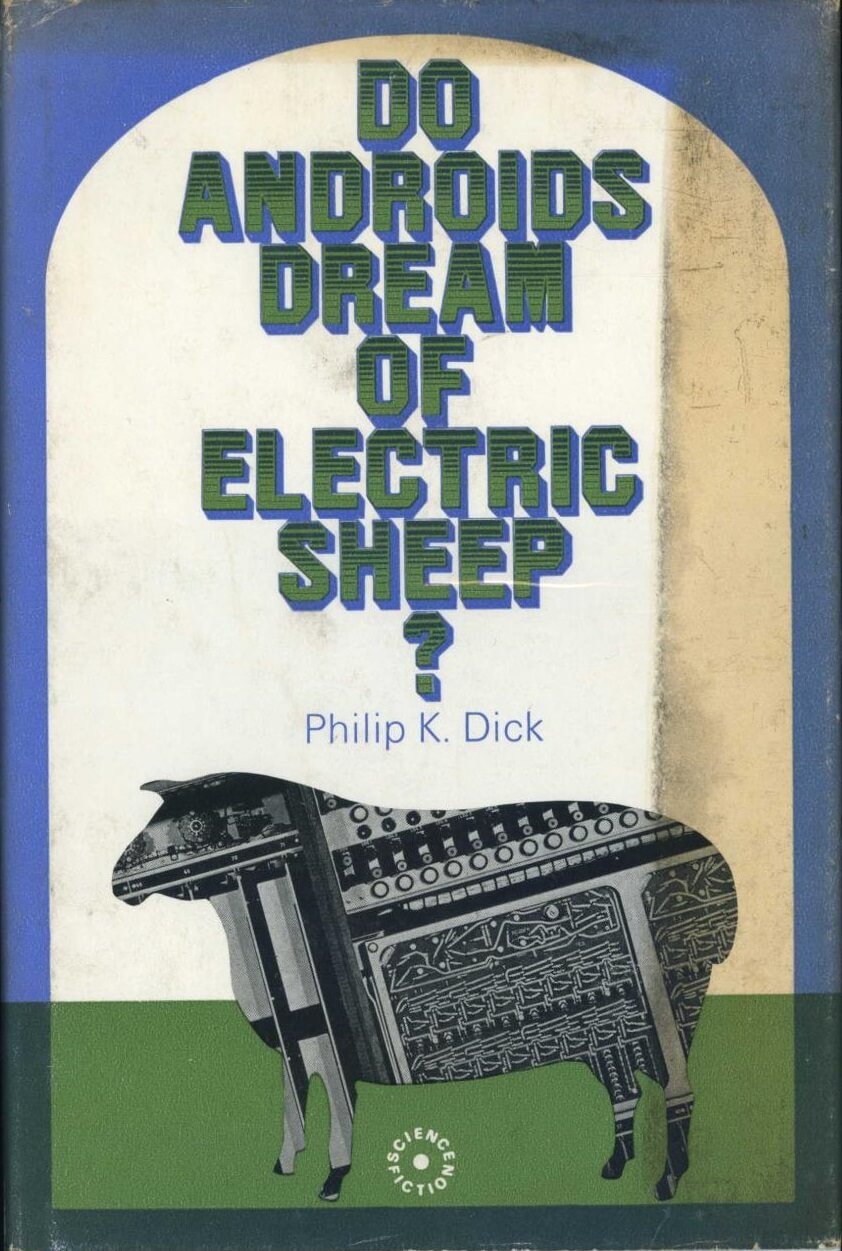
I’m not sure why Ridley Scott et al changed the title, aside from it being a bit of a mouthful, but Blade Runner was first penned as Do Androids Dream of Electric Sheep? by Philip K Dick in 1968. Said title is a question that never gets answered, but the rest of the book more than makes up for it. Rick Deckard is a bounty hunter, tasked with ‘retiring’ six androids. With the money he makes, he hopes to buy a real sheep, to replace the electric one that sits on the roof of his apartment building amongst everyone else’s real animals. Because in this post-World War Terminus Earth, those who hadn’t packed up and headed for Mars are obsessed with owning real animals, with the hope they can feed them and breed them and, someday, make Earth like it was before birds started dropping out of sky. Of course, androids and toxic nuclear fallout don’t make it easy.
The book is vastly different from the film, and not just in the change of the title and the tweaking of names (the Rosen Association of the book becoming the Tyrell Corporation, for example). Many of the primary themes of the novel are absent from the film, and while it makes the film no less entertaining, I believe the novel is far richer for their presence. And it is a rich book; Dick’s use of language is fantastic, and I could go on and on about his lovely turns of phrase like “despotic force of time” and the way language works with character and his vivid, almost cinematic imagery. There are a number of plotlines within the book as well that aren’t fully fleshed out within the film, such as John Isidore’s, a “special” (those with “distorted genes” and a low IQ courtesy of the nuclear fallout) and the sole occupant of an apartment building who makes friends with androids, a character who is sweet and painfully human. But the novel’s complexity isn’t overwhelming, and it’s a surprisingly quick read. Which, I think, is the best way to do it, because it’s a bleak book; not only in action, but also in how many of the themes of the novel play out.
Nature is one of the big themes—if not the biggest—of the novel. The toxic state of the planet affects everyone’s daily lives, from their having to dress in protective gear such as an “Ajax model Mountibank Lead Codpiece” to living in nigh-constant fear that the nuclear fallout will erode their brain and twist their DNA until they’re labeled “special”—defective. But it is in animal ownership that this theme is strongly and unceasingly displayed, starting first with Deckard’s electric sheep. Owning an animal is a status symbol, more so in the novel than it is for us now, with celebrities carting around doll-like dogs in their designer handbags, like the dog was something that came with their piece of Prada. But it isn’t just status that has people keeping horses and goats on the roofs of their apartments—it’s necessity. It’s unheard of, in the novel’s alternate 1990s, to find an animal in the wild, and because of their scarcity, they dominate most of the dialogue. Deckard keeps a well-thumbed catalogue with him at all times, called “Sidney’s Animal & Fowl”, and his thoughts are consumed with replacing his electric sheep with a real animal. It is, I think, the driving force behind everything he does. Oh, sure, he questions other things (his feelings towards androids, for example) and he needs the money he makes for supporting himself and his wife, Iran, but those are always passing thoughts. It’s the animals he dwells on. It’s like being back in the 19th Century, or any time before technology and urban sprawl reduced our reliance on, and subsequently the importance of, animals. In many cultures, animals were traded, used as a form of currency, and in fact a conversation between Deckard and one of his neighbours, Bill Barbour, sounds very much like one that might have happened between farmers years ago, when having prime livestock was the focus of their lives.
The psychological aspect of pet ownership has been a frequent focus in twentieth century psychology. Pets provide companionship and security, but within the novel, the way characters cling to animal ownership demonstrates just how important animals are to human life. Not just having a pet—a dog or cat or rabbit—but having nature present in our lives. The environmental message in the book is huge, and one that, as an environmentalist, I eagerly devoured. As previously stated, the world of the novel is one almost bereft of nature. The air is toxic, the flora brittle and contaminated, and the fauna almost non-existent. It’s the very definition of a wasteland, one that it is obvious humans can’t sanely inhabit. With so many people living in cities, you might think that you would get on fine without pigeons dirtying your car windscreen and flies invading your home. Ants and mosquitoes and spiders, hell, life would be perfect without insects ruining picnics and the clothes you forgot to stuff full of mothballs. But imagine walking down a street, with a shining sun and wind in the trees and there is…silence. Imagine strolling through the country with only the sound of your footsteps, with only your footsteps, because there are no squirrels on branches or sparrows in trees. Imagine barely being able to recall what a sparrow even looks like.
There are reasons why green spaces in cities are so important. Not just for human physical wellbeing, but for emotional and psychological wellbeing too. It’s not purely for estheticism that there are trees and hedges decorating carparks and that there’s always one potted plant in every home. People need nature in their lives, need the sense of connection it gives us to our evolutionary and historical past when we weren’t so removed from it. We need the sense of calm it brings, the joy, and we need it to remind us that no matter how advanced we become, no matter how much we construct and how much we take, nature is always the superior force. So much of what happens on our planet is outside of our control, and while acts of natural disaster can be taken at face value—as disaster—they can also been taken as a reminder of our own insignificance. At the heart of it, we are animals, and like animals we are subject to and reliant on the planet we inhabit. Because like I said, we need nature; it’s why groups like Greenpeace and World Wildlife Fun exist, and it’s something everyone in the novel has come to learn, in a way hopefully we don’t have to. The fate of the environment (both earth and animals) always hovers in the background of the novel, a desperate, didn’t-know-what-you-had-until-you-lost-it hope that it will recover and be like it once was.
Unfortunately for Deckard and everyone else, it seems to be a useless hope.
The film’s primary focus is the androids, and while I saw the environmental message as something greater, I also found it constantly at war with the presence of the artificial within the novel. And it’s not just Deckard vs. the androids, it’s other things as well. In a world so consumed by a desire for the natural—who believe its superiority over those manmade androids and pets—it is perfectly all right for humans to fabricate their emotions. The first glimpse of Deckard and Iran that we get is of them being awoken by their “Penfield Mood Organ”, a piece of technology that allows them to “dial” specific emotions, even “a setting that stimulates [their] cerebral cortex[es] into wanting to dial”. The only way of identifying an android is even through emotions, as they cannot feel empathy, and yet this supposedly highly-held hallmark is being willingly degraded. And I say degraded, because while alone in their apartment, Iran says she “heard the…[e]mpty apartments” and felt nothing, and “realized how unhealthy it was, sensing the absence of life, not just in [the] building but everywhere and not reacting”. This moment is a jumping off point for everything else in the novel, as for every question Deckard has about androids, every doubt, every time he looks within himself and wonders at his feelings towards androids, is because if he can figure that out—if he can find a definitive difference that is more than just biological—then he can be safe knowing that for all that he is chipping away at his own humanity, he is still separate from androids. But of course, that isn’t an easy quest, and Deckard frequently finds himself in existential crises concerning the androids. “‘Do you think androids have souls?’” Deckard asks, at one point, gun still hot from ‘retiring’ one; “Empathy towards an artificial construct? he asked himself. Something that only pretends to be alive? But [the android] had seemed genuinely alive; it had not worn the aspect of simulation.” He desperately tries to find a way to explain his sudden, naturally-occurring feeling, to find some sort of truth. If something is man-made, it isn’t alive. It may have the skin of a living thing—a talking doll or toy dog that can walk or electric sheep—but it’s a machine. It doesn’t feel. It’s no better than your toaster. But when does it get to the point that technology has replicated life? Is life personality? Unprompted speech? Independent movement? Is it taking up an occupation or owning an animal or, even, having a relationship? When does a machine stop being a machine, and start being…something else entirely?
There is a definitive difference between humans and androids that is made clear in the novel: belief. The easiest way this is shown is through Mercerism, the religion that greatly resembles Christianity, from the animal symbolism (important animals are “[t]he donkey and especially the toad”) to miraculous healing (making “the dead return[ed] to life”) to the promise of a Second Coming for the Christ-like Mercer (“He had sunk down into the tomb world. He could not get out until the bones strewn around him grew back into living creatures; he had become joined to the metabolism of other lives and until they rose he could not rise either.”). In itself, it’s fascinating to see that the human ability to believe in a godly figure doesn’t appear to have faded even after nuclear disaster. The religions we know may have died, but another took their place, and while Wilbur Mercer’s religion is interesting on its own, the notion that just like humans can’t live without nature neither can they live without the ability (and the option) of believing in something far greater than themselves is far more fascinating.
That’s what the entire novel comes down to, in the end: belief. If there is one overarching theme throughout this book, it is the question for reality—for truth. The whole book is filled with lies, fictions within a work of fiction; everything is questioned, from the androids to the animals, even the veracity of Mercerism is called into question, and there is a desperation, so poignant that as a reader you can feel it, to find something that is truthful.
Belief is the truth of the novel.
The human ability to believe, in a concept or a person or a religion, to believe that things will get better, is something that cannot be replicated. The characters in the novel spend massive amounts of money on animals, feed them and care for them, firmly believing that it makes a difference. People remain on a planet that is slowly killing them, because they believe that there is a chance that it may get better. Androids operate on facts, on things that are tangible, and while they have an academic understanding of belief, they don’t understand it. Towards the end of the novel, a climax of action although there is, I think, a second much more internal one for Deckard’s character, there is a revelation, but it doesn’t lead to the victory the androids were hoping for. “‘They will have trouble understanding why nothing has changed,’” one character remarks, because for we humans, sometimes the facts don’t matter. Sometimes, it’s not the messenger that’s important but rather the message itself. One of the trademarks of humanity is that we hold on to hope even in the bleakest of situations, and that is a truth put on brilliant display here, even if that hope appears to be rather hopeless.
Do Android’s Dream of Electric Sheep? is a beautiful novel and, I think, a great companion to Blade Runner. As I read and watched, I didn’t find myself preferring one over the other, rather I found that they acted as compliments (and from what I’ve read, Dick agrees with me). Of course, it’s not perfect; there is a trope used in the novel, albeit briefly, that I’m sure for its time was innovative. But it’s become such a science fiction cliché that for all the action, I found myself somewhat bored with it. Luckily, as I said, the use of the trope is brief, and I’m not about to condemn a forty-year-old book for twelve pages. It does, of course, speak for the power of the book that such a trope has continued to be used in fiction for decades. There is a timelessness to the novel, for all that it is set in a 1992 that (thankfully) never came to pass. Its message is just as relevant now as it was then, and in fact, even more so. It’s a warning of what our future could be, if we don’t do something to change it.
We just have to believe we can.
Originally published in June 2011