Tom Ruegger | BATMAN: THE ANIMATED SERIES

Tom Ruegger Batman: The Animated Series

When it comes to classic cartoon shows, Tom Ruegger has worked on a who’s who of the industry – from Scooby-Doo, to Yogi Bear, to Taz, to Tiny Toons, to Animaniacs, to Pinky and the Brain, and so many more. On Batman: The Animated Series, Tom was on board as a writer, producer, and as one of the creative forces behind this juggernaut of a show, and so, with BTAS now having had a swanky new Blu-ray release, we caught up with this fascinating fella to talk the Caped Crusader and a whole host of other fun topics.

STARBURST: With Batman: The Animated Series, is a fair to say that you were involved with the concept right from the very, very start?

Tom Ruegger: I came in at Warner Brothers just about when the Tim Burton Batman movie was making its way through the production process. At that point, I was making Tiny Toon Adventures at Warner Brothers, with Steven [Spielberg] and Bruce Timm and Eric Radomski and Paul Dini – they all worked on Tiny Toons. With the success of the Batman movie, suddenly Warner Brothers were just rolling in cash. So, they could afford to make Tiny Toons with a full orchestra for every episode, and they could afford to pay Steven and make a pretty heavy budget production. Warner Brothers looked at their assets and thought, “Well, Batman is huge for us. Maybe we need to make an animated series.” At that moment, people on our crew were very excited. We were doing the comedy with Tiny Toons, but now here was an opportunity to create a real iconic show that built on the visual concept that the Fleischer Studios contributed to animation back in the ‘40s with the Superman animated theatrical series. That was the inspiration for the new Batman TV show. Bruce Timm and Eric Radomski separately came to Jean McCurdy and me and said, “Hey, here’s some designs for the Batman character.” That was Bruce Timm, and then Eric Radomski said, “Here’s the design concept for the backgrounds.” And that was unique, because the backgrounds were all painted on black paper. Normally people are starting with a white canvas and adding colour and shadow to it. Eric started with the black canvas and then built colours out of it – which is what I think gives the series its film noir quality that very few animated series have ever achieved. There’s a book – A History of Television – that says Batman: The Animated Series was created by Tim Burton, and that is not the case. Certainly, Tim Burton’s movie was an inspiration for Warners to pursue it, but it was definitely created in-house at Warner Brothers TV Animation.
Batman The Complete Animated Series Blu-Ray Starburst Review

Do you feel that BTAS couldn’t have been done in the style and tone that we ultimately saw if it wasn’t for that 1989 Batman movie?

I suspect the tendency would’ve been to go with a lighter quality if the Tim Burton movie hadn’t existed. Especially for TV animation, Batman: The Animated Series was unique. It wasn’t really aimed at a very young kid audience. Clearly, not every little kid should’ve been watching it, because it was a little bit rough or a little bit more violent. The music was by Tim Burton’s orchestrator, Shirley Walker. Danny Elfman had done the music for the feature film, and Shirley Walker had been Danny’s orchestrator. That’s one of the odd little moments with the series, because Shirley wrote the theme music for Batman: The Animated Series, and Danny Elfman was very unhappy that Shirley had gone off to do this. What happened with the theme tune is that Danny insisted that it be slightly rewritten so his name could be credited. That was between Danny and Shirley, but it worked out and Shirley did all of Batman: The Animated Series; she did all of the composing and she was just fabulously brilliant.

And as well as the music, there was obviously the vocal talent on show. To this day, so many of us hear those voices when reading that Bat-books of today.

Isn’t Kevin Conroy perfect? Mark Hamill, I think The Joker was maybe his first voiceover work. He embraced it and became The Joker and, as you know, is world renowned for being one of the best Jokers ever – the definitive one.

Can anyone truly voice Bruce/Batman who isn’t named Kevin Conroy?

He is perfect. No false moves. I dare you to find a scene where he blows the moment.

Every time there’s an animated movie or show that doesn’t feature Kevin Conroy’s voice as Batman, it always takes a little bit of getting used to.

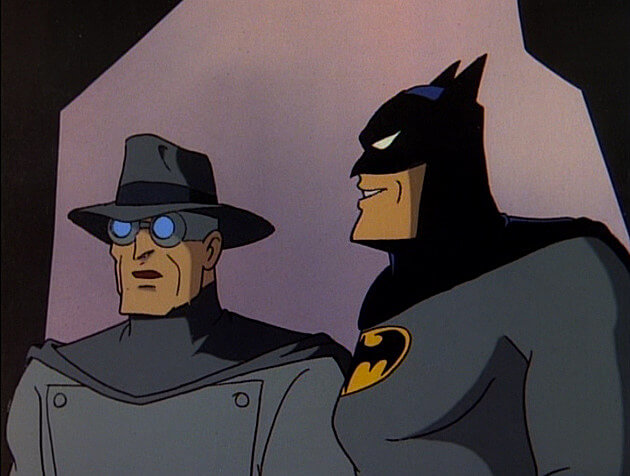
Why are they imitating Kevin Conroy?! He’s available. When I was a kid, like you, Batman had a role in my life. In this case, I’m talking about the Adam West and Burt Ward series from the ‘60s. When I was a kid, that was the definitive Batman. When I was writing an episode called Beware the Gray Ghost

An episode that many view as one of the greatest episodes in the history of animated television, might we add…

Well, I had to drop that in [laughs]. As I was writing it, I definitely was hearing Adam West as the voice of the Gray Ghost. Bruce Timm and I had shared stories about our earlier life, and our favourite show was Batman with Adam West. So, in coming up with Bruce Wayne’s iconic hero as a child – the Gray Ghost – we thought, “We have to get Adam West to play this role.” I also insisted, with great resistance from Bruce, that he play the villain in this episode so that they [Kevin Conroy and Adam West] would have some screen time together.
Batman - Beware the Gray Ghost

Why do you think that Batman: The Animated Series is still seen as so special to this very day?

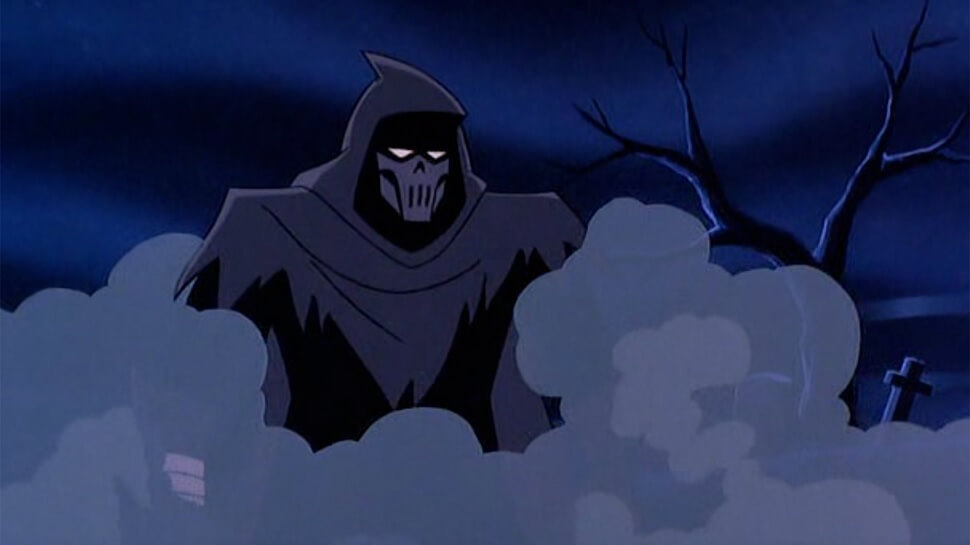
The character of Batman himself, he’s iconic. There have been lots and lots of comic book looks for each generation to enjoy, but really, the comic books were never really animated; they had never really been done in the way that they appear in the comics. I mean, Batman was this crimefighting superhero, and the only real animated versions of him were, first, a campy version in the ‘60s, then later really low-quality Super Friends episodes where he’s sitting around doing whatever, just kinda waiting for the call to go out, almost like a cop. So, it had never really been done properly. I think the series itself was really an answer to many fans’ request to do it right. I remember Batman: Mask of the Phantasm, it premiered here on Christmas Day. I know that a lot of people go to the movies on Christmas Day, but this was a $3 million animated movie, so that’s not really theatrical release quality. But Warner Brothers decided to put it out on Christmas Day. My kids were young at that point, so we all got in the car, we all went to the local movie theatre to see Batman: Mask of the Phantasm. Every kid in my kids’ school was there, each with a father. It made me realise that Batman really speaks to generations of children, whether they’re children right now enjoying the fantasy of superheroes, or they were Batman fans from childhood and they want to relive that. That was one of my favourite moviegoing experiences – Christmas Day, with neighbours and friends, watching this TV cartoon on the big screen. It was a lot of fun.

That must have been a tad surreal for you. And did the people there know that you were involved in the making of this movie?

There were people calling out to me during it. They’d punch me in the back of the head, “Hey, great line!” Of course, it was written by Alan Burnett. Certainly not everybody though, and the kids couldn’t care less – they just loved the movie.
Paul Dini

As a viewer, as a fan, and as a kid at the time, as soon as you see that opening title sequence for the first time, you instantly realise that this is something truly special. Being involved in the show, when did it hit home for you that this was going to be really, really good?

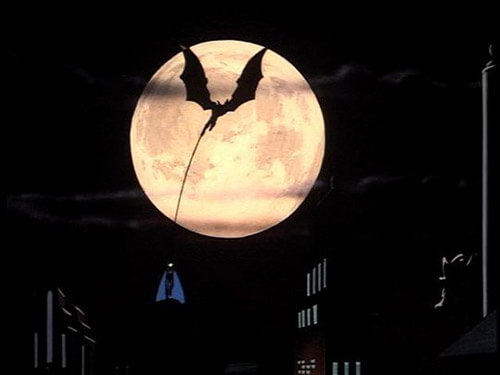
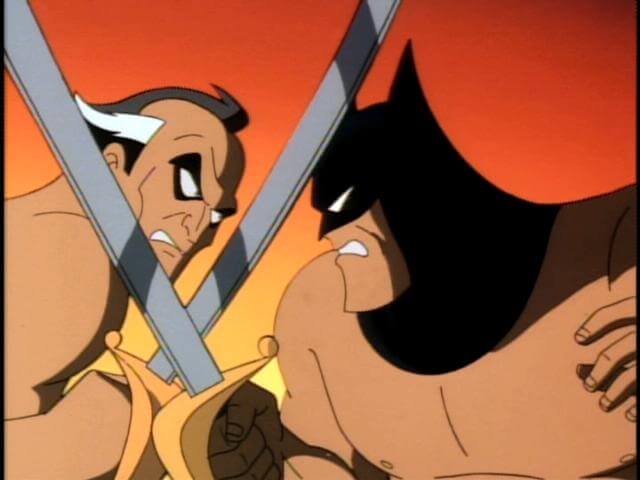
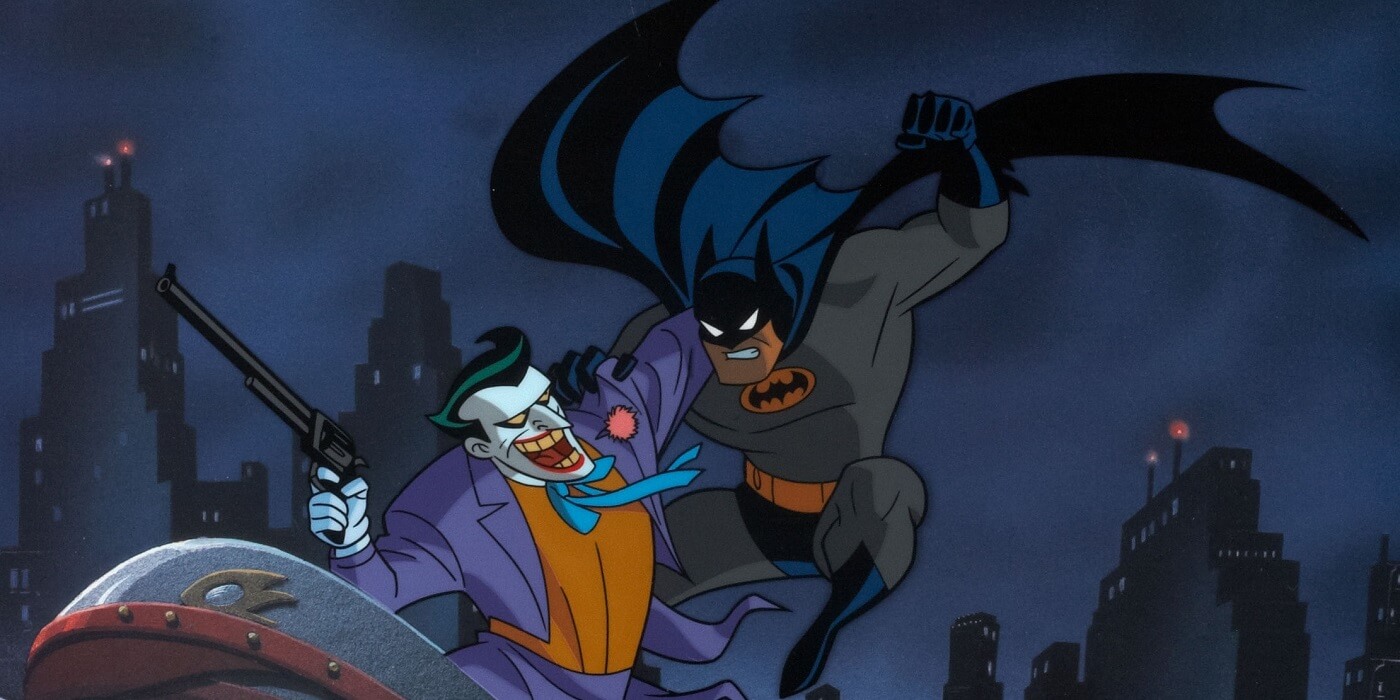
That is a perfect question, because that opening animated title is really where it began. That title, that is the refined beautiful version of that title. But the first proof of concept piece of animation that was made was a very rough version of that sequence. It was much more violent and there was a lot of gunfire in it, but it was basically the same sequence and it was Bruce Timm and Eric Radomski’s first piece of film that they ever produced professionally. It was Eric’s backgrounds, Bruce’s characters, and some really fun animation. This was reduced to a minute and ten seconds, and it was brought to the executives at Warner Brothers. They were always scared. When they have a hit like [Tim Burton’s] Batman, the last thing they want to do is diminish it in any way. So they were not chomping at the bit to make an animated series, because they didn’t want to spoil their golden goose. But when they saw this, this very violent, rough rooftop battle sequence with Batman, and they saw it was truly art – it was mood, it was film noir, it was splashes of red, it was this sinister character with his eyes narrowing – they said, “Oh, okay. Let’s make a series.” When the show first came on here, the first episode we aired was On Leather Wings. The animation performance in that, I felt if you’re going to start to make a good performance, that’s a great choice. It was beautifully animated, and it was very serious and dark, too. There was nothing kid-friendly about it.

Was there much pushback from the Warner Bros. higher-ups in regard to BTAS being slightly more violent and serious than the other cartoons of the day?

There are a few moments that are sort of humourous in BTAS, but for the most part it doesn’t really seek out to make audiences laugh. It seeks to thrill and, I think, maybe overwhelm your eyeballs. It really seeks to tell a big dramatic story with consequences. That’s something that just isn’t that common in children’s TV animation.

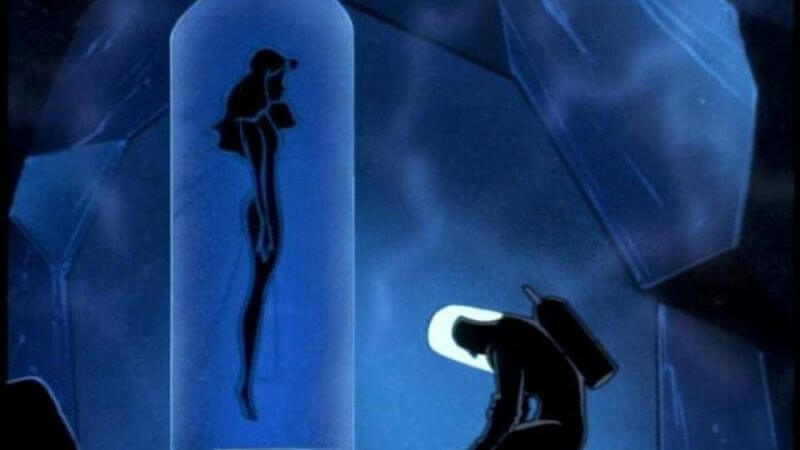
One of the best elements of BTAS is how you brought in lesser-known characters and made them feel important. A prime example is what you did with Mr. Freeze and how you gave audiences a piece of true TV gold in the A Heart of Ice episode. What was the motivation to use characters that people may not necessarily be too familiar with, and was it a case of believing in these characters or more the challenge of making them seem relevant?

On Heart of Ice, we had a staff of really talented writers and we had Alan Burnett and Paul Dini leading the charge. Both Alan and Paul, as kids, were big Batman fans. They were beyond aficionados; they were walking, talking Batman encyclopaedias. And Bruce Timm, certainly. Only those sorts of people can give these lesser characters the weight that they need to carry a story. Paul Dini is the kind of guy that can look at the Batman universe and realise The Joker needs a female assistant that is going to actually carry some weight. Another person walking in the door saying, “I wanna come up with a character named Harley Quinn…” They’re just not going to do it because they’re going to be too worried about getting The Joker right. But after our team had gotten a bunch of great Batman episodes under their belt, then they could start crafting brand new ideas and characters. And that’s where Harley Quinn comes in – she’s now one of the major characters in Warner Brothers’ vault. She’s super popular at all the Comic Cons. Everyone wants to be Harley Quinn, often in various stages of dripping make-up. Sometimes she looks great, sometimes not. There’s Harley at 10am, Harley at 10pm, and Harley at 3am.
Batman - Heart of Ice

How was it for those involved in the show when Harley Quinn became canon and appeared in the comic books for the first time?

She’s been a gamechanger really, because how many great, great women villains have been produced in the DC Comics universe. There are a few, but Harley’s taken her place at the top of the list now. They’ve teamed her up with Poison Ivy, and they’ve had all kinds of great stuff. I know that Bruce Timm drew the original Harley, and Paul Dini came up with the original material and concept of Harley, so I know those two guys are highly gratified that she’s become so iconic.

One new creation for Batman: The Animated Series that often gets overlooked is Renee Montoya…

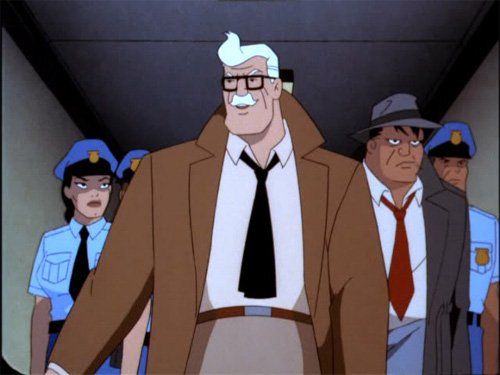
Thank you. For the design of Bullock, he was a villain in the first animated sequence Bruce and Eric made. Bullock was the major tough guy Batman was beating up on the rooftop. He was such a great design that Bruce and the team didn’t want to waste him on a little promo piece, so he was cut out of the promo piece and became the tough cop who you can’t really trust all of the time. One of our first ever story editors was Sean Derek, and she brought life to Montoya in the first few episodes. We were making this series for FOX TV, and they were delighted to see the presence of someone who was a female in the series, because I think the show itself carried a lot of male testosterone. So FOX was very pleased and encouraged us to keep Montoya very much active in the series.

For the most part, BTAS was made up of one-episode stories, but were there ever any talks back then of doing season-long narratives at all?

In Great Britain and all over the world, shows – like Doctor Who – had long arcs and multi-season arcs. I think our TV shows didn’t figure that out until a lot later; we didn’t pick up on it. I think if we were making Batman: The Animated Series brand new today, that’d probably play into it. We were just frantic to make enough to get on the air in time. It was quite a rigorous process just getting the ones made.
Batman: The Animated Series Renee Montoya Jim Gordon Harvey Bullock

Were there any particular comic book arcs you looked to adapt but ultimately decided against doing so, be that in Batman: The Animated Series or The New Batman Adventures?

I’m not really answering your question, but there were a bunch of comics that we liked that were too dark for us ultimately to pursue. There was one story that I wrote that we didn’t make, and I don’t even know why because I spent a month writing this. Everyone knew I was writing it and they were all cool with it, and yet ultimately the network said, “Too dark, we can’t do it.” I’ve spoken about this a little bit before, but it was called The One and Only Gun Story. It started in a mine where different metals are being mined out of the ground, and we follow the metal to the factory where it’s melted down and turned to steel and different things. We watch this delivered to a manufacturer – and this is all before anyone speaks – but we find that where it’s been mined, there’s a Native American there saying, “This is sacred land, you shouldn’t be there.” So, the metal gets turned to a gun. The camera, which has been watching this rock taken out of the ground and turned to metal on a gun, it follows this gun, it gets put in a box, and the next thing we know the box is being opened in a gun store and someone’s buying the gun. You follow it home, it’s put into a safe, the safe is closed, then blackness. Years pass, then it turns out this is the gun that kills Bruce Wayne’s parents. We watch this gun, which gets flipped into the river and fished out by a kid. Ultimately, Bruce Wayne gets hold of this gun and, at the end of the episode, melts it down and turns it into a plaque for the grave of his parents. That’s The One and Only Gun Story that the network said, “No, we’re not making that!” This is self-serving, I guess, but it was a very good script. It was dramatic. Obviously, they had never aired anything like it. They were just scared. They thought, “Oh, this is going to get us a lot of attention, and it’s about guns, so we’re not going to do it.”

You used a whole lot of different characters throughout the series, but were there any ones out there that you were pushing for but couldn’t use?

No. I came from the whole Adam West era, so I was satisfied with what we had. I thought we had a better Joker, a really good Penguin, The Riddler worked, and I felt that Ra’s al Ghul was an improvement over King Tut [laughs].
Batman: The Animated Series

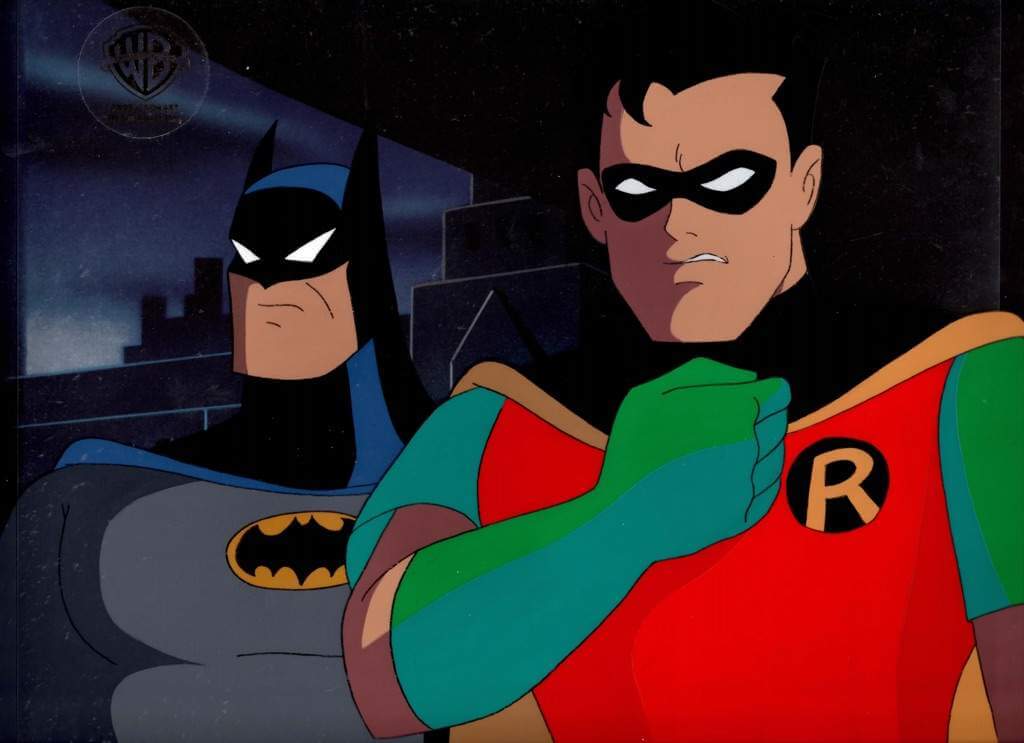
Due to your depiction of Dick Grayson in Batman: The Animated Series, many naysayers began to take Robin seriously and realise what a fantastic character he is.

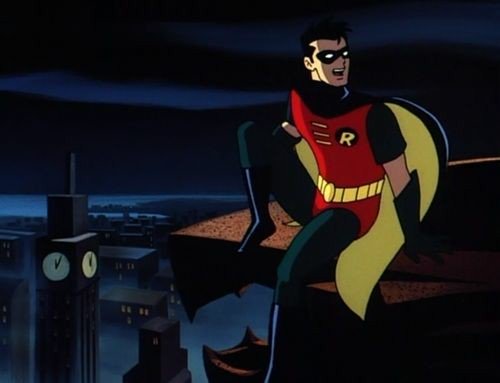
You clearly have the Robin thing figured out. For some people, he’s the Scrappy-Doo of the Batman world. And poor Scrappy gets no love anymore. I think Robin worked out in our series pretty well, the Dick Grayson Robin. I think it was smart that we didn’t start with him, because I think immediately it looks almost like a spin-off.

It’s just a shame that Batman Forever and particularly Batman & Robin again soured some audiences on Robin.

No, I don’t think it did help.

So you didn’t ever think of incorporating nipples into your Batsuits, then?

[Laughs] George Clooney would shake his head ever so slightly in every scene so that his ears would wiggle. That’s not helpful either! Michael Keaton would always just stay very still.

Personally, Michael Keaton is always my Batman when it comes to live-action.

The thing about Keaton, I was shocked. I thought, “I don’t even wanna go and see this. Michael Keaton as Batman?!” But he was great. At the time, I didn’t know he could play serious. He’s constantly holding back information. I don’t know if it was the director or Michael, but the voice – the low voice – every line was very effective.

We’ve touched upon Heart of Ice, Beware the Gray Ghost, and Mask of the Phantasm. To you, what would you say would be your finest moment from your time involved in the world of Batman: The Animated Series?

It’s probably a dramatic scene between us and the network. I’m not giving you an episode, but early on the network wanted to get rid of Bruce Timm and Eric Radomski. They said, “These guys, they’ve never made an animated series before, they don’t understand TV, they’re not making a show for kids, we need this thing to be nicer.” I remember going to Bruce and Eric and telling them this. They said, “Can we quit now?” So, we made a stand against the network and said, “Listen, they’re not going. Cancel this series, because we’re making this with Bruce Timm and Eric Radomski. They have the vision that works alongside Tim Burton’s vision. You’ve seen the little clip that they’re capable of making. Now you just have to let them do it, clear out, and let’s just continue – or skip it!” We did get to that moment, and normally I think the network gets its way. At that point, we had had experience with the network in making the Steven Spielberg show [Tiny Toon Adventures]. On that production, they’d say, “Oh, we don’t like this, we don’t like that, we want that changed.” We’d go back with, “Well, Steven likes this, and we don’t want to change it.”

Let’s face it, Steven Spielberg is quite the name to have as back-up.

We knew that they had a breaking point. Tim Burton really wasn’t involved, but we knew that Eric and Bruce had a visual vision that would make this show unique and special. The network may have wanted it to be a better flavour of vanilla, but we did fight them on that. So, not an answer to your question. That was an episode, but there’s so many episodes of Batman: The Animated Series. I wrote the first Poison Ivy episode, and I realised that I loved the show and I loved the process when I was writing the first scene for that script. I realised, “Oh my gosh, this is like we’re making movies here. We’re actually making 22-minute feature films.” They were very dramatic. The first scene I had was Harvey Dent at dinner with the character who would become Poison Ivy. I believe he’s lamenting that Bruce Wayne couldn’t make it, “Where’s Bruce? He was supposed to come to dinner. But you know Bruce, he’s always a lowkey, loner of a guy who stays to himself and doesn’t like to go out much.” We’re intercutting everything Harvey Dent says with contradictory footage of Bruce as Batman beating the living crap out of a villain. I realised, “This is so much fun to write!” For me, that was like a turning point in that, “Oh, I don’t just have to write little shenanigans with Buster and Babs. I can write these really dramatic scenes and I have the freedom to let it go wherever it goes.” It was just a wonderful creative writing experience that I think was the turning point for me. This was the episode prior to Harvey turning into Two-Face.
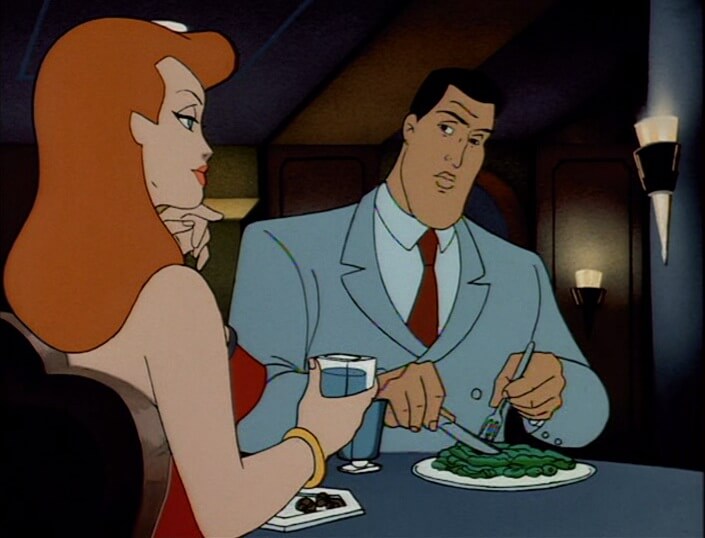
Batman: The Animated Series - Harvey Dent, Poison Ivy

The great thing about Harvey becoming Two-Face is that you had already began to drop in elements of the Two-Face personality such as the short temper, the dual identity element of Big Bad Harv…

That’s Bruce Timm and Eric Radomski having the vision, and ultimately Paul Dini and Alan Burnett as story editors. Early on, Bruce and Eric knew where these characters were heading. Many series would’ve started with Harvey as Two-Face, and maybe in the midst of that story tell a backstory about what happened. But here’s a series that’s not worried about how it re-runs, what order the episodes are going. We were going to show Harvey Dent before he became Two-Face.

Decisions such as giving Harvey Dent a dual identity before he became Two-Face, and creating a female sidekick for The Joker, they’re bold choices that the fanbase could’ve easily rejected. If you were making this show today, in the midst of social media, do you think such bold calls and changes to established canon would go down well with fans?

I think it always has to do with the creative people that are closest to the material, that really have been hired to pursue it, to make it, and who really have the chops to do a great job. When those people are allowed to have the freedom to do it, I think they almost always turn out a great product. It’s when executives and the front office – and I’m not talking about the animation department, necessarily – the people who should allow the creative people to pursue it but instead get their fingers involved in it and start micromanaging it, that’s when it all goes to hell. The beauty of making this in the ‘90s is that we had a president of the division in Jean McCurdy who was not there to tell us how to make it, she was there to protect us from people. She picked the people that she thought could make the show well, then her job became keeping other people out of the kitchen until we were ready to show the pies that we’d made.

 Were you ever in the frame to return for The New Batman Adventures or Batman Beyond?

I wrote the story for Big Time used in Batman Beyond.

Having worked on shows like Tiny Toon Adventures, Animaniacs, Pinky and the Brain, and Taz-Mania, how much fun was it to go with a more serious narrative for Batman: The Animated Series?

Definitely a different muscle.  I would occasionally like to add jokes to my Batman work. In Never Too Late, I had Batman meet with a priest inside a church. In my initial draft, Batman spoke with the priest inside the confessional. As Batman leaves, two altar boys notice the Dark Knight leaving the confessional. One altar boy says to the other, “Funny, I always thought he was Episcopalian.” I fought to retain this scene, but the network insisted it be cut.
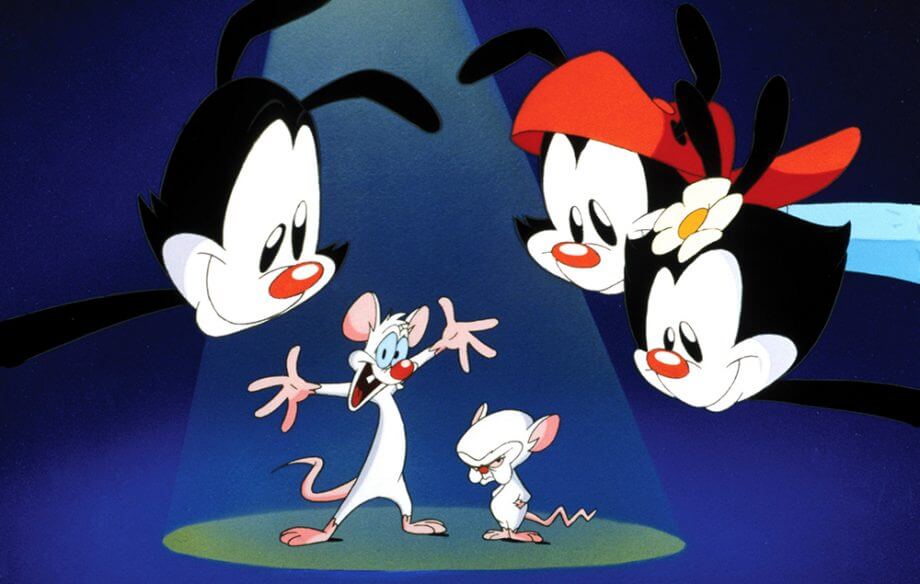
Animaniacs, Pinky and the Brain

Is it really true that Yakko, Wakko, and Dot of Animaniacs fame were based on your own kids? 

Yes. My three sons Nate, Luke and Cody served as the personality inspirations, while the character designs were based on a trio of characters I created for my college animated film, The Premiere of Platypus Duck. By putting red noses and ears that stick up on these characters, the platypus trio became the Warners.

How do you feel about the change to more CGI-driven animation these days, and do you think that takes away from some of what makes animation truly great?

There is a human quality to hand-drawn 2D animation that is eliminated by the plastic-looking models found in many CGI shows. Realism is more achievable in CGI, but movement and wild takes seem limited in CGI.

You’ve worked with so many great characters over the years, but is there any one animated character you’d love to work on but haven’t had the chance to?

I’d like to work on a feature with Bugs, Daffy and Elmer.

What can you tell us about what you’re currently working on or have in the pipeline?

Developing a few new animated series – two comedies and one drama. One with Paul Dini, another with a Hollywood icon. I’m developing all three with my son Luke Ruegger, who is an incredible artist, designer and animator, and who, as a kid, voiced The Flame on Animaniacs as well as Big Fat Baby and Billy the Kid on Histeria.

Batman: The Complete Animated Series is out now on Blu-ray, and you can keep up to date with Tom’s work by following him on Twitter.

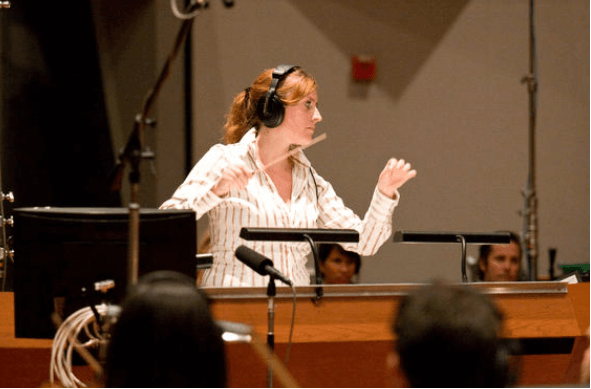
Sunna Wehrmeijer | SHE-RA AND THE PRINCESSES OF POWER

Sunna Wehrmeijer

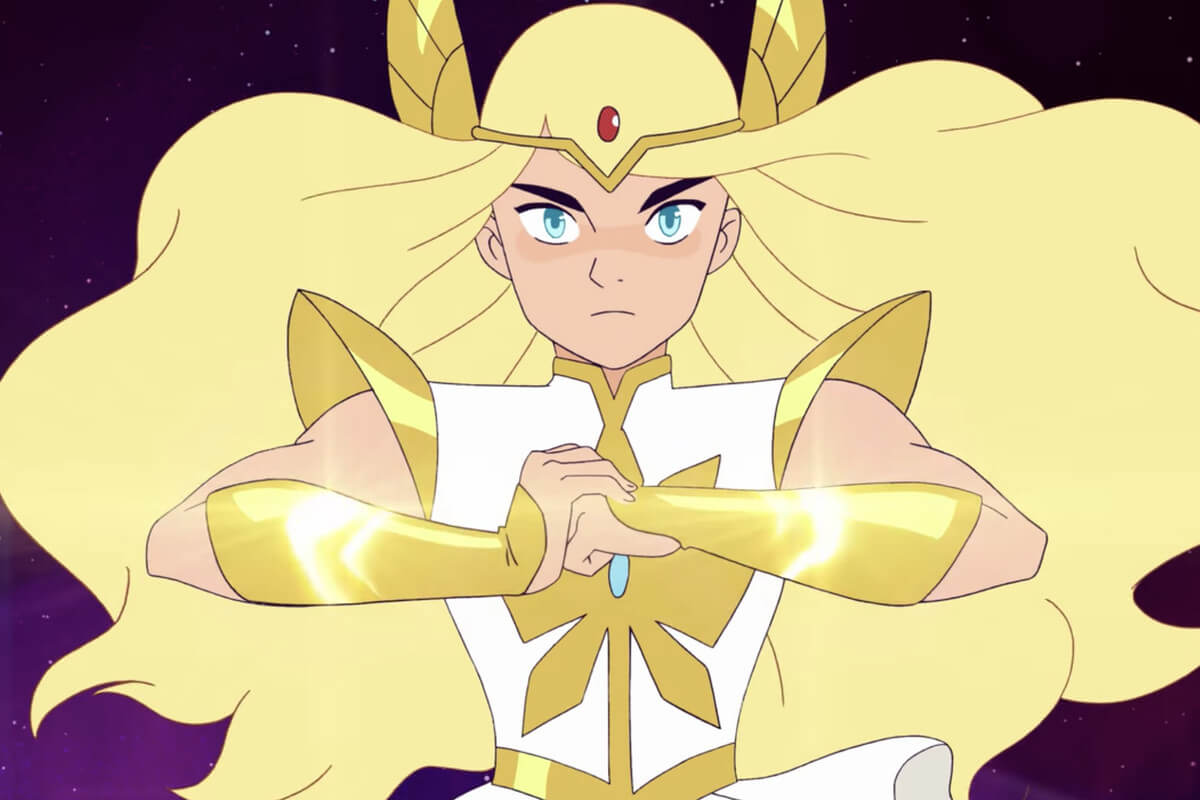
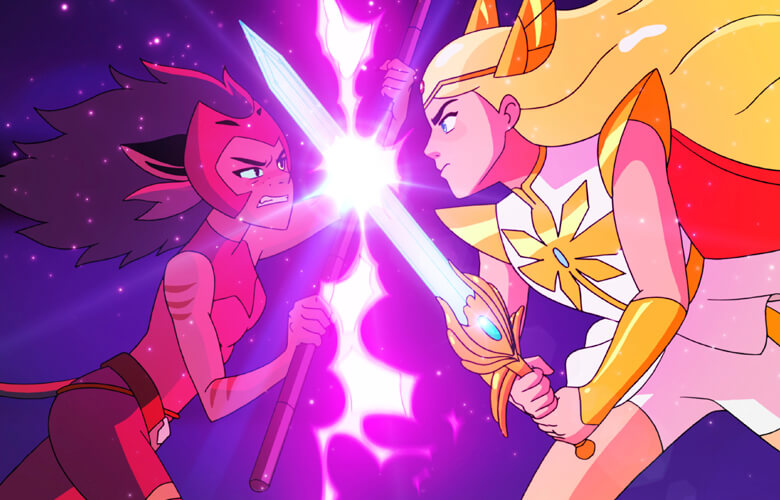
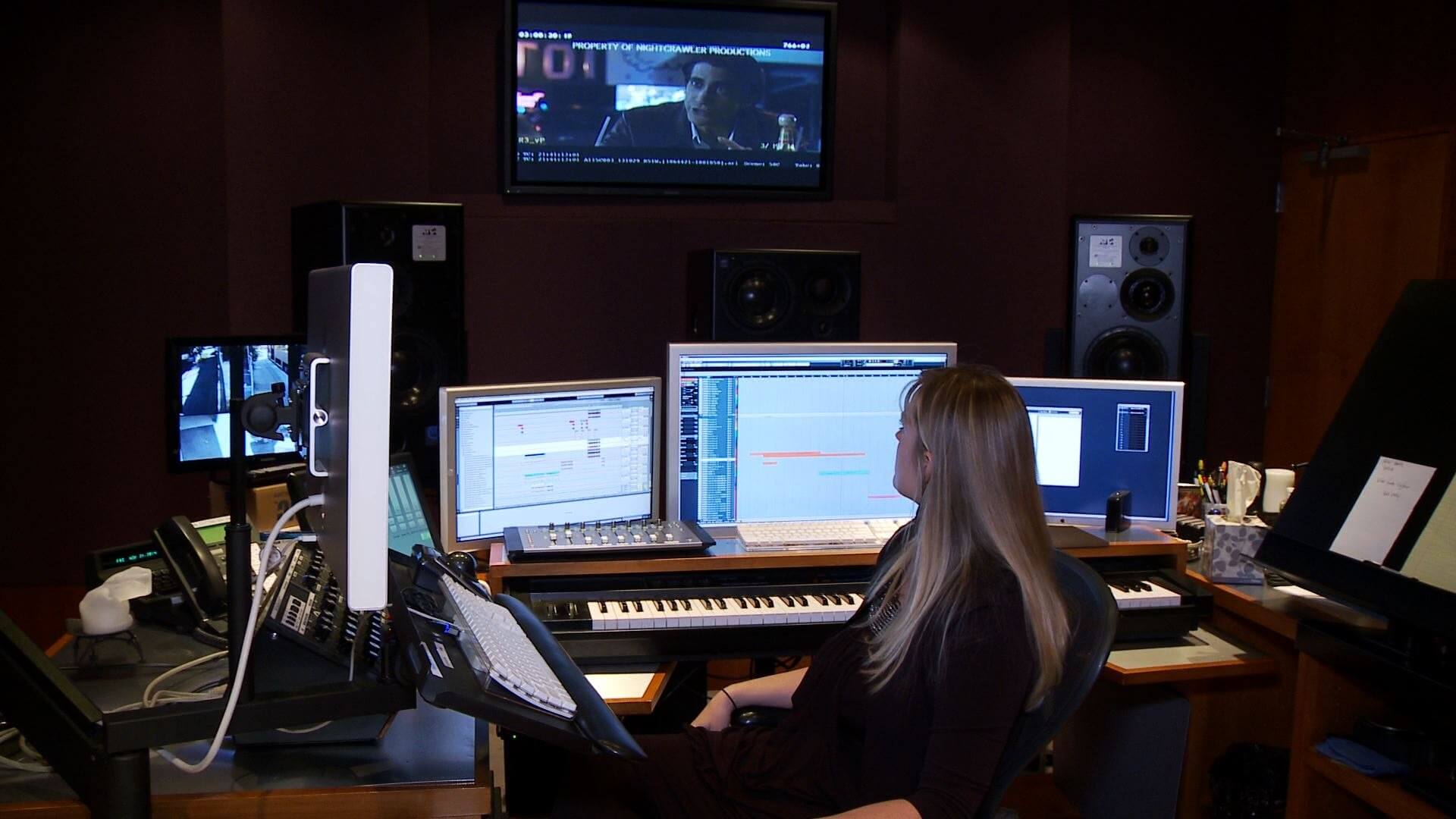
With She-Ra and the Princesses of Power having wowed many since landing on Netflix, we were lucky enough to catch up with composer Sunna Wehrmeijer to discuss her time working on this fan favourite project, her work on some truly huge Hollywood blockbusters, and a whole host more.

STARBURST: How did you career in music start?

Sunna Wehrmeijer: I studied composition and music production in the Netherlands, where I’m from. I always played music, I always composed pieces. I wasn’t quite sure what I wanted to do with it, but I wanted to do something with music. By the end of my studies, I decided I’d go to L.A. for a few weeks, see what that’s like and then I’d study something proper and get a normal job. Those few weeks in L.A., I fell in love with the place. Finally, it all made sense. I started working for other composers from there and really found my calling. It’s something I really love doing.

Moving from the Netherlands to Los Angeles is quite the big deal. How was it make the jump at such a young age?

It sounds weird, but it wasn’t really a big deal at the time. I’d just finished my studies, I didn’t have any responsibilities yet, it was just me. I found it very exciting. The initial plan was to go for eleven weeks. It never even entered my mind that I would move there. It wasn’t until someone in my class said, “Well, why don’t you move here and do the whole program?” That just made so much sense. I basically went home for Christmas and told everybody that I wouldn’t be coming back. It wasn’t such a huge thing like, “Oh, I’m packing up all my stuff.” I basically left and had my family do that for me [laughs]. It was such an exciting thing that I didn’t have to think much about it. I just felt that in L.A. the world was at my feet at that time.

Was there a certain moment or certain job that cemented to you that this would be your career?

It was so funny. You have to have these visas, which make things annoying. You get a visa for two years when you’re a student. During the first year, I started doing some unpaid internships. It was only three days a week that you actually had to go to UCLA. The second year, I’d already found a job as an assistant to Mark Streitenfeld. I told him during the interview, “I am very available to do this job, I want to do it, but could you help me with a visa?” That was extremely awkward. I was one of a lot of people wanting that job, so making requests was very uncomfortable. But he did end up sponsoring me, which was great. It’s one of those things. Leaving never entered my mind; I was just, “I will find a way to do this.” I wasn’t thinking about how this might not work or how I might have to go back home. I never thought about that because it was never an option. I never even considered it and thank god it worked out well.

Sunna Wehrmeijer

You have quite the eclectic array off credits to your name, from Dorothy and the Wizard of Oz, to Prometheus, to Robin Hood, to Drag Me to Hell, to Nightcrawler. Is there a certain genre that you prefer to work in or are you always open to exploring the right project?

I definitely love doing different sort of things. The fact that the two shows I’m doing now [She-Ra and the Princesses of Power and Dorothy and the Wizard of Oz] are animation is just a coincidence. Like you say, I’m not just an animation composer. I love a dramatic score, I love to write dramatic music for action, adventure, emotional drama. That’s just really what I enjoy doing. I enjoy writing the themes and thematic music. Obviously, sometimes you have to create tension, which I also enjoy doing. It’s not like I don’t like to do that. I don’t want to say I don’t like doing this, I do. I would say my first love is a dramatic score in which I can write and develop a nice theme. Which at the moment, I’m very lucky that I have a show in which I can actually do that.

There are always going to be certain similarities in your scoring work from project to project, but how conscious are you of not having projects sounding too similar to each other?

Obviously, there’s always the danger of that, especially because I sound like me. We all have a certain style and little things that we do. For instance, an action scene I’d write for She-Ra is very different to an action scene I’d do for Holmes & Watson. One is live-action, one is animation. They could be doing the same thing on screen, but in animation you’d score it differently. I’m always very inspired by the visuals, and because the visuals are always different to each other I will always come up with something just slightly different. Sure, I rip myself off by accident sometimes [laughs].

Do you have a preference between live-action and animation projects at all?

I love both. The good thing with animation is that you can often write lots of themes. The other side of that is that it takes a huge amount of work – especially with She-Ra. Every 22-minute episode is like a mini-movie. I’m emotionally drained by the end of it because it’s very intense. With some forms of live-action, you take a little bit of a step back as a composer because you don’t want to do anything that’s too much on the nose. It’s just a different way of scoring, but I have to say that I really enjoy both.

With She-Ra, did you get to see the animation before you put the music together or were you going in blind?

Yes, there was the demo phase. Getting the job, it was between me and a few others, and you get very early sketches to see what was going on. When I got the job and began working on it, I got a full episode to score. It wasn’t completely locked.

Sunna Wehrmeijer

How did your involvement in She-Ra and the Princesses of Power come about?

All these DreamWorks animated series, they usually try and find a new composer. I demoed for it, they listened to it blind so that they don’t know who it’s from, and that was the first round. After that, the demoing phase that I mentioned, I had three scenes with very rough pictures. I just did what I thought was right, and I guess that they liked that; they seemed to agree with that. So yeah, that’s how that happened.

Were you a fan of She-Ra as a child?

It’s so funny. I’m 34, and everyone I mention the show to, they’re all, “Oh my god, I used to love She-Ra!” Either it never made it to the Netherlands or I completely missed it, but I had no idea who She-Ra was. I can say it now, although obviously I didn’t mention it before [laughs]. But no, I didn’t watch it. I don’t know if it played there, but I guess it wasn’t a big thing in Holland. Even my husband when I mention it, he’s all, “Oh my god, I used to have the Greyskull castle!” I’m just, “Okay…”

So your first experience of She-Ra was when you got involved with Princesses of Power?

Yes it was, that’s right. I went back and had a look at it [1985’s She-Ra: Princess of Power series], and obviously it’s really cool. This is such a new approach and such a new thing, though. It’s much more cinematic, it’s much more emotional, the characters are much more developed. To me, I know their names are the same, but it’s such a new take on the whole thing that I don’t think the two need to be connected musically at all. The music worked very differently in the ‘80s. It suited it really well, but this take on it needed a more adventurous score. They were quite clear about what they wanted for the score. [Executive producer] Noelle Stevenson had worked on this for years before I came on. She’d gave it a lot of thought and wanted a classical orchestral adventure combined with contemporary ‘80s synth – which is exactly what it has become. There was a very good vision for it, and hopefully I’ve been doing what they asked for. It just fits the show really well. I don’t want to say anything bad about the ‘80s one, because it did what it did for that show and worked really well. I think that TV shows have become so much more cinematic, like mini films. That has a lot to do with the music also becoming more cinematic and helping to play the episodes like a movie. That’s probably where the biggest difference is.

Did you happen to see any of the weird backlash on the internet when She-Ra and the Princesses of Power was first announced, with middle-aged men saying that this character needs to be more sexualised?

It’s ridiculous. From what I’ve heard, young people are loving it, both boys and girls. The 40-year-old creeps in their basement, they don’t think she’s hot enough. I think we’re good [laughs]. It’s like, “I’m sorry this 16-year-old isn’t giving you an erection.”

And are we correct in thinking the second season has already been announced?

I’m allowed to say that there will be a second season.

And you will be back?

I hope so [laughs]. But yes, I will.

Sunna Wehrmeijer

Would you say that there’s now more respect and appreciation towards music than there maybe was for shows in the ‘80s and in to the ‘90s?

Maybe. To be honest, I can’t quite answer that as I wasn’t around in the ‘80s. Generally, whoever I’ve met in the film industry, they always find music important. We always come on later in the game, obviously, usually in post-production, and it’s only one part of the production. You’re not the main thing, you’re one of many elements. From my experience, there’s lots of appreciation for the music. Most filmmakers aren’t musicians, so they’ll find different ways of explaining what they want. I find that they respond with great enthusiasm about music that fits their film or their project.

You mention there how musicians are part of a larger production. Do you feel that when people first get into the industry, they maybe lose sight of that a little and try to overpower the overall project with their music?

It’s hard when you watch a project and you don’t know what the process was. If the music is too much, whose fault is it – the composer or the director? I think you have to be very aware that you’re not the most important person on this film. I only mean that in the sense that the filmmaker has many tools to make his film, and you’re just one of those tools. That’s just how it is. If you’re a concert composer, it’s so different. The filmmakers have been on these projects for years. I can come on later on, my job is to help them finish their movie in the best possible way. If that means rewriting something ten times, then that’s what that means. In fact, if I have to rewrite something ten times then they likely should’ve hired someone else [laughs]. But there’s going to be some rewrites involved or some rearranging. I put a lot in there, then I watch the final product and it gets taken down or it’s overpowered by sound effects. That’s just how it is. No, it’s not always fun, but it’s just how it is.

What is the process of working on something like She-Ra and the Princesses of Power like?

There’s a schedule, which is basically two weeks per episode. Then there’s another two weeks of adjustments and fixes before it gets made. So, one episode will usually take a month. There’s usually three things going on at once; you’re finishing one, doing fixes on another, and starting another one. Now, I’m much ahead of the ones that have just launched on Netflix. By now, it’s so much easier than it was on Episode 1, because you’re finding the sound, you’re coming up with themes, I’m making sure I’m doing what they’re looking for.

How much easier is it once you’ve established a signature theme for a character or location that you know you have in the bank and that you can go back to?

Absolutely, that is a relief. The thing with animation, because you’re hitting so much, it rarely happens that I can take a whole cue and take it somewhere else. That’s never going to work, but I can take bits. I think it’s always good to have that recurring feel, so people will notice, “Oh, this is about She-Ra or Glimmer or whomever it’s about.” I think that’s good in many ways.

Sunna Wehrmeijer

In your career, there have been small independent projects, giant Hollywood movies, animated efforts, and so much more. Is it possible for you to pick a particular career highlight so far?

A couple of things. First of all, getting She-Ra. DreamWorks just makes really nice things, so I was very excited to become part of that team in the DreamWorks world. On the big screen, I do still think it’s pretty cool that my vocals ended up in three out of four Hunger Games films. That was a nice moment, especially because it was so unexpected. That was so not ever my intention, so it was such a lovely surprise. I felt very appreciative.

How did it happen that your vocals made it in to the Hunger Games movies, then?

It’s a bit of a fun story. I was working for James Newton Howard at the time at his studio. He was writing Hunger Games and there was this one scene he did for Katniss, Jennifer Lawrence’s character. It was a very quiet cue, very beautiful, very lovely melody, a solo vocal. Vocals are very hard to sample, so the melody sounded great but the vocals sounded like shit. The next day, I just went in at 6am or 7am and re-recorded that vocal line myself and I said, “I put a little placeholder there so that you don’t have to listen to that horrible sample. You can re-record it with a vocalist later.” He really liked it, and so the actual recording I did myself is in Catching Fire, then Mockingjay – Part 1 and Mockingjay – Part 2. That was so weird but so nice. Then the vocal thing just kept kind of coming back. Maleficent I sang on, and now on She-Ra. A lot of scores don’t suit vocals at all, but She-Ra just makes so much sense.

What else are your currently working on or have in the pipeline at the moment?

There’s Dorothy and the Wizard of Oz, the Warner Brothers animated series that we’re starting Season 3 of. That’s playing around the world on Boomerang. The age group is a little younger than She-Ra, but it’s a really lovely show. It’s classic Warner Brothers cartoon music, it’s very exciting, the characters are really lovely. It’s just a really lovely show.

Having worked on dramatic films such as Prometheus, Robin Hood, Nightcrawler, and The Hunger Games, it must be nice to do something a little more light-hearted?

Yeah, it was. I have two kids, so it’s nice that they can walk in while I’m working. If they walked in on a scene I was doing from Prometheus, that wouldn’t be good. So yes, it is nice to do something a little lighter, for sure. They both love Dorothy, although they’re both slightly young for She-Ra. My son thinks that I get paid to watch cartoons all day for a living, which is kind of funny and not completely untrue either.

To keep up to date with Sunna and her upcoming projects, be sure to check follow her on Twitter or head over to http://sunnawehrmeijer.com.

Loren Lester | BATMAN: THE COMPLETE ANIMATED SERIES

Loren Lester Batman: The Animated Series

With Batman: The Complete Animated Series out now on Blu-ray, we continue our celebration of BTAS by catching up with one of the show’s mainstay voice talents: the brilliant Loren Lester. Whether as Robin or as Nightwing, Lester delivered a multi-layered Dick Grayson throughout BTAS and beyond, and we were lucky enough to grab some time with Loren to discuss a whole host of fun and fascinating topics.

STARBURST: When did it become clear to you that acting and voice acting was a realistic career for you?

Loren Lester: I started at a very young age – I was sixteen – and I was very lucky, because the agent that I had covered all of the different areas where actors worked. Now it’s very specialised – you have a voiceover agent, you have a commercial agent, you have a movie and TV agent – so this agent I had, my very first one, he had departments for all of the different areas. I started working immediately; I worked with the great Hanna-Barbera studio, I was very fortunate to do that, and the rest is history. I’ve been doing voiceovers, I’ve been doing commercials, I’ve been doing movies, I’ve been doing theatre. I’ve been very lucky. I’ve just passed forty years as a member of the Screen Actors Guild, which I’m very proud of. It came to me as a bundle – wherever we can sell you, wherever we think you can work you’ll work – and I was very lucky.

Until the mid ‘90s, it seemed as if voice acting was almost a closed shop of sorts – as in a lot of the same people did a lot of the shows out there.

It was very small group of people, and I was lucky enough to be embraced by that small community. Now, of course, it’s wide open, and especially a lot of celebrities are doing the work. They all have kids, so they love the idea that they’re going to be doing animated shows and their kids are going to hear them. It’s very, very fulfilling to them. Back then, it was kind of unusual. We had tonnes of celebrities do our show, but it was kind of the beginning of that. It was really the breakthrough of that. We had some incredible people, people who’d been working in television for many, many years. Especially a lot of them had been in radio. Bob Hastings, who played Commissioner Gordon, actually had a big radio career. He was familiar with voiceover, but he was also a TV actor. I remember him from McHale’s Navy. It was exciting for me to be working with all of these people I’d grown up with on television.

Loren Lester

You have a background in stage work, much like Kevin Conroy. Do you feel that there’s something about stage performers that translates perfectly to voiceover work?

Voiceover actors are simply wonderful actors. The best acting that people can get is in the theatre. Most people agree with that. A lot of people don’t get a theatre career anymore, they just say, “I want to be a voiceover actor.” But the best ones are people who are well trained actors, and the best training is in theatre. So yeah, that helped me. Kevin was a theatre actor, Mark Hamill, Bob Hastings, we were all theatre actors. And the celebrities, too. They all had had starts in theatre. So that was a big, big thing.

When BTAS was being cast, there was some major A-list competition for the key roles. How was the audition process for you, and do you know who you were up against?

I don’t know for certain, because I’m not on the other side of things, but I don’t think there were any celebrities. I know that every colleague of mine was up for the part, everybody wanted it; everybody really, really wanted the role of Robin. That was my pool of actors, all of my colleagues who I knew from auditions and work. I don’t think that there were any celebrities that they auditioned for it. Now, of course, that’s the first thing they do; they go for a celebrity. It’s too bad, because we have such a fantastic cast. We’ve become the icons of Batman and Robin and Nightwing. We are the icons of that, and it’s too bad that they say, “Well, let’s get a celebrity the next time we do a Batman or Robin show.”

It’s testament to those involved in BTAS that your voices have become synonymous with these characters. To this day, people hear your voices when they’re reading comic books.

I hear that so often, I hear that all the time. I’m at Rhode Island Comic Con and I know that I’m going to hear that at least a hundred times. And I’m saying that in a good way. It’s really an honour to hear a lot of people saying that to me. I have a very good friend who actually wrote a series of Nightwing comic books, and he said, “While I was writing it, I was hearing your voice in my head.” It’s just an honour and it means a lot.

Batman: The Animated Series

Were you a fan of DC Comics and the whole Batman mythos before you became involved in Batman: The Animated Series?

I had a real passion for the Batman series of the ‘60s. I was a very little child. Now I look at it and I see that it’s a spoof, it’s funny. As a kid, I took it very seriously. It would play on Tuesday and Wednesday, and Tuesday they’d leave a cliff-hanger. Tuesday, I’d say, “Oh my god, Batman and Robin are going to die! They won’t be back on Wednesday!” Of course, they would be. Everyone else who was older was just, “Of course they’re going to be back!” But to me, it was very, very serious. I had every possibly piece of memorabilia I could find. I had everything you could possibly get; the utility belt, there’s the Batman you threw up in the air and he’d land with a parachute. So I was a huge Batman fan. I wasn’t necessarily a big fan of Robin. I didn’t hate Robin or anything, but I was a Batman fan. So, when the opportunity came for me to audition for this, I was pretty excited about it. “Oh wow, I have the opportunity to be the voice of Robin!” I think only one other person at that point had been the voice of Robin, so it was an opportunity to kind of recreate that voice.

As someone who grew up reading comics, I always took Robin as a big deal – whether that was Dick, Jason, Tim, Stephanie, Damian…

No, no, no. There’s no other Robin, there’s just Dick Grayson [laughs].

For those who were only familiar with Robin from the Adam West and Burt Ward TV show, they often saw Robin as a joke character. In that regard, Batman: The Animated Series had such an important role in making people realise just how much of a fascinating character Dick Grayson is.

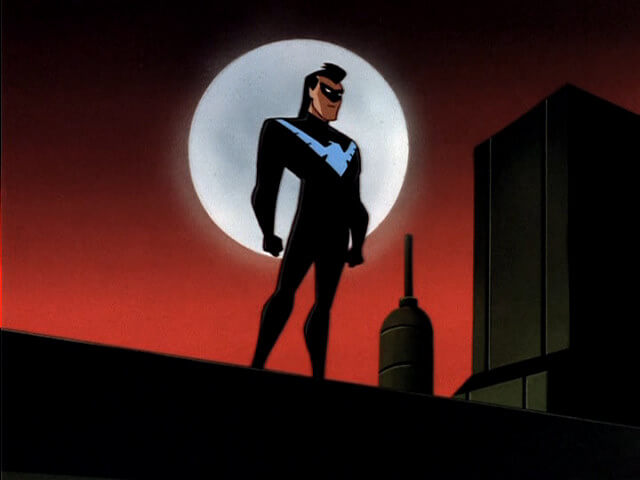
What they did was very smart. They started the Robin character in college, so that he was already older, he wasn’t this naïve kid. He was at a crossroads. He’s still young and naïve in some ways, but ready to transition. Later on, when they transitioned him to Nightwing, it was perfect because he was already on his way to getting there when they started him as Robin. By the time they got to Nightwing, he was ready for that. Interestingly enough, when I do these conventions and panels, I learn things that I never ever knew that were going on. Bruce [Timm] and Eric [Radomski] said they had no plans when they started the show of having Nightwing, which was interesting because it seemed like they were headed in that direction. Maybe it was subliminal or something, that they knew they wanted to go in that direction. And it was great, because he became his own man, he became his own superhero, and he was important as opposed to just being a sidekick.

Had did you approach that transition, from the Boy Wonder to a full-blown hero of his own?

It was very exciting, because when the show ended I thought that was the end of it. I didn’t know that they were going to go on and create The New Batman Adventures. Andrea [Romano] called me up and she said, “I have some good news and some bad news for you. You’re not going to be Robin anymore…” I was just, “Oh my god, why?!” “But, you’re now going to be Nightwing.” I was just so excited that that’s where they were taking the character. I think the show ended far too soon, because I think they really had plans to go even further with that, even create a Nightwing series at the time, but it never happened. If they ever made this Nightwing movie that they’re talking about, then maybe they will make a Nightwing series – and, y’know, I’m available. When they make the live-action Nightwing movie, there’ll be some young hunk in spandex, but then they’ll turn around and make an animated series. That’ll be me.

Loren Lester

When you’re so synonymous with a role, how is it to see other people voicing that character?

It’s not great. Every time they’ve done a new version of the show after our version of the show, they’ve actually made me audition for the role. They said, “We want something different, different than it used to be.” The fans don’t want it to be different. The fans want that. Every time I do these comic cons, they say, “When are there going to be new episodes? We want that show, not these other iterations.” Every time they do a new version, when they try to create something new from the ground up, it’s not really what the fans want. The fans want the show that we did. And you still have Kevin, you still have me, you still have Diane Pershing [Poison Ivy], you still have Paul Williams [Penguin], Mark Hamill. We’re all still here and we can all still do these voices. We could do this show again, and please not just one generation but two generations of fans. Every time I do these comic cons, I have people come in who watched the show originally, so they’re in their 30s, and they’re standing there with their kids who are 10, and they watch it together. Even the last show I did, which was Alamo City Comic Con, I had three generations. I had the grandfather, his son, and the grandson. That’s three generations that love that show and ask, “When is it coming back?” Hopefully after they release this Blu-ray, people at DC and Warner Brothers will say, “Hey, let’s do this again.”

It was, and still seems to be, a rarity to have an ensemble cast brought together for rehearsals and performance.

Nowadays, when you work you usually are by yourself. Especially with interactive games, you’re totally by yourself in a booth. So this was a great thing, and Andrea was very responsible for that. The group ensemble, it’s like doing a mini play, a mini radio play. We were all there, even the celebrities. Now, you’ll do a job and hear how so-and-so will do their own stuff when they’re available. With this, the celebrities were always there. We never had anybody be a prima donna; they were all there.

With BTAS, Dick Grayson didn’t turn up straight away, instead being introduced later down the line. Do you know what the thought was behind that?

What happened was I did the pilot episode. The original concept was Robin was going to be there from the beginning, but then they decided they wanted it to be a darker show, they wanted it to be like that first Batman movie with Michael Keaton. They wanted him to be a loner, very dark, and they drew the cells on dark paper, and the music was very dark and foreboding. They wanted a dark show, and they didn’t want it to be lightened up by the presence of Robin. After however many episodes it was, FOX Kids said, “Hey, where’s Robin? You can’t have Batman without Robin.” They started to put me in a few episodes, then they did this two-part episode called Robin’s Reckoning, which was a turning point. After they wrote that and after we recorded it, they saw that Robin was a really important part of the story. Things changed and Robin became a really important part of the show. That was an episode that won an Emmy, which was very nice. That was a great two-part story. I remember getting those scripts and thinking, “Wow, he’s really going to become part of the show.”

Audiences were instantly in love with BTAS, but, as someone who was involved in the series, when did you realise you were on to something truly special?

Remember, we record the voice first and then they animate to the voice. So, we didn’t see anything for six months to a year after we recorded it. Only then when we came back in for ADR, where we have to replace some of the dialogue, did we say, “Oh wow, this is really different.” It wasn’t a cartoon, it was truly a cinematic experience. That’s what Bruce Timm and Alan Burnett and all of these people, they were creating a cinematic experience like a movie not like a cartoon. It was at that point, after we’d recorded many, many episodes, that we started to see the show being completed. There was a richness and a subtlety. Cartoons aren’t very subtle, but you think about Robin’s Reckoning, one of my favourite moments is that you don’t see the death of Dick Grayson’s parents. You see a rope swing out of frame and then swing back broken. You know exactly what’s happened, and the drama of it is just as powerful, it not more powerful, than if you’d seen them go splat.

Loren Lester

Moments like that were just so cleverly constructed, covering some rather serious topics and dark moments but still managing to work within the restrictions of a kids cartoon show.

They were up against restrictions. No one ever died in that series, they couldn’t show blood. It’s just like in the golden age of Hollywood they couldn’t show sex or real violence. They could show a guy getting shot and dying, but the violence that we’re used to now, they couldn’t show any of that. But they created fantastic atmospheres, and that’s what this show did – it created a fantastic atmosphere even under the restrictions.

When we see Dick become Nightwing in The New Batman Adventures, was that still like putting on a familiar old slipper, or did you approach it a little differently?

In a way, but also the scripts for my character were much richer. When I got those scripts, there was so much more for me to sink my teeth into as an actor. It was very exciting coming back and seeing those scripts. At the time, and I don’t know if it’s still the case, but there was a policy where when you reach a certain number of episodes for syndication, you stop making the show and make a new show. Which is too bad, as I think there was a big audience then, and there’s a big audience now for it. The fans didn’t want it to end, we were hugely popular, yet they still ended the show because they felt that they had enough for syndication. It’s not like we jumped the shark – we didn’t have enough time to jump the shark!

The quality was definitely still there in The New Batman Adventures…

My favourite one from The New Batman Adventures was Old Wounds. I got to play both characters; I got to play Robin because they did a flashback, and then in the present I got to play Nightwing. They told the whole backstory of how Robin fell out with Batman and his conflicted moralities. He wasn’t going to put up with that anymore, so he punched Batman and he left to become his own man. That was a pretty thrilling episode from The New Adventures. We can see it again, they just need to pull the trigger.

That would be brilliant to see, although there’s the fact that Andrea Romano and Alan Burnett are now retired, and Paul Dini and Bruce Timm no longer seem to have a working relationship. Given that the crew of Batman: The Animated Series was just as important as the cast, it could prove tricky.

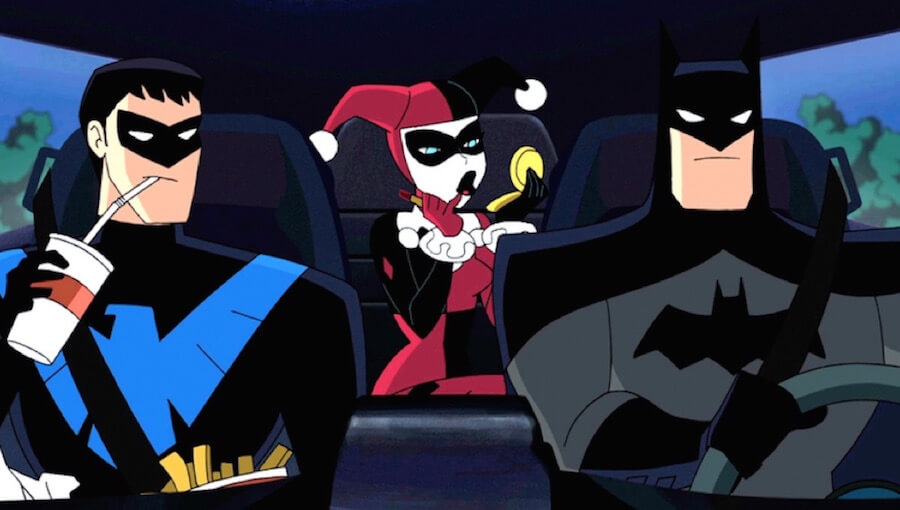
When we did Batman and Harley Quinn, that was Bruce’s film. I don’t know if he’s interested or what’s going on, but I think he could pull the trigger. Actors are the last people to know. When I did Batman and Harley Quinn, I got a call out of the blue. I had no idea they were writing it or doing it. So, I have no idea what they’re planning or what’s on the drawing board, be that DC or Warner Brothers. I think if they wanted to, they could definitely do it. We had a perfect reunion last year, so we could do it again – Kevin and me and Bruce, and it was terrific.

Nightwing Loren Lester

Why do you think that Batman: The Animated Series is still held up as so special by so many people?

People love comic books because comic books create three-dimensional characters with backstories and reasons for what they do, including the villains. They have reasons for what they do, and the show was very concentrated on that. All of the villains – except for The Joker, who’s just insane and we don’t know what his story is – everyone had a backstory for what they did and why the did it. It was three-dimensional characters, living, breathing human beings. That’s what makes a great comic book, and that’s what makes a great animated series. Nowadays, they don’t always follow that rule.

Was there ever a preference for you between playing Robin and Nightwing?

They were both incredibly fun, but I do have a special love for Nightwing. Nightwing really became his own man, and the scripts really became very multi-faceted for him. Robin was a sidekick in many, many of the episodes, but Nightwing was his own man – so I have a great affinity to that character. People tell me when they come up to me, “Nightwing is the coolest!” And I say, “You know what? You’re right!” He’s just a really cool character.

It might be like asking you to choose a favourite child, but is there a specific favourite episode, moment, or scene for you?

It’s three things. Mostly, it’s Old Wounds because I got to play both Robin and Nightwing, both sides of Dick Grayson. And then, Batman & Mr. Freeze: SubZero. That was a terrific movie. I’ve done a number of on-camera films, and that was like doing a really good on-camera film. Then, of course, Robin’s Reckoning.

As an actor, do you have a preference between live-action or animation work?

No, not at all. I’ve been very lucky to have a 40-year career doing all of this. When it’s a really good script and a really good director and everything is going terrific, it doesn’t matter if it’s animated or it’s live-action. Those experiences are unfortunately pretty rare. There’s usually a factor missing, like the script is good but everybody involved isn’t so good, or just other different variations of that. I did a movie called Red Eye that was directed by Wes Craven. That was a great example – a good script, a great director, the cast, everything was spectacular. Here [BTAS], I’ve had many, many episodes having that experience.

Is there a particular dream project out there for you, either Batman or not-Batman related?

I would love to take the next step. As you know, in the comic books Nightwing becomes Batman in Knightfall. It would be interesting, not to necessarily do it that way, but to have Kevin and I existing together as competing Batmen. With Kevin and myself, we love working together. I don’t want to speak for him, but I’m assuming that he feels the way that I do, that he would really love to do that.

Batman: The Complete Animated Series is out now on Blu-ray.

Frederik Wiedmann | THE DRAGON PRINCE

Frederik Weidmann

Right now, Netflix is in the midst of delivering some truly stunning animated TV shows, including The Dragon Prince. With the hugely popular series already renewed for a second season, we caught up with composer Frederik Weidmann to discuss his musical work on The Dragon Prince, plus his work on a slew of genre favourites featuring the likes of Batman, Superman, Green Lantern, Aquaman, and so many more.

STARBURST: When did it first hit you that music could be your career?

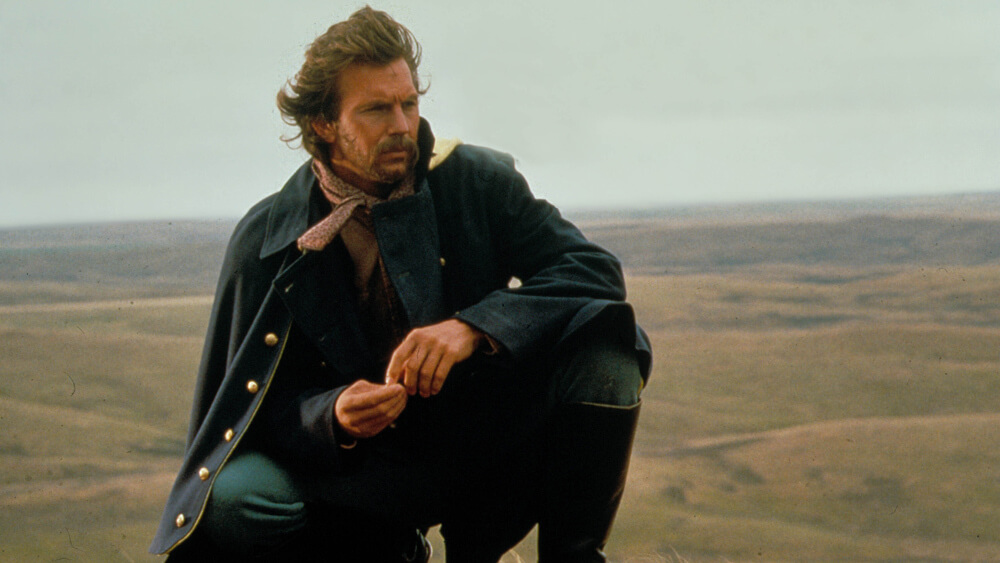
Frederik Wiedmann: It’s interesting. That started very early. I’ve had this one career desire since I was a teenager. There was nothing else I really wanted to do. The trigger for me was, I was 12-years-old and watching Dances with Wolves. Hearing that amazing John Barry score, I fell in love with it on the spot. That was the first soundtrack that I had. That played on repeat in my room for the next couple of years, and then I slowly increased my film score collection. That’s really when I realised that this is a profession and people do this for a living, and that there’s soundtracks to movies that you can buy. I think the next pivotal step for me was to meet a friend of mine through an ex-girlfriend of mine at the time. He lived in Augsburg, Germany – where I lived – and he was a film composer, a working guy who did a lot of work for TV, for a bunch of German shows. To me, that was eye-opening. I walked into his studio and I was just, “Oh my god! This is what I need to do.” Already being a film music nerd and having done some mild composing myself, practicing violin and guitar, and a little piano, that was the moment where I went, “I can’t believe this is actually something people can do. This is something I have to do.” Since then, it’s been pretty much a straight shot to where I am today. Back then, there were not that many colleges that offered film music or film composition as a specific major – so Berklee College of Music was one of the only options back then, in Boston, so that’s where I went. I finished my Batchelors and went straight to Los Angeles to work. I really never have wanted to do anything else. I wanted to be a composer.

Dances with Wolves

When you became obsessed with the Dances with Wolves score, had you already begun to play instruments or is that what gave you a kickstart to delve more into music?

I started playing violin when I was six, so I’ve always been involved with instruments from an early age. I was never the virtuoso wunderkind genius by any stretch of the imagination, but I enjoyed playing. When I was fourteen, I switched over to guitar. Being a cool teenager, a violin wasn’t something I wanted to carry around. That’s what I wanted to do, and my parents were completely open to that. The good part was that the teacher they chose for me was a jazz guitar teacher, not rock or fusion or anything like that. He was very deep into the jazz world. There’s something about jazz. There’s a huge world of music theory involved with learning how to be a good jazz guitarist. And he sort of cracked that with me, he started to talk about that, and that’s when I really dove into music theory and composition, the more theoretical aspects. It was a combination of already knowing about music and, having played music for my entire childhood, loving music itself. Moving into that world through my guitar teacher, and then meeting my friend, it all just kind of came together to this one thing that I completely fell in love with.

Do you feel that a wider audience has, not necessarily a new appreciation, but found a renewed appreciation for scoring work in recent years?

It’s funny, there’s two sides to this. I completely agree with you that there is a huge interest for this kind of music, which is, to me, a great gateway into the classical world that a lot of people may not necessarily want to dive in to. But once they start to love film music, it’s a natural next step to explore something else from that literature. I think it’s a really nice thing for them to explore that side of music. The concerts that they’re pulling off these days, and concerts that are massively packed and sold out over the world from all of these video games, it’s incredible to witness that, to see that there is a big interest of people to go and see this stuff performed. I think there’s a big interest in that, but the other side of the coin is that, ironically, soundtrack sales have gone down dramatically over the past ten years. You kind of wonder why that is. I don’t know if piracy has something to contribute to that. It’s certainly exciting to see that people like film music, people go to concerts, people talk about it. Young kids did a rock version of my Green Lantern theme, which I was a huge fan of seeing that online. Somebody did a six-minute mash-up of themes, going back and forth before The Dragon Prince and Avatar: The Last Airbender. It was amazing! The amount of time this person spent doing that, it was great. I even commented on that video.

How did your involvement on The Dragon Prince come about, then?

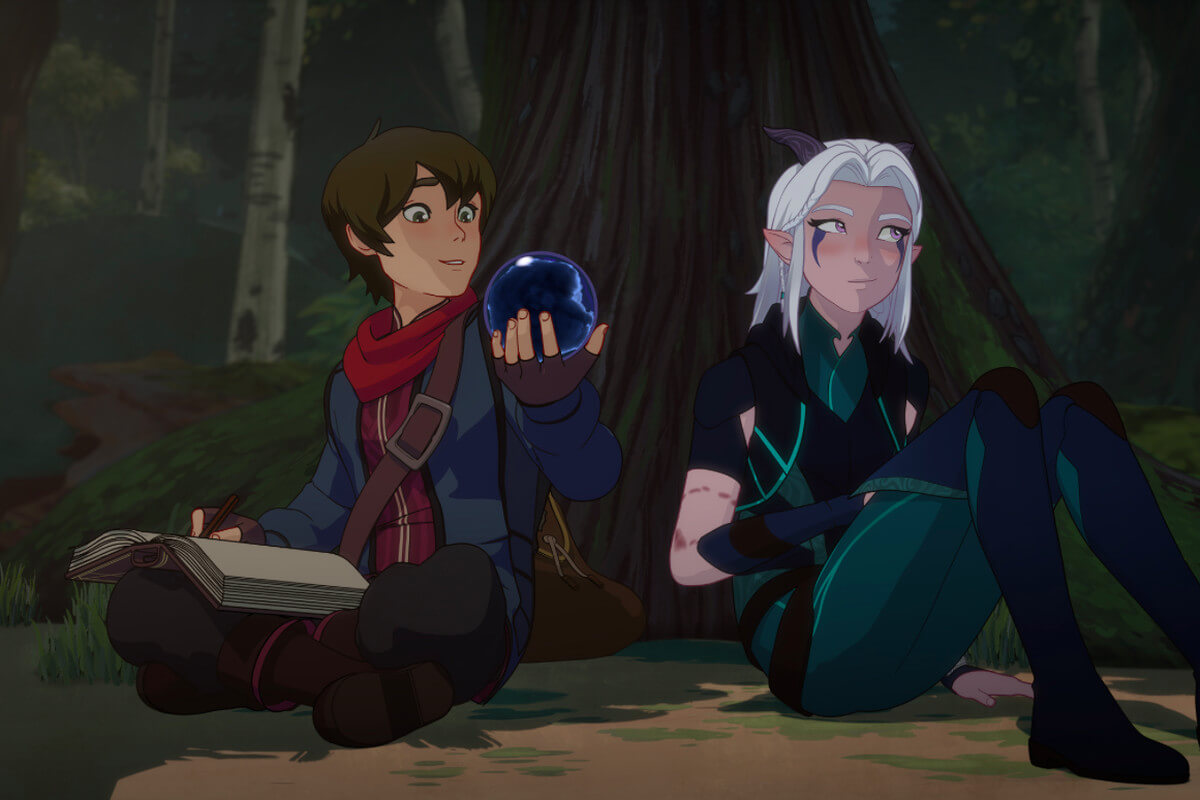
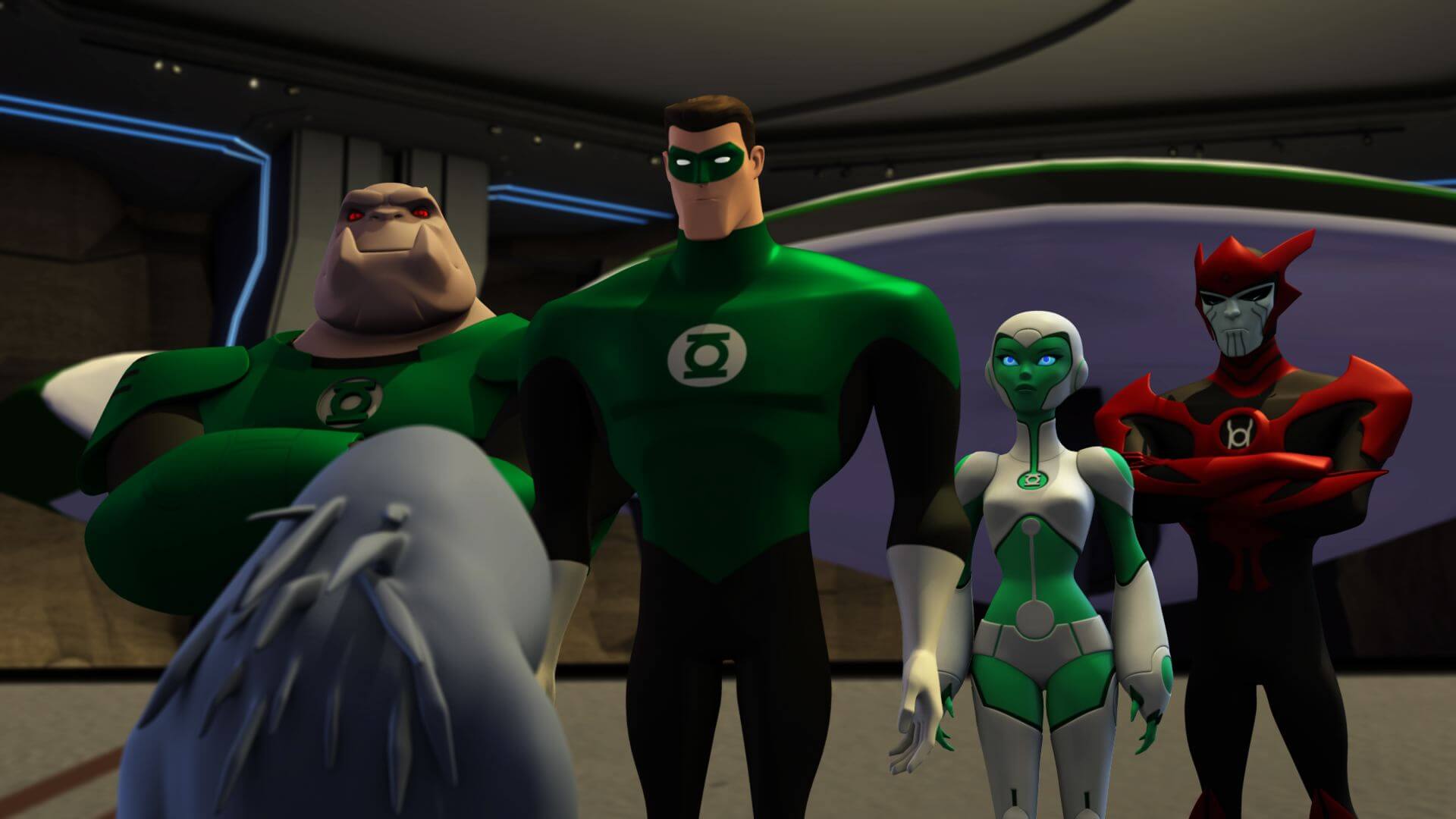
Through a friend. The first animated show that I did – that really started this career – is Green Lantern: The Animated Series with Bruce Timm. Getting that job was just an incredible first step into this world. One of the leading creative co-producers, Giancarlo Volpe, was working on that with me. Him and I got very close because we talked about the music a lot. He ended up moving on to The Dragon Prince and put my hat in the ring, so to speak. There was a big process of playing some music, demoing some of the scenes – the usual process on how you’d get hired on a show like this – and eventually they decided I was the right person to score it. Interestingly on this project, since Giancarlo introduced me early on to the team, we had a lot of time for a whole lot of exploration with instruments, dramatic material, and so forth. I wrote a large amount of music prior to scoring a single scene of the show, just to conceptualise what I was to do. It was very nice to do that, to have the time and to have the breathing to go into a world and decide on things. Once we got to episode one, things were already established, people know the themes that we’ve come up with, so when you end up using them in certain places it becomes so much more impactful and the creative team are already familiar with it. It’s like a puzzle that comes together really quickly.

The Dragon Prince

When tackling something like The Dragon Prince, is there a worry in your mind about trying to keep this completely fresh and original to what you’ve done on other shows previously?

Oh, absolutely. In this case, Dragon Prince is a very inviting canvas for me because it is a completely made-up fantasy world. Even though the DC and Marvel universes are also made up – there is no Gotham City, there is no Metropolis – at least there is something familiar to those words that feels like it could be happening in the present day in America. In Dragon Prince, you’re more in a Lord of the Rings type of environment where everything is new; all the names are new, the races are new, the languages are new. It’s this entirely new thing that now invites me musically to go in a completely different direction to the DC animated stuff. On top of that, a very good component of The Dragon Prince, which is sort of there in a lot of the DC movies, is a very strong emotional character development of the key characters that slowly progress from episode to episode. Being able to build this character arc from the first episode to the last is a very challenging but also great place for a composer to start dialling the certain key elements of the music that, when reoccurring, gives you the goosebumps, makes you feel more for the character. There’s an emotional difference, and also the world is just an entirely different world. We also needed to go heavily into exploring some soloistic instruments that were becoming a key part of the score. In our case, there is a lot of ethnic flutes that I don’t even know the names of. There’s a wonderful player here in LA who has hundreds of them – “How about this one? This one’s from Peru. This one’s from Brazil. This one’s from Nicaragua.” We’re just coming up with something a little unorthodox where you go, “Oh, I kind of know what this is, but I can’t pinpoint a region or country.” That was the idea.

With The Dragon Prince being in-tune with Lord of the Rings, did you go back and listen to any of the Howard Shore scores as an inspiration, or did you just go with your own instinct on this?

That’s exactly what happened. All I had to go on was conversations with the creative time and the beautiful concept art of the characters and the cities and the landscapes and the dragons. Really, all I had was these beautiful, very low rendered images. No videos, nothing was moving, just stills. There was a conversation about where the story was going. It emerged out of that. Whatever creatively that they had to go on visually that I could use as a reference, that was the starting point.

Would you agree that music is just as important as the visuals in terms of setting the tone of a movie or TV show?

I sort of agree with that, but at the same time I’m always coming in from the perspective of the filmmaker; as in, all I’m trying to do is tell the story that the filmmaker or whoever is in charge is trying to tell. In the end, that’s the most important thing; you have to make a movie, you’re not writing a tome poem or a concert piece of any sort that you want to draw too much attention to. What I’m really trying to do when I’m working on a project is how can I compliment the story and the mood and the images so that it elevates the experience. Ideally, you don’t want people coming out of a movie and the first thing they talk about is the music. My goal is for them to come out and say, “I saw a great movie, I was really moved by this film.” To me that’s a much bigger compliment. That’s at least my perspective. I really need to focus entirely on telling the story that needs to be told. If something gets stuck with the audience – they hum a theme when they walk out – that’s great. Ultimately, my goal is to make the film as good as it possibly can be and have the audience acknowledge that a lot more than the score itself. I have a fair amount of problems when I read the reviews of film music. There is so much of an evaluation on the music itself, and not enough on examining how did it work in the movie. I wish film music reviewers would be more like, “The score worked well in the movie, it did this in the movie. When I finished, I felt this and this and this” as opposed to, “It didn’t have any themes, it was boring.” All film music really needs to do is tell the story of the movie and make the movie better. Sometimes a score may be really effective and perfect for a film, but we’re not trying to write a great listening experience for a soundtrack. If that accidentally happens, great. First and foremost, it’s whether the score worked for the movie. If so, you praise that. If it made the movie exactly what it needed to be, to me that’s winning the game.

Frederik Wiedmann

Do you feel that some of those who are in the infancy of their careers can at times have a tendency to lose sight that they are part of a larger project and that the music shouldn’t necessarily overpower the end the product?

I think there’s a lot of that going on. I meet a lot of young film composers that reach out to me online. I did bit of teaching at USC for a couple of years, and I know that there is definitely a big resistance to feedback. They’re like, “No, my music is great. What are you talking about?” What a lot of people need to learn is how do you take feedback and how do you understand that what you’re doing is you’re employed to work for somebody and to realise somebody else’s vision – not your own! It’s very important as a film composer to know your place and to really focus on that; how do you get the vision of your employer realised in the best possible way. A lot of people fail to see that.

In your career so far, is there a particular emotion or feeling that you’ve found trickiest to convey?

No, there’s really nothing like that. There were a few things that used to intimidate me, like when I was working on All Hail King Julien for Netflix, the other animated show from DreamWorks, they asked me to write songs, which is something I’m not necessarily experienced in as much as score. That was a little bit daunting, but I ended up winning my first Emmy for the song. So I’m at a point where that doesn’t scare me anymore, I feel that I can pull it off. It was funny how that worked out. I think the most difficult thing for most composers is always comedy. You’re relying on so many aspects of the joke, the performance, the setting, the way it’s edited, the entire vibe of the show or the movie. How do you play comedy? Often, comedy is perfect dry with no music. You need to help it, but what do you accentuate? Do you create a mood, do you accentuate a certain punchline, do you need to start the music at a very specific place? Comedy is the thing that can be created in so many different ways, and a big factor is also taste; how do you want to treat comedy? I think it’s always the most complex nut to crack in a movie. Not necessarily children’s comedy for animation – that’s easier because you know what kids need – but when you get the more sophisticated adult comedic material, then it becomes a very tricky thing. It requires a lot of patience and understanding of how jokes work in movies to really nail that moment and make it as funny as it can be.

Is there a difference in your approach at all to live-action and animated projects?

There is a difference. Ultimately, I’m trying to establish the same thing with both. The story, that’s ultimately my goal and the first thing on my mind. In terms of the technical approach, the big thing that I’ve encountered over the past couple of years is that in animation I never have temp music. Temp music is existing music from other scores that the editor uses as a placeholder for previews to show it to directors, etc, to give an idea of what the movie will play like. Often, that’s a good jumping off point for composers to discuss what works and what doesn’t; it sort of gives you a roadmap of where to go. In animation, there never is such a thing. I’m basically just given the material completely dry. Most of the time it doesn’t even have sound effects. I don’t hear any footsteps, I don’t hear breathing, I don’t hear coffee mugs hitting the table and doors closing. That’s all gone. All I’m hearing is bone-dry ADR, and sometimes even unfinished animation. The state that I receive the material to work on is vastly different from a live-action movie, which has fully rendered sound, good performances, finished editing, and sound effects and a temp score. I think my brain has to be set in a different mode when approaching animation, because there’s so much that I need to imagine on how the story should be when it’s finished versus actually seeing it. It’s an interesting thing to realise in the beginning when you’re not very experienced; you tend to over-score things in animation because nothing’s there. It requires a lot of experience and knowledge of how things will end up in the end. Based on that, you can make good decisions on what to do with the music.

Green Lantern: The Animated Series

Bruce Timm brought you in for Green Lantern: The Animated Series, and you then went on to work on plentiful animated comic book movies and show. Were you a fan of comic books, or was that just a great opportunity that came along?

I knew a lot about the DC universe, and I read a bunch of comics when I was growing up. I wouldn’t necessarily call me a big fan or a fanboy that knows everything, but there was certainly a big love for superhero material in general – especially from a composer perspective. If you ask any film composer, they’d say that their big dream is to score a huge Spider-Man movie or some other superhero film. For me, it was definitely on my bucket list, to be working on superhero material, but I wouldn’t necessarily call me a big fan to begin with. In Germany, especially where I grew up, it’s not as big as it is here [in the United States]. I grew up reading Lucky Luke, Asterix and Obelix, and Tintin. Those kind of comics were way more popular in comic book stores than Batman.

Across the DC realm, there are so many different characters and different locations. For instance, you have Green Lantern up in the stars, whilst Aquaman is fighting the good fight in the depths of Atlantis, and then there are Elseworlds tales such as Gotham by Gaslight. Is there a favourite corner of that world that you prefer to work in?

No, not really. I really enjoy working in all of those places. They’re such a wonderful treat to be working on, to be honest. It’s my favourite thing to do. The filmmakers are so nice, they appreciate music so much, and it’s just this wonderful working environment Warner Brothers creates for me to do what I do. All of these are amazingly fun to work on. It’s always exciting when there is a project coming along that steps out of the norm. Not that it’s more enjoyable than the others, but it’s a nice little challenge thrown at you. Working on a movie like Gotham by Gaslight, where you’re suddenly working in an era where Batman doesn’t have his tools as it’s around the turn of the century, it’s a steampunk era, there’s no cars, people don’t have guns. It’s a whole different environment in a standalone universe that you’re trying to create. So it’s always a nice challenge to figure out a way to blend in the Batman material score to a world like this. This was similar to Gods and Monsters, another DC movie that I did a couple of years back. The whole backstory of the heroes is twisted and unusual, so that also was an invitation to do something slightly different. Long story short, they’re all amazing projects to work on, I thoroughly enjoy them, and when there’s occasional standalone projects that need a different approach, that’s always a nice little challenge for me.

You mentioned live-action superhero movies earlier, so is that the ultimate dream project for you, or is there something else out there?

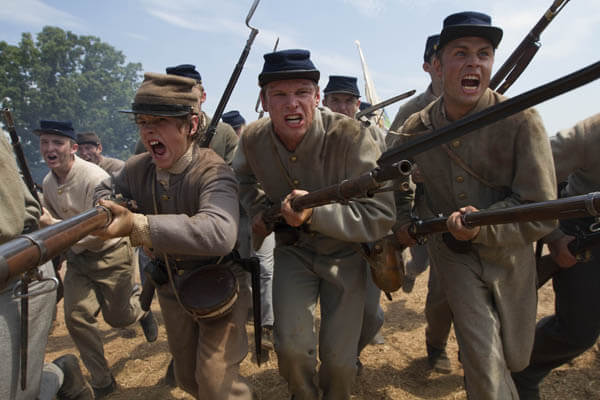
I would love to score a movie like Legends of the Fall. Just a big, sweeping orchestral, dramatic, a big family story, beautiful cinematic landscapes. That would be very exciting for me. That’s one of my all-time favourite scores anyway, by James Horner, and I think I would completely enjoy it. I had a little bit of a taste of that when I was working on Field of Lost Shoes, the civil war movie a couple of years back. That was a nice project because we got to do something a little along those lines. It was a small version of that, but certainly something like that would be an amazing thing for me to work on.

Field of Lost Shoes

Having been in the industry for over a decade now, how is it to have that seniority now where people come you to head up projects?

It’s amazing. I never would have dreamed that I would be doing that at this point in my career, at my age, at 37. It’s just amazing what’s been happening. I’m incredibly grateful for the people who have provided me with all of these opportunities over the years; the great filmmakers that keep coming back to me for more. It’s an amazing feeling. I just love the work. I’ve been very blessed with a great variety of work, too. There was a time early on in my career where I thought I might get pigeonholed to becoming a horror composure, as there was a lot of that going on for me. I love working on horror and I love watching horror movies, but it was not something I wanted to do exclusively. It’s very nice to see that I’ve drifted off of that path. Now I have this whole superhero world, I have the fantasy world from Dragon Prince, I’m working on great thrillers for other friends, a great Al Pacino movie called Hangman, some action projects, a comedy show for German television. It’s all very different the things I get to do, and I’m extremely grateful for that. I need that variety in my life.

In the horror genre particularly, it seems to be extremely easy to get pigeonholed.

It’s sad. I know there’s a lot of people that this has happened to, and I know what they’re capable of. It’s a challenge for them, because once you’re in that world it’s very hard for people to look at you differently. But you know what, this guy can do something else. I’ve always wanted to be a composure that is a filmmaker, not just a horror composer or an action composer. I want people to look at me and say I’m a filmmaker, that I’ll work on your project. So far that’s worked out, and I hope I can keep that going.

How was it for you making the move from Germany to the United States back then? Was there work already lined up, or was it more a case of just taking a chance and trying to find work?

Since I’ve wanted to do this one job for so long, Los Angeles has always been my target city to work in. It worked out that I got accepted to Berklee College of Music in Boston. I’d actually lived for England previously for a year, in Bristol, because I needed to learn more English. I worked with disabled children for a year as part of my studies. I needed to just be a better English speaker in order to succeed in college in America. Moving to Los Angeles, the thing that really helped me was that I met my now-wife back at Berklee and we moved to Los Angeles together. We were always dealing with the hardship of starting over in a new town, in a new country together as a couple. I think that makes it a whole lot more enjoyable than dealing with it by yourself. Needless to say, it was very difficult and very hard to get a foot in the door anywhere here in this town. It is so incredibly competitive with so many young people trying to do the same thing as you. Then there’s the hurdle of visas and not being a citizen and not having proper credit lines because you’re from another country. It’s a challenge on many, many levels. Luckily, being with my partner certainly made things a lot easier to cope with. And also, Berklee College of Music lent me an enormous amount of support once I came out to Los Angeles; to help me get connected with filmmakers and other composers that I could assist for the time being. That’s an asset that many people don’t have. Without that, it would’ve been very difficult for me to get started anywhere, I think. So I can give Berklee College of Music great praise for helping me to jumpstart this thing that I have going on now.

You mentioned about an upcoming German comedy show, so what else have you got in the pipeline that you can tell us about at this stage?

Sometimes it’s tricky because of non-disclosures and because things aren’t really announced yet, but I am working on the new Doom movie for Universal. I don’t know when it’s coming out, but we’re actually in the middle of it and it’s coming out great. So if you’re in to that video game, you’ll hopefully like that movie. The German show is for a channel called RTL. It’s about a woman who works as a police psychiatrist helping to solve cases. There’s a big dramatic component to it, but also a nice light-hearted feeling to it. It’s a nice show for primetime TV, it’s good entertainment.

The Dragon Prince’s first season is now on Netflix, and you can keep up to date with Frederik’s work and upcoming projects via Facebook, Twitter, Instagram or www.frederickwiedmann.com.

Kevin Altieri | BATMAN: THE ANIMATED SERIES

Kevin Altieri

When it comes to directing, nobody directed more episodes of Batman: The Animated Series than Kevin Altieri. And on top of that, Kevin has written and worked on the art of BTAS and a whole host of other genre favourites, such as The Real Ghostbusters, Scooby-Doo!, Hulk Vs., The Spectacular Spider-Man, G.I. Joe: Renegades, Transformers: Rescue Bots, and Young Justice. With Batman: The Complete Animated Series now available on Blu-ray, we were lucky enough to grab some time with Kevin to discuss the Caped Crusader and a whole host more.

STARBURST: Starting right from the beginning, how did you end up involved in Batman: The Animated Series in the first place?

Kevin Altieri: If I remember correctly, I think I got a phone call from Brad Rader, who had heard that Warner Brothers. was doing a new Batman show. I just thought, “Oh great. The people who did Tiny Toons are doing another goofy Batman.” But I was very interested, and he told me that Bruce [Timm] was in charge. So, I got in touch with Bruce, and I went over and talked to him and he showed me that trailer that he and Eric [Radomski] had done. From the moment I saw that, I was, “Oh my god! Sign me up! Please!” They didn’t really have anybody hired yet, and I think I was one of the very first people that they actually hired.

At the time of its development, did the majority of people expect another show similar in tone to the ‘60s Batman?

In the public – and me at the time being the public – that was the assumption. I was surfing at the time, and one of the surfers asked me what I was working on. I told him, “It’s a new Batman cartoon and it’s going to be cool.” Then he rolled his eyes. That was the general response I got from people. The only script they had at the time when I started was On Leather Wings, and I went, “Oh my god. It’s got kind of a werewolf transformation sequence in it! I don’t care whatever anyone says, I’m drawing that myself.”

Kevin Altieri Batman: The Animated Series On Leather Wings

BTAS was brilliant in how it was very much adult-driven, yet still worked so well for kids. Was that always the plan?

It was what we were all aiming for. That was the idea. And when Alan Burnett came on board, same thing. It was trying to push the envelope as far as we could. That was what the consensus was amongst us. At first there were people at Warner Brothers who really wanted goofy, wacky Batman. There were a couple of story editors that wanted it that way, and they just didn’t get what we were going for. We were all Batman fans, but it was, “Yeah, we’re all fans of Adam West, but I think we’re all even bigger fans of the Neal Adams/Denny O’Neil era.”

You talk about Neal Adams and Denny O’Neil, so is that your personal favourite era of Batman?

When I was a little kid, I had this paperback book of Batman. It had all the Jerry Robinson, the Dick Sprang, and the Bill Finger/Bob Kane stuff. It was all pretty goofy, but I loved it. As a kid growing up, I loved all that stuff. And I loved the Adam West series. Suddenly, when Neal Adams and Denny O’Neil turn up, in Detective Comics he was really a detective again. It was really committed, it was almost like it was in the real world. That changed everything. That was like, “Oh my god. This is my Batman.”

One of the great things that the Adams/O’Neil run did was put Batman in a world not too dissimilar to our own, and that was similarly the case with Tim Burton’s Batman movies and BTAS. How important do you feel that 1989 Batman film was in getting BTAS off the ground?

I’m sure it was the first Tim Burton movie that gave the green light to do the cartoon series. But, to give Jean MacCurdy and Tom Ruegger complete credit, they didn’t say that we’re basing it on Tim Burton’s movie at all. They wanted to do Superman from the Fleischer brothers. The concept at the beginning was always this alternative Earth where ‘40s, ‘50s style still exists.

And with that style and tone, it helped to give each episode the feel of a mini movie.

I think at the beginning, with Paul [Dini] and those guys, it’s almost like they were writing for 1940s and ‘50s radio, where they would actually tell these dramatic stories that would be told within twenty minutes and it feels like you just went through a movie.

Kevin Altieri Batman: The Animated Series

BTAS was never afraid to shine the spotlight on lesser known or one-off characters, be that Man-Bat or Sid the Squid. Were there ever any characters that you wanted to use but for some reason couldn’t?

I can’t believe that we got to do Jonah Hex. We went through one recording, I think the Count Vertigo one [Off Balance], and Michael York was there. We were really tickled to have Michael York. Paul, Bruce and I were just talking, and I think it was Paul who said, “Okay, what character would you want in the show, Kevin?” It was just out of nowhere. I was just, “Oh shit…” They know me, they know I’m the big fanboy, and so, “I’d like to do Sgt. Rock, but I don’t know how we can fit him in. We could have an older Sgt. Rock as the veteran?” And I love [Etrigan] the Demon. I actually got to do a comic of the Demon for Archie Goodwin and Denny O’Neil. Then I’m, “Oh, I’d love to do Jonah Hex, but I don’t know how we’d do Jonah Hex.” Then it was, “Wait, Jonah Hex vs Ra’s al Ghul?” We just went on a tangent from there. It was even before steampunk existed, and we did steampunk. On the original series, we were doing Wild Wild West but we were doing Jules Verne at the same time.

Being a fan of the comics, was there any time where you thought about trying to introduce any particular comic book story or arc?

I had a discussion with Bruce first, then Eric, then Alan Burnett. I just said, “When Ra’s al Ghul shows up, I’m doing him.” The thing is, that was a two-parter. Then you have Avatar. Ra’s al Ghul stories have continuity. All of these exist in their own world, but that was one almost a public serial kind of approach. There are things in the Ra’s al Ghul episodes, particularly Demon’s Quest Part 1, that were just so great – and I got to work with Denny O’Neil, which was fantastic.

That was your ultimate fanboy ‘get’, so how much fun was it to get to work with Denny?

It was fantastic. They had Denny O’Neil do an adaptation. As soon as I read the comic, I wanted to do a cartoon of it when I was thirteen. I was one of the original fanboys in Connecticut, what did I know? By a miracle I could’ve just done comics, but I actually wound up to actually do Ra’s al Ghul in animation. I don’t know why. And I got to do it. I got to do it, man.

Someone tied to Ra’s al Ghul is Jason Todd, who would eventually be brought back to life via a Lazarus Pit in the comics. As a fan, did you ever expect Jason to come back?

No, but I was never really a Jason Todd fan. The thing that I really loved in Batman: The Animated Series is what makes sense to me and always makes sense to me, is Batman, Robin and Alfred. Alfred’s the father figure to Bruce – he raised him – and then you have Robin. The kid shows up with amazing abilities because he was a trapeze artist. This tragedy happens to him, and Bruce Wayne saves him. Then, that’s his son. The son grows up and actually goes to college – he’s in college but he’s now a true partner in crimefighting. Bruce Wayne’s not obsessed with adopting kids. I don’t know why there has to be a new Robin.

You weren’t directly involved in The New Batman Adventures, but was that series done merely to keep things fresh, or was it purely a studio decision?

I was gone at that point. I was doing Gen 13 at the time, and I had an office over in Santa Monica when they did the whole style change. You can see the whole company style change, even on Superman, and I was just, “On Batman? Man, if it ain’t broke don’t fix it.” It’s not that it’s bad, but I loved The Joker the way he was, I loved Mr Freeze the way he was – that was a great design and a great character – and Batman, the original design that Bruce came up with was perfect. You don’t need to mess with these things.

Paul Dini

You were involved in Mask of the Phantasm, which many rightly herald as a stunning piece of movie-making. When did you know that was going to be as special as it was, and was there any trepidation about making a full feature film?

We were able to take the gloves off a little bit, because it was going PG and not G. There was a lot of horror. I won’t say I lucked out, because I opened my big mouth, but I only got to do The Last Laugh, which was not my favourite script, to do The Joker. And Tim Curry, who was great, did The Joker. And then, Mark Hamill takes over and I don’t get any Joker scripts at all. For the whole season, I didn’t get another one. Then we did Mask of the Phantasm, and it’s the origin story, basically it’s Batman: Year One, better than Batman: Year One even. I like Batman: Year One, but this is better, this makes more sense. And there’s The Joker. I said, “Look, give me the Joker stuff. I’ve never even seen Mark Hamill perform. Are you crazy?” So, basically, I got to direct all of the Joker sequences and I got to draw The Joker and knock his tooth out. I got away with some stuff, but there’s pools of blood that they cut out. I wish they’d let those stay in.

You mentioned Tim Curry there. What’s the story behind him only briefly being on board to play The Joker?

Oh, Tim Curry was on board. He did a lot of voice acting and he was on board. If I remember correctly, I think he had a Broadway show that he to do and so he had to go back to New York. I think it might have been Annie. But yeah, he had a big job that he had to take.

And then in stepped a young upstart called Mark Hamill…

They had audition tapes of different guys, and Bruce said, “Hey, come here. Listen to this.” He plays this Joker, and I’m just, “Wow! That’s it! Oh my god, that’s perfect. Who the hell is that?” He says, “It’s Luke Skywalker.” None of us had any idea that Mark Hamill had that many voices inside of him.

If the series magically came back tomorrow and you were tasked with doing one last story, what would it be?

If I was going to do a Batman story, it sounds really stupid, but I’d love to do Demon’s Quest again. It’s epic. There’s just too many of them, though. I would’ve loved to have done The Killing Joke. It would’ve been done much different.

The Killing Joke

In terms of pages, The Killing Joke isn’t that big of a story. As such, for the 2016 adaptation they did, a romance angle between Batman and Batgirl was added.

What I’ll say about that is, the one thing that we really nailed on the original Batman: The Animated Series is no matter what anyone says, if this young girl that you’ve seen grow up throws themselves at you, Bruce Wayne wouldn’t do it. He wouldn’t screw one of his best friends’ daughters, he just wouldn’t do it. There’s no amount of temptation. He’s Batman! The thing about the Batman: The Animated Series character is, everything about that Bruce Wayne is he’s a super boy scout, you believe that this guy would commit to doing what he does. He’s sacrificing so much to do what he does, including his own personal fortune. And the training that he goes through. That guy wouldn’t go, “Oh baby, let’s go!” No, he would not do it. He wouldn’t do it! It’s almost like it’s written by people who haven’t had sex. It doesn’t work like that. It’s not like she slipped him a drug and knocked him out or something like that, where he’s, “What? What happened?!” He doesn’t even go for Talia for a long time. Talia just says, “You’re the perfect man, you’re for me, there’s no two ways about it.” And he doesn’t try to seduce her or let her seduce him, and she’s, “Okay, I’m okay with that. Don’t worry, you’re still my beloved.” She’s there for him no matter what. He doesn’t even go for that because of his moral code.

The on-off romance between Barbara and Dick has always been a favourite of many.

And even that, Barbara and Dick, even as teenagers, when they do get involved it’s a finally thing. They hold off for a long time because they’re all so committed to what they’re doing. What they’re doing is crazy for a human being to pull off.

As someone who loves the al Ghuls, what was your thoughts when Damian Wayne was made ‘canon’ and became a part of the main Bat-books?

That’s another thing I wanted to do, just because we know that eventually Bruce admits, yeah, he’s in love with Talia. I mean, how could he not be? They are meant for each other. And they have a kid. Now, the kid becoming Robin? I don’t know if I would’ve done that, but I would’ve gone on to a more exotic storyline. It would almost be like Sherlock Holmes discovering that he has a son – what would that be like? That’s kind of where I would’ve liked to have taken it, but what they did is fine.

The thing is, what they kind of leave out is Talia is who she is because she’s Ra’s al Ghul’s daughter. She doesn’t agree with everything that he does. She agrees with his point of view, but she’s raised in this giant, vast ancient society with castles. And Damian, this guy would be raised as this spoilt, petulant brat no matter how old he gets. You can’t save him, he’s just spoilt. There would be something with Damian, I don’t think he’d be the guy that’s, “Oh, I wanna be Robin!” I think this kid showing up would be almost like Bruce Wayne discovers his son, and his son is the king, kinda like Ludwig, the mad monarch of something. He’d be royalty.

What would’ve happened, I would’ve had Ra’s al Ghul show up at the Batcave unannounced – him and Talia – and they have this teenager in town. They’d say, “This is your son. It’s time for him to learn.” The kid doesn’t want to leave all of the luxury. Living in Wayne Manor is luxurious, but it ain’t what he’s used to. I think I’d have Ra’s al Ghul would take him out of the nest and have him learn from Batman.

The Real Ghostbusters

You other credits feature so many other fan-favourite characters, such as Scooby Doo!, the Hulk, Spider-Man, Young Justice, GI Joe, and The Real Ghostbusters. Are these characters you were already a fan of, or was it simply a case of a job is a job?

No, no, I was instrumental in selling The Real Ghostbusters. I went to see the movie, and me and Dan Riba are working there, and we’re fanboys more than most in the building. So, when Ghostbusters came out, [producer] Richard Raynis walked in and said, “Hey, how about doing a Ghostbusters series?” And I said, “GHOSTBUSTERS???!!!” It was the same thing with Spectacular Spider-Man. I wasn’t really in love with doing the musclebound lumpy guy that Marvel was doing prior to that, but the Greg Weisman version, I read those and enjoyed them. I actually did storyboards for Vic Cook and Jennifer Coyle before I directed on that series, because I loved that. It’s a job, but I put a lot more into it – like, “Oh boy, I get to do the Green Goblin’s first appearance!”

Was Spider-Man always a character that you always wanted to work on, then?

Oh yeah, of course. Not quite as much as Batman, but all the characters I love. I’d love to do Thor. I got to do Hulk, for instance – [2009’s animated] Hulk vs Wolverine. There was no script. Both me and Butch [Lukic], we were hired by Frank [Paur – director] to develop this direct-to-video thing. All we did was we sat down and started doing storyboards, because we wanted to do the Hulk vs Wolverine fight. There’s so many characters that I wanted to do, and there’s still a lot of characters that I want to do.

Hulk vs Wolverine

Is there still an ultimate dream project out there for you?

One of the superhero movies that just nails the character is Captain America. I mean, Iron Man came first, but Captain America: The First Avenger by Joe Johnston is great. I would still love to do a World War II animated Captain America story.

Do you think that’d be better suited as a feature or series?

Feature and series. The thing is, the live-action Marvel Cinematic Universe handles things so well, including Agent Carter – I loved that series. What I would do is, I’d do an animated series and basically go back to the thing that Captain America is a secret weapon that’s developed for D-day.

Considering that Captain America had spent decades as a comic book character that most people weren’t interested in by that point in time, Chris Evans’ Cap is now arguably the finest part of the MCU.

It’s so well written. I can’t complain about those [first] two [Captain America movies]. That’s a good Captain America. That’s the Steve Rogers I know. I go to the movies and go, “Why would that girl be Harley Quinn? Where’s the clown stuff?” In BTAS, we get Harley Quinn, we get why she exists, we get her relationship with The Joker – who she is, why she acts, it’s all there. I go and look at Batman v Superman and I just go, “Why would that guy even be Superman? Why would he give a shit about people? He doesn’t act like he gives a shit. And why would that guy be Batman? Mr Wisecracker?” And the Richard Donner film with Christopher Reeve, that nails it. Perfect. Clark beats the car back to the farm, and he’s sitting there on the mailbox, “Clark, how did you get here?” “Oh, I walked.” Then Pa Kent comes out, “Son, are you showing off again? You’re put here for a reason and it ain’t about this.”

In the DC Extended Universe, they finally managed to nail Superman for the final 20 minutes of Justice League. He was the symbol of hope, the ever-determined hero. That shouldn’t be that hard to get right.

It’s weird, because at DC in the animation, in my opinion, they never got Wonder Woman right. Then Gal Gadot shows up and they nailed the character. World War I’s happening, and the way that she’s raised, the way that she’s the person she is, “Why are you leaving Diana?” “Because people need me” And that’s the right way it should be. I saw the trailer for the new Aquaman, and I was just, “What’s going on with it? Look, you go down to Atlantis and they’re walking around on the floor, they’re sitting at tables. They’re underwater!” If it was a domed city, I’d understand. Aquaman swims! Atlanteans swim! Are you kidding me?

There’s definitely ways to tweak characters in order to make them work for the big screen. The prime example being Tony Stark becoming more of a wiseass, rather than the straight-faced, depressed alcoholic many of us grew up with. Similarly, changes were made to Thor in order to incorporate him into the MCU.

The thing about the Marvel feature films, though, is that I do enjoy the Thor movies – although I go, “That ain’t the Kirby Thor.” I like the characters, though, and especially Loki, and especially how they are in The Avengers. And I cannot argue with Thanos. What they’ve done bringing Thanos in, right from the beginning, and then Guardians of the Galaxy had him and a great Gamora, that’s brilliant. And that’s such a good Bucky, too. Making him Steve Rogers’ big brother, so to speak, was brilliant, as opposed to his sidekick. It ain’t Kirby, but Kirby would approve.

Batman The Complete Animated Series Blu-Ray Starburst Review

To bring things back full circle, then, why do you think that Batman: The Animated Series is so special and still loved by so many people to this day?

It’s beautiful. It’s 2D animation. It’s living drawings and it looks like it’s living drawings. It doesn’t try to be what a lot of movies do now – to be a different reality. I’m not comparing myself obviously, but it’s like what [Hayao] Miyazaki set out to do and what Disney and the Fleischer brothers set out to do. It is living illustration that takes on a life of its own. It’s not just by a bunch of guys doing a job. It has heart. If you weren’t totally committed and totally in to the project when you were doing it, you didn’t last on the crew very long. Mostly, it was just the amount of work you were putting in to it. The creative emotional commitment you had to have, you can see it. It’s kind of like what Doug Wildey and Alex Toth did for me as a kid with Jonny Quest. I just couldn’t get enough of it. There was a limited amount of series, but every time it came on, I’d go out of my way to watch it. I was just riveted by these beautiful drawings moving.

With BTAS, that was the first time that a lot of fans gave just as much credit and attention to the creative team as they did to the stunning voice talent involved. When you’ve had the chance to work together again over the years, is it almost like a family vibe when you get together?

It definitely was. Most of us, certainly me, you have people having reputations of being hard to get along with, but that’s not it. You could have arguments with Bruce, but they’d be arguments where we’re both trying to do the right thing. You have differences of opinion on stuff. I was with Dan Riba and Brad Rader for years before – with The Real Ghostbusters and stuff – and we ended up all together on Batman. That was not an accident. We were all passionate about it. Everyone was passionate. There are superhero shows now that are just dull as dishwater. There’s the explosions and big haymaker fights and stuff, but there’s no passion or love behind it. It’s a bunch of people doing a job, and it feels like it. For those people, it’s just as a paycheck. I can’t really function like that, I have to be invested in what I’m doing or I’m a very unhappy person.

From speaking to you for over an hour now, we certainly wouldn’t say you were hard to get along with. Why might some people think that, though?

I’m just passionate about the projects. I’m actually rather easy to get along with, but the thing is, you’ll run into it quite often, I just got through with one job. I’m assigned artists and I go, “Okay, how’s your perspective?” They look at you blank and say, “I have to draw perspective? I just thought all I had to do was draw the characters in the storyboards.” “Can you draw a building?” And it’s no, they’ve never drawn a building. Why is this person hired to do storyboards? That’s the kind of stuff I get. That’s the thing about Bruce: you’ve got to have a certain ability or else you’re not going to get along. There are a lot of people who will bring in a portfolio that looks great, but once the person starts working, you’re like, “Urgh. I really wish I had the guy who’d done that portfolio” because the portfolio is fake. But there’s a lot of people who don’t talk to me.

Do the Evolution

And why would anyone ever do that?

The Pearl Jam video [for Do the Evolution] is an example. Someone who was my friend had a small studio that he’s trying to keep open, and they’d come to me and go, “Look, we’ve got twelve weeks to airdate for this rock video for Pearl Jam.” I wasn’t particularly a Pearl Jam fan, but he’s, “Please, please. This would be great for my studio!” And then there was Todd McFarlane. So, Todd McFarlane calls me up and goes, “Yeah, I screwed off for a year. I’ve had this thing for a year, so please can you help me out?” I listened to the song, immediately all of these images popped into my head, and I go, “Okay, this is what we’re going to do.” We pretty much hit the ground running, grabbed a handful of artists and very good draftsman, and we got this storyboarded in a couple of weeks. It’s like looking inside my head. Every image is from inside my head. Every image looks like I drew it. The video comes out and everyone’s desperately trying to prove that I had nothing to do with it.

Batman: The Complete Animated Series is out now on Blu-ray.

The Return of She-Ra!

she-ra

She-Ra, Princess of Power, is a toy line that became an eighties legend. With the new Netflix cartoon hitting our screens it’s time we took a look at He-Man’s cousin and Etheria’s mightiest hero.

Netflix’s new series has taken the world of fantasy fandom by storm. She-Ra and the Princesses of Power is smart, funny and charming. From its catchy theme tune (which will almost certainly become an anthem for various human rights protests across the world) to its easy art style, the show is simply lovely. It’s all due to the Eisner award-winning Noelle Stevenson.

She is the creative force behind the new She-Ra show, and she comes highly recommended. She’s responsible for Nimona, an online comic strip that blends mad-science with dragons and magic, as well as a strong vibe of fairness, justice and silly fun. (Sounds familiar to us).

She also created Lumberjanes, a sort of whimsical Girl-Scouts inspired comic book. Her work also includes collaborations with the likes of Ryan North and Rainbow Rowell. Her art style can be seen all across the reboot – she tends to favour simple yet realistic looking body forms.

She-Ra and the Princesses of Power is a more child-friendly and more engaging show concentrating on telling stories rather than selling toys. The actual backstory is broadly the same, but they’ve concentrated on character building, storytelling and silly fun. It’s also a modern show for a modern age; everyone will find a character they can relate to, regardless of their differences from each other, which is as it should be. This is a show where characters actually talk to each other to solve problems. Something that shouldn’t be revolutionary, but probably is.

The art style is very different from Filmation’s crude stylings or from the Boris Vallejo style art that Mattel used as inspiration for the brand. The characters are more integrated also; whereas the ‘80s show simply threw toy lines at us and expected the viewers to get it. The new show gives us time to find out favourites. One thing we find intriguing about the new show (and this is not a spoiler), is the fact that so far, lead villain Catra is lacking her mount, Clawdeen. This is a giant pink lion, and is conspicuous in its absence, though when you consider that similarly family-friendly show Steven Universe has a magical pink lion in it, maybe not.

It seems that nothing can be rebooted without it causing some degree of controversy. Before the show even came out, it was exposed to a now familiar cycle of outrage. This came from older fans who had nostalgic memories of the original cartoon series and toy range. The arguments seemed to stem from the radical change in style. Stevenson’s sparkling tom-boy is a stark and notable different from the ‘Barbie doll with a sword’ from the old Filmation days. The argument seemed to boil down to the idea that an idealised physical form equals battle ready and competent.

Old school She-Ra (both in the ‘80s cartoons and the later comics) is cast in more inhuman and statuesque form, with exaggerated features. This compares to the over-muscled He-Man. Both are power fantasies and are simplified ideas that did the job of marketing toys to kids in the ‘80s. When designing the original toy, Mattel had another interest as well. The She-Ra toy was a dry-run for redesigning their main product, Barbie. Executives at the time were keen to take Barbie’s design away from her origins as the German Bild Lilli doll, a toy intended as a raunchy gift for adults.

For the reboot, Stephenson and Netflix have concentrated on a style that’s more accessible to everyone. The style is cleaner and easier on the eye, as well as being relatable. She-Ra’s new design is an athletic and stylised, as well as sort of achievable. Aimed at children and teens, it shows a healthy body image. Online trolls have broadly ignored this nuance on both sides, who turned this fun redesign of a kids’ show into an argument about gender politics. And this is why some adults can’t have nice things.

She-Ra began life in 1985, as part of Mattel’s range of Masters of the Universe line. The ‘80s was a heady time for fantasy and science fiction focused on children. A change in advertising laws meant that American toy companies could produce TV shows, comics and so on that were effectively extended adverts for their goods. Coupled with the success of the Star Wars toy range, and kids wanted their toys with cool stories attached.

1982’s Masters of The Universe was Mattel’s attempt at cornering this market. The company was better known for sales of fashion doll Barbie at the time, and He-Man and chums enjoyed a similar marketing approach, with accessories and scenery designed to encourage imaginative play. The toy line rocketed off the shelves, being a fun mix of heroic fantasy with some sci-fi tropes for good measure. Magic swords are cool, but magic swords with jet bikes and laser rifles? An easy sell to any child. The toys came packaged with mini-comics and some captivating art. Though the graphic design initially led the storytelling, Mattel let Filmation take the lead.

By 1985 the Masters of The Universe was Mattel’s biggest seller, even going as far to out-strip Barbie in popularity.  Realising that their products were only selling to half a market, Mattel called upon the team to produce a companion line to She-Ra. It kind of worked. It mostly supported the existing Barbie line, providing a boost in sales to that line. Retailers claimed confusion; some stocked her with He-Man, others with Barbie.

The line was assisted by its own cartoon series, produced by Filmation in a similar style. Princess Adora, the alter-ego for She-Ra, lived in a much darker world than He-Man. The world of Etheria has been conquered by the Evil Horde, an interstellar empire lead by Hordak. A one-time mentor of He-Man bad guy Skeletor, Hordak was a mix of a great dictator and camp villain. We first met him in the cartoon movie The Secret of The Sword, along with his trusty companion, Force Captain Adora.

It turns out that the Captain was, in fact, He-Man alter-ego Prince Adam’s long-lost twin sister, Princess Adora. She also had access to the same mystical powers as He-Man, and when Princess Adora holds her magical Sword of Protection aloft, she becomes She-Ra, Princess of Power. Her powers were super strength, agility, healing and being kind. Forming a group called ‘The Great Rebellion’, She-Ra fought the evil horde.

Filmation’s approach was to repeat the formula that worked for He-Man. Simple animation, a world filled with monsters and technology, moral at the end. The censors constantly leant on both shows with concerns about violence. Sexism at the time forbade She-Ra from actually doing anything violent or ‘lusty’, which seems ridiculous by today’s standards. The writers, who included Sense8 and Babylon 5 creator J Michael Straczynski, rebelled, by trying to make the show as body positive and feminist as the censors would allow.

The toy range did moderately well; She-Ra was seen as a big sister to Barbie, and it helped that the toy was better proportioned. Market research showed that little girls thought Barbie was pretty, but She-Ra was strong and brave. It’s worth remembering that Barbie was originally designed to hold lots of layers of clothing. Its proportions were based on the German Lilli dolls, which were aimed at adults, so Barbie has a distorted shape, especially compared to the athletic She-Ra.

Unfortunately for the franchise, She-Ra contributed to an over-saturation of toys on the market. Only $60Million worth of She-Ra toys sold, compared to He-Man’s $400Million from the previous year. As sales plummeted, He-Man creator Roger Sweet blamed She-Ra, though the culprits were in fact global recession and too many similar toys on the shelves.

She-Ra also failed to appear in the 1987 Flop-Buster, Masters of the Universe, featuring Dolph Lundgren as He-Man. Though she was in the original script, that movie was such a mess that this is perhaps She-Ra’s mightiest escape.

The character continued to stay in the public consciousness, even after the decline of the He-Man brand, appearing mostly as the cosplay of choice for various Gay Pride marches across the world. (It doesn’t hurt that many of She-Ra’s male allies often wore tight spandex. Her friend Bow, who enjoys revealing heart-shaped panels on his costume, is particularly popular.) There was a failed attempt to revive the line a ‘rock-themed’ toy range in 2006.

The Netflix show is not the first attempt to reboot the franchise. Back in 2014, Mattel and DC hired Guardians of the Galaxy writer Dan Abnett to produce some He-Man and the Masters of the Universe comic books for them. Abnett made the whole thing a little bit cosmic, featuring ancient gods and a conspiracy of sinister serpent men masquerading as heroes. One of his innovations was to cast Princess Adora a champion of Hordak, and to make the character a villain for long, making the inevitable face-turn more satisfying.

In a story arc that is recognisable to fans of Super Girl, this particularly gritty take saw Adora as a hard-ass, conquering lands in Hordak’s name believing that people were better off conquered. After a lot of soul-searching (and beating up a lot of heroes) She eventually goes upon a redemptive arc and becomes the familiar rebel leader She-Ra, though one with considerably fewer allies. Abnett’s version alas didn’t make it past the pages of the comic book (despite a long-rumoured adaptation), but it’s a fun ride.

She-Ra was also planned for the third season of 2002’s Cartoon Network reboot of He-Man. Alas, the show was a little too messy to keep an audience and was shelved during its second season. It seems she has finally found her home on Netflix.

She-Ra and the Princesses of Power is available on Netflix now. The old ‘80s show can also be found on Netflix – if you really must.

[ENDED] Win WESTWORLD SEASON TWO: THE DOOR!

Westworld Season Two

Throughout its two seasons to date, HBO’s Westworld has become absolutely must-watch TV. And now, ahead of Season Two’s home release, we’ve got three copies of the stunning latest season to give away.

To be in with a chance of winning a copy of Westworld Season Two: The Door on Blu-ray or DVD, simply answer the below question:

Westworld star Luke Hemsworth’s brother Chris plays which superhero in the Marvel Cinematic Universe?

a) Ant-Man

b) Spider-Man

c) Thor

Send your answer, along with your address details, to [email protected] labelled Westworld before midnight on Sunday, December 9th.

 Westworld Season Two

The official word on Westworld Season Two: The Door reads:

Created for television by Jonathan Nolan and Lisa Joy, and based on the film written by best-selling author Michael Crichton, Westworld is produced by Kilter Films and Bad Robot Productions in association with Warner Bros. Television. The award-winning HBO series is executive produced by Nolan, Joy, J.J. Abrams, Richard J. Lewis, Roberto Patino, Athena Wickham and Ben Stephenson.

Westworld Season Two: The Door features a star-studded cast led by Golden Globe winner Ed Harris (A Beautiful Mind), Golden Globe and Emmy® nominee Evan Rachel Wood (The Wrestler), and Golden Globe nominee Thandie Newton (Crash) along with Jeffrey Wright (Boardwalk Empire), James Marsden (X-Men Days of Future Past), Tessa Thompson (Creed), Indgrid Bolsø Berdal (Chernobyl Diaries), Clifton Collins Jr. (Pacific Rim), Fares Fares (Zero Dark Thirty), Luke Hemsworth (The Reckoning), Katja Herbers (Manhattan), Louis Herthum (Longmire), Simon Quarterman (The Devil Inside), Talulah Riley (Inception), Rodrigo Santoro (300, The 33), Angela Sarafyan (American Horror Story), Gustaf Skarsgärd (Vikings) and Shannon Woodward (Raising Hope).

In Season Two, viewers are welcomed back to Westworld, where the puppet show is over and the newly liberated “hosts” are coming for humankind. Dolores (Evan Rachel Wood) takes charge, Maeve (Thandie Newton) is on a mission and the Man in Black (Ed Harris) is back. Chaos takes control in this dark odyssey about the dawn of artificial consciousness, the birth of a new form of life and the evolution of sin.

WESTWORLD SEASON TWO: THE DOOR is available on 4K Ultra HD, Blu Ray, DVD & Limited Edition Blu-Ray Steel Book on December 3, 2018. Season 1 & 2 boxsets also available in DVD & Blu-Ray for a perfect gift package.

Drew Pearce | HOTEL ARTEMIS

pearce

You might call Drew Pearce is ‘blockbuster specialist’. He co-wrote Iron Man 3, wrote the story for Mission: Impossible – Rogue Nation and has ‘script-doctored’ many other big budget movies he’s too polite to mention. This year sees the release of his first feature in the director’s chair, the low-budget SF noir Hotel Artemis starring Jodie Foster, Jeff Goldblum and Dave Bautista. He talked to us about budget constraints, the MCU family, and trusting his snake brain…

STARBURST: Hotel Artemis was your first time out directing a feature, how was it like making the transition from writing?

Drew Pearce: The tricky thing with an indie movie is, not only is your brain worried about actually making the film, you need a whole other brain because every other day your movie could fall apart and feels maybe like it will. I mean, eight days before we started shooting, we still didn’t have some of the financing and we looked like we weren’t going to make it to set, you know? So, it’s a true emotional rollercoaster of an experience but also pretty brilliant. It ended up being so compacted because the people that bought it in America then wanted to rush-release it, so between me actually finishing the movie and it coming out there, was only eight weeks. And then there’s been this gap between the American release and the places I care about just as much like Britain and France, the places I grew up. It’s interesting because after a movie comes out you expect a feeling of closure, but I haven’t had the chance to have that yet. And by the way, I love that – the UK is embracing Hotel Artemis more than anywhere else which I’m so proud of.

It’s a low-budget movie with a high-end cast, how did you manage to assemble your actors?

Jodie Foster hunted out the script in a way that she still will not tell me, before we’d even sent it out to anyone else. So, she came to me about the role, and she was very generous, and we sat down for four hours and she said, “look, I know you have to talk to other people, but just know I love it and I want to be The Nurse”. I walked out of the meeting and maybe gave it 20 seconds before I speed-dialed my producer as was like, “Just book Jodie Foster right now!”. And that’s part of how the cast came together; on the one hand, it’s hopefully because the writing of the characters was bold and there was stuff that each actor felt like they could get their teeth into. But I think also having Jodie Foster on it is a seal of approval, especially for a first-time director that actors might be wary of taking the leap to working with. But if two-time Academy Award winner and veteran of 45 years of the highest level of movie acting Jodie Foster is willing to make that leap, then maybe they can to. I purposely cast people to be slightly skewed from what they normally do, you know? I think that can make a role a lot more appealing to an actor. I didn’t do it in order to get people, I did it because I wanted to explore different facets of the actors involved, but I think that helped put this cast together.

You had the great Jeff Goldblum on set for a few days. What was your approach to directing such a force of nature?

Yeah, but a little Jeff can go a long way! He’s a dream. I was texting with him yesterday about the statue that’s just gone up by the Thames (The monument celebrates 25 years of Jurassic Park and has Goldblum reclining, open-shirted, in a recreation of his famous ‘sex god’ pose from the 1993 blockbuster). He ended the text exchange with the emoji for a wolf, and then a crown, and then the words “for eternity”. That sums up how much of a legendary man he is. He is everything you would hope he would be. He is as ‘Jeff Goldblum’ off-screen as he is on screen. He and I share a lot in common, we share a similar taste in movies and also in the design and style of things, though I wish I was as stylish as Jeff Goldblum…Jesus, is anyone? But he honestly was a dream; when he walks on set it’s like Sinatra is there.

The movie takes place almost entirely with the hotel itself. What were the challenges to working on that set?

Oh God, literally everything. I mean, first of all we couldn’t afford to build the whole of the floor it takes place on. We could only afford two bedrooms and one corridor, so you’re-dressing everything as you go. I knew right from the beginning that with this being a bubble movie, a chamber piece, that I would be hopping between bedrooms, and that’s one of the reasons that I came to the idea of the themes of each room being a different vacation destination from the 1920s. I knew that would allow me to put up a beautiful huge mural and change the colours of the room. What I didn’t know was that, because of the budget, we would have to re-dress the two rooms we had and be bouncing just between them. So after three days of shooting in the Honolulu Suite, I would never be able to go back there, because that room would never exist ever again. Doing anything on a budget is a huge challenge but creating a world that’s a view through a keyhole to a bigger universe? That’s giant, but it’s also glorious – the cliché about limitations fuelling creativity is also totally true. One of the great things about the fact we shot it in LA is all the set dressing and stuff that brings that really amazing production design to life is from the back of warehouses where things have been sitting there gathering dust since 1920. So instead of building all that stuff, creating every statue and every detail like you would on a big movie, we got to fill our set of the Artemis Hotel with the reality of 1920s Los Angeles – literally. That’s a gift and you have to run towards the gifts when you’re making low budget movies.

You wrote Iron Man 3 which kick-started Phase 2 of the MCU with an altogether more nuanced take on the characters of Tony Stark that set the tone for a lot of the wider character development we’ve seen in the films that followed. Would you like another shot at the MCU?

I was part of the MCU family very closely for a good few years and I’m still friends with everyone there. It’s still a tiny, tight-knit community. That’s what’s incredible about Marvel, you can talk about it as a machine, but as much as it has dates to hit and movie to do, Kevin (Feige) never makes a thing he doesn’t believe in, and he will stop developing it if that happens. They are kind of made like the biggest mini-movies in the world. On Iron Man 3 there were five of us. We were on it from the first day to the final day, which was two-and-a-half years, and really there were no decisions that came from outside of that group of Kevin, Robert (Downey Jr.), Shane (Black, Director), me and Stephen Broussard, who is the Exec under Kevin. And don’t get me wrong, you suddenly realise when you come to work on other blockbusters what a luxury that is. Again, people talk about the fact that Kevin has a strong control over the universe, but I think what comes with that is that a) he’s fucking brilliant at making Marvel movies, and b) you don’t have to sell anything up the line at Marvel. You’re sitting directly opposite the people who will say yes or no. That is one of the reasons why the Marvel blockbusters are often much more idiosyncratic – if you pitch something to Kevin and he likes it, it’ll go in the movie, or we’ll certainly shoot and then look at it in the edit. So, of course, Thor: Ragnarok isn’t pure Taika Waititi, in the way that Hunt for the Wilderpeople is, but I think there is a hell of lot more auteur in Ragnarok than there is in a lot of other summer blockbusters. The conversation is continually open. When I go back there I want it to be something that I love as much as I loved Iron Man 3. I want it to be something I believe in that much because it is two and a half years of your life. I don’t take jobs for the sake of it; I truly believe that whether you’re making your little indie movie or a $250 million blockbuster, your intention, at least in the beginning, should be to shoot for something great and full of personality. Now obviously, the course of making things can corrupt that fine endeavour, but hopefully when, not if, I work again with the gang at Marvel it can be for something that I can be proud of.

Perhaps a new cycle of Iron Man films? We keep getting heavy hints that Tony Stark’s story is coming to end but, after all, he’s the MCU’s most popular character and business is business…

Who knows! It’s really funny, I knew some stuff about Infinity War, but I don’t know much about what comes at the end and I literally don’t want to, I just don’t want to. I really want to see how this goes. It’s exciting!

The Mandarin twist (that he’s just a bloke called Trevor playing a part) in Iron Man 3 was really unexpected and largely well-received. But did you think “hang on, I could be asking for it here…”

I think every single day for the next two years after Shane and I came up with it we expected the boot to drop and it to be taken away from us, that in the re-shoots we would just have it that Sir Ben Kingsley was a straight-up bad guy or whatever. And that never happened, the boot never dropped, Kevin was always a cheerleader for it. And by the way, that support from Kevin was in the face of what at the time was the Marvel Creative Committee – there was a certain accountability that Kevin had to them that he doesn’t have now. Marvel Studios is now his domain and is all the more settled for it. But here’s the interesting thing: we did get a bit of shit (for the Mandarin twist) but neither Shane nor I care one jot. In the nicest possible, most respectful way, I do not think I ruined the dreams of your childhood by adapting the Mandarin into a different character. In fact, and this is something that I really like to make clear, I think what I did with the Mandarin is entirely thematically in line with what the creation of the Mandarin was. In the 60s, the Mandarin was a “yellow peril” demonization of a perceived threat that was coming from Asia, and it was propagandist in creation and intent. I think it’s very hard to argue that that isn’t the case, it’s one of the clearest examples of pop culture orientalism, certainly in comics. What we did with the Mandarin is we took that idea of a piece of propaganda and we simply acknowledge that that’s what it was in the character itself. In a way, for me, it’s actually the only right way in our era that you can honour that character. Of course, other people could have done it different ways, but for Shane and I, it wasn’t only the best way to unlock the Mandarin, it was actually the most exciting and relevant villain that we found in the pantheon. He’s certainly in the upper tier of the Iron Man rogue’s gallery. Plus, it’s a ballsy move! When was the last time that a blockbuster a) had a giant surprise that nobody found out about and b) essentially took an idea from an Adam Curtis documentary (The Power of Nightmares) and ‘Trojan Horsed’ it into the centre of a blockbuster that made $1.3 billion? I will never not be proud of that – plus it’s really funny!

When you’re watching other franchises, do you find it easy to let go and just enjoy these blockbusters or is there a writer’s voice in there that’s critiquing the script?

That’s a really interesting question. Even though my secret job is often coming in and script doctoring or edit doctoring some of the bigger movies to help out directors or writers that I love, I do also have this weird ability to completely turn off my critique of a film. But I find that the better a movie is, the easier I find it to switch off any forensic critical analysis and live in its world. The shittier a movie is, the more it takes me out of it. I’m almost the same as any other audience member, it’s just that when I get taken out of a shitty movie, it’s sometimes because I can see the cogs working in the background and I see how something went wrong. Luckily, overall, I still have the ability to be a total fan, there’s something in my snake-brain that can still switch off any professional, granular analysis and just live in a universe.


HOTEL ARTEMIS is available on all home video platforms from November 26th.

[ENDED] Win Tickets to See POKÉMON THE MOVIE: THE POWER OF US This Weekend!

POKÉMON THE MOVIE: THE POWER OF US

With Pokémon the Movie: The Power of Us hitting UK cinemas from Saturday, November 24th, we’ve got our hands on some free tickets to go and see this hotly anticipated animated effort this very weekend.

To be specific, two lucky winners will nab themselves a pair of tickets for a screening of Pokémon the Movie: The Power of Us at a cinema of your choice on this coming Saturday. Due to the quick turnaround on this one, think of it as a lightning competition of sorts. And let’s face it, Pokémon the Movie would surely add some spark to your Saturday, right? Geddit? Lightning? Spark?

Yeesh, tough crowd…

Right, to be in with a chance of winning yourself a pair of cinema tickets, simply answer the below question:

Ash Ketchum may be one of the main characters in the Pokémon franchise, but Ash Williams famously headed up which horror franchise?

a) Child’s Play

b) Evil Dead

c) Scream

Email your answer, along with your address details, to [email protected] labelled Pokémon before 12pm on Friday, November 23rd – as in midday. Like we said, there’s a quick turnaround on this one, so don’t hesitate in getting your answers in to us ASAP.

In the meantime, be sure to check out the Pokémon the Movie: The Power of Us trailer:

The official word on this latest big-screen Pokémon outing reads:

Based on the globally popular Pokémon brand, “Pokémon the Movie: The Power of Us” tells a new story of Ash and Pikachu as they team up with diverse characters to face unique challenges and thrilling Pokémon battles in this heartwarming film that illustrates the value of teamwork.

The feature-length anime film has a unique art style, new characters, and some exciting and fun surprises for fans both new and old to the extremely popular franchise. Continuing from last year’s “Pokémon the Movie: I Choose You,” it follows young trainer Ash as he voyages with the adorable and fan favourite Pikachu as they continue with their Pokémon-capturing adventures. The new installment takes place in the seaside town of Frau City, where an annual festival celebrating the legendary Pokémon Lugia is held each year, as it saved the town from danger in the years prior. When the festival’s livelihood is put at risk, Ash must team up with others in Frau City as well as some extremely familiar faces to face off a procession of Pokémon imposing threat to Frau City. This is an unmissable and thrilling installment and a complete treat for the whole family.

For full details on which cinemas are showing Pokémon the Movie: The Power of Us, head on over to https://en.fathomanimation.com/. Screenings will take place on November 24th, December 1st, plus additional screenings in select cinemas till December 3rd.

[ENDED] Win THE DOCTORS: VILLAINS! on DVD

The Doctors Villains!

What’s a good hero without a good villain, right? And let’s face it, Doctor Who has seen some of the most brilliant, baffling, and utterly terrifying baddies brought to the small screen. To mark the releases of Koch Media’s stunning two-disc The Doctors: Villains! DVD release, we’ve got two copies of this set to give away.

To be in with a chance of winning yourself a copy of The Doctors: Villains!, simply answer the below question:

Who currently plays the Doctor in Doctor Who?

a) Jodie Foster

b) Jodie Marsh

c) Jodie Whittaker

Email your answer, along with your address details, to [email protected] labelled Villains before midnight on Sunday, December 2nd.
The Doctors Villains!

The official blurb on this impressive new release reads:

This is the definitive set of interviews with a group of actors who brought the villains in Doctor Who to life and sent you “behind the sofa”!

This special release contains five in-depth interviews with Ian Collier (Omega – Arc of Infinity), Bernard Archard (Marcus Scarman – Pyramids of Mars), David Gooderson (Davros – Destiny of the Daleks), Peter Miles (Nyder – Genesis of the Daleks), Julian Glover (Scaroth – City of Death), plus a fascinating tribute to Roger Delgado (The Master) by the cast and production staff he worked with.

For all Doctor Who fans, this 2-disc special collector’s edition is 5 hours of pure nostalgia, which will give you a whole new insight into the making of your favourite science fiction series!

Koch Media Presents The Doctors: Villains! – out now on 2-disc DVD.