Five of Our Favourite Vampire Movies

dracula

Vampires have been around in the movies for more than a century following Bram Stoker’s Dracula all the way back in 1897. They are particularly popular in the Western culture where vampires appear in numerous films. Here’s a look at our five favourites:

  1. Buffy the Vampire Slayer (1992)

The long-running TV series that was a huge hit between 1997-2003 was originally a movie in the early 90s, also written by the TV show’s creator, Joss Whedon. Buffy Summers is played by Kristy Swanson in the movie as opposed to Sarah Michelle Gellar who rose to fame as a result.  Buffy is a valley girl who comes into her own when she discovers she’s the next in a long line of vampire killers…

  1. Blood for Dracula (1974)

Set in the 1920s this Italian-French vampire movie was directed by Paul Morrissey and produced by Andy Warhol which stars Udo Kier as the famed Transylvanian count. Dracula travels to Italy in search of virgin blood to regain his strength. The movie ends with Dracula being dismembered by an axe of the father of two virgins.

  1. Blade (1998)

The first Marvel Entertainment movie, Wesley Snipes played the leading role in Blade as a superhero who is half-vampire and possesses superhuman abilities. Snipes’ character uses his powers to fight against a race of vampires whose aim is to end humanity and rule the world.  Directed by Stephen Norrington, loosely based on the comic book written by Marv Wolfman and Gene Colan.

  1. The Lost Boys (1987)

Joel Schumacher’s horror-comedy in the late 80s saw blood suckers go a little punk rock as two brothers discover their new town is controlled by a gang of vampires after noticing the boardwalk is plastered with flyers of missing people in their small beach town in California.  Stars Kiefer Sutherland.

  1. Bram Stoker’s Dracula (1992)

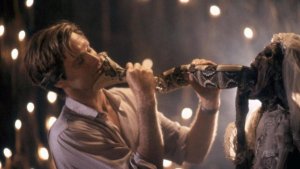
Directed by Francis Ford Coppola, best known for the Godfather, this adaptation of the seminal vampire is a lush, faithful and star-studded version of the classic horror movie. Gary Oldman plays the lead role whilst Winona Ryder, Anthony Hopkins and Keanu Reeves also star.

Jeff Goldblum Reintroduced to JURASSIC WORLD

Every year has its most anticipated action films and 2018 is no exception. Reboots of Tomb Raider and Robin Hood come out in the spring along with Steven Spielberg’s take on the novel Ready Player One. Those will be followed by two instalments in the Marvel Cinematic Universe – Avengers: Infinity War and Ant-Man and the Wasp; another Star Wars offering – Star Wars: Han Solo; and two X-Men chapters with X-Men: The New Mutants and Deadpool 2.


One other big franchise sequel to keep an eye out for is Jurassic World: Fallen Kingdom, which continues from 2015’s Jurassic World. The aforementioned Spielberg was the first to bring Michael Crichton’s novel to the big screen in 1993. This was followed by The Lost World: Jurassic Park in and the third of the trilogy, Jurassic Park III (1997).

As with any successful movie franchise, we saw crossovers into video games that evolved from the simple first editions of the ’90s to the more current releases, which include a Lego-themed game for kids and brand new game to be released in companionship with the film next year. Also, and not surprisingly, dinosaurs and the Jurassic World brand have been tied into the online casino experience, with a Jurassic World slot title available that features much of the iconography and music from its big-screen counterpart.

As for the movie, Chris Pratt will continue his streak as one of the hottest action heroes in Hollywood right now by reprising his role as velociraptor-whisperer Owen Grady, while Bryce Dallas Howard also returns as Claire Dearing, manager of the Jurassic World resort. One of the most talked about casting moves is the callback of Jeff Goldblum, as mathematician and chaos theorist Ian Malcolm, who starred in the first two chapters. Goldblum is one of Hollywood’s most recognisable actors, whose career really got going in the 1980s with films like The Big Chill, Silverado and The Fly. Some other notable, and somewhat more recent appearances were in Independence Day and its sequel Independence Day: Resurgence.

Goldblum also joined a talented ensemble cast – as most Paul Thomas Anderson films employ – in The Life Aquatic with Steve Zissou. He also starred in the acclaimed indy flick Igby Goes Down and had a major role in the successful Law & Order: Criminal Intent television series. Goldblum, you might remember, was recently seen in Pratt’s other franchise sequel, Guardians of the Galaxy Vol 2 as the Grandmaster which he also played in one of this summer’s blockbusters, Thor: Ragnarok.

Source: Law & Order: CI via Facebook

Goldblum’s return to the Jurassic Park/World franchise appears to be another example of increasingly common phenomena of bridging reboots of franchises with their originals. Whether it be for backstory or continuity or simply to market the newer release to older fans, it seems to be a common move for filmmakers when available. The original Star Trek cast joined Star Trek: Generations movie; Harrison Ford, Carrie Fisher and Mark Hamill have been in some of the newest releases in the Star Wars universe; the X-Men prequels have often crossed-over with cast members from the original films, and Matt Damon and Carl Reiner will appear in Ocean’s Eight next year.

From comments made by director J.A. Bayona and producer Frank Marshall, the storyline appears to revolve around a volcanic eruption on Isla Nublar, still home to Jurassic World, prompting the staff to attempt to relocate the dinosaurs off the island. Obviously, there is an ethical dilemma surrounding the risk/reward of such an endeavour and, should it succeed, the story has numerous potential directions to follow with the implications of dinosaurs on the mainland. One can be sure that the character of Ian Malcolm will be central in those discussions and, as an added bonus, he has experience in corralling dinosaurs rampaging in urban centres.


Who Is Taking the Oscar Home?

The Best Actor category at the upcoming Academy Awards looks like turning into a battle of the Brits and Gary Oldman is leading the way. The 59-year-old is one of Hollywood’s most recognisable stars and has enjoyed plenty of critical acclaim throughout his career, but an Oscar has always eluded him. He came close in 2012, when he was nominated for his lead role in Tinker, Tailor, Soldier, Spy, but he was pipped by Jean Dujardin. He has his best ever chance this year as he is the odds-on favourite to scoop the prestigious gong, but standing in his way is the legendary Daniel Day-Lewis.

The 60-year-old is the only male actor in history to win the Best Actor award at the Oscars on three different occasions. He first seized glory in 1989 for his stunning portrayal of an Irishman born with cerebral palsy. He doubled up in 2007 with an incendiary performance as a ruthless capitalist in There Will Be Blood, and made it three for his starring role in Lincoln. He could make it four in the upcoming Oscars ceremony as he is second favorite for his role as a renowned dressmaker named Reynolds Woodcock in Phantom Thread.

It is his last role as he is retiring from acting after four decades at the top, so a fourth Oscar would be a fitting send-off for one of the greatest actors of all time. He is likely to get a nomination at the very least, but he has twice been a losing finalist, for Gangs of New York and In the Name of the Father. And he could finish runner-up a third time as the buzz currently surrounds Oldman for what is by all accounts an exceptional portrayal of Winston Churchill in Darkest Hour.

“Hidden behind fake jowls and a receding hairline, Gary Oldman delivers one of the great performances of his career as Winston Churchill,” says Variety, while Vanity Fair adds: “Gary Oldman gives one of those towering, transformative performances that often earn a raft of gold hardware.” The reviews have been universally positive and everyone has praised his performance.

Oldman is cagey on his chances, saying: “I feel very lucky, very privileged to have been offered it, and to have actually played it. So I think I’ve got out of it what I wanted to get out of it. Anything else beyond that is a cherry on the cake. If I had an Oscar that said on it Gary Oldman, best actor for Darkest Hour, if I was going to get an Oscar, I can’t think of a better part to get it for, let’s put it that way.”

He may be trying to play it cool, but the bookmakers have him as the clear frontrunner. Check a review of Bookmaker to find the best odds and you will see that Oldman is currently just 2/5 to win Best Actor at the Academy Awards. Day-Lewis meanwhile is out at 5/1 and Tom Hanks and Timothee Chalamet are both 10/1. Hanks teams up with Steven Spielberg once again to star alongside Meryl Streep in The Post, which documents a publisher’s crusade for justice. That is an award-season dream team right there and The Post is expected to earn a raft of gold hardware itself over the next few months.

Hanks is a two-time winner for Forest Gump and Philadelphia, and has earned further nominations for Big, Cast Away and Saving Private Ryan. Chamalet looks a real dark horse for his breakout performance in Call Me By Your Name. At just 22, he would be the youngest winner in history but he is gaining rave reviews and picking up real momentum at a crucial time of year.

Jonathan Green | NEVERLAND – HERE BE MONSTERS!

neverland

Jonathan Green is one of the UK’s most prolific creators of franchise fiction. The freelance writer’s credits include Fighting Fantasy, Warhammer 40,000, Doctor Who and Sonic the Hedgehog. He’s also responsible for all sorts of steam punk, science fiction and fantasy novels. His latest project, Neverland Here Be Monsters!, mashes up Peter Pan with Sir Arthur Conan Doyle’s novel The Lost World to create a unique choose your adventure style fantasy gaming experience. It is currently seeking funding on Kickstarter.

STARBURST: What is NEVERLAND – Here Be Monsters

Jonathan Green: NEVERLAND – Here Be Monsters! Is a brand-new choose your path adventure gamebook, very much in the same style as Fighting Fantasy or Lone Wolf gamebooks, in which you take on the role of the automaton avenger Peter Pan or the shipwreck survivor Wendy Darling.

It’s an old school solo-RPG but with design elements inspired by modern developments in video games. There is not only one way through the adventure and so re-playability is a key element of the gamebook. And if the Kickstarter hits all its stretch goals, you will also be able to play as the heroic hunter Tiger Lily or the notorious pirate Captain James Hook himself.

How would you explain NEVERLAND – Here Be Monsters! to an elderly relative?

Do you remember King Kong? Do you remember the Skull Island, where he lived? Well imagine that Skull Island and Peter Pan’s Neverland were actually the same place. And then imagine being able to influence the course of the story, rather than just being a passive reader, by taking on the role of one of the characters from Barrie’s book. And that, in a nutshell, is NEVERLAND – Here Be Monsters!

Why mash-up Barrie with Doyle?

Why not? But in all seriousness, I suppose it really began after my first ACE Gamebook, Alice’s Nightmare in Wonderland, was published. It was well received and people asked if I was going to write a sequel, but I had already included Through the Looking-Glass, And What Alice Found There in the first gamebook and so I needed to look elsewhere.

The next logical step, for me at least, was to give The Wonderful Wizard of Oz the Alice’s Nightmare in Wonderland treatment, and so The Wicked Wizard of Oz was born. In Alice’s Nightmare, the reader guides Alice through a nightmarish version of Wonderland, but in Oz the reader takes on the role of one of the characters from Baum’s original, each with their own abilities and different encounters in the adventure. NEVERLAND – Here Be Monsters! continues this theme.

But I had also wanted to write a gamebook inspired by King Kong for a long time, and also had another idea featuring pirates (a subject my gamebooks have experimented with before) and it just seemed to make sense to combine them with Peter Pan. After all, I’m not the world’s biggest fan of Barrie’s original, and everything’s better with dinosaurs. Right?

The last fact, which just seemed to make the mash-up too good to be true, is that the novel Peter Pan and Wendy was published in 1911 and just a year later Doyle’s The Lost World was released.

What is it about Peter Pan that we keep coming back to?

It’s a classic of children’s literature and Disney’s 1953 animated interpretation of it means that many people have been exposed to the most well-known elements of the story without necessarily having read the story themselves. On top of that, it has enjoyed many stage adaptations and has become a staple of the pantomime circuit. And of course, children love to dress up and play as pirates, which is a vital element of the Peter Pan mythos, if that’s not too big a word for a rather twee 20th Century fairy-tale.

Doesn’t Pan have quite dark origins?

The primary theme of Peter Pan is the conflict between the innocence of childhood and the responsibility of adulthood. There’s also a puckish quality to Peter and other aspects of his character make him more pagan nature spirit than carelessly-abandoned human child left to be brought up by fairies. And then there’s also the rather uncomfortable romantic element, which many adaptations probably wisely choose to admit, with Wendy’s flirtatious desire to kiss Peter, Peter’s desire for a mother figure, and his conflicting feelings for Wendy, Tiger Lily, and Tinker Bell, each of whom represents a different female archetypes. And then there’s the symbolism of Peter’s fight with Captain Hook, who in stage productions is traditionally played by the same actor as Wendy’s father. I’m sure Freud would have a field day!

Why The Lost World?

Well, as already mentioned, there’s the fact that it was published a year after the novel Peter Pan and Wendy, and it has dinosaurs in it, but it also has the Accala tribe who I have chosen to replace Barrie’s Picaninny tribe who have become horribly culturally dated (never mind the fact that they were a racial slur in the first place).

How does NEVERLAND – Here Be Monsters! compare to The Wicked Wizard of Oz or Alice’s Nightmare in Wonderland?

The three books form a loose trilogy but each one is a progression from the last. Alice introduced the ACE Gamebooks concept and rules set, Oz added the option of playing the adventure as different characters with different abilities, and NEVERLAND will introduce companions to the mix.

What hasn’t changed is Kev Crossley fantastic artwork, which will ultimately adorn all three books in the series, helping to give them a unifying look.

Why is traditional gaming making such a comeback?

I think it’s the same reason why café culture is so popular at the moment; people have gone online and discovered all it has to offer, but have always realised that there’s nothing quite like actual face to face human contact. The tactile experience shouldn’t be forgotten; there’s something very satisfying about opening a box of game components, are painting a miniature, or feeling the weight of an actual book in your hand and taking in the heady scent that comes from the printed page.

Why Kickstarter?

It’s a great way of taking pre-orders and raising the funds for artwork. And by artwork, I mean quality hand-drawn art as opposed to regurgitated digital art with the cut and paste function being used far too readily. It’s strange that digital art, particularly black and white or grayscale digital art, can end up feeling flatter than hand-shaded pen and ink work, when, in theory at least, the opposite should be true.

How does this compare to your work on the Fighting Fantasy series?

My work on NEVERLAND – Here Be Monsters! and the rest of the ACE Gamebooks has grown out of the work I did for the Fighting Fantasy series. Through writing FF gamebooks I learnt what makes a good gamebook, in terms of game design as well as quality of writing. However, the ACE Gamebooks let me try things that I wouldn’t be able to do with a conventional FF adventure and help demonstrate how far the gamebook medium can be taken.

People who enjoyed my later FF titles, particularly Howl of the Werewolf and Night of the Necromancer, can expect the same sort of action-packed adventures from my ACE Gamebooks, and NEVERLAND – Here Be Monsters! especially. After all, it could equally be subtitled Pirates Vs Dinosaurs!

What’s happening next with the Fighting Fantasy books?

Next April, or thereabouts, Scholastic is going to release another six titles, Steve Jackson’s Creature of Havoc, Appointment with F.E.A.R., and Sorcery! book 1: The Shamutanti Hills, Ian Livingstone’s Deathtrap Dungeon and Island of the Lizard King, and Charlie Higson’s brand-new The Gates of Death. As Charlie is new to writing gamebooks, despite being a fantastic and established author, I have been giving him a hand with the gamebook mechanics side of things.

Will we see more YOU ARE THE HERO?

I actually have two more titles in the series tentatively planned. One would be a continuation of the history of Fighting Fantasy gamebooks, to be published around the time of the series’ 40th anniversary in 2022, and the other would be a history of other gamebook series, such as Lone Wolf, Fabled Lands and Destiny Quest.

What franchise series would you love to write for next?

I would love to write something for Stranger Things, but I have long held a desire to write for Batman. In fact, I would love to write a Batman adventure gamebook. I would cram it chock-full of my favourite Batman villains, such as Killer Croc, Solomon Grundy and Clayface.

What’s next?

I’m actually writing a short story at the moment that I hope will become part of an ongoing series and I have various other short stories to write for other people. I may be editing another anthology next year and am also working on ideas for a new novel.

In terms of gamebooks, after NEVERLAND – Here Be Monsters! I would like to get my teeth into Beowulf Beastslayer, which has been on my To Do list for the last four years.

Where can we found out more about your work?

Via my website/blog at www.JonathanGreenAuthor.com. I’m also on Facebook and tweet as @jonathangreen.

NEVERLAND – Here Be Monsters! Is currently running on Kickstarter until December 2nd.

Who Will Be the Next Bond Girl?

Daniel Craig has delighted fans by signing on for another James Bond movie but the big question remains: who will be the next Bond girl? The untitled 25th Bond movie has been scheduled for November 2019, penned by Neal Purvis and Robert Wade, and speculation will continue to mount in the buildup, while the most influential betting sites are sure to get in on the action realising attractive odds for the role. Here are some of the leading contenders for the coveted role:

Marion Cotillard

The Oscar-winning actress has enjoyed a long and glittering career, taking in critically acclaimed films like La Vie En Rose, Two Days, One Night and Rust and Bone. But she has also shown she is not averse to starring in huge blockbusters, including Inception, The Dark Knight Rises and Assassin’s Creed, while she has also showed her fun side in Anchorman 2. She has the smouldering looks typical of a Bond girl, but would also bring serious credibility to the role and is currently the favourite to land it.

Margot Robbie

Robbie was catapulted to superstardom with her eye-catching role in Wolf of Wall Street and has since gone on to improve her standing with several lauded performances in slightly more serious films. She too is a big name and has the right looks to make a success of the role, but there have not been too many blonde Bond girls in recent years.

Gal Gadot

Playing Wonder Woman was a dream role for Gadot, who has become a symbol of feminine empowerment. The Bond franchise has a bit of a sexist history and hiring Gadot could be a good way of cutting ties with the past and presenting a new Bond, who takes as good as he gives.

Jennifer Lawrence

Lawrence is the highest-paid actress in the world and also the highest-grossing female action star of all-time thanks to her starring roles in The Hunger Games. She is another Oscar winner and another passionate advocate of feminism and gender equality. She might not be too keen on a role as a mere sidekick to a historically chauvinistic character, but she would be a huge coup for the producers if they could land her services. She has appeared in various X-Men films alongside The Hunger Games and might be tempted by a role that made her as forceful a presence as Mystique and Katniss Everdeen.

Natalie Dormer

Another Hunger Games alumni is also on the list of potential Bond girls after dazzling as Margaery Tyrell in Game of Thrones. Landing the role of Bond girl would be a big stepping stone in her career and could help her gain more high-profile roles going forwards, so she would be an interesting option at around 16/1.

Priyanka Chopra

One of India’s highest-paid and most powerful stars would be an interesting choice if the Bond franchise was trying to boost its appeal in that huge market. She has enjoyed a hugely successful Bollywood career and has earned awards since making the transition to US television, but has not quite hit the heights of superstardom in the west, so this could be a great role for her.

Alicia Vikander

This 20/1 shot looks a great bet to be named the next Bond girl after finishing top in a survey conducting by the aptly named organisation The Next Bond Girl. It analysed the 72 previous Bond girls spread across 50 years of movies starring the famous spy, and focused on age, hair colour, height, nationality, number of films under their belt and years since making their film debut. Vikander, who has recently starred as Lara Croft, finished top of the ladder, ahead of Rachel Hurd-Wood, Ellarica Gallacher and Lily Collins.

Responsible Gambling is Best Monitored Online

In 2006, the US Congress and President Bush created a law called the Unlawful Internet Gambling Enforcement Act (UIGEA).  This law made it illegal for purveyors of “games of chance” to accept payments from credit card companies and ewallets.  The term “games of chance” was never fully defined.  The UIGEA also added a layer of enforcement and prosecution to enterprises violating the law.

A Huge Market Abandoned

The effect of the law was that most online casinos and game developers pulled out of the US online gaming market.  A few casinos, Grande Vegas prominent among them, stayed on.  Under the law, funding gambling activities at an online casino for US players is never simple.

There have been proposals ever since the law was passed and signed to make all or some online gambling legal.  It has long been assumed if not proven that land based casino interests, socially conservative voters, government-run lotteries, and pari-mutuel gambling interests such as horse racing, dog racing, and jai alai formed a coalition in opposition to the legalization of online gambling.

Equable Treatment of Gamblers

The first reason to legalize online gambling is simple fairness.  Not everyone who likes to gamble enjoys going to a racetrack, dog racing track, or jai alai stadium.  They may prefer slots or the several classic table games.  Their analytical bent may be more toward making the right plays in blackjack than determining which horse will win this particular race.

Who will Pay Taxes?

One well-worn objection to the legalization of online gambling is that it would be difficult to collect taxes both from the casino itself and also from winners.  This ignores the absolute difficulty of collecting taxes on winnings at any legal gambling emporium.  When a gambler cashes in his or her chips, the casino can’t know if the chips represent winnings or the money left over minus losses.

So taxes go uncollected.

Online gambling actually lends itself far more to the collection of taxes because there is a digital record of every play and every movement in a player’s account.  Thus, every dollar deposited is followed by the computers.  This applies only to the top online casinos that monitor each game and each account in real time primarily as a way to resolve conflicts between players and the casino.

Thus, by legalizing online gambling, the government would either be forcing poorly run casinos to monitor gameplay or fold their tents.  It would make online gambling safer for players.

Less Crime

It would also make the streets safer for gamblers and tourists alike.  A comparison here with the changes that have occurred in Major League Baseball since the inception of free agency is appropriate.

Counter-intuitivity in Baseball

When free agency was ordered by the court, MLB owners screamed that it would bankrupt the leagues.  Instead, revenues are up, baseball is more popular than ever, attendance is up, and crowds are far better behaved than they ever were.

At one time, attendance of 1,000,000 over the course of a season was considered good.  Now anything under 2,000,000 is considered bad.  Where it was rare indeed to have attendance of 3,000,000, now even small ballparks like Wrigley Field in Chicago fill up regularly and seasonal attendance is always above 3,000.

What happened is that teams marketed tickets to large corporations and other organizations and marketed a visit to the ballpark as a great place to have a date.  Where stadiums during Friday night games were once called “open-air saloons”, ballparks became a place to relax, have a few, but always stay in control.  And the leagues flourished even as salaries continued to rise.

Not Just Casinos

If land based casinos cease to be the only place Americans can go to play casino games, they can be marketed as vacation destinations with some gambling offered as well.  This is the “integrated resort” idea being pushed by Singapore among others as way to offer gambling mixed with shopping, convention centers, top restaurants, concerts, and more that would normally be considered aspects of a full-fledged vacation.

An integrated resort would attract far fewer of the low-lifes that seem to gravitate to places like Atlantic City and Las Vegas. So even as online gambling would grow, land-based casinos would realize a rebirth.  It would be a true win-win situation.

Responsible Gaming

The single biggest caveat to this entire argument is that a society suffers when gambling is seen as a get rich quick scheme.  We can only imagine the number of families who throw away their hard-earned cash on Powerball tickets.

Online casinos all support the notion of responsible gaming.  Most pay lip service to it but some, like Grande Vegas, take the notion very seriously, indeed.  These casinos set limits on the amounts players can deposit unless they can show that they can easily afford to do so.

There is a big difference between a high roller who knows not to bet more than he or she can afford and a high roller who is addicted to gambling.  The best online casinos monitor their players and make every effort to deny access to those players who they deem are possibly problem gamblers.

No land-based casino can monitor all the people who come through the doors.  Land-based casinos honour chips from other casinos.  So, a problem gambler can gamble in Vegas until their bankroll is used up and no one will know.  This cannot happen at a regulated and responsible online casino.

Why Was The Mummy Such a Flop?

Earlier in 2017, the Tom Cruise-led move The Mummy hit cinemas, and it did not go down well. As the last set of films to come out bearing the same name (The Mummy, 1999, The Mummy Returns, 2001, The Mummy: Tomb of the Dragon Emperor, 2008) were such a hit, it’s possible that people were expecting a more campy comedy adventure movie, but reviewers see fundamental flaws in the film itself.

While The Mummy 2017 was based more on the Universal Monsters film series from the 1930s through 1950s, it clearly didn’t live up to expectations. In fact, review aggregation website Rotten Tomatoes has The Mummy standing at a rather rotten 16% rating from 252 reviews, as well as only 32% of the 46,590 audiences saying that they liked it. People cite many reasons, from fundamental flaws in the plot, an unlikable lead character, taking little bits from many old horror movies that it didn’t do anything original, all the way to the film simply failing to achieve anything of substance, but one reason may be the theme of the movie.

Games exploring the theme better


Source: Xbox Addict, via Twitter

One area of gaming which is booming right now, and has a huge array of games in the Ancient Egypt theme, is in casino games. Over at Spinit online casino, a wide range of Ancient Egypt themed games are played by iGaming enthusiasts, such as Rich Wilde and the Book of Dead, Temple of Luxor, Hidden, Platinum Pyramid, Pyramid: Quest for Immortality and Gods of Giza.

Another game that was recently released and, in quite the opposite to The Mummy, has turned out to be a huge hit after it was expected to flop, has been Assassin’s Creed: Origins. Taking the gameplay of Assassin’s Creed – which some see as played out – to Ancient Egypt has revitalized people’s love of the game thanks to its setting and all of the incredible elements included from the era. The well-rounded Ancient Egypt based game delves into the most intriguing aspects of the time, expanding far beyond the somewhat niche area that the movies have mostly focused on.

Going back to Ancient Egypt

Many movies have tried and failed to utilize the Ancient Egyptian theme to its maximum potential, and The Mummy was simply another casualty of this plight. The Mummy from 1999 managed to use the Ancient Egyptian theme as a basis for a lighter enactment as well as the fast-paced adventure, so it brought strong entertainment value to the film.

The mummified leaders, some human-form gods, and Christianity have been the focal points in films when other, more interesting areas of Ancient Egypt could result in fascinating and entertaining films. Ancient Egyptian movies could revolve around one or some of their many more interesting gods, such as Anubis, Horus, Thoth, Sobek, Amun-Ra, or Sekhmet (all of which could make for incredible viewing on the big screen if done well); or around the various times of the Egyptian kingdom and their many foes in both lower and upper Egypt; or the many mysteries surrounding their traditions and structures; or their connections to the Roman Empire.

Hacked Off – An Introduction to SCORPION

Scorpion

STARBURST takes a look at </SCORPION>, a US TV show that may well have passed you by but is well worth checking out if you’re a fan of the likes of MR ROBOT and CSI…

Imagine if Sheldon Cooper from The Big Bang Theory had assembled his own version of The A-Team. Imagined it? Well, as flippant a comparison as that might be, it goes some way to offering a sense of what CBS show </SCORPION> is about. Instead of ex-Special Forces, each with their own individual, very specific set of skills, here we have a team of highly intelligent outsiders (and rather geeky outsiders at that), each with their own specific set of skills. Sound interesting? Well, in all honesty, it is, but there is also a curious background to the story, a background that follows the truth-is-stranger-than-fiction adage, and one which rather adds to the interest.

Walter O’Brien was born in County Wexford, Ireland in 1975. Growing up on a farm he attended the local school before continuing his education at the University of Sussex, where he obtained a bachelor’s degree in computer science and artificial intelligence. So far, so relatively normal. Except for one or two rather interesting ‘facts’. O’Brien claims to have an IQ of 197 – possibly the fourth highest ever recorded – and that aged just 13, he hacked into NASA under the pseudonym ‘Scorpion’; apparently, the teenager wanted to put blueprints of the space shuttle on his wall. He also claims that this led to his arrest by Homeland Security, but due to non-disclosure agreements signed at the time, cannot reveal anymore ‘facts’ about the event. Since then, he and Homeland Security have remained ‘in touch’, and O’Brien now runs Scorpion Computer Services, a think tank of geniuses.

Although this sounds very much like the standard preamble to a pilot show and too fantastical to be remotely true, and that may well be the case, O’Brien is very much a real person. He also stands firmly behind those claims to this day, although their validity is often questioned, and they remain unproven and unconfirmed. But, regardless of the legitimacy of the story, it does provide an intriguing basis upon which to produce a television show, and one that a few of Hollywood’s elite players including Alex Kurtzman (The Mummy, Star Trek), Justin Lin (Fast & Furious 6, Star Trek Beyond) and Roberto Orci (Transformers, The Amazing Spider-Man 2) decided to take on.

When transported into the sandbox world of television drama, O’Brien’s mythical background and history becomes fantastic stock material for writers, and compares favourably to anything in the Marvel or DC Universes; although in those worlds, O’Brien would undoubtedly be the villain, a genius gone bad. Here, however, he can be portrayed as the ‘nerd with a conscience’; a super-intelligent computer expert who, along with his equally eccentrically-natured friends, can offer assistance and help with problems no-one else in the world is equipped to deal with.

Taking on the lead role is Elyes Gabel, an actor who brings a necessary vulnerability to the character of O’Brien, while still retaining a little Sheldon-like disconnect with the larger world. Balancing that awkwardness is Homeland Security handler Cabe Gallo, played by former Terminator and fan favourite Robert Patrick. Patrick lends authority to the show, blending charismatic officialdom and fatherly protection with the experience of a film and television veteran. Jadyn Wong (Happy Quinn, mechanical engineer) and Ari Stidham (Sylvester Dodd, hyper-sensitive ‘human calculator’) add to the team, alongside American Pie alumnus Eddie Kaye Thomas (Finch) as behaviourist Toby Curtis. Perhaps the most interesting character on the team, and one who joins following the pilot episode is Paige Dineen. Played by Katharine McPhee, Paige is the token ‘normal’ person in the group. Her purpose is to liaise with clients and, well, anyone who encounters the team, providing empathy and understanding in situations generally too emotionally fraught or real for them to handle. As such, she plays the layman to O’Brien’s genius, allowing the explanation of complicated problems, and the complex solutions to said problems, to be less expositional and patronising than they could have been.

So, with all these interesting elements thrown together, what is it about </SCORPION> as a show that makes it interesting?

Firstly, it’s in the realism. While most of us may not fully appreciate the daily tribulations of being a genius in our particular field – although here at STARBURST we do believe our readers rank in the higher echelons of the population – the characters remain likeably relatable. The quirks and foibles displayed may be exaggerated for dramatic effect, but behind them are normal people just trying to get along. Add to that a wit and humour often more akin to a sitcom than a drama, and you have a firm footing for the show.

Secondly, there’s the heightened realism. When the opening episode features a set piece in which a sports car is being driven along a runway at top speed while a passenger jet flies just thirty feet above, and the co-pilot is hanging on the undercarriage trying to pass an Ethernet cable to someone in the car who’s working a laptop, you know you’re in for some extreme scenarios. The remit of the Scorpion team is to protect the world from complex new threats that the ordinary authorities are unable to handle, and the showrunners have certainly run with that mantra. If we also add that Justin Lin, who’s helmed a couple of films in the Fast & Furious franchise, directed that episode, you know you’re in for something spectacular.

The interactions between the characters are also key to the show, and much of the credit must go to the actors. Reeling off line after line of complicated, equation-riddled rhetoric with charm and conviction is not an easy skill, but each one inhabits their character with an air of comfort and ease. You instantly accept that these are people, Paige and Gallo aside, who have lived and worked together for some time. At the head of that and their leader is Gabel; for the most part sympathetic to his cohorts, but also tough when necessary, he bonds the group and provides the focal point for their adventures together.

There are a lot of television shows available now, an awful lot, so choosing a new one to begin is often a tough decision. What </SCORPION> brings is genre-spanning entertainment; drama mixed with action, all warmly wrapped around characters you’ll actually care about within a very short space of time. This isn’t a show that can draw on the resources of Marvel’s Agents of S.H.I.E.L.D., tackle the tension of 24 or reproduce the wit and dialogue of Sherlock. But what </SCORPION> does is draw on the strengths of those three shows – and many others – combining them to produce a truly enjoyable series that challenges you not to be entertained. Groundbreaking it may not be, but </SCORPION> is a show that fills a gap, a show that never takes itself too seriously and one that carries you along for the ride, purely for the hell of it.

And remember, it actually might all be true…

</SCORPION> will premiere on CBS Action on November 22nd at 19:00, continuing every weekday. Sky 148, Virgin 192, Freeview 39, and Freesat 137.

Claire North | THE END OF THE DAY

claire north

Claire North is one of the pen names of prolific author Catherine Webb, who is also known to younger readers as Kate Griffin. As Claire North, she has written three science fiction novels, including the award winning The First Fifteen Lives of Harry August. We caught up with her to talk about her recently released novel, The End of The Day.

STARBURST: Why the multiple pseudonyms?

Claire North: At first, it was because I was getting old. The irony! When I first started scribbling I was a teenager, and I wrote books that were groovy for teenagers, because I write for my own joy and happiness. Whether writers mean it or not, what they write tends to reflect who they are; my writing reflected that I was a young adult. Then I hit my early twenties. I was changing and so did the books. As a result my publisher decided to slap the equivalent of a PG warning on my stuff, a sort of ‘it’s like the books of Catherine Webb, but with more swearing’ tag. The fastest and easiest way to do that was to have a soft pseudonym, and become Kate Griffin. It’s a way of declaring ‘like this but different’.  Also if you look at most bookshelves, ‘W’ as a surname is in a very inconvenient place, whereas ‘G’ is bang smack at eye height. This stuff can actually matter….

Then a bit more time passed, and I wrote The First Fifteen Lives of Harry August, and once again my publisher was a bit like ‘oops you’re changing what you do, shucks’ – or words to that effect – and it was pseudonym o’clock. Becoming Claire North, however, was less about the health warnings and more about how genre is perceived. I absolutely believe that science fiction and fantasy can tell some of the most incredible, exciting, thought-provoking stories out there, while being full of joy and wonder – actual wonder, a thing that leaves you gaping at the power of imagination and full of hope for humanity. But sometimes people equate it to simply orcs and aliens. Which is fine. It can be exactly that, and that’s great. Entertainment, the joy of a romping adventure – these are things to be valued and cherished for the delight they bring, not to be looked down upon.

But with the Claire North books, my publisher judged that there was probably space for these books to be seen as both SF, but also as something a bit broader. And so Claire North popped into existence, as another way of differentiating what I write now, from what I have written before.

Also ‘N’ is at a very handy height on the bookshelves…

What’s the elevator pitch for The End of the Day?

Hi.

Death is coming.

Asked me to send you his best.

Have a lovely day!

How would you describe The Sudden Appearance of Hope to an elderly relative?

I only have one elderly relative, and she summarised one of my recent books as: ‘I could actually read this one,’ so you are setting a bit of a challenge here.

Probably: ‘Gran. You love me very much. I love you very much. I’m proud of this book. It’s about a woman no one can remember. I’d be really happy if you felt like giving it a go, and if it’s not your thing then that’s ok, we need never talk about it ever again.’

I know it’s not detailed.  But it’s honestly what I’d say.


How did the process for writing The End of the Day compare to The First Fifteen Lives of Harry August?

This is gonna sound awkward, but… I’m struggling a bit to remember. The End of the Day was finished about two years ago. Harry August was finished six years back. I wrote Harry August while working as a lampie at the National Theatre, and The End of the Day travelling between shows, so it’s a bit of a blur of snatched moments between cues.

Both had logistical challenges. In Harry August, it was tricky keeping the ages of various characters in order, and both books required attention in terms of places visited and the details that bring them to life.

Other than that… I can never really remember much about the act of writing. I remember stories, images, sounds and voices. I remember… colours as much as anything, the colour that a chapter had, or the way something tasted as it was written (synaesthesia is a bit of a family trait).  I remember looking up and being in certain spaces – the Blue Room at the National Theatre, or Manchester Central Library – but actually writing words? My brain doesn’t really clock the process. Just… feelings and tangled bits of sense. Some words feel square, heavy; others are hot, some are light and fast and fluffy, others are… something else again. Harry August felt solid, four beats to a bar, different shades of blue. End of the Day was more full of popping noises, of shimmering things that come and go, reds and oranges. That’s how writing feels, all the time. Which doesn’t make this answer any more useful for you, I’m afraid, but remains the truth.

Why are we so obsessed with the end of all things?

Naturally – we’re scared of dying.

Because, of course – we’re scared of living.

Let’s face it, dying itself… yes, it’s a scary thought, but what’s actually petrifying? A live lived in pain.  The ones we love being left behind. The hurts we never healed. The things we never achieved. A life without meaning. An existence without purpose. Being forgotten. Our achievements melting away into nothing more than a carbon footprint on a withered world. Having spent all our days in a haze of minor misery and distress, justifying the tick-tock of our existence with ‘maybe tomorrow it’ll be better’ when it isn’t, and never will be, and we blame ourselves for being prisoners of misery.  Being shunned. Being alone. Living our lives in hardship and greyness and never giving to others the joys we seek for ourselves. The end of everything isn’t about the snap-pop of existence fading, or even the promise of an afterlife in which we are punished or rewarded for our actions. Afterlives just serve to enhance the great big terror of today: what is my life worth?

What am I doing with my life?

Day by day, we live with this question by never thinking about what happens after tomorrow, and after the tomorrow after that.

But the end of all things throws that question into terrifying, sharp relief.

If my life ends today, what was it good for?

And from that, the scariest question of all: who am I, really, when push comes to shove?  What will I do, when tested at the last?

It’s the big question we spend our days exploring, with an answer that we never really wanna know.

Which of the Horsemen would you most like to invite for tea and scones?

Either War or Death. Famine would eat all the scones, and conversation with Pestilence will probably turn you off your supper. Whereas War will probably have incredible anecdotes, even if the entire evening ends in tears; and I can’t imagine Death caring much if you have the wrong kind of jam.


Which character in End of the Day was the most fun to write?

Probably Death.

I mean, Charlie was lovely to write, because he was kind. It’s not that often I write characters who value kindness so intensely in their souls.

But Death sits both outside the trivial furies of the world, above and beyond it, while also being such an integral, fundamental part of life that it creates an opportunity to do something… different.  Death is also seen, in this book, through the eyes of the beholder as something unique to everyone, which makes him/her/it a reflection of their beliefs in ultimate form.  And that was tonnes of fun.

claire north book


Is there a bit that you didn’t get to put in the book? Is there an element of the story that didn’t fit?

I feel like yes? I feel distinctly like we lopped 30,000 words off this book, but for the life I me I can’t remember what they were, which does imply that they weren’t very important….

I also seem to recall a lot of chopping and changing. One of the flaws of the book (and arguably there are plenty) is that the story isn’t a linear ‘there is a problem’ – ‘ah now we must solve the problem!’ narrative. When death is inevitable, unavoidable, and the very essence of every story we meet is that it must end, this is kinda a needful thing. But as humans we are drawn to stories that encapsulate something neat, and forward. This book isn’t really that, and there was a fair amount of wiggling to try and shape it into something that could be both true to the story it tells, but also to the stories we as readers’ desire.

What’s next?

My next book is called 84K and is out in spring 2018, I think. It’s the story of a dude called Theo, whose job it is to audit the value of someone’s murder. If you can afford to pay for the life of the person you killed, then you get off free, and there is nothing in society which can’t be bought or sold, if the price is right.

Theo is just a civil servant, part of that universe, until it all goes wrong.

I’m also one of three writers contributing to an anthology of novellas for Black Mirror, which I believe is also due to be published early 2018.

And I’m writing another book as well, just to keep things ticking along, and beginning to dabble – very cautiously – a little bit in film and TV.

Apart from that: there’s always another show to light!


If you were writing in someone else’s world, what world would that be?

Roger Zelazny’s Chronicles of Amber, which permits its characters to go anywhere you can conceive between the twin poles of Chaos and Amber while weaving in massive tales of politics, family and revenge. Although I probably wouldn’t, because I’d be too scared of screwing it up. But that’s sorta the nature of some of the greatest worlds out there, isn’t it? Earthsea, Discworld, the Culture… these are incredible, beautiful places to sink your senses into. But as much as every reader has a unique experience in every book, every writer’s best work is something that is from deep within themselves, whole and true.


Which of your works would you most like to see adapted to other media? Why?

Controversially… the Kate Griffin books (controversial ‘cos I haven’t written one for a while!). Urban fantasy. Things going boom! London! Magic! Dragons! Think of the hours of fun!

Also these books probably lend themselves to going beyond anything I ever wrote, if adapted for TV, and taking on a life beyond the page. I think that’s a lovely thing. I think it might be the point.

What’s the cleverest thing you’ve ever done?

Fixed an unresponsive projector that had its menu stuck upside down… and in Mandarin.

What’s the silliest thing you’ve ever done?

Well… I did choose to spend my career writing books for cash while being a theatre lighting designer and technician. As choices go, it’s pretty up there.

Apart from that blip, I’m pretty dull. Although if given a choice between hanging out talking about literature, or sneaking away to go play on trampolines, it’ll be bouncing all the way. Did you know there’s a street near the Excel Centre in Silvertown that has trampolines in the roads? That you can go and bounce whenever you want? How did we have to wait for the 21st century for this to be a thing?


Why is genre fiction so popular now?

Hum… you mean, popular with lotsa people as well as the millions of joyful souls who’ve totally known about this stuff for decades?

Because geeks have been around forever, and so the change in the perceived popularity of genre fiction has to be seen as a two-fold thing. 1. It is getting more popular, yes. But also 2. It’s now ok to be a geek, sorta. You’re less likely to be shunned or bullied. Geeks are coming out of the woodwork and there’s a lot more of us than anyone thought….

It’s worth highlighting this geek thing, because humanity has an uncanny ability to define its self-worth by diminishing others. I am better than you because I read Nabakov. He is better than she because he reads Proust. It’s horrifying that something as beautiful, as humane as books should be co-opted into this dance of self-worth, given that books fundamentally are exercises in empathy. It is also a very human instinct to define ourselves by what we are not. We are not geeks. We don’t like books with violence. We’d never be caught reading soft porn on the Piccadilly line. Or Harry Potter.  Whatever. Because we send signals to the world, constantly, about who we are and how we wish to be perceived, and what we read is part of that dance.

So part of the shift, I think, in the popularity of genre is that it’s getting ok to read what you like reading. For it not to be another thing, like body image, which is used to shame or cruelly define us.

Films have helped, because there comes a point where you have to admit that Marvel films are fun, that Arrival is pure SF, as is Gravity and the Martian, that Game of Thrones really does have dragons too, and that Doctor Who is something the grown-ups enjoy. And that as well as being enjoyable, sometimes they have ideas too.

By opening up these universes in a huge way, I think it makes it easier for SF/Fantasy to not be ‘that weird geek thing’ but to be an accepted part of our cultural landscape. There’s still a way to go.  A huge amount of genre fiction is still tagged as ‘speculative fiction’ or ‘magic realism’ as if 1984 or Brave New World or Frankenstein or Handmaid’s Tale aren’t, in fact, SF.

Genre has its uses. It serves to help us find more books that may be like the books we adore. But it is also occasionally a tool for drawing lines, for dressing ourselves up in borrowed clothes to project the image of who we think we should be, rather than celebrating the diversity of what we love and who we are.

Is the world of genre fiction as open and as accessible as it thinks it is?

Yeap. Firstly, you’ve used ‘genre’ here, which I’m gonna assume for a moment includes crime, thrillers, romance etc., as well as SF/fantasy. All of which are frequently accused of being too accessible, whatever that means. “It’s just a bit of pulp,” is I believe the phrase used to cover stories from the genres that brought us Raymond Chandler, John le Carre, Agatha Christie, Stephen King, Doris Lessing, David Mitchell, Arthur Conan Doyle and I’d argue could also cover Jane Austen and Emily Bronte.

So…. Yeap.

If you just wanna zoom into SF for a moment, then sure, I get where the question might come from.  It’s easy to be thrown into the deep end, into warp drives and fire magics and so on – into a landscape that feels distant. But when we watch medical dramas on TV, or anything much of that ilk, we tolerate CT scans and PETs and MRIs and ‘third lymphoplastic spinal nerve’ or such like, not because we understand it, but because we understand the emotion that lies beneath it. We embrace that when someone says “intubate stat!” what they also mean is “and I still love you!”

Science fiction is no different. But it’s easy to be scared of genre. It asks you to set aside your preconceptions and let your imagination soar over some of the hardest questions out there. What is humanity? What is life? What is death? What if? What if what if what if? These are scary questions.

They are also beautiful questions. They are at the heart of every piece of our daily struggle to find out who we are, and whether what we do matters as both individuals, and a species.

And what’s best, is we can ask these questions in genre while having a shit-tonne of fun. It is the most accessible thing ever. It is the questions of the philosophers packed up in spacesuit, given a laser and told to go get that asteroid.

Genre is awesome, and it welcomes you with all its heart.

Where can readers find out more about you?

@ClaireNorth42 and www.kategriffin.net.

Claire North, author of The End of the Day (Orbit, £8.99) is shortlisted for the 2017 Sunday Times Peters Fraser + Dunlop Young Writer of the Year Award, in association with the University of Warwick. Claire will be speaking at a panel event with the other shortlisted authors at Waterstones Trafalgar Square on November 28th (6.30-8.30pm). The winner is announced on December 7th. www.youngwriteraward.com.

ISSUE 443 – OUT NOW!

443

This month, we celebrate the release of the latest film in the STAR WARS sage – THE LAST JEDI. As well as previewing the movie, we look back the work and life of the series’ creator GEORGE LUCAS.

It’s also a very special month as STARBURST reaches our 40th Anniversary. This issue is packed with all manner of commemoration features including how the mag was reborn for the 21st Century – told in a warts and all fashion – and an interview with our amazing cover artist Mark Reihill.

We also take a look at the upcoming remake/sequel to JUMANJI – WELCOME TO THE JUNGLE, the fourth instalment of the INSIDIOUS franchise, THE LAST KEY and chat to the original Boy Wonder, BURT WARD. If that’s not enough, we preview the DOCTOR WHO Christmas Special, profile the late ARTHUR C. CLARKE, who would have been 100 in December.

In our regular features, we look at the fabulous shocker THE DESCENT as it heads to HORROR CHANNEL and Independents Day profiles the director of the documentary IN MY MIND.

Plus all your favourite COLUMNS, NEWS, REVIEWS and much MORE from the worlds of SCI-FI, HORROR and FANTASY!

AVAILABLE IN PRINT(HERE) & DIGITAL (HERE)