THE MANDALORIAN AND GROGU

pedro pascal as din djarin in the mandalorian and grogu star wars film

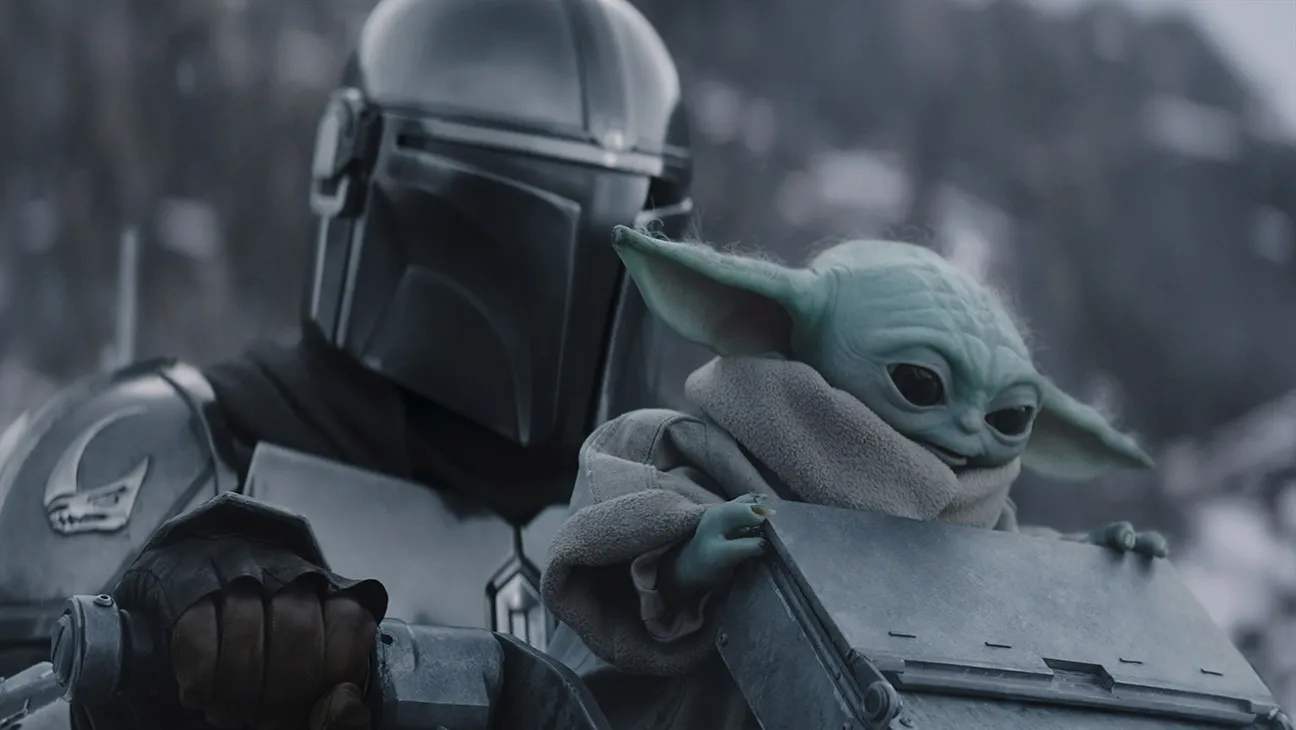
As the opening credits roll on Star Wars’ first feature outing since 2019, Reba McEntire’s lyrics pierce the darkness: “A single dad who works two jobs, who loves his kid and never stops, with gentle hands and a heart of a fighter,” hailing the return of a helmeted Pedro Pascal and baby Yoda – those two jobs being, of course, relentless bounty hunter by trade and emotionally tortured lone wolf by compulsion, a man so committed to stoic isolation that he somehow ended up the most devoted father in the galaxy.

At least, that was our original pitch for The Mandalorian & Grogu. In reality, Din Djarin and his green son’s return is accompanied by Ludwig Göransson’s excellent score, but we stand by our desired introduction.

The actual story finds our reluctant hero conscripted by the fledgling New Republic, who have decided that what their fragile galactic democracy needs is a beskar-clad gun-for-hire and his Force-gifted toddler to go and rescue Rotta the Hutt in exchange for information on an important target. On the way, they’ll face space gangsters, a gladiator ring, war criminals, and a giant water snake.
grogu in the mandalorian and grogu

The storyline and pacing make it clear that this feature is just three episodes of The Mandalorian’s previously planned fourth season, stitched together for a cinema release. Despite that, we’re also happy to confirm that if you’ve never seen a single episode of the Disney+ series, you will be fine to follow along. Jon Favreau has been generous enough to treat the whole enterprise as something of a soft reset, accessible to newcomers but still loaded with Easter eggs for the devoted faithful.

Visually, The Mandalorian and Grogu is doing a lot. Perhaps too much. Favreau wears his influences proudly — the ice-swept opening sequence carries a satisfying echo of The Empire Strikes Back, and across its runtime the film nods appreciatively to Top Gun, Blade Runner, Apocalypse Now, and, delightfully, Gremlins, with additional flavours of the western, kaiju movies, and samurai cinema seasoning the whole thing. It’s a great mood board, except that none of it coalesces into anything genuinely beautiful. Favreau geeks out (visibly, enthusiastically, and at considerable length), but the film never quite achieves the visual poetry of the works it’s so clearly in love with.

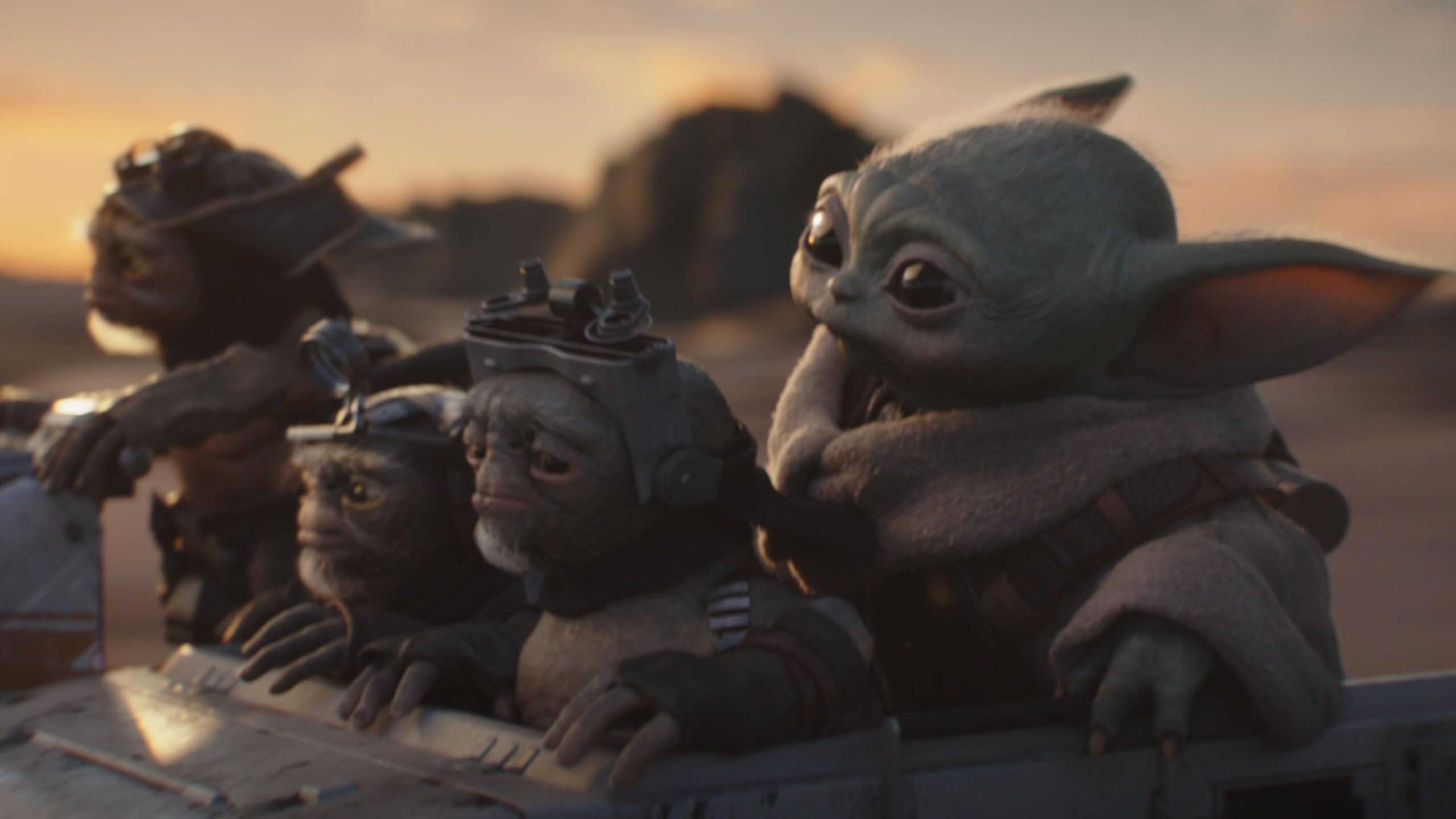
Where the film does succeed technically is in its creature work. Grogu and the Anzellans carry that old-school animatronic warmth that CGI will never fully replicate, a tactile physicality that grounds the film and endears the audience. It’s one of the most deliberately nostalgic choices in a film chock-full of them, and it works well.
the mandalorian and grogu

The cast is more variable. Sigourney Weaver appears to be operating under duress – an actress of her calibre deserves better than whatever she’s been handed here, and her scenes have the vaguely glazed energy of someone waiting out their contract. Elsewhere, Jabba’s nephew Rotta the Hutt is, against all odds, surprisingly lovable, though it’s worth noting that Jeremy Allen White’s voice has been so heavily processed that the casting barely registers. A brief cameo from Martin Scorsese as a Chef-inspired food truck-owning alien is, frankly, exactly as wonderful as it sounds.

The fight choreography is genuinely solid, the score is robust and inventive, and there are set pieces (particularly that aforementioned opening sequence) that remind you of the genuine craft at the project’s core. The wolf-and-cub structure gives the film a clear emotional throughline even when the actual plot refuses to provide one: the story, as we’ve said, is episodic and lacks the discernible beats that make a feature – which makes it all the more baffling when the film fumbles the one moment it should have been able to land in its sleep.

We’re talking here about the handling of Mando’s de-helmeting, which is given away like a free supermarket sample in the trailer. It’s a moment the series has always treated with near-religious gravity, and is here afforded roughly the same tonal weight as a scene transition. It lands with a jarring thud, the emotional architecture around it conspicuously absent.

For all its shortcomings, The Mandalorian and Grogu is nonetheless hard to resent. Made by people who love these references deeply, who want to share that love, and who haven’t quite figured out how to synthesise it all into something coherent, it’s simply too earnest a film to dislike wholly. As love letters go, it’s illegible in places. But the affection is real, and that counts for something.

 

stars


BUBSY 4D

PLATFORM: PC, PS4/5, SWITCH/2, XBOX ONE/SERIES (REVIEWED) | RELEASE DATE: MAY 22ND

Bubsy, the talking bobcat, first appeared in the early 90s during a time when “mascot platformers” were very much everywhere. Countless attempts were made at finding the next Sonic the Hedgehog, and the ones that succeeded are vastly outnumbered by the ones that didn’t quite make it. Bubsy falls into the latter category, with the already-dated gameplay of his initial 1993 outing only being marginally improved upon by its sequel, and a shift from 2D to 3D in 1996 seemingly banging the final nail into his coffin. After a muted response to Bubsy’s return to his 2D roots in 2017, it seemed like the party might be over once and for all but, as if trying to prove that cats do indeed have nine lives, he’s back again for another attempt at making a name for himself in the 3D platformer genre.

Calling back to his 90s roots, Bubsy 4D (because the gameplay attempts to build on his last 3D appearance) is a bright and colourful platformer with an art style that brings to mind Saturday morning cartooons of the era. The snarky humour is in full effect, too, kicking off with an in-joke where Bubsy talks about not being that old before his pal turns to the camera and gives a knowing look to the audience. Before long, word arrives that Bubsy’s longtime enemies, the Woolies, have returned, and are abducting sheep in an attempt to make their own golden fleece. That’s not all – the sheep have escaped and gone rogue, turning into cybernetically-enhanced BaaBots and causing havoc across the Woolies’ planets. So, of course, Bubsy springs into action and heads off to save the day once again.

From the start, Bubsy is able to jump, double jump, flutter (a bit like Yoshi) and pounce, and combining these abilities allows him to do all of the standard platforming feats like traversing large gaps and jumping between walls. A new addition is his ability to turn into a ball and roll around, using his pounce to increase his speed. Like always, levels are filled with balls of wool that Bubsy needs to collect, as well as hard-to-reach blueprints that unlock a handful of upgrades. There are occasional flashes of inspiration, but the game’s 15 levels are mostly standard platforming fare and Bubsy’s movement and mechanics don’t quite offer the sort of precision that’s really needed; he’ll happily refuse to stop when you want him to, directional inputs are often unresponsive, jumping is very floaty and imprecise, and unpredictable camera angles constantly need to be adjusted manually at the most inopportune moments.

There’s a possibility that these issues are intended to evoke the feeling of true 90s platformers, but they come across as frustrating and unwieldy in the modern era, making the game feel clunky and dated rather than charming and challenging. The addition of abilities and upgrades is certainly welcome, and it’s nice to see an attempt at redemption for this long-maligned character, but unfortunately Bubsy 4D doesn’t succeed.


stars

THE MANDALORIAN AND GROGU

The Mandalorian and Grogu

When The Force Awakens arrived in December 2015, Star Wars was untouchable, but despite over $2bn at the global box office and the remaining films in the trilogy bringing in north of a billion dollars there was trouble ahead. Rogue One made a billion, despite a troubled production, while Solo hit the skids at the box office, and The Last Jedi divided opinion. With nothing on the big screen since The Rise of Skywalker in 2019, much rides on the success (critical and financial) of The Mandalorian and Grogu. Can it reunite a fractured fandom? No pressure then….

First, the good news. The film is a lot of fun, with dizzying action, on-point humour (there’s more genuine laughs than most comedies), memorable music and visual effects. The film skilfully builds the world Din Djarin and Grogu inhabit, Pedro Pascal is effortlessly cool as Mando, Grogu remains a charming addition to the canon, and Jon Favreau directs with a steady hand… so (to paraphrase our beloved Princess) surely we have everything we need.

Despite all of that, there are issues. The plot is paper thin, with little at stake other than the continued existence of our lead characters, while the leaders of the Imperial Remnant range from incompetent to underwhelming. The Twins (first introduced in The Book of Boba Fett) are the film’s main villains, secure in their headquarters on Nal Hutta and presiding over a menagerie of creatures (and there are a LOT of aliens in this creature feature, including a four-armed Ardennian chef voiced by Martin Scorsese). There are child-friendly jokes and brutal kill scenes right next to each other (Mando is a wrecking machine), while the action regularly flits from stunningly cinematic to scenes reminiscent of the small-screen streaming series.

Jeremy Allen White voices tortured teen Rotta the Hutt (present far more in the film than one might expect and speaking basic rather than Huttese), while Sigourney Weaver is very welcome but underused as Colonel Ward. Look out for a number of cameos from faces that usually reside behind the camera, and if the fantastic Zeb (voiced by Steve Blum) doesn’t make you want to go back and re-watch Rebels, nothing will.

Fun, visually impressive, packed with action, and coming after the substantial feasts of Andor and Maul – Shadow Lord, it’s probably the right film for the right time as we head towards the 50th anniversary. Let’s hope the fandom agrees.

stars

THE MANDALORIAN AND GROGU is in cinemas from May 22nd. 

OBSESSION

Inde Navarrette as Nikki in Obsession

A feel-bad horror film for any man who’s ever whined about being ‘friendzoned’ without considering the damage his unrequited, unfair infatuation has wrought. A relationship drama for anybody who’s ever been in one that’s just a little too intense. A profoundly uncomfortable account of one woman’s agency and individuality being stripped away to satisfy of a man’s ‘love’. Definitely not for cat lovers.

All these things are true of Curry Barker’s Obsession, a supernatural horror film that does for the friendzone what Get Out did for white liberals. Young Bruce Campbell slash Dave Franco lookalike Michael Johnston plays Bear, a man who definitely hasn’t seen that one episode of Buffy the Vampire Slayer. Unable to pluck up the courage to ask out long-time crush Nikki (Inde Navarrette), he cracks open the mysterious ‘One Wish Willow,’ and makes his, uh, one wish.

It immediately becomes clear that he should have chosen his words more carefully. Or, better still, wished that his poor dead kitty was still alive instead. Even so, Bear’s initial qualms don’t stop him from enjoying the spoils of his wish, and he’s able to ignore some of nu-Nikki’s quirks in the name of love. Stifling, toxic, co-dependent love.

Barker takes a simple idea and boils it down to its unpleasant core. It’s essential that Nikki’s turn is so abrupt and so very obvious, not excusing Bear of his outright crimes for a second. There’s one shot, soon after their restaurant date, which is simply done, but perhaps the most harrowing in the whole film. Similarly, her monologue about Hansel and Gretel deserves to go down in the history books (preferably in the page next to Mia Goth’s Pearl) as one of the greatest things a horror film has done in the last ten years. Never date a writer.

It’s easy to understand why Bear might be taken with Nikki though. Navarrette is a revelation in the role, constantly leaving the audience trembling in fear as to what she might do next. Often hidden in shadow and moving in broken, puppet-like bursts of unnerving activity, she’s a force of nature, turning on a dime between Deadite and doe-eyed Disney Princess. She’s the manic pixie dream girl turned nightmare, and Navarrette owns the screen for every second of her time. When she’s not on it? You’ll be terrified as to what she’s been up to in Bear’s absence. The key, of course, is that neither she nor Barker lose sight of the young woman trapped inside. The film’s most powerful, primal moments are those in which she emerges – the bleak reality behind Bear’s one wish laid, ah, bare.

Lee Cronin may have only recently unwrapped his show-stoppingly horrible version of The Mummy, but Obsession comes hot on its tail as a contender for most disturbing film of the year. It’s a supernatural horror film which relies on none of the usual cheap tricks. Instead, it builds an air of suffocating malignancy from its leads’ performances. We’ve trodden this path before, the silly conceit is grounded in raw emotion and good humour, making its thrills and spills feel, if not natural, then inevitable. It’d be funny if it wasn’t so horrifying; touching if it wasn’t so deeply upsetting. In that respect, Obsession is the ultimate anti-romcom.

OBSESSION is out in UK cinemas now.

DANGER: DIABOLIK (1968)

Danger: Diabolik

Based on the hugely-popular fumetti neri (“black comic”) Diabolik series created in 1962 by Italian comic book writers Angela and Luciana Giussani, Mario Bava’s Danger: Diabolik is a wild, madcap, surreal and really rather bonkers 1960s pop art masterpiece. It’s a film that couldn’t be the product of any other decade than the 1960s, with its bright primary-colour pallet, arch performances, and absurdist plotting. Its influences range from the Fu Manchu series to TV’s Batman, the James Bond films, and what’s often referred to as the popular cycle of “supervillain” movies that swept Europe in the 1960s.

John Phillip Law (Barbarella) plays the elusive master thief known as Diabolik, who has been running rings around the police force in some unnamed European country. Inspector Ginko (Michel Piccoli) is charged with overseeing the transportation of $10 million across the country and is determined to stop the resourceful Diabolik and his lover/accomplice Eva Kant (Marissa Mell) from getting their hands on it.

But despite the best efforts of Ginko and his officers, Diabolik nabs the cash, before setting his sights on stealing a priceless emerald and twenty tons of gold as he embarks on a crime wave that pits him against the police, the government, and rival gangster Ralph Valmont (Thunderball’s Adolfo Celi).

Danger: Diabolik is eye-openingly bizarre and probably something of a culture shock for anyone not familiar with Bava’s work, much of which was considerably darker and more macabre. It’s a crazed, psychedelic dreamscape of a movie punctuated by moments of broad comedy (British comedy legend Terry-Thomas pops up a couple of times as the Minister of the Interior, then the Minister of Finance), spectacular action, widescreen cinematography, and coy titillation.

Law is no great actor, but he imbues his often monosyllabic Diabolik with a mischievous sense of danger, and there’s a real chemistry between him and his loyal sidekick Eva. Diabolik’s subterranean base is pure TV Batcave with its secret entrance, winding staircases, and cavernous interior. Bava brings it all to life with an uncharacteristic twinkle that even allows him to get away with the odd staggeringly badly composited greenscreen effects sequence, and you’ll soon get used to the rather clumsy dialogue dubbing.

Danger: Diabolik underperformed on its original release, but has inevitably found its audience over the years. It’s now a cult favourite, and Diabolik himself lives on in a new series of films launched in 2021. Bava’s version has appeared on physical media previously, of course, but this lavish new set from Eureka! is available in a hardback limited edition with a 60-page booklet, commentaries, featurettes, video essays, a music video and much more. Definitely not a diabolical release.

DANGER: DIABOLIK is available on 4K/Blu-Ray now from Eureka!

THE HOUSE WAS NOT HUNGRY THEN

The House Was Not Hungry Then

Not one for the thrill-seekers, this atmospheric, unnerving study of identity, connection and place builds its appeal through the creeping terror of what might be about to happen. This is a world away from a derivative haunted house flick.

The House Was Not Hungry Then unfolds in a surprisingly spacious empty house over countless, timeless days. The silence is only broken when an estate agent arrives to show prospective buyers around; visitors who, if the house needs sustenance, will never leave. While the agent lives in fear of the house’s vengeance, the building makes an unlikely connection with a squatter who moves in, a young woman struggling to emotionally reconnect with her ailing father, who’s been transferred into a care home.

Until the final scenes, the film is shot in a stubbornly obtuse way; locked-off cameras frame everything in static mid-shot in lengthy, unbroken takes. The ‘voice’ of the house, audible only to those it reveals itself to, is rendered noiselessly by simple on-screen ‘captions’. This could all come across as pretentious arthouse affectation. But there’s enough thoughtfulness stitched into the narrative to dilute those accusations.

Although Clive Russell (the agent) and Bill Paterson (the voice of the father) add acting gravitas to the modest cast, it’s Bobby Rainsbury (the girl) who carries the film’s emotional weight. Yet it’s the inanimate, sentient house that remains the lead character of the story. Writer-director Harry Aspinwall knows that he’s produced a film certain to divide audiences, sections of which will tune out and turn off after twenty minutes. But those who stay the course might find themselves drawn into a surprising, immersive, and extremely unusual quiet horror.

stars

THE HOUSE WAS NOT HUNGRY THEN is available on streaming platforms in the USA.

STAR WARS: MAUL – SHADOW LORD

Maul Shadow Lord Disney Star Wars

It’s been over a quarter of a century since Maul, the red-skinned, horned lord of the Sith, made his Star Wars debut. Now, following his incredible resurrection in The Clone Wars, he finally has his own series – proof that some things are worth waiting for. Maul – Shadow Lord is a breathless, carnal and stylish series that leans heavily into its protagonist’s appeal, while living and breathing the history of Star Wars.

The animation style has come so far since The Clone Wars. This is also true of other recent shows like The Bad Batch, but Shadow Lord shows it off like never before with an angular, dark style that combines elements of horror with crime noir. The lightsabers fizz with a newfound intensity, a perfect accompaniment to the duels that are the highlight of the series. Every one of them possesses a brutality and voraciousness that makes your heart beat faster (even if the results are arguably unsatisfying – Maul never seems capable of anything more than a stalemate). 

The whole show only exists so you can bask in Maul’s aura, and Star Wars legend Sam Witwer brings him to life with tangible anguish, pain, and grace, as well as his relentless fury. Much like the exceptional Andor, Shadow Lord concerns itself with independence, identity, and strength of will. But unlike other Star Wars stories, the protagonist here is never mistaken for a hero. He is a malevolent and scheming demon, who returns to the fold in scintillating style and in a manner that reminds you of why his popularity – like Maul himself – endures.

All episodes of Star Wars: Maul – Shadow Lord are streaming now on Disney+.

MERMAID

Johnny Pemberton in Mermaid

Doug is a lonely, drug-addicted loser, estranged from his daughter, jobless after being fired from the local strip club where he looked after the massive fish tank, and on the brink of suicide in Florida. He sees a way to turn his life around when he rescues an injured mermaid, takes it home, tends to its injuries, and calls it Destiny. But others seek to exploit the creature for their own gain. Can the bizarre bond between Doug and Destiny save them both when it comes to the crunch? Will Doug sink or will he swim?

For such a seemingly simple plot, there’s a lot going on in Mermaid. For a start, Doug, wonderfully played by Johnny Pemberton, is far from the romantic hero and Destiny is like the creature from Xtro but with a fish tail. They are not your typical fantasy film leads. Writer-director Tyler Cornack isn’t looking for easy emotions here – Doug keeps Destiny as drugged up as he is, partly to stop her biting him and partly because that’s his normal, whilst Destiny is pretty repulsive, chucking up black bile everywhere to sometimes comic effect. And yet, subtle nods at deeper feelings and compassionate motives hint at something that results in an unexpectedly emotional climax.

There’s a refreshingly generous spirit in, for example, the support the husband of the mother of Doug’s child wants to offer, or the way Doug responds to Destiny’s maritime partner, who, understandably, wants her back in the briny blue. Robert Patrick is great as the drugged-up, drunk threat, menacing and funny with a real sense of pathos and danger, and Kevin Dunn is pitch-perfect in the film’s finale, as a rich man who thinks he can exploit anyone and anything.

The film looks gorgeous. Cinematographer Joel Lavold has done wonders in capturing sun-soaked Florida on land and sea, and there’s a fantastic score too. The special make-up effects are superb – Destiny is pretty convincing – and the result is a film that punches way above the weight of what must have been a pretty limited budget.

Much like Doug, who spends much of the film in a drugged haze, there are moments when you want the slow pace to pick up and get a move on, but once it does, it’s all the more impactful.

Whilst there are obvious comparisons to the more pompous and overblown The Shape of Water, the film Mermaid really resembles is Spring Breakers, which is no bad thing. On the basis of this effort, Tyler Cornack will hopefully be making quite a splash.

MERMAID will be released on digital platforms later in 2026.

HOKUM

Adam Scott in Hokum

After attempting to take his own life in one of its rooms, antisocial novelist Ohm Bauman (Adam Scott) returns to the grounds of a supposedly haunted hotel hoping to make amends. Discovering a suitably bleak conspiracy, he’s at risk of crossing over to the other side himself when he’s locked in the nightmarish honeymoon suite where an ancient witch supposedly resides. A load of old hokum? Ohm is about to find out firsthand that sometimes things do go bump in the night.

The latest one-word feature from Damien Mc Carthy, Hokum is another cinematic oddity from the Irish writer-director. One caveat: Scott’s jerkass novelist starts out so thoroughly unpleasant that some might struggle to get past the film’s first half hour. To be sure, let him die in there!

When he returns to the remote Irish guesthouse, Ohm is alarmed to hear that hotel employee Fiona (Florence Ordesh) has disappeared. Blaming himself (she did walk in on his dangling body, after all), he lets himself into the honeymoon suite in search of answers. There, he’s confronted by ghosts both physical and metaphorical, and forced to reckon with manifestations of his own childhood trauma. Set in an isolated hotel during off-season and featuring a troubled writer in a haunted room, it’s a cross between Stephen King’s The Shining and Room 1408. There’s even a Pennywise figure in the rabbit-eared weirdo glimpsed in the film’s most unsettling scenes.

Well-trodden setup aside, Hokum takes an unexpected approach to the supernatural horror story. There’s plenty of black humour to be found within the hotel’s walls, but Mc Carthy largely plays the scares straight, setting Scott’s Ohm on a well-oiled rollercoaster of efficiently delivered scares. Given the unenviable task of playing an absolute asshole, Scott does great work, although the screenplay does tend to overplay his misanthropy a bit too much at times.

A welcome strain of black comedy runs through Hokum’s veins, making its segues into outright terror hit even harder. Its jump scares are too telegraphed in advance to land as they should, but its bizarro imagery keeps the blood nicely chilled.

HOKUM is out in UK cinemas now.

WINDROSE

PLATFORM: PC (EARLY ACCESS) | RELEASE DATE: OUT NOW

Set in the 1700s, Windrose casts players as an unnamed salty sea dog who recently had a run-in with the infamous Blackbeard. Starting you off on an island with little more than a broken sword and the rags that you washed ashore in, your task is to survive long enough to figure out what exactly your nefarious foe is up to. To do this, you’ll need to forage for materials, build a base, craft various tools and eventually cobble together a ship that will allow you to take to the seas in search of plunder and booty and all that other piratey stuff.

Currently in Early Access, Windrose contains around 50% of its planned content. You’re able to fully explore around 30 procedurally-generated islands across three distinct biomes, all with unique loot, enemies, bosses and side quests, and there are three types of ship along with upgradeable weapons and armour. You’ll level up by discovering new materials and fully looting hand-crafted points of interest on many of the islands that you’ll discover, allowing you to push further into the harsh terrain and take on increasingly perilous enemies – the local wildlife can be especially vicious, and that’s before we even get to the rival pirates, mutated sailors and undead monstrosities that roam the islands. Enemies hit very hard indeed, so those who enjoy a challenge will be in their element, but there are some handy options that allow you to make things less stressful if you prefer an easier ride.

Windrose allows up to eight players to join a single game, which can make for some really fun co-op mayhem. A solo adventurer can easily make their world available to other players without starting a new game if you suddenly decide you want to bring some pals in, and it’s quite pleasing that while the game recommends sticking to a maximum of four players, during this review there weren’t any noticeable issues with a full complement of eight. Main story quest progress is shared between all players, but it’s worth tinkering with the settings before you really get going – enemy health is increased for each additional player in a game, making things very difficult for anyone who finds themself in a fight without any backup…

With at least 50 hours’ worth of content in its current build, Windrose is well worth investing in even before it reaches its final form. Its story takes a back seat to the action a lot of the time, and occasionally it might feel like upgrading your weapons doesn’t always feel like you’ve got a whole lot stronger, but all of the game’s mechanics, from its crafting and survival to its land and sea combat, are extremely well done, forming a ridiculously addictive package that could well steal entire days of your life if it gets its hooks into you.