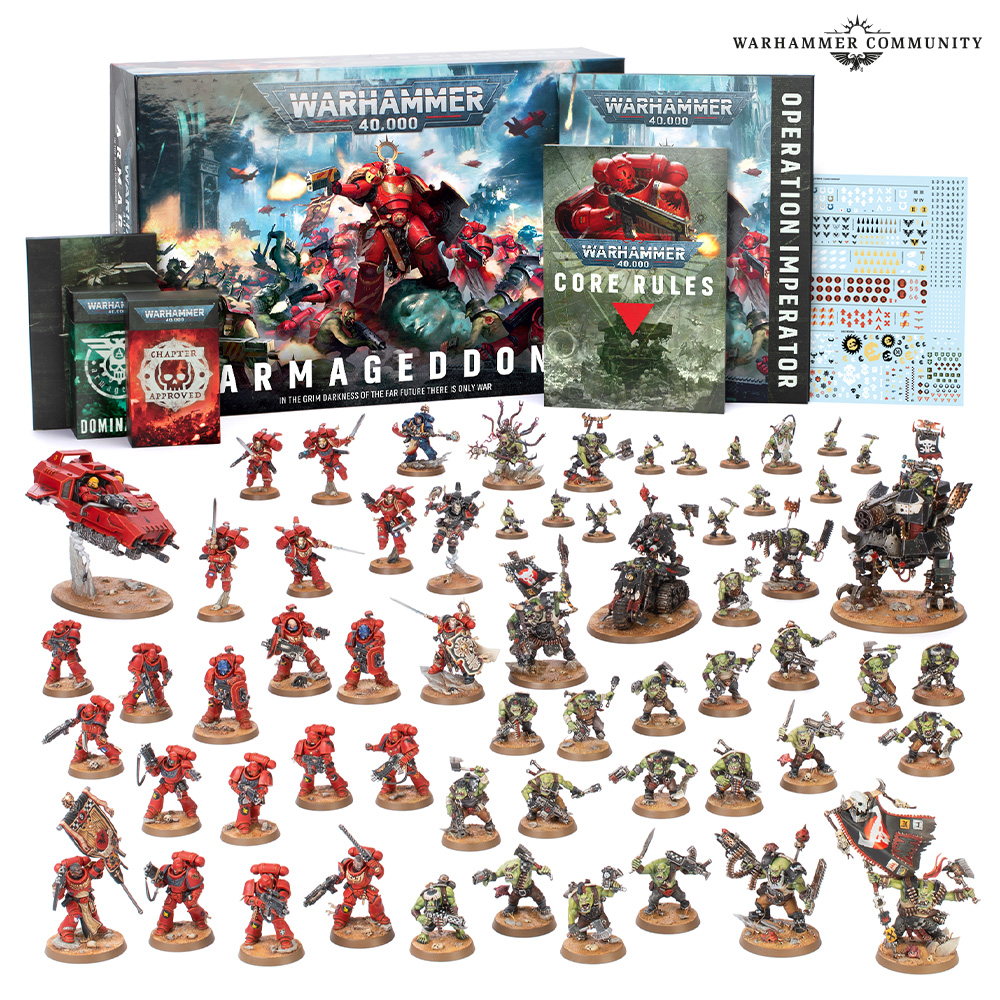
In our review of Warhammer 40000 : Armageddon we briefly touched on the fact that the box comes a rule book for the new edition of the rules. (Indeed, the point of the box is to launch those rules.) You can download them here, but the core point is that this latest iteration of the world’s most popular sci-fi skirmish game is still recognisable to players of previous, recent editions.
It’s still a unit focused tabletop wargame, with one player taking their turn, then the other. 6 sided dice and tape measures are used as basic tools of the game, and it’s focused on painted models that vary from a person sized piece to larger models that include large walking robots and big alien monsters. Tanks, bikes, artillery etc also make up a usual army.
Which brings us to the first big change; units are organised by detachments (a thematic collection of units), and you can have multiple detachments in your army list; basically you can swap out various bits of your army in order to optimise special abilities. The rules for the detachments will be available online and in physical form. This might seem a bit involved for those of us who are used to simpler (but more detailed) force organisation. This also affects your potential win conditions, as they vary depending on the way you put your army together.
This also means that gamers aren’t really punished for choosing models because they’re cool rather than optimal; they are a lot of ways to put your horde of Orks together to make them playable, so if you like just collecting and painting models but also like the odd game, this is a solid change; rule of cool is allowed.
Terrain is also now more important. You have to actually interact with the terrain in order to claim it, rather than lurking about near it for a tactical advantage. If you want to hold that ruined temple, you need to be inside it. Which is great, because the new rules make cover much more effective, and much easier to hide in if your unit is good at hiding. Makes for a more cinematic game. (Special abilities will be also updated, to fit in better with the changes.) This includes ‘main character’ style units, who look like they’ll be getting buffed to work with or without their allies.
Melee has been improved, to the delight of Ork and Tyranid players, but also for everyone else. Even Tau. The guidance on rolling all those dice makes for a smoother game also, but older players will probably stick to their bad habits.
Overall, a stronger, more unified system that seems to work for every style of play, and should make tournaments more accessible to players. More importantly; Games Workshop have listened to their players and added in things we’re already doing to make the game more fun. Which is how it should be.
Terrain is a key element in the latest edition of the Warhammer 40,000 game, so much so that the wise folk at Games Workshop have produced all sorts of exciting terrain options for folk to have fun with.
Terrain is a tricky thing to manage; ruins, burnt out vehicles, statues, forests and the like for your toy soldiers to fight over are an essential part of most war games. But that also makes them pretty chunky sort of things; if you’ve got limited storage space or have a house so full of stuff that you have to play games elsewhere, moving these things about can be a challenge.
The wargaming industry has come up with all sorts of solutions in the past, from pop up books to just using any old stuff you have lying around. GW loves to give you options, and they do have plenty of old-fashioned plastic terrain pieces, as well as various guides on how to make the stuff. Their latest solution it the Terrain Area Set, a cardboard envelope with sixteen full colour, double sided cardboard tiles.
They lie flat and essentially have ruins printed on them. Because the new game has very specific terrain rules, these work fine. And they also function as beer coasters of sorts for actual terrain that you may want to use without scuffing up your nice table.
It’s a nice, if odd idea, and our main take away is that the folder they come in opens from the bottom and doesn’t really re-seal, meaning that you’ll end up finding a new place to store them. Or using they as fancy mats for your drinks. Odd, but useful, and we do wonder why they weren’t in the excellent Armageddon box.
They are enough Warhammer 40,000 books out in the world that you could easily fill a library. Mostly though, these are works of fiction or rulebooks, things that either whet your appetite for the game or tell you how to play it. Useful guides such as The Ultimate Guide or Character Encyclopedia aren’t that common and sometimes what you want is a good old fashioned beginners book that doesn’t worry too much about the rules and gives you a good overview; a book that does the job of the whole library.
It’s always nice when we get a book from GW in the post, so we were delighted when the Combat Patrol Companion turned up on our review desk. It’s exactly the starter book we were looking for; a large form paperback book that you can flip through during those quiet moments in order to get an good idea of what you want to do with all those plastic models you either own or are intending to own.
Combat Patrol is also the name of the starter boxes for each of Warhammer 40,000’s army sets. The idea here is that you pick up the book, read about the various factions (there are a lot) and then look to pick up another box of toy soldiers. (Really cool toy soldiers though.)
The writing is solid, detailed, and the book is crammed with pictures and art that will help you get an idea of what this very British but loved internationally game is all about. It also features a battle report, which is essentially a very flowery example of play. These are a bit of a fine art in Warhammer circles, and this book does it very well. It’s easy to read, concise and fun.
We get a nice overview of ‘recent events’ in the current storyline, as well as some useful setting material. The photos of painted models and the artwork are mostly the point here, though; it’s intended to be a guide for what to do with your lovely box of Warhammer toys, in case you’re not sure what to do next.
It’s not a must-have for old players (though it’s nice to have), but it is a good thing to pick up for that potential new 40k fan in your life.
It’s become something of a trope that Games Workshop is a hoarder of ideas. Certainly, they love to hang on to good ideas, often taking decades to return to long-forgotten storylines and products. This even applies to their flagship products, such as Warhammer 40,000, now in its eleventh edition.
Big boxes for new editions have been a thing ever since the 2nd edition of the game; that initial big box pretty much launched Warhammer as a staple of Christmas presents across the UK and beyond, with the Argos catalogue listing still coming up as a topic in pretty much every relevant nostalgia-fueled retrospective we’ve ever seen. So nine editions later, why does that matter? Because 9 editions later, we have returned to the theme of that classic box; Orks versus Blood Angel Space Marines. The new box landed on our desk with a thud (thanks to GW in Nottingham for sending a copy over for review).
In the Warhammer 40,000 Armageddon box, we get a small horde of plastic models that are easy to assemble (but you’re still going to need a knife or pair of clippers to get them off the sprue). 61 models in total; 23 Space Marines and 38 Orks of varying sizes and types. Plus Two decks of boxes that both feel like their own card games that have escaped confinement. We get a cargo-pants pocket-sized rulebook, a pile of datasheets for each unit in the box and some transfer sheets so you don’t have to hand-draw numbers and logos onto the models when you paint them. No dice, which is reasonable; the game uses six-sided dice, and you absolutely have those. Fancy six-sided dice in bright colours are available separately if you need them.
Orks are the best xenos (alien) faction in the game; fun to paint, simple enough rules-wise for a new player to grasp and filled with lore that is entertaining and clever. 38 Orks are enough to start your own horde, and they break down nicely into command units, cannon fodder and heavy hitters.
Ork vehicles are meant to have a Mad Max / Wasteland look to them, and we get two of these scrappy monstrosities in the box: a War Trakk and a Big Mek DakkaRig. The Trakk is a bizarre-looking motorbike/ tractor hybrid, brimming with missiles and controlled by a crazy looking ork looking to blow up the world if it can. The DakkaRig is a walking gun platform, and is a shout-out of sorts to the old 2nd edition box, which was meant to have a similar sort of model (called a dreadnought), but GW at the time couldn’t quite make it work and instead gave us a cardboard counter. This new model isn’t cardboard, it is lovingly detailed plastic and looks totally wild (and will delight folk who like to modify their models.
The command orks (referred to hilariously as nobs) comprise of single models for the Warboss, Big Boss, Bannernob, Painboy and Weirdboy. Ork hero models have always been full of character, and each of these is very, very distinct; you’re unlikely to confuse the Weirdboy (Wizard) with the Bannernob (standard bearer). Only one of these, the Painboy (medic) comes with a adjutant model, which is a pity as Orks tend suit lots of little lackeys following the about.
Speaking of lackeys, though, we do get 10 Gretchen models. These are basically space goblins and are an essential part of any Ork army as they’re intended to soak up enemy fire. They are hilariously posed and obviously doomed. We also get 20 Boyz, the standard military unit of the Orks. Each model is an angry looking creature (that will look great painted green), toting an improbably large weapon and clearly yelling something obscene. They’re great Orks, and if you already collect these creatures (and why wouldn’t you, they are the best army), then these boyz will happily add to your collections.
The rest of the models are Blood Angel Space Marines, in the new style, which is a nice way of saying that they’re a bit taller and a bit more science fiction than the older models. For a faction that hasn’t innovated its technology in 10,000 years, they sure do seem to get regular design updates. Still, these Space Marines do fit the brief of looking like vengeful demi-gods that serve a super-horrid version of humanity.
We get one vehicle, but it’s a very nice one; Land Speeder. It’s a nice take on a classic model; the third edition of the game also had a Land Speeder in it’s launch box and this is a much better (but still recognisable) take on the vehicle. It’s essentially as armoured, flying sports car car covered in weapons and is absolutely meant to swoop in, wipe out an important enemy unit and then explode.
We also get five Vanguard Veterans; heavily armoured looking chaps sporting very big jet packs and space-aged swords, so they can swoop down with the Land Speeder and chop up the poor defenceless Orks (who are honestly just minding their own business. Though that business is invading worlds and starting fights, so fair enough.)
Our grunt units include three Eradicators armed with Heavy Bolters; basically, tall space marines with huge guns that will blow up things like walking gun platforms. They’re lovely looking models and snap together very easily.
They are assisted by ten intercessors, the basic troops. The storytelling on these models is great; their armour is a mismatch of other design types from across the galaxy. Basically, they’ve been fighting for so long that supplies are limited, and they’re now wearing the wrong sort of helmet and pauldrons. This gives them a ‘desperate eternal warrior’ vibe, which we have to admit is pretty cool.
Our command team includes a Captain, a Librarian, a Chaplain and an Ancient. The Ancient rocks a huge banner and is slightly smaller in stature than the rest of his fellows; basically, he’s been at this war stuff for a very long time. The Captain rocks a massive shield that feels like a relic from another time. The Librarian (a wizard) has a goatee and a techno-magic staff, and Chaplain ( priest/political officer) rocks a hazardous looking jet back and a massive melee weapon. Essentially, all of the leaders look like they have been fighting this one war forever, which is very in setting.
Rules wise, we’ll break it down in more detail in a seperate review, but the short version is ‘faster, flatter, more focused on terrain and missions, with a bunch of tweaks to make the game more accessible and more fun. Most gaming groups will house-rule their games to suit their resources and sense of fun anyway. Those who care about tournament rules and require strict standards will be delighted to learn that the core rule-set leans into competitive play as efficiently as it can without being too difficult for new gamers. The two-deck boxes of cards, the rule book and the unit cards make the game pretty smooth.
We also get a book called Operation Imperator, which gives us an overview of the storyline. The world of Armageddon is one of the more detailed parts of the world of Warhammer 40,000, so there’s a lot to get your teeth into. As always, this functions as a way to get inspiration for your painting and modelling projects.
The best Warhammer 40,000 box we’ve ever seen, and we’ve been watching this for a long time.
Over the years, Yoshi seems to have become something of an experimental vehicle for Nintendo. His first appearance, in 1995’s Super Mario World 2: Yoshi’s Island, completely changed people’s expectations of what a Mario game would (or should) be like, and pretty much all of the games that he’s starred in ever since have been, at the very least, a bit unconventional. But despite the gimmicks, Yoshi games have largely all been charming, quirky and fun, while never quite sticking to the standard platformer formula.
This trend continues with the Mysterious Book, which finds a gigantic talking encyclopedia, Mr E, arriving on Yoshi’s island. His pages have fallen out, and Yoshi is tasked with diving into the book and restoring its contents. Each chapter has a double-page spread which you’ll examine using a magnifying glass before zooming in on one of the weird and wonderful animals that inhabit that particular chapter. Each creature has its own dedicated level which you’ll need to thoroughly explore, using the creatures’ abilities to solve puzzles, find hidden flowers and earn stars.
Yoshi is able to jump, gobble up creatures, whip them onto his back, and shoot eggs to reach distant objects. It’s only a small suite of abilities, but each creature that you discover has a whole range of unique uses, which combine with Yoshi’s abilities to give a huge amount of possibilities. The froggy Croakaoke sings songs and has a head that can be bounced off, Glubbits create bubbles that Yoshi can float around in, while fluffy dandelion-like Scatterpuffs can be (slightly awkwardly) pushed around the screen in an attempt to make them land in the right place to grow into larger plants that you can bounce off. There are almost 60 creatures across the game’s 6 chapters, and the more you experiment, the more discoveries you make, although some of the creatures’ abilities can be a bit obtuse and more than a few levels will require a bit of trial and error to figure out.
The Mysterious Book is a curiously short game – a more skilled player could see the end credits within around 4-5 hours – but it crams a lot of endearing silliness into its brief appearance. Those looking for the type of platformer that Nintendo has become known for might find that this doesn’t quite scratch the same itch, with its unique approach to level design and the sometimes stubbornly confusing objectives, but a more inquisitive (and potentially younger) audience is likely to be more appreciative of its emphasis on exploration and experimentation.
PLATFORM: PC, PS4/5, SWITCH/2, XBOX ONE/SERIES (REVIEWED) | RELEASE DATE: MAY 22ND
Bubsy, the talking bobcat, first appeared in the early 90s during a time when “mascot platformers” were very much everywhere. Countless attempts were made at finding the next Sonic the Hedgehog, and the ones that succeeded are vastly outnumbered by the ones that didn’t quite make it. Bubsy falls into the latter category, with the already-dated gameplay of his initial 1993 outing only being marginally improved upon by its sequel, and a shift from 2D to 3D in 1996 seemingly banging the final nail into his coffin. After a muted response to Bubsy’s return to his 2D roots in 2017, it seemed like the party might be over once and for all but, as if trying to prove that cats do indeed have nine lives, he’s back again for another attempt at making a name for himself in the 3D platformer genre.
Calling back to his 90s roots, Bubsy 4D (because the gameplay attempts to build on his last 3D appearance) is a bright and colourful platformer with an art style that brings to mind Saturday morning cartooons of the era. The snarky humour is in full effect, too, kicking off with an in-joke where Bubsy talks about not being that old before his pal turns to the camera and gives a knowing look to the audience. Before long, word arrives that Bubsy’s longtime enemies, the Woolies, have returned, and are abducting sheep in an attempt to make their own golden fleece. That’s not all – the sheep have escaped and gone rogue, turning into cybernetically-enhanced BaaBots and causing havoc across the Woolies’ planets. So, of course, Bubsy springs into action and heads off to save the day once again.
From the start, Bubsy is able to jump, double jump, flutter (a bit like Yoshi) and pounce, and combining these abilities allows him to do all of the standard platforming feats like traversing large gaps and jumping between walls. A new addition is his ability to turn into a ball and roll around, using his pounce to increase his speed. Like always, levels are filled with balls of wool that Bubsy needs to collect, as well as hard-to-reach blueprints that unlock a handful of upgrades. There are occasional flashes of inspiration, but the game’s 15 levels are mostly standard platforming fare and Bubsy’s movement and mechanics don’t quite offer the sort of precision that’s really needed; he’ll happily refuse to stop when you want him to, directional inputs are often unresponsive, jumping is very floaty and imprecise, and unpredictable camera angles constantly need to be adjusted manually at the most inopportune moments.
There’s a possibility that these issues are intended to evoke the feeling of true 90s platformers, but they come across as frustrating and unwieldy in the modern era, making the game feel clunky and dated rather than charming and challenging. The addition of abilities and upgrades is certainly welcome, and it’s nice to see an attempt at redemption for this long-maligned character, but unfortunately Bubsy 4D doesn’t succeed.
PLATFORM: PC (EARLY ACCESS) | RELEASE DATE: OUT NOW
Set in the 1700s, Windrose casts players as an unnamed salty sea dog who recently had a run-in with the infamous Blackbeard. Starting you off on an island with little more than a broken sword and the rags that you washed ashore in, your task is to survive long enough to figure out what exactly your nefarious foe is up to. To do this, you’ll need to forage for materials, build a base, craft various tools and eventually cobble together a ship that will allow you to take to the seas in search of plunder and booty and all that other piratey stuff.
Currently in Early Access, Windrose contains around 50% of its planned content. You’re able to fully explore around 30 procedurally-generated islands across three distinct biomes, all with unique loot, enemies, bosses and side quests, and there are three types of ship along with upgradeable weapons and armour. You’ll level up by discovering new materials and fully looting hand-crafted points of interest on many of the islands that you’ll discover, allowing you to push further into the harsh terrain and take on increasingly perilous enemies – the local wildlife can be especially vicious, and that’s before we even get to the rival pirates, mutated sailors and undead monstrosities that roam the islands. Enemies hit very hard indeed, so those who enjoy a challenge will be in their element, but there are some handy options that allow you to make things less stressful if you prefer an easier ride.
Windrose allows up to eight players to join a single game, which can make for some really fun co-op mayhem. A solo adventurer can easily make their world available to other players without starting a new game if you suddenly decide you want to bring some pals in, and it’s quite pleasing that while the game recommends sticking to a maximum of four players, during this review there weren’t any noticeable issues with a full complement of eight. Main story quest progress is shared between all players, but it’s worth tinkering with the settings before you really get going – enemy health is increased for each additional player in a game, making things very difficult for anyone who finds themself in a fight without any backup…
With at least 50 hours’ worth of content in its current build, Windrose is well worth investing in even before it reaches its final form. Its story takes a back seat to the action a lot of the time, and occasionally it might feel like upgrading your weapons doesn’t always feel like you’ve got a whole lot stronger, but all of the game’s mechanics, from its crafting and survival to its land and sea combat, are extremely well done, forming a ridiculously addictive package that could well steal entire days of your life if it gets its hooks into you.
PLATFORM: PC, PS5, SWITCH 2, XBOX SERIES (REVIEWED) | RELEASE DATE: OUT NOW
Boomer shooters are ten a penny these days, but there aren’t many like Mouse: P.I. For Hire. Set in Mouseburg, a (very) alternate version of 1930s New York where the inhabitants are all anthropomorphic rodents, players assume the role of Jack Pepper, a private investigator in charge of a missing persons case. Taking cues from classic noir thrillers but adding plenty of subversive and satirical elements, the story unravels across 10-12 hours and takes in corruption, kidnapping, murder, lots and lots of cheese, and even a trip to a supernatural undead underworld…
Getting straight to the point, Mouse P.I. is one of the best games in its genre for quite some time. Each mission sends you to a different area of the city before returning back to your base where Jack puts together any clues that he’s found and figures out where to go next, before visiting a few shops to upgrade his gear and maybe playing a few rounds of a very addictive baseball-themed card game before jumping in his car and heading to the next location. Seemingly heavily inspired by Doom’s 2016 reboot, the focus is very much on fast-paced combat, with some downtime between fights to explore the environment and hunt for power-ups and upgrades. Your arsenal of weaponry feels great to use, and a range of handy tools like a grappling hook and floaty “helicopter hat” come into play during platforming sections that are spread liberally throughout each level.
It’s a fantastic looking game, too, with some phenomenal hand-drawn animations and striking black-and-white visuals giving a unique spin on some nicely varied environments like a steamboat, opera house and film studio. It’s in the latter area that we’re given a brief look at what the game might have looked like in full-colour, a tantalising glimpse at what might lie ahead in the future. The 1930s aesthetic is captured tremendously well, complemented by a superb jazz soundtrack that fits the mood perfectly. In Mouse P.I. For Hire, what might look at first glance like a bit of a gimmicky unassuming shooter quickly proves to be one of the standout entries in the entire genre. One not to be missed!
PLATFORM: PC, PS5, XBOX SERIES (REVIEWED) | RELEASE DATE: OUT NOW
In this narrative-driven investigate-em-up, players take the role of Noah, an employee of the Ancile, a company that specialises in “occult affairs”. Sent to the bottom of the Pacific Ocean to track down some missing miners, Noah finds something highly unusual – the entrance to R’lyeh, the sunken city long thought to be the lair of Cthulhu…
Like many other Lovecraft-related games, The Cosmic Abyss focuses on exploration and investigation rather than combat – you won’t be fighting anything other than Noah’s grip on his own sanity. Instead, you’re given an upgradeable AI companion that will assist you in your quest to uncover the many secrets that lie ahead. Each of the game’s chapters features a series of puzzles that need to be completed by thoroughly investigating your surroundings and piecing together the clues that you find. By analysing anything that might be useful, you’re able to add materials to a sonar that will help you to find additional information or routes through the level. All of the major clues that you find are stored in the Vault, where you’ll use your own detective abilities to figure out how and why the various bits of information link together, leading to a deduction that will hopefully show you what steps to take next.
In each chapter, the main Investigation always has two outcomes – one that strengthens Cthulhu’s influence, and one that reduces it. Your task is to not only find the puzzle’s solution, but to also choose the correct one that will keep Noah’s Corruption meter stable and stop him from going insane. In the standard “Investigation mode”, there’s very little hand-holding and you’re rarely explicitly told what to do, so you’ll need an inquisitive mind and a keen eye to progress safely. Those who prefer an easier ride can opt to play in “Exploration mode” which enables hints that range from nudging you in the right direction to just giving you the answer to your current puzzle, depending on how much help you feel you might need.
With its cerebral puzzle-solving, beautiful scenery and unsettling atmosphere, The Cosmic Abyss has plenty to offer for discerning puzzle fans. Its investigation mechanics can be a bit fiddly though, mid-game checkpoints are infrequent, and some of the clues and solutions can at times be almost prohibitively tricky to figure out, even when using the built-in hint system. If mind-bending puzzles of a Lovecraftian nature are your thing, Cthulhu: The Cosmic Abyss should scratch a very specific itch.
PLATFORM: PC, PS5, XBOX SERIES (REVIEWED) | RELEASE DATE: APRIL 17TH
In Pragmata – Capcom’s first major new IP since Dragon’s Dogma all the way back in 2012 – players are cast in the role of Hugh Williams, a space soldier who finds himself trapped on the Cradle, a colossal 3D-printed (for reasons that will become clear) moon base, after a routine mission goes awry. Rescued by a childlike android who Hugh names Diana, the pair team up and attempt to find a way back to Earth but quickly find themselves sidetracked as events take an unexpected turn…
Throughout this semi-linear action-adventure, Hugh and Diana travel through four distinct areas of the base, each becoming accessible after the previous area’s boss has been defeated, all with with a clearly defined path to follow but still allowing enough room to hunt for hidden secrets. The 3D-printed world gives plenty of scope for some inventive locations, and while the opening New York-esque area is a highlight, the environments remain beautiful and engaging the whole way through, with impressive visuals that make you slow down to take in your surroundings and plenty of puzzles and well-hidden secrets that offer useful items to reward the more determined explorer.
But Hugh and Diana aren’t always welcome in the Cradle, and legions of robotic enemies will try to stop them at every turn. While Hugh is able to equip a selection of firearms to damage, stun and immobilise enemies, bullets alone don’t have much effect on the heavily armoured androids. From her vantage point on Hugh’s back, though, players use Diana’s hacking skills in realtime, moving a cursor around a grid, passing through nodes to add various effects. A successful hack will break open its target’s armour, allowing Hugh to open fire and deal as much damage as possible. Dealing with all of this on the fly sounds like it would be overly fiddly and complicated, but the perfectly-mapped control scheme allows you to hack with the face buttons while simultaneously moving Hugh out of trouble, even dodging, hovering and shooting at the same time. On the whole, enemies are fairly slow, giving you enough time to reposition and collect your thoughts, and there are a few different ways of slowing them down further if the need arises. It’s a highly unusual mechanic, but it works really well and adds a new dynamic to the usual aiming and shooting.
As the game progresses, you’ll find new nodes that add a variety of abilities to Diana’s hacks, many of which are upgradeable to make them even stronger, as well as collecting new weapons for Hugh’s arsenal. Travelling to your Shelter from various points within each level, you’re able to upgrade your weapons and nodes, unlock mods and abilities, and change the loadout for your current mission. You’re also able to take part in some fun unlockable training missions to earn extra upgrade materials, and cash in any Cabin Coins you might have found to unlock prizes on a bingo-like stamp card.
Taking around 10-12 hours to complete on the standard difficulty setting (the trickiest one available when you start the game), some might find that Pragmata isn’t the most challenging of games. Those who finish the campaign will unlock a couple of fun features, though. New Game Plus allows you to replay the game equipped with most of your unlocked mods and abilities (apart from those learned as part of the story) right from the start, and without giving any spoilers you’re also given a good incentive to revisit each location and reach 100% completion in each area. A new “Lunatic” difficulty setting is unlocked as well, making the game much more tense and nerve-racking and allowing you to upgrade Hugh’s abilities even further.
Pragmata brings to mind games like Remember Me, Ghostwire Tokyo, Vanquish and Astral Chain, titles that stood out by taking a chance and trying something a bit different. Much in the same way that those games did, Pragmata feels new and exciting, and its unique mechanics mean that you’re never quite sure what’s going to happen at any given moment. It feels like it’s been years since a game has felt this fresh and interesting, and even longer since something that might be considered “a bit experimental” was pulled off in such a stylish and fun way. Both of its central characters are very likeable (how they managed to make a child companion who isn’t completely irritating is anyone’s guess, but they pulled it off here!), and the relationship between them – with Hugh being the self-aware fatherly protector to Diana’s childlike inquisitiveness – builds really nicely throughout the game. The overarching story might be on the weaker side, but serves its purpose well enough as a backdrop to the addictive combat and exploration that are Pragmata‘s undeniable high points. Overall, an excellent, if unusual, debut!