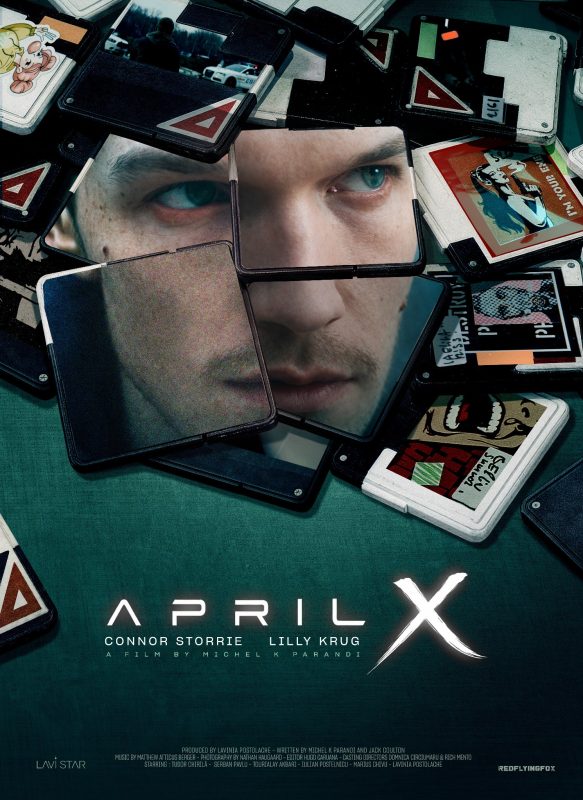
April X is a cerebral film noir sci-fi thriller, set in an un-named, somewhat dystopian, near-future post-Soviet eastern European city. This mash-up of genres is squeezed into a 92 minute running time which requires the viewer to pay close attention, as the plot does not unfold in a linear fashion.
This is a film which has come to greater attention than it perhaps otherwise would have due to the decision by director Michel K Parandi to cast Heated Rivalry phenom Connor Storrie (Joker: Folie a Deux, For All Mankind) in the lead role of Baxter. Co-starring as Baxter’s twin sister, April, is German actress Lilly Krug (Zero Contact, DRAGN).
It’s never made clear which eastern European city the film’s action is supposed to be set in – it probably doesn’t really matter, but the opportunity for some potential commentary on the nature of post-colonial communities has been lost in that vagueness. Whatever city we are in, is a vision of the future that mixes elements of Blade Runner and Minority Report, and throws in a lot of brutalist architecture that wouldn’t be out of place in 2000 AD’s comic book drawings of Judge Dredd or Halo Jones’ worlds.
Baxter exists on the fringes of the criminal underworld in this unspecified city. He’s crashing on his sister April’s sofa, whilst working with his friend Ronny (Tourialay Akbari: Around the World in 80 Days) as one-half of a modern day Burke & Hare to provide body parts to local gangland bigwig, Klein (Serban Pavlu).
It requires quite a lot of reading between the lines to realise that Klein wants the body parts as part of a cloning scheme, the legalities of which are dubious, at best. We are, exceptionally briefly, introduced to the notion that young women are being cloned. The clones are given real memories, allowing them to be ‘fully rounded people’, but are also given slightly different character attributes, that range from ‘accomodating’ to ‘psychotic’. This is, in fact, a core part of the narrative background to the entire plot, and a slightly longer scene here, or earlier discussions of the ethics / legality / cultural place of clones and cloning in this society would have made it much easier to understand the narrative beats, and many of the scenes, that followed this moment.
When Baxter and Ronnie’s attempts to stay in Klein’s good books go (predictably) wrong, we find ourselves in territory more usually found in a thriller: Baxter is very sure that he can ‘fix the problem’ – a position he will adopt frequently throughout the film’s narrative. Alas, Baxter cannot ‘fix the problem’, and, in attempting to assist, April vanishes.
Having frantically searched for his sister, he finds himself further in the mud with Klein. Recognising that Klein is almost certainly lying about knowing nothing about April’s disappearance, and therefore that he needs to play the long game, Baxter agrees to work for Klein on an ongoing basis.

Some five years pass, a shift which is conveyed by a single line of on screen text. Having had those five years to dwell on matters, Baxter decides to weaponise his simmering rage and finally find out what happened to his sister.
This notches up the action, as Baxter appears to channel the spirit of Bruce Willis in Die Hard, as he takes on powerful men with powerful weapons, in a series of shiny high-rise buildings.
There’s an important sub-plot about the importance of April’s memories, and her ability to harvest and manipulate her own dreams that could have been given significantly more screen time. As it is, this important thematic strand is again raced past in a bid to squeeze in the expanse of the story Parandi is attempting to tell.
Pre-release interviews suggest that Parandi, who also conceived the story and co-wrote the screenplay had a considerably expanded script prepared, significant elements of which fell by the wayside due to budgetary constraints. This film has been made for, we understand, a budget of under $2million US Dollars. Much of it has also been shot at night, which gives the visuals great atmosphere and aesthetics, but also increases production costs. There’s also a lot of use of on-screen drones, seemingly as a sort of ‘all seeing eye’ for the local police force. This is a nice touch, to increase the feeling of paranoia that everyone is being monitored at all times, but again, this isn’t developed strongly enough in the first act.
There’s a lot here that, in a film with a longer running time and larger budget, could have been built into a coherent world, dripping in paranoia and fear. As it is, we almost never encounter a character who isn’t involved in criminal activity, and it’s very hard to care about criminals killing other criminals.
We’re also baffled by the decision to have everyone speak in what appears to be softer versions of their natural accents. Thanks to his work on Heated Rivalry, we know that Storrie can speak Russian, and a pre-show skit in the week he hosted the US version of Saturday Night Live demonstrates that he can successfully speak in a wide range of accents. Here, Baxter has been given what seems to be a mid-Atlantic accent. Maybe this is an attempt to convey that we could be anywhere, but if that’s the case, the set dressing choices needed deeper consideration, as one contradicts the other.
There’s a lot going on here, and a lot to chew on. Baxter is both patient and rash, both clever and utterly naive. April is a ball of chaos, but we don’t know enough about her character before she disappears.
The individual acting performances are very good. Storrie does Slavic brooding, quiet grief and nervous fretting superbly. Krug, given the lead credit but absent for a solid third of the action, is great as the original April, and the many, many clones of her. Other actors have less to do, but manage to convey paranoia, rage, and general malevolence with success.
This is an interesting film, which may well become a cult classic in years to come. As an early role for Storrie, it’s destined to become a minor part of his acting CV, and possibly a future ‘pointless’ answer on the similarly named BBC tea-time quiz show.
A mish-mash of genres and ideas that never quite comes together thanks to too many plot strands that aren’t developed enough to allow us to become fully immersed in the world or the narrative, this is a film which is one for completists of Storrie’s career, or those with an interest in films with an eastern European visual aesthetic.

April X is on limited release in selected UK cinemas, and is expected to be available via streaming in 2027. It will be released in selected US cinemas on 2nd October 2026.