From 1988 until 1994, Alex Cox presented a series of cult films every Sunday night on BBC Two. Over 100 eclectic movies were shown during his seven season tenure, including Django (1966), Witchfinder General (1968), and Vamp (1986). Now, Moviedrome returns with screenings of cult classics at BFI Southbank during a two-month season curated by the show’s original producer, Nick Freand Jones.
STARBURST: Before presenting Moviedrome, you were involved with another BBC TV series, The Film Club; a curated collection of classic films presented by notable British directors. How did your involvement in The Film Club contribute to you getting the opportunity to present Moviedrome?
Alex Cox: I think it was because of the location in which we shot my introductions for The Film Club. As you say, The Film Club featured a selection of very notable British film directors, and really important people like Lindsay Anderson [The Old Crowd, 1979] and Nicolas Roeg [Don’t Look Now, 1973]. But they would be interviewed in their house because the deal was most film directors, if you want to be a film or a TV director in England, you have to live in London. So they would go to Lindsay Anderson’s house, or Nicolas Roeg’s house, and they’d end up shooting in front of the fireplace, you know, so you’d see a corner of the mantelpiece over the shoulder.
But I didn’t live in London, so when they asked me to do it, I said, where? “At your house?” Well, my house is in America. And so they said, “Okay, well, somewhere else then… somewhere in London”. So, I said, what about the Lloyd’s building [aka the Inside-Out Building], which at that time was a fairly new, very postmodern edifice that had been built in the style of the Pompidou Center in Paris. Very different from the traditional architecture of London. We shot in the Lloyd’s building with the result that the introductions that I did had these magnificent backgrounds, and I think that was why I got the job. Because when they saw Lindsay, or when they saw Nic, they just saw a guy sitting in front of the mantelpiece, but when they saw me, they saw this incredible, bizarre Blade Runner-type world!
When Moviedrome began in 1988, it debuted with an extended version of The Wicker Man (1973). And now, for the BFI’s Moviedrome retrospective, The Wicker Man [The Final Cut] has been selected for the opening screening at BFI Southbank. How involved were you in the curation of each Moviedrome season, and now for the BFI’s retrospective programme?
No, no, Nick [Freand] Jones. Nick was the curator. He was the director and the producer of the programme, and he thought up the concept because the BBC had a lot of films… a lot of feature films under license that they didn’t know how to program… They didn’t know where to put them, so Nick came up with this idea of Moviedrome, and that would provide the frame for all of these diverse films that the BBC had, including The Wicker Man, Yojimbo (1961), Ace in the Hole (1951), and all these other movies. And so, it was down to his genius.
I wonder if the version of The Wicker Man that they’re going to show at BFI… do you think that’s a new version and they’ve gone back to the negative, because as I recall, the 2001 Director’s Cut was fairly funky in the sense that it would cut to material that was considerably poorer quality and then go back to the original cut. And I wonder if they’ve gone through the whole thing and done a whole new restoration.
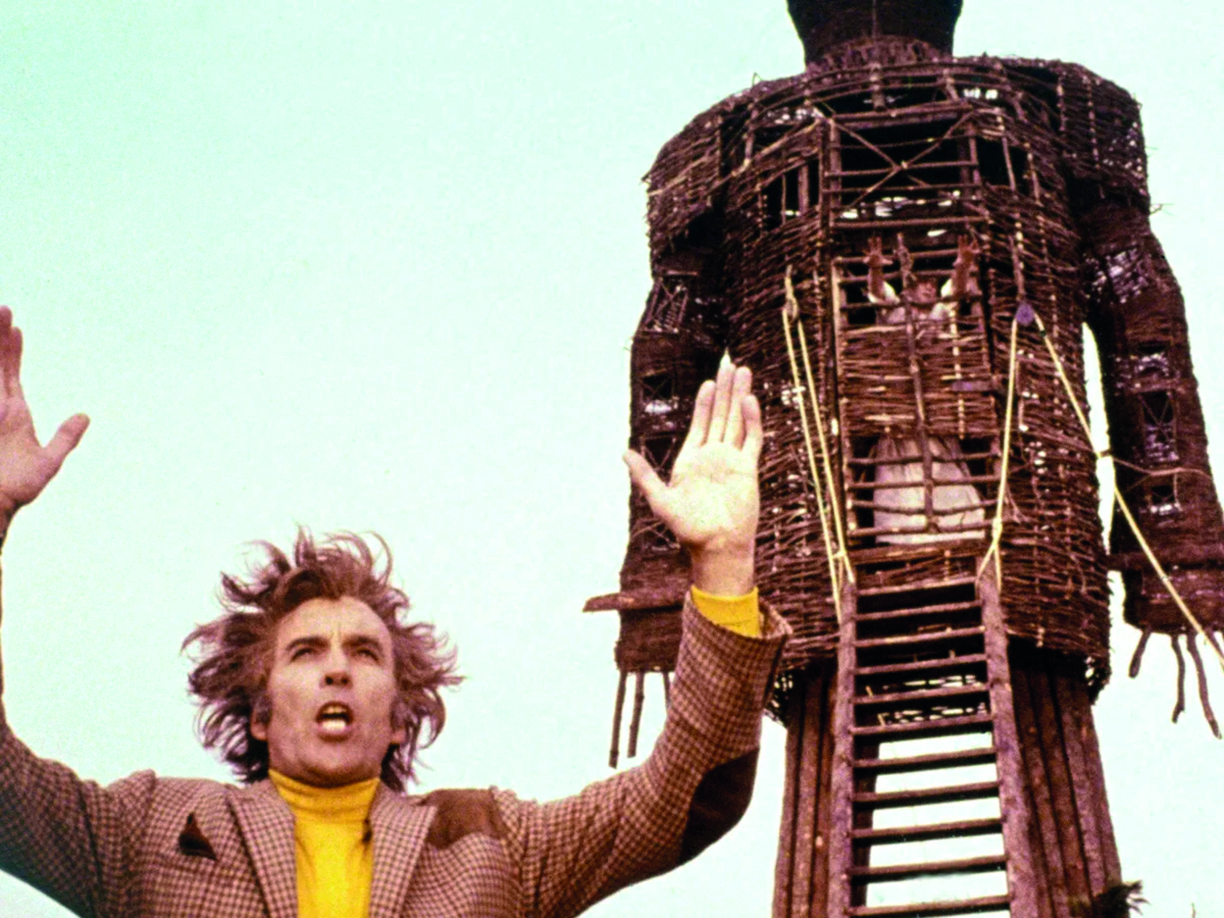
During your introduction to The Wicker Man for Moviedrome, you asked what constitutes a cult film. You said: “a cult film is one which has a passionate following, but does not appeal to everybody.” I think a notable aspect of Moviedrome is that many of your introductions were critical of the movies involved. You weren’t afraid to discuss a film’s failures. Do you agree that this approach is what helped Moviedrome gain its own passionate following?
Yes, I think that’s why, because it was kind of unique in that I didn’t have to just be a booster… a mindless booster for the product. You know, I could say, ah, this film isn’t very good, but there’s this great sequence where such and such happens. Or if it was a really great film like Sunset Boulevard [1950], it didn’t really need an introduction at all. So yeah, I think that the freedom that was available for me to talk discursively about the films probably added to the popularity of the series, because it was a little bit different.
Would you say you and Nick [Jones] were rebelling against the BBC’s programming ethos of the time with Moviedrome?
Well, I think it was interesting, because they were always looking for some kind of context to show films. There had to be a reason they were showing the film. But this was such a diverse collection of films that it was really impossible to put them all under one generic lid, you know? And I think the interesting thing was that Nick’s idea for Moviedrome, that it would be this sort of series of cult films, was very smart because that enabled him to program an enormous diversity of movies. So yeah, I think that the idea of Moviedrome that he came up with enabled us to show things that otherwise might not have got screened at all, like The Long Hair of Death [1964].
How has your definition of what constitutes a cult film evolved in the years since Moviedrome?
It hasn’t changed at all. I mean, the thing is, you can’t decide to make a cult film. And Hollywood has quite frequently spent vast amounts of money on projects that it thinks are going to be a cult film, and they always fail! If you intend to make a cult film, you will fail… you will fail really, really badly. But if you don’t intend to, you may be surprised.
We think you’re right, it doesn’t really work… and, especially with the major studios, it feels almost insincere.
It’s totally insincere. It’s totally bogus, you know, but that’s the way of the studio… to be totally bogus and insincere.
For the BFI retrospective, you are re-introducing in person [at BFI Southbank] cult films that were originally broadcast during Moviedrome‘s original run, like Sweet Smell of Success (1957). Would you say any of your original critique from Moviedrome has changed over the decades?
I don’t really know, because I don’t really remember what I said 20 or 30 years ago. I watched The Wicker Man again recently and I appreciated it more this time. I think it really bears multiple viewings. It’s a very interesting film and there’s nothing quite like it… That was the thing about Moviedrome, all the films had some merits. We weren’t just showing bad films so people could have a laugh at them. All the films that we showed actually had some virtue and we were pleased to show them. We didn’t feel embarrassed by showing any of them.
Well, cult film, it’s such a broad definition…
I think it was kind of bogus that we showed The Terminator (1984), because it isn’t a cult film, The Terminator is a big studio production. I don’t really think, with Arnold Schwarzenegger, that The Terminator franchise belonged on Moviedrome, but I understand why they programmed it.
As a director, you have a cult reputation yourself, and in a later season of Moviedrome [Season 5, 1992], you were given the opportunity to introduce the UK television broadcast of one of your own movies: Walker (1973). Your approach to remain impartial was to read a negative review from the BFI’s Monthly Film Bulletin. And now, Walker is now included in the BFI’s Moviedrome retrospective programme. If you had the opportunity, would you have introduced more of your own filmography during Moviedrome‘s original run?
No, no, that would be wrong. I’d be taking advantage of my privileged position. I was surprised they showed Walker, but I was glad they showed it too, because I wanted people to see it.
Was that Nick’s decision to include Walker?
Yes! I guess the BBC had probably bought it as part of a package, you know, with several other Universal films, but it was Nick’s idea to show it on Moviedrome. You can’t critique your own stuff because you’re too close to it.
Are there any cult films that you would have liked to have introduced for Moviedrome‘s original run, but never had the opportunity due to licensing, or concern from the BBC due to a film’s controversial content?
I think we were pretty lucky in the sense that we were able to license some Italian westerns which had never been officially shown in Britain before. We probably should have shown some more musicals. We didn’t show many musicals, but I imagine the obvious candidates would have been This Is Spinal Tap (1984) or The Rocky Horror Picture Show (1975). And I’m sure that they had been snapped up by another broadcaster, because either one of those films would have been a perfect way to begin any movie series.
For many, Moviedrome became their education in cult cinema. It was an introduction to obscure films that wouldn’t necessarily been shown on the BBC, if not for Moviedrome. How do you feel about the shift from curated TV programming like Moviedrome to today’s algorithm-driven streaming platforms?
I think that Moviedrome was a little bit like going to the video shop, you know? You would go in and there would be a whole row of films in one section, so you might find the film that you were looking for, but you might find something that you weren’t looking for as well. And when the algorithm decides, then you’re just at the mercy of this massive corporation… Netflix or Amazon or Apple making the decisions for you, essentially. So I think that, yeah, it’s a very unfortunate situation. It’s like going to the library. If you can’t browse the shelves in the library, if you only can go up to the librarian and say I want such and such a book, then you might get the book you’re looking for, but you’re not going to have that broader experience of all the other books adjacent to the book that you’re looking for, and what they might have to report on the subject.
Moviedrome was on at the time when there were only four television stations in Britain… so when we showed The Terminator, it would play on national television and 20 million people watched it, which is pretty amazing. But that was a different time.
Moviedrome: Bringing the Cult TV Series to the Big Screen is at BFI Southbank from July – August; a collection of Moviedrome films, including a new short documentary about the series, will also be available to stream on BFI Player.