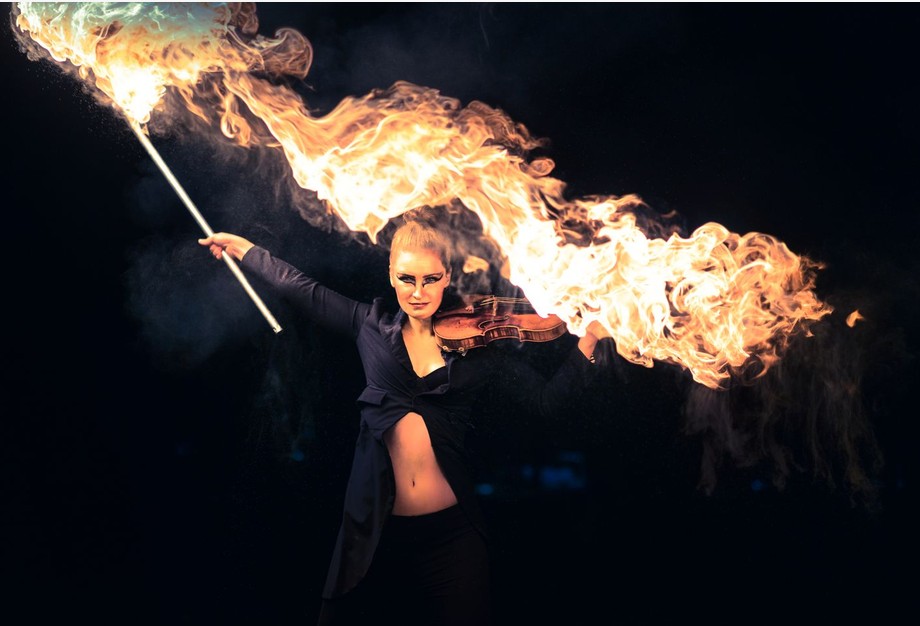
Chloé Charody is a composer. Sonja Schebeck is a violinist and artistic director. Both work for The Freestyle Orchestra. The have brought Tale Of The Firebird – Concerto For Violin, Fire & Acrobatic Orchestra to the Edinburgh Fringe. We caught up with them to find out more,
Introduce yourself please.
Sonja Schebeck: Hi! I’m a concert violinist and circus artist, and I love creating productions where both those worlds can co-exist. I’ve been fortunate to have had an extremely diverse career, from touring internationally as duo-partner to Nigel Kennedy alongside orchestral engagements including Sydney Symphony and Wiener Symphoniker whilst also working as a stage performer with major ballet and contemporary circus companies. Having dreamt of such a project since childhood, in 2016 I founded The Freestyle Orchestra specifically to further explore and expand the concept of the interplay and intersectionalities between the physical and musical artist. We’ve since created projects for festivals such as the Venice Biennale, VIVID Sydney, Orchester Am Berg at 1900m on the Austrian Alps and the Wiener Festwochen opening.
Chloé and I met as students at the Sydney Conservatorium of Music in 2007, connecting through a mutual interdisciplinary approach to concert presentation, a desire to create variety in ways that audiences can experience these genres, and indeed new ways that diverse organisations can present them – and we’ve been working together on a myriad of projects ever since!
Chloé Charody: Hello! I’m Chloé Charody – classical composer, show creator, refugee supporter and a fierce human rights activist.
I’ve always loved creating work that doesn’t fit neatly into one box. Whether it’s opera, ballet, chamber music, orchestral works or large-scale theatrical productions, I’m interested in bringing different art forms together to tell stories that feel immediate and human. Looking back, I’ve been incredibly fortunate to see my work performed all over the world. Some real highlights have been The Carnival, my first circus opera, which ran for two seasons on London’s West End; My Australia, commissioned by the Sydney Symphony Orchestra, ballets Magdalene and The Phoenix for Dutch National Ballet, opera Morning Blossoms which toured to some of the biggest concert halls across Europe with the Netherlands Symphony Orchestra; and Tale of The Firebird and LIMBO, which have travelled internationally. I’m also super excited about seeing my circus opera Mrs Giggly’s Magic School as well as Limbo and my 3rd string quartet playing later this year at the Sydney Opera House.
What’s always mattered most to me though, is creating work that connects with people. I’ve been lucky enough to have pieces performed everywhere from the Sydney Opera House, QPAC and Musiektheater Amsterdam to concert halls across Europe, as well as street theatre festivals, fringe festivals and all sorts of unconventional spaces. I love that those different settings bring in different audiences, especially young people. Across all of my work, there’s a common thread of telling stories that shine a light on refugees, displaced communities and other vulnerable people, and hopefully creating moments where audiences feel both entertained and challenged.
Ultimately, when people step into my artistic space, I see my job as helping that audience to expand their capacity to listen to the stories I’m telling, to feel them and most importantly, to care about them.
How would you pitch to a fan of classical music? And how would you pitch it to someone who has never seen acrobats and music in one show?
Chloé Charody: Honestly, we’d probably pitch it the same. For us, the music is not an accompaniment to the circus or vice versa – they are of equal weight and completely intertwined.
Come prepared to experience something you probably haven’t seen before. TALE OF THE FIREBIRD brings together live classical music, contemporary circus, fire, physical theatre and storytelling in a way that is both visually spectacular and emotionally engaging. At its heart, it’s a story about resilience, transformation and hope, things that feel incredibly relevant in the world we live in today. Whether you’re a classical music lover, a circus fan, or someone who doesn’t think either of those worlds is for you, there’s something in the show that can connect with you.
We’ve created it to be uncompromising yet accessible, exciting and full of wonder, while also exploring some deeply human themes. Most of all, we hope audiences leave feeling inspired by the Firebird’s journey and reminded of their own capacity to resist oppression, resist evil, rise above and fight for the freedom of all creatures, people and cultures.
Sonja Schebeck: I’d simply add that, if you don’t know Chloé Charody’s music already, I hope you’ll take the opportunity to discover it. Full of imagination, colour, emotion with a technical brilliance, it’s the kind of music that stays with you long after you’ve heard it.
Why the tale of the Firebird?
Chloé Charody: What I love about the Phoenix/Firebird myth is that it’s a story that exists across cultures and generations. It’s not actually about a magical bird, it’s about transformation, what happens after everything falls apart and how, somewhere deep inside us, there is a courage that enables us to rebuild and move on.
As a composer and show creator, I’ve always wanted to use my platform to tell stories about resisting oppression and about people finding the strength to rebuild after adversity. This is probably why the mythological story of the Phoenix resonated with me. Through my work in human rights and social justice, I’ve made friends with many people and communities who have faced the cruelest of injustices, yet somehow continue to find hope, and for the lucky ones that have the opportunity, the strength to rebuild their lives and move on.
When creating TALE OF THE FIREBIRD, I wanted to explore those ideas through a spectacle that audiences could feel rather than simply observe. Fire became a powerful symbol, not just of destruction, but of creativity, passion and renewal. The Firebird’s journey mirrors something I think is deeply human: the ability to rise again, often stronger than before.
How powerful is hope?
Chloé Charody: At a time when so many people are facing uncertainty, I think stories of resilience and hope are more important than ever. The piece celebrates the extraordinary capacity we all have to adapt, survive and create new beginnings, even when the odds seem stacked against us. That’s ultimately what inspired the narrative direction, and as the world continues to plummet further into darkness, it’s a message that could not feel more relevant to humanity today.
What was the greatest challenge getting this production made?
Sonja Schebeck: I’d say probably the fact that since our artist profile is fairly specific, not all of the 12 performers on stage are based in the same country – so it can be like managing a huge jigsaw puzzle sometimes! At the same time, this is also one of the most rewarding aspects – artists from all around the world, from different disciplines, cultures and backgrounds coming together to create something that none of us could have achieved on our own.
What is the hardest part of the show?
Sonja Schebeck: I think it depends on who you ask – each artist has different and specific challenges throughout. Across the board though I’d say that when you consider playing an instrument already requires concentrating on upwards of 5 different things at a time – during a show we often have to bundle these into one singular aspect so we can concentrate on 5 different physical or theatrical elements as well. We do love a challenge!
Why the Edinburgh Fringe?
Sonja Schebeck: There’s nothing quite like the vibe in Edinburgh during Fringe – with so many diverse and incredible artists, not to mention audiences are absolutely wonderful – warm, curious and open minded. It’s this unique atmosphere where it feels like everyone is riding the same adrenaline rush – artists, audiences, venue staff, everyone! The city itself becomes a venue, a huge celebration of creativity and you can see a mind-blowing range of art-forms all in one place.
We were also very fortunate to have completed a development residency at Assembly Roxy in early 2025, so bringing this new production to Fringe with the wonderful team at Assembly Festival seemed like a natural step – as well as being a wonderful chance for us to showcase this ambitious new production on the international stage.
What was your inspiration for the show?
Chloé Charody: I started conceiving this piece around the same time that Sonja was building The Freestyle Orchestra in Vienna, and seeing the development of their new skillset and their commitment to achieving the impossible, I was chomping at the bit to create a piece for them!
Most composers are used to writing for musicians who stay more or less in one place while they perform. With The Freestyle Orchestra, I was writing for world-class classical musicians who could play while hanging upside down, balance on apparatus as well as each other, tumble across the stage or interact with fire. Suddenly, the possibilities became much bigger and their developing acrobatic skills allowed me to think about the phrasing of the music and the overall development of the compositional arc of a traditional violin concerto in a completely different way.
Working closely with the performers, particularly Sonja, helped me understand what was physically possible and where the most exciting creative opportunities lay. We’d spend hours experimenting in the rehearsal room, discovering moments where music and movement could amplify each other in unexpected ways. Sometimes I’d rewrite sections of the score after seeing a new acrobatic idea, and other times The Freestyle Orchestra’s performers – both individually and collectively – would develop movement inspired by musical passages.
As someone who is passionate about breaking down barriers and creating new ways for people to engage with classical music, collaborating with an orchestra made up of exceptional musicians who challenge the traditional image of what an orchestra can be, made sense.
Where else can we see you?
Sonja Schebeck: We’ll be at the Salieri Circus award in Verona, Italy from 24-28 September with The Freestyle Orchestra and our smaller scale show LIMBO Sonata for Acrobatic Violinist & Acrobat (also composed and written by Chloé Charody) plays at the Sydney Opera House from 6-8 November.
Honesty or Politics?
Chloé: Both
Sonja: Honesty
Show or Business?
Both: Show
Truth or Beauty?
Chloé: Both
Sonja: Truth
Tale Of The Firebird – Concerto For Violin, Fire & Acrobatic Orchestra can be book via this link