Adam Egypt Mortimer | DANIEL ISN’T REAL

Director and writer Adam Egypt Mortimer’s debut feature, the 2015 slasher Some Kind of Hate, co-written with Brian DeLeeuw, was a breath of fresh air into a genre many thought had been done to death, and brought a unique vision of horror to the screen. It’s been a long wait, but the director’s sophomore feature, Daniel Isn’t Real (also co-written with DeLeeuw), finally released recently, and proved to be worth the wait. Not only does Daniel brim with amazing performances from its leads Miles Robbins and Patrick Schwarzenegger, as Luke and his frightening imaginary friend Daniel, but the story is filled with disturbing visuals and a story which will have viewers questioning their own perceptions of reality.

We spoke with Mortimer about the new film, and the thematic ideas to which he’s drawn.

STARBURST: I’ve been a fan of your work since I saw Some Kind of Hate when it came out almost five years ago and I was very excited when Daniel Isn’t Real was announced because I had really been waiting to see what you did for a follow-up for that movie, and it it did not disappoint.

Adam Egypt Mortimer: You know, Some Kind of Hate was the movie that I made basically so that we could make Daniel. Brian [DeLeeuw] and I had written Daniel first, and then realized, “How the hell am I gonna get this crazy movie made as my first movie?” So, then we said, “Well, let’s write what our version of a slasher movie would be like.” That was supposed to be very fast and easy to come together, and then even that was a nightmare to try to make, but all of that was a good thing, because it meant that, by the time I by the time I was finally able to make Daniel, I knew a lot more about making movies than I had when we first sat down to write it.

I think it really came at the at the right time and if you’re somebody who’s a fan of Some Kind of Hate, I’m sure you can see that there’s a lot of dramatic similarities and some similar kind of ideas. It wasn’t conscious at the time. It was a product, probably, of us writing them back-to-back and sharing the sensibility, but looking back on it, you sort of start to see all these things that are themes that are emerging, because they’re really important to me. Maybe I hadn’t even realized that at the time.

They just showed a double feature of those movies in Wales at a theater in Cardiff, and I thought that was so fun. It’s such a cool idea to be able to watch them back-to-back and see not only how have I improved as a filmmaker, but also how I returned to or developed the same sorts of ideas or feelings.

I was going to ask about what I see as the thematic elements that are similar in both of the movies: how things that happen in childhood / youth can have a very long tail in terms of how they affect you growing up.

Yeah, and I think that the idea of trauma on every level is such a crucial part of the human condition. It’s an important part of what we should be exploring in art. You can experience childhood trauma in so many different ways. Everything that you experience when you’re a child is so loud, and and that’s what it’s sort of getting at in that opening scene in Daniel, where we see his parents fighting.

You see these two adults throwing plates at each other, and then you see this tiny, tiny child with his cat puppet. Sometimes, I talk to my dad and I’ll be like, “I remember that totally insane fight you guys had,” or that horrible experience I had and he’ll be like, “Well, I think that we were just mildly annoyed.” Things are so loud, and affect you so deeply, and stain your DNA forever when you’re a child, and I think that was a big part of what I was trying to get at in Daniel.

To go from the dissolution of his family and what that feels like, to a literal bloody massacre within the same moment: it’s this idea that those things are both metaphors and the actual trauma at the same time. I think that, in trying to make Daniel go from a story that’s got a tiny, intimate childhood trauma story to something that becomes vast cosmic horror, I really sort of started to see the idea that the human race is itself sort of as a product of some kind of traumatic cosmic events, or that our whole thing — our whole society — is based on trauma. It’s something I’ve been coming towards more and more as my way of thinking about how the world works.

Both of your features like have — as you have very ably pointed out — this grounding in trauma. In Some Kind of Hate, it’s very much a more visceral sort of thing, where trauma is literally inflicted and can be then inflicted back upon the person giving it, like a vicious cycle. What I find really interesting about both of the movies is the world-building that you set up very early on, that then have this payoff a solid 90 minutes later. Everything that happens within the those first 15 or 20 minutes of Daniel Isn’t Real are so important to the end of the film.

When we had our LA premiere at Beyond Fest, a friend of mine came to see the movie, and he walked in with his popcorn and his soda 90 seconds after the movie had started — missing the opening. Without spoiling it, the opening 60 seconds of this movie is a shocking thing that is really crucial to the movie, and I have not stopped ragging my poor friend — who eventually came back and saw it a second time a couple weeks later.

There are a lot of movies in the horror genre, where a lot of times people offer this structure, where the first 15 minutes of the movie is like, “Everything is nice!” and it’s sunny with the families eating breakfast together, and then things go awry.

To me, I felt like that’s both sort of cinematically boring, and an inaccurate portrayal of the world. If I’m going to do something that’s a deliberately sort of a scary, bleak, shocking kind of story, the beginnings are so crucial. In those first few minutes that you have with an audience, you can really set a tone, and so I want you to feel like you’re kind of getting your ass kicked at the beginning, and then there is this sort of satisfaction from puzzling it out.

Trauma is a puzzle, and if it’s something that can be solved — or, I guess, resolved or compromised with — I think you need those pieces. Some Kind of Hate started the same way, right? The first eight seconds of that movie is a murder, and then you kind of come back around and, at the end, find out who the murderers were, and why, and all that.

I like that feeling of something clicking into place and having an understanding, even if the understanding is a horrific one. Daniel Isn’t Real escalates: it starts out terrifying, with a horrible event, and then I think it dips down, but then it just steadily starts climbing back up and beyond. When the cosmic horror aspect of it kicks in, it’s been built in such a way that you’re you’re there for it. It doesn’t come out of left field.

I love movies where, even like up to the very end, I’m not sure whether it actually happened or if it was all within the character’s head. There are parts of me that still wonder as to whether or not this actually all happened to Luke, or whether he imagined everything that Daniel did.

I think that’s a completely viable understanding of it. I mean, there’s a lot. It’s interesting: in designing the movie, I was obsessed by the idea of what is objective and what’s subjective, and how do you communicate that in a movie like this? How are we gonna live in a movie, where every scene of dialogue, there’s a character that nobody else can see? How is the audience gonna buy that? All these kind of things. It gets you to this really interesting place where, just because you can see something on the screen, what part of that is real and what part of it is not real? Even the title of the fucking movie potentially being, “Are we being honest with the audience or not?”

So, yeah — I’m completely open to the interpretation, but to interpret it the way you’re describing, you would have to look at things that appear to be objective and then sort of have a discussion about what really would be happening there. We don’t do the thing where you flashback and see everything differently, like, “Here’s what it really looked like!”

The way they do at the end of The Usual Suspects is an example of that: where suddenly, at the end, you rewind the whole movie and it’s like, “Oh, it was all a lie because there was actually this thing and there was this thing!” I don’t do that, here. I think I’m much more interested in [the idea that] reality itself is this kind of unstable field, and our unreality is made by our perceptions, and our perceptions are colored by our traumas and our emotions, so where do we stand? That’s the horror of it. The horrific aspect of the story? That’s about perception.

The reason this all works for me is because of the interaction between Patrick Schwarzenegger and Miles Robbins, because it is essentially a twisted buddy picture. I imagine the casting process for those two roles were very intense? These two have to be besties, for lack of a better term.

It is 100% a buddy movie, and the thing was that — no matter what the the metaphysics or the cosmic horror of it or whatever these two characters are in reality — I was very obsessed with making a movie that is accurately depicting the feelings of young male friendship, at that age and at that time, and sort of drawing on everything I could from my own experience of being in college. What is it like when you have these kind of friendships? When you’re 18 years old, with some other guy and it’s this incredibly intimate, energetic, strange kind of relationship that I don’t know that you have any time exactly before or after in your life?

It’s a really particular kind of friendship. There’s the moment where they’re making fun of the roommate, and trying to scare the roommate, and they’re flopping around on the floor laughing together, They’re so in their own world, and so comfortable with each other, and  it’s them against the world. Drawing on those very real experiences, and trying to depict that kind of friendship in a way that I haven’t seen in movie.

So, as far as the casting process? Yeah, I was super obsessed with getting the exact right people and Patrick was able to embody this otherworldly sort of beauty and intensity in the character. Miles was this kind of empathy machine. Then, we had the rehearsal process and put them in a room together for a week, week and a half, before we started shooting — finding that depiction of friendship. The ability for them to be close to each other was the whole crux of the movie.

DANIEL ISN’T REAL is playing in selected UK cinemas from February 7th and will hit Blu-ray and digital download February 10th.

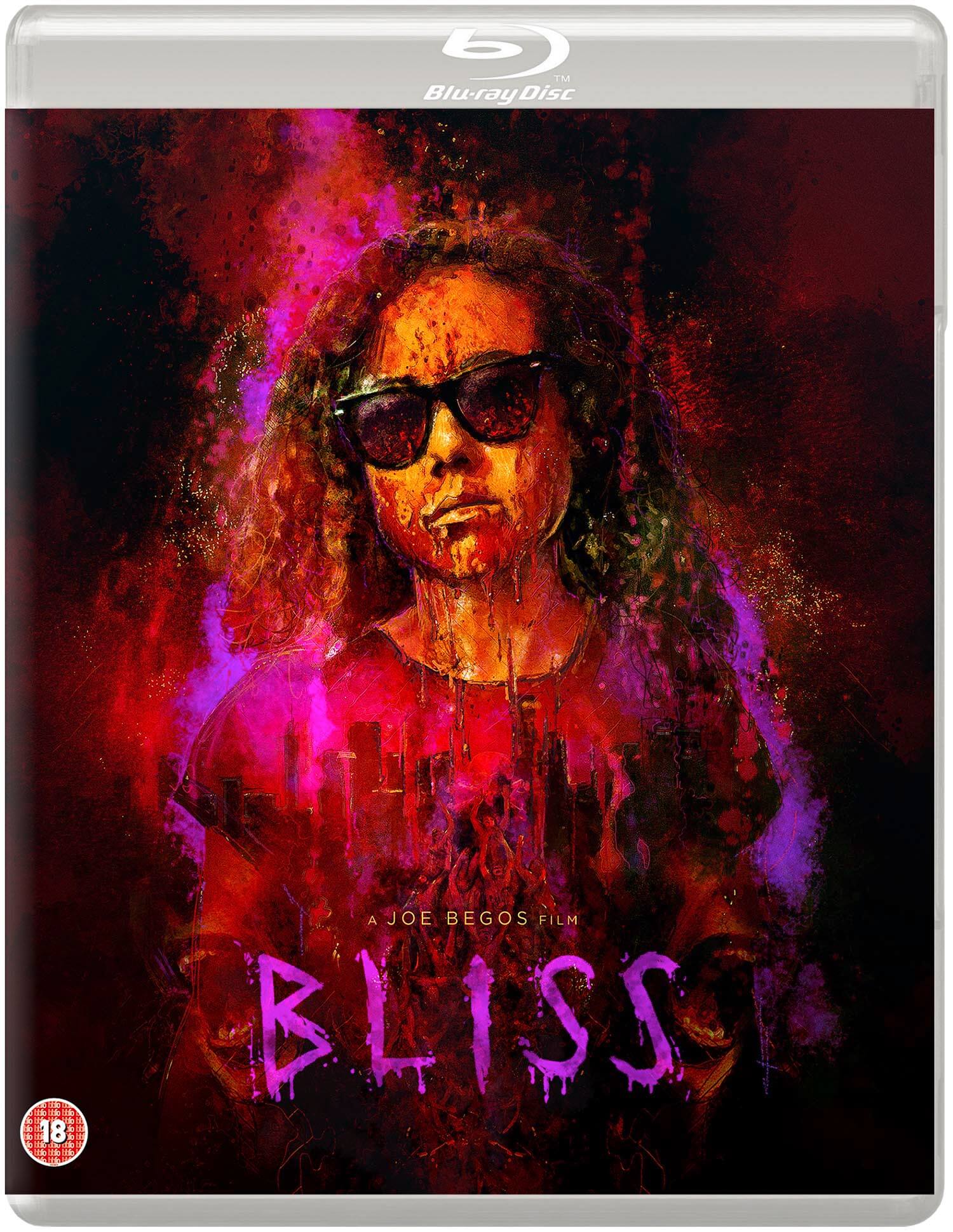
[ENDED] Win BLISS on Blu-ray

We are celebrating the imminent release of Bliss on Blu-ray by teaming up with Eureka and offering you the chance to win one of three gore-soaked discs that we have up for grabs.

For your chance to Bliss on Blu-ray simply answer the following question after watching the trailer…


Dora Madison who plays ‘Dezzy’ gets caught up in a blood-soaked,drug-fuelled and out of control situation trying to escape a creative block but what is her occupation?

(a) Painter

(b) Zookeeper

(c) Astronaut

Email your answers labelled ‘BLISS’ to [email protected] to arrive before 23:59 on February 26th.


From the Press Release:

Struggling through a seemingly endless creative rut, hard-partying and Los-Angeles-based artist Dezzy Donahue (Dora Madison, Friday Night Lights) can’t stop the resulting bad streak of problems, including unpaid rent and professional stagnation. In an effort to combat her tough luck, Dezzy throws caution to the wind, indulges in heavy drugs and rages her nights away. Her kinda/sorta boyfriend, Clive, is concerned while her debauchery-minded friend Courtney and her enigmatic hubby Ronnie keep feeding Dezzy’s darkest urges.

Gradually, though, the party starts to end, and in its place, Dezzy finds herself thirsting for blood and suffering from terrifying visions. Having never been one for moderation or self-control, she’s unable to resist her newfound dangerous impulses. And that’s very bad news for everyone in her life, all of whom are filled with the red liquid she now so desperately craves

STANDARD EDITION SPECIAL FEATURES

  • 1080p presentation of the film on Blu-ray
  • 5.1 DTS-HD MA and uncompressed LPCM 2.0 audio options
  • Optional English subtitles
  • Brand new audio commentary with film historians Kat Ellinger and Samm Deighan (Daughters of Darkness podcast)
  • Audio commentary with director Joe Begos and actress Dora Madison
  • Audio Commentary by director Joe Begos, producer Josh Ethier, and the Russell FX team
  • Deleted Scene
  • Trailer


BLISS, a blood-drenched voyage of drug-fuelled hysteria from director Joe Begos, is OUT NOW on Blu-ray and can be purchased here https://amzn.to/2rAR7od

Terms & Conditions:
Eureka/STARBURST do not accept any responsibility for late or lost entries due to the Internet or email problems. Proof of sending is not proof of receipt. Entrants must supply full details as required on the competition page, and comply with all rules to be eligible for the prizes. No responsibility is accepted for ineligible entries or entries made fraudulently. Unless otherwise stated, the Competition is not open to employees of: (a) the Company; and (b) any third party appointed by the Company to organise and/or manage the Competition; and (c) the Competition sponsor(s). This competition is a game promoted STARBURST. STARBURST’s decision is final in every situation and no correspondence will be entered into. STARBURST reserves the right to cancel the competition at any stage, if deemed necessary in its opinion, and if circumstances arise outside of its control. Entrants must be UK residents and 18 or over. Entrants will be deemed to have accepted these rules and to agree to be bound by them when entering this competition. The winners will be drawn at random from all the correct entries, and only they will be contacted personally. Prize must be taken as stated and cannot be deferred. There will be no cash alternatives. STARBURST routinely adds the email addresses of competition entrants to the regular newsletter, in order to keep entrants informed of upcoming competition opportunities. Details of how to unsubscribe are contained within each newsletter. All information held by STARBURST will not be disclosed to any third parties

LaMonica Garrett | PRIMAL

LaMonica Garrett

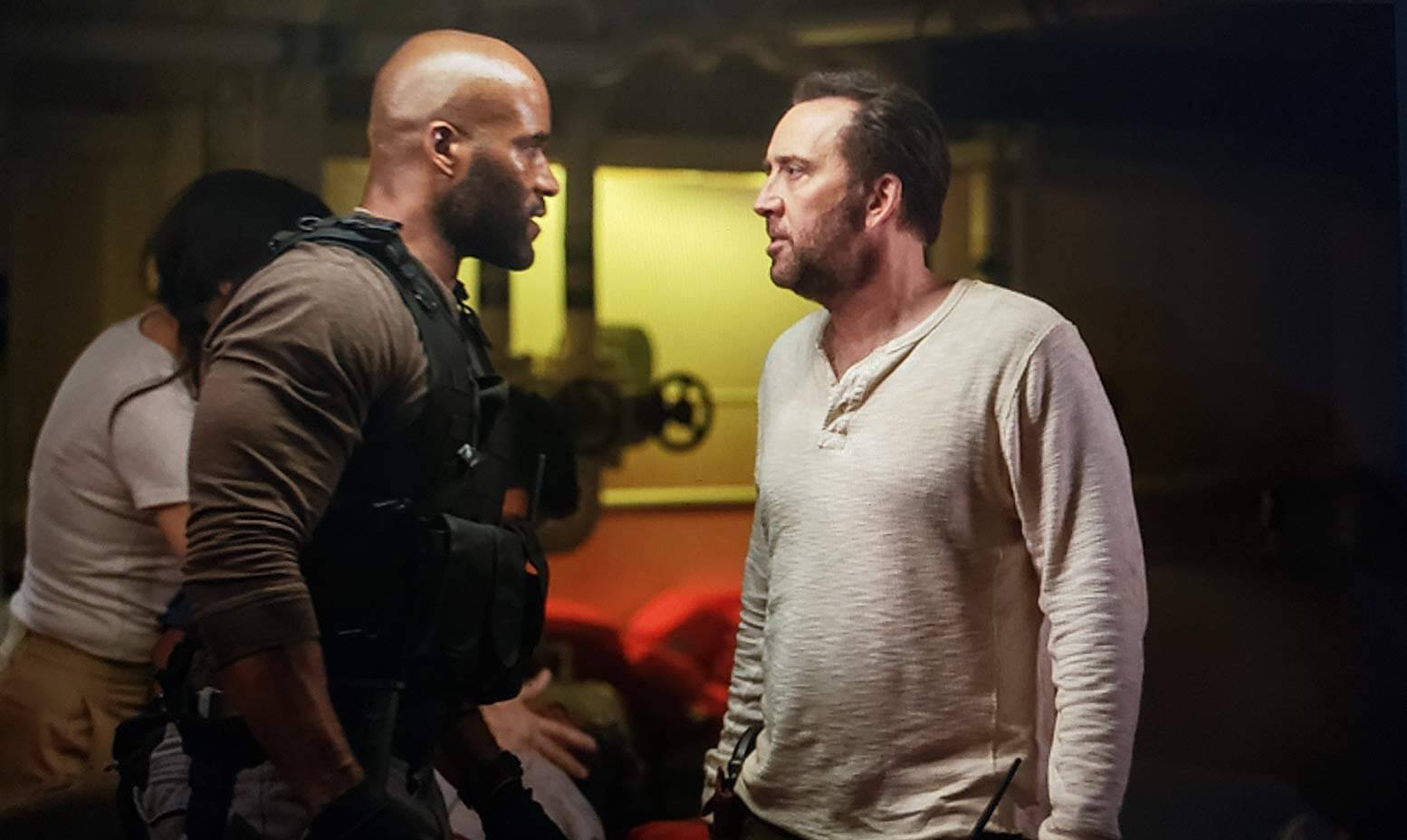
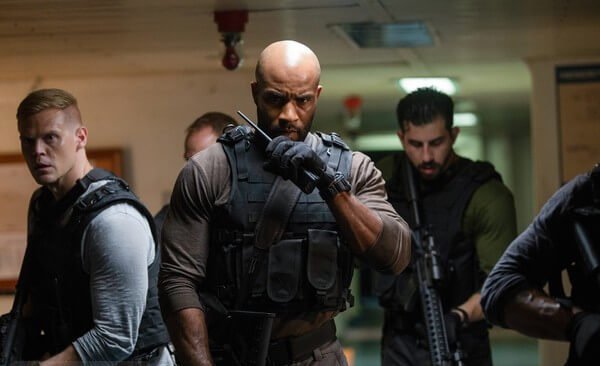
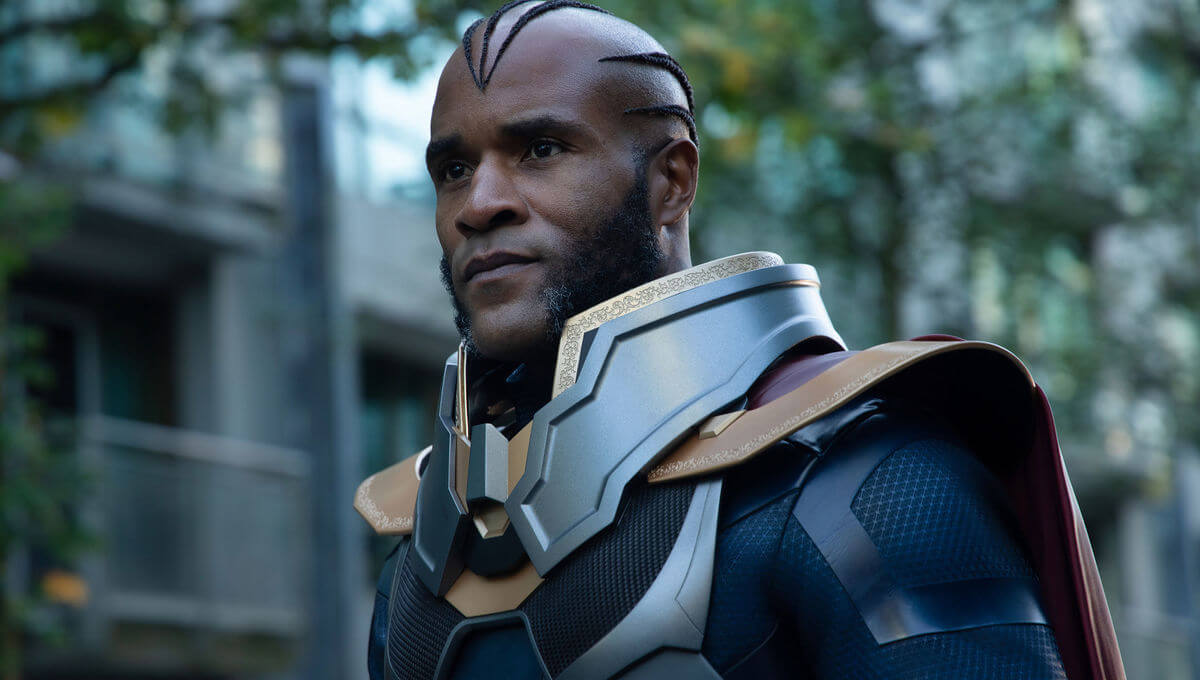
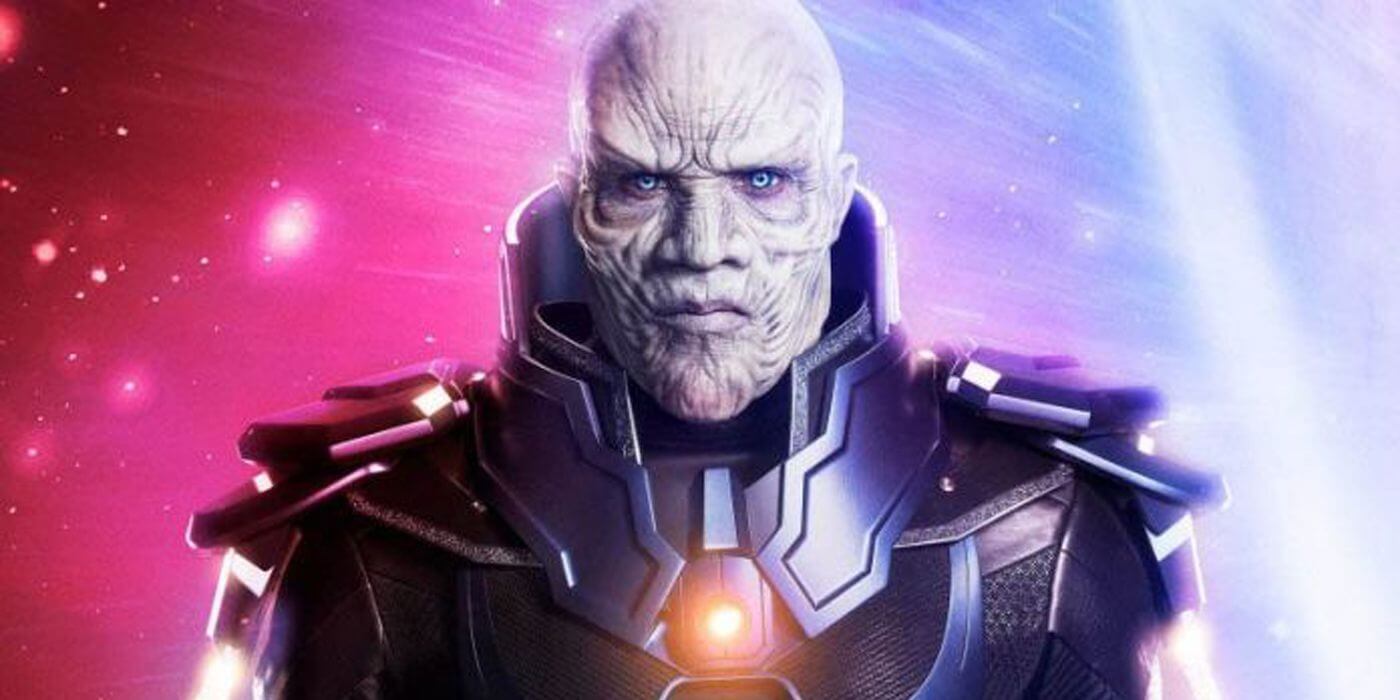
Having impressed many a genre fan with his turn as the Monitor and the Anti-Monitor in The CW’s Arrowverse, up next for LaMonica Garrett is a role opposite Nicolas Cage as wild animals and assassins run amok on a ship in Primal. We caught up with the actor to discuss the classic action feel of Primal, his time involved in the huge Crisis on Infinite Earths crossover event, being a big comic book fan, transitioning from the world of sports to acting, and plenty more.

STARBURST: Primal has the feel of an action movie of yesteryear and is a whole lot of fun. How did you become involved in the film in the first place?

LaMonica Garrett: They had already cast the role I played. They were meant to film maybe six months or a year before they did, and then they brought on board a new director [Nick Powell]. The new director, he saw the people that were cast and they weren’t his people. He wanted to bring his people in, and I had worked with him on another project back in the day. They called me up and offered it to me, and I found out who was involved and I read it. Like you said, it felt like an old school, throwback, ‘90s action film. That’s what I signed up for. It was fun to go out there and work with those guys.

Nic Cage is always going to grab the attention of any movie Nic Cage is in, but as well as yourself there’s names such as Michael Imperioli, Famke Janssen, and Kevin Durand rounding out an impressive ensemble. What was that dynamic like on set?

Whenever you work on location, it’s a fun opportunity to really bond with the cast. We were in Puerto Rico filming, so we didn’t know anyone out there. When you work at home, everyone goes back to their own village and you just go to work and then you take off. In Puerto Rico, we were all we had out there. So after work, we would all go get drinks or have dinner. On our days off we would hang out and go sight-seeing. It was my first time to Puerto Rico. Michael Imperioli had filmed out there a couple of times, and he was showing us around. Nic Cage had filmed out there a couple of times. It was fun. It was a good crew, and we all thoroughly enjoyed each other on and off set.

LaMonica Garrett

You’re pretty front-and-centre for some of Primal’s more intense and brutal moments. How were those more dramatic and tense scenes to be involved in?

I think the location we shot in, it lent itself to that feel of tension. It was a claustrophobic environment. We were on that ship for pretty much the whole time. There were low ceilings, it was hot, it was summertime, it was muggy. That tension was in the air without the cameras being on, so when it came time to shoot we just worked with the environment – and I think that came across well on the day.

Did you have much freedom to put your own spin on the character of Ringer?

They gave me some freedom to play around with it. That’s what was great about Nick Powell. He gave everyone some freedom. It wasn’t like when we shoot I was just going to go and do what I wanted to do. Everything was talked about beforehand. We changed some things, took a couple of things out, just to make it work for who we were and what strengths we were bringing to the table.

Was there anything you particularly went back and watched for inspiration, or did you just go into the film with a clear head?

I just went in like I do with everything – a blank canvas. I tried to let the creative space that we were in take over. I didn’t want to go in with ideas about ways of playing certain things that are my ideas, but they might not be good for the character. I just go in with a blank canvas and try to create from the ground up.

LaMonica Garrett Primal

Before your acting career took off, you were a professional SlamBall player. How did you make the transition from sports and an athletic background to then deciding you wanted to get into acting?

I knew I wanted to get into acting after football was over for me. The NFL didn’t work out for me, so I moved to LA. SlamBall came around, and I still had the competitive bug in me where I wanted to go out and compete athletically. SlamBall came around, I did it, I played at a high level, but in the back of my head I knew I wanted to get into acting. There was a two-episode arc on One Tree Hill where they implemented SlamBall into the season. Joe Manganiello and James Lafferty, they were two SlamBall players on the show. They needed a real SlamBall player to oppose them and be the antagonist on the show. I told the guys, “Look, this is me!” The front office were going to audition established actors to play that role. I told them to let me audition for it, and I got it. I went out to North Carolina to film it, and just being in that environment and seeing television working from the inside, I know that this is what I needed to be doing. That was in 2008. When I flew back to LA, I told them, “I’m finished with SlamBall” and I got into acting classes. From that point on, I’ve just been growing from within the business.

So the spark was already there, just One Tree Hill only further reiterated to you that this is what you wanted to do?

The flame was already lit, the pilot light was there, and that just threw gas everywhere. I knew that this is what I’m supposed to be doing. When I got back to LA, it was no more SlamBall. That was the last SlamBall I played. I got a manager – I’m with the same manager now – and have just been growing since then.

If you could go back to that version of LaMonica in 2008, what advice would you give to him?

I would tell myself not to worry so much about getting the role that I’m auditioning for. When you get the audition, it’s, “I want this role, I want it bad!” Be more concerned about winning over the casting office and just doing a great job in telling that story. Don’t try to give them what you think they want. Tell your version of the story and just be consistent. These casting officers, they’re like the gatekeepers for actors and for work. Once they see you consistently just doing a great job, you might not get that role but they see something in you. I would tell myself, “Don’t worry so much about the role. Worry about just telling the story truthfully and winning over the casting officers.”

LaMonica Garrett

Here in the UK, Crisis on Infinite Earths is soon to be upon us. How much fun was it to suit up and play the Monitor and the Anti-Monitor in that world of comic book characters?

It was amazing. I’m a comic book nerd, I grew up reading comic books and watching tons of animation – DC and Marvel. I’d been auditioning in that office for David Rapaport for years, and I didn’t get it. But that goes back to my point, they kept bringing me in and I’d gotten close to other roles. I believe everything happens for a reason. I’m so glad I didn’t get the other role that I was close to getting and they waited until now to use me. Suiting up? It just kept getting better and better. I didn’t know who I was auditioning for, and then they told me it was the Monitor. The first thing I think is, “Oh, I wonder if they’ll do Crisis?” I’d only signed on for four episodes – for Elseworlds and maybe one after – and then they called us and were just, “Alright, it’s going to be bigger. We want him for next season.” Then Crisis on Infinite Earths was introduced, and it just kept getting bigger and bigger. When I found out I was also playing the Anti-Monitor, I was like, “You guys gotta be kidding me!” My manager always say to never repeat this, but this is one of those jobs that you’d do for free because you’re just fanboying out and just having fun in this space. It’s not often that you get to do a job where you just love everything about it. From the research in the beginning, to the 15-hour days, to sitting in make-up for two-and-a-half hours, I enjoyed everything.

As such a big comic book fan, is there a particular story or arc that you’d say was your all-time personal favourite? And would Crisis be in that conversation?

Crisis is up there. My favourite storyline in comic books is probably Green Lantern: Blackest Night. The magnitude of Crisis for the DC Universe, it changed everything. If you named three of the biggest moments in DC, Crisis is right there at the top. Not just for DC Comics fans or for DC TV fans, but I think for television history – trying to pull something off to this magnitude and doing it. They want decades back, to the shows from the ‘60s, the ‘80s, the ‘90s, and bringing it all into focus right now and integrating all these parts of history with DC TV. It was just a special thing to be a part of.

Once things play out for the Monitor and the Anti-Monitor in Crisis, is any chance we could see you return down the line? Regardless of the fate of these characters, the concept of alternative worlds and varying timelines means nothing is ever quite as final as it may appear…

If they call me in the future, I’d jump through those hoops automatically. In the comic books right now, the New 52 Justice League reintroduced the Monitor and they’ve reintroduced the storyline where the Monitor has a mother now, Perpetua. And then there’s World Forger [the brother of the Monitor]. If they tackle a storyline as big as Crisis for television, who knows where they are two, three, four years from now. If the Monitor comes back to life or the Anti-Monitor’s around, I’d most definitely jump back into this space – and they know that, they know how much fun I had being around this environment.

LaMonica Garrett

From seeing the stars of the Arrowverse in interviews and on social media, and from speaking to a few of them over the past few years, it comes across as if this shared universe has a fun, family feel to its sets. Coming into this world, was it at all daunting or was everybody just welcoming from the get-go?

Yeah, it was a little intimidating when the train is already moving and you’re the last one to jump on board. But the whole community has been open arms. They embraced me like this was my home. Even though I was just passing through, they embraced me. The fandom, the fans, the writers, the actors. From everyone I’ve been around, they’ve all embraced me. I couldn’t have asked for a better experience. Sometimes you walk into one of these situations and they’re closed off and a little cold, and sometimes they embrace you. This time, they just happened to embrace me. It was awesome. That’s why they know that I’d come back whenever they call, should my schedule permit it.

You’ve done a huge comic book event with Crisis on Infinite Earths, you’ve now done an action movie with Nicolas Cage, you’ve had stints on shows like Sons of Anarchy, Designated Survivor, and The Last Ship. Is there a project that stands out as a particular favourite, or is that perhaps an unfair question?

I’ve been living in the moment. When I was on Designated Survivor, that was the best thing ever for me. When I was on The Last Ship, that was amazing. That was like a football/college locker room again, being with those guys in The Last Ship. We just had so much fun. We would go out to San Diego, to the actual naval base and film for the weekend. I’ve been having fun on every job I’ve been on. I just look forward to whatever the next journey and adventure is. I’m sure I’m going to have a ton of fun. But yeah, I’d really like to do more action stuff.

Primal certainly is a great example of how well you can handle the action genre. If there was a dream project for you, would that be something within the action wheelhouse?

It would probably be something like a franchise, like a Bourne Identity-type franchise with layers. Something like John Wick is awesome. Something like that, where it’s movie after movie and it keeps on getting better.

Having played two of the most powerful characters in all of DC Comics, who are key figures in such a truly huge TV crossover, the next few years are going to so often see people think of these characters when they see you or hear your name. Some may see that as a hindrance, some may see that as a privilege. What are your thoughts on that?

If it creates buzz and helps me get more work, if people loved what I did, then I’m all for it. It was brief, it was a lot in a little amount of time, but if you would have told me a year-and-a-half ago that when I left Designated Survivor this would have been the next chapter, I would have been through the roof. A month from now, I might be attached to another big project, and that’s going to get my undivided attention. Like I said, moment to moment, I just embrace everything to its fullest and just enjoy.

Finally, what’s up next for you that you’re able to tell us about right now?

There’s a film, Clemency, that’s out in theaters right now. I’m not sure if it’s coming to the UK, but it’s getting in more theaters out here and it should be nationwide soon. I’m back to the drawing board now. The Arrowverse took up a lot of time, and now I’m back at the beginning and seeing what’s next.

Primal is on VOD February 10th and out on DVD February 17th.

Johannes Roberts | 47 METERS DOWN: UNCAGED

Johannes Roberts

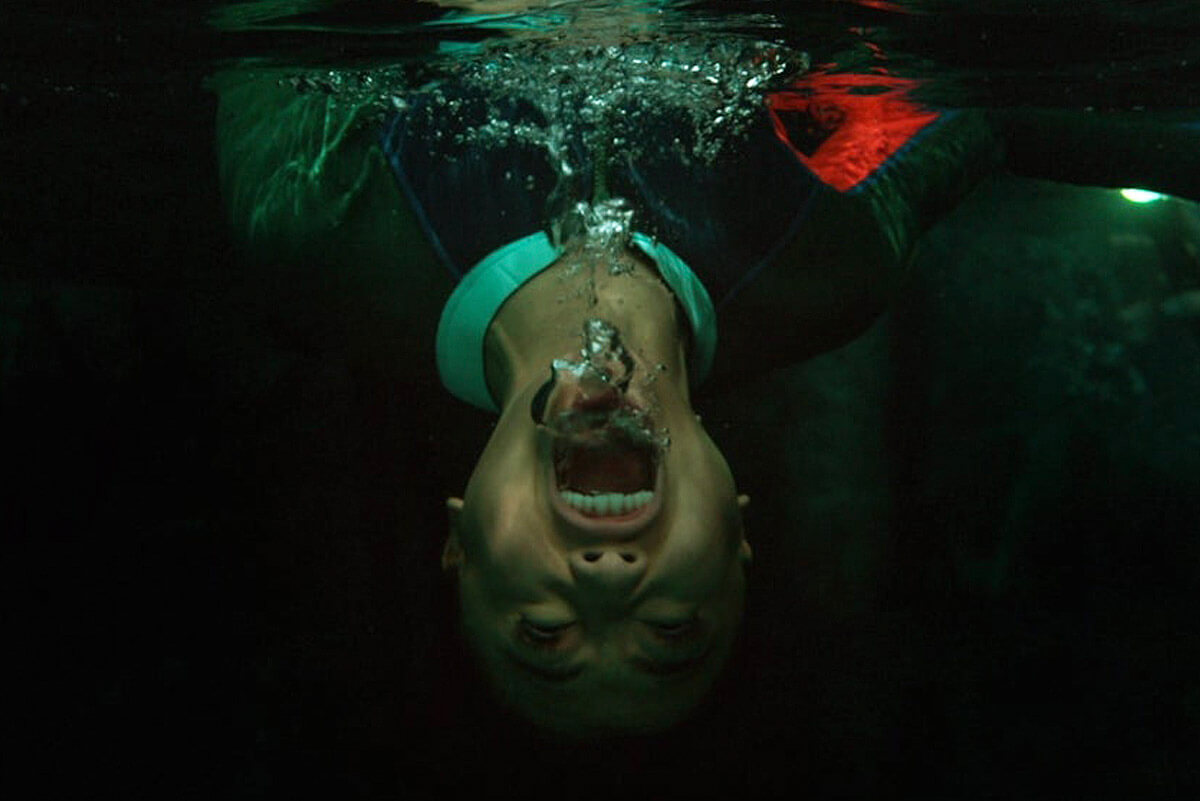
With Johannes Roberts’ 47 Meters Down: Uncaged now available on DVD, we caught up with the filmmaker to discuss the follow-up to his impressive 2017 movie, how tough it can be to sell such a dangerous shoot to actors, how he sought to make a shark movie the like of which had never been seen before, the influence of John Carpenter, and we even try and do some digging on the upcoming Resident Evil reboot that Johannes is directing.

STARBURST: 47 Meters Down: Uncaged seems like a hugely intensive and tense movie to shoot. What was the most challenging aspect of this sequel?

Johannes Roberts: Uncaged was a fucker of a movie to make. It was quite fun, because we knew so much more after doing the first one and we had a bit more money, but it had several big challenges – the first being we had to make that movie in seven months! I think I finished the sound mix two weeks before the film came out in cinemas. During the movie I had a baby, so I was actually directing that movie from the maternity ward at times because we didn’t have time to stop production. We literally set monitors up in the hospital. It was an absolutely insane production. I think we started it in December in the Dominican Republic, and it came out in August. It was just crazy. We had to build a whole underwater city. The timescale on it was insane. I really like filming underwater, it’s a really fun experience, but the tough stuff is all of the stuff on top of the water or in the jungle. It’s a real pain – it’s like doing a Werner Herzog movie. We were having to go through the bloody jungle to film this movie, and we got caught in really bad storms. That was really tough. We built that whole underwater Mayan city. [Production designer] David Bryan did an amazing job.

When they said, “Would you want to do a second one?”, I really wanted to press things further than had ever been done before. To do this as The Descent underwater, to do this underwater city, to do all this cave diving stuff, it hadn’t really been done. And that was tough. You’ve got four actresses actually cave diving, which is one of the most dangerous sports you can do. I don’t think there is anything more dangerous than cave diving. Even if it’s in a tank, they are literally doing cave diving. If you get caught down there, you’re in real trouble. Trying to record dialogue, you’ve got two cameras, you’ve got safety divers, you’ve got 20 people down there. It was fucking hard to just work out how to even film these tunnels. It was a pretty full-on thing. We had just an amazing crew – like Mark [Silk], who shot the first movie, and Bernie [Prentice] the gaffer, the entire camera team – and they just made things easier for me. Technically, nothing like this had been done before. It was cool, but I don’t think I’d necessarily want to do it again.

We couldn’t think of anything worse. When it came to assembling your cast, how hard was it to sell the film to an actor? It certainly doesn’t sound like an easy day’s work…  

The younger ones were by and large fine. But yeah, you lose 50% of actors before you even start because they’re like, “No, no, I’m not doing that.” I’d been wanting to work with Sophie [Nelisse] for a long time as I’m a big fan of hers. The others, we auditioned. We got a lot of tapes. Some of the things they had to do… the cave stuff was fucking scary, and the stuff with taking their masks off. I’m an experienced diver, but that’s a pretty full-on and terrifying thing. The ocean stuff at the end with the submarine, we actually shot that for real initially. That was at the top of the shoot with Sophie and Corinne [Foxx]. They were having to bang on the glass out in the ocean, without any oxygen, and we got caught in a storm. In the end, we shot for a couple of days but then I had to scrap it and we re-did it like how we did it. I wouldn’t have done what they did. They’d never done anything like that before, so they didn’t know what they were getting in to. That was pretty scary. It’s actually the older people, like John [Corbett]. I love John, he’s the nicest guy in the world, but he fucking hated being under the water. It’s always the older people, like maybe they know that you can die here. Any chance John could not be underwater, he would definitely take. By the end of it, the girls were just blasting through it. But yeah, you don’t necessarily go, “Oh fuck, I really wanna do that movie!”

47 Meters Down: Uncaged

What were the major lessons you learned from the first movie that you could implement here?

The lesson I should’ve learnt is don’t do it again! Obviously I didn’t, and I did it again. We learnt so much in terms of ways of filming and lighting. For instance, Claire [Holt] and Mandy [Moore]. Claire had the blue mask and Mandy had a clear mask in the first movie. We learnt that the blue mask actually really makes it super hard to light and it’s very unflattering on the skin. I learnt a lot from the second one in terms of shooting with four people is a very dangerous thing. I would’ve liked, now in hindsight, to differentiate them even more than I did. With the first movie, because there was only two people and they were always separated, you knew you were either with Mandy or Claire and it didn’t matter whether you could see their faces or understand their voices. In hindsight, I found it’s tricky with this one in that you have to almost take the four girls as a single entity and be worried about all of them as a single entity until the end when they separate. You learn different things and you move forward, and then you step back because you’re trying different things – like trying more people underwater and then realising that, “Okay, that’s actually pretty fucking tricky to get different identities in there”.

Both 47 Meters Down movies have been largely well-received, but there’s so often a stigma attached to the shark movie subgenre. For every good shark film, there are so many awful ones. As a filmmaker, how was it to explain to people that you were making a shark movie without them immediately attaching that stigma to you?

We got that a bit on the first one, and then the first one just took off. That silenced people. I remember at the beginning of the year, if you’d have said which would be the highest grossing British movie of the year, you wouldn’t put your money on something called 47 Meters Down over Trainspotting 2. But we made more money than Trainspotting 2. It became the biggest independent movie of that year. That just silenced people on it, so when we were doing the second one, I didn’t really get much of that at all.

47 meters down uncaged

The sharks in this movie are largely different to anything we’ve seen before, with them being battle-scarred and having been forced to adapt to their environment. Is there anything particular you used as inspiration for these creatures?

With this one, we were playing around a lot. I had done a standard shark movie with the first one and I just wanted to try something a bit different – in that shark movies tend to always be the shark is so quick, it’s frantic, you’re like, “What the fuck is going on?” Because these people are all trapped down there, I wanted to do a John Carpenter movie with sharks. I wanted to do Halloween with sharks. The shark comes down a corridor slowly towards you and there’s nowhere you can go, you can’t get away. I was having fun with that and then really gnarling up the sharks. I based them on a mixture of Greenland sharks and great whites, and I came up with this new species of shark that’s evolved in these caves. I really had fun giving them their character and then shooting them in a very different way to what I had ever seen done in a shark movie. It was basically doing a slasher movie with sharks. Things like Halloween and Christine. For me, I kind of wanted to have the sequences where you see the shark before the person. It’s just behind them, it’s just gliding along. I wanted to have these sequences of it coming down corridors and there’s nowhere that you can go. I was just having fun with a Michael Myers shark.

When we last spoke to you during Strangers: Prey at Night’s release, you mentioned how you had a wish to one day tackle a Christine remake. Is that something you’ve put any more feelers out there for?

I’ll always try and persuade someone to let me do that. As I’m sitting here in my office, I have an original Christine advert from a London newspaper, and somebody’s bought me a plastic Christine assemble kit which I’ve yet to make. It’s one of those movies that I’d love to remake, and equally I probably don’t ever want to do. I love the movie so much, and it probably should be left alone. Let someone else fuck it up. I don’t know. If I could get hold of it, then maybe one day.

47 meters down uncaged

There have been two 47 Meters Down movies to date, but are there any plans in place to push forward with a third film?

We haven’t officially announced a third, but we’ve now crossed over $110 million worldwide. There will definitely be a third. I think I personally, as a director, have taken my 47 Meters Down journey to its completion, but yes, we are definitely in talks at the moment for a third one.

You’re on board to direct the upcoming reboot for the big-screen Resident Evil franchise. While you’re obviously sworn to secrecy on that project right now, is there anything you can tell us about the film?

I’m sitting in front of the script at the moment. I think that we’ll be announcing the cast pretty soon – in the next couple of weeks. We’re getting there. It’s an exciting time. It’s a really fucking great project. I don’t know what I’m allowed to say or not allowed to say. The aim for me is to return to the very classic Resident Evil tone and style. This should be a very, very scary movie.

And with that, our interview with Johannes came to an end… but not before he gave us some ‘off the record’ Resident Evil info. While we can’t go into specifics, it sounds as if franchise fans are in for an absolute treat.

47 Meters Down: Uncaged is out now on DVD – and you can find our review here.

Re-Infected: CABIN FEVER

cabin fever

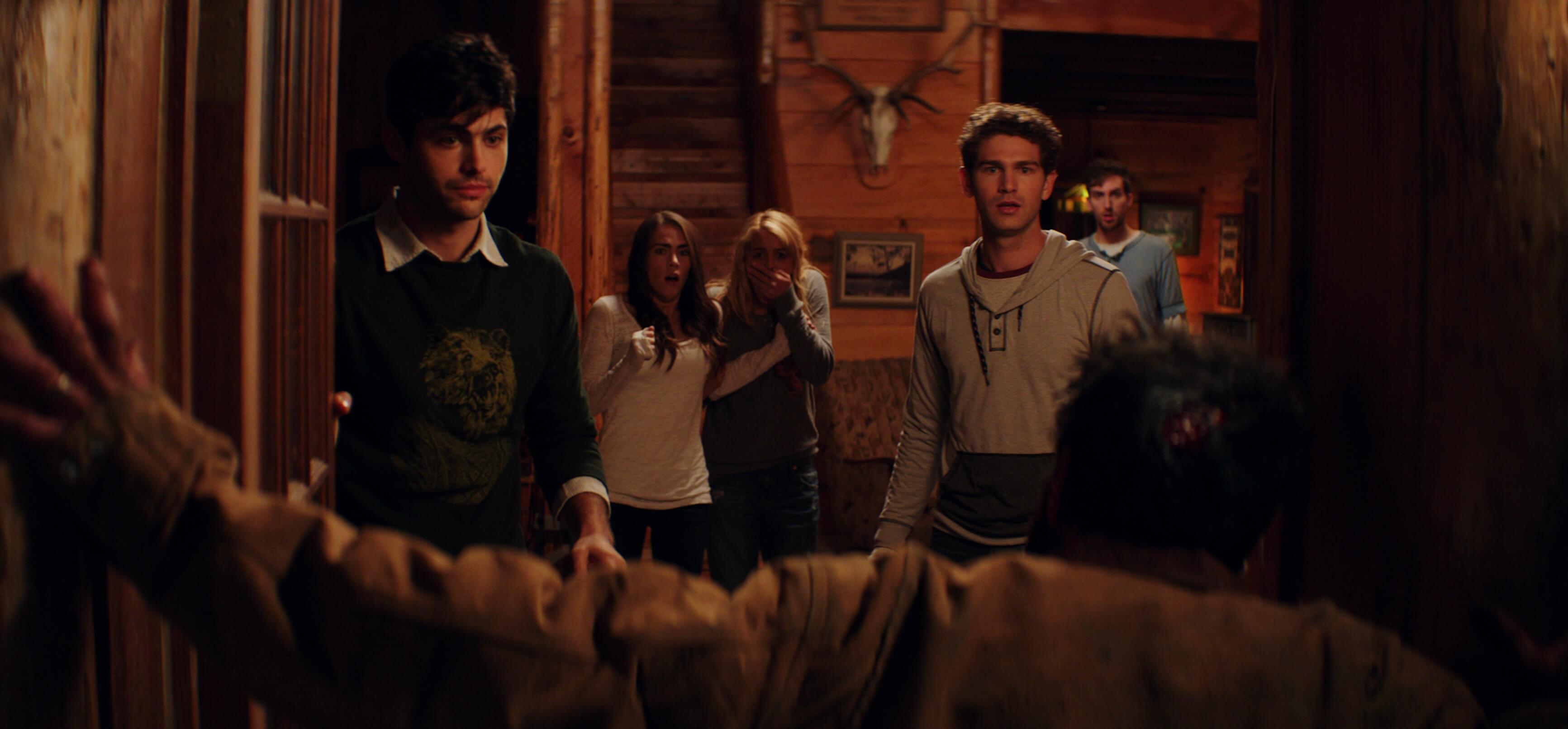
The 2002 film Cabin Fever was not only Eli Roth’s directorial debut, but provided a shot in the arm for the genre in the same way Scream and later The Cabin in the Woods did. Although not as overly knowing as those films, it played with the tropes of horror films and was highly entertaining. It was so successful, a string of sequels followed. Originally, there was going to be a movie shot back-to-back with the third in the series, Cabin Fever: Patient Zero, with the virus breaking out on a cruise ship. This wasn’t to be, however, and the decision was made to go back to the source and remake the original. With Roth on board as executive producer, director Travis Zariwny (billed as the more exciting Travis Z) would undertake the daunting and seemingly redundant task of updating a movie that was just over fifteen years old.

The 2016 film follows the original almost beat-for-beat. From the opening moments of the hermit hillbilly finding his beloved dog, Pancakes, dead and being sprayed with infected viscera, everything feels familiar. Fortunately, the cinematography by Gavin Kelly makes the most of the luscious location and increased budget to allow for some impressive aerial work.

Five college friends are off to celebrate spring break by renting a cottage in the middle of the woods. Yes, we know it’s such an original premise, right? There’s a harbinger of things to come when they stop at a gas station and one of them is bitten by a creepy kid in a handmade bunny mask. Once they get to the cabin – which is much swisher than the one in Roth’s version, and is more of a lake house – they make themselves at home and Bert (Dustin Ingram) decides to go shooting in the woods. Being a video game addict, he’s already voiced his concern about not being able to play online for a whole week, so it’s the nearest he has to Call of Duty. It’s during this macho time that he comes across the hermit, who is already suffering heavily from the flesh-eating virus he picked up from his dog. Promising to get help, he dashes back to the group. He naturally neglects to mention anything about him. This comes back to cause an even bigger problem when the hermit turns up at the cabin demanding help. Recognising Bert, he freaks out and tries to steal their truck. To get rid of him, they set him on fire. A perfectly rational reaction.

The following day, the whole crew are wracked with remorse, but are unable to report it or get help as their car has been trashed during the melee. Worst still, one of the girls has started being very ill…

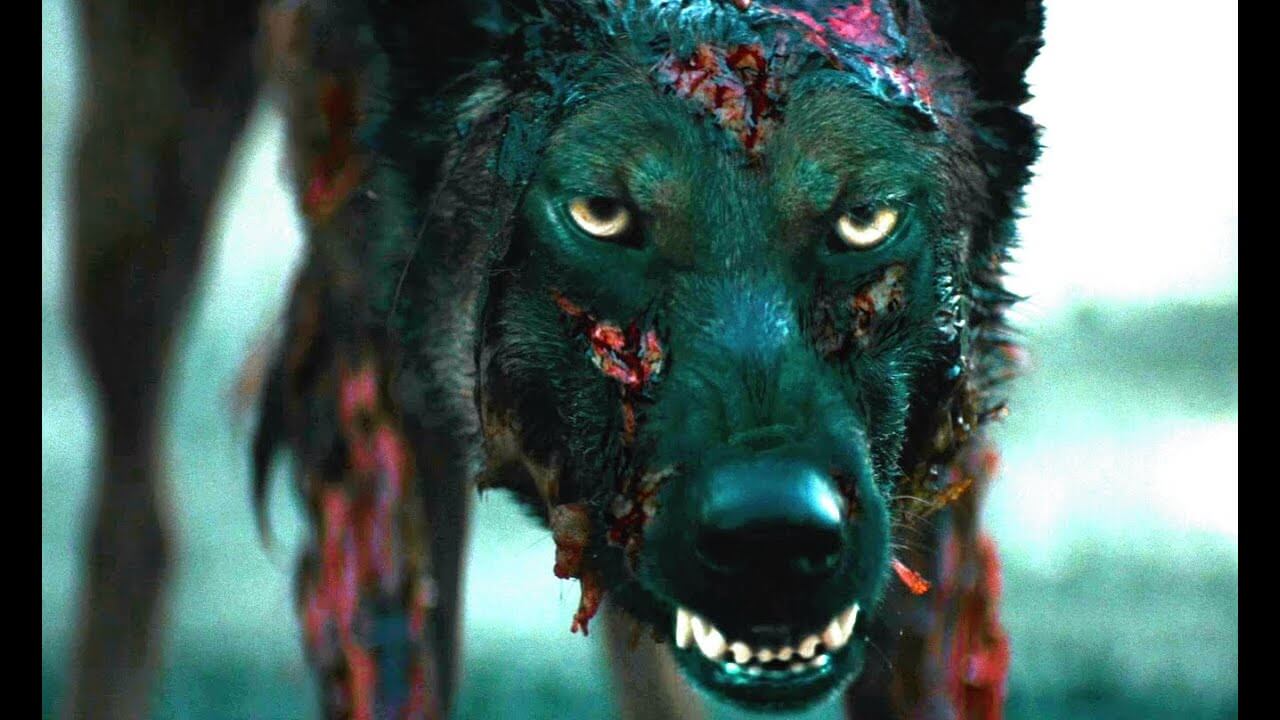
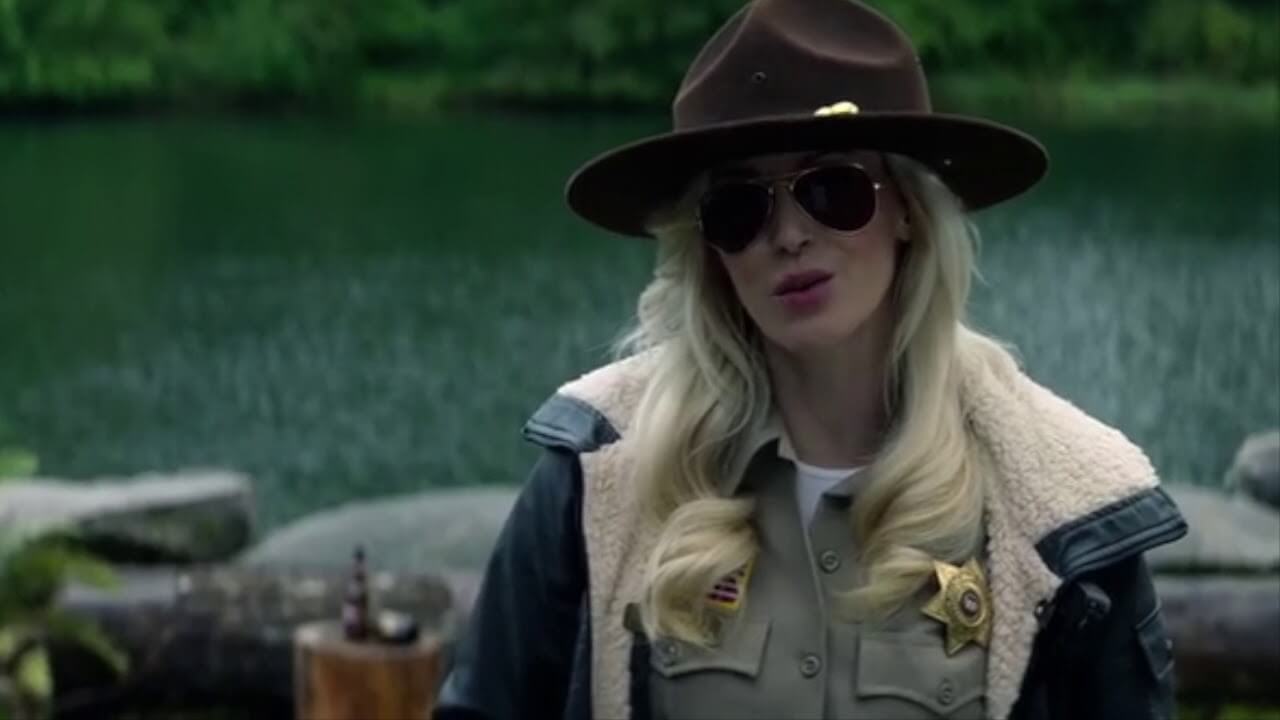
There’s no getting around it, the response to the remake was largely negative. This was possibly caused by the fan’s love of Roth’s original and the growing disapproval of remakes in general. There’s a lot to recommend in Travis Z’s update, however. The changes that are made – particularly in the character of Deputy Sheriff Winston – do improve the film. In Roth’s movie, he’s a goofy young lad who doesn’t appear old enough to grow a moustache, while in the 2016 version, the character is an attractive woman with a scar under her eye who takes a shine to one of the lads. This certainly makes the lines about “coming over to party” seem a bit sexier. The acting in general is of a much higher standard too. The gore effects are quite similar, although there’s certainly an improvement when it comes to the ‘rabid’ dog that terrorises the house, too. The hound is made up to look a lot more threatening and diseased, and the aftermath of one encounter is particularly gruesome.

Speaking several years after the release of the remake, director Travis Z said: “The Internet that killed me, honestly. That’s the real lesson I learned: to never read the Internet. The hardest lesson I learned and I learned it by myself, was to totally trust myself and my art, be happy in the moment, and make movies because I love it and not because of what viewers might think or say.” Obviously something he had to deal with the poor reviews and online badmouthing. “I responded to one YouTuber once who bashed my movie and then apologised and said that he really liked it, but he just did that for likes,” he said. “He completely thrashed the film because that’s what the audience likes.” It was a baptism of fire for the director, who had only made one feature (Scavengers, 2013) and several shorts before tackling Cabin Fever. “Before I became a director, I read all the blogs and all the stuff – as a fan you do that – but to make a film and just have it,” he revealed. “Cabin Fever in particular, have the audiences just jump on this crazy-train of hate was incredible to me. It validated a lot of things for me.

While the original version was peppered with horror film references (particularly in the incidental music choices, it does miss the use of David Hess’ The Road Leads to Nowhere – Wait for the Rain from The Last House on the Left as a driving tune), the remake plays it much more straight. What it loses in nods to the audience, it makes up in jump scares and a palpable feeling of dread between the characters as they realise the severity of the infection. One thing that definitely isn’t in the remake is humour. This is played dead straight and works better for it. It doesn’t take anything away from Roth’s original, and the outcome for some of the characters is completely different, so there’s still some surprises to be had if you’re a fan of that one.

You can catch the 2016 CABIN FEVER on Horror Channel on February 7th. Tune in via Sky 317, Virgin 149, Freeview 70, Freesat 138.

Robert Eggers | THE LIGHTHOUSE

Lighthouse

It was four years ago that Robert Eggers burst onto the indie film scene with his directorial debut and supernatural period-horror, The Witch. Now back with one of the year’s best and weirdest films, The Lighthouse cements Eggers’ place alongside Ari Aster and Jordan Peele as one of this generation’s great horror directors. A dizzying tale of supernatural horror and madness, The Lighthouse follows two lighthouse keepers in 1890s New England during a four-week stay tending to the isolated island’s beacon. Thomas and Ephraim, played by the ever-excellent Willem Dafoe and Robert Pattinson, steadily descend into a special brand of paranoid, sex-crazed and booze-fuelled cabin fever. Eggers’ unmatched attention to detail and uncompromised vision make for a sensory and psychological trip you’re unlikely to forget, for better or for worse. On an appropriately cold, grey and drizzly London morning, STARBURST sat down with the director to discuss the making of his sophomore feature…

STARBURST: We read that your idea for this film started out simply as: ‘a ghost story in a lighthouse’. Can you tell us about the development from that to the finalised film? 

Robert Eggers: Well, that was my brother’s idea and that just, for me, sort of spawned the visual atmosphere of the movie. You know, the black and white 35-millimetre, the Guernsey jumpers, the whole thing, and you learn more and it becomes more specific as you move forward. But more or less, I saw it like that, and then it was just about figuring out, “Well, what’s the story?” So we start reading about ghost stories and lighthouses, and lighthouse tragedies, and around day two I found the story of Smalls Lighthouse in Wales from 1801 – it was about two lighthouse keepers, both are named Thomas, one is older and one younger, and they get marooned in their lighthouse station. And the old one dies, the young one goes mad and basically, that seemed like a good story. And to some degree, I didn’t take it any further than that!

Do you think that the ghost’s presence still exists in that story? 

I’m more interested in demons and my brother’s more interested in ghosts. And I think that some of the mermaid, and some other elements, are maybe more like demons than ghosts, but there are some things that are shared between the two. And there’s a lot of very serious occultists who, in that time when spiritualism was very popular, were going around saying that what these spiritualists were doing was really dangerous, because they thought that they were talking to the ghosts of their dead loved ones, when really they were conjuring demons who are pretending to be ghosts. So, there’s some nerdy information for the audience [laughs].

As mentioned, you co-wrote this with your brother Max. How did collaborating on a screenplay compare to writing it yourself, like you did with 2015’s The Witch

They’re both satisfying in different ways. Right now, I’m really enjoying having a co-writer. I’ve had an incredibly fun time with my brother, and now I’m working with this Icelandic novelist and poet Sjón, which is also incredibly fun, but I do look forward to one day writing something by myself again. But the great thing about working with a collaborator is that you’re just constantly boosting the other person. You know, you’ll get this scene, and you’re like, what if we just tweak it like this, or like that. That’s exciting, and it creates a kind of joy that I don’t quite know of otherwise.

You’ve also often talked about how much you love the research aspect of pre-production, learning about the folklore behind settings, et cetera. Do you think that when you thoroughly research your films, is that more out of a desire of personal satisfaction, or do you believe it works to heighten the story?

For me, there is no story without the research. I mean, I truly love research. If I was not making creative works of some kind, I would probably be an archaeologist, and I’d be happy to just be digging around for artefacts and reading lots of books. I truly do enjoy it, and that doesn’t mean that I think you need to do all this research to create a believable world. You know, Bram Stoker’s Dracula, or Peter Brook’s King Lear, they create their own worlds, and that’s great. But I do think that for me, the atmosphere is an accumulation of details and when I’m doing research, then it’s easier for me to create a richer world than if I had pulled those details out of my imagination. That’s the hope, anyway.

Is that part of why you decided to build your lighthouse from scratch? 

Well, we partially just couldn’t find one that worked for the story, and that was accessible. If we could have helicoptered onto an island in Maine every day, we could have found a great lighthouse that worked for us. But aside from the practicality, it also gives you much more control as a filmmaker, like in deciding where to place my camera, if I just build everything accordingly.

And speaking of the camera, you used camera lenses from 1912 and from the 1930s which give the image a very distinctive look, as well having the film in black-and-white and in a vintage aspect ratio. At what stage in the creative process were you like, “Right, this is how I want it framed“?

I mean again, when my brother said, “ghost story in a lighthouse“, I pictured a boxy aspect ratio and the black-and-white 35-millimetre. The look evolved and, you know, I originally thought we would shoot the film in 1.33:1, but we shot the film in 1.19:1 which is an early aspect ratio that’s even boxier. That was sort of a suggestion that Jarin [Blaschke], my Director of Photography made, like half-jokingly over some bourbon one night and I thought, “actually, that’s a great idea!” I mean, this is many, many years before we shot the movie. This was something that we talked about often. So it was quite satisfying that we actually made the movie, because we were always fantasising about what it would be. And over the years, exactly what the black-and-white look would be, and how much grain, how much contrast, and so on and so forth, was something that was changing as we spoke, and when it came down to what equipment, what film stock, what lenses were available for us to use, then that made the final decisions for us.

In previous interviews, you’ve said that you and your DP created a ‘camera language’. Could you elaborate a little on that? 

Film 101 suggests traditional coverage. You shoot the scene in a wide shot, and then you go in for your medium shot and your close-ups, and if you need any inserts, you do that. That’s sort of the traditional filmmaking, and it’s certainly how most television shows are shot. If I wanted to photograph our conversation right now, I would want to think about whose point of view I’m telling the story from, and how I’m going to place the camera to convey that. And my DP and I were also looking for an economy of shots, so that every cut point has a purpose. Thinking about what the next sequential image would be and ensuring it had visual impact against the next shot. I don’t know if that’s clear, but we were designing our shots carefully to convey certain things; for example, we wouldn’t show a wide landscape unless the character whose perspective it’s from felt small psychologically. It can be a little precious when you talk about the intentions to find these things, and they’re to be felt, not necessarily something that would make someone say “Oh, blah blah blah, what our intentions are…” but there’s a feeling there.

It works subconsciously for the viewer. 

That’s the hope.

I understand that Robert Pattinson and Willem Dafoe approached you, rather than the other way around, wanting to collaborate on one of your projects. Once you had decided The Lighthouse was going to be your sophomore feature, how did you know those two would work well together?

The working together was a hunch, a hope, and a prayer. I did feel somewhat confident, having met both of them, that it would work out. And, I mean, who else could play these roles?

Well now that we’ve seen them in action, I’m tempted to say no one!

Exactly.

Of course, Dafoe is more theatre-trained whereas Pattinson has done a lot of indie, auteur cinema. Did they require very different directing styles?

Yeah, I mean, they both require different things, and that’s just fine. But their characters are very different and actually, their acting styles and directing requirements sort of mirrored their characters. I don’t know how much of that is my doing a good job casting, or their subconscious behaviour, but it worked out.

With those two stuck in a lighthouse together with no escape, there’s an exploration of toxic masculinity – even though, of course, the term didn’t exist then – set against extremely powerful, feminine forces like the sea and the mermaid. Can you talk a little about the tension that creates?

Looking at this poster here… [we are sat on opposite sofas, a huge film poster at our side picturing the roaring ocean and a lone lighthouse disappearing in the storm], with this tiny phallus surrounded by the sea, you know he doesn’t stand a chance. I think that one doesn’t – or I don’t – write intending a specific message, but things come to the surface as you’re writing. Given the zeitgeist, and also given the fact that it’s just two guys in a giant phallus, it’s only ever going to be hyper-masculine bad stuff. If you’re trying to create something inspired by the notion of a ghost story in a lighthouse, it’s not going to be the story of brotherly companionship and heroism; it’s going to be the dark side of that behaviour. For whatever reason, I like exploring the dark side of humanity [laughs]!

The Lighthouse and The Witch deal with ideas of feminine power in very different ways. Do you consider both films to be in conversations with one another?

I think that this becomes a sort of masculine companion piece to The Witch. But I think it’s interesting because, you know, the sea is the sea and she is what she is. The mermaid is weird because she literally begins as an object, and then this object of fantasy gains more power than Rob, then it becomes all-encompassing to him. How does that speak in conversation with The Witch, I don’t know, but I’m sure someone smarter than myself will have something clever to say.

The design of the mermaid is also pretty unusual; what influences did you draw upon for her design? [If you’ve yet to see the film, think your usual fishtail with a giant vagina in the middle]

So, not always but generally, mermaids in the Middle Ages and the Renaissance had a split tail, like the mermaid on the Starbucks cup. So that, with that design, the mermaid would be able to serve the function that her male fantasisers would thrust upon her. And the Victorians unsurprisingly sealed up the mermaid, but we needed to find out how mermaids could make more merpeople, so we based her genitals on shark genitals. And they’re both clearly not human, yet also look slightly human.

You referred to the lighthouse itself as phallic, but the characters often speak of the light as a feminine presence, and Dafoe’s character even calls it a ‘she’ and speaks of the light as though it were his wife or lover. What lies behind that duality?

I think that Dafoe, in his 19th-century mindset, would have to refer to the light as a ‘she’ for it to work in his worldview. For him to express that love for the lighthouse, he embraces a specific gender binary that works with how he sees the world. But, to show more of my hand than I usually do, I think of the light as more hermaphroditic than female.

Finally, as we’re wrapping up, can you say anything about your plans for future projects?

Yeah well, it was leaked that I’m making a Viking revenge saga. So, you know, anything can still happen. If you want to see that happen, think happy thoughts for me. I hope it happens.

Now it’s been leaked, the pressure’s on.

The pressure is on!

THE LIGHTHOUSE is in UK cinemas from January 31st.

Colin Stetson | COLOR OUT OF SPACE

stetson

Composer and musician Colin Stetson’s score for Ari Aster’s 2017 film Hereditary made his name as someone who can create beautiful, yet extraordinarily disconcerting film music. However, Stetson’s work for director Richard Stanley’s comeback, the brand-new adaptation of H.P. Lovecraft’s Color Out of Space, puts a bow on that name and firmly seals the deal. With the film’s visual palette requiring the composer to really stretch and create a soundscape which does a lot of heavy lifting, Stetson’s music is readily up to the task, and stands on its own as a terrifying journey. We spoke with Stetson about Color Out of Space, his work with Ari Aster on Hereditary, as well as the upcoming Adult Swim adaptation of Junji Ito’s manga Uzumaki

STARBURST: Color Out of Space is finally out, as well as your score; how are you feeling about the whole situation?

Colin Stetson: Well, I feel great. It was an incredibly fun project to work on and to make. It’s always really exciting when these things come full circle. I delivered the music that first week of August and so, by this time, I’ve been so removed from it, that it is really lovely to hear all the bits and pieces that are being played and be inundated with that world again, after so many months of me apart from it. So, it’s extremely fun and exciting.

How early in the process did you come in?

Very late in the process, actually. I remember for Hereditary, I was the first person they’d spoken with, so I was in the mix for three years and had started writing music for Ari Aster off the script, probably a year before it premiered at Sundance. This one, I started writing and was done, I would say, within two months.

The movie played at TIFF in early September, so if you delivered it in early August, that is very late in the process.

Yeah, I was brought on right around June, and so just dove in, and hit the ground running, as they say.

How familiar were you with the Lovecraft story before you started working on the film?

I was not familiar with the Lovecraft story, specifically. I had heard that Richard [Stanley] was coming back. To be entirely honest, they had me at Richard is coming back, but the fact that he was doing a Lovecraft story – and one that was very near and dear to his heart, as it was one of the stories that his mother had been telling him as bedtime stories as he was growing up – and then, to top that off with it being Spectravision? I had been fans of what they had done with Mandy, and then getting a chance to work on something that that Nicolas Cage had done was also another ‘can’t pass on it’ opportunity.

I had been just in complete fascination of him and what he’s capable of bringing to the screen. I’ve watched Leaving Las Vegas dozens of times, and had been so inspired by his craft, so I was excited on quite a few fronts.

Watching the film, so much of the Lovecraftian aspect of it is very much that your imagination has to do a lot of work, as part of that. A score always helps to direct the viewer, in terms of emotions and things like that, but your score in this particular film has a lot of directing people to do, because it is a color, it’s almost like a synesthesia you’re having to create.

That’s the word I was looking for! Ding-ding-ding! When I when I first came in on it, Richard’s initial, broad, sweeping question posed to me was something along the lines of, “What exactly does a hyper advanced alien life-form that manifest themselves as a spectrum of light, in a color that does not exist in our reality – what does that sound like?” I love starting from places like that; from big, broad, ridiculous questions like that. So immediately, the task was to not only identify that and to define that, but also then to identify and define the theme: the overall aesthetic and mood for the hapless protagonists, whose lives are going to be upended and altered in every way, mutated by that alien, and how then to take those two things, and merge them, with one to infiltrate and inundate the other over the course of the film, and do so in a way that’s got to be kind of Lovecraftian: hallucinatory, surprising, and unexpected at every turn.

It was actually the most fun, ‘cause all these things are always a puzzle for me. When you enter into starting to score a film, all the pieces of the puzzle – the things that need to be figured out –  it’s all a very simple equation. You know where you’re starting, you know where you’re ending, you got your point A and your point B, and you know the devices that are there to be utilised to get from one to the other, and the rest is just going and painting.

It’s interesting, because when you put it in terms of the colours and the sound and communication, we immediately flash to that end scene of Close Encounters of the Third Kind, but almost writ large across an entire film.

Thank you. I guess it’s one of the challenges, whenever you’re trying to do something that are there already. There are already monster movies, there are already horror films, there are already alien invasion, first contact movies, so you never want to really think about that and use archetypes. Beforehand, for this, I thought, if there is anything that’s using an archetypal structure, that I would need to find something akin to a Jaws moment. So, the sound that comes in as Jack is walking in the hallway when the colour is just about to land is, I guess, the colour theme. I actually wrote that hook right when I found out that this movie was being made. I was in the bathtub and I read about them making that movie, and then I was downstairs later on that day, and I was like, “You know, what this is probably how that would sound.” Then, later on, I ended up being able to actually take that thing that I wrote and use it as the theme for the colour, which is pretty rad.

With Hereditary, and now with Color Out of Space, those pictures have gotten like a wider release than some of the films you’ve scored in in the past. It seems interesting, because Hereditary is a horror movie, Color Out of Space is a horror movie, and the upcoming Uzumaki anime is very much a horror story, but in the scoring work you’ve done prior to this, there’s drama and there’s westerns. How did you come to horror? Was it with an interest in it, or is it just the projects themselves, with the script and the story that attracts you to these films?

I would have to say, for sure, the latter. In my case, as a consumer of film and music, it is roughly the same as my output as a performer and composer. I don’t have any particular bent. I would not call myself like a horrorphile or something, but I’ve been tapped to do mostly darker-themed pictures – thrillers and whatnot – but not exclusively, and that’s been really good. I was really I was very happy to be able to follow Hereditary up with something like The First, which unfortunately just had its one season and got cancelled, but it was a very fun show to work on and offered me the opportunity to flex a lot of different muscles, whereas with Hereditary, I took a route of avoiding recognisable theme, and melody, and convention. The First was something that really needed things in an epic, grand scope and so that something that was a lot of fun.

I don’t gravitate towards horror, per se, and Ari tapped me for Hereditary not because of the horror element inherent in my music, although he is acknowledging of and I am acknowledging of, that a lot of what it is that I create in the solo music does translate to many people as a lot of those sounds are inspiring a panic and other feelings of melancholy and distress. I totally get that. It’s not to say it’s not where my intention might be – it is where my intention lies – but not as the end result. You try to use those things to get in the door. That’s how you catch someone’s attention: by disturbing their equilibrium and then, once you’re there, once you have them, then you can actually direct them in some way to feel real emotion, not just to feel the things that they that they think they should feel, the kind of stock things that we’re inundated with every day.

I never really saw Hereditary as a horror film. It’s a narrative. It’s like a character study in grief and loss and familial dysfunction, but couched in the shell of horror, touching the guise of a horror film and so, I tried not to approach it as such. I didn’t want to approach it as a horror film, but now that most people know me as ‘the Hereditary guy’, I you should have seen what I’ve been offered. I didn’t want to do Color Out of Space because it was a horror film. I wanted to do it because it was Richard. Because it was a story that he was so passionate about. Because it was Spectravision, this was gonna offer up an opportunity to do something that was truly unique and a scenario where it would it would force me to challenge myself to do something I’d never done before. I learned a tremendous amount, working in a way I had not done before to get that score done, so that’s how I how I continue to try to approach new jobs.

Speaking of new jobs, just last year, you got to do your first video game, with Red Dead Redemption II.

I did do a fair amount of work for those guys over there on Red Dead. I wish I had time to play, ‘cause I hear it’s fucking fantastic, but I don’t, unfortunately.

There were so many musicians involved in that score. Duane Eddy plays guitar on it, and then on the soundtrack, you’ve Rhiannon Giddens and Daniel Lanois. It’s a big thing, but based on your response to this, we’re assuming this was a very positive experience for you, yeah?

Yes! My part of it was great, because largely 95% of what I do is absolutely solitary and so this was great — to have these idea come in from everybody and for them to send me in my workshop. Things that I would either be starting from some sort of a skeletal idea, or creating the skeletons myself and and sending back, and we collaborate. The bulk of the collaboration that I had was with my friends in Senyawa, and those fuckers are just the best, it was a playground. You get bass tracks from Senyawa, and then vice versa, and just collaborated with them back and forth in in our respective studios. It was super fun.

How’d you come to do Uzumaki? It seems to tie very nicely with Color Out of Space, because Junji Ito is very open in terms of how much Lovecraft influenced that particular work.

They approached me. It was as simple as that. They had the idea to work with me, and it was one of those things you’re just crossing your fingers that the scheduling is all gonna work out. [Adult Swim] are absolutely the kind of project and organisation that I love, because those guys came well over a year in advance to say, “Can you and would you like to do this?” They got a very prompt and enthusiastic, “Yes!” because that’s the kind of thing that I like to do: this singular, original, particular and uniquely voiced story.

Again, it doesn’t have to do with the genre. It’s just about the storytelling there. The thing that I love about Uzumaki is that it is not only does it harbour some of the most disturbing imagery, but it is also gorgeous. It is beautiful and haunting, and some of the scenes? The way they’re stylised, and imagining them brought to life in the way that they’re talking about animating it? I mean, I’m blown away. I’m very excited because it’s really merging a lot of my favourite things: being able to get truly twisted and disturbing, while doing so in such a way that is worthy – in a way that is showing real beauty and elegance.

Color Out of Space is out now in the US and is released in the UK on February 28th.

Kurt Farquhar | BLACK LIGHTNING

Farquhar

To the generation of today, composer Kurt Farquhar is a man of drama; his work for The CW on shows like Black Lightning, Bounce’s Saints & Sinners, and BET’s Being Mary Jane is all very serious, thrilling stuff. However, to those from the generation before, the composer’s resume reads like a who’s who of classic sitcoms: Moesha, Sister, Sister, The King of Queens, and The Parkers are but a few of the shows Farquhar has worked on. So it was a joy to speak with the composer about how he made that switch, how he made his bones in sitcoms, and how that iconic Moesha theme song came to be.


STARBURST: Early in your career you did so many sitcoms, but now you’re moving into drama. What’s it been like, making that transition?

Kurt Farquhar: I’ll tell you two things. At one point in my career, I thought that it would never happen – that I wasn’t going to get to do dramas and I thought, “Oh, maybe I’ll just retire from this, and call it a day.” I just made a concerted effort to try to make that shift, because I thought it was a shame, since that’s the one thing that I was trained for. I wrote my first symphony when I was 12 years old, so the one thing that I actually knew how to do, was more orchestral and symphonic works and to have had a television career, and not be doing very much of that, just seemed to be a shame to me. That and some other factors that made me really get aggressive about making that shift, and it added up to me getting where I am now.

It’s really kind of funny: although like, 90% of my initial career was all network sitcoms, I remember being recently in with the directors of one of my dramas and they said, “Well,  you did the shift in there, and it seemed it got kind of light – almost comical. This is really good. I don’t know whether we should go there, but this is really good. I didn’t know that you had a comedy strength.” I said, “Oh yeah, hate to tell you, but most of it has been.” [laughs] There’s a group of folks that now come up thinking that all I do is dramas, like Being Mary Jane and Black Lightning and so many others, so it’s interesting.

Given that you worked on Moesha and Sister, Sister – these beloved shows of an entire generation – and also because that’s where you got your start, do you have some fond memories of those shows?

Oh, I do. I remember doing Moesha, and The Parkers, and Sister, Sister like it was yesterday. So many of these shows, like you say, are now kind of iconic shows a lot of people came up with, but I was just a young guy hoping to do television, and I was just excited to be there. So many of these producers remain friends of mine and we all had such a good time doing the music. I remember that it was something magical that was happening – something in the air, you might say. I remember, with the theme song to Moesha, the producers were talking to me about the theme song, so I had already started thinking about some portion of it. I was doing the music and then, I thought I’d get to the lyrics at some point, but I’d already completely done what the music was gonna be – the instrumental part – and then they came to me and say, “Look, Brandy wants to be involved with the theme song, and she has an idea for it, okay?” So, we got together. She came over to my place, she sang to me her idea, and I said, “Oh, my goodness, you are never gonna believe this!” and I just turned around and turned on the tape. I said, “Count down four bars and start singing,” and she did, and she got the thing. Everything that she had written, exactly how she had written it, was in the exact same key, and it all worked – and even ended at the exact time! You say ‘something in the air’, and that’s one of the classic things, and it literally came together like that. We never changed another thing. She went into the studio and recorded it.

That’s amazing.

Yes. Amazing, but true. It was one of those things that was just meant to be. Of course, she was such an amazing voice to work with and also, just a lot of fun, just a lovely person to work with. Brandy’s just amazingly talented. Way back then, she was actually still a teenager when she was doing that show, so she was like the voice of young black teendom when she when she still was a young black teen.

What we find really fascinating about your career is that, as you’ve moved into drama, it’s also been side by side with doing documentaries. You’re the first composer I’ve ever talked to who has worked on a reality show. I’m curious: being as how you’ve done drama and you’ve also done documentaries, it seems that a reality show is like halfway in between those two things. Is that kind of the case?

Yeah, you know, people kind of poo-pooed the whole reality sort of thing, and I thought – much like hip hop – it was not going to go away. I remember, in the early days of hip-hop, you wonder if a guy doing poetry to beat is gonna last? Well, it’s something that’s happening culturally that people would be doing anyway, when it bubbles up from the streets like that. It’s likely the same thing with reality. I just think that it’s something of interest to people. All I could think of is, “I want to be a part of that, too.” I love the craft of doing music to pictures, and telling stories. However those stories are told? That’s not what I’m trying to do. I mean, that’s above my pay grade. My thing is, “How do I add musically to the whole concept of storytelling with pictures?

Black Lightning is your high-profile thing, right now. Is this your first action score?

Well, my first superhero thing. The closest thing I did to something like this was a show called Stitchers on freeform few years back. That was about the government program hacking into the minds of the recently dead, and so you could imagine you got to do some pretty crazy music with that. I think that, because I did that, people could actually imagine me doing something like Black Lightning. I don’t think that there’s a stretch to say that if I had not done that, that I would not have been on the short list to do to do Black Lightning.

The interesting thing about Black Lightning is because it is one part of a larger sort of TV and cinematic world. Are those concerns that you have to think of, when you’re scoring the show, being as how it connects to so many other things?

Well, in the initial season, the marching orders were that it should be a standalone, and that we should take Black Lightning for itself, in its own world. Initially, they were thinking they weren’t going to crossover and yet, here we are in Season Three, and I don’t think I’m breaking any news to say that Black Lightning will be going into the air over something when they do this big crossover this year.

The producers told me they wanted it to feel authentic to these characters, and something to feel new and fresh – but at the same time, the reality of it is, you can’t throw out the baby with the bathwater. There are certain things that are just a staple of the whole superhero genre. I mean, yes, you still hear the soaring French horns and so on, but there’s certain sorts of things that set it apart. I mean, it is a primarily African-American cast and a primarily African-American portion of a city.  I’m trying to make you feel that, and hear that, and understand that point of view – while at the same time, not closing on a hip-hop beat every time. If I had to toss on a hip-hop beat every time you saw a black face on that show, we might as well just have a Drake album play. We do it in a little bit more complicated ways. An example that I had in a previous season: basically what I did, is I took a part of a hip-hop beat and transposed it throughout the string section. The basses were kick drums and the violins were the fast high hats and so on. You still had the melodic content of traditional orchestral with the rhythmic propulsion of hip-hop, within the traditional instrumentations. So, you had those who are looking for that an urbanism feel something that was natural to them about this, but at the same time, it still sounds kind of classical in nature.

We keep trying to do more interesting ways of approaching the music. Another thing that I did, was I basically took the essence of a Miles Davis solo and put it throughout the violins and it’s like the violin sounded like Miles Davis within it. When I bring it up to people, and tell them where it was, it’s like, “Oh, my god, you’re right.” These are the other ways of making it feel a little different. Plus, there’s an enormous amount of songs that the wonderful music supervisor provides and the editors and showrunners provide within the body of the show. I’ve always been very big about how I don’t want it to be like, “Here’s a song,” then, “Here’s the score,” and “Here’s the phone,” and “Here’s the score.” I wanted it to feel like an organic outgrowth of things, so sometimes you don’t know where the song ended and the score began and vice versa, and it just kind of bubbles up out of things.

Sometimes, I’m just bubbling up out of the sound effects and making it a natural organic moment, so it’s seamless in a way. We’re using all of these different variations to create a particular world, and this season, we have a great deal of change.

Black Lightning Season 3 is currently screening on The CW in the US.

The Baby Monitor by Kate Shenton

monitor

The baby gurgled.

She reached for the monitor.

His mumbles crackled through the cheap speakers. A scratchy night-vision image on the screen showed a baby rolling onto his back, full spread-eagle. A saliva bubble popped on his lips before the camera switched itself off.

Relieved, she slotted the monitor back into its charger, then returned her attention to the numbing comfort of reality TV.

I should never have agreed to babysit. Why would you even have one?

She refused to bring something into the world which exploited her body, spent all her money and paid it back by covering her in shit! There’d been enough co-dependent relationships in her life, thank you very much.

I don’t want one, she kept telling herself. Her body clock disagreed.

Already, her ovaries were turning into scrambled eggs as her mind became a slideshow for her imaginary child. His first cry, emerging from her mutilated vagina. His first words, clearly preferring daddy over her. His wedding day, tears falling from her eyes at the existential crisis she was now facing.

No. I don’t want one!

Her mind and her body often disagreed.

Drama was erupting on the TV. The island was sweaty, the bikinis were skimpy and the speedos left little to the imagination. Generic Beauty One wanted to bang Generic Beauty Two, who was too busy banging Generic Beauties Three, Four, Five, and Seven. It was tense stuff. Living your life through others usually was.

The baby gurgled.

She reached for the monitor. A black flicker on the screen.

Trick of the eye? A spider running across the camera? The Argos Value purchase already packing in…. Or could there be someone in the room? A mass murderer caressing his weapon of choice, his face hidden by a ‘Poundland’ Halloween mask?

No, she concluded.

She resumed being a fly on the wall. Generic Beauty One was finally getting frisky with Generic Beauty Two. Reality TV was fulfilling its purpose: bringing vanilla porn to the British middle-classes.

Despite the steamy distraction, her mind kept wandering to her imaginary child. He always looked same. Curly black locks tumbling over his rosy cheeks, emerald green eyes full of mischief and a cheeky smile which was easy to forgive.

Stop it! You’re not having one!

She was a modern woman and wanted her own life – one which she could waste watching as much reality TV as she damn well pleased! It’s what the suffragettes died for.

The baby gurgled.

She reached for the monitor. Her heart stopped.

There was a shadow. In the corner of the room, behind the cot. The camera was too pixelated to show details, but it was there.

A human shape.

She dropped the monitor and ran out of the living room. Maternal instinct was kicking in; even though it wasn’t her child, she was going to fight to the death. It’s what women do.

The hallway was silent.

No noise from the bedroom.

Arming herself with an umbrella, which had been resting against the wall, she creeped up the stairs. She held her weapon like a baseball bat, adrenaline pumping through her veins.

Reaching the landing, she made her way to the unassuming bedroom, her grip tightening around the handle.

I’m going to kick the shit out of you! she kept telling herself. Positive thoughts lead to positive actions; that’s what her therapist said.

She pushed the door open and scanned the room. Nothing.

She flicked the light on. Nothing.

Just a plump baby dreaming about boobs.

Stupid monitor. She was going to write a strongly worded online review.

Lowering the umbrella, she spun around and stepped out of the room.

The baby gurgled.

Instinctively, she turned around. There was no baby in the cot.

She recognised him straightaway. Those beautiful black locks and that cheeky smile. The little boy her body longed for, but her mind feared, proudly standing in the cot, beaming at her with the neediness only a child can give.

‘Mummy!’ it squealed.

Pain gripped her belly. She clenched it for dear life.

Inside her something was growing, kicking and punching her womb, longing to break free of its cage. Ripping open her shirt, she saw her belly expanding; blue veins throbbing and stretch marks burning. Mercilessly it

kept enlarging, stretching her stomach, shoving organs against her diaphragm, turning her body against her.

‘I’m ready!’ smiled the imaginary child, pointing its little finger at her fully pregnant belly.

She screamed as the first contraction ricocheted through her. Water gushed down her legs.

It’s coming….

ENGAGE! In Conversation with the Cast & Crew of STAR TREK: PICARD

Picard

The Star Trek universe welcomes a new television show this year, simply yet unexpectedly titled Picard. To the glee of Trekkies everywhere, Patrick Stewart’s Jean-Luc Picard was announced to return to the screen after a twenty-six-year absence; having originally starred in Star Trek: The Next Generation from 1987 to 1994, and last seen in 2002’s Star Trek: Nemesis, the beloved Starfleet captain (later admiral) is back for at least another two seasons.

STARBURST had the pleasure of sitting down with Picard’s executive producers and creators, Alex Kurtzman, Akiva Goldsman, Michael Chabon, and Kirsten Beyer; Star Trek alumni Jeri Ryan and Jonathan Del Arco, reprising their respective roles as Seven of Nine and Hugh the Borg; newcomers and stars Isa Briones, Michelle Hurd, Evan Evagora and Harry Treadaway; and of course, the man of the hour himself, the legendary Sir Patrick Stewart.

Next Generation has its own fanbase, which almost goes deeper than the broader franchise,” says Akiva Goldsman, “and Jean-Luc Picard is a huge and iconic part of that. So, if one is revisiting Star Trek, one is likely to have a fantasy about it. And in truth, it was little more than a fantasy at first! We were chatting about making a Short Trek, and the pitch was that maybe a young man could be revealed to be a young Picard. And then Alex [Kurtzman] has this tendency to always push you and ask, ‘Why stop there?’.”

And so, the prospective showrunners approached Stewart, hoping he would reprise his role as the iconic Starfleet captain. “For many years, any suggestion that I might revive this role in different formats and contexts, I passed on immediately – straight away and without hesitation,” explains Patrick Stewart. “And not because I wasn’t proud of what we did on Next Generation. I was, and I loved all the people that I worked with very, very much. But I thought I had said and done everything that could be said and done about Jean-Luc, and the Enterprise, and his relationship with the crew and so forth.

Star Trek Picard Penance


“But I found myself sitting in front of the producers one day, and they began to talk about the new series in a way that was unexpected. And all I did was listen… And then, I gave a bit of a long speech as to why I was going to turn them down,” he laughs. “That took them a little by surprise. But then they talked some more and went into more detail about the storyline. And when the meeting was over, I asked my agent to contact them, and ask if they could put in writing everything they’d said. Two days later, I got a 35-page pitch. It was undeniably interesting, and it was not going to be like what I had experienced previously. It would be different, a very different world… which appealed to me, because the real world too has changed in the last 19 years.”

Though Picard follows on from the deeply divisive Nemesis, executive producer Kirsten Beyer asserts that this is not course-correction. “It’s not the motivation. Sometimes in the wider universe, the books and all the things like that, stories exist just for that purpose, to work on something that we were uncomfortable with and maybe try to fix it. In this case though, it’s all driven from the character of Picard and elements of his story that still resonate,” like dealing with the aftermath of Data’s (Brent Spiner) death. Interestingly, Picard also appears to follow the canon established by J.J. Abrams’ rebooted film series, in which the planet of Romulus was destroyed.

In the time since passed, these events have led to a dramatic rift between Picard and the Federation, but Michael Chabon is keen to emphasise that the Federation has not become the ‘bad guy’ of the show. “I think that, in spite of the fact that Picard says he can no longer stand behind the Federation, he means something very specific by that. And what has gone wrong with the Federation is exactly the same thing that has gone wrong with Picard: they both made promises which terrible – almost impossible – circumstances forced them to break. It’s a tragic thing. It’s a painful thing. It is something that a governmental entity like the Federation is bound to encounter many times in the course of its history, just like the United States have. Picard will come to reckon with the effects of his having failed to keep the promise that he made.”

The new world in which Picard is set draws parallels with the current political climate, says Stewart. “I thought that they were addressing not only a science fiction story, but the world in its current condition – because it’s bad. It’s really bad. And so, if we can give little nudges to what we all believe about what’s going on…” he trails off. “What I liked about the proposal that Alex and the team made was that the world that we had inhabited, and the world of the Federation had changed. It was no longer the secure, trustworthy, reliable place that it had been. And that was one of the major things that convinced me that I should look seriously at reviving this, and I’m very glad that I did.”


The Federation is not the only thing to have dramatically changed, however. The man we reunite with is not the Picard of old. As Isa Briones, who stars as Dahj explains, “something I notice is that, in past iterations of Star Trek and in many sci-fi or superhero genres, we find ourselves looking at this wonderful leader, someone who is perfect. And of course, we do have a wonderful leader in Picard, but I think we’re done seeing stories of that perfect person who can solve everything. We want to see heroes as people, we want to see them be humans and make mistakes. And I think that is what we are bringing into this show. We are seeing the almighty Picard, but he’s retired and he’s unhappy.”

“When we first meet Jean-Luc, he is in poor shape,” says Stewart, but that does not mean that the character we know and love is gone. “Even over the space of the first episode, he undergoes change because of his encounter with Isa’s character. And as the story goes on, we see more of the spirited believer in him, and the transformation that come from being socially conscious and aware of other people.”

Also returning to a well-loved role is Jeri Ryan as Voyager’s Seven of Nine. Similarly to her co-star’s initial reaction, Ryan thought her character’s story was done. “The most interesting part of her, I thought, was her exploration of becoming human again,” states the actress,“and we did that. So I hadn’t given the idea of returning a lot of thought… But when the idea was first broached with me two years ago, once they started explaining where they saw her being twenty years on, I was very intrigued! It was all too interesting to pass up, because she’s been through a lot; she’s seen a lot of really dark, bad stuff over the last two decades, and she’s kind of hardened, she’s a bit more cynical. She’s been working with an independent law and order group, trying to keep some semblance of order in a galaxy that has gone to hell in a handbasket, something for which she holds Starfleet and the Federation very much responsible, and Picard as an extension of that.”

Picard will also reunite with another Borg alum, Hugh (Jonathan Del Arco). Del Arco hints that these last twenty years have not been easy for his character either and that Hugh “has had to make some difficult choices. He’s doing the best he can under the circumstances to keep his people safe and alive. But with that comes some really hard compromises for him that eat at him. He’s in a tough position, trying to figure out how to balance doing the most good at the worst time.”

Alongside Star Trek old-timers comes a slate of new characters, bringing new life and youthful optimism to the somewhat jaded returning characters. As mentioned, Isa Briones plays Dahj, “a really cool young woman who is wonderfully empathetic and caring for other people. She’s starting a new chapter in her life and everything is going great for her, until a tragic incident occurs. And suddenly, she has no idea who she can trust or even if she can trust herself.”

Fans will also meet Elnor, “a young Romulan boy who’s an expert in hand to hand combat,” says Evan Evagora. “He’s pretty good with the sword as well, and he was raised in an all-female sect of warrior nuns.” Harry Treadaway plays another Romulan, though one “from a very, very wealthy family, who is now living on the Borg cube and conducting research there. All is not what it seems,” Treadaway warns, cautious not to let slip too much. Though Star Trek has in the past been accused of embracing a monoculture approach to different species, this is far from the case with these two very different Romulans. “I think trying to apply normality and reality to a show which is intergalactic and bends time and space is a really important thing to do,” Treadaway muses. “Otherwise you lose all anchors. And so everyone’s character, no matter which species they come from, their lives are their own.”

Rounding off the cast of newcomers is Michelle Hurd, who plays Raffi. “She’s a security analyst and a hacking genius. She has a very complicated relationship with the Federation and she worked with Picard back in the day, after Next Gen, and they had a bit of a falling out. She’s haunted by decisions that she’s made in the past and has crutches and vices that she leans on to get through the day.”

Star Trek: Picard season 2 trailer with Sir Patrick Stewart returning as Jean-Luc


Picard’s cast was not short on praise for leading man Patrick Stewart, expressing that although joining such an influential franchise was intimidating, Stewart had made them all feel instantly welcome. Del Arco recalls that Stewart and Whoopi Goldberg (who has been invited to return to her role in Season 2) were “like Mum and Dad on the set of Next Gen. They could not have been lovelier, kinder, more gracious or more supportive. Patrick is still that to the cast today. We’re very, very lucky.”

“I would say that when you’re on any kind of production,” says Hurd, “number one basically sets the tone for the entire set. And that man, Patrick Stewart, is just like Picard when he walks on set. He is our leader, and he is a fearless leader. He’s a brave leader. He’s a kind leader. He’s a generous one. He is obsessed and focused on ensemble, he’s playful and self-deprecating, and cheeky and sassy. And sexy, I’m just gonna say it,” she laughs.

If Jean-Luc Picard is still sexy, surely Star Trek: Picard cannot be a complete tonal break from what came before? Some fans have expressed concern that Picard, in reflecting the current socio-political context, will succumb to cynicism and abandon the optimism that defined earlier series. Jeri Ryan reassures that “Star Trek has always reflected the society of its time. This series is continuing in a fine tradition.” Evagora echoes this, stating that “it’s always been Gene Roddenberry’s vision to hold a mirror up to our society through every iteration of Star Trek. That’s what it’s always been, and we just continue that legacy.”

“We can’t help but be influenced by what’s happening in our present day, from paintings to dance, to music and acting,” Hurd explains. “So we are absolutely tackling the discord and divisiveness, and the discomfort that we all feel in our respective countries right now. It’s incredible that it’s ever-present, that it’s happening to all of us. What I love about our writers is that we’re not preaching it; it’s not like sitting down and getting a lesson, but you absolutely are going to see a mirror being held up. And what’s great about our story is that we’re seeking a solution. We’re trying to inject hope, optimism, and emphasising the sanctity, the vulnerability and the preciousness of life and love, and humanity.”

At the end of the day, all anyone appears to want is to preserve Star Trek’s legacy. As co-creator and executive producer Alex Kurtzman puts it, “What I learned from making the first film (Star Trek, 2009) is that the voices of the fans are essential to being a writer on Star Trek, and that processing and metabolising the information that they’re giving us is critical. It’s often uncomfortable, but I think the price of that is worth it. At the end of the day, the fans have kept this show alive for fifty-four years. It doesn’t really belong to anyone except for the fans – and Gene Roddenberry.

“And of course, it’s hard sometimes. But I also think that in equal measure, there’s so much love for it and so much joy and so much ‘thank you for doing this’. I will get letters from people, or people come up to me and they will say ‘Star Trek literally saved my life. This thing that you did saved my life. I was alone. I didn’t have anybody, and I happened to turn on the TV on the one night that I was thinking of killing myself. And it saved my life.’ And when you know that that’s also happening, that any flack you get is really irrelevant because the legacy of the show goes so far beyond me! I’m just a piece of it along the way. This show not only changed people’s lives for the better, but it’s changed history itself. I’ve met astronauts who became astronauts because they love Star Trek, and artists and scientists and writers. This is so much bigger than any one of us. It’s so much bigger. I think we all feel that our job is to protect it to the best of our ability.”

STAR TREK: PICARD airs from January 23rd in the UK on Amazon Prime Video, and CBS All Access in the States. For our review of episodes 1 – 3, read HERE.